
scriptura. It means that the Bible does not contradict itself. If we arrive at an
3. Geography. A third gap that needs to be closed is the geography gap. Biblical geography makes the Bible come alive. A good Bible atlas is an invaluable reference tool that can help you comprehend the geography of the Holy Land.
4. History. We must also bridge the history gap. Unlike the scriptures of most other world religions, the Bible contains the records of actual historical persons and events. An understanding of Bible history will help us place the people and events in it in their proper historical perspective. A good Bible dictionary or Bible encyclopedia is useful here, as are basic historical studies.
Principles to Understand
Four principles should guide us as we interpret the Bible: literal, historical, grammatical, and synthesis.
1. The Literal Principle. Scripture should be understood in its literal, normal, and natural sense. While the Bible does contain figures of speech and symbols, they were intended to convey literal truth. In general, however, the Bible speaks in literal terms, and we must allow it to speak for itself.
2. The Historical Principle. This means that we interpret a passage in its historical context. We must ask what the text meant to the people to whom it was first written. In this way we can develop a proper contextual understanding of the original intent of Scripture.
3. The Grammatical Principle. This requires that we understand the basic grammatical structure of each sentence in the original language. To whom do the pronouns refer? What is the tense of the main verb? You will find that when you ask some simple questions like those, the meaning of the text immediately becomes clearer.
4. The Synthesis Principle. This is what the Reformers called the analogia scriptura. It means that the Bible does not contradict itself. If we arrive at an interpretation of a passage that contradicts a truth taught elsewhere in the Scriptures, our interpretation cannot be correct. Scripture must be compared with Scripture to discover its full meaning.
STEP 3—Evaluating. You have been reading and asking the question, "What does the Bible say?" Then you have interpreted, asking the question, "What does
the Bible mean?" Now it is time to consult others to insure that you have the proper interpretation. Remember, the Bible will never contradict itself.
Read Bible introductions, commentaries, and background books which will enrich your thinking through that illumination which God has given to other men and to you through their books. In your evaluation, be a true seeker. Be one who accepts the truth of God's word even though it may cause you to change what you always have believed, or cause you to alter your life pattern.
STEP 4—Applying. The next question is: "How does God's truth penetrate and change my own life?" Studying Scripture without allowing it to penetrate to the depths of your soul would be like preparing a banquet without eating it. The bottom-line question to ask is, "How do the divine truths and principles contained in any passage apply to me in terms of my attitude and actions?"
Jesus made this promise to those who would carry their personal Bible study through to this point: "If you know these things, blessed are you if you do them" (John 13:17).
Having read and interpreted the Bible, you should have a basic understanding of what the Bible says, and what it means by what it says. But studying the Bible does not stop there. The ultimate goal should be to let it speak to you and enable you to grow spiritually. That requires personal application.
Bible study is not complete until we ask ourselves, "What does this mean for my life and how can I practically apply it?" We must take the knowledge we have gained from our reading and interpretation and draw out the practical principles that apply to our personal lives.
If there is a command to be obeyed, we obey it. If there is a promise to be embraced, we claim it. If there is a warning to be followed, we heed it. This is the ultimate step: we submit to Scripture and let it transform our lives. If you skip this step, you will never enjoy your Bible study and the Bible will never change your life.
STEP 5—Correlating. This last stage connects the doctrine you have learned in a particular passage or book with divine truths and principles taught elsewhere in the Bible to form the big picture. Always keep in mind that the Bible is one book in 66 parts, and it contains a number of truths and principles, taught over and over again in a variety of ways and circumstances. By correlating and cross-
referencing, you will begin to build a sound doctrinal foundation by which to live.
What Now?
The psalmist said, "Blessed is the man who walks not in the counsel of the wicked, nor stands in the way of sinners, nor sits in the seat of scoffers; but his delight is in the law of the Lord, and on his law he meditates day and night" (Ps. 1:1–2).
It is not enough just to study the Bible. We must meditate upon it. In a very real sense we are giving our brain a bath; we are washing it in the purifying solution of God's word.
This Book of the Law shall not depart from your mouth, but you shall meditate on it day and night, so that you may be careful to do according to all that is written in it. For then you will make your way prosperous, and then you will have good success.
Joshua 1:8
Here is the spring where waters flow,
To quench our heat of sin:
Here is the tree where truth doth grow,
To lead our lives therein:
Here is the judge that stints the strife,
When men's devices fail:
Here is the bread that feeds the life
That death cannot assail.
The tidings of salvation dear,
Comes to our ears from hence:
The fortress of our faith is here,
And shield of our defense.
Then be not like the swine that hath
A pearl at his desire,
And takes more pleasure from the trough
And wallowing in the mire.
Read not this book in any case,
But with a single eye:
Read not but first desire God's grace,
To understand thereby.
Pray still in faith with this respect,
To bear good fruit therein,
That knowledge may bring this effect,
To mortify your sin.
Then happy you shall be in all your life,
What so to you befalls:
Yes, double happy you shall be,
When God by death you calls.
(From the first Bible printed in Scotland—1576)
Preface to the English Standard Version
The Bible
"This Book [is] the most valuable thing that this world affords. Here is Wisdom; this is the royal Law; these are the lively Oracles of God." With these words the Moderator of the Church of Scotland hands a Bible to the new monarch in Britain's coronation service. These words echo the King James Bible translators, who wrote in 1611: "God's sacred word . . . is that inestimable treasure that excelleth all the riches of the earth." This assessment of the Bible is the motivating force behind the publication of the English Standard Version.
Translation Legacy
The English Standard Version (ESV) stands in the classic mainstream of English Bible translations over the past half-millennium. The fountainhead of that stream was William Tyndale's New Testament of 1526; marking its course were the King James Version of 1611 (KJV), the English Revised Version of 1885 (RV), the American Standard Version of 1901 (ASV), and the Revised Standard Version of 1952 and 1971 (RSV). In that stream, faithfulness to the text and vigorous pursuit of accuracy were combined with simplicity, beauty, and dignity of expression. Our goal has been to carry forward this legacy for a new century.
To this end each word and phrase in the ESV has been carefully weighed against the original Hebrew, Aramaic, and Greek, to ensure the fullest accuracy and clarity and to avoid under-translating or overlooking any nuance of the original text. The words and phrases themselves grow out of the Tyndale–King James legacy, and most recently out of the RSV, with the 1971 RSV text providing the starting point for our work. Archaic language has been brought to current usage and significant corrections have been made in the translation of key texts. But throughout, our goal has been to retain the depth of meaning and enduring language that have made their indelible mark on the English-speaking world and have defined the life and doctrine of the church over the last four centuries.
Translation Philosophy
The ESV is an "essentially literal" translation that seeks as far as possible to capture the precise wording of the original text and the personal style of each Bible writer. As such, its emphasis is on "word-for-word" correspondence, at the same time taking into account differences of grammar, syntax, and idiom between current literary English and the original languages. Thus it seeks to be transparent to the original text, letting the reader see as directly as possible the structure and meaning of the original.
In contrast to the ESV, some Bible versions have followed a "thought-forthought" rather than "word-for-word" translation philosophy, emphasizing "dynamic equivalence" rather than the "essentially literal" meaning of the original. A "thought-for-thought" translation is of necessity more inclined to reflect the interpretive opinions of the translator and the influences of contemporary culture.
Every translation is at many points a trade-off between literal precision and readability, between "formal equivalence" in expression and "functional equivalence" in communication, and the ESV is no exception. Within this framework we have sought to be "as literal as possible" while maintaining clarity of expression and literary excellence. Therefore, to the extent that plain English permits and the meaning in each case allows, we have sought to use the same English word for important recurring words in the original; and, as far as grammar and syntax allow, we have rendered Old Testament passages cited in the New in ways that show their correspondence. Thus in each of these areas, as well as throughout the Bible as a whole, we have sought to capture the echoes and overtones of meaning that are so abundantly present in the original texts.
As an essentially literal translation, then, the ESV seeks to carry over every possible nuance of meaning in the original words of Scripture into our own language. As such, it is ideally suited for in-depth study of the Bible. Indeed, with its emphasis on literary excellence, the ESV is equally suited for public reading and preaching, for private reading and reflection, for both academic and devotional study, and for Scripture memorization.
Translation Style
The ESV also carries forward classic translation principles in its literary style. Accordingly it retains theological terminology—words such as grace, faith, justification, sanctification, redemption, regeneration, reconciliation, propitiation —because of their central importance for Christian doctrine and also because the underlying Greek words were already becoming key words and technical terms in New Testament times.
The ESV lets the stylistic variety of the biblical writers fully express itself—from the exalted prose that opens Genesis, to the flowing narratives of the historical books, to the rich metaphors and dramatic imagery of the poetic books, to the ringing rhetorical indictments in the prophetic books, to the smooth elegance of Luke, to the profound simplicities of John, and the closely reasoned logic of Paul.
In punctuating, paragraphing, dividing long sentences, and rendering connectives, the ESV follows the path that seems to make the ongoing flow of thought clearest in English. The biblical languages regularly connect sentences by frequent repetition of words such as "and," "but," and "for," in a way that goes beyond the conventions of literary English. Effective translation, however, requires that these links in the original be reproduced so that the flow of the argument will be transparent to the reader. We have therefore normally translated these connectives, though occasionally we have varied the rendering by using alternatives (such as "also," "however," "now," "so," "then," or "thus") when they better capture the sense in specific instances.
In the area of gender language, the goal of the ESV is to render literally what is in the original. For example, "anyone" replaces "any man" where there is no word corresponding to "man" in the original languages, and "people" rather than "men" is regularly used where the original languages refer to both men and women. But the words "man" and "men" are retained where a male meaning component is part of the original Greek or Hebrew. Likewise, the word "man" has been retained where the original text intends to convey a clear contrast between "God" on the one hand and "man" on the other hand, with "man" being used in the collective sense of the whole human race (see Luke 2:52). Similarly, the English word "brothers" (translating the Greek word adelphoi) is retained as an important familial form of address between fellow-Jews and fellowChristians in the first century. A recurring note is included to indicate that the term "brothers" (adelphoi) was often used in Greek to refer to both men and women, and to indicate the specific instances in the text where this is the case. In
addition, the English word "sons" (translating the Greek word huioi) is retained in specific instances because the underlying Greek term usually includes a male meaning component and it was used as a legal term in the adoption and inheritance laws of first-century Rome. As used by the apostle Paul, this term refers to the status of all Christians, both men and women, who, having been adopted into God's family, now enjoy all the privileges, obligations, and inheritance rights of God's children.
The inclusive use of the generic "he" has also regularly been retained, because this is consistent with similar usage in the original languages and because an essentially literal translation would be impossible without it. Similarly, where God and man are compared or contrasted in the original, the ESV retains the generic use of "man" as the clearest way to express the contrast within the framework of essentially literal translation.
In each case the objective has been transparency to the original text, allowing the reader to understand the original on its own terms rather than on the terms of our present-day culture.
The Translation of Specialized Terms
In the translation of biblical terms referring to God, the ESV takes great care to convey the specific nuances of meaning of the original Hebrew and Greek terms. First, concerning terms that refer to God in the Old Testament: God, the Maker of heaven and earth, introduced himself to the people of Israel with the special, personal name, whose consonants are YHWH (see Ex. 3:14-15). Scholars call this the "Tetragrammaton," a Greek term referring to the four Hebrew letters YHWH. The exact pronunciation of YHWH is uncertain, because the Jewish people considered the personal name of God to be so holy that it should never be spoken aloud. Instead of reading the word YHWH, they would normally read the Hebrew word adonai ("Lord"), and the ancient translations into Greek, Syriac, and Aramaic also followed suit. When the vowels of the word adonai are placed with the consonants of YHWH, this results in the familiar word Jehovah that was used in some earlier English Bible translations. As is common among English translations today, the ESV usually renders the personal name of God (YHWH) with the word Lord (printed in small capitals). An exception to this is when the Hebrew word adonai appears together with YHWH, in which case the two words are rendered together as "the Lord [in lower case] God [in small capitals]." In contrast to the personal name for God (YHWH), the more general
name for God in Old Testament Hebrew is 'elohim and its related forms of 'el or 'eloah, all of which are normally translated "God" (in lower case letters). The use of these different ways to translate the Hebrew words for God is especially beneficial to the English reader, enabling the reader to see and understand the different ways that the personal name and the general name for God are both used to refer to the One True God of the Old Testament.
Second, in the New Testament, the Greek word Christos has been translated consistently as "Christ." Although the term originally meant "anointed," among Jews in New Testament times the term came to designate the Messiah, the great Savior that God had promised to raise up. In other New Testament contexts, however, especially among Gentiles, Christos ("Christ") was on its way to becoming a proper name. It is important, therefore, to keep the context in mind in understanding the various ways that Christos ("Christ") is used in the New Testament. At the same time, in accord with its "essentially literal" translation philosophy, the ESV has retained consistency and concordance in the translation of Christos ("Christ") throughout the New Testament.
A third specialized term, the word "behold," usually has been retained as the most common translation for the Hebrew word hinneh and the Greek word idou. Both of these words mean something like "Pay careful attention to what follows! This is important!" Other than the word "behold," there is no single word in English that fits well in most contexts. Although "Look!" and "See!" and "Listen!" would be workable in some contexts, in many others these words lack sufficient weight and dignity. Given the principles of "essentially literal" translation, it is important not to leave hinneh and idou completely untranslated, and so to lose the intended emphasis in the original languages. The older and more formal word "behold" has usually been retained, therefore, as the best available option for conveying the original sense of meaning.
Textual Basis
The ESV is based on the Masoretic text of the Hebrew Bible as found in Biblia Hebraica Stuttgartensia (2nd ed., 1983), and on the Greek text in the 1993 editions of the Greek New Testament (4th corrected ed.), published by the United Bible Societies (UBS), and Novum Testamentum Graece (27th ed.), edited by Nestle and Aland. The currently renewed respect among Old Testament scholars for the Masoretic text is reflected in the ESV's attempt, wherever possible, to translate difficult Hebrew passages as they stand in the Masoretic text rather than
resorting to emendations or to finding an alternative reading in the ancient versions. In exceptional, difficult cases, the Dead Sea Scrolls, the Septuagint, the Samaritan Pentateuch, the Syriac Peshitta, the Latin Vulgate, and other sources were consulted to shed possible light on the text, or, if necessary, to support a divergence from the Masoretic text. Similarly, in a few difficult cases in the New Testament, the ESV has followed a Greek text different from the text given preference in the UBS/Nestle-Aland 27th edition. In this regard the footnotes that accompany the ESV text are an integral part of the ESV translation, informing the reader of textual variations and difficulties and showing how these have been resolved by the ESV translation team. In addition to this, the footnotes indicate significant alternative readings and occasionally provide an explanation for technical terms or for a difficult reading in the text. Throughout, the translation team has benefited greatly from the massive textual resources that have become readily available recently, from new insights into biblical laws and culture, and from current advances in Hebrew and Greek lexicography and grammatical understanding.
Publishing Team
The ESV publishing team includes more than a hundred people. The fourteenmember Translation Oversight Committee has benefited from the work of fifty biblical experts serving as Translation Review Scholars and from the comments of the more than fifty members of the Advisory Council, all of which has been carried out under the auspices of the Crossway Board of Directors. This hundred-member team, which shares a common commitment to the truth of God's word and to historic Christian orthodoxy, is international in scope and includes leaders in many denominations.
To God's Honor and Praise
We know that no Bible translation is perfect or final; but we also know that God uses imperfect and inadequate things to his honor and praise. So to our triune God and to his people we offer what we have done, with our prayers that it may prove useful, with gratitude for much help given, and with ongoing wonder that our God should ever have entrusted to us so momentous a task.
Soli Deo Gloria!—To God alone be the glory!
The Translation Oversight Committee*
*A complete list of the Translation Oversight Committee, the Translation Review Scholars, and the Advisory Council, is available upon request from Crossway.
Explanation of Features Included in this Edition
The MacArthur Study Bible, ESV includes a number of valuable features to encourage the reading and study of the Bible. A brief description is provided below explaining the purpose and use of the MacArthur Study Bible, ESV features.
Section Headings
Section headings have been included throughout the text of the MacArthur Study Bible, ESV. While the headings are not part of the Bible text itself, they have been provided to help identify and locate important themes and topics throughout the Bible.
Center-Column Cross-Reference System
The MacArthur Study Bible, ESV includes one of the most extensive and useful cross-reference systems available. The ESV cross-reference system is based on a comprehensive system developed more than a hundred years ago by a team of Bible scholars from Oxford and Cambridge Universities. As far as possible this system also included the cross-references used in the original King James Version of 1611. The resulting cross-reference system was first used in the English Revised Version (RV) and has been highly regarded around the world for its effectiveness in showing the internal interrelationship of the text throughout the Bible.
The cross-reference system as it appears in the MacArthur Study Bible, ESV has been adapted as needed from the RV system for use with the ESV text. In some cases, therefore, the specific wording of the reference passage may differ, although the underlying meaning and relationship to the referenced text is normally the same.
Because the ESV is an essentially literal, word-for-word translation, the ESV is especially suited for cross-reference study of key words and concepts throughout the Bible.
Using the ESV Cross-Reference System
An alphabetical superscript, preceding a word or phrase, is used to indicate each word or phrase that is cross-referenced. Numerical superscripts, however, which follow words or phrases, refer to footnotes at the bottom of the page. See, for example, the word "psound8" in Titus 2:1, where the letter superscript "p" preceding the word refers to the cross-reference, while the number superscript "8" refers to the footnote at the bottom of the page.
Types of Cross-References
The ESV cross-reference system includes several types of cross-references, as illustrated here from Romans 3:3–4. These include:
(1) References to Specific Words or Phrases. References to words and phrases within the same chapter appear as, e.g., "ver. 7"; within the same book, as, e.g., "ch. 9:6"; in other books of the Bible, as, e.g., "Heb. 4:2."
(2) Comparative References. These references direct the reader to passages with the same theme and are indicated by square brackets, e.g., "[ch. 9:6; 2 Tim. 2:13]." In this example the theme of God's faithfulness as found in Rom. 3:3 is cross-referenced with the same theme found later in Rom. 9:6 and in 2 Tim. 2:13.
(3) Less Direct References. These references generally provide additional information or insight about a specific theme and are introduced with the word "See," e.g., "See John 8:26." In this example the reader is directed to John 8:26, where God is presented as a trustworthy judge, thereby illustrating the theme of God's faithfulness as taught in Rom. 3:4.
(4) Quoted References. These references indicate the source for verses or phrases quoted from other places in the Bible, e.g., "Cited from Ps. 51:4."
The notations "(Heb.)" and "(Gk.)" indicate that the reference is clearer in Hebrew or Greek than in English. "(Gk.)" in New Testament citations of the Old Testament indicates that the reference is most clear in the Septuagint, a Greek translation of the Old Testament.
Footnotes
Several kinds of footnotes related to the ESV text are provided throughout the ESV Bible to assist the reader. These footnotes appear at the bottom of the page and are indicated in the ESV text by a superscript number that follows the word or phrase to which the footnote applies (e.g., "Isaac2"). Superscript letters that precede a word (e.g., "cIsaac") are used to indicate cross-references (see crossreference explanation above).
The footnotes included in the ESV Bible are an integral part of the text and
provide important information concerning the understanding and translation of the text. The footnotes fall mainly into four categories, as illustrated in the examples below.
Types of Footnotes
(1) Alternative Translations. Footnotes of this kind provide alternative translations for specific words or phrases when there is a strong possibility that such words or phrases could be translated in another way, such as: "Or keep awake" (see Matt. 26:38); and "Or down payment" (see Eph. 1:14). In such cases, the translation deemed to have the stronger support is in the text while other possible renderings are given in the note.
(2) Explanation of Greek and Hebrew Terms. Notes of this kind relate primarily to the meaning of specific Greek or Hebrew terms, as illustrated by the following examples:
(a) Notes about the meaning of names in the original languages, such as: "Isaac means he laughs" (see Gen. 17:19); and "Simeon sounds like the Hebrew for heard" (see Gen. 29:33).
(b) Notes that give the literal translation of a Greek or Hebrew word or phrase deemed too awkward to be used in the English text, such as: "Greek girding up the loins of your mind" (see 1 Pet. 1:13).
(c) Notes indicating that absolute certainty of the meaning of a word or phrase is not possible given our best understanding of the original language (e.g., Hebrew words occurring so infrequently in the Old Testament that their meaning cannot be determined with certainty). Such words are identified with a note stating that "The meaning of the Hebrew is uncertain" (see, e.g., Josh. 17:11).
(d) Notes that indicate the specialized use of a Greek word, such as: "brothers," translating the Greek word adelphoi (see, e.g., the extended note on Rom. 1:13, corresponding to the first occurrence of adelphoi in any New Testament book, and the abbreviated note, e.g., on Rom. 7:1, corresponding to subsequent occurrences of adelphoi in any New Testament book); and "sons," translating the Greek word huioi (see, e.g., Rom. 8:14). See also the discussion of adelphoi and huioi in the preface.
(3) Other Explanatory Notes. Footnotes of this kind provide clarifying information as illustrated by the following examples:
(a) Notes clarifying additional meanings that may not otherwise be apparent in the text, such as: "Leprosy was a term for several skin diseases; see Lev. 13."
(b) Notes clarifying important grammatical points that would not otherwise be apparent in English, such as: "In Hebrew you is plural in verses 1-5" (see Gen. 3:1).
(c) Notes clarifying when the referent for a pronoun has been supplied in the English text, such as: "Greek he" (see, e.g., Mark 1:43).
(d) Notes giving English equivalents for weights, measures, and monetary values.
(4) Technical Translation Notes. Footnotes of this kind indicate how decisions have been made in the translation of difficult Hebrew and Greek passages. Such notes occasionally include technical terms. For an explanation of these terms the reader is referred to standard Bible study reference works. See further the section in the preface on "Textual Basis" for an explanation of the original-language texts used in the translation of the ESV Bible and how the translation of difficult passages has been resolved.
Maps
A valuable set of color maps is provided at the end of the MacArthur Study Bible, ESV. These include maps describing the biblical world and key historical periods in the life of ancient Israel and in New Testament times. Also included are maps showing Jerusalem in the time of Jesus as well as the missionary journeys of the apostle Paul.
Abbreviations and Special Markings
Abbreviations and Special Markings A.D. in the year of our Lord a.k.a. also known as A.M. midnight to noon B.C. before Christ
c. about, approximately cf. compare ch., chs. chapter, chapters contra. contrast e.g. for example Macc. 1 and 2 Maccabees—two historical books in the noncanonical Apocrypha ms., mss. manuscript, manuscripts
NT New Testament Or An alternate translation justified by the Hebrew, Aramaic, or Greek OT Old Testament P.M. noon to midnight v., vv. verse, verses [ ] In text, brackets indicate words probably not in the original writings
[ ] In margin, brackets indicate references to a name, place or thing similar to, but not identical with that in the text etc. and so forth f., ff. following verse, following verses i.e. that is lit., literally LXX Septuagint—an ancient translation of the Old Testament into Greek Key to Parenthetical References ( ) exact text (cf.) corroborative text (see) amplifying/clarifying text (contra.) contrasting text
Introduction to the Pentateuch
The first five books of the Bible (Genesis, Exodus, Leviticus, Numbers, Deuteronomy) form a complete literary unit called the Pentateuch, meaning "five scrolls." The five independent books of the Pentateuch were written as an unbroken unity in content and historical sequence, with each succeeding book beginning where the former left off.
Genesis' first words, "In the beginning, God created . . ." (Gen. 1:1) imply the reality of God's eternal or "before time" existence and announce the spectacular transition to time and space. While the exact date of creation cannot be determined, it certainly would be estimated to be thousands of years ago, not millions. Starting with Abraham (c. 2165–1990 B.C.) in Gen. 11, this book of beginnings spans over 300 years to the death of Joseph in Egypt (c. 1804 B.C.). There is then another gap of almost 300 years until the birth of Moses in Egypt (c. 1525 B.C.; Ex. 2).
Exodus begins with the words "These are the names" (Ex. 1:1), listing those of the family of Jacob who went down to Egypt to be with Joseph toward the end of Genesis (Gen. 46ff.). The second book of the Pentateuch, which records the escape of the Israelites from Egypt, concludes when the cloud which led the people through the wilderness descends upon the newly constructed tabernacle.
The first Hebrew words of Leviticus may be translated, "The Lord called Moses" (Lev. 1:1). From the cloud of God's Presence in the tabernacle of meeting (Lev. 1:1), God summons Moses in order to prescribe to him the ceremonial law which told Israel how they must approach their Holy Lord. Leviticus concludes with, "These are the commandments that the Lord commanded Moses for the people of Israel on Mount Sinai" (Lev. 27:34).
Numbers, much like Leviticus, commences with God commissioning Moses at the tabernacle of meeting, this time to take a census in preparation for war against Israel's enemies. The book's title in the Hebrew Bible accurately represents the content—"Wilderness." Due to lack of trust in God, Israel did not want to engage its enemies militarily in order to claim the Promised Land. After 40 additional years in the wilderness for their rebellion, Israel arrived on the plains of Moab.
Despite the fact that "It is eleven days' journey from Horeb by the way of Mount Seir to Kadesh-barnea" (Deut. 1:2), the journey took Israel 40 years due to their rebellion against God. Moses preached the book of Deuteronomy as a sermon on the Plains of Moab in preparation for God's people to enter the land of covenant promise (Gen. 12:1–3). The title Deuteronomy is from the Greek phrase deuteros nomos, meaning "second law." The book focuses on the restatement and, to some extent, the reapplication of the law to Israel's new circumstances.
Moses was the human author of the Pentateuch (Ex. 17:14; 24:4; Num. 33:1–2; Deut. 31:9; Josh. 1:8; 2 Kings 21:8); thus, another title for the collection is "The Books of Moses." Through Moses, God revealed himself, his former works, Israel's family history, and its role in his plan of redemption for mankind. The Pentateuch is foundational to all the rest of Scripture.
Quoted or alluded to thousands of times in the OT and in the NT, the Pentateuch was Israel's first inspired body of Scripture. For many years, this alone was Israel's Bible. Another common title for this section of Scripture is Torah or Law, nomenclature which looks at the didactic nature of these books. The Israelites were to meditate upon it (Josh. 1:8), teach it to their children (Deut. 6:4–8), and read it publicly (Neh. 8:1ff.). Just before his death and Israel's move into the Promised Land, Moses set forth the process by which public reading would make its way into human hearts and change their relationship with God, and ultimately their conduct:
Assemble the people, men, women, and little ones, and the sojourner
within your towns, that they may hear and learn to fear
the Lord your God, and be careful to do
all the words of this law.
Deuteronomy 31:12
Chronology of Old Testament Patriarchs and Judges
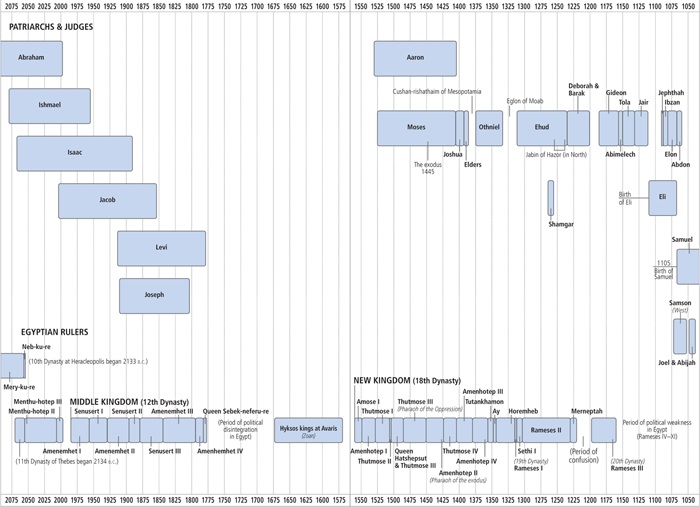
The relationships between the commands is important. The people must: 1) gather to hear the law in order to learn what is required of them and what it has to say about God; 2) learn about the Lord in order to fear him based on a correct understanding of who he is; and 3) fear God in order to be correctly motivated to obedience and good works. Good works performed for any other reason will be improperly motivated. The priests taught the law to the families (Mal. 2:4–7) and the parents instructed the children within the home (Deut. 6:4ff.). Instruction in the law, in short, would provide the right foundation for the OT believer's relationship with God.
Because the Israelites' knowledge of the world in which they lived came through the Egyptians, as well as their ancestors the Mesopotamians, there was much confusion about the creation of the world, how it got to its present state, and how Israel had come into existence. Genesis 1–11 helped Israel understand the origin and nature of creation, human labor, sin, marriage, murder, death, bigamy, judgment, the multiplicity of languages, cultures, etc. These chapters established the worldview which explained the remainder of Israel's first Bible, the Pentateuch.
The later portion of Genesis explained to Israel who they were, including the purpose God had for them as a people. In Gen. 12:1–3, God had appeared to Abraham and made a threefold promise to give them a land, descendants, and blessing. Years later, in a ceremony typical to Abraham's culture, God recast the threefold promise into a covenant (Gen. 15:7ff.). The remainder of Genesis treats the fulfillment of all three promises, but focuses especially on the seed or descendants. The barrenness of each of the patriarchs' chosen wives taught Israel the importance of trust and patience in waiting for children from God.
The rest of the Pentateuch looks at the way in which the promises of Gen. 12:1– 3 expand in the Abrahamic Covenant and achieve their initial stages of fulfillment. Exodus and Leviticus focus more on the blessing of relationship with God. In Exodus, Israel meets the God of their fathers and is led forth by him from Egypt to the Promised Land. Leviticus underscores the meticulous care with which the people and priests were to approach God in worship and every dimension of their lives. Holiness and cleanness come together in simple and practical ways. Numbers and Deuteronomy focus on the journey to and preparation for the land. The Pentateuch treats many issues related to Israel's relationship with their God. But the underlying theme of the Pentateuch is the
initial, unfolding fulfillments of God's promises made to Abraham.