
northern Mesopotamia or Syria, the best route from which to come down into
Abram was born later when Terah was 130 (c. 2165 B.C.). Cf. 11:32 with 12:4.
GENESIS—NOTE ON 11:27–25:11 The genealogy of Terah (v. 27).
GENESIS—NOTE ON 11:27 Abram. The name means "exalted father." Cf. 17:5.
GENESIS—NOTE ON 11:28 Ur of the Chaldeans. A prosperous, populous city in Mesopotamia.
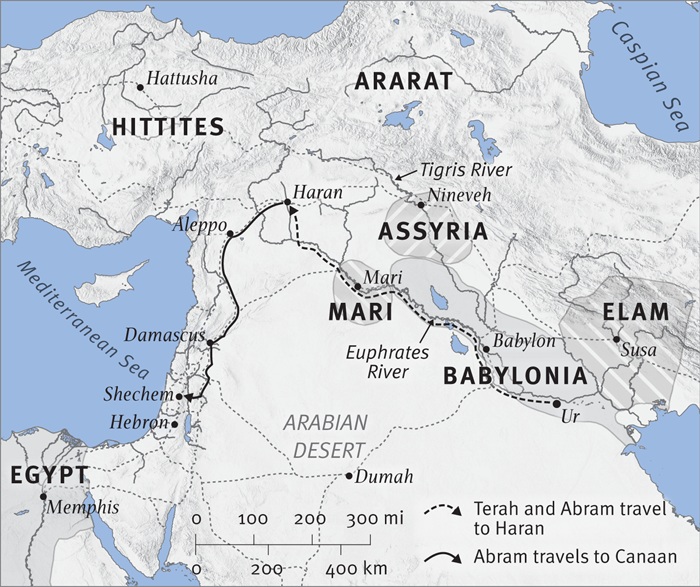
GENESIS—NOTE ON 11:31 from Ur . . . to Haran. Cf. Acts 7:2–4 and Heb. 11:8– 10. Abram traveled along the Euphrates to Haran, a crossroads trading town in northern Mesopotamia or Syria, the best route from which to come down into Canaan and avoid crossing the great desert with all his people and animals (see Gen. 12:4).
Abram Travels to Canaan
c. 2091/1925 B.C.
Abram was born in Ur, a powerful city in southern Babylonia. Abram's father, Terah, eventually led the family toward the land of Canaan but decided to settle in Haran (see Gen. 11:27–31). After Terah's death, the Lord called Abram to go "to the land that I will show you" (Canaan), which he promises to give to Abram's descendants.
GENESIS—NOTE ON 12:1–3 the Lord . . . to Abram. This passage is the promise whose fulfillment extends all through Scripture (either in fact or in expectation) to Rev. 20. The actual Abrahamic Covenant is introduced in Gen. 12:1–3, actually made in 15:18–21, reaffirmed in 17:1–21, then renewed also with Isaac (26:2–5) and Jacob (28:10–17). It is an everlasting covenant (17:7–8; 1 Chron. 16:17; Ps. 105:7–12; Isa. 24:5) which contains four elements: 1) seed (Gen. 17:2–7; cf. Gal. 3:8, 16 where it referred to Christ); 2) land (Gen. 15:18–21; 17:8); 3) a nation (12:2; 17:4); plus 4) divine blessing and protection (12:3). This covenant is unconditional in the sense of its ultimate fulfillment of a kingdom and salvation for Israel (see notes on Rom. 11:1–27), but conditional in terms of immediate fulfillment (cf. Gen. 17:4). Its national importance to Israel is magnified by its repeated references and point of appeal throughout the OT (cf. 2
Kings 13:23; 1 Chron. 16:15–22; Neh. 9:7, 8). Its importance spiritually to all believers is expounded by Paul (see notes on Gal. 3–4). Stephen quoted Gen. 12:1 in Acts 7:3.
GENESIS—NOTE ON 12:1 to the land. Abram was still in Haran (11:31) when the call was repeated (Acts 7:2) to go to Canaan.
GENESIS—NOTE ON 12:2 name great. Abram's magnificent reputation and legacy was fulfilled materially (13:2; 24:35), spiritually (21:22), and socially (23:6).
GENESIS—NOTE ON 12:3 him who dishonors you I will curse. Those who "dishonor" Abram and his descendants are those who treat him lightly, despise him, or treat him with contempt. God's curse for such lack of respect and disdain was to involve the most harsh of divine judgments. The opposite was to be true for those who bless him and his people. in you all the families of the earth shall be blessed. Paul identified these words as "the gospel beforehand to Abraham" (Gal. 3:8).
GENESIS—NOTE ON 12:4 Haran. See note on 11:31. They must have been there for some time because they accumulated a group of people (probably servants).
GENESIS—NOTE ON 12:5 they came to . . . Canaan. C. 2090 B.C.
GENESIS—NOTE ON 12:6 Shechem. A Canaanite town located in the valley between Mount Ebal and Mount Gerizim (cf. Deut. 27:4, 12) west of the Jordan about 15 miles and north of Jerusalem about 30 miles. Moreh was most likely a resident of the area for whom the tree was named. Canaanites were in the land. Moses was writing approximately 700 years after Abram entered the land (c. 1405 B.C.). The Canaanites, of whom he wrote, were soon to be the opponents of Israel as they entered Canaan.
GENESIS—NOTE ON 12:7 I will give this land. Cf. 13:15; 15:18; 17:7–8; Gal. 3:16. God was dealing with Abram, not in a private promise, but with a view toward high and sacred interests long into the future, i.e., the land that his posterity was to inhabit as a peculiar people. The seeds of divine truth were to be sown there for the benefit of all mankind. It was chosen as the most appropriate land for the coming of divine revelation and salvation for the world. altar to the Lord. By this act, Abram made an open confession of his religion, established worship of the true God, and declared his faith in God's promise. This was the first true place of worship ever erected in the Promised Land. Isaac would later
build an altar also to commemorate the Lord's appearance to him (Gen. 26:24– 25), and Jacob also built one in Shechem (33:18–20).
GENESIS—NOTE ON 12:8 Bethel . . . Ai. Bethel, 7 miles north of Jerusalem, was named later by Abraham (28:19). Ai was 2 miles east of Bethel, where Joshua later fought (Josh. 7–8).
GENESIS—NOTE ON 12:9 toward the Negeb. Abram moved toward the Negeb into a less desirable area for raising crops but better for his vocation as a herdsman, perhaps engaging also in merchant activity.
GENESIS—NOTE ON 12:10 a famine in the land. Famine was not an unusual phenomenon in Canaan; two other major food shortages also occurred during the patriarchal period (26:1; 41:56). The severity and timing of this one forced Abram, soon after his arrival and travel in the Promised Land (12:5–9), to emigrate to Egypt, where food was usually in abundant supply. Still holding to God's promise, he did not return to Ur, though matters were extremely difficult (cf. Heb. 11:15).
GENESIS—NOTE ON 12:11 a woman beautiful in appearance. At 65, Sarai was still young and exceptionally attractive, being only half the age she was to be when she died (127). The patriarchs lived long; Abram was 175 when he died.
GENESIS—NOTE ON 12:12–13 Abram's fear of Sarai's being taken to Pharaoh's harem and his being killed led him to disguise his true relationship to her (cf. 20:13). Abram sought on his own initiative to take care of his future, thinking to assist God in fulfilling his promises.
GENESIS—NOTE ON 12:13 sister. This was a lying half-truth, since Sarai was Abram's half-sister (20:12).
GENESIS—NOTE ON 12:15 taken into Pharaoh's house. Egyptian officials did take notice of Sarai and informed their monarch of her beauty. The result was not unexpected; she ended up in Pharaoh's harem!
GENESIS—NOTE ON 12:17 the Lord afflicted Pharaoh . . . with great plagues. The separation of Abram and Sarai was critical enough to evoke the Lord's personal and dramatic intervention. Abram engineered the ruse to protect himself (v. 13, "that my life may be spared") apparently without too much thought being given to Sarai; but God's reaction focused upon the protection of
Sarai ("because of Sarai").
GENESIS—NOTE ON 12:18–19 What is this you have done to me? . . . take her, and go. Somehow, and it remains unexplained, the plagues uncovered the deceit of Abram for Pharaoh. The monarch of Egypt humiliated Abram with his questions, showing more character than Abram gave him credit for and sending Abram out of his country.
GENESIS—NOTE ON 12:20 sent him away. Abram's lie brought him and his extended family to an ignominious exit from Egypt—one which the servants must have talked about among themselves, with some loss to Abram's integrity and reputation in their eyes. See note on 13:9.
GENESIS—NOTE ON 13:1–4 Significantly, after the disastrous situation in Egypt, Abram journeyed back to where he had erected an altar and there he again worshiped (see 12:8).
GENESIS—NOTE ON 13:5 flocks and herds. Wealth in the ancient world was measured, not by land owned, but by the size of one's herds and the possession of silver, gold, and jewels (cf. v. 2; Job 1:1–3).
GENESIS—NOTE ON 13:6–7 Not unexpectedly, conflict occurred because of crowded conditions and limited grazing space. Both uncle and nephew had accrued much on the slow trip from Ur via Haran and Egypt to the Bethel/Ai region.
GENESIS—NOTE ON 13:7 Perizzites. A Canaanite tribe. Cf. 34:30; Deut. 7:1; Judg. 1:4; 3:5–6; 1 Kings 9:20–21; Ezra 9:1.
GENESIS—NOTE ON 13:8 we are kinsmen. Abram's whole reaction in resolving the strife between the two households and their personnel portrayed a different Abram than seen in Egypt; one whose attitude was not self-centered. Waving his right to seniority, he gave the choice to his nephew, Lot.
GENESIS—NOTE ON 13:9 Is not the whole land before you? Abram gladly called on Lot to select for himself (vv. 10–11) what he desired for his household and flocks. After Lot's choice had been exercised, then Abram would accept what was left for him. Perhaps this did much to restore, in the eyes of the servants, Abram's integrity and reputation (see note on 12:20).
GENESIS—NOTE ON 13:10 before the Lord destroyed Sodom and Gomorrah. When Moses was writing (700 years after Abram came to Canaan) the devastation of that region had long before occurred by divinely initiated catastrophe (19:23–29), totally obliterating any evidence of its agricultural richness. like the garden of the Lord, like . . . Egypt. This twofold appraisal of the Jordan Valley, with its meadows on either side of the river to which Lot was so strongly attracted, highlighted its lush and fertile nature. Moses, reading this to the Jews about to enter Canaan and likening it to the Garden of Eden, referred hearer and reader to God's revelatory description of it (2:8–15). Likening it to an obviously well known and well irrigated region of Egypt referred them to a place the Jews had likely known well in their sojourn in Egypt. Zoar. Cf. 4:2. A town located at the south end of the Dead Sea, whose name means "little" (see 19:22 and esv footnote).
GENESIS—NOTE ON 13:11–12 An excellent yet selfish choice, from a worldly point of view, but disastrous spiritually because it drew him into the wickedness of Sodom (v. 13).
GENESIS—NOTE ON 13:13 the men of Sodom were wicked, great sinners. Lot's decisions put him in dangerous proximity to those cities whose names would become a byword for perversion and unbridled wickedness. Their evil is the theme of ch. 19.
GENESIS—NOTE ON 13:14–17 With Lot gone, the Lord reaffirmed his covenant promise with Abram (12:1–3). Strikingly and unmistakably, the Lord deeded the land (13:14—look in all directions, and 13:17—walk in all directions) in perpetuity to Abram and his descendants, whom he declared would be definitely innumerable (13:16—as the dust).
GENESIS—NOTE ON 13:18 the oaks of Mamre. A distinctively large grove of trees owned by Mamre the Amorite (14:13) located c. 19 miles southwest of Jerusalem at Hebron, whose elevation exceeds 3,000 feet. built an altar. Cf. 12:7–8 and 13:4. He was devoted to the worship of God.
GENESIS—NOTE ON 14:1–12 Raiding, conquering, and making other kings and city-states subservient vassals were all part of the world of the Fertile Crescent in Abraham's day. These locations mentioned range from Shinar in the east (the region of Babylon in Mesopotamia) to the region south of the Salt Sea (Dead Sea) to the Jordan Valley, to the land of Moab, southwest of the Dead Sea to
Mount Seir (later Edom). Amalekites (see note on Ex. 17:8) did not yet exist in Abram's time (cf. Gen. 36:12), but they did when Moses wrote. Amorites scattered throughout Palestine became Canaanites. Vassal states, when they thought they could throw off the yoke of their suzerain with impunity, rebelled by not paying the assessed tribute and waited for any military response. This time rebellion evoked a major military excursion by the offended suzerain Chedorlaomer and his allies (14:5–7); in the ensuing confrontation with Sodom and Gomorrah and their allies (14:8–10), the vassals miscalculated and they lost. Lot, by then a resident of Sodom, was taken captive.
GENESIS—NOTE ON 14:10 Valley of Siddim. Perhaps this was the large peninsula that comes out into the Dead Sea from the eastern shore. In Abram's time, it may have come all the way across to the western shore (near Masada), so the bottom third of the current Dead Sea formed this dry valley. bitumen pits. These pits provided sealants for all sorts of uses.
GENESIS—NOTE ON 14:13 one who had escaped. One of the survivors who had fled from the invaders to the mountains (v. 10) went further and located Lot's uncle (the people knew who was related to whom). One as wealthy as Abram would not be hard to find, and was obviously thought to be one who could do something about the crisis that had affected his own close relatives. the Hebrew. For the first time in the biblical record, this ethnic appellation, "descended from Eber" (cf. 11:15–17), is accorded to Abram. Foreigners used it of Israelites and Israelites used it of themselves in the presence of foreigners (cf. 34:14; 40:15; 43:32). oaks of Mamre. See note on 13:18.
GENESIS—NOTE ON 14:14 trained men. Abram's private militia, members of his extended family ("born in his house") totaling 318, were highly skilled bodyguards and the protective force for his possessions. These, together with the trained men of his allies (vv. 13, 24), were mustered and set off in pursuit of the military kidnappers, lest their captives be taken away to the east, to Shinar (the early name for Mesopotamia) or further east, to Elam.
GENESIS—NOTE ON 14:15–16 divided . . . defeated . . . pursued . . . brought back. A battle-wise Abram, no stranger to military strategy, pursued the enemy for over 150 miles (north of Damascus) and defeated the marauding consortium, being totally successful in his objective.
GENESIS—NOTE ON 14:17 the valley of Shaveh. See note on 2 Sam. 18:18. The
liberated king of Sodom went to meet Abram near Jerusalem.
GENESIS—NOTE ON 14:18 Melchizedek king of Salem. The lack of biographical and genealogical particulars for this ruler, whose name meant "righteous king" and who was a king-priest over ancient Jerusalem, allowed for later revelation to use him as a type of Christ (cf. Ps. 110:4; Heb. 7:17, 21). His superior status in Abram's day is witnessed 1) by the king of Sodom, the first to meet Abram returning in victory, deferring to Melchizedek before continuing with his request (Gen. 14:17, 21) and 2) by Abram, without demur, both accepting a blessing from and also giving a tithe to this priest-king (14:19–20). Cf. Heb. 7:1–2. priest of God Most High. The use of El Elyon (Sovereign Lord) for God's name indicated that Melchizedek, who used this title two times (Gen. 14:18–19), worshiped, served, and represented no Canaanite deity, but the same one whom Abram also called Yahweh El Elyon (v. 22). That this was so is confirmed by the added description, "Possessor of heaven and earth," being used by both Abram and Melchizedek (vv. 19, 22).
GENESIS—NOTE ON 14:20 who has delivered your enemies into your hand. Credit for victory over a superior military coalition correctly went to the Sovereign Lord (El Elyon) and not to Abram's prowess (see note on vv. 15–16). To Melchizedek, and to Abram too, this amounted to true worship of the true God. a tenth. This is the first mention in Scripture of giving 10 percent (cf. 28:22). This 10-percent offering was purely voluntary, and may only have been a tenth of the best, not a tenth of the total (see note on Heb. 7:4). This tenth is not like the required tenths given to Israel in the Mosaic law (see notes on Num. 18:21–24; Deut. 14:22; 26:12).
GENESIS—NOTE ON 14:21–24 If Abram acceded to the king of Sodom's request, he would have allowed that wicked king to attribute Abram's wealth to the king's generosity, thus distorting the clear testimony of the Lord's blessings on his life. To accept such payment would belie his trust in God! Such a personal commitment would not be foisted upon his allies, who could make their own decisions. As for his own servants, their meals taken from the spoils was sufficient compensation. Undoubtedly, the servants remembered their master's reaction and testimony; it overcame much of the negative aspects in the memory of the earlier exit from Egypt (see 12:20).
GENESIS—NOTE ON 15:1 I am your shield. God served Abram as his divine protector (cf. Ps. 7:10; 84:9).
GENESIS—NOTE ON 15:2 I continue childless. In response to God's encouragement and admonition (v. 1), Abram showed what nagged at him. How could God's promise of many descendants (13:16) and of being a great nation (12:2) come about when he had no children? Eliezer of Damascus. To Abram, God's promise had stalled; so adoption of a servant as the male heir—a well known contemporary Mesopotamian custom—was the best officially recognizable arrangement to make it come to pass, humanly speaking.
GENESIS—NOTE ON 15:3–5 The question, "what will you give me?" (v. 2) became an accusation, "you have given me no offspring!" (v. 3). The Lord's rejection of Abram's solution (v. 4) preceded God's reiterated promise of innumerable descendants (v. 5).
GENESIS—NOTE ON 15:5 So shall your offspring be. Cf. Rom. 4:18.
GENESIS—NOTE ON 15:6 believed . . . counted . . . as righteousness. The apostle Paul quoted these words as an illustration of faith over and against works (Rom. 4:3, 9, 22; Gal. 3:6; James 2:23). Abram was justified by faith! See notes on Rom. 4 and Gal. 3 for a fuller discussion of justification by faith.
GENESIS—NOTE ON 15:7 to give you this land to possess. That a specifically identifiable land (see vv. 18–21) was intimately linked with Abram's having many descendants in God's purpose and in the Abrahamic Covenant was clearly revealed and, in a formal ceremony (vv. 9–21), would be placed irrevocably beyond dispute.
GENESIS—NOTE ON 15:8 how am I to know that I shall possess it? A question not of veiled accusation at the delayed fulfillment but of genuine request for information and assurance. In response, God affirmed his covenant with Abram in a remarkable ceremony (vv. 9–21).
GENESIS—NOTE ON 15:9–10 cut them in half. The sign of ancient covenants often involved the cutting in half of animals, so that the pledging parties could walk between them, affirming that the same should happen to them if they broke the covenant (see Jer. 34:18–19).
GENESIS—NOTE ON 15:12 sleep. God put him to sleep, because the covenant did not involve any promise on his part. He would not walk through the pieces as a pledge (see v. 17).
GENESIS—NOTE ON 15:13–14 The words of God in the covenant ceremony assured Abram that his descendants would definitely be in the land, although a painful detour into Egypt would delay fulfillment until long after his demise. Cf. Acts. 7:6–7.
GENESIS—NOTE ON 15:13 four hundred years. This represents an approximated number that is precisely 430 years (cf. Ex. 12:40).
GENESIS—NOTE ON 15:16 the iniquity of the Amorites is not yet complete. A delay in judgment occasioned the delay in covenant fulfillment. Judgment on Egypt (v. 14) would mark the departure of Abram's descendants for their land, and judgment on the Canaanites (broadly defined ethnically as Amorites) would mark their entrance to that land.
GENESIS—NOTE ON 15:17 smoking fire pot . . . flaming torch. Cf. Ex. 13:21. These items symbolized the presence of God, who solemnly promised by divine oath to fulfill his promises to Abram by alone passing through the animal pieces (vv. 9–11).
GENESIS—NOTE ON 15:18–21 river of Egypt to the . . . Euphrates. Scripture records both general (Ex. 23:31; Num. 13:21; Deut. 11:24; 1 Kings 8:65; 2 Kings 14:25; Isa. 27:12) and specific (Num. 34:1–12; Josh. 15:1–2; Ezek. 47:15–20; 48:1, 28) descriptions of the Promised Land, centering on the ancient land of Canaan. Such precise geographic demarcation will not allow for any redefinitions that would emasculate God's promise of its specificity. The river of Egypt was most probably what became known as the Wadi El Arish, the southern border of Judah. Kenites . . . Jebusites. The various peoples who inhabited the land are named. Such precise detailing of the nations in the land of Canaan attests again to the specificity of the Promised Land in God's promises.
GENESIS—NOTE ON 16:1 Hagar. See Gal. 4:21–31, where Paul uses Hagar as an illustration.
GENESIS—NOTE ON 16:3 gave her to Abram her husband. After 10 childless years (cf. 12:4), Sarai resorted to the custom of the day by which a barren wife could get a child through one of her own maidservants (16:2, "I shall obtain children by her"). Abram, ignoring divine reaction and assurance in response to his earlier attempt to appoint an heir (cf. 15:2–5), sinfully yielded to Sarai's insistence, and Ishmael was born (16:15).
GENESIS—NOTE ON 16:5 wrong done to me be on you . . . . she looked on me with contempt. Sarai, not anticipating contemptuous disregard by Hagar (v. 4) as the result of her solution for barrenness, blamed Abram for her trouble and demanded judgment to rectify the broken mistress-servant relationship. Abram transferred his responsibility to Sarai, giving her freedom to react as she wished (v. 6, "your servant is in your power . . . "). Sarai treated her so badly, she left.
GENESIS—NOTE ON 16:7 The angel of the Lord. This special individual spoke as though he were distinct from Yahweh, yet also spoke in the first person as though he were indeed to be identified as Yahweh himself, with Hagar recognizing that, in seeing this angel, she had seen God (v. 13). Others had the same experience and came to the same conclusion (cf. 22:11–18; 31:11–13; Ex. 3:2–5; Num. 22:22–35; Judg. 6:11–23; 13:2–5; 1 Kings 19:5–7). The angel of the Lord, who does not appear after the birth of Christ, is often identified as the preincarnate Christ. See note on Ex. 3:2. Shur was south of Palestine and east of Egypt, which meant that Hagar attempted to return home to Egypt.
GENESIS—NOTE ON 16:8 Hagar, servant of Sarai. Both the salutation and the instruction (v. 9, "Return . . . submit") given by the angel and the response by Hagar treated the mistress-servant relationship as if it were still intact. Rebelling and absconding was not the solution (v. 9)!
GENESIS—NOTE ON 16:10 I will surely multiply. A servant she might have been, but mother of many she would also become, thus making Abram the father of two groups of innumerable descendants (see 13:16; 15:5).
GENESIS—NOTE ON 16:11 call his name Ishmael. With her son's name meaning "God hears," Hagar the servant could not ever forget how God had heard her cry of affliction.
GENESIS—NOTE ON 16:12 a wild donkey of a man. The untameable desert onager (wild donkey) best described the fiercely aggressive and independent nature Ishmael would exhibit, along with his Arabic descendants.
GENESIS—NOTE ON 16:13 You are a God of seeing. Recognizing the angel as God and ascribing this new name to him arose from Hagar's astonishment at having been the object of God's gracious attention. The theophany and revelation led her to call him also "the Living One who sees me" (v. 14 and esv footnote).
GENESIS—NOTE ON 16:15 his son . . . Ishmael. C. 2079 B.C.
GENESIS—NOTE ON 16:16 eighty-six years old. Abram was 75 when he left Haran (12:4). There would be a 13-year interval until 17:1 picks up the narrative again.
GENESIS—NOTE ON 17:2 my covenant between me and you. Another reaffirmation of his unilateral covenant with Abram, which did not mean that there would be no responsibilities falling upon its recipients. See notes on vv. 7– 9; 12:1–3; 15:18–21.
GENESIS—NOTE ON 17:4 a multitude of nations. The threefold reaffirmation of the divine promise of many descendants, perhaps including Isaac's and Ishmael's, brackets the change of name (vv. 4–6), giving it significant emphasis.
GENESIS—NOTE ON 17:5 your name shall be Abraham. Cf. 11:27. The name meaning "father of a multitude of nations" reflected Abraham's new relationship to God as well as his new identity based on God's promise of seed. Cf. Rom. 4:17.
GENESIS—NOTE ON 17:6 kings shall come from you. This promise highlights the reality of more than one people group, or nation in its own right, coming from Abraham.
GENESIS—NOTE ON 17:7 I will establish my covenant. This relationship was set up at God's initiative and also designated as an "everlasting covenant" (v. 7), thus applying to Abraham's posterity with equal force and bringing forth the declaration "I will be their God" (v. 8). This pledge became the dictum of the covenant relationship between Yahweh, i.e., Jehovah, and Israel.
GENESIS—NOTE ON 17:8 all the land of Canaan. God's reaffirmation of his covenant promises to Abraham did not occur without mention of the land being deeded by divine right to him and his descendants as "an everlasting possession." Cf. Acts 7:5.
GENESIS—NOTE ON 17:9 you shall keep my covenant. Despite repeated disobedience by the patriarchs and the nation, God's faithfulness to his covenant commitment never wavered (e.g., Deut. 4:25–31; 30:1–9; 1 Chron. 16:15–18; Jer. 30:11; 46:27–28; Amos 9:8; Luke 1:67–75; Heb. 6:13–18). Divine attestations of Abraham's obedience (Gen. 22:16–18; 26:3–5) were pronounced
years after the formal establishment of his covenant (12:1–3; 15:12–18). Though the nation was apostate, there was always an obedient remnant of faithful Israelites (see Zeph. 3:12–13).
GENESIS—NOTE ON 17:11 a sign of the covenant. Circumcision (cutting away the male foreskin) was not entirely new in this period of history, but the special religious and theocratic significance then applied to it was entirely new, thus identifying the circumcised as belonging to the physical and ethnical lineage of Abraham (cf. Acts 7:8; Rom. 4:11). Without divine revelation, the rite would not have had this distinctive significance, thus it remained a theocratic distinctive of Israel (cf. Gen. 17:13). There was a health benefit, since disease could be kept in the folds of the foreskin, so that removing it prevented that. Historically, Jewish women have had the lowest rate of cervical cancer. But the symbolism had to do with the need to cut away sin and be cleansed. It was the male organ that most clearly demonstrated the depth of depravity because it carried the seed that produced depraved sinners. Thus, circumcision symbolized the need for a profoundly deep cleansing to reverse the effects of depravity.
GENESIS—NOTE ON 17:12 eight days old. This same time frame was repeated in Lev. 12:3.
GENESIS—NOTE ON 17:14 shall be cut off from his people. Being cut off from the covenant community meant loss of temporal benefits stemming from being part of the special, chosen, and theocratic nation, even to the point of death by divine judgment.
GENESIS—NOTE ON 17:15 Sarai . . . Sarah. Fittingly, since Sarai ("my princess") would be the ancestress of the promised nations and kings, God changed her name to Sarah, taking away the limiting personal pronoun "my," and calling her "princess" (v. 16).
GENESIS—NOTE ON 17:16 She shall become nations. Cf. 17:5.
GENESIS—NOTE ON 17:17 fell on his face and laughed and said to himself. A proper reaction of adoration over God's promises was marred by the incredulity of Abraham. He knew he was to be a father (12:2; 15:4), but this was the first mention that his barren, old wife was to be the mother.
GENESIS—NOTE ON 17:18 Oh that Ishmael might live before you! Abraham's plea for a living son to be the designated beneficiary of God's promises betrayed
just how impossible it was for him and Sarah to have children (cf. Rom. 4:17).
GENESIS—NOTE ON 17:19–21 Again, patiently but firmly rejecting Abraham's alternative solution, God emphatically settled the matter by bracketing his gracious bestowal of much posterity to Ishmael (see 25:12–18) with affirmations that indeed Sarah's son would be the heir of the "everlasting covenant." For the first time God named the son.
GENESIS—NOTE ON 17:19 call his name Isaac. The name of the promised son meant "he laughs," an appropriate reminder to Abraham of his initial, faithless reaction to God's promise.
GENESIS—NOTE ON 17:23–27 that very day. Without delay, Abraham fully carried out God's command on himself, on "every male," and on "all the men of his house" (vv. 23, 27).
GENESIS—NOTE ON 18:1 the Lord appeared. Another instance of a theophany, although Abraham perhaps did not recognize at first that one of his visitors, whom he humbly greeted and entertained (vv. 2–8) and properly sent on their way (v. 16), was Yahweh. oaks of Mamre. See note on 13:18.
GENESIS—NOTE ON 18:3 O Lord. Although perhaps first used as the customary respectful address of a host to a visitor, later in their interchange it was used knowingly by Abraham of his true and Sovereign Lord whom he must have recognized when the visitor spoke of himself as "Lord" (v. 14).
GENESIS—NOTE ON 18:9–13 Despite a promise clearly reminiscent of God's words to Abraham, Sarah reacted with similar incredulity as her husband had done (cf. 17:17). She was not thinking of divine miracle but of divine providence working only within the normal course of life, being convinced that, at their age, bearing children was just not naturally possible.
GENESIS—NOTE ON 18:10, 14Cf. Rom. 9:9.
GENESIS—NOTE ON 18:14–15 A rhetorical question ("Is anything too hard . . . ?") and divine declaration ("At the appointed time . . . "), coupled with obvious knowledge of her thoughts ("laughed to herself "), made Sarah fearfully perceive her total misperception of God's working.
GENESIS—NOTE ON 18:17–18 Shall I hide from Abraham what I am about to
do, seeing that . . . ? The Lord's reason for permitting Abraham to know of judgment in advance underscored his special role in the plan of God and the certain outcome of his covenant with Abraham—many offspring and great blessing.
GENESIS—NOTE ON 18:18 all the nations of the earth shall be blessed. Cf. Gal. 3:8.
GENESIS—NOTE ON 18:19 For I have chosen him, that he may command. An expression of divine confidence, i.e., a tribute to faithfulness, obedience, and consistency.
GENESIS—NOTE ON 18:20 the outcry . . . is great. The iniquity of the two cities, by then complete (cf. 15:16), had reached the point of no return before the Lord, who demonstrated before Abraham how justly he assessed the time for judgment (18:21, "I will go down to see . . . ").
GENESIS—NOTE ON 18:23 Will you indeed sweep away the righteous with the wicked? The intercession for the two wicked cities began with a question that portrayed Abraham's acute awareness of God's mercy toward the righteous and the distinction he made between the good and the bad (v. 25).
GENESIS—NOTE ON 18:24 fifty righteous. Among the righteous was Lot (see 2 Pet. 2:7–8).
GENESIS—NOTE ON 18:25 Shall not the Judge of all the earth do what is just? Abraham's clear understanding of God's character being able only to do what is good and totally above reproach was affirmed with this rhetorical question.
GENESIS—NOTE ON 18:27 I who am but dust and ashes. Abraham's negotiation, far from being crassly or selfishly manipulative, humbly and compassionately expressed his concern for people (cf. 13:8–9) and particularly interceded for the place where his nephew Lot and his family lived. Neither did he intend to anger the Lord by his repeated requests (18:28, 30, 32).
GENESIS—NOTE ON 18:32 For the sake of ten. That the number of righteous people necessary to forestall judgment had been reduced from 50 to 10 may have reflected Abraham's awareness both of the intense wickedness of the cities as well as Lot's ineffective witness there. Abraham probably had the whole of Lot's family in mind.
GENESIS—NOTE ON 18:33 the Lord went his way . . . and Abraham returned to his place. Nothing more could be done; the judgment was inevitable!
GENESIS—NOTE ON 19:1 two angels. These were the angels who, with God, had visited Abraham (18:22). They had taken human form (19:10; called "men"). Lot was sitting in the gate. Since city officials and other prominent citizens conducted the community's affairs at the gate, Lot participated there as a judge (v. 9).
GENESIS—NOTE ON 19:2 please turn aside to your servant's house. Lot's invitation to the two angels (vv. 1–3) to partake themselves of his hospitality was most likely not just courtesy, but an effort to protect them from the known perversity of the Sodomites.
GENESIS—NOTE ON 19:3 he pressed them strongly. Such was Lot's concern for these strangers that their stated preference to pass the night in the town square could not be permitted.
GENESIS—NOTE ON 19:4 the men of the city . . . all the people. Both the size of the lustful mob of men boisterously milling around Lot's house and the widespread nature of Sodom's moral perversion received emphasis both from the additional qualifiers used ("all the people to the last man" and "both young and old") and the request made (v. 5, "that we may know them"). Even acknowledging legitimate exaggeration in this use of "all" would not detract from this emphasis—this was indeed a wicked city!
GENESIS—NOTE ON 19:5 know them. They sought homosexual relations with the visitors. God's attitude toward this vile behavior became clear when he destroyed the city (vv. 23–29). Cf. Lev. 18:22, 29; 20:13; Rom. 1:26; 1 Cor. 6:9; 1 Tim. 1:10 where all homosexual behavior is prohibited and condemned by God.
GENESIS—NOTE ON 19:6–8 Lot's response betrayed tension in his ethics; his offer to gratify their sexual lust contradicted his plea not to act "wickedly." Such contradiction made clear also the vexation of spirit under which he lived in wicked Sodom (cf. 2 Pet. 2:6–7).
GENESIS—NOTE ON 19:8 do to them as you please. The constraints of Eastern hospitality and the very purpose for which Lot had invited the visitors in (vv. 2– 3) compelled Lot to offer his daughters for a less deviant (see notes on Rom.
1:24–27) kind of wickedness, so as to protect his guests. This foolish effort shows that while Lot was right with God (2 Pet. 2:7–8), he had contented himself with some sins and weak faith rather than leaving Sodom. But God was gracious to him because he was righteous, by faith, before God.
GENESIS—NOTE ON 19:9 he has become the judge. Their accusation suggests Lot had made moral pronouncements before, but his evaluation was no longer tolerable. pressed hard. Homosexual deviation carries an uncontrollable lust that defies restraint. Even when blinded, they tried to fulfill their lust (v. 11).
GENESIS—NOTE ON 19:10–11 Lot was now being protected by those whom he had earlier sought to protect!
GENESIS—NOTE ON 19:13 the Lord has sent us to destroy it. With the wickedness of the city so graphically confirmed (vv. 4–11), divine judgment was the only outcome, but Lot's family could escape it (vv. 12–13). Cf. Jude 7.
GENESIS—NOTE ON 19:14 seemed . . . to be jesting. Lot's warning of imminent judgment fell within the category of jesting, so concluded his sons-in-law (or perhaps his daughters' fiancés).
GENESIS—NOTE ON 19:16 the Lordbeing merciful to him. This reason, elsewhere described as God having remembered Abraham (v. 29), is why, in the face of Lot's seeming reluctance to leave ("lingered"), the angels personally and forcefully escorted him and his family beyond the city's precincts.
GENESIS—NOTE ON 19:17–21 An urbanized lifestyle was apparently superior to a lonely one in the mountains and might be why Lot, playing upon the mercy already shown him, negotiated for an alternative escape destination—another city! The angel's reply (v. 21) indicated that this city was included in the original judgment plan, but would be spared for Lot's sake.
GENESIS—NOTE ON 19:24 sulfur and fire from the Lord out of heaven. When morning came (v. 23) judgment fell. Any natural explanation, about how the Lord used combustible sulfur deposits to destroy that locale, falters on this emphatic indication of miraculous judgment. "Sulfur" could refer to any inflammable substance; perhaps a volcanic eruption and an earthquake with a violent electrical storm "overthrew" (v. 25) the area. That area is now believed to be under the south end of the Dead Sea. Burning gases, sulfur, and magma blown into the air all fell to bury the region.
GENESIS—NOTE ON 19:26 Lot's wife . . . looked back. Lot's wife paid the price of disregarding the angelic warning to flee without a backward glance (v. 17). In so doing, she became not only encased in salt, but a poignant example of disobedience producing unwanted reaction at judgment day (cf. Luke 17:29–32), even as her home cities became bywords of God's judgment on sin (cf. Isa. 1:9; Rom. 9:29; 2 Pet. 2:5–6).
GENESIS—NOTE ON 19:29 the cities of the valley. The best archeological evidence locates Sodom and Gomorrah at the south of the Dead Sea region, i.e., in the area south of the Lisan Peninsula that juts out on the east (see note on 14:10). God remembered Abraham. Cf. 18:23–33.
GENESIS—NOTE ON 19:30 afraid to live in Zoar. Perhaps because the people there felt he was responsible for all the devastation, or he feared more judgment on the region might hit the city (vv. 17–23).
GENESIS—NOTE ON 19:31–36 The immoral philosophy of Sodom and Gomorrah had so corrupted the thinking of Lot's daughters that they unhesitatingly contrived to be impregnated by their own father! They were virgins (v. 8), the married daughters were dead (v. 14), and there were no men left for husbands (v. 25). In fearing they would have no children, they conceived the gross iniquity.
GENESIS—NOTE ON 19:37–38 The two sons born of incest became the progenitors of Moab and Ammon, Israel's longstanding enemies.
GENESIS—NOTE ON 20:1 Gerar. A Philistine city on the border between Palestine and Egypt, about 10 miles south of Gaza.
GENESIS—NOTE ON 20:2 She is my sister. Twenty-five years after leaving Egypt in disgrace because of lying about his wife (12:10–20), Abraham reverted to the same ploy. Abimelech. This king who took Sarah into his harem was most likely the father or grandfather of the Abimelech encountered by Isaac. See note on 26:1.
GENESIS—NOTE ON 20:3 God came . . . in a dream. Again Abraham's Lord intervened to protect Sarah, who had joined in the lie of her husband (v. 5), deceiving a king who earnestly protested his innocence and integrity before God (vv. 4–6) and who, together with his aides, demonstrated proper submission to the warning of God (v. 8).
GENESIS—NOTE ON 20:6 kept you from sinning. Notwithstanding God's restraint of Abimelech, he was still required to restore Sarah to forestall judgment.
GENESIS—NOTE ON 20:7 he is a prophet. Abraham, in spite of his lie, still served as God's intermediary and intercessor for Abimelech (cf. vv. 17–18). This is the first time the Hebrew term for "prophet" is used in Scripture. Here it identified Abraham as recognized by God to speak to him on behalf of Abimelech. Usually it is used to describe, not one who speaks to God on behalf of someone, but one who speaks to someone on behalf of God.
GENESIS—NOTE ON 20:9 things that ought not to be done. The confrontation between prophet and king attested the grievous nature of Abraham's actions. How humiliating for the prophet of God to be so rebuked by a heathen king.
GENESIS—NOTE ON 20:11–13 Abraham offered three reasons for his lie: 1) his perception from the horrible vices in Sodom that all other cities had no fear of God, including Gerar; 2) his fear of death as a mitigating factor for what he had done; and 3) his wife actually being his half-sister as justification for lying and hiding their marital status. Abraham didn't need fraud to protect himself. God was able to provide safety for him.
GENESIS—NOTE ON 20:16 vindicated. This is better translated "justified."
GENESIS—NOTE ON 21:1 The Lord visited Sarah. To the aged couple (vv. 2, 5,
7), exactly as promised, a son was born and the 25-year suspense was finally over, with the laughter of derision turning to rejoicing (v. 6). The barrenness of Sarah (11:26) had ended.
GENESIS—NOTE ON 21:4 circumcised. See note on 17:11.
GENESIS—NOTE ON 21:5 Isaac . . . born to him. C. 2065 B.C. God fulfilled his promise to Abraham (12:2; 15:4–5; 17:7).
GENESIS—NOTE ON 21:8 weaned. This usually occurred in the second or third year.
GENESIS—NOTE ON 21:9 the son of Hagar . . . laughing. The celebration of Isaac's passage from infancy to childhood witnessed the laughter of ridicule (an intensive form of the Hebrew for laughing) and offended Sarah, causing her to demand the expulsion of Ishmael and his mother from the encampment (v. 10).
GENESIS—NOTE ON 21:10 Cast out . . . not be heir. Legal codes of Abraham's day—e.g., of Nuzi and of Hammurabi—forbade the putting out of a handmaiden's son if a rightful, natural heir was born. Sarah's request thus offended social law, Abraham's sensibilities, and his love for Ishmael (v. 11). Abraham, however, was given divine approval and assurances to overcome his scruples before sending Hagar and Ishmael out into the wilderness (vv. 12–15). Cf. Gal. 4:22–31.
GENESIS—NOTE ON 21:12 through Isaac shall your offspring be named. Cf. Rom. 9:7 and Heb. 11:18.
GENESIS—NOTE ON 21:13 make a nation. Cf. v. 18; see notes on 16:11–12. Ishmael was about 17 years old, a customary time for sons to go out to set up their own lives.
GENESIS—NOTE ON 21:14 wilderness of Beersheba. A wide, extensive desert on the southern border of Palestine.
GENESIS—NOTE ON 21:17 God heard the voice of the boy. When desperation turned the lad's voice of scoffing into a cry of anguish at probable death from thirst (vv. 15–16), God heard him whose name had been given years before when God had heard Hagar's cries (16:11). It reminded the mother of the promise made to Abraham about her son (17:20). angel of God. Same person as
the angel of the Lord. See note on Ex. 3:2.
GENESIS—NOTE ON 21:18 make him into a great nation. See note on v. 13.
GENESIS—NOTE ON 21:21 wilderness of Paran. Located in the northeast section of the Sinai peninsula, the area called Arabia.
GENESIS—NOTE ON 21:22–34 A parity treaty formally struck between Abimelech and Abraham guaranteed the proper control and sharing of the region's limited water resources and also assured the king of the patriarch's fair and equitable treatment for years to come.
GENESIS—NOTE ON 21:31 Beersheba. This site is about 45 miles southwest of Jerusalem.
GENESIS—NOTE ON 21:32 the land of the Philistines. Abraham had contact with early migrations of Aegean traders who settled along the southwest coastal regions of Canaan and who were the predecessors of the twelfth century B.C. influx of Philistines, the future oppressors of Israel.
GENESIS—NOTE ON 21:33 tamarisk tree. This tree functioned as a reminder of the treaty concluded between two well known contemporaries, and also as a marker of one of Abraham's worship sites. the Everlasting God. A divine name appropriately signifying to Abraham the unbreakable and everlasting nature of the covenant God had made with him, notwithstanding his being only a resident alien and a sojourner in the land (cf. 23:4).
GENESIS—NOTE ON 22:1 God tested Abraham. This was not a temptation; rather God examined Abraham's heart (cf. James 1:2–4, 12–18).
GENESIS—NOTE ON 22:2 Take your son . . . and offer him. These startling commands activated a special testing ordeal for Abraham, i.e., to sacrifice his "only son" (repeated three times by God, vv. 2, 12, 16). This would mean killing the son (over 20 years old) and with that, ending the promise of the Abrahamic Covenant. Such action would seem irrational, yet Abraham obeyed (v. 3). Moriah. Traditionally associated with Jerusalem, and the site on which Solomon's temple would be built later (cf. 2 Chron. 3:1).
GENESIS—NOTE ON 22:4 third day. With no appearance of reluctance or delay, Abraham rose early (v. 3) for the two-day trip from Beersheba to Moriah, one of
the hills around Jerusalem.
GENESIS—NOTE ON 22:5 I and the boy will go over there and worship and come again to you. The three-day journey (v. 4) afforded much time of reflection upon God's commands but, without wavering or questioning the morality of human sacrifice or the purposes of God, Abraham confidently assured his servants of his and Isaac's return and went ahead with arrangements for the sacrifice (v. 6). Hebrews 11:17–19 reveals that he was so confident in the permanence of God's promise, that he believed if Isaac were to be killed, God would raise him from the dead (see notes there), or God would provide a substitute for Isaac (Gen. 22:8).
GENESIS—NOTE ON 22:9–10 Abraham's preparations to kill his only son could not have placed his trust in God in sharper focus. Cf. Heb. 11:17–19.
GENESIS—NOTE ON 22:11 angel of the Lord. See note on Ex. 3:2.
GENESIS—NOTE ON 22:12 now I know. Abraham passed the test (v. 1). He demonstrated faith that God responds to with justification. See note on James 2:21.
GENESIS—NOTE ON 22:13 instead of his son. The idea of substitutionary atonement is introduced, which would find its fulfillment in the death of Christ (Isa. 53:4–6; John 1:29; 2 Cor. 5:21).
GENESIS—NOTE ON 22:15–18 In this formal reaffirmation of his Abrahamic Covenant, the Lord mentioned the three elements of land, seed, and blessing, but with attention directed graphically to the conquest of the land promised (v. 17, "shall possess the gate of his enemies").
GENESIS—NOTE ON 22:16–17 I will surely bless you. Cf. 12:1–3; 15:13–18; 17:2, 7–9; Heb. 6:13–14.
GENESIS—NOTE ON 22:17 possess the gate of his enemies. Cf. 24:60. Refers to conquering enemies, so as to control their city.
GENESIS—NOTE ON 22:18 all the nations of the earth be blessed. Cf. Acts 3:25.
GENESIS—NOTE ON 22:20–24 it was told. This is clear indication that, despite geographical separation, information about family genealogies flowed back and
forth in the Fertile Crescent region. This update advised most notably of a daughter, Rebekah, born to Isaac's cousin, Bethuel (v. 23). It also reminds the readers that Abraham and Sarah had not lost all ties with their original home. Abraham's brother, Nahor, still lived back in Mesopotamia, though he had not seen him for about 60 years.
GENESIS—NOTE ON 23:1–2 Although Sarah's age—the only woman's age at death recorded in Scripture—might suggest her importance in God's plan, it more importantly reminds of the birth of her only son well beyond childbearing age (at 90 years of age, cf. 17:17) and of God's intervention to bring about the fulfillment of his word to her and Abraham. Sarah's death occurred c. 2028 B.C.
GENESIS—NOTE ON 23:2 Hebron. See note on 13:18.
GENESIS—NOTE ON 23:3 Hittites. A settlement of Hittites whose original home was in Anatolia (modern-day Turkey), who had already been established in Canaan far from their homeland.
GENESIS—NOTE ON 23:4 give me property among you for a burying place. Negotiations for the purchase ("give" signifies here "sell") of Hittite property was properly conducted in accordance with contemporary Hittite custom, with Abraham wanting to pay the market value for it (v. 9).
GENESIS—NOTE ON 23:6 a prince of God among us. Rank and reputation accorded Abraham a place of leadership and respect, leading his neighbors (the Hittites) to freely offer their best sepulchers to him. They went on and arranged for Abraham to purchase a cave that belonged to a wealthy neighbor called Ephron (vv. 7–9), unknown to Abraham.
GENESIS—NOTE ON 23:10 sitting. Ephron was probably sitting at the city gate where business was usually transacted.
GENESIS—NOTE ON 23:11 I give you the field. This suggests not that Ephron felt generous, but that he was constrained by Hittite feudal polity, which tied ownership of land with service to the ruler. Passing the land to Abraham would pass also feudal responsibilities to Abraham, making him liable for all taxes and duties. This Ephron was apparently anxious to do, thus the offer to give the land.
GENESIS—NOTE ON 23:16 shekels of silver, according to the weights. Precious metals were not made into coins for exchange until centuries later. Merchants
maintained the shekel as the standard weight of value for business transactions. A shekel weighed less than one half ounce.
GENESIS—NOTE ON 23:17–18 With the words of the transaction, the careful description of the property, and the payment of the stated price all done before witnesses and at the proper place of business, ownership of the land officially passed to Abraham. It was still binding years later in the time of Jacob (49:29– 32; 50:12–13).
GENESIS—NOTE ON 23:19 After this. Once the purchase had been made, Abraham buried Sarah. Moses notes the place is Hebron in Canaan, to which his initial readers were soon headed.
GENESIS—NOTE ON 23:20 The field and the cave . . . were made over. This is an important summary, because finally, after years of nomadic wandering, Abraham owned a small piece of real estate in the midst of all the land divinely promised to him and his descendants. The cave also became many years later the family burial plot for Abraham, Isaac, Rebekah, Leah, and Jacob (cf. 25:9; 49:31; 50:13), with Rachel being the exception (35:19).
GENESIS—NOTE ON 24:2 servant, the oldest of his household. Eliezer, at 85 years of age, had risen to steward, or "chief of staff," a position of substantial authority (indicated in v. 10). He would have received all Abraham's wealth if he had no son (see 15:1–2), yet when Isaac was born the inheritance became Isaac's. So, not only had he loyally served his master despite having been displaced by another heir (cf. 15:2–4), but he also faithfully served that heir (24:64–67).
GENESIS—NOTE ON 24:2–4 Put your hand under my thigh, that . . . swear. See note on v. 9. A solemn pledge mentioning the Lord's name and formalized by an accepted customary gesture indicated just how serious an undertaking this was in Abraham's eyes. At his age (v. 1), Abraham was concerned to perpetuate his people and God's promise through the next generation, so he covenanted with his servant to return to Mesopotamia and bring back a wife for Isaac.
GENESIS—NOTE ON 24:3–4 Matrimonial arrangements were made by parents, and chosen partners were to come from one's own tribe. It was apparently customary to marry one's first cousin. But Abraham's higher motive was to prevent Isaac from marrying a Canaanite pagan after Abraham's death, thus possibly leading
the people away from the true God.
GENESIS—NOTE ON 24:6–7 do not take my son back there. Should the expected scenario not materialize (v. 5) then the dictates of the oath were lifted (v. 8), but the option of Isaac going was summarily rejected because it suggested a nullification of God's promise and calling for the land of promise (v. 7).
GENESIS—NOTE ON 24:7 he will send his angel before you. A statement of Abraham's faith that the 450-mile expedition to Mesopotamia was clearly under divine oversight.
GENESIS—NOTE ON 24:9 his hand under the thigh. An ancient Near Eastern custom by which an intimate touch affirmed an oath (cf. 47:29).
GENESIS—NOTE ON 24:10 city of Nahor. No doubt the home of Abraham's brother, Nahor (22:20).
GENESIS—NOTE ON 24:12–14 The steward's prayer manifests not only his trust in God to direct affairs but also the selflessness with which he served Abraham. His patience after prayer (v. 21), his worship at answered prayer (v. 26), and his acknowledgment of divine guidance (v. 27) also portrayed his faith.
GENESIS—NOTE ON 24:14 water your camels. Hospitality required giving water to a thirsty stranger, but not to animals. A woman who would do that was unusually kind and served beyond the call of duty. Rebekah's servant attitude was revealed (vv. 15–20) as was her beauty and purity (v. 16).
GENESIS—NOTE ON 24:20 all his camels. A single camel can hold up to 25 gallons and he had 10 of them. Serving them was a great task as she filled them all (v. 22).
GENESIS—NOTE ON 24:22 shekels. See note on 23:16.
GENESIS—NOTE ON 24:24 I am the daughter of. In formal introductions, an abbreviated genealogy provided for specific identification (cf. 22:23). She was Isaac's cousin.
GENESIS—NOTE ON 24:29–31 Laban. From what is revealed about his character (ch. 29), there is reason to believe that his sight of all the presents and the camels generated the welcome.
GENESIS—NOTE ON 24:33 I will not eat until. The first order of business was to identify his master and to explain his assignment, but not without stressing the blessings of God upon his master and upon his trip (vv. 34–48) and also not without immediately seeking to conclude his task and return home (vv. 49, 54– 56). This is the portrait of a committed, faithful, and selfless servant!
GENESIS—NOTE ON 24:49 right . . . left. An expression indicating the matter of which way to go next.
GENESIS—NOTE ON 24:50–51 The servant's conviction and focus were obvious and intense, precluding anything but immediate acknowledgment of God's leading and anything less than a full compliance with his request from Rebekah's father and brother (vv. 50–51).
GENESIS—NOTE ON 24:53 By this dowry, Rebekah was betrothed to Isaac.
GENESIS—NOTE ON 24:54 Send me away to my master. Protocol and courtesy demanded a messenger be dismissed by the addressee.
GENESIS—NOTE ON 24:57–58 Will you go with this man? Commendably, Rebekah concurred with an immediate departure, and showed her confident acceptance of what was providentially coming about in her life.
GENESIS—NOTE ON 24:59 her nurse. See 35:8.
GENESIS—NOTE ON 24:60 they blessed Rebekah and said. Little did they realize that their conventional prayer wishing numerous offspring to Rebekah fitted in nicely with God's promises of many descendants to Abraham through Sarah and Isaac. They also wished for her offspring to be victorious over their enemies ("possess the gate"), perhaps echoing God's promises of possession of the land of the Canaanites (13:17; 15:7, 16; 17:8).
GENESIS—NOTE ON 24:62 Beer-lahai-roi. See 16:14. Located on the PalestineEgypt border, about 25 miles northwest of Kadesh-barnea. Isaac lived there after Abraham's death (25:11).
GENESIS—NOTE ON 24:63 to meditate. How God drew Isaac from home to where Hagar encountered the angel of the Lord (cf. 16:14) remains unknown, but he was in the right place to meet the caravan returning with his fiancée. Perhaps he was prayerfully contemplating the circumstances of his life and the void left by
his mother's death (24:67), as well as thinking about and hoping the steward would not return from a failed mission.
GENESIS—NOTE ON 24:65 she took her veil and covered herself. Convention demanded the designated bride veil her face in the presence of her betrothed until the wedding day.
GENESIS—NOTE ON 24:67 the tent of Sarah his mother. He thus established his acceptance of her as his wife before he had seen her beauty. When he did see her, "he loved her."
GENESIS—NOTE ON 25:1–4 Abraham's sons through Keturah, (a concubine, cf. v. 6; 1 Chron. 1:32) a wife of lower status than Sarah, became the progenitors of various Arab tribes to the east of Canaan.
GENESIS—NOTE ON 25:5–6 Conferring gifts upon these other sons, then sending them away, and also conferring the estate upon Isaac ensured that Isaac would be considered as the rightful heir without competition or threat from his halfbrothers. The steward, Eliezer, had informed Rebekah's relatives that all of Abraham's estate was Isaac's (cf. 24:36).
GENESIS—NOTE ON 25:8 gathered to his people. A euphemism for death, but also an expression of personal continuance beyond death, which denoted a reunion with previously departed friends (c. 1990 B.C.). Cf. Matt. 8:11 and Luke 16:22–23.
GENESIS—NOTE ON 25:9–10 his sons buried him. Abraham's funeral brought together two sons who would perhaps otherwise have remained somewhat estranged from each other (cf. 35:29). He was buried in the place that he had purchased at Hebron (ch. 23).
GENESIS—NOTE ON 25:12–18 the generations of Ishmael. With the death of Abraham and the focus shifting to Isaac, the record confirms God's promise of 12 princes to Ishmael (cf. 17:20–21).
GENESIS—NOTE ON 25:13–16 Arab tradition has it that these are their earliest ancestors.
GENESIS—NOTE ON 25:16 by their villages and by their encampments. In addition to serving as a testimony to God's promises (17:20), information such
as this genealogy helped Israel to understand the origins of their neighbors in central and northern Arabia.
GENESIS—NOTE ON 25:19–35:29 The genealogy of Isaac.
GENESIS—NOTE ON 25:20 Paddan-aram. The "plain of Aram" in upper Mesopotamia near Haran to the northeast of Canaan.
GENESIS—NOTE ON 25:21 she was barren. Confronted by 20 years of his wife's barrenness (vv. 19, 26), Isaac rose to the test and earnestly turned to God in prayer, obviously acknowledging thereby God's involvement and timing in the seed-promise.
GENESIS—NOTE ON 25:22 struggled together within her. The very uncomfortable condition of her pregnancy ("why is this happening to me?") prompted Rebekah, undoubtedly following the example of her husband, to turn earnestly to God in prayer. She learned directly from the Lord that the severe jostling in her womb prefigured the future antagonism between the two nations to arise from her twin sons (v. 23).
GENESIS—NOTE ON 25:23 the older shall serve the younger. This was contrary to the custom in patriarchal times when the elder son enjoyed the privileges of precedence in the household and at the father's death received a double share of the inheritance and became the recognized head of the family (cf. Ex. 22:29; Num. 8:14–17; Deut. 21:17). Grave offenses could annul such primogeniture rights (cf. Gen. 35:22; 49:3–4; 1 Chron. 5:1) or the birthright could be sacrificed or legally transferred to another in the family, as in this case (Gen. 25:29–34). In this case, God declared otherwise since his sovereign elective purposes did not necessarily have to follow custom (cf. Rom. 9:10–14, esp. v. 12).
GENESIS—NOTE ON 25:24 days . . . were completed. Esau and Jacob were born c. 2005 B.C.
GENESIS—NOTE ON 25:25 red. This would be the linguistic basis for calling Esau's country "Edom" (cf. v. 30).
GENESIS—NOTE ON 25:27–28 The difference between the two sons manifested itself in several areas: 1) as progenitors—Esau of Edom and Jacob of Israel; 2) in disposition—Esau a rugged, headstrong hunter preferring the outdoors and Jacob a plain, amiable man preferring the comforts of home; and 3) in parental
favoritism—Esau by his father and Jacob by his mother. These were the ingredients for conflict and heartache!
GENESIS—NOTE ON 25:30 Edom. In a play upon words to forever recall that Esau was born red and hairy (v. 25) and had sold his birthright for red stew, he was also named Edom, i.e., "Red."
GENESIS—NOTE ON 25:31 birthright. A double portion of the inheritance (Deut. 21:17) and the right to be family chief and priest (Ex. 4:22).
GENESIS—NOTE ON 25:34 despised his birthright. The final evaluation of the verbal tussle and bartering that took place between the twins, all of which was indicative of prior discussions or arguments sufficient for Jacob to conclude how little Esau valued it. He became, therefore, known as irreligious, i.e., "unholy" (Heb. 12:16).
GENESIS—NOTE ON 26:1 a famine in the land. Once again the land of promise forced the beneficiaries of the covenant to move so as to escape the effects of a famine. Abimelech. Most probably a Philistine dynastic title, with this being a different king from the one who had met Abraham (ch. 20). See note on 20:2. Philistines. This tribe of people who originally sailed the Mediterranean Sea became fierce enemies of Israel when they settled along the southwest coast of Palestine. Friendly to Isaac, they were forerunners of hostile descendant enemies.
GENESIS—NOTE ON 26:2–11 Obedience and deceit were in juxtaposition. Obeying God to dwell in the land (vv. 2–3, 6), yet lying about his wife to the people of the land (vv. 7–11) reflected familiar shades of Abraham's strategy for survival (see 12:10–14; 20:1–4).
GENESIS—NOTE ON 26:3–5 God confirmed the Abrahamic Covenant with Isaac, stressing the same three elements as before: land, seed, and blessing. He appended specific honorable mention of Abraham's obedient response to all of God's words. See notes on 12:1–3; 15:13–21; 17:2, 7–9. Although Abraham was commended for his deeds, the Abrahamic Covenant was an unconditional covenant grounded in God's sovereign will (cf. Lev. 26:44–45).
GENESIS—NOTE ON 26:4 nations of the earth shall be blessed. Cf. Acts 3:25.
GENESIS—NOTE ON 26:6–9 Unlike his ancestor to whom God sovereignly
revealed the relationship between Abraham and Sarah (20:3), this king providentially discovered Rebekah's relationship to Isaac by just happening to look out of a window and witnessing caresses indicative of marriage and intimacy.
GENESIS—NOTE ON 26:11 warned all the people . . . be put to death. A pagan king imposing the death penalty on anyone troubling Isaac or Rebekah suggests God was at work to preserve his chosen seed (cf. vv. 28–29). Cf. Ps. 105:14–15.
GENESIS—NOTE ON 26:12–14 Isaac was content to stay in that place and farm some land. His efforts were blessed by God, but envied by the Philistines!
GENESIS—NOTE ON 26:15 had stopped . . . all the wells. Water was so precious in that desert land that wells were essential. Plugging someone's well was ruinous to them and constituted serious aggression, often leading to war. Isaac could have retaliated, but he did not; rather he dug new wells (vv. 16–19).
GENESIS—NOTE ON 26:22 Rehoboth. The word means "room enough." Finally a well was dug without a quarrel erupting (vv. 20–21). Now that they were no longer perceived as encroaching upon another's territory, Isaac selected an appropriate place-name that reflected how he saw God providentially working out their situation.
GENESIS—NOTE ON 26:24–25 This abbreviated reaffirmation of the Abrahamic Covenant was designed to assuage Isaac's anxiety at facing envy, quarrels, and hostility (vv. 14, 20, 27), and to assure Isaac that he had reasoned right— fruitfulness in posterity would prevail. That it was a significant reminder to Isaac is seen in a response reminiscent of his father—he built an altar of worship to mark the spot of God's appearance to him (12:7).
GENESIS—NOTE ON 26:26 Abimelech . . . and Phicol. Because 90 years had passed since Abraham was visited by men with the same names, they must have been titles rather than proper names (cf. 21:22). See note on 26:1.
GENESIS—NOTE ON 26:28 a sworn pact . . . a covenant. In a mirror image of a former occasion (21:22–32), Abimelech in the company of a friend and the highest ranking officer in his army (26:26) sought after a treaty with one they estimated to be superior and stronger than themselves and a possible threat (v. 29). Isaac, on the other hand, perceived them as hostile (v. 27). The outcome was most desirable for both—peace between them (v. 31).
GENESIS—NOTE ON 26:30 Ratification of a covenant often involved a banquet.
GENESIS—NOTE ON 26:33 Beersheba. Lit., "the well of the oath." The very place where his father Abraham had made an oath with another Abimelech and Phicol (see note on v. 26) and which Abraham had named Beersheba (21:32).
GENESIS—NOTE ON 26:35 made life bitter. Esau's choice of wives from among neighboring Hittite women saddened his parents. His action had deliberately ignored the standard set by Abraham for Isaac (24:3). Cf. 27:46.
GENESIS—NOTE ON 27:1 Isaac was old. Blind Isaac evidently thought he was near death (v. 2) and would not live much beyond his current 137 years, which was the age of Ishmael when he died (25:17). He certainly did not expect to live another 43 years as he actually did (35:28; cf. 30:24–25; 31:41; 41:46–47; 45:6; 47:9 to calculate Isaac's age at 137 and his twin sons' ages at 77 years old).
GENESIS—NOTE ON 27:4 my soul may bless you. Ignoring the words of God to Rebekah (25:23), forgetting Esau's bartered birthright (25:33), and overlooking Esau's grievous marriages (26:35), Isaac was still intent on treating Esau as the eldest and granting him the blessing of birthright, and so arranged for his favorite meal before bestowing final fatherly blessing on his favorite son.
GENESIS—NOTE ON 27:5 Rebekah was listening. Desperation to secure patriarchal blessing for Jacob bred deception and trickery, with Rebekah believing her culinary skills could make goat's meat taste and smell like choice venison (vv. 8–10) and make Jacob seem like Esau (vv. 15–17).
GENESIS—NOTE ON 27:12 seem to be mocking him. To his credit, Jacob at first objected. The differences between him and Esau would surely not fool his father and might result in blessing being replaced with a curse as a fitting punishment for deception.
GENESIS—NOTE ON 27:13 your curse be on me. With his mother accepting full responsibility for the scheme and bearing the curse should it occur, Jacob acquiesced and followed Rebekah's instructions.
GENESIS—NOTE ON 27:15 best garments of . . . her older son. Esau, having been married for 37 years (cf. v. 1; 26:35), would have had his own tents and his own wives to do for him; so how and why Rebekah came by some of his best clothes in her tent is unknown. Perhaps these garments were the official robes associated
with the priestly functions of the head of the house, kept in her house until passed on to the oldest son. Perhaps Esau had, on occasion, worn them, thus their smell of the field (27:27).
GENESIS—NOTE ON 27:20 the Lord your God granted me success. Isaac's perfectly legitimate question in v. 20 (hunting took time and Jacob had come so quickly with goats from the pen) afforded Jacob an escape route—confess and stop the deceit! Instead, Jacob, with consummate ease, knowing he needed Isaac's irrevocable confirmation even though he had bought the birthright, ascribed success in the hunt to God's providence. A lie had to sustain a lie, and a tangled web had begun to be woven (vv. 21–24). Although Jacob received Isaac's blessing that day, the deceit caused severe consequences: 1) he never saw his mother after that; 2) Esau wanted him dead; 3) Laban, his uncle, deceived him; 4) his family life was full of conflict; and 5) he was exiled for years from his family. By the promise of God he would have received the birthright (25:23). He didn't need to scheme this deception with his mother.
GENESIS—NOTE ON 27:27–29 Finally, with all lingering doubts removed, Isaac pronounced the blessing upon Jacob, although the opening words show he thought the one receiving it was Esau, the man of the field. His prayer-wish called for prosperity and superiority and ended with a repeat of God's words to Abraham (v. 29c; cf. 12:1–3). The words indicated that Isaac thought the covenantal line should have continued through his eldest son, Esau.
GENESIS—NOTE ON 27:33 Isaac trembled very violently. Visibly shocked when the scandal was uncovered by the entrance of Esau, the father, remembering the Lord's words to Rebekah (25:23), refused to withdraw the blessing and emphatically affirmed its validity—"Yes, and he shall be blessed" and a little later "Behold, I have made him lord over you" and also "you shall serve your brother" (27:37, 40). Sudden realization at having opposed God's will all those years likely made the shock more severe.
GENESIS—NOTE ON 27:34 Bless me, even me also. Esau fully expected to receive the blessing, for he had identified himself to his father as the firstborn (v. 32). Anguished at losing this important paternal blessing and bitterly acting as the innocent victim (v. 36), Esau shifted the blame for the loss of birthright and blessing to Jacob and pleaded for some compensating word of blessing from his father (vv. 36, 38).
GENESIS—NOTE ON 27:39–40 The prayer-wish called for prosperity and inferiority, i.e., maintaining the validity of the words to Jacob and replacing "be lord over your brothers" with "you shall serve your brother" (vv. 29, 40). This secondary blessing would not and could not undo the first one.
GENESIS—NOTE ON 27:40 you shall break his yoke from your neck. In later history, the Edomites, who descended from the line of Esau, fought time and again with Israel and shook off Israelite control on several occasions (2 Kings 8:20; 2 Chron. 21:8–10; 28:16–17).
GENESIS—NOTE ON 27:41 The days of mourning for my father. Evidently Esau also thought his father was on the verge of death (27:1) and so, out of respect for his aged father, he postponed murder. Isaac lived another 43 years (see note on 27:1).
GENESIS—NOTE ON 27:45 bereft of you both in one day. Rebekah understood she stood to lose both her sons since, after the murder of Jacob, the avenger of blood, i.e., the next nearest relative, would track down and execute Esau.
GENESIS—NOTE ON 27:46 Hittite women. See esv footnote "daughters of Heth." See note on 26:35.
GENESIS—NOTE ON 28:1–2 take as your wife from there. Anxious for the safety of her son, Rebekah easily convinced her husband that the time had come for him to seek a non-Canaanite wife back in their homeland and preferably from near kinsmen (vv. 2, 5), just as Rebekah had been sought for Isaac (see 24:1–4).
GENESIS—NOTE ON 28:2 Paddan-aram. See note on 25:20.
GENESIS—NOTE ON 28:3–4 This extra patriarchal blessing unveiled where Isaac was in his thinking. He had come to understand that the divine blessings would go through Jacob, to whom the Abrahamic Covenant promises of posterity and land also applied—quite the reversal of prior wishes and understanding (cf. 27:27–29). The lack of land possession at that time, described by the phrase "the land of your sojournings," did not deter at all from the certainty of God's promise.
GENESIS—NOTE ON 28:3 God Almighty. Significantly, El Shaddai was the name Isaac chose to employ when blessing Jacob. It was the name of sovereign power with which God had identified himself to Abraham in covenant reaffirmation
(17:1), which must have been an encouraging factor to both him and his son.
GENESIS—NOTE ON 28:5 Isaac sent Jacob away. C. 1928 B.C. This must have been a hard departure for the domestic Jacob.
GENESIS—NOTE ON 28:9 Esau went to Ishmael. Marrying back into the line of Abraham through the family of Ishmael seemed to have been a ploy to gain favor with his father (vv. 6, 8), and show an obedience similar to his brother's (v. 7). He hoped by such gratifying of his parents to atone for past delinquencies, and maybe have his father change the will. He actually increased iniquity by adding to his pagan wives (26:34–35) a wife from a family God had rejected.
GENESIS—NOTE ON 28:10–15 For the first time, and significantly while Jacob was on his way out of the land of Canaan, God revealed himself to Jacob and confirmed the Abrahamic Covenant with him in all of its three elements of land, seed, and blessing (vv. 13–14). Later, God would remind Jacob of this event when he instructed him to return to the land (31:13) and Jacob would remind his household of it when he instructed them to cleanse their homes before they could return to Bethel (35:3).
GENESIS—NOTE ON 28:10 Haran. See note on 11:31.
GENESIS—NOTE ON 28:11 a certain place. Identified in v. 19 as Bethel, about 50 miles north of Beersheba, and about 6 miles north of Jerusalem. There he spent the night in an open field.
GENESIS—NOTE ON 28:12 a ladder . . . angels of God were ascending and descending. A graphic portrayal of the heavenly Lord's personal involvement in the affairs of earth, and here especially as they related to divine covenant promises in Jacob's life (vv. 13–15). This dream was to encourage the lonely traveler. God's own appointed angelic messengers ensured the carrying out of his will and plans. More than likely, the angels traversed a stairway rather than a ladder.
GENESIS—NOTE ON 28:15 will keep you . . . will bring you back. A most timely, comforting, and assuring promise that remained engraved on Jacob's heart during his sojourn in Haran (see 30:25). His forced departure from Canaan did not and would not abrogate any of God's promises to him.
GENESIS—NOTE ON 28:18–21 a pillar. Marking a particular site as of special
religious significance by means of a stone pillar was a known practice. A libation offering, a change of place-name, and a vow of allegiance to the Lord in exchange for promised protection and blessing completed Jacob's ceremonial consecration of Bethel, i.e., "house of God."
GENESIS—NOTE ON 28:22 a full tenth. Tithing, though not commanded by God, was obviously already known and voluntarily practiced, and served to acknowledge God's providential beneficence in the donor's life (see note on 14:20). Jacob may have been bargaining with God, as if to buy his favor rather than purely worshiping God with his gift, but it is best to translate the "if " (28:20) as "since" and see Jacob's vow and offering as genuine worship based on confidence in God's promise (vv. 13–15).
GENESIS—NOTE ON 29:1–4 Conveniently meeting at his destination, shepherds who knew both Laban and Rachel reflected the directing hand of God upon his life, just as promised (28:15).
GENESIS—NOTE ON 29:2–3 stone . . . was large. Perhaps due to the fact that this well of precious stored water could evaporate rapidly in the sun, or be filled with blowing dust, or used indiscriminately, it had been covered and its use regulated (vv. 7–8).
GENESIS—NOTE ON 29:5 Laban the son of Nahor. Genealogical fluidity in the use of "son," meaning male descendant, occurred in Jacob's inquiry after Laban, for he was actually Nahor's grandson (cf. 22:20–23).
GENESIS—NOTE ON 29:6–8 It appears that Jacob was trying to get these men to water their sheep immediately and leave, so he could be alone with Rachel for the meeting.
GENESIS—NOTE ON 29:9 speaking with them. The language of Haran was Aramaic or Chaldee and evidently was known by Abraham and his sons. There is no comment on how these patriarchs spoke with the Canaanites and Egyptians in their travels, but it is reasonable to assume they had become skilled linguists, knowing more than Hebrew and Aramaic.
GENESIS—NOTE ON 29:10–14 Customary greetings and personal introductions ended 97 years of absence since Rebekah had left (see notes on 25:21; 27:1), and Laban's nephew was welcomed home.
GENESIS—NOTE ON 29:14 a month. Tradition in that ancient area allowed a stranger to be cared for three days. On the fourth he was to tell his name and mission. After that he could remain if he worked in some agreed-upon way (v. 15).
GENESIS—NOTE ON 29:17 eyes were weak. Probably means that they were a pale color rather than the dark and sparkling eyes most common. Such paleness was viewed as a blemish.
GENESIS—NOTE ON 29:18–30 Love and working to provide his service as a dowry (vv. 18–20) combined to make Jacob happily remain during the first seven years in Laban's household, almost as an adopted son rather than a mere employee. But Jacob, the deceiver (27:1–29), was about to be deceived (29:22– 25). Local marriage customs (v. 26), love for Rachel, and more dowry desired by Laban (vv. 27–30) all conspired to give Jacob, not only seven more years of labor under Laban, but two wives who were to become caught up in a jealous childbearing competition (30:1–21).
GENESIS—NOTE ON 29:23 The deception was possible because of the custom of veiling the bride and the dark of the night (v. 24).
GENESIS—NOTE ON 29:23, 30 went in to. This is a euphemism for consummating marriage.
GENESIS—NOTE ON 29:27, 30 It appears that Laban agreed to give Jacob Rachel after the week of wedding celebration for Leah's marriage to him, and before the seven years of labor.
GENESIS—NOTE ON 29:28 Rachel to be his wife. Such consanguinity was not God's will (see note on Gen. 2:24), and the Mosaic code later forbade it (Lev. 18:18). Polygamy always brought grief, as in the life of Jacob.
GENESIS—NOTE ON 29:31 Leah was hated . . . Rachel was barren. There was quite a contrast when the one dearly beloved (vv. 18, 20, 30) had no children, whereas the one rejected did. Jacob might have demoted Leah, but God took action on her behalf. Leah had also prayed about her husband's rejection (v. 33) and had been troubled by it, as seen in the names given to her first four sons (vv. 32–35).
GENESIS—NOTE ON 30:1 or I shall die. A childless woman in ancient Near Eastern culture was no better than a dead wife and became a severe embarrassment to her husband (see v. 23).
GENESIS—NOTE ON 30:2 Am I in the place of God . . . ? Although spoken in a moment of frustration with Rachel's pleading for children and the envy with which it was expressed, Jacob's words do indicate an understanding that ultimately God opened and closed the womb.
GENESIS—NOTE ON 30:3 on my behalf. See esv footnote, "on my knees." When the surrogate gave birth while actually sitting on the knees of the wife, it symbolized the wife providing a child for her husband.
GENESIS—NOTE ON 30:1–21 The competition between the two sisters/wives is demonstrated in using their maids as surrogate mothers (vv. 3, 7, 9, 12), in declaring God had judged the case in favor of the plaintiff (v. 6), in bartering for time with the husband (vv. 14–16), in accusing one of stealing her husband's favor (v. 15), and in the name given to one son—"wrestled with my sister" (Naphtali, v. 8). The race for children was also accompanied by prayers to the Lord or by acknowledgment of his providence (vv. 6, 17, 20, 22; also 29:32, 33, 35). This bitter and intense rivalry, all the more fierce though they were sisters, and even though they occupied different dwellings with their children as customary, shows that the evil lay in the system itself (bigamy), which as a violation of God's ordinance (2:24) could not yield happiness.
GENESIS—NOTE ON 30:14 mandrakes. Jacob had eight sons by then from three women and about six years had elapsed since his marriages. The oldest son, Reuben, was about five. Playing in the field during wheat harvest, he found this small, orange-colored fruit and "brought them to his mother Leah." These were superstitiously viewed in the ancient world as "love-apples," an aphrodisiac or fertility-inducing narcotic.
GENESIS—NOTE ON 30:15–16 This odd and desperate bargain by Rachel was an attempt to become pregnant with the aid of the mandrakes, a folk remedy which failed to understand that God gives children (vv. 6, 17, 20, 22).
GENESIS—NOTE ON 30:20 now my husband will honor me. The plaintive cry of one still unloved (cf. 29:31) as confirmed by Jacob's frequent absence from her home. She hoped that having six children for Jacob would win his permanent
residence with her. Zebulun. The name means "honor," signifying her hope of Jacob's honoring her.
GENESIS—NOTE ON 30:21 Dinah. Although not the only daughter to be born to Jacob (cf. 37:35; 46:7), her name is mentioned in anticipation of the tragedy at Shechem (ch. 34).
GENESIS—NOTE ON 30:22 Then God remembered Rachel. All the desperate waiting (see 30:1) and pleading climaxed at the end of seven years with God's response. Then Rachel properly ascribed her delivery from barrenness to the Lord, whom she also trusted for another son (vv. 23–24).
GENESIS—NOTE ON 30:24 Joseph. C. 1914 B.C. his name means "he will add" or "may he add," indicating both her thanks and her faith that God would give her another son.
GENESIS—NOTE ON 30:25 Send me away . . . to my own home and country. Fourteen years of absence had not dulled Jacob's acute awareness of belonging to the land God had given to him. Since Mesopotamia was not his home and his contract with Laban was up, he desired to return to "my own home" and "country." Jacob's wish to return to Canaan was not hidden from Laban (v. 30).
GENESIS—NOTE ON 30:27 I have learned by divination. See note on Deut. 18:9– 12.
GENESIS—NOTE ON 30:28 Name your wages. On the two occasions that Laban asked this of Jacob it was to urge him to stay. The first time (29:15) Laban had sought to reward a relative, but this time it was because he had been rewarded since "the Lord has blessed me because of you" (30:27). Jacob readily confirmed Laban's evaluation in that "little" had indeed "increased abundantly" (v. 30) since he had come on the scene. Laban's superficial generosity should not be mistaken for genuine goodness (see 31:7). He was attempting to deceive Jacob into staying because it was potentially profitable for him.
GENESIS—NOTE ON 30:31–36 What shall I give you? Laban wanted Jacob to stay and asked what it would take for him to do so. Jacob wanted nothing except to be in a position for God to bless him. He was willing to stay, but not be further indebted to the scheming and selfish Laban. He offered Laban a plan that could bless him while costing Laban nothing. He would continue to care for Laban's animals, as he had been doing. His pay would consist of animals not yet born,
animals which would seem the less desirable to Laban because of their markings and color. None of the solid color animals would be taken by Jacob, and if any were born into Jacob's flocks, Laban could take them (they were considered as stolen). Only those animals born speckled, spotted, striped, or abnormally colored would belong to Jacob. Evidently, most of the animals were white (sheep), black (goats), and brown (cattle). Few were in the category of Jacob's request. Further, Jacob would not even use the living speckled or abnormally colored animals to breed more like them. He would separate them into a flock of their own kind, apart from the normally colored animals. Only the spotted and abnormally colored offspring born in the future to the normally colored would be his. Since it seemed to Laban that the birth of such abnormally marked animals was unlikely to occur in any significant volume from the normally colored, he agreed. He believed this a small and favorable concession on his part to maintain the skills of Jacob to further enlarge his herds and flocks. Jacob, by this, put himself entirely in God's hands. Only the Lord could determine what animals would be Jacob's. To make sure Jacob didn't cheat on his good deal, Laban separated the abnormally marked from the normal animals in Jacob's care (vv. 34–36).
GENESIS—NOTE ON 30:37–42 sticks. Jacob was knowledgeable about sheep, goats, and cattle, having kept his father's animals for most of his 90 years, and Laban's for the last 14 years. He knew that when one uncommonly marked animal was born (with a recessive gene), he could then begin to breed that gene selectively to produce flocks and herds of abnormally marked animals, which were in no way inferior physically to the normally marked. Once he began this breeding process, he sought to stimulate it by some methods that may appear superstitious and foolish to us (as the mandrakes in v. 14). But it is most likely that he had learned that, when the bark was peeled, there was some stimulant released into the water that stimulated the animals to sexual activity. In v. 38, the word "bred" is literally, in Hebrew "to be hot," or as is said of animals "to be in heat." His plan was successful (v. 39) and kept his own flock separate from the normally colored ones of Laban. His system worked to his own advantage, not that of Laban (v. 42) who had for years taken advantage of him. Jacob gave God the credit for the success of his efforts (31:7, 9).
GENESIS—NOTE ON 31:1–2 Of materialistic bent and envious at Jacob's success, Laban's sons grumbled at what they saw as the depleting of their father's assets, thus hurting their own inheritance. If Jacob heard of this, so did Laban, and that knowledge rankled him to the point of surliness toward his son-in-law (cf.
31:20). Profiting from God's blessings through Jacob (30:27, 30) was one thing, but seeing only Jacob blessed was quite another matter and elicited no praise or gratitude to God from Laban.
GENESIS—NOTE ON 31:3 Return to the land. When Jacob sought to leave at the end of his contract (30:25), God's timing was not right. Now it was, so God directed Jacob's departure, and in confirmation assured him of his presence. So, after another six years, it was time to go (31:38–41).
GENESIS—NOTE ON 31:4 called . . . into the field. In the privacy of the open field, Jacob's plans could be confidentially shared with his wives.
GENESIS—NOTE ON 31:5 your father . . . my father. A contrast, perhaps not intentional, but nevertheless noticeable since their father signaled rejection toward him, whereas the God of his father had accepted him.
GENESIS—NOTE ON 31:6–9 As Jacob explained it, his unstinting service to their father had been met by Laban with wage changes intended to cripple his son-inlaw's enterprise, but God had intervened by blocking the intended hurt (v. 7) and overriding the wage changes with great prosperity (v. 9).
GENESIS—NOTE ON 31:10–12 striped, spotted, and mottled. See notes on 30:37–42.
GENESIS—NOTE ON 31:11 the angel of God. Cf. 21:17. The same as the angel of the Lord (16:11; 22:11, 15). See note on Ex. 3:2.
GENESIS—NOTE ON 31:13 I am the God of Bethel. The angel of God (v. 11) clearly identified himself as the Lord, pointing back as he did so to the earlier critical encounter with God in Jacob's life (28:10–22).
GENESIS—NOTE ON 31:14–16 The two wives concurred that, in the context of severely strained family relationships, their inheritance might be in question since the ties that bind no longer held them there. They also agreed that God's intervention had, in effect, refunded what their father had wrongfully withheld and spent.
GENESIS—NOTE ON 31:19 household gods. Lit., teraphim (cf. 2 Kings 23:24; Ezek. 21:21). These images or figurines of varying sizes, usually of nude goddesses with accentuated sexual features, either signaled special protection