
See note on 2 Kings 13:2.
Rehoboam (see 1 Kings 14:15, 23). the host of heaven. In the ancient Near East, the sun, moon, and stars were deified and worshiped. This astral worship entered Israel and Judah (2 Kings 21:5; 23:4–5; Ezek. 8:15–16; Amos 5:26). The worship of the heavenly bodies was prohibited by the Mosaic law (Deut. 4:19; 17:3).
2 KINGS—NOTE ON 17:17 burned. See notes on 3:27 and 16:3. divination and omens. See note on Deut. 18:9–12. Isaiah prophesied of the devastation these practices would produce (2 Kings 8:19–22).
2 KINGS—NOTE ON 17:19 Judah followed Israel into sin and judgment.
2 KINGS—NOTE ON 17:21 he had torn Israel. See notes on 1 Kings 11:11–13, 29– 39.
2 KINGS—NOTE ON 17:22 the sins that Jeroboam. See notes on 1 Kings 12:25– 32. The sins of that king put in motion an unbroken pattern of idolatrous iniquity. See note on 2 Kings 13:2.
2 KINGS—NOTE ON 17:23 until this day. The exiles of Israel never returned en masse as did Judah (see note on 1 Chron. 9:1).
2 KINGS—NOTE ON 17:24 Samaria. After its conquest by the Assyrians, the central hill and coastal plain region of the former northern kingdom of Israel became an Assyrian province, all of which was called "Samaria" after the ancient capital city (cf. vv. 28–29). The Assyrian king, Sargon II, settled alien people, who came from widely scattered areas also conquered by Assyria, into the abandoned Israelite towns. Babylon and Cuthah were located in southern Mesopotamia. Hamath was a town on the Orontes River in Syria. The exact location of Avva and Sepharvaim are unknown. These people, who intermarried with the Jews who escaped exile, became the Samaritans—a mixed Jew and Gentile people, later hated by NT Jews (cf. Matt. 10:5; John 4:9; see notes on Luke 10:29–36).
2 KINGS—NOTE ON 17:25 lions among them. Lions were employed occasionally as instruments of punishment by God (cf. 1 Kings 13:24; 20:36).
2 KINGS—NOTE ON 17:26 the law of the god. The newcomers interpreted the lions as a punishment from the God of Israel, whom they viewed as a deity who needed to be placated. Since they did not know how to appease him, they
appealed for help to Sargon II.
2 KINGS—NOTE ON 17:27–28 one of the priests. In response, the Assyrian king ordered an Israelite priest back to Samaria from exile to teach the people what the God of the land required in worship.
2 KINGS—NOTE ON 17:29–32 Though they had been taught the proper way to worship God, these people all placed God alongside their other gods in an eclectic kind of worship that was blasphemy to the one true and living God.
2 KINGS—NOTE ON 17:30 Succoth-benoth. Lit., "tents of the daughters," probably indicating some deity worshiped by sexual orgies. Nergal. Perhaps the Assyrian god of war. Ashima. An idol in the form of a bald he-goat.
2 KINGS—NOTE ON 17:31 Nibhaz. A dog-like idol. Tartak. Either a donkey or a celestial body, Saturn. Adrammelech. Perhaps the same as Molech, worshiped in the form of the sun, a mule, or a peacock. Anammelech. A rabbit or a goat idol.
2 KINGS—NOTE ON 17:33 served their own gods. The religion of the Samaritans was syncretistic; it combined elements of the worship of the Lord with the worship practices of the gods that the Assyrian settlers had brought with them (see note on v. 24).
2 KINGS—NOTE ON 17:34–41 Having shown how the Samaritan people and their religion came into being (vv. 24–33), the writer of Kings shows how the syncretistic worship of the Samaritans continued for generations, even to his own day (cf. v. 41; during the Babylonian exile). The religion of the Samaritans was, at its foundation, no different from Jeroboam I's deviant religion.
2 KINGS—NOTE ON 18:1–25:21 With the fall of Samaria, the northern kingdom of Israel came to an end (17:5–6; 18:9–12). This last major division of the books of Kings narrates the events in the surviving southern kingdom of Judah from 722
B.C. to its captivity and destruction in 586 B.C. These chapters are dominated by the accounts of two good kings, Hezekiah (18:1–20:21) and Josiah (22:1–23:30). However, the reforms of these two godly kings did not reverse the effects of the two worst kings of Judah, Ahaz (16:1–20) and Manasseh (21:1–18). The result of Judah's apostasy was exile, just like it was for Israel (23:31–25:21). The books of Kings begin with the building of the temple (1 Kings 5:1–6:38) and end with its destruction (2 Kings 25:8–9, 13–17), chronicling the sad journey from
the establishment of true worship to the destruction of apostasy.
2 KINGS—NOTE ON 18:1 third year. C. 729 B.C. Hoshea began to reign in 732 B.C. (see notes on 15:27; 17:1). Hezekiah was coregent with Ahaz to 715 B.C. (see note on 16:2). See notes on 2 Chron. 29:1–32:32. With this verse, the writer returned from his digression summarizing the causes of captivity to the historical record of the kings of the southern kingdom, Judah.
2 KINGS—NOTE ON 18:2 twenty-nine years. 715–686 B.C. He reigned by himself for 20 years (715–695 B.C.), and with his son, Manasseh, for nine years (695–686
B.C.). The 29 years given here indicate only those years after his coregency with Ahaz was over, when he was the actual sovereign. During Hezekiah's reign, the prophets Isaiah (19:2; Isa. 1:1; 37:21) and Micah (Micah 1:1) continued to minister in Judah.
2 KINGS—NOTE ON 18:4 removed the high places. Hezekiah was the first king of Judah to totally eradicate the high places, i.e., the worship centers built contrary to the Mosaic law (cf. Deut. 12:2–7, 13, 14). pillars . . . Asherah. Hezekiah destroyed the idols used in the worship of Baal and Asherah. the bronze serpent. Hezekiah broke the Nehushtan into pieces, i.e., the bronze snake made by Moses in the wilderness (see notes on Num. 21:4–9), because Judah had come to worship it as an idol, perhaps influenced by Canaanite religion, which regarded snakes as fertility symbols.
2 KINGS—NOTE ON 18:5 He trusted in the Lord, the God of Israel. The most noble quality of Hezekiah (in dramatic contrast to his father, Ahaz) was that he relied on the Lord as his exclusive hope in every situation. What distinguished him from all other kings of Judah (after the division of the kingdom) was his firm trust in the Lord during a severe national crisis (18:17–19:34). Despite troublesome events, Hezekiah clung tightly to the Lord, faithfully following him and obeying his commands (18:6). As a result, the Lord was with him and gave him success (v. 7).
2 KINGS—NOTE ON 18:7 He rebelled against . . . Assyria. Before he became king, his father had submitted to Assyria. Courageously, Hezekiah broke that control by Assyria and asserted independence (cf. Deut. 7:2).
2 KINGS—NOTE ON 18:8 Gaza. The southernmost city of the Philistines, located about 55 miles southwest of Jerusalem. Since Assyria had controlled Philistia,
Hezekiah's invasion defied Assyrian rule and brought the threat of retaliation.
2 KINGS—NOTE ON 18:9–12 These verses flash back to the time just before Israel's destruction and captivity to give a summary of the fall of Samaria (more fully narrated in 17:5–23) as a graphic reminder of the Assyrian power and the threat they still were to Judah. This review sets the scene for the siege of Jerusalem with its reminder of Israel's apostasy against which Hezekiah's faith in the Lord was a bright contrast.
2 KINGS—NOTE ON 18:13–20:19 This narrative, with a few omissions and additions, is found in Isa. 36:1–39:8. See Isaiah notes for amplification.
2 KINGS—NOTE ON 18:13 fourteenth year. 701 B.C. Hezekiah began his sole rule in 715 B.C. (see notes on 18:1–2). This date for the siege of Jerusalem is confirmed in Assyrian sources. Sennacherib. He succeeded Sargon II as king of Assyria in 705 B.C. and ruled until 681 B.C. Hezekiah had rebelled against him (v. 7), probably by withholding tribute when he invaded Philistia. fortified cities. See note on Isa. 36:1.
2 KINGS—NOTE ON 18:14–16 Hezekiah sought to rectify the situation with Sennacherib by admitting his error in rebelling and paying the tribute the Assyrian king demanded. Sennacherib asked for about 11 tons of silver and one ton of gold. To pay, Hezekiah emptied the temple and palace treasuries and stripped the layers of gold off the doors and doorposts of the temple.
2 KINGS—NOTE ON 18:17–24 The tribute did not satisfy Sennacherib, who sent messengers to demand Hezekiah's complete surrender.
2 KINGS—NOTE ON 18:17 Tartan. General of the Assyrian army (cf. Isa. 20:1). Rab-saris. A high official in the palace. Rabshakeh. The word is not a proper noun, but means "commander." He was the spokesman for Sennacherib, who represented the king against Jerusalem on this occasion. Lachish. See note on 14:19. Sennacherib's conquest of this city was in its closing phase when he sent the messengers. great army. This was a token force of the main army (19:35) with which Sennacherib hoped to bluff Judah into submitting. conduit of the upper pool. Isaiah had met Ahaz at the same spot to try, unsuccessfully, to dissuade him from trusting in foreign powers (Isa. 7:3). It was probably located on the higher ground northwest of Jerusalem on the main north-south highway between Judah and Samaria. Washer's. The word means "launderer" and
indicates the field where such activity was done, being near the water supply.
2 KINGS—NOTE ON 18:18 Eliakim . . . Shebnah. Eliakim was the palace administrator and Shebnah, the secretary. See notes on Isa. 22:19–22. Joah . . . the recorder. The position was that of an intermediary between the king and the people (cf. 2 Sam. 8:16).
2 KINGS—NOTE ON 18:19–25 The Rabshakeh's logic was twofold: 1) Egypt would be unable to deliver Jerusalem (vv. 20–21, 23–24); and 2) the Lord had called on the Assyrians to destroy Judah (vv. 22, 25).
2 KINGS—NOTE ON 18:19 great king. Cf. v. 28. The self-appropriated title of Assyrian kings. In contrast, Rabshakeh rudely omitted any title for Hezekiah (vv. 19, 22, 29, 30–32).
2 KINGS—NOTE ON 18:20 mere words. See note on Isa. 36:5. In whom do you now trust . . . ? The implication was that Assyria was so strong, there was none stronger.
2 KINGS—NOTE ON 18:21 broken reed . . . Egypt. The Assyrian's advice strongly resembled that of Isaiah (Isa. 19:14–16; 30:7; 31:3). Egypt was not strong and could not be counted on for help.
2 KINGS—NOTE ON 18:22 he whose high places and altars. The Rabshakeh mistakenly thought Hezekiah's reforms in removing idols from all over the land and reestablishing central worship in Jerusalem (v. 4; 2 Chron. 31:1) had removed opportunities to worship the Lord, and thus cut back on honoring Judah's God, thereby displeasing him and forfeiting his help in war. this altar. That all worship should center in Solomon's temple was utterly foreign to the polytheistic Assyrians.
2 KINGS—NOTE ON 18:23–24 See note on Isa. 36:8–9.
2 KINGS—NOTE ON 18:25 The Lord said. See note on Isa. 36:10.
2 KINGS—NOTE ON 18:26 Aramaic . . . language of Judah. See note on Isa. 36:11.
2 KINGS—NOTE ON 18:27 men . . . on the wall. See note on Isa. 36:12.
2 KINGS—NOTE ON 18:28–32 The Rabshakeh spoke longer and louder in Hebrew suggesting that Hezekiah could not save the city, but the great king, of Assyria, would fill the people with abundance if they would promise to surrender to his sovereign control, give tribute to him, and be willing to go into a rich and beneficial exile (vv. 31–32).
2 KINGS—NOTE ON 18:32 take you away. See note on Isa. 36:17.
2 KINGS—NOTE ON 18:32–35 See note on Isa. 36:18–20.
2 KINGS—NOTE ON 18:36 were silent. See note on Isa. 36:21.
2 KINGS—NOTE ON 18:37 clothes torn. See note on Isa. 36:22.
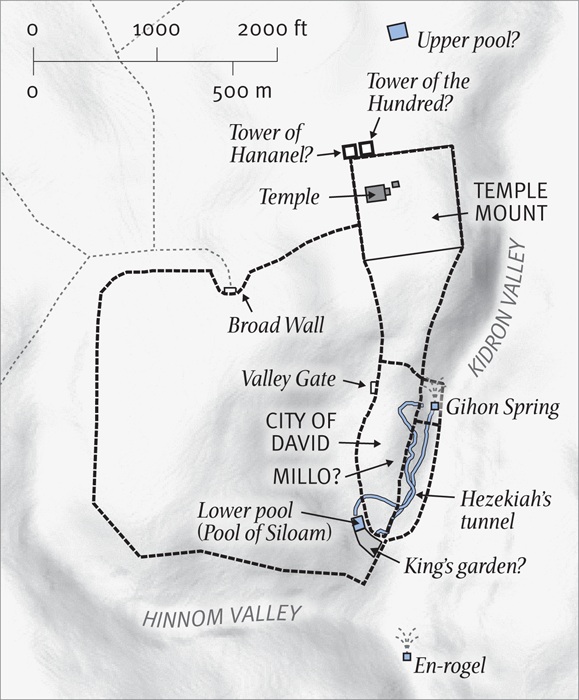
Hezekiah Fortifies Jerusalem
c. 702 B.C.
In anticipation of an Assyrian attack, King Hezekiah of Judah fortified Jerusalem, repairing broken sections of the wall and redirecting the flow of water from the Gihon Spring into the city. He also outfitted his army with weapons and shields and appointed battle commanders over the people. Archaeological evidence suggests he also enclosed the western hill of the city with a new wall and built the Temple Mount around Solomon's temple.
2 KINGS—NOTE ON 19:1 tore . . . sackcloth. See note on 6:30. A reaction that symbolized Hezekiah's grief, repentance, and contrition. The nation had to repent and the king had to lead the way. house of the Lord. See note on Isa. 37:1.
2 KINGS—NOTE ON 19:2 senior priests. See note on Isa. 37:2. the prophet Isaiah. The first reference in 1 and 2 Kings to one of the Lord's greatest prophets (cf. Isa. 1:1). He had already been ministering for 40 years since the days of Uzziah (Isa. 6:1), also called Azariah (2 Kings 14:21).
2 KINGS—NOTE ON 19:3 come to the point of birth . . . no strength. See note on Isa. 37:3.
2 KINGS—NOTE ON 19:4 mock the living God. See note on Isa. 37:4. remnant that is left. See note on Isa. 37:4.
2 KINGS—NOTE ON 19:6 Do not be afraid. Sennacherib had blasphemed the Lord by equating him with other gods. The Lord would personally demonstrate to the Assyrian king his superiority over all other so-called deities.
2 KINGS—NOTE ON 19:7 spirit. The Lord promised to incline Sennacherib's attitude in such a way that he would leave Jerusalem unharmed and return home. How the Lord did that is recorded in vv. 35–37.
2 KINGS—NOTE ON 19:8 Libnah. See note on Isa. 37:8.
2 KINGS—NOTE ON 19:9 Tirhakah king of Cush. See note on Isa. 37:9.
2 KINGS—NOTE ON 19:9–13 The king of Assyria sent messengers to summarize the arguments given in the Rabshakeh's ultimatum of 18:19–25.
2 KINGS—NOTE ON 19:10 deceive. The accusation of deception was first against Hezekiah (18:29), then against the Lord.
2 KINGS—NOTE ON 19:11–13 The threat repeated the thrust of 18:33–35.
2 KINGS—NOTE ON 19:12–13 The conquered cities mentioned here lay between the Tigris and Euphrates Rivers in Mesopotamia, and were cities of Syria that had recently fallen to Sennacherib and the Assyrians.
2 KINGS—NOTE ON 19:14 house of the Lord. Godly Hezekiah returned to the house of the Lord (cf. v. 1) as he should have, in contrast to Ahaz who in a similar crisis refused even to ask a sign from the Lord (Isa. 7:11–12).
2 KINGS—NOTE ON 19:15 enthroned . . . made heaven and earth. See note on Isa. 37:16.
2 KINGS—NOTE ON 19:16 hear . . . see . . . hear. See note on Isa. 37:17.
2 KINGS—NOTE ON 19:17–18 See note on Isa. 37:18–19.
2 KINGS—NOTE ON 19:19 you . . . alone. See note on Isa. 37:20.
2 KINGS—NOTE ON 19:20 Isaiah the son of Amoz. See note on Isa. 37:21.
2 KINGS—NOTE ON 19:21 despises you. See note on Isa. 37:22.
2 KINGS—NOTE ON 19:22 you mocked and reviled. The Lord had heard Sennacherib's reproach against him (v. 16).
2 KINGS—NOTE ON 19:23–24 See note on Isa. 37:24–25.
2 KINGS—NOTE ON 19:25–28 I bring to pass. See notes on Isa. 37:26–29.
2 KINGS—NOTE ON 19:29 sign. The two years in which they were sustained by the growth of the crops were the two in which Sennacherib ravaged them. He left immediately after the deliverance (v. 36), so in the third year the people remaining could plant again.
2 KINGS—NOTE ON 19:30–31 remnant . . . remnant. From the remnant of survivors in Jerusalem came descendants who covered the land once again (cf. Isa. 1:9, 27; 3:10; 4:3; 6:13; 8:16–17; 10:20–22; 11:12, 16; 26:1–4, 8; 27:12; 28:5; 37:4).
2 KINGS—NOTE ON 19:31 zeal of the Lord. The same confirmation of God's promise in v. 7 assured the future establishment of the messianic kingdom. Deliverance from Sennacherib in Hezekiah's day was a down payment on the literal, final restoration of Israel at Christ's second coming.
2 KINGS—NOTE ON 19:32 shall not come . . . cast up a siege mound. See note on Isa. 37:33.
2 KINGS—NOTE ON 19:33 he shall return. See note on Isa. 37:34.
2 KINGS—NOTE ON 19:34 for my own sake. Since Sennacherib had directly challenged the Lord's faithfulness to his word (v. 10), the faithfulness of God was at stake in this contest with the Assyrians (cf. Ezek. 36:22–23). for the sake of my servant David. God pledged to perpetuate David's line on his throne (2 Sam. 7:16; cf. Isa. 9:6, 7; 11:1; 55:3).
2 KINGS—NOTE ON 19:35 the angel of the Lord. For identification, see note on Ex. 3:2. For the angel as an agent of destruction, see Gen. 19:15 and 2 Sam. 24:16.
2 KINGS—NOTE ON 19:35–37 struck. See notes on Isa. 37:36–38.
2 KINGS—NOTE ON 20:1 In those days . . . point of death. The date of Hezekiah's sickness poses three reasonable possibilities: 1) since Hezekiah would be given 15 years of life and delivered from the Assyrians (v. 6), the sickness occurred c. 701 B.C.; 2) since Merodach-baladan (v. 12) died in 703 B.C., the sickness occurred shortly before and was followed by the embassy from Babylon that saw the temple treasures (vv. 12–19); or 3) since Merodachbaladan's greatest power was c. 721–710 B.C., Hezekiah's sickness occurred during those years. The first or second possibility is most likely. Set your house in order. An instruction telling Hezekiah to make his final will known to his family (cf. 2 Sam. 17:23). you shall die; you shall not recover. The prediction sounded final, but Hezekiah knew God was willing to hear his appeal (cf. Ex. 32:7–14).
2 KINGS—NOTE ON 20:2–3 prayed . . . wept bitterly. Hezekiah reminded the Lord in prayer of his piety and devotion to God. He did not specifically ask to be healed. Based on the interpretation of the date from v. 1, Hezekiah wept because: 1) he thought his death would give Sennacherib cause for boasting; or 2) his son Manasseh was too young to become king.
2 KINGS—NOTE ON 20:3 whole heart. See note on Isa. 38:3.
2 KINGS—NOTE ON 20:6 fifteen years. The Lord's immediate (v. 4) response granted the king's request. Having to reverse a prophecy so quickly did not alarm Isaiah as it did Jonah later on (Jonah 4:2–3). Isaiah resembled Nathan in this respect (2 Sam. 7:3–6). I will deliver . . . this city. See note on Isa. 38:6.
2 KINGS—NOTE ON 20:8–11 sign . . . back ten steps. Here is the first biblical mention of any means of marking time. Hezekiah requested this sign to confirm the Lord's promise of healing.
2 KINGS—NOTE ON 20:12 At that time. Just after Hezekiah's sickness and recovery. Merodach-baladan. This ruler of the city of Babylon defied Assyria repeatedly between 721 and 710 B.C. He apparently approached Hezekiah (c. 703
B.C.) for help against Sargon, king of Assyria, though interest in the reversal of the sundial (2 Chron. 32:31) and Hezekiah's recovery may have been part of his motivation.
2 KINGS—NOTE ON 20:13 Hezekiah welcomed. The text does not say whether it was because of flattery or out of a desire for help against the Assyrian threat. Cf.
"gladly" in Isa. 39:2.
2 KINGS—NOTE ON 20:13–14 treasure house . . . storehouses. See notes on Isa. 39:2–3.
2 KINGS—NOTE ON 20:16–17 word of the Lord . . . carried to Babylon. Isaiah predicted the Babylonian captivity that would come over a century later (586
B.C.), another prophecy historically fulfilled in all of its expected detail.
2 KINGS—NOTE ON 20:17 Nothing shall be left. Hezekiah's sin of parading his wealth before the visitors backfired, though this sin was only symptomatic of the ultimate reason for the captivity. The major cause was the corrupt leadership of Manasseh, Hezekiah's son (21:11–15).
2 KINGS—NOTE ON 20:18 sons, who shall be born to you. Hezekiah's sons had to go into captivity. See 24:12–16; 2 Chron. 33:11; Dan. 1:3–4, 6 for the prophecy's fulfillment.
2 KINGS—NOTE ON 20:19 word of the Lord . . . good. A surprising response to the negative prophecy of vv. 16–18. It acknowledged Isaiah as God's faithful messenger, and God's goodness in not destroying Jerusalem during Hezekiah's lifetime. peace and security in my days. Hezekiah might have reacted selfishly, or perhaps he looked for a bright spot to lighten the gloomy fate of his descendants.
2 KINGS—NOTE ON 20:20 conduit. See note on 2 Chron. 32:30.
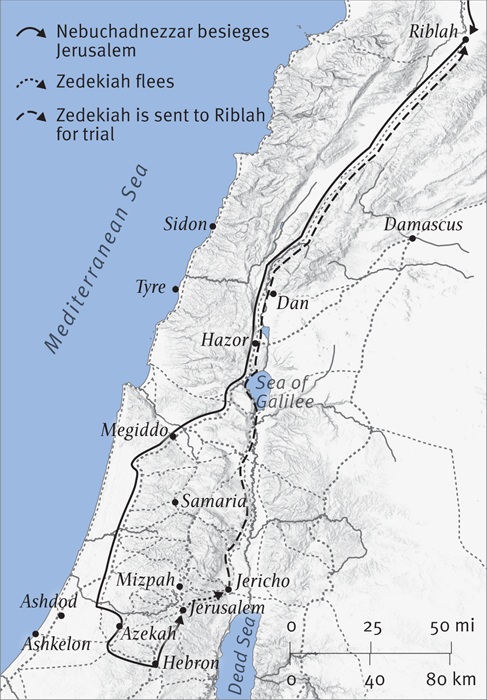
Exile to Babylon
597, 586 B.C.
The final years of the kingdom of Judah were marked by a power struggle between the Egyptians and the Babylonians, the rising power that had overtaken the Assyrian Empire. King Nebuchadnezzar of Babylon eventually won out and seized control of the Mediterranean coastal lands. When Zedekiah, who had been placed on the throne of Judah by the Babylonians, rebelled, Nebuchadnezzar besieged Jerusalem and captured the city. Zedekiah fled toward the east but was captured near Jericho and sent to Riblah to be judged.
2 KINGS—NOTE ON 21:1 twelve years old. Manasseh began to reign as co-regent alongside his father, Hezekiah, in 695 B.C. Since the years of the subsequent royal reigns in Judah total ten years longer than the actual historical period and the dates of the later kings synchronize well with history, it is best to assume a 10-year co-regency in Manasseh's long reign. Hezekiah groomed his son as a youth to succeed him as king; however, Manasseh turned out to be the worst king in Judah's history. fifty-five years. 695–642 B.C. See notes on 2 Chron.
33:1–20.
2 KINGS—NOTE ON 21:2 the despicable practices of the nations. The detestable practices of the Canaanites were enumerated in Deut. 18:9–12. Israel's reproduction of these abominable practices of the nations that preceded her in the land was forbidden in Deut. 12:29–31. The idolatry of Manasseh is detailed in 2 Kings 21:3–9 (cf. 17:7–12, 15–17).
2 KINGS—NOTE ON 21:3 high places . . . altars . . . Asherah. Manasseh reversed the reforms of Hezekiah (cf. 18:4), reestablishing the worship of Baal as an official state-sanctioned religion in Judah, just as Ahab had done in Israel (cf. 1 Kings 16:30–33). host of heaven. See note on 2 Kings 17:16. The worship of the sun, moon, and stars was prohibited in Deut. 4:19 and 17:2–5.
2 KINGS—NOTE ON 21:4 altars in the house of the Lord. These altars were dedicated to "the host of heaven" (v. 5).
2 KINGS—NOTE ON 21:6 burned his son. See note on 16:3. fortune-telling . . . omens . . . mediums and with necromancers. The king was engaged in every form of occultism, including black magic, fortune-telling, demon contacts, and wizards. All this was in direct violation of God's law (Lev. 19:31; Deut. 18:9– 12).
2 KINGS—NOTE ON 21:7 set . . . put. Manasseh provoked the Lord by "setting" an idol of a Canaanite goddess in the temple where the Lord had "set" his name (see 1 Kings 8:29; 9:3; 2 Chron. 7:12, 16). Asherah (cf. 2 Kings 23:4; 2 Chron. 15:16) was believed to be the mother of 70 deities, including Baal.
2 KINGS—NOTE ON 21:8–9 This alludes to the promise of 2 Sam. 7:10. From the very start of their time in Canaan, the people were called to this obedience, but because the people of Judah did not follow carefully the stipulations of the Mosaic law, they were again led into idolatry by Manasseh. Their idolatry even exceeded the idolatry of the Canaanites from whom they took the land.
2 KINGS—NOTE ON 21:10 the prophets. Through his spokesman, the Lord announced Judah's judgment. In vv. 11–15, the prophetic message to Judah is summarized.
2 KINGS—NOTE ON 21:11 Amorites. A general designation of the original inhabitants of Canaan (cf. Gen. 15:16; Josh. 24:8).
2 KINGS—NOTE ON 21:13 the plumb line. These were weighted lines dropped from walls to see whether they were structurally straight (cf. Isa. 28:17; Amos 7:7–8). Walls out of line were torn down. The Lord had measured Jerusalem by the standard of his word and had determined that the fate of Samaria (Israel) was also to befall Jerusalem. wipe Jerusalem. As one would wipe food off a dish, the Lord would wipe Jerusalem clean off the earth, i.e., obliterate her, and leave her turned upside down, empty, and useless.
2 KINGS—NOTE ON 21:14 forsake. The Lord was going to abandon his people into the hands of enemies who would plunder them (cf. Jer. 12:7). remnant. Judah, the only remaining group of the chosen people.
2 KINGS—NOTE ON 21:15 provoked me to anger. The history of God's people Israel was a history of disobedience toward the Lord. With the reign of Manasseh, the sin of God's people climaxed, God's patience was withdrawn, and the judgment of exile became inevitable (cf. 24:1–4).
2 KINGS—NOTE ON 21:16 very much innocent blood. The reference here is ambiguous and several interpretations have been offered: 1) child sacrifice (cf. v. 6); 2) oppression and persecution of the weak (Jer. 7:6; 22:3, 17; Ezek. 22:6–31); or 3) the martyrdom of God's prophets (cf. 2 Kings 21:10). A combination of all three is most likely. Jewish and Christian tradition alike report that Manasseh had Isaiah sawn in two inside a hollow log (cf. Heb. 11:37).
2 KINGS—NOTE ON 21:19 two years. 642–640 B.C. Amon continued the idolatrous practices of his father, abandoning the Lord completely (vv. 20–22). See note on 2 Chron. 33:21–25.
2 KINGS—NOTE ON 21:24 the people of the land. Probably a group of Judah's national leaders who killed the assassins of Amon and installed his son Josiah on the throne. Apparently, they desired to maintain the Davidic dynasty (cf. 11:14– 18).
2 KINGS—NOTE ON 22:1 thirty-one years. 640–609 B.C. During Josiah's reign, power in the ancient Near East passed from Assyria to Babylon. Nineveh, the capital of Assyria, was destroyed by the Babylonians in 612 B.C. and the whole Assyrian empire fell in 609 B.C. Josiah was the last good king of the Davidic line prior to the Babylonian exile. Jeremiah (Jer. 1:2), possibly Habakkuk, and Zephaniah (Zeph. 1:1) were prophets to Judah during the reign of Josiah. See
notes on 2 Chron. 34:1–35:27.
2 KINGS—NOTE ON 22:2 did not turn aside. Josiah had complete devotion to God's approved course of conduct for his life (cf. 23:25). He obeyed the Mosaic stipulations as he came to know them, following the example of David, who set the pattern for the rulers of God's people (Deut. 17:11, 20; Josh. 1:7).
2 KINGS—NOTE ON 22:3 eighteenth year. 622 B.C., when Josiah was 26 years of age.
2 KINGS—NOTE ON 22:4 Hilkiah. The high priest was the father of Azariah and the grandfather of Seraiah, the high priest who would be executed at the time of the exile by the Babylonians (cf. 25:8–20).
2 KINGS—NOTE ON 22:4–7 keepers of the threshold. See note on 12:9. Josiah used the same procedure as King Joash had for collecting funds to repair the temple after its abuse in the days of Manasseh and Amon.
2 KINGS—NOTE ON 22:8 the Book of the Law. A scroll containing the Torah (the Pentateuch), the revelation of God through Moses to Israel (see notes on 23:2; Deut. 28:61). Manasseh may have destroyed all the copies of God's law that were not hidden. This could have been the official copy laid beside the ark of the covenant in the Most Holy Place (Deut. 31:25–26). It may have been removed from its place under Ahaz, Manasseh, or Amon (cf. 2 Chron. 35:3), but was found during repair work.
2 KINGS—NOTE ON 22:9–10 Some believe that Shaphan must have read Deut. 28– 30, in which are recorded a renewal of the national covenant and a listing of the terrible threats and curses against all who violate the law of God.
2 KINGS—NOTE ON 22:11 tore his clothes. Josiah's reaction at the reading of the law was one of immediate contrition, expressed by the common sign of lamentation and grief (see 18:37; 19:1). Josiah's grief sprang from Judah's guilt and God's punishment (22:13).
2 KINGS—NOTE ON 22:14 Huldah. This prophetess is otherwise unknown in the OT. She was held in some regard for her prophetic gift, though why she was consulted and not another prophet like Jeremiah or Zephaniah (see note on 22:1) is unexplained. Rarely did God speak to the nation through a woman (cf. Miriam, Ex. 15; Deborah, Judg. 5) and never did a woman have an ongoing
prophetic ministry identified in Scripture. No woman was inspired to author any of Scripture's 66 books. the wardrobe. Likely, these were the royal garments or those used by the priests. the Second Quarter. This district of Jerusalem was called "second" because it comprised the city's first major expansion. It was probably located on the western hill of Jerusalem, an area enclosed by the city wall and built during the reign of Hezekiah. The expansion of the city during Hezekiah's reign was perhaps to accommodate Jewish refugees who had escaped from the Assyrian invasion of Israel.
2 KINGS—NOTE ON 22:15–20 Huldah gave God's message to Josiah through his messengers. First, the Lord confirmed to Josiah that he was surely going to bring his judgment upon Jerusalem because of her idolatry (vv. 15–17). Second, the Lord's personal word to Josiah was that he would die "in peace" (v. 20), meaning that he would escape the horrors in store for Jerusalem. This promise was based on Josiah's response of tenderness and humility before the Lord when he heard the scroll describing Judah's future devastation (vv. 18–19).
2 KINGS—NOTE ON 22:20 in peace. His heart was at peace with God and he never lived to see Jerusalem destroyed, but he did die in battle (2 Chron. 35:23).
2 KINGS—NOTE ON 23:2 Book of the Covenant. Although this designation was used in Ex. 24:7 with reference to the contents of Ex. 20:22–23:33, it seems here to refer to a larger writing. Since the larger part of the Pentateuch focused on the Mosaic Covenant, these five books came to be called thusly. Since all the men of Judah and all the inhabitants of Jerusalem were assembled together by Josiah, it seems best to view this as the reading of the whole written law found in Gen. 1 through Deut. 34 (see notes on Deut. 31:9–11).
2 KINGS—NOTE ON 23:3 pillar. See note on 11:14. a covenant . . . this covenant. Josiah made a public, binding agreement to completely obey the Lord by doing all that was commanded in the Book of the Covenant that the people had just heard read to them. Following Josiah's example, all the people promised to keep the stipulations of the Mosaic Covenant. See notes on 11:17 and Ex. 24:4–8.
2 KINGS—NOTE ON 23:4 Asherah. See note on 21:7. the fields of the Kidron. Josiah burned everything in the temple that was devoted to idolatry. This was done in the lower portion of the Kidron Valley, east of the city of Jerusalem (cf. 23:6). ashes to Bethel. Located about 10 miles north of Jerusalem, Bethel was one of the two original places where Jeroboam I established an apostate worship
center (1 Kings 12:28–33). Bethel was located just north of the border of Judah in the former northern kingdom, which was then the Assyrian province of Samaria. With a decline in Assyrian power, Josiah was able to exert his religious influence in the north. He used the ashes of the burned articles of idolatry to desecrate Jeroboam's religious center (cf. 2 Kings 23:15–20).
2 KINGS—NOTE ON 23:5 constellations. Cf. 21:3. The astrologers were also removed. See Isa. 47:13.
2 KINGS—NOTE ON 23:6 Asherah. The idol of Asherah (see note on 21:7). graves of the common people. The Kidron Valley contained a burial ground for the common people (cf. Jer. 26:23). Scattering ashes from the object of idolatry is said in 2 Chron. 34:4 to have been on the graves of those who sacrificed to that idol. The "common people" had followed their leaders to apostasy, defilement, and damnation—all symbolized by the act of scattering the ashes.
2 KINGS—NOTE ON 23:7 houses. Tents (called "Succoth-benoth" in 17:30) used by women who were devoted to Asherah, in which they made hangings and committed sexual sins.
2 KINGS—NOTE ON 23:8 Geba to Beersheba. Geba was located about 7 miles northeast of Jerusalem at the far north of Judah and Beersheba was located c. 45 miles south of Jerusalem at the southern end of Judah. Thus, this phrase was an idiomatic way of saying "throughout all of Judah."
2 KINGS—NOTE ON 23:10 Topheth. Meaning "a drum" and identifying the area in the Valley of Hinnom where child sacrifice occurred (cf. Isa. 30:33; Jer. 7:31–32; 19:5–6). Perhaps called "drum" because drums were beaten to drown out the cries of the children being sacrificed.
2 KINGS—NOTE ON 23:11 horses . . . dedicated to the sun. The horses and the chariots of the sun were probably thought to symbolize the sun blazing a trail across the sky and were a part of worshiping the sun. Recently, a religious shrine with horse figurines has been found in Jerusalem (cf. Ezek. 8:16).
2 KINGS—NOTE ON 23:12 on the roof. Altars were erected on the flat roofs of houses so people could worship the "host of heaven" by burning incense (Jer. 19:13; Zeph. 1:5).
2 KINGS—NOTE ON 23:13 Solomon . . . had built. Solomon had built high places
east of Jerusalem on the Mount of Olives, renamed after the desecration, to be used in worship of foreign gods, e.g., the fertility goddess Ashtoreth from Sidon, the Moabite god Chemosh, and the Ammonite god Molech (1 Kings 11:7). These altars existed for over 300 years before Josiah finally destroyed them. The placing of human bones defiled them and, thus, rendered these sites unclean and unsuitable as places of worship.
2 KINGS—NOTE ON 23:15 the altar at Bethel. Josiah reduced the altar that Jeroboam I had built at Bethel to dust and ashes (see 1 Kings 12:28–33).
2 KINGS—NOTE ON 23:16 tombs. Seeing graves nearby, perhaps where idolatrous priests were buried, Josiah had their bones removed and burned on the altar at Bethel to defile it. This action fulfilled a prophecy given about the altar approximately 300 years before (1 Kings 13:2).
2 KINGS—NOTE ON 23:17–18 See 1 Kings 13:1–32, especially vv. 31–32.
2 KINGS—NOTE ON 23:18 Samaria. The former northern kingdom of Israel had become known as Samaria, so named as an Assyrian province (see note on 17:24).
2 KINGS—NOTE ON 23:19 cities of Samaria. The desecration of the high place at Bethel was only the beginning of Josiah's desecration of all the high places in the Assyrian province of Samaria.
2 KINGS—NOTE ON 23:20 he sacrificed all the priests. These non-Levitical priests, who led apostate worship in the former northern kingdom, were idolaters who seduced God's people into idolatry. They were put to death in accordance with the statutes of Deut. 13:6–18 and 17:2–7, and their graves were doubly defiled with burned bones.
2 KINGS—NOTE ON 23:21–22 no such Passover. Judah's celebration of this Passover (see Deut. 16:2–8) more closely conformed to the instructions given in the Mosaic law than any in the previous 400 years of Israel's history. Though the Passover was observed by Hezekiah (2 Chron. 30), no observance had been in exact conformity to God's law since the judges. Further details of this Passover observance are found in 2 Chron. 35:1–19.
2 KINGS—NOTE ON 23:23 eighteenth year. C. 622 B.C. All the reforms of Josiah described took place in the same year (cf. 22:3).
2 KINGS—NOTE ON 23:24 the book . . . found. See 22:8.
2 KINGS—NOTE ON 23:25 no king like him. Of all the kings in David's line, including David himself, no king more closely approximated the royal ideal of Deut. 17:14–20 than Josiah (cf. Matt. 22:37). Yet, even Josiah fell short of complete obedience because he had multiple wives (cf. 2 Kings 23:31–36; see note on Gen. 2:24). However, even this righteous king could not turn away the Lord's wrath because of Manasseh's sin (2 Kings 23:26–27). See chs. 17 and 18.
2 KINGS—NOTE ON 23:29 Neco. Pharaoh Neco II (609–594 B.C.) was an ally of Assyria against the growing power of Babylon. For some unstated reason, Josiah was determined to stop Neco and his army from joining the Assyrian army at the Euphrates River to fight Babylon. Megiddo. The well-fortified stronghold overlooking the Jezreel Valley about 65 miles north of Jerusalem. Megiddo guarded a strategic pass on the route between Egypt and Mesopotamia. Josiah's death is explained in more detail in 2 Chron. 35:20–27.
2 KINGS—NOTE ON 23:31 three months. Jehoahaz reigned during 609 B.C., became a prisoner of Pharaoh Neco II, and ultimately died in Egypt. See note on 2 Chron. 36:1–4.
2 KINGS—NOTE ON 23:33 Riblah in the land of Hamath. Jehoahaz was in prison at Pharaoh Neco II's military headquarters located on the Orontes River in the north Lebanon Valley (see note on 25:6). silver . . . gold. The tax imposed on Judah, whose king was imprisoned, was 750 lbs. of silver and 7.5 lbs. of gold.
2 KINGS—NOTE ON 23:34 Eliakim . . . Jehoiakim. In 609 B.C., Pharaoh Neco II placed Jehoahaz's older brother on the throne of Judah. Neco changed his name from Eliakim, meaning "God has established," to Jehoiakim, "the Lord has established." The naming of a person was regarded in the ancient Near East as sign of authority; so by naming Jehoiakim, Neco demonstrated that he was the lord who controlled Judah. As a vassal of Egypt, Judah risked attack by Egypt's enemy Babylon. See note on 2 Chron. 36:5–8.
2 KINGS—NOTE ON 23:35 Jehoiakim taxed his people severely to pay tribute to Egypt, though he still had enough to build a magnificent palace for himself (see Jer. 22:13–14).
2 KINGS—NOTE ON 23:36 eleven years. 609–597 B.C.
2 KINGS—NOTE ON 24:1 Nebuchadnezzar. Nebuchadnezzar II was the son of Nabopolassar, king of Babylon from 626–605 B.C. As crown prince, Nebuchadnezzar had led his father's army against Pharaoh Neco and the Egyptians at Carchemish on the Euphrates River in northern Syria (605 B.C.). By defeating the Egyptians, Babylon was established as the strongest nation in the ancient Near East. Egypt and its vassals, including Judah, became vassals of Babylon with this victory. Nebuchadnezzar followed up his victory at Carchemish by invading the land of Judah. Later, in 605 B.C., Nebuchadnezzar took some captives to Babylon, including Daniel and his friends (cf. Dan. 1:1– 3). Toward the end of 605 B.C., Nabopolassar died and Nebuchadnezzar succeeded him as king of Babylon, three years after Jehoiakim had taken the throne in Judah (Jer. 25:1). Nebuchadnezzar reigned from 605–562 B.C. three years. Nebuchadnezzar returned to the west in 604 B.C. and took tribute from all of the kings of the west, including Jehoiakim of Judah. Jehoiakim submitted to Babylonian rule from 604–602 B.C. In 602 B.C., Jehoiakim rebelled against Babylon, disregarding the advice of the prophet Jeremiah (Jer. 27:9–11).
2 KINGS—NOTE ON 24:2 the Lord sent . . . bands. As punishment for Jehoiakim's disobedience of the Lord's word through his prophet Jeremiah, the Lord sent Babylonian troops, along with the troops of other loyal nations, to inflict military defeats upon Judah.
2 KINGS—NOTE ON 24:4 innocent blood. See note on 21:16.
2 KINGS—NOTE ON 24:7 king of Egypt. In 601 B.C., Nebuchadnezzar again marched west against Egypt and was turned back by strong Egyptian resistance. However Egypt, though able to defend its own land, was not able to be aggressive and recover its conquered lands or provide any help for its allies, including Judah.
2 KINGS—NOTE ON 24:8 eighteen. This reading is preferred over the "eight" of 2 Chron. 36:9 (see note). three months. Having regrouped, Nebuchadnezzar invaded Judah for a second time in the spring of 597 B.C. Before he could enter Jerusalem, Jehoiakim died and was succeeded as king of Judah by his son, Jehoiachin. Jehoiachin ruled for a short time in 597 B.C. See note on 2 Chron. 36:9–10.
2 KINGS—NOTE ON 24:10–12 The Babylonian siege of Jerusalem was begun by the troops of Nebuchadnezzar. Later, Nebuchadnezzar himself went to Jerusalem
and it was to the king himself that Jehoiachin surrendered (v. 12).
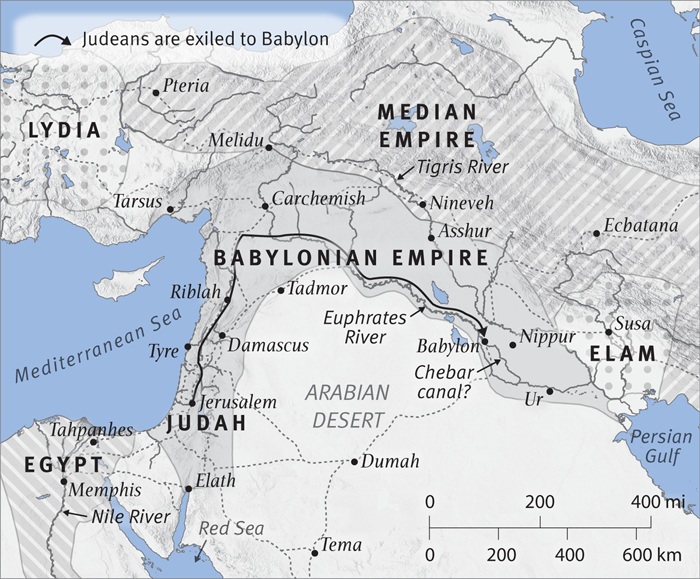
Babylon Attacks Judah
597, 586, 582 B.C.
It appears that three separate deportations of Judeans to Babylon took place under the rule of Nebuchadnezzar (see also Jer. 52:28–30). The first came during the reign of Jehoiachin, when Nebuchadnezzar besieged Jerusalem and carried away many of the treasures of the temple and the royal palace. The second occurred after the fall of Jerusalem in 586 B.C., when the walls of the city were leveled and the temple was completely destroyed. The third appears to have occurred around 582 B.C. while King Nebuchadnezzar was reasserting his control over the general region of Palestine.
2 KINGS—NOTE ON 24:12 eighth year. 597 B.C. For the first time, the books of
Kings dated an event in Israelite history by a non-Israelite king. This indicated that Judah's exile was imminent and the land would be in the hands of Gentiles.
2 KINGS—NOTE ON 24:13 Nebuchadnezzar plundered the treasures of the temple and king's palace, just as the Lord had said he would (cf. 20:16–18).
2 KINGS—NOTE ON 24:14–16 In 597 B.C., Nebuchadnezzar took an additional 10,000 Judeans as captives to Babylon, in particular the leaders of the nation. This included the leaders of the military and those whose skills would support the military. Included in this deportation was the prophet Ezekiel (see notes on Ezek. 1:1–3). Only the lower classes remained behind in Jerusalem. The Babylonian policy of captivity was different from that of the Assyrians, who took most of the people into exile and resettled the land of Israel with foreigners (2 Kings 17:24). The Babylonians took only the leaders and the strong, while leaving the weak and poor, elevating those left to leadership and thereby earning their loyalty. Those taken to Babylon were allowed to work and live in the mainstream of society. This kept the captive Jews together, so it would be possible for them to return, as recorded in Ezra.
2 KINGS—NOTE ON 24:17 Mattaniah . . . Zedekiah. Mattaniah was a son of Josiah and an uncle of Jehoiachin (cf. 1 Chron. 3:15; Jer. 1:3). Mattaniah's name, meaning "gift of the Lord," was changed to Zedekiah, "righteousness of the Lord." Nebuchadnezzar's changing of Zedekiah's name demonstrated his authority as lord over him (see note on 2 Kings 23:34). See notes on 2 Chron. 36:11–21.
2 KINGS—NOTE ON 24:18 eleven years. Zedekiah ruled in Jerusalem, under Babylonian sovereignty, from 597–586 B.C.
2 KINGS—NOTE ON 24:20 Zedekiah rebelled. In 588 B.C., Apries (also called Hophra), the grandson of Neco, became Pharaoh over Egypt. He appears to have influenced Zedekiah to revolt against Babylon (cf. Ezek. 17:15–18).
2 KINGS—NOTE ON 25:1 ninth year. Responding to Zedekiah's rebellion (24:20), Nebuchadnezzar sent his whole army to lay siege against the city of Jerusalem. The siege began in the ninth year of Zedekiah's reign, January, 588 B.C. The "siegeworks" were comprised of either wood towers higher than the walls of the city or a dirt rampart encircling the city.
2 KINGS—NOTE ON 25:2 eleventh year. Jerusalem withstood the siege until the
eleventh year of Zedekiah, July, 586 B.C. Hezekiah's tunnel guaranteed the city an uninterrupted supply of fresh water (20:20) and an Egyptian foray into Judah gave the city a temporary reprieve from the siege (Jer. 37:5).
2 KINGS—NOTE ON 25:3 famine. After a siege of two and one half years, the food supply in Jerusalem ran out (Jer. 38:2–3).
2 KINGS—NOTE ON 25:4 a breach was made in the city. The two walls near the king's garden were probably located at the extreme southeast corner of the city, giving direct access to the Kidron Valley. This gave Zedekiah and his soldiers an opportunity to flee for their lives to the east.
2 KINGS—NOTE ON 25:5 plains of Jericho. Zedekiah fled toward the Jordan Rift Valley. Babylonian pursuers caught him in the Jordan Valley south of Jericho, about 20 miles east of Jerusalem.
2 KINGS—NOTE ON 25:6 Riblah. Located on the Orontes River about 180 miles north of Jerusalem, Riblah was Nebuchadnezzar's military headquarters for his invasion of Judah. This location was ideally situated as a field headquarters for military forces because ample provisions could be found nearby (cf. 23:33). The captured traitor Zedekiah was brought to Nebuchadnezzar at Riblah, where he was blinded after witnessing the death of his sons. The execution of the royal heirs ensured the impossibility of a future claim to the throne or rebellion from his descendants. The blinding made his own future rebellion or retaliation impossible. Jeremiah had warned Zedekiah that he would see Nebuchadnezzar (see notes on Jer. 32:2–5; 34:3), while Ezekiel had said he would not see Babylon (see note on Ezek. 12:10–13). Both prophecies were accurately fulfilled.
2 KINGS—NOTE ON 25:8 seventh day. See note on Jer. 52:12. This was August, 586 B.C., one month after the Babylonian breakthrough of Jerusalem's walls (2 Kings 25:2–4). Nebuzaradan. He was the commander of Nebuchadnezzar's own imperial guard, sent by the king to oversee the destruction of Jerusalem. The dismantling and destruction of Jerusalem was accomplished by the Babylonians in an orderly progression.
2 KINGS—NOTE ON 25:9 First, Jerusalem's most important buildings were burned.
2 KINGS—NOTE ON 25:10 Second, the Babylonian army tore down Jerusalem's outer walls, the city's main defense.
2 KINGS—NOTE ON 25:11–12 Third, Nebuzaradan organized and led a forced march of remaining Judeans into exile in Babylon. The exiles included survivors from Jerusalem and those who had surrendered to the Babylonians before the capture of the city. Only poor, unskilled laborers were left behind to tend the vineyards and farm the fields.
2 KINGS—NOTE ON 25:13–17 Fourth, the items made with precious metals in the temple were carried away to Babylon. See notes on 1 Kings 7:15–49.
2 KINGS—NOTE ON 25:17 three cubits. See note on Jer. 52:22.
2 KINGS—NOTE ON 25:18–21 Fifth, Nebuzaradan took Jerusalem's remaining leaders to Riblah, where Nebuchadnezzar had them executed. This ensured that they would never lead another rebellion against Babylon.
2 KINGS—NOTE ON 25:18 Seraiah. Seraiah was the grandson of Hilkiah (22:4, 8; 1 Chron. 6:13–14) and an ancestor of Ezra (Ezra 7:1). Even though Seraiah was executed, his sons were deported (1 Chron. 6:15).
2 KINGS—NOTE ON 25:21 Judah was taken into exile. Exile was the ultimate curse brought upon Judah because of her disobedience to the Mosaic Covenant (cf. Lev. 26:33; Deut. 28:36, 64). The book of Lamentations records the sorrow of Jeremiah over this destruction of Jerusalem.
2 KINGS—NOTE ON 25:22–30 The books of Kings conclude with this brief epilogue. Despite the punishment of the Lord experienced by Israel and Judah, the people were still rebellious (vv. 22–26). However, due to the Lord's mercy, the house of David endured (vv. 27–30). The books of Kings end with a note of hope.
2 KINGS—NOTE ON 25:22 Gedaliah. In an attempt to maintain political stability, Nebuchadnezzar appointed a governor from an important Judean family. A more detailed account of Gedaliah's activities is found in Jer. 40:7–41:18. Gedaliah's grandfather, Shaphan, was Josiah's secretary, who had implemented that king's reforms (2 Kings 22:3). His father, Ahikam, was part of Josiah's delegation sent to Huldah (22:14) and a supporter of the prophet Jeremiah (Jer. 26:24).
2 KINGS—NOTE ON 25:23 Mizpah. Located about 8 miles north of Jerusalem, Mizpah became the new center of Judah. Mizpah might have been one of the few towns left standing after the Babylonian invasion.
2 KINGS—NOTE ON 25:24 swore. As governor, Gedaliah pledged to the remaining people that loyalty to the Babylonians would ensure their safety.
2 KINGS—NOTE ON 25:25 seventh month. October, 586 B.C., two months after the destruction of Jerusalem (cf. v. 8). Ishmael. Elishama, Ishmael's grandfather, was a secretary under Jehoiakim (Jer. 36:12; 41:1). Ishmael probably assassinated Gedaliah because he wished to reestablish the kingship in Judah with himself as king, since he was of royal blood (cf. Jer. 41:1).
2 KINGS—NOTE ON 25:26 went to Egypt. Fearing reprisals from the Babylonians, the people fled to Egypt.
2 KINGS—NOTE ON 25:27 thirty-seventh year. March, 561 B.C. Jehoiachin was about 55 years old (cf. 24:8). Evil-merodach. The son and successor of Nebuchadnezzar, he ruled as king of Babylon from 562–560 B.C. To gain favor with the Jews, the king released Jehoiachin from his imprisonment and gave him special privileges.
2 KINGS—NOTE ON 25:28–30 spoke kindly to him. This good word from the king of Babylon to the surviving representative of the house of David served as a concluding reminder of God's good word to David. Through the curse of exile, the dynasty of David had survived. There was still hope that God's good word to David concerning the seed who will build God's temple and establish God's eternal kingdom would be fulfilled (cf. 2 Sam. 7:12–16). The book of 2 Kings opened with Elijah being carried away to heaven, the destination of all those faithful to God. The book ends with Israel, and then Judah, being carried away to pagan lands as a result of failing to be faithful to God.
1 Chronicles
1 Chronicles 1 • 1 Chronicles 2 • 1 Chronicles 3 • 1 Chronicles 4 • 1 Chronicles 5 • 1 Chronicles 6 • 1 Chronicles 7 • 1 Chronicles 8 • 1 Chronicles 9 • 1 Chronicles 10 • 1 Chronicles 11 • 1 Chronicles 12 • 1 Chronicles 13 • 1 Chronicles 14 • 1 Chronicles 15 • 1 Chronicles 16 • 1 Chronicles 17 • 1 Chronicles 18 • 1 Chronicles 19 • 1 Chronicles 20 • 1 Chronicles 21 • 1 Chronicles 22 • 1 Chronicles 23 • 1 Chronicles 24 • 1 Chronicles 25 • 1 Chronicles 26 • 1 Chronicles 27 • 1 Chronicles 28 • 1 Chronicles 29 Introduction to 1 Chronicles
Title Author and Date Background and Setting Historical and Theological Themes Interpretive Challenges Outline Footnotes Study Notes
Introduction to 1 Chronicles
Title
The original title in the Hebrew Bible read "The annals (i.e., events or happenings) of the days." First and Second Chronicles were comprised of one book until later divided into separate books in the Greek OT translation, the Septuagint (LXX), c. 200 B.C. The title also changed at that time to the inaccurate title, "the things omitted," i.e., reflecting material not in 1 and 2 Samuel and 1 and 2 Kings. The English title "Chronicles" originated with Jerome's Latin Vulgate translation (c. 400 A.D.), which used the fuller title "The Chronicles of the Entire Sacred History."
Author and Date
Neither 1 nor 2 Chronicles contains direct statements regarding the human author, though Jewish tradition strongly favors Ezra the priest (cf. Ezra 7:1–6) as "the chronicler." These records were most likely recorded c. 450–430 B.C. The genealogical record in 1 Chron. 1–9 supports a date after 450 B.C. for the writing. The NT does not directly quote either 1 or 2 Chronicles.
Background and Setting
The immediate historical backdrop encompassed the Jews' three-phase return to the Promised Land from the Babylonian exile: 1) Zerubbabel in Ezra 1–6 (c. 538
B.C.); 2) Ezra in Ezra 7–10 (c. 458 B.C.); and 3) Nehemiah in Neh. 1–13 (c. 445
B.C.). Previous history looks back to the Babylonian deportation/exile (c. 605– 538 B.C.) as predicted/reported by 2 Kings, Jeremiah, Ezekiel, Daniel, and Habakkuk. The prophets of this restoration era were Haggai, Zechariah, and Malachi.
The Jews had returned from their 70 years of captivity (c. 538 B.C.) to a land that was markedly different from the one once ruled by King David (c. 1011–971
B.C.) and King Solomon (971–931 B.C.): 1) there was no Hebrew king, but rather a Persian governor (Ezra 5:3; 6:6); 2) there was no security for Jerusalem, so Nehemiah had to rebuild the wall (Neh. 1–7); 3) there was no temple, so
Zerubbabel had to reconstruct a pitiful semblance of the Solomonic temple's former glory (Ezra 3); 4) the Jews no longer dominated the region, but rather were on the defensive (Ezra 4; Neh. 4); 5) they enjoyed few divine blessings beyond the fact of their return; 6) they possessed little of the kingdom's former wealth; and 7) God's divine presence no longer resided in Jerusalem, having departed c. 597–591 B.C. (Ezek. 8–11).
To put it mildly, their future looked bleak compared to their majestic past, especially the time of David and Solomon. The return could best be described as bittersweet, i.e., bitter because their present poverty brought hurtful memories about what was forfeited by God's judgment on their ancestors' sin, but sweet because at least they were back in the land God had given Abraham 17 centuries earlier (Gen. 12:1–3). The chronicler's selective genealogy and history of Israel, stretching from Adam (1 Chron. 1:1) to the return from Babylon (2 Chron. 26:23), was intended to remind the Jews of God's promises and intentions about: 1) the land; 2) the nation; 3) the Davidic king; 4) the Levitical priests; 5) the temple; and 6) true worship, none of which had been abrogated because of the Babylonian captivity. All of this was to remind them of their spiritual heritage during the difficult times they faced, and to encourage them to be faithful to God.
Historical and Theological Themes
First and Second Chronicles, as named by Jerome, recreate an OT history in miniature, with particular emphases on the Davidic Covenant and temple worship. In terms of literary parallel, 1 Chronicles is the partner of 2 Samuel, in that both detail the reign of King David. First Chronicles opens with Adam (1 Chron. 1:1) and closes with the death of David (29:26–30) in 971 B.C. Second Chronicles begins with Solomon (2 Chron. 1:1) and covers the same historical period as 1 and 2 Kings, while focusing exclusively on the kings of the southern kingdom of Judah, thus excluding the history of the northern 10 tribes and their rulers, because of their complete wickedness and false worship. It ranges from the reign of Solomon (1:1) in 971 B.C. to the return from Babylon in 538 B.C. (36:23). Over 55 percent of the material in Chronicles is unique, i.e., not found in 2 Samuel or 1 and 2 Kings. The "chronicler" tended to omit what was negative or in opposition to the Davidic kingship; on the other hand, he tended to make unique contributions in validating temple worship and the line of David. Whereas 2 Kings 25 ends dismally with the deportation of Judah to Babylon, 2
Chron. 36:22–23 concludes hopefully with the Jews' release from Persia and return to Jerusalem.
These two books were written to the repatriated Jewish exiles as a chronicle of God's intention of future blessing, in spite of the nation's past moral/spiritual failure for which the people paid dearly under God's wrath. First and Second Chronicles could be briefly summarized as follows:
I. A Selected Genealogical History of Israel (1 Chron. 1–9)
II. Israel's United Kingdom Under Saul (1 Chron. 10), David (1 Chron. 11–29), and Solomon (2 Chron. 1–9)
III. Judah's Monarchy in the Divided Kingdom (2 Chron. 10–36:21)
IV. Judah's Release From Their Seventy-Year Captivity (2 Chron. 36:22–23).
The historical themes are inextricably linked with the theological in that God's divine purposes for Israel have been and will be played out on the stage of human history. These two books are designed to assure the returning Jews that, in spite of their checkered past and present plight, God will be true to his covenant promises. They have been returned by God to the land first given to Abraham as a race of people whose ethnic identity (Jewish) was not obliterated by the deportation and whose national identity (Israel) has been preserved (Gen. 12:1–3; 15:5), although they are still under God's judgment as prescribed by the Mosaic legislation (Deut. 28:15–68). The priestly line of Eleazar's son Phinehas and the Levitical line were still intact so that temple worship could continue in the hope that God's presence would one day return (Num. 25:10–13; Mal. 3:1). The Davidic promise of a king was still valid, although future in its fulfillment (2 Sam. 7:8–17; 1 Chron. 17:7–15). Their individual hope of eternal life and restoration of God's blessings forever rested in the New Covenant (Jer. 31:31– 34).
Two basic principles enumerated in these two books prevail throughout the OT, namely, obedience brings blessing, disobedience brings judgment. In the Chronicles, when the king obeyed and trusted the Lord, God blessed and protected. But when the king disobeyed and/or put his trust in something or someone other than the Lord, God withdrew his blessing and protection. Three basic failures by the kings of Judah brought God's wrath: 1) personal sin; 2) false worship/idolatry; and/or 3) trust in man rather than God.
Interpretive Challenges
First and Second Chronicles present a combination of selective genealogical and historical records, and no insurmountable challenges within the two books are encountered. A few issues arise, such as: 1) Who wrote 1 and 2 Chronicles? Does the overlap of 2 Chron. 36:22–23 with Ezra 1:1–3 point to Ezra as author? 2) Does the use of multiple sources taint the inerrancy doctrine of Scripture? 3) How does one explain the variations in the genealogies of 1 Chron. 1–9 from other OT genealogies? 4) Are the curses of Deut. 28 still in force, even though the 70-year captivity has concluded? 5) How does one explain the few variations in numbers when comparing Chronicles with parallel passages in Samuel and Kings? These will be dealt with in the notes at the appropriate places.
Outline
I. Selective Genealogy (1 Chronicles 1:1–9:34)
A. Adam to Before David (1:1–2:55)
B. David to the Captivity (3:1–24) C. Twelve Tribes (4:1–9:1) D. Jerusalem Dwellers (9:2–34) II. David's Ascent (1 Chronicles 9:35–12:40)
A. Saul's Heritage and Death (9:35–10:14)
B. David's Anointing (11:1–3) C. Jerusalem's Conquest (11:4–9) D. David's Men (11:10–12:40) III. David's Reign (1 Chronicles 13:1–29:30)
A. The Ark of the Covenant (13:1–16:43)
B. The Davidic Covenant (17:1–27) C. Selected Military History (18:1–21:30) D. Temple-Building Preparations (22:1–29:20)
E. Transition to Solomon (29:21–30)
1 Chronicles
From Adam to Abraham
1 Chronicles 1 ‡ [1] Adam, Seth, Enosh; 2Kenan, Mahalalel, Jared; 3Enoch, Methuselah, Lamech; 4Noah, Shem, Ham, and Japheth.
5The sons of Japheth: Gomer, Magog, Madai, Javan, Tubal, Meshech, and Tiras. 6The sons of Gomer: Ashkenaz, Riphath, [2] and Togarmah. 7The sons of Javan: Elishah, Tarshish, Kittim, and Rodanim.
8The sons of Ham: Cush, Egypt, Put, and Canaan. 9The sons of Cush: Seba, Havilah, Sabta, Raama, and Sabteca. The sons of Raamah: Sheba and Dedan. 10Cush fathered Nimrod. He was the first on earth to be a mighty man. [3]
11Egypt fathered Ludim, Anamim, Lehabim, Naphtuhim, 12Pathrusim, Casluhim (from whom the Philistines came), and Caphtorim.
13Canaan fathered Sidon his firstborn and Heth, 14and the Jebusites, the Amorites, the Girgashites, 15the Hivites, the Arkites, the Sinites, 16the Arvadites, the Zemarites, and the Hamathites.
17The sons of Shem: Elam, Asshur, Arpachshad, Lud, and Aram. And the sons of Aram: [4] Uz, Hul, Gether, and Meshech. 18Arpachshad fathered Shelah, and Shelah fathered Eber. 19†To Eber were born two sons: the name of the one was Peleg [5] (for in his days the earth was divided), and his brother's name was Joktan. 20Joktan fathered Almodad, Sheleph, Hazarmaveth, Jerah, 21Hadoram, Uzal, Diklah, 22Obal, [6] Abimael, Sheba, 23Ophir, Havilah, and Jobab; all these were the sons of Joktan.
24Shem, Arpachshad, Shelah; 25Eber, Peleg, Reu; 26Serug, Nahor, Terah; 27Abram, that is, Abraham.
From Abraham to Jacob
28‡The sons of Abraham: Isaac and Ishmael. 29These are their genealogies: the firstborn of Ishmael, Nebaioth, and Kedar, Adbeel, Mibsam, 30Mishma, Dumah, Massa, Hadad, Tema, 31Jetur, Naphish, and Kedemah. These are the sons of
Ishmael. 32The sons of Keturah, Abraham's concubine: she bore Zimran, Jokshan, Medan, Midian, Ishbak, and Shuah. The sons of Jokshan: Sheba and Dedan. 33The sons of Midian: Ephah, Epher, Hanoch, Abida, and Eldaah. All these were the descendants of Keturah.
34Abraham fathered Isaac. The sons of Isaac: Esau and Israel. 35The sons of Esau: Eliphaz, Reuel, Jeush, Jalam, and Korah. 36The sons of Eliphaz: Teman, Omar, Zepho, Gatam, Kenaz, and of Timna, [7] Amalek. 37The sons of Reuel: Nahath, Zerah, Shammah, and Mizzah.
38The sons of Seir: Lotan, Shobal, Zibeon, Anah, Dishon, Ezer, and Dishan. 39The sons of Lotan: Hori and Hemam; [8] and Lotan's sister was Timna. 40The sons of Shobal: Alvan, [9] Manahath, Ebal, Shepho, [10] and Onam. The sons of Zibeon: Aiah and Anah. 41The son [11] of Anah: Dishon. The sons of Dishon: Hemdan, [12] Eshban, Ithran, and Cheran. 42The sons of Ezer: Bilhan, Zaavan, and Akan. [13] The sons of Dishan: Uz and Aran.
43†These are the kings who reigned in the land of Edom before any king reigned over the people of Israel: Bela the son of Beor, the name of his city being Dinhabah. 44Bela died, and Jobab the son of Zerah of Bozrah reigned in his place. 45Jobab died, and Husham of the land of the Temanites reigned in his place. 46Husham died, and Hadad the son of Bedad, who defeated Midian in the country of Moab, reigned in his place, the name of his city being Avith. 47Hadad died, and Samlah of Masrekah reigned in his place. 48Samlah died, and Shaul of Rehoboth on the Euphrates reigned in his place. 49Shaul died, and Baal-hanan, the son of Achbor, reigned in his place. 50Baal-hanan died, and Hadad reigned in his place, the name of his city being Pai; and his wife's name was Mehetabel, the daughter of Matred, the daughter of Mezahab. 51And Hadad died.
The chiefs of Edom were: chiefs Timna, Alvah, Jetheth, 52Oholibamah, Elah, Pinon, 53Kenaz, Teman, Mibzar, 54Magdiel, and Iram; these are the chiefs of Edom.
A Genealogy of David
1 Chronicles 2 ‡These are the sons of Israel: Reuben, Simeon, Levi, Judah, Issachar, Zebulun, 2Dan, Joseph, Benjamin, Naphtali, Gad, and Asher. 3The sons of Judah: Er, Onan and Shelah; these three Bath-shua the Canaanite bore to him. Now Er, Judah's firstborn, was evil in the sight of the LORD, and he put him to death. 4His daughter-in-law Tamar also bore him Perez and Zerah. Judah had five sons in all.
5The sons of Perez: Hezron and Hamul. 6The sons of Zerah: Zimri, Ethan, Heman, Calcol, and Dara, five in all. 7†The son [1] of Carmi: Achan, the troubler of Israel, who broke faith in the matter of the devoted thing; 8and Ethan's son was Azariah.
9The sons of Hezron that were born to him: Jerahmeel, Ram, and Chelubai. 10Ram fathered Amminadab, and Amminadab fathered Nahshon, prince of the sons of Judah. 11Nahshon fathered Salmon, [2] Salmon fathered Boaz, 12Boaz fathered Obed, Obed fathered Jesse. 13Jesse fathered Eliab his firstborn, Abinadab the second, Shimea the third, 14Nethanel the fourth, Raddai the fifth, 15Ozem the sixth, David the seventh. 16And their sisters were Zeruiah and Abigail. The sons of Zeruiah: Abishai, Joab, and Asahel, three. 17Abigail bore Amasa, and the father of Amasa was Jether the Ishmaelite.
18Caleb the son of Hezron fathered children by his wife Azubah, and by Jerioth; and these were her sons: Jesher, Shobab, and Ardon. 19When Azubah died, Caleb married Ephrath, who bore him Hur. 20Hur fathered Uri, and Uri fathered Bezalel.
21Afterward Hezron went in to the daughter of Machir the father of Gilead, whom he married when he was sixty years old, and she bore him Segub. 22And Segub fathered Jair, who had twenty-three cities in the land of Gilead. 23But Geshur and Aram took from them Havvoth-jair, Kenath, and its villages, sixty towns. All these were descendants of Machir, the father of Gilead. 24After the death of Hezron, Caleb went in to Ephrathah, [3] the wife of Hezron his father, and she bore him Ashhur, the father of Tekoa.
25The sons of Jerahmeel, the firstborn of Hezron: Ram, his firstborn, Bunah, Oren, Ozem, and Ahijah. 26Jerahmeel also had another wife, whose name was Atarah; she was the mother of Onam. 27The sons of Ram, the firstborn of
Jerahmeel: Maaz, Jamin, and Eker. 28The sons of Onam: Shammai and Jada. The sons of Shammai: Nadab and Abishur. 29The name of Abishur's wife was Abihail, and she bore him Ahban and Molid. 30The sons of Nadab: Seled and Appaim; and Seled died childless. 31The son [4] of Appaim: Ishi. The son of Ishi: Sheshan. The son of Sheshan: Ahlai. 32The sons of Jada, Shammai's brother: Jether and Jonathan; and Jether died childless. 33The sons of Jonathan: Peleth and Zaza. These were the descendants of Jerahmeel. 34Now Sheshan had no sons, only daughters, but Sheshan had an Egyptian slave whose name was Jarha. 35So Sheshan gave his daughter in marriage to Jarha his slave, and she bore him Attai. 36Attai fathered Nathan, and Nathan fathered Zabad. 37Zabad fathered Ephlal, and Ephlal fathered Obed. 38Obed fathered Jehu, and Jehu fathered Azariah. 39Azariah fathered Helez, and Helez fathered Eleasah. 40Eleasah fathered Sismai, and Sismai fathered Shallum. 41Shallum fathered Jekamiah, and Jekamiah fathered Elishama.
42The sons of Caleb the brother of Jerahmeel: Mareshah [5] his firstborn, who fathered Ziph. The son [6] of Mareshah: Hebron. [7] 43The sons of Hebron: Korah, Tappuah, Rekem and Shema. 44Shema fathered Raham, the father of Jorkeam; and Rekem fathered Shammai. 45The son of Shammai: Maon; and Maon fathered Beth-zur. 46Ephah also, Caleb's concubine, bore Haran, Moza, and Gazez; and Haran fathered Gazez. 47The sons of Jahdai: Regem, Jotham, Geshan, Pelet, Ephah, and Shaaph. 48Maacah, Caleb's concubine, bore Sheber and Tirhanah. 49She also bore Shaaph the father of Madmannah, Sheva the father of Machbenah and the father of Gibea; and the daughter of Caleb was Achsah. 50These were the descendants of Caleb.
The sons [8] of Hur the firstborn of Ephrathah: Shobal the father of Kiriathjearim, 51Salma, the father of Bethlehem, and Hareph the father of Beth-gader. 52Shobal the father of Kiriath-jearim had other sons: Haroeh, half of the Menuhoth. 53And the clans of Kiriath-jearim: the Ithrites, the Puthites, the Shumathites, and the Mishraites; from these came the Zorathites and the Eshtaolites. 54The sons of Salma: Bethlehem, the Netophathites, Atroth-beth-joab and half of the Manahathites, the Zorites. 55The clans also of the scribes who lived at Jabez: the Tirathites, the Shimeathites and the Sucathites. These are the Kenites who came from Hammath, the father of the house of Rechab.
Descendants of David
1 Chronicles 3 ‡†These are the sons of David who were born to him in Hebron: the firstborn, Amnon, by Ahinoam the Jezreelite; the second, Daniel, by Abigail the Carmelite, 2the third, Absalom, whose mother was Maacah, the daughter of Talmai, king of Geshur; the fourth, Adonijah, whose mother was Haggith; 3the fifth, Shephatiah, by Abital; the sixth, Ithream, by his wife Eglah; 4six were born to him in Hebron, where he reigned for seven years and six months. And he reigned thirty-three years in Jerusalem. 5‡These were born to him in Jerusalem: Shimea, Shobab, Nathan and Solomon, four by Bath-shua, the daughter of Ammiel; 6then Ibhar, Elishama, Eliphelet, 7Nogah, Nepheg, Japhia, 8Elishama, Eliada, and Eliphelet, nine. 9All these were David's sons, besides the sons of the concubines, and Tamar was their sister.
10‡The son of Solomon was Rehoboam, Abijah his son, Asa his son, Jehoshaphat his son, 11Joram his son, Ahaziah his son, Joash his son, 12Amaziah his son, Azariah his son, Jotham his son, 13Ahaz his son, Hezekiah his son, Manasseh his son, 14Amon his son, Josiah his son. 15The sons of Josiah: Johanan the firstborn, the second Jehoiakim, the third Zedekiah, the fourth Shallum. 16†The descendants of Jehoiakim: Jeconiah his son, Zedekiah his son; 17and the sons of Jeconiah, the captive: Shealtiel his son, 18Malchiram, Pedaiah, Shenazzar, Jekamiah, Hoshama and Nedabiah; 19and the sons of Pedaiah: Zerubbabel and Shimei; and the sons of Zerubbabel: Meshullam and Hananiah, and Shelomith was their sister; 20and Hashubah, Ohel, Berechiah, Hasadiah, and Jushab-hesed, five. 21The sons of Hananiah: Pelatiah and Jeshaiah, his son [1] Rephaiah, his son Arnan, his son Obadiah, his son Shecaniah. 22†The son [2] of Shecaniah: Shemaiah. And the sons of Shemaiah: Hattush, Igal, Bariah, Neariah, and Shaphat, six. 23The sons of Neariah: Elioenai, Hizkiah, and Azrikam, three. 24The sons of Elioenai: Hodaviah, Eliashib, Pelaiah, Akkub, Johanan, Delaiah, and Anani, seven.
Descendants of Judah
1 Chronicles 4 The sons of Judah: Perez, Hezron, Carmi, Hur, and Shobal. 2Reaiah the son of Shobal fathered Jahath, and Jahath fathered Ahumai and Lahad. These were the clans of the Zorathites. 3These were the sons [1] of Etam: Jezreel, Ishma, and Idbash; and the name of their sister was Hazzelelponi, 4and Penuel fathered Gedor, and Ezer fathered Hushah. These were the sons of Hur, the firstborn of Ephrathah, the father of Bethlehem. 5Ashhur, the father of Tekoa, had two wives, Helah and Naarah; 6Naarah bore him Ahuzzam, Hepher, Temeni, and Haahashtari. These were the sons of Naarah. 7The sons of Helah: Zereth, Izhar, and Ethnan. 8Koz fathered Anub, Zobebah, and the clans of Aharhel, the son of Harum. 9Jabez was more honorable than his brothers; and his mother called his name Jabez, saying, "Because I bore him in pain." [2] 10Jabez called upon the God of Israel, saying, "Oh that you would bless me and enlarge my border, and that your hand might be with me, and that you would keep me from harm [3] so that it might not bring me pain!" And God granted what he asked. 11Chelub, the brother of Shuhah, fathered Mehir, who fathered Eshton. 12Eshton fathered Beth-rapha, Paseah, and Tehinnah, the father of Ir-nahash. These are the men of Recah. 13The sons of Kenaz: Othniel and Seraiah; and the sons of Othniel: Hathath and Meonothai. [4] 14Meonothai fathered Ophrah; and Seraiah fathered Joab, the father of Ge-harashim, [5] so-called because they were craftsmen. 15The sons of Caleb the son of Jephunneh: Iru, Elah, and Naam; and the son [6] of Elah: Kenaz. 16The sons of Jehallelel: Ziph, Ziphah, Tiria, and Asarel. 17The sons of Ezrah: Jether, Mered, Epher, and Jalon. These are the sons of Bithiah, the daughter of Pharaoh, whom Mered married; [7] and she conceived and bore [8] Miriam, Shammai, and Ishbah, the father of Eshtemoa. 18And his Judahite wife bore Jered the father of Gedor, Heber the father of Soco, and Jekuthiel the father of Zanoah. 19The sons of the wife of Hodiah, the sister of Naham, were the fathers of Keilah the Garmite and Eshtemoa the Maacathite. 20The sons of Shimon: Amnon, Rinnah, Ben-hanan, and Tilon. The sons of Ishi: Zoheth and Ben-zoheth. 21The sons of Shelah the son of Judah: Er the father of Lecah, Laadah the father of Mareshah, and the clans of the house of linen workers at Beth-ashbea; 22and Jokim, and the men of Cozeba, and Joash, and Saraph, who ruled in Moab and returned to Lehem [9] (now the records [10] are ancient). 23These were the potters who were inhabitants of Netaim and Gederah. They lived there in the king's service.
Descendants of Simeon
24The sons of Simeon: Nemuel, Jamin, Jarib, Zerah, Shaul; 25Shallum was his son, Mibsam his son, Mishma his son. 26The sons of Mishma: Hammuel his son, Zaccur his son, Shimei his son. 27Shimei had sixteen sons and six daughters; but his brothers did not have many children, nor did all their clan multiply like the men of Judah. 28They lived in Beersheba, Moladah, Hazar-shual, 29Bilhah, Ezem, Tolad, 30Bethuel, Hormah, Ziklag, 31Beth-marcaboth, Hazar-susim, Beth-biri, and Shaaraim. These were their cities until David reigned. 32And their villages were Etam, Ain, Rimmon, Tochen, and Ashan, five cities, 33along with all their villages that were around these cities as far as Baal. These were their settlements, and they kept a genealogical record.
34Meshobab, Jamlech, Joshah the son of Amaziah, 35Joel, Jehu the son of Joshibiah, son of Seraiah, son of Asiel, 36Elioenai, Jaakobah, Jeshohaiah, Asaiah, Adiel, Jesimiel, Benaiah, 37Ziza the son of Shiphi, son of Allon, son of Jedaiah, son of Shimri, son of Shemaiah— 38these mentioned by name were princes in their clans, and their fathers' houses increased greatly. 39They journeyed to the entrance of Gedor, to the east side of the valley, to seek pasture for their flocks, 40where they found rich, good pasture, and the land was very broad, quiet, and peaceful, for the former inhabitants there belonged to Ham. 41†These, registered by name, came in the days of Hezekiah, king of Judah, and destroyed their tents and the Meunites who were found there, and marked them for destruction to this day, and settled in their place, because there was pasture there for their flocks. 42And some of them, five hundred men of the Simeonites, went to Mount Seir, having as their leaders Pelatiah, Neariah, Rephaiah, and Uzziel, the sons of Ishi. 43†And they defeated the remnant of the Amalekites who had escaped, and they have lived there to this day.
Descendants of Reuben
1 Chronicles 5 The sons of Reuben the firstborn of Israel (for he was the firstborn, but because he defiled his father's couch, his birthright was given to the sons of Joseph the son of Israel, so that he could not be enrolled as the oldest son; 2†though Judah became strong among his brothers and a chief came from him, yet the birthright belonged to Joseph), 3the sons of Reuben, the firstborn of Israel: Hanoch, Pallu, Hezron, and Carmi. 4The sons of Joel: Shemaiah his son, Gog his son, Shimei his son, 5Micah his son, Reaiah his son, Baal his son, 6†Beerah his son, whom Tiglath-pileser [1] king of Assyria carried away into exile; he was a chief of the Reubenites. 7And his kinsmen by their clans, when the genealogy of their generations was recorded: the chief, Jeiel, and Zechariah, 8and Bela the son of Azaz, son of Shema, son of Joel, who lived in Aroer, as far as Nebo and Baal-meon. 9He also lived to the east as far as the entrance of the desert this side of the Euphrates, because their livestock had multiplied in the land of Gilead. 10And in the days of Saul they waged war against the Hagrites, who fell into their hand. And they lived in their tents throughout all the region east of Gilead.
Descendants of Gad
11The sons of Gad lived over against them in the land of Bashan as far as Salecah: 12Joel the chief, Shapham the second, Janai, and Shaphat in Bashan. 13And their kinsmen according to their fathers' houses: Michael, Meshullam, Sheba, Jorai, Jacan, Zia and Eber, seven. 14These were the sons of Abihail the son of Huri, son of Jaroah, son of Gilead, son of Michael, son of Jeshishai, son of Jahdo, son of Buz. 15Ahi the son of Abdiel, son of Guni, was chief in their fathers' houses, 16and they lived in Gilead, in Bashan and in its towns, and in all the pasturelands of Sharon to their limits. 17All of these were recorded in genealogies in the days of Jotham king of Judah, and in the days of Jeroboam king of Israel.
18The Reubenites, the Gadites, and the half-tribe of Manasseh had valiant men who carried shield and sword, and drew the bow, expert in war, 44,760, able to go to war. 19They waged war against the Hagrites, Jetur, Naphish, and Nodab. 20And when they prevailed over them, the Hagrites and all who were with them were given into their hands, for they cried out to God in the battle, and he granted their urgent plea because they trusted in him. 21They carried off their
livestock: 50,000 of their camels, 250,000 sheep, 2,000 donkeys, and 100,000 men alive. 22†For many fell, because the war was of God. And they lived in their place until the exile.
The Half-Tribe of Manasseh
23The members of the half-tribe of Manasseh lived in the land. They were very numerous from Bashan to Baal-hermon, Senir, and Mount Hermon. 24These were the heads of their fathers' houses: Epher, [2] Ishi, Eliel, Azriel, Jeremiah, Hodaviah, and Jahdiel, mighty warriors, famous men, heads of their fathers' houses. 25But they broke faith with the God of their fathers, and whored after the gods of the peoples of the land, whom God had destroyed before them. 26So the God of Israel stirred up the spirit of Pul king of Assyria, the spirit of Tiglathpileser king of Assyria, and he took them into exile, namely, the Reubenites, the Gadites, and the half-tribe of Manasseh, and brought them to Halah, Habor, Hara, and the river Gozan, to this day.
Descendants of Levi
1 Chronicles 6 ‡ [1] The sons of Levi: Gershon, Kohath, and Merari. 2The sons of Kohath: Amram, Izhar, Hebron, and Uzziel. 3The children of Amram: Aaron, Moses, and Miriam. The sons of Aaron: Nadab, Abihu, Eleazar, and Ithamar. 4Eleazar fathered Phinehas, Phinehas fathered Abishua, 5Abishua fathered Bukki, Bukki fathered Uzzi, 6Uzzi fathered Zerahiah, Zerahiah fathered Meraioth, 7Meraioth fathered Amariah, Amariah fathered Ahitub, 8†Ahitub fathered Zadok, Zadok fathered Ahimaaz, 9Ahimaaz fathered Azariah, Azariah fathered Johanan, 10and Johanan fathered Azariah (it was he who served as priest in the house that Solomon built in Jerusalem). 11Azariah fathered Amariah, Amariah fathered Ahitub, 12Ahitub fathered Zadok, Zadok fathered Shallum, 13†Shallum fathered Hilkiah, Hilkiah fathered Azariah, 14†Azariah fathered Seraiah, Seraiah fathered Jehozadak; 15and Jehozadak went into exile when the LORD sent Judah and Jerusalem into exile by the hand of Nebuchadnezzar.
16‡ [2] The sons of Levi: Gershom, Kohath, and Merari. 17And these are the names of the sons of Gershom: Libni and Shimei. 18The sons of Kohath: Amram, Izhar, Hebron and Uzziel. 19The sons of Merari: Mahli and Mushi. These are the clans of the Levites according to their fathers. 20Of Gershom: Libni his son, Jahath his son, Zimmah his son, 21Joah his son, Iddo his son, Zerah his son, Jeatherai his son. 22The sons of Kohath: Amminadab his son, Korah his son, Assir his son, 23Elkanah his son, Ebiasaph his son, Assir his son, 24Tahath his son, Uriel his son, Uzziah his son, and Shaul his son. 25The sons of Elkanah: Amasai and Ahimoth, 26Elkanah his son, Zophai his son, Nahath his son, 27‡Eliab his son, Jeroham his son, Elkanah his son. 28The sons of Samuel: Joel [3] his firstborn, the second Abijah. [4] 29The sons of Merari: Mahli, Libni his son, Shimei his son, Uzzah his son, 30Shimea his son, Haggiah his son, and Asaiah his son.
31‡These are the men whom David put in charge of the service of song in the house of the LORD after the ark rested there. 32They ministered with song before the tabernacle of the tent of meeting until Solomon built the house of the LORD in Jerusalem, and they performed their service according to their order. 33These are the men who served and their sons. Of the sons of the Kohathites: Heman the singer the son of Joel, son of Samuel, 34son of Elkanah, son of Jeroham, son of Eliel, son of Toah, 35son of Zuph, son of Elkanah, son of Mahath, son of Amasai, 36son of Elkanah, son of Joel, son of Azariah, son of Zephaniah, 37son of Tahath,
son of Assir, son of Ebiasaph, son of Korah, 38son of Izhar, son of Kohath, son of Levi, son of Israel; 39and his brother Asaph, who stood on his right hand, namely, Asaph the son of Berechiah, son of Shimea, 40son of Michael, son of Baaseiah, son of Malchijah, 41son of Ethni, son of Zerah, son of Adaiah, 42son of Ethan, son of Zimmah, son of Shimei, 43son of Jahath, son of Gershom, son of Levi. 44On the left hand were their brothers, the sons of Merari: Ethan the son of Kishi, son of Abdi, son of Malluch, 45son of Hashabiah, son of Amaziah, son of Hilkiah, 46son of Amzi, son of Bani, son of Shemer, 47son of Mahli, son of Mushi, son of Merari, son of Levi. 48And their brothers the Levites were appointed for all the service of the tabernacle of the house of God.
49‡But Aaron and his sons made offerings on the altar of burnt offering and on the altar of incense for all the work of the Most Holy Place, and to make atonement for Israel, according to all that Moses the servant of God had commanded. 50These are the sons of Aaron: Eleazar his son, Phinehas his son, Abishua his son, 51Bukki his son, Uzzi his son, Zerahiah his son, 52Meraioth his son, Amariah his son, Ahitub his son, 53Zadok his son, Ahimaaz his son.
54‡These are their dwelling places according to their settlements within their borders: to the sons of Aaron of the clans of Kohathites, for theirs was the first lot, 55to them they gave Hebron in the land of Judah and its surrounding pasturelands, 56but the fields of the city and its villages they gave to Caleb the son of Jephunneh. 57To the sons of Aaron they gave the cities of refuge: Hebron, Libnah with its pasturelands, Jattir, Eshtemoa with its pasturelands, 58Hilen with its pasturelands, Debir with its pasturelands, 59Ashan with its pasturelands, and Beth-shemesh with its pasturelands; 60and from the tribe of Benjamin, Gibeon, [5] Geba with its pasturelands, Alemeth with its pasturelands, and Anathoth with its pasturelands. All their cities throughout their clans were thirteen.
61To the rest of the Kohathites were given by lot out of the clan of the tribe, out of the half-tribe, the half of Manasseh, ten cities. 62To the Gershomites according to their clans were allotted thirteen cities out of the tribes of Issachar, Asher, Naphtali and Manasseh in Bashan. 63To the Merarites according to their clans were allotted twelve cities out of the tribes of Reuben, Gad, and Zebulun. 64So the people of Israel gave the Levites the cities with their pasturelands. 65They gave by lot out of the tribes of Judah, Simeon, and Benjamin these cities that are mentioned by name.
66And some of the clans of the sons of Kohath had cities of their territory out of the tribe of Ephraim. 67They were given the cities of refuge: Shechem with its pasturelands in the hill country of Ephraim, Gezer with its pasturelands, 68Jokmeam with its pasturelands, Beth-horon with its pasturelands, 69Aijalon with its pasturelands, Gath-rimmon with its pasturelands, 70and out of the halftribe of Manasseh, Aner with its pasturelands, and Bileam with its pasturelands, for the rest of the clans of the Kohathites.
71To the Gershomites were given out of the clan of the half-tribe of Manasseh: Golan in Bashan with its pasturelands and Ashtaroth with its pasturelands; 72and out of the tribe of Issachar: Kedesh with its pasturelands, Daberath with its pasturelands, 73Ramoth with its pasturelands, and Anem with its pasturelands; 74out of the tribe of Asher: Mashal with its pasturelands, Abdon with its pasturelands, 75Hukok with its pasturelands, and Rehob with its pasturelands; 76and out of the tribe of Naphtali: Kedesh in Galilee with its pasturelands, Hammon with its pasturelands, and Kiriathaim with its pasturelands. 77To the rest of the Merarites were allotted out of the tribe of Zebulun: Rimmono with its pasturelands, Tabor with its pasturelands, 78and beyond the Jordan at Jericho, on the east side of the Jordan, out of the tribe of Reuben: Bezer in the wilderness with its pasturelands, Jahzah with its pasturelands, 79Kedemoth with its pasturelands, and Mephaath with its pasturelands; 80and out of the tribe of Gad: Ramoth in Gilead with its pasturelands, Mahanaim with its pasturelands, 81Heshbon with its pasturelands, and Jazer with its pasturelands.
Descendants of Issachar
1 Chronicles 7 The sons [1] of Issachar: Tola, Puah, Jashub, and Shimron, four. 2The sons of Tola: Uzzi, Rephaiah, Jeriel, Jahmai, Ibsam, and Shemuel, heads of their fathers' houses, namely of Tola, mighty warriors of their generations, their number in the days of David being 22,600. 3The son [2] of Uzzi: Izrahiah. And the sons of Izrahiah: Michael, Obadiah, Joel, and Isshiah, all five of them were chief men. 4And along with them, by their generations, according to their fathers' houses, were units of the army for war, 36,000, for they had many wives and sons. 5Their kinsmen belonging to all the clans of Issachar were in all 87,000 mighty warriors, enrolled by genealogy.
Descendants of Benjamin
6The sons of Benjamin: Bela, Becher, and Jediael, three. 7The sons of Bela: Ezbon, Uzzi, Uzziel, Jerimoth, and Iri, five, heads of fathers' houses, mighty warriors. And their enrollment by genealogies was 22,034. 8The sons of Becher: Zemirah, Joash, Eliezer, Elioenai, Omri, Jeremoth, Abijah, Anathoth, and Alemeth. All these were the sons of Becher. 9And their enrollment by genealogies, according to their generations, as heads of their fathers' houses, mighty warriors, was 20,200. 10The son of Jediael: Bilhan. And the sons of Bilhan: Jeush, Benjamin, Ehud, Chenaanah, Zethan, Tarshish, and Ahishahar. 11All these were the sons of Jediael according to the heads of their fathers' houses, mighty warriors, 17,200, able to go to war. 12And Shuppim and Huppim were the sons of Ir, Hushim the son of Aher.
Descendants of Naphtali
13The sons of Naphtali: Jahziel, Guni, Jezer and Shallum, the descendants of Bilhah.
Descendants of Manasseh
14The sons of Manasseh: Asriel, whom his Aramean concubine bore; she bore Machir the father of Gilead. 15And Machir took a wife for Huppim and for Shuppim. The name of his sister was Maacah. And the name of the second was Zelophehad, and Zelophehad had daughters. 16And Maacah the wife of Machir bore a son, and she called his name Peresh; and the name of his brother was
Sheresh; and his sons were Ulam and Rakem. 17The son of Ulam: Bedan. These were the sons of Gilead the son of Machir, son of Manasseh. 18And his sister Hammolecheth bore Ishhod, Abiezer and Mahlah. 19The sons of Shemida were Ahian, Shechem, Likhi, and Aniam.
Descendants of Ephraim
20The sons of Ephraim: Shuthelah, and Bered his son, Tahath his son, Eleadah his son, Tahath his son, 21Zabad his son, Shuthelah his son, and Ezer and Elead, whom the men of Gath who were born in the land killed, because they came down to raid their livestock. 22And Ephraim their father mourned many days, and his brothers came to comfort him. 23And Ephraim went in to his wife, and she conceived and bore a son. And he called his name Beriah, because disaster had befallen his house. [3] 24His daughter was Sheerah, who built both Lower and Upper Beth-horon, and Uzzen-sheerah. 25Rephah was his son, Resheph his son, Telah his son, Tahan his son, 26Ladan his son, Ammihud his son, Elishama his son, 27Nun [4] his son, Joshua his son. 28Their possessions and settlements were Bethel and its towns, and to the east Naaran, and to the west Gezer and its towns, Shechem and its towns, and Ayyah and its towns; 29also in possession of the Manassites, Beth-shean and its towns, Taanach and its towns, Megiddo and its towns, Dor and its towns. In these lived the sons of Joseph the son of Israel.
Descendants of Asher
30The sons of Asher: Imnah, Ishvah, Ishvi, Beriah, and their sister Serah. 31The sons of Beriah: Heber, and Malchiel, who fathered Birzaith. 32Heber fathered Japhlet, Shomer, Hotham, and their sister Shua. 33The sons of Japhlet: Pasach, Bimhal, and Ashvath. These are the sons of Japhlet. 34The sons of Shemer his brother: Rohgah, Jehubbah, and Aram. 35The sons of Helem his brother: Zophah, Imna, Shelesh, and Amal. 36The sons of Zophah: Suah, Harnepher, Shual, Beri, Imrah. 37Bezer, Hod, Shamma, Shilshah, Ithran, and Beera. 38The sons of Jether: Jephunneh, Pispa, and Ara. 39The sons of Ulla: Arah, Hanniel, and Rizia. 40All of these were men of Asher, heads of fathers' houses, approved, mighty warriors, chiefs of the princes. Their number enrolled by genealogies, for service in war, was 26,000 men.
A Genealogy of Saul
1 Chronicles 8 ‡Benjamin fathered Bela his firstborn, Ashbel the second, Aharah the third, 2Nohah the fourth, and Rapha the fifth. 3And Bela had sons: Addar, Gera, Abihud, 4Abishua, Naaman, Ahoah, 5Gera, Shephuphan, and Huram. 6These are the sons of Ehud (they were heads of fathers' houses of the inhabitants of Geba, and they were carried into exile to Manahath): 7Naaman, [1] Ahijah, and Gera, that is, Heglam, [2] who fathered Uzza and Ahihud. 8And Shaharaim fathered sons in the country of Moab after he had sent away Hushim and Baara his wives. 9He fathered sons by Hodesh his wife: Jobab, Zibia, Mesha, Malcam, 10Jeuz, Sachia, and Mirmah. These were his sons, heads of fathers' houses. 11He also fathered sons by Hushim: Abitub and Elpaal. 12The sons of Elpaal: Eber, Misham, and Shemed, who built Ono and Lod with its towns, 13and Beriah and Shema (they were heads of fathers' houses of the inhabitants of Aijalon, who caused the inhabitants of Gath to flee); 14and Ahio, Shashak, and Jeremoth. 15Zebadiah, Arad, Eder, 16Michael, Ishpah, and Joha were sons of Beriah. 17Zebadiah, Meshullam, Hizki, Heber, 18Ishmerai, Izliah, and Jobab were the sons of Elpaal. 19Jakim, Zichri, Zabdi, 20Elienai, Zillethai, Eliel, 21Adaiah, Beraiah, and Shimrath were the sons of Shimei. 22Ishpan, Eber, Eliel, 23Abdon, Zichri, Hanan, 24Hananiah, Elam, Anthothijah, 25Iphdeiah, and Penuel were the sons of Shashak. 26Shamsherai, Shehariah, Athaliah, 27Jaareshiah, Elijah, and Zichri were the sons of Jeroham. 28These were the heads of fathers' houses, according to their generations, chief men. These lived in Jerusalem.
29Jeiel [3] the father of Gibeon lived in Gibeon, and the name of his wife was Maacah. 30His firstborn son: Abdon, then Zur, Kish, Baal, Nadab, 31Gedor, Ahio, Zecher, 32and Mikloth (he fathered Shimeah). Now these also lived opposite their kinsmen in Jerusalem, with their kinsmen. 33Ner was the father of Kish, Kish of Saul, Saul of Jonathan, Malchi-shua, Abinadab and Eshbaal; 34and the son of Jonathan was Merib-baal; and Merib-baal was the father of Micah. 35The sons of Micah: Pithon, Melech, Tarea, and Ahaz. 36Ahaz fathered Jehoaddah, and Jehoaddah fathered Alemeth, Azmaveth, and Zimri. Zimri fathered Moza. 37Moza fathered Binea; Raphah was his son, Eleasah his son, Azel his son. 38Azel had six sons, and these are their names: Azrikam, Bocheru, Ishmael, Sheariah, Obadiah, and Hanan. All these were the sons of Azel. 39The sons of Eshek his brother: Ulam his firstborn, Jeush the second, and Eliphelet the third. 40The sons of Ulam were men who were mighty warriors, bowmen, having many sons and grandsons, 150. All these were Benjaminites.
A Genealogy of the Returned Exiles
1 Chronicles 9 †So all Israel was recorded in genealogies, and these are written in the Book of the Kings of Israel. And Judah was taken into exile in Babylon because of their breach of faith. 2†Now the first to dwell again in their possessions in their cities were Israel, the priests, the Levites, and the temple servants. 3And some of the people of Judah, Benjamin, Ephraim, and Manasseh lived in Jerusalem: 4Uthai the son of Ammihud, son of Omri, son of Imri, son of Bani, from the sons of Perez the son of Judah. 5And of the Shilonites: Asaiah the firstborn, and his sons. 6Of the sons of Zerah: Jeuel and their kinsmen, 690. 7Of the Benjaminites: Sallu the son of Meshullam, son of Hodaviah, son of Hassenuah, 8Ibneiah the son of Jeroham, Elah the son of Uzzi, son of Michri, and Meshullam the son of Shephatiah, son of Reuel, son of Ibnijah; 9and their kinsmen according to their generations, 956. All these were heads of fathers' houses according to their fathers' houses.
10Of the priests: Jedaiah, Jehoiarib, Jachin, 11and Azariah the son of Hilkiah, son of Meshullam, son of Zadok, son of Meraioth, son of Ahitub, the chief officer of the house of God; 12and Adaiah the son of Jeroham, son of Pashhur, son of Malchijah, and Maasai the son of Adiel, son of Jahzerah, son of Meshullam, son of Meshillemith, son of Immer; 13besides their kinsmen, heads of their fathers' houses, 1,760, mighty men for the work of the service of the house of God.
14Of the Levites: Shemaiah the son of Hasshub, son of Azrikam, son of Hashabiah, of the sons of Merari; 15and Bakbakkar, Heresh, Galal and Mattaniah the son of Mica, son of Zichri, son of Asaph; 16and Obadiah the son of Shemaiah, son of Galal, son of Jeduthun, and Berechiah the son of Asa, son of Elkanah, who lived in the villages of the Netophathites.
17The gatekeepers were Shallum, Akkub, Talmon, Ahiman, and their kinsmen (Shallum was the chief); 18until then they were in the king's gate on the east side as the gatekeepers of the camps of the Levites. 19Shallum the son of Kore, son of Ebiasaph, son of Korah, and his kinsmen of his fathers' house, the Korahites, were in charge of the work of the service, keepers of the thresholds of the tent, as their fathers had been in charge of the camp of the LORD, keepers of the entrance. 20And Phinehas the son of Eleazar was the chief officer over them in time past; the LORD was with him. 21Zechariah the son of Meshelemiah was gatekeeper at the entrance of the tent of meeting. 22All these, who were chosen as
gatekeepers at the thresholds, were 212. They were enrolled by genealogies in their villages. David and Samuel the seer established them in their office of trust. 23So they and their sons were in charge of the gates of the house of the LORD, that is, the house of the tent, as guards. 24The gatekeepers were on the four sides, east, west, north, and south. 25And their kinsmen who were in their villages were obligated to come in every seven days, in turn, to be with these, 26for the four chief gatekeepers, who were Levites, were entrusted to be over the chambers and the treasures of the house of God. 27And they lodged around the house of God, for on them lay the duty of watching, and they had charge of opening it every morning.
28Some of them had charge of the utensils of service, for they were required to count them when they were brought in and taken out. 29Others of them were appointed over the furniture and over all the holy utensils, also over the fine flour, the wine, the oil, the incense, and the spices. 30Others, of the sons of the priests, prepared the mixing of the spices, 31and Mattithiah, one of the Levites, the firstborn of Shallum the Korahite, was entrusted with making the flat cakes. 32Also some of their kinsmen of the Kohathites had charge of the showbread, to prepare it every Sabbath.
33Now these, the singers, the heads of fathers' houses of the Levites, were in the chambers of the temple free from other service, for they were on duty day and night. 34These were heads of fathers' houses of the Levites, according to their generations, leaders. These lived in Jerusalem.
Saul's Genealogy Repeated
35‡In Gibeon lived the father of Gibeon, Jeiel, and the name of his wife was Maacah, 36and his firstborn son Abdon, then Zur, Kish, Baal, Ner, Nadab, 37Gedor, Ahio, Zechariah, and Mikloth; 38and Mikloth was the father of Shimeam; and these also lived opposite their kinsmen in Jerusalem, with their kinsmen. 39Ner fathered Kish, Kish fathered Saul, Saul fathered Jonathan, Malchi-shua, Abinadab, and Eshbaal. 40And the son of Jonathan was Merib-baal, and Merib-baal fathered Micah. 41The sons of Micah: Pithon, Melech, Tahrea, and Ahaz. [1] 42And Ahaz fathered Jarah, and Jarah fathered Alemeth, Azmaveth, and Zimri. And Zimri fathered Moza. 43Moza fathered Binea, and Rephaiah was his son, Eleasah his son, Azel his son. 44Azel had six sons and these are their names: Azrikam, Bocheru, Ishmael, Sheariah, Obadiah, and Hanan; these were the sons of Azel.
The Death of Saul and His Sons
1 Chronicles 10 ‡Now the Philistines fought against Israel, and the men of Israel fled before the Philistines and fell slain on Mount Gilboa. 2And the Philistines overtook Saul and his sons, and the Philistines struck down Jonathan and Abinadab and Malchi-shua, the sons of Saul. 3The battle pressed hard against Saul, and the archers found him, and he was wounded by the archers. 4Then Saul said to his armor-bearer, "Draw your sword and thrust me through with it, lest these uncircumcised come and mistreat me." But his armor-bearer would not, for he feared greatly. Therefore Saul took his own sword and fell upon it. 5And when his armor-bearer saw that Saul was dead, he also fell upon his sword and died. 6Thus Saul died; he and his three sons and all his house died together. 7And when all the men of Israel who were in the valley saw that the army [1] had fled and that Saul and his sons were dead, they abandoned their cities and fled, and the Philistines came and lived in them.
8The next day, when the Philistines came to strip the slain, they found Saul and his sons fallen on Mount Gilboa. 9And they stripped him and took his head and his armor, and sent messengers throughout the land of the Philistines to carry the good news to their idols and to the people. 10And they put his armor in the temple of their gods and fastened his head in the temple of Dagon. 11But when all Jabesh-gilead heard all that the Philistines had done to Saul, 12all the valiant men arose and took away the body of Saul and the bodies of his sons, and brought them to Jabesh. And they buried their bones under the oak in Jabesh and fasted seven days.
13‡So Saul died for his breach of faith. He broke faith with the LORD in that he did not keep the command of the LORD, and also consulted a medium, seeking guidance. 14†He did not seek guidance from the LORD. Therefore the LORD put him to death and turned the kingdom over to David the son of Jesse.
David Anointed King
1 Chronicles 11 ‡‡Then all Israel gathered together to David at Hebron and said, "Behold, we are your bone and flesh. 2In times past, even when Saul was king, it was you who led out and brought in Israel. And the LORD your God said to you, 'You shall be shepherd of my people Israel, and you shall be prince over my people Israel.'" 3So all the elders of Israel came to the king at Hebron, and David made a covenant with them at Hebron before the LORD. And they anointed David king over Israel, according to the word of the LORD by Samuel.
David Takes Jerusalem
4‡And David and all Israel went to Jerusalem, that is, Jebus, where the Jebusites were, the inhabitants of the land. 5The inhabitants of Jebus said to David, "You will not come in here." Nevertheless, David took the stronghold of Zion, that is, the city of David. 6David said, "Whoever strikes the Jebusites first shall be chief and commander." And Joab the son of Zeruiah went up first, so he became chief. 7And David lived in the stronghold; therefore it was called the city of David. 8And he built the city all around from the Millo in complete circuit, and Joab repaired the rest of the city. 9And David became greater and greater, for the LORD of hosts was with him.
David's Mighty Men
10‡Now these are the chiefs of David's mighty men, who gave him strong support in his kingdom, together with all Israel, to make him king, according to the word of the LORD concerning Israel. 11†This is an account of David's mighty men: Jashobeam, a Hachmonite, was chief of the three. [1] He wielded his spear against 300 whom he killed at one time.
12And next to him among the three mighty men was Eleazar the son of Dodo, the Ahohite. 13He was with David at Pas-dammim when the Philistines were gathered there for battle. There was a plot of ground full of barley, and the men fled from the Philistines. 14But he took his [2] stand in the midst of the plot and defended it and killed the Philistines. And the LORD saved them by a great victory.
15Three of the thirty chief men went down to the rock to David at the cave of
Adullam, when the army of Philistines was encamped in the Valley of Rephaim. 16David was then in the stronghold, and the garrison of the Philistines was then at Bethlehem. 17And David said longingly, "Oh that someone would give me water to drink from the well of Bethlehem that is by the gate!" 18Then the three mighty men broke through the camp of the Philistines and drew water out of the well of Bethlehem that was by the gate and took it and brought it to David. But David would not drink it. He poured it out to the LORD 19and said, "Far be it from me before my God that I should do this. Shall I drink the lifeblood of these men? For at the risk of their lives they brought it." Therefore he would not drink it. These things did the three mighty men.
20Now Abishai, the brother of Joab, was chief of the thirty. [3] And he wielded his spear against 300 men and killed them and won a name beside the three. 21He was the most renowned [4] of the thirty [5] and became their commander, but he did not attain to the three.
22And Benaiah the son of Jehoiada was a valiant man [6] of Kabzeel, a doer of great deeds. He struck down two heroes of Moab. He also went down and struck down a lion in a pit on a day when snow had fallen. 23And he struck down an Egyptian, a man of great stature, five cubits [7] tall. The Egyptian had in his hand a spear like a weaver's beam, but Benaiah went down to him with a staff and snatched the spear out of the Egyptian's hand and killed him with his own spear. 24These things did Benaiah the son of Jehoiada and won a name beside the three mighty men. 25He was renowned among the thirty, but he did not attain to the three. And David set him over his bodyguard.
26The mighty men were Asahel the brother of Joab, Elhanan the son of Dodo of Bethlehem, 27Shammoth of Harod, [8] Helez the Pelonite, 28Ira the son of Ikkesh of Tekoa, Abiezer of Anathoth, 29Sibbecai the Hushathite, Ilai the Ahohite, 30Maharai of Netophah, Heled the son of Baanah of Netophah, 31Ithai the son of Ribai of Gibeah of the people of Benjamin, Benaiah of Pirathon, 32Hurai of the brooks of Gaash, Abiel the Arbathite, 33Azmaveth of Baharum, Eliahba the Shaalbonite, 34Hashem [9] the Gizonite, Jonathan the son of Shagee the Hararite, 35Ahiam the son of Sachar the Hararite, Eliphal the son of Ur, 36Hepher the Mecherathite, Ahijah the Pelonite, 37Hezro of Carmel, Naarai the son of Ezbai, 38Joel the brother of Nathan, Mibhar the son of Hagri, 39Zelek the Ammonite, Naharai of Beeroth, the armor-bearer of Joab the son of Zeruiah, 40Ira the Ithrite, Gareb the Ithrite, 41‡Uriah the Hittite, Zabad the son of Ahlai, 42Adina the son of Shiza the Reubenite, a leader of the Reubenites, and thirty with him, 43Hanan the
son of Maacah, and Joshaphat the Mithnite, 44Uzzia the Ashterathite, Shama and Jeiel the sons of Hotham the Aroerite, 45Jediael the son of Shimri, and Joha his brother, the Tizite, 46Eliel the Mahavite, and Jeribai, and Joshaviah, the sons of Elnaam, and Ithmah the Moabite, 47Eliel, and Obed, and Jaasiel the Mezobaite.
The Mighty Men Join David
1 Chronicles 12 ‡‡†Now these are the men who came to David at Ziklag, while he could not move about freely because of Saul the son of Kish. And they were among the mighty men who helped him in war. 2They were bowmen and could shoot arrows and sling stones with either the right or the left hand; they were Benjaminites, Saul's kinsmen. 3The chief was Ahiezer, then Joash, both sons of Shemaah of Gibeah; also Jeziel and Pelet, the sons of Azmaveth; Beracah, Jehu of Anathoth, 4Ishmaiah of Gibeon, a mighty man among the thirty and a leader over the thirty; Jeremiah, [1] Jahaziel, Johanan, Jozabad of Gederah, 5Eluzai, [2] Jerimoth, Bealiah, Shemariah, Shephatiah the Haruphite; 6Elkanah, Isshiah, Azarel, Joezer, and Jashobeam, the Korahites; 7And Joelah and Zebadiah, the sons of Jeroham of Gedor.
8From the Gadites there went over to David at the stronghold in the wilderness mighty and experienced warriors, expert with shield and spear, whose faces were like the faces of lions and who were swift as gazelles upon the mountains: 9Ezer the chief, Obadiah second, Eliab third, 10Mishmannah fourth, Jeremiah fifth, 11Attai sixth, Eliel seventh, 12Johanan eighth, Elzabad ninth, 13Jeremiah tenth, Machbannai eleventh. 14These Gadites were officers of the army; the least was a match for a hundred men and the greatest for a thousand. 15†These are the men who crossed the Jordan in the first month, when it was overflowing all its banks, and put to flight all those in the valleys, to the east and to the west.
16And some of the men of Benjamin and Judah came to the stronghold to David. 17David went out to meet them and said to them, "If you have come to me in friendship to help me, my heart will be joined to you; but if to betray me to my adversaries, although there is no wrong in my hands, then may the God of our fathers see and rebuke you." 18†Then the Spirit clothed Amasai, chief of the thirty, and he said, "We are yours, O David, and with you, O son of Jesse!
Peace, peace to you, and peace to your helpers!
For your God helps you."
Then David received them and made them officers of his troops.
19‡Some of the men of Manasseh deserted to David when he came with the Philistines for the battle against Saul. (Yet he did not help them, for the rulers of the Philistines took counsel and sent him away, saying, "At peril to our heads he
will desert to his master Saul.") 20As he went to Ziklag, these men of Manasseh deserted to him: Adnah, Jozabad, Jediael, Michael, Jozabad, Elihu, and Zillethai, chiefs of thousands in Manasseh. 21‡They helped David against the band of raiders, for they were all mighty men of valor and were commanders in the army. 22For from day to day men came to David to help him, until there was a great army, like an army of God.
23‡These are the numbers of the divisions of the armed troops who came to David in Hebron to turn the kingdom of Saul over to him, according to the word of the LORD. 24The men of Judah bearing shield and spear were 6,800 armed troops. 25Of the Simeonites, mighty men of valor for war, 7,100. 26Of the Levites 4,600. 27The prince Jehoiada, of the house of Aaron, and with him 3,700. 28Zadok, a young man mighty in valor, and twenty-two commanders from his own fathers' house. 29Of the Benjaminites, the kinsmen of Saul, 3,000, of whom the majority had to that point kept their allegiance to the house of Saul. 30Of the Ephraimites 20,800, mighty men of valor, famous men in their fathers' houses. 31Of the half-tribe of Manasseh 18,000, who were expressly named to come and make David king. 32Of Issachar, men who had understanding of the times, to know what Israel ought to do, 200 chiefs, and all their kinsmen under their command. 33Of Zebulun 50,000 seasoned troops, equipped for battle with all the weapons of war, to help David [3] with singleness of purpose. 34Of Naphtali 1,000 commanders with whom were 37,000 men armed with shield and spear. 35Of the Danites 28,600 men equipped for battle. 36Of Asher 40,000 seasoned troops ready for battle. 37Of the Reubenites and Gadites and the half-tribe of Manasseh from beyond the Jordan, 120,000 men armed with all the weapons of war.
38‡All these, men of war, arrayed in battle order, came to Hebron with full intent to make David king over all Israel. Likewise, all the rest of Israel were of a single mind to make David king. 39And they were there with David for three days, eating and drinking, for their brothers had made preparation for them. 40And also their relatives, from as far as Issachar and Zebulun and Naphtali, came bringing food on donkeys and on camels and on mules and on oxen, abundant provisions of flour, cakes of figs, clusters of raisins, and wine and oil, oxen and sheep, for there was joy in Israel.
The Ark Brought from Kiriath-Jearim
1 Chronicles 13 ‡‡David consulted with the commanders of thousands and of hundreds, with every leader. 2And David said to all the assembly of Israel, "If it seems good to you and from the LORD our God, let us send abroad to our brothers who remain in all the lands of Israel, as well as to the priests and Levites in the cities that have pasturelands, that they may be gathered to us. 3†Then let us bring again the ark of our God to us, for we did not seek it [1] in the days of Saul." 4All the assembly agreed to do so, for the thing was right in the eyes of all the people.
Uzzah and the Ark
5†So David assembled all Israel from the Nile [2] of Egypt to Lebo-hamath, to bring the ark of God from Kiriath-jearim. 6And David and all Israel went up to Baalah, that is, to Kiriath-jearim that belongs to Judah, to bring up from there the ark of God, which is called by the name of the LORD who sits enthroned above the cherubim. 7‡And they carried the ark of God on a new cart, from the house of Abinadab, and Uzzah and Ahio [3] were driving the cart. 8And David and all Israel were rejoicing before God with all their might, with song and lyres and harps and tambourines and cymbals and trumpets.
9And when they came to the threshing floor of Chidon, Uzzah put out his hand to take hold of the ark, for the oxen stumbled. 10And the anger of the LORD was kindled against Uzzah, and he struck him down because he put out his hand to the ark, and he died there before God. 11And David was angry because the LORD had broken out against Uzzah. And that place is called Perez-uzza [4] to this day. 12And David was afraid of God that day, and he said, "How can I bring the ark of God home to me?" 13So David did not take the ark home into the city of David, but took it aside to the house of Obed-edom the Gittite. 14And the ark of God remained with the household of Obed-edom in his house three months. And the LORD blessed the household of Obed-edom and all that he had.
David's Wives and Children
1 Chronicles 14 ‡And Hiram king of Tyre sent messengers to David, and cedar trees, also masons and carpenters to build a house for him. 2And David knew that the LORD had established him as king over Israel, and that his kingdom was highly exalted for the sake of his people Israel.
3‡And David took more wives in Jerusalem, and David fathered more sons and daughters. 4These are the names of the children born to him in Jerusalem: Shammua, Shobab, Nathan, Solomon, 5Ibhar, Elishua, Elpelet, 6Nogah, Nepheg, Japhia, 7Elishama, Beeliada and Eliphelet.
Philistines Defeated
8‡When the Philistines heard that David had been anointed king over all Israel, all the Philistines went up to search for David. But David heard of it and went out against them. 9Now the Philistines had come and made a raid in the Valley of Rephaim. 10And David inquired of God, "Shall I go up against the Philistines? Will you give them into my hand?" And the LORD said to him, "Go up, and I will give them into your hand." 11And he went up to Baal-perazim, and David struck them down there. And David said, "God has broken through [1] my enemies by my hand, like a bursting flood." Therefore the name of that place is called Baalperazim. 12†And they left their gods there, and David gave command, and they were burned.
13And the Philistines yet again made a raid in the valley. 14And when David again inquired of God, God said to him, "You shall not go up after them; go around and come against them opposite the balsam trees. 15And when you hear the sound of marching in the tops of the balsam trees, then go out to battle, for God has gone out before you to strike down the army of the Philistines." 16And David did as God commanded him, and they struck down the Philistine army from Gibeon to Gezer. 17And the fame of David went out into all lands, and the LORD brought the fear of him upon all nations.
The Ark Brought to Jerusalem
1 Chronicles 15 ‡†David [1] built houses for himself in the city of David. And he prepared a place for the ark of God and pitched a tent for it. 2†Then David said that no one but the Levites may carry the ark of God, for the LORD had chosen them to carry the ark of the LORD and to minister to him forever. 3And David assembled all Israel at Jerusalem to bring up the ark of the LORD to its place, which he had prepared for it. 4‡And David gathered together the sons of Aaron and the Levites: 5of the sons of Kohath, Uriel the chief, with 120 of his brothers; 6of the sons of Merari, Asaiah the chief, with 220 of his brothers; 7of the sons of Gershom, Joel the chief, with 130 of his brothers; 8of the sons of Elizaphan, Shemaiah the chief, with 200 of his brothers; 9of the sons of Hebron, Eliel the chief, with 80 of his brothers; 10of the sons of Uzziel, Amminadab the chief, with 112 of his brothers. 11†Then David summoned the priests Zadok and Abiathar, and the Levites Uriel, Asaiah, Joel, Shemaiah, Eliel, and Amminadab, 12†and said to them, "You are the heads of the fathers' houses of the Levites. Consecrate yourselves, you and your brothers, so that you may bring up the ark of the LORD, the God of Israel, to the place that I have prepared for it. 13†Because you did not carry it the first time, the LORD our God broke out against us, because we did not seek him according to the rule." 14So the priests and the Levites consecrated themselves to bring up the ark of the LORD, the God of Israel. 15And the Levites carried the ark of God on their shoulders with the poles, as Moses had commanded according to the word of the LORD.
16‡David also commanded the chiefs of the Levites to appoint their brothers as the singers who should play loudly on musical instruments, on harps and lyres and cymbals, to raise sounds of joy. 17So the Levites appointed Heman the son of Joel; and of his brothers Asaph the son of Berechiah; and of the sons of Merari, their brothers, Ethan the son of Kushaiah; 18and with them their brothers of the second order, Zechariah, Jaaziel, Shemiramoth, Jehiel, Unni, Eliab, Benaiah, Maaseiah, Mattithiah, Eliphelehu, and Mikneiah, and the gatekeepers Obededom and Jeiel. 19The singers, Heman, Asaph, and Ethan, were to sound bronze cymbals; 20Zechariah, Aziel, Shemiramoth, Jehiel, Unni, Eliab, Maaseiah, and Benaiah were to play harps according to Alamoth; 21but Mattithiah, Eliphelehu, Mikneiah, Obed-edom, Jeiel, and Azaziah were to lead with lyres according to the Sheminith. 22Chenaniah, leader of the Levites in music, should direct the music, for he understood it. 23Berechiah and Elkanah were to be gatekeepers for the ark. 24Shebaniah, Joshaphat, Nethanel, Amasai, Zechariah, Benaiah, and
Eliezer, the priests, should blow the trumpets before the ark of God. Obed-edom and Jehiah were to be gatekeepers for the ark.
25‡So David and the elders of Israel and the commanders of thousands went to bring up the ark of the covenant of the LORD from the house of Obed-edom with rejoicing. 26And because God helped the Levites who were carrying the ark of the covenant of the LORD, they sacrificed seven bulls and seven rams. 27David was clothed with a robe of fine linen, as also were all the Levites who were carrying the ark, and the singers and Chenaniah the leader of the music of the singers. And David wore a linen ephod. 28So all Israel brought up the ark of the covenant of the LORD with shouting, to the sound of the horn, trumpets, and cymbals, and made loud music on harps and lyres.
29And as the ark of the covenant of the LORD came to the city of David, Michal the daughter of Saul looked out of the window and saw King David dancing and rejoicing, and she despised him in her heart.
The Ark Placed in a Tent
1 Chronicles 16 And they brought in the ark of God and set it inside the tent that David had pitched for it, and they offered burnt offerings and peace offerings before God. 2And when David had finished offering the burnt offerings and the peace offerings, he blessed the people in the name of the LORD 3and distributed to all Israel, both men and women, to each a loaf of bread, a portion of meat, [1] and a cake of raisins.
4‡Then he appointed some of the Levites as ministers before the ark of the LORD, to invoke, to thank, and to praise the LORD, the God of Israel. 5Asaph was the chief, and second to him were Zechariah, Jeiel, Shemiramoth, Jehiel, Mattithiah, Eliab, Benaiah, Obed-edom, and Jeiel, who were to play harps and lyres; Asaph was to sound the cymbals, 6and Benaiah and Jahaziel the priests were to blow trumpets regularly before the ark of the covenant of God. 7‡Then on that day David first appointed that thanksgiving be sung to the LORD by Asaph and his brothers.
David's Song of Thanks
8Oh give thanks to the LORD; call upon his name; make known his deeds among the peoples! 9Sing to him; sing praises to him; tell of all his wondrous works! 10Glory in his holy name; let the hearts of those who seek the LORD rejoice! 11Seek the LORD and his strength; seek his presence continually! 12Remember the wondrous works that he has done, his miracles and the judgments he uttered, 13O offspring of Israel his servant, sons of Jacob, his chosen ones! 14He is the LORD our God; his judgments are in all the earth. 15Remember his covenant forever, the word that he commanded, for a thousand generations, 16the covenant that he made with Abraham, his sworn promise to Isaac, 17which he confirmed as a statute to Jacob, as an everlasting covenant to Israel, 18saying, "To you I will give the land of Canaan, as your portion for an inheritance." 19When you were few in number, and of little account, and sojourners in it, 20wandering from nation to nation, from one kingdom to another people,
21he allowed no one to oppress them; he rebuked kings on their account, 22saying, "Touch not my anointed ones, do my prophets no harm!" 23‡Sing to the LORD, all the earth! Tell of his salvation from day to day. 24Declare his glory among the nations, his marvelous works among all the peoples! 25For great is the LORD, and greatly to be praised, and he is to be held in awe above all gods. 26For all the gods of the peoples are idols, but the LORD made the heavens. 27Splendor and majesty are before him; strength and joy are in his place. 28Ascribe to the LORD, O clans of the peoples, ascribe to the LORD glory and strength! 29Ascribe to the LORD the glory due his name; bring an offering and come before him! Worship the LORD in the splendor of holiness; [2]
30tremble before him, all the earth; yes, the world is established; it shall never be moved. 31Let the heavens be glad, and let the earth rejoice, and let them say among the nations, "The LORD reigns!" 32Let the sea roar, and all that fills it; let the field exult, and everything in it! 33Then shall the trees of the forest sing for joy before the LORD, for he comes to judge the earth. 34‡Oh give thanks to the LORD, for he is good; for his steadfast love endures forever!
35Say also: "Save us, O God of our salvation,
and gather and deliver us from among the nations, that we may give
thanks to your holy name, and glory in your praise. 36Blessed be the LORD, the God of Israel, from everlasting to everlasting!"
Then all the people said, "Amen!" and praised the LORD.
Worship Before the Ark
37‡So David left Asaph and his brothers there before the ark of the covenant of the LORD to minister regularly before the ark as each day required, 38and also Obed-edom and his [3] sixty-eight brothers, while Obed-edom, the son of Jeduthun, and Hosah were to be gatekeepers. 39†And he left Zadok the priest and
his brothers the priests before the tabernacle of the LORD in the high place that was at Gibeon 40to offer burnt offerings to the LORD on the altar of burnt offering regularly morning and evening, to do all that is written in the Law of the LORD that he commanded Israel. 41With them were Heman and Jeduthun and the rest of those chosen and expressly named to give thanks to the LORD, for his steadfast love endures forever. 42Heman and Jeduthun had trumpets and cymbals for the music and instruments for sacred song. The sons of Jeduthun were appointed to the gate.
43Then all the people departed each to his house, and David went home to bless his household.
The LORD's Covenant with David
1 Chronicles 17 ‡‡Now when David lived in his house, David said to Nathan the prophet, "Behold, I dwell in a house of cedar, but the ark of the covenant of the LORD is under a tent." 2And Nathan said to David, "Do all that is in your heart, for God is with you."
3But that same night the word of the LORD came to Nathan, 4"Go and tell my servant David, 'Thus says the LORD: It is not you who will build me a house to dwell in. 5†For I have not lived in a house since the day I brought up Israel to this day, but I have gone from tent to tent and from dwelling to dwelling. 6In all places where I have moved with all Israel, did I speak a word with any of the judges of Israel, whom I commanded to shepherd my people, saying, "Why have you not built me a house of cedar?"' 7Now, therefore, thus shall you say to my servant David, 'Thus says the LORD of hosts, I took you from the pasture, from following the sheep, to be prince over my people Israel, 8and I have been with you wherever you have gone and have cut off all your enemies from before you. And I will make for you a name, like the name of the great ones of the earth. 9And I will appoint a place for my people Israel and will plant them, that they may dwell in their own place and be disturbed no more. And violent men shall waste them no more, as formerly, 10from the time that I appointed judges over my people Israel. And I will subdue all your enemies. Moreover, I declare to you that the LORD will build you a house. 11When your days are fulfilled to walk with your fathers, I will raise up your offspring after you, one of your own sons, and I will establish his kingdom. 12He shall build a house for me, and I will establish his throne forever. 13I will be to him a father, and he shall be to me a son. I will not take my steadfast love from him, as I took it from him who was before you, 14but I will confirm him in my house and in my kingdom forever, and his throne shall be established forever.'" 15In accordance with all these words, and in accordance with all this vision, Nathan spoke to David.
David's Prayer
16Then King David went in and sat before the LORD and said, "Who am I, O LORD God, and what is my house, that you have brought me thus far? 17And this was a small thing in your eyes, O God. You have also spoken of your servant's house for a great while to come, and have shown me future generations, [1] O LORD God! 18And what more can David say to you for honoring your servant?
For you know your servant. 19For your servant's sake, O LORD, and according to your own heart, you have done all this greatness, in making known all these great things. 20There is none like you, O LORD, and there is no God besides you, according to all that we have heard with our ears. 21And who is like your people Israel, the one [2] nation on earth whom God went to redeem to be his people, making for yourself a name for great and awesome things, in driving out nations before your people whom you redeemed from Egypt? 22And you made your people Israel to be your people forever, and you, O LORD, became their God. 23And now, O LORD, let the word that you have spoken concerning your servant and concerning his house be established forever, and do as you have spoken, 24and your name will be established and magnified forever, saying, 'The LORD of hosts, the God of Israel, is Israel's God,' and the house of your servant David will be established before you. 25For you, my God, have revealed to your servant that you will build a house for him. Therefore your servant has found courage to pray before you. 26And now, O LORD, you are God, and you have promised this good thing to your servant. 27Now you have been pleased to bless the house of your servant, that it may continue forever before you, for it is you, O LORD, who have blessed, and it is blessed forever."
David Defeats His Enemies
1 Chronicles 18 ‡‡After this David defeated the Philistines and subdued them, and he took Gath and its villages out of the hand of the Philistines.
2†And he defeated Moab, and the Moabites became servants to David and brought tribute.
3David also defeated Hadadezer king of Zobah-Hamath, as he went to set up his monument [1] at the river Euphrates. 4†And David took from him 1,000 chariots, 7,000 horsemen, and 20,000 foot soldiers. And David hamstrung all the chariot horses, but left enough for 100 chariots. 5And when the Syrians of Damascus came to help Hadadezer king of Zobah, David struck down 22,000 men of the Syrians. 6Then David put garrisons [2] in Syria of Damascus, and the Syrians became servants to David and brought tribute. And the LORD gave victory to David [3] wherever he went. 7And David took the shields of gold that were carried by the servants of Hadadezer and brought them to Jerusalem. 8And from Tibhath and from Cun, cities of Hadadezer, David took a large amount of bronze. With it Solomon made the bronze sea and the pillars and the vessels of bronze.
9When Tou king of Hamath heard that David had defeated the whole army of Hadadezer, king of Zobah, 10he sent his son Hadoram to King David, to ask about his health and to bless him because he had fought against Hadadezer and defeated him; for Hadadezer had often been at war with Tou. And he sent all sorts of articles of gold, of silver, and of bronze. 11†These also King David dedicated to the LORD, together with the silver and gold that he had carried off from all the nations, from Edom, Moab, the Ammonites, the Philistines, and Amalek.
12†And Abishai, the son of Zeruiah, killed 18,000 Edomites in the Valley of Salt. 13Then he put garrisons in Edom, and all the Edomites became David's servants. And the LORD gave victory to David wherever he went.
David's Administration
14‡So David reigned over all Israel, and he administered justice and equity to all his people. 15And Joab the son of Zeruiah was over the army; and Jehoshaphat the son of Ahilud was recorder; 16and Zadok the son of Ahitub and Ahimelech
the son of Abiathar were priests; and Shavsha was secretary; 17and Benaiah the son of Jehoiada was over the Cherethites and the Pelethites; and David's sons were the chief officials in the service of the king.
The Ammonites Disgrace David's Men
1 Chronicles 19 ‡Now after this Nahash the king of the Ammonites died, and his son reigned in his place. 2And David said, "I will deal kindly with Hanun the son of Nahash, for his father dealt kindly with me." So David sent messengers to console him concerning his father. And David's servants came to the land of the Ammonites to Hanun to console him. 3But the princes of the Ammonites said to Hanun, "Do you think, because David has sent comforters to you, that he is honoring your father? Have not his servants come to you to search and to overthrow and to spy out the land?" 4So Hanun took David's servants and shaved them and cut off their garments in the middle, at their hips, and sent them away; 5and they departed. When David was told concerning the men, he sent messengers to meet them, for the men were greatly ashamed. And the king said, "Remain at Jericho until your beards have grown and then return."
6When the Ammonites saw that they had become a stench to David, Hanun and the Ammonites sent 1,000 talents [1] of silver to hire chariots and horsemen from Mesopotamia, from Aram-maacah, and from Zobah. 7They hired 32,000 chariots and the king of Maacah with his army, who came and encamped before Medeba. And the Ammonites were mustered from their cities and came to battle. 8When David heard of it, he sent Joab and all the army of the mighty men. 9And the Ammonites came out and drew up in battle array at the entrance of the city, and the kings who had come were by themselves in the open country.
Ammonites and Syrians Defeated
10When Joab saw that the battle was set against him both in front and in the rear, he chose some of the best men of Israel and arrayed them against the Syrians. 11The rest of his men he put in the charge of Abishai his brother, and they were arrayed against the Ammonites. 12And he said, "If the Syrians are too strong for me, then you shall help me, but if the Ammonites are too strong for you, then I will help you. 13Be strong, and let us use our strength for our people and for the cities of our God, and may the LORD do what seems good to him." 14So Joab and the people who were with him drew near before the Syrians for battle, and they fled before him. 15And when the Ammonites saw that the Syrians fled, they likewise fled before Abishai, Joab's brother, and entered the city. Then Joab came to Jerusalem.
16But when the Syrians saw that they had been defeated by Israel, they sent messengers and brought out the Syrians who were beyond the Euphrates, with Shophach the commander of the army of Hadadezer at their head. 17And when it was told to David, he gathered all Israel together and crossed the Jordan and came to them and drew up his forces against them. And when David set the battle in array against the Syrians, they fought with him. 18†And the Syrians fled before Israel, and David killed of the Syrians the men of 7,000 chariots and 40,000 foot soldiers, and put to death also Shophach the commander of their army. 19And when the servants of Hadadezer saw that they had been defeated by Israel, they made peace with David and became subject to him. So the Syrians were not willing to save the Ammonites anymore.
The Capture of Rabbah
1 Chronicles 20 ‡In the spring of the year, the time when kings go out to battle, Joab led out the army and ravaged the country of the Ammonites and came and besieged Rabbah. But David remained at Jerusalem. And Joab struck down Rabbah and overthrew it. 2And David took the crown of their king from his head. He found that it weighed a talent [1] of gold, and in it was a precious stone. And it was placed on David's head. And he brought out the spoil of the city, a very great amount. 3And he brought out the people who were in it and set them to labor [2] with saws and iron picks and axes. [3] And thus David did to all the cities of the Ammonites. Then David and all the people returned to Jerusalem.
Philistine Giants Killed
4‡And after this there arose war with the Philistines at Gezer. Then Sibbecai the Hushathite struck down Sippai, who was one of the descendants of the giants, and the Philistines were subdued. 5And there was again war with the Philistines, and Elhanan the son of Jair struck down Lahmi the brother of Goliath the Gittite, the shaft of whose spear was like a weaver's beam. 6And there was again war at Gath, where there was a man of great stature, who had six fingers on each hand and six toes on each foot, twenty-four in number, and he also was descended from the giants. 7And when he taunted Israel, Jonathan the son of Shimea, David's brother, struck him down. 8These were descended from the giants in Gath, and they fell by the hand of David and by the hand of his servants.
David's Census Brings Pestilence
1 Chronicles 21 ‡†Then Satan stood against Israel and incited David to number Israel. 2So David said to Joab and the commanders of the army, "Go, number Israel, from Beersheba to Dan, and bring me a report, that I may know their number." 3‡But Joab said, "May the LORD add to his people a hundred times as many as they are! Are they not, my lord the king, all of them my lord's servants? Why then should my lord require this? Why should it be a cause of guilt for Israel?" 4But the king's word prevailed against Joab. So Joab departed and went throughout all Israel and came back to Jerusalem. 5†And Joab gave the sum of the numbering of the people to David. In all Israel there were 1,100,000 men who drew the sword, and in Judah 470,000 who drew the sword. 6†But he did not include Levi and Benjamin in the numbering, for the king's command was abhorrent to Joab.
7†But God was displeased with this thing, and he struck Israel. 8And David said to God, "I have sinned greatly in that I have done this thing. But now, please take away the iniquity of your servant, for I have acted very foolishly." 9And the LORD spoke to Gad, David's seer, saying, 10"Go and say to David, 'Thus says the LORD, Three things I offer you; choose one of them, that I may do it to you.'" 11So Gad came to David and said to him, "Thus says the LORD, 'Choose what you will: 12†either three years of famine, or three months of devastation by your foes while the sword of your enemies overtakes you, or else three days of the sword of the LORD, pestilence on the land, with the angel of the LORD destroying throughout all the territory of Israel.' Now decide what answer I shall return to him who sent me." 13Then David said to Gad, "I am in great distress. Let me fall into the hand of the LORD, for his mercy is very great, but do not let me fall into the hand of man."
14So the LORD sent a pestilence on Israel, and 70,000 men of Israel fell. 15†And God sent the angel to Jerusalem to destroy it, but as he was about to destroy it, the LORD saw, and he relented from the calamity. And he said to the angel who was working destruction, "It is enough; now stay your hand." And the angel of the LORD was standing by the threshing floor of Ornan the Jebusite. 16†And David lifted his eyes and saw the angel of the LORD standing between earth and heaven, and in his hand a drawn sword stretched out over Jerusalem. Then David and the elders, clothed in sackcloth, fell upon their faces. 17And David said to God, "Was it not I who gave command to number the people? It is I who have
sinned and done great evil. But these sheep, what have they done? Please let your hand, O LORD my God, be against me and against my father's house. But do not let the plague be on your people."
David Builds an Altar
18Now the angel of the LORD had commanded Gad to say to David that David should go up and raise an altar to the LORD on the threshing floor of Ornan the Jebusite. 19So David went up at Gad's word, which he had spoken in the name of the LORD. 20‡Now Ornan was threshing wheat. He turned and saw the angel, and his four sons who were with him hid themselves. 21As David came to Ornan, Ornan looked and saw David and went out from the threshing floor and paid homage to David with his face to the ground. 22And David said to Ornan, "Give me the site of the threshing floor that I may build on it an altar to the LORD— give it to me at its full price—that the plague may be averted from the people." 23Then Ornan said to David, "Take it, and let my lord the king do what seems good to him. See, I give the oxen for burnt offerings and the threshing sledges for the wood and the wheat for a grain offering; I give it all." 24But King David said to Ornan, "No, but I will buy them for the full price. I will not take for the LORD what is yours, nor offer burnt offerings that cost me nothing." 25†So David paid Ornan 600 shekels [1] of gold by weight for the site. 26And David built there an altar to the LORD and presented burnt offerings and peace offerings and called on the LORD, and the LORD [2] answered him with fire from heaven upon the altar of burnt offering. 27Then the LORD commanded the angel, and he put his sword back into its sheath.
28‡At that time, when David saw that the LORD had answered him at the threshing floor of Ornan the Jebusite, he sacrificed there. 29†For the tabernacle of the LORD, which Moses had made in the wilderness, and the altar of burnt offering were at that time in the high place at Gibeon, 30†but David could not go before it to inquire of God, for he was afraid of the sword of the angel of the LORD.
1 Chronicles 22 ‡‡†Then David said, "Here shall be the house of the LORD God and here the altar of burnt offering for Israel."
David Prepares for Temple Building
2†David commanded to gather together the resident aliens who were in the land of Israel, and he set stonecutters to prepare dressed stones for building the house of God. 3†David also provided great quantities of iron for nails for the doors of the gates and for clamps, as well as bronze in quantities beyond weighing, 4†and cedar timbers without number, for the Sidonians and Tyrians brought great quantities of cedar to David. 5†For David said, "Solomon my son is young and inexperienced, and the house that is to be built for the LORD must be exceedingly magnificent, of fame and glory throughout all lands. I will therefore make preparation for it." So David provided materials in great quantity before his death.
Solomon Charged to Build the Temple
6‡Then he called for Solomon his son and charged him to build a house for the LORD, the God of Israel. 7David said to Solomon, "My son, I had it in my heart to build a house to the name of the LORD my God. 8‡But the word of the LORD came to me, saying, 'You have shed much blood and have waged great wars. You shall not build a house to my name, because you have shed so much blood before me on the earth. 9Behold, a son shall be born to you who shall be a man of rest. I will give him rest from all his surrounding enemies. For his name shall be Solomon, and I will give peace and quiet to Israel in his days. 10He shall build a house for my name. He shall be my son, and I will be his father, and I will establish his royal throne in Israel forever.'
11‡"Now, my son, the LORD be with you, so that you may succeed in building the house of the LORD your God, as he has spoken concerning you. 12Only, may the LORD grant you discretion and understanding, that when he gives you charge over Israel you may keep the law of the LORD your God. 13Then you will prosper if you are careful to observe the statutes and the rules that the LORD commanded Moses for Israel. Be strong and courageous. Fear not; do not be dismayed. 14†With great pains I have provided for the house of the LORD 100,000 talents [1] of gold, a million talents of silver, and bronze and iron beyond weighing, for there is so much of it; timber and stone, too, I have provided. To these you must
add. 15You have an abundance of workmen: stonecutters, masons, carpenters, and all kinds of craftsmen without number, skilled in working 16gold, silver, bronze, and iron. Arise and work! The LORD be with you!"
17‡David also commanded all the leaders of Israel to help Solomon his son, saying, 18"Is not the LORD your God with you? And has he not given you peace on every side? For he has delivered the inhabitants of the land into my hand, and the land is subdued before the LORD and his people. 19Now set your mind and heart to seek the LORD your God. Arise and build the sanctuary of the LORD God, so that the ark of the covenant of the LORD and the holy vessels of God may be brought into a house built for the name of the LORD."
David Organizes the Levites
1 Chronicles 23 ‡†When David was old and full of days, he made Solomon his son king over Israel.
2David [1] assembled all the leaders of Israel and the priests and the Levites. 3†The Levites, thirty years old and upward, were numbered, and the total was 38,000 men. 4†"Twenty-four thousand of these," David said, [2] "shall have charge of the work in the house of the LORD, 6,000 shall be officers and judges, 5†4,000 gatekeepers, and 4,000 shall offer praises to the LORD with the instruments that I have made for praise." 6†And David organized them in divisions corresponding to the sons of Levi: Gershon, Kohath, and Merari.
7The sons of Gershon [3] were Ladan and Shimei. 8The sons of Ladan: Jehiel the chief, and Zetham, and Joel, three. 9The sons of Shimei: Shelomoth, Haziel, and Haran, three. These were the heads of the fathers' houses of Ladan. 10And the sons of Shimei: Jahath, Zina, and Jeush and Beriah. These four were the sons of Shimei. 11Jahath was the chief, and Zizah the second; but Jeush and Beriah did not have many sons, therefore they became counted as a single father's house.
12The sons of Kohath: Amram, Izhar, Hebron, and Uzziel, four. 13The sons of Amram: Aaron and Moses. Aaron was set apart to dedicate the most holy things, that he and his sons forever should make offerings before the LORD and minister to him and pronounce blessings in his name forever. 14But the sons of Moses the man of God were named among the tribe of Levi. 15The sons of Moses: Gershom and Eliezer. 16The sons of Gershom: Shebuel the chief. 17The sons of Eliezer: Rehabiah the chief. Eliezer had no other sons, but the sons of Rehabiah were very many. 18The sons of Izhar: Shelomith the chief. 19The sons of Hebron: Jeriah the chief, Amariah the second, Jahaziel the third, and Jekameam the fourth. 20The sons of Uzziel: Micah the chief and Isshiah the second.
21The sons of Merari: Mahli and Mushi. The sons of Mahli: Eleazar and Kish. 22Eleazar died having no sons, but only daughters; their kinsmen, the sons of Kish, married them. 23The sons of Mushi: Mahli, Eder, and Jeremoth, three.
24‡These were the sons of Levi by their fathers' houses, the heads of fathers' houses as they were listed according to the number of the names of the individuals from twenty years old and upward who were to do the work for the service of the house of the LORD. 25‡For David said, "The LORD, the God of
Israel, has given rest to his people, and he dwells in Jerusalem forever. 26And so the Levites no longer need to carry the tabernacle or any of the things for its service." 27For by the last words of David the sons of Levi were numbered from twenty years old and upward. 28For their duty was to assist the sons of Aaron for the service of the house of the LORD, having the care of the courts and the chambers, the cleansing of all that is holy, and any work for the service of the house of God. 29Their duty was also to assist with the showbread, the flour for the grain offering, the wafers of unleavened bread, the baked offering, the offering mixed with oil, and all measures of quantity or size. 30And they were to stand every morning, thanking and praising the LORD, and likewise at evening, 31and whenever burnt offerings were offered to the LORD on Sabbaths, new moons, and feast days, according to the number required of them, regularly before the LORD. 32Thus they were to keep charge of the tent of meeting and the sanctuary, and to attend the sons of Aaron, their brothers, for the service of the house of the LORD.
David Organizes the Priests
1 Chronicles 24 ‡†The divisions of the sons of Aaron were these. The sons of Aaron: Nadab, Abihu, Eleazar, and Ithamar. 2But Nadab and Abihu died before their father and had no children, so Eleazar and Ithamar became the priests. 3†With the help of Zadok of the sons of Eleazar, and Ahimelech of the sons of Ithamar, David organized them according to the appointed duties in their service. 4‡Since more chief men were found among the sons of Eleazar than among the sons of Ithamar, they organized them under sixteen heads of fathers' houses of the sons of Eleazar, and eight of the sons of Ithamar. 5†They divided them by lot, all alike, for there were sacred officers and officers of God among both the sons of Eleazar and the sons of Ithamar. 6And the scribe Shemaiah, the son of Nethanel, a Levite, recorded them in the presence of the king and the princes and Zadok the priest and Ahimelech the son of Abiathar and the heads of the fathers' houses of the priests and of the Levites, one father's house being chosen for Eleazar and one chosen for Ithamar.
7The first lot fell to Jehoiarib, the second to Jedaiah, 8the third to Harim, the fourth to Seorim, 9the fifth to Malchijah, the sixth to Mijamin, 10†the seventh to Hakkoz, the eighth to Abijah, 11the ninth to Jeshua, the tenth to Shecaniah, 12the eleventh to Eliashib, the twelfth to Jakim, 13the thirteenth to Huppah, the fourteenth to Jeshebeab, 14the fifteenth to Bilgah, the sixteenth to Immer, 15the seventeenth to Hezir, the eighteenth to Happizzez, 16the nineteenth to Pethahiah, the twentieth to Jehezkel, 17the twenty-first to Jachin, the twenty-second to Gamul, 18the twenty-third to Delaiah, the twenty-fourth to Maaziah. 19These had as their appointed duty in their service to come into the house of the LORD according to the procedure established for them by Aaron their father, as the LORD God of Israel had commanded him.
20And of the rest of the sons of Levi: of the sons of Amram, Shubael; of the sons of Shubael, Jehdeiah. 21Of Rehabiah: of the sons of Rehabiah, Isshiah the chief. 22Of the Izharites, Shelomoth; of the sons of Shelomoth, Jahath. 23The sons of Hebron: [1] Jeriah the chief, [2] Amariah the second, Jahaziel the third, Jekameam the fourth. 24The sons of Uzziel, Micah; of the sons of Micah, Shamir. 25The brother of Micah, Isshiah; of the sons of Isshiah, Zechariah. 26The sons of Merari: Mahli and Mushi. The sons of Jaaziah: Beno. [3] 27The sons of Merari: of Jaaziah, Beno, Shoham, Zaccur, and Ibri. 28Of Mahli: Eleazar, who had no sons. 29Of Kish, the sons of Kish: Jerahmeel. 30The sons of Mushi: Mahli, Eder,
and Jerimoth. These were the sons of the Levites according to their fathers' houses. 31These also, the head of each father's house and his younger brother alike, cast lots, just as their brothers the sons of Aaron, in the presence of King David, Zadok, Ahimelech, and the heads of fathers' houses of the priests and of the Levites.
David Organizes the Musicians
1 Chronicles 25 ‡†David and the chiefs of the service also set apart for the service the sons of Asaph, and of Heman, and of Jeduthun, who prophesied with lyres, with harps, and with cymbals. The list of those who did the work and of their duties was: 2Of the sons of Asaph: Zaccur, Joseph, Nethaniah, and Asharelah, sons of Asaph, under the direction of Asaph, who prophesied under the direction of the king. 3Of Jeduthun, the sons of Jeduthun: Gedaliah, Zeri, Jeshaiah, Shimei, [1] Hashabiah, and Mattithiah, six, under the direction of their father Jeduthun, who prophesied with the lyre in thanksgiving and praise to the LORD. 4Of Heman, the sons of Heman: Bukkiah, Mattaniah, Uzziel, Shebuel and Jerimoth, Hananiah, Hanani, Eliathah, Giddalti, and Romamti-ezer, Joshbekashah, Mallothi, Hothir, Mahazioth. 5†All these were the sons of Heman the king's seer, according to the promise of God to exalt him, for God had given Heman fourteen sons and three daughters. 6They were all under the direction of their father in the music in the house of the LORD with cymbals, harps, and lyres for the service of the house of God. Asaph, Jeduthun, and Heman were under the order of the king. 7The number of them along with their brothers, who were trained in singing to the LORD, all who were skillful, was 288. 8And they cast lots for their duties, small and great, teacher and pupil alike.
9‡The first lot fell for Asaph to Joseph; the second to Gedaliah, to him and his brothers and his sons, twelve; 10the third to Zaccur, his sons and his brothers, twelve; 11the fourth to Izri, his sons and his brothers, twelve; 12the fifth to Nethaniah, his sons and his brothers, twelve; 13the sixth to Bukkiah, his sons and his brothers, twelve; 14the seventh to Jesharelah, his sons and his brothers, twelve; 15the eighth to Jeshaiah, his sons and his brothers, twelve; 16the ninth to Mattaniah, his sons and his brothers, twelve; 17the tenth to Shimei, his sons and his brothers, twelve; 18the eleventh to Azarel, his sons and his brothers, twelve; 19the twelfth to Hashabiah, his sons and his brothers, twelve; 20to the thirteenth, Shubael, his sons and his brothers, twelve; 21to the fourteenth, Mattithiah, his sons and his brothers, twelve; 22to the fifteenth, to Jeremoth, his sons and his brothers, twelve; 23to the sixteenth, to Hananiah, his sons and his brothers, twelve; 24to the seventeenth, to Joshbekashah, his sons and his brothers, twelve; 25to the eighteenth, to Hanani, his sons and his brothers, twelve; 26to the nineteenth, to Mallothi, his sons and his brothers, twelve; 27to the twentieth, to Eliathah, his sons and his brothers, twelve; 28to the twenty-first, to Hothir, his sons and his brothers, twelve; 29to the twenty-second, to Giddalti, his sons and
his brothers, twelve; 30to the twenty-third, to Mahazioth, his sons and his brothers, twelve; 31to the twenty-fourth, to Romamti-ezer, his sons and his brothers, twelve.
Divisions of the Gatekeepers
1 Chronicles 26 ‡As for the divisions of the gatekeepers: of the Korahites, Meshelemiah the son of Kore, of the sons of Asaph. 2And Meshelemiah had sons: Zechariah the firstborn, Jediael the second, Zebadiah the third, Jathniel the fourth, 3Elam the fifth, Jehohanan the sixth, Eliehoenai the seventh. 4And Obededom had sons: Shemaiah the firstborn, Jehozabad the second, Joah the third, Sachar the fourth, Nethanel the fifth, 5Ammiel the sixth, Issachar the seventh, Peullethai the eighth, for God blessed him. 6Also to his son Shemaiah were sons born who were rulers in their fathers' houses, for they were men of great ability. 7The sons of Shemaiah: Othni, Rephael, Obed and Elzabad, whose brothers were able men, Elihu and Semachiah. 8All these were of the sons of Obed-edom with their sons and brothers, able men qualified for the service; sixty-two of Obededom. 9And Meshelemiah had sons and brothers, able men, eighteen. 10And Hosah, of the sons of Merari, had sons: Shimri the chief (for though he was not the firstborn, his father made him chief), 11Hilkiah the second, Tebaliah the third, Zechariah the fourth: all the sons and brothers of Hosah were thirteen.
12These divisions of the gatekeepers, corresponding to their chief men, had duties, just as their brothers did, ministering in the house of the LORD. 13And they cast lots by fathers' houses, small and great alike, for their gates. 14†The lot for the east fell to Shelemiah. They cast lots also for his son Zechariah, a shrewd counselor, and his lot came out for the north. 15Obed-edom's came out for the south, and to his sons was allotted the gatehouse. 16†For Shuppim and Hosah it came out for the west, at the gate of Shallecheth on the road that goes up. Watch corresponded to watch. 17On the east there were six each day, [1] on the north four each day, on the south four each day, as well as two and two at the gatehouse. 18†And for the colonnade [2] on the west there were four at the road and two at the colonnade. 19These were the divisions of the gatekeepers among the Korahites and the sons of Merari.
Treasurers and Other Officials
20‡†And of the Levites, Ahijah had charge of the treasuries of the house of God and the treasuries of the dedicated gifts. 21The sons of Ladan, the sons of the Gershonites belonging to Ladan, the heads of the fathers' houses belonging to Ladan the Gershonite: Jehieli. [3]
22The sons of Jehieli, Zetham, and Joel his brother, were in charge of the treasuries of the house of the LORD. 23Of the Amramites, the Izharites, the Hebronites, and the Uzzielites— 24and Shebuel the son of Gershom, son of Moses, was chief officer in charge of the treasuries. 25His brothers: from Eliezer were his son Rehabiah, and his son Jeshaiah, and his son Joram, and his son Zichri, and his son Shelomoth. 26This Shelomoth and his brothers were in charge of all the treasuries of the dedicated gifts that David the king and the heads of the fathers' houses and the officers of the thousands and the hundreds and the commanders of the army had dedicated. 27From spoil won in battles they dedicated gifts for the maintenance of the house of the LORD. 28Also all that Samuel the seer and Saul the son of Kish and Abner the son of Ner and Joab the son of Zeruiah had dedicated—all dedicated gifts were in the care of Shelomoth [4] and his brothers.
29‡Of the Izharites, Chenaniah and his sons were appointed to external duties for Israel, as officers and judges. 30Of the Hebronites, Hashabiah and his brothers, 1,700 men of ability, had the oversight of Israel westward of the Jordan for all the work of the LORD and for the service of the king. 31†Of the Hebronites, Jerijah was chief of the Hebronites of whatever genealogy or fathers' houses. (In the fortieth year of David's reign search was made and men of great ability among them were found at Jazer in Gilead.) 32King David appointed him and his brothers, 2,700 men of ability, heads of fathers' houses, to have the oversight of the Reubenites, the Gadites and the half-tribe of the Manassites for everything pertaining to God and for the affairs of the king.
Military Divisions
1 Chronicles 27 ‡‡This is the number of the people of Israel, the heads of fathers' houses, the commanders of thousands and hundreds, and their officers who served the king in all matters concerning the divisions that came and went, month after month throughout the year, each division numbering 24,000: 2Jashobeam the son of Zabdiel was in charge of the first division in the first month; in his division were 24,000. 3He was a descendant of Perez and was chief of all the commanders. He served for the first month. 4Dodai the Ahohite [1] was in charge of the division of the second month; in his division were 24,000. 5The third commander, for the third month, was Benaiah, the son of Jehoiada the chief priest; in his division were 24,000. 6This is the Benaiah who was a mighty man of the thirty and in command of the thirty; Ammizabad his son was in charge of his division. [2] 7Asahel the brother of Joab was fourth, for the fourth month, and his son Zebadiah after him; in his division were 24,000. 8The fifth commander, for the fifth month, was Shamhuth the Izrahite; in his division were 24,000. 9Sixth, for the sixth month, was Ira, the son of Ikkesh the Tekoite; in his division were 24,000. 10Seventh, for the seventh month, was Helez the Pelonite, of the sons of Ephraim; in his division were 24,000. 11Eighth, for the eighth month, was Sibbecai the Hushathite, of the Zerahites; in his division were 24,000. 12Ninth, for the ninth month, was Abiezer of Anathoth, a Benjaminite; in his division were 24,000. 13Tenth, for the tenth month, was Maharai of Netophah, of the Zerahites; in his division were 24,000. 14Eleventh, for the eleventh month, was Benaiah of Pirathon, of the sons of Ephraim; in his division were 24,000. 15Twelfth, for the twelfth month, was Heldai the Netophathite, of Othniel; in his division were 24,000.
Leaders of Tribes
16‡Over the tribes of Israel, for the Reubenites, Eliezer the son of Zichri was chief officer; for the Simeonites, Shephatiah the son of Maacah; 17for Levi, Hashabiah the son of Kemuel; for Aaron, Zadok; 18for Judah, Elihu, one of David's brothers; for Issachar, Omri the son of Michael; 19for Zebulun, Ishmaiah the son of Obadiah; for Naphtali, Jeremoth the son of Azriel; 20for the Ephraimites, Hoshea the son of Azaziah; for the half-tribe of Manasseh, Joel the son of Pedaiah; 21for the half-tribe of Manasseh in Gilead, Iddo the son of Zechariah; for Benjamin, Jaasiel the son of Abner; 22for Dan, Azarel the son of Jeroham. These were the leaders of the tribes of Israel. 23‡David did not count
those below twenty years of age, for the LORD had promised to make Israel as many as the stars of heaven. 24†Joab the son of Zeruiah began to count, but did not finish. Yet wrath came upon Israel for this, and the number was not entered in the chronicles of King David.
25‡Over the king's treasuries was Azmaveth the son of Adiel; and over the treasuries in the country, in the cities, in the villages, and in the towers, was Jonathan the son of Uzziah; 26and over those who did the work of the field for tilling the soil was Ezri the son of Chelub; 27and over the vineyards was Shimei the Ramathite; and over the produce of the vineyards for the wine cellars was Zabdi the Shiphmite. 28Over the olive and sycamore trees in the Shephelah was Baal-hanan the Gederite; and over the stores of oil was Joash. 29Over the herds that pastured in Sharon was Shitrai the Sharonite; over the herds in the valleys was Shaphat the son of Adlai. 30Over the camels was Obil the Ishmaelite; and over the donkeys was Jehdeiah the Meronothite. Over the flocks was Jaziz the Hagrite. 31All these were stewards of King David's property.
32‡Jonathan, David's uncle, was a counselor, being a man of understanding and a scribe. He and Jehiel the son of Hachmoni attended the king's sons. 33Ahithophel was the king's counselor, and Hushai the Archite was the king's friend. 34Ahithophel was succeeded by Jehoiada the son of Benaiah, and Abiathar. Joab was commander of the king's army.
David's Charge to Israel
1 Chronicles 28 ‡David assembled at Jerusalem all the officials of Israel, the officials of the tribes, the officers of the divisions that served the king, the commanders of thousands, the commanders of hundreds, the stewards of all the property and livestock of the king and his sons, together with the palace officials, the mighty men and all the seasoned warriors. 2‡Then King David rose to his feet and said: "Hear me, my brothers and my people. I had it in my heart to build a house of rest for the ark of the covenant of the LORD and for the footstool of our God, and I made preparations for building. 3But God said to me, 'You may not build a house for my name, for you are a man of war and have shed blood.' 4Yet the LORD God of Israel chose me from all my father's house to be king over Israel forever. For he chose Judah as leader, and in the house of Judah my father's house, and among my father's sons he took pleasure in me to make me king over all Israel. 5And of all my sons (for the LORD has given me many sons) he has chosen Solomon my son to sit on the throne of the kingdom of the LORD over Israel. 6He said to me, 'It is Solomon your son who shall build my house and my courts, for I have chosen him to be my son, and I will be his father. 7I will establish his kingdom forever if he continues strong in keeping my commandments and my rules, as he is today.' 8†Now therefore in the sight of all Israel, the assembly of the LORD, and in the hearing of our God, observe and seek out all the commandments of the LORD your God, that you may possess this good land and leave it for an inheritance to your children after you forever.
David's Charge to Solomon
9‡‡"And you, Solomon my son, know the God of your father and serve him with a whole heart and with a willing mind, for the LORD searches all hearts and understands every plan and thought. If you seek him, he will be found by you, but if you forsake him, he will cast you off forever. 10Be careful now, for the LORD has chosen you to build a house for the sanctuary; be strong and do it."
11Then David gave Solomon his son the plan of the vestibule of the temple, [1] and of its houses, its treasuries, its upper rooms, and its inner chambers, and of the room for the mercy seat; 12and the plan of all that he had in mind for the courts of the house of the LORD, all the surrounding chambers, the treasuries of the house of God, and the treasuries for dedicated gifts; 13for the divisions of the priests and of the Levites, and all the work of the service in the house of the
LORD; for all the vessels for the service in the house of the LORD, 14the weight of gold for all golden vessels for each service, the weight of silver vessels for each service, 15the weight of the golden lampstands and their lamps, the weight of gold for each lampstand and its lamps, the weight of silver for a lampstand and its lamps, according to the use of each lampstand in the service, 16the weight of gold for each table for the showbread, the silver for the silver tables, 17and pure gold for the forks, the basins and the cups; for the golden bowls and the weight of each; for the silver bowls and the weight of each; 18†for the altar of incense made of refined gold, and its weight; also his plan for the golden chariot of the cherubim that spread their wings and covered the ark of the covenant of the LORD. 19†"All this he made clear to me in writing from the hand of the LORD, all the work to be done according to the plan."
20‡Then David said to Solomon his son, "Be strong and courageous and do it. Do not be afraid and do not be dismayed, for the LORD God, even my God, is with you. He will not leave you or forsake you, until all the work for the service of the house of the LORD is finished. 21And behold the divisions of the priests and the Levites for all the service of the house of God; and with you in all the work will be every willing man who has skill for any kind of service; also the officers and all the people will be wholly at your command."
Offerings for the Temple
1 Chronicles 29 ‡†And David the king said to all the assembly, "Solomon my son, whom alone God has chosen, is young and inexperienced, and the work is great, for the palace will not be for man but for the LORD God. 2So I have provided for the house of my God, so far as I was able, the gold for the things of gold, the silver for the things of silver, and the bronze for the things of bronze, the iron for the things of iron, and wood for the things of wood, besides great quantities of onyx and stones for setting, antimony, colored stones, all sorts of precious stones and marble. 3Moreover, in addition to all that I have provided for the holy house, I have a treasure of my own of gold and silver, and because of my devotion to the house of my God I give it to the house of my God: 4†3,000 talents [1] of gold, of the gold of Ophir, and 7,000 talents of refined silver, for overlaying the walls of the house, [2] 5and for all the work to be done by craftsmen, gold for the things of gold and silver for the things of silver. Who then will offer willingly, consecrating himself [3] today to the LORD?"
6‡Then the leaders of fathers' houses made their freewill offerings, as did also the leaders of the tribes, the commanders of thousands and of hundreds, and the officers over the king's work. 7†They gave for the service of the house of God 5,000 talents and 10,000 darics [4] of gold, 10,000 talents of silver, 18,000 talents of bronze and 100,000 talents of iron. 8And whoever had precious stones gave them to the treasury of the house of the LORD, in the care of Jehiel the Gershonite. 9Then the people rejoiced because they had given willingly, for with a whole heart they had offered freely to the LORD. David the king also rejoiced greatly.
David Prays in the Assembly
10‡Therefore David blessed the LORD in the presence of all the assembly. And David said: "Blessed are you, O LORD, the God of Israel our father, forever and ever. 11Yours, O LORD, is the greatness and the power and the glory and the victory and the majesty, for all that is in the heavens and in the earth is yours. Yours is the kingdom, O LORD, and you are exalted as head above all. 12Both riches and honor come from you, and you rule over all. In your hand are power and might, and in your hand it is to make great and to give strength to all. 13And now we thank you, our God, and praise your glorious name.
14"But who am I, and what is my people, that we should be able thus to offer willingly? For all things come from you, and of your own have we given you. 15For we are strangers before you and sojourners, as all our fathers were. Our days on the earth are like a shadow, and there is no abiding. [5] 16‡O LORD our God, all this abundance that we have provided for building you a house for your holy name comes from your hand and is all your own. 17†I know, my God, that you test the heart and have pleasure in uprightness. In the uprightness of my heart I have freely offered all these things, and now I have seen your people, who are present here, offering freely and joyously to you. 18O LORD, the God of Abraham, Isaac, and Israel, our fathers, keep forever such purposes and thoughts in the hearts of your people, and direct their hearts toward you. 19Grant to Solomon my son a whole heart that he may keep your commandments, your testimonies, and your statutes, performing all, and that he may build the palace for which I have made provision."
20†Then David said to all the assembly, "Bless the LORD your God." And all the assembly blessed the LORD, the God of their fathers, and bowed their heads and paid homage to the LORD and to the king. 21‡And they offered sacrifices to the LORD, and on the next day offered burnt offerings to the LORD, 1,000 bulls, 1,000 rams, and 1,000 lambs, with their drink offerings, and sacrifices in abundance for all Israel. 22†And they ate and drank before the LORD on that day with great gladness.
Solomon Anointed King
And they made Solomon the son of David king the second time, and they anointed him as prince for the LORD, and Zadok as priest.
23Then Solomon sat on the throne of the LORD as king in place of David his father. And he prospered, and all Israel obeyed him. 24All the leaders and the mighty men, and also all the sons of King David, pledged their allegiance to King Solomon. 25And the LORD made Solomon very great in the sight of all Israel and bestowed on him such royal majesty as had not been on any king before him in Israel.
The Death of David
26‡Thus David the son of Jesse reigned over all Israel. 27†The time that he reigned over Israel was forty years. He reigned seven years in Hebron and thirty-
three years in Jerusalem. 28Then he died at a good age, full of days, riches, and honor. And Solomon his son reigned in his place. 29†Now the acts of King David, from first to last, are written in the Chronicles of Samuel the seer, and in the Chronicles of Nathan the prophet, and in the Chronicles of Gad the seer, 30with accounts of all his rule and his might and of the circumstances that came upon him and upon Israel and upon all the kingdoms of the countries.
Footnotes
Footnotes for 1 Chronicles, Chapter 1
[1] 1:1 Many names in these genealogies are spelled differently in other biblical
books [2] 1:6 Septuagint; Hebrew Diphath
[3] 1:10 Or He began to be a mighty man on the earth
[4] 1:17 Septuagint; Hebrew lacks And the sons of Aram
[5] 1:19 Peleg means division
[6] 1:22 Septuagint, Syriac (compare Genesis 10:28); Hebrew Ebal
[7] 1:36 Septuagint (compare Genesis 36:12); Hebrew lacks and of
[8] 1:39 Septuagint (compare Genesis 36:22); Hebrew Homam
[9] 1:40 Septuagint (compare Genesis 36:23); Hebrew Alian
[10] 1:40 Septuagint (compare Genesis 36:23); Hebrew Shephi
[11] 1:41 Hebrew sons
[12] 1:41 Septuagint (compare Genesis 36:26); Hebrew Hamran
[13] 1:42 Septuagint (compare Genesis 36:27); Hebrew Jaakan
Footnotes for 1 Chronicles, Chapter 2
[1] 2:7 Hebrew sons
[2] 2:11 Septuagint (compare Ruth 4:21); Hebrew Salma
[3] 2:24 Septuagint, Vulgate; Hebrew in Caleb Ephrathah
[4] 2:31 Hebrew sons; three times in this verse [5] 2:42 Septuagint; Hebrew
Mesha
[6] 2:42 Hebrew sons
[7] 2:42 Hebrew the father of Hebron
[8] 2:50 Septuagint, Vulgate; Hebrew son
Footnotes for 1 Chronicles, Chapter 3
[1] 3:21 Septuagint (compare Syriac, Vulgate); Hebrew sons of; four times in
this verse [2] 3:22 Hebrew sons
Footnotes for 1 Chronicles, Chapter 4
[1] 4:3 Septuagint (compare Vulgate); Hebrew father
[2] 4:9 Jabez sounds like the Hebrew for pain
[3] 4:10 Or evil
[4] 4:13 Septuagint, Vulgate; Hebrew lacks Meonothai
[5] 4:14 Ge-harashim means valley of craftsmen
[6] 4:15 Hebrew sons
[7] 4:17 The clause These are . . . married is transposed from verse 18
[8] 4:17 Hebrew lacks and bore
[9] 4:22 Vulgate (compare Septuagint); Hebrew and Jashubi-lahem
[10] 4:22 Or matters
Footnotes for 1 Chronicles, Chapter 5
[1] 5:6 Hebrew Tilgath-pilneser; also verse 26
[2] 5:24 Septuagint, Vulgate; Hebrew and Epher
Footnotes for 1 Chronicles, Chapter 6
[1] 6:1 Ch 5:27 in Hebrew
[2] 6:16 Ch 6:1 in Hebrew
[3] 6:28 Septuagint, Syriac (compare verse 33 and 1 Samuel 8:2); Hebrew lacks
Joel
[4] 6:28 Hebrew and Abijah
[5] 6:60 Septuagint, Syriac (compare Joshua 21:17); Hebrew lacks Gibeon
Footnotes for 1 Chronicles, Chapter 7
[1] 7:1 Syriac (compare Vulgate); Hebrew And to the sons
[2] 7:3 Hebrew sons; also verses 10, 12, 17
[3] 7:23 Beriah sounds like the Hebrew for disaster
[4] 7:27 Hebrew Non
Footnotes for 1 Chronicles, Chapter 8
[1] 8:7 Hebrew and Naaman
[2] 8:7 Or he carried them into exile
[3] 8:29 Compare 9:35; Hebrew lacks Jeiel
Footnotes for 1 Chronicles, Chapter 9
[1] 9:41 Compare 8:35; Hebrew lacks and Ahaz
Footnotes for 1 Chronicles, Chapter 10
[1] 10:7 Hebrew they
Footnotes for 1 Chronicles, Chapter 11
[1] 11:11 Compare 2 Samuel 23:8; Hebrew thirty, or captains
[2] 11:14 Compare 2 Samuel 23:12; Hebrew they . . . their
[3] 11:20 Syriac; Hebrew three
[4] 11:21 Compare 2 Samuel 23:19; Hebrew more renowned among the two
[5] 11:21 Syriac; Hebrew three
[6] 11:22 Syriac; Hebrew the son of a valiant man
[7] 11:23 A cubit was about 18 inches or 45 centimeters [8] 11:27 Compare
2 Samuel 23:25; Hebrew the Harorite
[9] 11:34 Compare Septuagint and 2 Samuel 23:32; Hebrew the sons of Hashem
Footnotes for 1 Chronicles, Chapter 12
[1] 12:4 Hebrew verse 5
[2] 12:5 Hebrew verse 6
[3] 12:33 Septuagint; Hebrew lacks David
Footnotes for 1 Chronicles, Chapter 13
[1] 13:3 Or him
[2] 13:5 Hebrew Shihor
[3] 13:7 Or and his brother
[4] 13:11 Perez-uzza means the breaking out against Uzzah
Footnotes for 1 Chronicles, Chapter 14
[1] 14:11 Baal-perazim means Lord of breaking through
Footnotes for 1 Chronicles, Chapter 15
[1] 15:1 Hebrew He
Footnotes for 1 Chronicles, Chapter 16
[1] 16:3 Compare Septuagint, Syriac, Vulgate; the meaning of the Hebrew is
uncertain [2] 16:29 Or in holy attire
[3] 16:38 Hebrew their
Footnotes for 1 Chronicles, Chapter 17
[1] 17:17 The meaning of the Hebrew is uncertain [2] 17:21 Septuagint, Vulgate
other
Footnotes for 1 Chronicles, Chapter 18
[1] 18:3 Hebrew hand
[2] 18:6 Septuagint, Vulgate, 2 Samuel 8:6 (compare Syriac); Hebrew lacks
garrisons
[3] 18:6 Hebrew the LORD saved David; also verse 13
Footnotes for 1 Chronicles, Chapter 19
[1] 19:6 A talent was about 75 pounds or 34 kilograms
Footnotes for 1 Chronicles, Chapter 20
[1] 20:2 A talent was about 75 pounds or 34 kilograms [2] 20:3 Compare
2 Samuel 12:31; Hebrew he sawed
[3] 20:3 Compare 2 Samuel 12:31; Hebrew saws
Footnotes for 1 Chronicles, Chapter 21
[1] 21:25 A shekel was about 2/5 ounce or 11 grams [2] 21:26 Hebrew he
Footnotes for 1 Chronicles, Chapter 22
[1] 22:14 A talent was about 75 pounds or 34 kilograms
Footnotes for 1 Chronicles, Chapter 23
[1] 23:2 Hebrew He
[2] 23:4 Hebrew lacks David said
[3] 23:7 Vulgate (compare Septuagint, Syriac); Hebrew to the Gershonite
Footnotes for 1 Chronicles, Chapter 24
[1] 24:23 Compare 23:19; Hebrew lacks Hebron
[2] 24:23 Compare 23:19; Hebrew lacks the chief
[3] 24:26 Or his son; also verse 27
Footnotes for 1 Chronicles, Chapter 25
[1] 25:3 One Hebrew manuscript, Septuagint; most Hebrew manuscripts lack
Shimei
Footnotes for 1 Chronicles, Chapter 26
[1] 26:17 Septuagint; Hebrew six Levites
[2] 26:18 Or court; Hebrew parbar (meaning unknown); twice in this verse [3]
26:21 The Hebrew of verse 21 is uncertain
[4] 26:28 Hebrew Shelomith
Footnotes for 1 Chronicles, Chapter 27
[1] 27:4 Septuagint; Hebrew Ahohite and his division and Mikloth the chief
officer
[2] 27:6 Septuagint, Vulgate; Hebrew was his division
Footnotes for 1 Chronicles, Chapter 28
[1] 28:11 Hebrew lacks of the temple
Footnotes for 1 Chronicles, Chapter 29
[1] 29:4 A talent was about 75 pounds or 34 kilograms [2] 29:4 Septuagint;
Hebrew houses
[3] 29:5 Or ordaining himself; Hebrew filling his hand
[4] 29:7 A daric was a coin weighing about 1/4 ounce or 8.5 grams [5] 29:15
Septuagint, Vulgate; Hebrew hope, or prospect