
II. Epilogue (2 Samuel 21:1–24:25)
6. The recall and return of Absalom (14:1–33) 7. The rebellions against David (15:1–20:26) 8. The rebellion of Absalom (15:1–19:43) 9. The rebellion of Sheba (20:1–26) II. Epilogue (2 Samuel 21:1–24:25)
A. The Lord's Judgment against Israel (21:1–14)
B. David's Heroes (21:15–22) C. David's Song of Praise (22:1–51) D. David's Last Words (23:1–7)
E. David's Mighty Men (23:8–39)
F. The Lord's Judgment against David (24:1–25)
2 Samuel
David Hears of Saul's Death
2 SAMUEL 1 ‡†After the death of Saul, when David had returned from striking down the Amalekites, David remained two days in Ziklag. 2†And on the third day, behold, a man came from Saul's camp, with his clothes torn and dirt on his head. And when he came to David, he fell to the ground and paid homage. 3David said to him, "Where do you come from?" And he said to him, "I have escaped from the camp of Israel." 4‡And David said to him, "How did it go? Tell me." And he answered, "The people fled from the battle, and also many of the people have fallen and are dead, and Saul and his son Jonathan are also dead." 5Then David said to the young man who told him, "How do you know that Saul and his son Jonathan are dead?" 6†And the young man who told him said, "By chance I happened to be on Mount Gilboa, and there was Saul leaning on his spear, and behold, the chariots and the horsemen were close upon him. 7And when he looked behind him, he saw me, and called to me. And I answered, 'Here I am.' 8†And he said to me, 'Who are you?' I answered him, 'I am an Amalekite.' 9And he said to me 'Stand beside me and kill me, for anguish has seized me, and yet my life still lingers.' 10†So I stood beside him and killed him, because I was sure that he could not live after he had fallen. And I took the crown that was on his head and the armlet that was on his arm, and I have brought them here to my lord."
11Then David took hold of his clothes and tore them, and so did all the men who were with him. 12†And they mourned and wept and fasted until evening for Saul and for Jonathan his son and for the people of the LORD and for the house of Israel, because they had fallen by the sword. 13And David said to the young man who told him, "Where do you come from?" And he answered, "I am the son of a sojourner, an Amalekite." 14†David said to him, "How is it you were not afraid to put out your hand to destroy the LORD's anointed?" 15†Then David called one of the young men and said, "Go, execute him." And he struck him down so that he died. 16†And David said to him, "Your blood be on your head, for your own mouth has testified against you, saying, 'I have killed the LORD's anointed.'"
David's Lament for Saul and Jonathan
17†And David lamented with this lamentation over Saul and Jonathan his son, 18†and he said it [1] should be taught to the people of Judah; behold, it is written in the Book of Jashar. [2] He said: 19†"Your glory, O Israel, is slain on your high places!
How the mighty have fallen! 20†Tell it not in Gath, publish it not in the streets of Ashkelon, lest the daughters of the Philistines rejoice, lest the daughters of the uncircumcised exult. 21†"You mountains of Gilboa, let there be no dew or rain upon you, nor fields of offerings! [3] For there the shield of the mighty was defiled, the shield of Saul, not
anointed with oil. 22†"From the blood of the slain, from the fat of the mighty, the bow of Jonathan turned not back,
and the sword of Saul returned not empty. 23†"Saul and Jonathan, beloved and lovely! In life and in death they were not divided; they were swifter than
eagles; they were stronger than lions. 24"You daughters of Israel, weep over Saul, who clothed you luxuriously in scarlet, who put ornaments of gold on your apparel. 25"How the mighty have fallen in the midst of the battle! "Jonathan lies slain on your high places.
26†I am distressed for you, my brother Jonathan; very pleasant have you been to me; your love to me was extraordinary, surpassing the love of women. 27†"How the mighty have fallen, and the weapons of war perished!"
David Anointed King of Judah
2 SAMUEL 2 †After this David inquired of the LORD, "Shall I go up into any of the cities of Judah?" And the LORD said to him, "Go up." David said, "To which shall I go up?" And he said, "To Hebron." 2†So David went up there, and his two wives also, Ahinoam of Jezreel and Abigail the widow of Nabal of Carmel. 3And David brought up his men who were with him, everyone with his household, and they lived in the towns of Hebron. 4†And the men of Judah came, and there they anointed David king over the house of Judah.
When they told David, "It was the men of Jabesh-gilead who buried Saul," 5David sent messengers to the men of Jabesh-gilead and said to them, "May you be blessed by the LORD, because you showed this loyalty to Saul your lord and buried him. 6Now may the LORD show steadfast love and faithfulness to you. And I will do good to you because you have done this thing. 7†Now therefore let your hands be strong, and be valiant, for Saul your lord is dead, and the house of Judah has anointed me king over them."
Ish-bosheth Made King of Israel
8†But Abner the son of Ner, commander of Saul's army, took Ish-bosheth the son of Saul and brought him over to Mahanaim, 9†and he made him king over Gilead and the Ashurites and Jezreel and Ephraim and Benjamin and all Israel. 10†Ishbosheth, Saul's son, was forty years old when he began to reign over Israel, and he reigned two years. But the house of Judah followed David. 11†And the time that David was king in Hebron over the house of Judah was seven years and six months.
The Battle of Gibeon
12†Abner the son of Ner, and the servants of Ish-bosheth the son of Saul, went out from Mahanaim to Gibeon. 13†And Joab the son of Zeruiah and the servants of David went out and met them at the pool of Gibeon. And they sat down, the one on the one side of the pool, and the other on the other side of the pool. 14†And Abner said to Joab, "Let the young men arise and compete before us." And Joab said, "Let them arise." 15Then they arose and passed over by number, twelve for Benjamin and Ish-bosheth the son of Saul, and twelve of the servants of David. 16And each caught his opponent by the head and thrust his sword in his
opponent's side, so they fell down together. Therefore that place was called Helkath-hazzurim, [1] which is at Gibeon. 17And the battle was very fierce that day. And Abner and the men of Israel were beaten before the servants of David.
18†And the three sons of Zeruiah were there, Joab, Abishai, and Asahel. Now Asahel was as swift of foot as a wild gazelle. 19And Asahel pursued Abner, and as he went, he turned neither to the right hand nor to the left from following Abner. 20Then Abner looked behind him and said, "Is it you, Asahel?" And he answered, "It is I." 21†Abner said to him, "Turn aside to your right hand or to your left, and seize one of the young men and take his spoil." But Asahel would not turn aside from following him. 22†And Abner said again to Asahel, "Turn aside from following me. Why should I strike you to the ground? How then could I lift up my face to your brother Joab?" 23But he refused to turn aside. Therefore Abner struck him in the stomach with the butt of his spear, so that the spear came out at his back. And he fell there and died where he was. And all who came to the place where Asahel had fallen and died, stood still.
24But Joab and Abishai pursued Abner. And as the sun was going down they came to the hill of Ammah, which lies before Giah on the way to the wilderness of Gibeon. 25And the people of Benjamin gathered themselves together behind Abner and became one group and took their stand on the top of a hill. 26†Then Abner called to Joab, "Shall the sword devour forever? Do you not know that the end will be bitter? How long will it be before you tell your people to turn from the pursuit of their brothers?" 27And Joab said, "As God lives, if you had not spoken, surely the men would not have given up the pursuit of their brothers until the morning." 28So Joab blew the trumpet, and all the men stopped and pursued Israel no more, nor did they fight anymore.
29†And Abner and his men went all that night through the Arabah. They crossed the Jordan, and marching the whole morning, they came to Mahanaim. 30Joab returned from the pursuit of Abner. And when he had gathered all the people together, there were missing from David's servants nineteen men besides Asahel. 31But the servants of David had struck down of Benjamin 360 of Abner's men. 32And they took up Asahel and buried him in the tomb of his father, which was at Bethlehem. And Joab and his men marched all night, and the day broke upon them at Hebron.
Abner Joins David
2 SAMUEL 3 †There was a long war between the house of Saul and the house of David. And David grew stronger and stronger, while the house of Saul became weaker and weaker.
2‡†And sons were born to David at Hebron: his firstborn was Amnon, of Ahinoam of Jezreel; 3†and his second, Chileab, of Abigail the widow of Nabal of Carmel; and the third, Absalom the son of Maacah the daughter of Talmai king of Geshur; 4†and the fourth, Adonijah the son of Haggith; and the fifth, Shephatiah the son of Abital; 5†and the sixth, Ithream, of Eglah, David's wife. These were born to David in Hebron.
6‡†While there was war between the house of Saul and the house of David, Abner was making himself strong in the house of Saul. 7†Now Saul had a concubine whose name was Rizpah, the daughter of Aiah. And Ish-bosheth said to Abner, "Why have you gone in to my father's concubine?" 8†Then Abner was very angry over the words of Ish-bosheth and said, "Am I a dog's head of Judah? To this day I keep showing steadfast love to the house of Saul your father, to his brothers, and to his friends, and have not given you into the hand of David. And yet you charge me today with a fault concerning a woman. 9†God do so to Abner and more also, if I do not accomplish for David what the LORD has sworn to him, 10†to transfer the kingdom from the house of Saul and set up the throne of David over Israel and over Judah, from Dan to Beersheba." 11And Ish-bosheth could not answer Abner another word, because he feared him.
12†And Abner sent messengers to David on his behalf, [1] saying, "To whom does the land belong? Make your covenant with me, and behold, my hand shall be with you to bring over all Israel to you." 13†And he said, "Good; I will make a covenant with you. But one thing I require of you; that is, you shall not see my face unless you first bring Michal, Saul's daughter, when you come to see my face." 14†Then David sent messengers to Ish-bosheth, Saul's son, saying, "Give me my wife Michal, for whom I paid the bridal price of a hundred foreskins of the Philistines." 15And Ish-bosheth sent and took her from her husband Paltiel the son of Laish. 16†But her husband went with her, weeping after her all the way to Bahurim. Then Abner said to him, "Go, return." And he returned.
17†And Abner conferred with the elders of Israel, saying, "For some time past
you have been seeking David as king over you. 18†Now then bring it about, for the LORD has promised David, saying, 'By the hand of my servant David I will save my people Israel from the hand of the Philistines, and from the hand of all their enemies.'" 19†Abner also spoke to Benjamin. And then Abner went to tell David at Hebron all that Israel and the whole house of Benjamin thought good to do.
20When Abner came with twenty men to David at Hebron, David made a feast for Abner and the men who were with him. 21†And Abner said to David, "I will arise and go and will gather all Israel to my lord the king, that they may make a covenant with you, and that you may reign over all that your heart desires." So David sent Abner away, and he went in peace.
22Just then the servants of David arrived with Joab from a raid, bringing much spoil with them. But Abner was not with David at Hebron, for he had sent him away, and he had gone in peace. 23When Joab and all the army that was with him came, it was told Joab, "Abner the son of Ner came to the king, and he has let him go, and he has gone in peace." 24Then Joab went to the king and said, "What have you done? Behold, Abner came to you. Why is it that you have sent him away, so that he is gone? 25†You know that Abner the son of Ner came to deceive you and to know your going out and your coming in, and to know all that you are doing."
Joab Murders Abner
26†When Joab came out from David's presence, he sent messengers after Abner, and they brought him back from the cistern of Sirah. But David did not know about it. 27†And when Abner returned to Hebron, Joab took him aside into the midst of the gate to speak with him privately, and there he struck him in the stomach, so that he died, for the blood of Asahel his brother. 28†Afterward, when David heard of it, he said, "I and my kingdom are forever guiltless before the LORD for the blood of Abner the son of Ner. 29May it fall upon the head of Joab and upon all his father's house, and may the house of Joab never be without one who has a discharge or who is leprous or who holds a spindle or who falls by the sword or who lacks bread!" 30So Joab and Abishai his brother killed Abner, because he had put their brother Asahel to death in the battle at Gibeon.
David Mourns Abner
31†Then David said to Joab and to all the people who were with him, "Tear your clothes and put on sackcloth and mourn before Abner." And King David followed the bier. 32They buried Abner at Hebron. And the king lifted up his voice and wept at the grave of Abner, and all the people wept. 33And the king lamented for Abner, saying, "Should Abner die as a fool dies?
34Your hands were not bound; your feet were not fettered; as one falls before the wicked you have fallen."
And all the people wept again over him. 35‡Then all the people came to persuade David to eat bread while it was yet day. But David swore, saying, "God do so to me and more also, if I taste bread or anything else till the sun goes down!" 36And all the people took notice of it, and it pleased them, as everything that the king did pleased all the people. 37So all the people and all Israel understood that day that it had not been the king's will to put to death Abner the son of Ner. 38And the king said to his servants, "Do you not know that a prince and a great man has fallen this day in Israel? 39†And I was gentle today, though anointed king. These men, the sons of Zeruiah, are more severe than I. The LORD repay the evildoer according to his wickedness!"
Ish-bosheth Murdered
2 SAMUEL 4 †When Ish-bosheth, Saul's son, heard that Abner had died at Hebron, his courage failed, and all Israel was dismayed. 2‡†Now Saul's son had two men who were captains of raiding bands; the name of the one was Baanah, and the name of the other Rechab, sons of Rimmon a man of Benjamin from Beeroth (for Beeroth also is counted part of Benjamin; 3the Beerothites fled to Gittaim and have been sojourners there to this day).
4†Jonathan, the son of Saul, had a son who was crippled in his feet. He was five years old when the news about Saul and Jonathan came from Jezreel, and his nurse took him up and fled, and as she fled in her haste, he fell and became lame. And his name was Mephibosheth.
5‡Now the sons of Rimmon the Beerothite, Rechab and Baanah, set out, and about the heat of the day they came to the house of Ish-bosheth as he was taking his noonday rest. 6And they came into the midst of the house as if to get wheat, and they stabbed him in the stomach. Then Rechab and Baanah his brother escaped. [1] 7†When they came into the house, as he lay on his bed in his bedroom, they struck him and put him to death and beheaded him. They took his head and went by the way of the Arabah all night, 8†and brought the head of Ishbosheth to David at Hebron. And they said to the king, "Here is the head of Ishbosheth, the son of Saul, your enemy, who sought your life. The LORD has avenged my lord the king this day on Saul and on his offspring." 9†But David answered Rechab and Baanah his brother, the sons of Rimmon the Beerothite, "As the LORD lives, who has redeemed my life out of every adversity, 10when one told me, 'Behold, Saul is dead,' and thought he was bringing good news, I seized him and killed him at Ziklag, which was the reward I gave him for his news. 11How much more, when wicked men have killed a righteous man in his own house on his bed, shall I not now require his blood at your hand and destroy you from the earth?" 12And David commanded his young men, and they killed them and cut off their hands and feet and hanged them beside the pool at Hebron. But they took the head of Ish-bosheth and buried it in the tomb of Abner at Hebron.
David Anointed King of Israel
2 SAMUEL 5 ‡‡Then all the tribes of Israel came to David at Hebron and said, "Behold, we are your bone and flesh. 2In times past, when Saul was king over us, it was you who led out and brought in Israel. And the LORD said to you, 'You shall be shepherd of my people Israel, and you shall be prince over Israel.'" 3†So all the elders of Israel came to the king at Hebron, and King David made a covenant with them at Hebron before the LORD, and they anointed David king over Israel. 4David was thirty years old when he began to reign, and he reigned forty years. 5†At Hebron he reigned over Judah seven years and six months, and at Jerusalem he reigned over all Israel and Judah thirty-three years. [1]
6‡†And the king and his men went to Jerusalem against the Jebusites, the inhabitants of the land, who said to David, "You will not come in here, but the blind and the lame will ward you off"—thinking, "David cannot come in here." 7†Nevertheless, David took the stronghold of Zion, that is, the city of David. 8†And David said on that day, "Whoever would strike the Jebusites, let him get up the water shaft to attack 'the lame and the blind,' who are hated by David's soul." Therefore it is said, "The blind and the lame shall not come into the house." 9†And David lived in the stronghold and called it the city of David. And David built the city all around from the Millo inward. 10And David became greater and greater, for the LORD, the God of hosts, was with him.
11‡†And Hiram king of Tyre sent messengers to David, and cedar trees, also carpenters and masons who built David a house. 12†And David knew that the LORD had established him king over Israel, and that he had exalted his kingdom for the sake of his people Israel.
13†And David took more concubines and wives from Jerusalem, after he came from Hebron, and more sons and daughters were born to David. 14And these are the names of those who were born to him in Jerusalem: Shammua, Shobab, Nathan, Solomon, 15Ibhar, Elishua, Nepheg, Japhia, 16Elishama, Eliada, and Eliphelet.
David Defeats the Philistines
17‡‡†When the Philistines heard that David had been anointed king over Israel, all the Philistines went up to search for David. But David heard of it and went
down to the stronghold. 18†Now the Philistines had come and spread out in the Valley of Rephaim. 19And David inquired of the LORD, "Shall I go up against the Philistines? Will you give them into my hand?" And the LORD said to David, "Go up, for I will certainly give the Philistines into your hand." 20†And David came to Baal-perazim, and David defeated them there. And he said, "The LORD has burst through my enemies before me like a bursting flood." Therefore the name of that place is called Baal-perazim. [2] 21†And the Philistines left their idols there, and David and his men carried them away.
22And the Philistines came up yet again and spread out in the Valley of Rephaim. 23And when David inquired of the LORD, he said, "You shall not go up; go around to their rear, and come against them opposite the balsam trees. 24†And when you hear the sound of marching in the tops of the balsam trees, then rouse yourself, for then the LORD has gone out before you to strike down the army of the Philistines." 25†And David did as the LORD commanded him, and struck down the Philistines from Geba to Gezer.
The Ark Brought to Jerusalem
2 SAMUEL 6 ‡David again gathered all the chosen men of Israel, thirty thousand. 2†And David arose and went with all the people who were with him from Baalejudah to bring up from there the ark of God, which is called by the name of the LORD of hosts who sits enthroned on the cherubim. 3†And they carried the ark of God on a new cart and brought it out of the house of Abinadab, which was on the hill. And Uzzah and Ahio, [1] the sons of Abinadab, were driving the new cart, [2] 4with the ark of God, and Ahio went before the ark.
Uzzah and the Ark
5And David and all the house of Israel were making merry before the LORD, with songs [3] and lyres and harps and tambourines and castanets and cymbals. 6‡And when they came to the threshing floor of Nacon, Uzzah put out his hand to the ark of God and took hold of it, for the oxen stumbled. 7†And the anger of the LORD was kindled against Uzzah, and God struck him down there because of his error, and he died there beside the ark of God. 8†And David was angry because the LORD had burst forth against Uzzah. And that place is called Perez-uzzah, [4] to this day. 9And David was afraid of the LORD that day, and he said, "How can the ark of the LORD come to me?" 10†So David was not willing to take the ark of the LORD into the city of David. But David took it aside to the house of Obededom the Gittite. 11And the ark of the LORD remained in the house of Obed-edom the Gittite three months, and the LORD blessed Obed-edom and all his household.
12‡†And it was told King David, "The LORD has blessed the household of Obededom and all that belongs to him, because of the ark of God." So David went and brought up the ark of God from the house of Obed-edom to the city of David with rejoicing. 13†And when those who bore the ark of the LORD had gone six steps, he sacrificed an ox and a fattened animal. 14†And David danced before the LORD with all his might. And David was wearing a linen ephod. 15So David and all the house of Israel brought up the ark of the LORD with shouting and with the sound of the horn.
David and Michal
16†As the ark of the LORD came into the city of David, Michal the daughter of Saul looked out of the window and saw King David leaping and dancing before
the LORD, and she despised him in her heart. 17†And they brought in the ark of the LORD and set it in its place, inside the tent that David had pitched for it. And David offered burnt offerings and peace offerings before the LORD. 18And when David had finished offering the burnt offerings and the peace offerings, he blessed the people in the name of the LORD of hosts 19and distributed among all the people, the whole multitude of Israel, both men and women, a cake of bread, a portion of meat, [5] and a cake of raisins to each one. Then all the people departed, each to his house.
20†And David returned to bless his household. But Michal the daughter of Saul came out to meet David and said, "How the king of Israel honored himself today, uncovering himself today before the eyes of his servants' female servants, as one of the vulgar fellows shamelessly uncovers himself!" 21†And David said to Michal, "It was before the LORD, who chose me above your father and above all his house, to appoint me as prince over Israel, the people of the LORD—and I will make merry before the LORD. 22†I will make myself yet more contemptible than this, and I will be abased in your [6] eyes. But by the female servants of whom you have spoken, by them I shall be held in honor." 23†And Michal the daughter of Saul had no child to the day of her death.
God's Covenant with David
2 SAMUEL 7 ‡†Now when the king lived in his house and the LORD had given him rest from all his surrounding enemies, 2†the king said to Nathan the prophet, "See now, I dwell in a house of cedar, but the ark of God dwells in a tent." 3†And Nathan said to the king, "Go, do all that is in your heart, for the LORD is with you."
4‡But that same night the word of the LORD came to Nathan, 5†"Go and tell my servant David, 'Thus says the LORD: Would you build me a house to dwell in? 6I have not lived in a house since the day I brought up the people of Israel from Egypt to this day, but I have been moving about in a tent for my dwelling. 7†In all places where I have moved with all the people of Israel, did I speak a word with any of the judges [1] of Israel, whom I commanded to shepherd my people Israel, saying, "Why have you not built me a house of cedar?"' 8‡Now, therefore, thus you shall say to my servant David, 'Thus says the LORD of hosts, I took you from the pasture, from following the sheep, that you should be prince over my people Israel. 9And I have been with you wherever you went and have cut off all your enemies from before you. And I will make for you a great name, like the name of the great ones of the earth. 10And I will appoint a place for my people Israel and will plant them, so that they may dwell in their own place and be disturbed no more. And violent men shall afflict them no more, as formerly, 11†from the time that I appointed judges over my people Israel. And I will give you rest from all your enemies. Moreover, the LORD declares to you that the LORD will make you a house. 12†When your days are fulfilled and you lie down with your fathers, I will raise up your offspring after you, who shall come from your body, and I will establish his kingdom. 13He shall build a house for my name, and I will establish the throne of his kingdom forever. 14†I will be to him a father, and he shall be to me a son. When he commits iniquity, I will discipline him with the rod of men, with the stripes of the sons of men, 15†but my steadfast love will not depart from him, as I took it from Saul, whom I put away from before you. 16†And your house and your kingdom shall be made sure forever before me. [2] Your throne shall be established forever.'" 17In accordance with all these words, and in accordance with all this vision, Nathan spoke to David.
David's Prayer of Gratitude
18‡†Then King David went in and sat before the LORD and said, "Who am I, O
Lord GOD, and what is my house, that you have brought me thus far? 19†And yet this was a small thing in your eyes, O Lord GOD. You have spoken also of your servant's house for a great while to come, and this is instruction for mankind, O Lord GOD! 20And what more can David say to you? For you know your servant, O Lord GOD! 21Because of your promise, and according to your own heart, you have brought about all this greatness, to make your servant know it. 22Therefore you are great, O LORD God. For there is none like you, and there is no God besides you, according to all that we have heard with our ears. 23†And who is like your people Israel, the one nation on earth whom God went to redeem to be his people, making himself a name and doing for them [3] great and awesome things by driving out [4] before your people, whom you redeemed for yourself from Egypt, a nation and its gods? 24And you established for yourself your people Israel to be your people forever. And you, O LORD, became their God. 25†And now, O LORD God, confirm forever the word that you have spoken concerning your servant and concerning his house, and do as you have spoken. 26‡And your name will be magnified forever, saying, 'The LORD of hosts is God over Israel,' and the house of your servant David will be established before you. 27For you, O LORD of hosts, the God of Israel, have made this revelation to your servant, saying, 'I will build you a house.' Therefore your servant has found courage to pray this prayer to you. 28And now, O Lord GOD, you are God, and your words are true, and you have promised this good thing to your servant. 29Now therefore may it please you to bless the house of your servant, so that it may continue forever before you. For you, O Lord GOD, have spoken, and with your blessing shall the house of your servant be blessed forever."
David's Victories
2 SAMUEL 8 ‡†After this David defeated the Philistines and subdued them, and David took Metheg-ammah out of the hand of the Philistines.
2†And he defeated Moab and he measured them with a line, making them lie down on the ground. Two lines he measured to be put to death, and one full line to be spared. And the Moabites became servants to David and brought tribute.
3‡†David also defeated Hadadezer the son of Rehob, king of Zobah, as he went to restore his power at the river Euphrates. 4†And David took from him 1,700 horsemen, and 20,000 foot soldiers. And David hamstrung all the chariot horses but left enough for 100 chariots. 5†And when the Syrians of Damascus came to help Hadadezer king of Zobah, David struck down 22,000 men of the Syrians. 6Then David put garrisons in Aram of Damascus, and the Syrians became servants to David and brought tribute. And the LORD gave victory to David wherever he went. 7†And David took the shields of gold that were carried by the servants of Hadadezer and brought them to Jerusalem. 8†And from Betah and from Berothai, cities of Hadadezer, King David took very much bronze.
9†When Toi king of Hamath heard that David had defeated the whole army of Hadadezer, 10Toi sent his son Joram to King David, to ask about his health and to bless him because he had fought against Hadadezer and defeated him, for Hadadezer had often been at war with Toi. And Joram brought with him articles of silver, of gold, and of bronze. 11These also King David dedicated to the LORD, together with the silver and gold that he dedicated from all the nations he subdued, 12†from Edom, Moab, the Ammonites, the Philistines, Amalek, and from the spoil of Hadadezer the son of Rehob, king of Zobah.
13†And David made a name for himself when he returned from striking down 18,000 Edomites in the Valley of Salt. 14Then he put garrisons in Edom; throughout all Edom he put garrisons, and all the Edomites became David's servants. And the LORD gave victory to David wherever he went.
David's Officials
15‡†So David reigned over all Israel. And David administered justice and equity to all his people. 16†Joab the son of Zeruiah was over the army, and Jehoshaphat
the son of Ahilud was recorder, 17†and Zadok the son of Ahitub and Ahimelech the son of Abiathar were priests, and Seraiah was secretary, 18†and Benaiah the son of Jehoiada was over [1] the Cherethites and the Pelethites, and David's sons were priests.
David's Kindness to Mephibosheth
2 SAMUEL 9 ‡†And David said, "Is there still anyone left of the house of Saul, that I may show him kindness for Jonathan's sake?" 2†Now there was a servant of the house of Saul whose name was Ziba, and they called him to David. And the king said to him, "Are you Ziba?" And he said, "I am your servant." 3And the king said, "Is there not still someone of the house of Saul, that I may show the kindness of God to him?" Ziba said to the king, "There is still a son of Jonathan; he is crippled in his feet." 4†The king said to him, "Where is he?" And Ziba said to the king, "He is in the house of Machir the son of Ammiel, at Lodebar." 5Then King David sent and brought him from the house of Machir the son of Ammiel, at Lo-debar. 6†And Mephibosheth the son of Jonathan, son of Saul, came to David and fell on his face and paid homage. And David said, "Mephibosheth!" And he answered, "Behold, I am your servant." 7†And David said to him, "Do not fear, for I will show you kindness for the sake of your father Jonathan, and I will restore to you all the land of Saul your father, and you shall eat at my table always." 8†And he paid homage and said, "What is your servant, that you should show regard for a dead dog such as I?"
9Then the king called Ziba, Saul's servant, and said to him, "All that belonged to Saul and to all his house I have given to your master's grandson. 10†And you and your sons and your servants shall till the land for him and shall bring in the produce, that your master's grandson may have bread to eat. But Mephibosheth your master's grandson shall always eat at my table." Now Ziba had fifteen sons and twenty servants. 11Then Ziba said to the king, "According to all that my lord the king commands his servant, so will your servant do." So Mephibosheth ate at David's [1] table, like one of the king's sons. 12†And Mephibosheth had a young son, whose name was Mica. And all who lived in Ziba's house became Mephibosheth's servants. 13So Mephibosheth lived in Jerusalem, for he ate always at the king's table. Now he was lame in both his feet.
David Defeats Ammon and Syria
2 SAMUEL 10 ‡†After this the king of the Ammonites died, and Hanun his son reigned in his place. 2†And David said, "I will deal loyally [1] with Hanun the son of Nahash, as his father dealt loyally with me." So David sent by his servants to console him concerning his father. And David's servants came into the land of the Ammonites. 3†But the princes of the Ammonites said to Hanun their lord, "Do you think, because David has sent comforters to you, that he is honoring your father? Has not David sent his servants to you to search the city and to spy it out and to overthrow it?" 4†So Hanun took David's servants and shaved off half the beard of each and cut off their garments in the middle, at their hips, and sent them away. 5†When it was told David, he sent to meet them, for the men were greatly ashamed. And the king said, "Remain at Jericho until your beards have grown and then return."
6‡†When the Ammonites saw that they had become a stench to David, the Ammonites sent and hired the Syrians of Beth-rehob, and the Syrians of Zobah, 20,000 foot soldiers, and the king of Maacah with 1,000 men, and the men of Tob, 12,000 men. 7And when David heard of it, he sent Joab and all the host of the mighty men. 8And the Ammonites came out and drew up in battle array at the entrance of the gate, and the Syrians of Zobah and of Rehob and the men of Tob and Maacah were by themselves in the open country.
9When Joab saw that the battle was set against him both in front and in the rear, he chose some of the best men of Israel and arrayed them against the Syrians. 10The rest of his men he put in the charge of Abishai his brother, and he arrayed them against the Ammonites. 11And he said, "If the Syrians are too strong for me, then you shall help me, but if the Ammonites are too strong for you, then I will come and help you. 12†Be of good courage, and let us be courageous for our people, and for the cities of our God, and may the LORD do what seems good to him." 13So Joab and the people who were with him drew near to battle against the Syrians, and they fled before him. 14†And when the Ammonites saw that the Syrians fled, they likewise fled before Abishai and entered the city. Then Joab returned from fighting against the Ammonites and came to Jerusalem.
15But when the Syrians saw that they had been defeated by Israel, they gathered themselves together. 16†And Hadadezer sent and brought out the Syrians who were beyond the Euphrates. [2] They came to Helam, with Shobach the
commander of the army of Hadadezer at their head. 17And when it was told David, he gathered all Israel together and crossed the Jordan and came to Helam. The Syrians arrayed themselves against David and fought with him. 18†And the Syrians fled before Israel, and David killed of the Syrians the men of 700 chariots, and 40,000 horsemen, and wounded Shobach the commander of their army, so that he died there. 19†And when all the kings who were servants of Hadadezer saw that they had been defeated by Israel, they made peace with Israel and became subject to them. So the Syrians were afraid to save the Ammonites anymore.
David and Bathsheba
2 SAMUEL 11 †In the spring of the year, the time when kings go out to battle, David sent Joab, and his servants with him, and all Israel. And they ravaged the Ammonites and besieged Rabbah. But David remained at Jerusalem.
2†It happened, late one afternoon, when David arose from his couch and was walking on the roof of the king's house, that he saw from the roof a woman bathing; and the woman was very beautiful. 3†And David sent and inquired about the woman. And one said, "Is not this Bathsheba, the daughter of Eliam, the wife of Uriah the Hittite?" 4†So David sent messengers and took her, and she came to him, and he lay with her. (Now she had been purifying herself from her uncleanness.) Then she returned to her house. 5†And the woman conceived, and she sent and told David, "I am pregnant."
6‡So David sent word to Joab, "Send me Uriah the Hittite." And Joab sent Uriah to David. 7When Uriah came to him, David asked how Joab was doing and how the people were doing and how the war was going. 8†Then David said to Uriah, "Go down to your house and wash your feet." And Uriah went out of the king's house, and there followed him a present from the king. 9†But Uriah slept at the door of the king's house with all the servants of his lord, and did not go down to his house. 10When they told David, "Uriah did not go down to his house," David said to Uriah, "Have you not come from a journey? Why did you not go down to your house?" 11†Uriah said to David, "The ark and Israel and Judah dwell in booths, and my lord Joab and the servants of my lord are camping in the open field. Shall I then go to my house, to eat and to drink and to lie with my wife? As you live, and as your soul lives, I will not do this thing." 12Then David said to Uriah, "Remain here today also, and tomorrow I will send you back." So Uriah remained in Jerusalem that day and the next. 13†And David invited him, and he ate in his presence and drank, so that he made him drunk. And in the evening he went out to lie on his couch with the servants of his lord, but he did not go down to his house.
14In the morning David wrote a letter to Joab and sent it by the hand of Uriah. 15†In the letter he wrote, "Set Uriah in the forefront of the hardest fighting, and then draw back from him, that he may be struck down, and die." 16And as Joab was besieging the city, he assigned Uriah to the place where he knew there were valiant men. 17And the men of the city came out and fought with Joab, and some
of the servants of David among the people fell. Uriah the Hittite also died. 18‡Then Joab sent and told David all the news about the fighting. 19And he instructed the messenger, "When you have finished telling all the news about the fighting to the king, 20then, if the king's anger rises, and if he says to you, 'Why did you go so near the city to fight? Did you not know that they would shoot from the wall? 21Who killed Abimelech the son of Jerubbesheth? Did not a woman cast an upper millstone on him from the wall, so that he died at Thebez? Why did you go so near the wall?' then you shall say, 'Your servant Uriah the Hittite is dead also.'"
22So the messenger went and came and told David all that Joab had sent him to tell. 23The messenger said to David, "The men gained an advantage over us and came out against us in the field, but we drove them back to the entrance of the gate. 24Then the archers shot at your servants from the wall. Some of the king's servants are dead, and your servant Uriah the Hittite is dead also." 25†David said to the messenger, "Thus shall you say to Joab, 'Do not let this matter trouble you, for the sword devours now one and now another. Strengthen your attack against the city and overthrow it.' And encourage him."
26‡When the wife of Uriah heard that Uriah her husband was dead, she lamented over her husband. 27†And when the mourning was over, David sent and brought her to his house, and she became his wife and bore him a son. But the thing that David had done displeased the LORD.
Nathan Rebukes David
2 SAMUEL 12 ‡‡†And the LORD sent Nathan to David. He came to him and said to him, "There were two men in a certain city, the one rich and the other poor. 2The rich man had very many flocks and herds, 3but the poor man had nothing but one little ewe lamb, which he had bought. And he brought it up, and it grew up with him and with his children. It used to eat of his morsel and drink from his cup and lie in his arms, [1] and it was like a daughter to him. 4Now there came a traveler to the rich man, and he was unwilling to take one of his own flock or herd to prepare for the guest who had come to him, but he took the poor man's lamb and prepared it for the man who had come to him." 5†Then David's anger was greatly kindled against the man, and he said to Nathan, "As the LORD lives, the man who has done this deserves to die, 6†and he shall restore the lamb fourfold, because he did this thing, and because he had no pity."
7†Nathan said to David, "You are the man! Thus says the LORD, the God of Israel, 'I anointed you king over Israel, and I delivered you out of the hand of Saul. 8†And I gave you your master's house and your master's wives into your arms and gave you the house of Israel and of Judah. And if this were too little, I would add to you as much more. 9†Why have you despised the word of the LORD, to do what is evil in his sight? You have struck down Uriah the Hittite with the sword and have taken his wife to be your wife and have killed him with the sword of the Ammonites. 10†Now therefore the sword shall never depart from your house, because you have despised me and have taken the wife of Uriah the Hittite to be your wife.' 11†Thus says the LORD, 'Behold, I will raise up evil against you out of your own house. And I will take your wives before your eyes and give them to your neighbor, and he shall lie with your wives in the sight of this sun. 12For you did it secretly, but I will do this thing before all Israel and before the sun.'" 13†David said to Nathan, "I have sinned against the LORD." And Nathan said to David, "The LORD also has put away your sin; you shall not die. 14†Nevertheless, because by this deed you have utterly scorned the LORD, [2] the child who is born to you shall die." 15Then Nathan went to his house.
David's Child Dies
And the LORD afflicted the child that Uriah's wife bore to David, and he became sick. 16David therefore sought God on behalf of the child. And David fasted and went in and lay all night on the ground. 17And the elders of his house stood
beside him, to raise him from the ground, but he would not, nor did he eat food with them. 18On the seventh day the child died. And the servants of David were afraid to tell him that the child was dead, for they said, "Behold, while the child was yet alive, we spoke to him, and he did not listen to us. How then can we say to him the child is dead? He may do himself some harm." 19But when David saw that his servants were whispering together, David understood that the child was dead. And David said to his servants, "Is the child dead?" They said, "He is dead." 20Then David arose from the earth and washed and anointed himself and changed his clothes. And he went into the house of the LORD and worshiped. He then went to his own house. And when he asked, they set food before him, and he ate. 21Then his servants said to him, "What is this thing that you have done? You fasted and wept for the child while he was alive; but when the child died, you arose and ate food." 22He said, "While the child was still alive, I fasted and wept, for I said, 'Who knows whether the LORD will be gracious to me, that the child may live?' 23†But now he is dead. Why should I fast? Can I bring him back again? I shall go to him, but he will not return to me."
Solomon's Birth
24†Then David comforted his wife, Bathsheba, and went in to her and lay with her, and she bore a son, and he called his name Solomon. And the LORD loved him 25†and sent a message by Nathan the prophet. So he called his name Jedidiah, [3] because of the LORD.
Rabbah Is Captured
26Now Joab fought against Rabbah of the Ammonites and took the royal city. 27And Joab sent messengers to David and said, "I have fought against Rabbah; moreover, I have taken the city of waters. 28Now then gather the rest of the people together and encamp against the city and take it, lest I take the city and it be called by my name." 29‡†So David gathered all the people together and went to Rabbah and fought against it and took it. 30†And he took the crown of their king from his head. The weight of it was a talent [4] of gold, and in it was a precious stone, and it was placed on David's head. And he brought out the spoil of the city, a very great amount. 31†And he brought out the people who were in it and set them to labor with saws and iron picks and iron axes and made them toil at [5] the brick kilns. And thus he did to all the cities of the Ammonites. Then David and all the people returned to Jerusalem.
Amnon and Tamar
2 SAMUEL 13 ‡Now Absalom, David's son, had a beautiful sister, whose name was Tamar. And after a time Amnon, David's son, loved her. 2And Amnon was so tormented that he made himself ill because of his sister Tamar, for she was a virgin, and it seemed impossible to Amnon to do anything to her. 3†But Amnon had a friend, whose name was Jonadab, the son of Shimeah, David's brother. And Jonadab was a very crafty man. 4And he said to him, "O son of the king, why are you so haggard morning after morning? Will you not tell me?" Amnon said to him, "I love Tamar, my brother Absalom's sister." 5Jonadab said to him, "Lie down on your bed and pretend to be ill. And when your father comes to see you, say to him, 'Let my sister Tamar come and give me bread to eat, and prepare the food in my sight, that I may see it and eat it from her hand.'" 6So Amnon lay down and pretended to be ill. And when the king came to see him, Amnon said to the king, "Please let my sister Tamar come and make a couple of cakes in my sight, that I may eat from her hand."
7Then David sent home to Tamar, saying, "Go to your brother Amnon's house and prepare food for him." 8So Tamar went to her brother Amnon's house, where he was lying down. And she took dough and kneaded it and made cakes in his sight and baked the cakes. 9And she took the pan and emptied it out before him, but he refused to eat. And Amnon said, "Send out everyone from me." So everyone went out from him. 10Then Amnon said to Tamar, "Bring the food into the chamber, that I may eat from your hand." And Tamar took the cakes she had made and brought them into the chamber to Amnon her brother. 11But when she brought them near him to eat, he took hold of her and said to her, "Come, lie with me, my sister." 12‡She answered him, "No, my brother, do not violate [1] me, for such a thing is not done in Israel; do not do this outrageous thing. 13As for me, where could I carry my shame? And as for you, you would be as one of the outrageous fools in Israel. Now therefore, please speak to the king, for he will not withhold me from you." 14†But he would not listen to her, and being stronger than she, he violated her and lay with her.
15‡†Then Amnon hated her with very great hatred, so that the hatred with which he hated her was greater than the love with which he had loved her. And Amnon said to her, "Get up! Go!" 16But she said to him, "No, my brother, for this wrong in sending me away is greater than the other that you did to me." [2] But he would not listen to her. 17He called the young man who served him and said, "Put
this woman out of my presence and bolt the door after her." 18†Now she was wearing a long robe [3] with sleeves, for thus were the virgin daughters of the king dressed. So his servant put her out and bolted the door after her. 19†And Tamar put ashes on her head and tore the long robe that she wore. And she laid her hand on her head and went away, crying aloud as she went.
20†And her brother Absalom said to her, "Has Amnon your brother been with you? Now hold your peace, my sister. He is your brother; do not take this to heart." So Tamar lived, a desolate woman, in her brother Absalom's house. 21†When King David heard of all these things, he was very angry. [4] 22†But Absalom spoke to Amnon neither good nor bad, for Absalom hated Amnon, because he had violated his sister Tamar.
Absalom Murders Amnon
23‡After two full years Absalom had sheepshearers at Baal-hazor, which is near Ephraim, and Absalom invited all the king's sons. 24And Absalom came to the king and said, "Behold, your servant has sheepshearers. Please let the king and his servants go with your servant." 25But the king said to Absalom, "No, my son, let us not all go, lest we be burdensome to you." He pressed him, but he would not go but gave him his blessing. 26Then Absalom said, "If not, please let my brother Amnon go with us." And the king said to him, "Why should he go with you?" 27But Absalom pressed him until he let Amnon and all the king's sons go with him. 28‡Then Absalom commanded his servants, "Mark when Amnon's heart is merry with wine, and when I say to you, 'Strike Amnon,' then kill him. Do not fear; have I not commanded you? Be courageous and be valiant." 29†So the servants of Absalom did to Amnon as Absalom had commanded. Then all the king's sons arose, and each mounted his mule and fled.
30†While they were on the way, news came to David, "Absalom has struck down all the king's sons, and not one of them is left." 31Then the king arose and tore his garments and lay on the earth. And all his servants who were standing by tore their garments. 32†But Jonadab the son of Shimeah, David's brother, said, "Let not my lord suppose that they have killed all the young men, the king's sons, for Amnon alone is dead. For by the command of Absalom this has been determined from the day he violated his sister Tamar. 33Now therefore let not my lord the king so take it to heart as to suppose that all the king's sons are dead, for Amnon alone is dead."
Absalom Flees to Geshur
34‡But Absalom fled. And the young man who kept the watch lifted up his eyes and looked, and behold, many people were coming from the road behind him [5] by the side of the mountain. 35And Jonadab said to the king, "Behold, the king's sons have come; as your servant said, so it has come about." 36And as soon as he had finished speaking, behold, the king's sons came and lifted up their voice and wept. And the king also and all his servants wept very bitterly.
37But Absalom fled and went to Talmai the son of Ammihud, king of Geshur. And David mourned for his son day after day. 38So Absalom fled and went to Geshur, and was there three years. 39†And the spirit of the king [6] longed to go out [7] to Absalom, because he was comforted about Amnon, since he was dead.
Absalom Returns to Jerusalem
2 SAMUEL 14 †Now Joab the son of Zeruiah knew that the king's heart went out to Absalom. 2‡†And Joab sent to Tekoa and brought from there a wise woman and said to her, "Pretend to be a mourner and put on mourning garments. Do not anoint yourself with oil, but behave like a woman who has been mourning many days for the dead. 3Go to the king and speak thus to him." So Joab put the words in her mouth.
4When the woman of Tekoa came to the king, she fell on her face to the ground and paid homage and said, "Save me, O king." 5And the king said to her, "What is your trouble?" She answered, "Alas, I am a widow; my husband is dead. 6And your servant had two sons, and they quarreled with one another in the field. There was no one to separate them, and one struck the other and killed him. 7†And now the whole clan has risen against your servant, and they say, 'Give up the man who struck his brother, that we may put him to death for the life of his brother whom he killed.' And so they would destroy the heir also. Thus they would quench my coal that is left and leave to my husband neither name nor remnant on the face of the earth."
8Then the king said to the woman, "Go to your house, and I will give orders concerning you." 9†And the woman of Tekoa said to the king, "On me be the guilt, my lord the king, and on my father's house; let the king and his throne be guiltless." 10The king said, "If anyone says anything to you, bring him to me, and he shall never touch you again." 11†Then she said, "Please let the king invoke the LORD your God, that the avenger of blood kill no more, and my son be not destroyed." He said, "As the LORD lives, not one hair of your son shall fall to the ground."
12Then the woman said, "Please let your servant speak a word to my lord the king." He said, "Speak." 13†And the woman said, "Why then have you planned such a thing against the people of God? For in giving this decision the king convicts himself, inasmuch as the king does not bring his banished one home again. 14†We must all die; we are like water spilled on the ground, which cannot be gathered up again. But God will not take away life, and he devises means so that the banished one will not remain an outcast. 15‡Now I have come to say this to my lord the king because the people have made me afraid, and your servant thought, 'I will speak to the king; it may be that the king will perform the request
of his servant. 16For the king will hear and deliver his servant from the hand of the man who would destroy me and my son together from the heritage of God.' 17And your servant thought, 'The word of my lord the king will set me at rest,' for my lord the king is like the angel of God to discern good and evil. The LORD your God be with you!"
18‡Then the king answered the woman, "Do not hide from me anything I ask you." And the woman said, "Let my lord the king speak." 19The king said, "Is the hand of Joab with you in all this?" The woman answered and said, "As surely as you live, my lord the king, one cannot turn to the right hand or to the left from anything that my lord the king has said. It was your servant Joab who commanded me; it was he who put all these words in the mouth of your servant. 20In order to change the course of things your servant Joab did this. But my lord has wisdom like the wisdom of the angel of God to know all things that are on the earth."
21Then the king said to Joab, "Behold now, I grant this; go, bring back the young man Absalom." 22†And Joab fell on his face to the ground and paid homage and blessed the king. And Joab said, "Today your servant knows that I have found favor in your sight, my lord the king, in that the king has granted the request of his servant." 23†So Joab arose and went to Geshur and brought Absalom to Jerusalem. 24†And the king said, "Let him dwell apart in his own house; he is not to come into my presence." So Absalom lived apart in his own house and did not come into the king's presence.
25†Now in all Israel there was no one so much to be praised for his handsome appearance as Absalom. From the sole of his foot to the crown of his head there was no blemish in him. 26†And when he cut the hair of his head (for at the end of every year he used to cut it; when it was heavy on him, he cut it), he weighed the hair of his head, two hundred shekels [1] by the king's weight. 27†There were born to Absalom three sons, and one daughter whose name was Tamar. She was a beautiful woman.
28†So Absalom lived two full years in Jerusalem, without coming into the king's presence. 29Then Absalom sent for Joab, to send him to the king, but Joab would not come to him. And he sent a second time, but Joab would not come. 30‡Then he said to his servants, "See, Joab's field is next to mine, and he has barley there; go and set it on fire." So Absalom's servants set the field on fire. [2] 31Then Joab arose and went to Absalom at his house and said to him, "Why have your
servants set my field on fire?" 32Absalom answered Joab, "Behold, I sent word to you, 'Come here, that I may send you to the king, to ask, "Why have I come from Geshur? It would be better for me to be there still." Now therefore let me go into the presence of the king, and if there is guilt in me, let him put me to death.'" 33†Then Joab went to the king and told him, and he summoned Absalom. So he came to the king and bowed himself on his face to the ground before the king, and the king kissed Absalom.
Absalom's Conspiracy
2 SAMUEL 15 ‡†After this Absalom got himself a chariot and horses, and fifty men to run before him. 2And Absalom used to rise early and stand beside the way of the gate. And when any man had a dispute to come before the king for judgment, Absalom would call to him and say, "From what city are you?" And when he said, "Your servant is of such and such a tribe in Israel," 3Absalom would say to him, "See, your claims are good and right, but there is no man designated by the king to hear you." 4Then Absalom would say, "Oh that I were judge in the land! Then every man with a dispute or cause might come to me, and I would give him justice." 5And whenever a man came near to pay homage to him, he would put out his hand and take hold of him and kiss him. 6Thus Absalom did to all of Israel who came to the king for judgment. So Absalom stole the hearts of the men of Israel.
7‡†And at the end of four [1] years Absalom said to the king, "Please let me go and pay my vow, which I have vowed to the LORD, in Hebron. 8For your servant vowed a vow while I lived at Geshur in Aram, saying, 'If the LORD will indeed bring me back to Jerusalem, then I will offer worship to [2] the LORD.'" 9The king said to him, "Go in peace." So he arose and went to Hebron. 10‡But Absalom sent secret messengers throughout all the tribes of Israel, saying, "As soon as you hear the sound of the trumpet, then say, 'Absalom is king at Hebron!'" 11With Absalom went two hundred men from Jerusalem who were invited guests, and they went in their innocence and knew nothing. 12†And while Absalom was offering the sacrifices, he sent for [3] Ahithophel the Gilonite, David's counselor, from his city Giloh. And the conspiracy grew strong, and the people with Absalom kept increasing.
David Flees Jerusalem
13‡And a messenger came to David, saying, "The hearts of the men of Israel have gone after Absalom." 14Then David said to all his servants who were with him at Jerusalem, "Arise, and let us flee, or else there will be no escape for us from Absalom. Go quickly, lest he overtake us quickly and bring down ruin on us and strike the city with the edge of the sword." 15And the king's servants said to the king, "Behold, your servants are ready to do whatever my lord the king decides." 16So the king went out, and all his household after him. And the king left ten concubines to keep the house. 17And the king went out, and all the people
after him. And they halted at the last house.
18†And all his servants passed by him, and all the Cherethites, and all the Pelethites, and all the six hundred Gittites who had followed him from Gath, passed on before the king. 19‡Then the king said to Ittai the Gittite, "Why do you also go with us? Go back and stay with the king, for you are a foreigner and also an exile from your home. 20You came only yesterday, and shall I today make you wander about with us, since I go I know not where? Go back and take your brothers with you, and may the LORD show [4] steadfast love and faithfulness to you." 21But Ittai answered the king, "As the LORD lives, and as my lord the king lives, wherever my lord the king shall be, whether for death or for life, there also will your servant be." 22And David said to Ittai, "Go then, pass on." So Ittai the Gittite passed on with all his men and all the little ones who were with him. 23‡†And all the land wept aloud as all the people passed by, and the king crossed the brook Kidron, and all the people passed on toward the wilderness.
24‡And Abiathar came up, and behold, Zadok came also with all the Levites, bearing the ark of the covenant of God. And they set down the ark of God until the people had all passed out of the city. 25Then the king said to Zadok, "Carry the ark of God back into the city. If I find favor in the eyes of the LORD, he will bring me back and let me see both it and his dwelling place. 26But if he says, 'I have no pleasure in you,' behold, here I am, let him do to me what seems good to him." 27The king also said to Zadok the priest, "Are you not a seer? Go back [5] to the city in peace, with your two sons, Ahimaaz your son, and Jonathan the son of Abiathar. 28†See, I will wait at the fords of the wilderness until word comes from you to inform me." 29So Zadok and Abiathar carried the ark of God back to Jerusalem, and they remained there.
30†But David went up the ascent of the Mount of Olives, weeping as he went, barefoot and with his head covered. And all the people who were with him covered their heads, and they went up, weeping as they went. 31And it was told David, "Ahithophel is among the conspirators with Absalom." And David said, "O LORD, please turn the counsel of Ahithophel into foolishness."
32†While David was coming to the summit, where God was worshiped, behold, Hushai the Archite came to meet him with his coat torn and dirt on his head. 33David said to him, "If you go on with me, you will be a burden to me. 34But if you return to the city and say to Absalom, 'I will be your servant, O king; as I have been your father's servant in time past, so now I will be your servant,' then
you will defeat for me the counsel of Ahithophel. 35Are not Zadok and Abiathar the priests with you there? So whatever you hear from the king's house, tell it to Zadok and Abiathar the priests. 36Behold, their two sons are with them there, Ahimaaz, Zadok's son, and Jonathan, Abiathar's son, and by them you shall send to me everything you hear." 37So Hushai, David's friend, came into the city, just as Absalom was entering Jerusalem.
David and Ziba
2 SAMUEL 16 †When David had passed a little beyond the summit, Ziba the servant of Mephibosheth met him, with a couple of donkeys saddled, bearing two hundred loaves of bread, a hundred bunches of raisins, a hundred of summer fruits, and a skin of wine. 2And the king said to Ziba, "Why have you brought these?" Ziba answered, "The donkeys are for the king's household to ride on, the bread and summer fruit for the young men to eat, and the wine for those who faint in the wilderness to drink." 3†And the king said, "And where is your master's son?" Ziba said to the king, "Behold, he remains in Jerusalem, for he said, 'Today the house of Israel will give me back the kingdom of my father.'" 4Then the king said to Ziba, "Behold, all that belonged to Mephibosheth is now yours." And Ziba said, "I pay homage; let me ever find favor in your sight, my lord the king."
Shimei Curses David
5‡†When King David came to Bahurim, there came out a man of the family of the house of Saul, whose name was Shimei, the son of Gera, and as he came he cursed continually. 6And he threw stones at David and at all the servants of King David, and all the people and all the mighty men were on his right hand and on his left. 7And Shimei said as he cursed, "Get out, get out, you man of blood, you worthless man! 8The LORD has avenged on you all the blood of the house of Saul, in whose place you have reigned, and the LORD has given the kingdom into the hand of your son Absalom. See, your evil is on you, for you are a man of blood."
9†Then Abishai the son of Zeruiah said to the king, "Why should this dead dog curse my lord the king? Let me go over and take off his head." 10‡But the king said, "What have I to do with you, you sons of Zeruiah? If he is cursing because the LORD has said to him, 'Curse David,' who then shall say, 'Why have you done so?'" 11And David said to Abishai and to all his servants, "Behold, my own son seeks my life; how much more now may this Benjaminite! Leave him alone, and let him curse, for the LORD has told him to. 12It may be that the LORD will look on the wrong done to me, [1] and that the LORD will repay me with good for his cursing today." 13So David and his men went on the road, while Shimei went along on the hillside opposite him and cursed as he went and threw stones at him and flung dust. 14And the king, and all the people who were with him, arrived
weary at the Jordan. [2] And there he refreshed himself.
Absalom Enters Jerusalem
15‡†Now Absalom and all the people, the men of Israel, came to Jerusalem, and Ahithophel with him. 16†And when Hushai the Archite, David's friend, came to Absalom, Hushai said to Absalom, "Long live the king! Long live the king!" 17And Absalom said to Hushai, "Is this your loyalty to your friend? Why did you not go with your friend?" 18And Hushai said to Absalom, "No, for whom the LORD and this people and all the men of Israel have chosen, his I will be, and with him I will remain. 19And again, whom should I serve? Should it not be his son? As I have served your father, so I will serve you."
20Then Absalom said to Ahithophel, "Give your counsel. What shall we do?" 21‡Ahithophel said to Absalom, "Go in to your father's concubines, whom he has left to keep the house, and all Israel will hear that you have made yourself a stench to your father, and the hands of all who are with you will be strengthened." 22So they pitched a tent for Absalom on the roof. And Absalom went in to his father's concubines in the sight of all Israel. 23Now in those days the counsel that Ahithophel gave was as if one consulted the word of God; so was all the counsel of Ahithophel esteemed, both by David and by Absalom.
Hushai Saves David
2 SAMUEL 17 ‡Moreover, Ahithophel said to Absalom, "Let me choose twelve thousand men, and I will arise and pursue David tonight. 2I will come upon him while he is weary and discouraged and throw him into a panic, and all the people who are with him will flee. I will strike down only the king, 3and I will bring all the people back to you as a bride comes home to her husband. You seek the life of only one man, [1] and all the people will be at peace." 4†And the advice seemed right in the eyes of Absalom and all the elders of Israel.
5Then Absalom said, "Call Hushai the Archite also, and let us hear what he has to say." 6And when Hushai came to Absalom, Absalom said to him, "Thus has Ahithophel spoken; shall we do as he says? If not, you speak." 7‡Then Hushai said to Absalom, "This time the counsel that Ahithophel has given is not good." 8Hushai said, "You know that your father and his men are mighty men, and that they are enraged, [2] like a bear robbed of her cubs in the field. Besides, your father is expert in war; he will not spend the night with the people. 9Behold, even now he has hidden himself in one of the pits or in some other place. And as soon as some of the people fall [3] at the first attack, whoever hears it will say, 'There has been a slaughter among the people who follow Absalom.' 10Then even the valiant man, whose heart is like the heart of a lion, will utterly melt with fear, for all Israel knows that your father is a mighty man, and that those who are with him are valiant men. 11†But my counsel is that all Israel be gathered to you, from Dan to Beersheba, as the sand by the sea for multitude, and that you go to battle in person. 12So we shall come upon him in some place where he is to be found, and we shall light upon him as the dew falls on the ground, and of him and all the men with him not one will be left. 13†If he withdraws into a city, then all Israel will bring ropes to that city, and we shall drag it into the valley, until not even a pebble is to be found there." 14†And Absalom and all the men of Israel said, "The counsel of Hushai the Archite is better than the counsel of Ahithophel." For the LORD had ordained [4] to defeat the good counsel of Ahithophel, so that the LORD might bring harm upon Absalom.
15Then Hushai said to Zadok and Abiathar the priests, "Thus and so did Ahithophel counsel Absalom and the elders of Israel, and thus and so have I counseled. 16†Now therefore send quickly and tell David, 'Do not stay tonight at the fords of the wilderness, but by all means pass over, lest the king and all the people who are with him be swallowed up.'" 17†Now Jonathan and Ahimaaz
were waiting at En-rogel. A female servant was to go and tell them, and they were to go and tell King David, for they were not to be seen entering the city. 18†But a young man saw them and told Absalom. So both of them went away quickly and came to the house of a man at Bahurim, who had a well in his courtyard. And they went down into it. 19†And the woman took and spread a covering over the well's mouth and scattered grain on it, and nothing was known of it. 20When Absalom's servants came to the woman at the house, they said, "Where are Ahimaaz and Jonathan?" And the woman said to them, "They have gone over the brook [5] of water." And when they had sought and could not find them, they returned to Jerusalem.
21After they had gone, the men came up out of the well, and went and told King David. They said to David, "Arise, and go quickly over the water, for thus and so has Ahithophel counseled against you." 22Then David arose, and all the people who were with him, and they crossed the Jordan. By daybreak not one was left who had not crossed the Jordan.
23†When Ahithophel saw that his counsel was not followed, he saddled his donkey and went off home to his own city. He set his house in order and hanged himself, and he died and was buried in the tomb of his father.
24†Then David came to Mahanaim. And Absalom crossed the Jordan with all the men of Israel. 25†Now Absalom had set Amasa over the army instead of Joab. Amasa was the son of a man named Ithra the Ishmaelite, [6] who had married Abigal the daughter of Nahash, sister of Zeruiah, Joab's mother. 26And Israel and Absalom encamped in the land of Gilead.
27†When David came to Mahanaim, Shobi the son of Nahash from Rabbah of the Ammonites, and Machir the son of Ammiel from Lo-debar, and Barzillai the Gileadite from Rogelim, 28brought beds, basins, and earthen vessels, wheat, barley, flour, parched grain, beans and lentils, [7] 29honey and curds and sheep and cheese from the herd, for David and the people with him to eat, for they said, "The people are hungry and weary and thirsty in the wilderness."
Absalom Killed
2 SAMUEL 18 Then David mustered the men who were with him and set over them commanders of thousands and commanders of hundreds. 2†And David sent out the army, one third under the command of Joab, one third under the command of Abishai the son of Zeruiah, Joab's brother, and one third under the command of Ittai the Gittite. And the king said to the men, "I myself will also go out with you." 3†But the men said, "You shall not go out. For if we flee, they will not care about us. If half of us die, they will not care about us. But you are worth ten thousand of us. Therefore it is better that you send us help from the city." 4The king said to them, "Whatever seems best to you I will do." So the king stood at the side of the gate, while all the army marched out by hundreds and by thousands. 5†And the king ordered Joab and Abishai and Ittai, "Deal gently for my sake with the young man Absalom." And all the people heard when the king gave orders to all the commanders about Absalom.
6†So the army went out into the field against Israel, and the battle was fought in the forest of Ephraim. 7And the men of Israel were defeated there by the servants of David, and the loss there was great on that day, twenty thousand men. 8†The battle spread over the face of all the country, and the forest devoured more people that day than the sword.
9†And Absalom happened to meet the servants of David. Absalom was riding on his mule, and the mule went under the thick branches of a great oak, [1] and his head caught fast in the oak, and he was suspended between heaven and earth, while the mule that was under him went on. 10†And a certain man saw it and told Joab, "Behold, I saw Absalom hanging in an oak." 11‡Joab said to the man who told him, "What, you saw him! Why then did you not strike him there to the ground? I would have been glad to give you ten pieces of silver and a belt." 12But the man said to Joab, "Even if I felt in my hand the weight of a thousand pieces of silver, I would not reach out my hand against the king's son, for in our hearing the king commanded you and Abishai and Ittai, 'For my sake protect the young man Absalom.' 13On the other hand, if I had dealt treacherously against his life [2] (and there is nothing hidden from the king), then you yourself would have stood aloof." 14†Joab said, "I will not waste time like this with you." And he took three javelins in his hand and thrust them into the heart of Absalom while he was still alive in the oak. 15And ten young men, Joab's armor-bearers, surrounded Absalom and struck him and killed him.
16†Then Joab blew the trumpet, and the troops came back from pursuing Israel, for Joab restrained them. 17†And they took Absalom and threw him into a great pit in the forest and raised over him a very great heap of stones. And all Israel fled every one to his own home. 18†Now Absalom in his lifetime had taken and set up for himself the pillar that is in the King's Valley, for he said, "I have no son to keep my name in remembrance." He called the pillar after his own name, and it is called Absalom's monument [3] to this day.
David Hears of Absalom's Death
19†Then Ahimaaz the son of Zadok said, "Let me run and carry news to the king that the LORD has delivered him from the hand of his enemies." 20And Joab said to him, "You are not to carry news today. You may carry news another day, but today you shall carry no news, because the king's son is dead." 21†Then Joab said to the Cushite, "Go, tell the king what you have seen." The Cushite bowed before Joab, and ran. 22Then Ahimaaz the son of Zadok said again to Joab, "Come what may, let me also run after the Cushite." And Joab said, "Why will you run, my son, seeing that you will have no reward for the news?" 23"Come what may," he said, "I will run." So he said to him, "Run." Then Ahimaaz ran by the way of the plain, and outran the Cushite.
24Now David was sitting between the two gates, and the watchman went up to the roof of the gate by the wall, and when he lifted up his eyes and looked, he saw a man running alone. 25The watchman called out and told the king. And the king said, "If he is alone, there is news in his mouth." And he drew nearer and nearer. 26The watchman saw another man running. And the watchman called to the gate and said, "See, another man running alone!" The king said, "He also brings news." 27†The watchman said, "I think the running of the first is like the running of Ahimaaz the son of Zadok." And the king said, "He is a good man and comes with good news."
28Then Ahimaaz cried out to the king, "All is well." And he bowed before the king with his face to the earth and said, "Blessed be the LORD your God, who has delivered up the men who raised their hand against my lord the king." 29†And the king said, "Is it well with the young man Absalom?" Ahimaaz answered, "When Joab sent the king's servant, your servant, I saw a great commotion, but I do not know what it was." 30And the king said, "Turn aside and stand here." So he turned aside and stood still.
David's Grief
31And behold, the Cushite came, and the Cushite said, "Good news for my lord the king! For the LORD has delivered you this day from the hand of all who rose up against you." 32†The king said to the Cushite, "Is it well with the young man Absalom?" And the Cushite answered, "May the enemies of my lord the king and all who rise up against you for evil be like that young man." 33† [4] And the king was deeply moved and went up to the chamber over the gate and wept. And as he went, he said, "O my son Absalom, my son, my son Absalom! Would I had died instead of you, O Absalom, my son, my son!"
Joab Rebukes David
2 SAMUEL 19 It was told Joab, "Behold, the king is weeping and mourning for Absalom." 2So the victory that day was turned into mourning for all the people, for the people heard that day, "The king is grieving for his son." 3†And the people stole into the city that day as people steal in who are ashamed when they flee in battle. 4The king covered his face, and the king cried with a loud voice, "O my son Absalom, O Absalom, my son, my son!" 5†Then Joab came into the house to the king and said, "You have today covered with shame the faces of all your servants, who have this day saved your life and the lives of your sons and your daughters and the lives of your wives and your concubines, 6because you love those who hate you and hate those who love you. For you have made it clear today that commanders and servants are nothing to you, for today I know that if Absalom were alive and all of us were dead today, then you would be pleased. 7†Now therefore arise, go out and speak kindly to your servants, for I swear by the LORD, if you do not go, not a man will stay with you this night, and this will be worse for you than all the evil that has come upon you from your youth until now." 8†Then the king arose and took his seat in the gate. And the people were all told, "Behold, the king is sitting in the gate." And all the people came before the king.
David Returns to Jerusalem
Now Israel had fled every man to his own home. 9†And all the people were arguing throughout all the tribes of Israel, saying, "The king delivered us from the hand of our enemies and saved us from the hand of the Philistines, and now he has fled out of the land from Absalom. 10But Absalom, whom we anointed over us, is dead in battle. Now therefore why do you say nothing about bringing the king back?"
11†And King David sent this message to Zadok and Abiathar the priests: "Say to the elders of Judah, 'Why should you be the last to bring the king back to his house, when the word of all Israel has come to the king? [1] 12You are my brothers; you are my bone and my flesh. Why then should you be the last to bring back the king?' 13†And say to Amasa, 'Are you not my bone and my flesh? God do so to me and more also, if you are not commander of my army from now on in place of Joab.'" 14And he swayed the heart of all the men of Judah as one man, so that they sent word to the king, "Return, both you and all your servants."
15†So the king came back to the Jordan, and Judah came to Gilgal to meet the king and to bring the king over the Jordan.
David Pardons His Enemies
16†And Shimei the son of Gera, the Benjaminite, from Bahurim, hurried to come down with the men of Judah to meet King David. 17And with him were a thousand men from Benjamin. And Ziba the servant of the house of Saul, with his fifteen sons and his twenty servants, rushed down to the Jordan before the king, 18and they crossed the ford to bring over the king's household and to do his pleasure. And Shimei the son of Gera fell down before the king, as he was about to cross the Jordan, 19and said to the king, "Let not my lord hold me guilty or remember how your servant did wrong on the day my lord the king left Jerusalem. Do not let the king take it to heart. 20†For your servant knows that I have sinned. Therefore, behold, I have come this day, the first of all the house of Joseph to come down to meet my lord the king." 21Abishai the son of Zeruiah answered, "Shall not Shimei be put to death for this, because he cursed the LORD's anointed?" 22But David said, "What have I to do with you, you sons of Zeruiah, that you should this day be as an adversary to me? Shall anyone be put to death in Israel this day? For do I not know that I am this day king over Israel?" 23And the king said to Shimei, "You shall not die." And the king gave him his oath.
24‡And Mephibosheth the son of Saul came down to meet the king. He had neither taken care of his feet nor trimmed his beard nor washed his clothes, from the day the king departed until the day he came back in safety. 25And when he came to Jerusalem to meet the king, the king said to him, "Why did you not go with me, Mephibosheth?" 26He answered, "My lord, O king, my servant deceived me, for your servant said to him, 'I will saddle a donkey for myself, [2] that I may ride on it and go with the king.' For your servant is lame. 27He has slandered your servant to my lord the king. But my lord the king is like the angel of God; do therefore what seems good to you. 28For all my father's house were but men doomed to death before my lord the king, but you set your servant among those who eat at your table. What further right have I, then, to cry to the king?" 29†And the king said to him, "Why speak any more of your affairs? I have decided: you and Ziba shall divide the land." 30And Mephibosheth said to the king, "Oh, let him take it all, since my lord the king has come safely home."
31‡Now Barzillai the Gileadite had come down from Rogelim, and he went on
with the king to the Jordan, to escort him over the Jordan. 32Barzillai was a very aged man, eighty years old. He had provided the king with food while he stayed at Mahanaim, for he was a very wealthy man. 33And the king said to Barzillai, "Come over with me, and I will provide for you with me in Jerusalem." 34But Barzillai said to the king, "How many years have I still to live, that I should go up with the king to Jerusalem? 35I am this day eighty years old. Can I discern what is pleasant and what is not? Can your servant taste what he eats or what he drinks? Can I still listen to the voice of singing men and singing women? Why then should your servant be an added burden to my lord the king? 36Your servant will go a little way over the Jordan with the king. Why should the king repay me with such a reward? 37†Please let your servant return, that I may die in my own city near the grave of my father and my mother. But here is your servant Chimham. Let him go over with my lord the king, and do for him whatever seems good to you." 38And the king answered, "Chimham shall go over with me, and I will do for him whatever seems good to you, and all that you desire of me I will do for you." 39Then all the people went over the Jordan, and the king went over. And the king kissed Barzillai and blessed him, and he returned to his own home. 40The king went on to Gilgal, and Chimham went on with him. All the people of Judah, and also half the people of Israel, brought the king on his way.
41†Then all the men of Israel came to the king and said to the king, "Why have our brothers the men of Judah stolen you away and brought the king and his household over the Jordan, and all David's men with him?" 42†All the men of Judah answered the men of Israel, "Because the king is our close relative. Why then are you angry over this matter? Have we eaten at all at the king's expense? Or has he given us any gift?" 43†And the men of Israel answered the men of Judah, "We have ten shares in the king, and in David also we have more than you. Why then did you despise us? Were we not the first to speak of bringing back our king?" But the words of the men of Judah were fiercer than the words of the men of Israel.
The Rebellion of Sheba
2 SAMUEL 20 †Now there happened to be there a worthless man, whose name was Sheba, the son of Bichri, a Benjaminite. And he blew the trumpet and said, "We have no portion in David, and we have no inheritance in the son of Jesse; every man to his tents, O Israel!"
2†So all the men of Israel withdrew from David and followed Sheba the son of Bichri. But the men of Judah followed their king steadfastly from the Jordan to Jerusalem.
3†And David came to his house at Jerusalem. And the king took the ten concubines whom he had left to care for the house and put them in a house under guard and provided for them, but did not go in to them. So they were shut up until the day of their death, living as if in widowhood.
4†Then the king said to Amasa, "Call the men of Judah together to me within three days, and be here yourself." 5So Amasa went to summon Judah, but he delayed beyond the set time that had been appointed him. 6†And David said to Abishai, "Now Sheba the son of Bichri will do us more harm than Absalom. Take your lord's servants and pursue him, lest he get himself to fortified cities and escape from us." [1] 7†And there went out after him Joab's men and the Cherethites and the Pelethites, and all the mighty men. They went out from Jerusalem to pursue Sheba the son of Bichri. 8†When they were at the great stone that is in Gibeon, Amasa came to meet them. Now Joab was wearing a soldier's garment, and over it was a belt with a sword in its sheath fastened on his thigh, and as he went forward it fell out. 9†And Joab said to Amasa, "Is it well with you, my brother?" And Joab took Amasa by the beard with his right hand to kiss him. 10But Amasa did not observe the sword that was in Joab's hand. So Joab struck him with it in the stomach and spilled his entrails to the ground without striking a second blow, and he died.
Then Joab and Abishai his brother pursued Sheba the son of Bichri. 11†And one of Joab's young men took his stand by Amasa and said, "Whoever favors Joab, and whoever is for David, let him follow Joab." 12And Amasa lay wallowing in his blood in the highway. And anyone who came by, seeing him, stopped. And when the man saw that all the people stopped, he carried Amasa out of the highway into the field and threw a garment over him. 13When he was taken out
of the highway, all the people went on after Joab to pursue Sheba the son of Bichri.
14†And Sheba passed through all the tribes of Israel to Abel of Beth-maacah, [2] and all the Bichrites [3] assembled and followed him in. 15And all the men who were with Joab came and besieged him in Abel of Beth-maacah. They cast up a mound against the city, and it stood against the rampart, and they were battering the wall to throw it down. 16‡Then a wise woman called from the city, "Listen! Listen! Tell Joab, 'Come here, that I may speak to you.'" 17And he came near her, and the woman said, "Are you Joab?" He answered, "I am." Then she said to him, "Listen to the words of your servant." And he answered, "I am listening." 18Then she said, "They used to say in former times, 'Let them but ask counsel at Abel,' and so they settled a matter. 19†I am one of those who are peaceable and faithful in Israel. You seek to destroy a city that is a mother in Israel. Why will you swallow up the heritage of the LORD?" 20‡Joab answered, "Far be it from me, far be it, that I should swallow up or destroy! 21†That is not true. But a man of the hill country of Ephraim, called Sheba the son of Bichri, has lifted up his hand against King David. Give up him alone, and I will withdraw from the city." And the woman said to Joab, "Behold, his head shall be thrown to you over the wall." 22†Then the woman went to all the people in her wisdom. And they cut off the head of Sheba the son of Bichri and threw it out to Joab. So he blew the trumpet, and they dispersed from the city, every man to his home. And Joab returned to Jerusalem to the king.
23‡Now Joab was in command of all the army of Israel; and Benaiah the son of Jehoiada was in command of the Cherethites and the Pelethites; 24†and Adoram was in charge of the forced labor; and Jehoshaphat the son of Ahilud was the recorder; 25†and Sheva was secretary; and Zadok and Abiathar were priests; 26†and Ira the Jairite was also David's priest.
David Avenges the Gibeonites
2 SAMUEL 21 ‡‡‡†Now there was a famine in the days of David for three years, year after year. And David sought the face of the LORD. And the LORD said, "There is bloodguilt on Saul and on his house, because he put the Gibeonites to death." 2†So the king called the Gibeonites and spoke to them. Now the Gibeonites were not of the people of Israel but of the remnant of the Amorites. Although the people of Israel had sworn to spare them, Saul had sought to strike them down in his zeal for the people of Israel and Judah. 3†And David said to the Gibeonites, "What shall I do for you? And how shall I make atonement, that you may bless the heritage of the LORD?" 4The Gibeonites said to him, "It is not a matter of silver or gold between us and Saul or his house; neither is it for us to put any man to death in Israel." And he said, "What do you say that I shall do for you?" 5They said to the king, "The man who consumed us and planned to destroy us, so that we should have no place in all the territory of Israel, 6†let seven of his sons be given to us, so that we may hang them before the LORD at Gibeah of Saul, the chosen of the LORD." And the king said, "I will give them."
7†But the king spared Mephibosheth, the son of Saul's son Jonathan, because of the oath of the LORD that was between them, between David and Jonathan the son of Saul. 8†The king took the two sons of Rizpah the daughter of Aiah, whom she bore to Saul, Armoni and Mephibosheth; and the five sons of Merab [1] the daughter of Saul, whom she bore to Adriel the son of Barzillai the Meholathite; 9†and he gave them into the hands of the Gibeonites, and they hanged them on the mountain before the LORD, and the seven of them perished together. They were put to death in the first days of harvest, at the beginning of barley harvest.
10†Then Rizpah the daughter of Aiah took sackcloth and spread it for herself on the rock, from the beginning of harvest until rain fell upon them from the heavens. And she did not allow the birds of the air to come upon them by day, or the beasts of the field by night. 11‡When David was told what Rizpah the daughter of Aiah, the concubine of Saul, had done, 12David went and took the bones of Saul and the bones of his son Jonathan from the men of Jabesh-gilead, who had stolen them from the public square of Beth-shan, where the Philistines had hanged them, on the day the Philistines killed Saul on Gilboa. 13And he brought up from there the bones of Saul and the bones of his son Jonathan; and they gathered the bones of those who were hanged. 14†And they buried the bones of Saul and his son Jonathan in the land of Benjamin in Zela, in the tomb of Kish
his father. And they did all that the king commanded. And after that God responded to the plea for the land.
War with the Philistines
15‡There was war again between the Philistines and Israel, and David went down together with his servants, and they fought against the Philistines. And David grew weary. 16†And Ishbi-benob, one of the descendants of the giants, whose spear weighed three hundred shekels [2] of bronze, and who was armed with a new sword, thought to kill David. 17†But Abishai the son of Zeruiah came to his aid and attacked the Philistine and killed him. Then David's men swore to him, "You shall no longer go out with us to battle, lest you quench the lamp of Israel."
18†After this there was again war with the Philistines at Gob. Then Sibbecai the Hushathite struck down Saph, who was one of the descendants of the giants. 19†And there was again war with the Philistines at Gob, and Elhanan the son of Jaare-oregim, the Bethlehemite, struck down Goliath the Gittite, the shaft of whose spear was like a weaver's beam. [3] 20†And there was again war at Gath, where there was a man of great stature, who had six fingers on each hand, and six toes on each foot, twenty-four in number, and he also was descended from the giants. 21†And when he taunted Israel, Jonathan the son of Shimei, David's brother, struck him down. 22These four were descended from the giants in Gath, and they fell by the hand of David and by the hand of his servants.
David's Song of Deliverance
2 SAMUEL 22 ‡†And David spoke to the LORD the words of this song on the day when the LORD delivered him from the hand of all his enemies, and from the hand of Saul. 2‡†He said, "The LORD is my rock and my fortress and my deliverer, 3†my [1] God, my rock, in whom I take refuge, my shield, and the horn of my salvation,
my stronghold and my refuge, my savior; you save me from violence. 4I call upon the LORD, who is worthy to be praised, and I am saved from my enemies. 5‡‡"For the waves of death encompassed me, the torrents of destruction assailed me; [2] 6the cords of Sheol entangled me; the snares of death confronted me. 7†"In my distress I called upon the LORD; to my God I called. From his temple he heard my voice,
and my cry came to his ears. 8‡"Then the earth reeled and rocked; the foundations of the heavens trembled and quaked, because he was angry. 9Smoke went up from his nostrils, [3] and devouring fire from his mouth; glowing coals flamed forth from him. 10He bowed the heavens and came down; thick darkness was under his feet. 11He rode on a cherub and flew; he was seen on the wings of the wind. 12He made darkness around him his canopy, thick clouds, a gathering of water. 13Out of the brightness before him coals of fire flamed forth. 14†The LORD thundered from heaven, and the Most High uttered his voice. 15And he sent out arrows and scattered them; lightning, and routed them. 16Then the channels of the sea were seen; the foundations of the world were laid bare, at the rebuke of the LORD,
at the blast of the breath of his nostrils. 17‡"He sent from on high, he took me; he drew me out of many waters. 18He rescued me from my strong enemy, from those who hated me, for they were too mighty for me.
19They confronted me in the day of my calamity, but the LORD was my support. 20†He brought me out into a broad place; he rescued me, because he delighted in me. 21‡"The LORD dealt with me according to my righteousness; according to the cleanness of my hands he rewarded me. 22For I have kept the ways of the LORD and have not wickedly departed from my God. 23For all his rules were before me, and from his statutes I did not turn aside. 24I was blameless before him, and I kept myself from guilt. 25And the LORD has rewarded me according to my righteousness, according to my cleanness in his sight. 26‡"With the merciful you show yourself merciful; with the blameless man you show yourself blameless; 27with the purified you deal purely, and with the crooked you make yourself seem tortuous. 28†You save a humble people, but your eyes are on the haughty to bring them down. 29‡†For you are my lamp, O LORD, and my God lightens my darkness. 30For by you I can run against a troop, and by my God I can leap over a wall. 31This God—his way is perfect; the word of the LORD proves true; he is a shield for all those who take refuge in him. 32"For who is God, but the LORD? And who is a rock, except our God? 33This God is my strong refuge and has made my [4] way blameless. [5] 34He made my feet like the feet of a deer and set me secure on the heights. 35He trains my hands for war, so that my arms can bend a bow of bronze. 36You have given me the shield of your salvation, and your gentleness made me great. 37You gave a wide place for my steps under me, and my feet [6] did not slip; 38I pursued my enemies and destroyed them, and did not turn back until they were consumed. 39I consumed them; I thrust them through, so that they did not rise; they fell under my feet. 40For you equipped me with strength for the battle; you made those who rise against me sink under me. 41You made my enemies turn their backs to me, [7] those who hated me, and I destroyed them.
42They looked, but there was none to save; they cried to the LORD, but he did not answer them. 43I beat them fine as the dust of the earth; I crushed them and stamped them down like the mire of the streets. 44"You delivered me from strife with my people; [8] you kept me as the head of the nations; people whom I had not known served me. 45Foreigners came cringing to me; as soon as they heard of me, they obeyed me. 46Foreigners lost heart and came trembling [9] out of their fortresses. 47"The LORD lives, and blessed be my rock, and exalted be my God, the rock of my salvation, 48the God who gave me vengeance and brought down peoples under me, 49who brought me out from my enemies; you exalted me above those who rose against me; you delivered me from men of violence. 50†"For this I will praise you, O LORD, among the nations, and sing praises to your name. 51†Great salvation he brings [10] to his king, and shows steadfast love to his anointed, to David and his offspring forever."
The Last Words of David
2 SAMUEL 23 ‡†Now these are the last words of David: The oracle of David, the son of Jesse, the oracle of the man who was raised on high, the anointed of the God of Jacob, the sweet psalmist of Israel: [1]
2†"The Spirit of the LORD speaks by me; his word is on my tongue. 3‡The God of Israel has spoken; the Rock of Israel has said to me: When one rules justly over men, ruling in the fear of God, 4he dawns on them like the morning light, like the sun shining forth on a cloudless morning, like rain [2] that makes grass to sprout from the earth. 5†"For does not my house stand so with God? For he has made with me an everlasting covenant, ordered in all things
and secure. For will he not cause to prosper all my help and my desire? 6†But worthless men [3] are all like thorns that are thrown away, for they cannot be taken with the hand; 7but the man who touches them arms himself with iron and the shaft of a spear, and they are utterly consumed with fire." [4]
David's Mighty Men
8‡†These are the names of the mighty men whom David had: Josheb-basshebeth a Tahchemonite; he was chief of the three. [5] He wielded his spear [6] against eight hundred whom he killed at one time.
9And next to him among the three mighty men was Eleazar the son of Dodo, son of Ahohi. He was with David when they defied the Philistines who were gathered there for battle, and the men of Israel withdrew. 10He rose and struck down the Philistines until his hand was weary, and his hand clung to the sword. And the LORD brought about a great victory that day, and the men returned after him only to strip the slain.
11And next to him was Shammah, the son of Agee the Hararite. The Philistines gathered together at Lehi, where there was a plot of ground full of lentils, and the men fled from the Philistines. 12But he took his stand in the midst of the plot and defended it and struck down the Philistines, and the LORD worked a great victory.
13‡†And three of the thirty chief men went down and came about harvest time to David at the cave of Adullam, when a band of Philistines was encamped in the Valley of Rephaim. 14†David was then in the stronghold, and the garrison of the Philistines was then at Bethlehem. 15And David said longingly, "Oh, that someone would give me water to drink from the well of Bethlehem that is by the gate!" 16†Then the three mighty men broke through the camp of the Philistines and drew water out of the well of Bethlehem that was by the gate and carried and brought it to David. But he would not drink of it. He poured it out to the LORD 17and said, "Far be it from me, O LORD, that I should do this. Shall I drink the blood of the men who went at the risk of their lives?" Therefore he would not drink it. These things the three mighty men did.
18†Now Abishai, the brother of Joab, the son of Zeruiah, was chief of the thirty. [7] And he wielded his spear against three hundred men [8] and killed them and won a name beside the three. 19He was the most renowned of the thirty [9] and became their commander, but he did not attain to the three.
20†And Benaiah the son of Jehoiada was a valiant man [10] of Kabzeel, a doer of great deeds. He struck down two ariels [11] of Moab. He also went down and struck down a lion in a pit on a day when snow had fallen. 21And he struck down an Egyptian, a handsome man. The Egyptian had a spear in his hand, but Benaiah went down to him with a staff and snatched the spear out of the Egyptian's hand and killed him with his own spear. 22These things did Benaiah the son of Jehoiada, and won a name beside the three mighty men. 23He was renowned among the thirty, but he did not attain to the three. And David set him over his bodyguard.
24‡†Asahel the brother of Joab was one of the thirty; Elhanan the son of Dodo of Bethlehem, 25Shammah of Harod, Elika of Harod, 26Helez the Paltite, Ira the son of Ikkesh of Tekoa, 27Abiezer of Anathoth, Mebunnai the Hushathite, 28Zalmon the Ahohite, Maharai of Netophah, 29Heleb the son of Baanah of Netophah, Ittai the son of Ribai of Gibeah of the people of Benjamin, 30Benaiah of Pirathon, Hiddai of the brooks of Gaash, 31Abi-albon the Arbathite, Azmaveth of Bahurim, 32Eliahba the Shaalbonite, the sons of Jashen, Jonathan, 33Shammah the Hararite, Ahiam the son of Sharar the Hararite, 34Eliphelet the son of Ahasbai of Maacah, Eliam the son of Ahithophel of Gilo, 35Hezro [12] of Carmel, Paarai the Arbite, 36Igal the son of Nathan of Zobah, Bani the Gadite, 37Zelek the Ammonite, Naharai of Beeroth, the armor-bearer of Joab the son of Zeruiah, 38Ira the Ithrite, Gareb the Ithrite, 39†Uriah the Hittite: thirty-seven in all.
David's Census
2 SAMUEL 24 ‡†Again the anger of the LORD was kindled against Israel, and he incited David against them, saying, "Go, number Israel and Judah." 2†So the king said to Joab, the commander of the army, [1] who was with him, "Go through all the tribes of Israel, from Dan to Beersheba, and number the people, that I may know the number of the people." 3†But Joab said to the king, "May the LORD your God add to the people a hundred times as many as they are, while the eyes of my lord the king still see it, but why does my lord the king delight in this thing?" 4But the king's word prevailed against Joab and the commanders of the army. So Joab and the commanders of the army went out from the presence of the king to number the people of Israel. 5†They crossed the Jordan and began from Aroer, [2] and from the city that is in the middle of the valley, toward Gad and on to Jazer. 6†Then they came to Gilead, and to Kadesh in the land of the Hittites; [3] and they came to Dan, and from Dan [4] they went around to Sidon, 7†and came to the fortress of Tyre and to all the cities of the Hivites and Canaanites; and they went out to the Negeb of Judah at Beersheba. 8So when they had gone through all the land, they came to Jerusalem at the end of nine months and twenty days. 9†And Joab gave the sum of the numbering of the people to the king: in Israel there were 800,000 valiant men who drew the sword, and the men of Judah were 500,000.
The LORD's Judgment of David's Sin
10†But David's heart struck him after he had numbered the people. And David said to the LORD, "I have sinned greatly in what I have done. But now, O LORD, please take away the iniquity of your servant, for I have done very foolishly." 11†And when David arose in the morning, the word of the LORD came to the prophet Gad, David's seer, saying, 12"Go and say to David, 'Thus says the LORD, Three things I offer [5] you. Choose one of them, that I may do it to you.'" 13†So Gad came to David and told him, and said to him, "Shall three [6] years of famine come to you in your land? Or will you flee three months before your foes while they pursue you? Or shall there be three days' pestilence in your land? Now consider, and decide what answer I shall return to him who sent me." 14†Then David said to Gad, "I am in great distress. Let us fall into the hand of the LORD, for his mercy is great; but let me not fall into the hand of man."
15So the LORD sent a pestilence on Israel from the morning until the appointed
time. And there died of the people from Dan to Beersheba 70,000 men. 16†And when the angel stretched out his hand toward Jerusalem to destroy it, the LORD relented from the calamity and said to the angel who was working destruction among the people, "It is enough; now stay your hand." And the angel of the LORD was by the threshing floor of Araunah the Jebusite. 17†Then David spoke to the LORD when he saw the angel who was striking the people, and said, "Behold, I have sinned, and I have done wickedly. But these sheep, what have they done? Please let your hand be against me and against my father's house."
David Builds an Altar
18‡†And Gad came that day to David and said to him, "Go up, raise an altar to the LORD on the threshing floor of Araunah the Jebusite." 19So David went up at Gad's word, as the LORD commanded. 20And when Araunah looked down, he saw the king and his servants coming on toward him. And Araunah went out and paid homage to the king with his face to the ground. 21And Araunah said, "Why has my lord the king come to his servant?" David said, "To buy the threshing floor from you, in order to build an altar to the LORD, that the plague may be averted from the people." 22Then Araunah said to David, "Let my lord the king take and offer up what seems good to him. Here are the oxen for the burnt offering and the threshing sledges and the yokes of the oxen for the wood. 23All this, O king, Araunah gives to the king." And Araunah said to the king, "May the LORD your God accept you." 24†But the king said to Araunah, "No, but I will buy it from you for a price. I will not offer burnt offerings to the LORD my God that cost me nothing." So David bought the threshing floor and the oxen for fifty shekels [7] of silver. 25†And David built there an altar to the LORD and offered burnt offerings and peace offerings. So the LORD responded to the plea for the land, and the plague was averted from Israel.
Footnotes
Footnotes for 2 Samuel, Chapter 1
[1] 1:18 Septuagint; Hebrew the Bow, which may be the name of the lament's
tune [2] 1:18 Or of the upright
[3] 1:21 Septuagint firstfruits
Footnotes for 2 Samuel, Chapter 2
[1] 2:16 Helkath-hazzurim means the field of sword-edges
Footnotes for 2 Samuel, Chapter 3
[1] 3:12 Or where he was; Septuagint at Hebron
Footnotes for 2 Samuel, Chapter 4
[1] 4:6 Septuagint And behold, the doorkeeper of the house had been cleaning
wheat, but she grew drowsy and slept. So Rechab and Baanah his brother slipped in
Footnotes for 2 Samuel, Chapter 5
[1] 5:5 Dead Sea Scroll lacks verses 4-5
[2] 5:20 Baal-perazim means lord of bursting through
Footnotes for 2 Samuel, Chapter 6
[1] 6:3 Or and his brother; also verse 4
[2] 6:3 Compare Septuagint; Hebrew the new cart, and brought it out of the
house of Abinadab, which was on the hill
[3] 6:5 Septuagint, 1 Chronicles 13:8; Hebrew fir trees
[4] 6:8 Perez-uzzah means the bursting forth upon Uzzah
[5] 6:19 Vulgate; the meaning of the Hebrew term is uncertain [6] 6:22
Septuagint; Hebrew my
Footnotes for 2 Samuel, Chapter 7
[1] 7:7 Compare 1 Chronicles 17:6; Hebrew tribes
[2] 7:16 Septuagint; Hebrew you
[3] 7:23 With a few Targums, Vulgate, Syriac; Hebrew you
[4] 7:23 Septuagint (compare 1 Chronicles 17:21); Hebrew for your land
Footnotes for 2 Samuel, Chapter 8
[1] 8:18 Compare 20:23, 1 Chronicles 18:17, Syriac, Targum, Vulgate; Hebrew
lacks was over
Footnotes for 2 Samuel, Chapter 9
[1] 9:11 Septuagint; Hebrew my
Footnotes for 2 Samuel, Chapter 10
[1] 10:2 Or kindly; twice in this verse
[2] 10:16 Hebrew the River
Footnotes for 2 Samuel, Chapter 12
[1] 12:3 Hebrew bosom; also verse 8
[2] 12:14 Masoretic Text the enemies of the LORD; Dead Sea Scroll the word of
the LORD
[3] 12:25 Jedidiah means beloved of the LORD
[4] 12:30 A talent was about 75 pounds or 34 kilograms [5] 12:31 Hebrew pass
through
Footnotes for 2 Samuel, Chapter 13
[1] 13:12 Or humiliate; also verses 14, 22, 32
[2] 13:16 Compare Septuagint, Vulgate; the meaning of the Hebrew is uncertain
[3] 13:18 Or a robe of many colors (compare Genesis 37:3); also verse 19
[4] 13:21 Dead Sea Scroll, Septuagint add But he would not punish his son
Amnon, because he loved him, since he was his firstborn
[5] 13:34 Septuagint the Horonaim Road
[6] 13:39 Dead Sea Scroll, Septuagint; Hebrew David
[7] 13:39 Compare Vulgate ceased to go out
Footnotes for 2 Samuel, Chapter 14
[1] 14:26 A shekel was about 2/5 ounce or 11 grams [2] 14:30 Septuagint, Dead
Sea Scroll add So Joab's servants came to him with their clothes torn, and they said to him, "The servants of Absalom have set your field on fire."
Footnotes for 2 Samuel, Chapter 15
[1] 15:7 Septuagint, Syriac; Hebrew forty
[2] 15:8 Or will serve
[3] 15:12 Or sent
[4] 15:20 Septuagint; Hebrew lacks may the LORD show
[5] 15:27 Septuagint The king also said to Zadok the priest, "Look, go back
Footnotes for 2 Samuel, Chapter 16
[1] 16:12 Septuagint, Vulgate will look upon my affliction
[2] 16:14 Septuagint; Hebrew lacks at the Jordan
Footnotes for 2 Samuel, Chapter 17
[1] 17:3 Septuagint; Hebrew back to you. Like the return of the whole is the man
whom you seek
[2] 17:8 Hebrew bitter of soul
[3] 17:9 Or And as he falls on them
[4] 17:14 Hebrew commanded
[5] 17:20 The meaning of the Hebrew word is uncertain
[6] 17:25 Compare 1 Chronicles 2:17; Hebrew Israelite
[7] 17:28 Hebrew adds and parched grain
Footnotes for 2 Samuel, Chapter 18
[1] 18:9 Or terebinth; also verses 10, 14
[2] 18:13 Or at the risk of my life
[3] 18:18 Or Absalom's hand
[4] 18:33 Ch 19:1 in Hebrew
Footnotes for 2 Samuel, Chapter 19
[1] 19:11 Septuagint; Hebrew to the king, to his house
[2] 19:26 Septuagint, Syriac, Vulgate Saddle a donkey for me
Footnotes for 2 Samuel, Chapter 20
[1] 20:6 Hebrew and snatch away our eyes
[2] 20:14 Compare 20:15; Hebrew and Beth-maacah
[3] 20:14 Hebrew Berites
Footnotes for 2 Samuel, Chapter 21
[1] 21:8 Two Hebrew manuscripts, Septuagint; most Hebrew manuscripts
Michal
[2] 21:16 A shekel was about 2/5 ounce or 11 grams [3] 21:19 Contrast
1 Chronicles 20:5, which may preserve the original reading
Footnotes for 2 Samuel, Chapter 22
[1] 22:3 Septuagint (compare Psalm 18:2); Hebrew lacks my
[2] 22:5 Or terrified me
[3] 22:9 Or in his wrath
[4] 22:33 Or his; also verse 34
[5] 22:33 Compare Psalm 18:32; Hebrew he has blamelessly set my way free, or
he has made my way spring up blamelessly
[6] 22:37 Hebrew ankles
[7] 22:41 Or You gave me my enemies' necks
[8] 22:44 Septuagint with the peoples
[9] 22:46 Compare Psalm 18:45; Hebrew equipped themselves
[10] 22:51 Or He is a tower of salvation
Footnotes for 2 Samuel, Chapter 23
[1] 23:1 Or the favorite of the songs of Israel
[2] 23:4 Hebrew from rain
[3] 23:6 Hebrew worthlessness
[4] 23:7 Hebrew consumed with fire in the sitting
[5] 23:8 Or of the captains
[6] 23:8 1 Chronicles 11:11; the meaning of the Hebrew expression is uncertain
[7] 23:18 Two Hebrew manuscripts, Syriac; most Hebrew manuscripts three
[8] 23:18 Or slain ones
[9] 23:19 1 Chronicles 11:25; Hebrew Was he the most renowned of the three?
[10] 23:20 Or the son of Ishhai
[11] 23:20 The meaning of the word ariel is unknown [12] 23:35 Or Hezrai
Footnotes for 2 Samuel, Chapter 24
[1] 24:2 Septuagint to Joab and the commanders of the army
[2] 24:5 Septuagint; Hebrew encamped in Aroer
[3] 24:6 Septuagint; Hebrew to the land of Tahtim-hodshi
[4] 24:6 Septuagint; Hebrew they came to Dan-jaan and
[5] 24:12 Or hold over
[6] 24:13 Compare 1 Chronicles 21:12, Septuagint; Hebrew seven
[7] 24:24 A shekel was about 2/5 ounce or 11 grams
Study Notes
2 SAMUEL—NOTE ON 1:1–3:5 David ascends to the kingship of Judah.
2 SAMUEL—NOTE ON 1:1 the death of Saul. Second Samuel 1:1–14 begins where 1 Sam. 31:1–13 ends, with the death of Saul (cf. 1 Chron. 10:1–12). Amalekites. The mention of these people serves as a reminder of David's obedience to the Lord (1 Sam. 30:1–31) and Saul's disobedience (1 Sam. 15:1–33). See notes on Ex. 17:8–16. Ziklag. See notes on 1 Sam. 27:6 and 30:1. This town was not so completely sacked and destroyed that David and his 600 men with their families could not stay there.
2 SAMUEL—NOTE ON 1:2 clothes torn and dirt on his head. This was a common cultural sign of anguish and mourning over a death. Cf. 15:32 and 1 Sam. 4:12.
2 SAMUEL—NOTE ON 1:4–12 See 1 Sam. 31:1–13 and 1 Chron. 10:1–12.
2 SAMUEL—NOTE ON 1:6 chariots and the horsemen. Chariots and horsemen were a symbol of power and strength (cf. Ex. 14:9; 1 Sam. 8:11; 13:5; 2 Sam. 8:4; 1 Kings 4:26; 9:19; 10:26; 1 Chron. 19:6; 2 Chron. 1:14; 9:25; 12:3; 16:8; Dan. 11:40). The Philistines were in pursuit of Saul with an abundant number of warriors, making Saul's escape hopeless.
2 SAMUEL—NOTE ON 1:8 Amalekite. The man claiming to have killed Saul was from among the people whom David recently slaughtered (v. 1), whom God wanted eliminated (Ex. 17:14; 1 Sam. 15:3), and who would plague Israel for generations (Ex. 17:16) due to Saul's disobedience (1 Sam. 15:9–11).
2 SAMUEL—NOTE ON 1:10 killed him. The Amalekite claimed responsibility for Saul's death, saying that Saul was still alive when he found him. However, 1 Sam. 31:3–6 makes it clear that Saul died by falling on his own sword, not by the hand of the Amalekite. Thus, this man, who may have witnessed Saul's suicide, claimed to have killed Saul when in reality he had only reached his body before the Philistines and had fabricated the story to ingratiate himself with the new king by killing his enemy and by bringing Saul's crown and bracelet to David. The crown and bracelet in the hands of the Amalekite show that he was the first to pass by the body of Saul.
2 SAMUEL—NOTE ON 1:12 mourned and wept and fasted. David demonstrates genuine, heartfelt grief for the death of Saul and Jonathan by mourning and weeping, as well as fasting, which were common ways to demonstrate grief (cf. Est. 4:3; Joel 2:12).
2 SAMUEL—NOTE ON 1:14 the Lord's anointed. Despite Saul's many attempts on David's life, David would not allow himself to see Saul as just a mere man or human monarch; he remained "the Lord's anointed," who occupied a sacred role before God (cf. 1 Sam. 24:1–15; 26:1–20).
2 SAMUEL—NOTE ON 1:15 struck him down. This most certainly came as a great surprise to the Amalekite, for he intended to win the favor of David by saying he had killed Saul. This story is very similar to that of the men who later killed Ishbosheth, thinking they would be able to endear themselves to David (4:5–12).
2 SAMUEL—NOTE ON 1:16 Your blood be on your head. David executed the Amalekite on the basis of his own testimony, not on the basis of the truthfulness of his story.
2 SAMUEL—NOTE ON 1:17 lamented. David chose to have both Saul and his noble son Jonathan remembered through this lament, which would be taught to all Israel as a national war song.
2 SAMUEL—NOTE ON 1:18 it. See esv footnote, "the Bow." This was the title of the poem in which the word "bow" may have been chosen with reference to Jonathan, whose bow is mentioned in v. 22. Book of Jashar. A poetic collection of Israel's wars in which Israel's events and great men were commemorated (cf. Josh. 10:13).
2 SAMUEL—NOTE ON 1:19 Your glory, O Israel. Lit., the gazelle or antelope of Israel, the chosen symbol of youthful elegance and symmetry, most likely referring to Jonathan. Thus, the song began and ended with Saul's noble son (vv. 25–26). high places. These were open-air worship sites generally established at high elevations. In this case the high place was Mount Gilboa, where Saul had died. How the mighty have fallen! They were not only Israel's slain "glory," but Saul and Jonathan were mighty men who had fallen in battle. This phrase is repeated as a refrain in vv. 25 and 27.
2 SAMUEL—NOTE ON 1:20 Gath . . . Ashkelon. Two chief cities that together could represent all of the Philistine territory. Gath was situated in the eastern part
of the Philistine territory, while Ashkelon was in the west by the sea. David did not want the Philistines to rejoice at the calamities of Israel as Israel had rejoiced at the defeat of the Philistines (1 Sam. 18:7).
2 SAMUEL—NOTE ON 1:21 no dew or rain. David spoke a curse, seeking the absence of dew or rain upon the mountain where Saul and Jonathan died. not anointed with oil. It was necessary in those times to anoint a shield with oil (cf. Isa. 21:5) to prevent the leather from being hard and cracked. But there on Mount Gilboa lay the shield of Saul dried out, a symbol of defeat and death.
2 SAMUEL—NOTE ON 1:22 bow . . . sword. These two weapons were used by Saul and Jonathan with much power, accuracy, and effectiveness. It was also with the bow that Jonathan helped David escape Saul's wrath (1 Sam. 20:35–42).
2 SAMUEL—NOTE ON 1:23 beloved. This generous commendation, including Saul who was seeking to kill David, showed David's gracious, forgiving attitude—a model of gracious love (cf. Matt. 5:43–48).
2 SAMUEL—NOTE ON 1:26 surpassing the love of women. The bond between David and Jonathan was strong. However, this does not mean that their friendship was necessarily superior to the bond of love between a man and a woman. The commitment shared between the two of them was a noble, loyal, and selfless devotion (cf. 1 Sam. 18:3), which neither of them had ever felt for a woman. Unlike love between a man and a woman in which a sexual element is part of the strong attraction, this love between these two men had no such sexual feature, yet was compellingly strong.
2 SAMUEL—NOTE ON 1:27 weapons of war. A figurative expression referring to Saul and Jonathan.
2 SAMUEL—NOTE ON 2:1 David inquired of the Lord. After the death of Saul, David could move about the land freely as the Lord directed him. A contrast can be seen between Saul, who had inquired of the Lord and the Lord would not answer (cf. 1 Sam. 28:6) and David, who also inquired of the Lord and the Lord gave him direction. cities of Judah. David sought guidance from the Lord as to where to start his reign. David first asked if he should begin in the southern area of Judah. The Lord responded affirmatively and thus David sought for a more precise destination. The nucleus of David's future government would come from the cities of Judah. Hebron. With the highest elevation of any town in Judah, the
city was strategically chosen to be the initial location of David's rule over Israel. Hebron is located 20 miles south southwest of Jerusalem. Abraham had located there long before (Gen. 13:18), and later Hebron had been given to Caleb (Josh. 14:13–14; Judg. 1:20) when Israel occupied the land after the wilderness wanderings.
2 SAMUEL—NOTE ON 2:2 Ahinoam . . . Abigail. Abigail became David's wife after the death of Nabal (cf. 1 Sam. 25:40–44).
2 SAMUEL—NOTE ON 2:4 anointed David king. David had already been privately anointed king by Samuel (cf. 1 Sam. 16:3). This anointing recognized his rule in the southern area of Judah. Later he would be anointed as king over all Israel (cf. 2 Sam. 5:3). men of Jabesh-gilead. Jabesh, a city of Israel east of the Jordan, demonstrated its loyalty to Saul by giving him a proper burial (cf. 1 Sam. 31:11– 13).
2 SAMUEL—NOTE ON 2:7 Saul your lord is dead. David referred to Saul as "your lord" so as not to antagonize the men of Jabesh-gilead. He sought to win Israel over to his side, not force them into submission.
2 SAMUEL—NOTE ON 2:8 Abner. Abner, cousin of Saul and general of his army (1 Sam. 14:50–51), did not desire to follow the Lord's new anointed king, but placed Ish-bosheth on the throne, causing tension between Judah and the rest of the tribes in Israel. Ish-bosheth. His name means "man of shame." Saul's only surviving son was placed as king over the northern tribes of Israel and the eastern ones across the Jordan. Mahanaim. A town in Gilead to the east of the Jordan River. Ish-bosheth established himself there and reigned for two years in this city. This was the same city where Jacob saw the angels while on his way to Penuel (Gen. 32:2). It was appointed to be a Levitical city from the territory of Gad (Josh. 21:28; 1 Chron. 6:80). It later became the haven for David while fleeing from Absalom (2 Sam. 17:24, 27; 19:32; 1 Kings 2:8), because likely it was well fortified (cf. 2 Sam. 18:24).
2 SAMUEL—NOTE ON 2:9 king over Gilead . . . all Israel. Ish-bosheth's power seemed more solidified in the land of Gilead (east of the Jordan) than in the rest of Israel.
2 SAMUEL—NOTE ON 2:10 the house of Judah. A natural opposition arose between the tribe of Judah and the rest of Israel since Judah was under the reign
of David, while the rest of Israel recognized the reign of Ish-bosheth.
2 SAMUEL—NOTE ON 2:11 seven years and six months. Several years passed before Ish-bosheth assumed the throne of Israel, so that Ish-bosheth's two-year reign came at the end of David's seven-year-and-six-month reign over Judah. It must have taken Ish-bosheth about five years to regain the northern territory from the Philistines.
2 SAMUEL—NOTE ON 2:12 Gibeon. During the time of Joshua, Gibeon was a very important city (Josh. 10:2). Its people probably had sided with David because Saul had broken a treaty with the Gibeonites and acted treacherously toward them (2 Sam. 21:1).
2 SAMUEL—NOTE ON 2:13 Joab the son of Zeruiah. Joab was the leader of David's army and thus led the men against Abner. Although Ish-bosheth and David sat on the thrones of their respective territories, Joab and Abner truly had wielded the power and control by leading the military forces. Zeruiah was the sister of David (cf. 1 Chron. 2:16).
2 SAMUEL—NOTE ON 2:14 the young men . . . compete. Rather than all-out war, Abner proposed a representative contest between champions on behalf of the opposing armies. Because all 24 of the contestants lay fallen and dying in combat (vv. 15–16), the contest settled nothing, but excited passions so that a battle between the two armies ensued (v. 17).
2 SAMUEL—NOTE ON 2:18 Abishai. Brother of Joab, he was an aide to David throughout his rise to power. Abishai was with David in the camp of Saul when David had opportunity to kill Saul and encouraged the murder of Saul, which David would not allow (cf. 1 Sam. 26:6–9). Asahel. Another brother of Joab, Asahel was single-minded with dogged determination; though he was extremely fleet-footed, his determination would prove to be fatal (2 Sam. 2:23).
2 SAMUEL—NOTE ON 2:21 take his spoil. To gain the armor or spoil of the enemy general, Abner, who was fleeing the defeat, would be to possess the greatest trophy. Asahel was ambitious to get it, while Abner kept warning him and suggested he take the spoil of some other soldier for his trophy, since he was not able to defeat Abner.
2 SAMUEL—NOTE ON 2:22 How then could I lift up my face to your brother Joab? Abner sought to spare Asahel so as to avoid unnecessary vengeance from
Joab or David. Abner tried to give Asahel reasons to stop his pursuit, but Asahel was determined. Abner did not wish to strike down Asahel, but Asahel refused to listen, so he was forced to stop his effort with a fatal stab by the butt end of his spear.
2 SAMUEL—NOTE ON 2:26 Shall the sword devour forever? As Abner had earlier proposed that the hostilities begin, he now proposed that they cease.
2 SAMUEL—NOTE ON 2:29 Arabah. The central valley region marked by Mount Hermon to the north and the Red Sea to the south. Mahanaim. See note on 2:8.
2 SAMUEL—NOTE ON 3:1 a long war. The conflict between Ish-bosheth and David did not end in quick victory. There was a gradual transfer of power from the house of Saul to the house of David (v. 10) that lasted at least through the twoyear reign of Ish-bosheth and maybe longer.
2 SAMUEL—NOTE ON 3:2–5 See 1 Chron. 3:1–4.
2 SAMUEL—NOTE ON 3:2 Amnon. He raped and defiled his half-sister Tamar and later, by the command of Absalom, was killed for his crime (13:1–39).
2 SAMUEL—NOTE ON 3:3 Chileab. He apparently died before he was able to enter into position to contend for the throne, for nothing more is said about him. This child was born to David by the wife whom David had taken upon the death of Nabal (see 1 Sam. 25:3). Absalom. Lit., "my divine father is peace" or "divine father of peace." Absalom was the son of Maacah who was a Geshurite princess from a region in Syria, not Israel. David may have married her as part of a diplomatic agreement made with Talmai, the Geshurite king, to give David an ally north of Ish-bosheth. Later Absalom, in fear of his life, fled to Geshur (2 Sam. 13:37–38).
2 SAMUEL—NOTE ON 3:4 Adonijah. He was a prominent figure in the contention for David's throne at the end of his reign (1 Kings 1–2), but was assassinated, allowing the throne to be given to Solomon (1 Kings 2:25). Haggith was probably married to David after his accession to the throne. Shephatiah . . . Abital. Shephatiah means "the Lord judges." Abital means "my divine father is dew" or "my divine father of dew."
2 SAMUEL—NOTE ON 3:5 Eglah. Eglah is called "David's wife." This may be because she is the last of the list and serves to draw emphasis to David's
polygamy. The inclusion of these sons indicates all who would have been in contention for the throne. born to David. More children were born to David when he moved to Jerusalem (5:14).
2 SAMUEL—NOTE ON 3:6–5:16 David assumed the kingdom of all Israel by a similar progression of events as those that led to his assuming the throne of Judah. In both cases, a man comes seeking David's favor (Amalekite, 1:1–13; Abner, 3:6–21). Both of these men are executed for their deeds (Amalekite, 1:14–16; Abner, 3:22–32). In both cases, this is followed by a lament of David (1:17–27; 3:33–39). Close to the middle of both accounts is a brief look at the anointing of David as king (over Judah, 2:1–7; over Israel, 5:1–5). After this, David and his men are successful in defeating their enemies (2:8–3:1; 5:6–12). Each section concludes with a list of the children born to David (Hebron, 3:2–5; Jerusalem, 5:13–16).
2 SAMUEL—NOTE ON 3:6 Abner was making himself strong. Abner was the military leader of the country and the one who had put Ish-bosheth on the throne and whose power held him there. As time passed, Abner began to make his own move to take the throne.
2 SAMUEL—NOTE ON 3:7 Rizpah. By taking Rizpah, the concubine of Saul, Abner made a clear statement to the people that he would take the place of Saul as king over Israel. Going in to the king's concubine was a statement of power and rightful claim to the throne (cf. 16:21–22 in regard to Absalom). Ish-bosheth reacted strongly against Abner, so Abner resented his reaction as an indignity and, compelled by revenge, determined to transfer all the weight of his influence and power to David's side (3:9–10).
2 SAMUEL—NOTE ON 3:8 dog's head. This was another way to ask, "Am I a contemptible traitor allied with Judah?" This was a common expression to show disdain (1 Sam. 17:43). Abner used this opportunity to condemn Ish-bosheth by reminding him that he would not have been in power had Abner himself not placed him there.
2 SAMUEL—NOTE ON 3:9 the Lord has sworn to him. Abner seemed to demonstrate the knowledge that David was to be the next king of Israel as God had sworn to David (1 Sam. 13:14; 15:28; 24:20).
2 SAMUEL—NOTE ON 3:10 transfer the kingdom. Part of Saul's kingdom had
already been transferred to David, namely Judah; however, Abner vowed to complete the process by helping David obtain the rest of the kingdom. Dan to Beersheba. This was an expression meaning the whole country (cf. Judg. 20:1), i.e., from Dan in the north to Beersheba in the south.
2 SAMUEL—NOTE ON 3:12 To whom does the land belong? Though Abner's language (vv. 9–10) implied the conviction that in supporting Ish-bosheth he had been going against God's purpose of conferring the sovereignty of the kingdom on David, this acknowledgment was no justification of his motives. He selfishly wanted to be on the winning side and to be honored as the one who brought all the people under David's rule.
2 SAMUEL—NOTE ON 3:13 Michal, Saul's daughter. David requested Michal for two reasons. One, it would right the wrong Saul had committed toward David by having given Michal, who was David's wife and who loved him (1 Sam. 18:20, 28), to another man (1 Sam. 25:44). Two, it would serve to strengthen David's claim to the throne of all Israel by inclining some of Saul's house to be favorable to his cause.
2 SAMUEL—NOTE ON 3:14 a hundred foreskins of the Philistines. David reminded Ish-bosheth that he had not only paid the dowry to Saul for his daughter, 100 foreskins of the Philistines, but had delivered double the asking price (1 Sam. 18:25–27). Thus, Michal rightfully belonged to David.
2 SAMUEL—NOTE ON 3:16 Bahurim. Located just east of Jerusalem, it became the final location where Paltiel (cf. 1 Sam. 25:44) would see Michal. This was also the town of Shimei, the man who cursed David during his flight from Jerusalem before Absalom (2 Sam. 16:5). David's soldiers also found refuge in a well at Bahurim while being pursued by Absalom's men (17:18).
2 SAMUEL—NOTE ON 3:17 elders of Israel. These men were the recognized leaders of the people, serving as Ish-bosheth's advisers, who would have been consulted when important decisions needed to be made (cf. 19:7).
2 SAMUEL—NOTE ON 3:18 my servant David. David is called "the Lord's servant" more than 30 times in the OT. Abner's words to the elders of Israel clearly recognized David as the servant of the Lord, thus having the right to the throne according to God's sovereign will.
2 SAMUEL—NOTE ON 3:19 Benjamin. Abner gave special attention to the tribe of
Benjamin, for they were Saul's and Ish-bosheth's kinsmen (see 1 Sam. 9:1–2).
2 SAMUEL—NOTE ON 3:21 covenant with you. This covenant moved beyond the personal agreement made between Abner and David and was operative on the national level, uniting both north and south. in peace. The repetition of this phrase in vv. 22–23 serves to emphasize the fact that David sought to ensure peace with Abner. This also accentuates the fact that David was not involved in Abner's death (vv. 26–30).
2 SAMUEL—NOTE ON 3:25 Abner . . . came to deceive you. It is ironic that Joab accused Abner of deception in spying on David in v. 25 when in v. 26 he deceived David by not telling him of his request to have Abner returned to Hebron. Joab used this deception to slay Abner out of personal vengeance for the death of his brother Asahel (v. 27; see 2:19–23).
2 SAMUEL—NOTE ON 3:26 cistern of Sirah. The only mention of this location is found here. The town was located about 2.5 miles northwest of Hebron.
2 SAMUEL—NOTE ON 3:27 in the stomach. Abner died in a similar manner to Joab's brother Asahel, the man he had killed (2:23). However, Abner struck Asahel during battle (cf. 2:18–23) in self-defense, while Joab murdered Abner to avenge the death of Asahel.
2 SAMUEL—NOTE ON 3:28 the blood of Abner. Since life is in the blood (cf. Gen. 9:4; Lev. 17:11, 14; Deut. 12:23), this expression refers to the life of Abner. David made it clear he had nothing to do with the murder of Abner, and David sought the Lord's help to punish Joab for his evil deed (2 Sam. 3:39).
2 SAMUEL—NOTE ON 3:31 mourn. Joab was instructed to lament the death of Abner, as was the custom for commemorating the death of an individual. To further demonstrate David's condemnation of the killing of Abner, he instructed "all the people" to mourn the death of Abner, including Joab and his men (vv. 32–34).
2 SAMUEL—NOTE ON 3:35–39 David's feelings and conduct in response to Abner's death tended not only to remove all suspicion of guilt from him, but even turned the tide of public opinion in his favor and paved the way for his reigning over all the tribes much more honorably than by the negotiations of Abner (vv. 17–19).
2 SAMUEL—NOTE ON 3:39 gentle . . . severe. David had not yet solidified his power enough to exact his own judgment without jeopardizing his command. He was still "gentle" and needed time to consolidate his authority. Once that was accomplished, he no longer needed to fear the strength of Joab and Abishai, who were Zeruiah's sons (2:18).
2 SAMUEL—NOTE ON 4:1 courage failed. . . dismayed. Lit., "his hands became weak or limp" (cf. 17:2; 2 Chron. 15:7). Ish-bosheth and all of Israel realized that Abner had been the source of strength and stability for Israel. With Abner dead, Israel was troubled because Ish-bosheth no longer had a leader for the army that secured him in power.
2 SAMUEL—NOTE ON 4:2 sons of . . . Benjamin. It is stressed that these men were of the tribe of Benjamin (vv. 2–3), perhaps to show the friction within the house of Saul and his son Ish-bosheth, and how the grab for power began once Abner was gone.
2 SAMUEL—NOTE ON 4:2–3 Beeroth . . . Gittaim. Beeroth was a Canaanite town belonging to the tribe of Benjamin. Gittaim was also a village of the tribe of Benjamin.
2 SAMUEL—NOTE ON 4:4 Mephibosheth. He may be introduced here to demonstrate that his youth and physical handicap disqualified him from being considered for ruling Israel. He would have been only 12 years old at the time of Ish-bosheth's death. For the history of this man, see 9:6–13; 16:1–4; 19:24–30; 21:7.
2 SAMUEL—NOTE ON 4:5–6 It was the custom to secure wheat for the soldiers under their command (v. 2) along with some pay. Under the pretense of that normal routine, they came and killed the king.
2 SAMUEL—NOTE ON 4:7 the Arabah. To avoid easy detection, the men traveled by way of the Arabah (cf. 2:29), i.e., the Jordan Valley. This plain extended about 30 miles from Mahanaim to Hebron.
2 SAMUEL—NOTE ON 4:8 The Lord has avenged. The murderers of Ish-bosheth came to David and proclaimed that the Lord had avenged David. However, as happened earlier to the Amalekite (1:2–15), the men were very surprised at the response of David. David did not see their deed as the Lord's vengeance, but as murder of an innocent man.
2 SAMUEL—NOTE ON 4:9 the Lord . . . has redeemed my life out of every adversity. A striking contrast is shown between David and the two murderers who claimed they were performing the Lord's work by killing Ish-bosheth. However, David praised the Lord for his providential work through Ishbosheth's life and proclaimed the Lord's deliverance; thus, David condemned the murderers of Ish-bosheth and had them executed as he had done to the man who claimed to kill Saul (1:15–16).
2 SAMUEL—NOTE ON 5:1–3 See 1 Chron. 11:1–3.
2 SAMUEL—NOTE ON 5:1–2 all the tribes of Israel. The term "all" is used three times (vv. 1, 3, 5) to emphasize that the kingdom established under King David was truly a united monarchy. The "elders" of Israel (v. 3), representing the "tribes" (v. 1), came to David at Hebron with the express purpose of submitting to his rule. Three reasons were given by the Israelites for wanting to make David king: 1) he was an Israelite brother (cf. Deut. 17:15); 2) he was Israel's best warrior and commander; and 3) he had been chosen by the Lord to be the king of Israel.
2 SAMUEL—NOTE ON 5:3 King David made a covenant. David bound himself formally to certain obligations toward the Israelites, including their rights and responsibilities to one another and to the Lord (cf. 2 Kings 11:17). As good as this covenant was, it did not end the underlying sense of separate identity felt by Israel and Judah as the revolt of Sheba (2 Sam. 20:1) and the dissolution of the united kingdom under Rehoboam (1 Kings 12:16) would later demonstrate. they anointed David. David's third anointing (2 Sam. 2:4; 1 Sam. 16:13) resulted in the unification of the 12 tribes under his kingship.
2 SAMUEL—NOTE ON 5:5 Israel and Judah. The united kingdom was still known by its two component parts.
2 SAMUEL—NOTE ON 5:6–10 See 1 Chron. 11:4–9.
2 SAMUEL—NOTE ON 5:6 Jerusalem. This city is mentioned in the Bible more than any other (from Gen. 14:18 to Rev. 21:10). The city was located in the territory of Benjamin, near the northern border of Judah and was excellently fortified because of its elevation and the surrounding deep valleys, which made it naturally defensible on three sides. In addition, it had a good water supply, the Gihon spring, and was close to travel routes for trade. The city had earlier been
conquered by Judah (Judg. 1:8), but neither Judah nor Benjamin had been successful in permanently dislodging the Jebusite inhabitants (Josh. 15:33; Judg. 1:21). By taking Jerusalem, David was able to eliminate the foreign wedge between the northern and southern tribes and to establish his capital. Jebusites. A people of Canaanite descent (Gen. 10:16–18). Since the earlier inhabitants of Jerusalem were Amorites (Josh. 10:5), it seems that the Jebusites took control of Jerusalem after the time of the Israelite conquest. the blind and the lame. The Jebusites taunted the Israelites and mocked the power of David by boasting that the blind and the lame could defend Jerusalem against him.
2 SAMUEL—NOTE ON 5:7 stronghold of Zion. This is the first occurrence of "Zion" in the Bible and the only one in 1 and 2 Samuel. Referring here to the Jebusite citadel on the southeastern hill, the name was also later used of the temple mount (Isa. 10:12) and of the entire city of Jerusalem (Isa. 28:16). city of David. Both Bethlehem, David's birthplace (Luke 2:4), and Jerusalem, David's place of reign, were called by this title.
2 SAMUEL—NOTE ON 5:8 water shaft. A tunnel that channeled the city's water supply from the Gihon spring outside the city walls on the east side into the citadel.
2 SAMUEL—NOTE ON 5:9 Millo. Lit., "filling." Stone-filled terraces were built to serve as part of Jerusalem's northern defenses, since the city was most open to attack from that direction.
2 SAMUEL—NOTE ON 5:11–16 See 1 Chron. 14:1–7.
2 SAMUEL—NOTE ON 5:11 Hiram king of Tyre. Tyre was a Phoenician port city about 35 miles north of Mount Carmel and 25 miles south of Sidon. During the latter part of David's reign and much of Solomon's, the friendly Hiram traded building materials for agricultural products. He also provided craftsmen to build David's palace, indicating how the long war had brought the nation to a low place where there were few good artisans. Psalm 30 could possibly refer to the dedication of this house or to the temporary shelter for the ark in Jerusalem (6:17).
2 SAMUEL—NOTE ON 5:12 the Lord had established him king. Witnessing God's evident blessing on his life, David recognized the Lord's role in establishing his kingship.
2 SAMUEL—NOTE ON 5:13 more concubines and wives. The multiplication of David's wives and concubines was in direct violation of Deut. 17:17. These marriages probably (cf. 2 Sam. 3:3) reflected David's involvement in international treaties and alliances that were sealed by the marriage of a king's daughter to the other participants in the treaty. This cultural institution accounted for some of David's and many of Solomon's wives (see 1 Kings 11:1–3). In each case of polygamy in Scripture, the law of God was violated and the consequences were negative, if not disastrous.
2 SAMUEL—NOTE ON 5:17–8:18 This section is bracketed by the descriptions of David's military victories (5:17–25; 8:1–14). In between (6:1–7:29), David's concern for the ark of the covenant and a suitable building to house it are recounted.
2 SAMUEL—NOTE ON 5:17–23 See 1 Chron. 14:8–17.
2 SAMUEL—NOTE ON 5:17 Philistines. The Philistines had remained quiet neighbors during the long civil war between the house of Saul and David, but, jealous of the king who has consolidated the nation, they resolved to attack before his government was fully established. Realizing that David was no longer their vassal, they took decisive military action against his new capital of Jerusalem.
2 SAMUEL—NOTE ON 5:18 Valley of Rephaim. Lit., "the valley of the giants." It was a plain located southwest of Jerusalem on the border between Judah and Benjamin (Josh. 15:1, 8; 18:11, 16), where fertile land produced grain that provided food for Jerusalem and also attracted raiding armies.
2 SAMUEL—NOTE ON 5:20 Baal-perazim. The image seen in this name (see esv footnote) was that of flooding waters breaking through a dam as David's troops had broken through the Philistine assault.
2 SAMUEL—NOTE ON 5:21 idols. The idols that the Philistines had taken into battle to assure them of victory were captured by the Israelites and burned (1 Chron. 14:12).
2 SAMUEL—NOTE ON 5:24 the sound of marching. The leaves of this tree would rustle at the slightest movement of air, much of which would be generated by a large army marching.
2 SAMUEL—NOTE ON 5:25 Geba to Gezer. Geba was located about 5 miles north of Jerusalem and Gezer was about 20 miles west of Geba. David drove the Philistines out of the hill country back to the coastal plain.
David Captures the Stronghold of Zion
c. 1005 B.C.
After securing his reign over all Israel, David moved his capital from Hebron, a southern city of Judah, to a more central and tribally neutral location at Jerusalem. At the time, Jerusalem (called "the stronghold of Zion") was held by the Jebusites, and its terraced defensive walls and nearby steep hills and valleys made it seem impenetrable. But David sent men up a water shaft (believed by some to be Warren's Shaft) to capture the stronghold, and he renamed it the city of David.
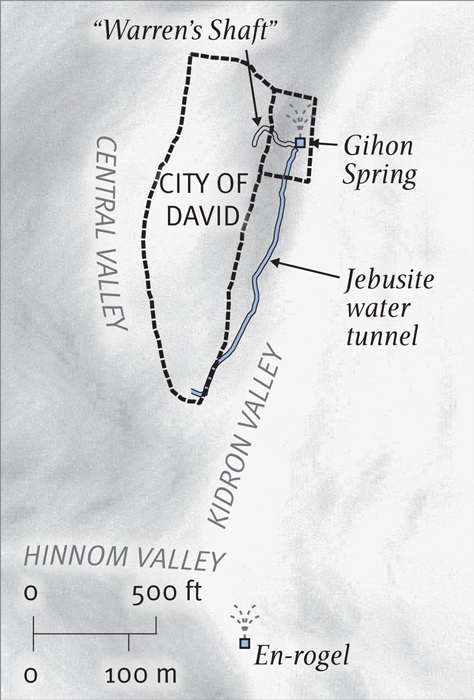
2 SAMUEL—NOTE ON 6:1–11 See 1 Chron. 13:1–14.
2 SAMUEL—NOTE ON 6:2 Baale-judah. Lit., "lords of Judah." Also known as Kiriath-jearim (1 Sam. 7:1–2), this town was located about 10 miles west of Jerusalem. ark of God. The ark of the covenant represented the glorious reputation and gracious presence of the Lord to Israel. the name. See note on Deut. 12:5. Lord of hosts. See note on 1 Sam. 1:3.
2 SAMUEL—NOTE ON 6:3 new cart. The Philistines had used a cart to transport the ark (1 Sam. 6:7). But the OT law required that the sacred ark be carried by the sons of Kohath (Num. 3:30–31; 4:15; 7:9), using the poles prescribed (Ex. 25:12–15). house of Abinadab. See 1 Sam. 7:1. Uzzah and Ahio. Descendants of Abinadab, possibly his grandsons.
2 SAMUEL—NOTE ON 6:6–8 See 1 Chron. 13:9–12.
2 SAMUEL—NOTE ON 6:7 because of his error. No matter how innocently it was done, touching the ark was in direct violation of God's law and was to result in death (see Num. 4:15). This was a means of preserving the sense of God's holiness and the fear of drawing near to him without appropriate preparation.
2 SAMUEL—NOTE ON 6:8 David was angry. Probably anger directed at himself because the calamity resulted from David's own carelessness. He was confused as to whether to carry on the transportation of the ark to Jerusalem (v. 9) and would not move it, fearing more death and calamity might come on him or the people (v. 10). It is likely that he waited to see the wrath of God subside before moving the ark.
2 SAMUEL—NOTE ON 6:10 Obed-edom the Gittite. Lit., "servant of Edom." The term "Gittite" can refer to someone from the Philistine city of Gath, but here it is better to see the term related to Gath-rimmon, one of the Levitical cities (cf. Josh. 21:24–25). Obed-edom is referred to as a Levite in Chronicles (1 Chron. 15:17–25; 16:5, 38; 26:4, 5, 8, 15; 2 Chron. 25:24).
2 SAMUEL—NOTE ON 6:12–19 See 1 Chron. 15:25–16:3.
2 SAMUEL—NOTE ON 6:12 blessed . . . because of the ark. During the three months when the ark remained with Obed-edom, the Lord blessed his family. In the same way God had blessed Obed-edom, David was confident that with the presence of the ark, the Lord would bless his house in ways that would last forever (7:29).
2 SAMUEL—NOTE ON 6:13 those who bore the ark. In David's second attempt to bring the ark to Jerusalem, it was transported in the manner prescribed by OT law. See note on v. 3. six steps. I.e., after the first six steps, not after every six steps.
2 SAMUEL—NOTE ON 6:14 David danced before the Lord. Cf. Ps. 150:4. The
Hebrews, like other ancient and modern people, had their physical expressions of religious joys as they praised God. linen ephod. See 1 Sam. 2:18.
2 SAMUEL—NOTE ON 6:16 Michal . . . despised him. Michal's contempt for David is explained by her sarcastic remark in v. 20. She considered David's unbridled, joyful dancing as conduct unbefitting for the dignity and gravity of a king because it exposed him in some ways.
2 SAMUEL—NOTE ON 6:17 tent. David had made a tent for the ark of the covenant until a permanent building for it could be built. Psalm 30 could refer possibly to this tent or to David's own home (2 Sam. 5:11–12).
2 SAMUEL—NOTE ON 6:20 bless his household. David desired the same inevitable success from the Lord as experienced in the household of Obed-edom (see v. 11). The attitude of Michal aborted the blessing at that time, but the Lord would bless David's house in the future (7:29). uncovering. A derogatory reference to the priestly attire that David wore (6:14) in place of his royal garments.
2 SAMUEL—NOTE ON 6:21 before the Lord. David's actions were for the delight of the Lord, not for the maidens.
2 SAMUEL—NOTE ON 6:22 abased in your eyes. The esv here follows the LXX, but the Hebrew reads "in my eyes" (see esv footnote). If so, then David is viewing himself with humility. It is the humble whom the Lord will exalt (cf. 1 Sam. 7:7–8).
2 SAMUEL—NOTE ON 6:23 Michal . . . had no child. Whether David ceased to have marital relations with Michal or the Lord disciplined Michal for her contempt of David, Michal bore no children. In OT times, it was a reproach to be childless (1 Sam. 1:5–6). Michal's childlessness prevented her from providing a successor to David's throne from the family of Saul (cf. 1 Sam. 15:22–28).
2 SAMUEL—NOTE ON 7:1–17 See 1 Chron. 17:1–15. These verses record the establishment of the Davidic Covenant, God's unconditional promise to David and his posterity. While not called a covenant here, it is later (2 Sam. 23:5). This promise is an important key to understanding God's irrevocable pledge of a king from the line of David to rule forever (7:16). It has been estimated that over 40 individual biblical passages are directly related to these verses (cf. Ps. 89; 110; 132); thus, this text is a major highlight in the OT. The ultimate fulfillment comes at Christ's second advent when he sets up his millennial kingdom on earth
(cf. Ezek. 37; Zech. 14; Rev. 19). This is the fourth of five irrevocable, unconditional covenants made by God. The first three include: 1) the Noahic Covenant (Gen. 9:8–17); 2) the Abrahamic Covenant (Gen. 15:12–21); and 3) the Levitic or Priestly Covenant (Num. 3:1–18; 18:1–20; 25:10–13). The New Covenant, which actually provided redemption, was revealed later through Jeremiah (Jer. 31:31–34) and accomplished by the death and resurrection of Jesus Christ. See note on Matt. 26:28.
2 SAMUEL—NOTE ON 7:1 lived in his house. See 5:11. David's palace was built with help from Hiram of Tyre. Since Hiram did not become king of Tyre until around 980 B.C., the events narrated in this chapter occurred in the last decade of David's reign. rest from all his surrounding enemies. David had conquered all the nations that were around Israel. See 8:1–14 for the details that occur prior to ch. 7.
2 SAMUEL—NOTE ON 7:2 Nathan. Mentioned here for the first time, Nathan played a significant role in ch. 12 (confronting David's sin with Bathsheba) and 1 Kings 1 (upsetting Adonijah's plot to usurp the throne from Solomon). in a tent. See note on 2 Sam. 6:17.
2 SAMUEL—NOTE ON 7:3 Go, do. Nathan the prophet encouraged David to pursue the noble project he had in mind and assured him of the Lord's blessing. However, neither David nor Nathan had consulted the Lord.
2 SAMUEL—NOTE ON 7:4–16 The Lord revealed his will to Nathan in this matter, to redirect the best human thoughts of the king.
2 SAMUEL—NOTE ON 7:5 Would you build me a house . . . ? Verses 5–7 are framed by two questions asked by the Lord, both of which pertain to building a temple for him. The first question, asking if David was the one who should build the temple, expected a negative answer (see 1 Chron. 17:4). According to 1 Chron. 22:8 and 28:3, David was not chosen by God to build the temple because he was a warrior who had shed much blood.
2 SAMUEL—NOTE ON 7:7 Why have you not built me a house . . . ? The second question, asking if the Lord had ever commanded any leader to build a temple for his ark, also expected a negative answer. So, contrary to Nathan's and David's intentions and assumptions, God did not want a house at that time and did not want David to build one.
2 SAMUEL—NOTE ON 7:8–16 a great name. These verses state the promises the Lord gave to David. Verses 8–11a give the promises to be realized during David's lifetime. Verses 11b–16 state the promises that would be fulfilled after David's death. During David's lifetime, the Lord: 1) gave David "a great name" (see note on Gen. 12:2); 2) appointed a place for Israel; and 3) gave David "rest" from all his enemies. After David's death, the Lord gave David: 1) a son to sit on his national throne, whom the Lord would oversee as a father with necessary chastening, discipline, and mercy (Solomon); and 2) a Son who would rule a kingdom that will be established forever (Messiah). This prophecy referred in its immediacy to Solomon and to the temporal kingdom of David's family in the land. But in a larger and more sublime sense, it refers to David's greater Son of another nature, Jesus Christ (cf. Heb. 1:8).
2 SAMUEL—NOTE ON 7:11 the Lord will make you a house. Although David desired to build the Lord a "house," i.e., a temple, instead it would be the Lord who would build David a "house," i.e., a dynasty.
2 SAMUEL—NOTE ON 7:12 your offspring. According to the rest of Scripture, it was the coming Messiah who would establish David's kingdom forever (see Isa. 9:6–7; Luke 1:32–33).
2 SAMUEL—NOTE ON 7:14 a father . . . a son. These words are directly related to Jesus the Messiah in Heb. 1:5. In Semitic thought, since the son had the full character of the father, the future seed or descendants of David would have the same essence of God. That Jesus Christ was God incarnate is the central theme of John's Gospel (see Introduction to John). When he commits iniquity. As a human father disciplines his sons, so the Lord would discipline David's descendants, if they committed iniquity. This has reference to the intermediary seed until Messiah's arrival (any king of David's line from Solomon on). However, the ultimate Seed of David will not be a sinner as David and his descendants were, as recorded in Samuel and Kings (see 2 Cor. 5:21). Significantly, Chronicles, focusing more directly on the Messiah, does not include this statement in its record of Nathan's words (1 Chron. 17:13).
2 SAMUEL—NOTE ON 7:15 This is an expression of the unconditional character of the Davidic Covenant. The Messiah will come to his glorious, eternal kingdom and that promise will not change.
2 SAMUEL—NOTE ON 7:16 your house . . . your kingdom . . . Your throne. Luke
1:32b–33 indicates that these three terms are fulfilled in Jesus, " And the Lord God will give to him the throne of his father David, and he will reign over the house of Jacob forever, and of his kingdom there will be no end." forever. This word conveys the idea of 1) an indeterminately long time or 2) into eternity future. It does not mean that there cannot be interruptions, but rather that the outcome is guaranteed. Christ's Davidic reign will conclude human history.
2 SAMUEL—NOTE ON 7:18–29 See 1 Chron. 17:16–27. David prayed with awe and thanksgiving over God's sovereign claim to bestow the divine blessing on his seed and nation.
2 SAMUEL—NOTE ON 7:18 sat before the Lord. I.e., before the ark of the covenant in the temporary tent. Who am I . . . ? David was overwhelmed by the Lord's promise that he would bring his kingdom through David's seed. In vv. 18–29, David referred to himself 10 times as "your servant" (vv. 19, 20, 21, 25, 26, 27, 28, 29), acknowledging his God-given title, "my servant David" (v. 5).
2 SAMUEL—NOTE ON 7:19 for a great while to come. David recognized that the Lord had spoken about the distant future, not only about his immediate descendant, Solomon. instruction for mankind. Lit., "and this is the law of man." The idea is that God's covenant promise is for an eternal kingdom, whereby the whole world of man shall be blessed, through the coming seed of David. The Davidic Covenant is thus a grant, conferring powers, rights, and privileges to David and his seed for the benefit of mankind, a promise that left David speechless (vv. 20–22).
2 SAMUEL—NOTE ON 7:23 your people. David is remembering aspects of the Abrahamic Covenant (cf. Gen. 12; 15; 17). Israel. In 2 Sam. 7:18–21, David praised the Lord for his favor to him. In vv. 22–24, David praised the Lord for the favor shown to the nation of Israel (cf. Deut. 7:6–11).
2 SAMUEL—NOTE ON 7:25 the word that you have spoken. In vv. 25–29, David prayed for the fulfillment of the divine promise spoken to him.
2 SAMUEL—NOTE ON 7:26–29 your words are true. David's prayer indicated that he fully accepted by faith the extraordinary, irrevocable promises God made to David as king and to Israel as a nation.
2 SAMUEL—NOTE ON 8:1–14 These verses outline the expansion of David's kingdom under the hand of the Lord (vv. 6, 14). Israel's major enemies were all
defeated as David's kingdom extended north, south, east, and west. See 1 Chron. 18:1–13. This conquering occurred before the event of 2 Sam. 7 (see 7:1).
2 SAMUEL—NOTE ON 8:1 Philistines . . . subdued. David's first priority was to deal with the Philistines to the west, whom he quickly defeated and subjugated (see 5:25). Metheg-ammah. Probably a reference to the chief city of the Philistines, Gath (cf. 1 Chron. 18:1). He defeated his enemies to the west.
2 SAMUEL—NOTE ON 8:2 Moab. David also defeated the Moabites who dwelt in Transjordan, east of the Dead Sea. This represented a change from the good relationship David once enjoyed with the Moabite royalty (cf. 1 Sam. 22:3–4). He defeated his enemies to the east. Two lines he measured. This could mean that David spared the young Moabites (whose height was approximately one cord) and executed the adults (whose height was two cords) or that one out of three rows of soldiers was arbitrarily chosen to be spared from execution. Such was a common practice of eastern kings in dealing with deadly enemies.
2 SAMUEL—NOTE ON 8:3–8 He defeated his enemies to the north. David had already defeated the Amalekites to the south (1 Sam. 30:16–17).
2 SAMUEL—NOTE ON 8:3 Hadadezer. Lit., "Hadad (the personal name of the Canaanite storm god) is my help." Psalm 60 was written to commemorate this battle. Zobah. An Aramaean kingdom north of Damascus (cf. 1 Sam. 14:47). river Euphrates. I.e., the most southwesterly point of the Euphrates River around the city of Tiphsah.
2 SAMUEL—NOTE ON 8:4 took . . . 1,700 horsemen. The reading of "7,000" in 1 Chron. 18:4 is preferable. See note there. hamstrung all the chariot horses. Hamstringing the horses disabled them from military action by cutting the back sinews of the hind legs (Josh. 11:6).
2 SAMUEL—NOTE ON 8:5 Syrians of Damascus. I.e., Syrians, who were peoples located around the city of Damascus as well as in the area of Zobah.
2 SAMUEL—NOTE ON 8:7 shields of gold. Ceremonial or decorative insignias that were not used in battle, but for decoration.
2 SAMUEL—NOTE ON 8:8 bronze. First Chronicles 18:8 notes three towns belonging to Hadadezer that yielded bronze that was later used in the construction of the temple.
2 SAMUEL—NOTE ON 8:9 Toi king of Hamath. Hamath was another Aramean territory located about 100 miles north of Damascus. The king, Toi, was thankful to see his enemy Zobah crushed and desired to establish good relations with David. So he gave David gifts to indicate that he voluntarily submitted to him as his vassal.
2 SAMUEL—NOTE ON 8:12 Edom. These were David's enemies to the south.
2 SAMUEL—NOTE ON 8:13 a name. The Lord began to fulfill his promise of giving David a great name (see 7:9). Edomites. See Ps. 60 and 1 Chron. 18:12. Valley of Salt. An area south of the Dead Sea.
2 SAMUEL—NOTE ON 8:15–18 See 1 Chron. 18:14–17. This is the record of the cabinet under David's rule.
2 SAMUEL—NOTE ON 8:15 justice and equity. David ruled his kingdom in a righteous manner, and in the future the "Messiah" will rule in a similar fashion (Isa. 9:7; Jer. 23:5; 33:15).
2 SAMUEL—NOTE ON 8:16 Joab. David's general (2:13; 1 Sam. 26:6). Jehoshaphat . . . recorder. The keeper of state records, and possibly the royal herald (1 Kings 4:3).
2 SAMUEL—NOTE ON 8:17 Zadok the son of Ahitub. Zadok, meaning "righteous," was a Levitical priest descended from Aaron through Eleazar (1 Chron. 6:3–8, 50–53), who, along with his house, was the fulfillment of the oracle by the man of God in 1 Sam. 2:35. Future sons of Zadok will be priests in the millennial kingdom of Messiah (Ezek. 44:15). Later, he became the only high priest in Solomon's reign, fulfilling God's promise to Phinehas (cf. Num. 25:10–13). Ahimelech the son of Abiathar. See 1 Sam. 22:20, which indicates that Abiathar is the son of Ahimelech. This is best accounted for by a scribal copying error (cf. 1 Chron. 18:16; 24:3, 6, 31). Abiathar was David's priest along with Zadok (2 Sam. 15:24, 35; 19:11). Abiathar traced his lineage through Eli (1 Kings 2:27) to Ithamar (1 Chron. 24:3). With Abiathar's removal (1 Kings 2:26–27), God's curse on Eli was completed (1 Sam. 2:33), and God's promise to Phinehas of Eleazar's line was fulfilled (cf. Num. 25:10–13; 1 Sam. 2:35). Seraiah was secretary. His name means "The Lord prevails," and he served as the official secretary of David.
2 SAMUEL—NOTE ON 8:18 Benaiah. His name means "The Lord builds," and he
served as the commander of David's personal bodyguard. He later became the commander-in-chief of Solomon's army (1 Kings 2:34–35; 4:4), after he killed Joab, David's general (cf. 1 Kings 2:28–35). Cherethites and the Pelethites. See note on 1 Sam. 30:14. priests. Though the Hebrew text referred to the sons of David as priests, the LXX referred to them as "princes of the court." The latter reading is supported by 1 Chron. 18:17, which refers to David's sons as "chiefs at the king's side."
2 SAMUEL—NOTE ON 9:1–20:26 These chapters begin with "the house of Saul" (9:1) and end with "Sheba . . . a Benjamite" (20:1). As with Saul, David is shown to be a failed king, albeit a repentant failure. It was only the grace and mercy of the Lord and his irrevocable covenant that kept David from being removed from the kingship, as Saul had been (cf. 7:15). The emphasis in this section is upon the troubles of David, troubles brought on by his own sin.
2 SAMUEL—NOTE ON 9:1 show him kindness for Jonathan's sake. David continued to display loving loyalty toward Jonathan (1 Sam. 20:42) by ministering to the physical needs of his crippled son, Mephibosheth (cf. 2 Sam. 4:4).
2 SAMUEL—NOTE ON 9:2 Ziba. A former servant of Saul, who is first mentioned here.
2 SAMUEL—NOTE ON 9:4 Machir the son of Ammiel. A man of wealth (see 17:27–29). Lo-debar. A city located in Gilead, east of the Jordan, about 10 miles south of the Sea of Galilee.
2 SAMUEL—NOTE ON 9:6 Mephibosheth. See note on 4:4.
2 SAMUEL—NOTE ON 9:7 restore . . . the land of Saul your father. The estate belonging to Saul was probably quite substantial. eat at my table. David desired to honor Mephibosheth by bringing him into the royal palace and providing for his daily needs (see 2 Kings 25:29).
2 SAMUEL—NOTE ON 9:8 dead dog. A "dead dog" was considered contemptible and useless. Mephibosheth saw himself as such in that he knew that he had not merited David's kindness and that there was no way for him to repay it. David's offer was an extraordinary expression of grace and beauty to his covenant with Jonathan (cf. 1 Sam. 18:3; 20:15, 42).
2 SAMUEL—NOTE ON 9:10 fifteen sons and twenty servants. This number shows the power and influence of Ziba. It also shows that the land given by David was substantial.
2 SAMUEL—NOTE ON 9:12 Mica. The descendants of Mica, the son of Mephibosheth, are listed in 1 Chron. 8:35–38 and 9:41–44.
The Setting of 2 Samuel
c. 1000 B.C.
The book of 2 Samuel recounts David's reign over Israel and his battles to establish Israel as the dominant power in Syria and Palestine. David expanded Israel's borders from Saul's fledgling territory until, by the end of his reign, he controlled all of Israel, Edom, Moab, Ammon, Syria, and Zobah. Other kingdoms, such as Tyre and Hamath, established treaties with him.
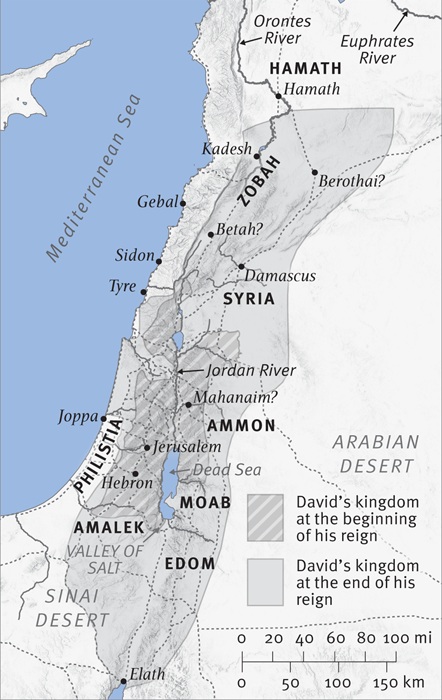
2 SAMUEL—NOTE ON 10:1–19 See 1 Chron. 19:1–19.
2 SAMUEL—NOTE ON 10:1 king of the Ammonites. I.e., Nahash (see note on 1 Sam. 11:1).
2 SAMUEL—NOTE ON 10:2 deal loyally with Hanun. Since Nahash was an enemy of Saul, he was viewed as a friend and supporter of David. It was implied that David and Nahash had entered into a covenant relationship, on the basis of which David desired to communicate his continuing loyalty to Nahash's son, Hanun.
2 SAMUEL—NOTE ON 10:3 the city. I.e., Rabbah (see note on 11:1).
2 SAMUEL—NOTE ON 10:4 shaved off half the beard of each. Forced shaving was considered an insult and a sign of submission (cf. Isa. 7:20). cut off their garments . . . at their hips. To those who wore long garments in that time, exposure of the buttocks was a shameful practice inflicted on prisoners of war (cf. Isa. 20:4). Perhaps this was partly the concern of Michal in regard to David's dancing (see 2 Sam. 6:14, 20).
2 SAMUEL—NOTE ON 10:5 Jericho. The first place west of the Jordan River that would have been reached by the servants of David as they returned from Rabbah.
2 SAMUEL—NOTE ON 10:6 Beth-rehob. An Aramean district located southwest of Zobah (cf. Num. 13:21; Judg. 18:28). Zobah. See note on 2 Sam. 8:3. Maacah. The region north of Lake Huleh north of Galilee (Deut. 3:14; Josh. 13:11–13). Tob. A city east of the Jordan River, located 45 miles northeast of Rabbah (Judg. 11:3, 5).
2 SAMUEL—NOTE ON 10:6–11 The Ammonite army was in the city ready for defense, while the Aramean mercenaries were at some distance, encamped in the fields around the city. Joab divided his forces to deal with both. See note on 1 Sam. 11:1.
2 SAMUEL—NOTE ON 10:12 Be of good courage . . . may the Lord do what seems good to him. Finding himself fighting on two fronts, Joab urged the army to "be strong" and recognize that the outcome of the battle depended ultimately upon the Lord (cf. 15:26). It was a just and necessary war forced on Israel, so
they could hope for God's blessing—and they received it (10:13–14).
2 SAMUEL—NOTE ON 10:14 Then Joab returned. He did not attempt to siege and capture the city of Rabbah at this time because the time was unseasonable (see note on 11:1). Cf. 12:26–29.
2 SAMUEL—NOTE ON 10:16 Hadadezer. See note on 8:3. Helam. The place of battle, about 7 miles north of Tob.
2 SAMUEL—NOTE ON 10:18 chariots . . . horsemen. See note on 1 Chron. 19:18.
2 SAMUEL—NOTE ON 10:19 made peace with Israel. All the petty kingdoms of Aram became subject to Israel and feared to aid Ammon against Israel.
2 SAMUEL—NOTE ON 11:1 the spring . . . when kings go out to battle. In the Near East, kings normally went out to battle in the spring of the year because of the good weather and the abundance of food available along the way. See note on 10:14. David sent Joab. David dispatched Joab, his army commander, with his mercenary soldiers and the army of Israel to continue the battle against Ammon begun the previous year (10:14). Rabbah. The capital of the Ammonites, about 24 miles east of the Jordan River opposite Jericho. The previous year, Abishai had defeated the Ammonite army in the open country, after which the remaining Ammonites fled behind the walls of the city of Rabbah for protection (10:14). Joab returned the next year to besiege the city. But David remained at Jerusalem. Staying home in such situations was not David's usual practice (5:2; 8:1–14; 10:17; but cf. 18:3; 21:17); this explicit remark implies criticism of David for remaining behind, as well as setting the stage for his devastating iniquity.
2 SAMUEL—NOTE ON 11:2 walking on the roof. The higher elevation of the palace roof allowed David to see into the courtyard of the nearby house. That same roof would later become the scene of other sinful immoralities (see 16:22).
2 SAMUEL—NOTE ON 11:3 Bathsheba. Not until 12:24 is her name used again. Rather, to intensify the sin of adultery, it is emphasized that she was the wife of Uriah (11:3, 26; 12:10, 15). Even the NT says "the wife of Uriah" (Matt. 1:6). Cf. Ex. 20:17. Eliam. The father of Bathsheba was one of David's mighty men (2 Sam. 23:34). Since Eliam was the son of Ahithophel, Bathsheba was Ahithophel's granddaughter (cf. 15:12; 16:15). This could explain why Ahithophel, one of David's counselors (15:12), later gave his allegiance to
Absalom in his revolt against David. Uriah. Also one of David's mighty men (23:39). Although a Hittite (cf. Gen. 15:20; Ex. 3:8, 17, 23), Uriah bore a Hebrew name meaning "the Lord is my light," indicating he was a worshiper of the one true God.
2 SAMUEL—NOTE ON 11:4 she came . . . he lay. These terms are euphemistic references to sexual intercourse (cf. Gen. 19:34), indicating that both Bathsheba and David were guilty of adultery. her uncleanness. Her recent days had involved menstruation and the required ceremonial purification (Lev. 15:19–30). They were followed by adulterous intercourse. The fact that she had just experienced menstruation makes it plain that Bathsheba was not pregnant by Uriah when she came to lie with David.
2 SAMUEL—NOTE ON 11:5 I am pregnant. The only words of Bathsheba recorded concerning this incident acknowledge the resultant condition of her sin, which became evident by her pregnancy and was punishable by death (Lev. 20:10; Deut. 22:22).
2 SAMUEL—NOTE ON 11:6–7 This inane conversation was a ploy to get Uriah to come home and sleep with his wife, so it would appear that he had fathered the child, thus sparing David the public shame and Bathsheba possible death.
2 SAMUEL—NOTE ON 11:8 wash your feet. Since this washing was done before going to bed, the idiom means to go home and go to bed. To a soldier coming from the battlefield, it said boldly, "enjoy your wife sexually." Hopefully, David's tryst with Bathsheba would be masked by Uriah's union. a present. This was designed to help Uriah and Bathsheba enjoy their evening together.
2 SAMUEL—NOTE ON 11:9 Uriah slept. Wanting to be a loyal example to his soldiers who were still in the field, Uriah did not take advantage of the king's less-than-honorable offer (v. 11).
2 SAMUEL—NOTE ON 11:11 The ark. The ark of the covenant was residing in either the tent in Jerusalem (6:17) or in a tent with the army of Israel on the battlefield (1 Sam. 4:6; 14:18).
2 SAMUEL—NOTE ON 11:13 made him drunk. Failing in his first attempt to cover up his sin, David tried unsuccessfully to make Uriah drunk so he would lose his resolve and self-discipline and return to his home and his wife's bed.
2 SAMUEL—NOTE ON 11:15 he may . . . die. Failing twice to cover up his sin with Bathsheba, the frustrated and panicked David plotted the murder of Uriah by taking advantage of Uriah's unswerving loyalty to him as king, even having Uriah deliver his own death warrant. Thus David engaged in another crime deserving of capital punishment (Lev. 24:17). This is graphic proof of the extremes people go to in pursuit of sin and in the absence of restraining grace.
2 SAMUEL—NOTE ON 11:18–24 Joab sent . . . Uriah . . . is dead. He sent a messenger with a veiled message to tell David his wish had been carried out. Joab must have known the reason behind this otherwise stupid military deployment.
2 SAMUEL—NOTE ON 11:25 encourage him. David hypocritically expressed indifference to those who died, and he consoled Joab, authorizing him to continue the attack against Rabbah.
2 SAMUEL—NOTE ON 11:26–27 the mourning was over. The customary period of mourning was probably seven days (Gen. 50:10; 1 Sam. 31:13). Significantly, the text makes no mention of mourning by David.
2 SAMUEL—NOTE ON 11:27 displeased the Lord. This sinful act would bring forth evil consequences.
2 SAMUEL—NOTE ON 12:1–14 Psalm 51 records David's words of repentance after being confronted by Nathan over his sin with Bathsheba (cf. Ps. 32, where David expresses his agony after Nathan's confrontation).
2 SAMUEL—NOTE ON 12:1 the Lord sent Nathan. The word "Lord" is conspicuously absent from the narrative of ch. 11 until v. 27, but then the Lord became actively involved by confronting David with his sin. As Joab had sent a messenger to David (11:18–19), so the Lord now sent his messenger to David.
2 SAMUEL—NOTE ON 12:1–4 two men . . . rich . . . poor. To understand this parable, it is necessary only to recognize that the rich man represented David, the poor man, Uriah, and the ewe lamb, Bathsheba.
2 SAMUEL—NOTE ON 12:5 deserves to die. According to Ex. 22:1, the penalty for stealing and slaughtering an ox or a sheep was not death, but restitution. However, in the parable, the stealing and slaughtering of the lamb represented the adultery with Bathsheba and the murder of Uriah by David. According to the
Mosaic law, both adultery (Lev. 20:10) and murder (Lev. 24:17) required punishment by death. In pronouncing this judgment on the rich man in the story, David unwittingly condemned himself to death.
2 SAMUEL—NOTE ON 12:6 fourfold. Exodus 22:1 demanded a fourfold restitution for the stealing of sheep. There is an allusion here to the subsequent death of four of David's sons: Bathsheba's first son (v. 18), Amnon (13:28–29), Absalom (16:14–15), and Adonijah (1 Kings 2:25).
2 SAMUEL—NOTE ON 12:7 anointed. Earlier, the prophet Samuel's confrontation with the sinful Saul emphasized the same point (1 Sam. 15:17).
2 SAMUEL—NOTE ON 12:8 your master's wives. This phraseology means nothing more than that God in his providence had given David, as king, everything that was Saul's. There is no evidence that he ever married any of Saul's wives, though the harem of eastern kings passed to their successors. Ahinoam, the wife of David (2:2; 3:2; 1 Sam. 25:43; 27:3; 30:5), is always referred to as the Jezreelitess, whereas Ahinoam, the wife of Saul, is distinguished clearly from her by being called "the daughter of Ahimaaz" (1 Sam. 14:50).
2 SAMUEL—NOTE ON 12:9 despised. To despise the word of the Lord was to break his commands and thus incur punishment (cf. Num. 15:31). In summarizing David's violations, his guilt is divinely affirmed.
2 SAMUEL—NOTE ON 12:10 the sword shall never depart from your house. David's tragic punishment was a lingering one. Since Uriah was killed by violence, the house of David would be continually plagued by violence. These words anticipated the violent deaths of Amnon (13:28–29), Absalom (18:14–15), and Adonijah (1 Kings 2:24–25).
2 SAMUEL—NOTE ON 12:11 evil . . . out of your own house. David had done evil to another man's family (11:27). Therefore, he would receive evil in his own family, such as Amnon's rape of Tamar (13:1–14), Absalom's murder of Amnon (13:28–29), and Absalom's rebellion against David (15:1–12). lie with your wives in the sight of this sun. This prediction was fulfilled by Absalom's public appropriation of David's royal concubines during his rebellion (16:21–22).
2 SAMUEL—NOTE ON 12:13 I have sinned against the Lord. David did not attempt to rationalize or justify his sin. When confronted with the facts, David's confession was immediate. The fuller confessions of David are found in Ps. 32
and 51. The Lord also has put away your sin. The Lord graciously forgave David's sin, but the inevitable temporal consequences of sin were experienced by him. Forgiveness does not always remove the consequences of sin in this life, only in the life to come. you shall not die. Although the sins of David legally demanded his death (see 2 Sam. 12:5), the Lord graciously released David from the required death penalty. There are events in the OT record where God required death and others where he showed grace and spared the sinner. This is consistent with justice and grace. Those who perished are illustrations of what all sinners deserve. Those who were spared are proofs and examples of God's grace.
2 SAMUEL—NOTE ON 12:14 you have utterly scorned the Lord. The Masoretic text says that David scorned the enemies of the Lord (see esv footnote). Because of God's reputation among those who opposed him, David's sin had to be judged. The judgment would begin with the death of Bathsheba's baby son.
2 SAMUEL—NOTE ON 12:23 I shall go to him. I.e., David would someday join his son after his own death (cf. 1 Sam. 28:19). Here is the confidence that there is a future reunion after death, which includes infants who have died being reunited with saints who die (see note on Matt. 19:14; cf. Mark 10:13–16).
2 SAMUEL—NOTE ON 12:24 Solomon. Either "(God is) peace" or "his replacement." Both were true of this child.
2 SAMUEL—NOTE ON 12:25 Jedidiah. "Beloved of the Lord" was Nathan's name for Solomon, who was loved in the sense of being chosen by the Lord to be the successor to David's throne, a remarkable instance of God's goodness and grace considering the sinful nature of the marriage.
2 SAMUEL—NOTE ON 12:29–31 See 1 Chron. 20:1–3.
2 SAMUEL—NOTE ON 12:29 David . . . took it. David completed what Joab had begun by capturing the city of Rabbah.
2 SAMUEL—NOTE ON 12:30 a talent of gold. About 75 lbs.
2 SAMUEL—NOTE ON 12:31 set them to labor. David imposed hard labor on the Ammonites. But these verses can also be translated with the sense that the Ammonites were cut with saws, indicating that David imposed cruel death on the captives in accordance with Ammonite ways (cf. 1 Sam. 11:2; Amos 1:13).
2 SAMUEL—NOTE ON 13:1–2 Tamar. "Palm tree." She was David's daughter by Maacah, the daughter of Talmai, king of Geshur (3:3), Absalom's (David's third son) full sister and half-sister of Amnon, David's first son by Ahinoam (3:2). Amnon's love for her was not filial, but lustful, as became clear in the story. Unmarried daughters were kept in seclusion from men, so that none could see them alone. Amnon had seen Tamar because of their family relationship and had conceived a violent passion for her. This was forbidden by God (see Lev. 18:11), yet with the example of Abraham (Gen. 20:12) and the common practice among the surrounding nations of marrying half-sisters, he felt justified and wanted his passion fulfilled with Tamar.
2 SAMUEL—NOTE ON 13:3 Jonadab. The son of David's brother, called Shammah in 1 Sam. 16:9; 17:3 and Shimea in 1 Chron. 2:13. Jonadab was Amnon's cousin and counselor who gave Amnon the plan by which he was able to rape Tamar.
2 SAMUEL—NOTE ON 13:12–13 this outrageous thing. Lit., "a wicked thing." Tamar appealed to Amnon with four reasons that he should not rape her. First, it was an utterly deplored act in Israel because it violated the law of God (see Lev. 18:11) and Tamar knew that such action could bring disharmony and bloodshed to the king's family, as it did. my shame. Second, as a fornicator, Tamar would be scorned as an object of reproach. Even though resistant to the evil crime perpetuated against her, Tamar would bear the stigma of one defiled. as one of the outrageous fools in Israel. Third, Amnon would be regarded by the people as a wicked fool, a God-rejecting man without principles who offended ordinary standards of morality, thereby jeopardizing Amnon's right to the throne. the king . . . will not withhold me from you. Fourth, Tamar appealed to Amnon to fulfill his physical desire for her through marriage. She surely knew that such a marriage between half siblings was not allowed by the Mosaic law (Lev. 18:9, 11; 20:17; Deut. 27:22), but in the desperation of the moment, Tamar was seeking to escape the immediate situation.
2 SAMUEL—NOTE ON 13:14 violated. A euphemism for "raped."
2 SAMUEL—NOTE ON 13:15 hated her. Amnon's "love" (v. 1) was nothing but sensual desire that, once gratified, turned to hatred. His sudden revulsion was the result of her unwilling resistance, the atrocity of what he had done, feelings of remorse, and dread of exposure and punishment. All of these rendered her intolerably undesirable to him.
2 SAMUEL—NOTE ON 13:15–17 Amnon's sending Tamar away was a greater wrong than the rape itself because it would inevitably have been supposed that she had been guilty of some shameful conduct, i.e., that the seduction had come from her.
2 SAMUEL—NOTE ON 13:18 long robe with sleeves. See Gen. 37:33. A garment which identified the wearer's special position. For Tamar, the robe identified her as a virgin daughter of the king. The tearing of this garment symbolized her loss of this special position (2 Sam. 13:19).
2 SAMUEL—NOTE ON 13:19 put ashes . . . tore the long robe . . . laid her hand . . . went away, crying aloud. The ashes were a sign of mourning. The torn garment symbolized the ruin of her life. The hand on the head was emblematic of exile and banishment. The crying showed that she viewed herself as good as dead.
2 SAMUEL—NOTE ON 13:20 do not take this to heart. Absalom told his sister not to pay undue attention or worry about the consequences of the rape. Absalom minimized the significance of what had taken place only for the moment, while already beginning to plot his revenge in using this crime as reason to do what he wanted to do anyway—remove Amnon from the line of succession to the throne (note also v. 32, where Jonadab knew of Absalom's plans). desolate. She remained unmarried and childless. Her full brother was her natural protector and the children of polygamists lived by themselves in different family units.
2 SAMUEL—NOTE ON 13:21 David . . . was very angry. Fury and indignation were David's reactions to the report of the rape (Gen. 34:7). Because he did not punish Amnon for his crime, he abdicated his responsibility both as king and as father. The lack of justice in the land would come back to haunt David in a future day (2 Sam. 15:4).
2 SAMUEL—NOTE ON 13:22 Absalom hated Amnon. As Amnon hated Tamar (v. 15), Absalom loathed his half-brother, Amnon.
2 SAMUEL—NOTE ON 13:23–27 Baal-hazor. The Benjamite village of Hazor (Neh. 11:33), located about 12 miles northeast of Jerusalem, was the place for a sheep-shearing feast put on by Absalom, to which he invited all his brothers and half-brothers, as well as King David and his royal court (2 Sam. 13:24). David declined, but encouraged Absalom to hold the feast for "the king's sons" as a
means to unity and harmony (vv. 25–27). With David's denial of the invitation, Absalom requested that Amnon go as his representative. Although David had reservations concerning Absalom's intent, he allowed all his sons to go.
2 SAMUEL—NOTE ON 13:28–29 kill him. Absalom murdered Amnon through his servants (cf. 11:15–17), just as David had killed Uriah through others (11:14– 17). Though rape was punishable by death, personal vengeance such as this was unacceptable to God. Due course of law was to be carried out.
2 SAMUEL—NOTE ON 13:29 his mule. Mules were ridden by the royal family in David's kingdom (18:9; 1 Kings 1:33, 38, 44).
2 SAMUEL—NOTE ON 13:30 all the king's sons. This exaggeration plunged everyone into grief (v. 31) until it was corrected (v. 32).
2 SAMUEL—NOTE ON 13:32 Jonadab . . . said. Jonadab knew of Absalom's plot to kill Amnon (see v. 20) for the rape of Tamar. Death was prescribed in Lev. 18:11, 29 ("cut off " means to execute). See note on 2 Sam. 13:28–29.
2 SAMUEL—NOTE ON 13:34, 37 Absalom fled. The law regarding premeditated murder, as most would view Absalom's act, gave him no hope of returning (see Num. 35:21). The cities of refuge would afford him no sanctuary, so he left his father's kingdom to live in Geshur, east of the Sea of Galilee, under the protection of the king who was the grandfather of both Tamar and Absalom (see note on 2 Sam. 13:1–2).
2 SAMUEL—NOTE ON 13:39 longed to go. David gradually accepted the fact of Amnon's death and desired to see Absalom again, but took no action to bring him back.
2 SAMUEL—NOTE ON 14:1 David was strongly attached to Absalom, and, having gotten over the death of Amnon, he desired the fellowship of his exiled son, three years absent. But the fear of public opinion made him hesitant to pardon his son. Joab, perceiving this struggle between parental affection and royal duty, devised a plan involving a wise country woman and a story told to the king.
2 SAMUEL—NOTE ON 14:2 Tekoa. A town about 10 miles south of Jerusalem (cf. Amos 1:1).
2 SAMUEL—NOTE ON 14:2–3 Joab put the words in her mouth. Joab used a
story, as Nathan had (12:1–12), to show David the error of his ways and to encourage him to call Absalom back to Jerusalem.
2 SAMUEL—NOTE ON 14:7 leave to my husband neither name nor remnant. The story the woman told involved one brother killing another (v. 6). If the death penalty for murder was invoked (cf. Ex. 21:12; Lev. 24:17), there would be no living heir in the family, leaving that family with no future, a situation the law sought to avoid (Deut. 25:5–10). This would extinguish the last "coal" of hope for a future for her line. Cf. 2 Sam. 21:17; Ps. 132:17, where the lamp refers to posterity.
2 SAMUEL—NOTE ON 14:9 On me be the guilt. The woman was willing to receive whatever blame might arise from the sparing of her guilty son.
2 SAMUEL—NOTE ON 14:11 avenger of blood. This is a specific term identifying the nearest relative of the deceased who would seek to put to death the murderer (Num. 35:6–28; Deut. 19:1–13; Matt. 27:25). not one hair. This is an expression meaning that no harm will come to the son of the widow in the story.
2 SAMUEL—NOTE ON 14:13 against the people of God. The woman asserted that by allowing Absalom to remain in exile, David had jeopardized the future welfare of Israel. If he would be so generous to a son he did not know in a family he did not know, would he not forgive his own son?
2 SAMUEL—NOTE ON 14:14 like water spilled on the ground. I.e., death is irreversible. God will not take away life. The woman stated that since God acts according to the dictates of mercy, as in David's own experience (12:13), David was obligated to do likewise.
2 SAMUEL—NOTE ON 14:15–16 the people . . . the man who would destroy me and my son. Those who were seeking to kill the son of the woman were like the people David feared who resented what Absalom had done and would have stood against a pardon for him.
2 SAMUEL—NOTE ON 14:18–20 David gets the intent of the story and discerns the source as Joab.
2 SAMUEL—NOTE ON 14:22 Joab's motives were selfish, in that he sought to ingratiate himself further with David for greater influence and power.
2 SAMUEL—NOTE ON 14:23 Geshur. See note on 13:34, 37.
2 SAMUEL—NOTE ON 14:24 he is not to come into my presence. Absalom returned to Jerusalem, but the estrangement with his father continued.
2 SAMUEL—NOTE ON 14:25 handsome. As with Saul before him (1 Sam. 9:1–2), Absalom looked like a king. His extraordinary popularity arose from his appearance.
2 SAMUEL—NOTE ON 14:26 hair of his head. At his annual haircut, it was determined that Absalom's head produced approximately 5 lbs. of hair that had to be cut off.
2 SAMUEL—NOTE ON 14:27 three sons. See note on 18:18. daughter . . . Tamar. Absalom named his daughter after his sister Tamar.
2 SAMUEL—NOTE ON 14:28 two full years. Whatever were David's errors in recalling Absalom, he displayed great restraint in wanting to stay apart from Absalom to lead his son through a time of repentance and a real restoration. Rather than produce repentance, however, Absalom's non-access to the royal court and all its amenities frustrated him so that he sent for Joab to intercede (v. 29).
2 SAMUEL—NOTE ON 14:30–32 set the field on fire. This was an act of aggression by Absalom to force Joab to act in his behalf with David, his father. Such a crime was serious, as it destroyed the livelihood of the owner and workers. It reveals that Absalom's heart was not repentant and submissive, but manipulative. He wanted an ultimatum delivered to David: Accept me or kill me!
2 SAMUEL—NOTE ON 14:33 the king kissed Absalom. The kiss signified David's forgiveness and Absalom's reconciliation with the family.
2 SAMUEL—NOTE ON 15:1 chariot and horses, and fifty men. After the reconciliation, Absalom possessed the symbols of royalty (see 1 Sam. 8:11).
2 SAMUEL—NOTE ON 15:1–6 stole the hearts. Public hearings were always conducted early in the morning in a court held outside by the city gates. Absalom positioned himself there to win favor. Because King David was busy with other matters or with wars, and was also aging, many matters were left
unresolved, building a deep feeling of resentment among the people. Absalom used that situation to undermine his father, by gratifying all he could with a favorable settlement and showing them all warm cordiality. Thus, he won the people to himself, without them knowing his wicked ambition.
2 SAMUEL—NOTE ON 15:7 four years. The four-year period began either with Absalom's return from Geshur (14:23) or with his reconciliation with David (14:33). The alternate reading "forty" (see esv footnote; nkjv; nasb) could refer neither to the age of Absalom since he was born at Hebron after David had begun to rule (3:2–5), nor the time of David's reign, since he ruled only 40 years total (5:4–5).
2 SAMUEL—NOTE ON 15:7–9 Hebron. The city of Absalom's birth (3:2–3), and the place where David was first anointed king over Judah (2:4) and over all Israel (5:3). Absalom said he had made a vow while in Geshur (see note on 13:34, 37) that if he was restored to Jerusalem, he would offer a sacrifice of thanksgiving in Hebron, where sacrifices were often made before the temple was built. David, who always encouraged such religious devotion, gave his consent.
2 SAMUEL—NOTE ON 15:10–12 Absalom formed a conspiracy, which included taking some of the leading men to create the impression that the king supported this action, and was in his old age sharing the kingdom. All of this was a subtle disguise so Absalom could have freedom to plan his revolution. Absalom was able to do this against his father not merely because of his cleverness, but also because of the laxness of his father (see 1 Kings 1:6).
2 SAMUEL—NOTE ON 15:12 Ahithophel. A counselor of David who was considered a man who "consulted the word of God" (16:23). This man was the father of Eliam (23:34) and the grandfather of Bathsheba (11:3; 23:24–39), who may have been looking for revenge on David. Giloh. A town in the hill country of Judah (Josh. 15:48, 51), probably located a few miles south of Hebron.
2 SAMUEL—NOTE ON 15:13–17 David's escape from Absalom is remembered in Ps. 3. Because he wanted to preserve the city he had beautified, and not have a war there, and since he felt that he could find greater support in the country, David left the city with all his household and personal guards.
2 SAMUEL—NOTE ON 15:18 Cherethites . . . Pelethites. Foreign mercenary soldiers of King David. See note on 1 Sam. 30:14. Gittites. Mercenary soldiers
from Gath, i.e., Philistines.
2 SAMUEL—NOTE ON 15:19–22 Ittai. The commander of the Gittites, who had only recently joined David. In spite of David's words, he displayed his loyalty by going into exile with him. Ittai's later appointment as commander of one-third of the army (18:2, 5, 12) was David's way of expressing appreciation for his loyalty.
2 SAMUEL—NOTE ON 15:23–28 Psalm 63 has this occasion in view or possibly 1 Sam. 23:14.
2 SAMUEL—NOTE ON 15:23 brook Kidron. This familiar valley, running north/south along the eastern side of Jerusalem, separates the city from the Mount of Olives.
2 SAMUEL—NOTE ON 15:24–29 Abiathar . . . Zadok. See notes on 8:17. They brought the ark to comfort David with assurance of God's blessing, but he saw that as placing more confidence in the symbol than in God and sent it back. David knew the possession of the ark did not guarantee God's blessing (cf. 1 Sam. 4:3).
2 SAMUEL—NOTE ON 15:28 fords of the wilderness. Probably the region along the western bank of the Jordan River (see 17:16; Josh. 5:10).
2 SAMUEL—NOTE ON 15:30 Mount of Olives. The hill to the east of the city of Jerusalem was the location for David's contrition and remorse over his sins and their results. This was the location from which Jesus ascended to heaven (Acts 1:9–12).
2 SAMUEL—NOTE ON 15:32 summit. This was the place from which David could look toward the city to the west. Hushai the Archite. Hushai was of the clan of the Archites who lived in Ephraim on the border with Manasseh (Josh. 16:2) and served as an official counselor to David (2 Sam. 15:37; 1 Chron. 27:33). David persuaded Hushai to return to Jerusalem and attach himself to Absalom as a counselor. His mission was to contradict the advice of Ahithophel (2 Sam. 17:5– 14) and to communicate Absalom's plans to David (17:21; 18:19).
2 SAMUEL—NOTE ON 16:1 Ziba. See note on 9:2. Mephibosheth. Saul's grandson by Jonathan (see note on 4:4).