
39. Magog. Some see this people as derived from Japheth (Gen. 10:2), later
and Jacob (Gen. 12:7; 26:24; 35:12).
EZEKIEL—NOTE ON 37:26 covenant of peace. Cf. 34:25. This is the New Covenant in full force. Israel has never yet been in a state of perpetual salvation peace; this awaits fulfillment in the future kingdom of the Messiah who is the "Prince of Peace" (Isa. 9:6). an everlasting covenant. The everlasting nature of the Abrahamic (cf. Gen. 17:7), Davidic (2 Sam. 23:5), and New (Jer. 50:5) Covenants are joined together in the redeemed who experience the millennial kingdom "forever" (used four times in Ezek. 37:25–28). The Hebrew word for "everlasting" may refer to a long time or eternity. It is also true that these covenants will continue to be fulfilled after the Millennium in the eternal state. my sanctuary. The Spirit of God begins to prepare for the great reality that God will have a sanctuary in the midst of his people and will dwell with them (cf. Zech. 6:12–13). God promised to dwell with man on earth (Ezek. 47:1–12). This has been God's desire in all epochs: 1) before Moses (Gen. 17:7–8); 2) in the Mosaic era (Lev. 26:11–13); 3) in the church era (1 Cor. 3:16; 6:19); 4) in the millennium (Ezek. 37:26–28); and 5) in eternity future (Rev. 21:3).
EZEKIEL—NOTE ON 37:27 Paul quotes this in 2 Cor. 6:16.
EZEKIEL—NOTE ON 38:1–39:29 These chapters tell of a coming northern confederacy of nations who will invade the Promised Land.
EZEKIEL—NOTE ON 38:2 toward Gog. This name is found in 1 Chron. 5:4. The lxx used "Gog" to render names such as Agag (Num. 24:7) and Og (Deut. 3:1), possibly showing that though it was a proper name, it came to be used as a general title for an enemy of God's people. "Gog" most likely carries the idea "high" or "supreme one," based on the comparison in Num. 24:7. It refers to a person, described as a "prince" from the land of Magog, who is the final Antichrist. See note on Rev. 20:8, where Gog and Magog are referred to again. These titles are used there symbolically of the final world uprising against Jerusalem, its people and Messiah King. This attack comes not just from the north but the four corners of the world, as a world of sinners at the end of the 1,000-year kingdom come to fight the saints in the "beloved city" of Jerusalem. On that occasion, there is only one weapon used—divine fire. This is the climax to the last battle with Satan and his armies, whose eternal destiny is set. It is followed by the final judgment of all the ungodly before the Lord (Rev. 20:11– 15) and the creation of the eternal, sinless state (Rev. 21:1). See notes on Ezek. 39. Magog. Some see this people as derived from Japheth (Gen. 10:2), later
called the Scythians. Others propose a people in southeast Anatolia, later known as Asiatic people such as the Mongols and Huns. Others see Magog as an overall term for barbarians, north of Palestine, around the Caspian and Black Seas. prince of Meshech and Tubal. Should be translated "chief prince of Meshech and Tubal" (see alternative reading in esv foornote) because: 1) Rosh (more than 600 times) in the Hebrew OT is an adjective, "chief," often in references to the "chief priest" (2 Kings 25:18); 2) most ancient versions took it to mean "chief " or "head"; and 3) in all places other than Ezek. 38 and 39 where both Meshech and Tubal are mentioned, Rosh is not listed as a third people (27:13; 32:26; Gen. 10:2; 1 Chron. 1:5). This is also descriptive of the Antichrist, who rises to world dominance in the coming time of tribulation (cf. Dan. 9:24–27; 11:36–45; Rev. 13:1–17; 19:20). Meshech and Tubal. Two peoples were recognized in ancient Assyrian monuments: one called Mushki (Mushku) and the other Tubali (Tabal). Both were in Asia Minor, the area of Magog, modern-day Turkey. Summing up, a chief prince, who is the enemy of God's people, will lead a coalition of nations against Jerusalem. The details of this enemy force and its destruction are given by Ezekiel in the rest of Ezek. 38 and 39.
EZEKIEL—NOTE ON 38:4 I will turn you about. Just as God used Assyria (Isa. 8) and Babylon (Ezek. 21:19) as human invaders for his judgments, he aims to use this army. In this case, he brings the invader to Palestine so that he may visit judgment (38:8) on the invader itself (38:18–23; 39:1–10). He thus uses the language of hooks in the jaws, as in judging Egypt (29:4). From the aggressors' perspective, they think that it is their plan only to seize the spoil that draws them to Palestine (38:11–12).
EZEKIEL—NOTE ON 38:5 Persia, Cush, and Put. The invasion involves a coalition of powers from the east and south of Palestine. Persia is modern Iran, Put (Libya) is in north Africa, west of Egypt; and Cush (Ethiopia) is south of Egypt.
EZEKIEL—NOTE ON 38:6 Gomer. Today the area is Armenia, which also was known as Cappadocia, having a people called Gomer in Assyrian inscriptions. Beth-togarmah. Today's eastern Turkey (see note on 27:14).
EZEKIEL—NOTE ON 38:7–8 This is the great time of Israel's cleansing, salvation, and spiritual life (cf. 39:22, 27–28; Zech. 12:10–13:9), getting them ready for Messiah's return and kingdom (Zech. 14).
EZEKIEL—NOTE ON 38:8 In the latter years. In the context of Israel's restoration (Ezek. 34–39), the invader will make its final bid for the land. restored from war. This refers to Israelites who have been returned to their land, after the sword had killed or scattered many of their people. The Hebrew word for "restored" means "to return" (Gen. 40:13; 41:13). gathered. This word also frequently refers to God's final regathering of Israel (Ezek. 37:21; Isa. 11:12; 43:5; Jer. 32:37). It has begun historically and will continue until the latter days. In the final millennial kingdom, there will occur the full and spiritual regathering, when all Israel is saved to enter their promised kingdom (cf. Zech. 12–14; Rom. 11:25–27). dwell securely. This term occurs in several contexts devoted to the Israelites' blessed estate after God has brought them back to their land (Ezek. 28:26; 34:25, 28; 39:26; Jer. 32:37; Zech. 14:11).
EZEKIEL—NOTE ON 38:9 You will advance. The time of the invasion is best understood as the end of the future tribulation period of seven years. Israel will have been under a false peace in treaty with the Antichrist (Dan. 9:27; 11:22, 24), before he turns on them in the "abomination of desolation" (Matt. 24:15; cf. Dan. 9:27). The false peace will end in hostility lasting to the completion of the seven years (Zech. 14:1–3). When this final war occurs (cf. Rev. 16:12–16), Christ will ultimately conquer the beast, the false prophet, and all the ungodly forces (Rev. 19:11–21) in order to establish his millennial kingdom (Rev. 20:1– 10).
EZEKIEL—NOTE ON 38:10–13 This describes the peace in Israel during the period of Antichrist's short-lived treaty with them (Dan. 9:27) in the first half of Daniel's seventieth week. References to "unwalled villages," refer to that period of three and one-half years when Israel is secure under the protection of the world-ruling "prince that shall come," called Antichrist (cf. Dan. 9:27). After Antichrist turns on Israel, there is an escalation of hostility until the end of the seven-year time when this great force comes to plunder Jerusalem and the Promised Land (Ezek. 38:12).
EZEKIEL—NOTE ON 38:12 to seize spoil . . . plunder. Antichrist takes over the world for his own power and possession. The wealth of his empire is described in Rev. 18.
EZEKIEL—NOTE ON 38:13 Dedan . . . Tarshish. See note on Jonah 1:3.
EZEKIEL—NOTE ON 38:15 riding on horses. These could be actual horses used in
war, if tribulation judgments (seals, trumpets, vials) in Rev. 6–16 have dealt drastic blows to industries producing war vehicles and weaponry. Or, some see horses and weapons here (Ezek. 39:3, 9) being used symbolically to represent meaning that would be easy to grasp in Ezekiel's day, but that would be fulfilled in the future time with different war forms suitable to that time.
EZEKIEL—NOTE ON 38:16 that the nations may know me. The phrase, frequent in Ezekiel, is part of the theme to glorify God and show his sovereign power (cf. Introduction: Historical and Theological Themes). God is the victor, who will be "vindicated" by fire (cf. v. 19).
EZEKIEL—NOTE ON 38:17 Are you he . . . ? See notes on 38:2. This refers to the general references to this time and the participants (cf. Joel 3:9–17; Amos 5:11– 12; Zeph. 3:8). Even Daniel (Dan. 2:41–44) referred to this time at least three decades prior to Ezek. 38. The nature of the question presupposes that the previous generalities are now being particularized in the person of Gog.
EZEKIEL—NOTE ON 38:18–23 my wrath will be roused. God's patience will be exhausted with the repeated attempts to annihilate Israel since the "abomination" by Antichrist (Dan. 9:27; Matt. 24:15), and he will employ a great earthquake in Israel; panic will seize the invading soldiers (Ezek. 38:21) who will turn and use their weapons against one another (cf. 2 Chron. 20:22–23). He will further decimate the ranks by pestilence, a deluge of rain, large hailstones, plus fire and brimstone. The descriptions here are identical to that of the last half of the sevenyear tribulation in Rev. 6:12–17; 11:19; 16:17–21; 19:11–21.
EZEKIEL—NOTE ON 39:1–10 I am against you. This scene of the army's ruin adds detail to 38:18–23 such as: 1) the disarming of soldiers (39:3); 2) their fall in death (vv. 4–5); 3) the gorging of birds and beasts on the corpses (v. 4); 4) fire sent also on others besides the army (v. 6); and 5) burning of weapons by Israelites (vv. 9–10).
EZEKIEL—NOTE ON 39:9–10 make fires of the weapons. There is enough equipment to provide fuel for seven years.
EZEKIEL—NOTE ON 39:9 seven years. A vast army (cf. "many," 38:15) would have much weaponry, requiring seven years to burn. Since this is likely at the end of the time of tribulation, synonymous with the battle of Armageddon (Rev. 16:16; 19:19–21), the burials would extend into the millennial kingdom.
EZEKIEL—NOTE ON 39:11–16 give to Gog a place for burial. Israelites moving east from the Mediterranean, with the sea to their backs and the Jezreel Valley before them, bury bodies. Further, people in the whole land help in the internment, which consumes seven months. The description fits the time after Christ's second advent extending into the millennial era as those who go into his kingdom do the work (cf. Rev. 20:1–10).
EZEKIEL—NOTE ON 39:11, 16 Hamon-gog. Lit., "the multitude of Gog." In v. 16, a city in the area will be named Hamonah, "multitude" (cf. a similar idea in Joel 3:14).
EZEKIEL—NOTE ON 39:17–20 Speak to the birds and . . . beasts. God's word summons carrion birds and carnivorous animals to consume the fallen flesh as described in Rev. 19:21.
EZEKIEL—NOTE ON 39:17–18 sacrificial feast. Since God describes the feast by the imagery of a sacrificial meal, the warriors who fell (v. 19) are described figuratively in words such as rams and other animals used in sacrifice.
EZEKIEL—NOTE ON 39:21–29 I will set my glory. God vanquishes Israel's foes to show his glory so that his enemies and Israel will all know that he is the Lord (vv. 6, 22). This is Israel's salvation spoken of in Zech. 12:10–13:9 and Rom. 11:25–27.
EZEKIEL—NOTE ON 39:29 pour out my Spirit. God's provision of his Spirit at the second advent complements the regathering (cf. 36:27; 37:14; Joel 2:28). The Gog and Magog assault in Rev. 20:7–9 at the end of the millennium is another assault on Jerusalem patterned after certain images of the invasion here (Ezek. 38–39), but it is a distinct event 1,000 years after the millennial kingdom begins. See note on Rev. 20:8–9.
EZEKIEL—NOTE ON 40:1–48:35 Following this great battle at the end of the time of tribulation, this section provides explicit details concerning Christ's millennial reign that follows, giving more detail about the 1,000-year kingdom than all other OT prophecies put together. It is the "holy of holies" among millennial forecasts. As has been done with the previous 39 chapters, this concluding portion will also be approached in a literal, historical manner, which best serves the interpreter in all Scripture. In many ways these chapters are the most important in the book since they form the crowning reality, the climax of Ezekiel's prophecy and Israel's restoration. The section includes: 1) the new temple (40:1–43:12); 2) the new worship (43:13–46:24); and 3) the new apportionment of the land (47:1–48:35).
EZEKIEL—NOTE ON 40:1 the twenty-fifth year. 573 B.C., in the first month of the ecclesiastical year, Nisan. The tenth day was the start of preparations for Passover.
EZEKIEL—NOTE ON 40:2 In visions of God he brought me. Ezekiel 40–48 narrates another vision, as did 1:1–3:27; 8–11; and 37:1–14. The characterization of the prophecy as a vision in no way detracts from its literal reality any more than Ezekiel's visions of Jerusalem's sins, idolatry, and destruction did. to the land of Israel. The vision pertains to Israel, as did chs. 1–24; 33; 34–39. a very high mountain. The mountain is not named; however, it is most likely Mount Zion (cf. 17:22; 20:40; Isa. 2:2; Mic. 4:1), lifted up from its surroundings by a great earthquake (Zech. 14:4–5, 10). structure like a city. God will be explaining details relating to Israel's spiritual future (Ezek. 40:2, 4), so this must be the temple in particular and Jerusalem in general. This new and glorious temple will stand in contrast to the desecration and destruction of Solomon's temple (chs. 8–11).
EZEKIEL—NOTE ON 40:3 a man. An angel conducted a tour of all the details shown to the prophet, appearing in the form of a man (e. g., Gen. 18; Ezek. 9), appearing like bright, gleaming bronze. He could be understood as the angel of the Lord since he is called "Lord" (44:2, 5; see note on Ex. 3:2). His "linen cord" was for larger measurements, the "reed" for shorter ones (cf. Rev. 11:1; 21:5). In each case God measured what belongs to him.
EZEKIEL—NOTE ON 40:4 Declare all that you see. Ezekiel 1–24 refers to Israel's historical removal from her land; chs. 25–32 to historical judgments against other nations; ch. 33 to a historical call to repentance and the fall of Jerusalem.
So in chs. 34–39, Israel's literal, future return to the same land as a reversal of the historical dispersion is the most natural way to interpret the chapters. Ezekiel 38–39 describe a future, historical invasion of Israel and its aftermath during the time just before Messiah's return. Therefore, chs. 40–48 would then be thought to continue the historical, prophetic pattern, describing the millennial conditions after Messiah comes and destroys the ungodly (Rev. 19:11ff.), under which Israel will live and worship. Believing Gentiles will also be in the kingdom as sheep of the great shepherd (cf. Matt. 25:31–46), while all unbelievers are destroyed. Ezekiel is to write down all the details.
EZEKIEL—NOTE ON 40:5 a wall all around the outside. This outer wall is later described as a separation of the holy areas (42:20). the temple. See 1 Kings 6–7 to compare with details of Solomon's temple. This could not be the heavenly temple since Ezekiel was taken to Israel to see it (Ezek. 40:2). It could not be Zerubbabel's temple since the glory of God was not present then. It could not be the eternal temple since the Lord and the Lamb are its temple (cf. Rev. 21:22). Therefore, it must be the earthly millennial temple built with all of the exquisite details that are yet to be outlined. measuring reed . . . six long cubits . . . a handbreadth. The rod extended 6 royal (long) cubits of 21 inches for a total of 10.5 feet, each cubit being made up of a standard width of 18 inches and a handbreadth of 3 inches.
EZEKIEL—NOTE ON 40:6–7 the gateway . . . east. The buildings of the east gate are first because this will be in the direct line of approach to the temple. Each opening was 10.5 feet across. Chambers (rooms) in the wall are 10.5 x 10.5 feet. Precise measurements describe a literal temple, not a symbolic one.
EZEKIEL—NOTE ON 40:8–16 The chambers described here are accommodations for the ministering priests and temple officers who care for the temple.
EZEKIEL—NOTE ON 40:16 windows. Since they had no glass, these are lattices (cf. 41:16–26). on the jambs were palm trees. These depict God's desire for fruit in Israel. Palms are symbols of beauty, salvation, and triumph (cf. Zech. 14:16ff.; Rev. 7:9). Palms are on the inner court's side pillars as well (Ezek. 40:31).
Ezekiel's Temple
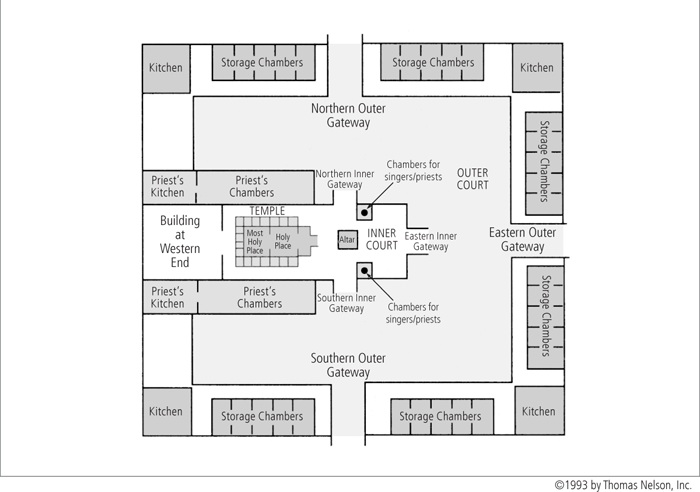
EZEKIEL—NOTE ON 40:17 the outer court. This court is farthest out from the temple proper and enclosed by the outer walls.
EZEKIEL—NOTE ON 40:17–37 Here is a further blueprint for the temple area, with more precise measurements. The numbers 5, 25, 50 and 100 are frequently used. The sanctuary formed a square of some 500 cubits.
EZEKIEL—NOTE ON 40:38–47 This section describes "chambers" for the priests, and raises the question of sacrifices in the millennial kingdom. They will exist as vv. 39–43 indicate, but will be no more efficacious then than they were in OT times. No sacrifice before or after Christ saves. They only point to him as the one true Lamb who takes away sin. The Lord's Supper is a memorial that looks back to Calvary and in no way diminishes the cross. Israel rejected their Messiah, but when they have received him and are in his kingdom, they will have a memorial of sacrifices that point to him. They will have missed the memorial of the Lord's Supper, but will then have their own memorial sacrifices for 1,000 years.