
only those who are alive at his coming. This is sometimes referred to as the
master.
MATTHEW—NOTE ON 25:26 You knew that I reap where I have not sown. In repeating the slave's charge against him, the master was not acknowledging that it was true. He was allowing the man's own words to condemn him. If the slave really believed the master to be the kind of man he portrayed, that was all the more reason for him not to be slothful. His accusation against the master—even if it had been true—did not justify his own laziness.
MATTHEW—NOTE ON 25:29 to everyone who has will more be given. See 13:12. The recipients of divine grace inherit immeasurable blessings in addition to eternal life and the favor of God (cf. Rom. 8:32). But those who despise the riches of God's goodness, forbearance, and longsuffering (Rom. 2:4), burying them in the ground and clinging instead to the paltry and transient goods of this world, will ultimately lose everything they have (cf. Matt. 6:19; John 12:25).
MATTHEW—NOTE ON 25:30 outer darkness . . . weeping and gnashing of teeth. See note on 22:13.
MATTHEW—NOTE ON 25:31 he will sit on his glorious throne. This speaks of the earthly reign of Christ described in Rev. 20:4–6. The judgment described here in Matt. 25:32–46 is different from the great white throne judgment of Rev. 20:11– 15. This judgment precedes Christ's millennial reign, and the subjects seem to be only those who are alive at his coming. This is sometimes referred to as the judgment of the nations, but his verdicts address individuals in the nations, not the nations as a whole (cf. Matt. 25:46).
MATTHEW—NOTE ON 25:32–33 sheep. I.e., believers (10:16; Ps. 79:13; Ezek. 34). They are given the place on "his right"—the place of favor. goats. These represent unbelievers, consigned to the place of dishonor and rejection.
MATTHEW—NOTE ON 25:34 prepared for you. This terminology underscores that their salvation is a gracious gift of God, not something merited by the deeds described in vv. 35–36. Before "the foundation of the world" they were chosen by God and ordained to be holy (Eph. 1:4)—predestined to be conformed to Christ's image (Rom. 8:29). So the good deeds commended in Matt. 25:35–36 are the fruit, not the root of their salvation. The deeds are not the basis for their entrance into the kingdom, but merely manifestations of God's grace in their lives. They are the objective criteria for judgment, because they are the evidence
of saving faith (cf. James 2:14–26).
MATTHEW—NOTE ON 25:40 one of the least of these my brothers. This refers in particular to other disciples. Some would apply this to national Israel; others to needy people in general. But here Christ is specifically commending "those on his right" (v. 34) for the way they received his emissaries. See note on 18:5.
MATTHEW—NOTE ON 25:46 eternal punishment . . . eternal life. The same Greek word is used in both instances. The punishment of the wicked is as neverending as the bliss of the righteous. The wicked are not given a second chance, nor are they annihilated. The punishment of the wicked dead is described throughout Scripture as "eternal fire" (v. 41); "unquenchable fire" (3:12); "shame and everlasting contempt" (Dan. 12:2); a place where "their worm does not die and the fire is not quenched" (Mark 9:45–49); a place of "torment" and "flame" (Luke 16:23–24); "eternal destruction" (2 Thess. 1:9); a place of torment with "fire and sulfur" where "the smoke of their torment goes up forever and ever" (Rev. 14:10–11); and a "lake of fire and sulfur" where the wicked are "tormented day and night forever and ever" (Rev. 20:10). Here Jesus indicates that the punishment itself is everlasting—not merely the smoke and flames. The wicked are forever subject to the fury and the wrath of God. They consciously suffer shame and contempt and the assaults of an accusing conscience—along with the fiery wrath of an offended deity—for all of eternity. Even hell will acknowledge the perfect justice of God (Ps. 76:10); those who are there will know that their punishment is just and that they alone are to blame (cf. Deut. 32:3–5).
MATTHEW—NOTE ON 26:2 Passover. This was God's chosen time for Christ to die. He was the antitype to which the Passover lamb had always referred. Christ had always avoided his enemies' plots to kill him (Luke 4:29–30; John 5:18; 10:39), but now it was his time (see note on Matt. 26:5). The true Lamb of God would take away the sin of the world (John 1:29).
MATTHEW—NOTE ON 26:3 Caiaphas. Caiaphas served as high priest from A.D. 18 to 36, an unusually long tenure for anyone in that role. His longevity suggests he had a close relationship with both Rome and the Herodian dynasty. He was sonin-law to his predecessor, Annas (John 18:13; see note on Luke 3:2). He controlled the temple and no doubt personally profited from the corrupt merchandising that was taking place there (see note on Matt. 21:12). His enmity against Jesus seems intensely personal and especially malevolent; every time he
appears in Scripture, he is seeking Jesus' destruction.
MATTHEW—NOTE ON 26:5 Not during the feast. The Jewish leaders, who had been eager to kill him for so long, decided to postpone their plot until a more politically opportune time. But they could not; God's chosen time had come (see notes on vv. 2, 18, 54).
MATTHEW—NOTE ON 26:6 Simon the leper. Simon was almost certainly someone whom Jesus had healed of leprosy, for lepers were deemed unclean and therefore not permitted to socialize or even live in cities. See note on Lev. 13:2 for a discussion on leprosy.
MATTHEW—NOTE ON 26:7 an alabaster flask of very expensive ointment. Mark sets the value at "more than three hundred denarii" (see note on Mark 14:5), nearly a year's wages—very costly indeed. Even the expensive flask was broken (Mark 14:3), making the act that much more costly. "Alabaster" was a fine variety of marble, quarried in Egypt, which could be carved into delicate containers for storing costly perfumes. John tells us this woman was Mary, sister of Martha and Lazarus (John 12:3); thus Martha and Mary were evidently serving the meal for Simon the leper. Matthew and Mark mention that she anointed his head. John adds that she anointed his feet and wiped them with her hair. A similar act of worship is related in Luke 7:36–38, but the differences in timing, location, and other details make it clear that the two occasions were different.
MATTHEW—NOTE ON 26:8 they were indignant. John says Judas was the spokesman who voiced the complaint, and that he did it for hypocritical reasons (John 12:4–6). Evidently the other disciples, being undiscerning, were quick to voice sympathy with Judas's protest.
MATTHEW—NOTE ON 26:11 For you always have the poor with you. Jesus certainly was not disparaging ministry to the poor—especially so soon after the lesson of the sheep and goats judgment (cf. 25:35–36). However, he revealed here that there is a higher priority than any other earthly ministry, and that is worship rendered to him. This would be an utter blasphemy for anyone less than God, so yet again he was implicitly affirming his deity (see notes on 8:27; 12:6, 8; 21:16; 22:42, 45).
MATTHEW—NOTE ON 26:12 she has done it to prepare me for burial. This does
not necessarily mean that Mary was consciously aware of the significance of her act. It is doubtful that she knew of his approaching death, or at least how close it was. But this was an act of pure worship, her heart having been moved by God to perform a sacrificial and symbolic act, the full significance of which she probably did not know.
MATTHEW—NOTE ON 26:13 in memory of her. This promise was guaranteed by the inclusion of this story in the NT.
MATTHEW—NOTE ON 26:15 thirty pieces of silver. The price of a slave (Ex. 21:32).
MATTHEW—NOTE ON 26:17 the first day of Unleavened Bread. The Passover lambs were killed (Mark 14:12) on 14 Nisan (March/April). That evening, the Passover meal was eaten. The Feast of Unleavened Bread followed immediately after Passover, from 15–21 Nisan. The entire time was often referred to either as "Passover" (Luke 22:1), or as the Feast of Unleavened Bread. Therefore the first day refers to 14 Nisan. See Introduction to John: Interpretive Challenges; see note on John 19:14.
MATTHEW—NOTE ON 26:18 a certain man. Mark 14:13 and Luke 22:10 say they would be able to identify the man because he would be "carrying a jar of water," a chore normally reserved for women. He was evidently someone they did not know, probably a servant of whoever owned the house with an "upper room," where the Passover meal was to be eaten (Mark 14:15; Luke 22:12). Jesus had evidently made these arrangements clandestinely, in order to prevent his premature betrayal. Had Judas known ahead of time where the meal was to be eaten, he would surely have alerted the chief priests and elders (see Matt. 26:14– 16). But none of these things were to happen until the "time" was "at hand." All of this reveals how Jesus himself was sovereignly in control of the details of his own crucifixion (see notes on vv. 5, 54).
MATTHEW—NOTE ON 26:20 he reclined. See note on Mark 14:18; cf. John 13:25.
MATTHEW—NOTE ON 26:26 Take, eat; this is my body. Jesus thus transformed the last Passover into the first observance of the Lord's Supper. He is the central antitype in both ceremonies, being represented symbolically by both the paschal lamb of the Passover and the elements in the communion service. His statement, "this is my body," could not possibly have been taken in any literal sense by the
disciples present that evening. See note on Luke 22:19.
Jesus' Arrest, Trial, and Crucifixion
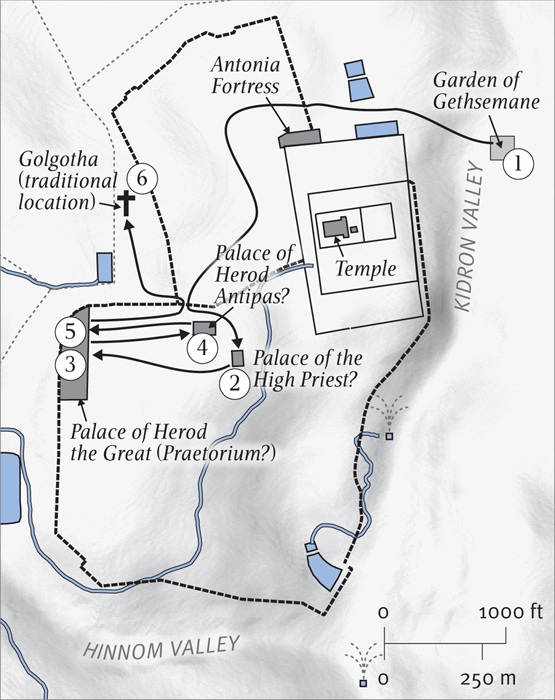
The path from Jesus' arrest to his crucifixion (part of which is often called the Via Dolorosa, "Way of Sorrows") is difficult to retrace with certainty. According to a possible harmony of the Gospel accounts, after the Passover meal Judas led a contingent of soldiers to Gethsemane to arrest Jesus (1). From there Jesus was led to Annas (location unknown), who sent him to his son-in-law Caiaphas, the high priest (2). The Jewish leaders then appealed to the Roman governor Pilate to have Jesus put to death (3). Luke records that Pilate sent Jesus to Herod Antipas (4), who questioned Jesus but returned him to Pilate without rendering any judgment (5). Pilate then sent Jesus to be crucified at Golgotha (6).
MATTHEW—NOTE ON 26:28 my blood of the covenant. Covenants were ratified with the blood of a sacrifice (Gen. 8:20; 15:9–10). Jesus' words here echo Moses' pronouncement in Ex. 24:8. The blood of the New Covenant is not an animal's blood, but Christ's own blood, shed for the remission of sins. See notes on Jer. 31:31–34; Heb. 8:1–10:18; 8:6.
MATTHEW—NOTE ON 26:29 my Father's kingdom. I.e., the earthly millennial
kingdom (see Luke 22:18, 29–30).
MATTHEW—NOTE ON 26:30 when they had sung a hymn. Probably Ps. 118. The Talmud designated Ps. 113–118 as the Hallel (praise psalms) of Egypt. These psalms were sung at Passover (see notes on Ps. 113–118).
MATTHEW—NOTE ON 26:31 fall away. See v. 56. The Greek word is the same word Jesus used in 24:10, describing the falling away and spiritual treachery that would occur in the last days. Here, however, Jesus spoke of something less than full and final apostasy. In a moment of fleshly fear they disowned Christ (26:34), but he prayed that their faith would not fail (Luke 22:32; John 17:9–11), and that prayer was answered. The verse Jesus quotes here is Zech. 13:7 (see note there.
MATTHEW—NOTE ON 26:32 I will go before you to Galilee. See note on 28:7.
MATTHEW—NOTE ON 26:34 before the rooster crows. Mark adds "twice." The rooster would begin crowing about 3:00 A.M. (cf. Mark 13:35). Though Peter and all the disciples insisted that they would never deny Christ (Matt. 26:33, 35), they were only a few hours away from fulfilling this prophecy (vv. 74–75; Mark 14:66–72).
MATTHEW—NOTE ON 26:36 Gethsemane. Lit., "oil press." This was a frequent meeting place for Christ and his disciples (John 18:2), just across the Kidron Valley from Jerusalem (John 18:1). A garden of ancient olive trees is there to this day. Judas's familiarity with Jesus' patterns enabled him to find Jesus there— even though Christ had not previously announced his intentions.
MATTHEW—NOTE ON 26:38 very sorrowful, even to death. His anguish had nothing to do with fear of men or the physical torments of the cross. He was sorrowful because within hours the full cup of divine fury against sin would be his to drink (see note on v. 39).
MATTHEW—NOTE ON 26:39 this cup. Cf. v. 42. A cup is often the symbol of divine wrath against sin in the OT (Isa. 51:17, 22; Jer. 25:15–17, 27–29; Lam. 4:21–22; Ezek. 23:31–34; Hab. 2:16). The next day Christ would "bear the sins of many" (Heb. 9:28)—and the fullness of divine wrath would fall on him (Isa. 53:10–11; 2 Cor. 5:21). This was the price of the sin he bore, and he paid it in full. His cry of anguish in Matt. 27:46 reflects the extreme bitterness of the cup of wrath he was given. not as I will, but as you will. This implies no conflict between the Persons of the Godhead. Rather, it graphically reveals how Christ in
his humanity voluntarily surrendered his will to the will of the Father in all things—precisely so that there would be no conflict between the divine will and his desires. See John 4:34; 6:38; 8:29; Phil. 2:8. See note on John 5:30.
MATTHEW—NOTE ON 26:41 the flesh is weak. The tenderness of this plea is touching. Christ himself was well acquainted with the feeling of human infirmities (Heb. 4:15)—yet without sin. At that very moment he was locked in a struggle against human passions which, while not sinful in themselves, must be subjugated to the divine will if sin was to be avoided. See note on Matt. 26:39.
MATTHEW—NOTE ON 26:47 Judas came, one of the twelve. See v. 14. All four evangelists refer to Judas this way (Mark 14:10, 43; Luke 22:47; John 6:71). Only once (John 20:24) is another disciple so described. The Gospel writers seem to use the expression to underscore the insidiousness of Judas's crime— especially here, in the midst of the betrayal.
MATTHEW—NOTE ON 26:48–49 See notes on Mark 14:44–45.
MATTHEW—NOTE ON 26:50 Friend. Not the usual Greek word for "friend," but another word meaning "comrade."
MATTHEW—NOTE ON 26:51 one of those. John identifies the swordsman as Peter and the victim as Malchus (John 18:10). Clearly, Peter was not aiming for the ear, but for the head. Only Luke mentions that Jesus healed Malchus's ear (see note on Luke 22:51).
MATTHEW—NOTE ON 26:52 perish by the sword. Peter's action was vigilantism. No matter how unjust the arrest of Jesus, Peter had no right to take the law into his own hands in order to stop it. Jesus' reply was a restatement of the Gen. 9:6 principle: "Whoever sheds the blood of man, by man shall his blood be shed," an affirmation that capital punishment is an appropriate penalty for murder.
MATTHEW—NOTE ON 26:53 more than twelve legions. A Roman legion was composed of 6,000 soldiers, so this would represent more than 72,000 angels. In 2 Kings 19:35 a single angel killed more than 185,000 men in a single night, so this many angels would make a formidable army. See note on Luke 2:13.
MATTHEW—NOTE ON 26:54 Scriptures be fulfilled. God himself had foreordained the very minutest details of how Jesus would die (Acts 2:23; 4:27– 28). Dying was Christ's consummate act of submission to the Father's will (see
note on Matt. 26:39). Jesus himself was in absolute control (John 10:17–18). Yet it was not Jesus alone, but everyone around him—his enemies included—who fulfilled precisely the details of the OT prophecies. These events display his divine sovereignty. See notes on Matt. 26:2; 1:22; 5:18; 27:50.
MATTHEW—NOTE ON 26:57 Caiaphas the high priest. See note on v. 3. From John 18:13, we learn that Christ was taken first to Annas (former high priest and father-in-law to Caiaphas). He then was sent bound to Caiaphas's house (John 18:24). The conspiracy was well planned, so that "the scribes and the elders" (the Sanhedrin, see note on Matt. 26:59) were already "gathered" at Caiaphas's house and ready to try Jesus. The time was sometime between midnight and the first rooster's crowing (v. 74). Such a hearing was illegal on several counts: criminal trials were not to be held at night (see note on 27:1); and trials in capital cases could only be held at the temple and only in public. See note on 27:2 for a fuller chronology of the events leading up to the crucifixion.
MATTHEW—NOTE ON 26:59 the whole Council. See note on John 3:1. The great Sanhedrin was the Supreme Court of Israel, consisting of 71 members, presided over by the high priest. They met daily in the temple to hold court, except on the Sabbath and other holy days. Technically, they did not have the power to administer capital punishment (John 18:31), but in the case of Stephen, for example, this was no deterrent to his stoning (cf. Acts 6:12–14; 7:58–60). Roman governors evidently sometimes ignored such incidents as a matter of political expediency. In Jesus' case, the men who were trying him were the same ones who had conspired against him (cf. John 11:47–50).
MATTHEW—NOTE ON 26:60 they found none. Even though many were willing to perjure themselves, the Sanhedrin could not find a charge that had enough credibility to indict Jesus. Evidently the "false witnesses" could not agree between themselves.
MATTHEW—NOTE ON 26:61 destroy the temple of God. See John 2:19–21. The witnesses' account was a distortion of Jesus' meaning. Mark 14:58 gives a fuller account of their testimony.
MATTHEW—NOTE ON 26:63 adjure you. See note on 5:34. Caiaphas was trying to break Jesus' silence (Matt. 26:62) by placing him under oath. The oath was supposed to make him legally obligated to reply. Jesus' answer (v. 64) implies acceptance of the oath.
MATTHEW—NOTE ON 26:64 The imagery was taken from Ps. 110:1 and Dan. 7:13.
MATTHEW—NOTE ON 26:65 the high priest tore his robes. Normally this was an expression of deep grief (2 Kings 19:1; Job 1:20; Jer. 36:24). The high priest was forbidden to tear his clothes (Lev. 10:6; 21:10)—but the Talmud made an exception for high priests who witnessed a blasphemy. But Caiaphas's supposed grief was as phony as the charge of blasphemy against Jesus; he was gloating over having found something to base his charges on (Matt. 26:67).
MATTHEW—NOTE ON 26:74 he began to invoke a curse. I.e., calling on God as his witness, Peter declared, "I do not know the man," and pronounced a curse of death on himself at God's hand if his words were untrue. All four Gospels record Peter's betrayal. Cf. vv. 31–35.
MATTHEW—NOTE ON 26:75 And Peter remembered. Luke 22:61 records that Jesus made eye contact with Peter at this very moment, which must have magnified Peter's already unbearable sense of shame. "He went out"—evidently departing from Caiaphas's house—"and wept bitterly." The true Peter is seen not in his denial but in his repentance. This account reminds us of not only our own weakness, but also the richness of divine grace (see also John 21:15–19).
MATTHEW—NOTE ON 27:1 When morning came. The Sanhedrin waited until daybreak to render their official verdict (cf. 26:66), possibly a token nod to the rule against criminal trials at night (see note on 26:57).
MATTHEW—NOTE ON 27:2 delivered him over to Pilate. Jesus had two trials, one Jewish and religious, the other Roman and secular. Rome reserved the right of execution in capital cases (see note on 26:59), so Jesus had to be handed over to the Roman authorities for execution of the death sentence. Pilate's headquarters were in Caesarea, on the Mediterranean coast, but he was in Jerusalem for the Passover celebrations, so he oversaw the trial (see note on Mark 15:1). Christ was brought before Pilate (Matt. 27:2–14), then was sent to Herod for yet another hearing (Luke 23:6–12), then returned to Pilate for the final hearing and pronouncing of sentence (Matt. 27:15–26).
MATTHEW—NOTE ON 27:3 changed his mind. Judas felt the sting of his own guilt, but this was not genuine repentance. There is a godly sorrow that leads to repentance, but Judas's remorse was of a different kind, as demonstrated by his
suicide (v. 5). Cf. 2 Cor. 7:10.
MATTHEW—NOTE ON 27:5 hanged himself. See note on Acts 1:18.
MATTHEW—NOTE ON 27:9 spoken by the prophet Jeremiah. Actually the statement paraphrases Zech. 11:12–13. But the Hebrew canon was divided into three sections: Law, Writings, and Prophets (cf. Luke 24:44). Jeremiah came first in the order of prophetic books, so the Prophets were sometimes collectively referred to by his name.
MATTHEW—NOTE ON 27:11 You have said so. These words were probably spoken immediately after the dialogue John 18:34–36 reports.
MATTHEW—NOTE ON 27:25 His blood be on us. The Jews accepted the blame for the execution of Jesus and did not hold the Romans responsible. Cf. 21:38–39.
MATTHEW—NOTE ON 27:26 scourged. The whip used for scourging consisted of several strands of leather attached to a wooden handle. Each strand had a bit of metal or bone attached to the end. The victim was bound to a post by the wrists, high over his head, so that the flesh of the back would be taut. An expert at wielding the scourge could literally tear the flesh from the back, lacerating muscles, and sometimes even exposing the kidneys or other internal organs. Scourging alone was fatal in some cases.
MATTHEW—NOTE ON 27:27 governor's headquarters. Pilate's residence in Jerusalem. It was probably located in the Antonia Fortress, adjacent to the northwest corner of the temple. "The soldiers of the governor" were part of a "cohort"—about 600 soldiers—assigned to serve the governor (Pilate) during his stay in Jerusalem.
MATTHEW—NOTE ON 27:28 scarlet robe. Mark 15:17 and John 19:2 say "purple," suggesting that the robe may have been something between royal purple, and "scarlet," the closest thing they could find to the traditional garb of royalty. The word for "robe" refers to a military cloak undoubtedly belonging to one of the soldiers.
MATTHEW—NOTE ON 27:29 a reed in his right hand. To imitate a scepter they purposely chose something flimsy-looking.
MATTHEW—NOTE ON 27:30 they spit on him. See Isa. 50:6. struck him on the
head. A reed long enough to make a mock scepter would be firm enough to be extremely painful, about like a broom handle. John 19:3 says they hit him with their fists as well.
MATTHEW—NOTE ON 27:31 to crucify him. Crucifixion was a form of punishment that had been passed down to the Romans from the Persians, Phoenicians, and Carthaginians. Roman crucifixion was a lingering doom—by design. Roman executioners had perfected the art of slow torture while keeping the victim alive. Some victims even lingered until they were eaten alive by birds of prey or wild beasts. Most hung on the cross for days before dying of exhaustion, dehydration, traumatic fever, or—most likely—suffocation. When the legs would no longer support the weight of the body, the diaphragm was constricted in a way that made breathing impossible. That is why breaking the legs would hasten death (John 19:31–33), but this was unnecessary in Jesus' case. The hands were usually nailed through the wrists, and the feet through the instep or the Achilles tendon (sometimes using one nail for both feet). None of these wounds would be fatal, but their pain would become unbearable as the hours dragged on. The most notable feature of crucifixion was the stigma of disgrace that was attached to it (Gal. 3:13; 5:11; Heb. 12:2). One indignity was the humiliation of carrying one's own cross, which might weigh as much as 200 pounds. Normally a quaternion, four soldiers, would escort the prisoner through the crowds to the place of crucifixion. A placard bearing the indictment would be hung around the person's neck.
MATTHEW—NOTE ON 27:32 Cyrene. A city in north Africa. Evidently the scourging had so weakened Jesus that he was unable to carry the cross. This is another touching picture of his humanity, beset with all human weaknesses except sin (Heb. 4:15).
MATTHEW—NOTE ON 27:33 Place of a Skull. "Golgotha" may have been a skullshaped hill, or it may have been so named because as a place of crucifixion, it accumulated skulls. None of the Gospels mention a hill.
MATTHEW—NOTE ON 27:34 wine . . . mixed with gall. "Gall" simply refers to something bitter. Mark 15:23 identifies it as myrrh, a narcotic. The Jews had a custom, based on Prov. 31:6, of administering a pain-deadening medication mixed with wine to victims of crucifixion, in order to deaden the pain. Tasting what it was, Christ, though thirsty, "would not drink it," lest it dull his senses before he completed his work. The lessening of physical pain would probably
not have diminished the efficacy of his atoning work (see notes on Matt. 26:38– 39). But he needed his full mental faculties for the hours yet to come. It was necessary for him to be awake and fully conscious, for example, to minister to the dying thief (Luke 23:43).
MATTHEW—NOTE ON 27:35 divided his garments. The garments of the victim were the customary spoils of the executioners. John 19:23–24 gives a fuller account. This action was foretold in Ps. 22:18.
MATTHEW—NOTE ON 27:37 the charge. For a reconciliation of the differences between the various accounts of this inscription, see note on Luke 23:38 (cf. Mark 15:26). The fact that the placard was placed "over his head" suggests that this cross was in the familiar shape with an upright protruding above the transom, and not the T-shaped cross that was also sometimes used.
MATTHEW—NOTE ON 27:38 robbers. This word denotes a rebel and brigand who plunders as he steals. Mere thieves were not usually crucified. These were probably cohorts of Barabbas.
MATTHEW—NOTE ON 27:40 destroy the temple and rebuild it in three days. See 26:61. They had missed his point. "He was speaking about the temple of his body" (John 2:21). He would not "come down from the cross," but it was not because he was powerless to do so (John 10:18). The proof that he was the Son of God came "in three days" (see note on Matt. 12:40), when he returned with "the temple" (i.e., his body) rebuilt.
MATTHEW—NOTE ON 27:42 we will believe in him. See notes on 12:38 and 16:1.
MATTHEW—NOTE ON 27:45 from the sixth hour . . . until the ninth hour. From noon until 3:00 P.M. The crucifixion began at 9:00 A.M. (see notes on Mark 15:25; Luke 23:44).
MATTHEW—NOTE ON 27:46 Eli, Eli, lema sabachthani. "Eli" is Hebrew; the rest Aramaic (Mark 15:34 gives the entire wail in Aramaic) This cry is a fulfillment of Ps. 22:1, one of many striking parallels between that psalm and the specific events of the crucifixion (see notes on Ps. 22). Christ at that moment was experiencing the abandonment and despair that resulted from the outpouring of divine wrath on him as sin-bearer (see note on Matt. 26:39).
MATTHEW—NOTE ON 27:50 yielded up his spirit. A voluntary act. See John
10:18. See note on Matt. 26:54.
MATTHEW—NOTE ON 27:51 the curtain of the temple. I.e., the curtain that blocked the entrance to the Most Holy Place (Ex. 26:33; Heb. 9:3). The tearing of the veil signified that the way into God's presence was now open to all through a new and living way (Heb. 10:19–22). The fact that it tore "from top to bottom" showed that no man had split the veil. God did it.
MATTHEW—NOTE ON 27:52 bodies of the saints . . . were raised. Matthew alone mentions this miracle. Nothing more is said about these people, which would be unlikely if they remained on earth for long. Evidently, these people were given glorified bodies; they appeared "to many" (v. 53), enough to establish the reality of the miracle; and then they no doubt ascended to glory—a kind of foretaste of 1 Thess. 4:16.
MATTHEW—NOTE ON 27:54 the centurion. See note on 8:5. those . . . with him. These were probably men under his charge. Mark 15:39 says the centurion was the one who uttered the words of confession, but he evidently spoke for his men as well. Their fear speaks of an awareness of their sin, and the word "truly" suggests a certainty and conviction that bespeaks genuine faith. These men represent an answer to Jesus' prayer in Luke 23:34. Their response contrasts sharply with the mocking taunts of Matt. 27:39–44.
MATTHEW—NOTE ON 27:56 Mary Magdalene. She had been delivered from seven demons (Luke 8:2); the other "Mary" ("wife of Clopas," John 19:25—a variant of Alphaeus) was the mother of the apostle known as "James the younger" (Mark 15:40; see note on Matt. 10:2). the mother of the sons of Zebedee. Salome (Mark 15:40), mother of James and John. From John 19:26, we learn that Mary, the mother of Jesus, was also present at the cross—possibly standing apart from these three, who were "looking on from a distance" (Matt. 27:55), as if they could not bear to watch his sufferings, but neither could they bear to leave him.
MATTHEW—NOTE ON 27:57 Arimathea. A town about 15–20 miles northwest of Jerusalem. Joseph. Mark 15:43 and Luke 23:50–51 identify him as a member of the Sanhedrin (see note on Matt. 26:59), though Luke says he "had not consented to their decision and action" in condemning Christ. Joseph and Nicodemus (John 19:39), both being prominent Jewish leaders, buried Christ in Joseph's own "new tomb" (Matt. 27:60), thus fulfilling exactly the prophecy of
Isa. 53:9.
MATTHEW—NOTE ON 27:62 The next day. The Sabbath. after the day of Preparation. This was on Friday.
MATTHEW—NOTE ON 28:1 toward the dawn of the first day of the week. Sabbath officially ended with sundown on Saturday. At that time the women could purchase and prepare spices (Luke 24:1). The event described here occurred the next morning, at dawn on Sunday, the first day of the week. other Mary. The mother of James the younger (see note on Matt. 27:56).
MATTHEW—NOTE ON 28:2 a great earthquake. The second earthquake associated with Christ's death (27:51). This one may have been confined to the immediate area around the grave, when "an angel" supernaturally "rolled back the stone"—not to let Jesus out, for if he could rise from the dead, he would need no help escaping an earthly tomb, but to let the women and the apostles in (28:6).
MATTHEW—NOTE ON 28:4 became like dead men. This suggests that they were not merely paralyzed with fear, but completely unconscious, totally traumatized by what they had seen. The word translated "trembled" has the same root as the word for "earthquake" in v. 2. The sudden appearance of this angel, at the same time the women arrived, was their first clue that anything extraordinary was happening.
MATTHEW—NOTE ON 28:6 Come, see the place where he lay. See note on Luke 24:4 for the order of these events as gleaned from all four Gospels.
MATTHEW—NOTE ON 28:7 there you will see him. See vv. 10, 16; 26:32; John 21:1–14. This does not mean they would not see him until then. He was seen by the apostles several times before they saw him in Galilee (Luke 24:15, 34, 36; John 20:19, 26). But his supreme post-resurrection appearance was in Galilee, where "he appeared to more than five hundred brothers at one time" (1 Cor. 15:6). See note on Matt. 28:16.
MATTHEW—NOTE ON 28:9 Jesus met them. For a summary of Christ's postresurrection appearances, see note on Luke 24:34.
MATTHEW—NOTE ON 28:10 my brothers. I.e., the disciples.
MATTHEW—NOTE ON 28:11 told the chief priests. The Jewish leaders' determination to cover up what had occurred reveals the obstinacy of unbelief in the face of evidence (Luke 16:31).
MATTHEW—NOTE ON 28:12 a sufficient sum of money. Lit., "silver" (cf. 26:15). The bribery was necessary because the soldiers' story, if true, could cost them their lives—since they were charged with guard duty under Pilate's personal orders (27:65). The Jewish leaders also promised to cover for the soldiers if the false story they spread leaked back to Pilate (28:14).
MATTHEW—NOTE ON 28:13 while we were asleep. The story was obviously bogus, and not a very good cover-up. They could not possibly know what had happened while they were asleep.
MATTHEW—NOTE ON 28:16 the eleven disciples. This does not mean that only the 11 were present. The fact that some "doubted" (v. 17) strongly suggests that more than the 11 were present. It is likely that Christ arranged this meeting in Galilee because that was where most of his followers were. This seems the most likely location for the massive gathering of disciples Paul describes in 1 Cor. 15:6 (see note on Matt. 28:7).
MATTHEW—NOTE ON 28:17 but some doubted. That simple phrase is one of countless testimonies to the integrity of Scripture. The transparent honesty of a statement like this shows that Matthew was not attempting to exclude or cover up facts that might lessen the perfection of such a glorious moment.
MATTHEW—NOTE ON 28:18 All authority. See 11:27; John 3:35. Absolute sovereign authority—lordship over all—is handed to Christ, "in heaven and on earth." This is clear proof of his deity. The time of his humiliation was at an end, and God had exalted him above all (Phil. 2:9–11).
MATTHEW—NOTE ON 28:19 therefore. I.e., on the basis of his authority, the disciples were sent to "make disciples of all the nations." The sweeping scope of their commission is consummate with his unlimited authority. in the name of the Father . . . Son . . . Holy Spirit. The formula is a strong affirmation of trinitarianism.
MATTHEW—NOTE ON 28:20 teaching them to observe all that I have commanded you. The kind of evangelism called for in this commission does not end with the conversion of the unbeliever. I am with you. There's a touching
echo of the beginning of Matthew's Gospel here. Immanuel, which is translated, "God with us" (1:23), remains "with" us "to the end of the age"—i.e., until he returns bodily to judge the world and establish his earthly kingdom.
Mark
Mark 1 • Mark 2 • Mark 3 • Mark 4 • Mark 5 • Mark 6 • Mark 7 • Mark 8 •
Mark 9 • Mark 10 • Mark 11 • Mark 12 • Mark 13 • Mark 14 • Mark 15 • Mark 16 Introduction to Mark
Title Author and Date Background and Setting Historical and Theological Themes Interpretive Challenges The Synoptic Problem Outline Footnotes Study Notes
Introduction to Mark
Title
Mark, for whom this Gospel is named, was a close companion of the apostle Peter and a recurring character in the book of Acts, where he is known as "John whose other name was Mark" (Acts 12:12, 25; 15:37, 39). It was to John Mark's mother's home in Jerusalem that Peter went when released from prison (Acts 12:12).
John Mark was a cousin of Barnabas (Col. 4:10), who accompanied Paul and Barnabas on Paul's first missionary journey (Acts 12:25; 13:5). But he deserted them along the way in Perga and returned to Jerusalem (Acts 13:13). When Barnabas wanted Paul to take John Mark on the second missionary journey, Paul refused. The friction that resulted between Paul and Barnabas led to their separation (Acts 15:38–40).
But John Mark's earlier vacillation evidently gave way to great strength and maturity, and in time he proved himself even to the apostle Paul. When Paul wrote the Colossians, he instructed them that if John Mark came, they were to welcome him (Col. 4:10). Paul even listed Mark as a fellow worker (Philem. 24). Later, Paul told Timothy to "get Mark and bring him with you, for he is very useful to me for ministry" (2 Tim. 4:11).
John Mark's restoration to useful ministry may have been, in part, due to the ministry of Peter. Peter's close relationship with Mark is evident from his description of him as "Mark, my son" (1 Pet. 5:13). Peter, of course, was no stranger to failure himself, and his influence on the younger man was no doubt instrumental in helping him out of the instability of his youth and into the strength and maturity he would need for the work to which God had called him.
Author and Date
Unlike the epistles, the Gospels do not name their authors. The early church Fathers, however, unanimously affirm that Mark wrote this second Gospel. Papias, bishop of Hieropolis, writing about A.D. 140, noted:
And the presbyter [the apostle John] said this: Mark having become the interpreter of Peter, wrote down accurately whatsoever he remembered. It was not, however, in exact order that he related the sayings or deeds of Christ. For he neither heard the Lord nor accompanied him. But afterwards, as I said, he accompanied Peter, who accommodated his instructions to the necessities [of his hearers], but with no intention of giving a regular narrative of the Lord's sayings. Wherefore Mark made no mistake in thus writing some things as he remembered them. For of one thing he took especial care, not to omit anything he had heard, and not to put anything fictitious into the statements. [From the Exposition of the Oracles of the Lord (6)]
Justin Martyr, writing about A.D. 150, referred to the Gospel of Mark as "the memoirs of Peter," and suggested that Mark committed his Gospel to writing while in Italy. This agrees with the uniform voice of early tradition, which regarded this Gospel as having been written in Rome, for the benefit of Roman Christians. Irenaeus, writing about A.D. 185, called Mark "the disciple and interpreter of Peter," and recorded that the second Gospel consisted of what Peter preached about Christ. The testimony of the church Fathers differs as to whether this Gospel was written before or after Peter's death (c. A.D. 67–68).
Evangelical scholars have suggested dates for the writing of Mark's Gospel ranging from A.D. 50 to 70. A date before the destruction of Jerusalem and the temple in A.D. 70 is required by the comment of Jesus in Mark 13:2. Luke's Gospel was clearly written before Acts (Acts 1:1–3). The date of the writing of Acts can probably be fixed at about A.D. 63, because that is shortly after the narrative ends (see Introduction to Acts: Author and Date). It is therefore likely, though not certain, that Mark was written at an early date, probably sometime in the 50s.
Background and Setting
Whereas Matthew was written to a Jewish audience, Mark seems to have targeted Roman believers, particularly Gentiles. When employing Aramaic terms, Mark translated them for his readers (3:17; 5:41; 7:11, 34; 10:46; 14:36; 15:22, 34). On the other hand, in some places he used Latin expressions instead of their Greek equivalents (5:9; 6:27; 12:15, 42; 15:16, 39). He also reckoned time according to the Roman system (6:48; 13:35) and carefully explained Jewish customs (7:3–4; 14:12; 15:42). Mark omitted Jewish elements, such as
the genealogies found in Matthew and Luke. This Gospel also makes fewer references to the OT, and includes less material that would be of particular interest to Jewish readers—such as that which is critical of the Pharisees and Sadducees (Sadducees are mentioned only once, in 12:18). When mentioning Simon of Cyrene (15:21), Mark identifies him as the father of Rufus, a prominent member of the church at Rome (Rom. 16:13). All of this supports the traditional view that Mark was written for a Gentile audience initially at Rome.
Historical and Theological Themes
Mark presents Jesus as the suffering servant of the Lord (10:45). His focus is on the deeds of Jesus more than his teaching, particularly emphasizing service and sacrifice. Mark omits the lengthy discourses found in the other Gospels, often relating only brief excerpts to give the gist of Jesus' teaching. Mark also omits any account of Jesus' ancestry and birth, beginning where Jesus' public ministry began, with his baptism by John in the wilderness.
Mark demonstrated the humanity of Christ more clearly than any of the other evangelists, emphasizing Christ's human emotions (1:41; 3:5; 6:34; 8:12; 9:36), his human limitations (4:38; 11:12; 13:32), and other small details that highlight the human side of the Son of God (e.g., 7:33–34; 8:12; 9:36; 10:13–16).
Interpretive Challenges
Three significant questions confront the interpreter of Mark: 1) What is the relationship of Mark to Luke and Matthew? (see below, "The Synoptic Problem"); 2) How should one interpret the eschatological passages? (see notes on chs. 4; 13); and 3) Were the last 12 verses of ch. 16 originally part of Mark's Gospel? (see note on 16:9–20).
The Synoptic Problem
Even a cursory reading of Matthew, Mark, and Luke reveals both striking similarities (cf. 2:3–12; Matt. 9:2–8; Luke 5:18–26) and significant differences as each views the life, ministry, and teaching of Jesus. The question of how to explain those similarities and differences is known as the "Synoptic Problem" (syn means "together"; optic means "seeing").
The modern solution—even among evangelicals—has been to assume that some form of literary dependence exists between the synoptic Gospels. The most commonly accepted theory to explain such an alleged literary dependence is known as the "Two-Source" theory. According to that hypothesis, Mark was the first Gospel written, and Matthew and Luke then used Mark as a source in writing their Gospels. Proponents of this view imagine a non-existent, second source, labeled Q (from the German word Quelle, "source"), and argue that this allegedly is the source of the material in Matthew and Luke that does not appear in Mark. They advance several lines of evidence to support their scenario.
First, most of Mark is paralleled in Matthew and Luke. Since it is much shorter than Matthew and Luke, the latter must be expansions of Mark. Second, the three Gospels follow the same general chronological outline, but when either Matthew or Luke departs from Mark's chronology, the other agrees with Mark. Put another way, Matthew and Luke do not both depart from Mark's chronology in the same places. That, it is argued, shows that Matthew and Luke used Mark for their historical framework. Third, in passages common to all three Gospels, Matthew's and Luke's wording seldom agrees when it differs from Mark's. Proponents of the "Two-Source" theory see that as confirmation that Matthew and Luke used Mark's Gospel as a source.
But those arguments do not prove that Matthew and Luke used Mark's Gospel as a source. In fact, the weight of evidence is strongly against such a theory:
1) The nearly unanimous testimony of the church until the nineteenth century was that Matthew was the first Gospel written. Such an impressive body of evidence cannot be ignored.
2) Why would Matthew, an apostle and eyewitness to the events of Christ's life, depend on Mark (who was not an eyewitness)—even for the account of his own conversion?
3) A significant statistical analysis of the synoptic Gospels has revealed that the parallels between them are far less extensive and the differences more significant than is commonly acknowledged. The differences, in particular, argue against literary dependence between the Gospel writers.
4) Since the Gospels record actual historical events, it would be surprising if they did not follow the same general historical sequence. For example, the fact
that three books on American history all had the Revolutionary War, the Civil War, World War I, World War II, the Vietnam War, and the Gulf War in the same chronological order would not prove that the authors had read each others' books. General agreement in content does not prove literary dependency.
5) The passages in which Matthew and Luke agree against Mark (see argument three in favor of the "Two-Source" theory) amount to about one-sixth of Matthew and one-sixth of Luke. If they used Mark's Gospel as a source, there is no satisfactory explanation for why Matthew and Luke would so often both change Mark's wording in the same way.
6) The "Two-Source" theory cannot account for the important section in Mark's Gospel (6:45–8:26) that Luke omits. That omission suggests Luke had not seen Mark's Gospel when he wrote.
7) There is no historical or manuscript evidence that the Q document ever existed; it is purely a fabrication of modern skepticism and a way to possibly deny the verbal inspiration of the Gospels.
8) Any theory of literary dependence between the Gospel writers overlooks the significance of their personal contacts with each other. Mark and Luke were both companions of Paul (cf. Philem. 24); the early church (including Matthew) met for a time in the home of Mark's mother (Acts 12:12); and Luke could easily have met Matthew during Paul's two-year imprisonment at Caesarea (see note on Acts 27:1). Such contacts make theories of mutual literary dependence unnecessary.
The simplest solution to the Synoptic Problem is that no such problem exists! Because critics cannot prove literary dependence between the Gospel writers, there is no need to explain it. The traditional view that the Gospel writers were inspired by God and wrote independently of each other—except that all three were moved by the same Holy Spirit (2 Pet. 1:21)—remains the only plausible view.
As the reader compares the various viewpoints in the Gospels, it becomes clear how well they harmonize and lead to a more complete picture of the whole event or message. The accounts are not contradictory, but complementary, revealing a fuller understanding when brought together. Apparent difficulties are dealt with in the notes of each Gospel.