
6:12; 8:17; cf. Gen. 3:22).
ECCLESIASTES—NOTE ON 4:1–3 The oppressiveness of some lives renders death more appealing.
ECCLESIASTES—NOTE ON 4:3 evil deeds. Earthly life can be so disheartening as to make nonexistence preferable.
ECCLESIASTES—NOTE ON 4:4 man's envy. The lack of satisfaction with life leads some to conclude that everyone else has it better.
ECCLESIASTES—NOTE ON 4:5 folds his hands . . . eats his own flesh. Even the man who settles into idleness, living on what he takes from others, is selftormented and never satisfied (cf. Isa. 9:20; 44:20).
ECCLESIASTES—NOTE ON 4:7–12 The futility of labor alone without satisfaction and without any heir to experience its value is addressed (cf. 2:18–22, a complementary message). Life is better with companionship.
Solomon Reflects on Genesis
Solomon Reflects on Genesis Toward the end of his life, the penitent King Solomon pondered life in the wake of the fall and the outworking of man's sin. Solomon drew the following conclusions, possibly from his own study of Genesis: 1. God created the heavens and earth with laws of design and regularity (Eccles. 1:2–7; 3:1–8; cf. Gen. 1:1–31; 8:22). 2. Man is created from dust and returns to dust (Eccles. 3:20; 12:7; cf. Gen. 2:7; 3:19). 3. God placed in man his life-giving breath (Eccles. 12:7; cf. Gen. 2:7). 4. As God ordained it, marriage is one of life's most enjoyable blessings (Eccles. 9:9; cf. Gen. 2:18–25). 5. Divine judgment results from the fall (Eccles. 3:14–22; 11:9; 12:14; cf. Gen. 2:17; 3:1–19). 6. The effect of the curse on creation is "vanity," i.e., futility (Eccles. 1:5–8; cf. Gen. 3:17–19). 7. Labor after the fall is difficult and yields little profit (Eccles. 1:3, 13; 2:3; 3:9–11; cf. Gen. 3:17–19). 8. Death overcomes all creatures after the fall (Eccles. 8:8; 9:4–5; cf. Gen. 2:17; 3:19). 9. After the fall, man's heart is desperately wicked (Eccles. 7:20, 29; 8:11; 9:3; cf. Gen. 3:22; 6:5; 8:21). 10. God withholds certain knowledge and wisdom from man for his wise, but unspoken, reasons (Eccles. 6:12; 8:17; cf. Gen. 3:22). ©1997 by Thomas Nelson, Inc.
ECCLESIASTES—NOTE ON 4:13–16 The cherished popularity of kings is precarious and short-lived.
ECCLESIASTES—NOTE ON 4:15 youth. This refers to the legitimate successor to the "old and foolish king," as opposed to the "poor and wise youth" (cf. v. 13) who rises on his ability to reign.
ECCLESIASTES—NOTE ON 5:1–7 A prelude to the book's concluding admonition to approach God with reverence.
ECCLESIASTES—NOTE ON 5:1 the house of God. The temple Solomon built in Jerusalem (cf. 1 Kings 8:15–21).
ECCLESIASTES—NOTE ON 5:2 heaven . . . earth. Because God is in heaven and man is on earth, rash promises and arguments before him are foolish.
ECCLESIASTES—NOTE ON 5:4–5 Pay what you vow. Promises made to God have serious implications. The OT background for this admonition is found in Deut. 23:21–23 and Judg. 11:35. Ananias and Sapphira learned the hard way (cf. Acts 5:1–11).
ECCLESIASTES—NOTE ON 5:6 mouth lead you into sin. Don't vow something that your fleshly desire will cause you to break. messenger. The priest in the house of God (cf. Mal. 2:7). Both priests and prophets are called messengers, commissaries who deliver and report back messages for the Heavenly King (cf. Isa. 6:1–13). Don't tell them your broken vow was a small thing.
ECCLESIASTES—NOTE ON 5:7 God . . . fear. Cf. 3:14; 8:12–13; 12:13.
ECCLESIASTES—NOTE ON 5:8–9 Officials have an unfair advantage to attain wealth.
ECCLESIASTES—NOTE ON 5:10 The love of money is never satisfied (cf. 1 Tim. 6:9–10).
ECCLESIASTES—NOTE ON 5:11 they increase who eat them. This refers to the rich man's dependents.
ECCLESIASTES—NOTE ON 5:12–17 Earthly treasures are precarious and bring disadvantages; they produce anxiety (v. 12) and pain (v. 13). They disappear through bad business (v. 14) and are left at death (v. 15). They can even produce fear (v. 17).
ECCLESIASTES—NOTE ON 5:18–20 In contrast to the anxiety of those just described (vv. 12–17), for those who consider God as the source of wealth, there are pleasures, riches, and the ability to enjoy them (see 2:24).
ECCLESIASTES—NOTE ON 5:18 fitting. The same word translated in 3:11 "beautiful." Once again, Solomon uses an admonition to enjoy the richness of life that God gives.
ECCLESIASTES—NOTE ON 5:19 the gift of God. To understand this is to enjoy the satisfaction of his good gifts.
ECCLESIASTES—NOTE ON 5:20 God keeps him occupied. When a person recognizes the goodness of God, he rejoices and does not dwell unduly on the troubles detailed in the previous context.
ECCLESIASTES—NOTE ON 6:2 God does not give him power to enjoy them. The Lord gives and takes away for his own purposes. So, the blessings of God cannot be assumed or taken for granted. But they should be enjoyed with thankfulness while they are available.
ECCLESIASTES—NOTE ON 6:3–6 Not having a burial, as in the case of King Jehoiakim (Jer. 22:18–19), indicated complete disrespect and disregard for one's life. To die without mourners or honors was considered worse than being born dead, even if one had many children and a full life.
ECCLESIASTES—NOTE ON 6:3 This is hyperbole.
ECCLESIASTES—NOTE ON 6:7–12 Lack of soul satisfaction comes from working only for what is consumed (v. 7), seeing little difference in the end between the wise and foolish (v. 8), not knowing the future (v. 9), realizing that God alone controls everything (v. 10), and true understanding of the present and future is limited (vv. 11–12).
ECCLESIASTES—NOTE ON 7:1 good name. Where a man has so lived to earn a good reputation, the day of his death can be a time of honor.
ECCLESIASTES—NOTE ON 7:2–6 The point of this section is to emphasize that more is learned from adversity than from pleasure. True wisdom is developed in the crucible of life's trials, though the preacher wishes that were not the case when he writes "this also is vanity" (v. 6).
ECCLESIASTES—NOTE ON 7:10 former days. In the midst of trouble and discontent, it is easy to lose touch with reality.
ECCLESIASTES—NOTE ON 7:12 wisdom is like the protection. Wisdom is better than money because it provides the fulfilled life.
ECCLESIASTES—NOTE ON 7:13 straight what he has made crooked? Man should consider God's activity because God is sovereign, decreeing and controlling everything under the sun (cf. 1:15).
ECCLESIASTES—NOTE ON 7:14 prosperity . . . adversity. God ordains both kinds of days and withholds knowledge of the future.
ECCLESIASTES—NOTE ON 7:15–18 The focus on the nature of righteousness is made clear in the statement "for the one who fears God shall come out from both of them" (v. 18).
ECCLESIASTES—NOTE ON 7:15 perishes . . . prolongs. The fact that some righteous men die young and some wicked men live long is enigmatic (cf. 8:11– 12).
ECCLESIASTES—NOTE ON 7:16 overly righteous . . . too wise. Solomon has already exhorted his readers to be righteous and wise (cf. v. 19). The warning here is against being self-righteous or pharisaical.
ECCLESIASTES—NOTE ON 7:19 Wisdom gives strength. The measure of wisdom is its ability to bring good outcomes in life.
ECCLESIASTES—NOTE ON 7:20 does good and never sins. Solomon gave great emphasis to the general effects of sin (cf. Gen. 3:1–24) and also pointed out the universality of personal transgressions. Paul may have recalled this passage when he wrote Rom. 3:10.
ECCLESIASTES—NOTE ON 7:21–22 all the things that people say. Since you have many offensive words to be forgiven, don't keep strict accounts of other's offensive words against you.
ECCLESIASTES—NOTE ON 7:23–24 "I will be wise" . . . who can find it out? The already wise king resolves to be even wiser. But upon further investigation, the limitations of wisdom become apparent. Some things are unknowable. This
realization quickly dampens his enthusiasm.
ECCLESIASTES—NOTE ON 7:26 the woman. This is the seductress about whom Solomon warns young men in Proverbs (Prov. 2:16–19; 5:1–14; 6:24–29; 7:1– 27). Elsewhere, Solomon exalts the virtues of man's lifetime companion (Eccles. 9:9; cf. Prov. 5:15–23; 31:10–31).
ECCLESIASTES—NOTE ON 7:27–29 Empirical acquisition of knowledge, that is man seeking righteousness through his many schemes, fails. Only God can make man upright.
ECCLESIASTES—NOTE ON 7:29 many schemes. The same word is translated "intent" and reflects the evil imaginations of all human beings since Adam and Eve.
ECCLESIASTES—NOTE ON 8:2–3 God's oath to him. This refers to Israel's promises to serve King Solomon (1 Chron. 29:24).
ECCLESIASTES—NOTE ON 8:5–6 proper time and the just way. A wise man knows when to apply the proper course of action for the best outcome, whether in an earthly sense before the king (8:2) or an eternal sense before God (cf. 12:13–14).
ECCLESIASTES—NOTE ON 8:7 what . . . how. God has appointed a time for everything but man knows neither the time nor the outcome. These uncertainties can increase his misery.
ECCLESIASTES—NOTE ON 8:8 spirit. Death is as precarious and uncontrollable as the wind.
ECCLESIASTES—NOTE ON 8:10 the holy place. This refers to the temple at Jerusalem (cf. 5:1). vanity. Lessons that should be gained from the death of the hypocritically wicked are quickly forgotten.
ECCLESIASTES—NOTE ON 8:11 the sentence. The gracious delay of God's retribution leads to further disobedience. This delay, in actuality, in no way diminishes the certainty of final judgment.
ECCLESIASTES—NOTE ON 8:12–13 those who fear God . . . the wicked. There is no real advantage for the wicked, although at times it might seem so (cf. 5:7;
12:13–14). Temporal patience does not eliminate eternal judgment.
ECCLESIASTES—NOTE ON 8:14 vanity. Temporally speaking, God generally rewards obedience and punishes disobedience. Solomon regards the exceptions to this principle as enigmatic and discouraging (see Ps. 73).
ECCLESIASTES—NOTE ON 8:15 joy. In no way does Solomon commend unbridled, rampant indulgence in sin, which is implied in Christ's account of the man whose barns were full. That man may have justified his sin by quoting this passage (cf. Luke 12:19). His focus here is on the resolve to enjoy life in the face of the injustice that surrounded him (see Eccles. 2:24).
ECCLESIASTES—NOTE ON 8:16–17 all the work of God. God's work is wonderful, but at times incomprehensible.
ECCLESIASTES—NOTE ON 9:1 in the hand of God. There will be no inequities in the final judgment of the righteous or the wicked, because God remembers both in perfect detail.
ECCLESIASTES—NOTE ON 9:2–3 the same event happens to all. Death because of universal depravity.
ECCLESIASTES—NOTE ON 9:7 eat . . . drink. See notes on 2:24.
ECCLESIASTES—NOTE ON 9:9 the wife. Cf. Prov. 5:15–19 and Solomon's Song.
ECCLESIASTES—NOTE ON 9:11 time and chance. Wisdom cannot guarantee good outcomes because of what appear to be so many unpredictable contingencies.
ECCLESIASTES—NOTE ON 9:12 his time. The time of his misfortune, especially death (cf. 11:8, "days of darkness"; 12:1, "evil days").
ECCLESIASTES—NOTE ON 9:13–15 Wisdom may not receive its due in this life.
ECCLESIASTES—NOTE ON 9:16 This is true because he lacks status and position.
ECCLESIASTES—NOTE ON 10:1–20 Solomon draws together assorted examples of the wisdom he has both scrutinized and touted.
ECCLESIASTES—NOTE ON 10:2 right . . . left. This proverb is based on the fact that, commonly, the right hand is more deft than the left.
ECCLESIASTES—NOTE ON 10:3 fool. See note on 2:14. walks. A person lacking wisdom will manifest that in daily conduct.
ECCLESIASTES—NOTE ON 10:5 It is a great and far-reaching evil when leaders make bad judgments.
ECCLESIASTES—NOTE ON 10:6–7 rich . . . princes. Life presents some strange ironies and is not, in this world, always fair.
ECCLESIASTES—NOTE ON 10:8–10 digs . . . does not sharpen. Dangers and uncertainties abound in life.
ECCLESIASTES—NOTE ON 10:10 wisdom . . . to succeed. A little wisdom will ease the efforts of life. Even though life's experiences often don't turn out the way one would have hoped, wise living usually produces a good outcome. This is a very important conclusion for Solomon's testing of wisdom.
ECCLESIASTES—NOTE ON 10:12–14 words. Man demonstrates wisdom in words as well as works. Foolish words yield unfavorable outcomes.
ECCLESIASTES—NOTE ON 10:15 to the city. A proverb for ignorance with regard to the most ordinary matters, which extends even to spiritual realities. If a fool can't find a town, how could he possibly locate God?
ECCLESIASTES—NOTE ON 10:18 roof sinks in . . . house leaks. This is likely an analogy for the kingdom of a lazy monarch.
ECCLESIASTES—NOTE ON 10:19 money answers everything. The partying king of v. 18 thinks he can fix all the disasters of his inept reign by raising taxes.
ECCLESIASTES—NOTE ON 11:1 Cast your bread. Take a calculated and wise step forward in life, like a farmer who throws his seed on the wet or marshy ground and waits for it to grow (cf. Isa. 32:20).
ECCLESIASTES—NOTE ON 11:2 Give a portion. Be generous while there is plenty, and make friends while time remains, because one never knows when he might need them to return the favor.
ECCLESIASTES—NOTE ON 11:7–12:8 Solomon crystallizes the book's message. Death is imminent and with it comes retribution. Enjoyment and judgment, though strange partners, come together in this section because both clamor for man's deepest commitment. Surprisingly, one does not win out over the other. In a world created for enjoyment but damaged by sin, judgment and enjoyment/pleasure are held in tension. With too much pleasure, judgment stands as a threatening force; with too much judgment, enjoyment suffers. In the final analysis, both are prominent themes of life that are resolved in our relationship to God, the primary issue of life and this book.
ECCLESIASTES—NOTE ON 11:3–6 The world is full of things over which one has no control including the purposes of God. There is no virtue in wishful wondering, but there is hope for those who get busy and do their work.
ECCLESIASTES—NOTE ON 11:7 Light. Good times in contrast to "darkness" (v. 8), meaning bad times. Cf. 12:1.
ECCLESIASTES—NOTE ON 11:9 Rejoice . . . judgment. The two terms seem to cancel out the other. How can this be explained? Enjoy life but do not commit iniquity. The balance that is called for insures that enjoyment is not reckless, sinful abandonment. Pleasure is experienced in faith and obedience, for as Solomon has said repeatedly, one can only receive true satisfaction as a gift from God.
ECCLESIASTES—NOTE ON 11:10 vanity. Enjoy childhood and youth while you can because they are soon gone.
ECCLESIASTES—NOTE ON 12:1 Remember . . . your Creator . . . evil days. Remember you are God's property, so serve him from the start of your years, not the end of your years, when service is very limited.
ECCLESIASTES—NOTE ON 12:2–6 Solomon uses the imagery of aging, incorporating elements of a dilapidated house, nature, and a funeral procession to heighten the emphasis of 11:7–12:1.
ECCLESIASTES—NOTE ON 12:2 sun . . . moon . . . clouds. Youth is typically the
time of dawning light, old age the time of twilight's gloom.
ECCLESIASTES—NOTE ON 12:3 keepers of the house tremble. The hands and arms that protect the body, as guards do a palace, shake in old age. strong men are bent. The legs, like supporting pillars, weaken. grinders. Teeth. those who look through the windows. Eyes.
ECCLESIASTES—NOTE ON 12:4 doors. Lips that do not have much to say. sound of the grinding. This refers to little eating, when the sound of masticating is low. rises up. Light sleep. daughters of song. The ear and voice that once loved music.
ECCLESIASTES—NOTE ON 12:5 afraid . . . of what is high. For fear of falling. almond tree blossoms. A white blossoming tree among dark trees speaks of hair. mourners. The funeral is near.
ECCLESIASTES—NOTE ON 12:6–7 Here are the images of death.
ECCLESIASTES—NOTE ON 12:6 silver cord is snapped. Perhaps this pictures a lamp hanging from a silver chain, which breaks with age, smashing the lamp. Some suggest this refers to the spinal cord. golden bowl. Possibly this refers to the brain. pitcher . . . wheel . . . cistern. Wells required a wheel with a rope attached in order to lower the pitcher for water. Perhaps this pictures the fountain of blood, the heart. snapped . . . broken . . . shattered . . . broken. All of these actions portray death as tragic and irreversible.
ECCLESIASTES—NOTE ON 12:7 dust . . . spirit. Solomon recalls Gen. 2:7 and 3:19 as he contemplates the end of the aging process. spirit returns to . . . who gave it. The sage ends his message with the culmination of a human life. "The Lord gave, and the Lord has taken away" (Job 1:21; 1 Tim. 6:7).
ECCLESIASTES—NOTE ON 12:7–8 This gloomy picture of old age does not negate the truth that old age can be blessed for the godly (Prov. 16:31), but it does remind the young that they will not have the ability to enjoy that blessing of a godly old age and a life of strong service to God if they do not remember their Creator while young (Eccles. 12:1).
ECCLESIASTES—NOTE ON 12:9–14 Solomon's final words of advice.
ECCLESIASTES—NOTE ON 12:11 goads . . . nails firmly fixed. Two shepherd's
tools are in view: one used to motivate reluctant animals, the other to secure those who might otherwise wander into dangerous territory. Both goads and nails picture aspects of applied wisdom. one Shepherd. True wisdom has its source in God alone.
ECCLESIASTES—NOTE ON 12:12 books. Books written on any other subject than God's revealed wisdom will only proliferate the uselessness of man's thinking.
ECCLESIASTES—NOTE ON 12:13–14 Fear God. Solomon's final word on the issues raised in this book, as well as life itself, focus on one's relationship to God. All of the concern for a life under the sun, with its pleasures and uncertainties, was behind Solomon. Such things seemed comparatively irrelevant to him as he faced the end of his life. But death, in spite of the focused attention he had given to it in Ecclesiastes, was not the greatest equalizer. Judgment/retribution is the real equalizer as Solomon saw it, for God will bring every person's every act to judgment. Unbelievers will stand at the great white throne judgment (cf. Rev. 20:11–15) and believers before Christ at the Bema judgment (cf. 1 Cor. 3:10–15; 2 Cor. 5:9–10). When all is said and done, the certainty and finality of retribution give life the meaning for which David's ofttimes foolish son had been searching. Whatever may be one's portion in life, accountability to God, whose ways are often mysterious, is both eternal and irrevocable.
Song of Solomon
Song of Solomon 1 • Song of Solomon 2 • Song of Solomon 3 • Song of
Solomon 4 • Song of Solomon 5 • Song of Solomon 6 • Song of Solomon 7 • Song of Solomon 8 Introduction to Song of Solomon
Title Author and Date Background and Setting Historical and Theological Themes Interpretive Challenges Outline Footnotes Study Notes
Introduction to Song of Solomon
Title
The Greek Septuagint (LXX) and Latin Vulgate (Vulgate) versions follow the Hebrew (Masoretic Text) with literal translations of the first two words in 1:1 —"The Song of Songs." This is followed by "which is Solomon's," giving the fuller sense. The superlative, "Song of Songs" (cf. Most Holy Place in Ex. 26:33–34 and "King of kings" in Rev. 19:16), indicates that this song is the best among Solomon's 1,005 musical works (1 Kings 4:32). The word translated "song" frequently refers to music that honors the Lord (cf. 1 Chron. 6:31–32; Ps. 33:3; 40:3; 144:9).
Author and Date
Solomon, who reigned over the united kingdom 40 years (971–931 B.C.), appears seven times by name in this book (1:1, 5; 3:7, 9, 11; 8:11–12). In view of his writing skills, musical giftedness (1 Kings 4:32), and the authorial, not dedicatory, sense of Song 1:1, this piece of Scripture could have been penned at any time during Solomon's reign. Since cities to the north and to the south are spoken of in Solomon's descriptions and travels, both the period depicted and the time of actual writing point to the united kingdom before it divided after Solomon's reign ended. Knowing that this portion of Scripture comprises one song by one author, it is best taken as a unified piece of poetic, Wisdom literature rather than a series of love poems without a common theme or author.
Background and Setting
Two people dominate this true-life, dramatic love song. Solomon, whose kingship is mentioned five times (1:4, 12; 3:9, 11; 7:5), appears as "the beloved." The Shulammite maiden (6:13) remains obscure; most likely she was a resident of Shunem, three miles north of Jezreel in lower Galilee. Some suggest she is Pharaoh's daughter (1 Kings 3:1), although the Song provides no evidence for this conclusion. Others favor Abishag, the Shunammite who cared for King David (1 Kings 1:1–4, 15). An unknown maiden from Shunem, whose family had possibly been employed by Solomon (Song 8:11), seems most reasonable.
She would have been Solomon's first wife (Eccles. 9:9), before he sinned by adding 699 other wives and 300 concubines (1 Kings 11:3).
Minor roles feature several different groups in this book. First, note the notinfrequent commentary by "the daughters of Jerusalem" (Song 1:4b, 8, 11; 3:6– 11; 5:9; 6:1, 10, 13a; 7:1–5; 8:5a), who might be part of Solomon's household staff (cf. 3:10). Second, the affirmation of 5:1b would most likely be God's blessing on the couple's union. Third, the Shulamite's brothers speak (8:8–9).
The setting combines both rural and urban scenes. Portions take place in the hill country north of Jerusalem, where the Shulammite lived (6:13) and where Solomon enjoyed prominence as a vinegrower and shepherd (Eccles. 2:4–7). The city section includes the wedding and time afterward at Solomon's abode in Jerusalem (Song 3:6–7:13).
The first spring appears in 2:11–13 and the second in 7:12. Assuming a chronology without gaps, the Song of Solomon took place over a period of time at least one year in length, but probably no longer than two years.
Historical and Theological Themes
All 117 verses in Solomon's Song have been recognized by the Jews as a part of their sacred writings. Along with Ruth, Esther, Ecclesiastes, and Lamentations, it is included among the OT books of the Megilloth, or "five scrolls." The Jews read this song at Passover, calling it "the Holy of Holies." Surprisingly, God is not mentioned explicitly except possibly in Song 8:6. No formal theological themes emerge. The NT never quotes Solomon's Song directly (nor Esther, Obadiah, and Nahum).
In contrast to the two distorted extremes of ascetic abstinence and lustful perversion outside of marriage, Solomon's ancient love song exalts the purity of marital affection and romance. It parallels and enhances other portions of Scripture that portray God's plan for marriage, including the beauty and sanctity of sexual intimacy between husband and wife. The Song rightfully stands alongside other classic Scripture passages that expand on this theme, e.g., Gen. 2:24; Ps. 45; Prov. 5:15–23; 1 Cor. 7:1–5; 13:1–8; Eph. 5:18–33; Col. 3:18–19; and 1 Pet. 3:1–7. Hebrews 13:4 captures the heart of this song, "Let marriage be held in honor among all, and let the marriage bed be undefiled, for God will judge the sexually immoral and adulterous."
Interpretive Challenges
The Song has suffered strained interpretations over the centuries by those who use the "allegorical" method of interpretation, claiming that this song has no actual historical basis, but rather that it depicts God's love for Israel and/or Christ's love for the church. The misleading idea from hymnology that Christ is the rose of Sharon and the lily of the valleys results from this method (2:1). The "typological" variation admits the historical reality, but concludes that it ultimately pictures Christ's bridegroom love for his bride the church.
A more satisfying way to approach Solomon's Song is to take it at face value and interpret it in the normal historical sense, understanding the frequent use of poetic imagery to depict reality. To do so understands that Solomon recounts 1) his own days of courtship, 2) the early days of his first marriage, followed by 3) the maturing of this royal couple through the good and bad days of life. The Song of Solomon expands on the ancient marriage instructions of Gen. 2:24, thus providing spiritual music for a lifetime of marital harmony. It is given by God to demonstrate his intention for the romance and loveliness of marriage, the most precious of human relations and "the grace of life" (1 Pet. 3:7).
The metaphoric and euphemistic nature of this book is designed by God to veil the private intimacy of marriage. Its beautiful expressions of romantic love are purposefully shrouded in poetic language—intended only to give general insight into the joys of passion, desire, and romance. In this way, the Song expresses the wonders of marital love while distancing itself from anything crass or explicitly sensual. Interpreters of this book must be careful to maintain the dignified character of the book, and must not read anything into it that is not actually there.
Outline
I. The Courtship: "Leaving" (1:2–3:5)
A. The Lovers' Remembrances (1:2–2:7)
B. The Lovers' Expression of Reciprocal Love (2:8–3:5) II. The Wedding: "Cleaving" (3:6–5:1)
A. The Kingly Bridegroom (3:6–11)
B. The Wedding and First Night Together (4:1–5:1a) C. God's Approval (5:1b)
III. The Marriage: "Weaving" (5:2–8:14)
A. The First Major Disagreement (5:2–6:3)
B. The Restoration (6:4–8:4) C. Growing in Grace (8:5–14)
The Song of Solomon
SONG OF SOLOMON 1 †The Song of Songs, which is Solomon's.
The Bride Confesses Her Love
She [1]
2‡‡Let him kiss me with the kisses of his mouth! For your love is better than wine; 3†your anointing oils are fragrant; your
name is oil poured out; therefore virgins love you. 4†Draw me after you; let us run. The king has brought me into his chambers. Others
We will exult and rejoice in you; we will extol your love more than wine;
rightly do they love you. She
5‡I am very dark, but lovely, O daughters of Jerusalem, like the tents of Kedar,
like the curtains of Solomon. 6†Do not gaze at me because I am dark, because the sun has looked upon me. My mother's sons were angry with me; they made me keeper of the
vineyards, but my own vineyard I have not kept! 7†Tell me, you whom my soul loves, where you pasture your flock, where you make it lie down at noon; for why should I be like one who
veils herself beside the flocks of your companions?
Solomon and His Bride Delight in Each Other
8†If you do not know, O most beautiful among women, follow in the tracks of the flock, and pasture your young goats
beside the shepherds' tents. 9†I compare you, my love, to a mare among Pharaoh's chariots. 10Your cheeks are lovely with ornaments, your neck with strings of jewels. Others
11We will make for you [2] ornaments of gold, studded with silver. She
12While the king was on his couch, my nard gave forth its fragrance. 13†My beloved is to me a sachet of myrrh that lies between my breasts. 14My beloved is to me a cluster of henna blossoms in the vineyards of Engedi. He
15†Behold, you are beautiful, my love; behold, you are beautiful; your eyes are doves. She
16‡Behold, you are beautiful, my beloved, truly delightful. Our couch is green;
17the beams of our house are cedar; our rafters are pine.
SONG OF SOLOMON 2 I am a rose [1] of Sharon, a lily of the valleys. He
2As a lily among brambles, so is my love among the young women. She
3‡As an apple tree among the trees of the forest, so is my beloved among the young men. With great delight I sat in his shadow, and his fruit was sweet to my taste. 4†He brought me to the banqueting house, [2] and his banner over me was love. 5Sustain me with raisins; refresh me with apples, for I am sick with love. 6His left hand is under my head, and his right hand embraces me! 7†I adjure you, [3] O daughters of Jerusalem, by the gazelles or the does of the field, that you not stir up or awaken love until it pleases.
The Bride Adores Her Beloved
8The voice of my beloved! Behold, he comes, leaping over the mountains,
bounding over the hills. 9My beloved is like a gazelle or a young stag. Behold, there he stands
behind our wall, gazing through the windows,
looking through the lattice. 10My beloved speaks and says to me: "Arise, my love, my beautiful one, and come away, 11‡for behold, the winter is past; the rain is over and gone. 12The flowers appear on the earth, the time of singing [4] has come, and the voice of the turtledove is heard in our land. 13The fig tree ripens its figs, and the vines are in blossom; they give forth fragrance. Arise, my love, my beautiful one, and come away. 14†O my dove, in the clefts of the rock, in the crannies of the cliff, let me see your face,
let me hear your voice, for your voice is sweet,
and your face is lovely. 15†Catch the foxes [5] for us, the little foxes that spoil the vineyards,
for our vineyards are in blossom." 16†My beloved is mine, and I am his; he grazes [6] among the lilies. 17Until the day breathes and the shadows flee, turn, my beloved, be like a gazelle or a young stag on cleft mountains. [7]
The Bride's Dream
SONG OF SOLOMON 3 ‡†On my bed by night I sought him whom my soul
loves; I sought him, but found him not. 2I will rise now and go about the city, in the streets and in the squares; I will seek him whom my soul loves. I sought him, but found him not. 3†The watchmen found me as they went about in the city. "Have you seen him whom my soul loves?" 4†Scarcely had I passed them when I found him whom my soul loves. I held him, and would not let him go until I had brought him into my
mother's house, and into the chamber of her who conceived me. 5†I adjure you, O daughters of Jerusalem, by the gazelles or the does of the field, that you not stir up or awaken love until it pleases.
Solomon Arrives for the Wedding
6‡‡What is that coming up from the wilderness like columns of smoke, perfumed with myrrh and frankincense, with all the fragrant powders of a
merchant? 7Behold, it is the litter [1] of Solomon! Around it are sixty mighty men,
some of the mighty men of Israel, 8all of them wearing swords and
expert in war, each with his sword at his thigh, against terror by night. 9King Solomon made himself a carriage [2] from the wood of Lebanon. 10He made its posts of silver, its back of gold, its seat of purple; its interior was inlaid with love by the daughters of Jerusalem. 11Go out, O daughters of Zion, and look upon King Solomon, with the crown with which his mother crowned him on the day of his
wedding, on the day of the gladness of his heart.
Solomon Admires His Bride's Beauty
SONG OF SOLOMON 4 ‡‡‡‡Behold, you are beautiful, my love, behold, you
are beautiful! Your eyes are doves
behind your veil. Your hair is like a flock of goats leaping down the slopes of Gilead. 2Your teeth are like a flock of shorn ewes that have come up from the washing, all of which bear twins, and not one among them has lost its young. 3Your lips are like a scarlet thread, and your mouth is lovely. Your cheeks are like halves of a pomegranate behind your veil. 4Your neck is like the tower of David, built in rows of stone; [1] on it hang a thousand shields,
all of them shields of warriors. 5Your two breasts are like two fawns, twins of a gazelle, that graze among the lilies. 6Until the day breathes and the shadows flee, I will go away to the mountain of myrrh and the hill of frankincense. 7You are altogether beautiful, my love; there is no flaw in you. 8†Come with me from Lebanon, my bride; come with me from Lebanon. Depart [2] from the peak of Amana, from the peak of Senir and Hermon,
from the dens of lions, from the mountains of leopards. 9†You have captivated my heart, my sister, my bride; you have captivated my heart with one glance of your eyes, with one jewel of your necklace. 10How beautiful is your love, my sister, my bride! How much better is your love than wine, and the fragrance of your oils
than any spice! 11Your lips drip nectar, my bride; honey and milk are under your tongue; the fragrance of your garments is like the fragrance of Lebanon. 12A garden locked is my sister, my bride, a spring locked, a fountain sealed. 13Your shoots are an orchard of pomegranates with all choicest fruits, henna with nard, 14nard and saffron, calamus and cinnamon, with all trees of frankincense, myrrh and aloes,
with all choice spices— 15†a garden fountain, a well of living water, and flowing streams from Lebanon.
16†Awake, O north wind, and come, O south wind! Blow upon my garden,
let its spices flow.
Together in the Garden of Love
She
Let my beloved come to his garden, and eat its choicest fruits. He
SONG OF SOLOMON 5 †I came to my garden, my sister, my bride, I gathered
my myrrh with my spice, I ate my honeycomb with my honey, I drank my wine with my milk. Others
Eat, friends, drink, and be drunk with love!
The Bride Searches for Her Beloved
She
2‡‡†I slept, but my heart was awake. A sound! My beloved is knocking. "Open to me, my sister, my love, my dove, my perfect one, for my head is wet with dew,
my locks with the drops of the night." 3†I had put off my garment; how could I put it on? I had bathed my feet;
how could I soil them? 4‡My beloved put his hand to the latch, and my heart was thrilled within me. 5I arose to open to my beloved, and my hands dripped with myrrh, my fingers with liquid myrrh, on the handles of the bolt. 6I opened to my beloved, but my beloved had turned and gone. My soul failed me when he spoke. I sought him, but found him not; I called him, but he gave no answer. 7†The watchmen found me as they went about in the city; they beat me, they bruised me, they took away my veil, those watchmen of the walls. 8I adjure you, O daughters of Jerusalem, if you find my beloved, that you tell him
I am sick with love. Others
9†What is your beloved more than another beloved, O most beautiful among women? What is your beloved more than another beloved, that you thus adjure us?
The Bride Praises Her Beloved
She
10‡My beloved is radiant and ruddy, distinguished among ten thousand. 11His head is the finest gold; his locks are wavy, black as a raven. 12His eyes are like doves beside streams of water, bathed in milk,
sitting beside a full pool. [1] 13His cheeks are like beds of spices, mounds of sweet-smelling herbs. His lips are lilies,
dripping liquid myrrh. 14His arms are rods of gold, set with jewels. His body is polished ivory, [2]
bedecked with sapphires. [3] 15His legs are alabaster columns, set on bases of gold. His appearance is like Lebanon, choice as the cedars. 16His mouth [4] is most sweet, and he is altogether desirable. This is my beloved and this is my friend, O daughters of Jerusalem. Others
SONG OF SOLOMON 6 †Where has your beloved gone, O most beautiful
among women? Where has your beloved turned,
that we may seek him with you?
Together in the Garden of Love
She
2‡My beloved has gone down to his garden to the beds of spices, to graze [1] in the gardens and to gather lilies. 3I am my beloved's and my beloved is mine; he grazes among the lilies.
Solomon and His Bride Delight in Each Other
4‡‡†You are beautiful as Tirzah, my love, lovely as Jerusalem, awesome as an army with banners. 5Turn away your eyes from me, for they overwhelm me— Your hair is like a flock of goats leaping down the slopes of Gilead. 6Your teeth are like a flock of ewes that have come up from the washing; all of them bear twins; not one among them has lost its young. 7Your cheeks are like halves of a pomegranate behind your veil. 8‡†There are sixty queens and eighty concubines, and virgins without number. 9My dove, my perfect one, is the only one, the only one of her mother, pure to her who bore her. The young women saw her and called her blessed; the queens and
concubines also, and they praised her. 10†"Who is this who looks down like the dawn, beautiful as the moon, bright as the sun, awesome as an army with banners?" She
11‡‡I went down to the nut orchard to look at the blossoms of the valley, to see whether the vines had budded, whether the pomegranates were in bloom. 12Before I was aware, my desire set me among the chariots of my kinsman,
a prince. [2] Others
13† [3] Return, return, O Shulammite, return, return, that we may look upon you. He
Why should you look upon the Shulammite, as upon a dance before two
armies? [4]
SONG OF SOLOMON 7 ‡†How beautiful are your feet in sandals, O noble
daughter! Your rounded thighs are like jewels, the work of a master hand. 2Your navel is a rounded bowl that never lacks mixed wine. Your belly is a heap of wheat,
encircled with lilies. 3Your two breasts are like two fawns, twins of a gazelle. 4Your neck is like an ivory tower. Your eyes are pools in Heshbon,
by the gate of Bath-rabbim. Your nose is like a tower of Lebanon, which looks toward Damascus. 5Your head crowns you like Carmel, and your flowing locks are like purple; a king is held captive in the tresses. 6‡How beautiful and pleasant you are, O loved one, with all your delights! [1] 7Your stature is like a palm tree, and your breasts are like its clusters. 8I say I will climb the palm tree and lay hold of its fruit. Oh may your breasts be like clusters of the vine, and the scent of your
breath like apples, 9‡and your mouth [2] like the best wine. She
It goes down smoothly for my beloved, gliding over lips and teeth. [3] 10†I am my beloved's, and his desire is for me.
The Bride Gives Her Love
11Come, my beloved, let us go out into the fields and lodge in the villages; [4] 12let us go out early to the vineyards and see whether the vines have budded, whether the grape blossoms have opened and the pomegranates are in bloom. There I will give you my love. 13The mandrakes give forth fragrance, and beside our doors are all choice fruits, new as well as old, which I have laid up for you, O my beloved.
Longing for Her Beloved
SONG OF SOLOMON 8 †Oh that you were like a brother to me who nursed at
my mother's breasts! If I found you outside, I would kiss you, and none would despise me. 2I would lead you and bring you into the house of my mother— she who used to teach me. I would give you spiced wine to drink, the juice of my pomegranate. 3‡His left hand is under my head, and his right hand embraces me! 4I adjure you, O daughters of Jerusalem, that you not stir up or awaken love until it pleases. 5‡†Who is that coming up from the wilderness, leaning on her beloved? Under the apple tree I awakened you. There your mother was in labor with you; there she who bore you was in
labor. 6‡†Set me as a seal upon your heart, as a seal upon your arm, for love is strong as death,
jealousy [1] is fierce as the grave. [2] Its flashes are flashes of fire,
the very flame of the LORD. 7Many waters cannot quench love, neither can floods drown it. If a man offered for love
all the wealth of his house, he [3] would be utterly despised.
Final Advice
Others
8‡We have a little sister, and she has no breasts. What shall we do for our sister
on the day when she is spoken for? 9†If she is a wall, we will build on her a battlement of silver, but if she is a door, we will enclose her with boards of cedar. She
10†I was a wall, and my breasts were like towers;
then I was in his eyes
as one who finds [4] peace. 11‡Solomon had a vineyard at Baal-hamon; he let out the vineyard to keepers; each one was to bring for its fruit a thousand pieces of silver. 12My vineyard, my very own, is before me; you, O Solomon, may have the thousand, and the keepers of the fruit two hundred. He
13†O you who dwell in the gardens, with companions listening for your voice; let me hear it. She
14Make haste, my beloved, and be like a gazelle or a young stag
on the mountains of spices.
Footnotes
Footnotes for The Song of Solomon, Chapter 1
[1] 1:2 The translators have added speaker identifications based on the gender
and number of the Hebrew words [2] 1:11 The Hebrew for you is feminine singular
Footnotes for The Song of Solomon, Chapter 2
[1] 2:1 Probably a bulb, such as a crocus, asphodel, or narcissus [2] 2:4 Hebrew
the house of wine
[3] 2:7 That is, I put you on oath; so throughout the Song [4] 2:12 Or pruning
[5] 2:15 Or jackals
[6] 2:16 Or he pastures his flock
[7] 2:17 Or mountains of Bether
Footnotes for The Song of Solomon, Chapter 3
[1] 3:7 That is, the couch on which servants carry a king [2] 3:9 Or sedan chair
Footnotes for The Song of Solomon, Chapter 4
[1] 4:4 The meaning of the Hebrew word is uncertain [2] 4:8 Or Look
Footnotes for The Song of Solomon, Chapter 5
[1] 5:12 The meaning of the Hebrew is uncertain [2] 5:14 The meaning of the
Hebrew word is uncertain [3] 5:14 Hebrew lapis lazuli
[4] 5:16 Hebrew palate
Footnotes for The Song of Solomon, Chapter 6
[1] 6:2 Or to pasture his flock; also verse 3
[2] 6:12 Or chariots of Ammi-Nadib
[3] 6:13 Ch 7:1 in Hebrew
[4] 6:13 Or dance of Mahanaim
Footnotes for The Song of Solomon, Chapter 7
[1] 7:6 Or among delights
[2] 7:9 Hebrew palate
[3] 7:9 Septuagint, Syriac, Vulgate; Hebrew causing the lips of sleepers to speak
[4] 7:11 Or among the henna plants
Footnotes for The Song of Solomon, Chapter 8
[1] 8:6 Or ardor
[2] 8:6 Hebrew as Sheol
[3] 8:7 Or it
[4] 8:10 Or brings out
Study Notes
SONG OF SOLOMON—NOTE ON 1:1 See Introduction: Title; Author and Date.
SONG OF SOLOMON—NOTE ON 1:2–3:5 In this first of three major sections to the Song, 32 out of 39 verses are spoken by the Shulammite, with brief interludes by her beloved and the daughters of Jerusalem. This portion most likely represents her remembrances of past events combined with the desires of her heart to marry the king, as she anticipates his arrival to take her to Jerusalem for the wedding in 3:6ff.
SONG OF SOLOMON—NOTE ON 1:2–3 Four features of Solomon attracted the beloved: 1) his lips, 2) his love, 3) his lotion, and 4) his pure lifestyle. Later Solomon noticed these same features in her (4:9–11).
SONG OF SOLOMON—NOTE ON 1:3 virgins. The daughters of Jerusalem (v. 5).
SONG OF SOLOMON—NOTE ON 1:4 let us run. This is better understood as spoken by the Shulammite, rather than the daughters of Jerusalem, in the sense of "let us hurry." The king has brought me. This is better understood as the desire of her heart—"Let the king bring me into his chambers"—rather than a statement of fact. we will extol your love. The daughters of Jerusalem affirmed the Shulammite's praise in v. 2.
SONG OF SOLOMON—NOTE ON 1:5–6 I am very dark. The Shulammite was concerned that the sun (from working outdoors) had marred her complexion (cf. vineyard, 7:12; 8:11).
SONG OF SOLOMON—NOTE ON 1:6 my own vineyard. Speaks of herself (cf. 8:12).
SONG OF SOLOMON—NOTE ON 1:7 veils herself. Valuing purity, she disclaimed the veil of the prostitute, unlike Tamar (Gen. 38:14–16). Rather, she would go as a shepherdess to a shepherd.
SONG OF SOLOMON—NOTE ON 1:8 This could have been spoken by the daughters of Jerusalem. most beautiful among women. The Shulammite received accolades as the best (cf. 5:9; 6:1). This is reminiscent of the Prov. 31 woman (Prov. 31:29).
SONG OF SOLOMON—NOTE ON 1:9 my love. The first of nine uses (1:15; 2:2, 10, 13; 4:1, 7; 5:2; 6:4) a mare. Coming from an accomplished horseman (1 Kings 10:26–29), this speech figure makes perfect sense as a striking compliment of her dazzling beauty.
Local Color in the Song of Solomon
Local Color in the Song of Solomon
1:5 "tents of Kedar" nomadic tribal tents made of dark goat hair
1:5 "curtains of Solomon" most likely the beautiful curtains of Solomon's palace
1:9 "a mare" a young, female horse 1:12; 4:13–14 "nard" an aromatic oil taken from an Indian herb 1:13; 3:6; 4:6, 14; 5:1, 5, 13 "myrrh" an aromatic gum from the bark of a balsam tree made into perfume in either liquid or solid form
1:14; 4:13 "henna blossoms"
a common shrub whose white, spring blossoms give off a fragrant scent 1:14 "Engedi" a lush oasis just west of the Dead Sea
1:15; 4:1; 5:12 "eyes are doves" beautiful, deep, smoke gray eyes of the dove
©1997 by Thomas Nelson, Inc.
SONG OF SOLOMON—NOTE ON 1:13 My beloved. The first of 24 appearances.
SONG OF SOLOMON—NOTE ON 1:15 you are beautiful. Verbal affirmation fueled this romance. He used "beautiful" at least 10 times (1:15; 2:10, 13; 4:1, 7; 6:4, 10; 7:6). eyes are doves. She returned the compliment in 5:12, which is best understood as beautiful eyes representing a beautiful personality.
SONG OF SOLOMON—NOTE ON 1:16–17 Actually an outdoor setting in the forest.
SONG OF SOLOMON—NOTE ON 2:3–6 This scene pictures the loving desire of the Shulammite rather than her actual experience.
SONG OF SOLOMON—NOTE ON 2:4 banqueting house. The scene continues in the outdoors. This "house of wine" symbolizes the vineyard, just as the beams and rafters of 1:17 refer to the forest. his banner. As a military flag indicates location or possession, so Solomon's love flew over his beloved one (cf. Num. 1:52; Ps. 20:5).
SONG OF SOLOMON—NOTE ON 2:7 I adjure you. This refrain, which is repeated before the wedding (3:5) and also afterward (8:4), explicitly expresses her commitment to a chaste life before and during marriage. She invites accountability to the daughters of Jerusalem.
Local Color in the Song of Solomon
Local Color in the Song of Solomon
2:1 "rose of Sharon"
probably a bulb flower like crocus, narcissus, iris, or daffodil growing in the low country (plain of Sharon), south of Mount Carmel
2:1, 16 "lily of the valleys" possibly a six petaled flower that grew in the fertile, watered areas
2:3, 5; 7:8; 8:5 "apple" an aromatic, sweet fruit—possibly an apricot
2:5 "raisins" a food associated with religious festivals, having possible erotic significance (cf. 2 Sam. 6:19; Hos. 3:1) 2:7, 9, 17; 3:5; 8:14 "gazelles" graceful members of the antelope family
2:7; 3:5 "does" female deer 2:9, 17; 8:14 "stag" a male deer
2:14; 5:2; 6:9 "dove" a common symbol of love
2:17 "cleft mountains" a ravine or rugged hills in an unidentifiable location in Israel
©1997 by Thomas Nelson, Inc.
SONG OF SOLOMON—NOTE ON 2:11–13 Winter past, rains over, flowers appearing, and vines blooming use springtime as a picture of their robust, growing love for one another.
SONG OF SOLOMON—NOTE ON 2:14 This is best taken as a continuation of what Solomon said as quoted by the Shulammite (vv. 10–15).
SONG OF SOLOMON—NOTE ON 2:15 Catch the foxes. Perhaps, as she literally did in the vineyards, Solomon wanted her to do by analogy in their relationship, i.e., to remove those things in their relationship that would spoil their blossoming love. It could also be thought of as "Let us . . . ."
SONG OF SOLOMON—NOTE ON 2:16 My beloved is mine, and I am his. This
clearly expresses the sanctity of a monogamous relationship that is built on mutual love (cf. 6:3; 7:10).
SONG OF SOLOMON—NOTE ON 3:1–4 As the wedding time approaches, the Shulammite's expectations grew more intense. It's best to understand this as her dream, rather than a historical remembrance.
SONG OF SOLOMON—NOTE ON 3:1 whom my soul loves. She repeated this phrase once in each of the first four verses, expressing her exclusive love for Solomon.
SONG OF SOLOMON—NOTE ON 3:3 watchmen. This imagined encounter resembles a later real experience (cf. 5:6–8).
SONG OF SOLOMON—NOTE ON 3:4 The Shulammite finds Solomon in her dreams and brings him to where she actually resides—her mother's house.
SONG OF SOLOMON—NOTE ON 3:5 As in 2:7, the beloved knows that the intensity of her love for Solomon cannot yet be experienced until the wedding, so she invites the daughters of Jerusalem to keep her accountable regarding sexual purity. Up to this point, the escalating desire of the Shulammite for Solomon has been expressed in veiled and delicate ways as compared to the explicit and open expressions that follow, as would be totally appropriate for a married couple (cf. 4:1ff.).
Local Color in the Song of Solomon
Local Color in the Song of Solomon 3:6; 4:6, 14 "frankincense" amber resin extracted from trees and used for incense/spice
3:6 "fragrant powders" various spices
3:7, 9 "litter, carriage" a chair that transported the king and his bride 3:9; 4:8, 11, 15; 5:15 "Lebanon" a beautiful country, north of Israel on the coast, with rich natural resources ©1997 by Thomas Nelson, Inc.
SONG OF SOLOMON—NOTE ON 3:6–5:1 This second major section portrays the king actually coming for his bride and their return to Jerusalem (3:6–11), the wedding (4:1–7), and the couple's consummation of their union (4:8–5:1). Unlike the previous section, Solomon does a majority of the speaking (15 of 23
verses).
SONG OF SOLOMON—NOTE ON 3:6–11 This narrative would be better understood as spoken by the daughters of Jerusalem who are also called the "daughters of Zion" (v. 11).
The Geography of Solomon's Song
c. 960 B.C.
The Song of Solomon draws richly upon the diverse and beautiful geographical setting of Israel and Lebanon, mentioning various cities, peaks, and regions within this general area.
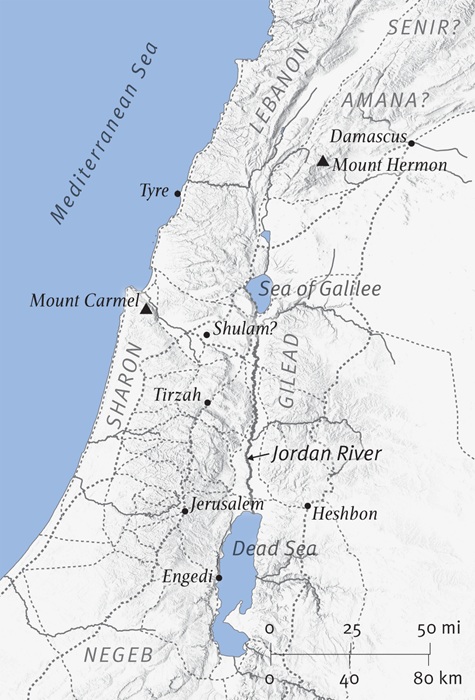
SONG OF SOLOMON—NOTE ON 4:1–5:1 Until 3:11, there has been no hint of a wedding or marriage; thus the scenario of events support the idea that 1:2–3:5 refers to premarital days, while 4:1ff. rehearses the wedding and their love life that followed. Several reasons support this explanation: 1) "wedding" is not mentioned before 3:11; 2) "bride" does not appear until 4:8, and then it is mentioned six times from 4:8 to 5:1; and 3) prior to 4:1 the beloved has a holy preoccupation with sexual restraint (cf. 2:7; 3:5), but not afterward in the holy
bonds of matrimony.
SONG OF SOLOMON—NOTE ON 4:1–15 Possibly Solomon speaks vv. 1–7 in public and the far more intimate words of vv. 8–15 in private as they prepare to consummate their marriage in v. 16 and 5:1.
SONG OF SOLOMON—NOTE ON 4:1–7 For other specific descriptions of the Shulammite's beauty, see 6:4–9 and 7:1–7. He begins 4:1 and closes v. 7 with the same refrain, "you are beautiful, my love."
SONG OF SOLOMON—NOTE ON 4:1, 3 veil. Not the veil of a prostitute (1:7), but rather the bride.
SONG OF SOLOMON—NOTE ON 4:8 from Lebanon. This figuratively describes the distance that the couple had kept sexually, which is further described in v. 12 as a locked garden and a sealed spring.
SONG OF SOLOMON—NOTE ON 4:9 my sister. A common ancient Near Eastern term of endearment by a husband for his wife, which expresses closeness and permanence of relationship (cf. 4:10, 12; 5:1–2).
SONG OF SOLOMON—NOTE ON 4:15 a well of living water. Solomon testified that whereas she was closed to his physical love before marriage (vv. 8, 12), now she is appropriately open to it (cf. Prov. 5:15–20).
SONG OF SOLOMON—NOTE ON 4:16 The Shulammite then portrays herself as an open garden, whereas before she was closed (4:12). She describes herself as "his garden" signifying voluntary sexual surrender (cf. 1 Cor. 7:3–5).
Local Color in the Song of Solomon
Local Color in the Song of Solomon 4:1; 6:5 "slopes of Gilead" the high plateau east of Galilee and Samaria 4:4 "tower of David" probably the armory tower of Neh. 3:19, 25 4:8 "peak of Amana" the hill in which the Amana River has its source in Syria
4:8 "peak of Senir and Hermon"
the Amorite and Hebrew names for the tallest summit in northern Israel (over 9,200 ft., cf. Deut. 3:9) 4:10, 14, 16; 5:1, 13; 6:2; 8:14 "spices" the sweet smelling oil from the balsam
4:14 "saffron" the dried, powdered pistils and stamens of a small crocus
4:14 "calamus" a wild grass with a gingery scent 4:14 "cinnamon" a spice taken from the bark of a tree 4:14 "aloes" a spicy drug with a strong scent ©1997 by Thomas Nelson, Inc.
SONG OF SOLOMON—NOTE ON 5:1 I came. While the guests feasted, the couple consummated their marriage (cf. Gen. 29:23; Deut. 22:13–21) and Solomon announced the blessing (cf. Gen. 2:25). Eat, friends. Given the intimate and private nature of sexual union, it seems difficult to understand anyone but God speaking these words (cf. Prov. 5:21). This is the divine affirmation of sexual love between husband and wife as holy and beautiful.
SONG OF SOLOMON—NOTE ON 5:2–8:14 This third major section features the couple's first argument (5:2–6:3) and their reconciliation (6:4–8:14).
SONG OF SOLOMON—NOTE ON 5:2–6:3 Inevitable discord comes to even the most idyllic marriage. The "little foxes" of 2:15 have visited the home in this segment.
SONG OF SOLOMON—NOTE ON 5:2 I slept, but my heart was awake. Some have suggested the beloved dreams here, as in 3:1–4. However, she acknowledges "my heart was awake," indicating that she was not sound asleep. To make this a dream would make the rest of the book a dream, which is highly unlikely. Open to me. It appears that Solomon returned home earlier than expected and wanted to give his bride a romantic surprise.
SONG OF SOLOMON—NOTE ON 5:3 how could I . . . ? Her groggy response to Solomon.
SONG OF SOLOMON—NOTE ON 5:4–6 By the time she awakens fully and opens the door, Solomon has departed.
SONG OF SOLOMON—NOTE ON 5:7 Unlike what happened in her dream (3:3), the watchmen treat her badly. Between the darkness and the unfamiliar features of the new bride, this could easily have happened.
SONG OF SOLOMON—NOTE ON 5:9 The wise daughters of Jerusalem twice ask a question that prompts this bride to recall the superlative features of her new husband in vv. 10–16.
SONG OF SOLOMON—NOTE ON 5:10–16 She responds that he is "distinguished among ten thousand" which is another way to say "he is the best of the best."
SONG OF SOLOMON—NOTE ON 6:1 Having established why they should look (5:9), the daughters ask where they should look.
SONG OF SOLOMON—NOTE ON 6:2–3 She believed Solomon had gone back to the garden and reaffirmed her exclusive love (cf. 2:16; 7:10).
SONG OF SOLOMON—NOTE ON 6:4–8:4 The couple works through their difficulties and rekindles their love.
SONG OF SOLOMON—NOTE ON 6:4–9 Apparently a reunion has occurred, and Solomon once again assured her of his love.
SONG OF SOLOMON—NOTE ON 6:4 lovely as Jerusalem. The nation's capital city was known as "the perfection of beauty, the joy of all the earth" (cf. Lam. 2:15; Ps. 48:1–2).
SONG OF SOLOMON—NOTE ON 6:8–9 Solomon reaches new heights in telling his bride she remains the best of the best (cf. 2:2; 4:7; 5:2).
SONG OF SOLOMON—NOTE ON 6:8 queens . . . concubines . . . virgins. Are these Solomon's other women? There is no language of ownership or relationship. The numerical progression from 60 to 80 to "without number" points to the use of various categories for effect only. Solomon tells his beloved that she stands above all women.
SONG OF SOLOMON—NOTE ON 6:10 This is better understood as being said by the daughters of Jerusalem as the third question in a series of three (cf. 5:9; 6:1). This time they exalt the Shulammite as one who ranks with the great beauties of God's creation.
SONG OF SOLOMON—NOTE ON 6:11–13 This represents the most difficult portion to interpret in the entire song.
SONG OF SOLOMON—NOTE ON 6:11–12 This is best understood as being spoken by the beloved. Solomon acknowledges that when he left home hastily (cf. 5:2– 6), he returned to agricultural (6:11) and military (v. 12) matters.
Local Color in the Song of Solomon
Local Color in the Song of Solomon 5:14 "ivory" possibly a yellowish or greenish stone such as topaz 5:14 "sapphires" the azure-blue lapis lazuli which was abundant in the East
6:4 "Tirzah" a site known for its natural beauty and gardens located seven miles northeast of Shechem in Samaria
6:13 "a dance before two armies"
possibly a dance of unknown origin associated with the place of Mahanaim (cf. Gen. 32:2) ©1997 by Thomas Nelson, Inc.
SONG OF SOLOMON—NOTE ON 6:13 Return, return. This is best understood as being spoken by the daughters of Jerusalem. In effect, they beckon the bride back to the royal palace. Shulammite. A resident of Shunem, a part of the land allotted to Issachar (cf. Josh. 19:18). Why should you look. This is best understood as being spoken by the beloved. This probably refers to some form of marital dance associated with the city of Mahanaim which would be inappropriate for anyone other than Solomon to witness.
SONG OF SOLOMON—NOTE ON 7:1–5 It is better to understand this as the friends answering Solomon. Verses 1 and 5 fit far better this way.
SONG OF SOLOMON—NOTE ON 7:1 O noble daughter! She appeared by beauty and dress to be of royal lineage, although she really came from a humble background.
SONG OF SOLOMON—NOTE ON 7:6–9a Solomon and his bride start all over again. He picked up where he left off at 5:2.
SONG OF SOLOMON—NOTE ON 7:9b–8:4 Unlike the response in 5:3, this time Solomon's beloved one responded with reciprocal love.
SONG OF SOLOMON—NOTE ON 7:10 I am my beloved's. She expressed her loyal love for the third time (cf. 2:16; 6:3).
Local Color in the Song of Solomon
Local Color in the Song of Solomon 7:4 "pools in Heshbon" water reservoirs in the Moabite city of Heshbon near modern Amman
7:4 "the gate of Bathrabbim" possibly a gate name in Heshbon
7:4 "a tower of Lebanon" most likely refers to the white color of the mountain rather than its elevation
of 10,000 feet 7:4 "Damascus" the capital city of Syria to the east of the Lebanon mountains 7:5 "Carmel" a prominent wooded mountain in northern Israel 7:13 "mandrakes" a pungently fragrant herb considered to be an aphrodisiac (cf. Gen. 30:14) 8:11 "Baal-hamon" an unknown location in the hill country north of Jerusalem ©1997 by Thomas Nelson, Inc.
SONG OF SOLOMON—NOTE ON 8:1 like a brother to me. This way she could have publicly bestowed her affection without embarrassment.
SONG OF SOLOMON—NOTE ON 8:3–4 It will be just like it was when they courted (cf. 2:6–7). This time the restraint involves waiting for lovemaking until they are in private circumstances rather than public.
SONG OF SOLOMON—NOTE ON 8:5–14 This final scene portrays the original "marriage encounter" where they reaffirm their love for one another.
SONG OF SOLOMON—NOTE ON 8:5b I awakened you. This is better understood as being spoken by Solomon. The Shulammite's dream of 3:4 has actually been realized now in their marriage. mother. This is the sixth reference to the Shulammite's mother (cf. 1:6; 3:4; 6:9; 8:1; 8:2). In contrast, Solomon's mother Bathsheba is mentioned only once (cf. 3:11).
SONG OF SOLOMON—NOTE ON 8:6 seal. The Shulammite is the seal and Solomon would do the sealing. This represents their publicly declared mutual love for one another.
SONG OF SOLOMON—NOTE ON 8:6–7 for love. This represents the 1 Cor. 13:1–8 of the OT. Four qualities of love appear: 1) love is unyielding in marriage, as death is to life; 2) love is intense like the brightest flame, perhaps as bright as the glory of the Lord; 3) love is invincible or unquenchable, even when flooded by difficulty; and 4) love is so priceless that it cannot be bought, only given away.
SONG OF SOLOMON—NOTE ON 8:8–9 The bride's brothers reminded everyone that they did their brotherly duty of keeping their sister pure before marriage (cf. the brothers of Rebekah in Gen. 24:50–60; Dinah in Gen. 34:13–27; and Tamar in 2 Sam. 13:1–22). The same standard of purity is taught in the NT (cf. 1 Thess.
4:1–8).
SONG OF SOLOMON—NOTE ON 8:9 wall . . . door. Wall represents sexual purity; door portrays an openness to immorality.
SONG OF SOLOMON—NOTE ON 8:10 wall. She reaffirmed that she lived a premarital life of a wall, successfully rebuffing all attempts on her honor. Thus her husband took great delight and contentment in her moral purity.
SONG OF SOLOMON—NOTE ON 8:11–12 While Solomon might have leased out his real vineyard for profit, she gave the vineyard of her love to Solomon.
SONG OF SOLOMON—NOTE ON 8:13 companions. These could be 1) Solomon's shepherd companions (cf. 1:7), 2) the daughters of Jerusalem (cf. 6:13), or 3) those who escorted the bride to Jerusalem (cf. 3:7).
Isaiah
Isaiah 1 • Isaiah 2 • Isaiah 3 • Isaiah 4 • Isaiah 5 • Isaiah 6 • Isaiah 7 •
Isaiah 8 • Isaiah 9 • Isaiah 10 • Isaiah 11 • Isaiah 12 • Isaiah 13 • Isaiah 14 • Isaiah 15 • Isaiah 16 • Isaiah 17 • Isaiah 18 • Isaiah 19 • Isaiah 20 • Isaiah 21 • Isaiah 22 • Isaiah 23 • Isaiah 24 • Isaiah 25 • Isaiah 26 • Isaiah 27 • Isaiah 28 • Isaiah 29 • Isaiah 30 • Isaiah 31 • Isaiah 32 • Isaiah 33 • Isaiah 34 • Isaiah 35 • Isaiah 36 • Isaiah 37 • Isaiah 38 • Isaiah 39 • Isaiah 40 • Isaiah 41 • Isaiah 42 • Isaiah 43 • Isaiah 44 • Isaiah 45 • Isaiah 46 • Isaiah 47 • Isaiah 48 • Isaiah 49 • Isaiah 50 • Isaiah 51 • Isaiah 52 • Isaiah 53 • Isaiah 54 • Isaiah 55 • Isaiah 56 • Isaiah 57 • Isaiah 58 • Isaiah 59 • Isaiah 60 • Isaiah 61 • Isaiah 62 • Isaiah 63 • Isaiah 64 • Isaiah 65 • Isaiah 66 Introduction to Isaiah
Title Author and Date Background and Setting Historical and Theological Themes Interpretive Challenges Outline Footnotes Study Notes
Introduction to Isaiah
Title
The book derives its title from the author, whose name means "The Lord is salvation," and is similar to the names Joshua, Elisha, and Jesus. Isaiah is quoted directly in the NT over 65 times, far more than any other OT prophet, and mentioned by name over 20 times.
Author and Date
Isaiah, the son of Amoz, ministered in and around Jerusalem as a prophet to Judah during the reigns of four kings of Judah: Uzziah (called "Azariah" in 2 Kings), Jotham, Ahaz, and Hezekiah (Isa. 1:1), from c. 739–686 B.C. He evidently came from a family of some rank, because he had easy access to the king (7:3). He was married and had two sons who bore symbolic names: "Shearjashub" ("a remnant shall return," 7:3) and "Maher-shalal-hash-baz" ("the spoil speeds, the prey hastens," 8:3). When called by God to prophesy, in the year of King Uzziah's death (c. 739 B.C.), he responded with a cheerful readiness, though he knew from the beginning that his ministry would be one of fruitless warning and exhortation (6:9–13). Having been reared in Jerusalem, he was an appropriate choice as a political and religious counselor to the nation.
Isaiah was a contemporary of Hosea and Micah. His writing style has no rival in its versatility of expression, brilliance of imagery, and richness of vocabulary. The early church father Jerome likened him to Demosthenes, the legendary Greek orator. His writing features a range of 2,186 different words, compared to 1,535 in Ezekiel, 1,653 in Jeremiah, and 2,170 in the Psalms. Second Chronicles 32:32 records that he wrote a biography of King Hezekiah also. The prophet lived until at least 681 B.C. when he penned the account of Sennacherib's death (cf. 37:38). Tradition has it that he met his death under King Manasseh (c. 695– 642 B.C.) by being cut in two with a wooden saw (cf. Heb. 11:37).
Background and Setting
During Uzziah's prosperous 52-year reign (c. 790–739 B.C.), Judah developed
into a strong commercial and military state with a port for commerce on the Red Sea and the construction of walls, towers, and fortifications (2 Chron. 26:3–5, 8– 10, 13–15). Yet the period witnessed a decline in Judah's spiritual status. Uzziah's downfall resulted from his attempt to assume the privileges of a priest and burn incense on the altar (2 Kings 15:3–4; 2 Chron. 26:16–19). He was judged with leprosy, from which he never recovered (2 Kings 15:5; 2 Chron. 26:20–21).
His son Jotham (c. 750–731 B.C.) had to take over the duties of king before his father's death. Assyria began to emerge as a new international power under Tiglath-pileser (c. 745–727 B.C.) while Jotham was king (2 Kings 15:19). Judah also began to incur opposition from Israel and Syria to her north during his reign (2 Kings 15:37). Jotham was a builder and a fighter like his father, but spiritual corruption still existed in the land (2 Kings 15:34–35; 2 Chron. 27:1–2).
Ahaz was 25 when he began to reign in Judah, and he reigned until age 41 (2 Chron. 28:1, 8; c. 735–715 B.C.). Israel and Syria formed an alliance to combat the rising Assyrian threat from the east, but Ahaz refused to bring Judah into the alliance (2 Kings 16:5; Isa. 7:6). For this, the northern neighbors threatened to dethrone him, and war resulted (734 B.C.). In panic, Ahaz sent to the Assyrian king for help (2 Kings 16:7) and the Assyrian king gladly responded, sacking Gaza, carrying all of Galilee and Gilead into captivity, and finally capturing Damascus (732 B.C.). Ahaz's alliance with Assyria led to his introduction of a heathen altar, which he set up in Solomon's temple (2 Kings 16:10–16; 2 Chron. 28:3). During his reign (722 B.C.), Assyria captured Samaria, capital of the northern kingdom, and carried many of Israel's most capable people into captivity (2 Kings 17:6, 24).
Hezekiah began his reign over Judah in 715 B.C. and continued for 29 years to c. 686 B.C. (2 Kings 18:1–2). Reformation was a priority when he became king (2 Kings 18:4, 22; 2 Chron. 30:1). The threat of an Assyrian invasion forced Judah to promise heavy tribute to that eastern power. In 701 B.C. Hezekiah became very ill with a life-threatening disease, but he prayed and God graciously extended his life for 15 years (2 Kings 20; Isa. 38) until 686 B.C. The ruler of Babylon used the opportunity of his illness and recovery to send congratulations to him, probably seeking to form an alliance with Judah against Assyria at the same time (2 Kings 20:12ff.; Isa. 39). When Assyria became weak through internal strife, Hezekiah refused to pay any further tribute to that power (2 Kings 18:7). So in 701 B.C. Sennacherib, the Assyrian king, invaded the coastal areas of Israel,
marching toward Egypt on Israel's southern flank. In the process he overran many Judean towns, looting and carrying many people back to Assyria. While besieging Lachish, he sent a contingent of forces to besiege Jerusalem (2 Kings 18:17–19:8; Isa. 36:2–37:8). The side-expedition failed, however, so in a second attempt he sent messengers to Jerusalem demanding an immediate surrender of the city (2 Kings 19:9ff.; Isa. 37:9ff.). With Isaiah's encouragement, Hezekiah refused to surrender, and when Sennacherib's army fell prey to a sudden disaster, he returned to Nineveh and never threatened Judah again.
Historical and Theological Themes
Isaiah prophesied during the period of the divided kingdom, directing the major thrust of his message to the southern kingdom of Judah. He condemned the empty ritualism of his day (e.g., 1:10–15) and the idolatry into which so many of the people had fallen (e.g., 40:18–20). He foresaw the coming Babylonian captivity of Judah because of this departure from the Lord (39:6–7).
Fulfillment of some of his prophecies in his own lifetime provided his credentials for the prophetic office. Sennacherib's effort to take Jerusalem failed, just as Isaiah had said it would (37:6–7, 36–38). The Lord healed Hezekiah's critical illness, as Isaiah had predicted (38:5; 2 Kings 20:7). Long before Cyrus, king of Persia appeared on the scene, Isaiah named him as Judah's deliverer from the Babylonian captivity (Isa. 44:28; 45:1). Fulfillment of his prophecies of Christ's first coming have given Isaiah further vindication (e.g., 7:14). The pattern of literal fulfillment of his already-fulfilled prophecies gives assurance that prophecies of Christ's second coming will also see literal fulfillment.
Isaiah provides data on the future day of the Lord and the time following. He details numerous aspects of Israel's future kingdom on earth not found elsewhere in the OT or NT, including changes in nature, the animal world, Jerusalem's status among the nations, the Suffering Servant's leadership, and others.
Through a literary device called "prophetic foreshortening," Isaiah predicted future events without delineating exact sequences of the events or time intervals separating them. For example, nothing in Isaiah reveals the extended period separating the two comings of the Messiah. Also, he does not provide as clear a distinction between the future temporal kingdom and the eternal kingdom as John does in Rev. 20:1–10; 21:1–22:5. In God's program of progressive revelation, details of these relationships awaited a prophetic spokesman of a later