
* Isa. 56:7; 66:20–23; Jer. 33:18 further confirm the burnt and grain offerings.
EZEKIEL—NOTE ON 40:39 burnt . . . sin . . . guilt offering. For OT background see 1) Lev. 1:1–17; 6:8–13; 2) Lev. 4:1–35; 6:24–30; and 3) Lev. 5:1–6:7; 7:1– 10 respectively. Cf. Ezek. 43:18–27; 45:13–25; 46:1–15, 19–24.
EZEKIEL—NOTE ON 40:41 tables . . . on which to slaughter. Four tables are on either side of the inner court's north gate, used for commemorating the death of Christ by slaying burnt, sin, and guilt offerings.
EZEKIEL—NOTE ON 40:44 chambers. See esv footnote, "chambers for singers." Provision is made for the praises of the redeemed in music.
EZEKIEL—NOTE ON 40:46 sons of Zadok. Proper names tie the vision to historical reality, calling for literal interpretation. This Levitical family descended from Levi, Aaron, Eleazar, and Phinehas (1 Chron. 6:3–8). In accord with God's covenant with Phinehas (Num. 25:10–13), and because of Eli's unfaithfulness (cf. 1 Sam. 1–2) and Zadok's faithfulness to David and Solomon (1 Kings 1:32–40), Zadok's sons serve as priests in the millennial temple. Other references to sons of Zadok are in Ezek. 43:19; 44:15, and 48:11.
Millennial Sacrifices
Millennial Sacrifices Levitical Millennial* 1. Burnt—Lev. 1:3–17 1. Burnt—Ezek. 40:39 2. Grain—Lev. 2:1–16 2. Grain—Ezek. 45:15 3. Peace—Lev. 3:1–17 3. Peace—Ezek. 45:15 4. Sin—Lev. 4:1–35 4. Sin—Ezek. 40:39 5. Guilt—Lev. 5:1–6:7 5. Guilt—Ezek. 40:39 6. Drink—Lev. 23:13, 37 6. Drink—Ezek. 45:17 * Isa. 56:7; 66:20–23; Jer. 33:18 further confirm the burnt and grain offerings. ©1997 by Thomas Nelson, Inc.
EZEKIEL—NOTE ON 40:47 measured the court. The court around the temple was a square, around the square temple (41:1). the altar. This is the bronze altar where offerings occur. Cf. 43:13–27.
EZEKIEL—NOTE ON 40:48–49 vestibule. This refers to the temple porch and is similar to that of Solomon's temple.
EZEKIEL—NOTE ON 41:1 to the nave. Precise descriptions continue for the temple proper, its sanctuary or holy place (here called "nave"), and side chambers for priests' quarters (vv. 5–11). This chapter can be studied in the light of 1 Kings 6–7 to note differences from Solomon's temple.
EZEKIEL—NOTE ON 41:4 the Most Holy Place. The Most Holy Place, which the high priest entered annually on the Day of Atonement (cf. Lev. 16). These dimensions are identical to Solomon's (1 Kings 6:20), and twice those of the tabernacle in the wilderness.
EZEKIEL—NOTE ON 41:5–11 This section describes the "wall" and "side chambers."
EZEKIEL—NOTE ON 41:12 building . . . on the west. Beyond the western end of the temple proper was a distinct building with space that serves the temple, possibly housing supplies.
EZEKIEL—NOTE ON 41:13 measured the temple. Cf. 40:47. It was about 175 feet square.
EZEKIEL—NOTE ON 41:15 galleries on either side. These were terraced buildings with decorations (vv. 18–20).
EZEKIEL—NOTE ON 41:18 cherubim and palm trees. Figures of angels (cf. chs. 1; 10) with palms between them (possibly to depict life and fruitfulness of God's servants) were on the walls of the temple proper and on the doors (41:25). Each cherub (unlike that of chs. 1; 10 that had four faces) had the face of a man and of a lion, possibly to represent the humanity and kingship of Messiah.
EZEKIEL—NOTE ON 41:22 This was the altar of incense (cf. Ex. 30:1–3; 1 Kings 7:48).
EZEKIEL—NOTE ON 42:3 gallery against gallery. Priestly rooms are described (vv. 3–12), situated along the south, north, and west walls of the sanctuary and Most Holy Place, in three stories. Priests eat the holy offerings (cf. Lev. 2:3, 10; 6:9–11; 10:12) and dress there (Ezek. 42:13–14).
EZEKIEL—NOTE ON 42:15–20 out by the gate. The angel measured the height and thickness of the outside wall (40:5); then the outer court (40:6–27); next the inner court with the chambers (40:28–42:14); finally, the extent of all the temple
buildings outside. Measurements of the outer wall, 500 reeds each way, were approximately one mile on each of the four sides. Much too large for Mount Moriah, this scheme will require changes in the topography of Jerusalem, as Zechariah predicted (Zech. 14:9–11).
EZEKIEL—NOTE ON 43:2 the glory of the God of Israel. In earlier chapters of this prophecy, emphasis was given to the departure of God's glory from the temple (see chs. 8–11). Thus the Lord abandoned his people to destruction and dispersion. Here, in the millennial temple, the glory of God returns to dwell. His glory will be manifest in fullness in the future kingdom, after the Lord's second advent, which is also to be glorious (Matt. 16:27; 25:31). Ezekiel 43:1–12 describes God's glorious entrance into the sanctuary. coming from the east. The glory had been in the tabernacle (Ex. 40:34–35) and the temple (1 Kings 8:10– 11), though not in Zerubbabel's temple. Here, the Lord returns to be Israel's King. The glory departed to the east from Israel (Ezek. 11:23) when God judged them, so the glory returns from the east when he has regathered them, and is restoring their worship.
EZEKIEL—NOTE ON 43:3 like the vision. This vision appearance of God to Ezekiel is glorious, just like the vision in chs. 8–11, which pictures his coming, by angels, to judge Jerusalem (cf. 9:3–11; 10:4–7). like the vision . . . by the Chebar canal. God's appearance is also glorious as in the vision of 1:3–28. I fell on my face. Just as in the other visions of God's glory (1:28; 9:8). Cf. Rev. 1:12–17.
EZEKIEL—NOTE ON 43:5 the glory . . . filled the temple. The future kingdom glory of God will fill his temple (Zech. 2:5), as he filled the tabernacle (Ex. 40:34) and later Solomon's temple (1 Kings 8:11; Ps. 29:9).
EZEKIEL—NOTE ON 43:7 the place of my throne. The King of glory (Ps. 24:7– 10) claims the millennial temple as his place to dwell. Cf. 1 Chron. 29:23; Zech. 6:13. There will be human, unresurrected people in the kingdom, who entered when Christ returned and destroyed all the wicked. They will worship at this actual temple.
EZEKIEL—NOTE ON 43:8–9 The future temple will be most holy, protected from 1) harlotry such as the Israelites had engaged in (2 Kings 23:7) and 2) defiling tombs of kings that Israel had allowed in the sacred temple area (Ezek. 21:18).
EZEKIEL—NOTE ON 43:10–12 Here is the key to the entire vision of chs. 40–48. These glorious future plans show how much Israel forfeited by their sins. Every detail should produce repentance in Ezekiel's hearers and readers.
EZEKIEL—NOTE ON 43:13–27 the altar. The measurements of the altar of burnt offering are given in vv. 13–17, then the offerings are described (vv. 18–27). These offerings are not efficacious, nor were the OT sacrifices. They were all symbolic of death for sin. They do not take away sin (cf. Heb. 10:4). They were prospective; these will be retrospective.
EZEKIEL—NOTE ON 43:19 family of Zadok. Cf. 40:46 and 44:10, and see notes there. a bull . . . for a sin offering. Exact offerings, in language just as definitive as the literal descriptions in Moses' day, are also just as literal here. They are of a memorial nature; they are not efficacious any more than OT sacrifices were. As OT sacrifices pointed forward to Christ's death, so these are tangible expressions, not competing with, but pointing back to the value of Christ's completely effective sacrifice, once for all (Heb. 9:28; 10:10). God at that time endorsed OT offerings as tokens of forgiving and cleansing worshipers on the basis and credit of the great Lamb they pointed to, who alone could take away sins (John 1:29). The tangible expressions of worship, which the Israelites for so long failed to offer validly (cf. Isa. 1:11–15), will at last be offered acceptably, then with full understanding about the Lamb of God to whom they point. The bread and the cup, which believers today find meaningful, do not compete with Christ's cross but are tangible memorials of its glory. So will these sacrifices be.
EZEKIEL—NOTE ON 43:24 salt. Cf. Lev. 2:13. burnt offering. As the sin offering is a part of future millennial worship (Ezek. 43:19), so there are other offerings also (cf. Lev. 1–7). The burnt offering, denoting full consecration to God is one; the peace offering expressing gratitude for peace with God in covenant bonds is another (Ezek. 43:27).
EZEKIEL—NOTE ON 43:25 without blemish. Commemorative of Christ's unblemished perfection.
EZEKIEL—NOTE ON 44:1–2 the outer gate . . . was shut. The Lord has returned from the direction in which he departed (10:18–19). It is kept closed, in honor of the Lord's glory having returned through it for the millennial worship and indicating that the Lord will not depart again as in chs. 8–11 (cf. 43:1–5). This eastern gate of the temple should not be confused with the modern sealed eastern
gate of the city (cf. 45:6–8).
EZEKIEL—NOTE ON 44:3 the prince may sit in it. The designation "prince" is used at least 14 times in chs. 44–47. He is not the Lord Jesus Christ, but someone distinct from him (cf. "eat bread before the Lord"); he has sins for which he offers sacrifice (45:22), and fathers sons (46:16–18). He cannot enter by the east gate that the Lord used, but he is allowed to come in and go out by the gate's vestibule, and eat bread by the gateway. He cannot perform priestly duties (45:19) as Messiah will (cf. Ps. 110:4; Zech. 6:12–13), and he must worship the Lord (Ezek. 46:2). Most likely "the prince" is one who is neither a priest nor the king, but rather one who administrates the kingdom, representing the King (the Lord Jesus Christ) on one hand, and also the princes (14:8–9) who individually lead the 12 tribes. Possibly, he will be a descendant of David.
EZEKIEL—NOTE ON 44:5–9 mark well . . . the entrance. Since the Lord's glory fills the temple, it is sanctified (v. 4), and God is particular about what kind of people worship there. Sins of the past, as in chs. 8–11, must not be repeated and if they are, will exclude their perpetrators from the temple. Only the circumcised in heart may enter (Deut. 30:6; Jer. 4:4; Rom. 2:25–29), whether of Israel or another nation (Ezek. 44:7, 9). Many other peoples than Jews will go into the kingdom in unresurrected bodies, because they have believed in Jesus Christ and were ready for his coming. They will escape his deadly judgment and populate and reproduce in the 1,000-year kingdom. Such circumcision pertains to a heart that is sincere about removing sin and being devoted to the Lord (cf. Jer. 29:13). In the millennium, a Jew with an uncircumcised heart will be considered a foreigner (Ezek. 44:9). "Uncircumcised in heart and flesh" refers to sinners, and "foreigners" identifies rejecters of the true God.
EZEKIEL—NOTE ON 44:10 Levites . . . shall bear their punishment. God makes distinctions. Levites in the line of those unfaithful in days before the judgment can minister in temple services but they cannot make offerings or enter the Most Holy Place (vv. 11–14). Only Zadok's line can fulfill these ministries (vv. 15– 16). The reason for this is the value that God attaches to the faithfulness of Zadok in the past (1 Sam. 2:35; 2 Sam. 15:24ff.; 1 Kings 1:32–40; 2:26–35). See note on Ezek. 40:46.
EZEKIEL—NOTE ON 44:16 my table. This is the altar of burnt offering (cf. 40:46; 41:22).
EZEKIEL—NOTE ON 44:17–27 They shall. Various standards govern priestly service, such as moderation (v. 20) and sobriety (v. 21). They will model holy behavior as they teach the people to live their lives set apart to God (vv. 23–24). Minutia about dress (such as forbidding the uncleanness of sweat resulting from wearing wool), marriage (cf. Lev. 21:14), contact with dead bodies, etc. point more naturally to a literal fulfillment than to a generalized blurring of details in a symbolical interpretation.
EZEKIEL—NOTE ON 44:28–31 I am their possession. As the priests had no possession in the land when it was originally apportioned, so in the future God will be their portion.
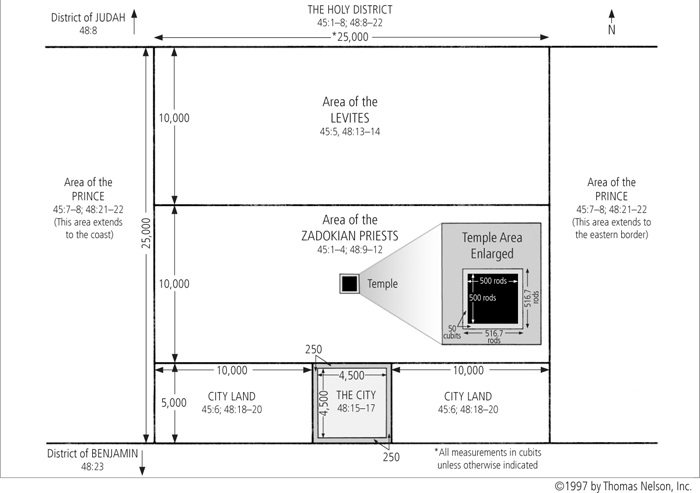
EZEKIEL—NOTE ON 45:1–5 set apart for the Lord. This sacred land, set apart at the heart (center) of Palestine, is separate from allotments designated for various tribes, seven to the north and five to the south (cf. ch. 48). Though the whole earth is the Lord's (Ps. 24:1), this area is meaningful to him in a special sense, as providing for special purposes that Ezek. 45:2–8 goes on to define. This holy rectangle (8.5 miles by 3.3 miles) (45:1, 3) corresponds to 48:8–22, which describes this portion as between Judah to the north and Benjamin to the south extending from the Mediterranean east to the eastern border. It is the area for the priestly homes (45:4) particularly, but is also for the benefit of all worshipers.
EZEKIEL—NOTE ON 45:2 a square plot . . . for the sanctuary. At the heart of the special allotment is the temple area (48:10), which serves all Israelite tribes, and also is the worship center for those of the whole world who visit (Isa. 4:2–3; Zech. 14:16–19). It is one mile square (cf. Ezek. 42:15–20). As a center, not only for those in Palestine but for the world, the area is appropriately larger than past temples that served Israel.
EZEKIEL—NOTE ON 45:5 for the Levites. Distinct from the land devoted to temple and priestly homes is another portion for Levites, who assist in temple service. This portion is also about 8.5 x 3.3 miles and lies north of the temple/priest allotment. Cf. 48:13–14 for more details.
EZEKIEL—NOTE ON 45:6 the property of the city. On the south of the central sanctuary plot is the city of Jerusalem with an area of about 8.5 x 1.65 miles Cf. 48:15–20 for more details.
EZEKIEL—NOTE ON 45:7 to the prince shall belong the land. See note on 44:3.
This administrator of the kingdom under Christ will have his territory in two parts, one to the west and the other to the east of the temple/priest and city portions in vv. 1–6. Cf. 48:21–22 for more details.
EZEKIEL—NOTE ON 45:8 my princes shall no more oppress. God pledges a kingdom era free from civil leaders selfishly taking advantage of the people, i.e., seizing their land (cf. 22:27; Num. 36:7–9; 1 Kings 21; Isa. 5:8; Hos. 5:10; Mic. 2:1–2). The princes most likely are the leaders of each tribe. No one will be deprived of his possession under Messiah's rule.
EZEKIEL—NOTE ON 45:9–12 The leaders of the land are urged to be thoroughly honest in their commercial dealings. This warning shows that there will be sin in the millennium. The believing Jews who entered the 1,000-year reign of Christ on earth and inherited the promised kingdom will be fully human and capable of such sins. There also will be children who do not necessarily believe, as the final rebellion against King Messiah and his temple proves (cf. Rev. 20:7–9).
EZEKIEL—NOTE ON 45:10 balances. Relates to selling by weight. ephah. Relates to selling by dry volume. bath. Relates to selling by liquid volume.
EZEKIEL—NOTE ON 45:11 ephah. About .75 bushels. bath. About 6 gallons. homer. In liquid volume about 60 gallons and in dry volume about 7.5 bushels.
EZEKIEL—NOTE ON 45:12 shekels. By weight about .4 ounces made up of 20 gerahs (.02 ounce/each). Sixty shekels (20+25+15) equal a "maneh," or "mina," or about 24 ounces (1.5 pounds).
EZEKIEL—NOTE ON 45:13–17 Here are the offerings for Israel's prince (v. 16). Because of what the people will give him, he will provide for public sacrifices (v. 17).
EZEKIEL—NOTE ON 45:13 They will give 1/60th of their grain.
The Holy District
EZEKIEL—NOTE ON 45:14 cor. See note on homer in 45:11. They will give one percent of their oil.
EZEKIEL—NOTE ON 45:15 They will give one lamb for every 200 in the flocks or one-half of one percent.
EZEKIEL—NOTE ON 45:16–17 prince. See note on 44:3.
EZEKIEL—NOTE ON 45:17 feasts . . . new moons . . . Sabbaths . . . appointed feasts. These will be discussed in notes on 45:18–46:15.
EZEKIEL—NOTE ON 45:18–25 The annual feasts for the nations are outlined. The millennial feasts include three of the six Levitical feasts: 1) Passover; 2) Unleavened Bread; and 3) Booths, or Tabernacles. Three Levitical feasts are not celebrated: 1) Pentecost; 2) Trumpets; and 3) Atonement. Most likely they are excluded because what they had looked forward to prophetically has been fulfilled and now serve no significant remembrance purpose such as Passover and Booths, or Tabernacle, will continue to provide.