
Pharaoh and Egyptians beg Israel to leave Egypt (12:31–33)
The Ten Plagues on Egypt
The Plague Egyptian Deity The Effect
1. Blood (7:20) Hapi Pharaoh hardened (7:22)
2. Frogs (8:6) Heqt Pharaoh begs relief, promises freedom (8:8), but is hardened (8:15) 3. Gnats (8:17) Hathor, Nut Pharaoh hardened (8:19) 4. Flies (8:24) Shu, Isis Pharaoh bargains (8:28), but is hardened (8:32) 5. Livestock diseased (9:6) Apis Pharaoh hardened (9:7)
6. Boils (9:10) Sekhmet Pharaoh hardened (9:12)
7. Hail (9:23) Geb Pharaoh begs relief (9:27), promises freedom (9:28), but is hardened (9:35)
8. Locusts (10:13) Serapis Pharaoh bargains (10:11), begs relief (10:17), but is hardened (10:20) 9. Darkness (10:22) Ra Pharaoh bargains (10:24), but is hardened (10:27) 10. Death of firstborn (12:29) Pharaoh and Egyptians beg Israel to leave Egypt (12:31–33)
© 1993 by Thomas Nelson, Inc.
EXODUS—NOTE ON 7:24 dug along the Nile. The only recourse was to tap into the natural water table, the subterranean water supply. Evidently this was the water which was available to the magicians to use (v. 22).
EXODUS—NOTE ON 7:25 Seven full days. An interval of time occurred before another warning was delivered, indicating that the plagues did not occur rapidly in uninterrupted succession.
EXODUS—NOTE ON 8:1 Go in to Pharaoh. The warning for the second plague was delivered to Pharaoh, presumably at his palace. Warnings for the fifth (9:1) and eighth (10:1) plagues also occurred at the palace.
EXODUS—NOTE ON 8:2 I will plague. Various terms, namely, "plagues" (9:14), "strike" (12:13), and "pestilence" (9:15), were employed to impress them with the severity of what was happening in Egypt. frogs. That Egyptians favored frogs was seen in the wearing of amulets in the shape of a frog and in the prohibition against intentionally killing frogs, who were considered sacred animals. The croaking of frogs from the river and pools of water signaled to farmers that the gods who controlled the Nile's flooding and receding had once again made the land fertile. The god Hapi was venerated on this occasion because he had caused alluvial deposits to come downstream. Further, the frog
was the representation, the image, of the goddess Heqt, the wife of the god Khum, and the symbol of resurrection and fertility. The presence of frogs in such abundance, all over everywhere outside and inside the houses (8:3, 13), however, brought only frustration, dismay, and much discomfort, rather than the normal signal that the fields were ready for cultivating and harvesting.
EXODUS—NOTE ON 8:7 the magicians did the same. Once again, instead of reversing the plague, the magicians in demonstrating the power of their secret arts only appeared to increase the frog population to the added discomfort of the people. Their power was not sufficient enough to do more than play "copycat." That the magicians could duplicate but not eradicate the problem was, however, sufficient to solidify royal stubbornness.
EXODUS—NOTE ON 8:8 Plead with the Lord. Using the Lord's name and begging for relief through his intervention was more a point in negotiation and not a personal or official recognition of Israel's Lord.
EXODUS—NOTE ON 8:9 left only in the Nile. A specific detail like this in Moses' question indicates that the Nile and the waters had returned to normal and again continued to support life.
EXODUS—NOTE ON 8:10 Tomorrow. Having been granted the privilege to set the time when the Lord would answer Moses' prayer for relief, Pharaoh requested a cessation only on the next day. Presumably he hoped something else would happen before then so that he would not have to acknowledge the Lord's power in halting the plague, nor be obligated to Moses and his God. But God answered the prayer of Moses, and Pharaoh remained obstinate (v. 15).
EXODUS—NOTE ON 8:16 Without prior warning, the third plague descended on the country. The same absence of warning occurred for the sixth (9:8–9) and the ninth (10:21) plagues. A threefold pattern surfaces: prior warning at the river, then at the palace, and then no warning given. gnats. The Hebrew term is preferably taken to designate tiny, stinging insects barely visible to the naked eye. Those priests, who fastidiously kept themselves religiously pure by frequent washing and by shaving off body hair, were afflicted and rendered impure in their duties.
EXODUS—NOTE ON 8:17 All the dust of the earth . . . in all the land. The record stresses by its repetition of "all" and "land" the tremendous extent and severity
of this pestilence.
EXODUS—NOTE ON 8:19 This is the finger of God. The failure of the magicians to duplicate this plague elicited from them this amazing evaluation, not only among themselves, but publicly before Pharaoh, who nevertheless remained recalcitrant, unwilling to acknowledge the power of God.
EXODUS—NOTE ON 8:21 swarms. The LXX translates "swarms" as "dog-fly," a bloodsucking insect. The ichneumon fly, which deposited its eggs on other living things so the larvae could feast upon it, was considered the manifestation of the god Uatchit. "The land was ruined by the swarms" (v. 24) is hardly an evaluation propitious for any insect-god! Whatever the specific type of fly might have been, the effect of the plague was intense and distressful.
EXODUS—NOTE ON 8:22 set apart the land of Goshen. For the first time in connection with the plagues, God specifically noted the discrimination to be made—Israel would be untouched! The term "sign" (v. 23) describes the distinction that was being drawn and that was also specifically noted for the fifth, seventh, ninth, and tenth plagues. Coupled with the repeated emphasis on "my people" in God's pronouncements, the specific distinguishing between Israel in Goshen and Egypt itself highlighted both God's personal and powerful oversight of his people.
EXODUS—NOTE ON 8:23 Tomorrow. The plague warning on this occasion stated exactly when it would strike, giving Pharaoh and his people opportunity to repent or yield. "Tomorrow" was also the due time for the fifth, seventh, and eighth plagues (9:5, 18; 10:4), and "about midnight" was the stated time for the tenth plague to commence (11:4). See note on 11:4.
EXODUS—NOTE ON 8:26 sacrifice . . . are an abomination to the Egyptians. An attempt at appeasement by compromise on the part of Pharaoh—"Go, sacrifice . . . within the land"—was countered by Moses' pointing out that Israel's sacrifices would not be totally acceptable to the Egyptians, who might even react violently—"will they not stone us?" This evaluation Pharaoh immediately understood. Either their strong dislike of shepherds and sheep (Gen. 46:34) or Israel's sacrificial animals being sacred ones in their religion brought about Egyptian aversion to Israel's sacrifices.
EXODUS—NOTE ON 8:27–29 We must go . . . I will let you go. The first
declaration showed the decision to travel no less than three days beyond Egyptian borders was a non-negotiable item. The second declaration showed Pharaoh trying to keep that decision to travel and sacrifice strictly under his authority and not as a response to the Lord's request for his people.
EXODUS—NOTE ON 8:28 Plead for me. An abbreviated request, applying not only to himself but also for the removal of the plague as previously asked in connection with the second plague (8:8).
EXODUS—NOTE ON 8:29 let not Pharaoh cheat again. Moses' closing exhortation underscored the deceptive nature of the king's words.
EXODUS—NOTE ON 8:31 not one remained. This declaration of the total divine removal of the flies—a demonstration of God's answering Moses' entreaty—did not persuade Pharaoh at all. Once again, removed from the humiliating effects of a plague, his stubborn resistance resurfaced (v. 32).
EXODUS—NOTE ON 9:3 in the field. Apparently stabled livestock did not succumb to the pestilence. Although incredibly severe, some animals were still alive afterward for Egypt to continue without total loss to an economy that depended upon domesticated animals. A few months later, when the seventh plague struck, there were still some cattle, which, if left in the field, would have died (9:19). horses . . . camels. Horses, which were common in the period, had been brought into military service by the Hyksos. See Introduction: Author and Date. Camels were a domesticated animal by this time in the fifteenth century B.C. a very severe plague. In listing the different kinds of livestock, the severe nature of the plague was emphatically underscored as one that would for the first time target personal property. Egyptian literature and paintings substantiate how valuable livestock was to them. Whatever the exact nature of this pestilence—anthrax, murrain, or other livestock disease—it was clearly contagious and fatal. Religious implications were obvious: Egypt prized the bull as a sacred animal with special attention and worship being given to the Apis bull, the sacred animal of the god Ptah. Heliopolis venerated the bull, Mnevis. Further, the goddess Hathor, represented by a cow, or a cow-woman image, was worshiped in several cities.
EXODUS—NOTE ON 9:4 nothing . . . shall die. The additional declaration on the safety of Israel's livestock graphically underscored the miraculous nature of what God was about to do as he declared for the second time the distinction
being made between Israel and Egypt. It underscored Israel's protection and to whom she really belonged.
EXODUS—NOTE ON 9:5 set a time. The prophetic and miraculous nature of this plague is highlighted by stating "tomorrow" and, by noting "the next day," it happened as predicted (v. 6).
EXODUS—NOTE ON 9:6 not one of the livestock of . . . Israel died. The distinction being made received added emphasis with this double declaration that Israelites suffered absolutely no loss in livestock.
EXODUS—NOTE ON 9:7 Pharaoh sent. This time the king had to check on the veracity of the protection afforded Israel. Whatever his own rationalizations or theories about it might have been, they only confirmed him in his resistance and disobedience, despite finding out that "not one . . . was dead."
EXODUS—NOTE ON 9:9 boils breaking out in sores on man and beast. For the first time human health was targeted.
EXODUS—NOTE ON 9:10 soot from the kiln. Aaron and Moses took two handfuls of soot, not just from any furnace, but from a lime-kiln or brick-making furnace. That which participated so largely in their oppressive labor became the source of a painful health hazard for the oppressors!
EXODUS—NOTE ON 9:11 magicians could not stand. A side comment indicates that these men (who in Egyptian eyes were men of power) had been so sorely afflicted that they could not stand, either physically or vocationally, before God's spokesmen. Although they are not mentioned after the third plague, they apparently had continued to serve before Pharaoh and were undoubtedly there when plagues four and five were announced. Their powerlessness had not been sufficient as yet for Pharaoh to dispense with their services—an outward symbol, perhaps, of Pharaoh's unwillingness to grant the God of Israel total sovereignty.
EXODUS—NOTE ON 9:12 the Lord hardened. For the first time, apart from the words to Moses before the plagues began (cf. 4:21; 7:3), the statement is made that God hardened Pharaoh's heart. In the other instances, the record observes that Pharaoh hardened his own heart. Each instance records "as the Lord had said," so what happened did so from two closely related perspectives: 1) God was carrying out his purpose through Pharaoh, and 2) Pharaoh was personally responsible for his actions as the command of 9:13 implies. See note on 4:21.
EXODUS—NOTE ON 9:14 my plagues. God's use of the possessive pronoun specified what should have become abundantly clear to Pharaoh by then, namely, that these were God's own workings.
EXODUS—NOTE ON 9:14–19 After sounding again the customary demand to release God's people for worship (v. 13), and after delivering a warning of how his plagues would really have an impact (v. 14), God provided more information and issued certain preliminary instructions: (1) A threefold purpose pertained to the plagues, namely, the Egyptians would recognize that Yahweh was incomparable, that his power would be demonstrated through them, and that his name, character, attributes, and power would be known everywhere. Egypt could not keep from other nations her humiliation by the plagues of Israel's Lord. (2) A declaration that whatever royal authority Pharaoh had, it had been because of God's sovereign and providential control of world affairs, which included putting Pharaoh on his throne. This was a telling reminder that he was what he declared himself to be, the one and only true and immanent Lord. (3) A reminder of the worst scenario for Egypt if Yahweh had chosen, in lieu of the preceding plagues, to strike the people first—they would have perished. In other words, God had been gracious and longsuffering in the progression of the plagues. (4) A declaration that the weather about to be unleashed by the incomparable God was unlike anything previously recorded in Egypt's entire history, or "from the day it was founded" or "since it became a nation." (5) An instruction as to how the Egyptians could avoid severe storm damage and loss of property. Grace again was afforded them!
EXODUS—NOTE ON 9:16 for this purpose. See Rom. 9:17 where Paul indicates God's sovereignty over Pharaoh.
EXODUS—NOTE ON 9:20–21 whoever feared . . . whoever did not pay attention. Some heard the instruction and obeyed; others, like their national leader, "did not pay attention to the word of the Lord," a graphic expression of refusal to heed divine instruction.
EXODUS—NOTE ON 9:23–24 fire ran down to the earth . . . fire flashing. The violent, electrical thunderstorm brought with it unusual lightning, or "fireballs," which zigzagged (lit., "fire taking hold of itself ") to and fro on the ground with the hail.
EXODUS—NOTE ON 9:26 Only in the land of Goshen. The discriminatory nature
of this plague was unannounced beforehand, but the national distinction previously declared and observed again prevailed. Although unstated, those who were in the strife-torn regions and who obeyed instructions obviously found their livestock equally safe and sound.
EXODUS—NOTE ON 9:27 This time I have sinned. Any improvement in Pharaoh's theological understanding, notwithstanding the following confession of a righteous Lord and of a wicked people, was rendered suspect by the facesaving caveat "this time." Lacking repentance, it brushed aside all previous reaction and disobedience as having no significance.
EXODUS—NOTE ON 9:28 there has been enough. Moses' reply (v. 30) indicated that such an evaluation was not one of repentance nor one of fearing the Lord and acknowledging his power.
EXODUS—NOTE ON 9:31–32 flax and the barley were struck down . . . the wheat and the emmer were not struck down. A very brief bulletin on which crops were damaged and which were not placed this plague in February. All four crops mentioned were important economic resources. Wheat would be harvested only a month later than flax and barley together with the aftercrop "emmer" or "spelt." God's timing of the disaster to two crops left room for Pharaoh to repent before the other crops might be destroyed.
EXODUS—NOTE ON 9:34 sinned yet again. Pharaoh's culpability increased because when he saw God answer Moses' prayer—an entreaty he had requested (v. 28)—all his admissions and promises were promptly swept aside. he and his servants. For the first time mention is made of the stubborn resistance of Pharaoh's entourage, all of whom had hardened their hearts. The striking contrast emerges in God's directions to Moses for the next plague: he had hardened their hearts for a purpose (10:1).
EXODUS—NOTE ON 10:2 that you may tell . . . that you may know. The release from Egypt, accompanied by these great acts of God, was designed to become an important and indelible part in recounting the history of Israel to succeeding generations. It would tell just who their God was and what he had done. signs I have done. Lit., "to deal harshly with" or "to make sport of," and describing an action by which shame and disgrace is brought upon its object.
EXODUS—NOTE ON 10:3 How long will you refuse . . . ? The question asked of Pharaoh struck a contrast with the opening words of God to Moses (v. 1), "I have hardened his heart." What God did cannot erase personal responsibility from Pharaoh to hear, repent, and submit. Under the cumulative weight of seven plagues, the time had come to deliver a challenge to reconsider and obey. This is God's grace operating parallel with his own sovereign purposes.
EXODUS—NOTE ON 10:4–6 The extent and intensity of the locust plague was such that it would be unique in Egyptian history—nothing like any locust problem during the previous two generations, nor like any locust swarm in the future (v. 14). Locust invasions were feared in Egypt, to the point that the farmers often prayed to the locust god to ensure the safety of their crops. The humiliation of their god was total, as was the damage: "Not a green thing remained" (v. 15).
EXODUS—NOTE ON 10:7 How long shall this man . . . ? The first "How long?" question in this encounter dealt with the desired response from Pharaoh (v. 3), whereas this second "How long?" question pointed out their impatience at Pharaoh's intransigence. Their advice—to give in—was the best choice. Egypt is ruined. The advisers negatively evaluated the state of the country after seven plagues, and suggested that Pharaoh was refusing to acknowledge how desperate the situation really was even before the agriculture was completely destroyed. Stubborn resistance did not necessarily rob them of all reason, and the better part of wisdom this time demanded acquiescence to Moses' request.
EXODUS—NOTE ON 10:8 But which ones are to go? For the first time Pharaoh tried to negotiate a deal before the threatened plague struck. Adroitly, he suggested in his question that only representatives of Israel, perhaps only the men (v. 11), need go out to worship.
EXODUS—NOTE ON 10:10 The Lord be with you. Sarcastic threats demonstrated the unyielding and unreasonable obstinacy of Pharaoh. Egyptian women did accompany their men in religious celebration, but in Israel's case if the men went
out then the women and children were in effect hostages bidding them return.
EXODUS—NOTE ON 10:11 driven out. For the first time, God's two spokesmen were angrily dismissed from the throne room.
EXODUS—NOTE ON 10:12 all that the hail has left. This reminder of the previous plague in which God had graciously restrained the extent of agricultural damage appeared also in the warning of the plague given to Pharaoh and his advisers (v. 5) and in the description of the damage done by the locusts (v. 15).
EXODUS—NOTE ON 10:13 an east wind. God used natural means, most probably the spring hot wind, or "sirocco," to bring the locusts into the country from the Arabian peninsula.
EXODUS—NOTE ON 10:16 hastily. A recognition on the part of Pharaoh that his country now faced a crisis brought forth a hurried confession to Aaron and Moses, which again was merely an expedient course of action.
EXODUS—NOTE ON 10:17 forgive my sin. Again, an attempt to sound earnest in his response, and again with an appeal for Moses to pray for removal of the plague. He referred to it this time as "this death," or "deadly plague," phrases that highlighted the severity of Egypt's condition.
EXODUS—NOTE ON 10:19 west wind. In answer to prayer, wind direction reversed as the Lord caused the locusts to be blown eastward out of the country. The completeness of their removal received emphasis. That none remained in the country was apparently something unusual, perhaps somewhat distinct from previously known locust invasions. The absence of locusts was a challenging reminder of the power of the Lord who had brought it all to pass.
EXODUS—NOTE ON 10:21–22 darkness . . . felt . . . pitch darkness. Such a description of the ninth plague, which occurred without warning, pointed to the most unusual nature of the three-day darkness that now prevented any from leaving their homes. That Israel had light in their dwellings and went about their normal activity stresses the supernatural nature of this plague. It takes attention away from trying to explain the darkness solely in terms of the Khamsin, the swirling sandstorms of the day. The LXX did, however, string together three Greek words, two for darkness and one for storm, to portray the nuance of the Hebrew. In so doing, it may unwittingly have given some credence to a severe sandstorm. Theologically, such thick darkness directly challenged the
faithfulness of the sun god, Ra, to provide warmth and sunshine from day to day, and also prevented any daily worship rituals from taking place.
EXODUS—NOTE ON 10:24 Go . . . little ones also may go with you. Pharaoh's deceitful and manipulative negotiating skills rose to the occasion: Let the people go but keep back their livestock as the hostage forcing their return. He had not yet understood that partial obedience to the Lord's directions was unacceptable.
EXODUS—NOTE ON 10:25 that we may sacrifice. See 3:18 for remarks on the request to leave for worship suggesting something less than permanent departure.
EXODUS—NOTE ON 10:28 Get away from me . . . you shall die. Pharaoh's obstinacy and resistance reached a new height when he summarily dismissed Moses and Aaron and this time added a death threat.
EXODUS—NOTE ON 10:29 not see your face again. Moses concurred, but from another perspective than that of Pharaoh. All negotiations and requests ceased immediately. Moses would be summoned to see Pharaoh again after the tenth plague (12:31), but that would be to hear him finally concede defeat.
EXODUS—NOTE ON 11:1–3 The Lord said. Read as "the Lord had said." In a parenthetical paragraph, the narrative recorded that which God had already said to Moses during the three days of darkness, priming him for Pharaoh's summons, and priming Israel to receive Egyptian jewelry and other goods. An aside explained Egyptian generosity as occasioned by divine intervention (cf. 12:35–36). This also included a healthy respect by Egypt's leaders and people for Israel's leader.
EXODUS—NOTE ON 11:4–8 Moses said. Moses' response to Pharaoh's threat continued with his giving warning of the final plague and leaving with great indignation. The death threat delivered by Pharaoh evoked one from God. The "get away" from Pharaoh to Israel's and God's spokesmen would be met by the "get out" from the Egyptians to Israel.
EXODUS—NOTE ON 11:4 About midnight. The day was not specified, as in previous plagues by "tomorrow." It took place either the same day of the final confrontation with Pharaoh or a few days later. If the instructions for the Passover (12:1–20) were not given during the days of darkness, then four days minimum would be required to set the stage for that special feast day, i.e., from
the tenth to the fourteenth day (12:3–6). See note on 8:23. I will go out. God was, of course, involved in all previous plagues through whatever means he chose to use, but this time, to warrant personal attention, God stated that he himself (emphatic personal pronoun used) would march throughout the land. Note the repeated "I will" statements in the Passover instructions (12:12–13).
EXODUS—NOTE ON 11:5 the firstborn. The firstborn held a particularly important position in the family and society, not only inheriting a double portion of the father's estate, but also representing special qualities of life and strength (cf. Gen. 49:3). In Egypt, the firstborn would ascend to the throne and continue the dynasty. Whatever significance might have been attached religiously, politically, dynastically, and socially, it was all stripped away by the extent and intensity of the plague—namely the execution of all the firstborn of all classes of the population including their animals.
EXODUS—NOTE ON 11:6 has never been, nor ever will be again. So drastic was this plague that its uniqueness in Egypt's history, already past and yet to come, was noted in the warning.
EXODUS—NOTE ON 11:7 not a dog shall growl. In contrast to the turmoil and grief experienced in Egyptian territory, all remained tranquil in Israelite territory —so much so that not even a dog barked. That the Lord had made and was making a sharp distinction between the two peoples was a fact to which none could be blind.
EXODUS—NOTE ON 12:1 The Lord said. Most probably, the instructions on the Passover (vv. 1–20) were also given during the three days of darkness in order to fully prepare Israel for the grand finale, their exodus from Egypt. in the land. Later, while Israel was in the wilderness, Moses wrote (23:14–17; Deut. 16:1–8) and indicated that the detailed instructions for this very special feast day in Israel's religious calendar were not like those of the other special days, all which were given after the nation had already left Egypt. This one, the Passover, was inextricably linked to what took place in the exodus, and that connection was never to be forgotten. It became indelibly entrenched in Israel's tradition and has always marked the day of redemption from Egypt.
EXODUS—NOTE ON 12:2 This month. The month of Abib (March/April) by divine decree became the beginning of the religious calendar, marking the start of Israel's life as a nation. Later in Israel's history, after the Babylonian captivity,
Abib would become Nisan (cf. Neh. 2:1; Est. 3:7).
EXODUS—NOTE ON 12:3–14 The detailed instructions for the Passover included what animal to select, when to kill it, what to do with its blood, how to cook it, what to do with leftovers, how to dress for the meal, the reason why it was being celebrated "in haste," and what the shed blood signified.
EXODUS—NOTE ON 12:5 Your lamb . . . without blemish. A kid goat was an alternative choice. Any flaw would render it unfit to represent a pure, wholesome sacrifice given to Yahweh.
EXODUS—NOTE ON 12:6 at twilight. Lit., "between the two evenings." Since the new day was reckoned from sunset, the sacrificing of the lamb or kid was done before sunset while it was still day 14 of the first month. "Twilight" has been taken to signify either that time between sunset and the onset of darkness, or from the decline of the sun until sunset. Later Moses would prescribe the time for the sacrifice as "in the evening at sunset" (Deut. 16:6). According to Josephus, it was customary in his day to kill the lamb at about 3:00 p.m. This was the time of day that Christ, the Christian's Passover lamb (1 Cor. 5:7), died (Luke 23:44–46).
EXODUS—NOTE ON 12:9 Do not eat any of it raw. A prohibition with health implications that also distinguished them from pagan peoples who often ate raw flesh in their sacred festivals.
EXODUS—NOTE ON 12:12 on all the gods. The tenth plague was a judgment against all Egyptian deities. The loss of the firstborn of men and beasts had farreaching theological implications, namely, the impotence of the pagan deities, many of whom were represented by animals, to protect their devotees from such nationwide tragedies. The great cry of grief (11:6; 12:30) may also have bemoaned the incapability of the nation's gods.
EXODUS—NOTE ON 12:14 a memorial. The details of how this Passover Day was to be memorialized in future years were laid down (vv. 14–20), and then repeated in the instructions to the elders (vv. 21–27). Prescribing the eating of unleavened bread for seven days, demanding a thorough housecleaning from leaven (v. 15), issuing a stern warning of banishment for eating leaven (v. 15), and bracketing the seven days with special holy days (v. 16), served to proclaim the high importance of the nation's remembering this event.
EXODUS—NOTE ON 12:16 prepared by you. See note on v. 46.
EXODUS—NOTE ON 12:19 a sojourner. Provision was made right at the beginning for non-Israelites to be included in the nation's religious festivals. Failure to comply with the regulations on leaven would result in banishment for the sojourner as well.
EXODUS—NOTE ON 12:22 bunch of hyssop. Certain identification is impossible, but this could be the marjoram plant. lintel . . . the two doorposts. The top and two sides of the doorway.
Chronology of the Exodus
Chronology of the Exodus Date Event Reference Fifteenth day, first month, first year Exodus Exodus 12 Fifteenth day, second month, first year Arrival in Wilderness of Sin Exodus 16:1 Third month, first year Arrival in Wilderness of Sinai Exodus 19:1 First day, first month, second year Erection of Tabernacle Exodus 40:1, 17 Dedication of Altar Numbers 7:1 Consecration of Levites Numbers 8:1–26 Fourteenth day, first month, second year Passover Numbers 9:5 First day, second month, second year Census Numbers 1:1, 18 Fourteenth day, second month, second year Supplemental Passover Numbers 9:11 Twentieth day, second month, second year Departure from Sinai Numbers 10:11 First month, fortieth year In Wilderness of Zin Numbers 20:1, 22–29; 33:38 First day, fifth month, fortieth year Death of Aaron Numbers 20:22–29; 33:38 First day, eleventh month, fortieth year Moses' Address Deuteronomy 1:3 © 1993 by Thomas Nelson, Inc.
EXODUS—NOTE ON 12:23 the destroyer. This is most likely the angel of the Lord (cf. 2 Sam. 24:16; Isa. 37:36). See note on Ex. 3:2.
EXODUS—NOTE ON 12:25 The promise of entering the land again received emphasis. Israel was not to think of the exodus as merely a departure from Egypt, but rather as a departure from one land in order to enter another land, which would be their own, in strict accordance with the specifics of the Abrahamic Covenant for his descendants through Isaac and Jacob (cf. Gen. 17:7–8).
EXODUS—NOTE ON 12:26–27 In the annual commemoration of the Passover, parents were obligated to teach their children its meaning. It became customary for the youngest child of a Jewish family to elicit the father's formal explanation of what happened in connection with the original observance of the meal in Egypt.
EXODUS—NOTE ON 12:31 Up, go out . . . serve the Lord. Finally, Pharaoh's response to the repeated "Let my people go!" became "Leave my people!" with no attempt at further negotiation, but total acquiescence. His subjects, fearing more deaths, concurred and hastened Israel's departure (v. 33), driving them out with no time wasted (v. 39).
The Journey to Mount Sinai
1446/1260 B.C.
Among the many theories regarding the route of the exodus, the traditional route to Jebel Musa is considered by many scholars to be the most plausible. Beginning at Rameses, the Israelites journeyed to Succoth, but these two sites are the only ones on the route identified with certainty. From there they traveled to Etham and Pi-hahiroth, where they crossed the Red Sea. From there they traveled to Marah, Elim, Rephidim, and finally Mount Sinai.
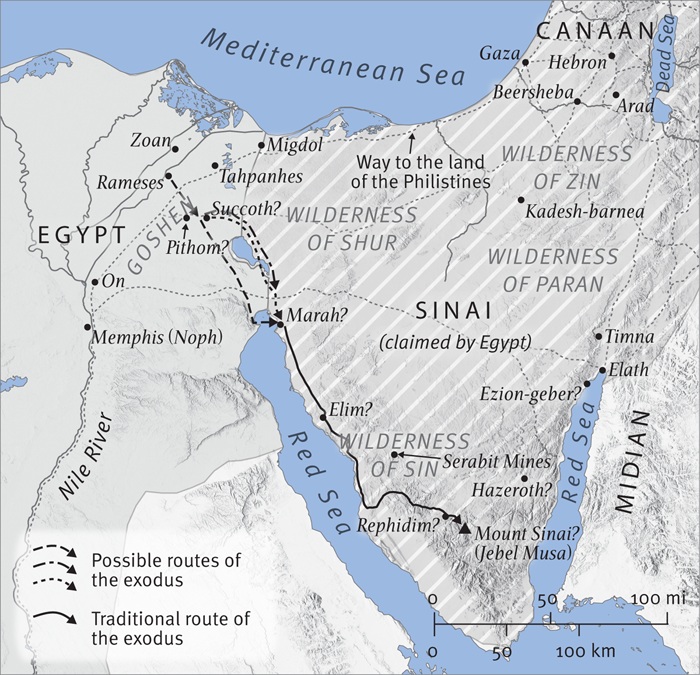
EXODUS—NOTE ON 12:32 bless me also. Undoubtedly, this final request from Pharaoh, whose heart was certainly not repentant (14:8), temporarily conceded defeat and acknowledged Moses and his God as the victors and as those who had the power and resources to bless him.
EXODUS—NOTE ON 12:36 they plundered the Egyptians. Cf. Gen. 15:14 and Ex 3:20–21. This was not done with deceit, but rather a straightforward request (cf. 11:2–3).
EXODUS—NOTE ON 12:37–18:27 This section recounts the march of the Israelites from Egypt to Mount Sinai.
EXODUS—NOTE ON 12:37 Rameses to Succoth. One of the cities Israel built (1:11) headed up the itinerary for the journey through the wilderness to Canaan. Succoth is first mentioned in Gen. 33:17 as an encampment designated by the word Succoth, which means "booth." Although there is later a town by that name east of the Jordan (cf. Judg. 8:5–16), this is rather a place near Egypt (cf. Ex. 13:20; Num. 33:5, 6). six hundred thousand men on foot. A conservative estimate based on the number of men, probably the fighting men 20 years of age and above, would give a population of 2 million. Israel's population had exploded from the 70 who entered with Jacob in 1875 B.C. to the 2 million who left with Moses in 1445 B.C. See note on Ex. 1:7.
EXODUS—NOTE ON 12:38 A mixed multitude. Other Semitic peoples, other races, and perhaps some native Egyptians accompanied the departing nation. They preferred to be identified with the victorious nation and Jehovah God. Later, some of these became the troublemakers with whom Moses had to deal (Num. 11:4).
EXODUS—NOTE ON 12:40–41 430 years. Abraham had been told that his descendants would be aliens mistreated in a foreign land for 400 years, using a figure rounded to hundreds (Gen. 15:13).
EXODUS—NOTE ON 12:43–51 Additional regulations given for the holding of the Passover contained prohibitions on any uncircumcised foreigner, stranger, or hired servant being a valid participant. To partake of this meal, non-Israelites had to be "as a native of the land" (v. 48). See note on Jer. 4:4.
EXODUS—NOTE ON 12:46 break any of its bones. Christ, the Christian's Passover lamb (1 Cor. 5:7), had no bones broken (John 19:36).
EXODUS—NOTE ON 12:50 All . . . did just as. On two occasions (see also v. 28) Moses emphasized the complete obedience of the nation in response to the Lord's commands to them: a contrast to the disobedience they would demonstrate in the very near future.
EXODUS—NOTE ON 12:51 on that very day. What would be for the nation in their new land a special Sabbath day, was for them at that time the day on which their journey began.
EXODUS—NOTE ON 13:2–10 Further explanation tied their departure to the divine promise of entrance and residence in a new land where commemoration of the exodus would occur through annual observance of this seven-day feast. Again the pedagogical opportunity afforded was not to be overlooked (vv. 8, 16).
EXODUS—NOTE ON 13:2 Consecrate to me all the firstborn. Since the firstborn of Israel, of both man and animal, were untouched by the tenth plague, it was fitting that they be set aside as special unto God. Notice the closing emphasis: "is mine." Further instruction followed on the law relating to the firstborn males once they were in their assigned territory (vv. 11–16). This divine demand was closely linked to the day of departure (12:51, "on that very day") and the Feast of Unleavened Bread (13:3, "this day" and v. 4, "today, in the month of Abib"). See Luke 2:7, where Christ was referred to as Mary's firstborn.
EXODUS—NOTE ON 13:8 for me when I. A personalized application of God's working belonged to the first generation who experienced the exodus. Later generations could only say "for us, when we . . ." in the sense of "our nation," but without loss to the significance of how God had brought about such an important day in the nation's history. Notice the personalized application of the law of the firstborn as well (v. 15, "I sacrifice . . . my sons I redeem").
EXODUS—NOTE ON 13:9 Later generations would translate this figurative and proverbial expression (cf. Prov. 3:3; 6:21) into the physical reality of phylacteries—the leather prayer-boxes that were strapped on the left arm and on the forehead. Four strips of parchment inscribed with certain words (Ex. 13:1– 16; Deut. 6:4–9; 11:13–21) were placed inside these boxes. The imagery of the proverbial mode of speech signified that their conduct was to be that of someone who could verbally recall what God's law demanded of them. Yahweh who had rescued them had also provided the standards of life for them!
EXODUS—NOTE ON 13:12, 15 first opens the womb. See Luke 2:23.
EXODUS—NOTE ON 13:17 by way of the land of the Philistines. Travelers going east and northeast out of Egypt had two good options: "the way of the sea," or "the way of Shur." The first route, the most direct and shortest, was dotted with Egyptian fortresses, which monitored arrivals and departures to and from Egypt. A little further north, Philistine territory also presented a military threat. The lack of battle-readiness on Israel's part deleted the first option, and God chose the second option (v. 18; 15:22). In any case, God had told Moses to lead the people
to Horeb or Sinai, the mountain of God (3:1), and not to take them immediately into Canaan (3:12).
EXODUS—NOTE ON 13:18 the Red Sea. An alternative designation, quite in accord with the Hebrew term, would be "Sea of Reeds," or perhaps "of papyrus marshes." The difficulty of precisely locating other names associated with the crossing of the Red Sea (see 14:2) has occasioned much debate on the location of the crossing. Four views have generally emerged: It was located 1) in the northeastern region of the delta—but this would have been in effect "the way of the sea" and would not have been three days' journey from Marah (15:22–23); 2) in the northern end of the Gulf of Suez—but this rules out entry into the wilderness of Shur (15:22); 3) in the vicinity of Lake Timsah or the southern extension of present day Lake Menzaleh—but probably more than three days from Marah; and 4) in the Bitter Lakes region, satisfying, in terms of geography and time, all objections to the other options.
EXODUS—NOTE ON 13:19 the bones of Joseph. In fulfillment of their solemnly sworn duty and responsibility (Gen. 50:24–26), the Israelites took Joseph's coffin with them. Some 360 years earlier he had foreseen the day when God would bring about the exodus, and his instructions about his bones being carried to the Promised Land indicated just how certain he was of Israel's departure for Canaan (cf. Gen. 50:24–26; Heb. 11:22). After the years of wilderness wanderings, Joseph's remains reached their final resting place in Shechem (Josh. 24:32).
EXODUS—NOTE ON 13:20 Etham, on the edge of the wilderness. The Hebrew name of this place may be a transliteration of the Egyptian Khetem meaning "fortress." A line of fortresses (see note on v. 17) stretched from the Mediterranean Sea to the Gulf of Suez. Even if the site remains unknown so that pinpointing it is not possible, it was surely a place bordering on the desert area to the east of Egypt.
EXODUS—NOTE ON 13:21 a pillar of cloud . . . a pillar of fire. This was the means by which God led the people. It was a single column, being cloud by day and fire by night (cf. 14:24) and was associated with the angel of God (14:19; 23:20–23) or the angel of God's presence (Isa. 63:8–9). See note on Ex. 3:2. It was the pillar from which the Lord also spoke to Moses (33:9–11).
EXODUS—NOTE ON 14:3–4 Pharaoh will say . . . I will harden. Pharaoh was
kept abreast of Israelite progress and when he heard of the change of direction, he assumed they were lost in unfamiliar territory and were trapped, closed in by desert, sea, and marsh. God intervened again and the stage was set for the final confrontation and final display of divine power.
EXODUS—NOTE ON 14:5 What is this we have done . . . ? Hardened hearts lost all sensitivity to the recent tragedy and focused instead on the loss of the economic benefit Israel's enslavement had provided. Those who had urged the Israelites to quickly leave now had the urge to force them to return!
EXODUS—NOTE ON 14:7 six hundred chosen chariots. Chariots, introduced by the Hyksos (see Introduction: Author and Date), featured prominently in the army of Egypt, and these "chosen" ones belonged to an elite, specialized unit.
EXODUS—NOTE ON 14:8 people of Israel were going out defiantly. The confidence shown by Israel in their departure is in sharp contrast to the fear they exhibited when they became aware of the pursuing force (v. 10).
EXODUS—NOTE ON 14:10 cried out to the Lord. The initial reaction of the people on seeing the approach was to turn to the Lord in anxious prayer. But prayer soon turned to complaints, with Moses as the target of their dismay.
EXODUS—NOTE ON 14:11 no graves in Egypt. In the light of Egypt's excessive preoccupation with death and various funerary and mortuary rituals, the bitter irony of Israel's questions marked how easily they had forgotten both bondage and rescue.
EXODUS—NOTE ON 14:12 serve the Egyptians. Just how much they conveniently forgot the degree of enslavement came out in their "We told you so" attitude. The comment of being better off living and serving than dying perhaps summarized their earlier reaction to Moses and Aaron outside the royal chambers (5:20–21).
EXODUS—NOTE ON 14:13 Fear not. Moses' exhortation turned attention to the Lord, whose power they had already seen dramatically in action, and whose deliverance they were about to witness and personally experience. All they needed to do was stand by and watch their God at work, fighting on their side. Euphemistically, Moses informed his people of the certain death of the Egyptian soldiers—you will not see them again! Expressing and experiencing fear did not mean Israel was less than 600,000 fighting men in number, as some have
objected. The poorly trained, inadequately equipped, militarily unprepared, and inexperienced Israelites (13:17) were no match for Pharaoh's experienced troops and his highly trained and mobilized chariot force.
EXODUS—NOTE ON 14:14 The Lord will fight. This has been and will be true throughout the history of Israel (cf. 1 Sam. 17:47; 2 Chron. 14:10–11; 20:15; Ps. 24:8; Zech. 14:3).
EXODUS—NOTE ON 14:15 Why do you cry to me? . . . go forward. The Lord's promise of deliverance overruled all despair and sense of hopelessness.
EXODUS—NOTE ON 14:16–17 Lift up your staff. For the grand, triumphant finale, the staff that had previously been used to bring in different plagues on the Egyptians now divided the water, opening up a valley through which Israel would walk and in which Egypt's army would drown.
EXODUS—NOTE ON 14:19 stood behind them. The angel of the Lord, and the pillar of cloud and fire, moved from being advance guard to being rear guard, from leading to protecting. See note on 3:2.
EXODUS—NOTE ON 14:21 strong east wind. God's use of natural phenomena does not detract in any way from the miraculous nature of what took place that night. The psalmist recorded this event as the Lord dividing the sea by his strength (Ps. 74:13). The wind walled up the waters on either side of the pathway then opened (Ex. 14:22; 15:8; Ps. 78:13).
EXODUS—NOTE ON 14:24 the morning watch. The last of three four-hour night watches (2:00–6:00 A.M.) ended about sunrise.
EXODUS—NOTE ON 14:24–25 the Lord looked down . . . threw the Egyptian forces into a panic. Not only was the Lord fully aware of exactly what was happening—after all, he hardened Egyptian hearts to pursue Israel—he also brought havoc among them. Entrapped in the valley between the walls of water and in total disarray, they acknowledged that the Lord was fighting for their enemy. Not only were they swept aside by the returning waters (vv. 26–28), they were also hindered from driving their chariots forward by a sudden cloudburst (Ps. 77:17–19).
EXODUS—NOTE ON 14:29–31 The stark difference between Israel and Egypt is again rehearsed: One nation is obstinate and defeated, their dead on the shores of
the sea, having acknowledged the Lord victorious; the other nation is alive on the shores, having traversed the sea on dry ground, acknowledging the work of the Lord, reverencing and believing him and his servant, Moses.
EXODUS—NOTE ON 15:1–18 The structure of the song now sung by the nation contains four stanzas (vv. 1–5; 6–10; 11–13; and 14–17) and a one-line closing declaration (v. 18). Stanzas one and two end with "they went down" and "they sank" a refrain emphasizing the finality of the enemy army's defeat. Stanzas three and four end with reference to God's Holy Place (vv. 13 and 17). More is involved than in easily observing these break points of the song. The flow of thought and emphasis is also interesting. Stanza one briefly introduces God's powerful victory (vv. 1–5). Stanza two graphically repeats the victory and then inserts the arrogant and vengeful assertions of victory by the enemy to show how puny they were (vv. 6–10). Stanza three concisely summarizes the victory after asking an appropriate question (vv. 11–13). Further, since the victory was essential for Israel's rescue, the stanza also introduces them. Stanza four picks up and expands on Yahweh's leading his people to their divinely assigned home and the consequent fear by other nations as they hear of Israel's dramatic rescue from such a powerful enemy nation (vv. 14–17). The closing line sums it all up: "The Lord will reign forever and ever." A narrative interlude (vv. 19–20) reminds of the theme behind the song, and introduces the antiphonal response of Miriam and her band of women (v. 21).
EXODUS—NOTE ON 15:1 I will sing. The Israelites began their song in the first person, effectively personalizing the community's song as individually relevant, each person heralding Yahweh's victory and declaring who and what he was to them (notice the possessive pronouns in v. 2).
EXODUS—NOTE ON 15:6 O Lord. The forthright declarations of the opening stanza (vv. 1–5) are most appropriately followed by this vocative form of address in the rest of the song (vv. 6, 11, 16–17), since the focus of attention is on his working and intervention.
EXODUS—NOTE ON 15:15 Edom . . . Moab . . . Canaan. Edom and Moab were on the eastern border of the Jordan; Canaan or Palestine is to the west.
EXODUS—NOTE ON 15:16–17 An expression of confidence in the promises that God had made to Abraham 700 years earlier (see Gen. 12; 15; 17).
EXODUS—NOTE ON 15:18 reign forever. This speaks of the eternal, universal kingship of the Lord (cf. Ps. 145:13).
EXODUS—NOTE ON 15:20 the prophetess. Miriam was the first woman to be given this honor. She herself claimed the Lord had spoken through her (Num. 12:2). She apparently played an important role in these rescue events because the prophet Micah states that God delivered Israel by the hand of Moses, Aaron, and Miriam (Mic. 6:4). Other women to receive this rare honor were Deborah (Judg. 4:4); Huldah (2 Kings 22:14); Isaiah's wife (Isa. 8:3); Anna (Luke 2:36); and Philip's four daughters (Acts 21:9).
EXODUS—NOTE ON 15:24 grumbled against Moses. Israelite memory of victory displayed a remarkable brevity. The personalized declarations of their ode to the Lord sung three days earlier vanished into thin air. Their belief in Moses faded out of the picture (14:31). Their question about drinking water roughly brushed aside all recent affirmations of God's being worthy of praise because he had done wonders and was clearly taking them to their land.
EXODUS—NOTE ON 15:25 water became sweet. Since there is no known tree that would naturally make unpalatable water drinkable, this must have been a miracle by which God demonstrated his willingness and ability to look after his people in a hostile environment. Marah is usually associated with modern-day Ain Hawarah, where the waters still remain brackish and unpleasant. tested them. "To subject to difficulty in order to prove the quality of someone or something" is one way to explain the meaning of the Hebrew word used. Later, at Rephidim (17:1–7), at Sinai (20:20), and at Taberah (Num. 11:1–3; 13:26–33), God did just that to Israel. This is something which no one can do to God himself (Deut. 6:16)—he needs no testing in character or deed, but man certainly does need proving.
EXODUS—NOTE ON 15:26 the Lord; your healer. Since this is what he is, Jehovah-Rapha, obedience to divine instruction and guidance will obviously bring healing, not the consequence of plagues like those visited upon Egypt. This promise is limited in context to Israel, most likely for the duration of the exodus only.
EXODUS—NOTE ON 15:27 Elim. The next stopping place, most probably in modern day Wadi Garandel, had an abundant water supply—God would and did lead them aright!
EXODUS—NOTE ON 16:1 wilderness of Sin. More details of the camp sites in the journey from Rameses to Succoth and beyond are found in Num. 33:5–11. That itinerary also lists the next stop as having been Dophkah (Num. 33:12). Identifying it with modern Debbet er Ramleh locates it in the southwest of the Sinai peninsula on a direct line between Elim and Sinai. fifteenth day . . . second month. Thirty days after their departure from Rameses.
EXODUS—NOTE ON 16:2 the whole congregation . . . grumbled. What characterized them as a whole was this attitude of negativism. Faced with the scarcity of resources in the wilderness, they hankered after the abundant resources they had experienced in Egypt. The country that had enslaved them looked good in comparison to the wilderness. Again, their complaining so soon after benefiting from the miracles done by the Lord on their behalf points only to their short-term memory and self-centeredness.
EXODUS—NOTE ON 16:3 died by the hand of the Lord. Incredibly, Israel's complaint still acknowledged the intervention of the Lord in their affairs. Sarcastically, they voiced a preference for dying in Egypt. The hand of the Lord, which they had glorified in song (15:6) only a month beforehand, they now pretended would have been better used to kill them in Egypt.
EXODUS—NOTE ON 16:4 I am about to rain bread. God's gracious answer to their complaining was to promise an abundance of the bread they missed. God's directions on how to gather it would also test their obedience to him (vv. 4–5, 16, 26–28). See note on 16:31.
EXODUS—NOTE ON 16:5 The same principle on a larger scale would feed the nation during and after the sabbatical year (cf. Lev. 25:18–22).
EXODUS—NOTE ON 16:6 you shall know. Israel's short-term memory loss would be short-lived because that very day of complaint would witness not only God's provision for them but also would powerfully remind them of who had brought them out of Egypt, namely, the Lord their God (cf. vv. 11–12).
EXODUS—NOTE ON 16:7 the glory of the Lord. In seeing the start of the provision of daily bread on the next day, Israel would also see the Lord's glory, an appropriate term to use because what he did showed his presence with them. "Glory" typically refers to God's manifested presence, which makes him impressive and leads to worship. your grumbling. Set in the context of
instruction on how the Lord would act to provide for them, the fourfold repetition of this phrase (vv. 6–9) served to highlight God's gracious response in contrast to their ungracious grumbling against him. For an effective poetic presentation of this contrast, refer to Ps. 78:17–25.
EXODUS—NOTE ON 16:13 quail. The psalmist removed all doubt about whether these birds of the partridge family were not real birds but something else, for he called them "winged birds" and in the preceding line of the parallelism referred to the coming of the quails as God having "rained meat" on them (Ps. 78:27). Upon return to their former habitat, these migratory birds would often fall to the ground, exhausted from prolonged flight. In ancient Egyptian paintings, people were shown catching quails by throwing nets over the brush where they were nesting.
EXODUS—NOTE ON 16:16, 32 omer. Slightly more than 2 quarts.
EXODUS—NOTE ON 16:18 See 2 Cor. 8:15, where Paul applies this truth to Christian giving.
EXODUS—NOTE ON 16:22–30 The provision of manna on six days only but none on the seventh was a weekly lesson on the nature of the Sabbath as a different day. It taught the people to keep the Sabbath properly, and acted as a challenge to obey God's commands.
EXODUS—NOTE ON 16:31 manna. The arrival of the quails in much quantity (v. 13) was totally overshadowed by the arrival of manna the next morning. Despite the different descriptions given for its form and taste (vv. 14, 31), the name chosen for it derived from the question they asked. "Manna" was an older form of their question, "What is it?" The psalmist referred to manna as the "grain of heaven" and "bread of the angels" that rained down after God had opened the windows of heaven (Ps. 78:23–25). Natural explanations for the manna, such as lichen growing on rocks or insect-excreted granules on tamarisk thickets, are totally inadequate to explain its presence in sufficient quantity on the ground under the dew every day except the Sabbath for the next 40 years (Ex. 16:35) to satisfy every family's hunger. It was supernaturally produced and supernaturally sustained to last for the Sabbath!
EXODUS—NOTE ON 16:32–36 place it before the Lord. Provision was made for memorializing the giving of the manna. When the tabernacle was finally
constructed, the pot of manna was placed inside the ark. Succeeding generations would be reminded, when they came for worship, of the faithfulness of the Lord in caring for his people (cf. Heb. 9:4).
EXODUS—NOTE ON 17:1 Rephidim. To be identified as modern-day Wadi Refayid.
EXODUS—NOTE ON 17:2 the people quarreled. This time the people, reacting to Moses' leading them to a waterless site, quarreled with him or laid a charge against him. So intense was their reaction that Moses thought he was about to be stoned (v. 4). Significantly, the nation had not come to Rephidim without divine guidance (v. 1), portrayed by the column of fire and cloud. The people, in the midst of their emotional response, simply could not see that right before their eyes was the evidence of God's leading.
EXODUS—NOTE ON 17:4 Moses cried to the Lord. The leader turned to God in prayer, whereas the people, instead of following his example, turned on their leader. Moses' petition was not an isolated incident. His life was characterized by prayer (cf. 15:25; 32:30–32; Num. 11:2, 11; 12:13; 14:13, 19) and by turning to God for solutions to problems and crises.
EXODUS—NOTE ON 17:5–6 Pass on before the people . . . I will stand before you. By these words in his instructions to Moses, the Lord reinforced both the position of Moses as leader and himself as present to act. He answered the people's charge against Moses and their underlying challenge of his presence (v. 7). In fact, he intervened miraculously!
EXODUS—NOTE ON 17:7 Massah and Meribah. Appropriate names, "Testing" and "Quarreling," were assigned to this place; a disappointing culmination to all they had experienced of God's miraculous care and guidance (cf. Ps. 95:7–8; Heb. 3:7–8).
EXODUS—NOTE ON 17:8 Amalek came and fought. The Amalekites took their name from Amalek, the grandson of Esau, and dwelt as a nomadic people in the Negeb. Israel first encountered their military at Rephidim in the wilderness (Ex 17:8–13; Deut. 25:17–18). As a result, the Amalekites were doomed to annihilation by God (Ex. 17:14; Num. 24:20; Deut. 25:19) but it would not be immediate (Ex. 17:16). The Amalekites defeated disobedient Israel at Hormah (Num. 14:43–45). Saul failed to destroy them as God ordered (1 Sam. 15:2–3,
9). David later fought and defeated the Amalekites (1 Sam. 30:1–20). In Hezekiah's day, the Amalekite remnant in the land was finally destroyed by Hezekiah (c. 716–687 B.C.). The final descendants of Agag (Est. 3:1), the Amalekite king in Saul's day, were destroyed in Persia at the time of Esther and Mordecai (c. 473 B.C.; Est. 2:5, 8–10).
EXODUS—NOTE ON 17:9–13 Through the circumstances they experienced, Israel had learned how God provided food and water. They had to learn through warfare that God would also bring about defeat of hostile neighbors.
EXODUS—NOTE ON 17:9 Joshua. The name of Moses' aide-de-camp, or personal minister (24:13; 33:11; Josh. 1:1) appears here for the first time in Exodus. His assignment to muster a task force was part of his being groomed for military leadership in Israel. Actually, at this stage his name was still Hoshea, which later changed to Joshua at Kadesh just before the reconnaissance mission in Canaan (Num. 13:16). At this stage, Israel could not be described as a seasoned army and was not even militarily well prepared and trained. See Introduction to Joshua. the staff of God. The staff that Moses held up in his hands was no magic wand. Rather it had been previously used to initiate, via his chosen leader, the miracles that God did and about which he had informed Moses in advance. It became, therefore, the symbol of God's personal and powerful involvement, with Moses' outstretched arms perhaps signifying an appeal to God. The ebb and flow of battle in correlation with Moses' uplifted or drooping arms imparted more than psychological encouragement as the soldiers looked up to their leader on the hilltop, and more than Moses' interceding for them. It demonstrated and acknowledged their having to depend upon God for victory in battle and not upon their own strength and zeal. It also confirmed the position of Moses both in relation to God and the nation's well-being and safety. They had angrily chided him for their problems, but God confirmed his appointment as leader.
EXODUS—NOTE ON 17:10 Hur. Caleb's son and the grandfather of Bezalel, the artisan (cf. 31:2–11; 1 Chron. 2:19–20).
EXODUS—NOTE ON 17:14 Write this as a memorial . . . and recite it. Moses would have learned writing and record-keeping in Pharaoh's school of government. Official Hebrew records other than Scripture were also to be kept, and in this case especially for the purpose of remembering the victory in the very first battle in which they nationally engaged. God referred to "a book," so Moses had evidently already begun it. This was not, then, the initial entry into what
perhaps became known as the "Book of the Wars of the Lord" (Num. 21:14). Writing it was essential, so the facts could be verified and needed not to depend upon human memory or solely oral tradition. blot out the memory. The sentence of national extinction that the Amalekites proclaimed for Israel (cf. Ps. 83:4–7) passed by divine decree upon the Amalekites. The sentence was partially realized in Saul's and David's day (cf. 1 Sam. 15:1–9 and 2 Sam. 1:1; 8:11–12), after which it is scarcely mentioned again. However, due to Saul's disobedience in sparing Agag, the Amalekite king and some of his people (1 Sam. 15:7–9), he lost his throne (1 Sam. 15:23). Samuel killed Agag (1 Sam. 15:33), but some Amalekites remained to return a few years later to raid Israel's southern territory, even capturing David's family (1 Sam. 30:1–5). David killed all but 400 (1 Sam. 30:16–17) who escaped. It was a descendant of Agag, Haman, who tried to exterminate the Jews later in Esther's day (cf. Est. 3:1, 6).
EXODUS—NOTE ON 17:15 The Lord Is My Banner. By titling the altar with this designation for the Lord, Yahweh-Nissi, Moses declared the Lord himself to be the standard of his people.
EXODUS—NOTE ON 17:16 The Lord will have war. The difficulty of the Hebrew text permits an alternative translation: "a hand is upon/toward/against the throne/banner of Yahweh," with the sense of supplication, or of taking an oath. Contextually, the significance is clear, whatever the translation adopted: The ongoing problem with Amalek was not merely one nation hostile toward another, it was a war between God and Amalek.
EXODUS—NOTE ON 18:1 Jethro . . . heard of all. The intelligence-gathering ability of ancient peoples should not be underestimated. Quickly and thoroughly the news of significant events in other lands passed from one place to another, very often via the merchant caravans that traversed the Fertile Crescent, or through ambassadors and other official contacts between nations. In Jethro's case, whatever knowledge he had gleaned of Israel's progress had been supplemented with information from Zipporah and her sons after Moses sent them ahead to her home (v. 2).
EXODUS—NOTE ON 18:7–12 Moses' testimony elicited responses of praise and sacrifice from Jethro; evidence of his belief. Further, he understood fully the incomparability of Yahweh (v. 11). The priest of Midian (v. 1) was surely no worshiper of Midian's gods! Since Midianites were generally regarded as idolaters (cf. Num. 25:17–18; 31:2–3, 16), Jethro must be viewed as remarkably
different from his contemporaries; a difference highlighted by Aaron and the elders worshiping and fellowshiping together with him (Ex. 18:12).
EXODUS—NOTE ON 18:12 to God. Since the name Yahweh is always used in connection with sacrifices prescribed for Israel in the Pentateuch, the switch to Elohim must have some significance here, particularly after Jethro had himself used the name of Yahweh in his response to Moses. Despite the strong declaration of his faith and understanding, Jethro was a believing Gentile, therefore, a proselyte, and an alien. In this situation the Lord was relating to the Israelite and Gentile world simultaneously, thus the use of Elohim rather than Yahweh, the unique covenant name for Israel.
EXODUS—NOTE ON 18:13–27 Jethro's practical wisdom was of immense benefit to Moses and Israel, and has been lauded as an example of delegation and management organization by efficiency experts for centuries—and still is. Woven into Jethro's advice were statements about God and the virtues of godly men that cause one to respect this man as having his newfound faith well integrated into his thinking. Indeed, he fully recognized that Moses needed divine permission to enact his advice (v. 23). Moses apparently did not immediately implement Jethro's solution, but waited until the law had been given (cf. Deut. 1:9–15).
EXODUS—NOTE ON 18:21 These same spiritual qualities were required of NT leaders (see Acts 6:3; 1 Tim. 3:1–7; Titus 1:6–9).
EXODUS—NOTE ON 19:1–40:38 This section outlines Israel's activities during their approximately 11-month stay at Sinai (cf. 19:1 with Num. 10:11).
EXODUS—NOTE ON 19:3–8 The Israelites discerned the familiar pattern, in shortened form, of a suzerainty (superior-subordinate relationship) treaty in God's words: a preamble (v. 3), a historical prologue (v. 4), certain stipulations (v. 5a), and blessings (vv. 5b–6a). The acceptance in solemn assembly would normally be recorded in the final treaty document. Here it follows upon presentation of the treaty to them (vv. 7–8). See note on 24:7.
EXODUS—NOTE ON 19:3 out of the mountain. The sign that the Lord had given particularly to Moses when he was still in Midian (3:12), that God had indeed sent him, was now fulfilled; he was with the people before the mountain of God. house of Jacob . . . people of Israel. In employing this dual designation for the
nation, the Lord reminded them of their humble beginnings as descendants of Abraham through Isaac and Jacob, who had been with them in Egypt, and of their status now as a nation.
EXODUS—NOTE ON 19:4 bore you on eagles' wings. With a most appropriate metaphor, God described the exodus and the journey to Sinai. Eagles were known to have carried their young out of the nests on their wings and taught them to fly, catching them when necessary on their outspread wings. Moses, in his final song, employed this metaphor of God's care for Israel and especially noted that there was only one Lord who did this (Deut. 32:11–12).
EXODUS—NOTE ON 19:5–6 Three titles for Israel, "My treasured possession," "a kingdom of priests," and "a holy nation," were given by the Lord to the nation, contingent upon their being an obedient and covenant-keeping nation. These titles summarized the divine blessings that such a nation would experience: belonging especially to the Lord, representing him in the earth and being set apart unto him for his purposes. These expanded ethnically and morally what it meant to have brought them to himself. "For all the earth is mine," in the midst of the titles, laid stress upon the uniqueness and sovereignty of the Lord and had to be understood as dismissing all other claims by so-called other gods of the nations. It was more than the power of one god over another in Israel's situation; it was the choice and power of the only Lord! See 1 Pet. 2:9, where Peter uses these terms in the sense of God's spiritual kingdom of the redeemed.
EXODUS—NOTE ON 19:8 All the people answered together. Presented with the details of God's bilateral, conditional covenant (notice the "if you will indeed obey . . . you shall be" in v. 5), the people, briefed by their elders, responded with positive enthusiasm. The Lord's response to them does not take it as a rash promise by the people (cf. Deut. 5:27–29).
EXODUS—NOTE ON 19:9 believe you forever. The Lord designed the upcoming encounter with him so as to forestall any later accusation that Moses had himself compiled the law and had not met with the Lord on the mountain. It would also lead to great deference being accorded Moses by the people.
EXODUS—NOTE ON 19:10 consecrate them. How serious this step was for the nation was emphasized for them by two days of special preparation. The inward preparation for meeting with God was mirrored in the outward actions of maintaining bodily cleanliness.
EXODUS—NOTE ON 19:12–13 The proper approach to a holy God could not have been better stressed than by imposing a death penalty upon those who violated the arbitrary boundaries that God had set around the mountain. Even animals could not encroach upon this sacred area (cf. Heb. 12:20).
EXODUS—NOTE ON 19:15 do not go near a woman. This was so they would be ceremonially clean (see Lev. 15:16–18).
EXODUS—NOTE ON 19:16 thunders and lightnings. The dramatic visual presentation of God's presence on the mountain, accompanied by thick cloud and trumpet blast, more than impressed the onlookers with God's majesty and power—they trembled, but so did Moses (Heb. 12:21). The unusual was happening, not the usual phenomena from volcanic activity, as some writers have proposed.
EXODUS—NOTE ON 19:24 the priests. With the law still to be given, no priesthood had been established in Israel. These priests must have been the firstborn in each family who served as family priests because they had been dedicated to the Lord (cf. 13:2; 24:5). Their place would be taken over later by the Levites (Num. 3:45).
EXODUS—NOTE ON 20:1 all these words. This general description of the commands to follow also received from Moses the title "Ten Commandments" (34:28; Deut. 4:13). By this emphasis on God himself speaking these words (cf. Deut. 5:12, 15–16, 22, 32–33), all theories on Israel's borrowing legal patterns or concepts from the nations around them are unacceptable.
EXODUS—NOTE ON 20:3–17 The Ten Commandments, also known as the Decalogue, which follow upon the opening historical prologue (v. 2), are formed as a precept or direct command given in the second person. This form was something rather uncommon in that day. Ancient Near Eastern law codes for the most part were casuistic, or case-law, in form, i.e., an "if . . . then" construction written in the third person wherein a supposed offense was followed by a statement of the action to be taken or penalty to be exacted. The Ten Commandments may also be grouped into two broad categories: the vertical, namely man's relationship to God (vv. 2–11), and the horizontal, namely man's relationship to the community (vv. 12–17). Concisely listed prohibitions mark the second category, with only one exception—an imperative plus its explanation (v. 12). Explanation or reason appended to a prohibition marks the first category. By these Ten Commandments, true theology and true worship, the name of God and the Sabbath, family honor, life, marriage, property, truth, and virtue are well protected. See note on 24:7.
EXODUS—NOTE ON 20:3 before me. Meaning "besides me," this is a most appropriate expression in the light of the next few verses. All false gods stand in opposition to the true God, and the worship of them is incompatible with the worship of Yahweh. When Israel departed from the worship of the only one and true God, she plunged into religious confusion (Judg. 17; 18).
EXODUS—NOTE ON 20:4–6 The mode or fashion of worship appropriate to only one Lord forbids any attempt to represent or caricature him by use of anything he has made. Total censure of artistic expression was not the issue; the absolute censure of idolatry and false worship was the issue. Violation would seriously affect succeeding generations because the Lord demanded full and exclusive devotion, i.e., he is a jealous God (cf. 34:14; Deut. 4:24; 5:9). The worship of man-made representations was nothing less than hatred of the true God.
EXODUS—NOTE ON 20:5–6 to the third and the fourth generation . . . thousands. Moses had made it clear that children were not punished for the sins of their parents (Deut. 24:16; see Ezek. 18:19–32), but children would feel the
impact of breaches of God's law by their parents' generation as a natural consequence of its disobedience, its hatred of God. Children reared in such an environment would imbibe and then practice similar idolatry, thus themselves expressing hateful disobedience. The difference in consequence served as both a warning and a motivation. The effect of a disobedient generation was to plant wickedness so deeply that it took several generations to reverse.
The Ten Commandments
The Ten Commandments Commandment O.T. Statement O.T. Death Penalty N.T. Restatement 1st Polytheism Ex. 20:3 Ex. 22:20; Deut. 6:13–15 Acts 14:15 2nd Idols Ex. 20:4 Deut. 27:15 1 John 5:21 3rd Swearing Ex. 20:7 Lev. 24:15–16 James 5:12 4th Sabbath Ex. 20:8 Num. 15:32–36 Col. 2:16 nullifies 5th Obedience to parents Ex. 20:12 Ex. 21:15–17 Eph. 6:1 6th Murder Ex. 20:13 Ex. 21:12 1 John 3:15 7th Adultery Ex. 20:14 Lev. 20:10 1 Cor. 6:9–10 8th Theft Ex. 20:15 Ex. 21:16 Eph. 4:28 9th False Witness Ex. 20:16 Deut. 18:16–21 Col. 3:9–10 10th Coveting Ex. 20:17 ——— Eph. 5:3 © 1997 by Thomas Nelson, Inc.
EXODUS—NOTE ON 20:7 take the name . . . in vain. To use God's name in such a way as to bring disrepute upon his character or deeds was to irreverently misuse his name. To fail to perform an oath in which his name had been legitimately uttered (cf. 22:10–11; Lev. 19:12; Deut. 6:13) was to call into question his existence, since the guilty party evidently had no further thought of the God whose name he had used to improve his integrity. For the believer in the church age, however, the use of the name of God is not a needed verification of his intention and trustworthiness since his life is to exhibit truth on all occasions, with his "yes" meaning "yes" and his "no" meaning "no" (Matt. 5:37; James 5:12).
EXODUS—NOTE ON 20:8 Sabbath. Cf. 31:12–17. Each seventh day belonged to the Lord and would not be a work day but one set apart (i.e., holy) for rest and for time devoted to the worship of Yahweh. The term "Sabbath" is derived from "to rest or cease from work." The historical precedent for such a special
observance was the creation week; a span of time equal to what man copied in practice. Each Sabbath day should have reminded the worshiper that the God whom he praised had indeed made everything in both realms of existence in six 24-hour days. The Sabbath would also stand, therefore, as a counter to evolutionary ideas prevalent in false religion. Moses, in the review of the Decalogue, also linked the observance of the Sabbath with Israel's exodus from Egypt and specified that this was why Israel was to keep it (Deut. 5:12–15). Significantly, the command for the Sabbath is not repeated in the NT, whereas the other nine are. In fact, it is nullified (cf. Col. 2:16–17). Belonging especially to Israel under the Mosaic economy, the Sabbath could not apply to the believer of the church age, for he is living in a new economy.
EXODUS—NOTE ON 20:12–16 Cf. Matt. 19:18–19; Mark 10:19; Luke 18:20.
EXODUS—NOTE ON 20:12 Honor your father and your mother. The key to societal stability is reverence and respect for parents and their authority. The appended promise primarily related the command to life in the Promised Land and reminded the Israelite of the program God had set up for him and his people. Within the borders of their territory, God expected them not to tolerate juvenile delinquency, which at heart is overt disrespect for parents and authority. Severe consequences, namely capital punishment, could apply (cf. Deut. 21:18–21). One of the reasons for the Babylonian exile was a failure to honor parents (Ezek. 22:7, 15). The apostle Paul individualized this national promise when he applied the truth to believers in his day (cf. Matt. 15:4; Mark 7:10; Eph. 6:1–3).
EXODUS—NOTE ON 20:13–15 Cf. Rom. 13:9.
EXODUS—NOTE ON 20:13 murder. The irreversible nature of the divinely imposed sentence of death on every manslayer who killed another intentionally (cf. 21:12; Num. 35:17–21) stands without parallel in ancient Near Eastern literature and legal codes (cf. Gen. 9:5–6). Further, the sacredness of human life stands out in the passages dealing with unintentional manslaughter. The accident of death still carried with it a penalty of banishment to the city of refuge until the death of the high priest for the one who killed but not with intent. Careful appraisal of the word Moses used (one of seven different Hb. words for killing, and one used only 47 times in the OT) suggests a broad translation of "to kill, slay" but denoting the taking of life under a legal system where he would have to answer to the stipulations of a legal code, no matter whether he killed unintentionally or intentionally. By this command, men would be reminded and
exhorted to strive after carefulness in the affairs of life so that on the person-toperson level no one would die by their hand. See note on 21:12–14 (cf. Matt. 5:21; James 2:11).
EXODUS—NOTE ON 20:14 adultery. Applicable to both men and women, this command protected the sacredness of the marriage relationship. God had instituted marriage at the creation of man and woman (Gen. 2:24) and had blessed it as the means of filling the earth (Gen. 1:28). The penalty for infidelity in the marital relationship was death (Lev. 20:10). Adultery was also referred to as "a great sin" (Gen. 20:9) and a "great wickedness and sin against God" (cf. Gen. 39:9; Matt. 5:27; James 2:11).
EXODUS—NOTE ON 20:15 steal. Any dishonest acquiring of another's goods or assets greatly disturbs the right to ownership of private property, which is an important principle for societal stability.
EXODUS—NOTE ON 20:16 false witness. Justice is not served by any untruthful testimony. Practically all societies have recognized this principle and adjure all witnesses in courts to tell the truth and nothing but the truth.
EXODUS—NOTE ON 20:17 covet. The thoughts and desires of the heart do not escape attention. A strong longing to have what another has is wrong. This tenth command suggests that none of the previous nine commandments are only external acts with no relation to internal thoughts (cf. Matt. 15:19; Rom. 7:7; 13:9).
EXODUS—NOTE ON 20:18 trembled, and they stood far off. The people fearfully withdrew from the cluster of phenomena accompanying this theophany, this appearance of God on the mountain. They instinctively placed Moses in the position of mediator between them and God, because such was the gap between them and their holy God that they feared they were not fit to live in his presence (v. 19).
EXODUS—NOTE ON 20:19 do not let God speak. Fearing for their lives, the nation asked Moses to be their mediator (cf. Heb. 12:18–21).
EXODUS—NOTE ON 20:20 Instructed not to respond to the phenomena with fear, they were also told that proper fear, i.e., awe and reverence of God, deterred sin.
EXODUS—NOTE ON 20:22–26 Sacrifices, offerings, and altars were not unknown
to Israel and were already part of certain worship ceremonies. Neither the earthen nor stone altars would have even a hint of being shaped to represent something more specific, so the restrictions on the form and the method of building would ensure the appropriateness and propriety of their worship. Leviticus 1–7 outlines the Mosaic sacrifices.
EXODUS—NOTE ON 21:1 rules. A combination of casuistic (case-law) and apodictic (direct command) precepts laid down, as a detailed enlargement of the Decalogue, the framework for judging and resolving civil disputes in Israel. Such a combination continued to confirm the uniqueness of Israel's law among the different ancient Near Eastern law codes. Later in a special ceremony, God entitled these precepts the Book of the Covenant (24:7).
EXODUS—NOTE ON 21:2–11 The law of the slave guaranteed freedom after a specified period of 6 years unless the slave himself elected permanent servitude, but this would be service in a context not of abuse but of love (v. 5). Any permanent, involuntary servitude for a Hebrew slave to a Hebrew master was obviously undesirable for Israelite society and was unknown in Israel (cf. Lev. 25:39–55). Provision was also made to ensure the proper treatment of female slaves, who could not deliberately be left destitute by wrongful action on the part of their master.
EXODUS—NOTE ON 21:12–14 The laws relating to personal injury (vv. 15–36) from man or animal were preceded by the most serious of injuries, homicide. The death penalty was prescribed for intentional homicide only (see 20:13), whereas for unintentional homicide the penalty was banishment to an appointed place, which later God revealed were the cities of refuge (cf. Num. 35:6–24; Deut. 19:1–13). No degree of sanctuary applied to one guilty of premeditated murder. Death by accident at the hand of another is something unplanned by man but which God let happen. The law did afford sanctuary but away from home and vengeful relatives, often for life, because there the one guilty of involuntary manslaughter remained until the death of the high priest (Num. 35:25, 28).
EXODUS—NOTE ON 21:15–17 Disrespect for parents seen in physical and verbal abuse of them by their children was so serious it was designated a capital offense. Commandment five was a serious matter! Other ancient law codes, e.g., the Code of Hammurabi, also respected parental authority and prescribed severe consequences, although not the death penalty.
EXODUS—NOTE ON 21:17 Cf. Matt. 15:4 and Mark 7:10.
EXODUS—NOTE ON 21:20–21, 26–27 Punishment of slaves was considered the right of the owner (Prov. 10:13; 13:24), but did not allow for violence. Judges were to decide the appropriate punishment if the slave died (Ex. 21:20). If the slave lived a few days it was evidence that the owner had no intent to kill, and the loss of the slave was punishment enough (v. 21). A beating without death immediately ensuing was construed as a disciplinary matter not a homicidal one. Any permanent personal injury brought freedom and loss of a master's investment. The master's power over the slave was thus limited, which made this law unprecedented in the ancient world.
EXODUS—NOTE ON 21:22 Compensation was mandatory for accidentally causing a premature birth, even if no injury resulted to either mother or child. Judges were brought into the legal process so that damages awarded were fair and were not calculated out of vengeance.
EXODUS—NOTE ON 21:23–24 Cf. Lev. 24:19–20 and Deut. 19:21. The principle of retaliation, or lex talionis, applied if injury did occur to either mother or child. The punishment matched, but did not exceed, the damage done to the victim. The welfare of a pregnant woman was protected by this law so that unintentional maltreatment constituted culpable negligence. Significantly for the abortion debate, the fetus was considered a person; thus, someone was held accountable for its death or injury.
EXODUS—NOTE ON 21:24 Cf. Matt. 5:38.
EXODUS—NOTE ON 21:30 Animal owners were held responsible for death or injuries caused by their animals. Since the owner was guilty of negligence and not of an intentional crime, he was able to make payment to escape the death penalty. Again, judges are brought into the process to ensure that no vengeful decisions are made.
EXODUS—NOTE ON 21:32 shekels. A shekel weighs .4 ounces; 30 shekels would weigh 12 ounces. Christ was betrayed for the price of a slave (Zech. 11:12–13; Matt. 26:14–15).
EXODUS—NOTE ON 22:3 if the sun has risen on him. The culpability of a householder's actions against an intruder depended on whether the break-in (lit., "digging through" the mud walls) was at night or in the daytime. At night quick
evaluation of an intruder's intentions was not as clear as it might be in daytime, nor would someone be awake and on hand to help.
EXODUS—NOTE ON 22:11 an oath by the Lord. Presumably an oath of innocence that would bind the two parties to a dispute over lost goods and preclude any further legal action being taken.
EXODUS—NOTE ON 22:16 If a man seduces . . . give the bride-price. The male was held accountable for premarital intercourse, and the victim was seen as having been exploited by him, for which he paid a price (cf. Deut. 22:22–29).
EXODUS—NOTE ON 22:18 sorceress. A woman who practices occultism.
EXODUS—NOTE ON 22:19 The degree of sexual perversion in Canaanite culture was such that bestiality was fairly commonplace (cf. Lev. 18:23–24). Hittite laws, for example, even permitted cohabitation with certain animals.
EXODUS—NOTE ON 22:20 devoted to destruction. Lit., meaning "put to the ban" or "devoted to sacred use," which in this case meant death (cf. Josh. 7:2ff.).
EXODUS—NOTE ON 22:22 widow or fatherless child. God reserved his special attention for widows and orphans, who often had no one to care for them. He also reserved a special reaction, his wrath, for those abusing and exploiting them. This wrath would work out in military invasions as the sword reduced the abusers' families to the same status of being without spouse or parents.
EXODUS—NOTE ON 22:25 interest. One way in which the people showed their concern for the poor and needy was to take no business advantage of them. Charging interest was allowable (Lev. 25:35–37; Deut. 23:19–20), but not when it was exorbitant or worsened the plight of the borrower. The psalmist identified a righteous man as one who lends money without interest (Ps. 15:5).
EXODUS—NOTE ON 22:28 See Acts 23:3–5, where Paul apparently violated this law, not knowing to whom he spoke.
EXODUS—NOTE ON 22:31 consecrated to me. All these laws and regulations caused Israel to be set apart in conduct, not just in name. The special calling as Yahweh's firstborn son (4:22) and as his treasured possession, a kingdom of priests, and a holy nation (19:5–6) mandated ethical uprightness. not eat any flesh that is torn. Flesh of an animal killed by another and lying in the field
became unclean by coming into contact with unclean carnivores and insects and with putrefaction by not having had the blood drained properly from it. A setapart lifestyle impacted every area of life, including from where one collected his meat.
EXODUS—NOTE ON 23:1–9 A list of miscellaneous laws, which includes the protection of equitable and impartial justice for all. False testimony, undiscerningly following a majority, favoring one over another, and accepting bribes, all contribute to the perversion of true justice. The attitude of impartiality was to include the helping of another with his animals regardless of whether he be friend or foe. If no help was given, his livelihood could very well be adversely affected, which was a situation others in the community could not allow to happen.
EXODUS—NOTE ON 23:10–11 seventh year. A sabbatical year of rest after six years of farming benefited both the land and the poor. This pattern of letting a field lie fallow appears to have been unique with Israel.
EXODUS—NOTE ON 23:13 Idolatry was to be avoided right down to the level of not causing the name of other deities to be remembered. This perhaps served also as a prohibition of intermarriage with other nations, for in the marriage contract recognition was given to the deities of the parties involved, which would have had the effect of putting God on a par with pagan gods.
EXODUS—NOTE ON 23:14–19 Requiring all males to be present for three specified feasts at a central sanctuary would have had a socially and religiously uniting effect on the nation. The men must trust the Lord to protect their landholdings while on pilgrimage to the tabernacle (cf. 34:23–24). All three feasts were joyful occasions, being a commemoration of the exodus (the Feast of Unleavened Bread), an expression of gratitude to God for all the grain he had provided (the Feast of the Harvest), and a thanksgiving for the final harvest (the Feast of Ingathering). Alternative names appear in the biblical record for the second and third feasts: the Feast of Weeks (34:22) or Firstfruits (34:22; Acts 2:1), and the Feast of Tabernacles or Booths (Lev. 23:33–36). For additional discussions see Lev. 23:1–24:9; Num. 28; 29; Deut. 16.
EXODUS—NOTE ON 23:19 not boil a young goat. Canaanite ritual, according to excavations at Ras Shamra (ancient Ugarit), called for sacrificial kids to be boiled in milk, but the damaged Ugaritic text does not clearly specify mother's
milk. If it were so, then it is understandable that Israel was being prevented from copying pagan idolatrous ritualism. Another option suggests that the dead kid was being boiled in the very substance which had sustained its life; hence the prohibition. Until more archeological information comes to light, the specific religious or cultural reason remains as supposition.
EXODUS—NOTE ON 23:23 my angel. Usually taken to be a reference to the angel of Yahweh, who is distinguished from the Lord who talks about him as another person. See note on 3:2. Yet, he is identified with him by reason of his forgiving sin and the Lord's name being in him (23:21). Neither Moses nor some other messenger or guide qualify for such descriptions. The key to victory in the upcoming takeover of the land would not be Israel's military skill but the presence of this angel, who is the preincarnate Christ.
EXODUS—NOTE ON 23:24 pillars. Stone markers of pagan shrines were absolutely intolerable once the land had been taken from the tribes just mentioned in the previous verse.
EXODUS—NOTE ON 23:25–26 Proper worship brought with it due rewards, not only good harvests and a good water supply, but also physical health, including fertility and safe pregnancies.
EXODUS—NOTE ON 23:28 hornets. This figurative expression of the panicproducing power of God parallels "my terror" (v. 27), which was the obvious effect of "my angel" having been the advance guard to the conquest (v. 23). In anticipation of the conquest of their land, Israel was being given another reminder that victory depended on God and not their own efforts alone. Fear and panic did play a strategic role in the victories in Transjordan and Canaan (Num. 22:3; Josh. 2:9–11; 5:1; 9:24). An alternative non-figurative view is based upon the bee or wasp being a heraldic symbol of Egyptian pharaohs whose steady succession of military strikes into Canaan year after year God providentially used to weaken Canaan prior to the invasion by Israel.
EXODUS—NOTE ON 23:29–30 The occupation would be a gradual but effective process taking longer than a year to accomplish, but ensuring full control of a land in good condition and not left desolate by a sweeping and destructive warfare. The reference to the multiplication of wild beasts if the land was desolated underscores the fertility of the land and its ability to support life.
EXODUS—NOTE ON 23:31 I will set your border. God gave both broad and more detailed geographic descriptions of the land. Even limited demarcation of borders was sufficient to lay out the extent of their possession. It would extend from the Gulf of Aqabah to the Mediterranean and from the desert in the Negeb to the river of the northern boundary.
EXODUS—NOTE ON 23:32 make no covenant. International diplomacy, with its parity or suzerainty treaties, was not an option open to Israel in dealing with the tribes living within the designated borders of the Promised Land (Deut. 7:1–2). All these treaties were accompanied by the names of the nations' gods, so it was fitting to deliver a charge not to make a treaty (covenant) with them, nor to serve their pagan gods. The situation with other nations outside the land being given to Israel was different (cf. Deut. 20:10–18).
EXODUS—NOTE ON 24:4 twelve pillars. Unlike pagan stone markers (23:24), these were built to represent the 12 tribes and were placed alongside the altar Moses had erected in preparation for a covenant ratification ceremony. They did not mark the worship site of a pagan deity.
EXODUS—NOTE ON 24:5 young men. Most probably a reference to firstborn children who officiated until the law appointed the Levites in their place.
EXODUS—NOTE ON 24:7 the Book of the Covenant. Civil, social, and religious laws were received by Moses on Mount Sinai, orally presented (v. 3), then written down (v. 4), and read to the people. This book contained not only this detailed enlargement of the Decalogue (20:22–23:33), but also the Ten Commandments themselves (20:1–17) and the preliminary abbreviated presentation of the treaty (19:3–6). See notes on 19:3–8 and 20:3–17.
EXODUS—NOTE ON 24:8 threw it on the people. By this act, Moses, in response to the positive acceptance and assertion of obedience by the people after hearing the Book of the Covenant read to them, officially sealed the treaty with blood, a not uncommon custom (cf. Gen. 15:9–13, 17). Half of the blood used had been sprinkled on the altar as part of the consecration ceremony. The representatives of Israel were thereby qualified to ascend the mountain and participate in the covenant meal with Yahweh (24:11; cf. Heb. 9:20).
EXODUS—NOTE ON 24:9–11 they saw the God of Israel. The representatives accompanying Moses up the mountain, by God's instructions, were privileged to
have seen God without being consumed by his holiness. Precisely what they saw must remain a moot point and must stay within the description given, which focuses only on what was under his feet. This perhaps indicates that only a partial manifestation took place such as would occur before Moses (33:20), or that the elders, in the presence of divine majesty, beauty, and strength (cf. Ps. 96:6), did not dare raise their eyes above his footstool.
EXODUS—NOTE ON 24:10 pavement of sapphire. The description sounds like a comparison with lapis lazuli, an opaque blue precious stone much used in Mesopotamia and Egypt at that time.
EXODUS—NOTE ON 24:12 tablets of stone. For the first time, mention is made of what form the revelation of the law would take: tablets of stone. They were also called the "tablets of the testimony" (31:18) and the "tablets of the covenant" (Deut. 9:9).
EXODUS—NOTE ON 24:14 Hur. See note on 17:10.
EXODUS—NOTE ON 24:16–18 This was the first (ending in 32:6) of two (40 days and 40 nights each) trips to Sinai (cf. 34:2–28). The awe-inspiring sight of God's glory cloud, the Shekinah, resting on the mountain and into which Moses disappeared for 40 days and nights, impressed everyone with the singular importance of this event in Israel's history. During these days Moses received all the instructions on the tabernacle and its furnishings and accoutrements (chs. 25– 31). The settling of the Shekinah upon the tabernacle at its completion impressed the Israelites with the singular importance of this structure in Israel's worship of and relationship to Yahweh (40:34–38).
EXODUS—NOTE ON 25:1–40:38 The primary focus of attention in the closing chapters is upon the design and construction of the central place of worship for the nation. In preparation for occupation of their land, they had been given a system of law to regulate individual and national life, to prevent exploitation of the poor and the stranger, and to safeguard against polytheism and idolatry. That these safeguards were needed was confirmed by the idolatrous golden calf incident (32:1–35). The very detailed and divinely given blueprint of the tabernacle removes all speculation about whether it has any comparison with, or was somehow derived from, the little portable sanctuaries belonging to various tribal deities. The origin of the tabernacle was found in God and delivered to Moses by special revelation (cf. 25:9, 40; 26:30; Heb. 8:5).
EXODUS—NOTE ON 25:2 contribution for me. Voluntarily and freely the people were given opportunity to personally contribute to the nation's worship center from the list of 14 components and materials needed to build the tabernacle. One wonders how much of their contribution came originally from Egyptian homes and had been thrust into the hands of the Israelites right before the exodus (cf. 12:35–36). The people so responded with joy and enthusiasm that they finally had to be restrained from bringing any more gifts (35:21–29; 36:3–7). A similar response occurred centuries later, when King David requested gifts to build the temple (1 Chron. 29:1–9).
EXODUS—NOTE ON 25:4 blue and purple and scarlet yarns. These colors were produced by dying the thread: blue from a shellfish, purple from the secretion of a murex snail, and crimson from powdered eggs and bodies of certain worms, which attached themselves to holly plants. Deriving different colored dyes from different natural sources demonstrates a substantial degree of technical sophistication with textiles and fabrics. fine twined linen. Egypt had a reputation for excellence in producing finely twined linens.
EXODUS—NOTE ON 25:5 tanned rams' skins. With all the wool removed and then dyed, it resembled moroccan leather. acacia wood. A hard, durable, closegrained, and aromatic desert wood avoided by wood-eating insects. It was considered good for cabinet making, and could also be found in sufficient quantities in the Sinai peninsula.
EXODUS—NOTE ON 25:6 spices. For the many years of Bible history, Arabia was highly respected for the variety of balsams she exported.
EXODUS—NOTE ON 25:7 onyx stones. Sometimes thought to be chrysoprase quartz, a product known to the Egyptians and with which Israel was no doubt familiar. The LXX translated it as beryl.
EXODUS—NOTE ON 25:8 I may dwell. The tabernacle, a noun derived from the verb "to dwell," was an appropriate designation for that which was to be the place of God's presence with his people. His presence would be between the cherubim and from there he would meet with Moses (v. 22).
EXODUS—NOTE ON 25:9 tabernacle. The Pentateuch records five different names for the tabernacle: 1) "sanctuary," denoting a sacred place or set apart, i.e., holy, place; 2) "tent," denoting a temporary or collapsible dwelling; 3) "tabernacle,"
from "to dwell," denoting the place of God's presence (as well as other titles); 4) "tabernacle of the congregation, or meeting"; and 5) "tabernacle of the testimony."
EXODUS—NOTE ON 25:11 pure gold. The technology of the day was sufficient to refine gold.
EXODUS—NOTE ON 25:16 the testimony. This designation for the two tablets of stone containing the Ten Commandments, which were placed inside the ark, explains why it was also called "the ark of the testimony" (v. 22), and shows why it was appropriate to call the whole structure "the tabernacle" or "the tent of the testimony." "The ark of the covenant of the Lord of all the earth" (Josh. 3:11) and "the holy ark" (2 Chron. 35:3) were alternative designations.
EXODUS—NOTE ON 25:17 mercy seat. The lid or cover of the ark was the "mercy seat" or the place at which atonement took place. Between the Shekinah glory cloud above the ark and the tablets of law inside the ark was the blood-sprinkled cover. Blood from the sacrifices stood between God and the broken law of God!
EXODUS—NOTE ON 25:18 cherubim. Forged as one with the golden cover of the ark were two angelic beings rising up on each end and facing one another, their wings stretching up and over, forming an arch. Cherubim, associated with the majestic glory and presence of God (cf. Ezek. 10:1–22), were appropriately woven into the tabernacle curtains and the veil for the Most Holy Place (26:1, 31), for this place was where God was present with his people. Scripture reveals them as the bearers of God's throne (1 Sam. 4:4; Isa. 37:16) and the guardians of the Garden of Eden and the Tree of Life (Gen. 3:24).
EXODUS—NOTE ON 25:30 bread of the Presence. Each week a new batch of 12 loaves of bread was laid on a table on the north side of the Holy Place. The utensils for this table were also made of refined gold (v. 29). This "bread of his Presence" was not set out in order to feed Israel's God, unlike food placed in pagan shrines and temples, but to acknowledge that the 12 tribes were sustained constantly under the watchful eye and care of their Lord. The bread was eaten in the Holy Place each Sabbath by the priests on duty (Lev. 24:5–9). The bread of the Presence is understood to typify the Lord Jesus Christ as the Bread that came from heaven (John 6:32–35).
The Plan of the Tabernacle
The tabernacle was to provide a place where God might dwell among his people. The term tabernacle sometimes refers to the tent, including the Holy Place and the Most Holy Place, which was covered with embroidered curtains. But in other places it refers to the entire complex, including the curtained court in which the tent stood. This illustration shows relative positions of the tabernacle furniture used in Israelite worship. The tabernacle is enlarged for clarity.
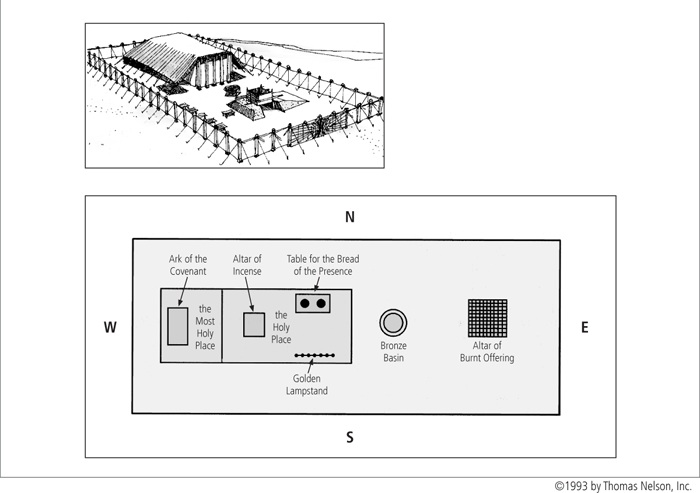
The Placement of Israel's Tribes
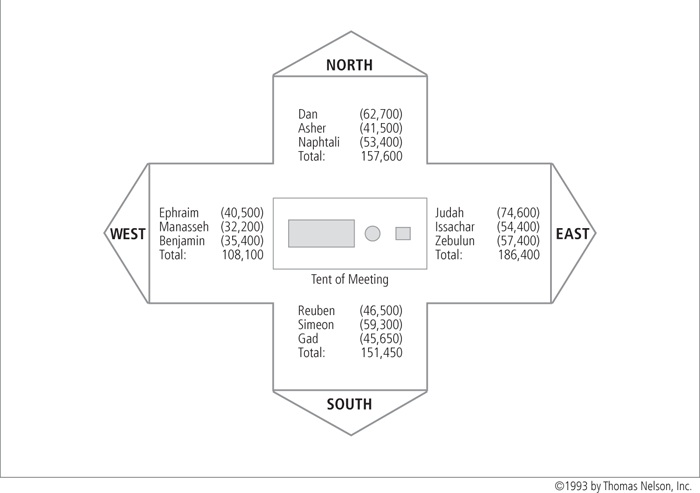
EXODUS—NOTE ON 25:31 lampstand. Situated opposite the table of the bread of the Presence on the south side of the Holy Place stood an ornate lampstand, or menorah, patterned after a flowering almond tree. It provided light for the priests serving in the Holy Place. Care was taken, according to God's instructions (27:20–21; 30:7–8; Lev. 24:1–4), to keep it well supplied with pure olive oil so that it would not be extinguished. The lampstand is seen as typifying the Lord Jesus Christ, who was the true light that came into the world (John 1:6–9; 8:12).
EXODUS—NOTE ON 25:39 talent. Approximately 75 pounds.
EXODUS—NOTE ON 25:40 Cf. Heb. 8:5.
EXODUS—NOTE ON 26:1 ten curtains. The beauty of these curtains could be seen only from the inside, the thick outer protective covering of goats' hair drapes, and ram and porpoise skins (v. 14) hiding them from the view of anyone except the priests who entered.
EXODUS—NOTE ON 26:7 eleven curtains. The extra length of the outer drapes
doubled as a covering for the front and back of the tabernacle structure (vv. 9– 13).
EXODUS—NOTE ON 26:15–29 The frame or trellis work, on which the curtains and outer coverings were draped, also received precise instructions. The portability of the whole structure was obvious. Throughout the wilderness wanderings, it could be quickly dismantled and readied for transport, and just as rapidly reerected.
EXODUS—NOTE ON 26:30 according to the plan. Again (cf. 25:40) the warning was sounded that the blueprint must be carefully followed. Nothing was to be left to human guesswork, no matter how skilled the craftsmen might have been.
EXODUS—NOTE ON 26:31–34 A veil, similar in design to the inner curtains (see note on 26:1), divided the tabernacle into the Holy Place and the Most Holy, or lit., the Most Holy Place.
EXODUS—NOTE ON 26:36 screen. Another curtain or veil, without the embroidered cherubim motif, was made to cover the entranceway into the Holy Place.
EXODUS—NOTE ON 27:1 altar. The largest piece of equipment, also known as the "altar of burnt offering" (Lev. 4:7, 10, 18), was situated in the courtyard of the tabernacle. It was covered, not in gold as the items inside the Holy Place, but in bronze. Like the other pieces of furniture and equipment, it was also built to be carried by poles (27:6–7).
EXODUS—NOTE ON 27:3 All the altar's utensils and accessories were also made of bronze, not gold.
EXODUS—NOTE ON 27:9 the court of the tabernacle. The dimensions of the rectangular courtyard space, bordered by curtains and poles around the tabernacle were also precisely given (vv. 9–19; 150 feet by 75 feet). The outer hangings were high enough, 5 cubits or 7.5 feet, to block all view of the interior of the courtyard (v. 18). Entry into the courtyard of God's dwelling place was not gained just generally and freely from all quarters.
EXODUS—NOTE ON 27:16 gate of the court. The curtain forming the covering for the entranceway into the courtyard was colored differently from that which surrounded the oblong courtyard. Clearly there was only one way to enter this
very special place where God had chosen to place the evidence of his dwelling with his people.
EXODUS—NOTE ON 27:20–21 pure beaten olive oil. The clear oil from crushed unripened olives granted almost a smoke-free light. The people were to provide the fuel to maintain the light needed by the high priest and his priestly staff in the Holy Place.
EXODUS—NOTE ON 28:1 serve me as priests. The threefold repetition of this phrase in the opening words about Aaron's priestly wardrobe would appear to stress the importance of his role in the religious life of the nation. Aaron's sons were part of the priesthood being set up. The Hebrew text groups the sons in two pairs, the first pair being Nadab and Abihu, both of whom died because of wanton disregard of God's instructions (Lev. 10:1–2). Aaron and his descendants, as well as the tribe of Levi, were selected by God to be Israel's priests—they did not appoint themselves to the position. The law clearly defined their duties for worship and the sacrifices in the tabernacle and for the individual worshiper and the nation's covenantal relationship to God.
EXODUS—NOTE ON 28:2 for glory and for beauty. The garments were designed to exalt the office and function of the priesthood, vividly marking out Aaron as a special person playing a special mediatorial role—they were "holy" vestments. In the OT priestly system for the nation of Israel, such dress maintained the priest-laity distinction.
EXODUS—NOTE ON 28:3 skillful. This was the first reference in God's instructions to Moses that certain men would be especially empowered by him to work skillfully on this construction project.
EXODUS—NOTE ON 28:5–13 ephod. Whenever Aaron entered the sanctuary, he carried with him on his shoulders the badge and the engraved stones that were representative of the 12 tribes.
EXODUS—NOTE ON 28:15–30 breastpiece of judgment. The 12 precious stones, each engraved with a tribe's name, colorfully and ornately displayed Aaron's representative role of intercession for the tribes before the Lord. The breastpiece was to be securely fastened to the ephod so as not to come loose from it (v. 28 and 39:21). Thus, to speak of the ephod after this was done would be to speak of the whole ensemble.
EXODUS—NOTE ON 28:30 Urim and the Thummim. The etymological source of these two terms, as well as the material nature of the objects represented by them, cannot be established with any degree of finality. Clearly two separate objects were inserted into the breastpiece and became thereby an essential part of the high priest's official regalia. Aaron and his successors bore over their heart "the judgment of the people of Israel," i.e., "judgment" in the sense of giving a verdict or decision. The passages in which the terms appear (Lev. 8:8; Num. 27:21; Deut. 33:8; 1 Sam. 28:6; Ezra 2:63; Neh. 7:65) and those that record inquiries of the Lord when a high priest with the ephod was present (Josh. 9:14; Judg. 1:1–2; 20:18; 1 Sam. 10:22; 23:2–4, 10–12; 1 Chron. 10:14) allow for the following conclusions: 1) that these two objects represented the right of the high priest to request guidance for the acknowledged leader who could not approach God directly, as Moses had done, but had to come via the God-ordained priestly structure, and 2) that the revelation then received gave specific direction for an immediate problem or crisis, and went beyond what could be associated with some sort of sacred lots providing merely a wordless "yes" and "no" response.
EXODUS—NOTE ON 28:31–35 robe. The priest's outer garment.
EXODUS—NOTE ON 28:32 opening in a garment. The meaning of the Hebrew word is uncertain. If it means "coat of mail" (see esv footnote), then it refers to a flexible metal covering used by the Egyptians for protection in battle.
EXODUS—NOTE ON 28:33 bells of gold. The sound of the tinkling bells sewn on the hem of the high priest's robe signaled those waiting outside the Holy Place that their representative ministering before the Lord was still alive and moving about, fulfilling his duties.
EXODUS—NOTE ON 28:36–38 turban. The headdress carried the declaration essential to worship and priestly representation, namely the holiness of the Lord, and in so doing reminded the high priest and all others that their approach to God must be done with reverence.
EXODUS—NOTE ON 28:39 coat . . . sash. An undergarment.
EXODUS—NOTE ON 28:40–43 The rest of the priests also had distinctive dress to wear, visually setting them apart from the ordinary citizen. Failure to comply with the dress regulations when serving in the sanctuary brought death. Such a severe consequence stressed the importance of their duties and should have
motivated the priests not to consider their priestly role as a mundane, routine, and thankless task.
EXODUS—NOTE ON 29:1–18 consecrate. The ones chosen to begin the priesthood could not enter into office without Moses' conducting a solemn, seven-day investiture (vv. 4–35 and Lev. 8:1–36), involving washing, dressing, anointing, sacrificing, daubing and sprinkling with blood, and eating.
EXODUS—NOTE ON 29:19–20 Daubing blood on the right ear, hand, and big toe symbolically sanctified the ear to hear the word of God, the hand to do the work of God, and the foot to walk in the way of God.
EXODUS—NOTE ON 29:27–28 wave offering . . . peace offerings. See note on Lev. 7:30–32.
EXODUS—NOTE ON 29:40 seah . . . hin. Four to 6 gallons and 6 to 8 pints respectively.
EXODUS—NOTE ON 29:42 throughout your generations. Perhaps this phrase intends a prophetic reminder or confirmation of a long history for Israel.
EXODUS—NOTE ON 29:45 I will dwell. That he would be their God and they would be his people was one thing, but that he would also dwell or tabernacle with them was a very important reality in the experience of the new nation. They were to understand not only the transcendence of their God, whose dwelling place was in the heaven of heavens, but also the immanence of their God, whose dwelling place was with them. Their redemption from Egypt was for this purpose (v. 46).
EXODUS—NOTE ON 30:1–10 altar . . . incense. The design for this piece of furniture for the Holy Place was not given with the other two (25:23–40) but follows the instructions about the priesthood perhaps because it was the last piece to which the high priest came before he entered the Most Holy Place once a year. Right after Aaron's consecration ceremony had been noted, his duties of 1) ensuring proper incense was offered continually upon this altar and 2) once a year cleansing it with blood from the atonement offering (v. 10) received attention.
EXODUS—NOTE ON 30:6 in front of the veil. This places the altar outside of the Most Holy Place in the Holy Place. Hebrews 9:3–4 speaks of the altar in the Most Holy Place in the sense of its proximity to the ark and in relation to its cleansing on the Day of Atonement. The priests could not go beyond it on any other day.
EXODUS—NOTE ON 30:9 unauthorized incense. See v. 38.
EXODUS—NOTE ON 30:12 census. The reason for the numbering of all males of military age (v. 14) was not stated, but its seriousness surfaces in the dire warning given about a plague and the use of the term "ransom" in connection with it (cf. 1 Chron. 21).
EXODUS—NOTE ON 30:13 shekel of the sanctuary. A shekel weighed about .4 ounces (cf. Lev. 5:15; 27:3, 25; Num. 3:47; 7:13ff.).
EXODUS—NOTE ON 30:18–21 basin of bronze. The washing of hands and feet was mandatory before engaging in priestly duties. Again, the seriousness of being ceremonially purified is seen in the warning of death if this washing is neglected. Nothing casual was being done in the sanctuary or out in the courtyard!
EXODUS—NOTE ON 30:22–33 Nothing was left to chance or to human ingenuity. The ingredients for making the anointing oil were carefully spelled out. Anything different was totally unacceptable and brought with it the penalty of death (v. 33). This was to be a unique blend! Using it for any other purpose also erased its holy status as set apart for use in the tabernacle and made it no different from the ordinary and the mundane.
EXODUS—NOTE ON 30:25, 35 as by the perfumer. The skill of the perfumer was
obviously already well known in Israel, a trade which they undoubtedly observed in Egypt.
EXODUS—NOTE ON 30:34–38 incense. God also listed the ingredients for the unique blend of incense prescribed for use at the altar of incense. Making anything different would have been to make "unauthorized incense" (v. 9) and would also result in death (v. 38). Personal use rendered its holy status null and void. Nadab and Abihu were executed for violating this command (cf. Lev. 10:1–2).
EXODUS—NOTE ON 31:1–11 God identified two men by name as specially chosen and divinely endued with ability, or Spirit-filled, to make all he had revealed to Moses (cf. 28:3; 36:1). None of the craftsmen were left untouched by divinely bestowed understanding in the intricacy of their work. They were called "craftsmen," suggesting previously developed skill. They were to make all that is prescribed in Ex. 25–30.
EXODUS—NOTE ON 31:12–17 See note on 20:8.
EXODUS—NOTE ON 31:18 two tablets of the testimony. See note on 25:16. written with the finger of God. A figurative way of attributing the law to God.
EXODUS—NOTE ON 32:1 make us gods. Such was the influence of the polytheistic world in which they lived that the Israelites, in a time of panic or impatience, succumbed to a pagan world view. What made it even more alarming was the rapidity with which pagan idolatry swept in despite recent reallife demonstrations of God's greatness and goodness toward them. But they weren't just requesting gods, but gods to lead them forward—"who shall go before us." The pagan world view had robbed them of seeing God as having led them out of Egypt and instead they scornfully attributed the exodus to Moses (cf. Acts 7:40).
EXODUS—NOTE ON 32:4 a golden calf. The young bull, which Aaron caused to be fashioned, was a pagan religious symbol of virile power. A miniature form of the golden calf, although made of bronze and silver, was found at the site of the ancient Philistine city of Ashkelon. Since it dates to about 1550 B.C. it indicates that calf worship was known not only in Egypt, but also in Canaan prior to the time of Moses. In worshiping the calf, the Israelites violated the first three commandments (20:3–7).
EXODUS—NOTE ON 32:5 feast to the Lord. Syncretism brought about the ludicrous combination of an idol, an altar, and a festal celebration held in a bizarre attempt to honor the true God.
EXODUS—NOTE ON 32:6 rose up to play. The Hebrew word allows for the inclusion of drunken and immoral activities so common to idolatrous fertility cults in their revelry (see the description in vv. 7, 25). Syncretism had robbed the people of all ethical alertness and moral discernment (cf. 1 Cor. 10:7).
EXODUS—NOTE ON 32:7 your people. In alerting Moses to the trouble in the camp, God designated Israel as Moses' people, a change of possessive pronoun Moses could not have missed. Beforehand God had acknowledged them as "my people." In pleading with God for Israel and in responding to God's offer to make of him a great nation (v. 10), Moses maintained what he knew to be true, given the exodus and the divine promises to the patriarchs (vv. 12–13), and designated them correctly as "your people" (v. 11).
EXODUS—NOTE ON 32:10 make a great nation of you. God could have consumed all the people and started over again with Moses, just as he had earlier with Abraham (Gen. 12).
EXODUS—NOTE ON 32:13 Israel. Another name for Jacob, which means "one who strives with God" (cf. Gen. 32:28).
EXODUS—NOTE ON 32:14 the Lord relented from the disaster. Moses' appeal for God to change his mind, to relent, succeeded because God had only threatened judgment, not decreed it. A divine intention is not an unchangeable divine decree. Decrees or sworn declarations (cf. Gen. 22:16–18; Ps. 110:4) or categorical statements of not changing or relenting (cf. Jer. 4:28; Ezek. 24:14; Zech. 8:14–15) are unconditional and bind the speaker to the stated course of action regardless of the circumstances or reactions of the listeners. Intentions retain a conditional element and do not necessarily bind the speaker to a stated course of action (cf. Jer. 15:6; 18:8–10; 26:3, 13, 19; Joel 2:13; Jonah 3:9–10; 4:2).
EXODUS—NOTE ON 32:19 broke them. Moses pictured the nation breaking God's commandments by actually breaking the tablets on which they were written.
EXODUS—NOTE ON 32:22–24 Aaron, held responsible by Moses for what had taken place in the camp (vv. 21, 25), endeavored to avoid responsibility for the
people's actions by shifting the blame to their propensity to do evil, and also for the presence of the golden calf by ridiculously representing it as having just popped out of the fire all by itself!
EXODUS—NOTE ON 32:23 See Acts 7:40.
EXODUS—NOTE ON 32:26 Who is on the Lord's side? Only the tribe of Levi responded to the call to take action in response to this situation that demanded judgment be inflicted. They had understood that neutrality could not exist in the open confrontation between good and evil. Family and national ties were superseded by submission to the Lord to do his will, which in this situation was to wield the sword of God's judgment to preserve his honor and glory.
EXODUS—NOTE ON 32:28 They apparently killed those who persisted in idolatry and immorality (cf. Num. 25:6–9).
EXODUS—NOTE ON 32:32 blot me out of your book. Nothing more strongly marked the love of Moses for his people than his sincere willingness to offer up his own life rather than see them disinherited and destroyed. The book to which Moses referred, the psalmist entitled "the book of the living" (Ps. 69:28). Untimely or premature death would constitute being blotted out of the book. The apostle Paul displayed a similar passionate devotion for his kinsmen (Rom. 9:1– 3).
EXODUS—NOTE ON 33:2–6 Good news included bad news! Entry into the Promised Land was not forfeited, but God's presence on the way was withdrawn. What was a sworn covenant-promise to the patriarchs just could not be broken: what was assured—the divine presence on the way—could be set aside because of sin (cf. 23:20–23). Removal of their jewelry depicted outwardly the people's sorrow of heart. It was a response analogous to donning sackcloth and ashes.
EXODUS—NOTE ON 33:2 See notes on 3:8.
EXODUS—NOTE ON 33:7 the tent of meeting. In the time prior to the construction of the tabernacle, Moses' tent became the special meeting place for Moses to talk intimately, "face to face" (v. 11), with God. No doubt the people watching from afar were reminded of the removal of God's immediate presence.
EXODUS—NOTE ON 33:12–17 Again Moses entered earnestly and confidently into the role of intercessor before God for the nation whom he again referred to as
"your people" (vv. 13, 16). Moses clearly understood that without God's presence they would not be a people set apart from other nations, so why travel any further? Moses' favored standing before the Lord comes out in the positive response to his intercession (v. 17).
EXODUS—NOTE ON 33:18–23 Cautionary measures were needed for God to respond only in part to Moses' request to see more of him than he was already experiencing (cf. Num. 12:8)—otherwise he would die. Notwithstanding God's being gracious and compassionate to whomever he chose, Moses could not see God's face and live. Whatever he saw of God's nature transformed into blazing light is referred to as "God's back" and was never subsequently described by Moses (cf. John 1:18; 1 John 4:12).
EXODUS—NOTE ON 33:19 See Rom. 9:15.
EXODUS—NOTE ON 34:1 Cut . . . two tablets of stone. Renewal of the covenant meant replacement of the broken original tablets on which God had personally written the Ten Commandments (cf. 32:19).
EXODUS—NOTE ON 34:2–28 Moses' second period of 40 days and nights on Mount Sinai (cf. chs. 25–32).
EXODUS—NOTE ON 34:6–7 Here is one of the testimonies to the character of God.
EXODUS—NOTE ON 34:7 See note on 20:5–6.
EXODUS—NOTE ON 34:11 See note on 3:8.
EXODUS—NOTE ON 34:12–17 See note on 23:32. This time the admonition on international treaties included a warning of how idolatry could easily ensnare them by seemingly innocent invitations to join the festivities like a good neighbor or by intermarriage, because these events would require recognition of the contracting parties' deities. Their future history demonstrated the urgency of such instruction and the disaster of disobeying it.
EXODUS—NOTE ON 34:18 See note on 12:14.
EXODUS—NOTE ON 34:19–20 See note on 13:2.
EXODUS—NOTE ON 34:21 See note on 20:8.
EXODUS—NOTE ON 34:22–23, 26 See note on 23:14–19.
EXODUS—NOTE ON 34:29–35 The first time on the mount (24:12–32:14), unlike the second, had not left Moses with a face that was reflecting some radiance associated with being in the presence of the Lord for an extended period of time. On the first occasion, mere mention was made of Moses' being gone 40 days and nights (24:18). On the second, mention was made of the 40-day-and-night absence but adding that Moses had been there with the Lord, neither eating nor drinking (34:28), appears to draw attention to the different nature of the second visit. It, in comparison with the first, was not interrupted by the Lord's sending Moses away because of sin in the camp (32:7–10). A compliant and not defiant people feared the evidence of God's presence. When not speaking to the Lord or authoritatively on his behalf to the people, Moses veiled his face. The apostle Paul advised that the veil prevented the people from seeing a fading glory and related it to the inadequacy of the Old Covenant and the blindness of the Jews in his day (see notes on 2 Cor. 3:7–18).
EXODUS—NOTE ON 35:1–40:38 In this section, the Israelites constructed the tabernacle as God so prescribed in 25:1–31:18.
EXODUS—NOTE ON 35:1–3 See note on 20:8. This time, however, an extra admonition forbids the making of a fire on the Sabbath.
EXODUS—NOTE ON 35:4–9 See note on 25:2.
EXODUS—NOTE ON 35:10–19 See notes on 25:11–28:43.
EXODUS—NOTE ON 35:20–29 See note on 25:2.
EXODUS—NOTE ON 35:30–36:1 The Lord also gave the two named craftsmen skill in teaching their trades. This substantiates that they were most probably the supervisors or leaders of the construction teams. See notes on 28:3; 31:1–11.
EXODUS—NOTE ON 36:2–7 The people, stubborn and disobedient at times, nevertheless rose to the occasion and voluntarily brought much more than was needed for the building of the tabernacle. See note on 25:2.
EXODUS—NOTE ON 36:8–39:43 The report of the work done is repeated in the past tense. This report also highlighted how careful the workers were in carrying out the instructions and blueprints received. Note the repeated refrain on doing
all just as the Lord had commanded Moses (39:1, 5, 7, 21, 26, 29, 31, 32, 42, 43 and 40:19, 21, 23, 25, 27, 29, 32).
EXODUS—NOTE ON 36:8–37 See notes on ch. 26.
EXODUS—NOTE ON 37:1–9 See notes on 25:16–18.
EXODUS—NOTE ON 37:10–16 See note on 25:30.
EXODUS—NOTE ON 37:17–24 See note on 25:31.
EXODUS—NOTE ON 37:25–28 See note on 30:1–10.
EXODUS—NOTE ON 37:29 See notes on 30:22–33, 34–38.
EXODUS—NOTE ON 38:1–7 See note on 27:1.
EXODUS—NOTE ON 38:8 See note on 30:18–21.
EXODUS—NOTE ON 38:9–20 See notes on 27:9, 16.
EXODUS—NOTE ON 38:21–31 The inventory taken calculates out at half a shekel (cf. 30:13–16) per man 20 years old and up to equal 603,550 men (cf. Num. 1:46 and the first census). Talents were about 75 pounds and shekels about half an ounce.
EXODUS—NOTE ON 39:1–2 They made . . . He made. The third-person plural, "they," dominating the manufacturing report (vv. 2–31), is interrupted four times by the singular "he" (vv. 2, 7, 8, 22). The plural undoubtedly refers to Bezalel and/or his associates in operation, whereas the singular marks out what Bezalel worked on by himself.
EXODUS—NOTE ON 39:1 as the Lord had commanded Moses. This repetitive refrain (vv. 1, 5, 7, 21, 26, 29, 31), a quality-control statement, signals to the reader of every age, or to the listener in Israel back then, that God's detailed instructions to Moses on the fabricating of the ephod (vv. 2–7), breastpiece (vv. 8–21), and priestly garments (vv. 22–31) were followed to the letter. Obedience in every detail was taken seriously by Israel's artisans.
EXODUS—NOTE ON 39:2 He made the ephod. See note on 28:5–13.
EXODUS—NOTE ON 39:3 they hammered out gold leaf, and he cut it into threads. The process adopted to get the delicate strips for braided chains or gold embroidery work conformed well with contemporary Egyptian methods of goldworking.
EXODUS—NOTE ON 39:8 He made the breastpiece. See notes on 28:15–30. The Urim and Thummim were inserted into the breastpiece and became an essential part of it, or were seen as a permanent connection with it.
EXODUS—NOTE ON 39:22 He also made the robe of the ephod. See note on 28:31–35.
EXODUS—NOTE ON 39:27 They also made the coats . . . for Aaron and his sons. See notes on 28:39–43.
EXODUS—NOTE ON 39:30 They made the plate of the holy crown. See note on 28:36–38 on this special plate engraved with its message of God's purity and separation from all the profane and impure.
EXODUS—NOTE ON 39:32 Thus all the work . . . was finished. Finally the moment arrived when all the different tasks assigned to different craftsmen were all completed, and the great task on which they embarked was ready for formal presentation to Israel's leader. and the people of Israel. No individual artisan is singled out for special mention or award; instead the whole nation was represented as doing everything in accordance with the Lord's instructions to Moses. so they did. In what is almost an offhanded aside, emphasis is placed on the strict attention paid to the official, divine specifications for all parts of the work for the tabernacle.
EXODUS—NOTE ON 39:33 they brought the tabernacle to Moses. Attestations of obedience and accuracy provide, as it were, an envelope (vv. 32, 42–43) for the concise inventory of all the parts included in that presentation to Moses. None of the individual parts listed, nor the sum of them, reflect just human ingenuity in designing something they wanted to have, but reflect instead just what their Lord required them to have. It was fully his architecture and his design at every level of the undertaking.
EXODUS—NOTE ON 39:42–43 The double repetition of the same quality-control refrain found earlier in the chapter together with the two additional phrases emphasizing exact conformity (notice "behold" and "so had") to all
specifications combine to formally mark the closing of these great God-initiated preparations for the place of his presence and the site of their worship. Israel's skillful craftsmen had done their work with zero tolerance for error in mind!
EXODUS—NOTE ON 39:43 Moses saw all the work. Fittingly enough, the one who had been with God on the mount and had passed on to the people the blueprints for everything connected with the Lord's tabernacle personally inspected the work and confirmed its successful completion. The term "work" is to be taken as "the end result of professional and skilled craftsmen." Then Moses blessed them. By this act, Moses set his final and formal seal of approval on the outcome of their earnestness and diligence, and expressed his prayer-wish that good would result to them from their God. This is the only instance recorded in Exodus of Moses' pronouncing a blessing upon his people. The other appearances of the verb "to bless" occur three times with God as the subject of the verb (20:11, 24; 23:25) and one time with Pharaoh requesting Moses to bless him (12:32).
EXODUS—NOTE ON 40:1–33 Finally the time arrived for the tabernacle to be erected with the Most Holy Place and its accompanying Holy Place to the west, and the courtyard entrance to the east. In terms of pagan religions and their worship of the sun god, some polemic significance might be seen in the high priest worshiping God with his back to the rising sun. All who entered the courtyard also turned their backs to the rising sun as they came in to sacrifice and worship.
EXODUS—NOTE ON 40:17 The tabernacle was completed almost one year after the exodus from Egypt. The people were at the foot of Mount Sinai at that time, where the book of Leviticus was given in the first month of that second year. The record of Numbers begins with the people still at Mount Sinai in the second month of that second year after leaving Egypt (cf. Num. 1:1).
EXODUS—NOTE ON 40:34 the cloud covered . . . the glory of the Lord filled. This was the final confirmation for Moses and the people that all the work for setting up God's dwelling place had been properly done and all the tedious instructions obediently followed.
EXODUS—NOTE ON 40:36 taken up. This first occurred (as recorded in Num. 10:11) 50 days after the tabernacle was finished and erected.
Leviticus
Leviticus 1 • Leviticus 2 • Leviticus 3 • Leviticus 4 • Leviticus 5 •
Leviticus 6 • Leviticus 7 • Leviticus 8 • Leviticus 9 • Leviticus 10 • Leviticus 11 • Leviticus 12 • Leviticus 13 • Leviticus 14 • Leviticus 15 • Leviticus 16 • Leviticus 17 • Leviticus 18 • Leviticus 19 • Leviticus 20 • Leviticus 21 • Leviticus 22 • Leviticus 23 • Leviticus 24 • Leviticus 25 • Leviticus 26 • Leviticus 27 Introduction to Leviticus
Title Author and Date Background and Setting Historical and Theological Themes Interpretive Challenges Outline Footnotes Study Notes
Introduction to Leviticus
Title
The original Hebrew title of this third book of the law is taken from the first word, translated "And he called." Several OT books derive their Hebrew names in the same manner (e.g., Genesis, "In the beginning"; Exodus, "Now these are the names"). The title "Leviticus" comes from the Latin Vulgate version of the Greek OT (LXX) Leuitikon meaning "matters of the Levites" (25:32–33). While the book addresses issues of the Levites' responsibilities, much more significantly, all the priests are instructed in how they are to assist the people in worship, and the people are informed about how to live a holy life. New Testament writers quote the book of Leviticus over 15 times.
Author and Date
Authorship and date issues are resolved by the concluding verse of the book, "These are the commandments that the Lord commanded Moses for the people of Israel on Mount Sinai" (27:34; cf. 7:38; 25:1; 26:46). The fact that God gave these laws to Moses (cf. 1:1) appears 56 times in Leviticus' 27 chapters. In addition to recording detailed prescriptions, the book chronicles several historical accounts relating to the laws (see chs. 8–10; 24:10–23). The exodus occurred in 1445 B.C. (see Introduction to Exodus: Author and Date) and the tabernacle was finished one year later (Ex. 40:17). Leviticus picks up the record at that point, probably revealed in the first month (Abib/Nisan) of the second year after the exodus. The book of Numbers begins after that in the second month (Ziv; cf. Num. 1:1).
Background and Setting
Before the year that Israel camped at Mount Sinai: 1) the presence of God's glory had never formally resided among the Israelites; 2) a central place of worship, like the tabernacle, had never existed; 3) a structured and regulated set of sacrifices and feasts had not been given; and 4) a high priest, a formal priesthood, and a cadre of tabernacle workers had not been appointed. As Exodus concluded, features one and two had been accomplished, thereby
requiring that elements three and four be inaugurated, which is where Leviticus fits in. Exodus 19:6 called Israel to be "a kingdom of priests and a holy nation." Leviticus in turn is God's instruction for his newly redeemed people, teaching them how to worship and obey him.
Israel had, up to that point, only the historical records of the patriarchs from which to gain their knowledge of how to worship and live before their God. Having been slaves for centuries in Egypt, the land of a seemingly infinite number of gods, they had a concept of worship and the godly life that was severely distorted. Their tendency to hold on to polytheism and pagan ritual is witnessed in the wilderness wanderings, e.g., when they worshiped the golden calf (cf. Ex. 32). God would not permit them to worship in the ways of their Egyptian neighbors, nor would he tolerate Egyptian ideas about morality and sin. With the instructions in Leviticus, the priests could lead Israel in worship appropriate to the Lord.
Even though the book contains a great deal of law, it is presented in a historical format. Immediately after Moses supervised the construction of the tabernacle, God came in glory to dwell there; this marked the close of the book of Exodus (40:34–38). Leviticus begins with God calling Moses from the tabernacle and ends with God's commands to Moses in the form of binding legislation. Israel's King had occupied his palace (the tabernacle), instituted his law, and declared himself a covenant partner with his subjects.
No geographical movement occurs in this book. The people of Israel stay at the foot of Sinai, the mountain where God came down to give his law (25:1; 26:46; 27:34). They were still there one month later when the record of Numbers began (cf. Num. 1:1).
Historical and Theological Themes
The core ideas around which Leviticus develops are the holy character of God and the will of God for Israel's holiness. God's holiness, mankind's sinfulness, sacrifice, and God's presence in the sanctuary are the book's most common themes. With a clear, authoritative tone, the book sets forth instruction toward personal holiness at the urging of God (11:44–45; 19:2; 20:7, 26; cf. 1 Pet. 1:14– 16). Matters pertaining to Israel's life of faith tend to focus on purity in ritual settings, but not to the exclusion of concerns regarding Israel's personal purity. In fact, there is a continuing emphasis on personal holiness in response to the
holiness of God (cf. this emphasis in Lev. 17–27). On over 125 occasions, Leviticus indicts mankind for uncleanness and/or instructs on how to be purified. The motive for such holiness is stated in two repeated phrases: "I am the Lord" and "I am holy." These are used over 50 times. See note on 11:44–45.
The theme of the conditional Mosaic Covenant resurfaces throughout the book, but particularly in ch. 26. This contract for the new nation not only details the consequences for obedience or disobedience to the covenant stipulations, but it does so in a manner scripted for determining Israel's history. One cannot help but recognize prophetic implications in the punishments for disobedience; they sound like the events of the much later Babylonian deportment, captivity, and subsequent return to the land almost 900 years after Moses wrote Leviticus (c. 538 B.C.). The eschatological implications for Israel's disobedience will not conclude until Messiah comes to introduce his kingdom and end the curses of Lev. 26 and Deut. 28 (cf. Zech. 14:11).
The five sacrifices and offerings were symbolic. Their design was to allow the truly penitent and thankful worshiper to express faith in and love for God by the observance of these rituals. When the heart was not penitent and thankful, God was not pleased with the ritual. Cf. Amos 5:21–27. The offerings were burnt, symbolizing the worshiper's desire to be purged of sin and sending up the fragrant smoke of true worship to God. The myriad of small details in the execution of the rituals was to teach exactness and precision that would extend to the way the people obeyed the moral and spiritual laws of God and the way they revered every facet of his word.
Interpretive Challenges
Leviticus is both a manual for the worship of God in Israel and a theology of Old Covenant ritual. Comprehensive understanding of the ceremonies, laws, and ritual details prescribed in the book is difficult today because Moses assumed a certain context of historical understanding. Once the challenge of understanding the detailed prescriptions has been met, the question arises as to how believers in the church should respond to them, since the NT clearly abrogates OT ceremonial law (cf. Acts 10:1–16; Col. 2:16–17), the levitical priesthood (cf. 1 Pet. 2:9; Rev. 1:6; 5:10; 20:6), and the sanctuary (cf. Matt. 27:51), as well as instituting the New Covenant (cf. Matt. 26:28; 2 Cor. 3:6–18; Heb. 7–10). Rather than try to practice the old ceremonies or look for some deeper spiritual significance in them, the focus should be on the holy and divine character behind