
©1997 by Thomas Nelson, Inc.
10. Ezekiel had to cook a pot of stew (24:1–14). 11. Ezekiel could not mourn at the death of his wife (24:15–24). 12. Ezekiel was mute for a season (24:25–27). 13. Ezekiel put two sticks together and they became one (37:15–28). ©1997 by Thomas Nelson, Inc.
EZEKIEL—NOTE ON 3:21 delivered your soul. The prophet had done his duty.
EZEKIEL—NOTE ON 3:23 the glory of the Lord. See Introduction: Historical and Theological Themes.
EZEKIEL—NOTE ON 3:24 shut yourself within your house. He was to fulfill much of his ministry at home (8:1; 12:1–7), thereby limiting it to those who came to hear him there.
EZEKIEL—NOTE ON 3:25 cords will be placed upon you. These were not literal, but spiritual. On one hand, they could be the inner ropes of depressing influence which the rebellious Jews exerted on his spirit. Their perversity, like ropes, would repress his freedom in preaching. More likely, they imply the restraint that God placed on him by supernatural power, so that he could only go and speak where and when God chose (cf. vv. 26–27).
EZEKIEL—NOTE ON 3:26–27 you shall be mute. He was not to speak primarily, but to act out God's message. The prohibition was only partial, for on any occasion (v. 27) when God did open his mouth, as he often did in chs. 5–7, he was to speak (3:22; 11:25; 12:10, 19, 23, 28). The end of such intermittent dumbness with regard to his own people closely synchronized with Ezekiel's receiving a refugee's report of Jerusalem's fall (24:25–27; 33:21–22). He also spoke with regard to judgments on other nations (chs. 25–32).
EZEKIEL—NOTE ON 4:1–7:27 Here is the first series of prophecies given over a year's time, of Jerusalem's conquest by the Babylonians in 586 B.C.
EZEKIEL—NOTE ON 4:1–3 engrave . . . Jerusalem. Ezekiel's object lesson was to use a soft tile to create a miniature city layout of Jerusalem with walls and siege objects to illustrate Babylon's final coming siege of Jerusalem (588–586 B.C.).
EZEKIEL—NOTE ON 4:4–6 lie on your left side . . . right side. Lying on his side, likely facing north, illustrated God's applying judgment to Israel, and facing
south pointed to judgment on Judah. It is not necessary to assume that Ezekiel was in the prone position all the time. It was doubtless part of each day, as his need for preparing food (v. 9) indicates.
EZEKIEL—NOTE ON 4:4 you shall bear their punishment. Ezekiel's action was to represent the time of Israel's punishment.
EZEKIEL—NOTE ON 4:5 390. Each day symbolized a year (v. 6). Israel in the north was accountable during this span of time whose beginning and end is uncertain.
EZEKIEL—NOTE ON 4:6 Forty. Judah was also guilty, but the 40 cannot represent less guilt (cf. 23:11). It may extend the time beyond the 390 to 430 or they may run concurrently, but the exact timing is uncertain.
EZEKIEL—NOTE ON 4:7 arm bared. A symbol for being ready for action, as a soldier would do (cf. Isa. 52:10).
EZEKIEL—NOTE ON 4:8 I will place cords upon you. This was to symbolize the impossibility of the Jews being able to shake off their punishment.
EZEKIEL—NOTE ON 4:9–13 make . . . bread. Scarcity of food in the 18-month siege especially made necessary the mixing of all kinds of grain for bread. The "twenty shekels" would be about 8 ounces, while "the sixth part of a hin" would be less than a quart. There would be minimums for daily rations. It must be noted that the command of v. 12 regarding "human dung" relates only to the fuel used to prepare the food. Bread was baked on hot stones (cf. 1 Kings 19:6) heated by human waste because no other fuel was available. This was repulsive and polluting (cf. Deut. 23:12–14) and the Lord calls it "bread unclean" (Ezek. 4:13).
EZEKIEL—NOTE ON 4:14–15 never defiled. Ezekiel, like Daniel, had convictions to be undefiled even in his food (cf. Dan. 1:8 and see note there). God permitted fuel of dried cow chips for cooking his food in gracious deference to his spokesman's sensitivity (cf. Ezek. 44:31).
EZEKIEL—NOTE ON 4:16–17 They were soon to have neither bread nor water in any amount, and they were to grieve over the famine and their iniquity (cf. Lev. 26:21–26).
EZEKIEL—NOTE ON 5:1–4 a barber's razor. The sign in shaving his hair illustrated the severe humiliation to come at the hand of enemies, emphasizing calamities to three segments of Jerusalem due to the Babylonian conquest. Some were punished by fire, i.e., plague and famine (v. 12), others died by the enemy's sword, and some were dispersed and pursued by death (cf. v. 12). A small part of his hair clinging to his garment (v. 3) depicted a remaining remnant, some of whom were subject to further calamity (v. 4; cf. 6:8; Jer. 41–44).
EZEKIEL—NOTE ON 5:5 Jerusalem. Here the great city alone was not meant, but was used as a representative of the whole land which, despite its strategic opportunity and responsibility, rejected God (vv. 6–7).
EZEKIEL—NOTE ON 5:7 Instead of being a witness to the heathen nations, Israel had exceeded them in idolatrous practices. The nations maintained their familiar idols, while Israel defected from their true and living God. God's people were worse than the pagans in proportion to spiritual knowledge and privileges. The judgments of God are always relative to light and privilege granted. Since Ezekiel's people were unique in their disobedience, they were to be outstanding in their punishment.
EZEKIEL—NOTE ON 5:8–10 The book of Lamentations reveals how literally these promises were realized when parents ate their children and sons ate their fathers in the times of starvation. Down through the centuries had come the threats of Lev. 26:29 and Deut. 28:53, taken up by Jeremiah (Jer. 19:9; Lam. 2:22; 4:10; cf. Isa. 9:20), and sealed in the life of the disobedient nation. Even the remnant would be scattered and suffer.
EZEKIEL—NOTE ON 5:11 as I live. Here was a solemn oath pledging the very existence of God for the fulfillment of the prophecy. It is found 14 times in this book. Their greatest sin was defiling the sanctuary, showing the height of their wickedness.
EZEKIEL—NOTE ON 5:12 The four well-known judgments (cf. vv. 2–4) of plague, famine, sword, and scattering were their judgment. They had no place to offer atoning blood, thus bearing their sins without relief.
EZEKIEL—NOTE ON 5:13–15 Ezekiel's purpose was to impress on Israel's conscience God's intense hatred of idolatry and apostasy. "Anger" and "fury" are repeated several times.
EZEKIEL—NOTE ON 5:16 deadly arrows of famine. The evil arrows included hail, rain, mice, locusts, and mildew (cf. Deut. 32:23–24).
EZEKIEL—NOTE ON 5:17 I am the Lord; I have spoken. Cf. vv. 13, 15 for the same expression, which was God's personal signature on their doom.
EZEKIEL—NOTE ON 6:3 says the Lord God to the mountains. God had the prophet do this because the people worshiped at idol altars in the "high places" (cf. Lev. 26:30–33; Isa. 65:7; Jer. 3:6; Hos. 4:13; Mic. 6:1–2).
EZEKIEL—NOTE ON 6:7 you shall know that I am the Lord. This clause recurs in vv. 10, 13, 14 and 60 times elsewhere in the book. It shows that the essential reason for judgment is the violation of the character of God. This is repeatedly acknowledged in Lev. 18–26, where the motive for all obedience to God's law is the fact that he is the Lord God.
EZEKIEL—NOTE ON 6:8–10 The mass of people was rejected, but grace and mercy were given to a godly group in the nation. There never has been nor ever will be a complete end to Israel. The doctrine of the remnant can be studied in Isa. 1:9; 10:20; Jer. 43:5; Zeph. 2:7; 3:13; Zech. 10:9; Rom. 9:6–13; 11:5.
EZEKIEL—NOTE ON 6:14 Riblah. A reference to Diblathaim, a city on the eastern edge of Moab (Num. 33:46; Jer. 48:22), near the desert east and south of the Dead Sea.
EZEKIEL—NOTE ON 7:1–9 This lament declared that the entire land of Israel was ripe for judgment. God's patience had ended. The final destruction of Jerusalem by Nebuchadnezzar was in view (586 B.C.).
EZEKIEL—NOTE ON 7:10 rod has blossomed. Verse 11 explains this. Violence had grown up into a rod of wickedness, which likely refers to Nebuchadnezzar, the instrument of God's vengeance (cf. Isa. 10:5; Jer. 51:20).
EZEKIEL—NOTE ON 7:12 buyer rejoice . . . seller mourn. Such matters of business were meaningless because the Chaldeans (Babylonians) took all the land and killed those they didn't take captive (v. 15) and the rest escaped (v. 16). Wealth was useless (vv. 19–20).
EZEKIEL—NOTE ON 7:13 seller shall not return to what he has sold. There was to be no jubilee year in which all lands were returned to their original owners (cf.
Lev. 25).
EZEKIEL—NOTE ON 7:17–22 This section described the mourning of the helpless and frightened people. In distress, they recognized the uselessness of the things in which they trusted. Their wealth provided nothing. Their "silver . . . gold" (v. 19), their "ornament" (v. 20) were as useless as the idols they made with them.
EZEKIEL—NOTE ON 7:22 my treasured place. The Most Holy Place in the temple will be desecrated by pagans, that place where only once a year the high priest could enter to make atonement in God's presence.
EZEKIEL—NOTE ON 7:23 Forge a chain! Ezekiel is to perform another emblematic act of captivity (cf. Jer. 27:2; Nah. 3:10).
EZEKIEL—NOTE ON 7:24 the worst of the nations. Babylonian pagans.
EZEKIEL—NOTE ON 7:27 According to their way. Cf. Gen. 18:25.
EZEKIEL—NOTE ON 8:1 the sixth year. 592 B.C. (cf. 1:2) in August/September, a year and two months after the first vision (1:1). the hand of the Lord. This ushered the prophet into a series of visions (8:3) stretching to the end of ch. 11.
EZEKIEL—NOTE ON 8:2 the appearance. He saw the glory of the Lord (v. 4) as in 1:26–28.
EZEKIEL—NOTE ON 8:3 visions of God. Ezekiel 8–11 deals with details conveyed only to Ezekiel in visions. Ezekiel's trip to Jerusalem was in spirit only, while his body physically remained in his house. In visions, he went to Jerusalem and in visions he returned to Babylon (11:24). After God finished the visions, Ezekiel told his home audience what he had seen. The visions are not a description of deeds done in the past in Israel, but a survey of Israel's current condition, as they existed at that very time. the seat . . . image of jealousy. God represents to Ezekiel the image of an idol (cf. Deut. 4:16) in the entrance to the inner court of the temple. It is called "the image of jealousy" because it provoked the Lord to jealousy (Ezek. 5:13; 16:38; 36:6; 38:19; Ex. 20:5).
EZEKIEL—NOTE ON 8:4 the glory of . . . God. God was also there in glory, but was ignored while the people worshiped the idol (v. 6).
EZEKIEL—NOTE ON 8:6 to drive me far. Sin would expel the people from their
land and God from his sanctuary.
EZEKIEL—NOTE ON 8:7–12 This section describes "greater abominations" (v. 6) of idolatry, namely a secret cult of idolatrous elders.
EZEKIEL—NOTE ON 8:8 dug in the wall . . . an entrance. This indicates the clandestine (cf. v. 12) secrecy of these idolaters, practicing their cult in hiding.
EZEKIEL—NOTE ON 8:10 engraved on the wall. The temple's walls are ugly with graffiti featuring creatures linked with Egyptian animal cults (cf. Rom. 1:23) and other idols. Leaders of Israel, who should be worshiping the God of the temple, are offering incense to them (Ezek. 8:11).
EZEKIEL—NOTE ON 8:11 seventy men of the elders. Obviously not the Sanhedrin, since it was not formed until after the restoration from Babylon, though the pattern had been suggested much earlier (cf. Ex. 24:9–10; Num. 11:16). These men were appointed to guard against idolatry! Jaazaniah the son of Shaphan. If he was the son of the Shaphan who read God's word to Josiah (2 Kings 22:8–11), we have some concept of the depth of sin to which the leaders had fallen. He is not to be confused with the man in Ezek. 11:1, who had a different father.
EZEKIEL—NOTE ON 8:14 weeping for Tammuz. Yet a greater abomination than the secret cult was Israel's engaging in the Babylonian worship of Tammuz or Dumuzi (Duzu), beloved of Ishtar, the god of spring vegetation. Vegetation burned in the summer, died in the winter, and came to life in the spring. The women mourned over the god's demise in July and longed for his revival. The fourth month of the Hebrew calendar still bears the name Tammuz. With the worship of this idol were connected the basest immoralities.
EZEKIEL—NOTE ON 8:16 worshiping the sun. In the most sacred inner court where only priests could go (Joel 2:17), there was the crowning insult to God. Twenty-five men were worshiping the sun as an idol (cf. Deut. 4:19; 2 Kings 23:5, 11; Job 31:26; Jer. 44:17). These 25 represent the 24 orders of priests plus the high priest.
EZEKIEL—NOTE ON 8:17 put the branch to their nose. The meaning is uncertain, but it seems to have been some act of contempt toward God. The Greek OT translators rendered it, "they are as mockers."
EZEKIEL—NOTE ON 8:18 I will act in wrath. God must judge intensely due to such horrible sins (cf. 24:9–10).
EZEKIEL—NOTE ON 9:1 executioners of the city. God summoned his servant angels to carry out his judgments. These angelic executioners (cf. Dan. 4:13, 17, 23) came equipped with weapons of destruction.
EZEKIEL—NOTE ON 9:2 six men. Angels can appear like men when ministering on earth (cf. Gen. 18:1; Dan. 9:20–23). a man. He was superior to the others. Linen indicates high rank (cf. Dan. 10:5; 12:6). Perhaps this was the angel of the Lord, the preincarnate Christ (see note on Ex. 3:2). He had all the instruments of an oriental scribe to carry out his task (Ezek. 9:4, 11).
EZEKIEL—NOTE ON 9:3 the glory . . . gone up. The glory of God departs before the destruction of the city and temple. The gradual departure of God from his temple is depicted in stages: the glory resides in the temple's Most Holy Place, between the wings of the cherubs on each side of the ark of the covenant over the mercy seat, then leaves to the front door (9:3; 10:4), later to the east gate by the outer wall (10:18–19), and finally to the Mount of Olives to the east, having fully departed (11:22–23). The glory will return in the future kingdom of Messiah (43:2–7).
EZEKIEL—NOTE ON 9:4 a mark on the foreheads. Since God's departure removed all protection and gave the people over to destruction, it was necessary for the angelic scribe (angel of the Lord) to mark for God's preservation the righteous who had been faithful to him. Those left unmarked were subject to death in Babylon's siege (v. 5). The mark was the indication of God's elect, identified personally by the preincarnate Christ. He was marking the elect (cf. Ex. 12:7). Malachi 3:16–18 indicates a similar idea. Cf. Rev. 7:3 and 9:4. The marked ones were penitent and were identified for protection. Here was a respite of grace for the remnant. The rest were to be killed (Ezek. 9:5–7).
EZEKIEL—NOTE ON 9:8 Will you destroy . . . ? Ezekiel is fearfully aroused in prayer because the judgment on Jerusalem and Israel is so vast. God replies that pervasive sin demands thorough judgment (vv. 9–10), yet comforts him by the report that the faithful had been marked to be spared (v. 11). Cf. Rom. 11:1–2, 25–27.
EZEKIEL—NOTE ON 10:1 a throne. It rises above God's angelic servants, the same four as in ch. 1 (10:20, 22), and is the throne of 1:26–28 on which God sits (cf. 10:20). From it, he directs the operation of his war machine ("wheels," see notes on 1:15–16) on Jerusalem (10:2). The throne is like a sapphire shining forth representing God's glory and holiness (11:22).
EZEKIEL—NOTE ON 10:2 Fill . . . with burning coals. God specifies that the marking angel (9:2, 11) reach into the war machine and fill his hands with fiery coals in the presence of the angels of ch. 1. These coals picture the fires of judgment that God's angels are to "scatter" on Jerusalem. In Isaiah 6, "a coal" was used for the purification of the prophet; here coals were for the destruction of the wicked (cf. Heb. 12:29). Fire did destroy Jerusalem in 586 B.C.
EZEKIEL—NOTE ON 10:3 cherubim. These were different from the cherubim of ch. 1 and here in 10:4.
EZEKIEL—NOTE ON 10:4 This verse explains how "the court was filled" with the "cloud" of v. 3. It repeats what is first described in 9:3.
EZEKIEL—NOTE ON 10:6–7 These verses picked up the action of the angelic scribe from v. 2.
EZEKIEL—NOTE ON 10:7 cherub . . . put it into the hands. One of the four cherubim of 1:5ff. and 10:1 puts the fiery coals into the marking angel's hand.
EZEKIEL—NOTE ON 10:9–17 wheels beside the cherubim. This whole section is similar to 1:4–21. Four wheels on God's chariot mingled with the four angels (cf. 1:15–21) coordinated with each other in precision, and each with a different one of the cherubim. All looked so much alike that it was as if one wheel blended entirely with another (10:10). As their appearance was so unified, their action was in unison, and instant (v. 11). The cherubim had bodies like men and their chariot wheels were full of eyes denoting full perception both to see the sinners and their fitting judgment. The color beryl is a sparkling yellow or gold.
EZEKIEL—NOTE ON 10:14 the face of the cherub. This description of one cherub in 1:10 indicates this was the face of an ox.
EZEKIEL—NOTE ON 10:15 mounted up. They were all ready to move in unison (vv. 16–17) as the Shekinah glory of God departed (v. 18).
EZEKIEL—NOTE ON 10:18–19 glory . . . mounted up. There were several stages: 9:3; 10:1, 3–4; 10:18–19; 11:22–23. There was thus written over the entire structure, as well as Israel's spiritual life, "Ichabod" (the glory has departed). Cf. 1 Sam. 4:21 and 10:18–19.
EZEKIEL—NOTE ON 11:1 twenty-five men. Ezekiel, though at the temple only in the vision (cf. 8:3, and see note there), saw because God, who was everywhere present and all-knowing, impressed specific details on him in the vision. The wicked leaders (cf. 11:2) were part of God's reason for the judgment (vv. 8, 10). Ezekiel was taken in spirit to the very place that the glory of God had left in 10:19 and was given a vision of "twenty-five men," who represented, not priests, but influential leaders among the people, who gave fatal advice to the people (11:2). Jaazaniah the son of Azzur. See note on 8:11.
EZEKIEL—NOTE ON 11:3 cauldron . . . meat. Though this is obscure, it may be that the bad advice these leaders were giving was that the people should not be engaged in business as usual, "to build houses" or to take care of their comfort and futures, when they were about to be cooked like flesh in a pot over a blazing fire. The idea must have been that the people should get ready for battle, and be prepared to fight, not focusing on comfort, but survival. Jeremiah had told the people to surrender to the Babylonians and save their lives, rather than fight and be killed (cf. Jer. 27:9–17). These false leaders, like the prophets and priests whom Jeremiah confronted for telling the people not to submit, scorned Jeremiah's words from God and would pay for it (Ezek. 11:4). Cf. 24:1–14.
EZEKIEL—NOTE ON 11:6 multiplied your slain. Leaders who misled Israel by inciting false expectations of a victorious defense, rather than peaceful surrender, were responsible for the deadly results. Many people died in resisting Babylon.
EZEKIEL—NOTE ON 11:7 you shall be brought out. The false leaders thought that unless they fought, they would all be in a boiling pot, i.e., the city. But here the Lord promised that some would be delivered from the city, only to die on Israel's border in the wilderness (vv. 8–11). This was literally fulfilled at Riblah (cf. 2 Kings 25:18–21; Jer. 52:24–27).
EZEKIEL—NOTE ON 11:13 Pelatiah . . . died. The death of one leader from v. 1 was a sign that God would indeed carry out his word. Apparently this leader did die suddenly at the time Ezekiel was shown the vision, so that the prophet feared that this death meant death for all Israelites (9:8).
EZEKIEL—NOTE ON 11:14–15 Ezekiel was told he had a new family, not the priests at Jerusalem to whom he was tied by blood, but his fellow exiles in Babylon, identified as those who were treated as outcasts. The priesthood was about to be ended and he was to have a new family.
EZEKIEL—NOTE ON 11:15 Go far from. The contemptuous words of those still left in Jerusalem at the carrying away of Jeconiah and the exiles indicated that they felt smugly secure and believed the land was their possession.
EZEKIEL—NOTE ON 11:16 sanctuary. God was to be the protection and provision for those who had been scattered through all the 70 years until they were restored. The exiles may have cast off the Jews, but God had not (Isa. 8:14). This holds true for the future restoration of the Jews (Ezek. 11:17–18).
EZEKIEL—NOTE ON 11:19–20 a new spirit. God pledged not only to restore Ezekiel's people to their ancient land, but to bring the New Covenant with its blessings. Cf. 36:25–28, and see note on Jer. 31:31–34.
EZEKIEL—NOTE ON 11:23 the mountain . . . east. The glory of God moved to the Mount of Olives to which the glorious Son of God will return at the second advent (cf. 43:1–5; Zech. 14:4).
EZEKIEL—NOTE ON 11:24 brought me in the vision. Again, Ezekiel has remained bodily in his Babylonian house, seen by his visitors (v. 25; 8:1). God, who supernaturally showed him a vision in Jerusalem, caused his sense of awareness to return to Chaldea, thus ending the vision state. Once the vision was completed, Ezekiel was able to tell his exiled countrymen what God had shown him (11:25).
EZEKIEL—NOTE ON 12:2 rebellious house. The message of Ezekiel was addressed to his fellow exiles who were as hardened as those still in Jerusalem. They were so intent on a quick return to Jerusalem, that they would not accept his message of Jerusalem's destruction. Their rebellion is described in familiar terms (Deut. 29:1–4; Isa. 6:9–10; Jer. 5:21; cf. Matt. 13:13–15; Acts 28:26–27).
EZEKIEL—NOTE ON 12:3 prepare for . . . exile. This dramatic object lesson by the prophet called for carrying belongings out in a stealthy way as an act that depicted baggage for exile, just the bare necessities. His countrymen carried out such baggage when they went into captivity, or sought to escape during Babylon's takeover of Jerusalem (vv. 7, 11). Some attempting to escape were
caught as in a net, like King Zedekiah who was overtaken, blinded, and forced into exile (vv. 12–13; 2 Kings 24:18–25:7; Jer. 39:4–7; 52:1–11). Ezekiel 12:7 indicates that Ezekiel actually did what he was told.
EZEKIEL—NOTE ON 12:5 This section depicts those in desperation trying to escape from their sun-dried brick homes.
EZEKIEL—NOTE ON 12:6 cover your face. This was to avoid recognition.
EZEKIEL—NOTE ON 12:10–13 the prince. This is a reference to King Zedekiah, who was always referred to by Ezekiel as prince, never king. Jehoiachin was regarded as the true king (cf. 17:13), because the Babylonians never deposed him formally. All the house of Israel, however, shared the calamity to fall on Zedekiah. How literally these prophecies were fulfilled can be seen from the account in 2 Kings 25:1–7. The "net" and "snare" (Ezek. 12:13) were the Babylonian army. He was taken captive to Babylon, but he never saw it because his eyes had been put out at Riblah.
EZEKIEL—NOTE ON 12:14–16 God's hand was to be with the enemy as his rod of correction, with only a few left.
EZEKIEL—NOTE ON 12:22 this proverb. Delay had given the people the false impression that the stroke of judgment would never come. In fact, a saying had become popular, no doubt developed by false prophets who caused the people to reject Ezekiel's visions and prophecies (cf. v. 27) and gave "false vision or flattering divination" (vv. 23–24).
EZEKIEL—NOTE ON 12:25 in your days. The prophet is explicit about the present time for fulfillment, i.e., in their lifetime.
EZEKIEL—NOTE ON 13:2 against the prophets. False prophets had long flourished in Judah and had been transported to Babylon as well. Here God directs Ezekiel to indict those false prophets for futile assurances of peace (as Jer. 23) in Ezek. 13:1–16. Then his attention turns to lying prophetesses in vv. 17–23. The test of a prophet is found in Deut. 13:1–5 and 18:21–22.
EZEKIEL—NOTE ON 13:2–3 prophesy . . . spirit. Spurious spokesmen prophesy subjectively out of their minds while claiming to have revelation and authority from the Lord (cf. v. 7).
EZEKIEL—NOTE ON 13:4 like jackals. False prophets did not do anything helpful. Rather, like foxes, they were mischievous and destructive.
EZEKIEL—NOTE ON 13:5 built up a wall. The false prophets did nothing to shore up the spiritual defenses the people so needed in the face of judgment. The enemy had made "breaches" but the false prophets never encouraged the people to repent and return to the Lord. Those who would were called for in 22:30. The "day of the Lord" came in 586 B.C. when the theocracy fell. See note on Isa. 2:12.
EZEKIEL—NOTE ON 13:9 A threefold judgment is given to the false prophets: 1) they would not be in the council of God's people; 2) their names would be wiped from the register of Israel (Ezra 2:62); and 3) they would never return to the land (cf. Ezek. 20:38).
EZEKIEL—NOTE ON 13:10–11 build a wall. False prophets had lulled the people into false security. Phony "peace" promises, while sin continued on the brink of God's judgment, was a way, so to speak, of erecting a defective "wall" and whitewashing it to make it look good. Such an unsafe "wall" was doomed to collapse (v. 11) when God would bring his storm, picturing the invaders' assault (v. 11).
EZEKIEL—NOTE ON 13:11–16 These descriptions are all images belonging to the illustration of the wall, not meant to convey real wind, flood, and hail. The Babylonians were the actual destroyers of Israel's hypocritical false spirituality.
EZEKIEL—NOTE ON 13:17–23 Although women are rebuked by Isaiah (3:16–4:1; 32:9–13) and Amos (4:1–3), this is the only OT text where false prophetesses are mentioned. Sorcery was practiced mainly by women. Jezebel is called a false prophetess in Rev. 2:20.
EZEKIEL—NOTE ON 13:18–19 bands . . . veils . . . handfuls of barley . . . bread. Apparently these sorceresses employed all these things in their divinations, hunting down souls for their advantage (v. 20).
EZEKIEL—NOTE ON 13:22 falsely. Predators had saddened the righteous by a false message leading to calamity that involved great loss even for them (cf. 21:3–4). They had encouraged the wicked to expect a bright future, and saw no need to repent to avoid death.
EZEKIEL—NOTE ON 13:23 I will deliver my people. Certainly this was true in the restoration after the 70 years in Babylon, but will be fully true in Messiah's kingdom. God's true promise will bring an end to sorcery and false prophecy (cf. Mic. 3:6–7; Zech. 13:1–6).
EZEKIEL—NOTE ON 14:1–3 elders . . . came. These leaders came insincerely seeking God's counsel (v. 3; cf. Ps. 66:18), as God reveals to the prophet, who thus saw through their facade and indicted them for determining to pursue their evil way and defy God's will. False prophets of Ezek. 13 were thriving, as the civil leaders and populace whom they represented set a welcoming climate and inclination for the delusions.
EZEKIEL—NOTE ON 14:4 I the Lord will answer. They received no verbal answer, but an answer directly from the Lord in the action of judgment.
EZEKIEL—NOTE ON 14:6 turn away. The Lord answered the two-faced inquiry in only one way, by a call to repent. The seekers were turned away from him to idols (v. 6b), and he must be turned away from them (v. 8a). The guilty, including both those back at Jerusalem and the exiles tolerating the same things, were to repent, turning away from idols to God.
EZEKIEL—NOTE ON 14:8 The punishment echoed the warnings of Lev. 20:3, 5–6 and Deut. 28:27.
EZEKIEL—NOTE ON 14:9 stretch out my hand. God will deceive (entice) a false prophet only in a qualified sense. When one willfully rejects his word, he places a resulting cloud of darkness, or permits it to continue, hiding the truth so that the person is deceived by his own obstinate self-will. This fits with the same principle as when God gives up Israel to evil statutes (20:25–26), counsel that they insist on as they spurn his word (20:24, 26). When people refuse the truth, he lets them seek after their own inclinations and gives them over to falsehood (20:39). This is the wrath of abandonment noted in Rom. 1:18–32 (cf. 1 Kings 22:20–23; 2 Thess. 2:11).
EZEKIEL—NOTE ON 14:12 the word . . . came. Ezekiel answered a deception that God would never judge the people of Judah, since some righteous were among them. God would honor the presence of the godly (vv. 14, 20).
EZEKIEL—NOTE ON 14:13–20 my hand against. God promised four acts in his drama of judgment (cf. summary, v. 21). In none could the three heroes avert
tragedy as advocates. These were: 1) famine; 2) wild beasts; 3) the sword; and 4) plague.
EZEKIEL—NOTE ON 14:14–20 Noah, Daniel, and Job. Jeremiah 7:16 and 15:1–4 provide a close parallel to this passage. According to Jeremiah, even Moses and Samuel, well known for their power in intercessory prayer, would not prevail to deliver Jerusalem and the people. The three OT heroes mentioned in this section exhibited power in intercession on behalf of others (cf. Gen. 6:18; Job 42:7–10; Dan. 1–2) at strategic points in redemptive history, and even they could not deliver anyone but themselves if they were there praying earnestly. Even the presence and prayers of the godly could not stop the coming judgment. Genesis 18:22–32 and Jer. 5:1–4 provide rare exceptions to the principle that one man's righteousness is no protection for others.
EZEKIEL—NOTE ON 14:22–23 their deeds. An ungodly Jerusalem remnant, brought as captives to join exiled Jews in Babylon, were to be very wicked. Exiles already there, repulsed by this evil, were to realize God's justness in his severe judgment on Jerusalem.
EZEKIEL—NOTE ON 15:1–3 And the word . . . came. Israel, often symbolized by a vine (17:6–10; Gen. 49:22; Jer. 2:21), had become useful for nothing. Failing to do the very thing God set her apart to do—bear fruit—she no longer served any purpose and was useless (Ezek. 15:2). Other trees can be used for construction of certain things, but a fruitless vine is useless (v. 3). It has no value. In every age the people of God have their value in their fruitfulness.
EZEKIEL—NOTE ON 15:4–5 fire for fuel. The burning of the fruitless vine symbolized judgment in the deportations of 605 B.C. and 597 B.C. leading up to the final conquest in 586 B.C. Isaiah made the same analogy in his prophecy (Isa. 5:1–7), saying Israel produced only useless sour berries.
EZEKIEL—NOTE ON 15:6–8 Therefore. The prophet applies the symbol to Israel and predicts the desolation of the city and the land. In the time of the great tribulation, it will be so again (cf. Rev. 14:18).
EZEKIEL—NOTE ON 16:1–7 This section covers the period from Abraham entering Canaan (cf. Gen. 12) through the exile in Egypt (cf. Ex. 12).
EZEKIEL—NOTE ON 16:1 the word. This longest chapter in Ezekiel is similar to ch. 23, in that both indict Judah as spiritually immoral (16:2). The story of
Israel's sin and unfaithfulness to the love of God is told in all its sordid, vile character. The chapter is so sad and indicting that some of the ancient rabbis did not allow it to be read in public.
EZEKIEL—NOTE ON 16:3–5 Israel was like an abandoned child. In 16:4–14 we see the history of Israel from her conception to her glory under Solomon.
EZEKIEL—NOTE ON 16:3 birth . . . Amorite . . . Hittite. Cf. v. 45. These names identify the residents of Canaan who occupied the land when Abraham migrated there (cf. Gen. 12:5–6). Jerusalem had the same moral character as the rest of Canaan.
EZEKIEL—NOTE ON 16:4–5 Israel, in the day of its birth, was unwanted and uncared for.
EZEKIEL—NOTE ON 16:6 Live! The time intended here is probably the patriarchal period of Abraham, Isaac, and Jacob, when God formed his people.
EZEKIEL—NOTE ON 16:7 flourish. This refers more to the people than to the land. It seems to refer to the time of Israel's growth during the 430-year stay in Egypt; wild but flourishing and beautiful Israel was "naked," without the benefits of culture and civilization (Gen. 46–Ex. 12; cf. Ex. 1:7, 9, 12).
EZEKIEL—NOTE ON 16:8–14 This is best taken as the time from the exodus (Ex. 12ff.) through David's reign (1 Kings 2).
EZEKIEL—NOTE ON 16:8 age for love. This refers to the marriageable state. Spreading his "garment" was a custom of espousal (cf. Ruth 3:9) and indicates that God entered into a covenant with the young nation at Mount Sinai (cf. Ex. 19:5–8). Making a covenant signifies marriage, the figure of God's relation to Israel (cf. Jer. 2:2; 3:1ff.; Hos. 2:2–23).
EZEKIEL—NOTE ON 16:9–14 These gifts were marriage gifts customarily presented to a queen. The crowning may refer to the reigns of David and Solomon, when Jerusalem became the royal city. Israel was actually a small kingdom but with a great reputation (cf. 1 Kings 10). This refers to the time from Joshua's conquest of Canaan (Josh. 3ff.) through David's reign (cf. 1 Kings 2) and into Solomon's time (before 1 Kings 11).
EZEKIEL—NOTE ON 16:14 splendor. The nation was truly a trophy of God's grace
(cf. Deut. 7:6–8). The presence and glory of the Lord provided Jerusalem with her beauty and prominence.
EZEKIEL—NOTE ON 16:15–34 Continuing the marriage metaphor, this section describes the spiritual harlotry of Israel from Solomon (cf. 1 Kings 11:1) all the way to Ezekiel's time.
EZEKIEL—NOTE ON 16:15–19 A general summary of the nation's idolatry as she gave herself to the religious practices of the Canaanites. Every gracious gift from God was devoted to idols.
EZEKIEL—NOTE ON 16:20–22 sons and your daughters. This refers to the sacrifices of children to pagan gods (cf. 20:25–26, 31; 2 Kings 16:3; 21:6; 23:10; 24:4). God had expressly forbidden this (cf. Deut. 12:31; 18:10). Still, the children were first slain, then burned (cf. Jer. 7:31; 19:5; 32:35; Mic. 6:7) until Josiah's abolition of it. It had been reinstated in Ezekiel's day.
EZEKIEL—NOTE ON 16:23–30 This section, partly woe and partly lament, spoke to Judah's obsession with idolatry and her being influenced by Egypt (v. 26), the Philistines (v. 27), Assyria (v. 28), and Chaldea, or Babylon (v. 29).
EZEKIEL—NOTE ON 16:27 ashamed. The wickedness and gross evil of the Jews even scandalized pagan Philistines.
EZEKIEL—NOTE ON 16:29 Chaldea. They even prostituted themselves with the Babylonians (cf. 2 Kings 20:12–19).
EZEKIEL—NOTE ON 16:31–34 It is wicked to solicit and then be paid for immorality. Israel engaged in far worse behavior—she solicited and even paid her idol consorts. This refers to the heavy tribute Israel had to pay to the godless nations.
EZEKIEL—NOTE ON 16:35–40 I will . . . uncover your nakedness. Public exposure of profligate women and the stoning of them were well-known customs in ancient Israel, making them a shameful spectacle.
EZEKIEL—NOTE ON 16:42 By exacting the full penalty on Israel's sins in the destruction by Babylon, God's wrath was to be satisfied.
EZEKIEL—NOTE ON 16:44–45 Like mother, like daughter. Judah has followed in
the pagan footsteps of her beginnings (cf. v. 3).
EZEKIEL—NOTE ON 16:46–59 Judah is compared to Samaria and Sodom, whose judgment for sin was great. Judah was more corrupt (v. 47), multiplied Samaria's and Sodom's sin (v. 51), and committed more abominable sin (v. 52).
EZEKIEL—NOTE ON 16:60 I will remember my covenant. God is gracious and he always finds a covenant basis on which he can exercise his grace. The Lord will remember the Abrahamic Covenant (cf. Gen. 12:1ff.) made with Israel in her youth. Restoration will be by grace, not merit. an everlasting covenant. This is the New Covenant, which is unconditional, saving, and everlasting (cf. Ezek. 37:26; Isa. 59:21; 61:8; Jer. 31:31–34; Heb. 8:6–13). The basis of God's grace will not be the Mosaic Covenant, which the Jews could never fulfill, even with the best intentions (cf. Ex. 24:1ff.). When God establishes his eternal covenant, Israel will know that God is the Lord because of his grace.
EZEKIEL—NOTE ON 16:63 I atone. This looks to the cross of Christ (cf. Isa. 53), by which God's just wrath on sin was satisfied so that he could grant grace to all who believe (cf. 2 Cor. 5:21).
EZEKIEL—NOTE ON 17:1 This chapter is dated about 588 B.C. (two years before the destruction of Jerusalem). The history of the period is in 2 Kings 24; 2 Chron. 36; Jer. 36; 37; 52.
EZEKIEL—NOTE ON 17:3 A great eagle. The king of Babylon, in view here, took royal captives and others (vv. 4, 12–13). the cedar. The kingdom of Judah.
EZEKIEL—NOTE ON 17:4 topmost of its young twigs. This is Jehoiachin, the king, exiled in 597 B.C. (2 Kings 24:11–16). Babylon is the "trading land" (Ezek. 16:29).
EZEKIEL—NOTE ON 17:5–6 seed. Those whom Babylon left in Judah in 597 B.C., who could prosper as a tributary to the conqueror, turned toward him (v. 6).
EZEKIEL—NOTE ON 17:6 spreading vine. Refers to Zedekiah (c. 597–586 B.C.), the youngest son of Josiah whom Nebuchadnezzar appointed king in Judah. The benevolent attitude of Nebuchadnezzar helped Zedekiah to prosper, and if he had remained faithful to his pledge to Nebuchadnezzar, Judah would have continued as a tributary kingdom. Instead, he began courting help from Egypt (2 Chron. 36:13), which Jeremiah protested (Jer. 37:5–7).
EZEKIEL—NOTE ON 17:7 another great eagle. Egypt is meant (v. 15), specifically Pharaoh Apries, a.k.a. Hophra (588–568 B.C.). Zedekiah turned to him to help revolt against Babylon.
EZEKIEL—NOTE ON 17:9–10 wither? Zedekiah's treachery would not prosper. The king was captured in the plains of Jericho (Jer. 52:8). The dependence on Egypt would fail, and Judah would wither as the east wind (a picture of Babylon, cf. Ezek. 13:11–13) blasted her.
EZEKIEL—NOTE ON 17:11–21 putting him under oath. The parable is explained in detail. Babylon (v. 12) made Zedekiah a vassal subject to her, took captives, and left Judah weak (vv. 13–14). Zedekiah broke the agreement (v. 15) in which he swore by the Lord to submit to Babylon (2 Chron. 36:13), and sought Egypt's help, thus he was taken to Babylon to live out his life (Ezek. 17:16, 19; Jer. 39:4–7). Egypt was to be no help to him (Ezek. 17:17) or any protector of his army (v. 21).
EZEKIEL—NOTE ON 17:22–23 a sprig from the lofty top. This is messianic prophecy stating that God will provide the Messiah from the royal line of David ("the cedar") and establish him in his kingdom (like a "mountain," cf. Dan. 2:35, 44–45). He will be "a sprig" reigning in the height of success. "Sprig," or "branch," is a name for Messiah (cf. Ezek. 34:23–24; 37:24–25; Isa. 4:2; Jer. 23:5; 33:15; Zech. 3:8; 6:12). Messiah will be "a tender one" (Ezek. 17:22) growing into a "noble cedar" (v. 23). Under his kingdom rule, all nations will be blessed and Israel restored.
EZEKIEL—NOTE ON 17:24 make the dry tree flourish. The Messiah would grow out of the dry tree left after humbling judgment, i.e., Judah's remnant from which he came of a lowly family (cf. Isa. 6:13), yet would prosper.
EZEKIEL—NOTE ON 18:1–32 One of the foundational principles of Scripture is presented in this chapter (also taught in Deut. 24:16; 2 Kings 14:6): Judgment is according to individual faith and conduct. He had foretold national punishment, but the reason was individual sin (cf. Ezek. 3:16–21; 14:12–20; 33:1–20).
EZEKIEL—NOTE ON 18:2 eaten sour grapes. The people of Judah would not acknowledge their guilt worthy of judgment. Though they were themselves wicked and idolatrous, they blamed their forefathers for their state (cf. 2 Kings 21:15). The rationalizing is expressed in a current proverb (cf. Jer. 31:29) which
means, in effect, "They sinned (eaten sour grapes); we inherit the bitterness" (teeth are set on edge).
EZEKIEL—NOTE ON 18:3 this proverb shall no more be used. God rejected their blame-shifting and evasion of responsibility.
EZEKIEL—NOTE ON 18:4 the soul who sins shall die. God played no favorites, but was fair in holding each individual accountable for his own sin. The death is physical death which, for many, results in eternal death.
EZEKIEL—NOTE ON 18:5–18 Two scenarios are proposed to clarify the matter of personal guilt: 1) a righteous father of an unrighteous son (vv. 5–13); and 2) an unrighteous father of a righteous son (vv. 14–18).
EZEKIEL—NOTE ON 18:5 If a man is righteous. The definition of "righteous" is given in specifics in vv. 6–9. Such behavior could only characterize a genuine believer who was "faithful" from the heart.
EZEKIEL—NOTE ON 18:8 not lend at interest. This refers to interest on loans (see notes on Deut. 23:19–20; 24:10–13).
EZEKIEL—NOTE ON 18:9 he shall surely live. The righteous do die physically for many reasons that do not contradict this principle, e.g., old age, martyrdom, or death in battle. While there are exceptions to "surely live" as to temporal life (cf. 21:3–4), and sometimes the ungodly survive, unlike 18:13 (cf. 14:22–23), there can be absolutely no exceptions in God's ultimate spiritual reckoning. In every case, the just die to live eternally and the unjust, who never possessed spiritual life, shall perish physically and eternally (John 5:28–29; Rev. 20:11–15). The just will live no matter what the character of his parents or children. For an explanation of Ex. 20:5–6, see the note there.
EZEKIEL—NOTE ON 18:10–13 son who is violent. Could such a sinful son claim the merits of his father's righteousness and live? No! Each person is responsible for his own personal sin.
EZEKIEL—NOTE ON 18:14–18 he shall die for his iniquity. This part features an unrighteous father and a righteous son to make the same point. The righteous son shall "surely live" (v. 17).
EZEKIEL—NOTE ON 18:19–20 The prophet restated the principle of personal
accountability.
EZEKIEL—NOTE ON 18:19–29 Cf. 33:12–20.
EZEKIEL—NOTE ON 18:21–22 if a wicked person turns. The next case involves an unrighteous person turning to righteousness. He received a clean slate in forgiveness (v. 22), and spiritual life forever.
EZEKIEL—NOTE ON 18:23 Have I . . . pleasure. God takes no willful pleasure in the death of the unrighteous (cf. John 5:40; 1 Tim. 2:4; 2 Pet. 3:9).
EZEKIEL—NOTE ON 18:24 a righteous person turns. The next scenario is a righteous man turning to a life of sin. His former, apparent righteousness was not genuine (cf. 1 John 2:19), and God did not remember it as a valid expression of faith.
EZEKIEL—NOTE ON 18:25–29 Yet you say. God applied the principle in summary to Israel's sin problem (cf. vv. 2–4). They, not he, must acknowledge their lack of equity (cf. vv. 25, 29).
EZEKIEL—NOTE ON 18:30 Therefore I will judge. The conclusion is that the just God must judge each person for his own life. But he invites repentance, so that hope may replace ruin (cf. 33:10–11).
EZEKIEL—NOTE ON 18:31 make . . . a new heart. The key to life eternal and triumph over death is conversion. This involves repentance from sin (vv. 30– 31a) and receiving the new heart that God gives with a new spirit, wrought by the Holy Spirit (36:24–27; Jer. 31:34; John 3:5–8).
EZEKIEL—NOTE ON 18:32 I have no pleasure. The death of his saints is precious to God (Ps. 116:15). By contrast, he has no such pleasure when a person dies without repentance. While God is sovereign in salvation, man is responsible for his own sin. turn, and live. This was a call to repent and avoid physical and eternal death (cf. Ps. 23:6; 73:24; Isa. 26:19–21; Dan. 12:2–3, 13). Ezekiel was a preacher of repentance and of God's offer of mercy to the penitent.
EZEKIEL—NOTE ON 19:1–14 lamentation. This is an elegy in typical lamentation meter (v. 14b), dealing with the captivity of Kings Jehoahaz (609 B.C.) and Jehoiachin (597 B.C.), and the collapse of the Davidic dynasty under Zedekiah (586 B.C.).
EZEKIEL—NOTE ON 19:1 the princes of Israel. This refers to the kings of Judah just mentioned.
EZEKIEL—NOTE ON 19:1–9 What was your mother? Judah is the "lioness," just as in v. 10 she is the "vine." Her cubs symbolize kings who were descendants of David exposed to the corrupting influences of heathen kings ("young lions").
EZEKIEL—NOTE ON 19:3–4 one of her cubs. This refers to Jehoahaz (Shallum), who ruled in 609 B.C. and was deposed by Egypt's Pharaoh Neco after reigning only three months (v. 4; 2 Kings 23:32–34; 2 Chron. 36:2).
EZEKIEL—NOTE ON 19:5–9 another of her cubs. This refers to Jehoiachin, who in 597 B.C. was carried to Babylon in a cage as in v. 9 (2 Kings 24:6–15). Though he reigned only three months, he was oppressive and unjust. God used the pagan nations of Egypt and Babylon to judge these wicked kings. The Babylonians kept Jehoiachin imprisoned for 37 years, releasing him at the age of 55 (2 Kings 25:27–30; Jer. 52:31–32).
EZEKIEL—NOTE ON 19:10–14 Your mother was like a vine. Judah prospered as a luxuriant vine (v. 10), with strong power and eminence (v. 11). God plucked up the vine in judgment, desolating her (v. 12; cf. 13:11–13), exiling her (19:13), and leaving no strong king (v. 14).
EZEKIEL—NOTE ON 19:14 The blame for the catastrophe that came to Judah is laid on one ruler, King Zedekiah who was responsible for the burning of Jerusalem because of his treachery (cf. Jer. 38:20–23). The house of David ended in shame and, for nearly 2,600 years since, Israel has had no king of David's line. When Messiah came, they rejected him and preferred Caesar. Messiah still became their Savior and will return as their King.
EZEKIEL—NOTE ON 20:1 the seventh year. C. 591 B.C.
EZEKIEL—NOTE ON 20:3–44 elders . . . to inquire. Cf. the similarity in 14:1–3. The prophet responds with a message from the Lord that gives a historical survey of Israel, featuring its uniform pattern of sin. Israel rebelled in Egypt (20:5–9), then in the wilderness trek (vv. 10–26), and the entry into the Land of Promise (vv. 27–32). Through all this, God kept delivering them to save his reputation (vv. 9, 14, 22). Yet sinful obstinacy finally led to his judging them (vv. 45–49). Verses 33–44 speak of his regathering Israel to their land in the future time of Christ's second advent.
EZEKIEL—NOTE ON 20:5 I swore. Cf. vv. 5–6, 15, 23, 28, 42. God promised Israel deliverance from Egypt (cf. Ex. 6:2–8).
EZEKIEL—NOTE ON 20:25–26 I gave them. God allowed the Jews to live in sin. Cf. v. 32, "Let us be like the nations . . . ." Cf. Ps. 81:11–12; Rom. 1:24–28. Like all human beings, the story of the Jews is one long history of rebellion.
EZEKIEL—NOTE ON 20:34 Paul alludes to this in 2 Cor. 6:17. God will someday rule over Israel in the glorious kingdom of Messiah, after the people have repented and been saved (cf. Zech. 12–14).
EZEKIEL—NOTE ON 20:35 wilderness of the peoples. Other lands where the scattered people of Israel live are pictured as a wilderness in which the Jews will suffer. This is analogous to God's bringing his people from Egypt through the wilderness long ago, before thrusting them into the Promised Land (v. 36).
EZEKIEL—NOTE ON 20:37 pass under the rod. God used a shepherd figure here, apt since he was their great shepherd (34:11–13; Jer. 23:5–8). As a shepherd, God brings his sheep home to their fold (cf. Jer. 33:13), has them file in, separating sheep from goats (cf. Matt. 25), passing under his shepherd's rod to be noted and checked for injury. He will bring them into the bond of the New Covenant by giving them his Spirit with life (Ezek. 36:24–27; 37:14; 39:29). This is Israel's final salvation (Rom. 11:26–33).
EZEKIEL—NOTE ON 20:38 I will purge out the rebels. God will see that no rebel, no one without the renewing by his Spirit in salvation, will come back to Palestine to have a part in the messianic kingdom. All whom he permits to return will serve him (v. 40), in contrast to those who serve idols (v. 39). The purging
takes place during the "time of distress for Jacob" (Jer. 30:7), during the great tribulation (Matt. 24:21).
EZEKIEL—NOTE ON 20:39 If they persist in their stubborn idolatry, God will allow them to follow it to their doom. He would also rather have them as outand-out idolaters than hypocritical patronizers of his worship like they had been (cf. Amos 5:21–26).
EZEKIEL—NOTE ON 20:40–42 all . . . in the land. The promised regathering in Messiah's earthly kingdom is to the very same land—literal Palestine—from which they were scattered (v. 41), expressly the land given to their fathers (36:28; Gen. 12:7). They will "all" be there, repentant (Ezek. 40:43) and saved (Rom. 11:26–27), serving the Lord wholeheartedly, a united nation engaged in purified worship (cf. Ezek. 27:22–23; Isa. 11:13).
EZEKIEL—NOTE ON 20:44 you shall know. God purposed all of this great restoration so that repentant, renewed Israel knew that he is the Lord, a key theme, as in v. 38. Also, those of other nations will know by this who he is and render him due reverence (v. 41; 36:23–36).
EZEKIEL—NOTE ON 20:46–48 preach against the south. The south is Palestine, particularly Judah, usually invaded from the north. Though Babylon was to the east (19:12), its army would swing west toward the Mediterranean Sea and then come south out of the north to invade Judah. The invader (Nebuchadnezzar in 586 B.C.) will overwhelm the land as a sweeping fire (cf. 15:1–8; 19:12; Zech. 11:1–3), devouring trees indiscriminately, green or dry (cf. Ezek. 21:3–4). Palestine had much more "forest" in biblical times.
EZEKIEL—NOTE ON 20:49 This demonstrates the elders' (v. 1) refusal to comprehend Ezekiel's clear message. To the unwilling heart, there was no understanding.
EZEKIEL—NOTE ON 21:1–7 The word . . . came. This is the sign of the sword against Jerusalem (vv. 1–17). God depicts his judgment in terms of a man unsheathing his polished sword for deadly thrusts. God is the swordsman (vv. 3– 4), but Babylon is his sword (v. 19). The historical background for this prophecy is Nebuchadnezzar's 588 B.C. campaign to quell revolts in Judah, as well as Tyre and Ammon.
EZEKIEL—NOTE ON 21:3–4 righteous and wicked. In Babylon's indiscrimination
as an invader, people in the army's path die, whether righteous or wicked. This occurs from north to south, through the whole span of Israel's land, tying in with the judgment pictured by fire (20:45–49). Trees green or dry (20:47) probably depict people whether righteous or wicked (21:3–4; cf. Luke 23:31).
EZEKIEL—NOTE ON 21:8–17 The sword (Babylon) was "sharpened."
EZEKIEL—NOTE ON 21:10 despised the rod. Cf. also v. 13. Possibly this affirmed that God's sword, so overwhelming in v. 10a, was to despise the Judean royal scepter (cf. Gen. 49:9–10), which was powerless to stop it and would soon pass away (Ezek. 21:25–27). God's judgment was too strong for this object made of (or partly of) wood, as it holds in contempt all such items of wood. "My son" may refer to Judah (cf. Ex. 4:22–23), or to the king as God's "son," such as was Solomon (1 Chron. 28:6).
EZEKIEL—NOTE ON 21:11 the slayer. God is always the judge and executioner, no matter what he uses.
EZEKIEL—NOTE ON 21:12 Strike . . . your thigh. Or it can be translated, "beat your breast." In either wording, it is an emphatic gesture of grief that the prophet acts out. This accompanies further symbols of grief in his "cry out and wail" (v. 12) and "clap" of hands (vv. 14, 17).
EZEKIEL—NOTE ON 21:18–20 This imagery sees Babylon's army on the march coming to a crossroads. The sword is the king of Babylon, Nebuchadnezzar, who is faced with a decision. One sign points to Jerusalem and Judah, the other to Rabbah, the capital of Ammon. In 593 B.C. Ammon had conspired with Judah against Babylon. The king had to decide which place to attack, so he sought his gods through divination (v. 21).
EZEKIEL—NOTE ON 21:21 the king . . . stands . . . to use divination. This means to "seek an omen," to gain guidance from superstitious devices (cf. Isa. 47:8– 15). Three methods are available to Babylon's leader. He shook arrows and let them fall, then read a conclusion from the pattern. He looked at Teraphim (idols), or examined an animal liver to gain help from his gods. Actually, the true God controlled this superstition to achieve his will, the attack on Jerusalem and Judah. Later, Nebuchadnezzar attacked Rabbah in Ammon east of the Jordan (Ezek. 21:28–32).
EZEKIEL—NOTE ON 21:22 All the paraphernalia of war were prepared.
EZEKIEL—NOTE ON 21:23 false divination. The people of Jerusalem thought this superstitious decision was not a true divination and would fail. They were wrong (vv. 24–25).
EZEKIEL—NOTE ON 21:25 wicked . . . prince. Zedekiah.
EZEKIEL—NOTE ON 21:26 Remove . . . turban . . . crown. God, in the coming judgment on Judah in 588–586 B.C., removed the turban representing the priestly leadership, and the crown picturing the succession of kings. Neither office was fully restored after the captivity. This marked the commencement of "the times of the Gentiles" (Luke 21:24).
EZEKIEL—NOTE ON 21:27 until he comes. The threefold mention of "ruin" expresses the severest degree of unsettled and chaotic conditions. Israel was to experience severe instability and even the kingly privilege will not be Israel's again until the coming of the Messiah, "tribute comes to him" (cf. Gen. 49:10). God will give the kingship to him (cf. Jer. 23:5–8), the greater "David" (Ezek. 37:24). His "right" is that perfect combination of priestly and royal offices (cf. Heb. 5–7).
EZEKIEL—NOTE ON 21:28–32 concerning the Ammonites. The Babylonian armies also were to conquer this people in 582/81 B.C. (cf. 25:1–7). Their "reproach" was the gleeful disdain they heaped on Jerusalem when the city fell, the temple was profaned, and Judeans were taken captive (25:3).
EZEKIEL—NOTE ON 21:30 Return it to its sheath. This called for the Ammonites not to resist Babylon, which would be useless, for they would be slaughtered in their own land.
EZEKIEL—NOTE ON 21:32 You shall be no more remembered. Israel had a future (v. 27), but God would not give Ammon mercy at the time and let the devastation occur. After this, they were further devastated by Judas Maccabeus' army, according to an ancient source (1 Macc. 5:6–7). Later, according to Jer. 49:6, God permitted exiles to return to their land. Finally, they disappeared from the family of nations altogether.
EZEKIEL—NOTE ON 22:2 the bloody city? Cf. vv. 3–4, 6, 9, 12–13. This refers to Jerusalem because of her judicial murders (vv. 6, 9, 23–27), her sacrifice of children, and her rebellion against Babylon (cf. 24:6).
EZEKIEL—NOTE ON 22:4–13 become guilty. At least 17 kinds of sin appear in this indictment of Jerusalem's blood guiltiness, and more in vv. 25–29. The only restraint on their evil was their ability. They did all the evil they could, and shedding blood seemed to be the most popular.
EZEKIEL—NOTE ON 22:5 Cf. Rom. 2:24. God links his honor to the behavior of his people.
EZEKIEL—NOTE ON 22:9 eat on the mountains. This meant idol worship, which the passage clarifies (v. 4), i.e., eating meals at idol shrines, accompanied by sexual sins, such as those described in vv. 10–11.
EZEKIEL—NOTE ON 22:14–16 Ezekiel saw not only the punishment in the immediate future, but the worldwide dispersion of the Jews still going on today, which continues for the purging of Israel's sins.
EZEKIEL—NOTE ON 22:16 you shall know. After the defiling dispersion, when the sin has been purged, Israel will come to know the Lord. Many Jews do know him now, but the nation will be saved in the future (cf. Zech. 12–14; Rom. 11:25–27).
EZEKIEL—NOTE ON 22:17–22 bronze and tin and iron and lead. This pictures God's judgment of Jerusalem as a smelting furnace (cf. Isa. 1:22; Jer. 6:28–30; Zech. 13:9; Mal. 3:2–3) that burns away dross and impurities, resulting in purified metal. His wrath was the fire (Ezek. 22:21; an apt term for Babylon's fiery destruction of the city), and his people were to be refined (v. 20), with the sinful ones removed (cf. 21:13–22). Even in the ultimate day, God will follow this principle in purging his creation of sin (2 Pet. 3:9–14).
EZEKIEL—NOTE ON 22:25–29 conspiracy. The whole nation was wicked. First, all leaders are indicted for their vicious sin: prophets, priests, princes, then the people in general.
EZEKIEL—NOTE ON 22:30 I sought for a man. Ezekiel and Jeremiah were faithful, but apart from them God sought a man capable of advocacy for Israel when its sin had gone so far. But no one could lead the people to repentance and draw the nation back from the brink of the judgment that came in 586 B.C. (Jer. 7:26, 34; 19:15). Only God's Messiah, God himself, will have the character and the credentials sufficient to do what no man can do, intercede for Israel (cf. Isa. 59:16–19; 63:5; Rev. 5). He was rejected by them in his earthly ministry, so the
effects of this judgment continue today, until they turn to him in faith (cf. Zech. 12:10; 13:1).
EZEKIEL—NOTE ON 23:2–4 two women. This chapter describes the spiritual infidelity of Israel and Judah, pictured as two sisters, to convey the gravity of sin in Judah. "One mother" refers to the united kingdom, while "two women" refers to the divided kingdom. Oholah, meaning "Her own tabernacle," as she had her separate dwelling-place apart from the temple, represents Samaria. In the northern kingdom, Jeroboam had set up worship, which God rejected. Oholibah, "My tabernacle is in her," represents Jerusalem, where God did establish worship.
EZEKIEL—NOTE ON 23:5–10 Oholah played the whore. The northern kingdom of Israel was a harlot, in a spiritual sense, by seeking union for fulfillment and security with idolatrous, young, wealthy, attractive Assyria. Assyria turned on her (v. 10), conquered her, and deported Israel in 722 B.C. (2 Kings 17).
EZEKIEL—NOTE ON 23:11–21 more corrupt. Cf. 16:47. The focus is Judah's (the southern kingdom) craving for Babylonian idolatry that alienated her from God. Judah learned nothing from Israel's punishment (23:13).
EZEKIEL—NOTE ON 23:12 Assyrians. Ahaz placed Judah under the protection of Assyria (2 Kings 16:7–10), a political move denounced by Isaiah (Isa. 7:13–17).
EZEKIEL—NOTE ON 23:14–16 Chaldeans. Judah was drawn to portraits of Babylonian men, done in brilliant colors, lusting for the Chaldean lifestyle. Social and political alliance led to spiritual defection.
EZEKIEL—NOTE ON 23:17 into the bed of love. The description portrays spiritual unfaithfulness graphically (v. 30).
EZEKIEL—NOTE ON 23:19 Judah renewed her old sins from the days of Egypt, returning to her first degradation.
EZEKIEL—NOTE ON 23:22–35 stir up . . . your lovers. God's anger at Judah's sin prompted his bringing Babylonians and others to deal severely with her. The passage sets forth how Judah's companion nations were the instruments of her judgment.
EZEKIEL—NOTE ON 23:23 Pekod and Shoa and Koa. Three different Aramean
tribes.
EZEKIEL—NOTE ON 23:25 cut off your nose and your ears. Atrocities by Babylonians would include facial dismemberment, ancient punishment for an adulteress practiced in Egypt, Chaldea, and elsewhere.
EZEKIEL—NOTE ON 23:32–34 drink your sister's cup. Judah was to experience the "cup" of God's judgment as Samaria had in 722 B.C. (cf. 23:46–49). Often the idea of "drinking a cup" is symbolic of receiving God's wrath (cf. Ps. 75:8; Isa. 51:17–22; Jer. 25:15–29; Matt. 20:22).
EZEKIEL—NOTE ON 23:36–42 The prophet detailed a shameful summary of God's case against the nation—a double arraignment calling for judgment.
EZEKIEL—NOTE ON 23:45 righteous men. This likely refers to the remnant of godly people in the nation who would affirm the justice of judgment.
EZEKIEL—NOTE ON 24:1–2 this very day. The time was January 15, 588 B.C. (dating from 597 as in 1:2). The Babylonians began the 18-month siege of Jerusalem (Jer. 39:1–2; 52:4–12).
EZEKIEL—NOTE ON 24:3–5 utter a parable. The choice cuts of lamb picture God's flock being boiled in a pot, symbolizing Jerusalem in the heat of the siege. Cf. 11:3. Animal bones were frequently used for fuel.
EZEKIEL—NOTE ON 24:6 Woe to the bloody city. Jerusalem's populace was guilty of bloody corruption, which was pictured by the boiled scum or rust in the pot (cf. 22:2).
EZEKIEL—NOTE ON 24:7 the blood. The city's blood (a general symbol of sin) was blatantly open, not hidden, as depicted by exposure on top of a rock. When blood was not covered with dust, the law was violated (Lev. 17:13). God's vengeance would come by Babylon's army.
EZEKIEL—NOTE ON 24:9–10 the pile great . . . bones be burned. Intensely provoked by sin, God wanted Ezekiel to picture the fire as furious judgment that kills the people.
EZEKIEL—NOTE ON 24:11–12 set it empty. After all pieces (people) were burned up, then the pot was heated empty. This portrayed the Lord's thorough follow-
through by the besieger to totally destroy the city and the temple, with all its residue (cf. the treatment of a leprous house in Lev. 14:34–45).
EZEKIEL—NOTE ON 24:16–27 Ezekiel's wife died as a sign to Israel. All personal sorrow was eclipsed in the universal calamity. Just as Ezekiel was not to mourn the death of his wife (v. 17), so Israel was not to mourn the death of her families (vv. 19–24). Though the text emphasizes how precious his wife was, the "delight of your eyes" (vv. 16, 21), his "pride" and "yearning" (v. 21), he was obedient and submitted to God's will. He became a heartbreaking sign to his people.
EZEKIEL—NOTE ON 24:25 on the day. This refers to the destruction of the temple.
EZEKIEL—NOTE ON 24:26–27 on that day. One who escaped the destruction of Jerusalem (586 B.C.) would come to Ezekiel in Babylon and report the story. From that day forward, he was to be silent until the captives arrived; then he could speak of Judah (cf. 3:26–27). This was about a two-year period (cf. 33:21; Jer. 52:5–7), when there was no need to preach judgment because it had come. He did speak of other nations (as recorded beginning in Ezek. 25).
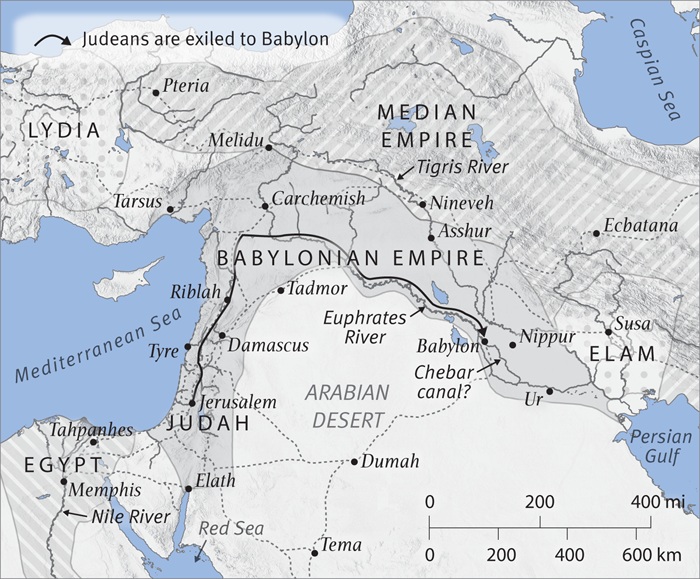
The Near East at the Time of Ezekiel
c. 593 B.C.
Ezekiel recorded his visions and prophecies while living in the vicinity of Babylon, where he had been exiled years earlier. By Ezekiel's time, the Babylonian Empire had engulfed virtually all of the area along the eastern coast of the Mediterranean Sea and would eventually subdue even the land of Egypt, where many other Judeans had fled.
EZEKIEL—NOTE ON 25:1 The word of the Lord came. Ezekiel 25:1–32:32 proclaims judgments on seven other nations, similar to the series in Jer. 46–51. Four of them are singled out in this chapter for vindictive jealousy and hate toward Israel. It is fitting, after devoting Ezek. 1–24 to calamity on his chosen nation, that God should reveal his impartiality toward all sinners and give the prophet judgments to proclaim on Gentiles. Israel's sinful failure had profaned God's honor in the eyes of these peoples (36:21–23), but these nations had falsely assumed that, when Israel was exiled, their God was defeated.
EZEKIEL—NOTE ON 25:2–3 toward the Ammonites. These people lived on the edge of the desert east of the Jordan River and north of Moab. They had joined Babylon against Judah about 600 B.C. (2 Kings 24:2ff.). In 594 B.C., together with
other nations, they tried to influence Judah to ally with them against Babylon (Jer. 27:2ff.). Ezekiel 21:18–20 indicates that Babylon came after them. There is no record of an attack, so they must have surrendered (21:28; Zeph. 2:8–11). They were of incestuous origin (cf. Gen. 19:37–38) and often hostile toward Judah (cf. Judg. 10; 1 Sam. 11; 2 Sam. 10; 12; Jer. 49:1–6; Lam. 2:15; Amos 1:13–15). God judged this people because of their enmity against Israel (Ezek. 25:3, 6). They expressed malicious pleasure at the dishonoring of the temple, desolation of the land, and dispersion of the inhabitants.
EZEKIEL—NOTE ON 25:4 handing you over to the people of the East. Perhaps this meant the coming of Babylon from the east that would devastate Ammon in either 588–86 B.C. or 582/81 B.C. Or it could refer to their land being occupied by the various nomadic tribes living beyond the Jordan.
EZEKIEL—NOTE ON 25:5 Rabbah. This important Ammonite capitol (cf. Amos 1:14), now called Amman, is about 25 miles northeast of the upper tip of the Dead Sea, east of the Jordan River.
EZEKIEL—NOTE ON 25:7 make you perish. Ammonites would be destroyed and eliminated from their land. Yet, Jer. 49:6 assures a later return of a remnant of these scattered people.
EZEKIEL—NOTE ON 25:8–11 Moab and Seir. The origin of these people is given in Gen. 19:37–38. Their land was the area south of the Arnon River along the lower region of the Dead Sea. Cf. Isa. 15–16; Jer. 48; Amos 2:1–3. The Babylonians destroyed cities there in 582/81 B.C. The reason for judgment (Ezek. 25:8) also included their gloating over Israel's fall, as well as their scorn in saying Israel was like all other people with no privileged position before God. Both Ammonites and Moabites became absorbed into the Arabian peoples.
EZEKIEL—NOTE ON 25:8 Seir. Another name for the adjacent Edomite area (Gen. 32:3; 36:20–21, 30), dominated by Mount Seir and a mountainous, extremely rugged, rocky country. Her judgments are given in Ezek. 25:12–14.
EZEKIEL—NOTE ON 25:12 Edom. Cf. ch. 35; Isa. 21:11–12; Jer. 49:7–22; Amos 1:11–12; Obadiah; Mal. 1:3–5. These people lived south of Moab from the Dead Sea to the Gulf of Aqabah. These people had been almost annihilated by David (2 Sam. 8:14), but won back independence during the reign of Ahaz (c. 735–715
B.C.). Their revenge was hostility to Israel constantly (cf. Gen. 27:27–41; Isa.
34:5–7). The reason for judgment is Edom's disdain when the Israelites were devastated in 588–86 B.C. They acted like a cheering section for Babylon, "Raze it, raze it" (Ps. 137:7; Lam. 4:21–22).
EZEKIEL—NOTE ON 25:13–14 against Edom . . . by the hand of my people Israel. The Arab tribe called Nabateans invaded Edom in 325 B.C.; but it was the Jewish forces of Judas Maccabeus in 164 B.C. and John Hyrcanus in 126 B.C. that fully subjugated Edom. Jews even compelled Edomites to submit to their religion. All three of these nations (Ammon, Moab, and Edom) have disappeared as separate nations into the Arab peoples.
EZEKIEL—NOTE ON 25:13 Teman . . . Dedan. Reference is to key Edomite towns. Teman (Teima) was possibly 200 miles east of the Dead Sea in the Arabian Desert in the northern expanse of Edom's territory. Dedan was maybe located 100 miles south of Teman, yet far east of the Red Sea.
EZEKIEL—NOTE ON 25:15–17 the Philistines. Cf. Isa. 14:29–32; Jer. 47; Joel 3:4; Amos 1:6–8; Obad. 19; Zeph. 2:4–7; Zech. 9:5. The reason for their judgment was perpetual enmity, and vengefulness against Israel, which perpetuated the "old hatred" from as far back as Judg. 13–16. They constantly harassed and oppressed Israel until David broke their power during Saul's reign (1 Sam. 17). They repeatedly rose up and were subdued by Israel. Nebuchadnezzar invaded their land (Jer. 47).
EZEKIEL—NOTE ON 25:16 Cherethites. They originated in Crete and became part of the Philistine nation (see note on 1 Sam. 30:14), with some serving in David's bodyguard (2 Sam. 8:18; 15:18).
EZEKIEL—NOTE ON 25:17 great vengeance. This was fulfilled at the time of Babylon's invasion of 588–86 B.C. or 582/81 B.C. (cf. Jer. 25:20; 47:1–7).
EZEKIEL—NOTE ON 26:1 the eleventh year. In 586 B.C., the eleventh year of Jehoiachin's captivity, on the tenth day of the fifth month, Jerusalem was captured.
EZEKIEL—NOTE ON 26:3–4 I am against you, O Tyre. The judgment of this city covers three chs. (26–28), indicating its importance to God. Cf. Isa. 23; Amos 1:9–10. Tyre was an ancient city of the Phoenicians, appearing for the first time in Josh. 19:29. During the reigns of David and Solomon it had great influence. Hiram, its king, was a friend to David (2 Sam. 5:11), who helped him and
Solomon in building operations (cf. 1 Kings 5:1–12; 1 Chron. 14:1; 2 Chron. 2:3, 11). Later, Tyrians sold Jews into slavery (cf. Joel 3:4–8; Amos 1:9–10). God would move "many nations" to invade Tyre, the commercial center of the Mediterranean (cf. Ezek. 27:3), in successive attacks pictured by wave following wave. Babylon (26:7) besieged Tyre from 585–573 B.C.; later came Alexander's Grecian army in 332 B.C. Babylon had devastated the coastal city, but many Tyrians escaped to an island fortress, which withstood attack. The later Grecian attackers "scraped" all the remaining "debris" and rubble and dumped it into the sea, building a causeway to the island nearly a half mile out. They also brought ships and overcame the fortress defenders in a devastating assault on Tyre. The predictions in chs. 26–28 have been fulfilled with amazing literal accuracy.
EZEKIEL—NOTE ON 26:5, 14 for the spreading of nets. Tyre became a fishing city, a place to spread fishing nets for centuries, until the Saracens finally destroyed what was left in the fourth century. Since then the once great center of Mediterranean commerce has been a nondescript village.
EZEKIEL—NOTE ON 26:7–14 Here is a vivid description of the original devastation by Babylon's King Nebuchadnezzar called "king of kings" (v. 7) because so many other rulers were subject to him. God had given him universal rule (cf. Dan. 2:37). Ezekiel 26:8–9 describes the siege, vv. 10–14, the devastation.
EZEKIEL—NOTE ON 26:12 They will plunder. After Nebuchadnezzar in v. 7 and "he" and "his" in vv. 8–11, "they" in v. 12 appears to broaden the reference to others among the "many nations" (v. 3). At this point, "they" are not only Babylonians, but also Alexander's army, which later heaped debris from the ruins into the sea to advance to the island stronghold (cf. Zech. 9:3–4).
EZEKIEL—NOTE ON 26:13 songs . . . lyres. According to Isa. 23:16, Tyre was famous for musicians.
EZEKIEL—NOTE ON 26:15–18 So important a center of commerce could not be destroyed without affecting all the nearby nations. All the nations around the Mediterranean would consider Tyre's fall a calamity. According to customs of mourning, rulers would descend from their thrones and disrobe.
EZEKIEL—NOTE ON 26:19–21 Tyre's destruction is compared to a dead person placed in the grave.
EZEKIEL—NOTE ON 27:1–11 a lamentation over Tyre. The whole chapter is a lamentation, describing Tyre as a great trade ship destroyed on the high seas. The proper names indicate the participants in commerce with Tyre.
EZEKIEL—NOTE ON 27:5–9 fir trees from Senir. The area is the Amorite designation for Mount Hermon, to the northeast from the northern tip of the Sea of Galilee. Lesser known places were: Elishah (v. 7), believed to be in Cyprus; Arvad (v. 8), an island city off the Mediterranean coast north of Byblos; and Gebal (v. 9), a name also used for Byblos, north of today's Beirut.
EZEKIEL—NOTE ON 27:10–11 men of war. These places provided mercenary soldiers for the Phoenician army to defend Tyre.
EZEKIEL—NOTE ON 27:11 Arvad. See note on vv. 5–9. men of Gamad. People from a place often identified as northern Aram, or Syria.
EZEKIEL—NOTE ON 27:12 Tarshish. This verse begins the description of the commercial glory of Tyre. Most likely this place refers to Tarshishah in southern Spain, a Phoenician colony famous for silver (Jer. 10:9).
EZEKIEL—NOTE ON 27:13 Javan, Tubal, and Meshech. Javan was Ionia, a large area in Greece. The other two, in Asia Minor, may be the Tibarenoi and Moschoi mentioned by the writer Herodotus, or slave-trading cities called Tabal and Mushku by the Assyrians.
EZEKIEL—NOTE ON 27:14 Beth-togarmah. Beth-togarmah is identified with Armenia in northeast Asia Minor, which is modern Turkey.
EZEKIEL—NOTE ON 27:15 Dedan. Probably Rhodes.
EZEKIEL—NOTE ON 27:17 Minnith. An Ammonite town (Judg. 11:33).
EZEKIEL—NOTE ON 27:18 Helbon. Today it is called Halbun, 13 miles north of Damascus.
EZEKIEL—NOTE ON 27:19 Uzal. A Danite area is not meant; but translators are not sure which areas are designated by this and Javan. cassia. A perfume.
EZEKIEL—NOTE ON 27:21 Kedar. Refers to nomadic Bedouin tribes.
EZEKIEL—NOTE ON 27:22 Sheba and Raamah. These were cities in the southwest extremity of Arabia (Gen. 10:7; 1 Chron. 1:9).
EZEKIEL—NOTE ON 27:23 Haran, Canneh, Eden. All were Mesopotamian towns; Canneh may have been in northern Syria, the Calneh of Amos 6:2, or the Caino of Isa. 10:9. Asshur, and Chilmad. These were also in Mesopotamia.
EZEKIEL—NOTE ON 27:25 ships of Tarshish. The large cargo carrying sea ships that sailed across the Mediterranean.
EZEKIEL—NOTE ON 27:26–27 The east wind has wrecked. This pictures Tyre's fall aptly as a shipwreck on the seas. The sea, the place of her glory, will be her grave. "The east wind" is a picture of Babylon in its power from the east (cf. 13:11–13).
EZEKIEL—NOTE ON 27:28–35 the cry. This maintains the metaphor of Tyre as a ship and turns particularly to men lamenting her ruin, for their livelihood has been tied to the commerce she represents. Verses 30–32 describe common actions signifying mourning.
EZEKIEL—NOTE ON 27:36 There will be some who scorn with malicious joy.
EZEKIEL—NOTE ON 28:1–19 This section concerning the king of Tyre is similar to Isa. 14:3–23 referring to the king of Babylon. In both passages, some of the language best fits Satan. Most likely, both texts primarily describe the human king who is being used by Satan, much like Peter when Jesus said to him, "Get behind me, Satan!" (Matt. 16:23). The judgment can certainly apply to Satan also.
EZEKIEL—NOTE ON 28:2 to the prince of Tyre. Since "leader," or "prince," is sometimes used to mean "the king" (37:24–25), the "prince" in v. 2 is the "king" in v. 12, Itto-baal II. The prophet is dealing with the spirit of Tyre more than just the king. This prophecy is dated shortly before the siege of Tyre by Nebuchadnezzar (585–573 B.C.). I am a god. Many ancient kings claimed to be a god, and acted as if they were (v. 6). When this king claimed to be a god, he was displaying the same proud attitude as the serpent who promised Adam and Eve they could be like God (Gen. 3:5).
EZEKIEL—NOTE ON 28:3–5 wiser than Daniel. This is said in sarcastic derision of the leader's own exaggerated claims. Here is an indicator that Daniel, who
had been captive for years in Babylon, had become well known.
EZEKIEL—NOTE ON 28:6–10 foreigners upon you . . . foreigners. The reference is to invading Babylonians, and later the Greeks (cf. ch. 26). God was the true executioner.
EZEKIEL—NOTE ON 28:11–19 This lament over "the king of Tyre" reached behind to the real supernatural source of wickedness, Satan. Cf. Matt. 16:21–23, where Peter was rebuked by the Lord, as under satanic control and motivation.
EZEKIEL—NOTE ON 28:12 the signet of perfection. The Lord led Ezekiel to address the king as the one to be judged, but clearly the power behind him was Satan. This phrase must be associated with Satan as one perfect in angelic beauty before he rebelled against God. But, it can also relate to "perfection" in the same context of Tyre's enterprise, topmost in its trade to the ancient world (27:3–4, 11), glorious in her seafaring efforts (27:24), and the crowning city (Isa. 23:8), i.e., "perfect" as Jerusalem also is said to be (Ezek. 16:14; Lam. 2:15). full of wisdom. This referred to Satan's wisdom as an angel and to Tyre's wisdom (skill) in trade (cf. 27:8–9; 28:4).
EZEKIEL—NOTE ON 28:13 You were in Eden. This could be Satan in the Garden of Eden (Gen. 3:1–15), or it might refer to Tyre's king in a beautiful environment, a kind of Eden. every precious stone. This depicts Satan's rich investiture (Gen. 2:12), and/or Tyre's king possessing every beautiful stone as Solomon had (1 Kings 10:10). crafted . . . were your settings. This could refer both to Satan's once being in charge of heavenly praise and to Tyre's beautiful musical instruments used in celebration (Ezek. 26:13). you were created. Satan, however, is more likely to have such wealth and beauty, wisdom, and perfection at his creation than this earthly king would have at his birth.
EZEKIEL—NOTE ON 28:14 anointed guardian cherub. This refers to Satan in his exalted privilege as an angel guarding (i.e., covering) God's throne, as cherubim guarded Eden (Gen. 3:24). Satan originally had continuous and unrestricted access to the glorious presence of God. I placed you. This was true of both Satan, by God's sovereign permission, and Tyre's king. you were on the holy mountain. A high privilege is meant, whether referring to Satan before God in his kingdom (mountain, cf. Dan. 2:35), or Tyre's monarch described in a picturesque analogy, as Assyria can be described as a cedar in Lebanon (Ezek. 31:3) to convey a picture of towering height.
EZEKIEL—NOTE ON 28:15 blameless in your ways. This verse was not completely true of the king, but it was accurate of Satan before he sinned. till unrighteousness was found in you. Satan's sin of pride (cf. Isa. 14:14; 1 Tim. 3:6) is in view here.
EZEKIEL—NOTE ON 28:16 The description transitions to feature the king of Tyre, describing his demise, as he followed the pattern of Satan himself.
EZEKIEL—NOTE ON 28:17–19 I exposed you before kings. It would be difficult to relate this to Satan. The earthly king of Tyre, in his downfall, would be knocked or cast to the ground, cut down, and lie before the gaze of other kings. From Isa. 23:17 there is the implication of a revival under Persian rule (Neh. 13:16). Two hundred and fifty years after Nebuchadnezzar, Tyre was strong enough to hold off Alexander for seven years. The Romans made it a capital of the province. Gradually it disappeared, and its location is not prominent.
EZEKIEL—NOTE ON 28:21 Sidon. Sidon (vv. 20–24) is a sister seaport to Tyre in Phoenicia, 23 miles north. Even in the time of the judges (Judg. 10:6), the corrupting influence of this place had begun. It was the headquarters for Baal worship.
EZEKIEL—NOTE ON 28:22–23 judgments in her. God is to bring bloodshed and pestilence on people there, probably at the time he brings an invasion against Tyre.
EZEKIEL—NOTE ON 28:24 no more a brier to prick. This is a summary of the judgment scenarios so far revealed (chs. 25–28). The enemies of Israel would be so devastated by God that 1) they would no longer be pestering Israel, and 2) they would see that the God who judges them is the true God of Israel.
EZEKIEL—NOTE ON 28:25–26 When I gather. In this brief excursus of hope, God promised to restore Israel to the land of Palestine (cf. chs. 34; 36–39; Isa. 65:21; Jer. 30–33; Amos 9:14–15). This looks to Messiah's earthly kingdom.
EZEKIEL—NOTE ON 29:1 the tenth year. 587 B.C. is the tenth year after Jehoiachin's deportation. It is a year and two days after Nebuchadnezzar had come to Jerusalem (24:1–2; 2 Kings 25:1) and seven months before its destruction (2 Kings 25:3–8). This is the first of seven oracles against Egypt (cf. Ezek. 29:17; 30:1; 32:1, 17).
EZEKIEL—NOTE ON 29:2 against all Egypt. Cf. Isa. 19 and Jer. 46:1–26. Egypt was to fall, even though it could be pictured as a water monster (Ezek. 29:3–5), a towering tree like Assyria (31:3), a young lion (32:2), and a sea monster (32:2– 8). The judgment looks ahead to 570 B.C. when the Greeks of Cyrene defeated Pharaoh (Apries) Hophra and 568/67 B.C. when Babylon conquered Egypt.
EZEKIEL—NOTE ON 29:3 great dragon. Most likely the crocodile is the figure used for the king. Crocodiles were worshiped by the Egyptians, and lived in their rivers. "Rahab" is a general term used for a monster that often symbolized Egypt. See notes on Ps. 87:4; 89:10; Isa. 30:7.
EZEKIEL—NOTE ON 29:4 fish of your streams. This figuratively represents the people who followed Pharaoh and who were a part of God's judgment on Egypt as a whole (vv. 5–6a).
EZEKIEL—NOTE ON 29:6 a staff of reed. The Israelites had depended on Egyptians in military alliances as people lean on a staff that gives way, failing them. Egypt had betrayed the confidence of Israel as God said they would (cf. Jer. 17:5, 7). Because Israel never should have trusted Egypt does not lessen Egypt's judgment.
EZEKIEL—NOTE ON 29:9 The Nile. The Nile River was the water supply for all Egypt's crops. See note on v. 19.
EZEKIEL—NOTE ON 29:10 from Migdol to Syene. This covered the entirety of Egypt, since Migdol (Ex. 14:2) was in the north and Syene in the southern border of "Cush."
EZEKIEL—NOTE ON 29:11–12 be uninhabited forty years. Although difficult to pinpoint, one possibility is that this period was when Babylon, under Nebuchadnezzar, reigned supreme in Egypt (vv. 19–20), from c. 568/67 B.C. to 525 B.C. until Cyrus gained Persian control.
EZEKIEL—NOTE ON 29:13–16 I will gather the Egyptians. Egypt regained normalcy as is currently true, but never again reached the pinnacle of international prominence she once enjoyed.
EZEKIEL—NOTE ON 29:17 the twenty-seventh year. This is 571/70 B.C. as counted from the captivity of Jehoiachin in 597 B.C., about 17 years after the prophecy in vv. 1–16.
EZEKIEL—NOTE ON 29:18 labor . . . against Tyre. In c. 585–573 B.C., Nebuchadnezzar besieged Tyre for 13 years before subduing the city (cf. 26:1– 28:19). Tyrians retreated to an island bastion out in the sea and survived, not giving Babylon full satisfaction in spoils ("pay") equal to such long struggle.
EZEKIEL—NOTE ON 29:19 I will give the land of Egypt. To make up for Babylon's lack of sufficient reward from Tyre, God allowed a Babylonian conquest of Egypt in 568/67 B.C. Babylon's army had worked as an instrument that God used to bring down Egypt.
EZEKIEL—NOTE ON 29:21 I will cause a horn to spring. Cf. 23:25–26. God caused Israel's power to return and restored her authority as the power in an animal's horn (cf. 1 Sam. 2:1). Though other nations subdued her, her latter end in messianic times will be blessed. I will open your lips. Most likely this refers to the day when Ezekiel's writings would be understood by looking back at their fulfillment. His muteness had already ceased in 586/585 B.C. when Jerusalem fell (cf. Ezek. 33:21–22).
EZEKIEL—NOTE ON 30:3 the day of the Lord is near. This is a common expression for God's judgment, especially his future judgment (cf. Joel 1:15; 2:1, 11; 3:14; Zech. 14:1; 1 Thess. 5:2; 2 Thess. 2:2; 2 Pet. 3:10). God's judgment "day" for Egypt embraces a near fulfillment in Babylon's 568/67 invasion (Ezek. 30:10; 32:11), as well as the distant day of the Lord in the future tribulation period when God calls all nations to judgment (Dan. 11:42–43). See note on Isa. 2:12.
EZEKIEL—NOTE ON 30:5 Cush, and Put, and Lud. See notes on 27:10–11 and 29:10. Libya. Or, Cub, an unidentified nation, along with the "people of the land that is in league." These also may have been mercenaries in Egypt's army, like the previous ones in this verse.
EZEKIEL—NOTE ON 30:6 Migdol to Syene. See note on 29:10.
EZEKIEL—NOTE ON 30:8 helpers. All Egypt's alliances and their arms will be useless in the day of God's judgment.
EZEKIEL—NOTE ON 30:9 Apparently, the Egyptians will flee the horrors to Ethiopia and increase that nation's fear of its own inevitable judgment.
EZEKIEL—NOTE ON 30:10–11 Nebuchadnezzar was God's instrument.
EZEKIEL—NOTE ON 30:12 dry. Apart from the Nile and its branches, Egypt was a barren desert. Her life depended on an annual inundation of the land by the flooding Nile.
EZEKIEL—NOTE ON 30:14 Pathros. The large region south of Memphis. Zoan. This key city of the Nile Delta's eastern portion was called Tanis by Greeks.
EZEKIEL—NOTE ON 30:15 Pelusium. Ancient Pelusium was a key city at the tip of the Nile's eastern arm near the Mediterranean Sea. Since Thebes and Pelusium were at opposite borders of Egypt and so many cities are named, the passage speaks of judgment on the entire land.
EZEKIEL—NOTE ON 30:17 Pi-beseth. The city was on the northeast branch of the Nile where cats were mummified in honor of the cat-headed goddess, Ugastet.
EZEKIEL—NOTE ON 30:18 Tehaphnehes. This city, named after the Egyptian
queen, was a residence of the pharaohs.
EZEKIEL—NOTE ON 30:20 the eleventh year. C. 587 B.C., counted from the deportation of Judah in 597 B.C.
EZEKIEL—NOTE ON 30:21 I have broken the arm. God figuratively depicted his act of taking power from Egypt through Nebuchadnezzar, resulting in defeat and dispersion (vv. 23, 26).
EZEKIEL—NOTE ON 30:22 break his arms. Both the defeat of Pharaoh Hophra (cf. Jer. 37:5ff.) and the earlier defeat of Pharaoh Neco at Carchemish (cf. 2 Kings 24:7; Jer. 46:2) are in view.
EZEKIEL—NOTE ON 30:26 People often don't learn that God is Lord until judgment falls.
EZEKIEL—NOTE ON 31:1 the eleventh year. 587 B.C. Two months after the oracle of 30:20–26.
EZEKIEL—NOTE ON 31:2–18 Whom are you like . . . ? Ezekiel filled this chapter with a metaphor/analogy comparing Egypt to a huge tree that dominates a forest to a king/nation that dominates the world (cf. 17:22–24; Dan. 4:1–12, 19–27). He reasoned that just as a strong tree like Assyria (Ezek. 31:3) fell (c. 609 B.C.), so will Egypt (c. 568 B.C.). If the Egyptians tend to be proud and feel invincible, let them remember how powerful Assyria had fallen already.
EZEKIEL—NOTE ON 31:3 cedar in Lebanon. The trees were as high as 80 feet and were an example of supreme power and domination, particularly the great cedars that grew in the mountains north of Israel.
EZEKIEL—NOTE ON 31:8–9 garden of God . . . trees of Eden. (36:35; Gen. 13:10; Isa. 51:3; Joel 2:3). Since Assyria was in the area of the Garden of Eden, Ezekiel used the ultimate of gardens as a point of relative reference by which to describe tree-like Assyria.
EZEKIEL—NOTE ON 31:10 Because it towered high. Ezekiel shifted from the historical illustration of Assyria's pride and fall to the reality of Egypt. God was using Assyria to teach the nations the folly of earthly power and might.
EZEKIEL—NOTE ON 31:14–16 the pit. The scene shifts from earth and the garden
of God to the grave (cf. 32:18), as God again refers to the destruction of Assyria and all her allies ("all the trees . . . that drink water").
EZEKIEL—NOTE ON 31:18 Whom are you thus like . . . ? Egypt, like all the other great nations, including Assyria, will be felled by God.
EZEKIEL—NOTE ON 32:1 the twelfth year. 585 B.C., 12 years from the deportation of Judah in 597 B.C.
EZEKIEL—NOTE ON 32:2 a lion. The picture describes Egypt's deadly energetic stalking power in her dealings with other nations. She was also violent like the crocodile, or "great dragon" (cf. 29:3).
EZEKIEL—NOTE ON 32:3–6 throw my net over you. God will entrap Egypt as a net ensnares a lion or crocodile, using "many peoples" (soldiers). Egyptians will fall, their corpses gorge birds and beasts, and their blood soak the earth and waters.
EZEKIEL—NOTE ON 32:7–8 blot you. This is likely a reference to Pharaoh, whose life and power is extinguished, and all the rest of the leaders and people basking in his light are plunged into darkness.
EZEKIEL—NOTE ON 32:11–12 The sword of . . . Babylon. This is the definite identification of the conqueror, as in 30:10 when Nebuchadnezzar is actually named (cf. 21:19; 29:19; Jer. 46:26).
EZEKIEL—NOTE ON 32:13–14 With no men or beasts to stir up the mud in the Nile and its branches, the water will be clear and flow smoothly. Since the river was the center of all life, this pictures the devastation graphically.
EZEKIEL—NOTE ON 32:17 the twelfth year. 585 B.C. reckoned from 597 B.C.
EZEKIEL—NOTE ON 32:18 majestic nations. All other countries that have been conquered. the pit. Refers to Sheol/grave (cf. 31:14–16).
EZEKIEL—NOTE ON 32:19–21 The prophet followed Egypt and her people beyond the grave. The king of Egypt is addressed by the other nations in "Sheol," taunting him as he is on the same level with them. This shows that there is conscious existence and fixed destiny beyond death. See Luke 16:19–31.
EZEKIEL—NOTE ON 32:22 Assyria is there. The slain of several nations are pictured in the afterlife: Assyria (vv. 22–23), Elam (vv. 24–25), Meshech and Tubal (vv. 26–28; cf. 38:1–2, and see notes there), and Edom (32:29–30). Although mighty for a time on earth, the fallen lie as defeated equals in death, all conquered by God and consigned to eternal hell (v. 21).
EZEKIEL—NOTE ON 32:31–32 Pharaoh . . . comforted. A strange comfort coming from the recognition that he and his people were not alone in misery and doom.
EZEKIEL—NOTE ON 33:1–33 The word . . . came. This chapter is a transition between God's judgments against Jerusalem and the nations (chs. 1–32) and Israel's bright future when she is restored to her land (chs. 34–48). It provided God's instructions for national repentance, and is thus the preface to the prophecies of comfort and salvation that follow (chs. 34–39).
EZEKIEL—NOTE ON 33:2–20 speak to your people. This was given to prepare the exiles' minds to look on the awful calamity in Jerusalem as a just act by God (cf. 14:21–23). He had faithfully warned, but they did not pay heed. Ezekiel had been forbidden to speak to his people from 24:26–27, until Jerusalem was captured. Meanwhile, he had spoken to the foreign nations (chs. 25–32).
EZEKIEL—NOTE ON 33:2–9 watchman. Such men as Jeremiah and Ezekiel (cf. 3:16–21) were spiritual watchmen (33:7–9), warning that God would bring a sword on his people so that they had opportunity to prepare and be safe. This analogy came from the custom of putting guards on the city wall watching for the approach of danger, then trumpeting the warning. For the function of a watchman, cf. 2 Sam. 18:24–25; 2 Kings 9:17; Jer. 4:5; 6:1; Hos. 8:1; Amos 3:6; Hab. 2:1.
EZEKIEL—NOTE ON 33:4 his blood . . . upon his own head. Once the watchman did his duty, the responsibility passed to each person. See the notes on ch. 18, where each person is accountable for his own response to God's warnings, whether to die in judgment or to live as one who heeded and repented. Ezekiel had been a very faithful and obedient "watchman."
EZEKIEL—NOTE ON 33:8–9 his blood I will require. A prophet who sounded the warning of repentance for sin was not to be judged (v. 9), but the one who failed to deliver the message was held accountable (v. 8). This referred to
unfaithfulness on the part of the prophet for which he bore responsibility and was chastened by God. See the notes on ch. 18 and Acts 20:26.
EZEKIEL—NOTE ON 33:10–11 How then can we live? The Israelites reasoned that if they were liable to death in judgment that was inevitable, they were in a hopeless condition and had no future. God replied that he had no pleasure in seeing the wicked go into death for their sin, but desired them to repent and live (cf. 2 Pet. 3:9). The divine answer to the human question is "Repent and be saved!" (cf. Ezek. 18:23, 30–32). Here was a blending of compassion with the demands of God's holiness. Repentance and forgiveness were offered to all.
EZEKIEL—NOTE ON 33:12–20 See notes on 18:19–29. One of the basic principles of God's dealing with his people is presented here: judgment is according to personal faith and conduct. The discussion is not about eternal salvation and eternal death, but physical death in judgment for sin which, for believers, could not result in eternal death. The righteous behavior in v. 15 could only characterize a true believer, who was faithful from the heart. There is no distinction made as to the matter of who is a true believer in God. There is only a discussion of the issue of behavior as a factor in physical death. For those who were apostate idolaters, physical death would lead to eternal death. For believers who were lovers of the true God, their sin would lead only to physical punishment (cf. 1 Cor. 11:28–31; 1 John 5:16–17). "Righteous" and "wicked" are terms describing behavior, not one's position before God. It is not the "righteousness of God" imputed as illustrated in the case of Abraham (Gen. 15:6; Rom. 4:3–5), but rather one's deeds that are in view (Ezek. 33:15–19).
EZEKIEL—NOTE ON 33:17, 20 not just. They blamed God for their calamities when actually they were being judged for their sins.
EZEKIEL—NOTE ON 33:21 The city has been struck down. A fugitive or fugitives (the Hebrew could be a collective noun) who escaped from Jerusalem reached Ezekiel with the report on January 8, 585 B.C., almost six months after the fall on July 18, 586 (Jer. 39:1–2; 52:5–7). Ezekiel 24:1–2 and 33:21 show a 36-month span from the outset of the siege on January 15, 588, to the report in 33:21.
EZEKIEL—NOTE ON 33:22 opened my mouth. God exercised control over the mouth of Ezekiel (see note on 3:26–27).
EZEKIEL—NOTE ON 33:23–29 There is no date attached to the prophecies from 33:23–39:29, but the first message after the fall of Jerusalem was a rebuke of Israel's carnal confidence. This prophecy was against the remnant of Judah who remained in the Land of Promise after the fall of Jerusalem. Ezekiel warns the survivors that more judgment will come on them if they do not obey God. By some strange reasoning, they thought that if God had given the land to Abraham when he was alone, it would be more securely theirs because they were many in number, a claim based on quantity rather than quality (33:24). But judgment will come if they turn and reject God again (vv. 25–29).
EZEKIEL—NOTE ON 33:30–33 Here was a message to exiles, who had no intention of obeying the prophet's messages. They liked to listen, but not apply the prophet's words. They finally knew by bitter experience that he had spoken the truth of God. The people appreciated the eloquence of Ezekiel, but not the reality of his message.
EZEKIEL—NOTE ON 34:1 From this chapter on, Ezekiel's messages are mostly comforting, telling of God's grace and faithfulness to his covenant promises.
EZEKIEL—NOTE ON 34:2 prophesy against the shepherds. The reference was to preexilic leaders such as kings, priests, and prophets, i.e., false ones who fleeced the flock for personal gain (vv. 3–4) rather than fed or led righteously (as 22:25– 28; Jer. 14; 23; Zech. 11). This stands in contrast to the Lord as Shepherd in Ps. 23; 80:1; Isa. 40:11; Jer. 31:10; Luke 15:4–5; John 10:1ff.
EZEKIEL—NOTE ON 34:5 food for all the wild beasts. The beast pictured nations that prey on Israel (cf. Dan. 7:3–7), though it could possibly include actual wild beasts, as in Ezek. 14:21. Cf. 34:25–28 and see notes there.
EZEKIEL—NOTE ON 34:9–10 This was no idle threat, as proven by the case of King Zedekiah (cf. Jer. 52:10–11).
EZEKIEL—NOTE ON 34:11 I . . . will search. God, the true Shepherd, would search out and find his sheep in order to restore Israel to their land for the kingdom that the Messiah leads (vv. 12–14).
EZEKIEL—NOTE ON 34:12 a day of clouds and thick darkness. This refers to the "day of the Lord" judgment on Israel (cf. Jer. 30:4–7).
EZEKIEL—NOTE ON 34:12–14 Here is the promise of a literal regathering and
restoration of the people of Israel to their own land from their worldwide dispersion. Since the scattering was literal, the regathering must also be literal. Once they are regathered in Messiah's kingdom, they will no longer want (vv. 15–16).
EZEKIEL—NOTE ON 34:15–16 I will feed them. In contrast to self-indulgent leaders who took advantage of the sheep, God will meet the needs of his sheep (people). This is clearly reminiscent of Psa. 23 and will be fulfilled by the good shepherd (John 10:1ff.), who will reign as Israel's Shepherd.
EZEKIEL—NOTE ON 34:17–22 judge between. Once he has judged the leaders, God will also judge the abusive members of the flock as to their true spiritual state. This passage anticipates the judgment of the people given by Jesus Christ in Matt. 25:31–46. The ungodly are known because they trample the poor. The Lord alone is able to sort out the true from the false (cf. parables of Matt. 13), and will do so in the final kingdom.
EZEKIEL—NOTE ON 34:23 one shepherd . . . David. This refers to the greater One in David's dynasty (cf. 2 Sam. 7:12–16), the Messiah, who will be Israel's ultimate king over the millennial kingdom (Ezek. 37:24–26; Jer. 30:9; Hos. 3:5; Zech. 14:9). The Lord in Ezek. 34:24 is God the Father.
EZEKIEL—NOTE ON 34:24 prince. The word can at times be used of the king himself (37:24–25; cf. 28:2, 12), as here.
EZEKIEL—NOTE ON 34:25 covenant of peace. Refers to the New Covenant of Jer. 31:31–34 (cf. Ezek. 37:26) in full operation during the millennial kingdom. wild beasts. This refers to actual animals that will be tamed in the kingdom, see Isa. 11:6–9; 35:9 and Hos. 2:18.
EZEKIEL—NOTE ON 34:26 my hill. A reference to Jerusalem and Zion in particular, where the Jews will come to worship the Lord. showers of blessing. Cf. the "times of refreshing" in Acts 3:19–20, when the curses of Deut. 28:15–68 are lifted.
EZEKIEL—NOTE ON 34:27 The faithfulness of the land is also indicated in Amos 9:13.
EZEKIEL—NOTE ON 34:28–29 no more be a prey. God will stop other nations from subjugating the people of Israel.
EZEKIEL—NOTE ON 34:30 I . . . their God. An oft-repeated OT theme (cf. Gen. 17:7–8). This speaks of the ultimate salvation of Israel as in Rom. 11:25–27.
EZEKIEL—NOTE ON 35:2 against Mount Seir. Cf. Isa. 21:11–12; Jer. 49:7–22; Amos 1:11–12; Obadiah. This is another name for Edom (cf. Ezek. 35:5; Gen. 32:3; 38:6), also threatened with judgment in Ezek. 25:12–14 (see notes there). Edom was considered Israel's most inveterate and bitter enemy (cf. Ps. 137:7; Mal. 1:2–5) and was located east of the Arabah from the Dead Sea to the Gulf of Aqabah. The main cities were Teman and Petra, now in ruins.
EZEKIEL—NOTE ON 35:3–4 This prediction (cf. vv. 6–9) came to pass literally, first by Nebuchadnezzar and later in 126 B.C. by John Hyrcanus. There is no trace of Edomites now, though their desolate cities can be identified as predicted by Obadiah (Obad. 18) and Jeremiah (Jer. 49:13). Cf. Ezek. 35:6–9.
EZEKIEL—NOTE ON 35:5 Because. God will judge Edom because of 1) her perpetual enmity against Israel since Esau's hatred of Jacob (Gen. 25–28), and 2) Edom's spiteful bloodshed against the Israelites trying to escape the Babylonians in 586 B.C.
EZEKIEL—NOTE ON 35:10 Because. A further reason for Edom's doom is her design to snatch control of the territory occupied by "two nations," i.e., Israel (north) and Judah (south). They plotted to take over these nations for their own gain (v. 12), but were prevented and destroyed because "the Lord was there."
EZEKIEL—NOTE ON 35:11–12 anger . . . envy . . . hatred. Here were more reasons for Edom's destruction.
EZEKIEL—NOTE ON 35:13 you magnified yourselves against me. Still another reason for judgment was Edom's proud ambitions that were really against God (cf. v. 10, "although the Lord was there").
EZEKIEL—NOTE ON 35:15 As you rejoiced. This final reason for doom was Edom's joy over Israel's calamity. they will know. The ultimate aim in Edom's judgment is that "the whole earth" (v. 14) may know he is the Lord and see his glory. Sadly, sinners find this out only in their own destruction. Cf. Heb. 10:31.
EZEKIEL—NOTE ON 36:1 This chapter presents the prerequisite regeneration that Israel must experience before they can nationally enter into the promised blessings. This chapter must be understood to speak of a literal Israel, a literal
land, and a literal regeneration, leading to a literal kingdom under Messiah. prophesy to the mountains. Cf. vv. 1, 4, 6, 8. Ezekiel addresses Israel's mountains, as symbolic of the whole nation. He promises: 1) to give these mountains again to dispersed Israel (v. 12); 2) to cause fruit to grow on them (v. 8); 3) to rebuild cities and to multiply people there (v. 10); and 4) to bless in a greater way than in the past (v. 11). This promise can only be fulfilled in future millennial blessing to Israel that she has not yet experienced, because it includes the salvation of the New Covenant (vv. 25–27, 29, 31, 33).
EZEKIEL—NOTE ON 36:2–15 This section continues the prophecy against Edom from ch. 35.
EZEKIEL—NOTE ON 36:2 Because the enemy said. God will restore these areas to Israel that their enemies claim to possess (cf. Gen. 12:7). They will pay for their spite against Israel.
EZEKIEL—NOTE ON 36:7 I swear. God testifies, as a formal pledge, that he will bring a turnabout in which the nations that seized the land will be shamed.
EZEKIEL—NOTE ON 36:8–15 Israel's land will be productive (vv. 8–9), populated (vv. 10–11), and peaceful (vv. 12–15). These features will be fully realized in the Messiah's kingdom. The return from Babylon was only a partial fulfillment and foreshadowing of the fullness to come in the future kingdom.
EZEKIEL—NOTE ON 36:16–19 Ezekiel gives a backward look to underscore why Israel had suffered the past judgments by the Lord. It was because the Jews had "defiled" their land by their sins that the Lord purged it. He likened such a defilement to a menstrual condition (v. 17).
EZEKIEL—NOTE ON 36:20 they profaned my holy name. Even in dispersion, Israelites tainted God's honor in the sight of the heathen, who concluded that the Lord of this exiled people was not powerful enough to keep them in their land.
EZEKIEL—NOTE ON 36:21–23 for my holy name. Restoring Israel to the land that God pledged in covenant (Gen. 12:7) will sanctify his great name, and move other peoples to "know that I am the Lord." This glory for God is the primary reason for Israel's restoration (cf. Ezek. 36:32).
EZEKIEL—NOTE ON 36:24 bring you into your own land. God assured Israel that he will bring them out of other lands back to the Promised Land (v. 24), the