
day of his 601st year. From beginning to end, the flood lasted one year and 10 days from Gen. 7:11 to
4. The waters further receded to the point that (600th year, seventh month, seventeenth day) the ark rested on Ararat (Gen. 8:3, 4) 5. The waters continued to abate so that (600th year, tenth month, first day) the tops of the mountains were visible (Gen. 8:5). 6. Forty days later (600th year, eleventh month, tenth day) Noah sent out a raven and a dove (Gen. 8:6). Over the next 14 days, Noah sent out two more doves (Gen. 8:10, 12). In all, this took 61 days or two months and one day. 7. By Noah's 601st year on the first month, the first day, the water had dried up (Gen. 8:12, 13). 8. Noah waited one month and 26 days before he disembarked in the second month, the twenty-seventh day of his 601st year. From beginning to end, the flood lasted one year and 10 days from Gen. 7:11 to Gen. 8:14. © 1997 by Thomas Nelson, Inc.
GENESIS—NOTE ON 8:1 But God remembered Noah. God's covenant with Noah brought provision and protection in the midst of severe judgment. The remnant was preserved, and God initiated steps toward reestablishing the created order on earth. the waters subsided. God used the wind to dry the ground; evaporation returned water to the atmosphere.
GENESIS—NOTE ON 8:4 the mountains of Ararat. These were in the region of the Caucasus, also known as ancient Urartu, where the elevation exceeded 17,000 feet.
Major Mountains of the Bible
Major Mountains of the Bible Mount Ararat (in modern Turkey), where Noah's ark came to rest (Gen. 8:4). Mount Carmel, where Elijah was victorious over the prophets of Baal (1 Kings 18:9–42). Mount Ebal (opposite Mount Gerizim), where Moses commanded that an altar be built after the Hebrews entered the Promised Land (Deut. 27:4). Mount Gerizim, where Jesus talked with the Samaritan woman at the well (John 4:20). Mount Gilboa, where King Saul and his sons were killed in a battle with the Philistines (1 Chron. 10:1, 8). Mount Hermon, a mountain range that marked the northern limit of the conquest of Canaan (Josh. 11:3, 17). Mount Lebanon, the source of cedar wood for Solomon's temple in Jerusalem (1 Kings 5:14, 18). Mount Moriah, where Abraham brought Isaac for sacrifice (Gen. 22:2) and the location of Solomon's temple (2 Chron. 3:1). Mount Olivet, or Mount of Olives, where Jesus gave the discourse on his second coming (Matt. 24:3). Mount Pisgah, or Nebo, where Moses viewed the Promised Land (Deut. 34:1). Mount Seir, south of the Dead Sea, the location to which Esau moved after Isaac's death (Gen. 36:8). Mount Sinai, or Horeb (near Egypt), where the law was given to Moses (Ex. 19:2–25).
Mount Tabor, 6 miles east of Nazareth, served as a boundary between Issachar and Zebulun; also Barak launched his attack on Sisera from Tabor (Judg. 4:6–15). Mount Zion, originally limited to the southwest sector (2 Sam. 5:7), was later used of all Jerusalem (Lam. 1:4). © 1997 by Thomas Nelson, Inc.
GENESIS—NOTE ON 8:7–12 a raven . . . a dove. Ravens survive on a broad range of food types. If any food was available outside the ark, the raven could survive. In contrast, a dove is much more selective in its food choices. The dove's choice of food would indicate that new life had begun to grow; thus Noah and his family could also survive outside the ark.
GENESIS—NOTE ON 8:14–16 Noah and his family had been in the ark for 378 days (cf. 7:4, 10, 11).
GENESIS—NOTE ON 8:17–19 be fruitful and multiply. In the process of replenishing the created order that he had judged with destruction, God repeated the words of the blessing that he had put upon non-human creatures (1:22). Noah faced a new world where longevity of life began to decline immediately; the earth was subject to storms and severe weather, blazing heat, freezing cold, seismic action, and natural disasters.
GENESIS—NOTE ON 8:20 built an altar. This was done as an act of worship in response to God's covenant faithfulness in sparing him and his family.
GENESIS—NOTE ON 8:21 smelled the pleasing aroma. God accepted Noah's sacrifice. curse . . . strike down. Regardless of how sinful mankind would become in the future, God promised not to engage in global catastrophe by flood again (cf. 9:11). See notes on 2 Pet. 3:3–10 for how God will destroy the earth in the future.
GENESIS—NOTE ON 8:22 While the earth remains. With many alterations from the global flood, God reestablished the cycle of seasons after the catastrophic interruption.
GENESIS—NOTE ON 9:1 blessed Noah . . . Be fruitful and multiply and fill the earth. God blessed Noah and recommissioned him to fill the earth (cf. 1:28).
GENESIS—NOTE ON 9:2–3 The fear of you. Man's relationship to the animals appears to have changed, in that man is free to eat animals for sustenance (v. 3).
GENESIS—NOTE ON 9:4 blood. Raw blood was not to be consumed as food. It symbolically represented life. To shed blood symbolically represented death (cf. Lev. 17:11). The blood of animals, representing their life, was not to be eaten. It was, in fact, that blood that God designed to be a covering for sin (Lev. 17:11).
GENESIS—NOTE ON 9:5 beast . . . man. Capital punishment was invoked upon every animal (Ex. 21:28) or man who took human life unlawfully. Cf. John 19:11; Acts 25:11; Rom. 13:4 for clear NT support for this punishment.
GENESIS—NOTE ON 9:6 for God made man in his own image. The reason man could kill animals, but neither animals nor man could kill man, is because man alone was created in God's image.
GENESIS—NOTE ON 9:9–17 This is the first covenant God made with man, afterward called the Noahic Covenant.
GENESIS—NOTE ON 9:9–10 with you and your offspring . . . with every living creature. The covenant with Noah included living creatures as was first promised in 6:18.
GENESIS—NOTE ON 9:11 by the waters. The specific promise of this covenant, never to destroy the world again by water, was qualified by the means, for God has since promised to destroy the earth with fire one day (2 Pet. 3:10–11; Rev. 20:9; 21:1).
GENESIS—NOTE ON 9:12 the sign of the covenant. The rainbow is the perpetual, symbolic reminder of this covenant promise, just as circumcision of all males would be for the Abrahamic Covenant (17:10–11).
GENESIS—NOTE ON 9:15 I will remember. Not simple recognition, but God's commitment to keep the promise.
GENESIS—NOTE ON 9:16 the everlasting covenant. This covenant with Noah is the first of five divinely originated covenants in Scripture explicitly described as "everlasting." The other four include: 1) Abrahamic (Gen. 17:7); 2) Priestly (Num. 25:10–13); 3) Davidic (2 Sam. 23:5); and 4) new (Jer. 32:40). The term "everlasting" can mean either 1) to the end of time and/or 2) through eternity future. It never looks back to eternity past. Of the six explicitly mentioned covenants of this kind in Scripture, only the Mosaic or Old Covenant was nullified.
GENESIS—NOTE ON 9:18 Ham was the father of Canaan. Canaan's offspring, the idolatrous enemies of Israel whose land Abraham's descendants would later take (15:13–16), becomes a primary focus in ch. 10. This notation is important since Moses was writing the Pentateuch just before the Israelites took Canaan (see Introduction: Author and Date; Background and Setting).
GENESIS—NOTE ON 9:19 from these the people of the whole earth. All men who have ever lived since the flood came from these three sons of Noah (cf. 10:32). The "one man" (Acts 17:26) from whom all nations came is Adam through Noah. All physical characteristics of the whole race were present in the genetics of Noah, his sons, and their wives.
GENESIS—NOTE ON 9:21 became drunk. Fermentation, which leads to drunkenness, may have been caused by changed ecological conditions as a result of the flood. Noah may have taken off his clothes because of the heat, or been involuntarily exposed due to his drunkenness.
GENESIS—NOTE ON 9:22 saw the nakedness. There is no reasonable support for the notion that some perverse activity, in addition to seeing nakedness, occurred. But clearly, the implication is that Ham looked with some sinful thought, if only for a while until he left to inform his brothers. Perhaps he was glad to see his father's dignity and authority reduced to such weakness. He thought his brothers might share his feelings so he eagerly told them. They did not, however, share his attitude (v. 23).
GENESIS—NOTE ON 9:25–27 Cursed be Canaan. The shift from Ham to his son Canaan established the historic legitimacy of Israel's later conquest of the Canaanites. These were the people with whom Israel had to do battle shortly after they first heard Moses' reading of this passage. Here, God gave Israel the theological basis for the conquest of Canaan. The descendants of Ham had received a sentence of judgment for the sins of their progenitor. In 10:15–20, the descendants of Canaan are seen to be the earlier inhabitants of the land later promised to Abraham.
GENESIS—NOTE ON 9:26 let Canaan be his servant. Conquered peoples were called servants, even if they were not household or private slaves. Shem, the ancestor of Israel, and the other "Semites" were to be the masters of Ham's descendants, the Canaanites. The latter would give their land to the former.
GENESIS—NOTE ON 9:27 dwell in the tents. This means that spiritual blessings would come to the Japhethites through the God of Shem (v. 26) and the line of Shem from which Messiah would come.
GENESIS—NOTE ON 10:1–11:9 The genealogy of Shem, Ham, and Japheth (v. 1).
GENESIS—NOTE ON 10:1–32 See the map "Table of Nations" for the locations of Noah's descendants.
Table of Nations
c. 2200 B.C.
Many of the people groups mentioned in Gen. 10 can be identified with relative certainty. In general, the descendants of Ham settled in North Africa and the eastern Mediterranean coast, the descendants of Shem in Mesopotamia and Arabia, and the descendants of Japheth in Europe and the greater area of Asia Minor.
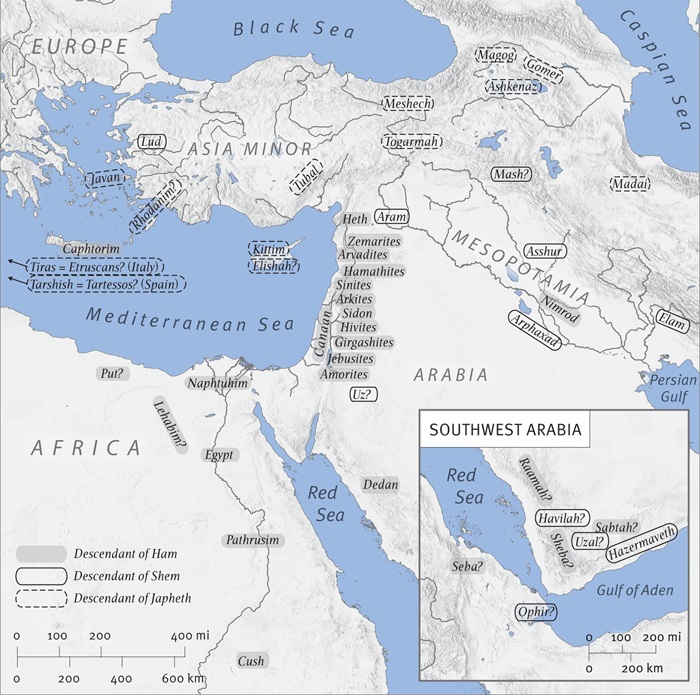
GENESIS—NOTE ON 10:5 spread . . . each with his own language. This act describes the situation after the Tower of Babel account in ch. 11.
GENESIS—NOTE ON 10:6–20 The sons of Ham. Many of whom were Israel's enemies.
GENESIS—NOTE ON 10:8–10 Nimrod. This powerful leader was evidently the
force behind the building of Babel (see 11:1–4).
GENESIS—NOTE ON 10:10 Babel. The beginning of what later would prove to be Babylon, the destroyer of God's people and his city Jerusalem (c. 605–539 B.C.).
GENESIS—NOTE ON 10:11 into Assyria and built Nineveh. This was Israel's primary enemy from the East. Nimrod was Israel's prototypical ancient enemy warrior, whose name in Hebrew means "rebel" (cf. Mic. 5:6).
GENESIS—NOTE ON 10:15–19 Canaan. A notable shift occurs in this section away from place names to the inhabitants themselves (note the "ite" ending). These are not only the cursed people of Canaan's curse for the scene at Noah's drunkenness, but also they are those who possess the Promised Land which Israel as a nation needed to conquer. But the Noahic curse alone did not determine their guilt, for God said to Abram that the iniquity of the Amorites must first be complete before his descendants could occupy the Promised Land (15:16).
GENESIS—NOTE ON 10:21–31 The sons of Shem. I.e., Semitic people.
GENESIS—NOTE ON 10:21 elder brother of Japheth. Shem was the oldest of Noah's three sons.
GENESIS—NOTE ON 10:25 the earth was divided. This looks ahead to the dispersion of nations at Babel (11:1–9).
GENESIS—NOTE ON 11:1 one language and the same words. God, who made man as the one creature with whom he could speak (1:28), was to take the gift of language and use it to divide the race, for the apostate worship at Babel indicated that man had turned against God in pride (11:8–9).
GENESIS—NOTE ON 11:2 as people migrated from the east. God had restated his commission for man to "be fruitful and multiply, teem on the earth" (9:7). It was in the course of spreading out that the events of this account occurred.
GENESIS—NOTE ON 11:3–4 let us make bricks . . . build ourselves a city and a tower . . . make a name for ourselves. While dispersing, a portion of the postflood group, under the leading of the powerful Nimrod (10:8–10), decided to stop and establish a city as a monument to their pride and for their reputation. The tower, even though it was a part of the plan, was not the singular act of
rebellion. Human pride was, which led these people to defy God. They were refusing to move on, i.e., scattering to fill the earth as they had been instructed. In fact, this was Nimrod's and the people's effort to disobey the command of God in 9:1, and thus defeat the counsel of heaven. They had to make bricks, since there were few stones on the plain.
GENESIS—NOTE ON 11:4 with its top in the heavens. Not that the tower would actually reach to the abode of God and not that the top would represent the heavens. They wanted it to be a high tower as a monument to their abilities, one that would enhance their fame. In this endeavor, they disobeyed God and attempted to steal his glory.
GENESIS—NOTE ON 11:6 nothing . . . will now be impossible. They were so united that they would do all they desired to do.
GENESIS—NOTE ON 11:7 let us. See note on 1:26 (cf. 3:22).
GENESIS—NOTE ON 11:8 dispersed them from there. God addressed their prideful rebellion at the first act. They had chosen to settle; he forced them to scatter. This account tells how it was that the families of the earth "spread . . . each with his own language" (10:5) and "spread abroad on the earth after the flood" (10:32).
GENESIS—NOTE ON 11:9 its name was called Babel. This is linked to a Hebrew word meaning "to confuse." From this account, Israel first understood not only how so many nations, peoples, and languages came about, but also the rebellious origins of their archetypal enemy, Babylon (cf. 10:5, 20, 31). dispersed them. Because they would not fill the earth as God had commanded them, God confused their language so that they had to separate and collect in regions where their own language was spoken.
GENESIS—NOTE ON 11:10–26 Shem . . . Abram. The genealogy of Shem (v. 10). Israel, upon hearing this section read, learned how the generation who survived the flood related to their own father, Abram (v. 26), later known as Abraham (cf. 17:5). The shortening of lifespans was in effect.
GENESIS—NOTE ON 11:14 Eber. Progenitor of the Hebrews (i.e., Eber's descendants).
GENESIS—NOTE ON 11:26 70 years. The age that Terah began to father children.