
wards (1949) was a sketch of Edwards' intellectual life. Patricia Tracy's Jon-
Preface
A number of people of common sense have asked me something like, ''Isn't there a good bit written on Jonathan Edwards already?'' or ''Aren't there quite a few other biographies of Edwards?'' Their implication, I believe—since they are people of common sense—has been, ''Why would anyone spend years working on a subject that has been so well covered?''
Part of the answer is that, despite the vast specialized literature about Edwards, there is no recent full critical biography. The last was Ola Winslow's Pulitzer Prize–winning Jonathan Edwards, 1703–1758, published in 1940. Perry Miller's influential, brilliant, and often misleading Jonathan Edwards (1949) was a sketch of Edwards' intellectual life. Patricia Tracy's Jonathan Edwards: Pastor (1980) dealt only with his years in Northampton. Iain Murray's Jonathan Edwards: A New Biography (1987) provides a welldocumented updating of biographies in the honorable but uncritical tradition of Edwards' earlier admirers.
Further, a revolution in Edwards studies, especially during the past decade, has made a full critical biography feasible in a way that it never was before. In recent years The Works of Jonathan Edwards project at Yale University has brought to fruition a generation of scholarship begun under Perry Miller in the 1950s. Since the early 1990s, the project has transcribed most of Edwards' enormous corpus of previously unpublished writings. Most of these works were known to Edwards specialists and were available in principle to anyone who had the patience to decipher his nearly illegible handwriting. Today the transcriptions can be perused by computer in ways that were unthinkable a generation ago. Further, the volumes of the Yale edition of The Works of Jonathan Edwards provide not only definitive editions of familiar writings, but also much that was not previously available and extensive
xviii Preface
introductions that fill in many of the gaps of earlier scholarship. In the meantime, scholars continue to add to an enormous literature about Edwards. The works published through just 1993 fill two volumes of M. X. Lesser's annotated bibliographies ( Jonathan Edwards: A Reference Guide, 1981, and Jonathan Edwards: An Annotated Bibliography, 1979–1993, 1994) and the pace has not slackened. These e√orts have made it possible to write a more comprehensive life of Edwards than was practicable before.
This book, then, is a tribute to a generation of scholars. Particularly all those who have participated in The Works of Jonathan Edwards project at Yale University have been essential to this enterprise. Every Edwards scholar today benefits from the decades of work by Thomas A. Schafer in dating Edwards' previously undated writings, typically by painstaking analysis of changes in paper, ink, and handwriting. George S. Claghorn, similarly, spent decades collecting all the extant correspondence of Edwards (now published) as well as collecting and transcribing letters to and about Edwards. He has been immensely helpful to me in making available transcriptions and information, in answering questions, in checking quotations from the correspondence, and in making numerous suggestions. Without the exhaustive archival work by Schafer, Claghorn, and others, we would not be able to reconstruct the details of Edwards' life and thought as we now can. Kenneth P. Minkema, the executive editor of The Works of Jonathan Edwards, who has become a legend in his own time for his skills in advancing such research, is another person without whom a volume like this would not have been possible. He has been immensely helpful at every stage of this process, providing me with complete access to all the materials the project has transcribed or collected and untiringly answering questions, o√ering information about details, and providing criticism of my work. My close friend Harry S. Stout, the general editor of The Works of Jonathan Edwards, has played an incalculable role. Although this volume is not connected with The Works as such, he brought me into contact with Yale University Press and has been a seemingly inexhaustible source of shrewd advice, enthusiasm, and goodwill. My wife, Lucie, and I are particularly grateful to Skip and his wife, Sue, for their wonderful hospitality whenever we were in New Haven.
Numerous others who have been part of The Works of Jonathan Edwards project have also contributed directly or indirectly to this volume. Douglas A. Sweeney, Ava Chamberlain, and Kyle Farley were especially helpful while they were on the sta√ of The Works. I am also deeply grateful to all the individual editors of the Yale University Press edition of The Works. Without
Preface xix
their researches and analyses, I would not have been able to proceed as I did. I am particularly grateful for the work of the former general editor, John E. Smith, and for that of the late Perry Miller, who was a major force in bringing about the publication of a definitive edition of Edwards' work. Although I am sometimes critical of Miller's specific interpretations of Edwards, Miller has always been one of my intellectual heroes.
I am grateful to the sta√s of the Beinecke Rare Book and Manuscript Library, Yale University; Storrs Library, Longmeadow, Massachusetts; the Forbes Library, Northampton, Massachusetts (particularly to Elise Feeley); and the Library of the University of Notre Dame for their gracious help. I am also indebted for the indirect help of other libraries, especially the Franklin Trask Library, Andover Newton Theological School, Newton Centre, Massachusetts, from which I have received transcriptions of materials collected through the research of others.
Among my largest debts are to the many readers of earlier drafts of this book. These include Ava Chamberlain, George S. Claghorn, David D. Hall, Mark Noll, Kenneth P. Minkema, Amy Plantinga Pauw, Stephen J. Stein, Harry S. Stout, and Grant Wacker. Thomas S. Kidd, my graduate assistant throughout most of the project, provided much help and insightful advice. R. Bryan Bademan and Kristin Kobes DuMez served as my editors in the latter stages, checking many quotations and o√ering astute suggestions on style and content. Joe Creech collected bibliographical materials for me at the early stages. The class members of my graduate course, ''Puritanism and the Culture of Colonial New England,'' Grant Brodrecht, Ángel Cortes, Timothy Gloege, Matthew Grow, Michael Lee, and Tammy Van Dyken, also read a late draft and made valuable suggestions. Collectively, these readers contributed tremendously to improving this volume. I am also indebted to my editors at Yale University Press, Lara Heimert and Susan Laity, for their skillful oversight. John Long, also of Yale University Press, worked beyond the call of duty in finding illustrations. Eliza Childs improved the work through her excellent copyediting.
I am especially grateful for support from the Francis A. McAnaney Chair in History at the University of Notre Dame, and to the Peter B. and Adeline W. Ru≈n Foundation in funding that chair. O≈cials of the University of Notre Dame have always been most helpful in encouraging this book. I am particularly grateful to the chairs of the History Department, Wilson Miscamble, Christopher Hamlin, and Thomas Kselman, for their help during the time I have been working on this project. Provost Nathan O. Hatch,
xx Preface
himself a distinguished scholar of eighteenth-century religion and culture, has provided personal encouragement and leadership for the university.
My sincere thanks go also to the John Simon Guggenheim Memorial Foundation for their award of a fellowship that supported this project in its early stages.
As always by far my greatest debt is to Lucie. A keen critic, her assurance that she genuinely enjoyed the chapters I gave her to read was a great encouragement. Far more important, her love and friendship has fostered an ''uncommon union'' that has grown even better with the years.
Note on the Text
Quotations have been modernized in spelling and sometimes in grammar, except in rare cases where the sense or tone would be changed.
Dates before September 1752 (when the date was advanced by eleven days in the British world) are old style, except that dual listings for winter months are treated as though the new year began on January 1 (e.g., February 1750–51 is translated as February 1751).
All biblical quotations are from the King James Version.
Introduction
dwards was extraordinary. By many estimates, he was the most acute early American philosopher and the most brilliant of all American theologians. At least three of his many works—Religious A√ections, Freedom of the Will, and The Nature of True Virtue—stand as masterpieces in the larger history of Christian literature. The appeal of his thought endures. Every year several new books and scores of academic articles, reviews, and dissertations appear about him. Yet he also wrote e√ectively for popular audiences. His celebrated biography of David Brainerd was a best-selling religious text in nineteenth-century America and encouraged countless Christians to seek lives of disinterested sacrifice and missionary service. His writings, including some of his more substantial works, continue to inspire many lay readers.∞
His pen brought lasting influence, but Edwards' life involved far more. An activist at the center of the most important religious and social movement of his day, he oversaw an amazing local revival, which became a prototype for one of America's most influential religious practices. He worked vigorously both in promoting and in attempting to delimit the momentous colonial and international awakenings that soon followed. A heralded preacher, he delivered what became America's most famous sermon, Sinners in the Hands of an Angry God. In his pastorate, he spent years shepherding parishioners through awakenings and declines, and he struggled to define the role of the church in a town and region that were making the transition from a Puritan heritage toward a revolutionary destiny. He sustained deep interests in politics and the military, especially as they bore on the international Protestant cause. In the midst of everything else, he spent much time in disciplined devotion and is sometimes most admired as a contemplative. For seven years Edwards served as a missionary to Indians in a dangerous frontier village. At his death, at age
≤ Introduction
fifty-four, he was the president of the College of New Jersey at Princeton. Throughout his life his experiences were shaped by his relationships to his large immediate and extended family. His wife, Sarah, also became a legendary figure. They reared eleven children and nurtured what became an American dynasty.
In writing this life of Edwards, one of my goals has been to understand him as a real person in his own time. Because he became such a monumental figure, it has often been di≈cult to find the person behind the monuments. Further, as a leading controversialist in a vigorous religious movement, Edwards invites strong reactions. He has many ardent admirers, many detractors, and many who attempt to rehabilitate him by making him over in their own images. My aspiration, which I am sure has been only partially realized, is to make Edwards intelligible to widely diverse audiences by first attempting to depict him in his own time and in his own terms.
Readers might also begin by thinking about Edwards as an eighteenthcentury figure and about how that context should shape their understanding of him. The most fascinating question that framed this book is ''What was it like to live in western New England in the first half of the eighteenth century?'' (or ''How was that time di√erent from our own?''). This second version of the question suggests, of course, a twenty-first-century viewpoint. My task as an historian is to make intelligible the outlook of another time, which demands taking into account the various perspectives of readers and also what has transpired since the eighteenth century. Yet it would be a failure of imagination if we were to start out—as today's histories sometimes do—by simply judging people of the past for having outlooks that are not like our own. Rather, we must first try to enter sympathetically into an earlier world and to understand its people. Once we do that we will be in a far better position both to learn from them and to evaluate their outlooks critically.
A number of things will be particularly striking to twenty-first-century readers about early eighteenth-century New England. First, the world into which Edwards was born will make a lot more sense if we think of it as British rather than American. It was, of course, significantly American, yet by the time of Edwards' death in 1758, it had not yet manifested most of the traits that were soon to be associated with ''America.'' The American Revolution was not yet on anyone's horizon, even if with hindsight we can see that many of the potentialities were there. Edwards lived in a thoroughly preRevolutionary British province.
Its British or Old World character was most conspicuously evident in its
Introduction ≥
rigid hierarchical structures. We might think of eighteenth-century or early nineteenth-century English novels to get some sense of the social hierarchy taken for granted in eighteenth-century British America. New England, having been shaped by seventeenth-century Puritanism, had its own version of such hierarchism. Edwards was an aristocrat by New England standards. Clergymen in New England wielded more authority and could expect more deference to their opinions than in most other parts of the British World. Further, Edwards belonged to an elite extended family that was part of the ruling class of clergy, magistrates, judges, military leaders, village squires, and merchants. The Stoddards and Williamses, along with a few other families with whom they intermarried, ruled the Connecticut River Valley, or western Massachusetts (Hampshire County) and parts of Connecticut.
Eighteenth-century Britons viewed their world as monarchical and controlled by hierarchies of personal relationships.≤ On both these counts, their assumptions were almost opposite of those of most Westerners today, who tend to think of society as in principle egalitarian and in fact controlled by impersonal forces. Eighteenth-century British-American society depended on patriarchy. One's most significant relationships were likely to be vertical rather than horizontal. Fathers had authority over families and households, the cornerstones of good order. Women, children, hired servants, indentures, and African slaves were all dependent on persons directly above them. Society was conceived of as an extended household. In this arrangement paternalism was a virtue, not a term of opprobrium. Although British people spoke much of ''liberty,'' few had personal freedom in a modern sense. Gentlemen ruled largely through a hierarchical system of patronage extending from the king down. Good order, especially for the lower ranks of society, was enforced by strict surveillance and stern punishments. Ordinary life under any circumstances was often cruel, plagued by epidemics, unrelieved pain, and constant uncertainties about life itself. Many essential tasks were painfully di≈cult and time-consuming. Personal dependency was one way of dealing with a harsh and insecure world and was often taken as a matter of course.
Adding to the distresses and periodic terror in western New England was its location on the frontier of British settlements in an era of frequent warfare. Edwards lived at the vortex of conflict among three civilizations—the British Protestant, the French Catholic, and the Indian. Each was fiercely struggling to control North America. We now know how those contests turned out, but the outcome was not apparent to Edwards' generation. This international context was enormously important to Edwards. He spent vast amounts of
∂ Introduction
time concerned about both Roman Catholicism and the Indians and their respective and very di√erent places in God's plans. Edwards framed his fundamental theological concerns and especially his view of history in the context of his perceptions of world wars, which he viewed as intimately linked to the prospects for the Gospel.
To make sense of Edwards' life, one must take seriously his religious outlook on his own terms. That might be said of any figure with strongly held views, but the point needs to be underscored regarding Edwards for several reasons. Because Edwards is associated with a number of living Christian traditions, current opinions about him are likely to be shaped by our reactions to those religious movements. Edwards was loyal to the theology inherited from the seventeenth-century Puritans and their continental ''Reformed,'' or Calvinistic, counterparts and he was pivotal in the emergence of international evangelicalism in the eighteenth century.≥ Puritanism and Calvinism have always elicited strong reactions regarding their role in American history. Evangelicalism now comes in so many energetic varieties that it is di≈cult to view one of its progenitors without looking through the lens of later popularizations. Edwards anticipated some traits of later evangelicals, but the facts that he was a Calvinistic thinker, that he was rigorously intellectual, and that he was working in an eighteenth-century context make him very di√erent from his evangelical heirs. Our challenge is to try to step into his world and to understand it in terms that he himself would recognize.
The central principle in Edwards' thought, true to his Calvinistic heritage, was the sovereignty of God. The triune eternally loving God, as revealed in Scripture, created and ruled everything in the universe. Most simply put, the sovereignty of God meant that if there were a question as to whether God or humans should be given credit for anything good, particularly in matters of salvation, the benefit of the doubt should always go to God. Edwards avoided allowing God's rule to be thought of as a distant abstraction, as it could become. Rather, he emphasized that God's very purpose in creation was the great work of redemption in Christ. Everything in the universe pointed ultimately to the loving character of the triune God.
If the central principle of Edwards' thought was the sovereignty of God, the central practical motive in his life and work was his conviction that nothing was more momentous personally than one's eternal relationship to God. Many Christians a≈rm this proposition, yet most have not followed its implications for personal relationships with utter seriousness. Most who have taken it seriously have been activists rather than thinkers. Edwards was both.
Introduction ∑
He built his life around disciplines designed constantly to renew that eternal perspective. In his sermons and writings he turned his immense intellectual powers to rigorously following out the implications of God's sovereignty for understanding humans' eternal destinies, as defined by his biblicist and Calvinistic heritage.∂ If there is an emphasis that appears di≈cult, or harsh, or overstated in Edwards, often the reader can better appreciate his perspective by asking the question: ''How would this issue look if it really were the case that bliss or punishment for a literal eternity was at stake?''
Presenting Edwards' life in terms that he would recognize and a wide variety of readers can understand may be a su≈cient end in itself. If we can enter imaginatively into another time and place and into the experiences of people di√erent from ourselves, we have achieved one of the goals of literature. For that reason I have tried to tell the story of Edwards and his family with relatively few interpretive intrusions. I hope I have done this in a way that is, as much as possible, objective in the sense of fair-minded and true to the evidence.
Nonetheless, we all have points of view. As one astute historian has recently reminded us, ''objectivity is not neutrality.''∑ Even the fairest observers have biases and blind spots. They have (and they ought to have) interests. The best way to deal with these universal phenomena is to acknowledge one's point of view rather than posing as a neutral observer. That way readers can take an author's viewpoint into account, discount it if they wish, and learn from it to the extent they can. At the same time, authors who are self-conscious about their points of view can use such self-knowledge to limit unintended or unfair warping of the evidence to fit their perspectives.
That being said, I find that after spending countless hours with Edwards, my point of view regarding him is complex. He was such a multisided person and thinker that the answer to the question of what I think about him depends on the particular aspect of his life or thought we are talking about. I find him to be a person of immense personal integrity. He was intensely pious and disciplined, admirably but dauntingly so for those of more ordinary religious faith. His unrelenting intensity led him to follow the logic of his faith to its conclusions. His accompanying seriousness made him not an easy person to spend time with as a casual acquaintance, although he would have been fascinating to talk to about matters that concerned him. His prowess as a logician made him exceedingly sure of his opinions, sometimes given to pride, overconfidence, tactlessness, and an inability to credit opposing views. At the same time, he was often aware of his pride and was constantly trying—and
∏ Introduction
apparently often succeeding—to subdue his arrogant spirit and to cultivate such Christian virtues as meekness, gentleness, and charity. As was common for eighteenth-century leaders, he was authoritarian, yet he was also extremely caring. He was much loved by those closest to him. His opponents found him aloof, opinionated, and intolerant. For a time he won the hearts of almost everyone in his Northampton parish; then he lost them again in a bitter dispute, a quarrel of former lovers.
My assessments of his theological views are similarly varied. My interest in Edwards arises from my admiration for aspects of his theology. As one committed to a Christian faith in a tradition that is a branch of the same Augustinian and Reformed tree, I find some of Edwards' emphases aweinspiring. Other aspects seem to me to be brilliant analysis based on false premises. Much else falls in between. Some of his views seem dated. Others are valuable just because they come from another era and challenge assumptions that are today too easily taken for granted. Overall, since I have learned from many of his insights, my attitude toward Edwards' theology is more sympathetic than not. I try to employ that sympathy in providing readers clear accounts of his thought, usually without arguing with him, though sometimes pointing out assumptions or implications I think he did not see. My overall sympathy, then, should not be mistaken for an endorsement of all his views. One reason for careful study of great persons of the past is to be able to learn from them in a discriminating way. Excepting a few comments on the concluding pages, I have attempted to follow my working principle of explaining as best I can Edwards' thought in its historical context, pointing out what I see as especially significant but also allowing readers to make most of their own critical judgments.
In writing a life of Edwards I am not attempting a theological work nor even an essentially intellectual biography. While I hope I have adequately integrated his theology and his thought into his life, my approach also reflects my interests as a historian of American culture. My focus is primarily on understanding Edwards as a person, a public figure, and a thinker in his own time and place. Implicit in my presentation is my fascination with how Edwards fits or does not fit with the larger patterns of religion in American life. Since I do not often interrupt the narrative to make such points explicit, I can here suggest to readers some themes to keep in mind.
The largest theme concerns a question that has always been near the center of American experience, but one that is not well integrated into our histories. How does a religion that claims universal and exclusive truth fit into
Introduction π
a pluralistic environment? This, of course, is not at all a uniquely American issue. Arguably it was also the central question for British culture in the first half of the eighteenth century. Much of the ''Enlightenment'' thought of that time was a direct reaction to the conflicting absolutist claims of the preceding era of deadly religious wars. The most explosive issue in British politics was still whether the monarchy would remain Anglican or revert to Roman Catholicism as it had been as recently as 1688 under James II. If Anglican, how should the nation treat Protestant dissenters, whose Puritan forebears had fought a holy war against the Anglican monarch in the 1640s, prospered under Cromwell's dictatorial Commonwealth in the 1650s, and been harshly repressed with the Restoration of Charles II in the 1660s? In the early 1700s all that was hardly forgotten. English dissenters, such as Congregationalists and Presbyterians, enjoyed toleration but were excluded from political o≈ce and the universities. In Scotland, joined with England to form the United Kingdom in 1707, the established church was Presbyterian. In this more pluralistic environment many of the leading champions of a more liberal rational Christianity were the heirs to militant Calvinists of the previous era.
Edwards came of age at a time and place that would give him an acute sense of the juxtaposition of old and new outlooks in this revolution taking place in British culture. The son of a strict Calvinistic pastor in the river town of East Windsor, Connecticut, Edwards grew up in a world where many of the ways of seventeenth-century New England Puritanism were preserved pretty much intact. Seventeenth-century Puritanism in turn was in many respects closer to the world of medieval Christendom than it was to that of even nineteenth-century America. Puritanism was part of an international Calvinistic movement to reform Christendom, not to destroy it. Its goal had been to establish one pure church supported by each Christian state.
A precocious teenage intellectual who immersed himself in the literature of the emerging British Enlightenment, the world of Locke and Newton and of Addison and Steele, Edwards was confronted with how hopelessly quaint, dated, and even laughable the provincial world of East Windsor would look to British sophisticates. Yet the New Englanders, unlike most provincials, were products of an intellectual tradition that until recently had been as formidable as any in the world and was—as notably represented, for instance by the Edwardses' family acquaintance Cotton Mather—still making heroic e√orts to keep in touch. Jonathan, after an early intellectual and spiritual crisis, emerged intensely committed to demonstrating how his heritage was not only viable but the answer to all the questions posed by the new world of
∫ Introduction
his day. Those answers were not only intellectual, but also practical, built around awakenings and missions as the engines through which the triune God would eventually bring the modern world to his love in Christ.
Edwards' life presents a particularly dramatic and influential instance of a perennial American story. Countless Americans reared in conservative religious traditions have confronted the troubling issue of how their exclusive faith should relate to a pluralistic modern American environment. That tension has been felt especially among persons in ethno-religious communities—
of which the English Puritans were one of the first instances—who brought with them Old World ideals concerning the one true religion. Much of the history of religion in America has been written to emphasize the triumph of pluralism. Perhaps rightly so. That has meant, however, that those who have never conceded the premise that all or most religions, or even most Christian denominations, are more or less equal, have not been taken as seriously in our histories as they might. Even today there are vast numbers of Americans who, although committed to live at peace with other religious groups, believe it is a matter of eternal life or death to convert members of those groups to their own faith. Like it or not, such evangelistic religion has been and continues to be a major part of the experiences of many ordinary Americans. The dynamics of such religious experience need to be understood if one is to understand large tracts of American culture. Indeed, the tensions between religious exclusivism and pluralism are among the leading unresolved issues shaping the twenty-first-century world.
Edwards' eighteenth-century Calvinistic evangelicalism is significant not merely as an early instance of a wider phenomenon, but also because it played a prominent role in subsequent American history. After the American Revolution, New England Calvinism with a deep Edwardsian imprint emerged as one of the most influential movements shaping the new American voluntary religious culture. Edwards' grandson Timothy Dwight was an early leader of resurgent evangelical Calvinism, and Lyman Beecher, progenitor of the famous Beecher family, was one of Dwight's most e√ective lieutenants. New England Congregationalists and their Presbyterian allies carried the evangelical Calvinist campaigns into the upper ''west'' (now upper Midwest). By the 1830s their voluntary organizations for missions, evangelism, and reform had combined budgets larger than that of the federal government. Before the Civil War these heirs to the now-contested Edwardsian heritage or their near counterparts controlled most of the nation's leading colleges, including the
Introduction Ω
state ''universities.'' They were leaders in the reform movements, including temperance and antislavery, and were leading figures in the moral reform wing of the Whig Party and then in Republicanism. To cite the best-known example, Harriet Beecher Stowe often wrote about and agonized over her Edwardsian heritage, from which she only gradually departed. On the eve of the Civil War she published a theological novel whose leading character was Edwards' protégé and first biographer, Samuel Hopkins.∏
Edwards' early eighteenth-century version of the tensions between a rigorous exclusivist Christianity and modern life were very di√erent from those of his nineteenth-century heirs, yet the latter can hardly be understood without knowing about the former. If we are comparing Edwards' wrestlings with such issues to those of his more recent counterparts, the di√erences are still greater, even if the comparisons may be illuminating. Our sense of encountering perennial cultural themes, or even perennial human themes, always needs to be tempered by a sense of di√erences among eras.
Historians of the United States have been prone to give much more attention to Benjamin Franklin than to Edwards as a progenitor of modern America. That is understandable since Franklin seems so congenially to represent tendencies that triumph in mainstream American life and politics. Yet a good case can be made that stories of America are deficient if they do not at least temper emphasis on the Franklins of the heritage with a serious reckoning with its Edwardses.π Most strikingly, the standard narratives fail to account for why levels of religious practice came to be much higher in the United States than in other modernized nations. They also do little to explain why evangelical Christianity flourished in American and why its revivalist style became one of America's leading exports. The particularities of Edwards' life—so di√erent in many ways from what followed—do not explain all that, even if they shed light on it. Nonetheless, the larger point is that histories of America—or of the modern world for that matter—need to integrate people like Edwards into their accounts.
I have been here emphasizing Edwards' significance in the history of American religion and culture, yet I realize that many readers will also be concerned with something larger. Edwards is, after all, most important as a figure in the history of Christianity. For one thing, although much of his influence has been mediated by his American setting, one should not forget that Edwards was a citizen of the British Empire and part of an international Reformed movement. He is still a revered figure in those circles and in
∞≠ Introduction
broader evangelicalism. Theologians continue to debate his insights. How he is to be evaluated at those levels will depend largely on one's religious commitments.
The first goal of a biographer, it seems to me, should be to tell a good story that illuminates not only the subject, but also the landscapes surrounding that person and the horizons of the readers. Unlike specialized studies that analyze every intellectual issue and historical debate, much of the illumination should come simply from the telling a story. That story should reveal a real person whose successes were achieved in the midst of anxieties, weaknesses, and failings. The tensions of a life are often what cast most light, not only on the person but also on the culture and on wider human experience. In the case of renowned thinkers, we also want to understand and learn from their thought. Once again it is the tensions, both within the thinker's own tradition and between that tradition and its competitors, that are most illuminating for understanding the creativity and the limits of the person's thought.
Edwards was involved with many of the most momentous issues of his day, and his life does not lack for drama and intrigue. I hope I have successfully uncovered and recounted some of that. A biographer's problem is that the goal of being comprehensive sometimes competes with the main story lines. In any life many things are going on at the same time, and some significant things do not contribute to dramatic narrative as well as others. Yet the understanding of a life can also be enriched by taking into account the interconnections among seemingly disparate themes.
I have tried to keep in view Edwards as a person, especially as a person in a family setting, as I deal with the larger issues. That is more of a challenge than it would be for some well-documented lives because the overwhelming proportion of his surviving writings deal with theological or ecclesiastical matters. Even his family letters seldom deal with personal matters outside of a theological framework. That underscores the point that for Edwards one cannot draw a line between his theological or ecclesiastical roles and the person in some more essential sense. Edwards' roles were so integrated in his life that they were basic to who he was. Even so, we know that there was more beneath that formidable surface and sometimes we do see it. Behind the roles of theologian, pastor, and preacher that shaped most of his writings, we can also get enough intimate glimpses of him and his family to gain a sense that we are dealing with a real person with weaknesses and strengths.
C H A P T E R ∞ kl
A Time to Be Born
od accompanied his blessings with warnings of his judgments. Solomon Stoddard, pastor of the river town of Northampton, Massachusetts, knew that well and preached it often. Although he was the most renowned man in the promising valley of the Connecticut River, he knew that no mortal could guarantee the survival of the English on this beleaguered frontier. In 1703 the little towns stretched out along the river were not the peaceful New England villages of later postcards. Many of them looked more like armed garrisons, especially from Northampton north to Deerfield, the region most vulnerable to Indian attacks. Part of Northampton itself was surrounded by a stockade wall and the town was divided into ''military divisions.''∞ Some families picketed their homes as well, creating an ominous e√ect almost the reverse of the next century's white picket fences.
Stoddard often served as a spokesman for the western half of Massachusetts. According to legend, the witticism in this hyper-Protestant land was that Stoddard aspired to be the ''pope'' of the Connecticut Valley.≤ He was at least a formidable presence. Every year he traveled 120 miles to Boston, the capital city, a horseback journey of two-and-a-half days, often preaching at a major public event, either the Harvard commencement or election day. Stoddard was a large, impressive man and a powerful preacher famed for speaking without notes. Sixty years old in 1703, he had come of age in Boston when Oliver Cromwell ruled in England, and he still dressed in the austere Puritan manner.≥ Stoddard disdained the modern fashion of gentlemen wearing wigs. Some of Boston's Congregational clergy now a√ected such English manners. To him their wigs made them look ''as if they were more disposed to court a maid, than to bear upon their hearts the weighty concernments of God's Kingdom.''∂ Yet Stoddard was also a man of a√airs: his brother was a leading
∞≤ A Time to Be Born
Boston merchant, the influential Judge Samuel Sewall was a close friend, and governors sought his advice on matters concerning the western regions of the colony.
On May 26, 1703, election day, Stoddard preached ''before his excellency, the governour, the honoured Council and Assembly,'' and his fellow clergy on ''The way for a People to Live Long in the Land that God hath Given Them.'' The subject was survival. The text was the Fifth Commandment: ''Honour thy father and thy mother, that thy days may be long upon the land which the Lord thy God giveth thee'' (Exodus 20:12). The commandment taught, as the Puritans had conventionally argued, to honor not only parents but ''all who are in authority,'' including civil rulers and clergy. These were God's representatives on earth.∑ To honor them was to honor God. Survival and prosperity depended on honoring God.
The latest threats to New England arose because England was, for the second time in a decade, at war with France. Queen Anne's War renewed two deadly conflicts for the colonists. Most monumental in New Englanders' minds was the contest with Roman Catholicism, with the Antichrist. Under Louis XIV, Catholic France was at its zenith, and New France was on New England's borders. The Sun King revoked the Edict of Nantes in 1685 and drove French Protestants from their homeland. Huguenot refugees in the Boston audience were ready with tales of Catholic cruelty. England, too, it was feared, could revert to becoming a Catholic domain. Although Protestants had ousted the openly Catholic James II in 1688, the question of succession was still in a turmoil. Parliament had declared in 1701 that only Protestants might succeed to the throne, but Queen Anne (r. 1702–14), a Protestant daughter of James, had no surviving children, and Louis XIV supported James' Catholic son, James III, or the ''Pretender,'' as the rightful ''King of Great Britain and Ireland.'' In New England, heirs to the Puritans knew that their liberty and their destiny as a people depended on the triumph of the Protestant cause.
War with France also renewed the more immediate deadly threat of Indian attacks on the colonial frontiers. The New Englanders' most conspicuous failure was their relationship to the natives they were displacing. King Philip's War of 1675–76, the most destructive war in losses per capita in American history, ended early hopes for peaceful relations and successful missions. Many of the surviving Indians were driven into the arms of the French and—worse—their Jesuit missionaries. The 15,000 French residents of New France would have been little threat to the far more numerous New Englanders, except for their Indian allies. Because the French population was
A Time to Be Born ∞≥
small, it had not displaced Indians from their lands, making relations with the natives generally more harmonious and missionary work more e√ective.∏
In this wartime setting Stoddard's message to the royal governor and the Massachusetts legislators was what would become classic advice from the American west: keep taxes low and defenses strong. ''Do not lay unnecessary burdens on the people, yet be willing to expend what is necessary.'' ''People are in a bad condition'' when those who are ''to preserve them'' are ''pillaging of them themselves: when their shepherds prove like evening wolves.'' Yet at the same time the government ''may not decline any necessary [expense for] the safety of the land,'' lest New England go the way of Carthage and Constantinople, which were lost ''through the penuriousness of the people.''
The far deeper problem, Stoddard declared, was moral and spiritual. God was punishing New England because its people violated his commandments. The evidence was clear. ''God has had a great controversy with the country for many years,'' Stoddard warned in familiar terms. Stoddard, who could have been a businessman himself, had calculated the economic consequences of God's judgments: ''I do judge that a third part of that income, that the country had or might with an ordinary blessing have had, has been taken away by the judgements of God.'' The only solution was ''the work of reformation.'' ''We live in a corrupt age, and multitudes of men take a licentious liberty, in their drinking and apparel, and company, and recreations, and unsavory discourses,'' Stoddard warned in vintage style. Perhaps with a glance at the powered wigs among the assembled clergy, he added ominously, ''and ministers living in an infectious air, are in danger to be infected also.'' Many people of the land made a ''profession of godliness.'' The clergy must now ''labour after their sincere conversion'' more e√ectively.π
Stoddard believed that God had brought this people to this promising land with an eternal purpose. God had designed all their earthly blessings and punishments, promises and warnings, to teach them of their need for a higher citizenship, to accept God's free gift of an eternal kingdom. New Englanders should thank God for their temporal blessings, yet they must always bear in mind that they were no better than the people of Old Testament Israel. God, like a loving father, taught them by chastisements as much as by blessings. Israel, New England's model, had lost its land and been carried into captivity.
Northampton, October 1703
Solomon Stoddard knew well, then, how he should interpret the juxtaposition of earthly emotions that confronted him in early October 1703. Within a
∞∂ A Time to Be Born
week he heard the news from down river, from East Windsor, Connecticut, that his daughter Esther Stoddard Edwards had borne a child—finally a son after four daughters—and he also received an alarming report that threatened family members closer to home. At Deerfield, just fifteen miles to the north, Indians had ambushed two young men and carried them captive into Canada. John Williams, Deerfield's pastor and the Stoddards' son-in-law, had narrowly escaped a similar fate.∫
Deerfield was in a panic. Stoddard wrote to Governor Joseph Dudley urging further protection and tax relief for the already overburdened town. He also proposed a controversial innovation that was later widely adopted: the colonial government might authorize the training of dogs to help track Indians, who were skilled at disappearing into the woods.Ω
Stoddard had a deep personal stake in the protection of Deerfield in the winter of 1703–4. His stepdaughter, Eunice Mather Williams, had grown up in Stoddard's household after he had married Esther Warham Mather, the widow of Eleazar Mather, Solomon's predecessor at the church in Northampton.∞≠ Her husband, John Williams, was a leading ministerial ally and a member of the most influential clan in the region. He and Eunice had seven children whom Solomon regarded as his own grandchildren.
Deerfield, February 1704
John Stoddard was probably as brave as any Harvard graduate was likely to be. Unlike an older brother and many of his classmates who had entered the ministry, the multitalented twenty-two-year-old son of Solomon Stoddard was now a young soldier heading toward a career in which he would eventually become commander of the military and the leading magistrate of the region. Whatever his bravery, when he was startled awake before dawn on February 29, 1704, he knew that the better part of valor was to run. No sooner did he hear the desperate call of his brother-in-law, the Reverend John Williams, than he realized that the house was overrun with Indian warriors—
perhaps twenty. He must escape. Grabbing only his greatcoat, he was out the back, barefoot, in two feet of snow. Once he made his way across the Deerfield River, he stopped long enough to cut o√ the bottom of his coat to cover his nearly frozen feet. He arrived completely exhausted at Hatfield, more than ten miles to the south, with the first news confirming the attack. The river towns had already sounded their alarms when they saw the sky ominously aglow with the fires at Deerfield.∞∞
A Time to Be Born ∞∑
The militia roused to aid the beleaguered town returned with grisly news. The Indians and their French o≈cers had killed 39 of Deerfield's some 300 residents and carried away another 112 through the deep snows as captives to Canada. For the Stoddards, the news, when it was all pieced together, was especially grim. In the early assault the Indians killed two of the Williams' children, six-week-old Jerusha and six-year-old John Jr. in front of their horrified parents. Their mother, Eunice (the Stoddards' daughter), recovering from childbirth and now further burdened by inexpressible grief, faltered and fell crossing a river on the second day of the trek to Canada. An Indian warrior put her out of her misery ''with his hatchet at one stroke.'' The Reverend John Williams and his surviving children were taken as captives to Canada.∞≤
The attack on Deerfield—to New Englanders, a terrorist massacre of innocents (even if the displaced Indians saw it as a justified act of war)—was the defining event of the era, especially for families of the victims, such as the Stoddards.∞≥ Over a year later Esther Mather Stoddard was still reeling from images of the slaughter of her daughter and two grandchildren. These losses were compounded by the sudden death of a son and by more recent news that another close family member, taken captive at sea, had died in France. ''What shall I say?'' she wrote to her daughter Esther Stoddard Edwards in East Windsor. ''It becomes me Aaron-like to hold my peace. God grant that I may, with Job, come as gold out of the fire when I have been tried.'' The mother went on to remind her daughter to be prepared for death at any moment. ''The time is short, and it may be very short to us that remains, as was to your sister and brother. One day made a great change in my dear daughter's condition.'' Her best consolation was that her son-in-law the Reverend John Williams, though still in captivity, had sent a letter assuring the family of the spiritual condition of his slain wife. ''Son Williams is satisfied that she is now in glory.''∞∂
East Windsor: Later That Same Era
Jonathan Edwards' earliest memories were shaped in this wartime setting. Although East Windsor, a small river town near Hartford, Connecticut, was far enough from the frontier to be safe from attack, the continuing war was ever present in defining who he, his family, and his people were. The family gathered for prayers several times a day. In their repeated entreaties he learned not only of distant conflicts, but also that the encounters were not simply
∞∏ A Time to Be Born
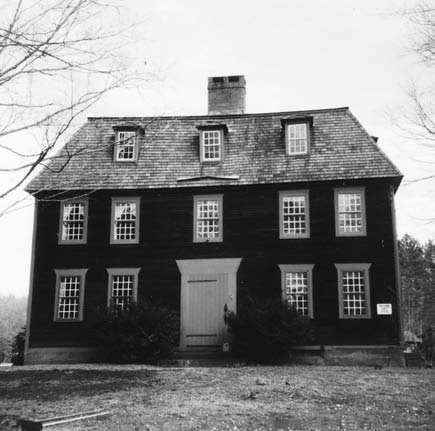
An East Windsor house dating from the era when Edwards was growing up
among the English, the French, and their Indian allies. The real war was among spiritual powers, a nation God had favored with true religion versus peoples in Satan's grip, Catholics and pagans.
Retellings of the Deerfield massacre vividly reinforced this understanding of the cosmic significance of the international struggles. Since before Jonathan could remember, family prayers included petitions for his Uncle Williams of Deerfield and cousins, captive in Canada. After Williams and two of his three remaining captive children returned in fall 1706, petitions continued for the one remaining child, Eunice (aged seven at the time of her capture), still with the Indians and, far worse, reportedly under Romish delusions.
A Time to Be Born ∞π
By the time the precocious Jonathan was old enough to read, he would have discovered that one of the most fascinating books in his father's library was his uncle's The Redeemed Captive, Returning to Zion. John Williams' best-selling narrative vividly recounted the horrors of the Indian attack, the agony of seeing two children killed and losing his wife, and the pain of his long captivity among the Indians and French in Canada. Williams' story highlighted the deviltry of the inventions of Rome, the judgment of God on papal superstitions, and the awful plight of the souls of the poor Indians subject to the deceptions of the Antichrist.∞∑
Queen Anne's War (which lasted until 1713) touched the Edwards family directly and almost disastrously. In summer 1711, when Jonathan was in his eighth year, his father, the Reverend Timothy Edwards, set out from home to serve as a chaplain for a colonial military expedition against Canada. Timothy Edwards was an extraordinarily meticulous, careful man, always concerned to control every detail. He was not suited for military life. Almost immediately he fell ill with a nervous stomach. He started to keep a campaign diary, but he soon became so preoccupied with the symptoms of his illness and his spiritual well-being that he recorded little about the campaign. By the time the army reached its staging ground in Albany, he was too ill to go on and feared he might die. Eventually he was shipped by wagon back to East Windsor where he soon recovered.∞∏
Although the Reverend Timothy Edwards' time ''in the queen's service'' was less than glorious, he was a formidable figure in his own domains—his home and his church. Jonathan, his only son, followed closely in his father's footsteps. One might think of Leopold and Wolfgang Amadeus Mozart, later in the century, for a partial analogy. The father was accomplished in his own right and controlling. The son was precocious and eventually outshone his father, but his achievements were also a tribute to the father's careful tutelage and continuing looming influence.
The Edwards Household
Timothy Edwards' letters home while he was serving as chaplain in 1711 provide our best picture of the Edwards household. The first of these letters, written to his wife, Esther, within a week of leaving home, is filled with admonitions. At the top of the list is the instruction for Jonathan's schooling: ''I desire you to take care that Jonathan don't lose what he has learned but that as he has got the accidence, and above two sides of propria Quae moribus by
∞∫ A Time to Be Born
heart so that he keep what he has got.'' The older sisters were helping in the Latin lessons and learning that language, which usually set apart the class of educated men, primarily for their brother's benefit. So their father continues, ''I would therefore have him say pretty often to the girls; I would also have the girls keep what they have learned of the grammar, and get by heart as far as Jonathan has learned: he can help them to read as far as he has learned: and would have both him and them keep their writing, and therefore write much oftener than they did when I was at home.''∞π
The scene that this letter depicts reminds us also that, while Timothy Edwards was unquestionably the head of the household, Jonathan was growing up in a home that was, practically speaking, a world of women. In addition to his mother, he had four older sisters in 1711 and three younger. Eventually he would have six younger sisters. All eleven children would, remarkably, survive childhood. Timothy Edwards, who was more given to witticisms than the son, later referred to them as his ''sixty-feet of daughters.'' Even allowing room for exaggeration, this was a tall family in an era when the average heights were far less than today. Jonathan, who would grow to be over six feet but strikingly thin as an adult, was probably spindly as a child.
We can only speculate as to what e√ect living in such a feminine environment had on Jonathan. He did have several male cousins, including one his age, living next door, and there were many other boys in East Windsor, a village of close to a hundred households of large families. Nevertheless, he seems to have been close to his sisters. They were an accomplished group. New England's elite encouraged their daughters to develop their intellectual gifts as these were useful for religion. The biblical figure of Mary who listened to Jesus' discourses, rather than helping her sister Martha in the kitchen, was a favorite Puritan model for women's learning—even though the care of family and home was their primary calling. Collegiate education was reserved strictly for men, yet in a pastor's household girls might be encouraged to learn all they could appropriate to their station. The Edwardses also sent all but one of Jonathan's sisters to Boston for finishing school. The eldest daughter, Esther, apparently wrote a satirical piece called ''The Soul,'' which was long attributed to Jonathan.∞∫ A younger sister, Jerusha, was said to have great delight in books and especially in theology.∞Ω Another younger sister, Hannah, who did not marry until her thirties, remarked that women may find the single state a great advantage ''if they can make religion and knowledge their chief end.'' One of the other younger sisters, Martha, apparently was not so easy to get along with. When a clergyman suitor asked Timothy for her
A Time to Be Born ∞Ω
hand, the father warned him of her temperament. The suitor persisted, pointing out that he had heard Martha had received God's converting grace. ''Oh yes, yes,'' Timothy replied, ''Martha is a good girl but . . . the grace of God will dwell where you or I cannot!''≤≠
While we would like to know more about the sisters, especially about the older girls who took care of Jonathan, we can be sure that as the family's only boy in a culture where males had many prerogatives, he was doted over and soon deferred to. One of the overarching rules of life was that everyone must respect God-ordained orders of society. Puritans did insist on the spiritual equality of all before God, but they carefully limited the applications of that potentially revolutionary doctrine in their social relationships. They also stressed the bonds of a√ection between superiors and inferiors. The a√ections and piety of some of his sisters may have been early lessons in his own cultivation of such sensibilities. Many commentators on Edwards have remarked on how often, in his later accounts of true religious a√ections and remarkable piety, he used women or girls to illustrate his point.
Jonathan's mother, Esther Stoddard Edwards, was a formidable presence in her own right, but it is symptomatic of those times that we know little about her. What we do know is largely from what was recalled from much later in her long life (she outlived both her husband and her son by twelve years). East Windsor villagers remembered her as ''tall, dignified and commanding in appearance'' yet ''a√able and gentle in her manners'' and as of impressive intelligence, learning, and theological acumen. Solomon Stoddard had sent his daughter to finishing school in Boston. As a young mother Esther assisted her husband in teaching their children and those of the town in a small school that occupied one of the two large downstairs rooms in their farmhouse. As an old woman, after her husband died, she remained an avid reader and teacher. Until she was in her nineties, women of East Windsor regularly came to afternoon sessions in the old parlor–school room for readings of the Bible and theological writers punctuated by her acute commentary.≤∞
Nevertheless, whatever the talents of Solomon Stoddard's daughter, it went without saying that Esther was a subordinate in Timothy Edwards' household. For Puritans, as for almost everyone else, the axiom that the world was hierarchical was as unquestionable as that the sun rose in the east. Fathers were the heads of their households and their rule was law. The household was also an economy in which everyone shared. The Edwardses farmed a number of acres of land to supplement their income. They used some of this land for orchards and some for crops such as flax, which the women could make into
≤≠ A Time to Be Born
linen yarn, and they kept some cattle.≤≤ Hospitality was an important virtue and the crowded household often included guests.
To help with this work, the Edwardses always had an African slave. Household slaves were particularly common among New England clergy, both because of a pastor's social status and because the head of the house was not primarily engaged in physical labor. The enslavement of Africans could take root in seventeenth-century New England not only because even the most pious were not exempt from human cupidity but also because other sorts of enslavements had been common for so long and were taken for granted in Scripture. Even so, by 1700 at least some whites recognized the unusual inequities of African slavery. Solomon Stoddard's Boston friend Judge Samuel Sewall raised the issue most forcefully in The Selling of Joseph: A Memorial (Boston, 1700). Yet Sewall's unusual views created only a ripple. Cotton Mather, whom Timothy Edwards knew and admired, probably represented the majority when he justified slavery as an opportunity for converting Africans to the Gospel. Mather also campaigned for treating slaves kindly as fellow humans.≤≥ If some New England slave owners had uneasy consciences, their most common way of dealing with the subject was to avoid it; so the topic received little more public discussion until the era of the American Revolution.
In a household economy where family members shared many tasks, Puritan fathers—as Timothy Edwards' wartime letters suggests—played a significant role in overseeing the discipline and spiritual nurture of the children. Children's natural selfishness, greed, and disobedience were everyday reminders that the human race was corrupt, inheriting sinful natures from their first parents, Adam and Eve. Likely the elder Edwardses subscribed to the principle of suppressing any signs of willfulness, although Puritan practices of childrearing varied and often included more displays of warm a√ection than is sometimes depicted. For those whose first concern was to prepare their children for salvation, the most loving thing a parent could do was to teach children the disciplines that would open them to receive a truly submissive spirit. Ultimately that could come only through the regenerating grace of God, but habits of obedience to God's commands could pave the way. As John Wesley, who was also born in 1703 and reared with similar rigor in an English parsonage, put it, ''Break their wills that you may save their souls.''≤∂
Timothy's wartime letters reveal that Jonathan at age seven was not the perfect child. ''I hope you will take special care of Jonathan,'' Timothy urged Esther, ''that he doesn't learn to be rude and naught[y] etc. of which you and I
A Time to Be Born ≤∞
have lately discoursed. I wouldn't have you venture him to ride out into the woods with Tim.'' This same letter is especially revealing of some characteristics of the father that shaped the son. No detail is too small to escape Timothy's attention and advice. ''Let care be taken that the cattle don't get into the orchard and wrong the trees. And that the barn door ben't left open to the cattle.'' Be sure the ''dung be carried out and laid in the orchard where there is most need before winter and that the flax be not spoiled.'' And so on and so forth. One suspects the family had heard these admonitions before. Or that, ''if any of the children should at any time go over the river to meeting I would have them be exceedingly careful, how they sit or stand in the boat lest they should fall in the river.'' Even what we might assumed would be his wife's domain comes under his purview: ''And let Esther and Betty [the two oldest girls] take their powders as soon as the dog days are over, and if they don't help Esther, talk further with the doctor about her. . . . Something also should be done for Anne who as thou knowest is weakly: and take care of thyself, and don't suckle little Jerusha too long.''≤∑
If such advice suggests overmanaging, even in matters that might be thought Esther's domain, it also reveals an a√ectionate father who is homesick and is thinking about everyone. Timothy's letters are filled with expressions of deep love for Esther and the children. In one he writes, ''Remember my love to each of the children,'' and then mentions each of the first seven by name, ''Esther, Elizabeth, Anne, Mary, Jonathan, Eunice and Abigail.'' He goes on: ''The Lord have mercy on and eternally save them all, with our dear little Jerusha. The Lord bind up their souls with thine and mine in the bundle of life.'' Ask the children, he continues, ''if they desire to see their father again, to pray daily for me in secret; and above all things to seek the grace and favor of God in Christ, and that while they are young.''≤∏ In a later sermon Timothy preached that a husband's love for his wife should be a ''singular peculiar thing,'' that displayed the ''honor and respect'' she deserved. He should ''not act magisterial or lordly, but in a loving manner with due respect to his wife.''≤π
At the same time the loving father was not indulgent to his children. After his own father died in 1718, Timothy made the best of his grief by writing privately for his ''soul's profit and comfort'' an eighty-eight-page tribute and spiritual biography. He observed approvingly that his father did not ''favor'' his children: ''Yea his spirit (though he loved them dearly) was more stirred against that which is evil in them than in such as were but neighbors.''≤∫ Everything we know about Timothy Edwards suggests an
≤≤ A Time to Be Born
intensely disciplined perfectionist, a worrier about details, a firm authoritarian who was nonetheless capable of good humor and warm a√ections toward his family.≤Ω Jonathan Edwards never entirely escaped the hold this demanding yet a√ectionate father had over him. He followed closely in his father's footsteps and, except for greater reserve, closely resembled his father in standards and attitudes.
It is not hard to guess one source of the family's perfectionist discipline. Timothy had learned from his father to use exacting discipline to overcome adversity. Timothy's great-grandfather had been a clergyman in Wales and then rector of a school in England, but his death in 1625 had brought the family into poverty. In 1635 the family migrated to Massachusetts and settled in Hartford, joining Thomas Hooker's migration to the new western colony. Timothy's father, Richard, born in Hartford in 1647, brought the family back to some financial success, turning a cooper's trade into a prosperous merchant business.
Timothy's mother, however, was a scandal and a disgrace. Three months after she married Richard Edwards, in 1667, Elizabeth Tuthill (or Tuttle) revealed that she was pregnant by another man. Richard nonetheless protected her by paying the fine for fornication himself and arranging to have the child raised by her parents. The problem proved to be much deeper. Elizabeth was a∆icted with a serious psychosis. She was given to fits of perversity ''too grievous to forget and too much here to relate,'' repeated infidelities, rages, and threats of violence, including the threat to cut Richard's throat while he was asleep. The Tuthill family was evidence that New England was not the staid place that we might imagine, but rather one where humans su√ered the same horrors found in any era. One of Elizabeth's sisters murdered her own child, and a brother killed another sister with an ax.≥≠ Jonathan Edwards is sometimes criticized for having too dim a view of human nature, but it may be helpful to be reminded that his grandmother was an incorrigible profligate, his great-aunt committed infanticide, and his great-uncle was an ax-murderer.
Elizabeth Tuthill Edwards' condition worsened with the burden of bearing six children to Richard, of whom Timothy was the eldest. Eventually she deserted her family for a number of years, staying away from Richard's bed when she returned. By 1688 her behavior became so erratic that Richard did something almost unheard of in New England: he sued for divorce. He had su√ered, he told the court, from ''a∆ictions, discontents, jealousies, the rage of man, with horrible confusions, distractions, with intricate, heart-breaking
A Time to Be Born ≤≥
miseries, the most pinching pressures of spirit that have been my meat day and night.''≥∞
Despite these agonizing circumstances, the court refused Richard's request. After more years of su√ering, he presented his case again, and this time the court relented, granting the divorce on the advice of a council of ministers. From then on Richard's situation improved dramatically. He joined the Hartford church. Still in his forties, he married a second wife, who bore him six more children. Richard, always a man of learning as well of piety, read law and in 1708 was appointed ''Queen's attorney.'' He became particularly noted for some cases he pleaded for the Pequot Indians.≥≤
In the meantime Timothy, who came by his apprehensive disposition honestly, had been groomed by his father to go to college to prepare for the ministry. He entered Harvard in 1686. Early in 1688 he left the college, apparently expelled. All we know is that an ''ominous'' mark was entered next to his name in the ''Severe Punishments'' column of the Harvard records. The best guess is that this had something to do with his father's first divorce proceedings, which began about the same time. Everything else we know about Timothy is of a meticulously disciplined perfectionist, and this episode did not ruin his reputation in the long run or divert him from his plans for a ministerial career. He continued his studies under the private tutelage of the Reverend Peletiah Glover in Springfield, Massachusetts, just north of Hartford. Timothy was a most able student, and in 1694 Harvard recognized his accomplishments by granting him both his belated B.A. and a M.A. (the latter a degree routinely granted for three years of some study, usually on one's own, beyond the four-year B.A.).≥≥
Timothy was proving himself to all who knew him and fast overcoming any stigma that may have been attached to his family background or the Harvard episode. Puritans were strict, but they were also strictly forgiving if the circumstances warranted. Timothy's dramatic rise in status came with the imprimatur of none other than Solomon Stoddard, who in 1694 granted him permission to marry his second daughter, Esther. By this time the Stoddards knew Timothy well because he was teaching school in Northampton. Everything quickly fell into place for the promising young man: Harvard granted him his degrees, and a new parish, called Windsor Farms or East Windsor, across the Connecticut River from Windsor and not far from his native Hartford, called him to be its pastor.
Esther, the new bride, was the granddaughter of John Warham, well remembered as the sometimes controversial first pastor in Windsor, so she
≤∂ A Time to Be Born
was already part of one of the leading families of the original town. Richard Edwards, who must have been delighted not only to have his children settled nearby but also with this second great upturn in the family's position, gave the new couple farmlands and a very adequate house. Their home stood along the one long road of East Windsor, paralleling the Connecticut and overlooking the fertile floodplain, the river in the distance and the roofs of Windsor beyond that. Soon there were grandchildren much the same age as Richard's second family. Timothy and Esther named Jonathan after the first son of Richard's second marriage, a child who had died in infancy.≥∂
C H A P T E R ≤ kl The Overwhelming Question
imothy Edwards was an e√ective preacher of revival. According to Jonathan's later estimation, of all the pastors in the region, only his grandfather, Solomon Stoddard, oversaw more local awakenings. In his famous account of the ''Surprising Work of God'' of 1734–35 in Northampton, Jonathan recorded that there had been ''four or five'' outpourings of the Spirit in ''my honored father's parish, which has in times past been a place favored with mercies of this nature above any on this western side of New England, excepting Northampton.''∞ So the father more directly than the grandfather set the footsteps in which Jonathan would try to follow. Timothy's reputation as a revivalist eventually faded in the light of his son's prominence. One di√erence was that he did not publicize his successes. Like many locally influential persons who are later forgotten, he relied on personal presence and the spoken word.
In 1712 and 1713, about a year after Timothy Edwards returned from the war, his preaching precipitated one of these awakenings. Jonathan marked the beginning of his own notable spiritual experiences from the time of this revival. His account, written much later, when he was a renowned evangelist, is inevitably stylized. Nonetheless, it provides evidence not only of the events themselves but also of Edwards' critical understanding of the meanings of his youthful experiences. When he was only nine years old, he recounted, he experienced the first of ''two more remarkable seasons of awakening, before I met that change, by which I was brought to those new dispositions, and that new sense of things, that I have had since.'' For months the nine-year-old was a model of sanctity. He prayed secretly five times a day, spoke much of religion to other boys, and organized prayer meetings with them. ''My mind was much engaged in it,'' he recalled, ''and had much self-righteous pleasure;
≤∏ The Overwhelming Question
and it was my delight to abound in religious duties.'' He and his schoolmates ''built a booth in a swamp, in a very secret and retired place, for a place of prayer.'' He also had his own secret places in the woods where he would retire ''and used to be from time to time much a√ected.'' Eventually, the nine-yearold lad ''entirely lost all those a√ections and delights'' and ''returned like a dog to his vomit, and went on in ways of sin.''≤
Timothy Edwards was an expert on the science of conversion. Nothing was more challenging than to be able to tell what was truly a work of God and what was self-deception. Nothing had more resting on it. Conversion was not just an euphoria of enthusiasm; emotions were deceptive and sure to change. Evidences of God's work had to be substantial and lasting. Like eighteenthcentury observers of nature, Timothy kept records of the indications of spiritual experiences among his parishioners and knew exactly what to look for. In observing the state of souls, the East Windsor pastor was drawing on more than a century of highly developed Puritan science. Yet the object of this science—whether an apparent spiritual experience was a work of God or a Satanic imitation—was notoriously elusive. Satan's favorite device was selfdeception. Self-generated religious enthusiasm could look like the real thing for a time but soon would fade away. So Timothy Edwards would not have been at all surprised by his nine-year-old son's falling from his self-generated enthusiasm for spiritual things or at finding that Jonathan and the other boys had reverted to pretending to fight Indians from their secret hideout in the woods.
Timothy Edwards, following Puritan precedents, emphasized three principal steps toward true conversion. First was ''conviction'' or ''an awakening sense of a person's sad estate with reference to eternity.''≥ The term that the Reverend Edwards used for this first, but insu≈cient, step was ''awakening.'' We must notice that usage because ''awakening'' is the most common term used for periodic outbreaks of religious enthusiasm in New England congregations. An ''awakening'' was no guarantee of salvation. Jonathan described his ephemeral boyhood experience as one of ''two more remarkable seasons of awakening.''
Recognition of the precariousness of both life and death, a ''sense of a person's sad estate with reference to eternity,'' as Timothy Edwards phrased it, often precipitated an initial awakening. Much of Puritan upbringing was designed to teach children to recognize how insecure their lives were. Every child knew of brothers, sisters, cousins, or friends who had suddenly died. Cotton Mather, under whose preaching Timothy had once sat, eventually
The Overwhelming Question ≤π
lost thirteen of his fifteen children. Parents nightly reminded their children that sleep was a type of death and taught them such prayers as ''This day is past; but tell me who can say / That I shall surely live another day.'' The New England Primer illustrated the letter ''T'' with ''Time cuts down all, both great and small'' and a woodcut of the grim reaper. ''Y'' was ''Youth forward slips, Death soonest nips'' with a woodcut of Death holding a large arrow at a child's head.∂ One of the Edwards children's surviving writing exercises reads, ''Nothing is more certain than death. Take no delay in the great work of preparing for death.''∑
If life was uncertain and frightening, eternity was more so. Parents who themselves experienced God's saving grace and who lost children in infancy might have hopes in God's covenant promises of mercy from generation to generation. Young children might have saving grace, even if they did not live long enough for it to come to fruition in identifiable signs of conversion. One nighttime prayer (a form of which has long survived) was ''Lord, if my Soul this night away thou take, / Let me by morning then in Heav'n awake.''∏ Yet no child was innocent or worthy of anything but eternal damnation. All were totally depraved. Not only would they sin as soon as they could, but they were also born guilty of the sins of the race. ''In Adam's fall, we sinned all,'' was the first lesson in the New England Primer. Children soon learned that in their natural state they deserved the flames of hell. Only God's mysterious grace might rescue them.
Timothy Edwards, like the vast majority of New England's preachers, was convinced he must not flinch from warning sinners of the dangers of falling into unending hellish tortures. Timothy recorded how a parishioner named Abigail Rockwell had been first awakened ''from hearing such a question expressed in a sermon to unconverted sinners, namely, can you bear to live half an hour in fire, and if not how can you bear to live in hell to all eternity.'' Joshua Wallis Jr., a local farmer, reported how he was ''stirred . . . to take more pains for an interest in Christ'' by ''fears of falling into the hands of an angry God.''π
To benefit from these awful warnings sinners had to reach the second step toward true conversion, which was humiliation. Normally, following the first enthusiasm of their awakening, they would experience a backsliding into sin that would lead them to realize the terribleness of their sins and that God would be entirely just in condemning them to hell. Sometimes this stage was described as involving a sense of ''terror.'' Puritan authors o√ered many complex lists of steps, and Timothy's standard was relatively flexible and simple in
≤∫ The Overwhelming Question
emphasizing only three essential steps—but he does seem to have insisted on these, particularly this one. Potential converts not only had to recognize their guilt deserving eternal flames, but be ''truly humbled'' by a total sense of their unworthiness.∫
Only then was one su≈ciently prepared to reach the third step—if God graciously granted it—of receiving God's regenerating ''light,'' or a ''new spirit created in them,'' so that they truly repented and sin would no longer reign in them, but rather they would be guided by the Holy Spirit ''dwelling in them'' and they would receive the gift of faith in Christ alone as their hope of salvation and would experience a ''glorious change'' to a life dedicated to serving God. Following stricter Puritan practice, Timothy Edwards required prospective communicant church members to give a public profession of their experience, which would follow this essential pattern.Ω
It is essential to notice that in this Calvinist scheme of things God's grace could not be controlled. Puritans, like others in the Reformed tradition, were insistent on giving God credit for everything. God's saving grace was in no way a reward for good works. Truly good works, or works motivated by true love to God, were possible only for the regenerate, and even then they were tinged by the remnants of one's inherited sinful nature. Even faith itself, though a positive act of receiving God's free gift of salvation, was not the e≈cient cause of salvation but only a necessary means by which one received the gift as one's own.∞≠
Unable to control God's grace, one could at best prepare oneself to be in a position to receive it. So the steps leading through the gradual process of conversion were steps of ''preparation.'' The irony of the rigorous discipline was that one could not take any pride in successfully following it. One sign of being on the road to conversion was to strive fervently to keep God's law, but it was only when sinners came to realize their total inability to succeed in keeping that law that they would be prepared truly to depend on God's grace. Seldom has there been a spiritual discipline where so much e√ort was put into recognizing the worthlessness of one's own e√orts.
Rigorous disciplines combined with a recognition of one's inability to follow them also characterized the lives of Christians after conversion. Like John Bunyan's pilgrim, one would constantly be discovering one's waywardness and the deceitfulness of one's residual old self even after the change of heart in regeneration.∞∞ Following the straight and narrow was hard work, but ultimately any success in it was a matter of God's grace. So Timothy Edwards and his contemporaries often used the prescription of ''preparation'' not only
The Overwhelming Question ≤Ω
regarding the steps toward conversion, but also to describe how to seek God's grace at other stages in Christian experience. One needed to be properly submitted to God or ''prepared'' for the Sabbath, or for partaking of the Lord's Supper, or when seeking the Holy Spirit in prayer. All of life was preparation for death and eternal judgment.∞≤
Despite their doctrines of grace, New England Calvinists, such as the Edwardses, worked constantly at trying to regulate their own lives and those of others by God's law. Keeping the law of God was part of God's original ''covenant of works'' with Adam and the human race. Nations and individuals were still blessed or punished according to that standard. Civil law accordingly should reflect God's commands, as in upholding true religion or requiring Sabbath observance. God's moral law, as summarized in the Ten Commandments, was also an essential guide to unregenerate persons seeking salvation. The law was a ''schoolmaster'' showing how far short of fulfilling God's covenant one's e√orts came. Those under the ''covenant of grace,'' whose salvation was purchased by Christ's perfect obedience and sacrifice, still had to be guided by the law. Even though they too would be reminded daily of their imperfections, their willingness to strive to keep God's commands would be an important evidence of conversion.∞≥
The Church and Its Sacraments
Although Puritans aspired to make all of life a ritual of obedience to God's commands, they drastically reduced the formal rituals of the church. Rigorously following the principle that ''the Bible alone'' should guide Christian life and worship, they observed only two formal sacraments, baptism and the Lord's Supper. These were, as the authoritative Westminster Confession of Faith of 1646 put it, ''holy signs and seals of the covenant of grace.''∞∂ These holy signs and seals were also the gateways to membership in the church, which was to be made up of those persons who were under the covenant of grace, as much as that could be determined. Since seventeenth-century New England Puritans found it so di≈cult to determine who was truly converted, they were never able to settle entirely the questions of who should have access to the sacraments or be regarded as part of the church.
Much of the problem arose from conflicting traditions that shaped their determinations of who should receive the two sacraments. Baptizing infants, based on the analogy to Old Testament circumcision and reflecting the long heritage of Christendom, suggested an inclusive Christian nation. Restricting
≥≠ The Overwhelming Question
the Lord's Supper to visible saints, or those who could give evidence of conversion, suggested a New Testament church separated from the rest of the nation. In the early days of Massachusetts, Roger Williams had pointed out what he saw as a contradiction in these two models and had attempted to resolve the tensions by following only the New Testament example of a separated church, denying that God any longer dealt with nations as such. After his exile to Rhode Island in 1636, he followed the logic of his position by becoming, at least briefly, a Baptist, or one who refused to baptize infants and confined that rite only to converted adults.∞∑
The dominant early New England leadership successfully marginalized Williams and the Baptists, but the inherent tensions in their views of the sacraments (and of the church and society) soon led to sharp disputes over the emotionally charged question of whose children to baptize. Under the initial impulse to institute a pure church, the early New Englanders baptized children only if the parents were full communicant members of the church. But they soon faced a troubling question. What happened if those baptized children grew to adulthood but were never certifiably converted, even though they might be upstanding in other respects? Should the children of these halfway (baptized) church members be baptized? If God's covenant, as the Old Testament clearly said, extended to many generations, how could the grandchildren of the regenerate be denied the sacrament? After much debate, a synod of clergy declared in 1662 that children of half-way members could be baptized. New England churches, however, were congregational and so were not subject to synods. Practice might di√er from one church to the next or one pastor to the next. It took much more debate before this ''half-way covenant'' was generally accepted by New England clergy, as it was even by the conservative Timothy Edwards.∞∏
By 1700 the sacramental debate had shifted to a new front, the question of communicant membership or of who should partake of the Lord's Supper, and at the center of this new controversy was Timothy's father-in-law, the redoubtable Solomon Stoddard. Northampton's renowned pastor shocked the New England establishment by challenging their practice of allowing only those who showed convincing evidence of conversion to become communicants or full members of a congregation. Instead, he adopted the practice followed by some Presbyterian and Reformed churches of opening the table to persons who professed Christian belief and whose lives were free from scandal. Stoddard o√ered several reasons. First, it was too hard to tell exactly who was converted. The external church would never be perfectly
The Overwhelming Question ≥∞
coextensive with the body of believers anyway. Second, the Lord's Supper was a means of grace, so that opening it to sincere upright people might foster their conversions. Stoddard, a proven champion of revival in Northampton, insisted that the sacrament itself could be ''a converting ordinance.''
Stoddard saw opening up communicant membership as part of a larger program of strengthening the role of the church and the clergy in the community. The concern was a common one for clergy, especially in the period after Massachusetts lost its original charter in the 1680s. Although the colony secured a new charter in 1692, it was now under a royal governor. No longer, as in the early Puritan days, could the church look to the state to do its bidding. To strengthen the role of the clergy, Stoddard favored a more ''Presbyterian'' form of church government, or government by regional associations of clergy rather than by congregations. Unlike most Presbyterians, though, he followed a New England trend toward diminishing the role of lay ruling elders.∞π
Extending communicant church membership to most citizens in a town would also strengthen the control of the clergy over the citizens.
Solomon Stoddard's proposed solution to New England's conundrum regarding the sacraments, the church, and society cut through the knot from almost the opposite direction of Roger Williams. Instead of putting all the emphasis on the New Testament church, Stoddard insisted that the church and society should be modeled even more than before on the Old Testament. Not only were the people under a national covenant, but the church and the people of the nation (or, in this case, a province,) should be, more or less, coextensive. In other words, the essence of a nation should be a true national church.
Virtually everyone in a parish would be baptized and hence under the direct discipline of the church and its pastor. As Stoddard put it in his fullest exposition of his plan, The Doctrine of the Instituted Churches (1700), ''If a Christian live in a Town where there is a church, he is immediately bound to join with that church; and that church is bound to him to govern him.''∞∫
New England was almost as divided over Stoddard's opening up of communicant membership as it had been over the half-way covenant. While most of the clergy shared Stoddard's concerns about strengthening their roles and retaining a national covenant, New Englanders took their sacraments seriously. At communion services New England pastors read the warning text (I Corinthians 11:29): ''For he that eateth and drinketh unworthily, eateth and drinketh damnation to himself, not discerning the Lord's body.'' Partaking unworthily could imperil one's soul. Many laypeople, even when urged to
≥≤ The Overwhelming Question
become communicants by their pastors, refused to do so on the ground that they feared they might not be truly converted.∞Ω
One of Stoddard's ministerial critics was Edward Taylor (ca. 1645–1729) of Westfield, Massachusetts, some twenty miles north and west of East Windsor. Taylor is remembered for his remarkable poetry, written for his own edification, often in preparation for communion. ''Lord, blow the Coal,'' Taylor prayed in a typical communion prayer, ''Thy Love Enflame in me.''≤≠
Such intense communion piety was common among laity as well as clergy.≤∞
To Taylor, Stoddard was demeaning the sacrament by encouraging people to partake, when there was no live coal in their heart that could be so inflamed. Taylor publicly attacked Stoddard's views and admonished him personally for proposing to open the Lord's Supper to ''all above fourteen years of age, that live morally, and have catechisical knowledge of the principals of religion.''≤≤
Privately he confided to his poetry notebooks the greater danger of returning to the degeneracy of the national Church of England, ruled by bishops or prelates:
Apostasy wherewith thou art thus driven Unto the tents of Presbyterianism (Which is refined Prelacy at best) . . .
Where open Sinners vile unmasked indeed Are welcome Guests (if they can say the Creed) Unto Christ's Table.≤≥
In Boston Stoddard's leading opponents were the Mathers, Increase and his irrepressible son Cotton, who also hinted that Stoddard was on the road toward making himself into a ''congregational Pope.''≤∂ During the first decade of the century the Mathers helped keep the local printers in business as they hammered away at the dangers of ''brother'' Stoddard's opening of communion to the merely upright. Increase referred to Stoddard as ''brother'' not only in the Christian sense but because the Northampton pastor was married to Esther Warham Mather, widow of Increase's brother Eleazar. In 1714, after years of controversy and a dozen titles on the two sides, the two ''brothers'' made peace, although they could not settle the controversy. As with much else in New England church policy, the matter was left to the potentially contentious vicissitudes of local option.≤∑
Timothy Edwards was caught in the middle of all this. He had been influenced by the Mathers, whose works he continued to revere, and he shared their views on requiring credible evidence of conversion for communi-
The Overwhelming Question ≥≥
cant church membership. He also shared with his ministerial neighbor and friend Edward Taylor a strong sense of the necessity of guarding the sanctity of the sacrament. His di√erence with Solomon Stoddard on the issue was both a question of theology and a family matter. Apparently the son-in-law and the father-in-law found enough in common on other matters, such as zeal for revival and a strong role for the clergy, that they could live with their di√erences over the sacrament. Timothy Edwards, however, was not one to give in to his formidable father-in-law, or to anyone else, on a matter of high principle.≤∏
The Quest
Even after his boyish religious experience proved ephemeral, Jonathan remained fascinated by the eternally momentous question of conversion. The first writing we have from him is a letter, written in 1716, when he was twelve, to his next oldest and favorite sister, Mary, recounting the remarkable awakening going on in their father's parish. ''Through the wonderful mercy and goodness of God,'' he wrote, ''there hath in this place been a very remarkable stirring and pouring out of the Spirit of God, and likewise now is, but I think I have reason to think it is in some measure diminished, but I hope not much. About thirteen have been joined to the church in an estate of full communion.''≤π
The East Windsor awakening was more than an ordinary event. Stephen Williams, who as a boy had been one of the Deerfield captives in Canada and was now a young pastor in the neighboring town of Longmeadow, Massachusetts, noted in his diary that there was ''an extraordinary stir among the people at East Windsor—many were crying what shall we do to be saved.''≤∫
Jonathan's own account records that ''commonly a-Mondays above thirty persons to speak with father about the conditions of their souls.'' A good proportion of the some hundreds of townspeople were seeking grace, even though, at the time Jonathan wrote, only thirteen had met Timothy Edwards' high standards and ''joined to the church in an estate of full communion.''≤Ω
As in his relationship to his family, Timothy Edwards as pastor tempered meticulous rigor with engaging warmth. Even in ordinary times, Timothy spent considerable time counseling, reflecting a sociable trait that his son did not acquire.≥≠ He was also an e√ective preacher. Unlike his son, he was first of all a speaker, rather than a writer. In East Windsor, the ''customary remark'' of those who later often heard the son as well as the father preach was that
≥∂ The Overwhelming Question
''Mr. Jonathan was the deeper preacher'' yet ''Mr. Edwards was perhaps the more learned man, and more animated in his manner.''≥∞
Timothy Edwards was also a disciplinarian who set high standards for everyone. His reputation for learning was based on his library that contained many spiritual classics, on his mastery of Scripture, and on being a skilled teacher of the classics who successfully prepared a number of the boys of the town for college. One of his former students recalled that when he arrived at college the o≈cers remarked that they had no need to examine Mr. Edwards' students.≥≤
Such perfectionism could be a mixed blessing when expressed in the o≈cial capacity of God's ordained overseer of the morals of the community. He was remembered in East Windsor as a formal and fastidious man who would never be seen in public without his full clerical garb.≥≥ He took seriously his role as the guardian of the behavior of the village. Like other Puritan clergy, he railed against the inevitable vices of drunkenness, lasciviousness, ''a rude vain conversation in any respect,'' and such sins of youth as ''nightwalking,'' and ''vain company-keeping.'' He also followed the custom of reinforcing community standards by bringing notorious violators before the congregation where they were publicly shamed as he read their confessions.≥∂ Although it was not out of the ordinary for ministers to play such authoritarian roles, it meant that villagers' a√ections toward them could easily change from love to hate. In later years Timothy Edwards enjoyed other revivals, but he also sometimes saw his relationship with the town deteriorate into bitter antagonisms—once again setting a course his son would follow.≥∑
We can imagine the strict attentions that such an exacting mentor must have directed toward preparing his only son for the ministry. In matters academic the two were well matched. The son's precocious aptitudes suited the father's perfectionist demands. Far more di≈cult for Jonathan was meeting the high standards his father set for true spirituality. No amount of discipline and striving could satisfy. For a boy who took great satisfaction in his own superior standing and achievements, the challenge of attaining superior humility was truly daunting. Yet God—and Timothy Edwards, the expert in God's standard—would accept nothing less. Twelve-year-old Jonathan's zeal for the revival of 1716 was transparent and he may have shown hopeful signs of seeking grace, yet he was not among those who could make profession. His next years would be spiritually troubled.
In the fall of that year, just as he was turning thirteen, Jonathan left home to begin college. The average age for beginning college was closer to sixteen,
The Overwhelming Question ≥∑
but it was not unusual for younger boys to attend as soon as they had mastered the necessary languages. Connecticut's fledgling Collegiate School, which had been founded on a shoestring in 1701, now had three tiny rival branches. Jonathan and nine or ten other students attended the branch at Wethersfield, near Hartford and only ten miles down river from East Windsor. This arrangement kept him in the family orbit. The principal tutor was Elisha Williams, a very talented half-cousin of the Williams-Stoddard clan, only nine years Jonathan's senior and a person who would long play important roles in his life. Jonathan probably boarded either with Elisha or with the family of his Aunt Mary, his mother's next oldest sister, and Uncle Stephen Mix, the local pastor.
By Jonathan's third year, in 1718, New Haven was beginning to prevail in the complex rivalries among Connecticut's regions as the future location of the Collegiate School. Cotton Mather, a tireless friend of the Connecticut college ever since Harvard had fallen out of the Mathers' control in 1701, had recently secured a gift from the English merchant Elihu Yale. The college trustees used this money to build a fine building in New Haven to house the students and a handsome collection of books earlier secured by Jeremiah Dummer, Massachusetts' agent in London. In September 1718 when the New Haven group marked the commencement of the school year by celebrating these events and renaming the college for Yale, the Wethersfield group held rival ceremonies. The Connecticut General Assembly then ordered the Wethersfield students to move to New Haven. They did so, apparently with a chip on their collective shoulders, and soon filed a list of complaints, centering on the poor teaching of the principal tutor, Samuel Johnson. Although only twenty-one, Johnson did not lack for intellectual firepower. Later he would become president of King's College (Columbia) in New York and be known as ''the American Samuel Johnson.'' The perceptions of his deficiencies as a fledgling teacher may have been accentuated by his lack of enthusiasm for some Calvinistic doctrines. Johnson would soon be among a group of young New Englanders who would defect to the great Puritan nemesis, Anglicanism. Whatever the source of the Wethersfield students' complaints, after a month they packed up and returned to Wethersfield and Elisha Williams.
Jonathan reported to his sister Mary in March 1719 that they were doing well in Wethersfield yet soon expected to return to New Haven since the college trustees had recently ''removed that which was the cause of our coming away, viz. Mr. [Samuel] Johnson, from the place of a tutor, and have put in Mr. [Timothy] Cutler, pastor of Canterbury, [as] president.''≥∏ When
≥∏ The Overwhelming Question
Jonathan and others moved to New Haven later that spring, he found Cutler, the new president, to be an impressive man in his mid-thirties. In mid-July he wrote to his father, ''Mr. Cutler is extraordinary courteous to us, has a very good spirit of government, keeps the school in excellent order, seems to increase in learning, and is loved and feared by all that are under him.''≥π
These were just the qualities the fifteen-year-old had long since learned to admire.
Studying under Cutler and, above all, having access to a library of modern books was an exhilarating adventure for the precocious scholar, and he would graduate as the valedictorian of his class; yet something even more important was going on in his spiritual life. During his senior year he fell deathly ill with pleurisy; he was not prepared to die and was terrified. As he later recalled, it was as though God ''shook me over the pit of hell.'' Having peered over the edge of the abyss, Jonathan resolved to give himself up to God and for a time had the delight of believing himself reconciled to God. Soon after his recovery, however, the same thing happened as after his childhood experience, he ''fell again into my old ways of sin.''≥∫
Self-discipline had failed as much as it had succeeded. Self-examination was not encouraging either. As early as he could remember, he had resented much of the endless tedium of his parents' teaching and discipline. Holiness seemed ''a melancholy, morose, sour and unpleasant thing.''≥Ω He did not find delight in lengthy church services. He still had a rebellious nature. He was proud. He had a di≈cult and unsociable personality, and he did not have signs of charity that were evidence of grace. He struggled with sexual lusts which, despite prodigious e√orts, he could not wholly control.∂≠
The sixteen-year-old returned to his old ways, but this time God would not let him go and Jonathan would not give up. He stayed on in New Haven the next year to read for a M.A. degree. It was a time of immense intellectual growth, yet once again that was overshadowed by intense spiritual struggles without much satisfaction. ''God would not su√er me to go on with any quietness; but I had great and violent struggles: till after many conflicts with wicked inclinations, and repeated resolutions, and bonds that I laid myself under by a kind of vows to God, I was brought wholly to break o√ all former wicked ways, and all ways of known outward sin; and to apply myself to seek my salvation, and practice the duties of religion: but without that kind of a√ection and delight, that I had formerly experienced.''∂∞
Further distressing him were his personal relationships to other students. Although adults lauded his intellectual achievements, that did not translate
The Overwhelming Question ≥π
into being liked by his peers. His struggles to right himself with the deity at the same time he was intensely engaged in trying to comprehend the essence of reality probably accentuated his naturally shy and antisocial habit.
First he had a terrible falling out with his roommate and cousin Elisha Mix. Jonathan knew Elisha well because Elisha's father was Stephen Mix, the pastor at Wethersfield. Elisha was only two years younger than Jonathan, but he was no scholar and only beginning his freshman year during Jonathan's first M.A. year. Apparently the father had encouraged the rooming arrangement in the hope that Jonathan would be able to watch over Elisha in his studies. The arrangement went badly almost immediately. Elisha loved to play, detested living with someone so unrelentingly serious, and ignored Jonathan's e√orts to prod him to study. To make matters worse, as a freshman, Elisha had to do the bidding of the more advanced students. This was a standard arrangement in colleges: spending one's first year as an errand boy was what an apprentice to any craft or profession at the time would expect. The sudden disparity in status did not work between these cousins. Jonathan, nonetheless, saw a principle involved and was jealous of his prerogatives.
Not wanting to be distracted from his studies and spiritual exercises, Jonathan would as often as ten times a day order Elisha to draw cider for him from the basement immediately below their room in the new Yale building. Late one evening Jonathan gave such an order, but Elisha acted as though he did not hear. Jonathan demanded whether he had heard and, if so, why he did not come. Jonathan described the issue in a complaint to his uncle. ''He answered with some earnestness that he did [not] love to be called from play to draw cider. I was astonished at his answer, and it is the first instance I have known of a freshman's absolutely refusing his senior, whether graduate or undergraduate.'' Jonathan went on, with characteristic thoroughness, to observe that he demanded relatively little of Elisha and that ''the burthen of his freshmanship caeteris paribus is no greater than of other freshmen.''∂≤
Jonathan apparently sent this complaint by way of his own father who added his own considerably less deferential admonishments to his brotherin-law. Elisha's behavior, Timothy suggested, reflected Stephen's laxness. Not one to allow tact to stand in the way of principle, Timothy added that he intended soon ''to write my mind concerning some things that I have observed in you and met with from you, that have not been very pleasant . . . and I am verily persuaded are not justifiable in you.''∂≥
We can see Jonathan as his father's son in a second incident during the same school year. On March 1, 1721, Jonathan wrote to his father, reassuring
≥∫ The Overwhelming Question
him that he had no part in a small student uprising that had become the talk of the colony. He began by thanking his father ''from the bottom of my heart for your wholesome advice, and counsel and the abundance of fatherlike tenderness therein expressed.'' Far from needing such advice, Jonathan assured, he was the model of rectitude throughout the entire a√air. What had happened, he wrote, was that ''Every undergraduate, one and all, that had anything to do with the college commons,'' announced that they had made a pact never to eat there again nor to pay for the service. Edwards was not a party to this ''cabal.'' One reason was that he was the college butler, an attractive position he would not want to jeopardize, even if he had been sympathetic to the other students. Jonathan believed that the undergraduates' pernicious agreement had been made ''before Mr. Cutler [the rector] or (I believe) anybody knew that they were discontented.'' When the next meal was served, none of the some fifty students of the college appeared. Jonathan allowed that ''the commons at some times have not been su≈cient as to quality, yet I think there has been very little occasion for such an insurrection as this.''
What comes through in this account, aside from his scrupulous respect for authority, is that Jonathan appears to have had miserable relationships with his fellow students. Not only was he the outsider, but he was not reticent to express his adultlike opinions. Particularly, he told his father, he had done so to his fellow East Windsorite, Isaac Stiles. Stiles was six years older than Jonathan. Timothy Edwards had noticed the intelligence of this farmer's son (who later became father to a famous Yale president). Jonathan, who was superior in status to Isaac, took the older student under his wing. Stiles, said Jonathan, had been strongly pressured by his colleagues to enter into this bond, without time to consider. Jonathan was quick with his advice: ''As soon as I understood him to be one of them, I told him that I thought he had done exceedingly unadvisedly, and I told him also which I thought of the ill consequences of it would be, and quickly made him sorry that he did not take advice in the matter, I am apt to think that this thing will be the greatest obstacle of any to Stiles' being butler.''
While the rebellion was ''speedily quashed,'' the disturbances were ''succeeded by much worse and greater, and I believe greater than ever were in the college before.'' As Jonathan reported in shocked tones, ''some monstrous impieties, and acts of immorality lately committed in the College, particularly stealing of hens, geese, turkeys, pigs, meat, wood, etc., unseasonable night-walking, breaking people's windows, playing at cards, cursing, swear-
The Overwhelming Question ≥Ω
ing, and damning, and using all manner of ill language, which never were at such a pitch in the College as they now are.'' Rector Cutler had called a meeting of the trustees, and '' 'tis thought the upshot will be the expulsion of some, and the public admonition of others.'' Jonathan, however, had remained pure. ''Through the goodness of God,'' he attested, ''I am perfectly free of all their janglings.''
He went on to assure that ''I live in very good amity and agreement with my chambermate.'' While that conflict at the college may have been resolved, Edwards' relationships with other students remained poor and he continued to look to adults for justice. The best he could report was, ''There has no new quarrels broke out betwixt me and any of the scholars, though they still persist in their former combination but I am not without hopes that it will be abolished by this meeting of the Trustees.''∂∂
Jonathan's alienation from his fellow students and his revulsion at their escapades can be better understood if we recognize that he was undergoing the most intense spiritual journey of his life. He was living like a young monk seeking sainthood in a school of rowdy boys. By March 1, 1721, the date he was reporting on the college shenanigans, he was on the verge of, or perhaps already in the midst of, discovering some of the marvels that he would eventually recognize as the essence of his conversion.∂∑ During this academic year he was also engaged in what for a seventeen-year-old were prodigious philosophical and theological speculations. If we take seriously the level of profundity he was reaching in his search to understand the harmonies of God's reality and the sense of beauty toward which he was reaching, it is easier to see why he was out of tune with his foul-minded and rambunctious schoolmates. Temperamentally he was never at ease in the midst of secular male camaraderie. He expected others to sustain the serious intensity of which he himself was capable. He had no middle gears. He could not abide inconsistencies, such as seeing fellow students, many training for the ministry, flaunting the moral order. Further, he was a boy who had much to learn about himself and about human relationships, not all of which he ever quite learned. Nonetheless, we must take into account that, like a great artist, he was exploring dimensions of reality that were beyond the imagination of most of his peers.
Until his intense experiences began, the year was one of excruciating spiritual struggles for Jonathan. He later described his e√orts, in a conventional phrase, as ''miserable seeking.'' He wondered whether his e√orts could have been of any value at all, yet through them, he recalled, ''I was brought to seek salvation, in a manner that I never was before.'' Even though since his
∂≠ The Overwhelming Question
illness the year before he had ''felt a spirit to part with all things in the world, for an interest in Christ,'' he seemed not to have made real progress.
While one part of him was powerfully drawn toward full commitment, another part sti∆y resisted. The resistance built its bastion in his intellect. Since childhood, as he later depicted it, he had been ''full of objections against the doctrine of God's sovereignty, in choosing whom he would to eternal life, and rejecting whom he please; leaving them eternally to perish, and be everlastingly tormented in hell. It used to appear like a horrible doctrine to me.''∂∏
This brief passage is crucial for understanding not only the young Edwards, but also his entire later career. As a young man he was, if the di√erence of the two eras is taken into account, like the intensely saintly Aloysha Karamazov, disciplining himself in the quest to know God; but he was also the skeptical Ivan. His moral outrage against God's sovereignty reflected his youthful rebellious spirit, which despite his outward conformity had long reserved a place for secret inward resistance to his parents, their schooling, and to church indoctrination. His resourceful intellect provided a powerful weapon for this resistance. Like many other of the great thinkers of the era, he attacked Calvinist teachings at their most vulnerable point: that the sovereignty of God meant that by God's decree many humans were predestined to the horrors of eternal punishment. As he read widely he found such objections reinforced by the new humanitarian spirit of the age. Part of him was ready, as so many of the greatest thinkers of the age had done, to overthrow the dogmas of his heritage. Yet he also recognized his frailty before eternity, and another side of him believed that his rebellious spirit must be repressed. Once he had stared death in the face, once he been shaken over the pit of hell, he could not rest until his heart rested in God.
His heart and his intellect were not separable in this quest. His reason and his moral sensibilities had put a huge obstacle in his path. These objections were manifestations of a rebelliousness against the orthodoxy of his parents, dating to his childhood. He could not believe in God's total sovereignty, the doctrine at the very foundation of Calvinist teaching. Yet he was sure also that he had no hope on his own. What good would it do him if ''he gain the whole world, and lose his own soul'' (Matthew 16:26)? Earth's pleasures were fleeting and would turn to dust. Even if he thought it was repulsively unfair, he deeply feared that the fires of hell awaited those who rebelled against God.∂π
He desperately wanted to trust in God, yet he could not believe in, let alone submit to, such a tyrant.
In the midst of this turmoil, he had a breakthrough. Suddenly he became
The Overwhelming Question ∂∞
convinced that indeed God was just in ''eternally disposing of men, according to his sovereign pleasure.'' The tortuous obstacle was removed. Later he remembered clearly when he had reached this conviction, but ''never could give an account, how, or by what means, I was thus convinced; not in the least imagining, in the time of it, nor a long time after, that there was any extraordinary influence of God's Spirit in it: but only that now I saw further, and my reason apprehended the justice and reasonableness of it.''∂∫
Attributing all to God's grace, as he did in his later narrative, Edwards played down the extent to which his reasoning had been crucial in reconciling himself to his heritage. We, of course, cannot tell what brought him to overcome this hurdle, since he says he himself did not fully understand. Yet we do know that around this time he was beginning to formulate his most characteristic and profound insights on God's character and relationship to the entire universe. These insights were for him like a Copernican revolution, providing a whole new perspective for understanding God's relation to reality and putting questions of God's relation to humans in an entirely new framework.
This intellectual breakthrough later seemed the work of the Holy Spirit because it soon had an overwhelming spiritual manifestation. At first Jonathan's mind simply ''rested'' in his insights, ''and it put an end to all those cavils and objections, that I had till then abode with me, all the preceding part of my life.'' Then one day came a wondrous response, far beyond what his intellect could produce. He was reading I Timothy 1:17, ''Now unto the King eternal, invisible, the only wise God, be honor and glory forever and ever, Amen.'' He had heard these words countless times and long since repeated catechism answers cataloguing such attributions of the deity and emphasizing that people existed to ''glorify and enjoy'' (or be in a state of joy with) God.∂Ω
Now the implications of the incomprehensible greatness of the God of the vast universe who was truly eternal and all wise flamed out at him. As he read these words, he recalled, ''there came into my soul, and was as it were di√used through it, a sense of the glory of the divine being; a new sense, quite di√erent from anything I ever experienced before.'' He was so much enraptured that, as he put it, ''I thought with myself, how excellent a Being that was; and how happy I should be, if I might enjoy that God, and be wrapped up to God in heaven, and be as it were swallowed up in him.'' He kept repeating the verse ''and as it were singing over these words of Scripture to myself . . . and prayed in a manner quite di√erent from what I used to do; with a new sort of a√ection.''
∂≤ The Overwhelming Question
Even so, the introspective and keenly observant young man remained deeply suspicious of his own a√ections, having been twice fooled by what had seemed like the strongest spiritual emotions that disappeared when the crisis was past. So he added immediately to the above account the remarkable observation ''But it never came into my thought, that there was anything spiritual, or of a saving nature in this.''
This time was di√erent. The new sensibilities grew during the spring. As he wandered in the fields, woods, and hills near New Haven for his meditations he repeatedly saw the glory and beauty of God's love in Christ. He experienced an ''inward sweet sense'' of Christ's love expressed in ''the work of redemption, and the glorious way of salvation by him.'' He spent much time reading the love poetry of the Canticles or Song of Songs. In the fields he would often contemplate the words ''I am the rose of Sharon, the lily of the valleys'' (Cant. 2:1). ''The words seemed to me, sweetly to represent the loveliness and beauty of Jesus Christ.'' Such contemplations would carry him away ''from all the concerns of the world'' into ''a kind of vision . . . of being alone in the mountains, or some solitary wilderness, far from all mankind, sweetly conversing with Christ, and wrapped and swallowed up in God.'' This new sense of divine things ''would often of a sudden as it were, kindle up a sweet burning in my heart; an ardor of my soul, that I know not how to express.''
Not long after he began having these experiences, they reached a memorable peak. He was at home for vacation in the spring and had been talking to his father about what was happening. Jonathan recalled that he was ''pretty much a√ected'' by this conversation, and when it ended he walked alone into the fields for contemplation. ''And as I was walking there,'' he reported, ''and looked up on the sky and clouds; there came into my mind, a sweet sense of the glorious majesty and grace of God, that I know not how to express.'' What overwhelmed him was two seemingly opposite attributes of the triune God ''in a sweet conjunction: majesty and meekness joined together: it was a sweet and gentle, and holy majesty; and also a majestic meekness; an awful sweetness; a high, and great, and holy gentleness.''∑≠
A crude interpretation of Jonathan's experience might suggest that his vision of God was a cosmic projection of his father.∑∞ While there is always a grain of truth in such reductionist observations, the essence of the matter is nearly the opposite. So long as Jonathan's God was substantially a projection of his father or of other human analogies, he could not believe. If God were simply a cosmic version of the greatest imaginable human, God would still be
The Overwhelming Question ∂≥
by human standards a capricious and unreasonable tyrant, the father whose love turned out to be petty control, harsh judgments, tenderness mixed with fits of anger, unyielding disciplines, and punishments.∑≤ In fact, it was only when Jonathan's vision expanded to appreciate that the triune God who controlled this vast universe must be ine√ably good, beautiful, and loving beyond human comprehension that he could lose himself in God.
C H A P T E R ≥ kl
The Pilgrim's Progress
fter this,'' Edwards recalled in his spiritual autobiography, ''my sense of divine things gradually increased, and became more and more lively, and had more of that inward sweetness. The appearance of everything was altered: there seemed to be, as it were, a calm, sweet cast, or appearance of divine glory, in almost everything. God's excellency, his wisdom, his purity and love, seemed to appear in everything; in the sun, moon and stars; in the clouds, and blue sky; in the grass, flowers, trees; in the water, and all nature.''
One might think, from this account, written almost twenty years later, that Jonathan lived happily ever after, enraptured in God's love and enthralled by God's glory. He described himself as often lost in contemplations of nature. Before his spiritual transformation, he noted, he had been ''uncommonly terrified'' by thunderstorms; afterward they inspired ''sweet and glorious contemplations of my great and glorious God.'' It became natural for him ''to sing or chant forth my meditations; to speak my thoughts in soliloquies, and speak with a singing voice.''
True, once he experienced these ecstasies his life would never be the same. The exhilaration of having encountered the light of God's love, being enthralled by the beauty of Christ, and being filled by ''an infinite fountain of divine glory and sweetness'' was almost more than he could describe.∞ His new ''sense of divine things,'' an overwhelming sense of the wondrous beauty and love of the triune God, would often be renewed. Even when such experiences were absent, their object remained the polestar of his life and thought. Without an appreciation of the intensity of these life-transforming experiences and their monumental implications for all else that he did, it is impossible to make sense of Edwards.
The Pilgrim's Progress ∂∑
Yet Edwards' experiences were not simply those of a born mystic who at will could lose himself in contemplations of divine beauties. He was not a saint by nature. Even his stylized account in the later ''Personal Narrative'' reveals that his spiritual life was often an immense struggle. Despite his massive intellect and heroic disciplines, he was, like everyone else, a person with frailties and contradictions. That becomes apparent, as we shall soon see, from reading his private spiritual diary, in which he confided during his early years as a spiritual pilgrim. In the ''Personal Narrative'' he was writing as a famed revival preacher to a younger admirer.≤ So he was, in e√ect, preaching, using his experience as a model. Without changing the facts (he had the diary before him), he put them into a conventional theological framework.
His Calvinist framework itself demanded that even the greatest saints acknowledge their ongoing sinfulness. So in the ''Personal Narrative,'' after several pages of describing the overwhelming joys of the heart whose a√ections are fully turned to God, Edwards turned back to an acknowledgment of his terrible failings. ''My wickedness, as I am in myself, has long appeared to me perfectly ine√able. . . . When I look into my heart, and take a view of my wickedness, it looks like an abyss infinitely deeper than hell.''
In this context of declaring his exceeding sinfulness, Edwards o√ered some reflections on the di√erences between his mature faith and that of his early years. ''It is a√ecting to me,'' he remarked, ''to think, how ignorant I was, when I was a young Christian, of the bottomless, infinite depths of wickedness, pride, hypocrisy and deceit left in my heart.'' Particularly, the mature Edwards lamented, with insight on his most besetting sin (which he was not the only one to notice), ''I am greatly a∆icted with a proud and self-righteous spirit; much more sensibly, than I used to be formerly. I see that serpent rising and putting forth its head, continually, everywhere, all around me.''≥
Edwards immediately followed this confession of his pride in his ''Personal Narrative'' with a particularly important interpretation of the di√erence between his early and his mature years: ''Though it seems to me,'' he wrote, ''that in some respects I was a far better Christian, for two or three years after my first conversion, than I am now; and lived in a more constant delight and pleasure: yet of late years, I have had a more full and constant sense of the absolute sovereignty of God, and a delight in that sovereignty; and have had more of a sense of the glory of Christ, as a mediator, as revealed in the gospel.''∂
What does this passage and its theological framework tell us about his first two or three years as a convert? And what do these early years reveal about the mature Edwards? To answer these questions we must turn to the
∂∏ The Pilgrim's Progress
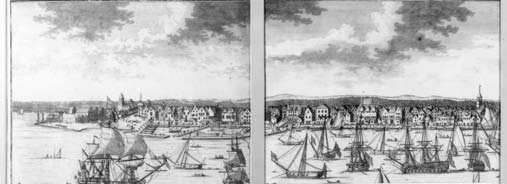
New York City was a thriving seaport when Edwards lived there in 1722–23. This engraving is from around 1719.
evidence from those years. We do not have much of a written record of the first year and a half of this intense time, when Jonathan was still an M.A. student at Yale. The only contemporary evidence comes from a number of sermons he preached during that time of preparation for the ministry. These cover a range of conventional Calvinistic topics. One revealing tendency is that the young convert sometimes adopted a balance-sheet approach to matters eternal, apparently reflecting a persistent theme in his own spiritual struggles. Worldly pleasures, wealth, and honors all soon turn to dust. It would be very foolish to invest in them. Sensual pleasures, from which people expect so much, ''are like shadows and phantoms which vanish as we endeavor to embrace them.'' Only one of these early sermons, Glorious Grace, expresses much of the enthusiasm later recalled in the ''Personal Narrative.''∑ We get a much fuller picture of the latter part of his early years as a fervent convert because in December 1722 he began to keep his spiritual diary. First, we need to look at the setting.
In August 1722, still not quite nineteen, Jonathan went to New York City to minister as an unordained ''supply'' pastor to a small Presbyterian church that had broken away from the larger Presbyterian church of the town. The conflict was of the sort that plagued American Presbyterianism for much of its history. The Presbyterian Church of the Middle Colonies was made up of two principal groups, Scots-Irish and New Englanders of English heritage. They shared the same theology but had developed di√ering ecclesiastical traditions and styles. In New York City the two groups had formed a Presbyterian congregation in 1716 and built a building at Wall Street and Broadway. The
The Pilgrim's Progress ∂π
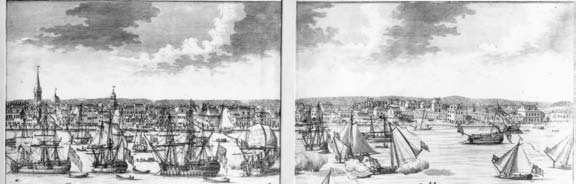
New Englanders, however, believed that the Scottish pastor, James Anderson, overstepped his pastoral authority, and withdrew to form their own group. They found a meeting place on Williams Street, near the docks, and invited the young Edwards to serve them, in hope that if they survived as a congregation he might become their regular pastor.∏
During the eight months he lived in New York, from August 1722 to May 1723, Jonathan lived with a Madam Susanna Smith and her son, John. The Smiths, recent immigrants from England, were ardent Calvinists. Jonathan came to know them through the oldest son, William, an outstanding student in the class ahead of him at Yale.π The little Presbyterian congregation was small enough to be like a family, and Jonathan became deeply attached to the Smiths, who seemed to him models of Christian piety.
New York City, though a town of only seven to ten thousand inhabitants, was already far more cosmopolitan than anywhere Jonathan had lived. The city's Dutch origins and populace gave it a European tone still much in evidence less than sixty years after the British takeover. The British who lived in this seaport were themselves far more diverse than he had encountered in New England. The city also had a closely watched African slave population. A decade earlier nineteen participants in a bloody slave insurrection had been brutally executed in retaliation for killing nine whites. Jonathan also encountered French Huguenots, Protestant refugees from Louis XIV's revocation of the Edict of Nantes in 1685. Such refugees were constant reminders of the dangers of coming under the rule of the Catholic Antichrist and his minions. Jonathan also saw many people who were openly of no religion, and for the
∂∫ The Pilgrim's Progress
first time he was seriously confronted with the realities of another faith. As he later recalled, ''I once lived for many months next to a Jew (the houses adjoining one to another) and had much opportunity daily to observe him; who appeared to me the devoutest person that ever I saw in my life; great part of his time being spent in acts of devotion, at his eastern window, which opened next to mine, seeming to be most earnestly engaged, not only in the daytime, but sometimes whole nights.''∫
The town at the tip of Manhattan Island was also one of the most beautiful settings in British North America. Jonathan loved to walk along the banks of the Hudson well north of the city to seek a solitary place where he could revel not just in the natural beauty but in the beauty of the sacrificial compassion of Christ to which all of nature pointed. Jonathan also found in Madam Smith's twenty-year-old son John a spiritual brother and soul mate. John would sometimes accompany Jonathan on his walks along the wilds of the Hudson's shore and, as Jonathan fondly recalled, ''our conversation used much to turn on the advancement of Christ's kingdom in the world, and the glorious things that God would accomplish for his church in the latter days.''
Living near the docks in this seaport town enhanced Jonathan's keen interest in world a√airs. As with everything else, he saw world events as merely outward signs of spiritual realities, of what God was doing through human history. During his stay in New York he began making entries in his notebooks on the mysterious revelations of the last book of the Bible as a framework for understanding current events. This subject soon became a lifetime preoccupation. As he recalled of his New York days: ''If I heard the least hint of any thing that happened in any part of the world, that appeared to me, in some respect or other, to have a favorable aspect on the interest of Christ's kingdom, my soul eagerly catched at it; and it would much animate and refresh me. I used to be earnest to read public news-letters, mainly for that end; to see if I could not find some news favorable to the interest of religion in the world.''Ω
What is especially striking amid all this spiritual exuberance in these
Detail of view of New York in Edwards' day. The original Trinity Church (Anglican) overshadows City Hall. The harborside pavilion, known as ''The Exchange,'' is at the end of Wall Street, where a slave market was sometimes held. The original Presbyterian meetinghouse was on Wall Street, and the break-o√ group met nearby.
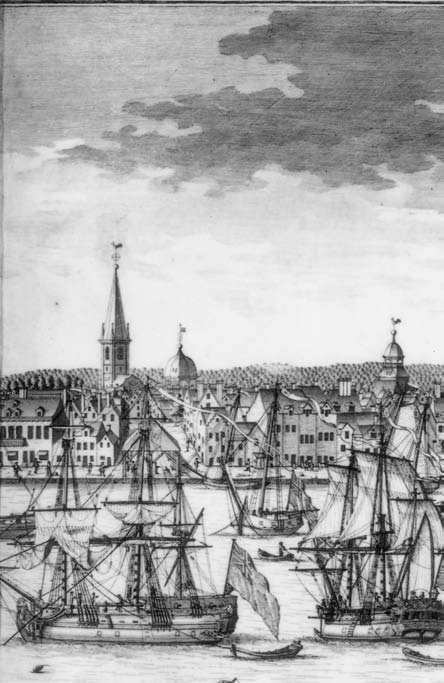
∑≠ The Pilgrim's Progress
early—and in some ways best—days of his journey as a convert was how rocky the road was. In Edwards' reconstruction he reported that in New York he felt a ''sense of divine things'' in ''a much higher degree, than I had done before.'' He did confess that during these months he was also in ''continual strife day and night, and constant inquiry, how I should be more holy.''∞≠ Nevertheless, that representation glosses over the depth of the struggle as revealed in his original record.
Probably in late fall 1722, perhaps in response to the di≈culties in sustaining high levels of spiritual intensity, Jonathan undertook the Puritan practice of framing a set of resolutions to discipline himself, adding new entries as needed. Shortly later, in December 1722, he also started a spiritual diary, which he kept fairly regularly at first and then sporadically over the next three years. These documents are worth careful scrutiny because they are almost the only sources from his entire career that provide a direct window into Edwards' interior life.∞∞ In his mature years he left no such candid record. Nevertheless, we may presume that throughout the rest of his life, beneath the discipline and genuine exterior of the model saint, there were also painful struggles for grace and for control amid uncertainties and vicissitudes.
The diary begins on a note of uncertainty, raising the question that was still plaguing him during these years, as to whether he was truly converted. In his first entry he listed a number of reasons why, despite his intense experiences, he might ''question my interest in God's love and favor.'' He worried, probably reflecting the concerns of his father, that his experiences did not fit the exact steps of which the Puritan divines spoke. More seriously, he questioned whether his experiences themselves were ''su≈ciently inward, full, sincere, entire and hearty.'' He knew he was ''sometimes guilty of sins of omission and commission.'' Were his spiritual sensibilities, he asked, ''wrought into my very nature,'' or were they simply ''hypocritical outside a√ections, which wicked men may feel.'' Was he once again in love with his own raptures?
Jonathan directed his ''Resolutions'' toward plugging every gap that would allow distraction from what he saw as his only worthy activity, to glorify God. In his fourth resolution, which is a briefer summary of the first three, he determined ''never to do any manner of thing, whether in soul or body, less or more, but what tends to the glory of God; nor be, nor su√er it, if I can avoid it.'' Many of the resolutions are directed toward trying never to lose focus on spiritual things. In a number of them he reminded himself, as he had
The Pilgrim's Progress ∑∞
been taught since childhood, to think of his own dying, or to live as though he had only an hour left before his death or ''before I should hear the last trump.''
Sometimes he went beyond typical Puritan rigor. He resolved ''to maintain the strictest temperance in eating and drinking.'' On this he was constantly experimenting with himself, seeing how much he needed to eat out of necessity and avoiding all excesses that would dull his mind or rouse his passions. Throughout his life observers commented on his strict eating habits and often emaciated appearance. Though he lived in the midst of the world, he did so as an ascetic. Few better illustrated the Protestant ideal of what Max Weber called ''worldly asceticism.''
True to his Puritan heritage, he often came back to the use of time. He early resolved, ''never to lose one moment of time; but improve it the most profitable way I possibly can.'' In one later entry he observed that ''a minute, gained in times of confusion, conversation, or in a journey, is as good as a minute gained in my study.'' In an early resolution, perhaps after being slowed down by a stalled horse in Manhattan tra≈c, he determined, ''Resolved, never to su√er the least motions of anger to irrational beings.''
Many of his resolutions and diary entries have to do with cultivating practical Christian virtues. He resolved, for instance, ''to be endeavoring to find out fit objects of charity and liberality.'' In another entry he determined ''always to do what I can towards making, maintaining and establishing peace, when it can be without over-balancing detriment in other respects.''
Most of the specifically practical resolutions have to do, however, with correcting personal faults, especially irritability, pride, and evil-speaking. Typically, he related these tendencies to his pride and resolved to view himself in the perspectives of others and not to think himself better than others. In a New York sermon on ''poverty of spirit'' he attempted to show of what ''an excellent, lovely temper and disposition true Christians'' possess if the selfdenying spirit of Christ truly dwells in them. A Christian was ''at all times to esteem others better than himself, to place himself last in his own esteem.''∞≤
He was preaching first of all to himself. He knew he was proud, yet he was resolved to fight pride every step of the way. In an early resolution he determined ''to act in all respects . . . as if nobody had been so vile as I, and as if I had committed the same sins, or had the same infirmities or failings as others.''
A. C. McGi√ert, writing of the rigor of these resolutions in an early twentieth-century biography of Edwards, observes that ''deliberately he set
∑≤ The Pilgrim's Progress
about to temper his character into steel.''∞≥ That is a helpful way of getting a modern sense of what he was doing, but we also have to take into account that ''character'' suggests a typically twentieth-century idea of self-development as a primary motive. Edwards' resolutions are even a far cry from those of Benjamin Franklin, which were designed as practical disciplines for a life of success. In spite of the preoccupation with self that Puritan piety inevitably entailed, Edwards was desperately trying to keep God in the forefront of his consciousness. Unlike Franklin, he was concerned with law and duty more than with what would work. High among his priorities were reminders not to omit his regular times of Scripture study and prayer and to control those passions that would distract his focus on God. He was indeed honing a character of steel, but his goal was also to subordinate his natural self so that he would be pliable to the demands of God's law and will.
Like both Franklin and Cotton Mather before him, Edwards literally kept score of how well he did or, as he would put it, of the evidence of God's grace. Late in December 1723, near the beginning of his diary he ''Concluded to observe, at the end of every month, the number of breaches of resolutions, to see whether they increase or diminish, to begin from this day, and to compute from that the weekly account, my monthly increase, and, out of the whole, my yearly increase, beginning from new year days.''
In his diary he also kept track of his spiritual highs and lows. On Saturday, December 22, 1722, he noted that he was particularly ''a√ected with the sense of the excellency of holiness'' and that he ''felt more exercise of love to Christ than usual.'' On Monday the twenty-fourth he had ''higher thoughts than usual of the excellency of Jesus Christ and his kingdom.'' The next day he ''was hindered by the headache all day.'' By Saturday sunset, the time when the Sabbath began, he was ''dull and lifeless.'' The next Tuesday the dullness persisted, despite the fact that he could not think of any ''negligence'' of which he was guilty. On Wednesday he reflected how without the Spirit of God, no amount of resolution could help him. Nevertheless, he also believed the inverse. Without the firmest resolution, he would not find the Spirit. So when finding that the tally of his ''weekly account'' had fallen low, he ''Resolved, that I have been negligent in two things: in not striving enough in duty; and in not forcing myself upon religious thoughts.''
By the following Tuesday he had ''Higher thoughts than usual of the excellency of Christ, and felt an unusual repentance of sin therefrom.'' But by Wednesday night he reported: ''Decayed. I am sometimes apt to think, I have a great deal more of holiness than I have. I find now and then, that abomin-
The Pilgrim's Progress ∑≥
able corruption which is directly contrary to what I read of eminent Christians.'' On Thursday he was ''reviving'' again and concluded that he was ''much more sprightly and healthy, both in body and mind, for my self-denial in eating, drinking, and sleeping.''
He was still on the upswing on Saturday, January 12, which became a milestone in his spiritual autobiography. In the morning he ''solemnly renewed my baptismal covenant'' and then spent the rest of the day in spiritual disciplines and reflections.∞∂ He debated with himself the ''Query'' whether he ought ever to delight in anything other than that which had a specifically religious purpose. He concluded that he might because otherwise one could not rejoice in seeing friends or even take the pleasure in eating necessary for good digestion. So he made a resolution that was just slightly more lenient: he ''never ought to allow any joy or sorrow, but what helps religion.'' That same evening, he observed: ''it is suggested to me'' (one suspects by Madam Smith) that ''too constant a mortification, and too vigorous application to religion, may be prejudicial to health.'' He resolved, however, not to give in ''no matter how much tired and weary I am, if my health is not impaired.''
Despite the spiritual heights of the weekend, by Tuesday, January 15, he was ''decaying'' again. On Thursday he reported being ''overwhelmed with melancholy.'' Five days after being at a peak, he was in a dark valley. Friday night he thought he was ''beginning to endeavor to recover out of the death I have been in for these several days.'' So his diary goes back and froth from spiritual highs to dreadful lows. On Tuesday February 5 he was considering ''that this being so exceedingly careful, and so particularly anxious, to force myself to think of religion, at all leisure moments, has exceedingly distracted my mind, and made me altogether unfit for that, and everything else.'' That excessive discipline, he determined, may have ''caused the dreadful, low condition I was in on the 15th of January.'' Yet in the very same entry he lamented that ''I do not seem so greatly and constantly to mortify and deny myself, as the mortification of which they [the apostles] speak.'' So, rather than relaxing his discipline he concluded he must do more: ''I am again grown too careless about eating, drinking and sleeping—not careful enough about evil speaking.''
The mature Edwards looked back on this rigor as involving ''too great a dependence on my own strength; which afterwards proved a great damage to me.''∞∑ Yet he never abandoned his belief in the value of strict spiritual disciplines, as his later Life of David Brainerd would reveal.
His theological explanation in his ''Personal Narrative'' for the di√erence between his early and his mature experiences as a convert was that he now had
∑∂ The Pilgrim's Progress
''a more full and constant sense of the absolute sovereignty of God, and a delight in that sovereignty; and have had more of the sense of the glory of Christ, as a mediator.'' Both of these sensibilities, that one must trust more in God's care and in Christ's intercession, fit with his self-criticism that he had earlier depended too much on his own e√orts.
At the same time, if we notice that it was in his early years after conversion that he ''lived in a more constant delight and pleasure'' than afterward, then we must also recognize that his time of more constant delight was also a time of moving back and forth between his spiritual mountains and deep valleys. Only steady habits of spiritual disciplines kept his emotional swings under control. Edwards later explained the distinction involved when writing about David Brainerd, whose intense spirituality was tempered by even deeper bouts of ''melancholy,'' or what we might call depression. True religion for Brainerd, Edwards wrote, ''did not consist in unaccountable flights and vehement pangs,'' but was ''like the steady lights of heaven, constant principles of light, though sometimes hid with clouds.'' Faith is then an abiding ''principle'' or habit that persists in spite of a ''natural temper'' prone to ''the disease'' of ''melancholy and dejection of spirit.''∞∏
In the winter of 1723 in New York, Jonathan must have appeared as an extraordinarily pious and intense young man to his parishioners in his little Presbyterian congregation. They could not but feel the power of his penetrating intellect. His carefully memorized sermons already had the relentless quality that characterized his later preaching. He left no loophole in his logic as he deduced his conclusions from his Scriptural premises (the ''doctrine'' portion of a Puritan sermon) and then showed how this set of proven truths must apply to his hearers (the ''use'' or ''application''). The most conspicuous themes, not surprisingly, reflected his personal struggles. Quite a few of the sermons are on self-renunciation and total dedication to God. ''God will not accept of any if we keep back a part. The flesh, the world, and the devil are God's most irreconcilable enemies.''∞π Constantly he reminded his hearers of the inversion of values that Christianity involves. They must be renouncing all worldly ambitions and counting as gain only time spent in devotion and service to God.
In other sermons Edwards' almost poetic sensibilities begin to emerge in mature form. The sermon Jesus Christ the Light of the World is a gem of his early writing, sustaining his favorite metaphor of light throughout. Light is a primary biblical image to describe God's love. Light was also a familiar theme in both the preaching and philosophizing of an era so concerned with en-
The Pilgrim's Progress ∑∑
lightenment. No one looked more intensely at the biblical meaning of light for his day than did Edwards. For him, light was the most powerful image of how God communicated his love to his creation. Regeneration meant to be given eyes to see the light of Christ in hearts that had been hopelessly darkened by sin.∞∫
As spring was reaching its height in late April 1723 (early May by our modern calendars, which add eleven days), Jonathan reluctantly had to leave New York. Timothy Edwards was trying to get his son back to Connecticut and more under his wing. The previous fall Timothy had engineered a call for Jonathan to be pastor of the village of Bolton, Connecticut, only fifteen miles from East Windsor. Jonathan had responded in December to the Bolton search committee that he was not yet certain as to whether he might settle as pastor in New York, although he thought it unlikely in light of the congregation's circumstances and ''my father's inclinations to the contrary.'' If he returned to New England in the spring, he might consider their call again, should they care to wait.∞Ω
Leaving his friends in New York was one of the most bittersweet moments in his life. He remembered it vividly when he wrote his ''Personal Narrative.'' ''I came away from New York in the month of April 1723, and had a most bitter parting with Madam Smith and her son. My heart seemed to sink within me, at leaving the family and city, where I had enjoyed so many sweet and pleasant days. I went from New York to Wethersfield by water. As I sailed away, I kept sight of the city as long as I could; and when I was out of sight of it, it would a√ect me much to look that way, with a kind of melancholy mixed with sweetness.'' Characteristically, he turned such earthly emotions into a spiritual lesson, reflecting in his diary on how they anticipated heavenly love ''where these persons that appear so lovely in this world, will really be inexpressibly more lovely, and full of love to us. And how sweetly will the mutual lovers join together to sing the praises of God and the Lamb.'' So fondly did he recall these sentiments that he copied them from his diary into his ''Personal Narrative.''≤≠
He faced the prospects of a summer at home with mixed emotions. On the day he arrived, May 1, he reminded himself not to wish he were with his faraway friends but to dwell on the heavenly love in the passage quoted above. During the summer he continued to enjoy some intense spiritual contemplations, but he also noted that his fervor was diminishing. Early in the summer he wrote that he had ''lost that relish of the Scriptures and other good books, which I had five or six months ago'' (May 12). In July he admonished himself
∑∏ The Pilgrim's Progress
for being ''too impatient'' at a church meeting (July 11). In August he observed, ''There are many things which I should really think to be my duty, if I had the same a√ections, as when I first came from New York; which now I think not so to be.''
He continued to work on cultivating a good nature and reducing his fretfulness. He resolved ''to wear a benign aspect, and air of acting and speaking, in all companies, except it should so happen, that duty requires it otherwise'' (July 22). He continued to wrestle with evil-speaking, apparently a fault to which he was particularly prone. Early in his stay at home he experimented with eliminating evil-speaking entirely for a week and then resolved that it ''is a duty to be observed forever'' (May 18, 1723). He also resolved not to hear sarcastic remarks about others (July 31, 1723).
His fretful disposition plus his pride and the resultant attitude toward others were the sins he combated most openly, but we can be sure that he was also fighting sexual desires, even if he did not directly record his struggles with those temptations.≤∞ One possible allusion to such enticements is in an entry on a Saturday morning in July: ''When I am violently beset with temptation, or cannot rid myself of evil thoughts, to do some sum in arithmetic, or geometry, or some other study, which necessarily engages all my thoughts, and unavoidably keeps them from wandering'' (July 27).
The problems of sustaining his spiritual intensity through the summer were compounded by the irritations of living under the rule of his parents. In a July 19 diary entry he quoted I Peter 2:18, which tells servants to be subject to their masters, even if the masters are hard to please. Jonathan observed that the same must apply in children's duties to their parents. He went on, significantly, to reflect on the next two verses in which Peter says that it is pleasing to God if we ''endure grief, su√ering wrongfully.'' A few weeks later, on the morning of August 13, he confessed that he had ''sinned, in not being careful enough to please my parents.'' Later that same day he added: ''I find it would be very much to advantage, to be thoroughly acquainted with the Scriptures. When I am reading doctrinal books or books of controversy, I can proceed with abundantly more confidence; can see upon what footing and foundation I stand.''
What was the source of this conflict? Part of it may have been that his parents were insisting that he fill the vacancy in the pastorate at Bolton, a prospect Jonathan did not relish. If that were the main issue, though, one would wonder why he would resolve to be better acquainted with Scripture as a tool for assessing doctrinal ''books of controversy.''
The Pilgrim's Progress ∑π
The previous day's entry suggests the immediate source of open contention. Jonathan was still worrying about his eternal estate because of ''my not having experienced conversion in those particular steps, wherein the people of New England, and anciently the Dissenters of Old England, used to experience it.'' As far as we know, Jonathan had not yet become a full communicant church member—oddly we have no record of when he did. That lacuna leaves the door open to speculation as to whether his dramatic spiritual experiences and subsequent heroic e√orts to do good still seemed unsatisfactory to him (despite his later estimate that they marked his conversion). Or perhaps he and his parents saw the matter di√erently. If we may conjecture, perhaps he had proposed that he was ready for communicant membership and Timothy Edwards, learned in such matters and always setting the highest standards for his son, had said no.
Whether or not communicant membership was at stake, the dispute seems to have been going on for over a month and to have been about the steps to conversion. Jonathan's diary entry of July 4 is especially revealing of the mentality of those who cultivated a consciousness of the precariousness of this life and the urgency of questions of eternal destiny. He began matter-offactly, ''Last night, in bed, when thinking of death . . . ,'' as though that was his usual nightly concern. He went on to say that the only reason he would face death ''in the least degree fearfully, would be, the want of a trusting and relying on Jesus Christ, so distinctly and plainly, as has been described by divines.'' In particular, he worried that he might not be ''entirely trusting my soul on Christ, after the fears of hell, and terrors of the Lord, encouraged by the mercy, faithfulness and promises, of God, and the gracious invitations of Christ.'' After some further reflections on this issue he added: ''Resolved, for the future, to observe rather more of meekness, moderation and temper, in disputes.''
Possibly Jonathan had recounted his spiritual experiences to his parents, but they were not entirely convinced that this was not just a later version of building the secret prayer booth in the woods. All the fervor in the world, all the religious discipline in the world, would do no good, if one did not have the true marks of conversion. Considering what we know of his e√orts to cultivate spiritual and moral rigors, such doubt may seem di≈cult to imagine. Yet his spirituality was marked by bright peaks and dismal valleys, and Jonathan himself kept coming back to the possibility that his parents might be right.≤≤
Apparently the dispute involved Timothy Edwards' emphasis on a preparatory step toward conversion that some Puritans had described as the
∑∫ The Pilgrim's Progress
experience of ''legal terrors.'' Timothy's views seem to have been influenced by the Elizabethan Puritan writer William Perkins (1558–1602), who insisted that undergoing ''legal terrors'' was a necessary step in preparation for conversion. One had to be so overcome by one's sinfulness as to experience the terror of total ''humiliation'' before knowing total dependence on God's grace. In a 1695 sermon Timothy had declared, ''No person that is not truly humbled whatever change is wrought in him is not, can not be, savingly changed or truly converted.'' Years later in his ''Personal Narrative,'' Jonathan was still concerned about the topic and made a point of remarking that ''it never seemed to be proper to express my concern that I had by the name of terror.''≤≥
Whatever the exact details of the dispute, both parents were involved and it was sometimes heated. One or both of the learned parents had outgunned their brilliant son in mastery of Scripture and the Puritan authors. Jonathan resolved to show proper deference to his parents and to endure wrongful su√ering. Yet Jonathan never gave up on an argument. At the same time that he deferred to his parents he was determining to be more thoroughly prepared with knowledge of Scripture, the one authority that could trump Puritan divines. He also privately ''resolved, never to leave searching, till I have satisfyingly found out the very bottom and foundation, the real reason, why they used to be converted in those steps.''≤∂
Out of his disconcerting religious struggles—which were by no means over—arose one of the major agendas of his later career. How could one tell the di√erence between true and false religious a√ections? At age nineteen he had already determined to apply his philosophical or scientific talents to the task of setting the world right on that topic. That question touched him at the center of his being. Not only was his eternal destiny of agonizing personal importance, how he answered the question was deeply tied to his relationship to his parents, his extended family, his community, his church, and his career. In the light of all the ink already poured into that most di≈cult question by earlier divines, the task of once and for all resolving it might have seemed a formidable life's work in itself. Yet for the young Jonathan it was only one part of a far larger design that he was already drafting to redirect the thought of Christendom.
C H A P T E R ∂ kl The Harmony of All Knowledge
For we know that Antichrist is to be destroyed by clear light, by the breath of Christ's mouth, [by the] brightness of his coming, that is, by plain reason and demonstration, deduced from the Word of God.
''Exposition on the Apocalypse,'' 1723
mid both the exhilarations of New York and the tensions of the summer back at East Windsor, the nineteen-year-old Jonathan was laying out a monumental design. At the same time that he was pursuing his spiritual goals with such intensity he was organizing his views on everything. To do this, he began what would become great notebooks, formed from carefully sewn folded pages. At Yale during his graduate years he had begun to put together his thoughts on natural science (then called ''natural philosophy''), a subject that particularly excited him in his late teen years and one that would remain a lifelong interest. In New York he began a notebook of ''Miscellanies,'' in which he placed his thoughts on theology and philosophy. By the end of 1723 he had added three more notebooks: ''Notes on the Apocalypse,'' ''Notes on Scripture,'' and ''The Mind.''∞ The pastorate was his calling, yet he was resolved that his life's work would not be just local. He was determined to be an international figure. This was part ambition—of which he had a lot—yet he also saw it as his larger calling, if God granted him the grace, to play a role in promoting God's earthly kingdom at a crucial moment in the history of redemption.
Occasionally he reflected on his grand expectations explicitly. On the cover of one of his earliest notebooks he wrote rules for writing. He advised himself, for instance, to display modesty of style and to try to gain readers rather than to silence opposition. Perhaps he thought of Cotton Mather, the
∏≠ The Harmony of All Knowledge
most conspicuous model of colonial ambition, who hurt his cause by an a√ected and self-conscious display of style. Consistent with his resolution of modesty, Edwards put the last of his original set of rules, written in 1723, in shorthand: ''6. The world will expect more modesty because of my circumstances—
in America, young, etc. Let there be a superabundance of modesty, and though perhaps 'twill otherwise be needless, it will wonderfully make way for its reception in the world. Mankind are by nature proud and exceeding envious, and ever jealous of such upstarts; and it exceedingly irritates and a√ronts 'em to see 'em appear in print. Yet the modesty ought not to be a√ected and foolish, but decent and natural.'' ≤ A few years later he added another shorthand note on how, if he hoped to get published in London, he might first need to experiment in his own country.≥ It is possible that he had earlier, perhaps before he went to New York, broached the subject of personally going to London. On a manuscript sermon from 1722 Timothy Edwards doodled the following words in this order: ''Jonathan. London. Corruption.''∂ What was behind this we can only guess, though we know that the ever-anxious Timothy was eager to keep Jonathan close to home.
Jonathan never traveled widely, yet he saw himself in the midst of an international upheaval of immense significance. While he remained intensely loyal to his Puritan heritage, he was also part of the first generation of New Englanders who had to face the revolutionary scientific and philosophical thought of the era. New Englanders had long been friendly to scientific advances and were confident that discoveries of God's ways of governing the natural world would only confirm what they knew from Scripture. Cotton Mather, for instance, had done much to transmit the latest in contemporary natural philosophy to New England audiences, incorporating summaries of recent texts into his voluminous writings. The younger educated New Englanders—mostly clergy, of course—of the early decades of the century had a passing acquaintance with Newton, Locke, and other British luminaries. Précis of recent publications were available in periodicals and in books of the day.∑ Still, the implications of the new science had not been fully integrated into New England intellectual life. Educated New Englanders took a Copernican viewpoint and the new science for granted, yet the college curricula of the early 1700s included Aristotle but not Newton.
It is easy to misconceive the intellectual situation in which the young Edwards found himself. It is especially easy because such a misconception has been so eloquently presented by Perry Miller, the most influential historian of New England. Miller, who let his creativity get the best of him in his biogra-
The Harmony of All Knowledge ∏∞
phy of Edwards, depicted young Jonathan as a revolutionary intellectual prodigy who, upon reading Locke, ''grasped in a flash'' the implications of modern thought. That placed him so far ahead of his generation that his genius could never be fully appreciated in his own time. According to Miller, who adopted the romantic image of the ''lonely genius,'' this ''backwoods adolescent'' had no more preparation for this insight than the contemplation of God in his father's field. Similarly, when reading Newton he ''saw in a glance that no theology would any longer survive unless it could be integrated with the Principia.'' Edwards was ''the last great American, perhaps the last European, for whom there could be no warfare between religion and science, or between ethics and nature.'' The young genius ''cast o√ habits of mind formed in feudalism, and entered abruptly into modernity, where facts rather than prescriptive rights and charters were henceforth to be the arbiters of human a√airs.''∏
Miller's portrait is to Edwards what Hamlet is to the actual Danish prince, a triumph of the imagination. Edwards thoroughly grounded his early thought, as we now know in exhaustive detail, in the international trends of the era.π He was part of a New England culture that was much enamored of things British and, as Mather's example itself illustrates, much concerned with staying current. Early New England had been ruled, perhaps more than any culture in history, by the educated. Despite their predominantly theological interests, many influential New England clergy made considerable e√orts to learn about the international trends of the day. Harvard College and later Yale were indeed slow in incorporating some of the new natural philosophy into their curricula, but that was because these institutions were a cross between boys' Latin schools and theological seminaries. Much of their curricula was based on centuries of medieval assumptions as to what education should be. ''Education'' without Aristotle was almost unthinkable. Even so, particularly at Harvard, modern thought had made significant inroads. Harvard graduates of the late decades of the seventeenth century were familiar, for instance, with the thought of Descartes, who was a dominant figure in midseventeenth-century natural science as well as in other aspects of philosophy. Solomon Stoddard owned Descartes' works as a Harvard student in the 1660s. Sophisticated New Englanders of the early 1700s subscribed to British journals to keep in touch with the international ''republic of letters,'' especially England, France, and Holland, during an extraordinarily creative period. They would have known about Pierre Bayle's encylopedic and some-
∏≤ The Harmony of All Knowledge
times skeptical Dictionaire historique et critique (1697–1702) soon after it was translated into English in 1710. They were familiar with the English ''latitudinarians'' and such Anglican writers as the popular preacher John Tillotson (1630–94), who used reason to disparage many Calvinist dogmas, and they would have quickly learned of the Third Earl of Shaftesbury's celebration of a sense of divine beauty, published in The Moralist in 1709. They might spend an evening over pipes discussing the latest intelligence from the periodicals, such as Joseph Addison's and Richard Steele's witty and sophisticated Spectator.
Young Edwards eagerly engaged all these writers. He early became an avid reader of The Spectator, which contained the latest in contemporary thought. At Yale College he was one of the first beneficiaries of the library's impressive Dummer collection, to which Isaac Newton and Richard Steele were among the English contributors. Edwards devoured everything from natural philosophy to polite literature. He was profoundly influenced by Isaac Newton, probably the most important thinker of the era.∫ Like many men of his time Edwards was determined to know everything and how it all fit together in God's universe.
Miller's myth about Edwards' single-handed appropriation of the insights of John Locke had, like any distortion, a plausible basis. One of Edwards' earliest memorialists, apparently someone who knew him in college, recalled, ''He seemed to be of a logician and a metaphysician by nature; but greatly improved by art and study. He had imbibed the sentiments of the great Mr. Locke; these grew in him as in native soil.''Ω Edwards' first biographer, his younger friend and associate Samuel Hopkins, reported:
In his second year at college, and the thirteenth of his age, he read Locke on human understanding, with great delight and profit. His uncommon genius, by which he was, as it were by nature, formed for closeness of thought and deep penetration, now began to exercise and discover itself. Taking that book into his hand, upon some occasion, not long before his death, he said to some of his select friends . . . that he was beyond expression entertained and pleased with it, when he read it in his youth at college; that he was as much engaged and had more satisfaction and pleasure in studying it, than the most greedy miser in gathering up handsful of silver and gold from some new discovered treasure.∞≠
If this discovery of Locke happened as early as Hopkins alleges, it would have been in 1717 while Edwards was still studying at Wethersfield under his
The Harmony of All Knowledge ∏≥
cousin Elisha Williams. Some question has been raised about the early date, since no copy of Locke's Essay Concerning Human Understanding (1690) is known to have been in New England by that time.∞∞ Still, it is conceivable that a young intellectual like Elisha Williams had acquired the volume. Williams was a recent Harvard graduate and brought with him from the more cosmopolitan Boston some philosophical sophistication.∞≤ In any case, by 1719 when Jonathan went to study in New Haven under Timothy Cutler, he had access not only to Locke but to the whole treasure trove of modern writers in the library's new Dummer collection. The college was also in the process of updating its curriculum, which had been based largely on Aristotelian science and what would soon become known as the ''old logic'' of Petrus Ramus (1515–72). The Ramist scheme, a seventeenth-century Puritan staple, was largely a matter of arranging all knowledge in logically distinct categories that would at least dimly reflect the archetypal logic of the divine mind.∞≥ By 1718–19 the Yale curriculum began to include a little of Locke and (to the extent that they could handle the mathematics) Newton and other popular interpreters of contemporary science.∞∂
Jonathan's exhilarating reading of Locke, Newton, and a host of other modern thinkers convinced him that he stood at a pivotal point in New England's history. This sense grew out of his personal experience. During the early years of such reading, his orthodoxy stood on shaky ground. Almost all modern thinkers professed and defended Christianity; yet virtually all, like Locke, endorsed a broader, more tolerant, and more ''reasonable'' religion than Jonathan had learned in Connecticut. As a young teenager he had thought of many reasons to doubt the Calvinist teaching of the total sovereignty of God, and these new authors may have reinforced those doubts.
Soon, however, their e√ect became almost the opposite. Somehow in the midst of this study and his agonizing spiritual searching, his doubts about divine sovereignty dissolved without his quite knowing why.∞∑ By the time of the electrifying ecstasies of his conversion experience in the spring of his first graduate year, he was also enthralled by a sense of a special calling. He felt called to use the new learning in defense of God's eternal word.
His attitude toward Locke provides the best example. Locke opened up exciting new ways of looking at things, especially regarding the relation between ideas and reality. Locke was crucial in setting Edwards' philosophical agenda and shaping some of his categories. Yet Edwards was no Lockean in any strict sense. When, as a tutor at Yale a few years later, he recorded his
∏∂ The Harmony of All Knowledge
views of Locke in his notebooks, it was to refute him or go far beyond him.∞∏
As others have observed, Edwards was ''a miser who critically appraised his treasure.''∞π
God and Natural Philosophy
Edwards' early enthusiasm for natural science is hardly surprising for a boy who was in his mid-teens in an era when natural philosophy was changing dramatically and had become a much-respected avocation among educated men. Natural philosophy for such eighteenth-century gentlemen meant not so much experimentation as keen observation of natural phenomena. The Philosophical Transactions of the famous Royal Society in London were filled with scientific trivia from all over the world. The contributors constituted a worldwide network of observers who were constantly looking out for any phenomena not yet heard of or explained. Isaac Newton himself still presided over the Royal Society. Being published in its Philosophical Transactions would mark one as having a part in this great international enterprise.
When he was sixteen or perhaps earlier, Edwards became fascinated with the behavior of spiders, one of the creatures with which New Englanders were constantly surrounded. During his senior year in college, at age seventeen, he wrote an engaging account of his observations.∞∫ His admiration for spiders is apparent throughout. ''Of all insects,'' he began, ''no one is more wonderful than the spider, especially with respect to their sagacity and admirable way of working.'' Like any New Englander well trained in the Ramist method of separating things into categories, he began by distinguishing house spiders from those he was interested in, which lived on trees and bushes in his favorite haunt, the forest. These seemed to be able to fly great distances from tree to tree and could, upon close observation, be seen to be ''swimming'' high in the air. ''The appearance is truly very pretty and pleasing, and it was so pleasing, as well as surprising, to me, that I resolved to endeavor to satisfy my curiosity about it.''
By close observation and a little experimentation in shaking spiders o√ sticks, Jonathan saw exactly how they could fly. The filament they released from their tails was lighter than air, so that by simply letting enough of it out they could ascend or simply float in the air. Drawing on his experience as a swimmer, Jonathan explained that the spiders' movement was like a man at the bottom of the sea who could arise, descend, or maintain an equilibrium by holding onto an object of the appropriate weight. Spiders could thus float at
The Harmony of All Knowledge ∏∑
will in light breezes by letting out or contracting the vast filament on which they rode. ''And without doubt,'' he added, ''they do it with a great deal of their sort of pleasure.'' In good New England fashion, which suggested that the Calvinist God was not against joy in recreation, he added the ''Corollary'' that ''We hence see the exuberant goodness of the Creator, who hath not only provided for all the necessities, but also for the pleasure and recreation of all sorts of creatures, and even the insects and those that are most despicable.''
Edwards' analysis combined piety with the latest contemporary thought. He addressed the question of why, if the filaments of the web are so small that they can hardly be seen in close observation, they sometimes appear so clearly at ''prodigious height'' when they are between us and the sun. Optics was another scientific field in which he had great interest, and he explained the spider web phenomenon in those terms: it was like a candle flame that appears far larger than it should at a long distance, or the distant stars appearing larger than their actual proportion of the sky. Particularly, Sir Isaac Newton's demonstration of the ''incurvation of the rays passing by the edge of any body'' explained the distant visibility of the webs.
A final set of pious observations not only reveals some characteristic patterns in Edwards' thinking but also reflects the state of the art in relating science to religion at that time. Edwards observed that spiders did their flying only on fair days in the fall when the breezes were blowing from the west. Asserting that in all countries fair weather came only ''when the wind blows from the midland parts, and so toward the sea,'' he surmised that those spiders not eaten by birds and so forth must eventually reach the sea and be drowned.
From this analysis he drew two pious ''corollaries.'' First, ''we may behold and admire the wisdom of the Creator, and be convinced that is exercised about such little things, in this wonderful contrivance of annually carrying o√ and burying the corrupting nauseousness of our air, of which flying insects are little collections, in the bottom of the ocean where it will do no harm.'' So the Creator uses the pleasure and recreation of these creatures for the ''greater end,'' which is their destruction. If, as was commonly supposed, they merely hibernated through the winter, the world would soon be overrun by insects. The second corollary was that we should ''admire also the Creator in so nicely and mathematically adjusting their multiplying nature'' so that ''taking one year with another, there is always just an equal number of them.''∞Ω
Although Jonathan's science became speculative on how the spiders met their end, his pieties were not out of the ordinary. The greatest philosophers
∏∏ The Harmony of All Knowledge
of the day agreed that the more one explored the ingenuities of nature, the more one must admire the genius of the Creator. Only an all-wise Governor of the universe could account for such marvels. There was no other way to explain them.≤≠
Jonathan's youthful work on spiders, though indeed our best glimpse of him as a close observer of nature, has received inordinate attention because his nineteenth-century biographer and great-grandson, Sereno Dwight, incorrectly dated it from 1716, when Jonathan was twelve. This mistake created a legend about Edwards' scientific precocity, analogous to the myth of George Washington's moral precocity in confessing to cutting down the cherry tree.≤∞
The actual story is one more typical of the times but nonetheless revealing. Jonathan continued his scientific pursuits through his college and M.A. years, although he put them aside when he was pastoring in New York. In summer 1723, when he was at home, he picked them up again. Timothy Edwards had an amateur interest in natural philosophy and had recently sent to Judge Paul Dudley, a Massachusetts member of the Royal Society of London, an account of a prodigious pumpkin. He had it on good authority that in 1669 a stray pumpkin vine in a New England field had borne 260 pumpkins, not counting those small or unripe. Dudley sent this information on to the Philosophical Transactions, where it was recounted on the authority of a ''worthy divine,'' ''the Reverend Mr. Edwards of Windsor.'' In thanking Timothy, Dudley added that he would welcome any other remarkable observations of nature. Timothy showed this letter to Jonathan, who in fall 1723 carefully polished his paper on spiders and sent it on to Dudley. Nothing more came of it. A reader jotted the name ''Lister'' on the last page, referring to the English naturalist Martin Lister, who had earlier published on flying spiders, perhaps accounting for not publishing Jonathan's otherwise worthy and original work.≤≤
In the meantime, Jonathan's scientific interests had soared to airy heights. ''Natural philosophy'' in his day was not detached from ''philosophy,'' as it has been since the nineteenth century. Only in the later Victorian era did ''science'' come to mean natural science, a verbal triumph of momentous proportions. In Edwards' day, by contrast, every serious thinker believed that natural philosophy and philosophy generally (and hence theology) must be of one piece. Natural science had a bearing on the larger sciences of reality, but only later was it widely thought that ''nature'' was the highest form of reality and hence natural science the definitive mode of thought. Few of Edwards' contemporaries would have thought of natural science and theology as being in conflict.
The Harmony of All Knowledge ∏π
Natural philosophy was sparking wide questioning of some features of traditional Christianity. Nonetheless, the greatest philosophers, mathematicians, and natural philosophers of the day typically combined the highest metaphysical and theological speculations with their down-to-earth concerns.
Edwards' earliest notebooks on natural science, begun in his graduate years at Yale, suggest that he was sketching long-range plans for a great scientific and metaphysical treatise. He titled some of the earliest entries: ''Things to Be Considered and Written Fully About.'' This list, which he continued until he went to Northampton, eventually grew to nearly one hundred short expositions of puzzling natural phenomena or their philosophical implications. Many are thoroughly practical. Why is air necessary to preserve a fire? Why are all mountains pitched westward? Why are no two trees exactly alike? What makes a bubble break? Why is the heat of the sun's rays greater near the surface of earth than higher up? Why do waves form as they do? Why does lightning not travel in a straight line and why do repeated flashes follow the same pattern?≤≥
A fair number of these entries reflect his special interest in optics. As a young man enthralled by the spiritual dimensions of light, he was keenly interested in knowing about its mechanics. One of his earliest entries expresses his resolve ''to show, from Isaac Newton's principles of light and colors, why the sky is blue, the sun is not perfectly white,'' and so forth. Edwards avidly studied Newton's great work Opticks. In his graduate years he drafted papers on rainbows and on light rays coming from distant stars. He found the phenomenon that colors did not reside in their objects especially fascinating. When he sat under a tree reading a book he noticed that the sunlight filtered through the leaves was a reddish-purplish color, which he attributed to the green rays being filtered out as they passed over the edges of leaves.≤∂ The insight—common among students of Locke and Newton—that colors were phenomena that existed nowhere but in the minds that experienced them was a crucial stimulant to much wider philosophical reflections.
Edwards' discussions contain sophisticated reflections on the scientific explanations of the day, occasional keen observations, a recognition of di≈- culties in current explanations of some natural phenomena, and fascination with scientific explanations. Samuel Hopkins reported that ''he made good proficiency in all the arts and sciences, and had an uncommon taste for natural philosophy, which he cultivated to the end of his life, with that justness and accuracy of thought which was peculiar to him.''≤∑ Because his love of theology and metaphysics eventually overwhelmed his scholarly interests in