
CHAPTER XII.
FOOTNOTES:
Without entering into the merits of a disputed point as to whether the men on their return journey would have been brought to a standstill at Unyanyembé but for the opportune presence of Lieutenant Cameron and his party, it will be seen nevertheless that this entry fully bears out the assertion of the men that they had cloth laid by in store here for the journey to the coast.
It seems that by an unfortunate mistake a box of desiccated milk, of which the Doctor was subsequently in great need, was left behind amongst these goods. The last words written by him will remind one of the circumstance. On their return the unlucky box was the first thing that met Susi's eye!—ED.
CHAPTER X.
False guides. Very difficult travelling. Donkey dies of tsetse bites. The Kasonso family. A hospitable chief. The River Lofu. The nutmeg tree. Famine. Ill. Arrives at Chama's town. A difficulty. An immense snake. Account of Casembe's death. The flowers of the Babisa country. Reaches the River Lopoposi. Arrives at Chituñkué's. Terrible marching. The Doctor is borne through the flooded country.
1st November, 1872.—We hear that an eruption of Babemba, on the Baulungu, destroyed all the food. We tried to buy food here, but everything is hidden in the mountains, so we have to wait to-day till they fetch it. If in time, we shall make an afternoon's march. Raining to-day. The Eiver Mulu from Chingolao gave us much trouble in crossing from being filled with vegetation: it goes into Tanganyika. Our course south and east.
2nd November, 1872.—Deceived by a guide, who probably feared his countrymen in front. Went round a stony cape, and then to a land-locked harbour, three miles long by two broad. Here was a stockade, where our guide absconded. They told us that if we continued our march we should not get water for four hours, so we rested, having marched four and a quarter hours.
3rd November, 1872.—We marched this morning to a village where food
was reported. I had to punish two useless men for calling out, "Posho!
posho! posho!" (rations) as soon as I came near. One is a confirmed
bangé-smoker;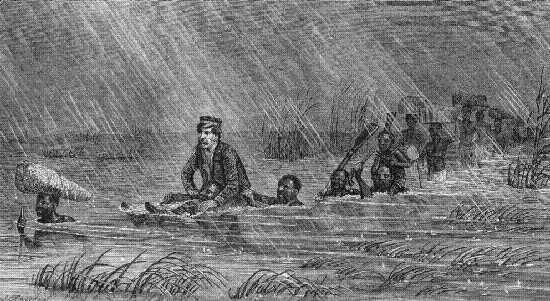
4th November, 1872.—All very tired. We tried to get food, but it is very dear, and difficult to bargain for. Goods are probably brought from Fipa. A rest will be beneficial to us.
5th November, 1872.—We went up a high mountain, but found that one of the cows could not climb up, so I sent back and ordered it to be slaughtered, waiting on the top of the mountain whilst the people went down for water.
6th November, 1872.—Pass a deep narrow bay and climb a steep mountain. Too much for the best donkey. After a few hours' climb we look down on the Lake, with its many bays. A sleepy glare floats over it. Further on we came on a ledge of rocks, and looked sheer down 500 feet or 600 feet into its dark green waters. We saw three zebras and a young python here, and fine flowers.
7th November, 1872, Sunday.—Remained, but the headman forbade his people to sell us food. We keep quiet except to invite him to a parley, which he refuses, and makes loud lullilooing in defiance, as if he were inclined to fighting. At last, seeing that we took no notice of him, he sent us a present; I returned three times its value.
8th November, 1872.—The large donkey is very ill, and unable to climb the high mountain in our front. I left men to coax him on, and they did it well. I then sent some to find a path out from the Lake mountains, for they will kill us all; others were despatched to buy food, but the Lake folks are poor except in fish.
Swifts in flocks were found on the Lake when we came to it, and there are small migrations of swallows ever since. Though this is the very hottest time of year, and all the plants are burnt off or quite dried, the flowers persist in bursting out of the hot dry surface, generally without leaves. A purple ginger, with two yellow patches inside, is very lovely to behold, and it is alternated with one of a bright canary yellow; many trees, too, put on their blossoms. The sun makes the soil so hot that the radiation is as if it came from a furnace. It burns the feet of the people, and knocks them up. Subcutaneous inflammation is frequent in the legs, and makes some of my most hardy men useless. We have been compelled to slowness very much against my will. I too was ill, and became better only by marching on foot. Riding exposes one to the bad influence of the sun, while by walking the perspiration modifies beneficially the excessive heat. It is like the difference in effect of cold if one is in activity or sitting, and falling asleep on a stage-coach. I know ten hot fountains north of the Orange River; the further north the more hot and numerous they become.
[Just here we find a note, which does not bear reference to anything that occurred at this time. Men, in the midst of their hard earnest toil, perceive great truths with a sharpness of outline and a depth of conviction which is denied to the mere idle theorist: he says:—]
The spirit of Missions is the spirit of our Master: the very genius of His religion. A diffusive philanthropy is Christianity itself. It requires perpetual propagation to attest its genuineness.
9th November, 1872.—We got very little food, and kill a calf to fill our mouths a little. A path east seems to lead out from these mountains of Tanganyika. We went on east this morning in highland open forest, then descended by a long slope to a valley in which there is water. Many Milenga gardens, but the people keep out of sight. The highlands are of a purple colour from the new leaves coming out. The donkey began to eat to my great joy. Men sent off to search for a village return empty-handed, and we must halt. I am ill and losing much blood.
10th November, 1872.—Out from the Lake mountains, and along high ridges of sandstone and dolomite. Our guide volunteered to take the men on to a place where food can be bought—a very acceptable offer. The donkey is recovering; it was distinctly the effects of tsetse, for the eyes and all the mouth and nostrils swelled. Another died at Kwihara with every symptom of tsetse poison fully developed.
[The above remarks on the susceptibility of the donkey to the bite of the tsetse fly are exceedingly important. Hitherto Dr. Livingstone had always maintained, as the result of his own observations, that this animal, at all events, could be taken through districts in which horses, mules, dogs, and oxen would perish to a certainty. With the keen perception and perseverance of one who was exploring Africa with a view to open it up for Europeans, he laid great stress on these experiments, and there is no doubt that the distinct result which he here arrived at must have a very significant bearing on the question of travel and transport.
Still passing through the same desolate country, we see that he makes a
note on the forsaken fields and the watch-towers in them. Cucumbers are
cultivated in large quantities by the natives of Inner Africa, and the
reader will no doubt call to mind the simile adopted by Isaiah some 2500
years ago, as he pictured the coming desolation of Zion, likening her to
a "lodge in a garden of cucumbers."
11th November, 1872.—Over gently undulating country, with many old gardens and watch-houses, some of great height, we reached the River Kalambo, which I know as falling into Tanganyika. A branch joins it at the village of Mosapasi; it is deep, and has to be crossed by a bridge, whilst the Kalambo is shallow, and say twenty yards wide, but it spreads out a good deal.
[Their journey of the 12th and 13th led them over low ranges of sandstone and hæmatite, and past several strongly stockaded villages. The weather was cloudy and showery—a relief, no doubt, after the burning heat of the last few weeks. They struck the Halochéché River, a rapid stream fifteen yards wide and thigh deep, on its way to the Lake, and arrived at Zombé's town, which is built in such a manner that the river runs through it, whilst a stiff palisade surrounds it. He says:—]
It was entirely surrounded by M'toka's camp, and a constant fight maintained at the point where the line of stakes was weakened by the river running through. He killed four of the enemy, and then Chitimbwa and Kasonso coming to help him, the siege was raised.
M'toka compelled some Malongwana to join him, and plundered many villages; he has been a great scourge. He also seems to have made an attack upon an Arab caravan, plundering it of six bales of cloth and one load of beads, telling them that if they wanted to get their things back they must come and help him conquer Zombé. The siege lasted three months, till the two brothers of Zombé, before-mentioned, came, and then a complete rout ensued. M'toka left nearly all his guns behind him; his allies, the Malongwana, had previously made their escape. It is two months since this rout, so we have been prevented by a kind Providence from coming soon enough. He was impudent and extortionate before, and much more now that he has been emboldened by success in plundering.
16th November, 1872.—After waiting some time for the men I sent men back yesterday to look after the sick donkey, they arrived, but the donkey died this morning. Its death was evidently caused by tsetse bite and bad usage by one of the men, who kept it forty-eight hours without water. The rain, no doubt, helped to a fatal end; it is a great loss to me.
17th November, 1872.—We went on along the bottom of a high ridge that flanks the Lake on the west, and then turned up south-east to a village hung on the edge of a deep chasm in which flows the Aeezy.
18th November, 1872.—We were soon overwhelmed in a pouring rain, and had to climb up the slippery red path which is parallel and near to Mbétté's. One of the men picked up a little girl who had been deserted by her mother. As she was benumbed by cold and wet he carried her; but when I came up he threw her into the grass. I ordered a man to carry her, and we gave her to one of the childless women; she is about four years old, and not at all negro-looking. Our march took us about S.W. to Kampamba's, the son of Kasonso, who is dead.
19th November, 1872.—I visited Kampamba. He is still as agreeable as he was before when he went with us to Liemba. I gave him two cloths as a present. He has a good-sized village. There are heavy rains now and then every day.
20th, 21st, and 23rd November, 1872.—The men turn to stringing beads for future use, and to all except defaulters I give a present of 2 dotis, and a handful of beads each. I have diminished the loads considerably, which pleases them much. We have now 3-1/2 loads of calico, and 120 bags of beads. Several go idle, but have to do any odd work, such as helping the sick or anything they are ordered to do. I gave the two Nassickers who lost the cow and calf only 1 doti, they were worth 14 dotis. One of our men is behind, sick with dysentery. I am obliged to leave him, but have sent for him twice, and have given him cloth and beads.
24th November, 1872.—Left Kampamba's to-day, and cross a meadow S.E. of the village in which the River Muanani rises. It flows into the Kapondosi and so on to the Lake. We made good way with Kiteneka as our guide, who formerly accompanied Kampamba and ourselves to Liemba. We went over a flat country once covered with trees, but now these have all been cut down, say 4 to 5 feet from the ground, most likely for clearing, as the reddish soil is very fertile. Long lines of hills of denudation are in the distance, all directed to the Lake.
We came at last to Kasonso's successor's village on the River Molulwé, which is, say, thirty yards wide, and thigh deep. It goes to the Lofu. The chief here gave a sheep—a welcome present, for I was out of flesh for four days. Kampamba is stingy as compared with his father.
25th November, 1872.—We came in an hour's march to a rivulet called the Casembe—the departed Kasonso lived here. The stream is very deep, and flows slowly to the Lofu. Our path lay through much pollarded forest, troublesome to walk in, as the stumps send out leafy shoots.
26th November, 1872.—Started at daybreak. The grass was loaded with dew, and a heavy mist hung over everything. Passed two villages of people come out to cultivate this very fertile soil, which they manure by burning branches of trees. The Rivulet Loela flows here, and is also a tributary of the Lofu.
27th November, 1872.—As it is Sunday we stay here at N'dari's village, for we shall be in an uninhabited track to-morrow, beyond the Lofu. The headman cooked six messes for us and begged us to remain for more food, which we buy. He gave us a handsome present of flour and a fowl, for which I return him a present of a doti. Very heavy rain and high gusts of wind, which wet us all.
28th November, 1872.—We came to the River Lofu in a mile. It is sixty feet across and very deep. We made a bridge, and cut the banks down, so that the donkey and cattle could pass over. It took us two hours, during which time we hauled them all across with a rope. We were here misled by our guide, who took us across a marsh covered with tufts of grass, but with deep water between that never dries; there is a path which goes round it. We came to another village with a river which must be crossed—no stockade here, and the chief allowed us to camp in his town. There are long low lines of hills all about. A man came to the bridge to ask for toll-fee: as it was composed of one stick only, and unfit for our use because rotten, I agreed to pay provided he made it fit for our large company; but if I re-made and enlarged it, I said he ought to give me a goat for the labour. He slunk away, and we laid large trees across, where previously there was but one rotten pole.
29th November, 1872.—Crossed the Loozi in two branches, and climbed up the gentle ascent of Malembé to the village of Chiwé, whom I formerly called Chibwé, being misled by the Yao tongue. Ilamba is the name of the rill at his place. The Loozi's two branches were waist deep. The first was crossed by a natural bridge of a fig-tree growing across. It runs into the Lofu, which river rises in Isunga country at a mountain called Kwitetté. The Chambezé rises east of this, and at the same place as Louzua.
Chiwé presented a small goat with crooked legs and some millet flour, but he grumbled at the size of the fathom cloth I gave. I offered another fathom, and a bundle of needles, but he grumbled at this too, and sent it back. On this I returned his goat and marched.
[The road lay through the same country among low hills, for several miles, till they came on the 1st December to a rivulet called Lovu Katanta, where curiously enough they found a nutmeg-tree in full bearing. A wild species is found at Angola on the West Coast and it was probably of this description, and not the same species as that which is cultivated in the East. In two places he says:—]
Who planted the nutmeg-tree on the Katanta?
[Passing on with heavy rain pouring down, they now found themselves in the Wemba country, the low tree-covered hills exhibiting here and there "fine-grained schist and igneous rocks of red, white, and green colour."]
3rd December, 1872.—No food to be got on account of M'toka's and Tipo Tipo's raids.
A stupid or perverse guide took us away to-day N.W. or W.N.W. The villagers refused to lead us to Chipwité's, where food was to be had; he is S.W. 1-1/2 day off. The guide had us at his mercy, for he said, "If you go S.W. you will be five days without food or people." We crossed the Kañomba, fifteen yards wide, and knee deep. Here our guide disappeared, and so did the path. We crossed the Lampussi twice; it is forty yards wide, and knee deep; our course is W.N.W. for about 4-1/2 hours to-day. We camped and sent men to search for a village that has food. My third barometer (aneroid) is incurably injured by a fall, the man who carried it slipped upon a clayey path.
4th December, 1872.—Waiting for the return of our men in a green wooded valley on the Lampussi River. Those who were sent yesterday return without anything; they were directed falsely by the country people, where nought could be bought. The people themselves are living on grubs, roots, and fruits. The young plasterer Sphex is very fat on coming out of its clay house, and a good relish for food. A man came to us demanding his wife and child; they are probably in hiding; the slaves of Tipo Tipo have been capturing people. One sinner destroyeth much good!
5th December, 1872.—The people eat mushrooms and leaves. My men returned about 5 P.M. with two of Kafimbé's men bringing a present of food to me. A little was bought, and we go on to-morrow to sleep two nights on the way, and so to Kafimbé, who is a brother of Nsama's, and fights him.
6th December, 1872.—We cross the Lampussi again, and up to a mountain along which we go, and then down to some ruins. This took us five hours, and then with 2-1/4 more hours we reach Sintila. We hasten along as fast as hungry men (four of them sick) can go to get food.
1th December, 1872.—Off at 6.15 A.M. A leopard broke in upon us last night and bit a woman. She screamed, and so did the donkey, and it ran off. Our course lay along between two ranges of low hills, then, where they ended, we went by a good-sized stream thirty yards or so across, and then down into a valley to Kafimbé's.
8th December, 1872.—Very heavy rains. I visited Kafimbé. He is an intelligent and pleasant young man, who has been attacked several times by Kitandula, the successor of Nsama of Itawa, and compelled to shift from Motononga to this rivulet Motosi, which flows into the Kisi and thence into Lake Moero.
9th December, 1872.—Send off men to a distance for food, and wait of course. Here there is none for either love or money. To-day a man came from the Arab party at Kumba-Kumba's with a present of M'chelé and a goat. He reports that they have killed Casembe, whose people concealed from him the approach of the enemy till they were quite near. Having no stockade, he fell an easy prey to them. The conquerors put his head and all his ornaments on poles. His pretty wife escaped over Mofwé, and the slaves of the Arabs ran riot everywhere. We sent a return present of two dotis of cloth, one jorah of Kaniké, one doti of coloured cloth, three pounds of beads, and a paper of needles.
10th December, 1872.—Left Kafimbé's. He gave us three men to take us into Chama's village, and came a mile along the road with us. Our road took us by a winding course from one little deserted village to another.
11th December, 1872.—Being far from water we went two hours across a plain dotted with villages to a muddy rivulet called the Mukubwé (it runs to Moero), where we found the village of a nephew of Nsama. This young fellow was very liberal in gifts of food, and in return I gave him two cloths. An Arab, Juma bin Seff, sent a goat to-day. They have been riding it roughshod over all the inhabitants, and confess it.
12th December, 1872.—Marenza sent a present of dura flour and a fowl, and asked for a little butter as a charm. He seems unwilling to give us a guide, though told by Kafimbé to do so. Many Garaganza about: they trade in leglets, ivory, and slaves. We went on half-an-hour to the River Mokoé, which is thirty yards wide, and carries off much water into Malunda, and so to Lake Moero.
When palm-oil palms are cut down for toddy, they are allowed to lie three days, then the top shoot is cut off smoothly, and the toddy begins to flow; and it flows for a month, or a month and a half or so, lying on the soil.
[The note made on the following day is written with a feeble hand, and scarce one pencilled word tallies with its neighbour in form or distinctness—in fact, it is seen at a glance what exertion it cost him to write at all. He says no more than "Ill" in one place, but this is the evident explanation; yet with the same painstaking determination of old, the three rivers which they crossed have their names recorded, and the hours of marching and the direction are all entered in his pocket book.]
13th December, 1872.—Westward about by south, and crossed a river, Mokobwé, thirty-five yards. Ill, and after going S.W. camped in a deserted village, S.W. travelling five hours. River Mekanda 2nd. Meñomba 3, where we camp.
14th December, 1872.—Guides turned N.W. to take us to a son of Nsama, and so play the usual present into his hands. I objected when I saw their direction, but they said, "The path turns round in front." After going a mile along the bank of the Meñomba, which has much water, Susi broke through and ran south, till he got a S. by W. path, which we followed, and came to a village having plenty of food. As we have now camped in village, we sent the men off to recall the fugitive women, who took us for Komba-Komba's men. Crossed the Luperé, which runs into the Makobwé.
A leech crawling towards me in the village this morning elicited the Bemba idea that they fall from the clouds or sky—"mulu." It is called here "Mosunda a maluzé," or leech of the rivers; "Luba" is the Zanzibar name. In one place I counted nineteen leeches in our path, in about a mile; rain had fallen, and their appearance out of their hiding-places suddenly after heavy rain may have given rise to the idea of their fall with it as fishes do, and the thunder frog is supposed to do. Always too cloudy and rainy for observations of stars.
15th December, 1872.—The country is now level, covered with trees pollarded for clothing, and to make ashes of for manure. There are many deserted villages, few birds. Cross the Eiver Lithabo, thirty yards wide and thigh deep, running fast to the S.W., joined by a small one near. Reached village of Chipala, on the Rivulet Chikatula, which goes to Moipanza. The Lithabo goes to Kalongwesi by a S.W. course.
16th December, 1872.—Off at 6 A.M. across the Chikatula, and in three-quarters of an hour crossed the Lopanza, twelve yards wide and waist deep, being now in flood. The Lolela was before us in half-an-hour, eight yards wide and thigh deep, both streams perennial and embowered in tall umbrageous trees that love wet; both flow to the Kalongwesi.
We came to quite a group of villages having food, and remain, as we got only driblets in the last two camps. Met two Banyamwezi carrying salt to Lobemba, of Moambu. They went to Kabuiré for it, and now retail it on the way back.
At noon we got to the village of Kasiané, which is close to two rivulets, named Lopanza and Lolela. The headman, a relative of Nsama, brought me a large present of flour of dura, and I gave him two fathoms of calico.
Floods by these sporadic rainfalls have discoloured waters, as seen in Lopanza and Lolela to-day. The grass is all springing up quickly, and the Maleza growing fast. The trees generally in full foliage. Different shades of green, the dark prevailing; especially along rivulets, and the hills in the distance are covered with dark blue haze. Here, in Lobemba, they are gentle slopes of about 200 or 300 feet, and sandstone crops out over their tops. In some parts clay schists appear, which look as if they had been fused or were baked by intense heat.
The pugnacious spirit is one of the necessities of life. When people have little or none of it, they are subjected to indignity and loss. My own men walk into houses where we pass the nights without asking any leave, and steal cassava without shame. I have to threaten and thrash to keep them honest, while if we are at a village where the natives are a little pugnacious they are as meek as sucking doves. The peace plan involves indignity and wrong. I give little presents to the headmen, and to some extent heal their hurt sensibilities. This is indeed much appreciated, and produces profound hand-clapping.
17th December, 1872.—It looked rainy, but we waited half-an-hour, and then went on one hour and a half, when it set in and forced us to seek shelter in a village. The head of it was very civil, and gave us two baskets of cassava, and one of dura. I gave a small present first. The district is called Kisinga, and flanks the Kalongwezé.
18th December, 1872.—Over same flat pollarded forest until we reached the Kalongwesé Kiver on the right bank, and about a quarter of a mile east of the confluence of the Luéna or Kisaka. This side of the river is called Kisinga, the other is Chama's and Kisinga too. The Luena comes from Jangé in Casembe's land, or W.S.W. of this. The Kalongwesé comes from the S.E. of this, and goes away N.W. The donkey sends a foot every now and then through the roof of cavities made apparently by ants, and sinks down 18 inches or more and nearly falls. These covered hollows are right in the paths.
19th December, 1872.—So cloudy and wet that no observations can be taken for latitude and longitude at this real geographical point. The Kalongwesé is sixty or eighty yards wide and four yards deep, about a mile above the confluence of the Luéna. We crossed it in very small canoes, and swamped one twice, but no one was lost. Marched S. about 1-1/4 hour.
20th December, 1872.—Shut in by heavy clouds. Wait to see if it will clear up. Went on at 7.15, drizzling as we came near the Mozumba or chiefs stockade. A son of Chama tried to mislead us by setting out west, but the path being grass-covered I objected, and soon came on to the large clear path. The guide ran off to report to the son, but we kept on our course, and he and the son followed us. We were met by a party, one of whom tried to regale us by vociferous singing and trumpeting on an antelope's horn, but I declined the deafening honour. Had we suffered the misleading we should have come here to-morrow afternoon.
A wet bed last night, for it was in the canoe that was upset. It was so rainy that there was no drying it.
21st December, 1872.—Arrived at Chama's. Heavy clouds drifting past, and falling drizzle. Chama's brother tried to mislead us yesterday, in hopes of making us wander hopelessly and helplessly. Failing in this, from my refusal to follow a grass-covered path, he ran before us to the chief's stockade, and made all the women flee, which they did, leaving their chickens damless. We gave him two handsome cloths, one for himself and one for Chama, and said we wanted food only, and would buy it. They are accustomed to the bullying of half-castes, who take what they like for nothing. They are alarmed at our behaviour to-day, so we took quiet possession of the stockade, as the place that they put us in was on the open defenceless plain. Seventeen human skulls ornament the stockade. They left their fowls, and pigeons. There was no bullying. Our women went in to grind food, and came out without any noise. This flight seems to be caused by the foolish brother of the chief, and it is difficult to prevent stealing by my horde. The brother came drunk, and was taking off a large sheaf of arrows, when we scolded and prevented him.
22nd December, 1872.—We crossed a rivulet at Chama's village ten yards wide and thigh deep, and afterwards in an hour and a half came to a sedgy stream which we could barely cross. We hauled a cow across bodily. Went on mainly south, and through much bracken.
23rd December, 1872.—Off at 6 A.M. in a mist, and in an hour and a quarter came to three large villages by three rills called Misangwa, and much sponge; went on to other villages south, and a stockade.
24th December, 1872.—Cloud in sky with drifting clouds from S. and S.W. Very wet and drizzling. Sent back Chama's arrows, as his foolish brother cannot use them against us now; there are 215 in the bundle. Passed the Lopopussi running west to the Lofubu about seven yards wide, it flows fast over rocks with heavy aquatic plants. The people are not afraid of us here as they were so distressingly elsewhere: we hope to buy food here.
25th December, 1872, Christmas Day.—I thank the good Lord for the good gift of His Son Christ Jesus our Lord. Slaughtered an ox, and gave a fundo and a half to each of the party. This is our great day, so we rest. It is cold and wet, day and night. The headman is gracious and generous, which is very pleasant compared with awe, awe, and refusing to sell, or stop to speak, or show the way.
The White Nile carrying forward its large quasi-tidal wave presents a mass of water to the Blue Nile, which acts as a buffer to its rapid flood. The White Nile being at a considerable height when the Blue rushes down its steep slopes, presents its brother Nile with a soft cushion into which it plunges, and is restrained by the vis inertiæ of the more slowly moving river, and, both united, pass on to form the great inundation of the year in Lower Egypt. The Blue River brings down the heavier portion of the Nile deposit, while the White River comes down with the black finely divided matter from thousands of square miles of forest in Manyuema, which probably gave the Nile its name, and is in fact the real fertilizing ingredient in the mud that is annually left. Some of the rivers in Manyuema, as the Luia and Machila, are of inky blackness, and make the whole main stream of a very Nilotic hue. An acquaintance with these dark flowing rivers, and scores of rills of water tinged as dark as strong tea, was all my reward for plunging through the terrible Manyuema mud or "glaur."
26th December, 1872.—Along among the usual low tree-covered hills of red and yellow and green schists—paths wet and slippery. Came to the Lofubu, fifteen yards broad and very deep, water clear, flowing north-west to join Luéna or Kisaka, as the Lopopussi goes west too into Lofubu it becomes large as we saw. We crossed by a bridge, and the donkey swam with men on each side of him. We came to three villages on the other side with many iron furnaces. Wet and drizzling weather made us stop soon. A herd of buffaloes, scared by our party, rushed off and broke the trees in their hurry, otherwise there is no game or marks of game visible.
27th December, 1872.—Leave the villages on the Lofubu. A cascade comes down on our left. The country undulating deeply, the hills, rising at times 300 to 400 feet, are covered with stunted wood. There is much of the common bracken fern and hart's-tongue. We cross one rivulet running to the Lofubu, and camp by a blacksmith's rill in the jungle. No rain fell to-day for a wonder, but the lower tier of clouds still drifts past from N.W.
I killed a Naia Hadje snake seven feet long here, he reared up before me and turned to fight. The under north-west stratum of clouds is composed of fluffy cottony masses, the edges spread out as if on an electrical machine—the upper or south-east is of broad fields like striated cat's hair. The N.W. flies quickly, the S.E. slowly away where the others come from. No observations have been possible through most of this month. People assert that the new moon will bring drier weather, and the clouds are preparing to change the N.W. lower stratum into S.E., ditto, ditto, and the N.W. will be the upper tier.
A man, ill and unable to come on, was left all night in the rain, without fire. We sent men back to carry him. Wet and cold. We are evidently ascending as we come near the Chambezé. The N.E. clouds came up this morning to meet the N.W. and thence the S.E. came across as if combating the N.W. So as the new moon comes soon, it may be a real change to drier weather.
4 P.M.—The man carried in here is very ill; we must carry him to-morrow.
29th December, 1872.—Our man Chipangawazi died last night and was buried this morning. He was a quiet good man, his disease began at Kampamba's. New moon last night.
29th, or 1st January, 1873.—I am wrong two days.
29th December, 1872.—After the burial and planting four branches of Moriñga at the corners of the grave we went on southwards 3-1/4 hours to a river, the Luongo, running strongly west and south to the Luapula, then after one hour crossed it, twelve yards wide and waist deep. We met a man with four of his kindred stripping off bark to make bark-cloth: he gives me the above information about the Luongo.
1st January, 1873. (30th.)—Came on at 6 A.M. very cold. The rains have ceased for a time. Arrive at the village of the man who met us yesterday. As we have been unable to buy food, through the illness and death of Chipangawazi, I camp here.
2nd January, 1873.—Thursday—Wednesday was the 1st, I was two days wrong.
3rd January, 1873.—The villagers very anxious to take us to the west to Chikumbi's, but I refused to follow them, and we made our course to the Luongo. Went into the forest south without a path for 1-1/2 hour, then through a flat forest, much fern and no game. We camped in the forest at the Situngula Rivulet. A little quiet rain through the night. A damp climate this—lichens on all the trees, even on those of 2 inches diameter. Our last cow died of injuries received in crossing the Lofubu. People buy it for food, so it is not an entire loss.
4th January, 1873.—March south one hour to the Lopoposi or Lopopozi stream of 25 or 30 feet, and now breast deep, flowing fast southwards to join the Chambezé. Camped at Ketebé's at 2 P.M. on the Rivulet Kizima after very heavy rain.
5th January, 1873.—A woman of our party is very ill; she will require to be carried to-morrow.
6th January, 1873.—Ketebé or Kapesha very civil and generous. He sent three men to guide us to his elder brother Chungu. The men drum and sing harshly for him continually. I gave him half-a-pound of powder, and he lay on his back rolling and clapping his hands, and all his men lulliloed; then he turned on his front, and did the same. The men are very timid—no wonder, the Arab slaves do as they choose with them. The women burst out through, the stockade in terror when my men broke into a chorus as they were pitching my tent. Cold, cloudy, and drizzling. Much cultivation far from the stockades.
The sponges here are now full and overflowing, from the continuous and heavy rains. Crops of mileza, maize, cassava, dura, tobacco, beans, ground-nuts, are growing finely. A border is made round each patch, manured by burning the hedge, and castor-oil plants, pumpkins, calabashes, are planted in it to spread out over the grass.
7th January, 1873.—A cold rainy day keeps us in a poor village very unwillingly. 3 P.M. Fair, after rain all the morning—on to the Rivulet Kamalopa, which runs to Kamolozzi and into Kapopozi.
8th January, 1873.—Detained by heavy continuous rains in the village Moenje. We are near Lake Bangweolo and in a damp region. Got off in the afternoon in a drizzle; crossed a rill six feet wide, but now very deep, and with large running sponges on each side; it is called the Kamalopa, then one hour beyond came to a sponge, and a sluggish rivulet 100 yards broad with broad sponges on either bank waist deep, and many leeches. Came on through flat forest as usual S.W. and S.
[We may here call attention to the alteration of the face of the country and the prominent notice of "sponges." His men speak of the march from this point as one continual plunge in and out of morass, and through rivers which were only distinguishable from the surrounding waters by their deep currents and the necessity for using canoes. To a man reduced in strength and chronically affected with dysenteric symptoms ever likely to be aggravated by exposure, the effect may be well conceived! It is probable that had Dr. Livingstone been at the head of a hundred picked Europeans, every man would have been down within the next fortnight. As it is, we cannot help thinking of his company of followers, who must have been well led and under the most thorough control to endure these marches at all, for nothing cows the African so much as rain. The next day's journey may be taken as a specimen of the hardships every one had to endure:—]
9th January, 1873.—Mosumba of Chungu. After an hour we crossed the rivulet and sponge of Nkulumuna, 100 feet of rivulet and 200 yards of flood, besides some 200 yards of sponge full and running off; we then, after another hour, crossed the large rivulet Lopopozi by a bridge which was 45 feet long, and showed the deep water; then 100 yards of flood thigh deep, and 200 or 300 yards of sponge. After this we crossed two rills called Liñkanda and their sponges, the rills in flood 10 or 12 feet broad and thigh deep. After crossing the last we came near the Mosumba, and received a message to build our sheds in the forest, which we did.
Chungu knows what a nuisance a Safari (caravan) makes itself. Cloudy day, and at noon heavy rain from N.W. The headman on receiving two cloths said he would converse about our food and show it to-morrow. No observations can be made, from clouds and rain.
10th January, 1873.—Mosumba of Chungu. Rest to-day and get an insight into the ford: cold rainy weather. When we prepared to visit Chungu, we received a message that he had gone to his plantations to get millet. He then sent for us at 1 P.M. to come, but on reaching the stockade we heard a great Kelélé, or uproar, and found it being shut from terror. We spoke to the inmates but in vain, so we returned. Chungu says that we should put his head on a pole like Casembe's! We shall go on without him to-morrow. The terror guns have inspired is extreme.
11th January, 1873.—Chungu sent a goat and big basket of flour, and excused his fears because guns had routed Casembe and his head was put on a pole; it was his young men that raised the noise. We remain to buy food, as there is scarcity at Mombo, in front. Cold and rainy weather, never saw the like; but this is among the sponges of the Nile and near the northern shores of Bangweolo.
12th January, 1873.—A dry day enabled us to move forward an hour to a rivulet and sponge, but by ascending it we came to its head and walked over dryshod, then one hour to another broad rivulet—Pinda, sluggish, and having 100 yards of sponge on each side. This had a stockaded village, and the men in terror shut the gates. Our men climbed over and opened them, but I gave the order to move forward through flat forest till we came to a running rivulet of about twenty feet, but with 100 yards of sponge on each side. The white sand had come out as usual and formed the bottom. Here we entered a village to pass the night. We passed mines of fine black iron ore ("motapo"); it is magnetic.
13th January, 1873.—Storm-stayed by rain and cold at the village on the Rivulet Kalambosi, near the Chambezé. Never was in such a spell of cold rainy weather except in going to Loanda in 1853. Sent back for food.
14th January, 1873.—Went on dry S.E. and then S. two hours to River Mozinga, and marched parallel to it till we came to the confluence of Kasié. Mosinga, 25 feet, waist deep, with 150 yards of sponge on right bank and about 50 yards on left. There are many plots of cassava, maize, millet, dura, ground-nuts, voandzeia, in the forest, all surrounded with strong high hedges skilfully built, and manured with wood ashes. The villagers are much afraid of us. After 4-1/2 hours we were brought up by the deep rivulet Mpanda, to be crossed to-morrow in canoes. There are many flowers in the forest: marigolds, a white jonquil-looking flower without smell, many orchids, white, yellow, and pink Asclepias, with bunches of French-white flowers, clematis—Methonica gloriosa, gladiolus, and blue and deep purple polygalas, grasses with white starry seed-vessels, and spikelets of brownish red and yellow. Besides these there are beautiful blue flowering bulbs, and new flowers of pretty delicate form and but little scent. To this list may be added balsams, compositæ of blood-red colour and of purple; other flowers of liver colour, bright canary yellow, pink orchids on spikes thickly covered all round, and of three inches in length; spiderworts of fine blue or yellow or even pink. Different coloured asclepedials; beautiful yellow and red umbelliferous flowering plants; dill and wild parsnips; pretty flowery aloes, yellow and red, in one whorl of blossoms; peas, and many other flowering plants which I do not know. Very few birds or any kind of game. The people are Babisa, who have fled from the west and are busy catching fish in basket traps.
15th January, 1873.—Found that Chungu had let us go astray towards the Lake, and into an angle formed by the Mpandé and Lopopussi, and the Lake-full of rivulets which are crossed with canoes. Chisupa, a headman on the other side of the Mpanda, sent a present and denounced Chungu for heartlessness. We explained to one man our change of route and went first N.E., then E. to the Monsinga, which we forded again at a deep place full of holes and rust-of-iron water, in which we floundered over 300 yards. We crossed a sponge thigh deep before we came to the Mosinga, then on in flat forest to a stockaded village; the whole march about east for six hours.
16th January, 1873.—Away north-east and north to get out of the many rivulets near the Lake back to the River Lopopussi, which now looms large, and must be crossed in canoes. We have to wait in a village till these are brought, and have only got 1-3/4 hour nearly north.
We were treated scurvily by Chungu. He knew that we were near the Chambezé, but hid the knowledge and himself too. It is terror of guns.
17th January, 1873.—We are troubled for want of canoes, but have to treat gently with the owners, otherwise they would all run away, as they have around Chungu's, in the belief that we should return to punish their silly headman. By waiting patiently yesterday, we drew about twenty canoes towards us this morning, but all too small for the donkey, so we had to turn away back north-west to the bridge above Chungu's. If we had tried to swim the donkey across alongside a canoe it would have been terribly strained, as the Lopopussi is here quite two miles wide and full of rushes, except in the main stream. It is all deep, and the country being very level as the rivulets come near to the Lake, they become very broad. Crossed two sponges with rivulets in their centre.
Much cultivation in the forest. In the second year the mileza and maize are sickly and yellow white; in the first year, with fresh wood ashes, they are dark green and strong. Very much of the forest falls for manure. The people seem very eager cultivators. Possibly mounds have the potash brought up in forming.
18th January, 1873.—We lost a week by going to Chungu (a worthless terrified headman), and came back to the ford of Lopopussi, which we crossed, only from believing him to be an influential man who would explain the country to us. We came up the Lopopussi three hours yesterday, after spending two hours in going down to examine the canoes. We hear that Sayde bin Ali is returning from Katanga with much ivory.
19th January, 1873.—After prayers we went on to a fine village, and on from it to the Mononsé, which, though only ten feet of deep stream flowing S., had some 400 yards of most fatiguing, plunging, deep sponge, which lay in a mass of dark-coloured rushes, that looked as if burnt off: many leeches plagued us. We were now two hours out. We went on two miles to another sponge and village, but went round its head dryshod, then two hours more to sponge Lovu. Flat forest as usual.
20th January, 1873.—Tried to observe lunars in vain; clouded over all, thick and muggy. Came on disappointed and along the Lovu 1-1/2 mile. Crossed it by a felled tree lying over it. It is about six feet deep, with 150 yards of sponge. Marched about 2-1/2 hours: very unsatisfactory progress.
[In answer to a question as to whether Dr. Livingstone could possibly manage to wade so much, Susi says that he was carried across these sponges and the rivulets on the shoulders of Chowpéré or Chumah.]
21st January, 1873.—Fundi lost himself yesterday, and we looked out for him. He came at noon, having wandered in the eager pursuit of two herds of eland; having seen no game for a long time, he lost himself in the eager hope of getting one. We went on 2-1/2 hours, and were brought up by the River Malalanzi, which is about 15 feet wide, waist deep, and has 300 yards or more of sponge. Guides refused to come as Chituñkùe, their headman, did not own them. We started alone: a man came after us and tried to mislead us in vain.
22nd January, 1873.—We pushed on through many deserted gardens and villages, the man evidently sent to lead us astray from our S.E. course; he turned back when he saw that we refused his artifice. Crossed another rivulet, possibly the Lofu, now broad and deep, and then came to another of several deep streams but sponge, not more than fifty feet in all. Here we remained, having travelled in fine drizzling rain all the morning. Population all gone from the war of Chitoka with this Chituñkùe.
No astronomical observations worth naming during December and January; impossible to take any, owing to clouds and rain.
It is trying beyond measure to be baffled by the natives lying and misleading us wherever they can. They fear us very, greatly, and with a terror that would gratify an anthropologist's heart. Their unfriendliness is made more trying by our being totally unable to observe for our position. It is either densely clouded, or continually raining day and night. The country is covered with brackens, and rivulets occur at least one every hour of the march. These are now deep, and have a broad selvage of sponge. The lower stratum of clouds moves quickly from the N.W.; the upper move slowly from S.E., and tell of rain near.
23rd January, 1873.—We have to send back to villages of Chituñkùe to buy food. It was not reported to me that the country in front was depopulated for three days, so I send a day back. I don't know where we are, and the people are deceitful in their statements; unaccountably so, though we deal fairly and kindly. Rain, rain, rain as if it never tired on this watershed. The showers show little in the gauge, but keep everything and every place wet and sloppy.
Our people return with a wretched present from Chituñkùe; bad flour and a fowl, evidently meant to be rejected. He sent also an exorbitant demand for gunpowder, and payment of guides. I refused his present, and must plod on without guides, and this is very difficult from the numerous streams.
 "The Main Stream came up to Susi's Mouth"
24th January, 1873.—Went on E. and N.E. to avoid the deep part of a large river, which requires two canoes, but the men sent by the chief would certainly hide them. Went 1-3/4 hour's journey to a large stream through drizzling rain, at least 300 yards of deep water, amongst sedges and sponges of 100 yards. One part was neck deep for fifty yards, and the water cold. We plunged in elephants' footprints 1-1/2 hour, then came on one hour to a small rivulet ten feet broad, but waist deep, bridge covered and broken down. Carrying me across one of the broad deep sedgy rivers is really a very difficult task. One we crossed was at least 2000 feet broad, or more than 300 yards. The first part, the main stream, came up to Susi's mouth, and wetted my seat and legs. One held up my pistol behind, then one after another took a turn, and when he sank into a deep elephant's foot-print, he required two to lift him, so as to gain a footing on the level, which was over waist deep. Others went on, and bent down the grass, to insure some footing on the side of the elephants' path. Every ten or twelve paces brought us to a clear stream, flowing fast in its own channel, while over all a strong current came bodily through all the rushes and aquatic plants. Susi had the first spell, then Farijala, then a tall, stout, Arab-looking man, then Amoda, then Chanda, then Wadé Salé, and each time I was lifted off bodily, and put on another pair of stout willing shoulders, and fifty yards put them out of breath: no wonder! It was sore on the women folk of our party. It took us full an hour and a half for all to cross over, and several came over turn to help me and their friends. The water was cold, and so was the wind, but no leeches plagued us. We had to hasten on the building of sheds after crossing the second rivulet, as rain threatened us. After 4 P.M. it came on a pouring cold rain, when we were all under cover. We are anxious about food. The Lake is near, but we are not sure of provisions, as there have been changes of population. Our progress is distressingly slow. Wet, wet, wet; sloppy weather, truly, and no observations, except that the land near the Lake being very level, the rivers spread out into broad friths and sponges. The streams are so numerous that there has been a scarcity of names. Here we have Loon and Luéna. We had two Loous before, and another Luena.
25th January, 1873.—Kept in by rain. A man from Unyanyembé joined us this morning. He says that he was left sick. Rivulets and sponges again, and through flat forest, where, as usual, we can see the slope of the land by the leaves being washed into heaps in the direction which the water in the paths wished to take. One and a half hours more, and then to the River Loou, a large stream with bridge destroyed. Sent to make repairs before we go over it, and then passed. The river is deep, and flows fast to the S.W., having about 200 yards of safe flood flowing in long grass—clear water. The men built their huts, and had their camp ready by 3 P.M. A good day's work, not hindered by rain. The country all depopulated, so we can buy nothing. Elephants and antelopes have been here lately.
26th January, 1873.—I arranged to go to our next River Luena, and ascend it till we found it small enough for crossing, as it has much "Tinga-tinga," or yielding spongy soil; but another plan was formed by night, and we were requested to go down the Loou. Not wishing to appear overbearing, I consented until we were, after two hours' southing, brought up by several miles of Tinga-tinga. The people in a fishing village ran away from us, and we had to wait for some sick ones. The women are collecting mushrooms. A man came near us, but positively refused to guide us to Matipa, or anywhere else.
The sick people compelled us to make an early halt.
27th January, 1873.—On again through streams, over sponges and rivulets thigh deep. There are marks of gnu and buffalo. I lose much blood, but it is a safety-valve for me, and I have no fever or other ailments.
28th January, 1873.—A dreary wet morning, and no food that we know of near. It is drop, drop, drop, and drizzling from the north-west. We killed our last calf but one last night to give each a mouthful. At 9.30 we were allowed by the rain to leave our camp, and march S.E. for two hours to a strong deep rivulet ten feet broad only, but waist deep, and 150 yards of flood all deep too. Sponge about forty yards in all, and running fast out. Camped by a broad prairie or Bouga.
29th January, 1873.—No rain in the night, for a wonder. We tramped 1-1/4 hour to a broad sponge, having at least 300 yards of flood, and clear water flowing S.W., but no usual stream. All was stream flowing through the rushes, knee and thigh deep. On still with the same, repeated again and again, till we came to broad branching sponges, at which I resolved to send out scouts S., S.E., and S.W. The music of the singing birds, the music of the turtle doves, the screaming of the frankolin proclaim man to be near.
30th January, 1873.—Remain waiting for the scouts. Manuasera returned at dark, having gone about eight hours south, and seen the Lake and two islets. Smoke now appeared in the distance, so he turned, and the rest went on to buy food where the smoke was. Wet evening.
FOOTNOTES:
CHAPTER XI.
Entangled amongst the marshes of Bangweolo. Great privations. Obliged to return to Chituñkuè's. At the chief's mercy. Agreeably surprised with the chief. Start once more. Very difficult march. Robbery exposed. Fresh attack of illness. Sends scouts out to find villages. Message to Chirubwé. An ant raid. Awaits news from Matipa. Distressing perplexity. The Bougas of Bangweolo. Constant rain above and flood below. Ill. Susi and Chuma sent as envoys to Matipa. Reach Bangweolo. Arrive at Matipa's islet. Matipa's town. The donkey suffers in transit. Tries to go on to Kabinga's. Dr. Livingstone makes a demonstration. Solution of the transport difficulty. Susi and detachment sent to Kabinga's. Extraordinary extent of flood. Reaches Kabinga's. An upset. Crosses the Chambezé. The River Muanakazi. They separate into companies by land and water. A disconsolate lion. Singular caterpillars. Observations on fish. Coasting along the southern flood of Lake Bangweolo. Dangerous state of Dr. Livingstone.
1st February, 1873.—Waiting for the scouts. They return unsuccessful—forced to do so by hunger. They saw a very large river flowing into the Lake, but did not come across a single soul. Killed our last calf, and turn back for four hard days' travel to Chituñkuè's. I send men on before us to bring food back towards us.
2nd February, 1873.—March smartly back to our camp of 28th ult. The people bear their hunger well. They collect mushrooms and plants, and often get lost in this flat featureless country.
3rd February, 1873.—Return march to our bridge on the Lofu, five hours. In going we went astray, and took six hours to do the work of five. Tried lunars in vain. Either sun or moon in clouds. On the Luéna.
4th February, 1873.—Return to camp on the rivulet with much Methonica gloriosa on its banks. Our camp being on its left bank of 26th. It took long to cross the next river, probably the Kwalé, though the elephants' footprints are all filled up now. Camp among deserted gardens, which afford a welcome supply of cassava and sweet potatoes. The men who were sent on before us slept here last night, and have deceived us by going more slowly without loads than we who are loaded.
5th February, 1873.—Arrived at Chituñkuè's, crossing two broad deep brooks, and on to the Malalenzi, now swollen, having at least 200 yards of flood and more than 300 yards of sponge. Saluted by a drizzling shower. We are now at Chituñkuè's mercy.
We find the chief more civil than we expected. He said each chief had his own land and his own peculiarities. He was not responsible for others. We were told that we had been near to Matipa and other chiefs: he would give us guides if we gave him a cloth and some powder.
We returned over these forty-one miles in fifteen hours, through much deep water. Our scouts played us false both in time and beads: the headmen punished them. I got lunars, for a wonder. Visited Chitunkubwé, as his name properly is. He is a fine jolly-looking man, of a European cast of countenance, and very sensible and friendly. I gave him two cloths, for which he seemed thankful, and promised good guides to Matipa's. He showed me two of Matipa's men who had heard us firing guns to attract one of our men who had strayed; these men followed us. It seems we had been close to human habitations, but did not know it. We have lost half a month by this wandering, but it was all owing to the unfriendliness of some and the fears of all. I begged for a more northerly path, where the water is low. It is impossible to describe the amount of water near the Lake. Rivulets without number. They are so deep as to damp all ardour. I passed a very large striped spider in going to visit Chitunkubwé. The stripes were of yellowish green, and it had two most formidable reddish mandibles, the same shape as those of the redheaded white ant. It seemed to be eating a kind of ant with a light-coloured head, not seen elsewhere. A man killed it, and all the natives said that it was most dangerous. We passed gardens of dura; leaves all split up with hail, and forest leaves all punctured.
6th February, 1873.—Chitunkubwé gave a small goat and a large basket of flour as a return present. I gave him three-quarters of a pound of powder, in addition to the cloth.
7th February, 1873.—This chief showed his leanings by demanding prepayment for his guides. This being a preparatory step to their desertion I resisted, and sent men to demand what he meant by his words; he denied all, and said that his people lied, not he. We take this for what it is worth. He gives two guides to-morrow morning, and visits us this afternoon.
8th February, 1873.—The chief dawdles, although he promised great things yesterday. He places the blame on his people, who did not prepare food on account of the rain. Time is of no value to them. We have to remain over to-day. It is most trying to have to wait on frivolous pretences. I have endured such vexatious delays. The guides came at last with quantities of food, which they intend to bargain with my people on the way. A Nassicker who carried my saddle was found asleep near my camp.
9th February, 1873.—Slept in a most unwholesome, ruined village. Rank vegetation had run over all, and the soil smelled offensively. Crossed a sponge, then a rivulet, and sponge running into the Miwalé Eiver, then by a rocky passage we crossed the Mofiri, or great Tinga-tinga, a water running strongly waist and breast deep, above thirty feet broad here, but very much broader below. After this we passed two more rills and the River Methonua, but we build a camp above our former one. The human ticks called "papasi" by the Suaheli, and "karapatos" by the Portuguese, made even the natives call out against their numbers and ferocity.
10th February, 1873.—Back again to our old camp on the Lovu or Lofu by the bridge. We left in a drizzle, which continued from 4 A.M. to 1 P.M. We were three hours in it, and all wetted, just on reaching camp by 200 yards, of flood mid-deep; but we have food.
11th February, 1873.—Our guides took us across country, where we saw tracks of buffaloes, and in a meadow, the head of a sponge, we saw a herd of Hartebeests. A drizzly night was followed by a morning of cold wet fog, but in three hours we reached our old camp: it took us six hours to do this distance before, and five on our return. We camped on a deep bridged stream, called the Kiachibwé.
12th February, 1873.—We crossed the Kasoso, which joins the Mokisya, a river we afterwards crossed: it flows N.W., then over the Mofungwé. The same sponges everywhere.
13th February, 1873.—In four hours we came within sight of the Luéna and Lake, and saw plenty of elephants and other game, but very shy. The forest trees are larger. The guides are more at a loss than we are, as they always go in canoes in the flat rivers and rivulets. Went E., then S.E. round to S.
14th February, 1873.—Public punishment to Chirango for stealing beads, fifteen cuts; diminished his load to 40 lbs., giving him blue and white beads to be strung. The water stands so high in the paths that I cannot walk dryshod, and I found in the large bougas or prairies in front, that it lay knee deep, so I sent on two men to go to the first villages of Matipa for large canoes to navigate the Lake, or give us a guide to go east to the Chambezé, to go round on foot. It was Halima who informed on Chirango, as he offered her beads for a cloth of a kind which she knew had not hitherto been taken out of the baggage. This was so far faithful in her, but she has an outrageous tongue. I remain because of an excessive hæmorrhagic discharge.
[We cannot but believe Livingstone saw great danger in these constant recurrences of his old disorder: we find a trace of it in the solemn reflections which he wrote in his pocket-book, immediately under the above words:—]
If the good Lord gives me favour, and permits me to finish my work, I shall thank and bless Him, though it has cost me untold toil, pain, and travel; this trip has made my hair all grey.
15th February, 1873, Sunday.—Service. Killed our last goat while waiting for messengers to return from Matipa's. Evening: the messenger came back, having been foiled by deep tinga-tinga and bouga. He fired his gun three times, but no answer came, so as he had slept one night away he turned, but found some men hunting, whom he brought with him. They say that Matipa is on Chirubé islet, a good man too, but far off from this.
16th February, 1873.—Sent men by the hunter's canoe to Chirubé, with a request to Matipa to convey us west if he has canoes, but, if not, to tell us truly, and we will go east and cross the Chambezé where it is small. Chitunkubwé's men ran away, refusing to wait till we had communicated with Matipa. Here the water stands underground about eighteen inches from the surface. The guides played us false, and this is why they escaped.
17th February, 1873.—The men will return to-morrow, but they have to go all the way out to the islet of Chirubé to Matipa's.
Suffered a furious attack at midnight from the red Sirafu or Driver ants. Our cook fled first at their onset. I lighted a candle, and remembering Dr. Van der Kemp's idea that no animal will attack man unprovoked, I lay still. The first came on my foot quietly, then some began to bite between the toes, then the larger ones swarmed over the foot and bit furiously, and made the blood start out. I then went out of the tent, and my whole person was instantly covered as close as small-pox (not confluent) on a patient. Grass fires were lighted, and my men picked some off my limbs and tried to save me. After battling for an hour or two they took me into a hut not yet invaded, and I rested till they came, the pests, and routed me out there too! Then came on a steady pour of rain, which held on till noon, as if trying to make us miserable. At 9 A.M. I got back into my tent. The large Sirafu have mandibles curved like reaping-sickles, and very sharp—as fine at the point as the finest needle or a bee's sting. Their office is to remove all animal refuse, cockroaches, &c., and they took all my fat. Their appearance sets every cockroach in a flurry, and all ants, white and black, get into a panic. On man they insert the sharp curved mandibles, and then with six legs push their bodies round so as to force the points by lever power. They collect in masses in their runs and stand with mandibles extended, as if defying attack. The large ones stand thus at bay whilst the youngsters hollow out a run half an inch wide, and about an inch deep. They remained with us till late in the afternoon, and we put hot ashes on the defiant hordes. They retire to enjoy the fruits of their raid, and come out fresh another day.
18th February, 1873.—We wait hungry and cold for the return of the men who have gone to Matipa, and hope the good Lord will grant us influence with this man.
Our men have returned to-day, having obeyed the native who told them to sleep instead of going to Matipa. They bought food, and then believed that the islet Chirubé was too far off, and returned with a most lame story. We shall make the best of it by going N.W., to be near the islets and buy food, till we can communicate with Matipa. If he fails us by fair means, we must seize canoes and go by force. The men say fear of me makes them act very cowardly. I have gone amongst the whole population kindly and fairly, but I fear I must now act rigidly, for when they hear that we have submitted to injustice, they at once conclude that we are fair game for all, and they go to lengths in dealing falsely that they would never otherwise attempt. It is, I can declare, not my nature, nor has it been my practice, to go as if "my back were up."
19th February, 1873.—A cold wet morning keeps us in this uncomfortable spot. When it clears up we go to an old stockade, to be near an islet to buy food. The people, knowing our need, are extortionate. We went on at 9 A.M. over an extensive water-covered plain. I was carried three miles to a canoe, and then in it we went westward, in branches of the Luena, very deep and flowing W. for three hours. I was carried three miles to a canoe, and we were then near enough to hear Bangweolo bellowing. The water on the plain is four, five, and seven feet deep. There are rushes, ferns, papyrus, and two lotuses, in abundance. Many dark grey caterpillars clung to the grass and were knocked off as we paddled or poled. Camped in an old village of Matipa's, where, in the west, we see the Luena enter Lake Bangweolo; but all is flat prairie or buga, filled with fast-flowing water, save a few islets covered with palms and trees. Rain continued sprinkling us from the N.W. all the morning. Elephants had run riot over the ruins, eating a species of grass now in seed. It resembles millet, and the donkey is fond of it. I have only seen this and one other species of grass in seed eaten by the African elephant. Trees, bulbs, and fruits are his dainties, although ants, whose hills he overturns, are relished. A large party in canoes came with food as soon as we reached our new quarters: they had heard that we were in search of Matipa. All are eager for calico, though they have only raw cassava to offer. They are clothed in bark-cloth and skins. Without canoes no movement can be made in any direction, for it is water everywhere, water above and water below.
20th February, 1873.—I sent a request to a friendly man to give me men, and a large canoe to go myself to Matipa; he says that he will let me know to-day if he can. Heavy rain by night and drizzling by day. No definite answer yet, but we are getting food, and Matipa will soon hear of us as he did when we came and returned back for food. I engaged another man to send a canoe to Matipa, and I showed him his payment, but retain it here till he comes back.
21st February, 1873.—The men engaged refuse to go to Matipa's, they have no honour. It is so wet we can do nothing. Another man spoken to about going, says that they run the risk of being killed by some hostile people on another island between this and Matipa's.
22nd February, 1873.—A wet morning. I was ill all yesterday, but escape fever by hæmorrhage. A heavy mantle of N.W. clouds came floating over us daily. No astronomical observation can possibly be taken. I was never in such misty cloudy weather in Africa. A man turned up at 9 A.M. to carry our message to Matipa; Susi and Chumah went with him. The good Lord go with them, and lend me influence and grant me help.
23rd February, 1873, Sunday.—Service. Rainy.
24th February, 1873.—Tried hard for a lunar, but the moon was lost in the glare of the sun.
25th February, 1873.—For a wonder it did not rain till 4 P.M. The people bring food, but hold out for cloth, which is inconvenient.
Susi and Chumah not appearing may mean that the men are preparing canoes and food to transport us.
25th February, 1873.—Susi returned this morning with good news from Matipa, who declares his willingness to carry us to Kabendé for the five bundles of brass wire I offered. It is not on Chirubé, but amid the swamps of the mainland on the Lake's north side. Immense swampy plains all around except at Kabendé. Matipa is at variance with his brothers on the subject of the lordship of the lands and the produce of the elephants, which are very numerous. I am devoutly thankful to the Giver of all for favouring me so far, and hope that He may continue His kind aid.
No mosquitoes here, though Speke, at the Victoria Nyanza, said they covered the bushes and grass in myriads, and struck against the hands and face most disagreeably.
27th February, 1873.—Waiting for other canoes to be sent by Matipa. His men say that there is but one large river on the south of Lake Bangweolo, and called Luomba. They know the mountains on the south-east as I do, and on the west, but say they don't know any on the middle of the watershed. They plead their youth as an excuse for knowing so little.
Matipa's men proposed to take half our men, but I refused to divide our force; they say that Matipa is truthful.
28th February, 1873.—No night rain after 8 P.M., for a wonder. Baker had 1500 men in health on 15th June, 1870, at lat. 9° 26' N., and 160 on sick list; many dead. Liberated 305 slaves. His fleet was thirty-two vessels; wife and he well. I wish that I met him. Matipa's men not having come, it is said they are employed bringing the carcase of an elephant to him. I propose to go near to him to-morrow, some in canoes and some on foot. The good Lord help me. New moon this evening.
1st March, 1873.—Embarked women and goods in canoes, and went three hours S.E. to Bangweolo. Stopped on an island where people were drying fish over fires. Heavy rain wetted us all as we came near the islet, the drops were as large as half-crowns by the marks they made. We went over flooded prairie four feet deep, and covered with rushes, and two varieties of lotus or sacred lily; both are eaten, and so are papyrus. The buffaloes are at a loss in the water. Three canoes are behind. The men are great cowards. I took possession of all the paddles and punting poles, as the men showed an inclination to move off from our islet. The water in the country is prodigiously large: plains extending further than the eye can reach have four or five feet of clear water, and the Lake and adjacent lands for twenty or thirty miles are level. We are on a miserable dirty fishy island called Motovinza; all are damp. We are surrounded by scores of miles of rushes, an open sward, and many lotus plants, but no mosquitoes.
2nd March, 1873.—It took us 7-1/2 hours' punting to bring us to an
island, and then the miserable weather rained constantly on our landing
into the Boma (stockade), which is well peopled. The prairie is ten
hours long, or about thirty miles by punting. Matipa is on an island
too, with four bomas on it. A river, the Molonga, runs past it, and is a
protection.
The men wear a curious head-dress of skin or hair, and large upright ears.
3rd March, 1873.—Matipa paid off the men who brought us here. He says
that five Sangos or coils (which brought us here) will do to take us to
Kabendé, and I sincerely hope that they will. His canoes are off,
bringing the meat of an elephant. There are many dogs in the village,
which they use in hunting to bring elephants to bay. I visited Matipa at
noon. He is an old man, slow of tongue, and self-possessed; he
recommended our crossing to the south bank of the Lake to his brother,
who has plenty of cattle, and to goalong that side where there are few
rivers and plenty to eat. Kabendé's land was lately overrun by
Banyamwezi, who now inhabit that country, but as yet have no food to
sell. Moanzabamba was the founder of the Babisa tribe, and used the
curious plaits of hair which form such a singular head-dress here like
large ears. I am rather in a difficulty, as I fear I must give the five
coils for a much shorter task; but it is best not to appear unfair,
although I will be the loser. He sent a man to catch a Sampa for me, it
is the largest fish in the Lake, and he promised to have men ready to
take my men over to-morrow. Matipa never heard from any of the elders of
his people that any of his forefathers ever saw a European. He knew
perfectly about Pereira, Lacerda, and Monteiro, going to Casembe, and my
coming to the islet Mpabala. No trace seems to exist of Captain
Singleton's march.
4th March, 1873.—Sent canoes off to bring our men over tothe island of Matipa. They brought ten, but the donkey could not come as far through the "tinga-tinga" as they, so they took it back for fear that it should perish. I spoke to Matipa this morning to send more canoes, and he consented. We move outside, as the town swarms with mice, and is very closely built and disagreeable. I found mosquitoes in the town.
5th March, 1873.—Time runs on quickly. The real name of this island is Masumbo, and the position may be probably long. 31° 3'; lat. 10° 11' S. Men not arrived yet. Matipa very slow.
6th March, 1873.—Building a camp outside the town for quiet and cleanliness, and no mice to run over us at night. This islet is some twenty or thirty feet above the general flat country and adjacent water.
At 3 P.M. we moved up to the highest part of the island where we can see around us and have the fresh breeze from the Lake. Rainy as we went up, as usual.
7th March, 1873.—We expect our men to-day. I tremble for the donkey! Camp sweet and clean, but it, too, has mosquitoes, from which a curtain protects me completely—a great luxury, but unknown to the Arabs, to whom I have spoken about it. Abed was overjoyed by one I made for him; others are used to their bites, as was the man who said that he would get used to a nail through the heel of his shoe. The men came at 3 P.M., but eight had to remain, the canoes being too small. The donkey had to be tied down, as he rolled about on his legs and would have forced his way out. He bit Mabruki Speke's lame hand, and came in stiff from lying tied all day. We had him shampooed all over, but he could not eat dura—he feels sore. Susi did well under the circumstances, and we had plenty of flour ready for all. Chanza is near Kabinga, and this last chief is coming to visit me in a day or two.
8th March, 1873.—I press Matipa to get a fleet of canoes equal to our number, but he complains of their being stolen by rebel subjects. He tells me his brother Kabinga would have been here some days ago but for having lost a son, who was killed by an elephant: he is mourning for him but will come soon. Kabinga is on the other side of the Chambezé. A party of male and female drummers and dancers is sure to turn up at every village; the first here had a leader that used such violent antics perspiration ran off his whole frame. I gave a few strings of beads, and the performance is repeated to-day by another lot, but I rebel and allow them to dance unheeded. We got a sheep for a wonder for a doti; fowls and fish alone could be bought, but Kabinga has plenty of cattle.
 Dr. Livingstone's Mosquito Curtain.
There is a species of carp with red ventral fin, which is caught and used in very large quantities: it is called "pumbo." The people dry it over fires as preserved provisions. Sampa is the largest fish in the Lake, it is caught by a hook. The Luéna goes into Bangweolo at Molandangao. A male Msobé had faint white stripes across the back and one well-marked yellow stripe along the spine. The hip had a few faint white spots, which showed by having longer hair than the rest; a kid of the same species had a white belly.
The eight men came from Motovinza this afternoon, and now all our party is united. The donkey shows many sores inflicted by the careless people, who think that force alone can be used to inferior animals.
11th March, 1873.—Matipa says "Wait; Kabinga is coming, and he has canoes." Time is of no value to him. His wife is making him pombe, and will drown all his cares, but mine increase and plague me. Matipa and his wife each sent me a huge calabash of pombe; I wanted only a little to make bread with.
By putting leaven in a bottle and keeping it from one baking to another (or three days) good bread is made, and the dough being surrounded by banana leaves or maize leaves (or even forest leaves of hard texture and no taste, or simply by broad leafy grass), is preserved from burning in an iron pot. The inside of the pot is greased, then the leaves put in all round, and the dough poured in to stand and rise in the sun.
Better news comes: the son of Kabinga is to be here to-night, and we shall concoct plans together.
12th March, 1873.—The news was false, no one came from Kabinga. The men strung beads to-day, and I wrote part of my despatch for Earl Granville.
13th March, 1873.—- I went to Matipa, and proposed to begin the embarkation of my men at once, as they are many, and the canoes are only sufficient to take a few at a time. He has sent off a big canoe to reap his millet, when it returns he will send us over to see for ourselves where we can go. I explained the danger of setting my men astray.
14th March, 1873.—Rains have ceased for a few days. Went down to Matipa and tried to take his likeness for the sake of the curious hat he wears.
15th March, 1873.—Finish my despatch so far.
16th March, 1873, Sunday.—Service. I spoke sharply to Matipa for his duplicity. He promises everything and does nothing: he has in fact no power over his people. Matipa says that a large canoe will come to-morrow, and next day men will go to Kabinga to reconnoitre. There may be a hitch there which we did not take into account; Kabinga's son, killed by an elephant, may have raised complications: blame may be attached to Matipa, and in their dark minds it may appear all important to settle the affair before having communication with him. Ill all day with my old complaint.
 Matipa and his Wife.
17th March, 1873.—The delay is most trying. So many detentions have occurred they ought to have made me of a patient spirit.
As I thought, Matipa told us to-day that it is reported he has some Arabs with him who will attack all the Lake people forthwith, and he is anxious that we shall go over to show them that we are peaceful.
18th March, 1873.—Sent off men to reconnoitre at Kabinga's and to make a camp there. Rain began again after nine days' dry weather, N.W. wind, but in the morning fleecy clouds came from S.E. in patches. Matipa is acting the villain, and my men are afraid of him: they are all cowards, and say that they are afraid of me, but this is only an excuse for their cowardice.
19th March, 1873.—Thanks to the Almighty Preserver of men for sparing
me thus far on the journey of life. Can I hope for ultimate success? So
many obstacles have arisen. Let not Satan prevail over me, Oh! my good
Lord Jesus.
8 A.M. Got about twenty people off to canoes. Matipa not friendly. They go over to Kabinga on S.W. side of the Chambezé, and thence we go overland. 9 A.M. Men came back and reported Matipa false again; only one canoe had come. I made a demonstration by taking quiet possession of his village and house; fired a pistol through the roof and called my men, ten being left to guard the camp; Matipa fled to another village. The people sent off at once and brought three canoes, so at 11 A.M. my men embarked quietly. They go across the Chambezé and build a camp on its left bank. All Kabinga's cattle are kept on an island called Kalilo, near the mouth of the Chambezé, and are perfectly wild: they are driven into the water like buffaloes, and pursued when one is wanted for meat. No milk is ever obtained of course.
20th March, 1873.—Cold N.W. weather, but the rainfall is small, as the S.E. stratum comes down below the N.W. by day. Matipa sent two large baskets of flour (cassava), a sheep, and a cock. He hoped that we should remain with him till the water of the over-flood dried, and help him to fight his enemies, but I explained our delays, and our desire to complete our work and meet Baker.
21st March, 1873.—Very heavy N.W. rain and thunder by night, and by morning. I gave Matipa a coil of thick brass wire, and his wife a string of large neck beads, and explained my hurry to be off. He is now all fair, and promises largely: he has been much frightened by our warlike demonstration. I am glad I had to do nothing but make a show of force.
22nd March, 1873.—Susi not returned from Kabinga. I hope that he is getting canoes, and men also, to transport us all at one voyage. It is flood as far as the eye can reach; flood four and six feet deep, and more, with three species of rushes, two kinds of lotus, or sacred lily, papyrus, arum, &c. One does not know where land ends, and Lake begins: the presence of land-grass proves that this is not always overflowed.
23rd March, 1873.—Men returned at noon. Kabinga is mourning for his son killed by an elephant, and keeps in seclusion. The camp is formed on the left bank of the Chambezé.
24th March.—The people took the canoes away, but in fear sent for them. I got four, and started with all our goods, first giving a present that no blame should follow me. We punted six hours to a little islet without a tree, and no sooner did we land than a pitiless pelting rain came on. We turned up a canoe to get shelter. We shall reach the Chambezé to-morrow. The wind tore the tent out of our hands, and damaged it too; the loads are all soaked, and with the cold it is bitterly uncomfortable. A man put my bed into the bilge, and never said "Bale out," so I was for a wet night, but it turned out better than I expected. No grass, but we made a bed of the loads, and a blanket fortunately put into a bag.
25th March, 1873.—Nothing earthly will make me give up my work in despair. I encourage myself in the Lord my God, and go forward.
We got off from our miserably small islet of ten yards at 7 A.M., a grassy sea on all sides, with a few islets in the far distance. Four varieties of rushes around us, triangular and fluted, rise from eighteen inches to two feet above the water. The caterpillars seem to eat each other, and a web is made round others; the numerous spiders may have been the workmen of the nest. The wind on the rushes makes a sound like the waves of the sea. The flood extends out in slightly depressed arms of the Lake for twenty or thirty miles, and far too broad to be seen across; fish abound, and ant-hills alone lift up their heads; they have trees on them. Lukutu flows from E. to W. to the Chambezé, as does the Lubanseusi also. After another six hours' punting, over the same wearisome prairie or Bouga, we heard the merry voices of children. It was a large village, on a flat, which seems flooded at times, but much cassava is planted on mounds, made to protect the plants from the water, which stood in places in the village, but we got a dry spot for the tent. The people offered us huts. We had as usual a smart shower on the way to Kasenga, where we slept. We passed the Islet Luangwa.
26th March, 1873.—We started at 7.30, and got into a large stream out of the Chambezé, called Mabziwa. One canoe sank in it, and we lost a slave girl of Amoda. Fished up three boxes, and two guns, but the boxes being full of cartridges were much injured; we lost the donkey's saddle too. After this mishap we crossed the Lubanseusi, near its confluence with the Chambezé, 300 yards wide and three fathoms deep, and a slow current. We crossed the Chambezé. It is about 400 yards wide, with a quick clear current of two knots, and three fathoms deep, like the Lubanseusé; but that was slow in current, but clear also. There is one great lock after another, with thick mats of hedges, formed of aquatic plants between. The volume of water is enormous. We punted five hours, and then camped.
27th March, 1873.—I sent canoes and men back to Matipa's to bring all the men that remained, telling them to ship them at once on arriving, and not to make any talk about it. Kabinga keeps his distance from us, and food is scarce; at noon he sent a man to salute me in his name.
28th March, 1873.—Making a pad for a donkey, to serve instead of a saddle. Kabinga attempts to sell a sheep at an exorbitant price, and says that he is weeping over his dead child. Mabruki Speke's hut caught fire at night, and his cartridge box was burned.
29th March, 1873.—I bought a sheep for 100 strings of beads. I wished to begin the exchange by being generous, and told his messenger so; then a small quantity of maize was brought, and I grumbled at the meanness of the present: there is no use in being bashful, as they are not ashamed to grumble too. The man said that Kabinga would send more when he had collected it.
30th March, 1873, Sunday.—A lion roars mightily. The fish-hawk utters his weird voice in the morning, as if he lifted up to a friend at a great distance, in a sort of falsetto key.
5 P.M. Men returned, but the large canoe having been broken by the donkey, we have to go back and pay for it, and take away about twenty men now left. Matipa kept all the payment from his own people, and so left us in the lurch; thus another five days is lost.
31st March, 1873.—I sent the men back to Matipa's for all our party. I give two dotis to repair the canoe. Islanders are always troublesome, from a sense of security in their fastnesses. Made stirrups of thick brass wire four-fold; they promise to do well. Sent Kabinga a cloth, and a message, but he is evidently a niggard, like Matipa: we must take him as we find him, there is no use in growling. Seven of our men returned, having got a canoe from one of Matipa's men. Kabinga, it seems, was pleased with the cloth, and says that he will ask for maize from his people, and buy it for me; he has rice growing. He will send a canoe to carry me over the next river.
3rd April, 1873.—Very heavy rain last night. Six inches fell in a short time. The men at last have come from Matipa's.
4th April, 1873.—Sent over to Kabinga to buy a cow, and got a fat one for 2-1/2 dotis, to give the party a feast ere we start. The kambari fish of the Chambezé is three feet three inches in length.
Two others, the "polwé" and "lopatakwao," all go up the Chambezé to spawn when the rains begin. Casembe's people make caviare of the spawn of the "pumbo."
[The next entry is made in a new pocket-book, numbered XVII. For the first few days pen and ink were used, afterwards a well-worn stump of pencil, stuck into a steel penholder and attached to a piece of bamboo, served his purpose.]
5th April, 1873.—March from Kabinga's on the Chambezé, our luggage in canoes, and men on land. We punted on flood six feet deep, with many ant-hills all about, covered with trees. Course S.S.E. for five miles, across the River Lobingela, sluggish, and about 300 yards wide.
6th April, 1873.—Leave in the same way, but men were sent from
Kabinga to steal the canoes, which we paid his brother Mateysa
handsomely for. A stupid drummer, beating the alarm in the distance,
called us inland; we found the main body of our people had gone on, and
so by this, our party got separated,
Pitiless pelting showers wetted everything; but near sunset we saw two fishermen paddling quickly off from an ant-hill, where we found a hut, plenty of fish, and some firewood. There we spent the night, and watched by turns, lest thieves should come and haul away our canoes and goods. Heavy rain. One canoe sank, wetting everything in her. The leaks in her had been stopped with clay, and a man sleeping near the stern had displaced this frail caulking. We did not touch the fish, and I cannot conjecture who has inspired fear in all the inhabitants.
7th April, 1873.—Went on S.W., and saw two men, who guided us to the River Muanakazi, which forms a connecting link between the River Lotingila and the Lolotikila, about the southern borders of the flood. Men were hunting, and we passed near large herds of antelopes, which made a rushing, plunging sound as they ran and sprang away among the waters. A lion had wandered into this world of water and ant-hills, and roared night and morning, as if very much disgusted: we could sympathise with him! Near to the Muanakazi, at a broad bank in shallow water near the river, we had to unload and haul. Our guides left us, well pleased with the payment we had given them. The natives beating a drum on our east made us believe them to be our party, and some thought that they heard two shots. This misled us, and we went towards the sound through papyrus, tall rushes, arums, and grass, till tired out, and took refuge on an ant-hill for the night. Lion roaring. We were lost in stiff grassy prairies, from three to four feet deep in water, for five hours. We fired a gun in the stillness of the night, but received no answer; so on the 8th we sent a small canoe at daybreak to ask for information and guides from the village where the drums had been beaten. Two men came, and they thought likewise that our party was south-east; but in that direction the water was about fifteen inches in spots and three feet in others, which caused constant dragging of the large canoe all day, and at last we unloaded at another branch of the Muanakazi with a village of friendly people. We slept there.
All hands at the large canoe could move her only a few feet. Putting all their strength to her, she stopped at every haul with a jerk, as if in a bank of adhesive plaister. I measured the crown of a papyrus plant or palm, it was three feet across horizontally, its stalk eight feet in height. Hundreds of a large dark-grey hairy caterpillar have nearly cleared off the rushes in spots, and now live on each other. They can make only the smallest progress by swimming or rather wriggling in the water: their motion is that of a watch-spring thrown down, dilating and contracting.
9th April, 1873.—After two hours' threading the very winding, deep channel of this southern branch of the Muanakazi, we came to where our land party had crossed it and gone on to Gandochité, a chief on the Lolotikila. My men were all done up, so I hired a man to call some of his friends to take the loads; but he was stopped by his relations in the way, saying, "You ought to have one of the traveller's own people with you." He returned, but did not tell us plainly or truly till this morning.
[The recent heavy exertions, coupled with constant exposure and extreme anxiety and annoyance, no doubt brought on the severe attack which is noticed, as we see in the words of the next few days.]
10th April, 1873.—The headman of the village explained, and we sent two of our men, who had a night's rest with the turnagain fellow of yesterday. I am pale, bloodless, and; weak from bleeding profusely ever since the 31st of March last: an artery gives off a copious stream, and takes away my strength. Oh, how I long to be permitted by the Over Power to finish my work.
12th April, 1873.—Cross the Muanakazi. It is about 100 or 130 yards broad, and deep. Great loss of aíµa made me so weak I could hardly walk, but tottered along nearly two hours, and then lay down quite done. Cooked coffee—our last—and went on, but in an hour I was compelled to lie down. Very unwilling to be carried, but on being pressed I allowed the men to help me along by relays to Chinama, where there is much cultivation. We camped in a garden of dura.
 The Last Miles of Dr. Livingstone's Travels
13th April, 1873.—Found that we had slept on the right bank of the Lolotikila, a sluggish, marshy-looking river, very winding, but here going about south-west. The country is all so very flat that the rivers down here are of necessity tortuous. Fish and other food abundant, and the people civil and reasonable. They usually partake largely of the character of the chief, and this one, Gondochité, is polite. The sky is clearing, and the S.E. wind is the lower stratum now. It is the dry season well begun. Seventy-three inches is a higher rainfall than has been observed anywhere else, even in northern Manyuema; it was lower by inches than here far south on the watershed. In fact, this is the very heaviest rainfall known in these latitudes; between fifty and sixty is the maximum.
One sees interminable grassy prairies with lines of trees, occupying quarters of miles in breadth, and these give way to bouga or prairie again. The bouga is flooded annually, but its vegetation consists of dry land grasses. Other bouga extend out from the Lake up to forty miles, and are known by aquatic vegetation, such as lotus, papyrus, arums, rushes of different species, and many kinds of purely aquatic subaqueous plants which send up their flowers only to fructify in the sun, and then sink to ripen one bunch after another. Others, with great cabbage-looking leaves, seem to remain always at the bottom. The young of fish swarm, and bob in and out from the leaves. A species of soft moss grows on most plants, and seems to be good fodder for fishes, fitted by hooked or turned-up noses to guide it into their maws.
 Fish Eagle on Hippopotamus Trap
One species of fish has the lower jaw turned down into a hook, which enables the animal to hold its mouth close to the plant, as it glides up or down, sucking in all the soft pulpy food. The superabundance of gelatinous nutriment makes these swarmers increase in bulk with extraordinary rapidity, and the food supply of the people is plenteous in consequence. The number of fish caught by weirs, baskets, and nets now, as the waters decline, is prodigious. The fish feel their element becoming insufficient for comfort, and retire from one bouga to another towards the Lake; the narrower parts are duly prepared by weirs to take advantage of their necessities; the sun heat seems to oppress them and force them to flee. With the south-east aerial current comes heat and sultriness. A blanket is scarcely needed till the early hours of the morning, and here, after the turtle doves and cocks give out their warning calls to the watchful, the fish-eagle lifts up his remarkable voice. It is pitched in a high falsetto key, very loud, and seems as if he were calling to some one in the other world. Once heard, his weird unearthly voice can never be forgotten—it sticks to one through life.
We were four hours in being ferried over the Loitikila, or Lolotikila, in four small canoes, and then two hours south-west down its left bank to another river, where our camp has been formed. I sent over a present to the headman, and a man returned with the information that he was ill at another village, but his wife would send canoes to-morrow to transport us over and set us on our way to Muanazambamba, south-west, and over Lolotikila again.
14th April, 1873.—At a branch of the Lolotikila.
15th April, 1873.—Cross Lolotikila again (where it is only fifty yards) by canoes, and went south-west an hour. I, being very weak, had to be carried part of the way. Am glad of resting; aíµa flow copiously last night. A woman, the wife of the chief, gave a present of a goat and maize.
16th April, 1873.—Went south-west two and a half hours, and crossed the Lombatwa River of 100 yards in width, rush deep, and flowing fast in aquatic vegetation, papyrus, &c., into the Loitikila. In all about three hours south-west.
17th April, 1873.—A tremendous rain after dark burst all our now rotten tents to shreds. Went on at 6.35 A.M. for three hours, and I, who was suffering severely all night, had to rest. We got water near the surface by digging in yellow sand. Three hills now appear in the distance. Our course, S.W. three and three-quarter hours to a village on the Kazya River. A Nyassa man declared that his father had brought the heavy rain of the 16th on us. We crossed three sponges.
18th April, 1873.—On leaving the village on the Kazya, we forded it and found it seventy yards broad, waist to breast deep all over. A large weir spanned it, and we went on the lower side of that. Much papyrus and other aquatic plants in it. Fish are returning now with the falling waters, and are guided into the rush-cones set for them. Crossed two large sponges, and I was forced to stop at a village after travelling S.W. for two hours: very ill all night, but remembered that the bleeding and most other ailments in this land are forms of fever. Took two scruple doses of quinine, and stopped it quite.
19th April, 1873.—A fine bracing S.E. breeze kept me on the donkey
across a broad sponge and over flats of white sandy soil and much
cultivation for an hour and a half, when we stopped at a large village
on the right bank of,
20th April, 1873, Sunday.—Service. Cross over the sponge, Moenda, for food and to be near the headman of these parts, Moanzambamba. I am excessively weak. Village on Moenda sponge, 7 A.M. Cross Lokulu in a canoe. The river is about thirty yards broad, very deep, and flowing in marshes two knots from S.S.B. to N.N.W. into Lake.
FOOTNOTES:
 The Last Entry in Dr. Livingstone's Journals
CHAPTER XII.
Dr. Livingstone rapidly sinking. Last entries in his diary. Susi and Chumah's additional details. Great agony in his last illness. Carried across rivers and through flood. Inquiries for the Hill of the Four Rivers. Kalunganjovu's kindness. Crosses the Mohlamo into the district of Ilala in great pain. Arrives at Chitambo's village. Chitambo comes to visit the dying traveller. The last night. Livingstone expires in the act of praying. The account of what the men saw. Remarks on his death. Council of the men. Leaders selected. The chief discovers that his guest is dead. Noble conduct of Chitambo. A separate village built by the men wherein to prepare the body for transport. The preparation of the corpse. Honour shown by the natives to Dr. Livingstone. Additional remarks on the cause of death. Interment of the heart at Chitambo's in Ilala of the Wabisa. An inscription and memorial sign-posts left to denote spot.
[We have now arrived at the last words written in Dr. Livingstone's diary: a copy of the two pages in his pocket-book which contains them is, by the help of photography, set before the reader. It is evident that he was unable to do more than make the shortest memoranda, and to mark on the map which he was making the streams which enter the Lake as he crossed them. From the 22nd to the 27th April he had not strength to write down anything but the several dates. Fortunately Susi and Chumah give a very clear and circumstantial account of every incident which occurred on these days, and we shall therefore add what they say, after each of the Doctor's entries. He writes:—]
21st April, 1873.—Tried to ride, but was forced to lie down, and they carried me back to vil. exhausted.
[The men explain this entry thus:—This morning the Doctor tried if he were strong enough to ride on the donkey, but he had only gone a short distance when he fell to the ground utterly exhausted and faint. Susi immediately undid his belt and pistol, and picked up his cap which had dropped off, while Chumah threw down his gun and ran to stop the men on ahead. When he got back the Doctor said, "Chumah, I have lost so much blood, there is no more strength left in my legs: you must carry me." He was then assisted gently to his shoulders, and, holding the man's head to steady himself, was borne back to the village and placed in the hut he had so recently left. It was necessary to let the Chief Muanazawamba know what had happened, and for this purpose Dr. Livingstone despatched a messenger. He was directed to ask him to supply a guide for the next day, as he trusted then to have recovered so far as to be able to march: the answer was, "Stay as long as you wish, and when you want guides to Kalunganjovu's you shall have them."]
22nd April, 1873.—Carried on kitanda over Buga S.W. 2-1/4.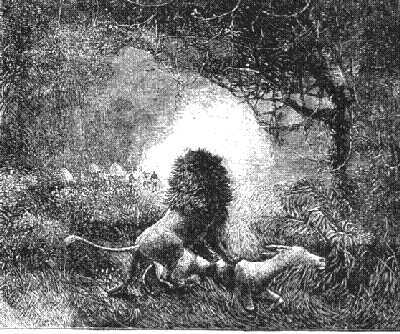
[His servants say that instead of rallying, they saw that his strength was becoming less and less, and in order to carry him they made a kitanda of wood, consisting of two side pieces of seven feet in length, crossed with rails three feet long, and about four inches apart, the whole lashed strongly together. This framework was covered with grass, and a blanket laid on it. Slung from a pole, and borne between two strong men, it made a tolerable palanquin, and on this the exhausted traveller was conveyed to the next village through a flooded grass plain. To render the kitanda more comfortable another blanket was suspended across the pole, so as to hang down on either side, and allow the air to pass under whilst the sun's rays were fended off fromthe sick man. The start was deferred this morning until the dew was off the heads of the long grass sufficiently to ensure his being kept tolerably dry.
The excruciating pains of his dysenteric malady caused him the greatest exhaustion as they marched, and they were glad enough to reach another village in 2-1/4 hours, having travelled S.W. from the last point. Here another hut was built. The name of the halting-place is not remembered by the men, for the villagers fled at their approach; indeed the noise made by the drums sounding the alarm had been caught by the Doctor some time before, and he exclaimed with thankfulness on hearing it, "Ah, now we are near!" Throughout this day the following men acted as bearers of the kitanda: Chowpéré, Songolo, Chumah, and Adiamberi. Sowféré, too, joined in at one time.]
23rd April, 1873.—(No entry except the date.)
[They advanced another hour and a half through the same expanse of flooded treeless waste, passing numbers of small fish-weirs set in such a manner as to catch the fish on their way back to the Lake, but seeing nothing of the owners, who had either hidden themselves or taken to flight on the approach of the caravan. Another village afforded them a night's shelter, but it seems not to be known by any particular name.]
24th April, 1873.—(No entry except the date.)
[But one hour's march was accomplished to-day, and again they halted amongst some huts—place unknown. His great prostration made progress exceedingly painful, and frequently when it was necessary to stop the bearers of the kitanda, Chumah had to support the Doctor from falling.]
25th April, 1873.—(No entry except the date.)
[In an hour's course S.W. they arrived at a village in which they found a few people. Whilst his servants were busy completing the hut for the night's encampment, the Doctor, who was lying in a shady place on the kitanda, ordered them to fetch one of the villagers. The chief of the place had disappeared, but the rest of his people seemed quite at their ease, and drew near to hear what was going to be said. They were asked whether they knew of a hill on which four rivers took their rise. The spokesman answered that they had no knowledge of it; they themselves, said he, were not travellers, and all those who used to go on trading expeditions were now dead. In former years Malenga's town, Kutchinyama, was the assembling place of the Wabisa traders, but these had been swept off by the Mazitu. Such as survived had to exist as best they could amongst the swamps and inundated districts around the Lake. Whenever an expedition was organised to go to the coast, or in any other direction, travellers met at Malenga's town to talk over the route to be taken: then would have been the time, said they, to get information about every part. Dr. Livingstone was here obliged to dismiss them, and explained that he was too ill to continue talking, but he begged them to bring as much food as they could for sale to Kalunganjovu's.]
26th April, 1873.—(No entry except the date.)
[They proceeded as far as Kalunganjovu's town, the chief himself coming to meet them on the way dressed in Arab costume and wearing a red fez. Whilst waiting here Susi was instructed to count over the bags of beads, and, on reporting that twelve still remained in stock, Dr. Livingstone told him to buy two large tusks if an opportunity occurred, as he might run short of goods by the time they got to Ujiji, and could then exchange them with the Arabs there for cloth, to spend on their way to Zanzibar.]
To-day, the 27th April, 1873, he seems to have been almost dying. No entry at all was made in his diary after that which follows, and it must have taxed him to the utmost to write:—
"Knocked up quite, and remain—recover—sent to buy milch goats. We are on the banks of the Molilamo."
They are the last words that David Livingstone wrote.
From this point we have to trust entirely to the narrative of the men.
They explain the above sentence as follows: Salimané, Amisi, Hamsani,
and Laedé, accompanied by a guide, were sent off to endeavour if
possible to buy some milch goats on the upper part of the Molilamo.
28th April, 1873.—Men were now despatched in an opposite direction, that is to visit the villages on the right bank of the Molilamo as it flows to the Lake; unfortunately they met with no better result, and returned empty handed.
On the 29th April, Kalunganjovu and most of his people came early to the village. The chief wished to assist his guest to the utmost, and stated that as he could not be sure that a sufficient number of canoes would be forthcoming unless he took charge of matters himself, he should accompany the caravan to the crossing place, which was about an hour's march from the spot. "Everything should be done for his friend," he said.
They were ready to set out. On Susi's going to the hut, Dr. Livingstone told him that he was quite unable to walk to the door to reach the kitanda, and he wished the men to break down one side of the little house, as the entrance was too narrow to admit it, and in this manner to bring it to him where he was: this was done, and he was gently placed upon it, and borne out of the village.
Their course was in the direction of the stream, and they followed it till they came to a reach where the current was uninterrupted by the numerous little islands which stood partly in the river and partly in the flood on the upper waters. Kalunganjovu was seated on a knoll, and actively superintended the embarkation, whilst Dr. Livingstone told his bearers to take him to a tree at a little distance off, that he might rest in the shade till most of the men were on the other side. A good deal of care was required, for the river, by no means a large one in ordinary times, spread its waters in all directions, so that a false step, or a stumble in any unseen hole, would have drenched the invalid and the bed also on which he was carried.
The passage occupied some time, and then came the difficult task of conveying the Doctor across, for the canoes were not wide enough to allow the kitanda to be deposited in the bottom of either of them. Hitherto, no matter how weak, Livingstone had always been able to sit in the various canoes they had used on like occasions, but now he had no power to do so. Taking his bed off the kitanda, they laid it in the bottom of the strongest canoe, and tried to lift him; but he could not bear the pain of a hand being passed under his back. Beckoning to Chumah, in a faint voice he asked him to stoop down over him as low as possible, so that he might clasp his hands together behind his head, directing him at the same how to avoid putting any pressure on the lumbar region of the back; in this way he was deposited in the bottom of the canoe, and quickly ferried across the Mulilamo by Chowpéré, Susi, Farijala, and Chumah. The same precautions were used on the other side: the kitanda was brought close to the canoe, so as to prevent any unnecessary pain in disembarking.
Susi now hurried on ahead to reach Chitambo's village, and superintend the building of another house. For the first mile or two they had to carry the Doctor through swamps and plashes, glad to reach something like a dry plain at last.
It would seem that his strength was here at its very lowest ebb. Chumah, one of his bearers on these the last weary miles the great traveller was destined to accomplish, says that they were every now and then implored to stop and place their burden on the ground. So great were the pangs of his disease during this day that he could make no attempt to stand, and if lifted for a few yards a drowsiness came over him, which alarmed them all excessively. This was specially the case at one spot where a tree stood in the path. Here one of his attendants was called to him, and, on stooping down, he found him unable to speak from faintness. They replaced him in the kitanda, and made the best of their way on the journey. Some distance further on great thirst oppressed him; he asked them if they had any water, but, unfortunately for once, not a drop was to be procured. Hastening on for fear of getting too far separated from the party in advance, to their great comfort they now saw Farijala approaching with some which Susi had thoughtfully sent off from Chitambo's village.
Still wending their way on, it seemed as if they would not complete their task, for again at a clearing the sick man entreated them to place him on the ground, and to let him stay where he was. Fortunately at this moment some of the outlying huts of the village came in sight, and they tried to rally him by telling him that he would quickly be in the house that the others had gone on to build, but they were obliged as it was to allow him to remain for an hour in the native gardens outside the town.
On reaching their companions it was found that the work was not quite finished, and it became necessary therefore to lay him under the broad eaves of a native hut till things were ready.
Chitambo's village at this time was almost empty. When the crops are growing it is the custom to erect little temporary houses in the fields, and the inhabitants, leaving their more substantial huts, pass the time in watching their crops, which are scarcely more safe by day than by night; thus it was that the men found plenty of room and shelter ready to their hand. Many of the people approached the spot where he lay whose praises had reached them in previous years, and in silent wonder they stood round him resting on their bows. Slight drizzling showers were falling, and as soon as possible his house was made ready and banked round with earth.
Inside it, the bed was raised from the floor by sticks and grass, occuping a position across and near to the bay-shaped end of the hut: in the bay itself bales and boxes were deposited, one of the latter doing duty for a table, on which the medicine chest and sundry other things were placed. A fire was lighted outside, nearly opposite the door, whilst the boy Majwara slept just within to attend to his master's wants in the night.
On the 30th April, 1873, Chitambo came early to pay a visit of courtesy, and was shown into the Doctor's presence, but he was obliged to send him away, telling him to come again on the morrow, when he hoped to have more strength to talk to him, and he was not again disturbed. In the afternoon he asked Susi to bring his watch to the bedside, and explained to him the position in which to hold his hand, that it might lie in the palm whilst he slowly turned the key.
So the hours stole on till nightfall. The men silently took to their huts, whilst others, whose duty it was to keep watch, sat round the fires, all feeling that the end could not be far off. About 11 P.M. Susi, whose hut was close by, was told to go to his master. At the time there were loud shouts in the distance, and, on entering, Dr. Livingstone said, "Are our men making that noise?" "No," replied Susi; "I can hear from the cries that the people are scaring away a buffalo from their dura fields." A few minutes afterwards he said slowly, and evidently wandering, "Is this the Luapula?" Susi told him they were in Chitambo's village, near the Mulilamo, when he was silent for a while. Again, speaking to Susi, in Suaheli this time, he said, "Sikun'gapi kuenda Luapula?" (How many days is it to the Luapula?)
"Na zani zikutatu, Bwana" (I think it is three days, master), replied Susi.
A few seconds after, as if in great pain, he half sighed, half said, "Oh dear, dear!" and then dozed off again.
It was about an hour later that Susi heard Majwara again outside the door, "Bwana wants you, Susi." On reaching the bed the Doctor told him he wished him to boil some water, and for this purpose he went to the fire outside, and soon returned with the copper kettle full. Calling him close, he asked him to bring his medicine-chest and to hold the candle near him, for the man noticed he could hardly see. With great difficulty Dr. Livingstone selected the calomel, which he told him to place by his side; then, directing him to pour a little water into a cup, and to put another empty one by it, he said in a low feeble voice, "All right; you can go out now." These were the last words he was ever heard to speak.
It must have been about 4 A.M. when Susi heard Majwara's step once more. "Come to Bwana, I am afraid; I don't know if he is alive." The lad's evident alarm made Susi run to arouse Chumah, Chowperé, Matthew, and Muanyaséré, and the six men went immediately to the hut.
Passing inside they looked towards the bed. Dr. Livingstone was not lying on it, but appeared to be engaged in prayer, and they instinctively drew backwards for the instant. Pointing to him, Majwara said, "When I lay down he was just as he is now, and it is because I find that he does not move that I fear he is dead." They asked the lad how long he had slept? Majwara said he could not tell, but he was sure that it was some considerable time: the men drew nearer.
A candle stuck by its own wax to the top of the box, shed a light sufficient for them to see his form. Dr. Livingstone was kneeling by the side of his bed, his body stretched forward, his head buried in his hands upon the pillow. For a minute they watched him: he did not stir, there was no sign of breathing; then one of them, Matthew, advanced softly to him and placed his hands to his cheeks. It was sufficient; life had been extinct some time, and the body was almost cold: Livingstone was dead.
His sad-hearted servants raised him tenderly up, and laid him full length on the bed, then, carefully covering him, they went out into the damp night air to consult together. It was not long before the cocks crew, and it is from this circumstance—coupled with the fact that Susi spoke to him some time shortly before midnight—that we are able to state with tolerable certainty that he expired early on the 1st of May.
It has been thought best to give the narrative of these closing hours as nearly as possible in the words of the two men who attended him constantly, both here and in the many illnesses of like character which he endured in his last six years' wanderings; in fact from the first moment of the news arriving in England, it was felt to be indispensable that they should come home to state what occurred.
The men have much to consider as they cower around the watch-fire, and little time for deliberation. They are at their furthest point from home and their leader has fallen at their head; we shall see presently how they faced their difficulties.
Several inquiries will naturally arise on reading this distressing history; the foremost, perhaps, will be with regard to the entire absence of everything like a parting word to those immediately about him, or a farewell line to his family and friends at home. It must be very evident to the reader that Livingstone entertained very grave forebodings about his health during the last two years of his life, but it is not clear that he realized the near approach of death when his malady suddenly passed into a more dangerous stage.
It may be said, "Why did he not take some precautions or give some strict injunctions to his men to preserve his note-books and maps, at all hazards, in the event of his decease? Did not his great ruling passion suggest some such precaution?"
Fair questions, but, reader, you have all—every word written, spoken, or implied.
Is there, then, no explanation? Yes; we think past experience affords it, and it is offered to you by one who remembers moreover how Livingstone himself used to point out to him in Africa the peculiar features of death by malarial poisoning.
In full recollection of eight deaths in the Zambesi and Shiré districts, not a single parting word or direction in any instance can be recalled. Neither hope nor courage give way as death approaches. In most cases a comatose state of exhaustion supervenes, which, if it be not quickly arrested by active measures, passes into complete insensibility: this is almost invariably the closing scene.
In Dr. Livingstone's case we find some departure from the ordinary
symptoms.
On more closely questioning the men one only elicits that they imagine he hoped to recover as he had so often done before, and if this really was the case it will in a measure account for the absence of anything like a dying statement, but still they speak again and again of his drowsiness, which in itself would take away all ability to realize vividly the seriousness of the situation. It may be that at the last a flash of conviction for a moment lit up the mind—if so, what greater consolation can those have who mourn his loss, than the account that the men give of what they saw when they entered the hut?
Livingstone had not merely turned himself, he had risento pray; he still rested on his knees, his hands were clasped under his head: when they approached him he seemed to live. He had not fallen to right or left when he rendered up his spirit to God. Death required no change of limb or position; there was merely the gentle settling forwards of the frame unstrung by pain, for the Traveller's perfect rest had come. Will not time show that the men were scarcely wrong when they thought "he yet speaketh"—aye, perhaps far more clearly to us than he could have done by word or pen or any other means!
Is it, then, presumptuous to think that the long-used fervent prayer of the wanderer sped forth once more—that the constant supplication became more perfect in weakness, and that from his "loneliness" David Livingstone, with a dying effort, yet again besought Him for whom He laboured to break down the oppression and woe of the land?
Before daylight the men were quietly told in each hut what had happened, and that they were to assemble. Coming together as soon as it was light enough to see, Susi and Chumah said that they wished everybody to be present whilst the boxes were opened, so that in case money or valuables were in them, all might be responsible. Jacob Wainwright (who could write, they knew) was asked to make some notes which should serve as an inventory, and then the boxes were brought out from the hut.
Before he left England in 1865, Dr. Livingstone arranged that his travelling equipment should be as compact as possible. An old friend gave him some exceedingly well-made tin-boxes, two of which lasted out the whole of his travels. In these his papers and instruments were safe from wet and from white ants, which have to be guarded against more than anything else. Besides the articles mentioned below, a number of letters and despatches in various stages were likewise enclosed, and one can never sufficiently extol the good feeling which after his death invested all these writings with something like a sacred care in the estimation of his men. It was the Doctor's custom to carry a small metallic note-book in his pocket: a quantity of these have come to hand filled from end to end, and as the men preserved every one that they found, we have a daily entry to fall back upon. Nor was less care shown for his rifles, sextants, his Bible and Church-service, and the medicine chest.
Jacob's entry is as follows, and it was thoughtfully made at the back end of the same note-book that was in use by the Doctor when he died. It runs as follows:—
"11 o'clock night, 28th April.
"In the chest was found about a shilling and half, and in other chest his hat, 1 watch, and 2 small boxes of measuring instrument, and in each box there was one. 1 compass, 3 other kind of measuring instrument. 4 other kind of measuring instrument. And in other chest 3 drachmas and half half scrople."
A word is necessary concerning the first part of this. It will be observed that Dr. Livingstone made his last note on the 27th April. Jacob, referring to it as the only indication of the day of the month, and fancying, moreover, that it was written on the preceding day, wrote down "28th April." Had he observed that the few words opposite the 27th in the pocket-book related to the stay at Kalunganjovu's village, and not to any portion of the time at Chitambo's, the error would have been avoided. Again, with respect to the time. It was about 11 o'clock P.M. when Susi last saw his master alive, and therefore this time is noted, but both he and Chumah feel quite sure, from what Majwara said, that death did not take place till some hours after.
It was not without some alarm that the men realised their more immediate difficulties: none could see better than they what complications might arise in an hour.
They knew the superstitious horror connected with the dead to be prevalent in the tribes around them, for the departed spirits of men are universally believed to have vengeance and mischief at heart as their ruling idea in the land beyond the grave. All rites turn on this belief. The religion of the African is a weary attempt to propitiate those who show themselves to be still able to haunt and destroy, as war comes or an accident happens.
On this account it is not to be wondered at that chief and people make common cause against those who wander through their territory, and have the misfortune to lose one of their party by death. Who is to tell the consequences? Such occurrences are looked on as most serious offences, and the men regarded their position with no small apprehension.
Calling the whole party together, Susi and Chumah placed the state of affairs before them, and asked what should be done. They received a reply from those whom Mr. Stanley had engaged for Dr. Livingstone, which was hearty and unanimous. "You," said they, "are old men in travelling and in hardships; you must act as our chiefs, and we will promise to obey whatever you order us to do." From this moment we may look on Susi and Chumah as the Captains of the caravan. To their knowledge of the country, of the tribes through which they were to pass, but, above all, to the sense of discipline and cohesion which was maintained throughout, their safe return to Zanzibar at the head of their men must, under God's good guidance, be mainly attributed.
All agreed that Chitambo ought to be kept in ignorance of Dr. Livingstone's decease, or otherwise a fine so heavy would be inflicted upon them as compensation for damage done that their means would be crippled, and they could hardly expect to pay their way to the coast. It was decided that, come what might, the body must be borne to Zanzibar. It was also arranged to take it secretly, if possible, to a hut at some distance off, where the necessary preparations could be carried out, and for this purpose some men were now despatched with axes to cut wood, whilst others went to collect grass. Chumah set off to see Chitambo, and said that they wanted to build a place outside the village, if he would allow it, for they did not like living amongst the huts. His consent was willingly given.
Later on in the day two of the men went to the people to buy food, and divulged the secret: the chief was at once informed of what had happened, and started for the spot on which the new buildings were being set up. Appealing to Chumah, he said, "Why did you not tell me the truth? I know that your master died last night. You were afraid to let me know, but do not fear any longer. I, too, have travelled, and more than once have been to Bwani (the Coast), before the country on the road was destroyed by the Mazitu. I know that you have no bad motives in coming to our land, and death often happens to travellers in their journeys." Reassured by this speech, they told him of their intention to prepare the body and to take it with them. He, however, said it would be far better to bury it there, for they were undertaking an impossible task; but they held to their resolution. The corpse was conveyed to the new hut the same day on the kitanda carefully covered with cloth and a blanket.
2nd May, 1873.—The next morning Susi paid a visit to Chitambo, making him a handsome present and receiving in return a kind welcome. It is only right to add, that the men speak on all occasions with gratitude of Chitambo's conduct throughout, and say that he is a fine generous fellow. Following out his suggestion, it was agreed that all honours should be shown to the dead, and the customary mourning was arranged forthwith.
 Temporary Village in which Dr. Livingstone's Body was prepared
At the proper time, Chitambo, leading his people, and accompanied by his wives, came to the new settlement. He was clad in a broad red cloth, which covered the shoulders, whilst the wrapping of native cotton cloth, worn round the waist, fell as low as his ankles. All carried bows, arrows, and spears, but no guns were seen. Two drummers joined in the loud wailing lamentation, which so indelibly impresses itself on the memories of people who have heard it in the East, whilst the band of servants fired volley after volley in the air, according to the strict rule of Portuguese and Arabs on such occasions.
As yet nothing had been done to the corpse.
A separate hut was now built, about ninety feet from the principal one. It was constructed in such a manner that it should be open to the air at the top, and sufficiently strong to defy the attempts of any wild beast to break through it. Firmly driven boughs and saplings were planted side by side and bound together, so as to make a regular stockade. Close to this building the men constructed their huts, and, finally, the whole settlement had another high stockade carried completely around it.
Arrangements were made the same day to treat the corpse on the following morning. One of the men, Saféné, whilst in Kalunganjovu's district, bought a large quantity of salt: this was purchased of him for sixteen strings of beads, there was besides some brandy in the Doctor's stores, and with these few materials they hoped to succeed in their object.
Farijala was appointed to the necessary task. He had picked up some knowledge of the method pursued in making post-mortem examinations, whilst a servant to a doctor at Zanzibar, and at his request, Carras, one of the Nassick boys, was told off to assist him. Previous to this, however, early on the 3rd May, a special mourner arrived. He came with the anklets which are worn on these occasions, composed of rows of hollow seed-vessels, fitted with rattling pebbles, and in low monotonous chant sang, whilst he danced, as follows: