
CHAPTER III.
Editor: Horace Waller
THE LAST JOURNALS
OF
DAVID LIVINGSTONE,
IN CENTRAL AFRICA,
FROM 1865 TO HIS DEATH.
CONTINUED BY A NARRATIVE OF
HIS LAST MOMENTS AND SUFFERINGS,
OBTAINED FROM
HIS FAITHFUL SERVANTS CHUMA AND SUSI,
BY HORACE WALLER, F.R.G.S.,
RECTOR OF TWYWELL,
NORTHAMPTON.
IN TWO VOLUMES.—VOL. II.
[1869–1873]
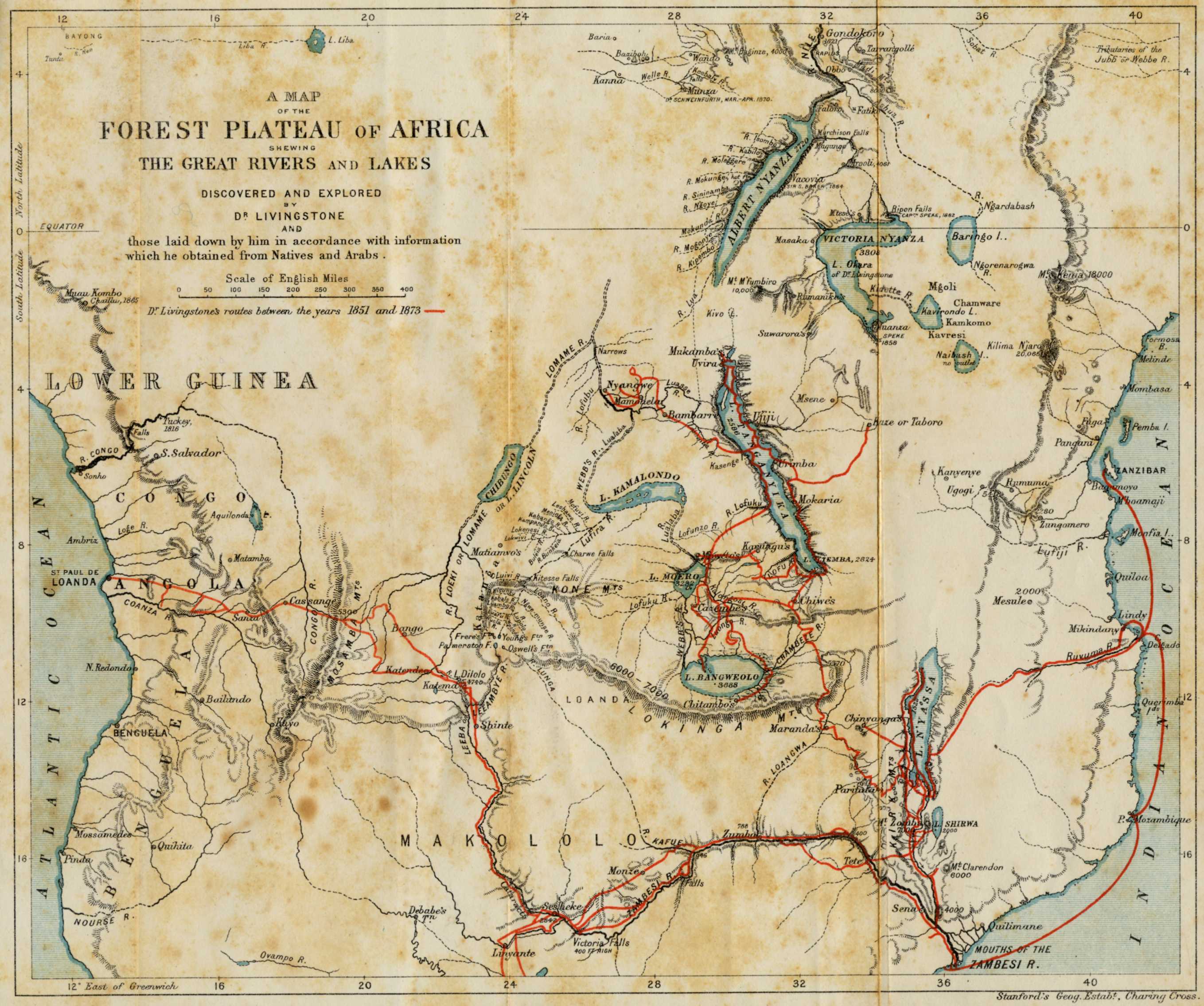
WITH PORTRAIT, MAPS, AND ILLUSTRATIONS.
LONDON:
JOHN MURRAY, ALBEMARLE STREET.
1874.
 Evening Ilala. 29 April, 1873.
CONTENTS.
Bad beginning of the new year. Dangerous illness. Kindness of Arabs. Complete helplessness. Arrive at Tanganyika. The Doctor is conveyed in canoes. Kasanga Islet. Cochin-China fowls. Reaches Ujiji. Receives some stores. Plundering hands. Slow recovery. Writes despatches. Refusal of Arabs to take letters. Thani bin Suellim. A den of slavers. Puzzling current in Lake Tanganyika. Letters sent off at last. Contemplates visiting the Manyuema. Arab depredations. Starts for new explorations in Manyuema, 12th July, 1869. Voyage on the Lake. Kabogo East. Crosses Tanganyika. Evil effects of last illness. Elephant hunter's superstition. Dugumbé. The Lualaba reaches the Manyuema. Sons of Moenékuss. Sokos first heard of. Manyuema customs. Illness.
Prepares to explore River Lualaba. Beauty of the Manyuema country. Irritation at conduct of Arabs. Dugumbé's ravages. Hordes of traders arrive. Severe fever. Elephant trap. Sickness in camp. A good Samaritan. Reaches Mamohela and is prostrated. Beneficial effects of Nyumbo plant. Long illness. An elephant of three tusks. All men desert except Susi, Chuma, and Gardner. Starts with these to Lualaba. Arab assassinated by outraged Manyuema. Returns baffled to Mamohela. Long and dreadful suffering from ulcerated feet. Questionable cannibalism. Hears of four river sources close together. Resumé of discoveries. Contemporary explorers. The soko. Description of its habits. Dr. Livingstone feels himself failing. Intrigues of deserters
Footsteps of Moses. Geology of Manyuema land. "A drop of comfort." Continued sufferings. A stationary explorer. Consequences of trusting to theory. Nomenclature of Rivers and Lakes. Plunder and murder is Ujijian trading. Comes out of hut for first time after eighty days' illness. Arab cure for ulcerated sores. Rumour of letters. The loss of medicines a great trial now. The broken-hearted chief. Return of Arab ivory traders. Future plans. Thankfulness for Mr. Edward Young's Search Expedition. The Hornbilled Phoenix. Tedious delays. The bargain for the boy. Sends letters to Zanzibar. Exasperation of Manyuema against Arabs. The "Sassassa bird." The disease "Safura."
Degraded state of the Manyuema. Want of writing materials. Lion's fat a specific against tsetse. The Neggeri. Jottings about Meréré. Various sizes of tusks. An epidemic. The strangest disease of all! The New Year. Detention at Bambarré. Goître. News of the cholera. Arrival of coast caravan. The parrot's-feather challenge. Murder of James. Men arrive as servants. They refuse to go north. Part at last with malcontents. Receives letters from Dr. Kirk and the Sultan. Doubts as to the Congo or Nile. Katomba presents a young soko. Forest scenery. Discrimination of the Manyuema. They "want to eat a white one." Horrible bloodshed by Ujiji traders. Heartsore and sick of blood. Approach Nyañgwé. Reaches the Lualaba
The Chitoka or market gathering. The broken watch. Improvises ink. Builds a new house at Nyañgwé on the bank of the Lualaba. Marketing. Cannibalism. Lake Kamalondo. Dreadful effect of slaving. News of country across the Lualaba. Tiresome frustration. The Bakuss. Feeble health. Busy scene at market. Unable to procure canoes. Disaster to Arab canoes. Rapids in Lualaba. Project for visiting Lake Lincoln and the Lomamé. Offers large reward for canoes and men. The slave's mistress. Alarm, of natives at market. Fiendish slaughter of women by Arabs. Heartrending scene. Death on land and in the river. Tagamoio's assassinations. Continued slaughter across the river. Livingstone becomes desponding
Leaves for Ujiji. Dangerous journey through forest. The Manyuema understand Livingstone's kindness. Zanzibar slaves. Kasongo's. Stalactite caves. Consequences of eating parrots. Ill. Attacked in the forest. Providential deliverance. Another extraordinary escape. Taken for Mohamad Bogharib. Running the gauntlet for five hours. Loss of property. Reaches place of safety. Ill. Mamohela. To the Luamo. Severe disappointment. Recovers. Severe marching. Reaches Ujiji. Despondency. Opportune arrival of Mr. Stanley. Joy and thankfulness of the old traveller. Determines to examine north end of Lake Tanganyika. They start. Reach the Lusizé. No outlet. "Theoretical discovery" of the real outlet. Mr. Stanley ill. Returns to Ujiji. Leaves stores there. Departure for Unyanyembé with Mr. Stanley. Abundance of game. Attacked by bees. Serious illness of Mr. Stanley. Thankfulness at reaching Unyanyembé
Determines to continue his work. Proposed route. Refits. Robberies discovered. Mr. Stanley leaves. Parting messages. Mteza's people arrive. Ancient Geography. Tabora. Description of the country. The Banyamwezi. A Baganda bargain. The population of Unyamyembe. The Mirambo war. Thoughts on Sir Samuel Baker's policy. The cat and the snake. Firm faith. Feathered neighbours. Mistaken notion concerning mothers. Prospects for missionaries. Halima. News of other travellers. Chuma is married
Letters arrive at last. Sore intelligence. Death of an old friend. Observations on the climate. Arab caution. Dearth of Missionary enterprise. The slave trade and its horrors. Progressive barbarism. Carping benevolence. Geology of Southern Africa. The fountain sources. African elephants. A venerable piece of artillery. Livingstone on Materialism. Bin Nassib. The Baganda leave at last. Enlists a new follower
Short years in Buganda. Boys' playthings in Africa. Reflections. Arrival of the men. Fervent thankfulness. An end of the weary waiting. Jacob Wainwright takes service under the Doctor. Preparations for the journey. Flagging and illness. Great heat. Approaches Lake Tanganyika. The borders of Fipa. Lepidosirens and Vultures. Capes and islands of Lake Tanganyika. High mountains. Large Bay
False guides. Very difficult travelling. Donkey dies of tsetse bites. The Kasonso family. A hospitable chief. The River Lofu. The nutmeg tree. Famine. Ill. Arrives at Chama's town. A difficulty. An immense snake. Account of Casembe's death. The flowers of the Babisa country. Reaches the River Lopoposi. Arrives at Chituñkué's. Terrible marching. The Doctor is borne through the flooded country
Entangled amongst the marshes of Bangweolo. Great privations. Obliged to return to Chituñkué's. At the chiefs mercy. Agreeably surprised with the chief. Start once more. Very difficult march. Robbery exposed. Fresh attack of illness. Sends scouts out to find villages. Message to Chirubwé. An ant raid. Awaits news from Matipa. Distressing perplexity. The Bougas of Bangweolo. Constant rain above and flood below. Ill. Susi and Chuma sent as envoys to Matipa. Reach Bangweolo. Arrive at Matipa's islet. Matipa's town. The donkey suffers in transit. Tries to go on to Kabinga's. Dr. Livingstone makes a demonstration. Solution of the transport difficulty. Susi and detachment sent to Kabinga's. Extraordinary extent of flood. Reaches Kabinga's. An upset. Crosses the Chambezé. The River Muanakazi. They separate into companies by land and water. A disconsolate lion. Singular caterpillars. Observations on fish. Coasting along the southern flood of Lake Bangweolo. Dangerous state of Dr. Livingstone
Dr. Livingstone rapidly sinking. Last entries in his diary. Susi and Chuma's additional details. Great agony in his last illness. Carried across rivers and through flood. Inquiries for the Hill of the Four Rivers. Kalunganjovu's kindness. Crosses the Mohlamo into the district of Ilala in great pain. Arrives at Chitambo's village. Chitambo comes to visit the dying traveller. The last night. Livingstone expires in the act of praying. The account of what the men saw. Remarks on his death. Council of the men. Leaders selected. The chief discovers that his guest is dead. Noble conduct of Chitambo. A separate village built by the men wherein to prepare the body for transport. The preparation of the corpse. Honour shown by the natives to Dr. Livingstone. Additional remarks on the cause of death. Interment of the heart at Chitambo's in Ilala of the Wabisa. An inscription and memorial sign-posts left to denote spot
They begin the homeward march from Ilala. Illness of all the men. Deaths. Muanamazungu. The Luapula. The donkey killed by a lion. A disaster at N'kossu's. Native surgery. Approach Chawende's town. Inhospitable reception. An encounter. They take the town. Leave Chawende's. Reach Chiwaie's. Strike the old road. Wire drawing. Arrive at Kumbakumba's. John Wainwright disappears. Unsuccessful search. Reach Tanganyika. Leave the Lake. Cross the Lambalamfipa range. Immense herds of game. News of East-Coast Search Expedition. Confirmation of news. They reach Baula. Avant-couriers sent forwards to Unyanyembé. Chuma meets Lieut. Cameron. Start for the coast. Sad death of Dr. Dillon. Clever precautions. The body is effectually concealed. Girl killed by a snake. Arrival on the coast. Concluding remarks
ILLUSTRATIONS.
Full-page Illustrations.
Smaller Illustrations.
[
CHAPTER I.
Bad beginning of the new year. Dangerous illness. Kindness of Arabs. Complete helplessness. Arrive at Tanganyika. The Doctor is conveyed in canoes. Kasanga Islet. Cochin-China fowls. Beaches Ujiji. Receives some stores. Plundering hands. Slow recovery. Writes despatches. Refusal of Arabs to take letters. Thani bin Suellim. A den of slavers. Puzzling current in Lake Tanganyika. Letters sent off at last. Contemplates visiting the Manyuema. Arab depredations. Starts for new explorations in Manyuema, 12th July, 1869. Voyage on the Lake. Kabogo East. Crosses Tanganyika. Evil effects of last illness. Elephant hunter's superstition. Dugumbé. The Lualaba reaches the Manyuema. Sons of Moenékuss. Sokos first heard of. Manyuema customs. Illness.
[The new year opened badly enough, and from letters he wrote subsequently concerning the illness which now attacked him, we gather that it left evils behind, from which he never quite recovered. The following entries were made after he regained sufficient strength, but we see how short they necessarily were, and what labour it was to make the jottings which relate to his progress towards the western shore of Lake Tanganyika. He was not able at any time during this seizure to continue the minute maps of the country in his pocket-books, which for the first time fail here.]
1st January, 1869.—I have been wet times without number, but the wetting of yesterday was once too often: I felt very ill, but fearing that the Lofuko might flood, I resolved to cross it. Cold up to the waist, which made me worse, but I went on for 2-1/2 hours E.
3rd January, 1869.—I marched one hour, but found I was too ill to go further. Moving is always good in fever; now I had a pain in the chest, and rust of iron sputa: my lungs, my strongest part, were thus affected. We crossed a rill and built sheds, but I lost count of the days of the week and month after this. Very ill all over.
About 7th January, 1869.—Cannot walk: Pneumonia of right lung, and I cough all day and all night: sputa rust of iron and bloody: distressing weakness. Ideas flow through the mind with great rapidity and vividness, in groups of twos and threes: if I look at any piece of wood, the bark seems covered over with figures and faces of men, and they remain, though I look away and turn to the same spot again. I saw myself lying dead in the way to Ujiji, and all the letters I expected there useless. When I think of my children and friends, the lines ring through my head perpetually:
And listen to what you say,
And be often very near you
When you think I'm far away."
Mohamad Bogharib came up, and I have got a cupper, who cupped my chest.
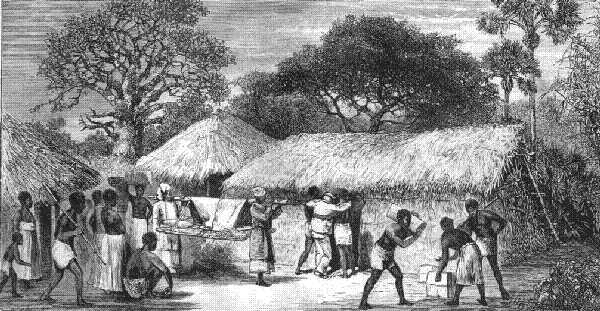
8th and 9th January, 1869.—Mohamad Bogharib offered to carry me. I am so weak I can scarcely speak. We are in Marungu proper now—a pretty but steeply-undulating country. This is the first time in my life I have been carried in illness, but I cannot raise myself to the sitting posture. No food except a little gruel. Great distress in coughing all night long; feet swelled and sore. I am carried four hours each day on a kitanda or frame, like a cot; carried eight hours one day. Then sleep in a deep ravine. Next day six hours, over volcanic tufa; very rough. We seem near the brim of Tanganyika. Sixteen days of illness. May be 23rd of January; it is 5th of lunar month. Country very undulating; it is perpetually up and down. Soil red, and rich knolls of every size and form. Trees few. Erythrinas abound; so do elephants. Carried eight hours yesterday to a chief's village. Small sharp thorns hurt the men's feet, and so does the roughness of the ground. Though there is so much slope, water does not run quickly off Marungu. A compact mountain-range flanks the undulating country through which we passed, and may stop the water flowing. Mohamad Bogharib is very kind to me in my extreme weakness; but carriage is painful; head down and feet up alternates with feet down and head up; jolted up and down and sideways—changing shoulders involves a toss from one side to the other of the kitanda. The sun is vertical, blistering any part of the skin exposed, and I try to shelter my face and head as well as I can with a bunch of leaves, but it is dreadfully fatiguing in my weakness.
I had a severe relapse after a very hot day. Mohamad gave me medicines; one was a sharp purgative, the others intended for the cure of the cough.
14th February, 1869.—Arrived at Tanganyika. Parra is the name of the land at the confluence of the River Lofuko: Syde bin Habib had two or three large canoes at this place, our beads were nearly done, so I sent to Syde to say that all the Arabs had served me except himself. Thani bin Suellim by his letter was anxious to send a canoe as soon as I reached the Lake, and the only service I wanted of Syde was to inform Thani, by one of his canoes, that I was here very ill, and if I did not get to Ujiji to get proper food and medicine I should die. Thani would send a canoe as soon as he knew of my arrival I was sure: he replied that he too would serve me: and sent some flour and two fowls: he would come in two days and see what he could do as to canoes.
15th February, 1869.—The cough and chest pain diminished, and I feel thankful; my body is greatly emaciated. Syde came to-day, and is favourable to sending me up to Ujiji. Thanks to the Great Father in Heaven.
24th February, 1869.—We had remarkably little rain these two months.
25th February, 1869.—I extracted twenty Funyés, an insect like a maggot, whose eggs had been inserted on my having been put into an old house infested by them; as they enlarge they stir about and impart a stinging sensation; if disturbed, the head is drawn in a little. When a poultice is put on they seem obliged to come out possibly from want of air: they can be pressed out, but the large pimple in which they live is painful; they were chiefly in my limbs.
26th February, 1869.—Embark, and sleep at Katonga after seven hours' paddling.
27th February, 1869.—Went 1-3/4 hour to Bondo or Thembwé to buy food. Shore very rough, like shores near Capréra, but here all is covered with vegetation. We were to cross to Kabogo, a large mass of mountains on the eastern side, but the wind was too high.
28th February, 1869.—Syde sent food back to his slaves.
2nd March, 1869.—Waves still high, so we got off only on 3rd at 1h. 30m. A.M. 6-1/2 hours, and came to M. Bogharib, who cooked bountifully.
6th March, 1869.—5 P.M. Off to Toloka Bay—three hours; left at 6 A.M., and came, in four hours, to Uguha, which is on the west side of Tanganyika.
7th March, 1869.—Left at 6 P.M., and went on till two canoes ran on rocks in the way to Kasanga islet. Rounded a point of land, and made for Kasanga with a storm in our teeth; fourteen hours in all. We were received by a young Arab Muscat, who dined us sumptuously at noon: there are seventeen islets in the Kasanga group.
8th March, 1869.—On Kasanga islet. Cochin-China fowls
Patience was never more needed than now: I am near Ujiji, but the slaves who paddle are tired, and no wonder; they keep up a roaring song all through their work, night and day. I expect to get medicine, food, and milk at Ujiji, but dawdle and do nothing. I have a good appetite, and sleep well; these are the favourable symptoms; but am dreadfully thin, bowels irregular, and I have no medicine. Sputa increases; hope to hold out to Ujiji. Cough worse. Hope to go to-morrow.
9th March, 1869.—The Whydah birds have at present light breasts and dark necks. Zahor is the name of our young Arab host.
11th March, 1869.—Go over to Kibizé islet, 1-1/2 hour from Kasanga. Great care is taken not to encounter foul weather; we go a little way, then wait for fair wind in crossing to east side of Lake.
12th March, 1869.—People of Kibizé dress like those in Rua, with
cloth made of the Muabé or wild-date leaves; the same is used in
Madagascar for the "lamba."
From Kibizé islet to Kabogo River on east side of Lake ten hours; sleep there. Syde slipped past us at night, but we made up to him in four hours next morning.
13th March, 1869.—At Rombolé; we sleep, then on.
[At last he reached the great Arab settlement at Ujiji, on the eastern shore of Tanganyika. It was his first visit, but he had arranged that supplies should be forwarded thither by caravans bound inland from Zanzibar. Most unfortunately his goods were made away with in all directions—not only on this, but on several other occasions. The disappointment to a man shattered in health, and craving for letters and stores, must have been severe indeed.]
14th March, 1869.—Go past Malagarasi River, and reach Ujiji in 3-1/2 hours. Found Haji Thani's agent in charge of my remaining goods. Medicines, wine, and cheese had been left at Unyanyembé, thirteen days east of this. Milk not to be had, as the cows had not calved, but a present of Assam tea from Mr. Black, the Inspector of the Peninsular and Oriental Company's affairs, had come from Calcutta, besides my own coffee and a little sugar. I bought butter; two large pots are sold for two fathoms of blue calico, and four-year-old flour, with which we made bread. I found great benefit from the tea and coffee, and still more from flannel to the skin.
15th March, 1869.—Took account of all the goods left by the
plunderer; sixty-two out of eighty pieces of cloth (each of twenty-four
yards) were stolen, and most of my best beads. The road to Unyembé
I clothed him, but he tried to make bad blood between the respectable Arab who supplied me with milk and myself, telling him that I abused him, and then he would come back, saying that he abused me! I can account for his conduct only by attributing it to that which we call ill-conditioned: I had to expel him from the house.
I repaired a house to keep out the rain, and on the 23rd moved into it. I gave our Kasanga host a cloth and blanket; he is ill of pneumonia of both lungs.
28th March, 1869.—Flannel to the skin and tea very beneficial in the cure of my disease; my cough has ceased, and I walk half a mile. I am writing letters for home.
8th April, 1869.—Visited Moené Mokaia, who sent me two fowls and rice; gave him two cloths. He added a sheep.
13th April, 1869.—Employed Suleyman to write notes to Governor of Unyembé, Syde bin Salem Burashid, to make inquiries about the theft of my goods, as I meant to apply to Syed Majid, and wished to speak truly about his man Musa bin Salum, the chief depredator.
Wrote also to Thani for boat and crew to go down Tanganyika.
Syde bin Habib refused to allow his men to carry my letters to the coast; as he suspected that I would write about his doings in Rua.
27th April, 1869.—Syde had three canoes smashed in coming up past Thembwé; the wind and waves drove them on the rocks, and two were totally destroyed: they are heavy unmanageable craft, and at the mercy of any storm if they cannot get into a shut bay, behind the reeds and aquatic vegetation. One of the wrecks is said to have been worth 200 dollars (40l.).
The season called Masika commenced this month with the usual rolling thunder, and more rain than in the month preceding.
I have been busy writing letters home, and finished forty-two, which in
some measure will make up for my long silence. The Ujijians are
unwilling to carry my letters, because, they say, Seyed Majid will order
the bearer to return with others: he may say, "You know where he is, go
back to him," but I suspect they fear my exposure of their ways more
than anything else.
16th May, 1869.—Thani bin Suellim sent me a note yesterday to say that he would be here in two days, or say three; he seems the most active of the Ujijians, and I trust will help me to get a canoe and men.
The malachite at Katañga is loosened by fire, then dug out of four hills: four manehs of the ore yield one maneh of copper, but those who cultivate the soil get more wealth than those who mine the copper.
[No change of purpose was allowed to grow out of sickness and disappointment. Here and there, as in the words written on the next day, we find Livingstone again with his back turned to the coast and gazing towards the land of the Manyuema and the great rivers reported there.] 17th May, 1869.—Syde bin Habib arrived to-day with his cargo of copper and slaves. I have to change house again, and wish I were away, now that I am getting stronger. Attendants arrive from Parra or Mparra.
[The old slave-dealer, whom he met at Casembe's, and who seems to have been set at liberty through Livingstone's instrumentality, arrives at Ujiji at last.]
18th May, 1869.—Mohamad bin Saleh arrived to-day. He left this when comparatively young, and is now well advanced in years.
The Bakatala at Lualaba West killed Salem bin Habib. Mem.—Keep clear of them. Makwamba is one of the chiefs of the rock-dwellers, Ngulu is another, and Masika-Kitobwé on to Baluba. Sef attached Kilolo N'tambwé.
19th May, 1869.—The emancipation of our West-Indian slaves was the work of but a small number of the people of England—the philanthropists and all the more advanced thinkers of the age. Numerically they were a very small minority of the population, and powerful only from the superior abilities of the leading men, and from having the right, the true, and just on their side. Of the rest of the population an immense number were the indifferent, who had no sympathies to spare for any beyond their own fireside circles. In the course of time sensation writers came up on the surface of society, and by way of originality they condemned almost every measure and person of the past. "Emancipation was a mistake;" and these fast writers drew along with them a large body, who would fain be slaveholders themselves. We must never lose sight of the fact that though the majority perhaps are on the side of freedom, large numbers of Englishmen are not slaveholders only because the law forbids the practice. In this proclivity we see a great part of the reason of the frantic sympathy of thousands with the rebels in the great Black war in America. It is true that we do sympathize with brave men, though we may not approve of the objects for which they fight. We admired Stonewall Jackson as a modern type of Cromwell's Ironsides; and we praised Lee for his generalship, which, after all, was chiefly conspicuous by the absence of commanding abilities in his opponents, but, unquestionably, there existed besides an eager desire that slaveocracy might prosper, and the Negro go to the wall. The would-be slaveholders showed their leanings unmistakably in reference to the Jamaica outbreak; and many a would-be Colonel Hobbs, in lack of revolvers, dipped his pen in gall and railed against all Niggers who could not be made slaves. We wonder what they thought of their hero, when informed that, for very shame at what he had done and written, he had rushed unbidden out of the world.
26th May, 1869.—Thani bin Suellim came from Unyanyembé on the 20th. He is a slave who has risen to freedom and influence; he has a disagreeable outward squint of the right eye, teeth protruding from the averted lips, is light-coloured, and of the nervous type of African. He brought two light boxes from Unyembé, and charged six fathoms for one and eight fathoms for the other, though the carriage of both had been paid for at Zanzibar. When I paid him he tried to steal, and succeeded with one cloth by slipping it into the hands of a slave. I gave him two cloths and a double blanket as a present. He discovered afterwards what he knew before, that all had been injured by the wet on the way here, and sent two back openly, which all saw to be an insult. He asked a little coffee, and I gave a plateful; and he even sent again for more coffee after I had seen reason to resent his sending back my present. I replied, "He won't send coffee back, for I shall give him none." In revenge he sends round to warn all the Ujijians against taking my letters to the coast; this is in accordance with their previous conduct, for, like the Kilwa people on the road to Nyassa, they have refused to carry my correspondence.
This is a den of the worst kind of slave-traders; those whom I met in Urungu and Itawa were gentlemen slavers: the Ujiji slavers, like the Kilwa and Portuguese, are the vilest of the vile. It is not a trade, but a system of consecutive murders; they go to plunder and kidnap, and every trading trip is nothing but a foray. Moené Mokaia, the headman of this place, sent canoes through to Nzigé, and his people, feeling their prowess among men ignorant of guns, made a regular assault but were repulsed, and the whole, twenty in number, were killed. Moené Mokaia is now negotiating with Syde bin Habib to go and revenge this, for so much ivory, and all he can get besides. Syde, by trying to revenge the death of Salem bin Habib, his brother, on the Bakatala, has blocked up one part of the country against me, and will probably block Nzigé, for I cannot get a message sent to Chowambé by anyone, and may have to go to Karagwé on foot, and then from Rumanyika down to this water.
[In reference to the above we may add that there is a vocabulary of Masai words at the end of a memorandum-book. Livingstone compiled this with the idea that it would prove useful on his way towards the coast, should he eventually pass through the Masai country. No doubt some of the Arabs or their slaves knew the language, and assisted him at his work.]
29th May, 1869.—Many people went off to Unyembé, and their houses were untenanted; I wished one, as I was in a lean-to of Zahor's, but the two headmen tried to secure the rent for themselves, and were defeated by Mohamad bin Saleh. I took my packet of letters to Thani, and gave two cloths and four bunches of beads to the man who was to take them to Unyanyembé; an hour afterwards, letters, cloths, and beads were returned: Thani said he was afraid of English letters; he did not know what was inside. I had sewed them up in a piece of canvas, that was suspicious, and he would call all the great men of Ujiji and ask them if it would be safe to take them; if they assented he would call for the letters, if not he would not send them. I told Mohamad bin Saleh, and he said to Thani that he and I were men of the Government, and orders had come from Syed Majid to treat me with all respect: was this conduct respectful? Thani then sent for the packet, but whether it will reach Zanzibar I am doubtful. I gave the rent to the owner of the house and went into it on 31st May. They are nearly all miserable Suaheli at Ujiji, and have neither the manners nor the sense of Arabs.
[We see in the next few lines how satisfied Livingstone was concerning the current in the Lake: he almost wishes to call Tanganyika a river. Here then is a problem left for the future explorer to determine. Although the Doctor proved by experiments during his lengthy stay at Ujiji that the set is towards the north, his two men get over the difficulty thus: "If you blow upon the surface of a basin of water on one side, you will cause the water at last to revolve round and round; so with Tanganyika, the prevailing winds produce a similar circulation.". They feel certain there is no outlet, because at one time or another they virtually completed the survey of the coast line and listened to native testimony besides. How the phenomenon of sweet water is to be accounted for we do not pretend to say. The reader will see further on that Livingstone grapples with the difficulty which this Lake affords, and propounds an exceedingly clever theory.]
Tanganyika has encroached on the Ujiji side upwards of a mile, and the bank, which was in the memory of men now living, garden ground, is covered with about two fathoms of water: in this Tanganyika resembles most other rivers in this country, as the Upper Zambesi for instance, which in the Barotsé country has been wearing eastwards for the last thirty years: this Lake, or river, has worn eastwards too.
1st June, 1869.—I am thankful to feel getting strong again, and wish to go down Tanganyika, but cannot get men: two months must elapse ere we can face the long grass and superabundant water in the way to Manyuema.
 Lines of Green Scum
The green scum which forms on still water in this country is of vegetable origin—confervæ. When the rains fall they swell the lagoons, and the scum is swept into the Lake; here it is borne along by the current from south to north, and arranged in long lines, which bend from side to side as the water flows, but always N.N.W. or N.N.E., and not driven, as here, by the winds, as plants floating above the level of the water would be.
7th June, 1869.—It is remarkable that all the Ujiji Arabs who have any opinion on the subject, believe that all the water in the north, and all the water in the south, too, flows into Tanganyika, but where it then goes they have no conjecture. They assert, as a matter of fact, that Tanganyika, Usigé water, and Loanda, are one and the same piece of river.
Thani, on being applied to for men and a canoe to take me down this line of drainage, consented, but let me know that his people would go no further than Uvira, and then return. He subsequently said Usigé, but I wished to know what I was to do when left at the very point where I should be most in need. He replied, in his silly way, "My people are afraid; they won't go further; get country people," &c. Moenegheré sent men to Loanda to force a passage through, but his people were repulsed and twenty killed.
Three men came yesterday from Mokamba, the greatest chief in Usigé, with four tusks as a present to his friend Moenegheré, and asking for canoes to be sent down to the end of Urundi country to bring butter and other things, which the three men could not bring: this seems an opening, for Mokamba being Moenegheré's friend I shall prefer paying Moenegheré for a canoe to being dependent on Thani's skulkers. If the way beyond Mokamba is blocked up by the fatal skirmish referred to, I can go from Mokamba to Rumanyika, three or four or more days distant, and get guides from him to lead me back to the main river beyond Loanda, and by this plan only three days of the stream will be passed over unvisited. Thani would evidently like to receive the payment, but without securing to me the object for which I pay. He is a poor thing, a slaveling: Syed Majid, Sheikh Suleiman, and Korojé, have all written to him, urging an assisting deportment in vain: I never see him but he begs something, and gives nothing, I suppose he expects me to beg from him. I shall be guided by Moenegheré.
I cannot find anyone who knows where the outflow of the unvisited Lake
S.W. of this goes; some think that it goes to the Western Ocean, or, I
should say, the Congo. Mohamad Bogharib goes in a month to Manyuema, but
if matters turn out as I wish, I may explore this Tanganyika line first.
One who has been in Manyuema three times, and was of the first party
that ever went there, says that the Manyuema are not cannibals, but a
tribe west of them eats some parts of the bodies of those slain in war.
Some people south of Moenékuss
22nd June, 1869.—After listening to a great deal of talk I have come to the conclusion that I had better not go with Moenegheré's people to Mokamba. I see that it is to be a mulcting, as in Speke's case: I am to give largely, though I am not thereby assured of getting down the river. They say, "You must give much, because you are a great man: Mokamba will say so"—though Mokamba knows nothing about me! It is uncertain whether I can get down through by Loanda, and great risk would be run in going to those who cut off the party of Moenegheré, so I have come to the conclusion that it will be better for me to go to Manyuema about a fortnight hence, and, if possible, trace down the western arm of the Nile to the north—if this arm is indeed that of the Nile, and not of the Congo. Nobody here knows anything about it, or, indeed, about the eastern or Tanganyika line either; they all confess that they have but one question in their minds in going anywhere, they ask for ivory and for nothing else, and each trip ends as a foray. Moenegheré's last trip ended disastrously, twenty-six of his men being cut off; in extenuation he says that it was not his war but Mokamba's: he wished to be allowed to go down through Loanda, and as the people in front of Mokamba and Usigé own his supremacy, he said, "Send your force with mine and let us open the way," so they went on land and were killed. An attempt was made to induce Syde bin Habib to clear the way, and be paid in ivory, but Syde likes to battle with those who will soon run away and leave the spoil to him.
The Manyuema are said to be friendly where they have not been attacked by Arabs: a great chief is reported as living on a large river flowing northwards, I hope to make my way to him, and I feel exhilarated at the thought of getting among people not spoiled by contact with Arab traders. I would not hesitate to run the risk of getting through Loanda, the continuation of Usigé beyond Mokamba's, had blood not been shed so very recently there; but it would at present be a great danger, and to explore some sixty miles of the Tanganyika line only. If I return hither from Manyuema my goods and fresh men from Zanzibar will have arrived, and I shall be better able to judge as to the course to be pursued after that. Mokamba is about twenty, miles beyond Uvira; the scene of Moenegheré's defeat, is ten miles beyond Mokamba; so the unexplored part cannot be over sixty miles, say thirty if we take Baker's estimate of the southing of his water to be near the truth.
Salem or Palamotto told me that he was sent for by a headman near to this to fight his brother for him: he went and demanded prepayment; then the brother sent him three tusks to refrain: Salem took them and came home. The Africans have had hard measures meted out to them in the world's history!
28th June, 1869.—The current in Tanganyika is well marked when the lighter-coloured water of a river flows in and does not at once mix—the Luishé at Ujiji is a good example, and it shows by large light greenish patches on the surface a current of nearly a mile an hour north. It begins to flow about February, and continues running north till November or December. Evaporation on 300 miles of the south is then at its strongest, and water begins to flow gently south till arrested by the flood of the great rains there, which takes place in February and March. There is, it seems, a reflux for about three months in each year, flow and reflow being the effect of the rains and evaporation on a lacustrine river of some three hundred miles in length lying south of the equator. The flow northwards I have myself observed, that again southwards rests on native testimony, and it was elicited from the Arabs by pointing out the northern current: they attributed the southern current to the effect of the wind, which they say then blows south. Being cooled by the rains, it comes south into the hot valley of this great Riverein Lake, or lacustrine river.
In going to Moenékuss, the paramount chief of the Manyuema, forty days are required. The headmen of trading parties remain with this chief (who is said by all to be a very good man), and send their people out in all directions to trade. Moenemogaia says that in going due north from Moenékuss they come to a large river, the Robumba, which flows into and is the Luama, and that this again joins the Lualaba, which retains its name after flowing with the Lufira and Lofu into the still unvisited Lake S.S.W. of this: it goes thence due north, probably into Mr. Baker's part of the eastern branch of the Nile. When I have gone as far north along Lualaba as I can this year, I shall be able to judge as to the course I ought to take after receiving my goods and men from Zanzibar, and may the Highest direct me, so that I may finish creditably the work I have undertaken. I propose to start for Manyuema on the 3rd July.
The dagala or nsipé, a small fish caught in great numbers in every flowing water, and very like whitebait, is said to emit its eggs by the mouth, and these immediately burst and the young fish manages for itself. The dagala never becomes larger than two or three inches in length. Some, putrefied, are bitter, as if the bile were in them in a good quantity. I have eaten them in Lunda of a pungent bitter taste, probably arising from the food on which the fish feeds. Men say that they have seen the eggs kept in the sides of the mouth till ready to go off as independent fishes. The nghédé-dégé, a species of perch, and another, the ndusi, are said to do the same. The Arabs imagine that fish in general fall from the skies, but they except the shark, because they can see the young when it is cut open.
10th July, 1869.—After a great deal of delay and trouble about a canoe, we got one from Habee for ten dotis or forty yards of calico, and a doti or four yards to each of nine paddlers to bring the vessel back. Thani and Zahor blamed me for not taking their canoes for nothing; but they took good care not to give them, but made vague offers, which meant, "We want much higher pay for our dhows than Arabs generally get:" they showed such an intention to fleece me that I was glad to get out of their power, and save the few goods I had. I went a few miles, when two strangers I had allowed to embark (from being under obligations to their masters), worked against each other: so I had to let one land, and but for his master would have dismissed the other: I had to send an apology to the landed man's master for politeness' sake.
[It is necessary to say a few words here, so unostentatiously does Livingstone introduce this new series of explorations to the reader. The Manyuema country, for which he set out on the 12th of July, 1869, was hitherto unknown. As we follow him we shall see that in almost every respect both the face of the country and the people differ from other regions lying nearer to the East Coast. It appears that the Arabs had an inkling of the vast quantities of ivory which might be procured there, and Livingstone went into the new field with the foremost of those hordes of Ujijian traders who, in all probability, will eventually destroy tribe after tribe by slave-trading and pillage, as they have done in so many other regions.]
Off at 6 A.M., and passed the mouth of the Luishé, in Kibwé Bay; 3 1/2 hours took us to Rombola or Lombola, where all the building wood of Ujiji is cut.
12th July, 1869.—Left at 1.30 A.M., and pulled 7 1/2 hours to the left bank of the Malagarasi River. We cannot go by day, because about 11 A.M. a south-west wind commences to blow, which the heavy canoes cannot face; it often begins earlier or later, according to the phases of the moon. An east wind blows from sunrise till 10 or 11 A.M., and the south-west begins. The Malagarasi is of considerable size at its confluence, and has a large islet covered with eschinomena, or pith hat material, growing in its way.
Were it not for the current Tanganyika would be covered with green scum now rolling away in miles of length and breadth to the north; it would also be salt like its shut-in bays. The water has now fallen two feet perpendicularly. It took us twelve hours to ascend to the Malagarasi River from Ujiji, and only seven to go down that distance. Prodigious quantities of confervæ pass us day and night in slow majestic flow. It is called Shuaré. But for the current Tanganyika would be covered with "Tikatika" too, like Victoria Nyanza.
13th July, 1869.—Off at 3.15 A.M., and in five hours reached Kabogo Eiver; from this point the crossing is always accomplished: it is about thirty miles broad. Tried to get off at 6 P.M., but after two miles the south wind blew, and as it is a dangerous wind and the usual one in storms, the men insisted on coming back, for the wind, having free scope along the entire southern length of Tanganyika, raises waves perilous to their heavy craft; after this the clouds cleared all away, and the wind died off too; the full moon shone brightly, and this is usually accompanied by calm weather here. Storms occur at new moon most frequently.
14th July, 1869.—Sounded in dark water opposite the high fountain Kabogo, 326 fathoms, but my line broke in coming up, and we did not see the armed end of the sounding lead with sand or mud on it: this is 1965 feet.
People awaking in fright utter most unearthly yells, and they are joined in them by all who sleep near. The first imagines himself seized by a wild beast, the rest roar because they hear him doing it: this indicates the extreme of helpless terror.
15th July, 1869.—After pulling all night we arrived at some islands and cooked breakfast, then we went on to Kasengë islet on their south, and came up to Mohamad Bogharib, who had come from Tongwé, and intended to go to Manyuema. We cross over to the mainland, that is, to the western shore of the Lake, about 300 yards off, to begin our journey on the 21st. Lunars on 20th. Delay to prepare food for journey. Lunars again 22nd.
 Uguha Head-dresses
A strong wind from the East to-day. A current sweeps round this islet Kiséngé from N.E. to S.E., and carries trees and duckweed at more than a mile an hour in spite of the breeze blowing across it to the West. The wind blowing along the Lake either way raises up water, and in a calm it returns, off the shore. Sometimes it causes the current to go southwards. Tanganyika narrows at Uvira or Vira, and goes out of sight among the mountains there; then it appears as a waterfall into the Lake of Quando seen by Banyamwezi.
23rd July, 1869.—I gave a cloth to be kept for Kasanga, the chief of Kasengé, who has gone to fight with the people of Goma.
1st August, 1869.—Mohamad killed a kid as a sort of sacrifice, and they pray to Hadrajee before eating it. The cookery is of their very best, and I always get a share; I tell them that I like the cookery, but not the prayers, and it is taken in good part.
2nd August, 1869.—We embarked from the islet and got over to the
mainland, and slept in a hooked-thorn copse, with a species of black
pepper plant, which we found near the top of Mount Zomba, in the
Manganja country,
3rd August, 1869.—Marched 3-1/4 hours south, along Tanganyika, in a very undulating country; very fatiguing in my weakness. Passed many screw-palms, and slept at Lobamba village.
4th August, 1869.—A relative of Kasanga engaged to act as our guide, so we remained waiting for him, and employed a Banyamwezi smith to make copper balls with some bars of that metal presented by Syde bin Habib. A lamb wasstolen, and all declared that the deed must have been done by Banyamwezi. "At Guha people never steal," and I believe this is true.
7th August, 1869.—The guide having arrived, we marched 2-1/4 hours west and crossed the River Logumba, about forty yards broad and knee deep, with a rapid current between deep cut banks; it rises in the western Kabogo range, and flows about S.W. into Tanganyika. Much dura or Holcus sorghum is cultivated on the rich alluvial soil on its banks by the Guha people.
8th August, 1869.—West through open forest; very undulating, and the path full of angular fragments of quartz. We see mountains in the distance.
9th-10th August, 1869.—Westwards to Makhato's village, and met a company of natives beating a drum as they came near; this is the peace signal; if war is meant the attack is quiet and stealthy. There are plenty of Masuko trees laden with fruit, but unripe. It is cold at night, but dry, and the people sleep with only a fence at their heads, but I have a shed built at every camp as a protection for the loads, and sleep in it.
Any ascent, though gentle, makes me blow since the attack of pneumonia; if it is inclined to an angle of 45°, 100 or 150 yards make me stop to pant in distress.
11th August, 1869.—Came to a village of Ba Rua, surrounded by hills of some 200 feet above the plain; trees sparse.
12th-13th August, 1869.—At villages of Mekhéto. Guha people. Remain to buy and prepare food, and because many are sick.
16th August, 1869.—West and by north through much forest reach Kalalibébé; buffalo killed.
17th August, 1869.—To a high mountain, Golu or Gulu, and sleep at its base.
18th August, 1869.—Cross two rills flowing into River Mgoluyé. Kagoya and Moishé flow into Lobumba.
19th August, 1869.—To the River Lobumba, forty-five yards Avide, thigh deep, and rapid current. Logumba and Lobumba are both from Kabogo Mounts: one goes into Tanganyika, and the other, or Lobumba, into and is the Luamo: prawns are found in this river. The country east of the Lobumba is called Lobanda, that west of it, Kitwa.
21st August, 1869.—Went on to the River Loungwa, which has worn for itself a rut in new red sandstone twenty feet deep, and only three or four feet wide at the lips.
25th August, 1869.—We rest because all are tired; travelling at this season is excessively fatiguing. It is very hot at even 10 A.M., and 2½ or 3 hours tires the strongest—carriers especially so: during the rains five hours would not have fatigued so much as three do now. We are now on the same level as Tanganyika. The dense mass of black smoke rising from the burning grass and reeds on the Lobumba, or Robumba, obscures the sun, and very sensibly lowers the temperature of the sultriest day; it looks like the smoke in Martin's pictures. The Manyuema arrows here are very small, and made of strong grass stalks, but poisoned, the large ones, for elephants and buffaloes, are poisoned also.
31st August, 1869.—Course N.W. among Palmyras and Hyphené Palms, and many villages swarming with people. Crossed Kibila, a hot fountain about 120°, to sleep at Kolokolo River, five yards wide, and knee deep: midway we passed the River Kanzazala. On asking the name of a mountain on our right I got three names for it—Kaloba, Chingedi, and Kihomba, a fair specimen of the superabundance of names in this country!
1st September, 1869.—West in flat forest, then cross Kishila River, and go on to Kundé's villages. The Katamba is a fine rivulet. Kundé is an old man without dignity or honour: he came to beg, but offered nothing.
2nd September, 1869.—We remained at Katamba to hunt buffaloes and rest, as I am still weak. A young elephant was killed, and I got the heart: the Arabs do not eat it, but that part is nice if well cooked.
A Lunda slave, for whom I interceded to be freed of the yoke, ran away, and as he is near the Barna, his countrymen, he will be hidden. He told his plan to our guide, and asked to accompany him back to Tanganyika, but he is eager to deliver him up for a reward: all are eager to press each other down in the mire into which they are already sunk.
5th September, 1869.—Kundé's people refused the tusks of an elephant killed by our hunter, asserting that they had killed it themselves with a hoe: they have no honour here, as some have elsewhere.
7th September, 1869.—W. and N.W., through forest and immense fields of cassava, some three years old, with roots as thick as a stout man's leg.
8th September, 1869.—Across five rivers and through many villages. The country is covered with ferns and gingers, and miles and miles of cassava. On to village of Karun-gamagao.
9th September, 1869.—Rest again to shoot meat, as elephants and buffaloes are very abundant: the Suaheli think that adultery is an obstacle to success in killing this animal: no harm can happen to him who is faithful to his wife, and has the proper charms inserted under the skin of his forearms.
10th September, 1869.—North and north-west, over four rivers, and. past the village of Makala, to near that of Pyana-mosindé.
12th September, 1869.—We had wandered, and now came back to our path on hilly ground. The days are sultry and smoking. We came to some villages of Pyana-mosindé; the population prodigiously large. A sword was left at the camp, and at once picked up; though the man was traced to a village it was refused, till he accidentally cut his foot with it, and became afraid that worse would follow, elsewhere it would have been given up at once: Pyana-mosindé came out and talked very sensibly.
13th September, 1869.—Along towards the Moloni or Mononi; cross seven rills. The people seized three slaves who lagged behind, but hearing a gun fired at guinea-fowls let them go. Route N.
14th September, 1869.—Up and down hills perpetually. We went down into some deep dells, filled with gigantic trees, and I measured one twenty feet in circumference, and sixty or seventy feet high to the first branches; others seemed fit to be ship's spars. Large lichens covered many and numerous new plants appeared on the ground.
15th September, 1869.—Got clear of the mountains after 1-1/2 hour, and then the vast valley of Mamba opened out before us; very beautiful, and much of it cleared of trees. Met Dugumbé carrying 18,000 lbs. of ivory, purchased in this new field very cheaply, because no traders had ever gone into the country beyond Bambarré, or Moenékuss's district before. We were now in the large bend of the Lualaba, which is here much larger than at Mpwéto's, near Moero Lake. River Kesingwé.
16th September, 1869.—To Kasangangazi's. We now came to the first palm-oil trees (Elais Guineensis) in our way since we left Tanganyika. They had evidently been planted at villages. Light-grey parrots, with red tails, also became common, whose name, Kuss or Koos, gives the chief his name, Moenékuss ("Lord of the Parrot"); but the Manyuema pronunciation is Monanjoosé. Much reedy grass, fully half an inch in diameter in the stalk on our route, and over the top of the range Moloni, which we ascended: the valleys are impassable.
17th September, 1869.—Remain to buy food at Kasanga's, and rest the carriers. The country is full of pahn-oil palms, and very beautiful. Our people are all afraid to go out of sight of the camp for necessary purposes, lest the Manyuema should kill them. Here was the barrier to traders going north, for the very people among whom we now are, murdered anyone carrying a tusk, till last year, when Moene-mokaia, or Katomba, got into friendship with Moenékuss, who protected his people, and always behaved in a generous sensible manner. Dilongo, now a chief here, came to visit us: his elder brother died, and he was elected; he does not wash in consequence, and is very dirty.
Two buffaloes were killed yesterday. The people have their bodies tattooed with new and full moons, stars, crocodiles, and Egyptian gardens.
19th September, 1869.—We crossed several rivulets three yards to twelve yards, and calf deep. The mountain where we camped is called Sangomélambé.
20th September, 1869.—Up to a broad range of high mountains of light grey granite; there are deep dells on the top filled with gigantic trees, and having running rills in them. Some trees appear with enormous roots, buttresses in fact like mangroves in the coast swamps, six feet high at the trunk and flattened from side to side to about three inches in diameter. There are many villages dotted over the slopes which we climbed; one had been destroyed, and revealed the hard clay walls and square forms of Manyuema houses. Our path lay partly along a ridge, with a deep valley on each side: one on the left had a valley filled with primeval forests, into which elephants when wounded escape completely. The forest was a dense mass, without a bit of ground to be seen except a patch on the S.W., the bottom of this great valley was 2000 feet below us, then ranges of mountains with villages on their bases rose as far as they could reach. On our right there was another deep but narrow gorge, and mountains much higher than on our ridge close adjacent. Our ridge looked like a glacier, and it wound from side to side, and took us to the edge of deep precipices, first on the right, then on the left, till down below we came to the villages of Chief Monandenda. The houses here are all well filled with firewood on shelves, and each has a bed on a raised platform in an inner room.
The paths are very skilfully placed on the tops of the ridges of hills, and all gullies are avoided. If the highest level were not in general made the ground for passing through the country the distances would at least be doubled, and the fatigue greatly increased. The paths seem to have been used for ages: they are worn deep on the heights; and in hollows a little mound rises on each side, formed by the feet tossing a little soil on one side.
21st September, 1869.—Cross five or six rivulets, and as many villages, some burned and deserted, or inhabited. Very many people come running to see the strangers. Gigantic trees all about the villages. Arrive at Bambarré or Moenékuss.
About eighty hours of actual travelling, say at 2' per hour = say 160' or 140'. Westing from 3rd August to 21st September. My strength increased as I persevered. From Tanganyika west bank say =
29° 30' east - 140' = 2° 20,'
2 20
———-
27° 10' Long.
Chief village of Moenékuss.
Observations show a little lower altitude than Tanganyika.
22nd September, 1869.—Moenékuss died lately, and left his two sons to fill his place. Moenembagg is the elder of the two, and the most sensible, and the spokesman on all important occasions, but his younger brother, Moenemgoi, is the chief, the centre of authority. They showed symptoms of suspicion, and Mohamad performed the ceremony of mixing blood, which is simply making a small incision on the forearm of each person, and then mixing the bloods, and making declarations of friendship. Moenembagg said, "Your people must not steal, we never do," which is true: blood in a small quantity was then conveyed from one to the other by a fig-leaf. "No stealing of fowls or of men," said the chief: "Catch the thief and bring him to me, one who steals a person is a pig," said Mohamad. Stealing, however, began on our side, a slave purloining a fowl, so they had good reason to enjoin honesty on us! They think that we have come to kill them: we light on them as if from another world: no letters come to tell who we are, or what we want. We cannot conceive their state of isolation and helplessness, with nothing to trust to but their charms and idols—both being bits of wood. I got a large beetle hung up before an idol in the idol house of a deserted and burned village; the guardian was there, but the village destroyed.
I presented the two brothers with two table cloths, four bunches of beads, and one string of neck-beads; they were well satisfied.
A wood here when burned emits a horrid fæcal smell, and one would think the camp polluted if one fire was made of it. I had a house built for me because the village huts are inconvenient, low in roof, and low doorways; the men build them, and help to cultivate the soil, but the women have to keep them well filled with firewood and supplied with water. They carry the wood, and almost everything else in large baskets, hung to the shoulders, like the Edinburgh fishwives. A man made a long loud prayer to Mulungu last night after dark for rain.
The sons of Moenékuss have but little of their father's power, but they try to behave to strangers as he did. All our people are in terror of the Manyéma, or Manyuema, man-eating fame: a woman's child had crept into a quiet corner of the hut to eat a banana—she could not find him, and at once concluded that the Manyuema had kidnapped him to eat him, and with a yell she ran through the camp and screamed at the top of her shrill voice, "Oh, the Manyuema have stolen my child to make meat of him! Oh, my child eaten—oh, oh!"
26th-28th September, 1869.—A Lunda slave-girl was sent off to be sold for a tusk, but the Manyuema don't want slaves, as we were told in Lunda, for they are generally thieves, and otherwise bad characters. It is now clouded over and preparing for rain, when sun comes overhead. Small-pox comes every three or four years, and kills many of the people. A soko alive was believed to be a good charm for rain; so one was caught, and the captor had the ends of two fingers and toes bitten off. The soko or gorillah always tries to bite off these parts, and has been known to overpower a young man and leave him without the ends of fingers and toes. I saw the nest of one: it is a poor contrivance; no more architectural skill shown than in the nest of our Cushat dove.
29th September, 1869.—I visited a hot fountain, an hour west of our camp, which has five eyes, temperature 150°, slightly saline taste, and steam issues constantly. It is called Kasugwé Colambu. Earthquakes are well known, and to the Manyuema they seem to come from the east to west; pots rattle and fowls cackle on these occasions.
2nd October, 1869.—A rhinoceros was shot, and party sent off to the River Luamo to buy ivory.
5th October, 1869.—An elephant was killed, and the entire population went off to get meat, which was given freely at first, but after it was known how eagerly the Manyuema sought it, six or eight goats were demanded for a carcase and given.
9th October, 1869.—The rite of circumcision is general among all the Manyuema; it is performed on the young. If a headman's son is to be operated on, it is tried on a slave first; certain times of the year are unpropitious, as during a drought for instance; but having by this experiment ascertained the proper time, they go into the forest, beat drums, and feast as elsewhere: contrary to all African custom they are not ashamed to speak about the rite, even before women.
Two very fine young men came to visit me to-day. After putting several preparatory inquiries as to where our country lay, &c., they asked whether people died with us, and where they went to after death. "Who kills them?" "Have you no charm (Buanga) against death?" It is not necessary to answer such questions save in a land never visited by strangers. Both had the "organs of intelligence" largely developed. I told them that we prayed to the Great Father, "Mulungu," and He hears us all; they thought this to be natural.
14th October, 1869.—An elephant killed was of the small variety, and only 5 feet 8 inches high at the withers. The forefoot was in circumference 3 feet 9 inches, which doubled gives 7 feet 6 inches; this shows a deviation from the usual rule "twice round the forefoot = the height of the animal." Heart 1-1/2 foot long, tusks 6 feet 8 inches in length.
15th October, 1869.—Fever better, and thankful. Very cold and rainy.
18th October, 1869.—Our Hassani returned from Moené Kirumbo's; then one of Dugumbé's party (also called Hassani) seized ten goats and ten slaves before leaving, though great kindness had been shown: this is genuine Suaheli or Nigger-Moslem tactics—four of his people were killed in revenge.
A whole regiment of Soldier ants in my hut were put into a panic by a detachment of Driver ants called Sirufu. The Chungu or black soldiers rushed out with their eggs and young, putting them down and running for more. A dozen Sirafu pitched on one Chungu and killed him. The Chungu made new quarters for themselves. When the white ants cast off their colony of winged emigrants a canopy is erected like an umbrella over the ant-hill. As soon as the ants fly against the roof they tumble down in a shower and their wings instantly become detached from their bodies. They are then helpless, and are swept up in baskets to be fried, when they make a very palatable food.
 Catching Ants.
24th-25th October, 1869.—Making copper rings, as these are highly prized by Manyuema. Mohamad's Tembé fell. It had been begun on an unlucky day, the 26th of the moon; and on another occasion on the same day, he had fifty slaves swept away by a sudden flood of a dry river in the Obena country: they are great observers of lucky and unlucky days.
FOOTNOTES:
CHAPTER II.
Prepares to explore River Lualaba. Beauty of the Manyuema country. Irritation at conduct of Arabs. Dugumbé's ravages. Hordes of traders arrive. Severe fever. Elephant trap. Sickness in camp. A good Samaritan. Reaches Mamohela and is prostrated. Beneficial effects of Nyumbo plant. Long illness. An elephant of three tusks. All men desert except Susi, Chuma, and Gardner. Starts with these to Lualaba. Arab assassinated by outraged Manyuema. Returns baffled to Mamohela. Long and dreadful suffering from ulcerated feet. Questionable cannibalism. Hears of four river sources close together. Resumé of discoveries. Contemporary explorers. The soko. Description of its habits. Dr. Livingstone feels himself failing. Intrigues of deserters.
1st November, 1869.—Being now well rested, I resolved to go west to Lualaba and buy a canoe for its exploration. Our course was west and south-west, through a country surpassingly beautiful, mountainous, and villages perched on the talus of each great mass for the sake of quick drainage. The streets often run east and west, in order that the bright blazing sun may lick up the moisture quickly from off them. The dwelling houses are generally in line, with public meeting houses at each end, opposite the middle of the street, the roofs are low, but well thatched with a leaf resembling the banana leaf, but more tough; it seems from its fruit to be a species of Euphorbia. The leaf-stack has a notch made in it of two or three inches lengthways, and this hooks on to the rafters, which are often of the leaf-stalks of palms, split up so as to be thin; the water runs quickly off this roof, and the walls, which are of well-beaten clay, are screened from the weather. Inside, the dwellings are clean and comfortable, and before the Arabs came bugs were unknown—as I have before observed, one may know where these people have come by the presence or absence of these nasty vermin: the human tick, which infests all Arab and Suaheli houses, is to the Manyuema unknown.
In some cases, where the south-east rains are abundant, the Manyuema place the back side of the houses to this quarter, and prolong the low roof down, so that the rain does not reach the walls. These clay walls stand for ages, and men often return to the villages they left in infancy and build again the portions that many rains have washed away. The country generally is of clayey soil, and suitable for building. Each housewife has from twenty-five to thirty earthen pots slung to the ceiling by very neat cord-swinging tressels; and often as many neatly made baskets hung up in the same fashion, and much firewood.
5th November, 1869.—In going we crossed the River Luela, of twenty yards in width, five times, in a dense dripping forest. The men of one village always refused to accompany us to the next set of hamlets, "They were at war, and afraid of being killed and eaten." They often came five or six miles through the forests that separate the districts, but when we drew near to the cleared spaces cultivated by their enemies they parted civilly, and invited us to come the same way back, and they would sell us all the food we required.
The Manyuema country is all surpassingly beautiful. Palms crown the highest heights of the mountains, and their gracefully bended fronds wave beautifully in the wind; and the forests, usually about five miles broad, between groups of villages, are indescribable. Climbers of cable size in great numbers are hung among the gigantic trees, many unknown wild fruits abound, some the size of a child's head, and strange birds and monkeys are everywhere. The soil is excessively rich, and the people, although isolated by old feuds that are never settled, cultivate largely. They have selected a kind of maize that bends its fruit-stalk round into a hook, and hedges some eighteen feet high are made by inserting poles, which sprout like Robinson Crusoe's hedge, and never decay. Lines of climbing plants are tied so as to go along from pole to pole, and the maize cobs are suspended to these by their own hooked fruit-stalk. As the corn cob is forming, the hook is turned round, so that the fruit-leaves of it hang down and form a thatch for the grain beneath, or inside it. This upright granary forms a solid-looking, wall round the villages, and the people are not stingy, but take down maize and hand it to the men freely.
The women are very naked. They bring loads of provisions to sell, through the rain, and are eager traders for beads. Plantains, cassava, and maize, are the chief food. The first rains had now begun, and the white ants took the hint to swarm and colonize.
6th, 7th, and 8th November, 1869.—We came to many large villages, and were variously treated; one headman presented me with a parrot, and on my declining it, gave it to one of my people; some ordered us off, but were coaxed to allow us to remain over night. They have no restraint; some came and pushed off the door of my hut with a stick while I was resting, as we should do with a wild-beast cage.
Though reasonably willing to gratify curiosity, it becomes tiresome to be the victim of unlimited staring by the ugly, as well as by the good-looking. I can bear the women, but ugly males are uninteresting, and it is as much as I can stand when a crowd will follow me wherever I move. They have heard of Dugumbé Hassani's deeds, and are evidently suspicious of our intentions: they say, "If you have food at home, why come so far and spend your beads to buy it here?" If it is replied, on the strength of some of Mohamad's people being present, "We want to buy ivory too;" not knowing its value they think that this is a mere subterfuge to plunder them. Much palm-wine to-day at different parts made them incapable of reasoning further; they seemed inclined to fight, but after a great deal of talk we departed without collision.
9th November, 1869.—We came to villages where all were civil, but afterwards arrived where there were other palm-trees and palm-toddy, and people low and disagreeable in consequence. The mountains all around are grand, and tree-covered. I saw a man with two great great toes: the double toe is usually a little one.
11th November, 1869.—We had heard that the Manyuema were eager to buy slaves, but that meant females only to make wives of them: they prefer goats to men. Mohamad had bought slaves in Lunda in order to get ivory from these Manyuema, but inquiry here and elsewhere brought it out plainly that they would rather let the ivory lie unused or rot than invest in male slaves, who are generally criminals—at least in Lunda. I advised my friend to desist from buying slaves who would all "eat off their own heads," but he knew better than to buy copper, and on our return he acknowledged that I was right.
15th November, 1869.—We came into a country where Dugumbé's slaves had maltreated the people greatly, and they looked on us as of the same tribe, and we had much trouble in consequence. The country is swarming with villages. Hassani of Dugumbé got the chief into debt, and then robbed him of ten men and ten goats to clear off the debt: The Dutch did the same in the south of Africa.
17th November, 1869.—Copious rains brought us to a halt at Muana Balangé's, on the banks of the Luamo River. Moerekurambo had died lately, and his substitute took seven goats to the chiefs on the other side in order to induce them to come in a strong party and attack us for Hassani's affair.
20th to 25th November, 1869.—We were now only about ten miles from the confluence of the Luamo and Lualaba, but all the people had been plundered, and some killed by the slaves of Dugumbé. The Luamo is here some 200 yards broad and deep; the chiefs everywhere were begged to refuse us a passage. The women were particularly outspoken in asserting our identity with the cruel strangers, and when one lady was asked in the midst of her vociferation just to look if I were of the same colour with Dugumbé, she replied with a bitter little laugh, "Then you must be his father!"
It was of no use to try to buy a canoe, for all were our enemies. It was now the rainy season, and I had to move with great caution. The worst our enemies did, after trying to get up a war in vain, was to collect as we went by in force fully armed with their large spears and huge wooden shields, and show us out of their districts. All are kind except those who have been abused by the Arab slaves. While waiting at Luamo a man, whom we sent over to buy food, got into a panic and fled he knew not whither; all concluded that he had been murdered, but some Manyuema whom we had never seen found him, fed him, and brought him home unscathed: I was very glad that no collision had taken place. We returned to Bambarré 19th December, 1869.
20th December, 1869.—While we were away a large horde of Ujijians came to Bambarré, all eager to reach the cheap ivory, of which a rumour had spread far and wide; they numbered 500 guns, and invited Mohamad to go with them, but he preferred waiting for my return from the west. We now resolved to go due north; he to buy ivory, and I to reach another part of the Lualaba and buy a canoe.
Wherever the dense primeval forest has been cleared off by man, gigantic grasses usurp the clearances. None of the sylvan vegetation can stand the annual grass-burnings except a species of Bauhinia, and occasionally a large tree which sends out new wood below the burned places. The parrots build thereon, and the men make a stair up 150 feet by tying climbing plants (called Binayoba) around, at about four feet distance, as steps: near the confluence of the Luamo, men build huts on this same species of tree for safety against the arrows of their enemies.
21st December, 1869.—The strong thick grass of the clearances dries down to the roots at the surface of the soil, and fire does it no harm. Though a few of the great old burly giants brave the fires, none of the climbers do: they disappear, but the plants themselves are brought out of the forests and ranged along the plantations like wire fences to keep wild beasts off; the poles of these vegetable wire hedges often take root, as also those in stages for maize.
22nd, 23rd, and 24th December, 1869.—Mohamad presented a goat to be eaten on our Christmas. I got large copper bracelets made of my copper by Manyuema smiths, for they are considered very valuable, and have driven iron bracelets quite out of fashion.
25th December, 1869.—We start immediately after Christmas: I must try with all my might to finish my exploration before next Christmas.
26th December, 1869.—I get fever severely, and was down all day, but we march, as I have always found that moving is the best remedy for fever: I have, however, no medicine whatever. We passed over the neck of Mount Kinyima, north-west of Moenékuss, through very slippery forest, and encamped on the banks of the Lulwa Rivulet.
28th December, 1869.—Away to Monangoi's village, near the Luamo River, here 150 or more yards wide and deep. A man passed us, bearing a human finger wrapped in a leaf; it was to be used as a charm, and belonged to a man killed in revenge: the Arabs all took this as clear evidence of cannibalism: I hesitated, however, to believe it.
29th, 30th, and 31st December, 1869.—Heavy rains. The Luamo is called the Luassé above this. We crossed in canoes.
1st January, 1870.—May the Almighty help me to finish, the work in hand, and retire through the Basango before the year is out. Thanks for all last year's loving kindness.
Our course was due north, with the Luassé flowing in a gently undulating green country on our right, and rounded mountains in Mbongo's country on our left.
2nd January, 1870.—Rested a day at Mbongo's, as the people were honest.
3rd January, 1870.—Reached a village at the edge of a great forest, where the people were excited and uproarious, but not ill-bred, they ran alongside the path with us shouting and making energetic remarks to each other about us. A newly-married couple stood in a village where we stopped to inquire the way, with arms around each other very lovingly, and no one joked or poked fun at them. We marched five hours through forest and crossed three rivulets and much stagnant water which the sun by the few rays he darts in cannot evaporate. We passed several huge traps for elephants: they are constructed thus—a log of heavy wood, about 20 feet long, has a hole at one end for a climbing plant to pass through and suspend it, at the lower end a mortice is cut out of the side, and a wooden lance about 2 inches broad by 1-1/2 thick, and about 4 feet long, is inserted firmly in the mortice; a latch down on the ground, when touched by the animal's foot, lets the beam run down on to his body, and the great weight of the wood drives in the lance and kills the animal. I saw one lance which had accidentally fallen, and it had gone into the stiff clay soil two feet.
4th January, 1870.—- The villagers we passed were civil, but like noisy children, all talked and gazed. When surrounded by 300 or 400, some who have not been accustomed to the ways of wild men think that a fight is imminent; but, poor things, no attack is thought of, if it does not begin on our side. Many of Mohamad's people were dreadfully afraid of being killed and eaten; one man out in search of ivory seemed to have lost sight of his companions, for they saw him running with all his might to a forest with no path in it; he was searched for for several days, and was given up as a murdered man, a victim of the cannibal Manyuema! On the seventh day after he lost his head, he was led into camp by a headman, who not only found him wandering but fed and lodged and restored him to his people.
[With reference to the above we may add that nothing can exceed the terror in which cannibal nations are held by other African tribes. It was common on the River Shiré to hear Manganja and Ajawa people speak of tribes far away to the north who eat human bodies, and on every occasion the fact was related with the utmost horror and disgust.]
The women here plait the hair into the form of a basket behind; it is first rolled into a very long coil, then wound round something till it is about 8 or 10 inches long, projecting from the back of the head.
5th, 6th, and 7th January, 1870.—Wettings by rain and grass overhanging our paths, with bad water, brought on choleraic symptoms; and opium from Mohamad had no effect in stopping it: he, too, had rheumatism. On suspecting the water as the cause, I had all I used boiled, and this was effectual, but I was greatly reduced in flesh, and so were many of our party.
We proceeded nearly due north, through wilderness and many villages and running rills; the paths are often left to be choked up by the overbearing vegetation, and then the course of the rill is adopted as the only clear passage; it has also this advantage, it prevents footmarks being followed by enemies: in fact the object is always to make approaches to human dwellings as difficult as possible, even the hedges around villages sprout out and grow a living fence, and this is covered by a great mass of a species of calabash with its broad leaves, so that nothing appears of the fence outside.
11th January, 1870.—The people are civil, but uproarious from the excitement of having never seen strangers before; all visitors from a distance came with their large wooden shields; many of the men are handsome and tall but the women are plainer than at Bambarré.
12th January, 1870.—Cross the Lolindé, 35 yards and knee deep, flowing to join Luamo far down: dark water. (13th.) Through the hills Chimunémuné; we see many albinos and partial lepers and syphilis is prevalent. It is too trying to travel during the rains.
14th January, 1870.—The Muabé palm had taken possession of a broad valley, and the leaf-stalks, as thick as a strong man's arm and 20 feet long, had fallen off and blocked up all passage except by one path made and mixed up by the feet of buffaloes and elephants. In places like this the leg goes into elephants' holes up to the thigh and it is grievous; three hours of this slough tired the strongest: a brown stream ran through the centre, waist deep, and washed off a little of the adhesive mud. Our path now lay through a river covered with tikatika, a living vegetable bridge made by a species of glossy leafed grass which felts itself into a mat capable of bearing a man's weight, but it bends in a foot or fifteen inches every step; a stick six feet long could not reach the bottom in certain holes we passed. The lotus, or sacred lily, which grows in nearly all the shallow waters of this country, sometimes spreads its broad leaves over the bridge so as to lead careless observers to think that it is the bridge builder, but the grass mentioned is the real agent. Here it is called Kintéfwétéfwé; on Victoria Nyanza Titatika.
15th January, 1870.—Choleraic purging again came on till all the water used was boiled, but I was laid up by sheer weakness near the hill Chanza.
20th and 21st January. 1870.—Weakness and illness goes on because we get wet so often; the whole party suffers, and they say that they will never come here again. The Manyango Rivulet has fine sweet water, but the whole country is smothered with luxuriant vegetation.
27th, 29th, and 30th January, 1870.—Rest from sickness in camp. The country is indescribable from rank jungle of grass, but the rounded hills are still pretty; an elephant alone can pass through it—these are his head-quarters. The stalks are from half an inch to an inch and a half in diameter, reeds clog the feet, and the leaves rub sorely on the face and eyes: the view is generally shut in by this megatherium grass, except when we come to a slope down to a valley or the bed of a rill.
We came to a village among fine gardens of maize, bananas, ground-nuts, and cassava, but the villagers said, "Go on to next village;" and this meant, "We don't want you here." The main body of Mohamad's people was about three miles before us, but I was so weak I sat down in the next hamlet and asked for a hut to rest in. A woman with leprous hands gave me hers, a nice clean one, and very heavy rain came on: of her own accord she prepared dumplings of green maize, pounded and boiled; which are sweet, for she said that she saw I was hungry. It was excessive weakness from purging, and seeing that I did not eat for fear of the leprosy, she kindly pressed me: "Eat, you are weak only from hunger; this will strengthen you." I put it out of her sight, and blessed her motherly heart.
I had ere this come to the conclusion that I ought not to risk myself further in the rains in my present weakness, for it may result in something worse, as in Marungu and Liemba.
The horde mentioned as having passed Bambarré was now somewhere in our vicinity, and it was impossible to ascertain from the Manyuema where the Lualaba lay.
In going north on 1st February we came to some of this horde belonging to Katomba or Moene-mokaia, who stated that the leader was anxious for advice as to crossing Lualaba and future movements. He supposed that this river was seven days in front of him, and twelve days in front of us. It is a puzzle from its north-westing and low level: it is possibly Petherick's Bahr Ghazal. Could get no latitude.
2nd February, 1870.—I propose to cross it, and buy an exploring canoe, because I am recovering my strength; but we now climb over the bold hills Bininango, and turn south-west towards Katomba to take counsel: he knows more than anyone else about the country, and his people being now scattered everywhere seeking ivory, I do not relish their company.
3rd February, 1870.—Caught in a drenching rain, which made me fain to sit, exhausted as I was, under an umbrella for an hour trying to keep the trunk dry. As I sat in the rain a little tree-frog, about half an inch long, leaped on to a grassy leaf, and began a tune as loud as that of many birds, and very sweet; it was surprising to hear so much music out of so small a musician. I drank some rain-water as I felt faint—in the paths it is now calf deep. I crossed a hundred yards of slush waist deep in mid channel, and full of holes made by elephants' feet, the path hedged in by reedy grass, often intertwined and very tripping. I stripped off my clothes on reaching my hut in a village, and a fire during night nearly dried them. At the same time I rubbed my legs with palm oil, and in the morning had a delicious breakfast of sour goat's milk and porridge.
5th February, 1870.—The drenching told on me sorely, and it was repeated after we had crossed the good-sized rivulets Mulunkula and many villages, and I lay on an enormous boulder under a Muabé palm, and slept during the worst of the pelting. I was seven days southing to Mamohela, Katomba's camp, and quite knocked up and exhausted. I went into winter quarters on 7th February, 1870.
7th February, 1870.—This was the camp of the headman of the ivory horde now away for ivory. Katomba, as Moene-mokaia is called, was now all kindness. We were away from his Ujijian associates, and he seemed to follow his natural bent without fear of the other slave-traders, who all hate to see me as a spy on their proceedings. Rest, shelter, and boiling all the water I used, and above all the new species of potato called Nyumbo, much famed among the natives as restorative, soon put me all to rights. Katomba supplied me liberally with nyumbo; and, but for a slightly medicinal taste, which is got rid of by boiling in two waters, this vegetable would be equal to English potatoes.
11th February, 1870.—First of all it was proposed to go off to the Lualaba in the north-west, in order to procure Holcus sorghum or dura flour, that being, in Arab opinion, nearly equal to wheat, or as they say "heating," while the maize flour we were obliged to use was cold or cooling.
13th February, 1870.—I was too ill to go through mud waist deep, so I allowed Mohamad (who was suffering much) to go away alone in search of ivory. As stated above, shelter and nyumbo proved beneficial.
22nd February, 1870.—Falls between Vira and Baker's Water seen by Wanyamwezi. This confirms my conjecture on finding Lualaba at a lower level than Tanganyika. Bin Habib went to fight the Batusi, but they were too strong, and he turned.
1st March, 1870.—Visited my Arab friends in their camp for the first time to-day. This is Kasessa's country, and the camp is situated between two strong rivulets, while Mamohela is the native name, Mount Bombola stands two miles from it north, and Mount Bolunkela is north-east the same distance. Wood, water, and grass, the requisites of a camp abound, and the Manyuema bring large supplies of food every day; forty large baskets of maize for a goat; fowls and bananas and nyumbo very cheap.
25th March, 1870.—Iron bracelets are the common medium of exchange, and coarse beads and cowries: for a copper bracelet three large fowls are given, and three and a half baskets of maize; one basket three feet high is a woman's load, and they are very strong.
The Wachiogoné are a scattered tribe among the Maarabo or Suaheli, but they retain their distinct identity as a people.
The Mamba fish has breasts with milk, and utters a cry; its flesh is very white, it is not the crocodile which goes by the same name, but is probably the Dugong or Peixe Mulher of the Portuguese(?). Full-grown leeches come on the surface in this wet country.
Some of Katomba's men returned with forty-three tusks. An animal with short horns and of a reddish colour is in the north; it is not known to the Arabs(?).
Joseph, an Arab from Oman, says that the Simoom is worse in Sham (Yemen?) than in Oman: it blows for three or four hours. Butter eaten largely is the remedy against its ill effects, and this is also smeared on the body: in Oman a wetted cloth is put over the head, body, and legs, while this wind blows.
1st May, 1870.—An elephant was killed which had three tusks; all of
good size.
Rains continued; and mud and mire from the clayey soil of Manyuema were too awful to be attempted.
24th May, 1870.—I sent to Bambarré for the cloth and beads I left there. A party of Thani's people came south and said that they had killed forty Manyuema, and lost four of theirown number; nine villages were burned, and all this about a single string of beads which a man tried to steal!
June, 1870.—Mohamad bin Nassur and Akila's men brought 116 tusks from the north, where the people are said to be all good and obliging: Akila's chief man had a large deep ulcer on the foot from the mud. When we had the people here, Kassessa gave ten goats and one tusk to hire them to avenge a feud in which his elder brother was killed, and they went; the spoils secured were 31 captives, 60 goats, and about 40 Manyuema killed: one slave of the attacking party was killed, and two badly wounded. Thani's man, Yahood, who was leader in the other case of 40 killed, boasted before me of the deed. I said, "You were sent here not to murder, but to trade;" he replied, "We are sent to murder." Bin Nassur said, "The English are always killing people;" I replied, "Yes, but only slavers who do the deeds that were done yesterday."
Various other tribes sent large presents to the Arabs to avert assaults, and tusks too were offered.
The rains had continued into June, and fifty-eight inches fell.
 Chuma and Susi
26th June, 1870.—Now my people failed me; so, with only three attendants, Susi, Chuma, and Gardner, I started off to the north-west for the Lualaba. The numbers of running rivulets to be crossed were surprising, and at each, for some forty yards, the path had been worked by the feet of passengers into adhesive mud: we crossed fourteen in one day—some thigh deep; most of them run into the Liya, which we crossed, and it flows to the Lualaba. We passed through many villages, for the paths all lead through human dwellings. Many people presented bananas, and seemed surprised when I made a small return gift; one man ran after me with a sugar-cane; I paid for lodgings too: here the Arabs never do.
28th June, 1870.—The driver ants were in millions in some part of the way; on this side of the continent they seem less fierce than I have found them in the west.
29th June, 1870.—At one village musicians with calabashes, having holes in them, flute-fashion, tried to please me by their vigorous acting, and by beating drums in time.
30th June, 1870.—We passed through the nine villages burned for a single string of beads, and slept in the village of Malola.
July, 1870.—While I was sleeping quietly here, some trading Arabs camped at Nasangwa's, and at dead of night one was pinned to the earth by a spear; no doubt this was in revenge for relations slain in the forty mentioned: the survivors now wished to run a muck in all directions against the Manyuema.
When I came up I proposed to ask the chief if he knew the assassin, and he replied that he was not sure of him, for he could only conjecture who it was; but death to all Manyuemas glared from the eyes of half-castes and slaves. Fortunately, before this affair was settled in their way, I met Mohamad Bogharib coming back from Kasonga's, and he joined in enforcing peace: the traders went off, but let my three people know, what I knew long before, that they hated having a spy in me on their deeds. I told some of them who were civil tongued that ivory obtained by bloodshed was unclean evil—"unlucky" as they say: my advice to them was, "Don't shed human blood, my friends; it has guilt not to be wiped off by water." Off they went; and afterwards the bloodthirsty party got only one tusk and a half, while another party, which avoided shooting men, got fifty-four tusks!
From Mohamad's people I learned that the Lualaba was not in the N.W. course I had pursued, for in fact it flows W.S.W. in another great bend, and they had gone far to the north without seeing it, but the country was exceedingly difficult from forest and water. As I had already seen, trees fallen across the path formed a breast-high wall which had to be climbed over: flooded rivers, breast and neck deep, had to be crossed, the mud was awful, and nothing but villages eight or ten miles apart.
In the clearances around these villages alone could the sun be seen. For the first time in my life my feet failed me, and now having but three attendants it would have been unwise to go further in that direction. Instead of healing quietly as heretofore, when torn by hard travel, irritable-eating ulcers fastened on both feet; and I limped back to Bambarré on 22nd.
The accounts of Ramadân (who was desired by me to take notes as he went in the forest) were discouraging, and made me glad I did not go. At one part, where the tortuous river was flooded, they were five hours in the water, and a man in a small canoe went before them sounding for places not too deep for them, breast and chin deep, and Hassani fell and hurt himself sorely in a hole. The people have goats and sheep, and love them as they do children.
[Fairly baffled by the difficulties in his way, and sorely troubled by the demoralised state of his men, who appear not to have been proof against the contaminating presence of the Arabs, the Doctor turns back at this point.]
6th July, 1870.—Back to Mamohela, and welcomed by the Arabs, who all approved of my turning back. Katomba presented abundant provisions for all the way to Bambarré. Before we reached this, Mohamad made a forced march, and Moene-mokaia's people came out drunk: the Arabs assaulted them, and they ran off.
23rd July, 1870.—The sores on my feet now laid me up as irritable-eating ulcers. If the foot were put to the ground, a discharge of bloody ichor flowed, and the same discharge happened every night with considerable pain, that prevented sleep: the wailing of the slaves tortured with these sores is one of the night sounds of a slave-camp: they eat through everything—muscle, tendon, and bone, and often lame permanently if they do not kill the poor things. Medicines have very little effect on such wounds: their periodicity seems to say that they are allied to fever. The Arabs make a salve of bees'-wax and sulphate of copper, and this applied hot, and held on by a bandage affords support, but the necessity of letting the ichor escape renders it a painful remedy: I had three ulcers, and no medicine. The native plan of support by means of a stiff leaf or bit of calabash was too irritating, and so they continued to eat in and enlarge in spite of everything: the vicinity was hot, and the pain increased with the size of the wound.
2nd August, 1870.—An eclipse at midnight: the Moslems called loudly on Moses. Very cold.
On 17th August, 1870, Monanyembé, the chief who was punished by Mohamad Bogharib, lately came bringing two goats; one he gave to Mohamad, the other to Moenékuss' son, acknowledging that he had killed his elder brother: he had killed eleven persons over at Linamo in our absence, in addition to those killed in villages on our S.E. when we were away. It transpired that Kandahara, brother of old Moenékuss, whose village is near this, killed three women and a child, and that a trading man came over from Kasangangayé, and was murdered too, for no reason but to eat his body. Mohamad ordered old Kandahara to bring ten goats and take them over to Kasangangayé to pay for the murdered man. When they tell of each other's deeds they disclose a horrid state of bloodthirsty callousness. The people over a hill N.N.E. of this killed a person out hoeing; if a cultivator is alone, he is almost sure of being slain. Some said that people in the vicinity, or hyænas, stole the buried dead; but Posho's wife died, and in Wanyamesi fashion was thrown out of camp unburied. Mohamad threatened an attack if Manyuema did not cease exhuming the dead; it was effectual, neither men nor hyænas touched her, though exposed now for seven days.
The head of Moenékuss is said to be preserved in a pot in his house, and all public matters are gravely communicated to it, as if his spirit dwelt therein: his body was eaten, the flesh was removed from the head and eaten too; his father's head is said to be kept also: the foregoing refers to Bambarré alone. In other districts graves show that sepulture is customary, but here no grave appears: some admit the existence of the practice here; others deny it. In the Metamba country adjacent to the Lualaba, a quarrel with a wife often ends in the husband killing her and eating her heart, mixed up in a huge mess of goat's flesh: this has the charm character. Fingers are taken as charms in other parts, but in Bambarré alone is the depraved taste the motive for cannibalism.
Bambarré, 18th August, 1870.—I learn from Josut and Moenepembé, who have been to Katañga and beyond, that there is a Lake N.N.W. of the copper mines, and twelve days distant; it is called Chibungo, and is said to be large. Seven days west of Katañga flows another Lualaba, the dividing line between Rua and Lunda or Londa; it is very large, and as the Lufira flows into Chibungo, it is probable that the Lualaba West and the Lufira form the Lake. Lualaba West and Lufira rise by fountains south of Katañga, three or four days off. Luambai and Lunga fountains are only about ten miles distant from Lualaba West and Lufira fountains: a mound rises between them, the most remarkable in Africa. Were this spot in Armenia it would serve exactly the description of the garden of Eden in Genesis, with its four rivers, the Gihon, Pison, Hiddekel, and Euphrates; as it is, it possibly gave occasion to the story told to Herodotus by the Secretary of Minerva in the City of Saïs, about two hills with conical tops, Crophi and Mophi. "Midway between them," said he, "are the fountains of the Nile, fountains which it is impossible to fathom: half the water runs northward into Egypt; half to the south towards Ethiopia."
Four fountains rising so near to each other would readily be supposed to have one source, and half the water flowing into the Nile and the other half to the Zambesi, required but little imagination to originate, seeing the actual visitor would not feel bound to say how the division was effected. He could only know the fact of waters rising at one spot, and separating to flow north and south. The conical tops to the mound look like invention, as also do the names.
A slave, bought on Lualaba East, came from Lualaba West in about twelve days: these two Lualabas may form the loop depicted by Ptolemy, and upper and lower Tanganyika be a third arm of the Nile.
Patience is all I can exercise: these irritable ulcers hedge me in now, as did my attendants in June, but all will be for the best, for it is in Providence and not in me.
The watershed is between 700 and 800 miles long from west to east, or say from 22° or 23° to 34° or 35° East longitude. Parts of it are enormous sponges; in other parts innumerable rills unite into rivulets, which again form rivers—Lufira, for instance, has nine rivulets, and Lekulwé other nine. The convex surface of the rose of a garden watering-can is a tolerably apt similitude, as the rills do not spring off the face of it, and it is 700 miles across the circle; but in the numbers of rills coming out at different heights on the slope, there is a faint resemblance, and I can at present think of no other example.
I am a little thankful to old Nile for so hiding his head that all "theoretical discoverers" are left out in the cold. With all real explorers I have a hearty sympathy, and I have some regret at being obliged, in a manner compelled, to speak somewhat disparagingly of the opinions formed by my predecessors. The work of Speke and Grant is part of the history of this region, and since the discovery of the sources of the Nile was asserted so positively, it seems necessary to explain, not offensively, I hope, wherein their mistake lay, in making a somewhat similar claim. My opinions may yet be shown to be mistaken too, but at present I cannot conceive how. When Speke discovered Victoria Nyanza in 1858, he at once concluded that therein lay the sources of the Nile. His work after that was simply following a foregone conclusion, and as soon as he and Grant looked towards the Victoria Nyanza, they turned their backs on the Nile fountains; so every step of their splendid achievement of following the river down took them further and further away from the Caput Nili. When it was perceived that the little river that leaves the Nyanza, though they called it the White Nile, would not account for that great river, they might have gone west and found headwaters (as the Lualaba) to which it can bear no comparison. Taking their White Nile at 80 or 90 yards, or say 100 yards broad, the Lualaba, far south of the latitude of its point of departure, shows an average breadth of from 4000 to 6000 yards, and always deep.
Considering that more than sixteen hundred years have elapsed since Ptolemy put down the results of early explorers, and emperors, kings, philosophers—all the great men of antiquity in short longed to know the fountains whence flowed the famous river, and longed in vain—exploration does not seem to have been very becoming to the other sex either. Madame Tinné came further up the river than the centurions sent by Nero Cæsar, and showed such indomitable pluck as to reflect honour on her race. I know nothing about her save what has appeared in the public papers, but taking her exploration along with what was done by Mrs. Baker, no long time could have elapsed before the laurels for the modern re-discovery of the sources of the Nile should have been plucked by the ladies. In 1841 the Egyptian Expedition under D'Arnauld and Sabatier reached lat. 4° 42': this was a great advance into the interior as compared with Linant in 1827, 13° 30' N., and even on the explorations of Jomard(?); but it turned when nearly a thousand miles from the sources.
 Manuema Hunters killing Sokos
[The subjoined account of the soko—which is in all probability an entirely new species of chimpanzee, and not the gorilla, is exceedingly interesting, and no doubt Livingstone had plenty of stories from which to select. Neither Susi nor Chuma can identify the soko of Manyuema with the gorilla, as we have it stuffed in the British Museum. They think, however, that the soko is quite as large and as strong as the gorilla, judging by the specimens shown to them, although they could have decided with greater certainty, if the natives had not invariably brought in the dead sokos disembowelled; as they point out, and as we imagine from Dr. Livingstone's description, the carcase would then appear much less bulky. Livingstone gives an animated sketch of a soko hunt.]
24th August, 1870.—Four gorillas or sokos were killed yesterday: an extensive grass-burning forced them out of their usual haunt, and coming on the plain they were speared. They often go erect, but place the hand on the head, as if to steady the body. When seen thus, the soko is an ungainly beast. The most sentimental young lady would not call him a "dear," but a bandy-legged, pot-bellied, low-looking villain, without a particle of the gentleman in him. Other animals, especially the antelopes, are graceful, and it is pleasant to see them, either at rest or in motion: the natives also are well made, lithe and comely to behold, but the soko, if large, would do well to stand for a picture of the Devil.
He takes away my appetite by his disgusting bestiality of appearance. His light-yellow face shows off his ugly whiskers, and faint apology for a beard; the forehead villainously low, with high ears, is well in the back-ground of the great dog-mouth; the teeth are slightly human, but the canines show the beast by their large development. The hands, or rather the fingers, are like those of the natives. The flesh of the feet is yellow, and the eagerness with which the Manyuema devour it leaves the impression that eating sokos was the first stage by which they arrived at being cannibals; they say the flesh is delicious. The soko is represented by some to be extremely knowing, successfully stalking men and women while at their work, kidnapping children, and running up trees with them—he seems to be amused by the sight of the young native in his arms, but comes down when tempted by a bunch of bananas, and as he lifts that, drops the child: the young soko in such a case would cling closely to the armpit of the elder. One man was cutting out honey from a tree, and naked, when a soko suddenly appeared and caught him, then let him go: another man was hunting, and missed in his attempt to stab a soko: it seized the spear and broke it, then grappled with the man, who called to his companions, "Soko has caught me," the soko bit off the ends of his fingers and escaped unharmed. Both men are now alive at Bambarré.
The soko is so cunning, and has such sharp eyes, that no one can stalk him in front without being seen, hence, when shot, it is always in the back; when surrounded by men and nets, he is generally speared in the back too, otherwise he is not a very formidable beast: he is nothing, as compared in power of damaging his assailant, to a leopard or lion, but is more like a man unarmed, for it does not occur to him to use his canine teeth, which are long and formidable. Numbers of them come down in the forest, within a hundred yards of our camp, and would be unknown but for giving tongue like fox-hounds: this is their nearest approach to speech. A man hoeing was stalked by a soko, and seized; he roared out, but the soko giggled and grinned, and left him as if he had done it in play. A child caught up by a soko is often abused by being pinched and scratched, and let fall.
The soko kills the leopard occasionally, by seizing both paws, and biting them so as to disable them, he then goes up a tree, groans over his wounds, and sometimes recovers, while the leopard dies: at other times, both soko and leopard die. The lion kills him at once, and sometimes tears his limbs off, but does not eat him. The soko eats no flesh—small bananas are his dainties, but not maize. His food consists of wild fruits, which abound: one, Staféné, or Manyuema Mamwa, is like large sweet sop but indifferent in taste and flesh. The soko brings forth at times twins. A very large soko was seen by Mohamad's hunters sitting picking his nails; they tried to stalk him, but he vanished. Some Manyuema think that their buried dead rise as sokos, and one was killed with holes in his ears, as if he had been a man. He is very strong and fears guns but not spears: he never catches women.
Sokos collect together, and make a drumming noise, some say with hollow trees, then burst forth into loud yells which are well imitated by the natives' embryotic music. If a man has no spear the soko goes away satisfied, but if wounded he seizes the wrist, lops off the fingers, and spits them out, slaps the cheeks of his victim, and bites without breaking the skin: he draws out a spear (but never uses it), and takes some leaves and stuffs them into his wound to staunch the blood; he does not wish an encounter with an armed man. He sees women do him no harm, and never molests them; a man without a spear is nearly safe from him. They beat hollow trees as drums with hands, and then scream as music to it; when men hear them, they go to the sokos; but sokos never go to men with hostility. Manyuema say, "Soko is a man, and nothing bad in him."
 Portrait of a Young Soko
They live in communities of about ten, each having his own female; an intruder from another camp is beaten off with their fists and loud yells. If one tries to seize the female of another, he is caught on the ground, and all unite in boxing and biting the offender. A male often carries a child, especially if they are passing from one patch of forest to another over a grassy space; he then gives it to the mother.
I now spoke with my friend Mohamad, and he offered to go with me to see Lualaba from Luamo, but I explained that merely to see and measure its depth would not do, I must see whither it went. This would require a number of his people in lieu of my deserters, and to take them away from his ivory trade, which at present is like gold digging, I must make amends, and I offered him 2000 rupees, and a gun worth 700 rupees, R. 2700 in all, or 270l. He agreed, and should he enable me to finish up my work in one trip down Lualaba, and round to Lualaba West, it would be a great favour.
[How severely he felt the effects of the terrible illnesses of the last two years may be imagined by some few words here, and it must ever be regretted that the conviction which he speaks of was not acted up to.]
The severe pneumonia in Marunga, the choleraic complaint in Manyuema, and now irritable ulcers warn me to retire while life lasts. Mohamad's people went north, and east, and west, from Kasonga's: sixteen marches north, ten ditto west, and four ditto E. and S.E. The average march was 6-1/2 hours, say 12' about 200' N. and W., lat. of Kasongo, say 4° south. They may have reached 1°, 2° S. They were now in the Baléggé country, and turned. It was all dense forest, they never saw the sun except when at a village, and then the villages were too far apart. The people were very fond of sheep, which they call ngombé, or ox, and tusks are never used. They went off to where an elephant had formerly been killed, and brought the tusks rotted and eaten or gnawed by "Déré" (?)—a Rodent, probably the Aulocaudatus Swindermanus. Three large rivers were crossed, breast and chin deep; in one they were five hours, and a man in a small canoe went ahead sounding for water capable of being waded. Much water and mud in the forest. This report makes me thankful I did not go, for I should have seen nothing, and been worn out by fatigue and mud. They tell me that the River Metunda had black water, and took two hours to cross it, breast deep. They crossed about forty smaller rivers over the River Mohunga, breast deep. The River of Mbité also is large. All along Lualaba and Metumbé the sheep have hairy dew-laps, no wool, Tartar breed (?), small thin tails.
A broad belt of meadow-land, with no trees, lies along Lualaba, beyond that it is all dense forest, and trees so large, that one lying across the path is breast high: clearances exist only around the villages. The people are very expert smiths and weavers of the "Lamba," and make fine large spears, knives, and needles. Market-places, called "Tokos," are numerous all along Lualaba; to these the Barua of the other bank come daily in large canoes, bringing grass-cloth, salt, flour, cassava, fowls, goats, pigs, and slaves. The women are beautiful, with straight noses, and well-clothed; when the men of the districts are at war, the women take their goods to market as if at peace and are never molested: all are very keen traders, buying one thing with another, and changing back again, and any profit made is one of the enjoyments of life.
I knew that my deserters hoped to be fed by Mohamad Bogharib when we left the camp at Mamohela, but he told them that he would not have them; this took them aback, but they went and lifted his ivory for him, and when a parley was thus brought about, talked him over, saying that they would go to me, and do all I desired: they never came, but, as no one else would take them, I gave them three loads to go to Bambarré; there they told Mohamad that I would not give them beads, and they did not like to steal; they were now trying to get his food by lies. I invited them three times to come and take beads, but having supplies of food from the camp women, they hoped to get the upper hand with me, and take what they liked by refusing to carry or work. Mohamad spoke long to them, but speaking mildly makes them imagine that the spokesman is afraid of them. They kept away from my work and would fain join Mohamad's, but he won't have them. I gave beads to all but the ringleaders. Their conduct looks as if a quarrel had taken place between us, but no such excuse have they.
I am powerless, as they have left me, and think that they may do as they like, and the "Manyuema are bad" is the song. Their badness consists in being dreadfully afraid of guns, and the Arabs can do just as they like with them and their goods. If spears alone were used the Manyuema would be considered brave, for they fear no one, though he has many spears. They tell us truly "that were it not for our guns not one of us would return to our own country." Moene-mokaia killed two Arab agents, and took their guns; this success led to their asserting, in answer to the remonstrances of the women, "We shall take their goats, guns, and women from them." The chief, in reporting the matter to Moenemger(?) at Luamo, said, "The Englishman told my people to go away as he did not like fighting, but my men were filled with 'malofu,' or palm-toddy, and refused to their own hurt." Elsewhere they made regular preparation to have a fight with Dugumbé's people, just to see who was strongest—they with their spears and wooden shields, and the Arabs with what in derision they called tobacco-pipes (guns). They killed eight or nine Arabs.
No traders seem ever to have come in before this. Banna brought copper and skins for tusks, and the Babisa and Baguha coarse beads. The Bavira are now enraged at seeing Ujijians pass into their ivory field, and no wonder; they took the tusks which cost them a few strings of beads, and received weight for weight in beads, thick brass wire, and loads of calico.
FOOTNOTES:
CHAPTER III.
Footsteps of Moses. Geology of Manyuema land. "A drop of comfort." Continued sufferings. A stationary explorer. Consequences of trusting to theory. Nomenclature of Rivers and Lakes. Plunder and murder is Ujijian trading. Comes out of hut for first time after eighty days' illness. Arab cure for ulcerated sores. Rumour of letters. The loss of medicines a great trial now. The broken-hearted chief. Return of Arab ivory traders. Future plans. Thankfulness for Mr. Edward Young's Search Expedition. The Hornbilled Phoenix. Tedious delays. The bargain for the boy. Sends letters to Zanzibar. Exasperation of Manyuema against Arabs. The "Sassassa bird." The disease "Safura."
Bambarré, 25th August, 1870.—One of my waking dreams is that the legendary tales about Moses coming up into Inner Ethiopia with Merr his foster-mother, and founding a city which he called in her honour "Meroe," may have a substratum of fact. He was evidently a man of transcendent genius, and we learn from the speech of St. Stephen that "he was learned in all the wisdom of the Egyptians, and was mighty in words and in deeds." His deeds must have been well known in Egypt, for "he supposed that his brethren would have understood how that God by His hand would deliver them, but they understood not." His supposition could not be founded on his success in smiting a single Egyptian; he was too great a man to be elated by a single act of prowess, but his success on a large scale in Ethiopia afforded reasonable grounds for believing that his brethren would be proud of their countryman, and disposed to follow his leadership, but they were slaves. The notice taken of the matter by Pharaoh showed that he was eyed by the great as a dangerous, if not powerful, man. He "dwelt" in Midian for some time before his gallant bearing towards the shepherds by the well, commended him to the priest or prince of the country. An uninteresting wife, and the want of intercourse with kindred spirits during the long forty years' solitude of a herdsman's life, seem to have acted injuriously on his spirits, and it was not till he had with Aaron struck terror into the Egyptian mind, that the "man Moses" again became "very great in the eyes of Pharaoh and his servants." The Ethiopian woman whom he married could scarcely be the daughter of Renel or Jethro, for Midian was descended from Keturah, Abraham's concubine, and they were never considered Cushite or Ethiopian. If he left his wife in Egypt she would now be some fifty or sixty years old, and all the more likely to be despised by the proud prophetess Miriam as a daughter of Ham.
I dream of discovering some monumental relics of Meroe, and if anything confirmatory of sacred history does remain, I pray to be guided thereunto. If the sacred chronology would thereby be confirmed, I would not grudge the toil and hardships, hunger and pain, I have endured—the irritable ulcers would only be discipline.
Above the fine yellow clay schist of Manyuema the banks of Tanganyika reveal 50 feet of shingle mixed with red earth; above this at some parts great boulders lie; after this 60 feet of fine clay schist, then 5 strata of gravel underneath, with a foot stratum of schist between them. The first seam of gravel is about 2 feet, the second 4 feet, and the lowest of all about 30 feet thick. The fine schist was formed in still water, but the shingle must have been produced in stormy troubled seas if not carried hither and thither by ice and at different epochs.
This Manyuema country is unhealthy, not so much from fever as from debility of the whole system, induced by damp, cold, and indigestion: this general weakness is ascribed by some to maize being the common food, it shows itself in weakness of bowels and choleraic purging. This may be owing to bad water, of which there is no scarcity, but it is so impregnated with dead vegetable matter as to have the colour of tea. Irritable ulcers fasten on any part abraded by accident, and it seems to be a spreading fungus, for the matter settling on any part near becomes a fresh centre of propagation. The vicinity of the ulcer is very tender, and it eats in frightfully if not allowed rest. Many slaves die of it, and its periodical discharges of bloody ichor makes me suspect it to be a development of fever. I have found lunar caustic useful: a plaister of wax, and a little finely-ground sulphate of copper is used by the Arabs, and so is cocoa-nut oil and butter. These ulcers are excessively intractable, there is no healing them before they eat into the bone, especially on the shins.
Rheumatism is also common, and it cuts the natives off. The traders fear these diseases, and come to a stand if attacked, in order to use rest in the cure. "Taema," or Tape-worm, is frequently met with, and no remedy is known among the Arabs and natives for it.
[Searching in his closely-written pocket-books we find many little mementoes of his travels; such, for instance, as two or three tsetse flies pressed between the leaves of one book; some bees, some leaves and moths in another, but, hidden away in the pocket of the note-book which Livingstone used during the longest and most painful illness he ever underwent lies a small scrap of printed paper which tells a tale in its own simple way. On one side there is written in his well-known hand:—]
"Turn over and see a drop of comfort found when suffering from irritable eating ulcers on the feet in Manyuema, August, 1870."
[On the reverse we see that the scrap was evidently snipped off a list of books advertised at the end of some volume which, with the tea and other things sent to Ujiji, had reached him before setting out on this perilous journey. The "drop of comfort" is as follows:—]
"A NARRATIVE OF AN EXPEDITION TO THE ZAMBESI AND ITS TRIBUTARIES,
"And the discovery of Lakes Shirwa and Nyassa.
"Fifth Thousand. With Map and Illustrations. 8vo. 21s.
"'Few achievements in our day have made a greater impression than that of the adventurous missionary who unaided crossed the Continent of Equatorial Africa. His unassuming simplicity, his varied intelligence, his indomitable pluck, his steady religious purpose, form a combination of qualities rarely found in one man. By common consent, Dr. Livingstone has come to be regarded as one of the most remarkable travellers of his own or of any other age.'—British Quarterly Review."
[The kindly pen of the reviewer served a good turn when there was "no medicine" but the following:—]
I was at last advised to try malachite, rubbed down with water on a stone, and applied with a feather: this is the only thing that has any beneficial effect.
9th September, 1870.—A Londa slave stole ten goats from the Manyuema; he was bound, but broke loose, and killed two goats yesterday. He was given to the Manyuema. The Balonda evidently sold their criminals only. He was shorn of his ears and would have been killed, but Monangoi said: "Don't let the blood of a freeman touch our soil."
26th September, 1870.—I am able now to report the ulcers healing. For
eighty days I have been completely laid up by them, and it will be long
ere the lost substance will be replaced. They kill many slaves; and an
epidemic came to us which carried off thirty in our small camp.
[We come to a very important note under the next date. It may be necessary to remind the reader that when Livingstone left the neighbourhood of Lake Nyassa and bent his steps northwards, he believed that the "Chambezé" River, which the natives reported to be ahead of him, was in reality the Zambezi, for he held in his hand a map manufactured at home, and so conveniently manipulated as to clear up a great difficulty by simply inserting "New Zambezi" in the place of the Chambezé. As we now see, Livingstone handed back this addled geographical egg to its progenitor, who, we regret to say, has not only smashed it in wrath, but has treated us to so much of its savour in a pamphlet written against the deceased explorer, that few will care to turn over its leaves.
However, the African traveller has a warning held up before him which may be briefly summed up in a caution to be on the look out for constant repetitions in one form or another of the same name. Endless confusion has arisen from Nyassas and Nyanzas, from Chiroas and Kiroas and Shirwas, to say nothing of Zambesis and Ohambezés. The natives are just as prone to perpetuate Zambezi or Lufira in Africa as we are to multiply our Avons and Ouses in England.]
4th October, 1870.—A trading party from Ujiji reports an epidemic raging between the coast and Ujiji, and very fatal. Syde bin Habib and Dugumbé are coming, and they have letters and perhaps people for me, so I remain, though the irritable ulcers are well-nigh healed. I fear that my packet for the coast may have fared badly, for the Lewalé has kept Musa Kamaal by him, so that no evidence against himself or the dishonest man Musa bin Saloom should be given: my box and guns, with despatches, I fear will never be sent. Zahor, to whom I gave calico to pay carriers, has been sent off to Lobemba.
Mohamad sowed rice yesterday, and has to send his people (who were unsuccessful among the Balégga) away to the Metambé, where they got ivory before.
I cannot understand very well what a "Theoretical Discoverer" is. If anyone got up and declared in a public meeting that he was the theoretical discoverer of the philosopher's stone, or of perpetual motion for watches, should we not mark him as a little wrong in the head? So of the Nile sources. The Portuguese crossed the Chambezé some seventy years before I did, but to them it was a branch of the Zambezi and nothing more. Cooley put it down as the New Zambesi, and made it run backwards, up-hill, between 3000 and 4000 feet! I was misled by the similarity of names and a map, to think it the eastern branch of the Zambezi. I was told that it formed a large water in the south-west, this I readily believed to be the Liambai, in the Barotsé Valley, and it took me eighteen months of toil to come back again to the Chambezé in Lake Bangweolo, and work out the error into which I was led—twenty-two months elapsed ere I got back to the point whence I set out to explore Chambezé, Bangweolo, Luapula, Moero, and Lualaba. I spent two full years at this work, and the Chief Casembe was the first to throw light on the subject by saying, "It is the same water here as in the Chambezé, the same in Moero and Lualaba, and one piece of water is just like another. Will you draw out calico from it that you wish to see it? As your chief desired you to see Bangweolo, go to it, and if in going north you see a travelling party, join it; if not, come back to me, and I will send you safely by my path along Moero."
The central Lualaba I would fain call the Lake River Webb; the western, the Lake River Young. The Lufira and Lualaba West form a Lake, the native name of which, "Chibungo," must give way to Lake Lincoln. I wish to name the fountain of the Liambai or Upper Zambesi, Palmerston Fountain, and adding that of Sir Bartle Frere to the fountain of Lufira, three names of men who have done more to abolish slavery and the slave-trade than any of their contemporaries.
[Through the courtesy of the Earl of Derby we are able to insert a paragraph here which occurs in a despatch written to Her Majesty's Foreign Office by Dr. Livingstone a few weeks before his death. He treats more fully in it upon the different names that he gave to the most important rivers and lakes which he discovered, and we see how he cherished to the last the fond memory of old well-tried friendships, and the great examples of men like President Lincoln and Lord Palmerston.]
"I have tried to honour the name of the good Lord Palmerston, in fond remembrance of his long and unwearied labour for the abolition of the Slave Trade; and I venture to place the name of the good and noble Lincoln on the Lake, in gratitude to him who gave freedom to 4,000,000 of slaves. These two great men are no longer among us; but it pleases me, here in the wilds, to place, as it were, my poor little garland of love on their tombs. Sir Bartle Frere having accomplished the grand work of abolishing slavery in Scindiah, Upper India, deserves the gratitude of every lover of human kind.
"Private friendship guided me in the selection of other names where distinctive epithets were urgently needed. 'Paraffin' Young, one of my teachers in chemistry, raised himself to be a merchant prince by his science and art, and has shed pure white light in many lowly cottages, and in some rich palaces. Leaving him and chemistry, I went away to try and bless others. I, too, have shed light of another kind, and am fain to believe that I have performed a small part in the grand revolution which our Maker has been for ages carrying on, by multitudes of conscious, and many unconscious agents, all over the world. Young's friendship never faltered.
"Oswell and Webb were fellow-travellers, and mighty hunters. Too much engrossed myself with mission-work to hunt, except for the children's larder, when going to visit distant tribes, I relished the sight of fair stand-up fights by my friends with the large denizens of the forest, and admired the true Nimrod class for their great courage, truthfulness, and honour. Being a warm lover of natural history, the entire butcher tribe, bent only on making 'a bag,' without regard to animal suffering, have not a single kindly word from me. An Ambonda man, named Mokantju, told Oswell and me in 1851 that the Liambai and Kafué rose as one fountain and then separated, but after a long course came together again in the Zambezi above Zumbo."
8th October, 1870.—Mbarawa and party came yesterday from Katomba at Mamohela. He reports that Jangeongé (?) with Moeneokela's men had been killing people of the Metamba or forest, and four of his people were slain. He intended fighting, hence his desire to get rid of me when I went north: he got one and a half tusks, but little ivory, but Katomba's party got fifty tusks; Abdullah had got two tusks, and had also been fighting, and Katomba had sent a fighting party down to Lolindé; plunder and murder is Ujijian trading. Mbarawa got his ivory on the Lindi, or as he says, "Urindi," which has black water, and is very large: an arrow could not be shot across its stream, 400 or 500 yards wide, it had to be crossed by canoes, and goes into Lualaba. It is curious that all think it necessary to say to me, "The Manyuema are bad, very bad;" the Balégga will be let alone, because they can fight, and we shall hear nothing of their badness.
10th October, 1870.—I came out of my hut to-day, after being confined to it since the 22nd July, or eighty days, by irritable ulcers on the feet. The last twenty days I suffered from fever, which reduced my strength, taking away my voice, and purging me. My appetite was good, but the third mouthful of any food caused nausea and vomiting—purging took place and profuse sweating; it was choleraic, and how many Manyuema died of it we could not ascertain. While this epidemic raged here, we heard of cholera terribly severe on the way to the coast. I am thankful to feel myself well.
Only one ulcer is open, the size of a split pea: malachite was the remedy most useful, but the beginning of the rains may have helped the cure, as it does to others; copper rubbed down is used when malachite cannot be had. We expect Syde bin Habib soon: he will take to the river, and I hope so shall I. The native traders reached people who had horns of oxen, got from the left bank of the Lualaba. Katomba's people got most ivory, namely, fifty tusks; the others only four. The Metamba or forest is of immense extent, and there is room for much ivory to be picked up at five or seven bracelets of copper per tusk, if the slaves sent will only be merciful. The nine villages destroyed, and 100 men killed, by Katomba's slaves at Nasangwa's, were all about a string of beads fastened to a powder horn, which a Manyuema man tried in vain to steal!
Katomba gets twenty-five of the fifty tusks brought by his people. We
expect letters, and perhaps men by Syde bin Habib. No news from the
coast had come to Ujiji, save a rumour that some one was building a
large house at Bagamoio, but whether French or English no one can say:
possibly the erection of a huge establishment on the mainland may be a
way of laboriously proving that it is more healthy than the island. It
will take a long time to prove by stone and lime that the higher lands,
200 miles inland, are better still, both for longevity and work.
The Manyuema hoeing is little better than scraping the soil, and cutting through the roots of grass and weeds, by a horizontal motion of the hoe or knife; they leave the roots of maize, ground-nuts, sweet potatoes, and dura, to find their way into the rich soft soil, and well they succeed, so there is no need for deep ploughing: the ground-nuts and cassava hold their own against grass for years, and bananas, if cleared of weeds, yield abundantly. Mohamad sowed rice just outside the camp without any advantage being secured by the vicinity of a rivulet, and it yielded forone measure of seed one hundred and twenty measures of increase. This season he plants along the rivulet called "Bondé," and on the damp soil.
The rain-water does not percolate far, for the clay retains it about two feet beneath the surface: this is a cause of unhealthiness to man. Fowls and goats have been cut off this year in large numbers by an epidemic.
The visits of the Ujijian traders must be felt by the Manyuema to be a severe infliction, for the huts are appropriated, and no leave asked: firewood, pots, baskets, and food are used without scruple, and anything that pleases is taken away; usually the women flee into the forest, and return to find the whole place a litter of broken food. I tried to pay the owners of the huts in which I slept, but often in vain, for they hid in the forest, and feared to come near. It was common for old men to come forward to me with a present of bananas as I passed, uttering with trembling accents, "Bolongo, Bolongo!" ("Friendship, Friendship!"), and if I stopped to make a little return present, others ran for plantains or palm-toddy. The Arabs' men ate up what they demanded, without one word of thanks, and turned round to me and said, "They are bad, don't give them anything." "Why, what badness is there in giving food?" I replied. "Oh! they like you, but hate us." One man gave me an iron ring, and all seemed inclined to be friendly, yet they are undoubtedly bloodthirsty to other Manyuema, and kill each other.
I am told that journeying inland the safe way to avoid tsetse in going to Meréré's is to go to Mdongé, Makindé, Zungoméro, Masapi, Irundu, Nyangoré, then turn north to the Nyannugams, and thence to Nyémbé, and so on south to Meréré's. A woman chief lies in the straight way to Meréré, but no cattle live in the land. Another insect lights on the animals, and when licked off bites the tongue, or breeds, and is fatal as well as tsetse: it is larger in size. Tipo Tipo and Syde bin Ali come to Nyémbé, thence to Nsama's, cross Lualaba at Mpwéto's, follow left bank of that river till they cross the next Lualaba, and so into Lunda of Matiamvo. Much ivory may be obtained by this course, and it shows enterprise. Syde bin Habib and Dugumbé will open up the Lualaba this year, and I am hoping to enter the West Lualaba, or Young's River, and if possible go up to Katanga. The Lord be my guide and helper. I feel the want of medicine strongly, almost as much as the want of men.
16th October, 1870.—Moenemgoi, the chief, came to tell me that Monamyembo had sent five goats to Lohombo to get a charm to kill him. "Would the English and Kolokolo (Mohamad) allow him to be killed while they were here?" I said that it was a false report, but he believes it firmly: Monamyembo sent his son to assure us that he was slandered, but thus quarrels and bloodshed feuds arise!
The great want of the Manyuema is national life, of this they have none: each headman is independent of every other. Of industry they have no lack, and the villagers are orderly towards each other, but they go no further. If a man of another district ventures among them, it is at his peril; he is not regarded with more favour as a Manyuema than one of a herd of buffaloes is by the rest: and he is almost sure to be killed.
Moenékuss had more wisdom than his countrymen: his eldest son went over to Monamyembo (one of his subjects) and was there murdered by five spear wounds. The old chief went and asked who had slain his son. All professed ignorance, whilst some suggested "perhaps the Bahombo did it," so he went off to them, but they also denied it and laid it at the door of Monamdenda, from whom he got the same reply when he arrived at his place—no one knew, and so the old man died. This, though he was heartbroken, was called witchcraft by Monamyembo. Eleven people were murdered, and after this cruel man was punished he sent a goat with the confession that he had killed Moenékuss' son. This son had some of the father's wisdom: the others he never could get to act like men of sense.
19th October, 1870.—Bambarré. The ringleading deserters sent Chuma to say that they were going with the people of Mohamad (who left to-day), to the Metamba, but I said that I had nought to say to them. They would go now to the Metamba, whom, on deserting, they said they so much feared, and they think nothing of having left me to go with only three attendants, and get my feet torn to pieces in mud and sand. They probably meant to go back to the women at Mamohela, who fed them in the absence of their husbands. They were told by Mohamad that they must not follow his people, and he gave orders to bind them, and send them back if they did. They think that no punishment will reach them whatever they do: they are freemen, and need not work or do anything but beg. "English," they call themselves, and the Arabs fear them, though the eagerness with which they engaged in slave-hunting showed them to be genuine niggers.
20th October, 1870.—The first heavy rain of this season fell yesterday afternoon. It is observable that the permanent halt to which the Manyuema have come is not affected by the appearance of superior men among them: they are stationary, and improvement is unknown. Moenékuss paid smiths to teach his sons, and they learned to work in copper and iron, but he never could get them to imitate his own generous and obliging deportment to others; he had to reprove them perpetually for mean shortsightedness, and when he died he virtually left no successor, for his sons are both narrowminded, mean, shortsighted creatures, without dignity or honour. All they can say of their forefathers is that they came from Lualaba up Luamo, then to Luelo, and thence here. The name seems to mean "forest people"—Manyuema.
The party under Hassani crossed the Logumba at Kanyingéré's, and went N. and N.N.E. They found the country becoming more and more mountainous, till at last, approaching Moreré, it was perpetually up and down. They slept at a village on the top, and could send for water to the bottom only once, it took so much time to descend and ascend. The rivers all flowed into Kereré or Lower Tanganyika. There is a hot fountain whose water could not be touched nor stones stood upon. The Balégga were very unfriendly, and collected in thousands. "We come to buy ivory," said Hassani, "and if there is none we go away." "Nay," shouted they, "you come to die here!" and then they shot with arrows; when musket-balls were returned they fled, and would not come to receive the captives.
25th October, 1870.—Bambarré. In this journey I have endeavoured to follow with unswerving fidelity the line of duty. My course has been an even one, turning neither to the right hand nor to the left, though my route has been tortuous enough. All the hardship, hunger, and toil were met with the full conviction that I was right in persevering to make a complete work of the exploration of the sources of the Nile. Mine has been a calm, hopeful endeavour to do the work that has been given me to do, whether I succeed or whether I fail. The prospect of death in pursuing what I knew to be right did not make me veer to one side or the other. I had a strong presentiment during the first three years that I should never live through the enterprise, but it weakened as I came near to the end of the journey, and an eager desire to discover any evidence of the great Moses having visited these parts bound me, spell-bound me, I may say, for if I could bring to light anything to confirm the Sacred Oracles, I should not grudge one whit all the labour expended. I have to go down the Central Lualaba or Webb's Lake River, then up the Western or Young's Lake River to Katanga head waters and then retire. I pray that it may be to my native home.
Syde bin Habib, Dugumbé, Juma Merikano, Abdullah Masendi are coming in with 700 muskets, and an immense store of beads, copper, &c. They will cross Lualaba and trade west of it: I wait for them because they may have letters for me.
28th October, 1870.—Moenemokata, who has travelled further than most Arabs, said to me, "If a man goes with a good-natured, civil tongue, he may pass through the worst people in Africa unharmed:" this is true, but time also is required: one must not run through a country, but give the people time to become acquainted with you, and let their first fears subside.
29th October, 1870.—The Manyuema buy their wives from each other; a pretty girl brings ten goats. I saw one brought home to-day; she came jauntily with but one attendant, and her husband walking behind. They stop five days, then go back and remain other five days at home: then the husband fetches her again. Many are pretty, and have perfect forms and limbs.
31st October, 1870.—Monangoi, of Luamo, married to the sister of Moenékuss, came some time ago to beg that Kanyingeré might be attacked by Mohamad's people: no fault has he, "but he is bad." Monangoi, the chief here, offered two tusks to effect the same thing; on refusal, he sends the tusks to Katomba, and may get his countryman spoiled by him. "He is bad," is all they can allege as a reason. Meantime this chief here caught a slave who escaped, a prisoner from Moene-mokia's, and sold him or her to Moene-mokia for thirty spears and some knives; when asked about this captive, he said, "She died:" it was simply theft, but he does not consider himself bad.
2nd November, 1870.—The plain without trees that flanks the Lualaba on the right bank, called Mbuga, is densely peopled, and the inhabitants are all civil and friendly. From fifty to sixty large canoes come over from the left bank daily to hold markets; these people too "are good," but the dwellers in the Metamba or dense forest are treacherous and murder a single person without scruple: the dead body is easily concealed, while on the plain all would become aware of it.
I long with intense desire to move on and finish my work, I have also an excessive wish to find anything that may exist proving the visit of the great Moses and the ancient kingdom of Tirhaka, but I pray give me just what pleases Thee my Lord, and make me submissive to Thy will in all things.
I received information about Mr. Young's search trip up the Shiré and Nyassa only in February 1870, and now take the first opportunity of offering hearty thanks in a despatch to Her Majesty's Government, and all concerned in kindly inquiring after my fate.
Musa and his companions were fair average specimens for heartlessness and falsehood of the lower classes of Mohamadans in East Africa. When we were on the Shiré we used to swing the ship into mid-stream every night, in order to let the air which was put in motion by the water, pass from end to end. Musa's brother-in-law stepped into the water one morning, in order to swim off for a boat, and was seized by a crocodile, the poor fellow held up his hand imploringly, but Musa and the rest allowed him to perish. On my denouncing his heartlessness, Musa-replied, "Well, no one tell him go in there." When at Senna a slave woman was seized by a crocodile: four Makololo rushed in unbidden, and rescued her, though they knew nothing about her: from long intercourse with both Johanna men and Makololo I take these incidents as typical of the two races. Those of mixed blood possess the vices of both races, and the virtues of neither.
A gentleman of superior abilities
The Sultan of Zanzibar, who knows his people better than any stranger, cannot entrust any branch of his revenue to even the better class of his subjects, but places all his customs, income, and money affairs, in the hands of Banians from India, and his father did before him.
When the Mohamadan gentlemen of Zanzibar are asked "why their sovereign places all his pecuniary affairs and fortune in the hands of aliens?" they frankly avow that if he allowed any Arab to farm his customs, he would receive nothing but a crop of lies.
Burton had to dismiss most of his people at Ujiji for dishonesty: Speke's followers deserted at the first approach of danger. Musa fled in terror on hearing a false report from a half-caste Arab about the Mazitu, 150 miles distant, though I promised to go due west, and not turn to the north till far past the beat of that tribe. The few liberated slaves with whom I went on had the misfortune to be Mohamadan slaves in boyhood, but did fairly till we came into close contact with Moslems again. A black Arab was released from a twelve years' bondage by Casembe, through my own influence and that of the Sultan's letter: we travelled together for a time, and he sold the favours of his female slaves to my people for goods which he perfectly well knew were stolen from me. He received my four deserters, and when I had gone off to Lake Bangweolo with only four attendants, the rest wished to follow, but he dissuaded them by saying that I had gone into a country where there was war: he was the direct cause of all my difficulties with these liberated slaves, but judged by the East African Moslem standard, as he ought to be, and not by ours, he isa very good man, and I did not think it prudent to come to a rupture with the old blackguard.
"Laba" means in the Manyuema dialect "medicine;" a charm, "boganga:" this would make Lualaba mean the River of Medicine or charms. Hassani thought that it meant "great," because it seemed to mean flowing greatly or grandly.
Casembe caught all the slaves that escaped from Mohamad, and placed them in charge of Fungafunga; so there is little hope for fugitive slaves so long as Casembe lives: this act is to the Arabs very good: he is very sensible, and upright besides.
3rd November, 1870.—Got a Kondohondo, the large double-billed Hornbill (the Buceros cristata), Kakomira, of the Shiré, and the Sassassa of Bambarré. It is good eating, and has fat of an orange tinge, like that of the zebra; I keep the bill to make a spoon of it.
An ambassador at Stamboul or Constantinople was shown a hornbill spoon, and asked if it were really the bill of the Phoenix. He replied that he did not know, but he had a friend in London who knew all these sort of things, so the Turkish ambassador in London brought the spoon to Professor Owen. He observed something in the divergences of the fibres of the horn which he knew before, and went off into the Museum of the College of Surgeons, and brought a preserved specimen of this very bird. "God is great—God is great," said the Turk, "this is the Phoenix of which we have heard so often." I heard the Professor tell this at a dinner of the London Hunterian Society in 1857.
There is no great chief in Manyuema or Balégga; all are petty headmen, each of whom considers himself a chief: it is the ethnic state, with no cohesion between the different portions of the tribe. Murder cannot be punished except by a war, in which many fall, and the feud is made worse, and transmitted to their descendants.
The heathen philosophers were content with mere guesses at the future of the soul. The elder prophets were content with the Divine support in life and in death. The later prophets advance further, as Isaiah: "Thy dead men shall live, together with my dead body shall they arise. Awake, and sing, ye that dwell in the dust: for thy dew is as the dew of herbs. The earth also shall cast out her dead." This, taken with the sublime spectacle of Hades in the fourteenth chapter, seems a forecast of the future, but Jesus instructed Mary and her sister and Lazarus; and Martha without hesitation spoke of the resurrection at the last day as a familiar doctrine, far in advance of the Mosaic law in which she had been reared.
The Arabs tell me that Monyungo, a chief, was sent for five years among the Watuta to learn their language and ways, and he sent his two sons and a daughter to Zanzibar to school. He kills many of his people, and says they are so bad that if not killed they would murder strangers. Once they were unruly, when he ordered some of them to give their huts to Mohamad; on refusing, he put fire to them, and they soon called out, "Let them alone; we will retire." He dresses like an Arab, and has ten loaded guns at his sitting-place, four pistols, two swords, several spears, and two bundles of the Batuta spears: he laments that his father filed his teeth when he was young. The name of his very numerous people is Bawungu, country Urungu: his other names are Ironga, Mohamu.
The Basango, on the other hand, consider their chief as a deity, and fear to say aught wrong, lest he should hear them: they fear both before him and when out of sight.
The father of Meréré never drank pombe or beer, and assigned as a reason that a great man who had charge of people's lives should never become intoxicated so as to do evil. Bangé he never smoked, but in council smelled at a bunch of it, in order to make his people believe that it had a great effect on him. Meréré drinks pombe freely, but never uses bangé: he alone kills sheep; he is a lover of mutton and beef, but neither goats nor fowls are touched by him.
9th November, 1870.—I sent to Lohombo for dura, and planted some Nyumbo. I long excessively to be away and finish my work by the two Lacustrine rivers, Lualaba of Webb and Young, but wait only for Syde and Dugumbé, who may have letters, and as I do not intend to return hither, but go through Karagwé homewards, I should miss them altogether. I groan and am in bitterness at the delay, but thus it is: I pray for help to do what is right, but sorely am I perplexed, and grieved and mourn: I cannot give up making a complete work of the exploration.
10th November, 1870.—A party of Katomba's men arrived on their way to Ujiji for carriers, they report that a foray was made S.W. of Mamohela to recover four guns, which were captured from Katomba; three were recovered, and ten of the Arab party slain. The people of Manyuema fought very fiercely with arrows, and not till many were killed and others mutilated would they give up the guns; they probably expected this foray, and intended to fight till the last. They had not gone in search of ivory while this was enacting, consequently Mohamad's men have got the start of them completely, by going along Lualaba to Kasongo's, and then along the western verge of the Metamba or forest to Loindé or Rindi River. The last men sent took to fighting instead of trading, and returned empty; the experience gained thus, and at the south-west, will probably lead them to conclude that the Manyuema are not to be shot down without reasonable cause. They have sown rice and maize at Mamohela, but cannot trade now where they got so much ivory before. Five men were killed at Rindi or Loindé, and one escaped: the reason of this outbreak by men who have been so peaceable is not divulged, but anyone seeing the wholesale plunder to which the houses and gardens were subject can easily guess the rest. Mamohela's camp had several times been set on fire at night by the tribes which suffered assault, but did not effect all that was intended. The Arabs say that the Manyuema now understand that every gunshot does not kill; the next thing they will learn will be to grapple in close quarters in the forest, where their spears will outmatch the guns in the hands of slaves, it will follow, too, that no one will be able to pass through this country; this is the usual course of Suaheli trading; it is murder and plunder, and each slave as he rises in his owner's favour is eager to show himself a mighty man of valour, by cold-blooded killing of his countrymen: if they can kill a fellow-nigger, their pride boils up. The conscience is not enlightened enough to cause uneasiness, and Islam gives less than the light of nature.
I am grievously tired of living here. Mohamad is as kind as he can be, but to sit idle or give up before I finish my work are both intolerable; I cannot bear either, yet I am forced to remain by want of people.
11th November, 1870.—I wrote to Mohamad bin Saleh at Ujiji for letters and medicines to be sent in a box of China tea, which is half empty: if he cannot get carriers for the long box itself, then he is to send these, the articles of which I stand in greatest need.
The relatives of a boy captured at Monanyembé brought three goats to redeem him: he is sick and emaciated; one goat was rejected. The boy shed tears when he saw his grandmother, and the father too, when his goat was rejected. "So I returned, and considered all the oppressions that are done under the sun: and behold the tears of such as were oppressed, and they had no comforter; and on the side of their oppressors there was power; but they had no comforter."—Eccles. iv. 1. The relations were told either to bring the goat, or let the boy die; this was hard-hearted. At Mamohela ten goats are demanded for a captive, and given too; here three are demanded. "He that is higher than the highest regardeth, and there be higher than they. Marvel not at the matter."
I did not write to the coast, for I suspect that the Lewalé Syde bin Salem Buraschid destroys my letters in order to quash the affair of robbery by his man Saloom, he kept the other thief, Kamaels, by him for the same purpose. Mohamad writes to Bin Saleh to say that I am here and well; that I sent a large packet of letters in June 1869, with money, and received neither an answer, nor my box from Unyanyembé, and this is to be communicated to the Consul by a friend at Zanzibar. If I wrote, it would only be to be burned; this is as far as I can see at present: the friend who will communicate with the Consul is Mohamad bin Abdullah the Wuzeer, Seyd Suleiman is the Lewalé of the Governor of Zanzibar, Suleiman bin Ali or Sheikh Suleiman the Secretary.
The Mamohela horde is becoming terrified, for every party going to trade has lost three or four men, and in the last foray they saw that the Manyuema can fight, for they killed ten men: they will soon refuse to go among those whom they have forced to become enemies.
One of the Bazula invited a man to go with him to buy ivory; he went with him, and on getting into the Zulas country the stranger was asked by the guide if his gun killed men, and how it did it: whilst he was explaining the matter he was stabbed to death. No one knows the reason of this, but the man probably lost some of his relations elsewhere: this is called murder without cause. When Syde and Dugumbé come, I hope to get men and a canoe to finish my work among those who have not been abused by Ujijians, and still retain their natural kindness of disposition; none of the people are ferocious without cause; and the sore experience which they gain from slaves with guns in their hands usually ends in sullen hatred of all strangers.
The education of the world is a terrible one, and it has come down with relentless rigour on Africa from the most remote times! What the African will become after this awfully hard lesson is learned, is among the future developments of Providence. When He, who is higher than the highest, accomplishes His purposes, this will be a wonderful country, and again something like what it was of old, when Zerah and Tirhaka flourished, and were great.
The soil of Manyuema is clayey and remarkably fertile, the maize sown in it rushes up to seed, and everything is in rank profusion if only it be kept clear of weeds, but the Bambarré people are indifferent cultivators, planting maize, bananas and plantains, and ground-nuts only—no dura, a little cassava, no pennisetum, meleza, pumpkins, melons, or nyumbo, though they all flourish in other districts: a few sweet potatoes appear, but elsewhere all these native grains and roots are abundant and cheap. No one would choose this as a residence, except for the sake of Moenékuss. Oil is very dear, while at Lualaba a gallon may be got for a single string of beads, and beans, ground-nuts, cassava, maize, plantains in rank profusion. The Balégga, like the Bambarré people, trust chiefly to plantains and ground-nuts; to play with parrots is their great amusement.
13th November, 1870.—The men sent over to Lohombo, about thirty miles off, got two and a half loads of dura for a small goat, but the people were unwilling to trade. "If we encourage Arabs to trade, they will come and kill us with their guns," so they said, and it is true: the slaves are overbearing, and when this is resented, then slaughter ensues. I got some sweet plantains and a little oil, which is useful in cooking, and with salt, passes for butter on bread, but all were unwilling to trade. Monangoi was over near Lohombo, and heard of a large trading party coming, and not far off; this may be Syde and Dugumbé, but reports are often false. When Katomba's men were on the late foray, they were completely overpowered, and compelled by the Manyuema to lay down their guns and powder-horns, on pain of being instantly despatched by bow-shot: they were mostly slaves, who could only draw the trigger and make a noise. Katomba had to rouse out all the Arabs who could shoot, and when they came they killed many, and gained the lost day; the Manyuema did not kill anyone who laid down his gun and powder-horn. This is the beginning of an end which was easily perceived when it became not a trading, but a foray of a murdering horde of savages.
The foray above mentioned was undertaken by Katomba for twenty goats from Kassessa!—ten men lost for twenty goats, but they will think twice before they try another foray.
A small bird follows the "Sassassa" or Buceros cristata. It screams and pecks at his tail till he discharges the contents of his bowels, and then leaves him; it is called "play" by the natives, and by the Suaheli "Utané" or "Msaha"—fun or wit; he follows other birds in the same merciless way, screaming and pecking to produce purging; Manyuema call this bird "Mambambwa." The buffalo bird warns its big friend of danger, by calling "Chachacha," and the rhinoceros bird cries out, "Tye, tye, tye, tye," for the same purpose. The Manyuema call the buffalo bird "Mojela," and the Suaheli, "Chassa." A climbing plant in Africa is known as "Ntulungopé," which mixed with flour of dura kills mice; they swarm in our camp and destroy everything, but Ntulungopé is not near this.
The Arabs tell me that one dollar a day is ample for provisions for a large family at Zanzibar; the food consists of wheat, rice, flesh of goats or ox, fowls, bananas, milk, butter, sugar, eggs, mangoes, and potatoes. Ambergris is boiled in milk and sugar, and used by the Hindoos as a means of increasing blood in their systems; a small quantity is a dose; it is found along the shore of the sea at Barawa or Brava, and at Madagascar, as if the sperm whale got rid of it while alive. Lamoo or Amu is wealthy, and well supplied with everything, as grapes, peaches, wheat, cattle, camels, &c. The trade is chiefly with Madagascar: the houses are richly furnished with furniture, dishes from India, &c. At Garaganza there are hundreds of Arab traders, there too all fruits abound, and the climate is healthy, from its elevation. Why cannot we missionaries imitate these Arabs in living on heights?
24th November, 1870.—Herpes is common at the plantations in Zanzibar, but the close crowding of the houses in the town they think prevents it; the lips and mouth are affected, and constipation sets in for three days, all this is cured by going over to the mainland. Affections of the lungs are healed by residence at Bariwa or Brava, and also on the mainland. The Tafori of Halfani took my letters from Ujiji, but who the person employed is I do not know.
29th November, 1870.—Safura is the name of the disease of clay or earth eating, at Zanzibar; it often affects slaves, and the clay is said to have a pleasant odour to the eaters, but it is not confined to slaves, nor do slaves eat in order to kill themselves; it is a diseased appetite, and rich men who have plenty to eat are often subject to it. The feet swell, flesh is lost, and the face looks haggard; the patient can scarcely walk for shortness of breath and weakness, and he continues eating till he dies. Here many slaves are now diseased with safura; the clay built in walls is preferred, and Manyuema women when pregnant often eat it. The cure is effected by drastic purges composed as follows: old vinegar of cocoa-trees is put into a large basin, and old slag red-hot cast into it, then "Moneyé," asafoetida, half a rupee in weight, copperas, sulph. ditto: a small glass of this, fasting morning and evening, produces vomiting and purging of black dejections, this is continued for seven days; no meat is to be eaten, but only old rice or dura and water; a fowl in course of time: no fish, butter, eggs, or beef for two years on pain of death. Mohamad's father had skill in the cure, and the above is his prescription. Safura is thus a disease per se; it is common in Manyuema, and makes me in a measure content to wait for my medicines; from the description, inspissated bile seems to be the agent of blocking up the gall-duct and duodenum and the clay or earth may be nature trying to clear it away: the clay appears unchanged in the stools, and in large quantity. A Banyamwezi carrier, who bore an enormous load of copper, is now by safura scarcely able to walk; he took it at Lualaba where food is abundant, and he is contented with his lot. Squeeze a finger-nail, and if no blood appears beneath it, safura is the cause of the bloodlessness.