
CHAPTER VI.
FOOTNOTES:
CHAPTER IV.
Degraded state of the Manyuema. Want of writing materials. Lion's fat a specific against tsetse. The Neggeri. Jottings about Meréré. Various sizes of tusks. An epidemic. The strangest disease of all! The New Year. Detention at Bambarré. Goître. News of the cholera. Arrival of coast caravan. The parrot's-feather challenge. Murder of James. Men arrive as servants. They refuse to go north. Parts at last with malcontents. Receives letters from Dr. Kirk and the Sultan. Doubts as to the Congo or Nile. Katomba presents a young soko. Forest scenery. Discrimination of the Manyuema. They "want to eat a white one." Horrible bloodshed by Ujiji traders. Heartsore and sick of blood. Approach Nyangwé. Reaches the Lualaba.
6th December, 1870.—Oh, for Dugumbé or Syde to come! but this delay may be all for the best. The parrots all seize their food, and hold it with the left hand, the lion, too, is left-handed; he strikes with the left, so are all animals left-handed save man.
I noticed a very pretty woman come past this quite jauntily about a month ago, on marriage with Monasimba. Ten goats were given; her friends came and asked another goat, which being refused, she was enticed away, became sick of rheumatic fever two days afterwards, and died yesterday. Not a syllable of regret for the beautiful young creature does one hear, but for the goats: "Oh, our ten goats!"—they cannot grieve too much—"Our ten goats—oh! oh!"
Basanga wail over those who die in bed, but not over those who die in battle: the cattle are a salve for all sores. Another man was killed within half a mile of this: they quarrelled, and there is virtually no chief. The man was stabbed, the village burned, and the people all fled: they are truly a bloody people!
A man died near this, Monasimba went to his wife, and after washing he may appear among men. If no widow can be obtained, he must sit naked behind his house till some one happens to die, all the clothes he wore are thrown away. They are the lowest of the low, and especially in bloodiness: the man who killed a woman without cause goes free, he offered his grandmother to be killed in his stead, and after a great deal of talk nothing was done to him!
8th December, 1870.—Suleiman-bin-Juma lived on the mainland, Mosessamé, opposite Zanzibar: it is impossible to deny his power of foresight, except by rejecting all evidence, for he frequently foretold the deaths of great men among Arabs, and he was pre-eminently a good man, upright and sincere: "Thirti," none like him now for goodness and skill. He said that two middle-sized white men, with straight noses and flowing hair down to the girdle behind, came at times, and told him things to come. He died twelve years ago, and left no successor; he foretold his own decease three days beforehand by cholera. "Heresi," a ball of hair rolled in the stomach of a lion, is a grand charm to the animal and to Arabs. Mohamad has one.
10th December, 1870.—I am sorely let and hindered in this Manyuema. Rain every day, and often at night; I could not travel now, even if I had men, but I could make some progress; this is the sorest delay I ever had. I look above for help and mercy.
[The wearied man tried to while away the time by gaining little scraps of information from the Arabs and the natives, but we cannot fail to see what a serious stress was all the time put upon his constitution under these circumstances; the reader will pardon the disjointed nature of his narrative, written as it was under the greatest disadvantage.]
Lion's fat is regarded as a sure preventive of tsetse or bungo. This was noted before, but I add now that it is smeared on the ox's tail, and preserves hundreds of the Banyamwesi cattle in safety while going to the coast; it is also used to keep pigs and hippopotami away from gardens: the smell is probably the efficacious part in "Heresi," as they call it.
12th December, 1870.—It may be all for the best that I am so hindered, and compelled to inactivity.
An advance to Lohombo was the furthest point of traders for many a day, for the slaves returning with ivory were speared mercilessly by Manyuema, because they did not know guns could kill, and their spears could. Katomba coming to Moenékuss was a great feat three or four years ago; then Dugumbé went on to Lualaba, and fought his way, so I may be restrained now in mercy till men come.
The Neggeri, an African animal, attacks the tenderest parts of man and beast, cuts them off, and retires contented: buffaloes are often castrated by him. Men who know it, squat down, and kill him with knife or gun. The Zibu or mbuidé flies at the tendon Achilles; it is most likely the Ratel.
The Fisi ea bahari, probably the seal, is abundant in the seas, but the ratel or badger probably furnished the skins for the Tabernacle: bees escape from his urine, and he eats their honey in safety; lions and all other animals fear his attacks of the heel.
The Babemba mix a handful (about twenty-five to a measure) of castor-oil seeds with the dura and meleza they grind, and usage makes them like it, the nauseous taste is not perceptible in porridge; the oil is needed where so much farinaceous or starchy matter exists, and the bowels are regulated by the mixture: experience has taught them the need of a fatty ingredient.
[Dr. Livingstone seems to have been anxious to procure all the information possible from the Arabs respecting the powerful chief Meréré, who is reported to live on the borders of the Salt Water Lake, which lies between Lake Tanganyika and the East Coast. It would seem as if Meréré held the most available road for travellers passing to the south-west from Zanzibar, and although the Doctor did not go through his country, he felt an interest no doubt in ascertaining as much as he could for the benefit of others.]
Goambari is a prisoner at Meréré's, guarded by a thousand or more men, to prevent him intriguing with Monyungo, who is known as bloodthirsty. In the third generation Charura's descendants numbered sixty able-bodied spearmen, Garahenga or Kimamuré killed many of them. Charura had six white attendants with him, but all died before he did, and on becoming chief he got all his predecessor's wives. Meréré is the son of a woman of the royal stock, and of a common man, hence he is a shade or two darker than Charura's descendants, who are very light coloured, and have straight noses. They shave the head, and straight hair is all cut off; they drink much milk, warm, from the teats of the cows, and think that it is strengthening by its heat.
December 23rd, 1870.—Bambarré people suffer hunger now because they will not plant cassava; this trading party eats all the maize, and sends to a distance for more, and the Manyuema buy from them with malofu, or palm-toddy. Rice is all coming into ear, but the Manyuema planted none: maize is ripening, and mice are a pest. A strong man among the Manyuema does what he pleases, and no chief interferes: for instance, a man's wife for ten goats was given off to a Mené man, and his child, now grown, is given away, too; he comes to Mohamad for redress! Two elephants killed were very large, but have only small tusks: they come from the south in the rains. All animals, as elephants, buffaloes, and zebras, are very large in the Basango country; tusks are full in the hollows, and weigh very heavy, and animals are fat and good in flesh: eleven goats are the exchange for the flesh of an elephant.
[The following details respecting ivory cannot fail to be interesting here: they are very kindly furnished by Mr. F.D. Blyth, whose long experience enables him to speak with authority upon the subject. He says, England imports about 550 tons of ivory annually,—of this 280 tons pass away to other countries, whilst the remainder is used by our manufacturers, of whom the Sheffield cutlers alone require about 170 tons. The whole annual importation is derived from the following countries, and in the quantities given below, as near as one can approach to actual figures:
Bombay and Zanzibar export 160 tons. Alexandria and Malta 180 " West Coast of Africa 140 " Cape of Good Hope 50 " Mozambique 20 "
The Bombay merchants collect ivory from all the southern countries of Asia, and the East Coast of Africa, and after selecting that which is most suited to the wants of the Indian and Chinese markets, ship the remainder to Europe.
From Alexandria and Malta we receive ivory collected from Northern and Central Africa, from Egypt, and the countries through which the Nile flows.
Immediately after the Franco-German war the value of ivory increased considerably; and when we look at the prices realized on large Zanzibar tusks at the public sales, we can well understand the motive power which drove the Arab ivory hunters further and further into the country from which the chief supply was derived when Dr. Livingstone met them.
In 1867 their price varied from £39 to £42. " 1868 " " " " 39 " 42. " 1869 " " " " 41 " 44. " 1870 " " " " do. " do. " 1871 " " " " do. " do. " 1872 " " " " 58 " 61. " 1873 " " " " 68 " 72. " 1874 " " " " 53 " 58.
Single tusks vary in weight from 1 lb. to 165 lbs.: the average of a pair of tusks may be put at 28 lbs., and therefore 44,000 elephants, large and small, must be killed yearly to supply the ivory which comes to England alone, and when we remember that an enormous quantity goes to America, to India and China, for consumption there, and of which we have no account, some faint notion may be formed of the destruction that goes on amongst the herds of elephants.
Although naturalists distinguish only two living species of elephants, viz. the African and the Asiatic, nevertheless there is a great difference in the size, character, and colour of their tusks, which may arise from variations in climate, soil, and food. The largest tusks are yielded by the African elephant, and find their way hither from the port of Zanzibar: they are noted for being opaque, soft or "mellow" to work, and free from cracks or defects.
The tusks from India, Ceylon, &c, are smaller in size, partly of an opaque character, and partly translucent (or, as it is technically called "bright"), and harder and more cracked, but those from Siam and the neighbouring countries are very "bright," soft, and fine grained; they are much sought after for carvings and ornamental work. Tusks from Mozambique and the Cape of Good Hope seldom exceed 70 lbs. in weight each: they are similar in character to the Zanzibar kind.
Tusks which come through Alexandria and Malta differ considerably in quality: some resemble those from Zanzibar, whilst others are white and opaque, harder to work, and more cracked at the points; and others again are very translucent and hard, besides being liable to crack: this latter description fetches a much lower price in the market.
From the West Coast of Africa we get ivory which is always translucent, with a dark outside or coating, but partly hard and partly soft.
The soft ivory which comes from Ambriz, the Gaboon River, and the ports south of the equator, is more highly valued than any other, and is called "silver grey": this sort retains its whiteness when exposed to the air, and is free from that tendency to become yellowish in time which characterises Asiatic and East African ivory.
Hard tusks, as a rule, are proportionately smaller in diameter, sharper, and less worn than soft ones, and they come to market much more cracked, fetching in consequence a lower price.
In addition to the above a few tons of Mammoth ivory are received from time to time from the Arctic regions and Siberia, and although of unknown antiquity, some tusks are equal in every respect to ivory which is obtained in the present day from elephants newly killed; this, no doubt, is owing to the preservative effects of the ice in which the animals have been imbedded for many thousands of years. In the year 1799 the entire carcase of a mammoth was taken from the ice, and the skeleton and portions of the skin, still covered with reddish hair, are preserved in the Museum of St. Petersburg: it is said that portions of the flesh were eaten by the men who dug it out of the ice.]
24th December, 1870.—Between twenty-five and thirty slaves have died in the present epidemic, and many Manyuema; two yesterday at Kandawara. The feet swell, then the hands and face, and in a day or two they drop dead; it came from the East, and is very fatal, for few escape who take it.
A woman was accused of stealing maize, and the chief here sent all his people yesterday, plundered all she had in her house and garden, and brought her husband bound in thongs till he shall pay a goat: she is said to be innocent.
Monangoi does this by fear of the traders here; and, as the people tell him, as soon as they are gone the vengeance he is earning by injustice on all sides will be taken: I told the chief that his head would be cut off as soon as the traders leave, and so it will be; and Kasessa's also.
Three men went from Katomba to Kasongo's to buy Viramba, and a man was speared belonging to Kasongo, these three then fired into a mass of men who collected, one killed two, another three, and so on; so now that place is shut up from traders, and all this country will be closed as soon as the Manyuema learn that guns are limited in their power of killing, and especially in the hands of slaves, who cannot shoot, but only make a noise. These Suaheli are the most cruel and bloodthirsty missionaries in existence, and withal so impure in talk and acts, spreading disease everywhere. The Lord sees it.
28th December, 1870.—Moenembegg, the most intelligent of the two sons of Moenékuss, in power, told us that a man was killed and eaten a few miles from this yesterday: hunger was the reason assigned. On speaking of tainted meat, he said that the Manyuema put meat in water for two days to make it putrid and smell high. The love of high meat is the only reason I know for their cannibalism, but the practice is now hidden on account of the disgust that the traders expressed against open man-eating when they first arrived.
Lightning was very near us last night. The Manyuema say that when it is so loud fishes of large size fall with it, an opinion shared by the Arabs, but the large fish is really the Clarias Capensis of Smith, and it is often seen migrating in single file along the wet grass for miles: it is probably this that the Manyuema think falls from the lightning.
The strangest disease I have seen in this country seems really to be broken-heartedness, and it attacks free men who have been captured and made slaves. My attention was drawn to it when the elder brother of Syde bin Habib was killed in Rua by a night attack, from a spear being pitched through his tent into his side. Syde then vowed vengeance for the blood of his brother, and assaulted all he could find, killing the elders, and making the young men captives. He had secured a very large number, and they endured the chains until they saw the broad River Lualaba roll between them and their free homes; they then lost heart. Twenty-one were unchained as being now safe; however, all ran away at once, but eight, with many others still in chains, died in three days after crossing. They ascribed their only pain to the heart, and placed the hand correctly on the spot, though many think that the organ stands high up under the breast bone. Some slavers expressed surprise to me that they should die, seeing they had plenty to eat and no work. One fine boy of about twelve years was carried, and when about to expire, was kindly laid down on the side of the path, and a hole dug to deposit the body in. He, too, said he had nothing the matter with him, except pain in his heart: as it attacks only the free (who are captured and never slaves), it seems to be really broken-hearts of which they die.
[Livingstone's servants give some additional particulars in answer to questions put to them about this dreadful history. The sufferings endured by these unfortunate captives, whilst they were hawked about in different directions, must have been shocking indeed; many died because it was impossible for them to carry a burden on the head whilst marching in the heavy yoke or "taming stick," which weighs from 30 lbs. to 40 lbs. as a rule, and the Arabs knew that if once the stick were taken off, the captive would escape on the first opportunity. Children for a time would keep up with wonderful endurance, but it happened sometimes that the sound of dancing and the merry tinkle of the small drums would fall on their ears in passing near to a village; then the memory of home and happy days proved too much for them; they cried and sobbed, the "broken-heart" came on, and they rapidly sank.
The adults as a rule came into the slave-sticks from treachery, and had never been slaves before. Very often the Arabs would promise a present of dried fish to villagers if they would act as guides to some distant point, and as soon as they were far enough away from their friends they were seized and pinned into the yoke from which there is no escape. These poor fellows would expire in the way the Doctor mentions, talking to the last of their wives and children who would never know what had become of them. On one occasion twenty captives succeeded in escaping as follows. Chained together by the neck, and in the custody of an Arab armed with a gun, they were sent off to collect wood; at a given signal, one of them called the guard to look at something which he pretended he had found: when he stooped down they threw themselves upon him and overpowered him, and after he was dead managed to break the chain and make off in all directions.]
 A dangerous Prize
Rice sown on 19th October was in ear in seventy days. A leopard killed my goat, and a gun set for him went off at 10 P.M.—the ball broke both hind legs and one fore leg, yet he had power to spring up and bite a man badly afterwards; he was a male, 2 feet 4 inches at withers, and 6 feet 8 inches from tip of nose to end of tail.
1st January, 1871.—O Father! help me to finish this work to Thy honour.
Still detained at Bambarré, but a caravan of 500 muskets is reported from the coast: it may bring me other men and goods.
Rain daily. A woman was murdered without cause close by the camp; the murderer said she was a witch and speared her: the body is exposed till the affair is settled, probably by a fine of goats.
The Manyuema are the most bloody, callous savages I know; one puts a scarlet feather from a parrot's tail on the ground, and challenges those near to stick it in the hair: he who does so must kill a man or woman!
Another custom is that none dare wear the skin of the musk cat, Ngawa, unless he has murdered somebody: guns alone prevent them from killing us all, and for no reason either.
16th January, 1871.—Ramadân ended last night, and it is probable my people and others from the coast will begin to travel after three days of feasting. It has been so rainy I could have done little though I had had people.
22nd January, 1871.—A party is reported to be on the way hither. This is likely enough, but reports are so often false that doubts arise. Mohamad says he will give men when the party of Hassani comes, or when Dugumbé arrives.
24th January, 1871.—Mohamad mentioned this morning that Moene-mokaia, and Moeneghera his brother, brought about thirty slaves from Katañga to Ujiji, affected with swelled thyroid glands or "Goître," and that drinking the water of Tanganyika proved a perfect cure to all in a very few days. Sometimes the swelling went down in two days after they began to use the water, in their ordinary way of cooking, washing, and drinking: possibly some ingredient of the hot fountain that flows into it affects the cure, for the people on the Lofubu, in Nsama's country, had the swelling. The water in bays is decidedly brackish, while the body of Tanganyika is quite fresh.
The odour of putrid elephant's meat in a house kills parrots: the Manyuema keep it till quite rotten, but know its fatal effects on their favourite birds.
27th January, 1871.—Safari or caravan reported to be near, and my men and goods at Ujiji.
28th January, 1871.—A safari, under Hassani and Ebed, arrived with news of great mortality by cholera (Towny), at Zanzibar, and my "brother," whom I conjecture to be Dr. Kirk, has fallen. The men I wrote for have come to Ujiji, but did not know my whereabouts; when told by Katomba's men they will come here, and bring my much longed for letters and goods. 70,000 victims in Zanzibar alone from cholera, and it spread inland to the Masoi and Ugogo! Cattle shivered, and fell dead: the fishes in the sea died in great numbers; here the fowls were first seized and died, but not from cholera, only from its companion. Thirty men perished in our small camp, made still smaller by all the able men being off trading at the Metamba, and how many Manyuema died we do not know; the survivors became afraid of eating the dead.
Formerly the Cholera kept along the sea-shore, now it goes far inland,
and will spread all over Africa; this we get from Mecca filth, for
nothing was done to prevent the place being made a perfect cesspool of
animals' guts and ordure of men.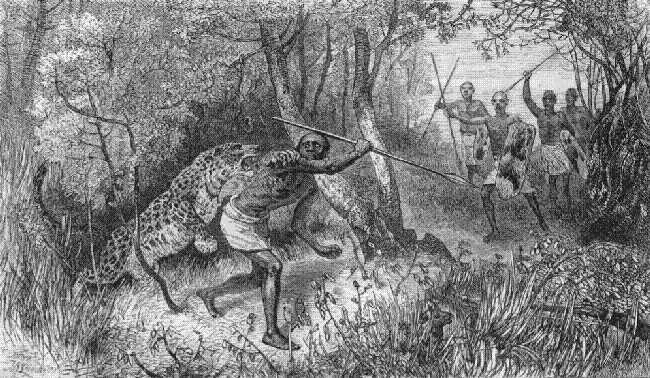
Ebed's party bring 200 frasilahs of all sorts of beads; they will cross Lualaba, and open a new field on the other, or Young's Lualaba: all Central Africa will soon be known: the evils inflicted by these Arabs are enormous, but probably not greater than the people inflict on each other. Meréré has turned against the Arabs, and killed one; robbing several others of all they had, though he has ivory sufficient to send down 7000 lbs. to the coast, and receive loads of goods for 500 men in return. He looks as if insane, and probably is so, and will soon be killed. His insanity may be the effect of pombe, of which he drinks largely, and his people may have told him that the Arabs were plotting with Goambari. He restored Mohamad's ivory and slaves, and sent for the other traders who had fled, saying his people had spoken badly, and he would repay all losses.
The Watuta (who are the same as the Mazitu) came stealing Banyamwezi cattle, and Mtéza's men went out to them, and twenty-two were killed, but the Lewale's people did nothing. The Governor's sole anxiety is to obtain ivory, and no aid is rendered to traders. Seyed Suleiman the Wazeer is the author of the do-nothing policy, and sent away all the sepoys as too expensive, consequently the Wagogo plunder traders unchecked. It is reported that Egyptian Turks came up and attacked Mtéza, but lost many people, and fled. The report of a Moslem Mission to his country was a falsehood, though the details given were circumstantial: falsehood is so common, one can believe nothing the Arabs say, unless confirmed by other evidence: they are the followers of the Prince of lies—Mohamad, whose cool appropriation of the knowledge gained at Damascus, and from the Jews, is perfectly disgusting. All his deeds were done when unseen by any witnesses. It is worth noticing that all admit the decadence of the Moslem power, and they ask how it is so fallen? They seem sincere in their devotion and in teaching the Koran, but its meaning is comparatively hid from most of the Suaheli. The Persian Arabs are said to be gross idolators, and awfully impure. Earth from a grave at Kurbelow (?) is put in the turban and worshipped: some of the sects won't say "Amen."
Moenyegumbé never drank more than a mouthful of pombe. When young, he could make his spear pass right through an elephant, and stick in the ground on the other side. He was a large man, and all his members were largely developed, his hands and fingers were all in proportion to his great height; and he lived to old age with strength unimpaired: Goambari inherits his white colour and sharp nose, but not his wisdom or courage. Meréré killed five of his own people for exciting him against the Arabs. The half-caste is the murderer of many of Charura's descendants. His father got a daughter of Moenyegumbé for courage in fighting the Babema of Ubena.
Cold-blooded murders are frightfully common here. Some kill people in order to be allowed to wear the red tail feathers of a parrot in their hair, and yet they are not ugly like the West Coast Negroes, for many men have as finely formed heads as could be found in London. We English, if naked, would make but poor figures beside the strapping forms and finely shaped limbs of Manyuema men and women. Their cannibalism is doubtful, but my observations raise grave suspicions. A Scotch jury would say, "Not proven." The women are not guilty.
4th February, 1871.—Ten of my men from the coast have come near to Bambarré, and will arrive to-day. I am extremely thankful to hear it, for it assures me that my packet of letters was not destroyed; they know at home by this time what has detained me, and the end to which I strain.
Only one letter reached, and forty are missing! James was killed to-day
by an arrow: the assassin was hid in the forest till my men going to buy
food came up.
8th February, 1871.—The ten men refusing to go north are influenced probably by Shereef, and my two ringleaders, who try this means to compel me to take them.
9th February, 1871.—The man who contrived the murder of James came here, drawn by the pretence that he was needed to lead a party against the villages, which he led to commit the outrage. His thirst for blood is awful: he was bound, and word sent to bring the actual murderers within three days, or he suffers death. He brought five goats, thinking that would smooth the matter over.
11th February, 1871.—Men struck work for higher wages: I consented to give them six dollars a month if they behaved well; if ill I diminish it, so we hope to start to-morrow. Another hunting quelled by Mohamad and me.
The ten men sent are all slaves of the Banians, who are English subjects, and they come with a lie in their mouth: they will not help me, and swear that the Consul told them not to go forward, but to force me back, and they spread the tale all over the country that a certain letter has been sent to me with orders to return forthwith. They swore so positively that I actually looked again at Dr. Kirk's letter to see if his orders had been rightly understood by me. But for Mohamad Bogharib and fear of pistol-shot they would gain their own and their Banian masters' end to baffle me completely; they demand an advance of one dollar, or six dollars a month, though this is double freeman's pay at Zanzibar. Their two headmen, Shereef and Awathé, refused to come past Ujiji, and are revelling on my goods there.
13th February, 1871.—Mabruki being seized with choleraic purging
detains us to-day. I gave Mohamad five pieces Americano, five ditto
Kaniké,
16th, February, 1871.—Started to-day. Mabruki making himself out very ill, Mohamad roused him out by telling him I travelled when much worse. The chief gave me a goat, and Mohamad another, but in coming through the forest on the neck of the mountain the men lost three, and have to go back for them, and return to-morrow. Simon and Ibram were bundled out of the camp, and impudently followed me: when they came up, I told them to be off.
17th February, 1871.—Waiting at a village on the Western slope for the men to come up with the goats, if they have gone back to the camp. Mohamad would not allow the deserters to remain among his people, nor would I. It would only be to imbue the minds of my men with their want of respect for all English, and total disregard of honesty and honour: they came after me with inimitable effrontery, believing that though I said I would not take them, they were so valuable, I was only saying what I knew to be false. The goats were brought by a Manyuema man, who found one fallen into a pitfall and dead; he ate it, and brought one of his own in lieu of it. I gave him ten strings of beads, and he presented a fowl in token of goodwill.
18th February, 1871.—Went on to a village on the Lulwa, and on the 19th reached Moenemgoi, who dissuaded me so earnestly against going to Moenekurumbo for the cause of Molembalemba that I agreed not to venture.
20th February, 1871.—To the ford with only one canoe now, as two men of Katomba were swept away in the other, and drowned. They would not sell the remaining canoe, so I go N.W. on foot to Moené Lualaba, where fine large canoes are abundant. The grass and mud are grievous, but my men lift me over the waters.
21st February, 1871.—Arrived at Monandewa's village, situated on a high ridge between two deep and difficult gullies. These people are obliging and kind: the chief's wife made a fire for me in the evening unbidden.
22nd February, 1871.—On N.W. to a high hill called Chibandé a Yundé, with a spring of white water at the village on the top. Famine from some unknown cause here, but the people are cultivating now on the plain below with a will.
23rd February, 1871.—On to two large villages with many banana plants around, but the men said they were in fear of the traders, and shifted their villages to avoid them: we then went on to the village Kahombogola, with a feeble old man as chief. The country is beautiful and undulating: light-green grass covers it all, save at the brooks, where the eye is relieved by the dark-green lines of trees. Grass tears the hands and wets the extremities constantly. The soil is formed of the débris of granitic rocks; rough and stony, but everywhere fertile. One can rarely get a bare spot to sit down and rest.
24th February, 1871.—To a village near Lolandé River. Then across the Loengadyé, sleeping on the bank of the Luha, and so to Mamohela, where we were welcomed by all the Arabs, and I got a letter from Dr. Kirk and another from the Sultan, and from Mohamad bin Nassib who was going to Karagwé: all anxious to be kind. Katomba gave flour, nuts, fowls, and goat. A new way is opened to Kasongo's, much shorter than that I followed. I rest a few days, and then go on.
25th February, 1871.—So we went on, and found that it was now known that the Lualaba flowed west-south-west, and that our course was to be west across this other great bend of the mighty river. I had to suspend my judgment, so as to be prepared to find it after all perhaps the Congo. No one knew anything about it except that when at Kasongo's nine days west, and by south it came sweeping round and flowed north and north and by east.
Katomba presented a young soko or gorillah that had been caught while its mother was killed; she sits eighteen inches high, has fine long black hair all over, which was pretty so long as it was kept in order by her dam. She is the least mischievous of all the monkey tribe I have seen, and seems to know that in me she has a friend, and sits quietly on the mat beside me. In walking, the first thing observed is that she does not tread on the palms of her hands, but on the backs of the second line of bones of the hands: in doing this the nails do not touch the ground, nor do the knuckles; she uses the arms thus supported crutch fashion, and hitches herself along between them; occasionally one hand is put down before the other, and alternates with the feet, or she walks upright and holds up a hand to any one to carry her. If refused, she turns her face down, and makes grimaces of the most bitter human weeping, wringing her hands, and sometimes adding a fourth hand or foot to make the appeal more touching. Grass or leaves she draws around her to make a nest, and resents anyone meddling with her property. She is a most friendly little beast, and came up to me at once, making her chirrup of welcome, smelled my clothing, and held out her hand to be shaken. I slapped her palm without offence, though she winced. She began to untie the cord with which she was afterwards bound, with fingers and thumbs, in quite a systematic way, and on being interfered with by a man looked daggers, and screaming tried to beat him with her hands: she was afraid of his stick, and faced him, putting her back to me as a friend. She holds out her hand for people to lift her up and carry her, quite like a spoiled child; then bursts into a passionate cry, somewhat like that of a kite, wrings her hands quite naturally, as if in despair. She eats everything, covers herself with a mat to sleep, and makes a nest of grass or leaves, and wipes her face with a leaf.
I presented my double-barrelled gun which is at Ujiji to Katomba, as he has been very kind when away from Ujiji: I pay him thus for all his services. He gave me the soko, and will carry it to Ujiji for me; I have tried to refund all that the Arabs expended on me.
1st March, 1871.—I was to start this morning, but the Arabs asked me to take seven of their people going to buy biramba, as they know the new way: the offer was gladly accepted.
2nd to 5th March, 1871.—Left Mamohela, and travelled over fine grassy plains, crossing in six hours fourteen running rills, from three to ten or fifteen feet broad, and from calf to thigh deep. Tree-covered mountains on both sides. The natives know the rills by names, and readily tell their courses, and which falls into which, before all go into the great Lualaba; but without one as a guide, no one can put them in a map. We came to Monanbunda's villages, and spent the night. Our next stage was at Monangongo's. A small present of a few strings of beads satisfies, but is not asked: I give it invariably as acknowledgment for lodgings. The headman of our next stage hid himself in fear, as we were near to the scene of Bin Juma's unprovoked slaughter of five men, for tusks that were not stolen, but thrown down. Our path lay through dense forest, and again, on 5th, our march was in the same dense jungle of lofty trees and vegetation that touch our arms on each side. We came to some villages among beautiful tree-covered hills, called Basilañgé or Mobasilangé. The villages are very pretty, standing on slopes. The main street generally lies east and west, to allow the bright sun to stream his clear hot rays from one end to the other, and lick up quickly the moisture from the frequent showers which is not drained off by the slopes. A little verandah is often made in front of the door, and here at dawn the family gathers round a fire, and, while enjoying the heat needed in the cold that always accompanies the first darting of the light or sun's rays across the atmosphere, inhale the delicious air, and talk over their little domestic affairs. The various shaped leaves of the forest all around their village and near their nestlings are bespangled with myriads of dewdrops. The cocks crow vigorously, and strut and ogle; the kids gambol and leap on the backs of their dams quietly chewing the cud; other goats make believe fighting. Thrifty wives often bake their new clay pots in a fire, made by lighting a heap of grass roots: the next morning they extract salt from the ashes, and so two birds are killed with one stone. The beauty of this morning scene of peaceful enjoyment is indescribable. Infancy gilds the fairy picture with its own lines, and it is probably never forgotten, for the young, taken up from slavers, and treated with all philanthropic missionary care and kindness, still revert to the period of infancy as the finest and fairest they have known. They would go back to freedom and enjoyment as fast as would our own sons of the soil, and be heedless to the charms of hard work and no play which we think so much better for them if not for us.
In some cases we found all the villages deserted; the people had fled at our approach, in dread of repetitions of the outrages of Arab slaves. The doors were all shut: a bunch of the leaves of reeds or of green reeds placed across them, means "no entrance here." A few stray chickens wander about wailing, having hid themselves while the rest were caught and carried off into the deep forest, and the still smoking fires tell the same tale of recent flight from the slave-traders.
Many have found out that I am not one of their number, so in various cases they stand up and call out loudly, "Bolongo, Bolongo!" "Friendship, Friendship!" They sell their fine iron bracelets eagerly for a few beads; for (bracelets seem out of fashion since beads came in), but they are of the finest quality of iron, and were they nearer Europe would be as eagerly sought and bought as horse-shoe nails are for the best gun-barrels. I overhear the Manyuema telling each other that I am the "good one." I have no slaves, and I owe this character to the propagation of a good name by the slaves of Zanzibar, who are anything but good themselves. I have seen slaves belonging to the seven men now with us slap the cheeks of grown men who had offered food for sale; it was done in sheer wantonness, till I threatened to thrash them if I saw it again; but out of my sight they did it still, and when I complained to the masters they confessed that all the mischief was done by slaves; for the Manyuema, on being insulted, lose temper and use their spears on the nasty curs, and then vengeance is taken with guns. Free men behave better than slaves; the bondmen are not responsible. The Manyuema are far more beautiful than either the bond or free of Zanzibar; I overhear the remark often, "If we had Manyuema wives what beautiful children we should beget." The men are usually handsome, and many of the women are very pretty; hands, feet, limbs, and forms perfect in shape and the colour light-brown, but the orifices of the nose are widened by snuff-takers, who ram it up as far as they can with the finger and thumb: the teeth are not filed, except a small space between the two upper front teeth.
5th March, 1871.—We heard to-day that Mohamad's people passed us on the west, with much ivory. I lose thus twenty copper rings I was to take from them, and all the notes they were to make for me of the rivers they crossed.
6th March, 1871.—Passed through very large villages, with many forges in active work; some men followed us, as if to fight, but we got them to turn peaceably: we don't know who are enemies, so many have been maltreated and had relatives killed. The rain of yesterday made the paths so slippery that the feet of all were sorely fatigued, and on coming to Manyara's, I resolved to rest on 7th near Mount Kimazi. I gave a cloth and beads in lieu of a fine fat goat from the chief, a clever, good man.
9th March, 1871.—We marched about five hours across a grassy plain without trees—buga or prairie. The torrid sun, nearly vertical, sent his fierce rays down, and fatigued us all: we crossed two Sokoyé streams by bridges, and slept at a village on a ridge of woodland overlooking Kasonga. After two hours this morning, we came to villages of this chief, and at one were welcomed by the Safari of Salem Mokadam, and I was given a house. Kasonga is a very fine young man, with European features, and "very clever and good." He is clever, and is pronounced good, because he eagerly joins the Arabs in marauding! Seeing the advantage of firearms, he has bought four muskets. Mohamad's people were led by his, and spent all their copper for some fifty frasilahs of good ivory. From this party men have been sent over Lualaba, and about fifty frasilahs obtained: all praise Kasonga. We were now only six miles from Lualaba, and yet south of Mamohela; this great river, in fact, makes a second great sweep to the west of some 130 miles, and there are at least 30' of southing; but now it comes rolling majestically to the north, and again makes even easting. It is a mighty stream, with many islands in it, and is never wadeable at any point or at any time of the year.
10th March, 1871.—Mohamad's people are said to have gone to Luapanya, a powerful chief, who told them they were to buy all their ivory from him: he had not enough, and they wanted to go on to a people who have ivory door-posts; but he said, "You shall go neither forward nor backwards, but remain here," and he then called an immense body of archers, and said, "You must fight these." The consequence was they killed Luapanya and many of his people, called Bahika, then crossed a very large river, the Morombya or Morombwé, and again the Pembo River, but don't seem to have gone very far north. I wished to go from this in canoes, but Kasonga has none, so I must tramp for five or six days to Moené Lualaba to buy one, if I have credit with Abed.
11th March, 1871.—I had a long, fierce oration from Amur, in which I was told again and again that I should be killed and eaten—the people wanted a "white one" to eat! I needed 200 guns; and "must not go to die." I told him that I was thankful for advice, if given by one who had knowledge, but his vehement threats were dreams of one who had never gone anywhere, but sent his slaves to kill people. He was only frightening my people, and doing me an injury. I told him that Baker had only twelve people, and came near to this: to this he replied "Were the people cannibals?" &c. &c.
I left this noisy demagogue, after saying I thanked him for his warnings, but saw he knew not what he was saying. The traders from Ujiji are simply marauders, and their people worse than themselves, they thirst for blood more than for ivory, each longs to be able to tell a tale of blood, and the Manyuema are an easy prey. Hassani assaulted the people at Moené Lualaba's, and now they keep to the other bank, and I am forced to bargain with Kasonga for a canoe, and he sends to a friend for one to be seen on the 13th. This Hassani declared to me that he would not begin hostilities, but he began nothing else; the prospect of getting slaves overpowers all else, and blood flows in horrid streams. The Lord look on it! Hassani will have some tale to tell Mohamad Bogharib.
[At the outset of his explorations Livingstone fancied that there were degrees in the sufferings of slaves, and that the horrors perpetrated by the Portuguese of Tette were unknown in the system of slave hunting which the Arabs pursue: we now see that a further acquaintance with the slave-trade of the Interior has restored the balance of infamy, and that the same tale of murder and destruction is common wherever the traffic extends, no matter by whom it is carried on.]
15th March, 1871.—Falsehood seems ingrained in their constitutions: no wonder that in all this region they have never tried to propagate Islamism; the natives soon learn to hate them, and slaving, as carried on by the Kilwans and Ujijians, is so bloody, as to prove an effectual barrier against proselytism.
My men are not come back: I fear they are engaged in some broil. In confirmation of what I write, some of the party here assaulted a village of Kasonga's, killed three men and captured women and children; they pretended that they did not know them to be his people, but they did not return the captives.
20th March, 1871.—I am heartsore, and sick of human blood.
21st March, 1871.—Kasongo's brother's child died, and he asked me to remain to-day while he buried the dead, and he would give me a guide to-morrow; being rainy I stop willingly. Dugumbé is said to purpose going down the river to Kanagumbé River to build on the land Kanagumbé, which is a loop formed by the river, and is large. He is believed to possess great power of divination, even of killing unfaithful women.
22nd March, 1871.—I am detained another day by the sickness of one of the party. Very cold rain yesterday from the north-west. I hope to go to-morrow towards the Lakoni, or great market of this region.
23rd March, 1871.—Left Kasongo, who gave me a goat and a guide. The country is gently undulating, showing green slopes fringed with wood, with grass from four to six feet. We reached Katenga's, about five miles off. There are many villages, and people passed us carrying loads of provisions, and cassava, from the chitoka or market.
24th March, 1871.—Great rain in the night and morning, and sickness of the men prevented our march.
25th March, 1871.—Went to Mazimwé, 7-1/2 miles off.
26th March, 1871.—Went four miles and crossed the Kabwimaji; then a mile beyond Kahembai, which flows into the Kunda, and it into the Lualaba; the country is open, and low hills appear in the north. We met a party from the traders at Kasenga, chiefly Materéka's people under Salem and Syde bin Sultan; they had eighty-two captives, and say they fought ten days to secure them and two of the Malongwana, and two of the Banyamwezi. They had about twenty tusks, and carried one of their men who broke his leg in fighting; we shall be safe only when past the bloodshed and murder.
27th March, 1871.—We went along a ridge of land overhanging a fine valley of denudation, with well-cultivated hills in the distance (N.), where Hassani's feat of bloodshed was performed. There are many villages on the ridge, some rather tumbledown ones, which always indicate some misrule. Our march was about seven miles. A headman who went with us plagued another chief to give me a goat; I refused to take what was not given willingly, but the slaves secured it; and I threatened our companion, Kama, with dismissal from our party if he became a tool in slave hands. The arum is common.
28th March, 1871.—The Banian slaves are again trying compulsion—I don't know what for. They refused to take their bead rations, and made Chakanga spokesman: I could not listen to it, as he has been concocting a mutiny against me. It is excessively trying, and so many difficulties have been put in my way I doubt whether the Divine favour and will is on my side.
We came six miles to-day, crossing many rivulets running to the Kunda, which also we crossed in a canoe; it is almost thirty yards wide and deep: afterwards, near the village where we slept, we crossed the Luja about twenty yards wide, going into the Kunda and Lualaba. I am greatly distressed because there is no law here; they probably mean to create a disturbance at Abed's place, to which we are near: the Lord look on it.
29th March, 1871.—Crossed the Liya, and next day the Moangoi, by two well-made wattle bridges at an island in its bed: it is twenty yards, and has a very strong current, which makes all the market people fear it. We then crossed the Molembé in a canoe, which is fifteen yards, but swelled by rains and many rills. Came 7 1/2 miles to sleep at one of the outlying villages of Nyangwé: about sixty market people came past us from the Chitoka or marketplace, on the banks of Lualaba; they go thither at night, and come away about mid-day, having disposed of most of their goods by barter. The country is open, and dotted over with trees, chiefly a species of Bauhinia, that resists the annual grass burnings; there are trees along the watercourses, and many villages, each with a host of pigs. This region is low as compared with Tanganyika; about 2000 feet above the sea.
The headman's house, in which I was lodged, contained the housewife's little conveniences, in the shape of forty pots, dishes, baskets, knives, mats, all of which she removed to another house: I gave her four strings of beads, and go on to-morrow. Crossed the Kunda River and seven miles more brought us to Nyañgwé, where we found Abed and Hassani had erected their dwellings, and sent their people over Lualaba, and as far west as the Loéki or Lomamé. Abed said that my words against bloodshedding had stuck into him, and he had given orders to his people to give presents to the chiefs, but never fight unless actually attacked.
31st March, 1871.—I went down to take a good look at the Lualaba here. It is narrower than it is higher up, but still a mighty river, at least 3000 yards broad, and always deep: it can never be waded at any point, or at any time of the year; the people unhesitatingly declare that if any one tried to ford it, he would assuredly be lost. It has many large islands, and at these it is about 2000 yards or one mile. The banks are steep and deep: there is clay, and a yellow-clay schist in their structure; the other rivers, as the Luya and Kunda, have gravelly banks. The current is about two miles an hour away to the north.
FOOTNOTES:
CHAPTER V.
The Chitoka or market gathering. The broken watch. Improvises ink. Builds a new house at Nyañgwé on the bank of the Lualaba. Marketing. Cannibalism. Lake Kamalondo. Dreadful effect of slaving. News of country across the Lualaba. Tiresome frustration. The Bakuss. Feeble health. Busy scene at market. Unable to procure canoes. Disaster to Arab canoes. Rapids in Lualaba. Project for visiting Lake Lincoln and the Lomamé. Offers large reward for canoes and men. The slave's mistress. Alarm of natives at market. Fiendish slaughter of women by Arabs. Heartrending scene. Death on land and in the river. Tagamoio's assassinations. Continued slaughter across the river. Livingstone becomes desponding.
1st April, 1871.—The banks are well peopled, but one must see the gathering at the market, of about 3000, chiefly women, to judge of their numbers. They hold market one day, and then omit attendance here for three days, going to other markets at other points in the intervals. It is a great institution in Manyuema: numbers seem to inspire confidence, and they enforce justice for each other. As a rule, all prefer to buy and sell in the market, to doing business anywhere else; if one says, "Come, sell me that fowl or cloth," the reply is, "Come to the 'Chitoka,' or marketplace."
2nd April, 1871.—To-day the market contained over a thousand people, carrying earthen pots and cassava, grass cloth, fishes, and fowls; they were alarmed at my coming among them and were ready to flee, many stood afar off in suspicion; some came from the other side of the river with their goods. To-morrow market is held up river.
3rd April, 1871.—I tried to secure a longitude by fixing a weight on the key of the watch, and so helping it on: I will try this in a quiet place to-morrow. The people all fear us, and they have good reason for it in the villainous conduct of many of the blackguard half-castes which alarms them: I cannot get a canoe, so I wait to see what will turn up. The river is said to overflow all its banks annually, as the Nile does further down. I sounded across yesterday. Near the bank it is 9 feet, the rest 15 feet, and one cast in the middle was 20 feet: between the islands 12 feet, and 9 feet again in shore: it is a mighty river truly. I took distances and altitudes alternately with a bullet for a weight on the key of the chronometer, taking successive altitudes of the sun and distances of the moon. Possibly the first and last altitudes may give the rate of going, and the frequent distances between may give approximate longitude.
4th April, 1871.—Moon, the fourth of the Arabs, will appear in three or four days. This will be a guide in ascertaining the day of observing the lunars, with the weight.
The Arabs ask many questions about the Bible, and want to know how many prophets have appeared, and probably say that they believe in them all; while we believe all but reject Mohamad. It is easy to drive them into a corner by questioning, as they don't know whither the inquiries lead, and they are not offended when their knowledge is, as it were, admitted. When asked how many false prophets are known, they appeal to my knowledge, and evidently never heard of Balaam, the son of Beor, or of the 250 false prophets of Jezebel and Ahab, or of the many lying prophets referred to in the Bible.
6th April, 1871.—Ill from drinking two cups of very sweet malofu, or beer, made from bananas: I shall touch it no more.
 Facsimile of a Portion of Dr. Livingstone's Journal,
7th April, 1871.—Made this ink with the seeds of a plant, called by the Arabs Zugifaré; it is known in India, and is used here by the Manyuema to dye virambos and ornament faces and heads. I sent my people over to the other side to cut wood to build a house for me; the borrowed one has mud walls and floors, which are damp, foul, smelling, and unwholesome. I shall have grass walls, and grass and reeds on the floor of my own house; the free ventilation will keep it sweet. This is the season called Masika, the finishing rains, which we have in large quantities almost every night, and I could scarcely travel even if I had a canoe; still it is trying to be kept back by suspicion, and by the wickedness of the wicked.
Some of the Arabs try to be kind, and send cooked food every day: Abed is the chief donor. I taught him to make a mosquito-curtain of thin printed calico, for he had endured the persecution of these insects helplessly, except by sleeping on a high stage, when they were unusually bad. The Manyuema often bring evil on themselves by being untrustworthy. For instance, I paid one to bring a large canoe to cross the Lualaba, he brought a small one, capable of carrying three only, and after wasting some hours we had to put off crossing till next day.
8th April, 1871.—Every headman of four or five huts is a mologhwé, or chief, and glories in being called so. There is no political cohesion. The Ujijian slavery is an accursed system; but it must be admitted that the Manyuema, too, have faults, the result of ignorance of other people: their isolation has made them as unconscious of danger in dealing with the cruel stranger, as little dogs in the presence of lions. Their refusal to sell or lend canoes for fear of blame by each other will be ended by the party of Dugumbé, which has ten headmen, taking them by force; they are unreasonable and bloody-minded towards each other: every Manyuema would like every other headman slain; they are subjected to bitter lessons and sore experience. Abed went over to Mologhwé Kahembé and mixed blood with him; he was told that two large canoes were hollowed out, and nearly ready to be brought for sale; if this can be managed peaceably it is a great point gained, and I may get one at our Arabs' price, which may be three or four times the native price. There is no love lost among the three Arabs here.
9th April, 1871.—Cut wood for my house. The Loéki is said by slaves who have come thence to be much larger than the Lualaba, but on the return of Abed's people from the west we shall obtain better information.
10th April, 1871.—Chitoka, or market, to-day. I counted upwards of 700 passing my door. With market women it seems to be a pleasure of life to haggle and joke, and laugh and cheat: many come eagerly, and retire with careworn faces; many are beautiful, and many old; all carry very heavy loads of dried cassava and earthen pots, which they dispose of very cheaply for palm-oil, fish, salt, pepper, and relishes for their food. The men appear in gaudy lambas, and carry little save their iron wares, fowls, grass cloth, and pigs.
Bought the fish with the long snouts: very good eating.
12th April, 1871.—New moon last night; fourth Arab month: I am at a loss for the day of the month. My new house is finished; a great comfort, for the other was foul and full of vermin: bugs (Tapazi, or ticks), that follow wherever Arabs go, made me miserable, but the Arabs are insensible to them; Abed alone had a mosquito-curtain, and he never could praise it enough. One of his remarks is, "If slaves think you fear them, they will climb over you." I clothed mine for nothing, and ever after they have tried to ride roughshod over me, and mutiny on every occasion!
14th April, 1871.—Kahembé came over, and promises to bring a canoe; but he is not to be trusted; he presented Abed with two slaves, and is full of fair promises about the canoe, which he sees I am anxious to get. They all think that my buying a canoe means carrying war to the left bank; and now my Banian slaves encourage the idea: "He does not wish slaves nor ivory," say they, "but a canoe, in order to kill Manyuema." Need it be wondered at that people, who had never heard of strangers or white men before I popped down among them, believed the slander? The slaves were aided in propagating the false accusation by the half-caste Ujijian slaves at the camp. Hassani fed them every day; and, seeing that he was a bigoted Moslem, they equalled him in prayers in his sitting-place seven or eight times a day! They were adepts at lying, and the first Manyuema words they learned were used to propagate falsehood.
I have been writing part of a despatch, in case of meeting people from the French settlement on the Gaboon at Loéki, but the canoe affair is slow and tedious: the people think only of war: they are a bloody-minded race.
15th April, 1871.—The Manyuema tribe, called Bagenya, occupy the left bank, opposite Nyañgwé. A spring of brine rises in the bed of a river, named Lofubu, and this the Bayenga inspissate by boiling, and sell the salt at market. The Lomamé is about ten days west of Lualaba, and very large; the confluence of Lomamé, or Loéki, is about six days down below Nyañgwé by canoe; the river Nyanzé is still less distant.
16th April, 1871.—On the Nyanzé stands the principal town and market of the chief, Zurampela. Rashid visited him, and got two slaves on promising to bring a war-party from Abed against Chipangé, who by similar means obtained the help of Salem Mokadam to secure eighty-two captives: Rashid will leave this as soon as possible, sell the slaves, and leave Zurampela to find out the fraud! This deceit, which is an average specimen of the beginning of half-caste dealings, vitiates his evidence of a specimen of cannibalism which he witnessed; but it was after a fight that the victims were cut up, and this agrees with the fact that the Manyuema eat only those who are killed in war. Some have averred that captives, too, are eaten, and a slave is bought with a goat to be eaten; but this I very strongly doubt.
17th April, 1871.—Rainy.
18th April, 1871.—I found that the Lepidosiren is brought to market in pots with water in them, also white ants roasted, and the large snail, achetina, and a common snail: the Lepidosiren is called "sembé."
Abed went a long way to examine a canoe, but it was still further, and he turned back.
19th April, 1871.—Dreary waiting, but Abed proposes to join and trade along with me: this will render our party stronger, and he will not shoot people in my company; we shall hear Katomba's people's story too.
20th April, 1871.—Katomba a chief was to visit us yesterday, but failed, probably through fear.
The chief Mokandira says that Loéki is small where it joins Lualaba, but another, which they call Lomamé, is very much larger, and joins Lualaba too: rapids are reported on it.
21st April, 1871.—A common salutation reminds me of the Bechuana's "U le hatsi" (thou art on earth); "Ua tala" (thou lookest); "Ua boka," or byoka (thou awakest); "U ri ho" (thou art here); "U li koni" (thou art here)—about pure "Sichuana," and "Nya," No, is identical. The men here deny that cannibalism is common: they eat only those killed in war, and, it seems, in revenge, for, said Mokandira, "the meat is not nice; it makes one dream of the dead man." Some west of Lualaba eat even those bought for the purpose of a feast; but I am not quite positive on this point: all agree in saying that human flesh is saltish, and needs but little condiment. And yet they are a fine-looking race; I would back a company of Manyuema men to be far superior in shape of head and generally in physical form too against the whole Anthropological Society. Many of the women are very light-coloured and very pretty; they dress in a kilt of many folds of gaudy lambas.
22nd April, 1871.—In Manyuema, here Kusi, Kunzi, is north; Mhuru, south; Nkanda, west, or other side Lualaba; Mazimba, east. The people are sometimes confused in name by the directions; thus Bankanda is only "the other side folk." The Bagenya Chimburu came to visit me, but I did not see him, nor did I know Moené Nyañgwé till too late to do him honour; in fact, every effort was made to keep me in the dark while the slavers of Ujiji made all smooth for themselves to get canoes. All chiefs claim the privilege of shaking hands, that is, they touch the hand held out with their palm, then clap two hands together, then touch again, and clap again, and the ceremony concludes: this frequency of shaking hands misled me when the great man came.
24th April, 1871.—Old feuds lead the Manyuema to entrap the traders to fight: they invite them to go to trade, and tell them that at such a village plenty of ivory lies; then when the trader goes with his people, word is sent that he is coming to fight, and he is met by enemies, who compel him to defend himself by their onslaught. We were nearly entrapped in this way by a chief pretending to guide us through the country near Basilañgé; he would have landed us in a fight, but we detected his drift, changed our course so as to mislead any messengers he might have sent, and dismissed him with some sharp words.
Lake Kamolondo is about twenty-five miles broad. The Lufira at Katanga is a full bow-shot wide; it goes into Kamolondo. Chakomo is east of Lufira Junction. Kikonzé Kalanza is on the west of it, and Mkana, or the underground dwellings, still further west: some are only two days from Katanga. The Chorwé people are friendly. Kamolondo is about ten days distant from Katanga.
25th April, 1871.—News came that four men sent by Abed to buy ivory had been entrapped, and two killed. The rest sent for aid to punish the murderers, and Abed wished me to send my people to bring the remaining two men back. I declined; because, no matter what charges I gave, my Banian slaves would be sure to shed human blood. We can go nowhere but the people of the country ask us to kill their fellow-men, nor can they be induced to go to villages three miles off, because there, in all probability, live the murderers of fathers, uncles, or grandfathers—a dreadful state truly. The traders are as bloodthirsty every whit as the Manyuema, where no danger exists, but in most cases where the people can fight they are as civil as possible. At Moeré Mpanda's, the son of Casembe, Mohamad Bogharib left a debt of twenty-eight slaves and eight bars of copper, each seventy pounds, and did not dare to fire a shot because they saw they had met their match: here his headmen are said to have bound the headmen of villages till a ransom was paid in tusks! Had they only gone three days further to the Babisa, to whom Moene-mokaia's men went, they would have got fine ivory at two rings a tusk, while they had paid from ten to eighteen. Here it is as sad a tale to tell as was that of the Manganja scattered and peeled by the Waiyau agents of the Portuguese of Tétte. The good Lord look on it.
26th April, 1871.—Chitovu called nine slaves bought by Abed's people from the Kuss country, west of the Lualaba, and asked them about their tribes and country for me. One, with his upper front teeth extracted, was of the tribe Maloba, on the other side of the Loéki, another comes from the River Lombadzo, or Lombazo, which is west of Loéki (this may be another name for the Lomamé), the country is called Nanga, and the tribe Noñgo, chief Mpunzo. The Malobo tribe is under the chiefs Yunga and Lomadyo. Another toothless boy said that he came from the Lomamé: the upper teeth extracted seem to say that the tribe have cattle; the knocking out the teeth is in imitation of the animals they almost worship. No traders had ever visited them; this promises ivory to the present visitors: all that is now done with the ivory there is to make rude blowing horns and bracelets.
27th April, 1871.—Waiting wearily and anxiously; we cannot move people who are far off and make them come near with news. Even the owners of canoes say, "Yes, yes; we shall bring them," but do not stir; they doubt us, and my slaves increase the distrust by their lies to the Manyuema.
28th April, 1871.—Abed sent over Manyuema to buy slaves for him and got a pretty woman for 300 cowries and a hundred strings of beads; she can be sold again to an Arab for much more in ivory. Abed himself gave $130 for a woman-cook, and she fled to me when put in chains for some crime: I interceded, and she was loosed: I advised her not to offend again, because I could not beg for her twice.
Hassani with ten slaves dug at the malachite mines of Katanga for three months, and gained a hundred frasilahs of copper, or 3500 lbs. We hear of a half-caste reaching the other side of Lomamé, probably from Congo or Ambriz, but the messengers had not seen him.
1st May, 1871.—Katomba's people arrived from the Babisa, where they sold all their copper at two rings for a tusk, and then found that abundance of ivory still remained: door-posts and house-pillars had been made of ivory which now was rotten. The people of Babisa kill elephants now and bring tusks by the dozen, till the traders get so many that in this case they carried them by three relays. They dress their hair like the Bashukulompo, plaited into upright basket helmets: no quarrel occurred, and great kindness was shown to the strangers. A river having very black water, the Nyengeré, flows into Lualaba from the west, and it becomes itself very large: another river or water, Shamikwa, falls into it from the south-west, and it becomes still larger: this is probably the Lomamé. A short-horned antelope is common.
3rd May, 1871.—Abed informs me that a canoe will come in five days. Word was sent after me by the traders south of us not to aid me, as I was sure to die where I was going: the wish is father to the thought! Abed was naturally very anxious to get first into the Babisa ivory market, yet he tried to secure a canoe for me before he went, but he was too eager, and a Manyuema man took advantage of his desire, and came over the river and said that he had one hollowed out, and he wanted goats and beads to hire people to drag it down to the water. Abed on my account advanced five goats, a thousand cowries, and many beads, and said that he would tell me what he wished in return: this was debt, but I was so anxious to get away I was content to take the canoe on any terms. However, it turned out that the matter on the part of the headman whom Abed trusted was all deception: he had no canoe at all, but knew of one belonging to another man, and wished to get Abed and me to send men to see it—in fact, to go with their guns, and he would manage to embroil them with the real owner, so that some old feud should be settled to his satisfaction. On finding that I declined to be led into his trap, he took a female slave to the owner, and on his refusal to sell the canoe for her, it came out that he had adopted a system of fraud to Abed. He had victimized Abed, who was naturally inclined to believe his false statements, and get off to the ivory market. His people came from the Kuss country in the west with sixteen tusks, and a great many slaves bought and not murdered for. The river is rising fast, and bringing down large quantities of aquatic grass, duckweed, &c. The water is a little darker in colour than at Cairo. People remove and build their huts on the higher forest lands adjacent. Many white birds (the paddy bird) appear, and one Ibis religiosa; they pass north.
The Bakuss live near Lomamé; they were very civil and kind to the strangers, but refused passage into the country. At my suggestion, the effect of a musket-shot was shown on a goat: they thought it supernatural, looked up to the clouds, and offered to bring ivory to buy the charm that could draw lightning down. When it was afterwards attempted to force a path, they darted aside on seeing the Banyamwezi's followers putting the arrows into the bowstrings, but stood in mute amazement looking at the guns, which mowed them down in large numbers. They thought that muskets were the insignia of chieftainship. Their chiefs all go with a long straight staff of rattan, having a quantity of black medicine smeared on each end, and no weapons in their hands: they imagined that the guns were carried as insignia of the same kind; some, jeering in the south, called them big tobacco-pipes; they have no fear on seeing a gun levelled at them.
They use large and very long spears very expertly in the long grass and forest of their country, and are terrible fellows among themselves, and when they become acquainted with firearms will be terrible to the strangers who now murder them. The Manyuema say truly, "If it were not for your guns, not one of you would ever return to your country." The Bakuss cultivate more than the southern Manyuema, especially Pennisetum and dura, or Holeus sorghum; common coffee is abundant, and they use it, highly scented with vanilla, which must be fertilized by insects; they hand round cups of it after meals. Pineapples too are abundant. They bathe regularly twice a day: their houses are of two storeys. The women have rather compressed heads, but very pleasant countenances; and ancient Egyptian, round, wide-awake eyes. Their numbers are prodigious; the country literally swarms with people, and a chief's town extends upwards of a mile. But little of the primeval forest remains. Many large pools of standing water have to be crossed, but markets are held every eight or ten miles from each other, and to these the people come from far, for the market is as great an institution as shopping is with the civilized. Illicit intercourse is punished by the whole of the offender's family being enslaved.
The Bakuss smelt copper from the ore and sell it very cheaply to the traders for beads. The project of going in canoes now appeared to the half-castes so plausible, that they all tried to get the Bagenya on the west bank to lend them, and all went over to mix blood and make friends with the owners, then all slandered me as not to be trusted, as they their blood-relations were; and my slaves mutinied and would go no further. They mutinied three times here, and Hassani harboured them till I told him that, if an English officer harboured an Arab slave he would be compelled by the Consul to refund the price, and I certainly would not let him escape; this frightened him; but I was at the mercy of slaves who had no honour, and no interest in going into danger.
16th May, 1871.—Abed gave me a frasilah of Matunda beads, and I returned fourteen fathoms of fine American sheeting, but it was an obligation to get beads from one whose wealth depended on exchanging beads for ivory.
16th May, 1871.—At least 3000 people at market to-day, and my going among them has taken away the fear engendered by the slanders of slaves and traders, for all are pleased to tell me the names of the fishes and other things. Lepidosirens are caught by the neck and lifted out of the pot to show their fatness. Camwood ground and made into flat cakes for sale and earthen balls, such as are eaten in the disease safura or earth-eating, are offered and there is quite a roar of voices in the multitude, haggling. It was pleasant to be among them compared to being with the slaves, who were all eager to go back to Zanzibar: some told me that they were slaves, and required a free man to thrash them, and proposed to go back to Ujiji for one. I saw no hope of getting on with them, and anxiously longed for the arrival of Dugumbé; and at last Abed overheard them plotting my destruction. "If forced to go on, they would watch till the first difficulty arose with the Manyuema, then fire off their guns, run away, and as I could not run as fast as they, leave me to perish." Abed overheard them speaking loudly, and advised me strongly not to trust myself to them any more, as they would be sure to cause my death. He was all along a sincere friend, and I could not but take his words as well-meant and true.
18th May, 1871.—Abed gave me 200 cowries and some green beads. I was at the point of disarming my slaves and driving them away, when they relented, and professed to be willing to go anywhere; so, being eager to finish my geographical work, I said I would run the risk of their desertion, and gave beads to buy provisions for a start north. I cannot state how much I was worried by these wretched slaves, who did much to annoy me, with the sympathy of all the slaving crew. When baffled by untoward circumstances the bowels plague me too, and discharges of blood relieve the headache, and are as safety-valves to the system. I was nearly persuaded to allow Mr. Syme to operate on me when last in England, but an old friend told me that his own father had been operated on by the famous John Hunter, and died in consequence at the early age of forty. His advice saved me, for this complaint has been my safety-valve.
The Zingifuré, or red pigment, is said to be a cure for itch common among both natives and Arab slaves and Arab children.
20th May, 1871.—Abed called Kalonga the headman, who beguiled him as I soon found, and delivered the canoe he had bought formally to me, and went off down the Lualaba on foot to buy the Babisa ivory. I was to follow in the canoe and wait for him in the River Luéra, but soon I ascertained that the canoe was still in the forest, and did not belong to Kalonga. On demanding back the price he said, "Let Abed come and I will give it to him;" then when I sent to force him to give up the goods, all his village fled into the forest: I now tried to buy one myself from the Bagenya, but there was no chance; so long as the half-caste traders needed any they got all—nine large canoes, and I could not secure one.
24th May, 1871.—The market is a busy scene—everyone is in dead earnest—little time is lost in friendly greetings; vendors of fish run about with potsherds full of snails or small fishes or young Clarias capensis smoke-dried and spitted on twigs, or other relishes to exchange for cassava roots dried after being steeped about three days in water—potatoes, vegetables, or grain, bananas, flour, palm-oil, fowls, salt, pepper; each is intensely eager to barter food for relishes, and makes strong assertions as to the goodness or badness of everything: the sweat stands in beads on their faces—cocks crow briskly, even when slung over the shoulder with their heads hanging down, and pigs squeal. Iron knobs, drawn out at each end to show the goodness of the metal, are exchanged for cloth of the Muabé palm. They have a large funnel of basket-work below the vessel holding the wares, and slip the goods down if they are not to be seen. They deal fairly, and when differences arise they are easily settled by the men interfering or pointing to me: they appeal to each other, and have a strong sense of natural justice. With so much food changing hands amongst the three thousand attendants much benefit is derived; some come from twenty to twenty-five miles. The men flaunt about in gaudy-coloured lambas of many folded kilts—the women work hardest—the potters slap and ring their earthenware all round, to show that there is not a single flaw in them. I bought two finely shaped earthen bottles of porous earthenware, to hold a gallon each, for one string of beads, the women carry huge loads of them in their funnels above the baskets, strapped to the shoulders and forehead, and their hands are full besides; the roundness of the vessels is wonderful, seeing no machine is used: no slaves could be induced to carry half as much as they do willingly. It is a scene of the finest natural acting imaginable. The eagerness with which all sorts of assertions are made—the eager earnestness with which apparently all creation, above, around, and beneath, is called on to attest the truth of what they allege—and then the intense surprise and withering scorn cast on those who despise their goods: but they show no concern when the buyers turn up their noses at them. Little girls run about selling cups of water for a few small fishes to the half-exhausted wordy combatants. To me it was an amusing scene. I could not understand the words that flowed off their glib tongues, but the gestures were too expressive to need interpretation.
27th May, 1871.—Hassani told me that since he had come, no Manyuema had ever presented him with a single mouthful of food, not even a potato or banana, and he had made many presents. Going from him into the market I noticed that one man presented a few small fishes, another a sweet potato and a piece of cassava, and a third two small fishes, but the Manyuema are not a liberal people. Old men and women who remained in the half-deserted villages we passed through in coming north, often ran forth to present me with bananas, but it seemed through fear; when I sat down and ate the bananas they brought beer of bananas, and I paid for all. A stranger in the market had ten human under jaw-bones hung by a string over his shoulder: on inquiry he professed to have killed and eaten the owners, and showed with his knife how he cut up his victim. When I expressed disgust he and others laughed. I see new faces every market-day. Two nice girls were trying to sell their venture, which was roasted white ants, called "Gumbé."
30th May, 1871.—The river fell four inches during the last four days; the colour is very dark brown, and large quantities of aquatic plants and trees float down. Mologhwé, or chief Ndambo, came and mixed blood with the intensely bigoted Moslem, Hassani: this is to secure the nine canoes. He next went over to have more palaver about them, and they do not hesitate to play me false by detraction. The Manyuema, too, are untruthful, but very honest; we never lose an article by them: fowls and goats are untouched, and if a fowl is lost, we know that it has been stolen by an Arab slave. When with Mohamad Bogharib, we had all to keep our fowls at the Manyuema villages to prevent them being stolen by our own slaves, and it is so here. Hassani denies complicity with them, but it is quite apparent that he and others encourage them in mutiny.
5th June, 1871.—The river rose again six inches and fell three. Rain nearly ceased, and large masses of fleecy clouds float down here from the north-west, with accompanying cold.
7th June, 1871.—I fear that I must march on foot, but the mud is forbidding.
11th June, 1871.—New moon last night, and I believe Dugumbé will leave Kasonga's to-day. River down three inches.
14th June, 1871.—Hassani got nine canoes, and put sixty-three persons in three; I cannot get one. Dugumbé reported near, but detained by his divination, at which he is an expert; hence his native name is "Molembalemba"—"writer, writing."
16th June, 1871.—The high winds and drying of soap and sugar tell that the rains are now over in this part.
18th June, 1871.—Dugumbé arrived, but passed to Moené Nyañgwé's, and found that provisions were so scarce, and dear there, as compared with our market, that he was fain to come back to us. He has a large party and 500 guns. He is determined to go into new fields of trade, and has all his family with him, and intends to remain six or seven years, sending regularly to Ujiji for supplies of goods.
20th June, 1871.—Two of Dugumbé's party brought presents of four large fundos of beads each. All know that my goods are unrighteously detained by Shereef and they show me kindness, which I return by some fine calico which I have. Among the first words Dugumbé said to me were, "Why your own slaves are your greatest enemies: I will buy you a canoe, but the Banian slaves' slanders have put all the Manyuema against you." I knew that this was true, and that they were conscious of the sympathy of the Ujijian traders, who hate to have me here.
24th June, 1871.—Hassani's canoe party in the river were foiled by narrows, after they had gone down four days. Rocks jut out on both sides, not opposite, but alternate to each other; and the vast mass of water of the great river jammed in, rushes round one promontory on to another, and a frightful whirlpool is formed in which the first canoe went and was overturned, and five lives lost. Had I been there, mine would have been the first canoe, for the traders would have made it a point of honour to give me the precedence (although actually to make a feeler of me), while they looked on in safety. The men in charge of Hassani's canoes were so frightened by this accident that they at once resolved to return, though they had arrived in the country of the ivory: they never looked to see whether the canoes could be dragged past the narrows, as anyone else would have done. No better luck could be expected after all their fraud and duplicity in getting the canoes; no harm lay in obtaining them, but why try to prevent me getting one?
27th June, 1871.—In answer to my prayers for preservation, I was prevented going down to the narrows, formed by a dyke of mountains cutting across country, and jutting a little ajar, which makes the water in an enormous mass wheel round behind it helplessly, and if the canoes reach the rock against which the water dashes, they are almost certainly overturned. As this same dyke probably cuts across country to Lomamé, my plan of going to the confluence and then up won't do, for I should have to go up rapids there. Again, I was prevented from going down Luamo, and on the north of its confluence another cataract mars navigation in the Lualaba, and my safety is thereby secured. We don't always know the dangers that we are guided past.
28th June, 1871.—The river has fallen two feet: dark brown water, and still much wreck floating down.
Eight villages are in flames, set fire to by a slave of Syde bin Habib, called Manilla, who thus shows his blood friends of the Bagenya how well he can fight against the Mohombo, whose country the Bagenya want! The stragglers of this camp are over on the other side helping Manilla, and catching fugitives and goats. The Bagenya are fishermen by taste and profession, and sell the produce of their nets and weirs to those who cultivate the soil, at the different markets. Manilla's foray is for an alleged debt of three slaves, and ten villages are burned.
30th June, 1871.—Hassani pretended that he was not aware of Manilla's foray, and when I denounced it to Manilla himself, he showed that he was a slave, by cringing and saying nothing except something about the debt of three slaves.
1st July, 1871.—I made known my plan to Dugumbé, which was to go west with his men to Lomamé, then by his aid buy a canoe and go up Lake Lincoln to Katanga and the fountains, examine the inhabited caves, and return here, if he would let his people bring me goods from Ujiji; he again referred to all the people being poisoned in mind against me, but was ready to do everything in his power for my success. My own people persuaded the Bagenya not to sell a canoe: Hassani knows it all, but swears that he did not join in the slander, and even points up to Heaven in attestation of innocence of all, even of Manilla's foray. Mohamadans are certainly famous as liars, and the falsehood of Mohamad has been transmitted to his followers in a measure unknown in other religions.
2nd July, 1871.—The upper stratum of clouds is from the north-west, the lower from the south-east; when they mix or change places the temperature is much lowered, and fever ensues. The air evidently comes from the Atlantic, over the low swampy lands of the West Coast. Morning fogs show that the river is warmer than the air.
4th July, 1871.—Hassani off down river in high dudgeon at the cowards who turned after reaching the ivory country. He leaves them here and goes himself, entirely on land. I gave him hints to report himself and me to Baker, should he meet any of his headmen.
5th July, 1871.—The river has fallen three feet in all, that is one foot since 27th June.
I offer Dugumbé $2000, or 400l., for ten men to replace the Banian slaves, and enable me to go up the Lomamé to Katanga and the underground dwellings, then return and go up by Tanganyika to Ujiji, and I added that I would give all the goods I had at Ujiji besides: he took a few days to consult with his associates.
6th July, 1871.—Mokandira, and other headmen, came with a present of a pig and a goat on my being about to depart west. I refused to receive them till my return, and protested against the slander of my wishing to kill people, which they all knew, but did not report to me: this refusal and protest will ring all over the country.
7th July, 1871.—I was annoyed by a woman frequently beating a slave near my house, but on my reproving her she came and apologized. I told her to speak softly to her slave, as she was now the only mother the girl had; the slave came from beyond Lomamé, and was evidently a lady in her own land; she calls her son Mologwé, or chief, because his father was a headman.
Dugumbé advised my explaining my plan of procedure to the slaves, and he evidently thinks that I wish to carry it towards them with a high hand. I did explain all the exploration I intended to do: for instance, the fountains of Herodotus—beyond Katanga—Katanga itself, and the underground dwellings, and then return. They made no remarks, for they are evidently pleased to have me knuckling down to them; when pressed on the point of proceeding, they say they will only go with Dugumbé's men to the Lomamé, and then return. River fallen three inches since the 5th.
10th July, 1871.—Manyuema children do not creep, as European children do, on their knees, but begin by putting forward one foot and using one knee. Generally a Manyuema child uses both feet and both hands, but never both knees: one Arab child did the same; he never crept, but got up on both feet, holding on till he could walk.
New moon last night of seventh Arab month.
11th July, 1871.—I bought the different species of fish brought to market, in order to sketch eight of them, and compare them with those of the Nile lower down: most are the same as in Nyassa. A very active species of Glanis, of dark olive-brown, was not sketched, but a spotted one, armed with offensive spikes in the dorsal and pectoral fins, was taken. Sesamum seed is abundant just now and cakes are made of ground-nuts, as on the West Coast. Dugumbé's horde tried to deal in the market in a domineering way. "I shall buy that," said one. "These are mine," said another; "no one must touch them but me," but the market-women taught them that they could not monopolize, but deal fairly. They are certainly clever traders, and keep each other in countenance, they stand by each other, and will not allow overreaching, and they give food astonishingly cheap: once in the market they have no fear.
12th and 13th July 1871.—The Banian slaves declared before Dugumbé that they would go to the River Lomamé, but no further: he spoke long to them, but they will not consent to go further. When told that they would thereby lose all their pay, they replied, "Yes, but not our lives," and they walked off from him muttering, which is insulting to one of his rank. I then added, "I have goods at Ujiji; I don't know how many, but they are considerable, take them all, and give me men to finish my work; if not enough, I will add to them, only do not let me be forced to return now I am so near the end of my undertaking." He said he would make a plan in conjunction with his associates, and report to me.
14th July, 1871.—I am distressed and perplexed what to do so as not to be foiled, but all seems against me.
15th July, 1871.—The reports of guns on the other side of the Lualaba all the morning tell of the people of Dugumbé murdering those of Kimburu and others who mixed blood with Manilla. "Manilla is a slave, and how dares he to mix blood with chiefs who ought only to make friends with free men like us"—this is their complaint. Kimburu gave Manilla three slaves, and he sacked ten villages in token of friendship; he proposed to give Dugumbé nine slaves in the same operation, but Dugumbé's people destroy his villages, and shoot and make his people captives to punish Manilla; to make an impression, in fact, in the country that they alone are to be dealt with—"make friends with us, and not with Manilla or anyone else"—such is what they insist upon.
About 1500 people came to market, though many villages of those that usually come from the other side were now in flames, and every now and then a number of shots were fired on the fugitives.
 The Massacre of the Manyuema Women at Nyangwe
It was a hot, sultry day, and when I went into the market I saw Adie and Manilla, and three of the men who had lately come with Dugumbé. I was surprised to see these three with their guns, and felt inclined to reprove them, as one of my men did, for bringing weapons into the market, but I attributed it to their ignorance, and, it being very hot, I was walking away to go out of the market, when I saw one of the fellows haggling about a fowl, and seizing hold of it. Before I had got thirty yards out, the discharge of two guns in the middle of the crowd told me that slaughter had begun: crowds dashed off from the place, and threw down their wares in confusion, and ran. At the same time that the three opened fire on the mass of people near the upper end of the marketplace volleys were discharged from a party down near the creek on the panic-stricken women, who dashed at the canoes. These, some fifty or more, were jammed in the creek, and the men forgot their paddles in the terror that seized all. The canoes were not to be got out, for the creek was too small for so many; men and women, wounded by the balls, poured into them, and leaped and scrambled into the water, shrieking. A long line of heads in the river showed that great numbers struck out for an island a full mile off: in going towards it they had to put the left shoulder to a current of about two miles an hour; if they had struck away diagonally to the opposite bank, the current would have aided them, and, though nearly three miles off, some would have gained land: as it was, the heads above water showed the long line of those that would inevitably perish.
Shot after shot continued to be fired on the helpless and perishing. Some of the long line of heads disappeared quietly; whilst other poor creatures threw their arms high, as if appealing to the great Father above, and sank. One canoe took in as many as it could hold, and all paddled with hands and arms: three canoes, got out in haste, picked up sinking friends, till all went down together, and disappeared. One man in a long canoe, which could have held forty or fifty, had clearly lost his head; he had been out in the stream before the massacre began, and now paddled up the river nowhere, and never looked to the drowning. By-and-bye all the heads disappeared; some had turned down stream towards the bank, and escaped. Dugumbé put people into one of the deserted vessels to save those in the water, and saved twenty-one, but one woman refused to be taken on board from thinking that she was to be made a slave of; she preferred the chance of life by swimming, to the lot of a slave: the Bagenya women are expert in the water, as they are accustomed to dive for oysters, and those who went down stream may have escaped, but the Arabs themselves estimated the loss of life at between 330 and 400 souls. The shooting-party near the canoes were so reckless, they killed two of their own people; and a Banyamwezi follower, who got into a deserted canoe to plunder, fell into the water, went down, then came up again, and down to rise no more.
My first impulse was to pistol the murderers, but Dugumbé protested against my getting into a blood-feud, and I was thankful afterwards that I took his advice. Two wretched Moslems asserted "that the firing was done by the people of the English;" I asked one of them why he lied so, and he could utter no excuse: no other falsehood came to his aid as he stood abashed, before me, and so telling him not to tell palpable falsehoods, I left him gaping.
After the terrible affair in the water, the party of Tagamoio, who was the chief perpetrator, continued to fire on the people there and fire their villages. As I write I hear the loud wails on the left bank over those who are there slain, ignorant of their many friends now in the depths of Lualaba. Oh, let Thy kingdom come! No one will ever know the exact loss on this bright sultry summer morning, it gave me the impression of being in Hell. All the slaves in the camp rushed at the fugitives on land, and plundered them: women were for hours collecting and carrying loads of what had been thrown down in terror.
Some escaped to me, and were protected: Dugumbé saved twenty-one, and of his own accord liberated them, they were brought to me, and remained over night near my house. One woman of the saved had a musket-ball through the thigh, another in the arm. I sent men with our flag to save some, for without a flag they might have been victims, for Tagamoio's people were shooting right and left like fiends. I counted twelve villages burning this morning. I asked the question of Dugumbé and others, "Now for what is all this murder?" All blamed Manilla as its cause, and in one sense he was the cause; but it is hardly credible that they repeat it is in order to be avenged on Manilla for making friends with headmen, he being a slave. I cannot believe it fully. The wish to make an impression in the country as to the importance and greatness of the new comers was the most potent motive; but it was terrible that the murdering of so many should be contemplated at all. It made me sick at heart. Who could accompany the people of Dugumbé and Tagamoio to Lomamé and be free from blood-guiltiness?
I proposed to Dugumbé to catch the murderers, and hang them up in the marketplace, as our protest against the bloody deeds before the Manyuema. If, as he and others added, the massacre was committed by Manilla's people, he would have consented; but it was done by Tagamoio's people, and others of this party, headed by Dugumbé. This slaughter was peculiarly atrocious, inasmuch as we have always heard that women coming to or from market have never been known to be molested: even when two districts are engaged in actual hostilities, "the women," say they, "pass among us to market unmolested," nor has one ever been known to be plundered by the men. These Nigger Moslems are inferior to the Manyuema in justice and right. The people under Hassani began the superwickedness of capture and pillage of all indiscriminately. Dugumbé promised to send over men to order Tagamoio's men to cease firing and burning villages; they remained over among the ruins, feasting on goats and fowls all night, and next day (16th) continued their infamous work till twenty-seven villages were destroyed.
16th July, 1871.—I restored upwards of thirty of the rescued to their friends: Dugumbé seemed to act in good faith, and kept none of them; it was his own free will that guided him. Women are delivered to their husbands, and about thirty-three canoes left in the creek are to be kept for the owners too.
12 A.M.—Shooting still going on on the other side, and many captives caught. At 1 P.M. Tagamoio's people began to cross over in canoes, beating their drums, firing their guns, and shouting, as if to say, "See the conquering heroes come;" they are answered by the women of Dugumba's camp lullilooing, and friends then fire off their guns in joy. I count seventeen villages in flames, and the smoke goes straight up and forms clouds at the top of the pillar, showing great heat evolved, for the houses are full of carefully-prepared firewood. Dugumbé denies having sent Tagamoio on this foray, and Tagamoio repeats that he went to punish the friends made by Manilla, who, being a slave, had no right to make war and burn villages, that could only be done by free men. Manilla confesses to me privately that he did wrong in that, and loses all his beads and many friends in consequence.
2 P.M.—An old man, called Kabobo, came for his old wife; I asked her if this were her husband, she went to him, and put her arm lovingly around him, and said "Yes." I gave her five strings of beads to buy food, all her stores being destroyed with her house; she bowed down, and put her forehead to the ground as thanks, and old Kabobo did the same: the tears stood in her eyes as she went off. Tagamoio caught 17 women, and other Arabs of his party, 27; dead by gunshot, 25. The heads of two headmen were brought over to be redeemed by their friends with slaves.
3 P.M.—Many of the headmen who have been burned out by the foray came over to me, and begged me to come back with them, and appoint new localities for them to settle in again, but I told them that I was so ashamed of the company in which I found myself, that I could scarcely look the Manyuema in the face. They had believed that I wished to kill them—what did they think now? I could not remain among bloody companions, and would flee away, I said, but they begged me hard not to leave until they were again settled.
The open murder perpetrated on hundreds of unsuspecting women fills me with unspeakable horror: I cannot think of going anywhere with the Tagamoio crew; I must either go down or up Lualaba, whichever the Banian slaves choose.
4 P.M.—Dugumbé saw that by killing the market people he had committed a great error, and speedily got the chiefs who had come over to me to meet him at his house, and forthwith mix blood: they were in bad case. I could not remain to see to their protection, and Dugumbé, being the best of the whole horde, I advised them to make friends, and then appeal to him as able to restrain to some extent his infamous underlings. One chief asked to have his wife and daughter restored to him first, but generally they were cowed, and the fear of death was on them. Dugumbé said to me, "I shall do my utmost to get all the captives, but he must make friends now, in order that the market may not be given up." Blood was mixed, and an essential condition was, "You must give us chitoka," or market. He and most others saw that in theoretically punishing Manilla, they had slaughtered the very best friends that strangers had. The Banian slaves openly declare that they will go only to Lomamé, and no further. Whatever the Ujijian slavers may pretend, they all hate to have me as a witness of their cold-blooded atrocities. The Banian slaves would like to go with Tagamoio, and share in his rapine and get slaves. I tried to go down Lualaba, then up it, and west, but with bloodhounds it is out of the question. I see nothing for it but to go back to Ujiji for other men, though it will throw me out of the chance of discovering the fourth great Lake in the Lualaba line of drainage, and other things of great value.
At last I said that I would start for Ujiji, in three days, on foot. I wished to speak to Tagamoio about the captive relations of the chiefs, but he always ran away when he saw me coming.
17th July, 1871.—All the rest of Dugumbé's party offered me a share of every kind of goods they had, and pressed me not to be ashamed to tell them what I needed. I declined everything save a little gunpowder, but they all made presents of beads, and I was glad to return equivalents in cloth. It is a sore affliction, at least forty-five days in a straight line—equal to 300 miles, or by the turnings and windings 600 English miles, and all after feeding and clothing the Banian slaves for twenty-one months! But it is for the best though; if I do not trust to the riffraff of Ujiji, I must wait for other men at least ten months there. With help from above I shall yet go through Rua, see the underground excavations first, then on to Katanga, and the four ancient fountains eight days beyond, and after that Lake Lincoln.
18th July, 1871.—The murderous assault on the market people felt to me like Gehenna, without the fire and brimstone; but the heat was oppressive, and the firearms pouring their iron bullets on the fugitives, was not an inapt representative of burning in the bottomless pit.
The terrible scenes of man's inhumanity to man brought on severe headache, which might have been serious had it not been relieved by a copious discharge of blood; I was laid up all yesterday afternoon, with the depression the bloodshed made,—it filled me with unspeakable horror. "Don't go away," say the Manyuema chiefs to me; but I cannot stay here in agony.
19th July, 1871.—Dugumbé sent me a fine goat, a maneh of gunpowder, a maneh of fine blue beads, and 230 cowries, to buy provisions in the way. I proposed to leave a doti Merikano and one of Kaniké to buy specimens of workmanship. He sent me two very fine large Manyuema swords, and two equally fine spears, and said that I must not leave anything; he would buy others with his own goods, and divide them equally with me: he is very friendly.
River fallen 4-1/2 feet since the 5th ult.
A few market people appear to-day, formerly they came in crowds: a very few from the west bank bring salt to buy back the baskets from the camp slaves, which they threw away in panic, others carried a little food for sale, about 200 in all, chiefly those who have not lost relatives: one very beautiful woman had a gunshot wound in her upper arm tied round with leaves. Seven canoes came instead of fifty; but they have great tenacity and hopefulness, an old established custom has great charms for them, and the market will again be attended if no fresh outrage is committed. No canoes now come into the creek of death, but land above, at Ntambwé's village: this creek, at the bottom of the long gentle slope on which the market was held, probably led to its selection.
A young Manyuema man worked for one of Dugumbé's people preparing a space to build on; when tired, he refused to commence to dig a pit, and was struck on the loins with an axe, and soon died: he was drawn out of the way, and his relations came, wailed over him, and buried him: they are too much awed to complain to Dugumbé!!
CHAPTER VI.
Leaves for Ujiji. Dangerous journey through forest. The Manyuema understand Livingstone's kindness. Zanzibar slaves. Kasongo's. Stalactite caves. Consequences of eating parrots. Ill. Attacked in the forest. Providential deliverance. Another extraordinary escape. Taken for Mohamad Bogharib. Running the gauntlet for five hours. Loss of property. Reaches place of safety. Ill. Mamohela. To the Luamo. Severe disappointment. Recovers. Severe marching. Reaches Ujiji. Despondency. Opportune arrival of Mr. Stanley. Joy and thankfulness of the old traveller. Determines to examine north end of Lake Tanganyika. They start. Reach the Lusizé. No outlet. "Theoretical discovery" of the real outlet. Mr. Stanley ill. Returns to Ujiji. Leaves stores there. Departure for Unyanyembé with Mr. Stanley. Abundance of game.—Attacked by bees. Serious illness of Mr. Stanley. Thankfulness at reaching Unyatiyembé.
20th July, 1871.—I start back for Ujiji. All Dugumbé's people came to say good bye, and convoy me a little way. I made a short march, for being long inactive it is unwise to tire oneself on the first day, as it is then difficult to get over the effects.
21st July, 1871.—One of the slaves was sick, and the rest falsely reported him to be seriously ill, to give them time to negotiate for women with whom they had cohabited: Dugumbé saw through the fraud, and said "Leave him to me: if he lives, I will feed him; if he dies, we will bury him: do not delay for any one, but travel in a compact body, as stragglers now are sure to be cut off." He lost a woman of his party, who lagged behind, and seven others were killed besides, and the forest hid the murderers. I was only too anxious to get away quickly, and on the 22nd started off at daylight, and went about six miles to the village of Mañkwara, where I spent the night when coming this way. The chief Mokandira convoyed us hither: I promised him a cloth if I came across from Lomamé. He wonders much at the underground houses, and never heard of them till I told him about them. Many of the gullies which were running fast when we came were now dry. Thunder began, and a few drops of rain fell.
23rd-24th July, 1871.—We crossed the River Kunda, of fifty yards, in two canoes, and then ascended from the valley of denudation, in which it flows to the ridge Lobango. Crowds followed, all anxious to carry loads for a few beads. Several market people came to salute, who knew that we had no hand in the massacre, as we are a different people from the Arabs. In going and coming they must have a march of 25 miles with loads so heavy no slave would carry them. They speak of us as "good:" the anthropologists think that to be spoken of as wicked is better. Ezekiel says that the Most High put His comeliness upon Jerusalem: if He does not impart of His goodness to me I shall never be good: if He does not put of His comeliness on me I shall never be comely in soul, but be like these Arabs in whom Satan has full sway—the god of this world having blinded their eyes.
25th July, 1871.—We came over a beautiful country yesterday, a vast hollow of denudation, with much cultivation, intersected by a ridge some 300 feet high, on which the villages are built: this is Lobango. The path runs along the top of the ridge, and we see the fine country below all spread out with different shades of green, as on a map. The colours show the shapes of the different plantations in the great hollow drained by the Kunda. After crossing the fast flowing Kahembai, which flows into the Kunda, and it into Lualaba, we rose on to another intersecting ridge, having a great many villages burned by Matereka or Salem Mokadam's people, since we passed them in our course N.W. They had slept on the ridge after we saw them, and next morning, in sheer wantonness, fired their lodgings,—their slaves had evidently carried the fire along from their lodgings, and set fire to houses of villages in their route as a sort of horrid Moslem Nigger joke; it was done only because they could do it without danger of punishment: it was such fun to make the Mashensé, as they call all natives, houseless. Men are worse than beasts of prey, if indeed it is lawful to call Zanzibar slaves men. It is monstrous injustice to compare free Africans living under their own chiefs and laws, and cultivating their own free lands, with what slaves afterwards become at Zanzibar and elsewhere.
26th July, 1871.—Came up out of the last valley of denudation—that drained by Kahembai, and then along a level land with open forest. Four men passed us in hot haste to announce the death of a woman at their village to her relations living at another. I heard of several deaths lately of dysentery. Pleurisy is common from cold winds from N.W. Twenty-two men with large square black shields, capable of completely hiding the whole person, came next in a trot to receive the body of their relative and all her gear to carry her to her own home for burial: about twenty women followed them, and the men waited under the trees till they should have wound the body up and wept over her. They smeared their bodies with clay, and their faces with soot. Reached our friend Kama.
27th July, 1871.—Left Kama's group of villages and went through many others before we reached Kasongo's, and were welcomed by all the Arabs of the camp at this place. Bought two milk goats reasonably, and rest over Sunday. (28th and 29th). They asked permission to send a party with me for goods to Ujiji; this will increase our numbers, and perhaps safety too, among the justly irritated people between this and Bambarré. All are enjoined to help me, and of course I must do the same to them. It is colder here than at Nyañgwé. Kasongo is off guiding an ivory or slaving party, and doing what business he can on his own account; he has four guns, and will be the first to maraud on his own account.
30th July, 1871.—They send thirty tusks to Ujiji, and seventeen Manyuema volunteers to carry thither and back: these are the very first who in modern times have ventured fifty miles from the place of their birth. I came only three miles to a ridge overlooking the River Shokoyé, and slept at village on a hill beyond it.
31st July, 1871.—Passed through the defile between Mount Kimazi and Mount Kijila. Below the cave with stalactite pillar in its door a fine echo answers those who feel inclined to shout to it. Come to Mangala's numerous villages, and two slaves being ill, rest on Wednesday.
1st August, 1871.—A large market assembles close to us.
2nd August, 1871.—Left Mangala's, and came through a great many villages all deserted on our approach on account of the vengeance taken by Dugumbé's party for the murder of some of their people. Kasongo's men appeared eager to plunder their own countrymen: I had to scold and threaten them, and set men to watch their deeds. Plantains are here very abundant, good, and cheap. Came to Kittetté, and lodge in a village of Loembo. About thirty foundries were passed; they are very high in the roof, and thatched with leaves, from which the sparks roll off as sand would. Rain runs off equally well.
3rd August, 1871.—Three slaves escaped, and not to abandon ivory we wait a day, Kasongo came up and filled their places.
I have often observed effigies of men made of wood in Manyuema; some of clay are simply cones with a small hole in the top; on asking about them here, I for the first time obtained reliable information. They are called Bathata—fathers or ancients—and the name of each is carefully preserved. Those here at Kittetté were evidently the names of chiefs, Molenda being the most ancient, whilst Mbayo Yamba, Kamoanga, Kitambwé, Noñgo, Aulumba, Yengé Yengé, Simba Mayañga, Loembwé, are more recently dead. They were careful to have the exact pronunciation of the names. The old men told me that on certain occasions they offer goat's flesh to them: men eat it, and allow no young person or women to partake. The flesh of the parrot is only eaten by very old men. They say that if eaten by young men their children will have the waddling gait of the bird. They say that originally those who preceded Molenda came from Kongolakokwa, which conveys no idea to my mind. It was interesting to get even this little bit of history here. (Nkoñgolo = Deity; Nkoñgolokwa as the Deity.)
4th August, 1871.—Came through miles of villages all burned because the people refused a certain Abdullah lodgings! The men had begun to re-thatch the huts, and kept out of our way, but a goat was speared by some one in hiding, and we knew danger was near. Abdullah admitted that he had no other reason for burning them than the unwillingness of the people to lodge him and his slaves without payment, with the certainty of getting their food stolen and utensils destroyed.
5th and 6th August, 1871.—Through many miles of palm-trees and plantains to a Boma or stockaded village, where we slept, though the people were evidently suspicious and unfriendly.
7th August, 1871.—To a village, ill and almost every step in pain. The people all ran away, and appeared in the distance armed, and refused to come near—then came and threw stones at us, and afterwards tried to kill those who went for water. We sleep uncomfortably, the natives watching us all round. Sent men to see if the way was clear.
8th August, 1871.—They would come to no parley. They knew their advantage, and the wrongs they had suffered from Bin Juma and Mohamad's men when they threw down the ivory in the forest. In passing along the narrow path with a wall of dense vegetation touching each hand, we came to a point where an ambush had been placed, and trees cut down to obstruct us while they speared us; but for some reason it was abandoned. Nothing could be detected; but by stooping down to the earth and peering up towards the sun, a dark shade could sometimes be seen: this was an infuriated savage, and a slight rustle in the dense vegetation meant a spear. A large spear from my right lunged past and almost grazed my back, and stuck firmly into the soil. The two men from whom it came appeared in an opening in the forest only ten yards off and bolted, one looking back over his shoulder as he ran. As they are expert with the spear I don't know how it missed, except that he was too sure of his aim and the good hand of God was upon me.
 The Manuema Ambush
I was behind the main body, and all were allowed to pass till I, the leader, who was believed to be Mohamad Bogharib, or Kolokolo himself, came up to the point where they lay. A red jacket they had formerly seen me wearing was proof to them, that I was the same that sent Bin Juma to kill five of their men, capture eleven women and children, and twenty-five goats. Another spear was thrown at me by an unseen assailant, and it missed me by about a foot in front. Guns were fired into the dense mass of forest, but with no effect, for nothing could be seen; but we heard the men jeering and denouncing us close by: two of our party were slain.
Coming to a part of the forest cleared for cultivation I noticed a gigantic tree, made still taller by growing on an ant-hill 20 feet high; it had fire applied near its roots, I heard a crack which told that the fire had done its work, but felt no alarm till I saw it come straight towards me: I ran a few paces back, and down it came to the ground one yard behind me, and breaking into several lengths, it covered me with a cloud of dust. Had the branches not previously been rotted off, I could scarcely have escaped.
Three times in one day was I delivered from impending death.
My attendants, who were scattered in all directions, came running back to me, calling out, "Peace! peace! you will finish all your work in spite of these people, and in spite of everything." Like them, I took it as an omen of good success to crown me yet, thanks to the "Almighty Preserver of men."
We had five hours of running the gauntlet, waylaid by spearmen, who all felt that if they killed me they would be revenging the death of relations. From each hole in the tangled mass we looked for a spear; and each moment expected to hear the rustle which told of deadly weapons hurled at us. I became weary with the constant strain of danger, and—as, I suppose, happens with soldiers on the field of battle—not courageous, but perfectly indifferent whether I were killed or not.
When at last we got out of the forest and crossed the Liya on to the cleared lands near the villages of Monan-bundwa, we lay down to rest, and soon saw Muanampunda coming, walking up in a stately manner unarmed to meet us. He had heard the vain firing of my men into the bush, and came to ask what was the matter. I explained the mistake that Munangonga had made in supposing that I was Kolokolo, the deeds of whose men he knew, and then we went on to his village together.
In the evening he sent to say that if I would give him all my people who had guns, he would call his people together, burn off all the vegetation they could fire, and punish our enemies, bringing me ten goats instead of the three milch goats I had lost. I again explained that the attack was made by a mistake in thinking I was Mohamad Bogharib, and that I had no wish to kill men: to join in his old feud would only make matters worse. This he could perfectly understand.
I lost all my remaining calico, a telescope, umbrella, and five spears, by one of the slaves throwing down the load and taking up his own bundle of country cloth.
9th August, 1871.—Went on towards Mamohela, now deserted by the Arabs. Monanponda convoyed me a long way, and at one spot, with grass all trodden down, he said, "Here we killed a man of Moezia and ate his body." The meat cut up had been seen by Dugumbé.
10th August, 1871.—In connection with this affair the party that came through from Mamalulu found that a great fight had taken place at Muanampunda's, and they saw the meat cut up to be cooked with bananas. They did not like the strangers to look at their meat, but said, "Go on, and let our feast alone," they did not want to be sneered at. The same Muanampunda or Monambonda told me frankly that they ate the man of Moezia: they seem to eat their foes to inspire courage, or in revenge. One point is very remarkable; it is not want that has led to the custom, for the country is full of food: nobody is starved of farinaceous food; they have maize, dura, pennisetum, cassava and sweet potatoes, and for fatty ingredients of diet, the palm-oil, ground-nuts, sessamum, and a tree whose fruit yields a fine sweet oil: the saccharine materials needed are found in the sugar-cane, bananas, and plantains.
Goats, sheep, fowls, dogs, pigs, abound in the villages, whilst the forest affords elephants, zebras, buffaloes, antelopes, and in the streams there are many varieties of fish. The nitrogenous ingredients are abundant, and they have dainties in palm-toddy, and tobacco or Bangé: the soil is so fruitful that mere scraping off the weeds is as good as ploughing, so that the reason for cannibalism does not lie in starvation or in want of animal matter, as was said to be the case with the New Zealanders. The only feasible reason I can discover is a depraved appetite, giving an extraordinary craving for meat which we call "high." They are said to bury a dead body for a couple of days in the soil in a forest, and in that time, owing to the climate, it soon becomes putrid enough for the strongest stomachs.
The Lualaba has many oysters in it with very thick shells. They are called Makessi, and at certain seasons are dived for by the Bagenya women: pearls are said to be found in them, but boring to string them has never been thought of. Kanone, Ibis religiosa. Uruko, Kuss name of coffee.
The Manyuema are so afraid of guns, that a man borrows one to settle any dispute or claim: he goes with it over his shoulder, and quickly arranges the matter by the pressure it brings, though they all know that he could not use it.
Gulu, Deity above, or heaven. Mamvu, earth or below. Gulu is a person, and men, on death, go to him. Nkoba, lightning. Nkongolo, Deity (?). Kula or Nkula, salt spring west of Nyangwé. Kalunda, ditto. Kiria, rapid down river. Kirila, islet in sight of Nyangwé. Magoya, ditto.
Note.—The chief Zurampela is about N.W. of Nyangwé, and three days off. The Luivé River, of very red water, is crossed, and the larger Mabila River receives it into its very dark water before Mabila enters Lualaba.
A ball of hair rolled in the stomach of a lion, as calculi are, is a great charm among the Arabs: it scares away other animals, they say.
Lion's fat smeared on the tails of oxen taken through a country abounding in tsetse, or bungo, is a sure preventive; when I heard of this, I thought that lion's fat would be as difficult of collection as gnat's brains or mosquito tongues, but I was assured that many lions are killed on the Basango highland, and they, in common with all beasts there, are extremely fat: so it is not at all difficult to buy a calabash of the preventive, and Banyamwezi, desirous of taking cattle to the coast for sale, know the substance, and use it successfully (?).
11th August, 1871.—Came on by a long march of six hours across plains of grass and watercourses, lined with beautiful trees, to Kassessa's, the chief of Mamohela, who has helped the Arabs to scourge several of his countrymen for old feuds: he gave them goats, and then guided them by night to the villages, where they got more goats and many captives, each to be redeemed with ten goats more. During the last foray, however, the people learned that every shot does not kill, and they came up to the party with bows and arrows, and compelled the slaves to throw down their guns and powder-horns. They would have shown no mercy had Manyuema been thus in slave power; but this is a beginning of the end, which will exclude Arab traders from the country. I rested half a day, as I am still ill. I do most devoutly thank the Lord for sparing my life three times in one day. The Lord is good, a stronghold in the day of trouble, and He knows them that trust in Him.
[The brevity of the following notes is fully accounted for: Livingstone was evidently suffering too severely to write more.]
12th August, 1871.—Mamohela camp all burned off. We sleep at Mamohela village.
13th August, 1871.—At a village on the bank of River Lolindi, I am suffering greatly. A man brought a young, nearly full-fledged, kite from a nest on a tree: this is the first case of their breeding, that I am sure of, in this country: they are migratory into these intertropical lands from the south, probably.
14th August, 1871.—Across many brisk burns to a village on the side of a mountain range. First rains 12th and 14th, gentle; but near Luamo, it ran on the paths, and caused dew.
15th August, 1871.—To Muanambonyo's. Golungo, a bush buck, with stripes across body, and two rows of spots along the sides (?)
16th August, 1871.—To Luamo River. Very ill with bowels.
17th August, 1871.—Cross river, and sent a message to my friend. Katomba sent a bountiful supply of food back.
18th August, 1871.—Reached Katomba, at Moenemgoi's, and was welcomed by all the heavily-laden Arab traders. They carry their trade spoil in three relays. Kenyengeré attacked before I came, and 150 captives were taken and about 100 slain; this is an old feud of Moenemgoi, which the Arabs took up for their own gain. No news whatever from Ujiji, and M. Bogharib is still at Bambarré, with all my letters.
19th-20th August, 1871.—Rest from weakness. (21st August, 1871.) Up to the palms on the west of Mount Kanyima Pass. (22nd August, 1871.) Bambarré. (28th August, 1871.) Better and thankful. Katomba's party has nearly a thousand frasilahs of ivory, and Mohamad's has 300 frasilahs.
29th August, 1871.—Ill all night, and remain. (30th August, 1871.) Ditto, ditto; but go on to Monandenda's on River Lombonda.
31st August, 1871.—Up and half over the mountain range, (1st September, 1871) and sleep in dense forest, with several fine running streams.
2nd September, 1871.—Over the range, and down on to a marble-capped hill, with a village on top.
3rd September, 1871.—Equinoctial gales. On to Lohombo.
5th September, 1871.—To Kasangangazi's. (6th September, 1871.) Rest. (7th September, 1871.) Mamba's. Rest on 8th. (9th September, 1871.) Ditto ditto. People falsely accused of stealing; but I disproved it to the confusion of the Arabs, who wish to be able to say, "the people of the English steal too." A very rough road from Kasangangazi's hither, and several running rivulets crossed.
10th September, 1871.—Manyuema boy followed us, but I insisted on his father's consent, which was freely given: marching proved too hard for him, however, and in a few days he left.
Down into the valley of the Kapemba through beautiful undulating country, and came to village of Amru: this is a common name, and is used as "man," or "comrade," or "mate."
11th September, 1871.—Up a very steep high mountain range, Moloni or Mononi, and down to a village at the bottom on the other side, of a man called Molembu.
12th September, 1871.—Two men sick. Wait, though I am now comparatively sound and well. Dura flour, which we can now procure, helps to strengthen me: it is nearest to wheaten flour; maize meal is called "cold," and not so wholesome as the Holeus sorghum or dura. A lengthy march through a level country, with high mountain ranges on each hand; along that on the left our first path lay, and it was very fatiguing. We came to the Rivulet Kalangai. I had hinted to Mohamad that if he harboured my deserters, it might go hard with him; and he came after me for two marches, and begged me not to think that he did encourage them. They came impudently into the village, and I had to drive them out: I suspected that he had sent them. I explained, and he gave me a goat, which I sent back for.
13th September, 1871.—This march back completely used up the Manyuema boy: he could not speak, or tell what he wanted cooked, when he arrived. I did not see him go back, and felt sorry for the poor boy, who left us by night. People here would sell nothing, so I was glad of the goat.
14th September, 1871.—To Pyanamosindé's. (15th September, 1871.) To Karungamagao's; very fine undulating green country. (16th and 17th September, 1871.) Rest, as we could get food to buy.
(18th September, 1871.) To a stockaded village, where the people ordered us to leave. We complied, and went out half a mile and built our sheds in the forest: I like sheds in the forest much better than huts in the villages, for we have no mice or vermin, and incur no obligation.
19th September, 1871.—Found that Barua are destroying all the Manyuema villages not stockaded.
20th September, 1871.—We came to Kunda's on the River Katemba, through great plantations of cassava, and then to a woman chief's, and now regularly built our own huts apart from the villages, near the hot fountain called Kabila which is about blood-heat, and flows across the path. Crossing this we came to Mokwaniwa's, on the River Gombezé, and met a caravan, under Nassur Masudi, of 200 guns. He presented a fine sheep, and reported that Seyed Majid was dead—he had been ailing and fell from some part of his new house at Darsalam, and in three days afterwards expired. He was a true and warm friend to me and did all he could to aid me with his subjects, giving me two Sultan's letters for the purpose. Seyed Burghash succeeds him; this change causes anxiety. Will Seyed Burghash's goodness endure now that he has the Sultanate? Small-pox raged lately at Ujiji.
22nd September, 1871.—Caravan goes northwards, and we rest, and eat the sheep kindly presented.
23rd September, 1871.—We now passed through the country of mixed Barua and Baguha, crossed the River Loñgumba twice and then came near the great mountain mass on west of Tanganyika. From Mokwaniwa's to Tanganyika is about ten good marches through open forest. The Guha people are not very friendly; they know strangers too well to show kindness: like Manyuema, they are also keen traders. I was sorely knocked up by this march from Nyañgwé back to Ujiji. In the latter part of it, I felt as if dying on my feet. Almost every step was in pain, the appetite failed, and a little bit of meat caused violent diarrhoea, whilst the mind, sorely depressed, reacted on the body. All the traders were returning successful: I alone had failed and experienced worry, thwarting, baffling, when almost in sight of the end towards which I strained.
3rd October, 1871.—I read the whole Bible through four times whilst I was in Manyuema.
8th October, 1871.—The road covered with angular fragments of quartz was very sore to my feet, which are crammed into ill-made French shoes. How the bare feet of the men and women stood out, I don't know; it was hard enough on mine though protected by the shoes. We marched in the afternoons where water at this season was scarce. The dust of the march caused ophthalmia, like that which afflicted Speke: this was my first touch of it in Africa. We now came to the Lobumba River, which flows into Tanganyika, and then to the village Loanda and sent to Kasanga, the Guha chief, for canoes. The Loñgumba rises, like the Lobumba, in the mountains called Kabogo West. We heard great noises, as if thunder, as far as twelve days off, which were ascribed to Kabogo, as if it had subterranean caves into which the waves rushed with great noise, and it may be that the Loñgumba is the outlet of Tanganyika: it becomes the Luassé further down, and then the Luamo before it joins the Lualaba: the country slopes that way, but I was too ill to examine its source.
9th October, 1871.—On to islet Kasengé. After much delay got a good canoe for three dotis, and on 15th October, 1871 went to the islet Kabiziwa.
18th October, 1871.—Start for Kabogo East, and 19th reach it 8 A.M.
20th October, 1871.—Rest men.
22nd October, 1871.—To Rombola.
23rd October, 1871.—At dawn, off and go to Ujiji. Welcomed by all the Arabs, particularly by Moenyegheré. I was now reduced to a skeleton, but the market being held daily, and all kinds of native food brought to it, I hoped that food and rest would soon restore me, but in the evening my people came and told me that Shereef had sold off all my goods, and Moenyegheré confirmed it by saying, "We protested, but he did not leave a single yard of calico out of 3000, nor a string of beads out of 700 lbs." This was distressing. I had made up my mind, if I could not get people at Ujiji, to wait till men should come from the coast, but to wait in beggary was what I never contemplated, and I now felt miserable. Shereef was evidently a moral idiot, for he came without shame to shake hands with me, and when I refused, assumed an air of displeasure, as having been badly treated; and afterwards came with his "Balghere," good-luck salutation, twice a day, and on leaving said, "I am going to pray," till I told him that were I an Arab, his hand and both ears would be cut off for thieving, as he knew, and I wanted no salutations from him. In my distress it was annoying to see Shereef's slaves passing from the market with all the good things that my goods had bought.
24th October, 1871.—My property had been sold to Shereef's friends at merely nominal prices. Syed bin Majid, a good man, proposed that they should be returned, and the ivory be taken from Shereef; but they would not restore stolen property, though they knew it to be stolen. Christians would have acted differently, even those of the lowest classes. I felt in my destitution as if I were the man who went down from Jerusalem to Jericho, and fell among thieves; but I could not hope for Priest, Levite, or good Samaritan to come by on either side, but one morning Syed bin Majid said to me, "Now this is the first time we have been alone together; I have no goods, but I have ivory; let me, I pray you, sell some ivory, and give the goods to you." This was encouraging; but I said, "Not yet, but by-and-bye." I had still a few barter goods left, which I had taken the precaution to deposit with Mohamad bin Saleh before going to Manyuema, in case of returning in extreme need. But when my spirits were at their lowest ebb, the good Samaritan was close at hand, for one morning Susi came running at the top of his speed and gasped out, "An Englishman! I see him!" and off he darted to meet him. The American flag at the head of a caravan told of the nationality of the stranger. Bales of goods, baths of tin, huge kettles, cooking pots, tents, &c, made me think "This must be a luxurious traveller, and not one at his wits' end like me." (28th October, 1871.) It was Henry Moreland Stanley, the travelling correspondent of the New York Herald, sent by James Gordon Bennett, junior, at an expense of more than 4000l., to obtain accurate information about Dr. Livingstone if living, and if dead to bring home my bones. The news he had to tell to one who had been two full years without any tidings from Europe made my whole frame thrill. The terrible fate that had befallen France, the telegraphic cables successfully laid in the Atlantic, the election of General Grant, the death of good Lord Clarendon—my constant friend, the proof that Her Majesty's Government had not forgotten me in voting 1000l. for supplies, and many other points of interest, revived emotions that had lain dormant in Manyuema. Appetite returned, and instead of the spare, tasteless, two meals a day, I ate four times daily, and in a week began to feel strong. I am not of a demonstrative turn; as cold, indeed, as we islanders are usually reputed to be, but this disinterested kindness of Mr. Bennett, so nobly carried into effect by Mr. Stanley, was simply overwhelming. I really do feel extremely grateful, and at the same time I am a little ashamed at not being more worthy of the generosity. Mr. Stanley has done his part with untiring energy; good judgment in the teeth of very serious obstacles. His helpmates turned out depraved blackguards, who, by their excesses at Zanzibar and elsewhere, had ruined their constitutions, and prepared their systems to be fit provender for the grave. They had used up their strength by wickedness, and were of next to no service, but rather downdrafts and unbearable drags to progress.
16th November, 1871.—As Tanganyika explorations are said by Mr. Stanley to be an object of interest to Sir Roderick, we go at his expense and by his men to the north of the Lake.
[Dr. Livingstone on a previous occasion wrote from the interior of Africa to the effect that Lake Tanganyika poured its waters into the Albert Nyanza Lake of Baker. At the time perhaps he hardly realized the interest that such an announcement was likely to occasion. He was now shown the importance of ascertaining by actual observation whether the junction really existed, and for this purpose he started with Mr. Stanley to explore the region of the supposed connecting link in the North, so as to verify the statements of the Arabs.]
16th November, 1871.—Four hours to Chigoma.
20th and 21st November, 1871.—Passed a very crowded population, the men calling to us to land to be fleeced and insulted by way of Mahonga or Mutuari: they threw stones in rage, and one, apparently slung, lighted close to the canoe. We came on until after dark, and landed under a cliff to rest and cook, but a crowd came and made inquiries, then a few more came as if to investigate more perfectly: they told us to sleep, and to-morrow friendship should be made. We put our luggage on board and set a watch on the cliff. A number of men came along, cowering behind rocks, which then aroused suspicion, and we slipped off quietly; they called after us, as men baulked of their prey. We went on five hours and slept, and then this morning came on to Magala, where the people are civil, but Mukamba had war with some one. The Lake narrows to about ten miles, as the western mountains come towards the eastern range, that being about N.N.W. magnetic. Many stumps of trees killed by water show an encroachment by the Lake on the east side. A transverse range seems to shut in the north end, but there is open country to the east and west of its ends.
24th November, 1871.—To Point Kizuka in Mukamba's country. A Molongwana came to us from Mukamba and asserted most positively that all the water of Tanganyika flowed into the River Lusizé, and then on to Ukerewé of Mtéza; nothing could be more clear than his statements.
25th November, 1871.—We came on about two hours to some villages on a high bank where Mukamba is living. The chief, a young good-looking man like Mugala, came and welcomed us. Our friend of yesterday now declared as positively as before that the water of Lusizé flowed into Tanganyika, and not the way he said yesterday! I have not the smallest doubt but Tanganyika discharges somewhere, though we may be unable to find it. Lusizé goes to or comes from Luanda and Karagwé. This is hopeful, but I suspend my judgment. War rages between Mukamba and Wasmashanga or Uasmasané, a chief between this and Lusizé: ten men were killed of Mukamba's people a few days ago. Vast numbers of fishermen ply their calling night and day as far as we can see. Tanganyika closes in except at one point N. and by W. of us. The highest point of the western range, about 7000 feet above the sea, is Sumburuza. We are to go to-morrow to Luhinga, elder brother of Mukamba, near Lusizé, and the chief follows us next day.
26th November, 1871.—Sunday. Mr. Stanley has severe fever. I gave Mukamba 9 dotis and 9 fundos. The end of Tanganyika seen clearly is rounded off about 4' broad from east to west.
27th November, 1871.—Mr. Stanley is better. We started at sunset westwards, then northwards for seven hours, and at 4 A.M. reached Lohinga, at the mouth of the Lusizé.
28th November, 1871.—Shot an Ibis religiosa. In the afternoon Luhinga, the superior of Mukambé, came and showed himself very intelligent. He named eighteen rivers, four of which enter Tanganyika, and the rest Lusizé: all come into, none leave Tanganyika. Lusizé is said to rise in Kwangeregéré in the Kivo lagoon, between Mutumbé and Luanda. Nyabungu is chief of Mutumbé. Luhinga is the most intelligent and the frankest chief we have seen here.
29th November, 1871.—We go to see the Lusizé Eiver in a canoe. The mouth is filled with large reedy sedgy islets: there are three branches, about twelve to fifteen yards broad, and one fathom deep, with a strong current of 2' per hour: water discoloured. The outlet of the Lake is probably by the Loñgumba River into Lualaba as the Luamo, but this as yet must be set down as a "theoretical discovery."
30th November, 1871.—A large present of eggs, flour, and a sheep came from Mukamba. Mr. Stanley went round to a bay in the west, to which the mountains come sheer down.
1st December, 1871, Friday.—Latitude last night 3° 18' 3" S. I gave fifteen cloths to Lohinga, which pleased him highly. Kuansibura is the chief who lives near Kivo, the lagoon from which the Lusizé rises: they say it flows under a rock.
2nd December, 1871.—Ill from bilious attack.
3rd December, 1871.—Better and thankful. Men went off to bring Mukamba, whose wife brought us a handsome present of milk, beer, and cassava. She is a good-looking young woman, of light colour and full lips, with two children of eight or ten years of age. We gave them cloths, and sheasked beads, so we made them a present of two fundos. By lunars I was one day wrong to-day.
4th December, 1871.—Very heavy rain from north all night. Baker's Lake cannot be as near as he puts it in his map, for it is unknown to Lohingé. He thinks that he is a hundred years old, but he is really about forty-five! Namataranga is the name of birds which float high in air in large flocks.
5th December, 1871.—We go over to a point on our east. The bay is about 12' broad: the mountains here are very beautiful. We visited the chief Mukamba, at his village five miles north of Lohinga's; he wanted us to remain a few days, but I declined. We saw two flocks of Ibis religiosa, numbering in all fifty birds, feeding like geese.
6th December, 1871.—Remain at Luhinga's.
7th December, 1871.—Start and go S.W. to Lohanga: passed the point where Speke turned, then breakfasted at the marketplace.
8th December, 1871.—Go on to Mukamba; near the boundary of Babembé and Bavira. We pulled six hours to a rocky islet, with two rocks covered with trees on its western side. The Babembé are said to be dangerous, on account of having been slaughtered by the Malongwana. The Lat. of these islands is 3° 41' S.
9th December, 1871.—Leave New York Herald Islet and go S. to Lubumba Cape. The people now are the Basansas along the coast. Some men here were drunk and troublesome: we gave them a present and left them about 4 1/2 in afternoon and went to an islet at the north end in about three hours, good pulling, and afterwards in eight hours to the eastern shore; this makes the Lake, say, 28 or 30 miles broad. We coasted along to Mokungos and rested.
10th December, 1871.—Kisessa is chief of all the islet Mozima. His son was maltreated at Ujiji and died in consequence; this stopped the dura trade, and we were not assaulted because not Malongwana.
11th December, 1871.—Leave Mokungo at 6 A.M. and coast along 6 1/2 hours to Sazzi.
12th December, 1871.—Mr. Stanley ill with fever. Off, and after three hours, stop at Masambo village.
13th December, 1871.—Mr. Stanley better. Go on to Ujiji. Mr. Stanley received a letter from Consul Webb (American) of 11th June last, and telegrams from Aden up to 29th April.
14th December, 1871.—Many people off to fight Mirambo at Unyanyembé: their wives promenade and weave green leaves for victory.
15th December, 1871.—At Ujiji. Getting ready to march east for my goods.
16th December, 1871.—Engage paddlers to Tongwé and a guide.
17th December, 1871.—S. 18th.—Writing. 19th-20th.—Still writing despatches. Packed up the large tin box with Manyuema swords and spear heads, for transmission home by Mr. Stanley. Two chronometers and two watches—anklets of Nzigé and of Manyuema. Leave with Mohamad bin Saleh a box with books, shirts, paper, &c.; also large and small beads, tea, coffee and sugar.
21st December, 1871.—Heavy rains for planting now.
22nd December, 1871.—Stanley ill of fever.
23rd December, 1871.—Do. very ill. Rainy and uncomfortable.
24th December, 1871.—S. 25th.—Christmas. I leave here one bag of beads in a skin, 2 bags of Sungo mazi 746 and 756 blue. Gardner's bag of beads, soap 2 bars in 3 boxes (wood). 1st, tea and matunda; 2nd, wooden box, paper and shirts; 3rd, iron box, shoes, quinine, 1 bag of coffee, sextant stand, one long wooden box empty. These are left with Mohamad bin Saleh at Ujiji, Christmas Day, 1871. Two bags of beads are already here and table cloths.
26th December, 1871.—Had but a sorry Christmas yesterday.
27th December, 1871.—Mem. To send Moenyegheré some coffee and tell his wishes to Masudi.
27th December, 1871.—Left Ujiji 9 A.M., and crossed goats, donkeys, and men over Luiché. Sleep at the Malagarasi.
29th December, 1871.—Crossed over the broad bay of the Malagarasi to Kagonga and sleep.
30th December, 1871.—Pass Viga Point, red sandstone, and cross the bay of the River Lugufu and Nkala village, and transport the people and goats: sleep.
31st December, 1871.—Send for beans, as there are no provisions in front of this. Brown water of the Lugufu bent away north: the high wind is S.W. and W. Having provisions we went round Munkalu Point. The water is slightly discoloured for a mile south of it, but brown water is seen on the north side of bay bent north by a current.
1st January, 1872.—May the Almighty help me to finish my work this year for Christ's sake! We slept in Mosehezi Bay. I was storm-stayed in Kifwé Bay, which is very beautiful—still as a millpond. We found 12 or 13 hippopotami near a high bank, but did not kill any, for our balls are not hardened. It is high rocky tree-covered shore, with rocks bent and twisted wonderfully; large slices are worn off the land with hillsides clad with robes of living green, yet very, very steep.
2nd January, 1872.—A very broad Belt of large tussocks of reeds lines the shore near Mount Kibanga or Boumba. We had to coast along to the south. Saw a village nearly afloat, the people having there taken refuge from their enemies. There are many hippopotami and crocodiles in Tanganyika. A river 30 yards wide, the Kibanga, flows in strongly. We encamped on an open space on a knoll and put up flags to guide our land party to us.
3rd January, 1872.—We send off to buy food. Mr. Stanley shot a fat zebra, its meat was very good.
4th January, 1872.—The Ujijians left last night with their canoes. I gave them 14 fundos of beads to buy food on the way. We are now waiting for our land party. I gave headmen here at Burimba 2 dotis and a Kitamba. Men arrived yesterday or 4 1/2 days from the Lugufu.
5th January, 1872.—Mr. Stanley is ill of fever. I am engaged in copying notes into my journal. All men and goats arrived safely.
6th January, 1872.—Mr. Stanley better, and we prepare to go.
7th January, 1872.—Mr. Stanley shot a buffalo at the end of our first march up. East and across the hills. The River Luajeré is in front. We spend the night at the carcase of the buffalo.
8th January, 1872.—We crossed the river, which is 30 yards wide and rapid. It is now knee and waist deep. The country is rich and beautiful, hilly and tree-covered, reddish soil, and game abundant.
9th January, 1872.—Rainy, but we went on E. and N.N.E. through a shut-in valley to an opening full of all kinds of game. Buffalo cows have calves now: one was wounded. Rain came down abundantly.
10th January, 1872.—Across a very lovely green country of open forest all fresh, and like an English gentleman's park. Game plentiful. Tree-covered mountains right and left, and much brown hæmatite on the levels. Course E. A range of mountains appears about three miles off on our right.
11th January, 1872.—Off through open forest for three hours east, then cook, and go on east another three hours, over very rough rocky, hilly country. River Mtambahu.
12th January, 1872.—Off early, and pouring rain came down; as we advance the country is undulating. We cross a rivulet 15 yards wide going north, and at another of 3 yards came to a halt; all wet and uncomfortable.
The people pick up many mushrooms and manendinga roots, like turnips. There are buffaloes near us in great numbers.
13th January, 1872.—Fine morning. Went through an undulating hilly country clothed with upland trees for three hours, then breakfast in an open glade, with bottom of rocks of brown hæmatite, and a hole with rain-water in it. We are over 1000 feet higher than Tanganyika. It became cloudy, and we finished our march in a pouring rain, at a rivulet thickly clad with aquatic trees on banks. Course E.S.E.
14th January, 1872.—Another fine morning, but miserably wet afternoon. We went almost 4' E.S.E., and crossed a strong rivulet 8 or 10 yards wide: then on and up to a ridge and along the top of it, going about south. We had breakfast on the edge of the plateau, looking down into a broad lovely valley. We now descended, and saw many reddish monkeys, which made a loud outcry: there was much game, but scattered, and we got none. Miserably wet crossing another stream, then up a valley to see a deserted Boma or fenced village.
15th January, 1872.—Along a valley with high mountains on each hand, then up over that range on our left or south. At the top some lions roared. We then went on on high land, and saw many hartebeests and zebra, but did not get one, though a buffalo was knocked over. We crossed a rivulet, and away over beautiful and undulating hills and vales, covered with many trees and jambros fruit. Sleep at a running rill.
16th January, 1872.—A very cold night after long-continued and heavy rain. Our camp was among brakens. Went E. and by S. along the high land, then we saw a village down in a deep valley into which we descended. Then up another ridge in a valley and along to a village well cultivated—up again 700 feet at least, and down to Meréra's village, hid in a mountainous nook, about 140 huts with doors on one side. The valleys present a lovely scene of industry, all the people being eagerly engaged in weeding and hoeing to take advantage of the abundant rains which have drenched us every afternoon.
17th January, 1872.—We remain at Meréra's to buy food for our men and ourselves.
18th January, 1872.—March, but the Mirongosi wandered and led us round about instead of S.S.E. We came near some tree-covered hills, and a river Monya Mazi—Mtamba River in front. I have very sore feet from bad shoes.
19th January, 1872.—Went about S.E. for four hours, and crossed the Mbamba River and passed through open forest. There is a large rock in the river, and hills thickly tree-covered, 2' East and West, down a steep descent and camp. Came down River Mpokwa over rough country with sore feet, to ruins of a village Basivira and sleep. 21st.—Rest. 22nd.—Rest. Mr. Stanley shot two zebras yesterday, and a she giraffe to-day, the meat of the giraffe was 1000 lbs. weight, the two zebras about 800 lbs.
23rd January, 1872.—Rest. Mr. Stanley has fever. 24th.—Ditto. 25th.—Stanley ill. 26th.—Stanley better and off.
26th January, 1872.—Through low hills N.E. and among bamboos to open forest—on in undulating bushy tract to a river with two rounded hills east, one having three mushroom-shaped trees on it.
27th January, 1872.—On across long land waves and the only bamboos east of Mpokwa Rill to breakfast. In going on a swarm of bees attacked a donkey Mr. Stanley bought for me, and instead of galloping off, as did the other, the fool of a beast rolled down, and over and over. I did the same, then ran, dashed into a bush like an ostrich pursued, then ran whisking a bush round my head. They gave me a sore head and face, before I got rid of the angry insects: I never saw men attacked before: the donkey was completely knocked up by the stings on head, face, and lips, and died in two days, in consequence. We slept in the stockade of Misonghi.
28th January, 1872.—We crossed the river and then away E. to near a hill. Crossed two rivers, broad and marshy, and deep with elephants plunging. Rain almost daily, but less in amount now. Bombay says his greatest desire is to visit Speke's grave ere he dies: he has a square head with the top depressed in the centre.
29th January, 1872.—We ascended a ridge, the edge of a flat basin with ledges of dark brown sandstone, the brim of ponds in which were deposited great masses of brown hæmatite, disintegrated into gravel, flat open forest with short grass. We crossed a rill of light-coloured water three times and reached a village. After this in 1-1/2 hour we came to Meréra's.
30th January, 1872.—At Meréra's, the second of the name. Much rain and very heavy; food abundant. Baniayamwezi and Yukonongo people here.
31st January, 1872.—Through scraggy bush, then open forest with short grass, over a broad rill and on good path to village Mwaro; chief Kamirambo.
1st February, 1872.—We met a caravan of Syde bin Habib's people yesterday who reported that Mirambo has offered to repay all the goods he has robbed the Arabs of, all the ivory, powder, blood, &c., but his offer was rejected. The country all around is devastated, and Arab force is at Simba's. Mr. Stanley's man Shaw is dead. There is very great mortality by small-pox amongst the Arabs and at the coast. We went over flat upland forest, open and bushy, then down a deep descent and along N.E. to a large tree at a deserted stockade.
2nd February, 1872.—Away over ridges of cultivation and elephant's footsteps. Cultivators all swept away by Basavira. Very many elephants feed here. We lost our trail and sent men to seek it, then came to the camp in the forest. Lunched at rill running into Ngombé Nullah.
Ukamba is the name of the Tsetse fly here.
3rd February, 1872.—Mr. Stanley has severe fever, with great pains in the back and loins: an emetic helped him a little, but resin of jalap would have cured him quickly. Rainy all day.
4th February, 1872.—Mr. Stanley so ill that we carried him in a cot across flat forest and land covered with short grass for three hours, about north-east, and at last found a path, which was a great help. As soon as the men got under cover continued rains began. There is a camp of Malongwana here.
5th February, 1872.—Off at 6 A.M. Mr. Stanley a little better, but still carried across same level forest; we pass water in pools, and one in hæmatite. Saw a black rhinoceros, and come near people.
6th February, 1872.—Drizzly morning, but we went on, and in two hours got drenched with cold N.W. rain: the paths full of water we splashed along to our camp in a wood. Met a party of native traders going to Mwara.
7th February, 1872.—Along level plains, and clumps of forest, and hollows filled at present with water, about N.E., to a large pool of Ngombé Nullah. Send off two men to Unyanyembé for letters and medicine.
8th February, 1872.—Removed from the large pool of the nullah, about an hour north, to where game abounds. Saw giraffes and zebras on our way. The nullah is covered with lotus-plants, and swarms with crocodiles.
9th February, 1872.—Remained for game, but we were unsuccessful. An eland was shot by Mr. Stanley, but it was lost. Departed at 2 P.M., and reached Manyara, a kind old chief. The country is flat, and covered with detached masses of forest, with open glades and flats.
10th February, 1872.—Leave Manyara and pass along the same park-like country, with but little water. The rain sinks into the sandy soil at once, and the collection is seldom seen. After a hard tramp we came to a pool by a sycamore-tree, 28 feet 9 inches in circumference, with broad fruit-laden branches. Ziwané.
11th February, 1872.—Rain nearly all night. Scarcely a day has passed without rain and thunder since we left Tanganyika Across a flat forest again, meeting a caravan for Ujiji. The grass is three feet high, and in seed. Reach Chikuru, a stockaded village, with dura plantations around it and pools of rain-water.
12th February, 1872.—Rest.
13th February, 1872.—Leave Chikuru, and wade across an open flat with much standing-water. They plant rice on the wet land round the villages. Our path lies through an open forest, where many trees are killed for the sake of the bark, which is used as cloth, and for roofing and beds. Mr. Stanley has severe fever.
14th February, 1872.—Across the same flat open forest, with scraggy trees and grass three feet long in tufts. Came to a Boma. N.E. Gunda.
15th February, 1872.—Over the same kind of country, where the water was stagnant, to camp in the forest.
16th February, 1872.—Camp near Kigando, in a rolling country with granite knolls.
17th February, 1872.—Over a country, chiefly level, with stagnant water; rounded hills were seen. Cross a rain torrent and encamp in a new Boma, Magonda.
18th February, 1872.—Go through low tree-covered hills of granite, with blocks of rock sticking out: much land cultivated, and many villages. The country now opens out and we come to the Tembé, in the midst of many straggling villages. Unyanyembé. Thanks to the Almighty.