
Chapter Viii.
 Curiously
cut-out stool of one block of wood.
Curiously
cut-out stool of one block of wood.
12th October, 1866.—We march westerly, with a good deal of southing. Kulu gave us a goat, and cooked liberally for us all. He set off with us as if to go to Kauma's in our company, but after we had gone a couple of miles he slipped behind, and ran away. Some are naturally mean, and some naturally noble: the mean cannot help showing their nature, nor can the noble; but the noble-hearted must enjoy life most. Kulu got a cloth, and he gave us at least its value; but he thought he had got more than he gave, and so by running away that he had done us nicely, without troubling himself to go and introduce us to Kauma. I usually request a headman of a village to go with us. They give a good report of us, if for no other reason than for their own credit, because no one likes to be thought giving his countenance to people other than respectable, and it costs little.
We came close to the foot of several squarish mountains,
having perpendicular sides. One, called "Ulazo pa Malungo," is
used by the people, whose villages cluster round its base as a
storehouse for grain. Large granaries stand on its top,
containing food to be used in case of war. A large cow is kept up
there, which is supposed capable of knowing and letting the
owners know when war is coming.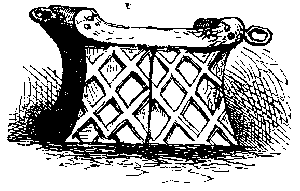
We spent the night at a Kanthunda village on the western side of a mountain called Phunzé (the h being an aspirate only). Many villages are planted round its base, but in front, that is, westwards, we have plains, and there the villages are as numerous: mostly they are within half a mile of each other, and few are a mile from other hamlets. Each village has a clump of trees around it: this is partly for shade and partly for privacy from motives of decency. The heat of the sun causes the effluvia to exhale quickly, so they are seldom offensive. The rest of the country, where not cultivated, is covered with grass, the seed-stalks about knee deep. It is gently undulating, lying in low waves, stretching N.E. and S.W. The space between each wave is usually occupied by a boggy spot or watercourse, which in some cases is filled with pools with trickling rills between. All the people are engaged at present in making mounds six or eight feet square, and from two to three feet high. The sods in places not before hoed are separated from the soil beneath and collected into flattened heaps, the grass undermost; when dried, fire is applied and slow combustion goes on, most of the products of the burning being retained in the ground, much of the soil is incinerated. The final preparation is effected by the men digging up the subsoil round the mound, passing each hoeful into the left hand, where it pulverizes, and is then thrown on to the heap. It is thus virgin soil on the top of the ashes and burned ground of the original heap, very clear of weeds. At present many mounds have beans and maize about four inches high. Holes, a foot in diameter and a few inches deep, are made irregularly over the surface of the mound, and about eight or ten grains put into each: these are watered by hand and calabash, and kept growing till the rains set in, when a very early crop is secured.
13th October, 1866.—After leaving Phunzé, we crossed the Leviñgé, a rivulet which flows northwards, and then into Lake Nyassa; the lines of gentle undulation tend in that direction. Some hills appear on the plains, but after the mountains which we have left behind they are mere mounds. We are over 3000 feet above the sea, and the air is delicious; but we often pass spots covered with a plant which grows in marshy places, and its heavy smell always puts me in mind that at other seasons this may not be so pleasant a residence. The fact of even maize being planted on mounds where the ground is naturally quite dry, tells a tale of abundant humidity of climate.
Kauma, a fine tall man, with a bald head and pleasant manners, told us that some of his people had lately returned from the Chibisa or Babisa country, whither they had gone to buy ivory, and they would give me information about the path. He took a fancy to one of the boys' blankets; offering a native cloth, much larger, in exchange, and even a sheep to boot; but the owner being unwilling to part with his covering, Kauma told me that he had not sent for his Babisa travellers on account of my boy refusing to deal with him. A little childish this, but otherwise he was very hospitable; he gave me a fine goat, which, unfortunately, my people left behind.
The chief said that no Arabs ever came his way, nor Portuguese native traders. When advising them to avoid the first attempts to begin the slave-trade, as it would inevitably lead to war and depopulation, Kauma replied that the chiefs had resolved to unite against the Waiyau of Mpondé should he come again on a foray up to the highlands; but they are like a rope of sand, there is no cohesion among them, and each village is nearly independent of every other: they mutually distrust each other.
14th October, 1866.—Spent Sunday here. Kauma says that his people are partly Kanthunda and partly Chipéta. The first are the mountaineers, the second dwellers on the plains. The Chipéta have many lines of marking: they are all only divisions of the great Manganja tribe, and their dialects differ very slightly from that spoken by the same people on the Shiré. The population is very great and very ceremonious. When we meet anyone he turns aside and sits down: we clap the hand on the chest and say, "Re peta—re peta," that is, "we pass," or "let us pass:" this is responded to at once by a clapping of the hands together. When a person is called at a distance he gives two loud claps of assent; or if he rises from near a superior he does, the same thing, which is a sort of leave-taking.
We have to ask who are the principal chiefs in the direction which we wish to take, and decide accordingly. Zomba was pointed out as a chief on a range of hills on our west: beyond him lies Undi m'senga. I had to take this route, as my people have a very vivid idea of the danger of going northwards towards the Mazitu. We made more southing than we wished. One day beyond Zomba and W.S.W. is the part called Chindando, where the Portuguese formerly went for gold. They don't seem to have felt it worth while to come here, as neither ivory nor gold could be obtained if they did. The country is too full of people to allow any wild animals elbow-room: even the smaller animals are hunted down by means of nets and dogs.
We rested at Pachoma; the headman offering a goat and beer, but I declined, and went on to Molomba. Here Kauma's carriers turned because a woman had died that morning as we left the village. They asserted that had she died before we started not a man would have left: this shows a reverence for death, for the woman was no relative of any of them. The headman of Molomba was very poor but very liberal, cooking for us and presenting a goat: another headman from a neighbouring village, a laughing, good-natured old man, named Chikala, brought beer and a fowl in the morning. I asked him to go on with us to Mironga, it being important, as above-mentioned, to have the like of his kind in our company, and he consented. We saw Mount Ngala in the distance, like a large sugar-loaf shot up in the air: in our former route to Kasungu we passed north of it.
16th October, 1866.—Crossed the rivulet Chikuyo
going N. for the Lake, and Mironga being but one-and-a-half hour
off, we went on to Chipanga: this is the proper name of what on
the Zambesi is corrupted into Shupanga. The headman, a miserable
hemp-consuming
Zomha is in a range of hills to our west, called Zala nyama. The Portuguese, in going to Casembe, went still further west than this.
Passing on we came to a smithy, and watched the founder at work drawing off slag from the bottom of his furnace. He broke through the hardened slag by striking it with an iron instrument inserted in the end of a pole, when the material flowed out of the small hole left for the purpose in the bottom of the furnace. The ore (probably the black oxide) was like sand, and was put in at the top of the furnace, mixed with charcoal. Only one bellows was at work, formed out of a goatskin, and the blast was very poor. Many of these furnaces, or their remains, are met with on knolls; those at work have a peculiarly tall hut built over them.
On the eastern edge of a valley lying north and south, with the Diampwé stream flowing along it, and the Dzala nyama range on the western side, are two villages screened by fine specimens of the Ficus Indica. One of these is owned by the headman Theresa, and there we spent the night. We made very short marches, for the sun is very powerful, and the soil baked hard, is sore on the feet: no want of water, however, is felt, for we come to supplies every mile or two.
The people look very poor, having few or no beads; the ornaments being lines and cuttings on the skin. They trust more to buazé than cotton. I noticed but two cotton patches. The women are decidedly plain; but monopolize all the buazé cloth. Theresa was excessively liberal, and having informed us that Zomba lived some distance up the range and was not the principal man in these parts, we, to avoid climbing the hills, turned away to the north, in the direction of the paramount chief, Chisumpi, whom we found to be only traditionally great.
20th October, 1866.—In passing along we came to a village embowered in fine trees; the headman is Kaveta, a really fine specimen of the Kanthunda, tall, well-made, with a fine forehead and Assyrian nose. He proposed to us to remain over night with him, and I unluckily declined.
Convoying us out a mile, we parted with this gentleman, and then came to a smith's village, where the same invitation was given and refused. A sort of infatuation drove us on, and after a long hot march we found the great Chisumpi, the facsimile in black of Sir Colin Campbell; his nose, mouth, and the numerous wrinkles on his face were identical with those of the great General, but here all resemblance ceased. Two men had preceded us to give information, and when I followed I saw that his village was one of squalid misery, the only fine things about being the lofty trees in which it lay. Chisumpi begged me to sleep at a village about half a mile behind: his son was browbeating him on some domestic affair, and the older man implored me to go. Next morning he came early to that village, and arranged for our departure, offering nothing, and apparently not wishing to see us at all. I suspect that though paramount chief, he is weak-minded, and has lost thereby all his influence, but in the people's eyes he is still a great one.
Several of my men exhibiting symptoms of distress, I inquired for a village in which we could rest Saturday and Sunday, and at a distance from Chisumpi. A headman volunteered to lead us to one west of this. In passing the sepulchral grove of Chisumpi our guide remarked, "Chisumpi's forefathers sleep there." This was the first time I have heard the word "sleep" applied to death in these parts. The trees in these groves, and around many of the villages, are very large, and show what the country would become if depopulated.
We crossed the
Diampwé or Adiampwé, from five to fifteen yards
wide, and well supplied with water even now. It rises near the
Ndomo mountains, and flows northwards into the Lintipé and
Lake. We found Chitokola's village, called Paritala, a pleasant
one on the east side of the Adiampwé Valley. Many
elephants and other animals feed in the valley, and we saw the
Bechuana Hopo
The Ambarré, otherwise Nyumbo plant, has a pea-shaped, or rather papilionaceous flower, with a fine scent. It seems to grow quite wild; its flowers are yellow.
Chaola is the poison used by the Maravi for their arrows, it is said to cause mortification.
One of the wonders usually told of us in this upland region is that we sleep without fire. The boys' blankets suffice for warmth during the night, when the thermometer sinks to 64°-60°, but no one else has covering sufficient; some huts in process of building here show that a thick coating of plaster is put on outside the roof before the grass thatch is applied; not a chink is left for the admission of air.
Ohitikola was absent from Paritala when we arrived on some
milando or other. These milandos are the business
of their lives. They are like petty lawsuits; if one trespasses
on his neighbour's rights in any way it is a milando, and
the headmen of all the villages about are called on to settle it.
Women are a fruitful source of milando. A few ears of
Indian corn had been taken by a person, and Chitikola had been
called a full day's journey off to settle this milando. He
administered Muavé
FOOTNOTES:
CHAPTER VI.
Progress northwards. An African forest. Destruction by Mazitu. Native salutations. A disagreeable chief. On the watershed between the Lake and the Loangwa River. Extensive iron-workings. An old Nimrod. The Bua Eiver. Lovely scenery. Difficulties of transport. Chilobé. An African Pythoness. Enlists two Waiyou bearers. Ill. The Chitella bean. Rains set in. Arrives at the Loangwa.
We started with Chitikola as our guide on the 22nd of October,
and he led us away westwards across the Lilongwé River,
then turned north till we came to a village called Mashumba, the
headman of which was the only chief who begged anything except
medicine, and he got less than we were in the habit of giving in
consequence: we give a cloth usually, and clothing being very
scarce this is considered munificent.
We had the Zalanyama range on our left, and our course was generally north, but we had to go in the direction of the villages which were on friendly terms with our guides, and sometimes we went but a little way, as they studied to make the days as short as possible. The headman of the last village, Chitoku, was with us, and he took us to a village of smiths, four furnaces and one smithy being at work. We crossed the Chiniambo, a strong river coming from Zalanyama and flowing into the Mirongwé, which again goes into Lintipé. The country near the hills becomes covered with forest, the trees are chiefly Masuko Mochenga (the gum-copal tree), the bark-cloth tree and rhododendrons. The heath known at the Cape as Rhinoster bosch occurs frequently, and occasionally we have thorny acacias. The grass is short, but there is plenty of it.
24th October, 1866.—Our guide, Mpanda, led us through the forest by what he meant to be a short cut to Chimuna's. We came on a herd of about fifteen elephants, and many trees laid down by these animals: they seem to relish the roots of some kinds, and spend a good deal of time digging them up; they chew woody roots and branches as thick as the handle of a spade. Many buffaloes feed here, and we viewed a herd of elands; they kept out of bow-shot only: a herd of the baama or hartebeest stood at 200 paces, and one was shot.
While all were rejoicing over the meat we got news, from the inhabitants of a large village in full flight, that the Mazitu were out on a foray. While roasting and eating meat I went forward with Mpanda to get men from Chimuna to carry the rest, but was soon recalled. Another crowd were also in full retreat; the people were running straight to the Zalanyama range regardless of their feet, making a path for themselves through the forest; they had escaped from the Mazitu that morning; "they saw them!" Mpanda's people wished to leave and go to look after their own village, but we persuaded them, on pain of a milando, to take us to the nearest village, that was at the bottom of Zalanyama proper, and we took the spoor of the fugitives. The hard grass with stalks nearly as thick as quills must have hurt their feet sorely, but what of that in comparison with dear life! We meant to take our stand on the hill and defend our property in case of the Mazitu coming near; and we should, in the event of being successful, be a defence to the fugitives who crowded up its rocky sides, but next morning we heard that the enemy had gone to the south. Had we gone forward, as we intended, to search for men to carry the meat we should have met the marauders, for the men of the second party of villagers had remained behind guarding their village till the Mazitu arrived, and they told us what a near escape I had had from walking into their power.
25th October, 1866.—Came along northwards to Chimuna's town, a large one of Chipéta with many villages around. Our path led through the forest, and as we emerged into the open strath in which the villages lie, we saw the large anthills, each the size of the end of a one-storied cottage, covered with men on guard watching for the Mazitu.
A long line of villagers were just arriving from the south, and we could see at some low hills in that direction the smoke arising from the burning settlements. None but men were present, the women and the chief were at the mountain called Pambé; all were fully armed with their long bows, some flat in the bow, others round, and it was common to have the quiver on the back, and a bunch of feathers stuck in the hair like those in our Lancers' shakos. But they remained not to fight, but to watch their homes and stores of grain from robbers amongst their own people in case no Mazitu came! They gave a good hut, and sent off at once to let the chief at Pambé know of our arrival. We heard the cocks crowing up there in the mountain as we passed in the morning. Chimuna came in the evening, and begged me to remain a day in his village, Pamaloa, as he was the greatest chief the Chipéta had. I told him all wished the same thing, and if I listened to each chief we should never get on, and the rains were near, but we had to stay over with him.
26th October, 1866.—All the people came down to-day from Pambé, and crowded to see the strangers. They know very little beyond their own affairs, though these require a good deal of knowledge, and we should be sorely put about if, without their skill, we had to maintain an existence here. Their furnaces are rather bottle shaped, and about seven feet high by three broad. One toothless patriarch had heard of books and umbrellas, but had never seen either. The oldest inhabitant had never travelled far from the spot in which he was born, yet he has a good knowledge of soils and agriculture, hut-building, basket-making, pottery, and the manufacture of bark-cloth and skins for clothing, as also making of nets, traps, and cordage.
Chimuna had a most ungainly countenance, yet did well enough: he was very thankful for a blister on his loins to ease rheumatic pains, and presented a huge basket of porridge before starting, with a fowl, and asked me to fire a gun that the Mazitu might hear and know that armed men were here. They all say that these marauders flee from fire-arms, so I think that they are not Zulus at all, though adopting some of their ways.
In going on to Mapuio's we passed several large villages, each surrounded by the usual euphorbia hedge, and having large trees for shade. We are on & level, or rather gently amdulating country, rather bare of trees. At the junctions of these earthen waves we have always an oozing bog, this often occurs in the slope down the trough of this terrestrial sea; bushes are common, and of the kind which were cut down as trees. Yellow haematite is very abundant, but the other rocks scarcely appear in the distance; we have mountains both on the east and west.
On arriving at Mapuio's village, he was, as often happens, invisible, but he sent us a calabash of fresh-made beer, which is very refreshing, gave us a hut, and promised to cook for us in the evening. We have to employ five or six carriers, and they rule the length of the day's march. Those from Chimuna's village growled at the cubit of calico with which we paid them, but a few beads pleased them perfectly, and we parted good friends. It is not likely I shall ever see them again, but I always like to please them, because it is right to consider their desires. Is that not what is meant in "Blessed is he that considereth the poor"? There is a great deal of good in these poor people. In cases of milando they rely on the most distant relations and connections to plead their cause, and seldom are they disappointed, though time at certain seasons, as for instance at present, is felt by all to be precious. Every man appears with hoe or axe on shoulder, and the people often only sit down as we pass and gaze at us till we are out of sight.
 Women's Teeth hollowed.
Many of the men have large slits in the lobe of the ear, and they have their distinctive tribal tattoo. The women indulge in this painful luxury more than the men, probably because they have very few ornaments. The two central front teeth are hollowed at the cutting edge. Many have quite the Grecian facial angle. Mapuio has thin legs and quite a European face. Delicate features and limbs are common, and the spur-heel is as scarce as among Europeans; small feet and hands are the rule.
Clapping the hands in various ways is the polite way of saying "Allow me," "I beg pardon," "Permit me to pass," "Thanks," it is resorted to in respectful introduction and leave-taking, and also is equivalent to "Hear hear." When inferiors are called they respond by two brisk claps of the hands, meaning "I am coming." They are very punctilious amongst each other. A large ivory bracelet marks the headman of a village; there is nothing else to show differences of rank.
28th October, 1866.—We spent Sunday at Mapuio's and had a long talk with him; his country is in a poor state from the continual incursions of the Mazitu, who are wholly unchecked.
29th October, 1866.—We marched westwards to Makosa's village, and could not go further, as the next stage is long and through an ill-peopled country. The morning was lovely, the whole country bathed in bright sunlight, and not a breath of air disturbed the smoke as it slowly curled up from the heaps of burning weeds, which the native agriculturist wisely destroys. The people generally were busy hoeing in the cool of the day. One old man in a village where we rested had trained the little hair he had left into a tail, which, well plastered with fat, he had bent on itself and laid flat on his crown; another was carefully paring a stick for stirring the porridge, and others were enjoying the cool shade of the wild fig-trees which are always planted at villages. It is a sacred tree all over Africa and India, and the tender roots which drop down towards the ground are used as medicine—a universal remedy. Can it be a tradition of its being like the tree of life, which Archbishop Whately conjectures may have been used in Paradise to render man immortal? One kind of fig-tree is often seen hacked all over to get the sap, which is used as bird-lime; bark-cloth is made of it too. I like to see the men weaving or spinning, or reclining under these glorious canopies, as much as I love to see our more civilized people lolling on their sofas or ottomans.
The first rain—a thunder shower—fell in the afternoon, air in shade before it 92°; wet bulb 74°. At noon the soil in the sun was 140°, perhaps more, but I was afraid of bursting the thermometer, as it was graduated only a few degrees above that. This rain happened at the same time that the sun was directly overhead on his way south; it was but a quarter of an inch, but its effect was to deprive us of all chance of getting the five carriers we needed, all were off to their gardens to commit the precious seed to the soil. We got three, but no one else would come, so we have to remain here over to-day (30th October).
30th October, 1866.—The black traders come from Tette to this country to buy slaves, and as a consequence here we come to bugs again, which we left when we passed the Arab slave-traders' beat.
31st October, 1866.—We proceed westwards, and a little south through a country covered with forest trees, thickly planted, but small, generally of bark-cloth and gum-copal trees, masukos, rhododendrons, and a few acacias. At one place we saw ten wild hogs in a group, but no other animal, though marks of elephants, buffaloes, and other animals having been about in the wet season were very abundant. The first few miles were rather more scant of water than usual, but we came to the Leué, a fine little stream with plenty of water sand from 20 to 30 yards wide; it is said by the people to flow away westwards into the Loangwa.
1st November 1866.—In the evening we made the Chigumokiré, a nice rivulet, where we slept, and the next morning we proceeded to Kangené, whose village is situated on a mass of mountains, and to reach which we made more southing than we wished. Our appearance on the ascent of the hill caused alarm, and we were desired to wait till our spokesman had explained the unusual phenomenon of a white man.
This kept us waiting in the hot sun among heated rocks, and the chief, being a great ugly public-house-keeper looking person, excused his incivility by saying that his brother had been killed by the Mazitu, and he was afraid that we were of the same tribe. On asking if Mazitu wore clothes like us he told some untruths, and, what has been an unusual thing, began to beg powder and other things. I told him how other chiefs had treated us, which made him ashamed. He represented the country in front to the N.W. to be quite impassable from want of food: the Mazitu had stripped it of all provisions, and the people were living on what wild fruits they could pick up.
2nd November, 1866.—Kangené is very disagreeable naturally, and as we have to employ five men as carriers, we are in his power.
We can scarcely enter into the feelings of those who are harried by marauders. Like Scotland in the twelfth and thirteenth centuries harassed by Highland Celts on one side and by English Marchmen on the other, and thus kept in the rearward of civilisation, these people have rest neither for many days nor for few. When they fill their garners they can seldom reckon on eating the grain, for the Mazitu come when the harvest is over and catch as many able-bodied young persons as they can to carry away the corn. Thus it was in Scotland so far as security for life and property was concerned; but the Scotch were apt pupils of more fortunate nations. To change of country they were as indifferent as the Romans of the olden times; they were always welcome in France, either as pilgrims, scholars, merchants, or soldiers; but the African is different. If let alone the African's mode of life is rather enjoyable; he loves agriculture, and land is to be had anywhere. He knows nothing of other countries, but he has imbibed the idea of property in man. This Kangené told me that he would like to give me a slave to look after my goats: I believe he would rather give a slave than a goat!
We were detained by the illness of Simon for four days. When he recovered we proposed to the headman to start with five of his men, and he agreed to let us have them; but having called them together such an enormous demand was made for wages, and in advance, that on the 7th of November we took seven loads forward through a level uninhabited country generally covered with small trees, slept there, and on the morning of the 8th, after leaving two men at our depôt, came back, and took the remaining five loads.
Kangené was disagreeable to the last. He asked where we had gone, and, having described the turning point as near the hill Chimbimbé, he complimented us on going so far, and then sent an offer of three men; but I preferred not to have those who would have been spies unless he could give five and take on all the loads. He said that he would find the number, and after detaining us some hours brought two, one of whom, primed with beer, babbled out that he was afraid of being killed by us in front. I asked whom we had killed behind, and moved off. The headman is very childish, does women's work—cooking and pounding; and in all cases of that kind the people take after their leader. The chiefs have scarcely any power unless they are men of energy; they have to court the people rather than be courted. We came much further back on our way from Mapuio's than we liked; in fact, our course is like that of a vessel baffled with foul winds: this is mainly owing to being obliged to avoid places stripped of provisions or suffering this spoliation. The people, too, can give no information about others at a distance from their own abodes. Even the smiths, who are a most plodding set of workers, are as ignorant as the others: they supply the surrounding villages with hoes and knives, and, combining agriculture with handicraft, pass through life. An intelligent smith came as our guide from Chimbimbé Hill on the 7th, and did not know a range of mountains about twenty miles off: "it was too far off for him to know the name."
9th November, 1866.—The country over which we actually travel is level and elevated, but there are mountains all about, which when put on the map make it appear to be a mountainous region. We are on the watershed, apparently between the Loangwa of Zumbo on the west, and the Lake on the east. The Leué or Leuia is said by the people to flow into the Loangwa. The Chigumokiré coming from the north in front, eastward of Irongwé (the same mountains on which Kangené skulks out of sight of Mazitu), flows into the Leué, and north of that we have the Mando, a little stream, flowing into the Bua. The rivulets on the west flow in deep defiles, and the elevation on which we travel makes it certain that no water can come from the lower lands on the west. It seems that the Portuguese in travelling to Casembe did not inquire of the people where the streams they crossed went, for they are often wrongly put, and indicate the direction only in which they appeared to be flowing at their crossing places. The natives have a good idea generally of the rivers into which the streams flow, though they are very deficient in information as to the condition of the people that live on their banks. Some of the Portuguese questions must have been asked through slaves, who would show no hesitation in answering. Maxinga, or Machinga, means "mountains" only; once or twice it is put down Saxa de Maxinga, or Machinga, or Mcanga, which translated from the native tongue means "rocks of mountains, or mountains of rocks."
10th November, 1866.—We found the people on the Mando to be Chawa or Ajawa, but not of the Waiyau race: they are Manganja, and this is a village of smiths. We got five men readily to go back and bring up our loads; and the sound of the hammer is constant, showing a great deal of industry. They combine agriculture, and hunting with nets, with their handicraft.
A herd of buffaloes came near the village, and I went and shot one, thus procuring a supply of meat for the whole party and villagers too. The hammer which we hear from dawn till sunset is a large stone, bound with the strong inner bark of a tree, and loops left which form handles. Two pieces of bark form the tongs, and a big stone sunk into the ground the anvil. They make several hoes in a day, and the metal is very good; it is all from yellow haematite, which abounds all over this part of the country; the bellows consist of two goatskins with sticks at the open ends, which are opened and shut at every blast.

13th November, 1866.—A lion came last night and gave a growl or two on finding he could not get our meat: a man had lent us a hunting net to protect it and us from intruders of this sort. The people kept up a shouting for hours afterwards, in order to keep him away by the human voice.
We might have gone on, but I had a galled heel from new shoes. Wild figs are rather nice when quite ripe.
14th November, 1866.—We marched northwards round the end of Chisia Hill, and remained for the night at a blacksmith's, or rather founder's village; the two occupations of founder and smith are always united, and boys taught to be smiths in Europe or India would find themselves useless if unable to smelt the ore. A good portion of the trees of the country have been cut down for charcoal, and those which now spring up are small; certain fruit trees alone are left. The long slopes on the undulating country, clothed with fresh foliage, look very beautiful. The young trees alternate with patches of yellow grass not yet burned; the hills are covered with a thick mantle of small green trees with, as usual, large ones at intervals. The people at Kalumbi, on the Mando (where we spent four days), had once a stockade of wild fig (Ficus Indica) and euphorbia round their village, which has a running rill on each side of it; but the trees which enabled them to withstand a siege by Mazitu fell before elephants and buffaloes during a temporary absence of the villagers; the remains of the stockade are all around it yet. Lions sometimes enter huts by breaking through the roof: elephants certainly do, for we saw a roof destroyed by one; the only chance for the inmates is to drive a spear into the belly of the beast while so engaged.
A man came and reported the Mazitu to be at Chanyandula's village, where we are going. The headman advised remaining at his village till we saw whether they came this way or went by another path. The women were sent away, but the men went on with their employments; two proceeded with the building of a furnace on an anthill, where they are almost always placed, and they keep a look-out while working. We have the protection of an all-embracing Providence, and trust that He, whose care of His people «xceeds all that our utmost self-love can attain, will shield us and make our way prosperous.
16th November, 1866.—An elephant came near enough last night to scream at us, but passed on, warned, perhaps, by the shouting of the villagers not to meddle with man. No Mazitu having come, we marched on and crossed the Bua, eight yards wide and knee deep. It rises in the northern hills a little beyond Kanyindula's village, winds round his mountains, and away to the east. The scenery among the mountains is very lovely: they are covered with a close mantle of green, with here and there red and light-coloured patches, showing where grass has been burned off recently and the red clay soil is exposed; the lighter portions are unburned grass or rocks. Large trees are here more numerous, and give an agreeable change of contour to the valleys and ridges of the hills; the boughs of many still retain a tinge of red from young leaves. We came to the Bua again before reaching Kanyenjé, as Kanyindula's place is called. The iron trade must have been carried on for an immense time in the country, for one cannot go a quarter of a mile without meeting pieces of slag and broken pots, calcined pipes, and fragments of the furnaces, which are converted by the fire into brick. It is curious that the large stone sledge-hammers now in use are not called by the name stone-hammers, but by a distinct word, "kama:" nyundo is one made of iron.
When we arrived at Kanyenjé, Kanyindula was out collecting charcoal. He sent a party of men to ask if we should remain next day: an old, unintellectual-looking man was among the number sent, who had twenty-seven rings of elephant's skin on his arm, all killed by himself by the spear alone: he had given up fighting elephants since the Mazitu came, whom we heard had passed away to the south-east of this place, taking all the crops of last year, and the chief alone has food. He gave us some, which was very acceptable, as we got none at the two villages south of this. Kanyindula came himself in the evening, an active, stern-looking man, but we got on very well with him.
The people say that they were taught to smelt iron by Chisumpi, which is the name of Mulungu (God), and that they came from Lake Nyassa originally; if so, they are greatly inferior to the Manganja on the Lake in pottery, for the fragments, as well as modern whole vessels, are very coarse; the ornamentation is omitted or merely dots. They never heard of aërolites, but know hail.
I notice here that the tree Mfu, or Mö, having sweet-scented leaves, yields an edible plum in clusters. Bua-bwa is another edible fruit-tree with palmated leaves.
Mbéu is a climbing, arboraceous plant, and yields a very pleasant fruit, which tastes like gooseberries: its seeds are very minute.
18th and 19th November, 1866.—Rain fell heavily yesterday afternoon, and was very threatening to-day; we remain to sew a calico tent.
20th November, 1866.—Kanyindula came with three carriers this morning instead of five, and joined them in demanding prepayment: it was natural for him to side with them, as they have more power than he has, in fact, the chiefs in these parts all court their people, and he could feel more interest in them than in an entire stranger whom he might never see again: however, we came on without his people, leaving two to guard the loads.
About four miles up the valley we came to a village named Kanyenjeré Mponda, at the fountain-eye of the Bua, and thence sent men back for the loads, while we had the shelter of good huts during a heavy thunder-shower, and made us willing to remain all night. The valley is lovely in the extreme. The mountains on each side are gently rounded, and, as usual, covered over with tree foliage, except where the red soil is exposed by recent grass-burnings. Quartz rocks jut out, and much drift of that material has been carried down by the gullies into the bottom. These gullies being in compact clay, the water has but little power of erosion, so they are worn deep but narrow. Some fragments of titaniferous iron ore, with haematite changed by heat, and magnetic, lay in the gully, which had worn itself a channel on the north side of the village. The Bua, like most African streams whose sources I have seen, rises in an oozing boggy spot. Another stream, the Tembwé, rises near the same spot, and flows N.W. into, the Loangwa. We saw Shuaré palms in its bed.
21st November, 1866.—We left Bua fountain, lat. 13° 40' south, and made a short march to Mokatoba, a stockaded village, where the people refused to admit us till the headman, came. They have a little food here, and sold us some. We have been on rather short commons for some time, and this made our detention agreeable. We rose a little in altitude after leaving this morning, then, though in the same valley, made a little descent towards the N.N.W. High winds came driving over the eastern range, which is called Mchinjé, and bring large masses of clouds, which are the rain-givers. They seem to come from the south-east. The scenery of the valley is lovely and rich in the extreme. All the foliage is fresh washed and clean; young herbage is bursting through the ground; the air is deliciously cool, and the birds are singing joyfully: one, called Mzié, is a good songster, with a loud melodious voice. Large game abounds, but we do not meet with it.
We are making our way slowly to the north, where food is said to be abundant. I divided about 50 lbs. of powder among the people of my following to shoot with, and buy goats or other food as we could. This reduces our extra loads to three—four just now, Simon being sick again. He rubbed goat's-fat on a blistered surface, and caused an eruption of pimples.
Mem.—The people assent by lifting up the head instead of nodding it down as we do; deaf mutes are said to do the same.
22nd November, 1866.—Leaving Mokatoba village, and proceeding down the valley, which on the north is shut up apparently by a mountain called Kokwé, we crossed the Kasamba, about two miles from Mokatoba, and yet found it, though so near its source, four yards wide, and knee deep. Its source is about a mile above Mokatoba, in the same valley, with the Bua and Tembwé. We were told that elephants were near, and we saw where they had been an hour before; but after seeking about could not find them. An old man, in the deep defile between Kokwé and Yasika Mountains, pointed to the latter, and said, "Elephants! why, there they are. Elephants, or tusks, walking on foot are never absent;" but though we were eager for flesh, we could not give him credit, and went down the defile which gives rise to the Sandili River: where we crossed it in the defile, it was a mere rill, having large trees along its banks, yet it is said to go to the Loangwa of Zumbo, N.W. or N.N.W. We were now in fact upon the slope which inclines to that river, and made a rapid descent in altitude. We reached Silubi's village, on the base of a rocky detached hill. No food to be had; all taken by Mazitu, so Silubi gave me some Masuko fruit instead. They find that they can keep the Mazitu off by going up a rocky eminence, and hurling stones and arrows down on the invaders: they can defend themselves also by stockades, and these are becoming very general.
On leaving Silubi's village, we went to a range of hills, and after passing through found that we had a comparatively level country on the north: it would be called a well-wooded country if we looked at it only from a distance. It is formed into long ridges, all green and wooded; but clumps of large trees, where villages have been, or are still situated, show that the sylvan foliage around and over the whole country is that of mere hop-poles. The whole of this upland region might be called woody, if we bear in mind that where the population is dense, and has been long undisturbed, the trees are cut down to the size of low bush. Large districts are kept to about the size of hop-poles, growing on pollards three or four feet from the ground, by charcoal burners, who, in all instances, are smiths too.
On reaching Zeoré's village, on the Lokuzhwa, we found it stockaded, and stagnant pools round three sides of it. The Mazitu had come, pillaged all the surrounding villages, looked at this, and then went away; so the people had food to sell. They here call themselves Echéwa, and have a different marking from the Atumboka. The men have the hair dressed as if a number of the hairs of elephants' tails were stuck around the head: the women wear a small lip-ring, and a straw or piece of stick in the lower lip, which dangles down about level with the lower edge of the chin: their clothing in front is very scanty. The men know nothing of distant places, the Manganja being a very stay-at-home people. The stockades are crowded with huts, and the children have but small room to play in the narrow spaces between.
25th November, 1866.—Sunday at Zeoré's. The villagers thought we prayed for rain, which was much needed. The cracks in the soil have not yet come together by the «welling of soil produced by moisture. I disabused their minds about rain-making prayers, and found the headman intelligent.
I did not intend to notice the Lokuzhwa, it is such a contemptible little rill, and not at present running; but in going to our next point, Mpandé's village, we go along its valley, and cross it several times, as it makes for the Loangwa in the north. The valley is of rich dark red loam, and so many lilies of the Amaryllis kind have established themselves as completely to mask the colour of the soil. They form a covering of pure white where the land has been cleared by the hoe. As we go along this valley to the Loangwa, we descend in altitude. It is said to rise at "Nombé rumé," as we formerly heard.
27th November, 1866.—Zeoré's people would not carry without prepayment, so we left our extra loads as usual and went on, sending men back for them: these, however, did not come till 27th, and then two of my men got fever. I groan in spirit, and do not know how to make our gear into nine loads only. It is the knowledge that we shall be detained, some two or three months during the heavy rains that makes me cleave to it as means of support.
Advantage has been taken by the people, of spots where the Lokuzhwa goes round three parts of a circle, to erect their stockaded villages. This is the case here, and the water, being stagnant, engenders disease. The country abounds in a fine light blue flowering perennial pea, which the people make use of as a relish. At present the blossoms only are collected and boiled. On inquiring the name, chilóbé, the men asked me if we had none in our country. On replying in the negative, they looked with pity on us: "What a wretched, country not to have chilóbé." It is on the highlands above; we never saw it elsewhere! Another species of pea (Chilobé Weza), with reddish flowers, is eaten in the same way; but it has spread but little in comparison. It is worth remarking that porridge of maize or sorghum is never offered without some pulse, beans, or bean leaves, or flowers, they seem to feel the need of it, or of pulse, which is richer in flesh-formers than the porridge.
Last night a loud clapping of hands by the men was followed by
several half-suppressed screams by a woman. They were quite
eldritch, as if she could not get them out. Then succeeded
a lot of utterances as if she were in ecstasy, to which a man
responded, "Moio, moio." The utterances, so far as I could catch,
were in five-syllable snatches—abrupt and laboured. I
wonder if this "bubbling or boiling over" has been preserved as
the form in which the true prophets of old gave forth their
"burdens"? One sentence, frequently repeated towards the close of
the effusion, was "linyama uta," "flesh of the bow," showing that the Pythoness
loved venison killed by the bow. The people applauded, and
attended, hoping, I suppose, that rain would follow her efforts.
Next day she was duly honoured by drumming and dancing.
Prevalent beliefs seem to be persistent in certain tribes. That strange idea of property in man that permits him to be sold to another is among the Arabs, Manganja, Makoa, Waiyau, but not among Kaffirs or Zulus, and Bechuanas. If we exclude the Arabs, two families of Africans alone are slavers on the east side of the Continent.
30th November, 1866.—We march to Chilunda's or Embora's, still on the Lokuzhwa, now a sand-stream about twenty yards wide, with pools in its bed; its course is pretty much north or N.N.W. We are now near the Loangwa country, covered with a dense dwarf forest, and the people collected in stockades. This village is on a tongue of land (between Lokuzhwa and another sluggish rivulet), chosen for its strength. It is close to a hill named Chipemba, and there are ranges of hills both east and west in the distance. Embora came to visit us soon after we arrived—a tall man with a Yankee face. He was very much tickled when asked if he were a Motumboka. After indulging in laughter at the idea of being one of such a small tribe of Manganja, he said proudly, "That he belonged to the Echéwa, who inhabited all the country to which I was going." They are generally smiths; a mass of iron had just been brought in to him from some outlying furnaces. It is made into hoes, which are sold for native cloths down the Loangwa.
3rd December, 1866.—March through a hilly country covered with dwarf forest to Kandé's village, still on the Lokuzhwa. We made some westing. The village was surrounded by a dense hedge of bamboo and a species of bushy fig that loves edges of water-bearing streams: it is not found where the moisture is not perennial. Kandé is a fine tall smith; I asked him if he knew his antecedents; he said he had been bought by Babisa at Chipéta, and left at Chilunda's, and therefore belonged to no one. Two Waiyau now volunteered to go on with us, and as they declared their masters were killed by the Mazitu, and Kandé seemed to confirm them, we let them join. In general, runaway slaves are bad characters, but these two seem good men, and we want them to fill up our complement: another volunteer we employ as goatherd.
A continuous tap-tapping in the villages shows that bark cloth is being made. The bark, on being removed from the-tree, is steeped in water, or in a black muddy hole, till the outer of the two inner barks can be separated, then commences the tapping with a mallet to separate and soften the fibres. The head of this is often of ebony, with the face cut into small furrows, which, without breaking, separate and soften the fibres.
 Mallet for
Separating Fibres of Bark.
Mallet for
Separating Fibres of Bark.
4th December, 1866.—Marched westwards, over a hilly, dwarf forest-covered country: as we advanced, trees increased in size, but no people inhabited it; we spent a miserable night at Katétté, wetted by a heavy thunder-shower, which lasted a good while. Morning (5th December) muggy, clouded all over, and rolling thunder in distance. Went three hours with, for a wonder, no water, but made westing chiefly, and got on to the Lokuzhwa again: all the people are collected on it.
6th December, 1866.—Too ill to march.
7th December, 1866.—Went on, and passed Mesumbé's village, also protected by bamboos, and came to the hill Mparawé, with a village perched on its northern base and well up its sides. The Babisa have begun to imitate the Mazitu by attacking and plundering Manganja villages. Muasi's brother was so attacked, and now is here and eager to attack in return. In various villages we have observed miniature huts, about two feet high, very neatly thatched and plastered, here we noticed them in dozens. On inquiring, we were told that when a child or relative dies one is made, and when any pleasant food is cooked or beer brewed, a little is placed in the tiny hut for the departed soul, which is believed to enjoy it.
The Lokuzhwa is here some fifty yards wide, and running. Numerous large pitholes in the fine-grained schist in its bed show that much water has flowed in it.
8th December, 1866.—A kind of bean called "chitetta" is eaten here, it is an old acquaintance in the Bechuana country, where it is called "mositsané," and is a mere plant; here it becomes a tree, from fifteen to twenty feet high. The root is used for tanning; the bean is pounded, and then put into a sieve of bark cloth to extract, by repeated washings, the excessively astringent matter it contains. Where the people have plenty of water, as here, it is used copiously in various processes, among Bechuanas it is scarce, and its many uses unknown: the pod becomes from fifteen to eighteen inches long, and an inch in diameter.
9th December, 1866.—A poor child, whose mother had died, was unprovided for; no one not a relative will nurse another's child. It called out piteously for its mother by name, and the women (like the servants in the case of the poet Cowper when a child), said, "She is coming." I gave it a piece of bread, but it was too far gone, and is dead to-day.
An alarm of Mazitu sent all the villagers up the sides of Mparawé this morning. The affair was a chase of a hyaena, but everything is Mazitu! The Babisa came here, but were surrounded and nearly all cut off. Muasi was so eager to be off with a party to return the attack on the Mazitu, that, when deputed by the headman to give us a guide, he got the man to turn at the first village, so we had to go on without guides, and made about due north.
11th December, 1866.—We are now detained in the forest, at a place called Chondé Forest, by set-in rains. It rains every day, and generally in the afternoon; but the country is not wetted till the "set-in" rains commence; the cracks in the soil then fill up and everything rushes up with astonishing rapidity; the grass is quite crisp and soft. After the fine-grained schist, we came on granite with large flakes of talc in it. This forest is of good-sized trees, many of them mopané. The birds now make much melody and noise—all intent on building.
12th December, 1866.—Across an undulating forest country north we got a man to show us the way, if a pathless forest can so be called. We used a game-path as long as it ran north, but left it when it deviated, and rested under a baobab-tree with a marabou's nest—a bundle of sticks on a branch; the young ones uttered a hard chuck, chuck, when the old ones flew over them. A sun-bird, with bright scarlet throat and breast, had its nest on another branch, it was formed like the weaver's nest, but without a tube. I observed the dam picking out insects from the bark and leaves of the baobab, keeping on the wing the while: it would thus appear to be insectivorous as well as a honey-bibber. Much spoor of elands, zebras, gnus, kamas, pallahs, buffaloes, reed-bucks, with tsetse, their parasites.
13th December, 1866.—Reached the Tokosusi, which is said to rise at Nombé Rumé, about twenty yards wide and knee deep, swollen by the rains: it had left a cake of black tenacious mud on its banks. Here I got a pallah antelope, and a very strange flower called "katendé," which was a whorl of seventy-two flowers sprung from a flat, round root; but it cannot be described. Our guide would have crossed the Tokosusi, which was running north-west to join the Loangwa, and then gone to that river; but always when we have any difficulty the "lazies" exhibit themselves. We had no grain; and three remained behind spending four hours at what we did in an hour and a quarter. Our guide became tired and turned, not before securing another; but he would not go over the Loangwa; no one likes to go out of his own country: he would go westwards to Maranda's, and nowhere else. A "set-in" rain came on after dark, and we went on through slush, the trees sending down heavier drops than the showers as we neared the Loangwa; we forded several deep gullies, all flowing north or north-west into it. The paths were running with water, and when we emerged from the large Mopané Forest, we came on the plain of excessively adhesive mud, on which Maranda's stronghold stands on the left bank of Loangwa, here a good-sized river. The people were all afraid of us, and we were mortified to find that food is scarce. The Mazitu have been here three times, and the fear they have inspired, though they were successfully repelled, has prevented agricultural operations from being carried on.
Mem.—A flake of reed is often used in surgical operations among the natives, as being sharper than their knives.
FOOTNOTES:
Kowé! kowé!
n'andambwi,
M'vula léru,
korolé ko okwé,
Waie, ona, kordi,
mvula!
He cannot translate it as it is pure Manganja, but with the exception of the first line—which relates to a little song-bird with a beautiful note, it is a mere reiteration "rain will surely come to-day."—ED.
CHAPTER VII.
Crosses the Loangwa. Distressing march. The king-hunter. Great hunger. Christmas feast necessarily postponed. Loss of goats. Honey-hunters. A meal at last. The Babisa. The Mazitu again. Chitembo's. End of 1866. The new year. The northern brim of the great Loangwa Valley. Accident to chronometers. Meal gives out. Escape from a Cobra capella. Pushes for the Chambezé. Death of Chitané. Great pinch for food. Disastrous loss of medicine chest. Bead currency. Babisa. The Chambezé. Beaches Chitapangwa's town. Meets Arab traders from Zanzibar. Sends off letters. Chitapangwa and his people. Complications.
16th December, 1866.—We could get no food at any
price on 15th, so we crossed the Loangwa, and judged it to be
from seventy to a hundred yards wide: it is deep at present, and
it must always be so, for some Atumboka submitted to the Mazitu,
and ferried them over and back again. The river is said to rise
in the north; it has alluvial banks with large forest trees along
them, bottom sandy, and great sandbanks are in it like the
Zambesi. No guide would come, so we went on without one. The
"lazies" of the party seized the opportunity of remaining
behind—wandering, as they said, though all the cross paths
were marked.
17 December,
1866.—We went on through a bushy country without paths,
and struck the Pamazi, a river of sixty yards wide, in steep
banks and in flood, and held on as well as we could through a
very difficult country, the river forcing us north-west: I heard
hippopotami in it. Game is abundant but wild; we shot two poku
antelopes
18th December, 1866.—As the men grumbled at their
feet being pierced by thorns in the trackless portions we had
passed I was anxious to get a guide, but the only one we could
secure would go to Molenga's only; so I submitted, though this
led us east instead of north. When we arrived we were asked what
we wanted, seeing we brought neither slaves nor ivory: I replied
it was much against our will that we came; but the guide had
declared that this was the only way to Casembe's, our next stage.
To get rid of us they gave a guide, and we set forward
northwards. The Mopané Forest is perfectly level, and
after rains the water stands in pools; but during most of the
year it is dry. The trees here were very large, and planted some
twenty or thirty yards apart: as there are no branches on their
lower parts animals see very far. I shot a gnu, but wandered in
coming back to the party, and did not find them till it was
getting dark. Many parts of the plain are thrown up into heaps,
of about the size of one's cap (probably by crabs), which now, being hard, are
difficult to walk over; under the trees it is perfectly smooth.
The Mopané-tree furnishes the iron wood of the Portuguese
Pao Ferro: it is pretty to travel in and look at the bright
sunshine of early morning; but the leaves hang perpendicularly as
the sun rises high, and afford little or no shade through the
day,
We observed that the people had placed corn-granaries at
different parts of this forest, and had been careful to leave no
track to them—a provision in case of further visits of
Mazitu. King-hunters
19th December, 1866.—I got a fine male kudu. We have no grain, and live on meat alone, but I am better off than the men, inasmuch as I get a little goat's-milk besides. The kudu stood five feet six inches high; horns, three feet on the straight.
20th December, 1866.—Reached Casembe,
After a short march we came to the Nyamazi, another considerable rivulet coming from the north to fall into the Loangwa. It has the same character, of steep alluvial banks, as Pamazi, and about the same width, but much shallower; loin deep, though somewhat swollen; from fifty to sixty yards wide. We came to some low hills, of coarse sandstone, and on crossing these we could see, by looking back, that for many days we had been travelling over a perfectly level valley, clothed with a mantle of forest. The barometers had shown no difference of level from about 1800 feet above the sea. We began our descent into this great valley when we left the source of the Bua; and now these low hills, called Ngalé or Ngaloa, though only 100 feet or so above the level we had left, showed that we had come to the shore of an ancient lake, which probably was let off when the rent of Kebra-basa on the Zambesi was made, for we found immense banks of well-rounded shingle above—or, rather, they may be called mounds of shingle—all of hard silicious schist with a few pieces of fossil-wood among them. The gullies reveal a stratum of this well-rounded shingle, lying on a soft greenish sandstone, which again lies on the coarse sandstone first observed. This formation is identical with that observed formerly below the Victoria Falls. We have the mountains still on our north and north-west (the so-called mountains of Bisa, or Babisa), and from them the Nyamazi flows, while Pamazi comes round the end, or what appears to be the end, of the higher portion. (22nd December, 1866.) Shot a bush-buck; and slept on the left bank of Nyamazi.
23rd December, 1866.—Hunger sent us on; for a meat diet is far from satisfying: we all felt very weak on it, and soon tired on a march, but to-day we hurried on to Kavimba, who successfully beat off the Mazitu. It is very hot, and between three and four hours is a good day's march. On sitting down to rest before entering the village we were observed, and all the force of the village issued to kill us as Mazitu, but when we stood up the mistake was readily perceived, and the arrows were placed again in their quivers. In the hut four Mazitu shields show that they did not get it all their own way; they are miserable imitations of Zulu shields, made of eland and water-buck's hides, and ill sewn.
A very small return present was made by Kavimba, and nothing could be bought except at exorbitant prices. We remained all day on the 24th haggling and trying to get some grain. He took a fancy to a shirt, and left it to his wife to bargain for. She got the length of cursing and swearing, and we bore it, but could get only a small price for it. We resolved to hold our Christmas some other day, and in a better place. The women seem ill-regulated here—Kavimba's brother had words with his spouse, and at the end of every burst of vociferation on both sides called out, "Bring the Muavi! bring the Muavi!" or ordeal.
Christmas-day, 1866.—No one being willing to guide us to Moerwa's, I hinted to Kavimba that should we see a rhinoceros I would kill it. He came himself, and led us on where he expected to find these animals, but we saw only their footsteps. We lost our four goats somewhere—stolen or strayed in the pathless forest, we do not know which, but the loss I felt very keenly, for whatever kind of food we had, a little milk made all right, and I felt strong and well, but coarse food hard of digestion without it was very trying. We spent the 26th in searching for them, but all in vain. Kavimba had a boy carrying two huge elephant spears, with these he attacks that large animal single-handed. We parted from him, as I thought, good friends, but a man who volunteered to act as guide saw him in the forest afterwards, and was counselled by him to leave us as we should not pay him. This hovering near us after we parted makes me suspect Kavimba of taking the goats, but I am not certain. The loss affected me more than I could have imagined. A little indigestible porridge, of scarcely any taste, is now my fare, and it makes me dream of better.
27th December, 1866.—Our guide asked for his
cloth to wear on the way, as it was wet and raining, and his bark
cloth was a miserable covering. I consented, and he bolted on the
first opportunity; the forest being so dense he was soon out of
reach of pursuit: he had been advised to this by Kavimba, and
nothing else need have been expected. We then followed the track
of a travelling party of Babisa, but the grass springs up over
the paths, and it was soon lost: the rain had fallen early in
these parts, and the grass was all in seed. In the afternoon we
came to the hills in the north where Nyamazi rises, and went up
the bed of a rivulet for some time, and then ascended out of the
valley. At the bottom of the ascent and in the rivulet the
shingle stratum was sometimes fifty feet thick, then as we
ascended we met mica schist tilted on edge, then grey gneiss, and
last an igneous trap among quartz rocks, with a great deal of
bright mica and talc in them. On resting near the top of the
first ascent two honey hunters came to us. They were using the
honey-guide as an aid, the bird came to us as they arrived,
waited quietly during the half-hour they smoked and chatted, and
then went on with them.
The tsetse flies, which were very numerous at the bottom, came up the ascent with us, but as we increased our altitude by another thousand feet they gradually dropped off and left us: only one remained in the evening, and he seemed out of spirits. Near sunset we encamped by water on the cool height, and made our shelters with boughs of leafy trees; mine was rendered perfect by Dr. Stenhouse's invaluable patent cloth, which is very superior to mackintosh: indeed the india-rubber cloth is not to be named in the same day with it.
28th December, 1866.—Three men, going to hunt bees, came to us as we were starting and assured us that Moerwa's was near. The first party had told us the same thing, and so often have we gone long distances as "pafupi" (near), when in reality they were "patari" (far), that we begin to think pafupi means "I wish you to go there," and patari the reverse. In this case near meant an hour and three-quarters from our sleeping-place to Moerwa's!
When we look back from the height to which we have ascended we see a great plain clothed with dark green forest except at the line of yellowish grass, where probably the Loangwa flows. On the east and south-east this plain is bounded at the extreme range of our vision by a wall of dim blue mountains forty or fifty miles off. The Loangwa is said to rise in the Chibalé country due north of this Malambwé (in which district Moerwa's village is situated), and to flow S.E., then round to where we found it.
Moerwa came to visit me in my hut, a rather stupid man, though he has a well-shaped and well-developed forehead, and tried the usual little arts of getting us to buy all we need here though the prices are exorbitant. "No people in front, great hunger there." "We must buy food here and carry it to support us." On asking the names of the next headman he would not inform me, till I told him to try and speak like a man; he then told us that the first Lobemba chief was Motuna, and the next Chafunga. We have nothing, as we saw no animals in our way hither, and hunger is ill to bear. By giving Moerwa a good large cloth he was induced to cook a mess of maëre or millet and elephant's stomach; it was so good to get a full meal that I could have given him another cloth, and the more so as it was accompanied by a message that he would cook more next day and in larger quantity. On inquiring next evening he said "the man had told lies," he had cooked nothing more: he was prone to lie himself, and was a rather bad specimen of a chief.
The Babisa have round bullet heads, snub noses, often high cheek-bones, an upward slant of the eyes, and look as if they had a lot of Bushman blood in them, and a good many would pass for Bushmen or Hottentots. Both Babisa and Waiyau may have a mixture of the race, which would account for their roving habits. The women have the fashion of exposing the upper part of the buttocks by letting a very stiff cloth fall down behind. Their teeth are filed to points, they wear no lip-ring, and the hair is parted so as to lie in a net at the back part of the head. The mode of salutation among the men is to lie down nearly on the back, clapping the hands, and making a rather inelegant half-kissing sound with the lips.
29th December, 1866.—We remain a day at
Malambwé, but get nothing save a little
maëre,
30th December, 1866.—Marched for Chitemba's, because it is said he has not fled from the Mazitu, and therefore has food to spare. While resting, Moerwa, with all his force of men, women, and dogs, came up, on his way to hunt elephants. The men were furnished with big spears, and their dogs are used to engage the animal's attention while they spear it; the women cook the meat and make huts, and a smith goes with them to mend any spear that may be broken.
We pass over level plateaux on which the roads are wisely placed, and do not feel that we are travelling in a mountainous region. It is all covered with dense forest, which in many cases is pollarded, from being cut for bark cloth or for hunting purposes. Masuko fruit abounds. From the cisalpinae and gum-copal trees bark cloth is made.
We now come to large masses of haematite, which is often ferruginous: there is conglomerate too, many quartz pebbles being intermixed. It seems as if when the lakes existed in the lower lands, the higher levels gave forth great quantities of water from chalybeate fountains, which deposited this iron ore. Grey granite or quartz with talc in it or gneiss lie under the haematite.
The forest resounds with singing birds, intent on nidification. Francolins abound, but are wild. "Whip-poor-wills," and another bird, which has a more laboured treble note and voice—"Oh, oh, oh!" Gay flowers blush unseen, but the people have a good idea of what is eatable and what not. I looked at a woman's basket of leaves which she had collected for supper, and it contained eight or ten kinds, with mushrooms and orchidaceous flowers. We have a succession of showers to-day, from N.E. and E.N.E. We are uncertain when we shall come to a village, as the Babisa will not tell us where they are situated. In the evening we encamped beside a little rill, and made our shelters, but we had so little to eat that I dreamed the night long of dinners I had eaten, and might have been eating.
I shall make this beautiful land better known, which is an essential part of the process by which it will become the "pleasant haunts of men." It is impossible to describe its rich luxuriance, but most of it is running to waste through the slave-trade and internal wars.
31st December, 1866.—When we started this morning after rain, all the trees and grass dripping, a lion roared, but we did not see him. A woman had come a long way and built a neat miniature hut in the burnt-out ruins of her mother's house: the food-offering she placed in it, and the act of filial piety, no doubt comforted this poor mourner's heart!
We arrived at Chitembo's village and found it deserted. The Babisa dismantle their huts and carry off the thatch to their gardens, where they live till harvest is over. This fallowing of the framework destroys many insects, but we observed that wherever Babisa and Arab slavers go they leave the breed of the domestic bug: it would be well if that were all the ill they did! Chitembo was working in his garden when we arrived, but soon came, and gave us the choice of all the standing huts: he is an old man, much more frank and truthful than our last headman, and says that Chitapanga is paramount chief of all the Abemba.
Three or four women whom we saw performing a rain dance at Moerwa's were here doing the same; their faces smeared with meal, and axes in their hands, imitating as well as they could the male voice. I got some maëre or millet here and a fowl.
We now end 1866. It has not been so fruitful or useful as I intended. Will try to do better in 1867, and be better—more gentle and loving; and may the Almighty, to whom I commit my way, bring my desires to pass, and prosper me! Let all the sins of '66 be blotted out for Jesus' sake.
1st January, 1867.—May He who was full of grace and truth impress His character on mine. Grace—eagerness to show favour; truth—truthfulness, sincerity, honour—for His mercy's sake.
We remain to-day at Mbulukuta-Chitembo's district, by the boys' desire, because it is New Year's day, and also because we can get some food.
2nd and 3rd January, 1867.—Remain on account of a threatened set-in rain. Bought a senzé (Aulocaudatus Swindernianus), a rat-looking animal; but I was glad to get anything in the shape of meat.
4th January, 1867.—It is a set-in rain.
The boiling-point thermometer shows an altitude of 3565 feet
above the sea. Barometer, 3983 feet ditto. We get a little
maëre here, and prefer it to being drenched and our goods
spoiled. We have neither sugar nor salt, so there are no soluble
goods; but cloth and gunpowder get damaged easily. It is hard
fare and scanty; I feel always hungry, and am constantly dreaming
of better food when I should be sleeping. Savoury viands of
former times come vividly up before the imagination, even in my
waking hours; this is rather odd as I am not a dreamer; indeed I
scarcely ever dream but when I am going to be ill or actually
so.
We are on the northern brim (or north-western rather) of the
great Loangwa Valley we lately crossed: the rain coming from the
east strikes it, and is deposited both above and below, while
much of the valley itself is not yet well wetted. Here all the
grasses have run up to seed, and yet they are not more than two
feet or so in the seed-stalks. The pasturage is very fine. The
people employ these continuous or set-in rains for hunting
the elephant, which gets bogged, and sinks in from fifteen to
eighteen inches in soft mud,
then even he, the strong one, feels it difficult to
escape.
5th January, 1867.—Still storm-stayed. We shall be off as soon as we get a fair day and these heavy rains cease.
6th January, 1867.—After service two men came and said that they were going to Lobemba, and would guide us to Motuna's village; another came a day or two ago, but he had such a villainous look we all shrank from him. These men's faces pleased us, but they did not turn out all we expected, for they guided us away westwards without a path: it was a drizzling rain, and this made us averse to striking off in the forest without them. No inhabitants now except at wide intervals, and no animals either. In the afternoon we came to a deep ravine full of gigantic timber trees and bamboos, with the Mavoché River at the bottom. The dampness had caused the growth of lichens all over the trees, and the steep descent was so slippery that two boys fell, and he who carried the chronometers, twice: this was a misfortune, as it altered the rates, as was seen by the first comparison of them together in the evening. No food at Motuna's village, yet the headman tried to extort two fathoms of calico on the ground that he was owner of the country: we offered to go out of his village and make our own sheds on "God's land," that is, where it is uncultivated, rather than have any words about it: he then begged us to stay. A very high mountain called Chikokwé appeared W.S.W. from this village; the people who live on it are called Matumba; this part is named Lokumbi, but whatever the name, all the people are Babisa, the dependants of the Babemba, reduced by their own slaving habits to a miserable jungly state. They feed much on wild fruits, roots, and leaves; and yet are generally plump. They use a wooden hoe for sowing their maëre, it is a sort of V-shaped implement, made from a branch with another springing out of it, about an inch in diameter at the sharp point, and with it they claw the soil after scattering the seed; about a dozen young men were so employed in the usual small patches as we passed in the morning.
The country now exhibits the extreme of leafiness and the undulations are masses of green leaves; as far as the eye can reach with distinctness it rests on a mantle of that hue, and beyond the scene becomes dark blue. Near at hand many gay flowers peep out. Here and there the scarlet martagón (Lilium chalcedonicum), bright blue or yellow gingers; red, orange, yellow, and pure white orchids; pale lobelias, &c.; but they do not mar the general greenness. As we ascended higher on the plateau, grasses, which have pink and reddish brown seed-vessels imparted distinct shades of their colours to the lawns, and were grateful to the eye. We turned aside early in our march to avoid being wetted by rains, and took shelter in some old Babisa sheds; these, when the party is a slaving one, are built so as to form a circle, with but one opening: a ridge pole, or rather a succession of ridge poles, form one long shed all round, with no partitions in the roof-shaped hut.
On the 9th of January we ascended a hardened sandstone range. Two men who accompanied our guide called out every now and then to attract the attention of the honey-guide, but none appeared. A water-buck had been killed and eaten at one spot, the ground showing marks of a severe struggle, but no game was to be seen. Buffaloes and elephants come here at certain seasons; at present they have migrated elsewhere. The valleys are very beautiful: the oozes are covered with a species of short wiry grass, which gives the valleys the appearance of well-kept gentlemen's parks; but they are full of water to overflowing—immense sponges in fact;—and one has to watch carefully in crossing them to avoid plunging into deep water-holes, made by the feet of elephants or buffaloes. In the ooze generally the water comes half-way up the shoe, and we go plash, plash, plash, in the lawn-like glade. There are no people here now in these lovely wild valleys; but to-day we came to mounds made of old for planting grain, and slag from iron furnaces. The guide was rather offended because he did not get meat and meal, though he is accustomed to leaves at home, and we had none to give except by wanting ourselves: he found a mess without much labour in the forest. My stock of meal came to an end to-day, but Simon gave me some of his. It is not the unpleasantness of eating unpalatable food that teases one, but we are never satisfied; I could brace myself to dispose of a very unsavoury mess, and think no more about it; but this maëre engenders a craving which plagues day and night incessantly.
10th January, 1867.—We crossed the Muasi, flowing strongly to the east to the Loangwa River.
In the afternoon an excessively heavy thunderstorm wetted us all to the skin before any shelter could be made. Two of our men wandered, and other two remained behind lost, as our track was washed out by the rains. The country is a succession of enormous waves, all covered with jungle, and no traces of paths; we were in a hollow, and our firing was not heard till this morning, when we ascended a height and were answered. I am thankful that up one was lost, for a man might wander a long time before reaching a village. Simon gave me a little more of his meal this morning, and went without himself: I took my belt up three holes to relieve hunger. We got some wretched wild fruit like that called "jambos" in India, and at midday reached the village of Chafunga. Famine here too, but some men had killed an elephant and came to sell the dried meat: it was high, and so were their prices; but we are obliged to give our best from this craving hunger.
12th January, 1867.—Sitting down this morning near a tree my head was just one yard off a good-sized cobra, coiled up in the sprouts at its root, but it was benumbed with cold: a very pretty little puff-adder lay in the path, also benumbed; it is seldom that any harm is done by these reptiles here, although it is different in India. We bought up all the food we could get; but it did not suffice for the marches we expect to make to get to the Chambezé, where food is said to be abundant, we were therefore again obliged to travel on Sunday. We had prayers before starting; but I always feel that I am not doing fight, it lessens the sense of obligation in the minds of my companions; but I have no choice. We went along a rivulet till it ended in a small lake, Mapampa or Chimbwé, about five miles long, and one and a half broad. It had hippopotami, and the poku fed on its banks.
15th January, 1867.—We had to cross the Chimbwé at its eastern end, where it is fully a mile wide. The guide refused to show another and narrower ford up the stream, which emptied into it from the east; and I, being the first to cross, neglected to give orders about the poor little dog, Chitané. The water was waist deep, the bottom soft peaty stuff with deep holes in it, and the northern side infested by leeches. The boys were—like myself—all too much engaged with preserving their balance to think of the spirited little beast, and he must have swam till he sunk. He was so useful in keeping all the country curs off our huts; none dare to approach and steal, and he never stole himself. He shared the staring of the people with his master, then in the march he took charge of the whole party, running to the front, and again to the rear, to see that all was right. He was becoming yellowish-red in colour; and, poor thing, perished in what the boys all call Chitané's water.
16th January, 1867.—March through the mountains, which are of beautiful white and pink dolomite, scantily covered with upland trees and vegetation. The rain, as usual, made us halt early, and wild fruits helped to induce us to stay.
In one place we lighted
on a party of people living on Masuko fruit, and making mats of
the Shuaré
17th January, 1867.—Detained in an old Babisa slaving encampment by set-in rain till noon, then set off in the midst of it. Came to hills of dolomite, but all the rocks were covered with white lichens (ash-coloured). The path took us thence along a ridge, which separates the Lotiri, running westwards, and the Lobo, going northwards, and we came at length to the Lobo, travelling along its banks till we reached the village called Lisunga, which was about five yards broad, and very deep, in flood, with clear water, as indeed are all the rivulets now; they can only be crossed by felling a tree on the bant and letting it fall across. They do not abrade their banks—vegetation protects them. I observed that the brown ibis, a noisy bird, took care to restrain his loud, harsh voice when driven from the tree in which his nest was placed, and when about a quarter of a mile off, then commenced his loud "Ha-ha-ha!"
18th January, 1867.—The headman of Lisunga, Chaokila, took our present, and gave nothing in return. A deputy from Chitapangwa came afterwards and demanded a larger present, as he was the greater man, and said that if we gave him two fathoms of calico, he would order all the people to bring plenty of food, not here only, but all the way to the paramount chief of Lobemba, Chitapangwa. I proposed that he should begin by ordering Chaokila to give us some in return for our present. This led, as Chaokila told us, to the cloth being delivered to the deputy, and we saw that all the starvelings south of the Chambezé were poor dependants on the Babemba, or rather their slaves, who cultivate little, and then only in the rounded patches above mentioned, so as to prevent their conquerors from taking away more than a small share. The subjects are Babisa—a miserable lying lot of serfs. This tribe is engaged in the slave-trade, and the evil effects are seen in their depopulated country and utter distrust of every one.
19th January, 1867.—Raining most of the day. Worked out the longitude of the mountain-station said to be Mpini, but it will be better to name it Chitané's, as I could not get the name from our maundering guide; he probably did not know it. Lat, 11° 9' 2" S.; long. 32° 1' 30" E.
Altitude above sea
(barometer) 5353 feet;
Altitude above sea
(boiling-point) 5385 feet.
——
Diff. 32.
Nothing but famine and famine prices, the people living on mushrooms and leaves. Of mushrooms we observed that they choose five or six kinds, and rejected ten sorts. One species becomes as large as the crown of a man's hat; it is pure white, with a blush of brown in the middle of the crown, and is very good roasted; it is named "Motenta;" another, Mofeta; 3rd, Boséfwé; 4th, Nakabausa; 5th, Chisimbé, lobulated, green outside, and pink and fleshy inside; as a relish to others: some experience must have been requisite to enable them to distinguish the good from the noxious, of which they reject ten sorts.
We get some elephants' meat from the people, but high is no name for its condition. It is very bitter, but we used it as a relish to the maëre porridge: none of the animal is wasted; skin and all is cut up and sold, not one of us would touch it with the hand if we had aught else, for the gravy in which we dip our porridge is like an aqueous solution of aloes, but it prevents the heartburn, which maëre causes when taken alone. I take mushrooms boiled instead; but the meat is never refused when we can purchase it, as it seems to ease the feeling of fatigue which jungle-fruit and fare engenders. The appetite in this country is always very keen, and makes hunger worse to bear: the want of salt, probably, makes the gnawing sensation worse.
[We now come to a disaster which cannot be exaggerated in importance when we witness its after effects month by month on Dr. Livingstone. There can be little doubt that the severity of his subsequent illnesses mainly turned upon it, and it is hardly too much to believe that his constitution from this time was steadily sapped by the effects of fever-poison which he was powerless to counteract, owing to the want of quinine. In his allusion to Bishop Mackenzie's death, we have only a further confirmation of the one rule in all such cases which must be followed, or the traveller in Africa goes—not with his life in his hand, but in some luckless box, put in the charge of careless servants. Bishop Mackenzie had all his drugs destroyed by the upsetting of a canoe, in which was his case of medicines, and in a moment everything was soaked and spoilt.
It cannot be too strongly urged on explorers that they should divide their more important medicines in such a way that a total loss shall become well-nigh impossible. Three or four tin canisters containing some calomel, Dover's powder, colocynth, and, above all, a supply of quinine, can be distributed in different packages, and then, if a mishap occurs similar to that which Livingstone relates, the disaster is not beyond remedy.]
20th January, 1867.—A guide refused, so we marched without one. The two Waiyau, who joined us at Kandé's village, now deserted. They had been very faithful all the way, and took our part in every case. Knowing the language well, they were extremely useful, and no one thought that they would desert, for they were free men—their masters had been killed by the Mazitu—and this circumstance, and their uniform good conduct, made us trust them more than we should have done any others who had been slaves. But they left us in the forest, and heavy rain came on, which obliterated every vestige of their footsteps. To make the loss the more galling, they took what we could least spare—the medicine-box, which they would only throw away as soon as they came to examine their booty. One of these deserters exchanged his load that morning with a boy called Baraka, who had charge of the medicine-box, because he was so careful. This was done, because with the medicine-chest were packed five large cloths and all Baraka's clothing and beads, of which he was very careful. The Waiyau also offered to carry this burden a stage to help Baraka, while he gave his own load, in which there was no cloth, in exchange. The forest was so dense and high, there was no chance of getting a glimpse of the fugitives, who took all the dishes, a large box of powder, the flour we had purchased dearly to help us as far as the Chambezé, the tools, two guns, and a cartridge-pouch; but the medicine-chest was the sorest loss of all! I felt as if I had now received the sentence of death, like poor Bishop Mackenzie.
All the other goods I had divided in case of loss or desertion, but had never dreamed of losing the precious quinine and other remedies; other losses and annoyances I felt as just parts of that undercurrent of vexations which is not wanting in even the smoothest life, and certainly not worthy of being moaned over in the experience of an explorer anxious to benefit a country and people—but this loss I feel most keenly. Everything of this kind happens by the permission of One who watches over us with most tender care; and this may turn out for the best by taking away a source of suspicion among more superstitious, charm-dreading people further north. I meant it as a source of benefit to my party and to the heathen.
We returned to Lisunga, and got two men off to go back to Chafunga's village, and intercept the deserters if they went there; but it is likely that, having our supply of flour, they will give our route a wide berth and escape altogether. It is difficult to say from the heart, "Thy will be done;" but I shall try. These Waiyau had few advantages: sold into slavery in early life, they were in the worst possible school for learning to be honest and honourable, they behaved well for a long time; but, having had hard and scanty fare in Lobisa, wet and misery in passing through dripping forests, hungry nights and fatiguing days, their patience must have been worn out, and they had no sentiments of honour, or at least none so strong as we ought to have; they gave way to the temptation which their good conduct had led us to put in their way. Some we have come across in this journey seemed born essentially mean and base—a great misfortune to them and all who have to deal with them, but they cannot be so blamable as those who have no natural tendency to meanness, and whose education has taught them to abhor it. True; yet this loss of the medicine-box gnaws at the heart terribly.
21st and 22nd January, 1867.—Remained at Lisunga—raining nearly all day; and we bought all the maëre the chief would sell. We were now forced to go on and made for the next village to buy food. Want of food and rain are our chief difficulties now, more rain falls here on this northern slope of the upland than elsewhere; clouds come up from the north and pour down their treasures in heavy thunder-showers, which deluge the whole country south of the edge of the plateau: the rain-clouds come from the west chiefly.
23rd January, 1867.—A march of five and three-quarter hours brought us yesterday to a village, Chibanda's stockade, where "no food" was the case, as usual. We crossed a good-sized rivulet, the Mapampa (probably ten yards wide), dashing along to the east; all the rest of the way was in dark forest. I sent off the boys to the village of Muasi to buy food, if successful, to-morrow we march for the Chambezé, on the other side of which all the reports agree in the statement that there plenty of food is to be had. We all feel weak and easily tired, and an incessant hunger teases us, so it is no wonder if so large a space of this paper is occupied by stomach affairs. It has not been merely want of nice dishes, but real biting hunger and faintness.
24th January, 1867.—Four hours through unbroken, dark forest brought us to the Movushi, which here is a sluggish stream, winding through and filling a marshy valley a mile wide. It comes from south-east, and falls into the Chambezé, about 2' north of our encampment. The village of Moaba is on the east side of the marshy valley of the Movuhi, and very difficult to be approached, as the water is chin-deep in several spots. I decided to make sheds on the west side, and send over for food, which, thanks to the Providence which watches over us, we found at last in a good supply of maëre and some ground-nuts; but through, all this upland region the trees yielding bark-cloth, or nyanda, are so abundant, that the people are all well-clothed with it, and care but little for our cloth. Red and pink beads are in fashion, and fortunately we have red.
[We may here add a few particulars concerning beads, which form such an important item of currency all through Africa. With a few exceptions they are all manufactured in Venice. The greatest care must be exercised, or the traveller—ignorant of the prevailing fashion in the country he is about to explore—finds himself with an accumulation of beads of no more value than tokens would be if tendered in this country for coin of the realm.
Thanks to the kindness of Messrs. Levin & Co., the bead merchants, of Bevis Marks, E.C., we have been able to get some idea of the more valuable beads, through a selection made by Susi and Chuma in their warehouse. The Waiyou prefer exceedingly small beads, the size of mustard-seed, and of various colours, but they must be opaque: amongst them dull white chalk varieties, called "Catchokolo," are valuable, besides black and pink, named, respectively, "Bububu" and "Sekundereché" = the "dregs of pombe." One red bead, of various sizes, which has a white centre, is always valuable in every part of Africa. It is called "Sami-sami" by the Suahélé, "Chitakaraka" by the Waiyou, "Mangazi," = "blood," by the Nyassa, and was found popular even amongst the Manyuema, under the name of "Maso-kantussi", "bird's eyes." Whilst speaking of this distant tribe, it is interesting to observe that one peculiar long bead, recognised as common in the Manyuema land, is only sent to the West Coast of Africa, and never to the East. On Chuma pointing to it as a sort found at the extreme limit explored by Livingstone, it was at once seen that he must have touched that part of Africa which begins to be within the reach of the traders in the Portuguese settlements. "Machua Kanga" = "guinea fowl's eyes," is another popular variety; and the "Moiompio" = "new heart," a large pale blue bead, is a favourite amongst the Wabisa; but by far the most valuable of all is a small white oblong bead, which, when strung, looks like the joints of the cane root, from which it takes its name, "Salani" = cane. Susi says that 1 lb. weight of these beads would buy a tusk of ivory, at the south end of Tanganyika, so big that a strong man could not carry it more than two hours.]
25th January, 1867.—Remain and get our maëre ground into flour. Moaba has cattle, sheep, and goats. The other side of the Chambezé has everything in still greater abundance; so we may recover our lost flesh. There are buffaloes in this quarter, but we have not got a glimpse of any. If game was to be had, I should have hunted; but the hopo way of hunting prevails, and we pass miles of hedges by which many animals must have perished. In passing-through the forests it is surprising to see none but old footsteps of the game; but the hopo destruction accounts for its absence. When the hedges are burned, then the manured space is planted with pumpkins and calabashes.
I observed at Chibanda's a few green mushrooms, which, on being peeled, showed a pink, fleshy inside; they are called "chisimba;" and only one or two are put into the mortar, in which the women pound the other kinds, to give relish, it was said, to the mass: I could not ascertain what properties chisimba had when taken alone; but mushroom diet, in our experience, is good only for producing dreams of the roast beef of bygone days. The saliva runs from the mouth in these dreams, and the pillow is wet with it in the mornings.
These Babisa are full of suspicion; everything has to be paid for accordingly in advance, and we found that giving a present to a chief is only putting it in his power to cheat us out of a supper. They give nothing to each other for nothing, and if this is enlargement of mind produced by commerce, commend me to the untrading African!
Fish now appear in the rivulets. Higher altitudes have only small things, not worth catching.
An owl makes the woods resound by night and early morning with his cries, which consist of a loud, double-initial note, and then a succession of lower descending notes. Another new bird, or at least new to me, makes the forests ring.
When the vultures see us making our sheds, they conclude that
we have killed some animal; but after watching awhile, and seeing
no meat, they depart. This is suggestive of what other things
prove, that it is only by sight they are guided.
With respect to the native head-dresses the colouring-matter, "nkola," which seems to be camwood, is placed as an ornament on the head, and some is put on the bark-cloth to give it a pleasant appearance. The tree, when cut, is burned to bring out the strong colour, and then, when it is developed, the wood is powdered.
The gum-copal trees now pour out gum where wounded, and I have seen masses of it fallen on the ground.
26th January, 1867.—Went northwards along the Movushi, near to its confluence with Chambezé, and then took lodging in a deserted temporary village. In the evening I shot a poku, or tsébula, full-grown male. It measured from snout to insertion of tail, 5 feet 3 inches; tail, 1 foot; height at withers, 3 feet; circumference of chest, 5 feet; face to insertion of horns, 9-1/2 inches; horns measured on curve, 16 inches. Twelve rings on horns, and one had a ridge behind, 1/2 inch broad, 1/2 inch high, and tapering up the horn; probably accidental. Colour: reddish-yellow, dark points in front of foot and on the ears, belly nearly white. The shell went through from behind the shoulder to the spleen, and burst on the other side, yet he ran 100 yards. I felt very thankful to the Giver of all good for this meat.
27th January, 1867.—A set-in rain all the morning, but having meat we were comfortable in the old huts. In changing my dress this morning I was frightened at my own emaciation.
28th January, 1867.—- We went five miles along the Movushi and the Chambezé to a crossing-place said to avoid three rivers on the other side, which require canoes just now, and have none. Our lat. 10° 34' S. The Chambezé was flooded with clear water, but the lines of bushy trees, which showed its real banks, were not more than forty yards apart, it showed its usual character of abundant animal life in its waters and on its banks, as it wended its way westwards. The canoe-man was excessively suspicious; when prepayment was acceded to, he asked a piece more, and although he was promised full payment as soon as we were all safely across he kept the last man on the south side as a hostage for this bit of calico: he then ran away. They must cheat each other sadly.
Went northwards, wading across two miles of flooded flats on to which the Clarias Capensis, a species of siluris, comes to forage out of the river. We had the Likindazi, a sedgy stream, with hippopotami, on our right. Slept in forest without seeing anyone. Then next day we met with a party who had come from their village to look for us. We were now in Lobemba, but these villagers had nothing but hopes of plenty at Chitapangwa's. This village had half a mile of ooze and sludgy marsh in front of it, and a stockade as usual. We observed that the people had great fear of animals at night, and shut the gates carefully, of even temporary villages. When at Molemba (Chitapangwa's village) afterwards, two men were killed by a lion, and great fear of crocodiles was expressed by our canoe-man at the Chambezé, when one washed in the margin of that river. There was evidence of abundance of game, elephants, and buffaloes, but we saw none.
29th January, 1867.—When near our next stage end we were shown where lightning had struck; it ran down a gum-copal tree without damaging it, then ten yards horizontally, and dividing there into two streams it went up an anthill; the withered grass showed its course very plainly, and next day (31st), on the banks of the Mabula, we saw a dry tree which had been struck; large splinters had been riven off and thrown a distance of sixty yards in one direction and thirty yards in another: only a stump was left, and patches of withered grass where it had gone horizontally.
30th January, 1867.—Northwards through almost trackless dripping forests and across oozing bogs.
31st January, 1867.—Through forest, but gardens of larger size than in Lobisa now appear. A man offered a thick bar of copper for sale, a foot by three inches. The hard-leafed acacia and mohempi abound. The valleys, with the oozes, have a species of grass, having pink seed-stalks and yellow seeds: this is very pretty. At midday we came to the Lopiri, the rivulet which waters Chitapanga's stockade, and soon after found that his village has a triple stockade, the inner being defended also by a deep broad ditch and hedge of a solanaceous thorny shrub. It is about 200 yards broad and 500 long. The huts not planted very closely.

The rivulets were all making for the Chambezé. They contain no fish, except very small ones—probably fry. On the other, or western side of the ridge, near which "Malemba" is situated, fish abound worth catching.

Chitapangwa, or Motoka, as he is also called, sent to inquire if we wanted an audience. "We must take something in our hands the first time we came before so great a man." Being tired from marching, I replied, "Not till the evening," and sent notice at 5 P.M. of my coming. We passed through the inner stockade, and then on to an enormous hut, where sat Chitapangwa, with three drummers and ten or more men, with two rattles in their hands. The drummers beat furiously, and the rattlers kept time to the drums, two of them advancing and receding in a stooping posture, with rattles near the ground, as if doing the chief obeisance, but still keeping time with the others. I declined to sit on the ground, and an enormous tusk was brought for me. The chief saluted courteously. He has a fat jolly face, and legs loaded with brass and copper leglets. I mentioned our losses by the desertion of the Waiyau, but his power is merely nominal, and he could do nothing. After talking awhile he came along with us to a group of cows, and pointed out one. "That is yours," said he. The tusk on which I sat was sent after me too as being mine, because I had sat upon it. He put on my cloth as token of acceptance, and sent two large baskets of sorghum to the hut afterwards, and then sent for one of the boys to pump him after dark.

1st February, 1867.—We found a small party of black Arab slave-traders here from Bagamoio on the coast, and as the chief had behaved handsomely as I thought, I went this morning and gave him one of our best cloths; but when we were about to kill the cow, a man interfered and pointed out a smaller one. I asked if this was by the orders of the chief. The chief said that the man had lied, but I declined to take any cow at all if he did not give it willingly.
The slavers, the headman of whom was Magaru Mafupi, came and said that they were going off on the 2nd; (2nd February, 1867) but by payment I got them to remain a day, and was all day employed in writing despatches.
3rd February, 1867.—Magaru Mafupi left this
morning with a packet of letters, for which he is to get Rs. 10
at Zanzibar.
They came to three large rivers: 1. Wembo; 2. Luaha; 3. Luvo; but I had not time to make further inquiries. They had one of Speke's companions to Tanganyika with them, named Janjé, or Janja, who could imitate a trumpet by blowing into the palm of his hand. I ordered another supply of cloth and beads, and I sent for a small quantity of coffee, sugar, candles, French preserved meats, a cheese in tin, six bottles of port-wine, quinine, calomel, and resin of jalap, to be sent to Ujiji.
I proposed to go a little way east with this route to buy goats, but Chitapangwa got very angry, saying, I came only to show my things, and would buy nothing: he then altered his tone, and requested me to take the cow first presented and eat it, and as we were all much in need I took it. We were to give only what we liked in addition; but this was a snare, and when I gave two more cloths he sent them back, and demanded a blanket. The boys alone have blankets; so I told him these were not slaves, and I could not take from them what I had once given. Though it is disagreeable to be thus victimized, it is the first time we have tasted fat for six weeks and more.
6th February, 1867.—Chitapangwa came with his wife to see the instruments which I explained to them as well as I could, and the books, as well as the Book of Books, and to my statements he made intelligent remarks. The boys are sorely afraid of him. When Abraham does not like to say what I state, he says to me "I don't know the proper word;" but when I speak without him, he soon finds them. He and Simon thought that talking in a cringing manner was the way to win him over, so I let them try it with a man he sent to communicate with us, and the result was this fellow wanted to open their bundles, pulled them about, and kept them awake most of the night. Abraham came at night: "Sir, what shall I do? they won't let me sleep." "You have had your own way," I replied, "and must abide by it." He brought them over to me in the morning, but I soon dismissed both him and them.
7th February, 1867.—I sent to the chief either to come to me or say Avhen I should come to him and talk; the answer I got was that he would come when shaved, but he afterwards sent a man to hear what I had to advance—this I declined, and when the rain ceased I went myself.
On coming into his hut I stated that I had given him four times the value of his cow, but if he thought otherwise, let us take the four cloths to his brother Moamba, and if he said that I had not given enough, I would buy a cow and send it back. This he did not relish at all. "Oh, great Englishman! why should we refer a dispute to an inferior. I am the great chief of all this country. Ingleze mokolu, you are sorry that you have to give so much for the ox you have eaten. You would not take a smaller, and therefore I gratified your heart by giving the larger; and why should not you gratify my heart by giving cloth sufficient to cover me, and please me?"
I said that my cloths would cover him, and his biggest wife too all over, he laughed at this, but still held out; and as we have meat, and he sent maize and calabashes, I went away. He turns round now, and puts the blame of greediness on me. I cannot enter into his ideas, or see his point of view; cannot, in fact, enter into his ignorance, his prejudices, or delusions, so it is impossible to pronounce a true judgment. One who has no humour cannot understand one who has: this is an equivalent case.
Rain and clouds so constantly, I could not get our latitude till last night, 10° 14' 6" S. On 8th got lunars. Long. 31° 46' 45" E. Altitude above sea, 4700 feet, by boiling-point and barometer.
8th February, 1867.—The chief demands one of my
boxes and a blanket; I explain that one day's rain would spoil
the contents, and the boys who have blankets, not being slaves, I
cannot take from them what I have given. I am told that he
declares that he will take us back to the Loangwa; make war and
involve us in it, deprive us of food, &c.: this succeeds in
terrifying the boys. He thinks that we have some self-interest to
secure in passing through
the country, and therefore he has a right to a share in the gain.
When told it was for a public benefit, he pulled down the
underlid of the right eye.
It is possibly only a coincidence, but no sooner do we meet with one who accompanied Speke and Burton to Tanganyika, than the system of mulcting commences. I have no doubt but that Janjé told this man how his former employers paid down whatever was demanded of them.
10th February, 1867.—I had service in the open air, many looking on, and spoke afterwards to the chief, but he believes nothing save what Speke and Burton's man has told him. He gave us a present of corn and ground-nuts, and says he did not order the people not to sell grain to us. We must stop and eat green maize. He came after evening service, and I explained a little to him, and showed him woodcuts in the 'Bible Dictionary,' which he readily understood.
11th February, 1867.—The chief sent us a basket of hippopotamus flesh from the Chambezé, and a large one of green maize. He says the three cloths I offered are still mine: all he wants is a box and blanket; if not a blanket, a box must be given, a tin one. He keeps out of my way, by going to the gardens every morning. He is good-natured, and our intercourse is a laughing one; but the boys betray their terrors in their tone of voice, and render my words powerless.
The black and white, and the brownish-grey water wagtails are remarkably tame. They come about the huts and even into them, and no one ever disturbs them. They build their nests about the huts. In the Bechuana country, a fine is imposed on any man whose boys kill one, but why, no one can tell me. The boys with me aver that they are not killed, because the meat is not eaten! or because they are so tame!!
13th February, 1867.—I gave one of the boxes at last, Chitapangwa offering a heavy Arab wooden one to preserve our things, which I declined to take, as I parted with our own partly to lighten a load. Abraham unwittingly told me that he had not given me the chiefs statement in full when he pressed me to take his cow. It was, "Take and eat the one you like, and give me a blanket." Abraham said "He has no blanket." Then he said to me, "Take it and eat it, and give him any pretty thing you like." I was thus led to mistake the chief, and he, believing that he had said explicitly he wanted a blanket for it, naturally held out. It is difficult to get these lads to say what one wants uttered: either with enormous self-conceit, they give different, and, as they think, better statements, suppress them altogether, or return false answers: this is the great and crowning difficulty of my intercourse.
I got ready to go, but the chief was very angry, and came with all his force, exclaiming that I wanted to leave against his will and power, though he wished to adjust matters, and send me away nicely. He does not believe that we have no blankets. It is hard to be kept waiting here, but all may be for the best: it has always turned out so, and I trust in Him on whom I can cast all my cares. The Lord look on this and help me. Though I have these nine boys, I feel quite alone.
I gave the chief some seeds, peas, and beans, for which he seemed thankful, and returned little presents of food and beer frequently. The beer of maëre is stuffed full of the growing grain as it begins to sprout, it is as thick as porridge, very strong and bitter, and goes to the head, requiring a strong digestion to overcome it.
February, 1867.—I showed the chief one of the boys' blankets, which he is willing to part with for two of our cloths, each of which is larger than it, but he declines to receive it, because we have new ones. I invited him, since he disbelieved my assertions, to look in our bales, and if he saw none, to pay us a fine for the insult: he consented in a laughing way to give us an ox. All our personal intercourse has been of the good-natured sort. It is the communications to the boys, by three men who are our protectors, or rather spies, that is disagreeable; I won't let them bring those fellows near me.
10th February, 1867.—He came early in the morning, and I showed that I had no blanket, and he took the old one, and said that the affair was ended. A long misunderstanding would have been avoided, had Abraham told me fully what the chief said at first.
16th February, 1867.—The chief offered me a cow for à piece of red serge, and after a deal of talk and Chitapangwa swearing that no demand would be made after the bargain was concluded, I gave the serge, a cloth, and a few beads for a good fat cow. The serge was two fathoms, a portion of that which Miss Coutts gave me when leaving England in 1858.
The chief is not so bad, as the boys are so cowardly. They assume a chirping, piping tone of voice in speaking to him, and do not say what at last has to be said, because in their cringing souls they believe they know what should be said better than I do. It does not strike them in the least that I have grown grey amongst these people; and it is immense conceit in mere boys to equal themselves to me. The difficulty is greater, because when I do ask their opinions I only receive the reply, "It is as you please, sir." Very likely some men of character may arise and lead them; but such as I have would do little to civilise.
17th February, 1867.—Too ill with rheumatic-fever to have service; this is the first attack of it I ever had—and no medicine! but I trust in the Lord, who healeth His people.
18th February, 1867.—This cow we divided at once. The last one we cooked, and divided a full, hearty meal to all every evening.
The boom—booming of water dashing against or over the rocks is heard at a good distance from most of the burns in this upland region; hence it is never quite still.
The rocks here are argillaceous schist, red and white. (Keel, Scotticé.)
19th February, 1867.—Chitapangwa begged me to stay another day, that one of the boys might mend his blanket; it has been worn every night since April, and I, being weak and giddy, consented. A glorious day of bright sunlight after a night's rain. We scarcely ever have a twenty-four hours without rain, and never half that period without thunder.
The camwood (?) is here called molombwa, and grows very abundantly. The people take the bark, boil, and grind it fine: it is then a splendid blood-red, and they use it extensively as an ornament, sprinkling it on the bark-cloth, or smearing it on the head. It is in large balls, and is now called mkola. The tree has pinnated, alternate lanceolate, leaves, and attains a height of 40 or 50 feet, with a diameter of 15 or 18 inches finely and closely veined above, more widely beneath.
I am informed by Abraham that the Nyumbo (Numbo or Mumbo) is easily propagated by cuttings, or by cuttings of the roots. A bunch of the stalks is preserved in the soil for planting next year, and small pieces are cut off, and take root easily; it has a pea-shaped flower, but we never saw the seed. It is very much better here than I have seen it elsewhere; and James says that in his country it is quite white and better still; what I have seen is of a greenish tinge after it is boiled.
[Amongst the articles brought to the coast the men took care not to lose a number of seeds which they found in Dr. Livingstone's boxes after his death. These have been placed in the hands of the authorities at Kew, and we may hope that in some instances they have maintained vitality.
It is a great pity that there is such a lack of enterprise in the various European settlements on the East Coast of Africa. Were it otherwise a large trade in valuable woods and other products would assuredly spring up. Ebony and lignum vitae abound; Dr. Livingstone used hardly any other fuel when he navigated the Pioneer, and no wood was found to make such "good steam." India-rubber may be had for the collecting, and we see that even the natives know some of the dye-woods, besides which the palm-oil tree is found, indigo is a weed everywhere, and coffee is indigenous.]
FOOTNOTES:
CHAPTER VIII.
Chitapangwa's parting oath. Course laid for Lake Tanganyika. Moamba's village. Another watershed. The Babemba tribe. Ill with fever. Threatening attitude of Chibué's people. Continued illness. Reaches cliffs overhanging Lake Liemba. Extreme beauty of the scene. Dangerous fit of insensibility. Leaves the Lake. Pernambuco cotton. Rumours of war between Arabs and Nsama. Reaches Chitimba's village. Presents Sultan's letter to principal Arab Harnees. The war in Itawa. Geography of the Arabs. Ivory traders and slave-dealers. Appeal to the Koran. Gleans intelligence of the Wasongo to the eastward, and their chief, Meréré. Harnees sets out against Nsama. Tedious sojourn. Departure for Ponda. Native cupping.
20th February, 1867.—I told the chief before starting that my heart was sore, because he was not sending me away so cordially as I liked. He at once ordered men to start with us, and gave me a brass knife with ivory sheath, which he had long worn, as a memorial. He explained that we ought to go north as, if we made easting, we should ultimately be obliged to turn west, and all our cloth would be expended ere we reached the Lake Tanganyika; he took a piece of clay off the ground and rubbed it on his tongue as an oath that what he said was true, and came along with us to see that all was right; and so we parted.
We soon ascended the plateau, which encloses with its edge the village and stream of Molemba. Wild pigs are abundant, and there are marks of former cultivation. A short march brought us to an ooze, surrounded by hedges, game-traps, and pitfalls, where, as we are stiff and weak, we spend the night. Rocks abound of the same dolomite kind as on the ridge further south, between the Loangwa and Chambezé, covered, like them, with lichens, orchids, euphorbias, and upland vegetation, hard-leaved acacias, rhododendrons, masukos. The gum-copal tree, when perforated by a grub, exudes from branches no thicker than one's arm, masses of soft, gluey-looking gum, brownish yellow, and light grey, as much as would fill a soup-plate. It seems to yield this gum only in the rainy season, and now all the trees are full of sap and gum.
21st February, 1867.—A night with loud and near thunder, and much heavy rain, which came through the boys' sheds. Roads all plashy or running with water, oozes full, and rivulets overflowing; rocks of dolomite jutting out here and there. I noticed growing here a spikenard-looking shrub, six feet high, and a foot in diameter. The path led us west against my will. I found one going north; but the boys pretended that they did not see my mark, and went west, evidently afraid of incurring Moamba's displeasure by passing him. I found them in an old hut, and made the best of it by saying nothing. They said that they had wandered; that was, they had never left the west-going path.
22nd February, 1867.—We came to a perennial rivulet running north, the Merungu. Here we met Moamba's people, but declined going to his village, as huts are disagreeable; they often have vermin, and one is exposed to the gaze of a crowd through a very small doorway. The people in their curiosity often make the place dark, and the impudent ones offer characteristic remarks, then raise a laugh, and run away.
We encamped on the Meningu's right bank in forest, sending word to Moamba that we meant to do so. He sent a deputation, first of all his young men, to bring us; then old men, and lastly he came himself with about sixty followers. I explained that I had become sick by living in a little hut at Molemba; that I was better in the open air; that huts contained vermin; and that I did not mean to remain any while here, but go on our way. He pressed us to come to his village, and gave us a goat and kid, with a huge calabashful of beer. I promised to go over and visit him next day; and went accordingly.
23rd February, 1867.—Moamba's village was a mile off, and on the left bank of the Merengé, a larger stream than the Merungu flowing north and having its banks and oozes covered with fine, tall, straight, evergreen trees. The village is surrounded with a stockade, and a dry ditch some fifteen or twenty feet wide, and as many deep. I had a long talk with Moamba, a big, stout, public-house-looking person, with a slight outward cast in his left eye, but intelligent and hearty. I presented him with a cloth; and he gave me as much maëre meal as a man could carry, with a large basket of ground-nuts. He wished us to come to the Merengé, if not into his village, that he might see and talk with me: I also showed him some pictures in Smith's 'Bible Dictionary,' which he readily understood, and I spoke to him about the Bible. He asked me "to come next day and tell him about prayer to God," this was a natural desire after being told that we prayed.
He was very anxious to know why we were going to Tanganyika; for what we came; what we should buy there; and if I had any relations there. He then showed me some fine large tusks, eight feet six in length. "What do you wish to buy, if not slaves or ivory?" I replied, that the only thing I had seen worth buying was a fine fat chief like him, as a specimen, and a woman feeding him, as he had, with beer. He was tickled at this; and said that when we reached our country, I must put fine clothes on him. This led us to speak of our climate, and the production of wool.
24th February, 1867.—I went over after service, but late, as the rain threatened to be heavy. A case was in process of hearing, and one old man spoke an hour on end, the chief listening all the while with the gravity of a judge. He then delivered his decision in about five minutes, the successful litigant going off lullilooing. Each person, before addressing him, turns his back to him and lies down on the ground, clapping the hands: this is the common mode of salutation. Another form here in Lobemba is to rattle the arrows or an arrow on the bow, which all carry. We had a little talk with the chief; but it was late before the cause was heard through. He asked us to come and spend one night near him on the Merenga, and then go on, so we came over in the morning to the vicinity of his village. A great deal of copper-wire is here made, the wire-drawers using for one part of the process a seven-inch cable. They make very fine wire, and it is used chiefly as leglets and anklets; the chief's wives being laden with them, and obliged to walk in a stately style from the weight: the copper comes from Katanga.
26th February, 1867.—The chief wishes to buy a cloth with two goats, but his men do not bring them up quickly. Simon, one of the boys, is ill of fever, and this induces me to remain, though moving from one place to another is the only remedy we have in our power.
With the chief's men we did not get on well, but with himself all was easy. His men demanded prepayment for canoes to cross the river Loömbé; but in the way that he put it, the request was not unreasonable, as he gave a man to smooth our way, and get canoes, or whatever else was needed, all the way to Chibué's. I gave a cloth when he put it thus, and he presented a goat, a spear ornamented with copper-wire, abundance of meal, and beer, and numbo; so we parted good friends, as his presents were worth the cloth.
Holding a north-westerly course we met with the Chikosho flowing west, and thence came to the Likombé by a high ridge called Losauswa, which runs a long way westward. It is probably a watershed between streams going to the Chambezé and those that go to the northern rivers.
We have the Locopa, Loömbé, Nikéléngé, then Lofubu or Lovu; the last goes north into Liembe, but accounts are very confused. The Chambezé rises in the Mambivé country, which is north-east of Moamba, but near to it.
The forest through which we passed was dense, but scrubby; trees unhealthy and no drainage except through oozes. On the keel which forms a clay soil the rain runs off, and the trees attain a large size. The roads are not soured by the slow process of the ooze drainage. At present all the slopes having loamy or sandy soil are oozes, and full to overflowing; a long time is required for them to discharge their contents. The country generally may be called one covered with forest.
6th March, 1867.—We came after a short march to a village on the Molilanga, flowing east into the Loömbé, here we meet with bananas for the first time, called, as in Lunda, nkondé. A few trophies from Mazitu are hung up: Chitapangwa had twenty-four skulls ornamenting his stockade. The Babemba are decidedly more warlike than any of the tribes south of them: their villages are stockaded, and have deep dry ditches round them, so it is likely that Mochimbé will be effectually checked, and forced to turn his energies to something else than to marauding.
Our man from Moamba here refused to go further, and we were put on the wrong track by the headman wading through three marshes, each at least half a mile broad. The people of the first village we came to shut their gates on us, then came running after us; but we declined to enter their village: it is a way of showing their independence. We made our sheds on a height in spite of their protests. They said that the gates were shut by the boys; but when I pointed out the boy who had done it, he said that he had been ordered to do it by the chief. If we had gone in now we should have been looked on as having come under considerable obligations.
8th March, 1867.—We went on to a village on the Loömbé, where the people showed an opposite disposition, for not a soul was in it—all were out at their farms. When the good wife of the place came she gave us all huts, which saved us from a pelting shower. The boys herding the goats did not stir as we passed down the sides of the lovely valley. The Loömbé looks a sluggish stream from a distance. The herdsman said we were welcome, and he would show the crossing next day, he also cooked some food for us.
Guided by our host, we went along the Loömbé westwards till we reached the bridge (rather a rickety affair), which, when the water is low may be used as a weir. The Loömbé main stream is 66 feet wide, 6 feet deep, with at least 200 feet of flood beyond it. The water was knee deep on the bridge, but clear; the flooded part beyond was waist deep and the water flowing fast.
All the people are now transplanting tobacco from the spaces under the eaves of the huts into the fields. It seems unable to bear the greater heat of summer: they plant also a kind of liranda, proper for the cold weather. We thought that we were conferring a boon in giving peas, but we found them generally propagated all over the country already, and in the cold time too. We went along the Diola River to an old hut and made a fire; thence across country to another river, called Loendawé, 6 feet wide, and 9 feet deep.
10th March, 1867.—I have been ill of fever ever since we left Moamba's; every step I take jars in the chest, and I am very weak; I can scarcely keep up the march, though formerly I was always first, and had to hold in my pace not to leave the people altogether. I have a constant singing in the ears, and can scarcely hear the loud tick of the chronometers. The appetite is good, but we have no proper food, chiefly maëre meal or beans, or mapemba or ground-nuts, rarely a fowl.
The country is full of hopo-hedges, but the animals are harassed, and we never see them.
11th March, 1867..—Detained by a set-in rain. Marks on masses of dolomite elicited the information that a party of Londa smiths came once to this smelting ground and erected their works here. We saw an old iron furnace, and masses of haematite, which seems to have been the ore universally used.
12th March, 1867.—Rain held us back for some time, but we soon reached Chibué, a stockaded village. Like them all, it is situated by a stream, with a dense clump of trees on the waterside of some species of mangrove. They attain large size, have soft wood, and succulent leaves; the roots intertwine in the mud, and one has to watch that he does not step where no roots exist, otherwise he sinks up to the thigh. In a village the people feel that we are on their property, and crowd upon us inconveniently; but outside, where we usually erect our sheds, no such feeling exists, we are each on a level, and they don't take liberties.
The Balungu are marked by three or four little knobs on the temples, and the lobes of the ears are distended by a piece of wood, which is ornamented with beads; bands of beads go across the forehead and hold up the hair.
Chibué's village is at the source of the Lokwéna, which goes N. and N.E.; a long range of low hills is on our N.E., which are the Mambwé, or part of them. The Chambezé rises in them, but further south. Here the Lokwéna, round whose source we came on starting this morning to avoid wet feet, and all others north and west of this, go to the Lofu or Lobu, and into Liemba Lake. Those from the hills on our right go east into the Loanzu and so into the Lake.
15th March, 1867.—We now are making for Kasonso, the chief of the Lake, and a very large country all around it, passing the Lochenjé, five yards wide, and knee deep, then to the Chañumba. All flow very rapidly just now and are flooded with clean water. Everyone carries an axe, as if constantly warring with the forest. My long-continued fever ill disposes me to enjoy the beautiful landscape. We are evidently on the ridge, but people have not a clear conception of where the rivers run.
19th March, 1867.—A party of young men came out of the village near which we had encamped to force us to pay something for not going into their village. "The son of a great chief ought to be acknowledged," &c. They had their bows and arrows with them, and all ready for action. I told them we had remained near them because they said we could not reach Kasonso that day. Their headman had given us nothing. After talking a while, and threatening to do a deal to-morrow, they left, and through an Almighty Providence nothing was attempted. We moved on N.W. in forest, with long green tree-covered slopes on our right, and came to a village of Kasonso in a very lovely valley. Great green valleys were now scooped out, and many, as the Kakanza, run into the Lovu.
20th March, 1867.—The same features of country prevailed, indeed it was impossible to count the streams flowing N.W. We found Kasonso situated at the confluence of two streams; he shook hands a long while, and seems a frank sort of man. A shower of rain set the driver ants on the move, and about two hours after we had turned in we were overwhelmed by them. They are called Kalandu or Nkalanda.
To describe this attack is utterly impossible. I wakened covered with them: my hair was full of them. One by one they cut into the flesh, and the more they are disturbed, the more vicious are their bites; they become quite insolent. I went outside the hut, but there they swarmed everywhere; they covered the legs, biting furiously; it is only when they are tired that they leave off.
One good trait of the Balungu up here is, they retire when they see food brought to anyone, neither Babisa nor Makoa had this sense of delicacy: the Babemba are equally polite.
We have descended considerably into the broad valley of the Lake, and it feels warmer than on the heights. Cloth here is more valuable, inasmuch as bark-cloth is scarce. The skins of goats and wild animals are used, and the kilt is very diminutive among the women.
22nd March, 1867.—Cross Loéla, thirty feet wide and one deep, and meet with tsetse fly, though we have seen none since we left Chitapangwa's. Kasonso gave us a grand reception, and we saw men present from Tanganyika; I saw cassava here, but not in plenty.
28th March, 1867.—Set-in rain and Chuma fell ill. There are cotton bushes of very large size here of the South American kind. After sleeping in various villages and crossing numerous streams, we came to Mombo's village, near the ridge overlooking the Lake.
31st March, and 1st April, 1867.—I was too ill to
march through. I offered to go on the 1st, but Kasonso's son, who
was with us, objected. We went up a low ridge of hills at its
lowest part, and soon after passing the summit the blue water
loomed through the trees. I was detained, but soon heard the boys
firing their muskets on reaching the edge of the ridge, which
allowed of an undisturbed view. This is the south-eastern end of
Liemba, or, as it is sometimes called, Tanganyika.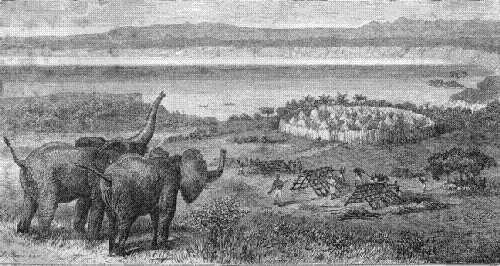
I never saw anything so still and peaceful as it lies all the morning. About noon a gentle breeze springs up, and causes the waves to assume a bluish tinge. Several rocky islands rise in the eastern end, which are inhabited by fishermen, who capture abundance of fine large fish, of which they enumerate about twenty-four species. In the north it seems to narrow into a gateway, but the people are miserably deficient in geographical knowledge, and can tell us nothing about it. They suspect us, and we cannot get information, or indeed much of anything else. I feel deeply thankful at having got so far. I am excessively weak—cannot walk without tottering, and have constant singing in the head, but the Highest will lead me further.
Lat. of the spot we touched at first, 2nd April, 1867. Lat. 8° 46' 54" S., long. 31° 57'; but I only worked out (and my head is out of order) one set of observations. Height above level of the sea over 2800 feet, by boiling-point thermometers and barometer. The people won't let me sound the Lake.
After being a fortnight at this Lake it still appears one of
surpassing loveliness. Its peacefulness is remarkable, though at
times it is said to be lashed up by storms. It lies in a deep
basin whose sides are nearly perpendicular, but covered well with
trees; the rocks which appear are bright red argillaceous schist;
the trees at present all green: down some of these rocks come
beautiful cascades, and buffaloes, elephants, and antelopes
wander and graze on the more level spots, while lions roar by
night. The level place below is not two miles from the
perpendicular. The village (Pambété), at which we first touched
the Lake, is surrounded by palm-oil trees—not the stunted
ones of Lake Nyassa, but the real West Coast palm-oil
tree,
After I had been a few days here I had a fit of insensibility, which shows the power of fever without medicine. I found myself floundering outside my hut and unable to get in; I tried to lift myself from my back by laying hold of two posts at the entrance, but when I got nearly upright I let them go, and fell back heavily on my head on a box. The boys had seen the wretched state I was in, and hung a blanket at the entrance of the hut, that no stranger might see my helplessness; some hours elapsed before I could recognize where I was.
As for these Balungu, as they are called, they have a fear of us, they do not understand our objects, and they keep aloof. They promise everything and do nothing; but for my excessive weakness we should go on, but we wait for a recovery of strength.
As people they are greatly reduced in numbers by the Mazitu, who carried off very large numbers of the women, boys, girls, and children. They train or like to see the young men arrayed as Mazitu, but it would be more profitable if they kept them to agriculture. They are all excessively polite. The clapping of hands on meeting is something excessive, and then the string of salutations that accompany it would please the most fastidious Frenchman. It implies real politeness, for in marching with them they always remove branches out of the path, and indicate stones or stumps in it carefully to a stranger, yet we cannot prevail on them to lend carriers to examine the Lake or to sell goats, of which, however, they have very few, and all on one island.