
CHAPTER V.
Horrors of the slave-trader's track. System of cultivation. Pottery. Special exorcising. Death of the last mule. Rescue of Chirikaloma's wife. Brutalities of the slave-drivers. Mtarika's. Desperate march to Mtaka's. Meets Arab caravans. Dismay of slavers. Dismissal of sepoys. Mataka. The Waiyan metropolis. Great hospitality and good feeling. Mataka restores stolen cattle. Life with the chief. Beauty of country and healthiness of climate. The Waiyan people and their peculiarities. Regrets at the abandonment of Bishop Mackenzie's plans.
19th June, 1866.—We passed a woman tied by the
neck to a tree and dead, the people of the country explained that
she had been unable to keep up with the other slaves in a gang,
and her master had determined that she should not become the
property of anyone else if she recovered after resting for a
time. I may mention here that we saw others tied up in a similar
manner, and one lying in the path shot or stabbed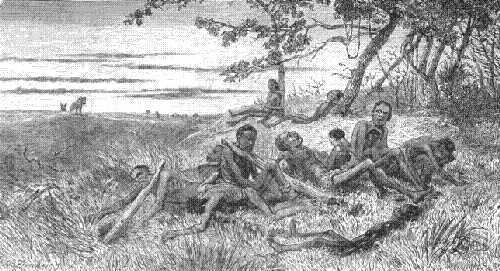
20th June, 1866.—Having returned to Metaba, we were told by Kinazombé, the chief, that no one had grain to sell but himself. He had plenty of powder and common cloth from the Arabs, and our only chance with him was parting with our finer cloths and other things that took his fancy. He magnified the scarcity in front in order to induce us to buy all we could from him, but he gave me an ample meal of porridge and guinea-fowl before starting.
21st June, 1866.—We had difficulties about carriers, but on reaching an island in the Rovuma, called Chimiki, we found the people were Makoa and more civil and willing to work than the Waiyau: we sent men back to bring up the havildar to a very civil headman called Chirikaloma.
22nd June, 1866.—A poor little boy with prolapsus ani was carried yesterday by his mother many a weary mile, lying over her right shoulder—the only position he could find ease in,—an infant at the breast occupied the left arm, and on her head were carried two baskets. The mother's love was seen in binding up the part when we halted, whilst the coarseness of low civilization was evinced in the laugh with which some black brutes looked at the sufferer.
23rd June, 1866.—The country is covered with forest, much more open than further east. We are now some 800 feet above the sea. The people all cultivate maize near the Rovuma, and on islands where moisture helps them, nearly all possess guns, and plenty of powder and fine beads,—red ones strung on the hair, and fine blue ones in rolls on the neck, fitted tightly like soldiers' stocks. The lip-ring is universal; teeth filed to points.
24th June, 1866.—Immense quantities of wood are cut down, collected in heaps, and burned to manure the land, but this does not prevent the country having an appearance of forest. Divine service at 8.30 A.M.; great numbers looking on. They have a clear idea of the Supreme Being, but do not pray to Him.. Cold south winds prevail; temp. 55°. One of the mules is very ill—it was left with the havildar when we went back to Ngozo, and probably remained uncovered at night, for as soon as we saw it, illness was plainly visible. Whenever an animal has been in their power the sepoys have abused it. It is difficult to feel charitably to fellows whose scheme seems to have been to detach the Nassick boys from me first, then, when the animals were all killed, the Johanna men, afterwards they could rule me as they liked, or go back and leave me to perish; but I shall try to feel as charitably as I can in spite of it all, for the mind has a strong tendency to brood over the ills of travel. I told the havildar when I came up to him at Metaba what I had done, and that I was very much displeased with the sepoys for compassing my failure, if not death; an unkind word had never passed my lips to them: to this he could bear testimony. He thought that they would only be a plague and trouble to me, but he "would go on and die with me."
Stone boiling is unknown in these countries, but ovens are made in anthills. Holes are dug in the ground for baking the heads of large game, as the zebra, feet of elephants, humps of rhinoceros, and the production of fire by drilling between the palms of the hands is universal. It is quite common to see the sticks so used attached to the clothing or bundles in travelling; they wet the blunt end of the upright stick with the tongue, and dip it in the sand to make some particles of silica adhere before inserting it in the horizontal piece. The wood of a certain wild fig-tree is esteemed as yielding fire readily.
In wet weather they prefer to carry fire in the dried balls of elephants' dung which are met with—the male's being about eight inches in diameter and about a foot long: they also employ the stalk of a certain plant which grows on rocky places for the same purpose.
We bought a senzé, or Aulacaudatus Swindernianus, which had been dried over a slow fire. This custom of drying fish, flesh, and fruits, on stages over slow fires, is practised very generally: the use of salt for preservation is unknown. Besides stages for drying, the Makondé use them about six feet high for sleeping on instead of the damp ground: a fire beneath helps to keep off the mosquitoes, and they are used by day as convenient resting-places and for observation.
Pottery seems to have been known to the Africans from the remotest times, for fragments are found everywhere, even among the oldest fossil bones in the country. Their pots for cooking, holding water and beer, are made by the women, and the form is preserved by the eye alone, for no sort of machine is ever used. A foundation or bottom is first laid, and a piece of bone or bamboo used to scrape the clay or to smooth over the pieces which are added to increase the roundness; the vessel is then left a night: the next morning a piece is added to the rim—as the air is dry several rounds may be added—and all is then carefully smoothed off; afterwards it is thoroughly sun-dried. A light fire of dried cow-dung, or corn-stalks, or straw, and grass with twigs, is made in a hole in the ground for the final baking. Ornaments are made on these pots of black lead, or before being hardened by the sun they are ornamented for a couple or three inches near the rim, all the tracery being in imitation of plaited basket work.
Chirikaloma says that the surname of the Makoa, to whom he
belongs, is Mirazi—others have the surname Melola or
Malola—Chimposola. All had the half-moon mark when in the
south-east, but now they leave it off a good deal and adopt the
Waiyau marks, because of living in their country. They show no
indications of being named after beasts and birds. Mirazi was an
ancestor; they eat all clean animals, but refuse the hyaena,
leopard, or any beast that devours dead men.
25th June, 1866.—On leaving Chirikaloma we came on to Namalo, whose village that morning had been deserted, the people moving off in a body towards the Matambwé country, where food is more abundant. A poor little girl was left in one of the huts from being too weak to walk, probably an orphan. The Arab slave-traders flee from the path as soon as they hear of our approach. The Rovuma is from 56 to 80 yards wide here. No food to be had for either love or money.
Near many of the villages we observe a wand bent and both ends inserted into the ground: a lot of medicine, usually the bark of trees, is buried beneath it. When sickness is in a village, the men proceed to the spot, wash themselves with the medicine and water, creep through beneath the bough, then bury the medicine and the evil influence together. This is also used to keep off evil spirits, wild beasts, and enemies.
Chirikaloma told us of a child in his tribe which was deformed from his birth. He had an abortive toe where his knee should have been; some said to his mother, "Kill him;" but she replied, "How can I kill my son?" He grew up and had many fine sons and daughters, but none deformed like himself: this was told in connection with an answer to my question about the treatment of Albinoes: he said they did not kill them, but they never grew to manhood. On inquiring if he had ever heard of cannibals, or people with tails, he replied, "Yes, but we have always understood that these and other monstrosities are met with only among you sea-going people." The other monstrosities he referred to were those who are said to have eyes behind the head as well as in front: I have heard of them before, but then I was near Angola, in the west.
The rains are expected here when the Pleiades appear in the east soon after sunset; they go by the same name here as further south—Lemila or the "hoeings."
In the route along the Rovuma, we pass among people who are so well supplied with white calico by the slave-trade from Kilwa, that it is quite a drug in the market: we cannot get food for it. If we held on westwards we should cross several rivers flowing into the Rovuma from the southward, as the Zandulo, the Sanjenzé, the Lochiringo, and then, in going round the north end of Nyassa, we should pass among the Nindi, who now inhabit the parts vacated by the Mazitu, and imitate them in having shields and in marauding. An Arab party went into their country, and got out again only by paying a whole bale of calico; it would not be wise in me to venture there at present, but if we return this way we may; meanwhile we shall push on to Mataka, who is only a few days off from the middle of the Lake, and has abundance of provisions.
26th June, 1866.—My last mule died. In coming along in the morning we were loudly accosted by a well-dressed woman who had just had a very heavy slave-taming stick put on her neck; she called in such an authoritative tone to us to witness the flagrant injustice of which she was the victim that all the men stood still and went to hear the case. She was a near relative of Chirikaloma, and was going up the river to her husband, when the old man (at whose house she was now a prisoner) caught her, took her servant away from her, and kept her in the degraded state we saw. The withes with which she was bound were green and sappy. The old man said in justification that she was running away from Chirikaloma, and he would be offended with him if he did not secure her.
I asked the officious old gentleman in a friendly tone what he expected to receive from Chirikaloma, and he said, "Nothing." Several slaver-looking fellows came about, and I felt sure that the woman had been seized in order to sell her to them, so I gave the captor a cloth to pay to Chirikaloma if he were offended, and told him to say that I, feeling ashamed to see one of his relatives in a slave-stick, had released her, and would, take her on to her husband.
She is evidently a lady among them, having many fine beads and some strung on elephant's hair: she has a good deal of spirit too, for on being liberated she went into the old man's house and took her basket and calabash. A virago of a wife shut the door and tried to prevent her, as well as to cut off the beads from her person, but she resisted like a good one, and my men thrust the door open and let her out, but minus her slave. The other wife—for old officious had two—joined her sister in a furious tirade of abuse, the elder holding her sides in regular fishwife fashion till I burst into a laugh, in which the younger wife joined. I explained to the different headmen in front of this village what I had done, and sent messages to Chirikaloma explanatory of my friendly deed to his relative, so that no misconstruction should be put on my act.

We passed a slave woman shot or stabbed through the body and lying on the path: a group of mon stood about a hundred yards off on one side, and another of women on the other side, looking on; they said an Arab who passed early that morning had done it in anger at losing the price he had given for her, because she was unable to walk any longer.
27th June, 1866.—To-day we came upon a man dead from starvation, as he was very thin. One of our men wandered and found a number of slaves with slave-sticks on, abandoned by their master from want of food; they were too weak to be able to speak or say where they had come from; some were quite young. We crossed the Tulosi, a stream coming from south, about twenty yards wide.
At Chenjewala's the people are usually much startled when I explain that the numbers of slaves we see dead on the road have been killed partly by those who sold them, for I tell them that if they sell their fellows, they are like the man who holds the victim while the Arab performs the murder.
Chenjewala blamed Machemba, a chief above him on the Rovuma, for encouraging the slave-trade; I told him I had travelled so much among them that I knew all the excuses they could make, each headman blamed some one else.
"It would be better if you kept your people and cultivated more largely," said I, "Oh, Machemba sends his men and robs our gardens after we have cultivated," was the reply. One man said that the Arabs who come and tempt them with fine clothes are the cause of their selling: this was childish, so I told them they would very soon have none to sell: their country was becoming jungle, and all their people who did not die in the road would be making gardens for Arabs at Kilwa and elsewhere.
28th June, 1866.—When we got about an hour from Chenjewala's we came to a party in the act of marauding; the owners of the gardens made off for the other side of the river, and waved to us to go against the people of Machemba, but we stood on a knoll with all our goods on the ground, and waited to see how matters would turn out. Two of the marauders came to us and said they had captured five people. I suppose they took us for Arabs, as they addressed Musa. They then took some green maize, and so did some of my people, believing that as all was going, they who were really starving might as well have a share.
I went on a little way with the two marauders, and by the footprints thought the whole party might amount to four or five with guns; the gardens and huts were all deserted. A poor woman was sitting, cooking green maize, and one of the men ordered her to follow him. I said to him, "Let her alone, she is dying." "Yes," said he, "of hunger," and went'on without her.
We passed village after village, and gardens all deserted! We were now between two contending parties. We slept at one garden; and as we were told by Chenjewala's people to take what we liked, and my men had no food, we gleaned what congo beans, bean leaves, and sorghum stalks we could,—poor fare enough, but all we could get.
29th June, 1866.—We came onto Machemba's brother, Chimseia, who gave us food at once. The country is now covered with deeper soil, and many large acacia-trees grow in the rich loam: the holms too are large, and many islands afford convenient maize grounds. One of the Nassiek lads came up and reported his bundle, containing 240 yards of calico, had been stolen; he went aside, leaving it on the path (probably fell asleep), and it was gone when he came back. I cannot impress either on them or the sepoys that it is wrong to sleep on the march.
Akosakoné, whom we had liberated, now arrived at the residence of her husband, who was another brother of Machemba. She behaved like a lady all through, sleeping at a fire apart from the men. The ladies of the different villages we passed condoled with her, and she related to them the indignity that had been done to her. Besides this she did us many services: she bought food for us, because, having a good address, we saw that she could get double what any of our men could purchase for the same cloth; she spoke up for us when any injustice was attempted, and, when we were in want of carriers, volunteered to carry a bag of beads on her head. On arriving at Machemba's brother, Chimseia, she introduced me to him, and got him to be liberal to us in food on account of the service we had rendered to her. She took leave of us all with many expressions of thankfulness, and we were glad that we had not mistaken her position or lavished kindness on the undeserving.
One Johanna man was caught stealing maize, then another, after I had paid for the first. I sent a request to the chief not to make much of a grievance about it, as I was very much ashamed at my men stealing; he replied that he had liked me from the first, and I was not to fear, as whatever service he could do he would most willingly in order to save me pain and trouble. A sepoy now came up having given his musket to a man to carry, who therefore demanded payment. As it had become a regular nuisance for the sepoys to employ people to carry for them, telling them that I would pay, I demanded why he had promised in my name. "Oh, it was but a little way he carried the musket," said he. Chimseia warned us next morning, 30th June, against allowing any one to straggle or steal in front, for stabbing and plundering were the rule. The same sepoy who had employed a man to carry his musket now came forward, with his eyes fixed and shaking all over. This, I was to understand, meant extreme weakness; but I had accidentally noticed him walking quite smartly before this exhibition, so I ordered him to keep close to the donkey that carried the havildar's luggage, and on no account to remain behind the party. He told the havildar that he would sit down only for a little while; and, I suppose, fell asleep, for he came up to us in the evening as naked as a robin.
I saw another person bound to a tree and dead—a sad sight to see, whoever was the perpetrator. So many slave-sticks lie along our path, that I suspect the people here-about make a practice of liberating what slaves they cian find abandoned on the march, to sell them again.
A large quantity of maize is cultivated at Chimsaka's, at whose place we this day arrived. We got a supply, but being among thieves, we thought it advisable to move on to the next place (Mtarika's). When starting, we found that fork, kettle, pot, and shot-pouch had been taken. The thieves, I observed, kept up a succession of jokes with Chuma and Wikatani and when the latter was enjoying them, gaping to the sky, they were busy putting the things of which he had charge under their cloths! I spoke to the chief, and he got the three first articles back for me.
A great deal if not all the lawlessness of this quarter is the result of the slave-trade, for the Arabs buy whoever is brought to them and in a country covered with forest as this is, kidnapping can be prosecuted with the greatest ease; elsewhere the people are honest, and have a regard for justice.
1st July, 1866.—As we approach Mtarika's place, the country becomes more mountainous and the land sloping for a mile down to the south bank of the Rovuma supports a large population. Some were making new gardens by cutting down trees and piling the branches for burning; others had stored tip large quantities of grain and were moving it to a new locality, but they were all so well supplied with calico (Merikano) that they would not look at ours: the market was in fact glutted by slavers from (Quiloa) Kilwa. On asking why people were seen tied to trees to die as we had seen them, they gave the usual answer that the Arabs tie them thus and leave them to perish, because they are vexed, when the slaves can walk no further, that they have lost their money by them. The path is almost strewed with slave-sticks, and though the people denied it, I suspect that they make a practice of following slave caravans and cutting off the sticks from those who fall out in the march, and thus stealing them. By selling them again they get the quantities of cloth we see. Some asked for gaudy prints, of which we had none, because we knew that the general taste of the Africans of the Interior is for strength rather than show in what they buy.
The Rovuma here is about 100 yards broad, and still keeps up its character of a rapid stream, with sandy banks and islands: the latter are generally occupied, as being defensible when the river is in flood.
2nd July, 1866.—We rested at Mtarika's old place;
and though we had to pay dearly with our best
table-cloths
On the southern slope down to the river there are many oozing springs and damp spots where rice has been sown and reaped. The adjacent land has yielded large crops of sorghum, congo-beans, and pumpkins. Successive crowds of people came to gaze. My appearance and acts often cause a burst of laughter; sudden standing up produces a flight of women and children. To prevent peeping into the hut which I occupy, and making the place quite dark, I do my writing in the verandah. Chitané, the poodle dog, the buffalo-calf, and our only remaining donkey are greeted with the same amount of curiosity and laughter-exciting comment as myself.
Every evening a series of loud musket reports is heard from the different villages along the river; these are imitation evening guns. All copy the Arabs in dress and chewing tobacco with "nora" lime, made from burnt river shells instead of betel-nut and lime. The women are stout, well-built persons, with thick arms and legs; their heads incline to the bullet shape; the lip-rings are small; the tattoo a mixture of Makoa and Waiyau. Fine blue and black beads are in fashion, and so are arm-coils of thick brass wire. Very nicely inlaid combs are worn in the hair; the inlaying is accomplished by means of a gum got from the root of an orchis called Nangazu.
3rd July, 1866.—A short march brought us to Mtarika's new place. The chief made his appearance only after he had ascertained all he could about us. The population is immense; they are making new gardens, and the land is laid out by straight lines about a foot broad, cut with the hoe; one goes miles without getting beyond the marked or surveyed fields.
Mtarika came at last; a big ugly man, with large mouth and receding forehead. He asked to see all our curiosities, as the watch, revolver, breech-loading rifle, sextant. I gave him a lecture on the evil of selling his people, and he wished me to tell all the other chiefs the same thing.
They dislike the idea of guilt being attached to them for having sold many who have lost their lives on their way down to the sea-coast. We had a long visit from Mtarika next day; he gave us meal, and meat of wild hog, with a salad made of bean-leaves. A wretched Swaheli Arab, ill with rheumatism, came for aid, and got a cloth. They all profess to me to be buying ivory only.
5th July, 1866.—We left for Mtendé, who is the last chief before we enter on a good eight days' march to Mataka's; we might have gone to Kandulo's, who is near the Rovuma, and more to the north, but all are so well supplied with everything by slave-traders that we have difficulty in getting provisions at all. Mataka has plenty of all kinds of food. On the way we passed the burnt bones of a person Avho was accused of having eaten human flesh; he had been poisoned, or, as they said, killed by poison (muave?), and then burned. His clothes were hung, up on trees by the wayside as a warning to others. The country was covered with scraggy forest, but so undulating that one could often see all around from the crest of the waves. Great mountain masses appear in the south and south-west. It feels cold, and the sky is often overcast.
6th July, 1866.—I took lunars yesterday, after which Mtendé invited us to eat at his house where he had provided a large mess of rice porridge and bean-leaves as a relish. He says that many Arabs pass him and many of them die in their journeys. He knows no deaf or dumb person in the country. He says that he cuts the throats of all animals to be eaten, and does not touch lion or hyaena.
7th July, 1866.—We got men from Mtendé to carry loads and show the way. He asked a cloth to ensure his people going to the journey's end and behaving properly; this is the only case of anything like tribute being demanded in this journey: I gave him a cloth worth 5s. 6d. Upland vegetation prevails; trees are dotted here and there among bushes five feet high, and fine blue and yellow flowers are common. We pass over a succession of ridges and valleys as in Londa; each valley has a running stream or trickling rill; garden willows are in full bloom, and also a species of sage with variegated leaves beneath the flowers.
When the sepoy Perim threw away the tea and the lead lining, I only reproved him and promised him punishment if he committed any other wilful offence, but now he and another skulked behind and gave their loads to a stranger to carry, with a promise to him that I would pay. We waited two hours for them; and as the havildar said that they would not obey him, I gave Perim and the other some smart cuts with a cane, but I felt that I was degrading myself, and resolved not to do the punishment myself again.
8th July, 1866.—Hard travelling through a depopulated country. The trees are about the size of hop-poles with abundance of tall grass; the soil is sometimes a little sandy, at other times that reddish, clayey sort which yields native grain so well. The rock seen uppermost is often a ferruginous conglomerate, lying on granite rocks. The gum-copal tree is here a mere bush, and no digging takes place for the gum: it is called Mchenga, and yields gum when wounded, as also bark, cloth, and cordage when stripped. Mountain masses are all around us; we sleep at Linata mountain.
9th July, 1866.—The Masuko fruit abounds: the name is the same here as in the Batoka country; there are also rhododendrons of two species, but the flowers white. We slept in a wild spot, near Mount Leziro, with many lions roaring about us; one hoarse fellow serenaded us a long time, but did nothing more. Game is said to be abundant, but we saw none, save an occasional diver springing away from the path. Some streams ran to the north-west to the Lismyando, which flows N. for the Rovuma; others to the south-east for the Loendi.
10th and 11th July, 1866.—Nothing to interest but the same weary trudge: our food so scarce that we can only give a handful or half a pound of grain to each person per day. The Masuko fruit is formed, but not ripe till rains begin; very few birds are seen or heard, though there is both food and water in the many grain-bearing grasses and running streams, which we cross at the junction of every two ridges. A dead body lay in a hut by the wayside; the poor thing had begun to make a garden by the stream, probably in hopes of living long enough (two months or so) on wild fruits to reap a crop of maize.
12th July, 1866.—A drizzling mist set in during the night and continued this morning, we set off in the dark, however, leaving our last food for the havildar and sepoys who had not yet come up. The streams are now of good size. An Arab brandy bottle was lying broken in one village called Msapa. We hurried on as fast as we could to the Luatizé, our last stage before getting to Mataka's; this stream is rapid, about forty yards wide, waist deep, with many podostemons on the bottom. The country gets more and more undulating and is covered with masses of green foliage, chiefly Masuko trees, which have large hard leaves. There are hippopotami further down the river on its way to the Loendi. A little rice which had been kept for me I divided, but some did not taste food.
13th July, 1866.—A good many stragglers behind, but we push on to get food and send it back to them. The soil all reddish clay, the roads baked hard by the sun, and the feet of many of us are weary and sore: a weary march and long, for it is perpetually up and down now. I counted fifteen running streams in one day: they are at the bottom of the valley which separates the ridges. We got to the brow of a ridge about an hour from Mataka's first gardens, and all were so tired that we remained to sleep; but we first invited volunteers to go on and buy food, and bring it back early next morning: they had to be pressed to do this duty.
14th July, 1866.—As our volunteers did not come at 8 A.M., I set off to see the cause, and after an hour of perpetual up and down march, as I descended the steep slope which overlooks the first gardens, I saw my friends start up at the apparition—they were comfortably cooking porridge for themselves! I sent men of Mataka back with food to the stragglers behind and came on to his town.
An Arab, Sef Rupia or Rubea, head of a large body of slaves, on his way to the coast, most kindly came forward and presented an ox, bag of flour, and some cooked meat, all of which were extremely welcome to half-famished men, or indeed under any circumstances. He had heard of our want of food and of a band of sepoys, and what could the English think of doing but putting an end to the slave-trade? Had he seen our wretched escort, all fear of them would have vanished! He had a large safari or caravan under him. This body is usually divided into ten or twelve portions, and all are bound to obey the leader to á certain extent: in this case there were eleven parties, and the traders numbered about sixty or seventy, who were dark coast Arabs. Each underling had his men under him, and when I saw them they were busy making the pens of branches in which their slaves and they sleep. Sef came on with me to Mataka's, and introduced me in due form with discharges of gunpowder. I asked him to come back next morning, and presented three cloths with a request that he would assist the havildar and sepoys, if he met them, with food: this he generously did.
We found Mataka's town situated in an elevated valley surrounded by mountains; the houses numbered at least 1000, and there were many villages around. The mountains were pleasantly green, and had many trees which the people were incessantly cutting down. They had but recently come here: they were besieged by Mazitu at their former location west of this; after fighting four days they left unconquered, having beaten the enemy off.
Mataka kept us waiting some time in the verandah of his large square house, and then made his appearance, smiling with his good-natured face. He is about sixty years of age, dressed as an Arab, and if we may judge from the laughter with which his remarks were always greeted, somewhat humorous. He had never seen any but Arabs before. He gave me a square house to live in, indeed the most of the houses here are square, for the Arabs are imitated in everything: they have introduced the English pea, and we were pleased to see large patches of it in full bearing, and ripe in moist hollows which had been selected for it. The numerous springs which come out at various parts are all made use of. Those parts which are too wet are drained, whilst beds are regularly irrigated by water-courses and ridges: we had afterwards occasion to admire the very extensive draining which has been effected among the hills. Cassava is cultivated on ridges along all the streets in the town, which give it a somewhat regular and neat appearance. Peas and tobacco were the chief products raised by irrigation, but batatas and maize were often planted too: wheat would succeed if introduced. The altitude is about 2700 feet above the sea: the air at this time is cool, and many people have coughs.
Mataka soon sent a good mess of porridge and cooked meat (beef); he has plenty of cattle and sheep: and the next day he sent abundance of milk. We stand a good deal of staring unmoved, though it is often accompanied by remarks by no means complimentary; they think that they are not understood, and probably I do misunderstand sometimes. The Waiyau jumble their words as I think, and Mataka thought that I did not enunciate anything, but kept my tongue still when I spoke.
Town of Matak, Moembé. 15th July, 1866.—The safari under Sef set off this morning for Kilwa. Sef says that about 100 of the Kilwa people died this year, so slaving as well as philanthropy is accompanied with loss of life: we saw about seven of their graves; the rest died on the road up.
There are two roads from this to the Lake, one to Loséwa, which is west of this, and opposite Kotakota; the other, to Makatu, is further south: the first is five days through deserted country chiefly; but the other, seven, among people and plenty of provisions all the way.
It struck me after Sef had numbered up the losses that the Kilwa people sustained by death in their endeavours to «nslave people, similar losses on the part of those who go to "proclaim liberty to the captives, the opening of the prison to them that are bound,"—to save and elevate, need not be made so very much of as they sometimes are.
Soon after our arrival we heard that a number of Mataka's Waiyau had, without his knowledge, gone to Nyassa, and in a foray carried off cattle and people: when they came home with the spoil, Mataka ordered all to be sent back whence they came. The chief came up to visit me soon after, and I told him that his decision was the best piece of news I had heard in the country: he was evidently pleased with my approbation, and, turning to his people, asked if they heard what I said. He repeated my remark, and said, "You silly fellows think me wrong in returning the captives, but all wise men will approve of it," and he then scolded them roundly.
I was accidentally spectator of this party going back, for on going out of the town I saw a meat market opened, and people buying with maize and meal. On inquiring, I was told that the people and cattle there were the Nyassas, and they had slaughtered an ox, in order to exchange meat for grain as provisions on the journey. The women and children numbered fifty-four, and about a dozen boys were engaged in milking the cows: the cattle were from twenty-five to thirty head.
The change from hard and scanty fare caused illness in several of our party. I had tasted no animal food except what turtle-doves and guinea-fowls could be shot since we passed Matawatawa,—true, a fowl was given by Mtendé. The last march was remarkable for the scarcity of birds, so eight days were spent on porridge and rice without relish.
I gave Mataka a trinket, to be kept in remembrance of his having sent back the Nyassa people: he replied that he would always act in a similar manner. As it was a spontaneous act, it was all the more valuable.
The sepoys have become quite intolerable, and if I cannot get rid of them we shall all starve before we accomplish what we wish. They dawdle behind picking up wild fruits, and over our last march (which we accomplished on the morning of the eighth day) they took from fourteen to twenty-two days. Retaining their brutal feelings to the last they killed the donkey which I lent to the havildar to carry his things, by striking it on the head when in boggy places into which they had senselessly driven it loaded; then the havildar came on (his men pretending they could go no further from weakness), and killed the young buffalo and eat it when they thought they could hatch up a plausible story. They said it had died, and tigers came and devoured it—they saw them. "Did you see the stripes of the tiger?" said I. All declared that they saw the stripes distinctly. This gave us an idea of their truthfulness, as there is no striped tiger in all Africa. All who resolved on skulking or other bad behaviour invariably took up with the sepoys; their talk seemed to suit evil-doers, and they were such a disreputable-looking lot that I was quite ashamed of them. The havildar had no authority, and all bore the sulky dogged look of people going where they were forced but hated to go. This hang-dog expression of countenance was so conspicuous that I many a time have heard the country people remark, "These are the slaves of the party." They have neither spirit nor pluck as compared with the Africans, and if one saw a village he turned out of the way to beg in the most abject manner, or lay down and slept, the only excuse afterwards being, "My legs were sore." Having allowed some of them to sleep at the fire in my house, they began a wholesale plunder of everything they could sell, as cartridges, cloths, and meat, so I had to eject them. One of them then threatened to shoot my interpreter Simon if he got him in a quiet place away from the English power. As this threat had been uttered three times, and I suspect that something of the kind had prevented the havildar exerting his authority, I resolved to get rid of them by sending them back to the coast by the first trader. It is likely that some sympathizers will take their part, but I strove to make them useful. They had but poor and scanty fare in a part of the way, but all of us suffered alike. They made themselves thoroughly disliked by their foul talk and abuse, and if anything tended more than another to show me that theirs was a moral unfitness for travel, it was the briskness assumed when they knew they were going back to the coast. I felt inclined to force them on, but it would have been acting from revenge, and to pay them out, so I forbore. I gave Mataka forty-eight yards of calico, and to the sepoys eighteen yards, and arranged that he should give them food till Suleiman, a respectable trader, should arrive. He was expected every day, and we passed him near the town. If they chose to go and get their luggage, it was of course all safe for them behind. The havildar begged still to go on with me, and I consented, though he is a drag on the party, but he will count in any difficulty.
Abraham recognised his uncle among the crowds who came to see us. On making himself known he found that his mother and two sisters had been sold to the Arabs after he had been enslaved. The uncle pressed him to remain, and Mataka urged, and so did another uncle, but in vain. I added my voice, and could have given him goods to keep him afloat a good while, but he invariably replied, "How can I stop where I have no mother and no sister?" The affection seems to go to the maternal side. I suggested that he might come after he had married a wife, but I fear very much that unless some European would settle, none of these Nassick boys will come to this country. It would be decidedly better if they were taught agriculture in the simplest form, as the Indian. Mataka would have liked to put his oxen to use, but Abraham could not help him with that. He is a smith, or rather a nothing, for unless he could smelt iron he would be entirely without materials to work with.
14th-28th July, 1866.—One day, calling at Mataka's, I found as usual a large crowd of idlers, who always respond with a laugh to everything he utters as wit. He asked, if he went to Bombay what ought he to take to secure some gold? I replied, "Ivory," he rejoined, "Would slaves not be a good speculation?" I replied that, "if he took slaves there for sale, they would put him in prison." The idea of the great Mataka in "chokee" made him wince, and the laugh turned for once against him. He said that as all the people from the coast crowd to him, they ought to give him something handsome for being here to supply their wants. I replied, if he would fill the fine well-watered country we had passed over with people instead of sending them off to Kilwa, he would confer a benefit on visitors, but we had been starved on the way to him; and I then told him what the English would do in road-making in a fine country like this. This led us to talk of railways, ships, ploughing with oxen—the last idea struck him most. I told him that I should have liked some of the Nassick boys to remain and teach this and other things, but they might be afraid to venture lest they should be sold again. The men who listened never heard such decided protests against selling each other into slavery before!
The idea of guilt probably floated but vaguely in their minds, but the loss of life we have witnessed (in the guilt of which the sellers as well as the buyers participate) comes home very forcibly to their minds.
Mataka has been an active hand in slave wars himself, though now he wishes to settle down in quiet. The Waiyau generally are still the most active agents the slave-traders have. The caravan leaders from Kilwa arrive at a Waiyau village, show the goods they have brought, are treated liberally by the elders, and told to wait and enjoy themselves, slaves enough to purchase all will be procured: then a foray is made against the Manganja, who have few or no guns. The Waiyau who come against them are abundantly supplied with both by their coast guests. Several of the low coast Arabs, who differ in nothing from the Waiyau, usually accompany the foray, and do business on their own account: this is the usual way in which a safari is furnished with slaves.
Makanjela, a Waiyau chief about a third of the way from Mtendé's to Mataka, has lost the friendship of all his neighbours by kidnapping and selling their people; if any of Mataka's people are found in the district between Makanjela and Moembé, they are considered fair game and sold. Makanjela's people cannot piss Mataka to go to the Manganja, so they do what they can by kidnapping and plundering all who fall into their hands.
When I employed two of Mataka's people to go back on the 14th with food to the havildar and sepoys, they went a little way and relieved some, but would not venture as far as the Luatizé, for fear of losing their liberty by Makanjela's people. I could not get the people of the country to go back; nor could I ask the Nassick boys, who had been threatened by the sepoys with assassination,—and it was the same with the Johanna men, because, though Mahometans, the sepoys had called them Caffirs, &c., and they all declared, "We are ready to do anything for you, but we will do nothing for these Hindis." I sent back a sepoy, giving him provisions; he sat down in the first village, ate all the food, and returned.
An immense tract of country lies uninhabited. To the north-east of Moembé we have at least fifty miles of as fine land as can be seen anywhere, still bearing all the marks of having once supported a prodigious iron-smelting and grain-growing population. The clay pipes which are put on the nozzles of their bellows and inserted into the furnace are met with everywhere—often vitrified. Then the ridges on which they planted maize, beans, cassava, and sorghum, and which they find necessary to drain off the too abundant moisture of the rains, still remain unlevelled to attest the industry of the former inhabitants; the soil being clayey, resists for a long time the influence of the weather. These ridges are very regular, for in crossing the old fields, as the path often compels us to do, one foot treads regularly on the ridge, and the other in the hollow, for a considerable distance. Pieces of broken pots, with their rims ornamented with very good imitations of basket-work, attest that the lady potters of old followed the example given them by their still more ancient mothers,—their designs are rude, but better than we can make them without referring to the original.
 Imitation of
basket-work in Pottery.
Imitation of
basket-work in Pottery.
No want of water has here acted to drive the people away, as has been the case further south. It is a perpetual succession of ridge and valley, with a running stream or oozing bog, where ridge is separated from ridge: the ridges become steeper and narrower as we approach Mataka's.
I counted fifteen running burns of from one to ten yards wide in one day's march of about six hours; being in a hilly or rather mountainous region, they flow rapidly and have plenty of water-power. In July any mere torrent ceases to flow, but these were brawling burns with water too cold (61°) for us to bathe in whose pores were all open by the relaxing regions nearer the coast. The sound, so un-African, of gushing water dashing over rocks was quite familiar to our ears.
This district, which rises up west of Mataka's to 3400 feet above the sea, catches a great deal of the moisture brought up by the easterly winds. Many of the trees are covered with lichens. While here we had cold southerly breezes, and a sky so overcast every day after 10 A.M., that we could take no astronomical observations: even the latitude was too poor to be much depended on. 12° 53' S. may have been a few miles from this.
The cattle, rather a small breed, black and white in patches, and brown, with humps, give milk which is duly prized by these Waiyau. The sheep are the large-tailed variety, and generally of a black colour. Fowls and pigeons are the only other domestic animals we see, if we except the wretched village dogs which our-poodle had immense delight in chasing.
The Waiyau are far from a handsome race, but they are not the prognathous beings one sees on the West Coast either. Their heads are of a round shape; compact foreheads, but not particularly receding; the alae nasi are flattened out; lips full, and with the women a small lip-ring just turns them up to give additional thickness. Their style of beauty is exactly that which was in fashion when the stone deities were made in the caves of Elephanta and Kenora near Bombay. À favourite mode of dressing the hair into little knobs, which was in fashion there, is more common in some tribes than in this. The mouths of the women would not be so hideous with a small lip-ring if they did not file their teeth to points, but they seem strong and able for the work which falls to their lot. The men are large, strong-boned fellows, and capable of enduring great fatigue, they undergo a rite which once distinguished the Jews about the age of puberty, and take a new name on the occasion; this was not introduced by the Arabs, whose advent is a recent event, and they speak of the time before they were inundated with European manufactures in exchange for slaves, as quite within their memory.
Young Mataka gave me a dish of peas, and usually brought something every time he made a visit, he seems a nice boy, and his father, in speaking of learning to read, said he and his companions could learn, but he himself was too old. The soil seems very fertile, for the sweet potatoes become very large, and we bought two loads of them for three cubits and two needles; they quite exceeded 1 cwt. The maize becomes very large too; one cob had 1600 seeds. The abundance of water, the richness of soil, the available labour for building square houses, the coolness of the climate, make this nearly as desirable a residence as Magomero; but, alas! instead of three weeks' easy sail up the Zambesi and Shiré, we have spent four weary months in getting here: I shall never cease bitterly to lament the abandonment of the Magomero mission.
Moaning seems a favourite way of spending the time with some sick folk. For the sake of the warmth, I allowed a Nassick boy to sleep in my house; he and I had the same complaint, dysentery, and I was certainly worse than he, but did not moan, while he played at it as often as he was awake. I told him that people moaned only when too ill to be sensible of what they were doing; the groaning ceased, though he became worse.
Three sepoys played at groaning very vigorously outside my door; they had nothing the matter with them, except perhaps fatigue, which we all felt alike; as these fellows prevented my sleeping, I told them quite civilly that, if so ill that they required to groan, they had better move off a little way, as I could not sleep; they preferred the verandah, and at once forbore.
The abundance of grain and other food is accompanied by great numbers of rats or large mice, which play all manner of pranks by night; white ants have always to be guarded against likewise. Anyone who would find an antidote to drive them away would confer a blessing; the natural check is the driver ant, which when it visits a house is a great pest for a time, but it clears the others out.
FOOTNOTES:
CHAPTER IV.
Geology and description of the Waiyau land. Leaves Mataka's. The Nyumbo plant. Native iron-foundry. Blacksmiths. Makes for the Lake Nyassa. Delight at seeing the Lake once more. The Manganja or Nyassa tribe. Arab slave crossing. Unable to procure passage across. The Kungu fly. Fear of the English amongst slavers. Lake shore. Blue ink. Chitané changes colour. The Nsaka fish. Makalaosé drinks beer. The Sanjika fish. London antiquities. Lake rivers. Mukaté's. Lake Pamalombé. Mponda's. A slave gang. Wikatani discovers his relatives and remains.
28th July, 1866.—We proposed to start to-day, but Mataka said that he was not ready yet: the flour had to be ground, and he had given us no meat. He had sent plenty of cooked food almost every day. He asked if we would slaughter the ox he would give here, or take it on; we preferred to kill it at once. He came on the 28th with a good lot of flour for us, and men to guide us to Nyassa, telling us that this was Moembé, and his district extended all the way to the Lake: he would not send us to Loséwa, as that place had lately been plundered and burned.
In general the chiefs have shown an anxiety to promote our safety. The country is a mass of mountains. On leaving Mataka's we ascended considerably, and about the end of the first day's march, near Magola's village, the barometer showed our greatest altitude, about 3400 feet above the sea. There were villages of these mountaineers everywhere, for the most part of 100 houses or more each. The springs were made the most use of that they knew; the damp spots drained, and the water given a free channel for use in irrigation further down: most of these springs showed the presence of iron by the oxide oozing out. A great many patches of peas are seen in full bearing and flower. The trees are small, except in the hollows: there is plenty of grass and flowers near streams and on the heights. The mountain-tops may rise 2000 or 3000 feet above their flanks, along which we wind, going perpetually up and down the steep ridges of which the country is but a succession.
Looking at the geology of the district, the plateaux on each
side of the Rovuma are masses of grey sandstone, capped with
masses of ferruginous conglomerate; apparently an aqueous
deposit. When we ascend the Rovuma about sixty miles, a great
many pieces and blocks of silicified wood appear on the surface
of the soil at the bottom of the slope up the plateaux. This in
Africa is a sure indication of the presence of coal beneath, but
it was not observed cropping out; the plateaux are cut up in
various directions by wadys well supplied with grass and trees on
deep and somewhat sandy soil: but at the confluence of the Loendi
highlands they appear in the far distance. In the sands of the
Loendi pieces of coal are quite common.
Before reaching the confluence of the Rovuma and Loendi, or say about ninety miles from the sea, the plateau is succeeded by a more level country, having detached granitic masses shooting up some 500 or 700 feet. The sandstone of the plateau has at first been hardened, then quite metamorphosed into a chocolate-coloured schist. As at Chilolé hill, we have igneous rocks, apparently trap, capped with masses of beautiful white dolomite. We still ascend in altitude as we go westwards, and come upon long tracts of gneiss with hornblende. The gneiss is often striated, all the striae looking one way—sometimes north and south, and at other times east and west. These rocks look as if a stratified rock had been nearly melted, and the strata fused together by the heat. From these striated rocks have shot up great rounded masses of granite or syenite, whose smooth sides and crowns contain scarcely any trees, and are probably from 3000 to 4000 feet above the sea. The elevated plains among these mountain masses show great patches of ferruginous conglomerate, which, when broken, look like yellow haematite with madrepore holes in it: this has made the soil of a red colour.
On the watershed we have still the rounded granitic hills jutting above the plains (if such they may be called) which are all ups and downs, and furrowed with innumerable running rills, the sources of the Rovuma and Loendi. The highest rock observed with mica schist was at an altitude of 3440 feet. The same uneven country prevails as we proceed from the watershed about forty miles down to the Lake, and a great deal of quartz in small fragments renders travelling-very difficult. Near the Lake, and along its eastern shore, we have mica schist and gneiss foliated, with a great deal of hornblende; but the most remarkable feature of it is that the rocks are all tilted on edge, or slightly inclined to the Lake. The active agent in effecting this is not visible. It looks as if a sudden rent had been made, so as to form the Lake, and tilt all these rocks nearly over. On the east side of the lower part of the Lake we have two ranges of mountains, evidently granitic: the nearer one covered with small trees and lower than the other; the other jagged and bare, or of the granitic forms. But in all this country no fossil-yielding rock was visible except the grey sandstone referred to at the beginning of this note. The rocks are chiefly the old crystalline forms.
One fine straight tall tree in the hollows seemed a species of fig: its fruit was just forming, but it was too high for me to ascertain its species. The natives don't eat the fruit, but they eat the large grubs which come out of it. The leaves were fifteen inches long by five broad: they call it Unguengo.
29th July, 1866.—At Magola's village. Although we are now rid of the sepoys, we cannot yet congratulate ourselves on being rid of the lazy habits of lying down in the path which they introduced. A strong scud comes up from the south bringing much moisture with it: it blows so hard above, this may be a storm on the coast. Temperature in mornings 55°.
30th July, 1866.—A short march brought us to Pezimba's village, which consists of 200 houses and huts. It is placed very nicely on a knoll between two burns, which, as usual, are made use of for irrigating peas in winter time. The headman said that if we left now we had a good piece of jungle before us, and would sleep twice in it before reaching Mbanga. We therefore remained. An Arab party, hearing of our approach, took a circuitous route among the mountains to avoid coming in contact with us. In travelling to Pezimba's we had commenced our western descent to the Lake, for we were now lower than Magola's by 300 feet. We crossed many rivulets and the Lochesi, a good-sized stream. The watershed parts some streams for Loendi and some for Rovuma. There is now a decided scantiness of trees. Many of the hill-tops are covered with grass or another plant; there is pleasure now in seeing them bare. Ferns, rhododendrons, and a foliaged tree, which looks in the distance like silver-fir, are met with.
The Mandaré root is here called Nyumbo, when cooked it has a slight degree of bitterness with it which cultivation may remove. Mica schist crowned some of the heights on the watershed, then gneiss, and now, as we descend further, we have igneous rocks of more recent eruption, porphyry and gneiss, with hornblende. A good deal of ferruginous conglomerate, with holes in it, covers many spots; when broken, it looks like yellow haematite, with black linings to the holes: this is probably the ore used in former times by the smiths, of whose existence we now find still more evidence than further east.
31st July, 1866.—I had presented Pezimba with a cloth, so he cooked for us handsomely last night, and this morning desired us to wait a little as he had not yet sufficient meal made to present: we waited and got a generous present.
It was decidedly milder here than at Mataka's, and we had a
clear sky. In our morning's march we passed the last of the
population, and went on through a fine well-watered fruitful
country, to sleep near a mountain called Mtéwiré,
by a stream called Msapo. A very large Arab slave-party was close
by our encampment, and I wished to speak to them; but as soon as
they knew of our being near they set off in a pathless course
across country, and were six days in the wilderness.
1st August, 1866.—We saw the encampment of another Arab party. It consisted of ten pens, each of which, from the number of fires it contained, may have held from eighty to a hundred slaves. The people of the country magnified the numbers, saying that they would reach from this to Mataka's; but from all I can learn, I think that from 300 to 800 slaves is the commoner gang. This second party went across country very early this morning. We saw the fire-sticks which the slaves had borne with them. The fear they feel is altogether the effect of the English name, for we have done nothing to cause their alarm.
2nd August, 1866.—There was something very cheering to me in the sight at our encampment of yellow grass and trees dotted over it, as in the Bechuana country. The birds were singing merrily too, inspired by the cold, which was 47°, and by the vicinity of some population. Gum-copal trees and bushes grow here as well as all over the country; but gum is never dug for, probably because the trees were never large enough to yield the fossil gum. Marks of smiths are very abundant and some furnaces are still standing. Much cultivation must formerly have been where now all is jungle.
We arrived at Mbanga, a village embowered in trees, chiefly of the euphorbia, so common in the Manganja country further south. Kandulo, the headman, had gone to drink beer at another village, but sent orders to give a hut and to cook for us. We remained next day. Took lunars.
We had now passed through, at the narrowest part, the hundred
miles of depopulated country, of which about seventy are on the
N.E. of Mataka. The native accounts differ as to the cause. Some
say slave wars, and assert that the Makoa from the vicinity of
Mozambique played an important part in them; others say famine;
others that the people have moved to and beyond Nyassa.
4th August, 1866.—An hour and a half brought us to Miulé, a village on the same level with Mbanga; and the chief pressing us to stay, on the plea of our sleeping two nights in the jungle, instead of one if we left early next morning, we consented. I asked him what had become of the very large iron-smelting population of this region; he said many had died of famine, others had fled to the west of Nyassa: the famine is the usual effect of slave wars, and much death is thereby caused—probably much more than by the journey to the coast. He had never heard any tradition of stone hatchets having been used, nor of stone spear-heads or arrowheads of that material, nor had he heard of any being turned up by the women in hoeing. The Makondé, as we saw, use wooden spears where iron is scarce. I saw wooden hoes used for tilling the soil in the Bechuana and Bataka countries, but never stone ones. In 1841 I saw a Bushwoman in the Cape Colony with a round stone and a hole through it; on being asked she showed me how it was used by inserting the top of a digging-stick into it, and digging a root. The stone was to give the stick weight.
 Digging-stick
weighted with round Stone.
Digging-stick
weighted with round Stone.
The stones still used as anvils and sledge-hammers by many of the African smiths, when considered from their point of view, show sounder sense than if they were burdened with the great weights we use. They are unacquainted with the process of case-hardening, which, applied to certain parts of our anvils, gives them their usefulness, and an anvil of their soft iron would not do so well as a hard stone. It is true a small light one might be made, but let any one see how the hammers of their iron bevel over and round in the faces with a little work, and he will perceive that only a wild freak would induce any sensible native smith to make a mass equal to a sledge-hammer, and burden himself with a weight for what can be better performed by a stone. If people are settled, as on the coast, then they gladly use any mass of cast iron they may find, but never where, as in the interior, they have no certainty of remaining any length of time in one spot.
5th August, 1866.—We left Miulé, and commenced our march towards Lake Nyassa, and slept at the last of the streams that flow to the Loendi. In Mataka's vicinity, N.E., there is a perfect brush of streams flowing to that river: one forms a lake in its course, and the sources of the Rovuma lie in the same region. After leaving Mataka's we crossed a good-sized one flowing to Loendi, and, the day after leaving Pezimba's, another going to the Chiringa or Lochiringa, which is a tributary of the Rovuma.
6th August, 1866.—We passed two cairns this morning at the beginning of the very sensible descent to the Lake. They are very common in all this Southern Africa in the passes of the mountains, and are meant to mark divisions of countries, perhaps burial-places, but the Waiyau who accompanied us thought that they were merely heaps of stone collected by some one making a garden. The cairns were placed just about the spot where the blue waters of Nyassa first came fairly into view.
We now came upon a stream, the Misinjé, flowing into the Lake, and we crossed it five times; it was about twenty yards wide, and thigh deep. We made but short stages when we got on the lower plateau, for the people had great abundance of food, and gave large presents of it if we rested. One man gave four fowls, three large baskets of maize, pumpkins, eland's fat—a fine male, as seen by his horns,—and pressed us to stay, that he might see our curiosities as well as others. He said that at one day's distance south of him all sorts of animals, as buffaloes, elands, elephants, hippopotami, and antelopes, could be shot.
8th August, 1866.—We came to the Lake at the confluence of the Misinjé, and felt grateful to That Hand which had protected us thus far on our journey. It was as if I had come back to an old home I never expected again to see; and pleasant to bathe in the delicious waters again, hear the roar of the sea, and dash in the rollers. Temp. 71° at 8 A.M., while the air was 65°. I feel quite exhilarated.
The headman here, Mokalaosé, is a real Manganja, and he and all his people exhibit the greater darkness of colour consequent on being in a warm moist climate; he is very friendly, and presented millet, porridge, cassava, and hippopotamus meat boiled and asked if I liked milk, as he had some of Mataka's cattle here. His people bring sanjika the best Lake fish, for sale; they are dried on stages over slow fires, and lose their fine flavour by it, but they are much prized inland. I bought fifty for a fathom of calico; when fresh, they taste exactly like the best herrings, i.e. as we think, but voyagers' and travellers' appetites are often so whetted as to be incapable of giving a true verdict in matters of taste.
[It is necessary to explain that Livingstone knew of an Arab settlement on the western shore of the Lake, and that he hoped to induce the chief man Jumbé to give him a passage to the other side.]
10th August, 1866.—I sent Seyed Majid's letter up to Jumbé, but the messenger met some coast Arabs at the Loangwa, which may be seven miles from this, and they came back with him, haggling a deal about the fare, and then went off, saying that they would bring the dhow here for us. Finding that they did not come, I sent Musa, who brought back word that they had taken the dhow away over to Jumbé at Kotakota, or, as they pronounce it, Ngotagota. Very few of the coast Arabs can read; in words they are very polite, but truthfulness seems very little regarded. I am resting myself and people—working up journal, lunars, and altitudes—but will either move south or go to the Arabs towards the north soon.
Mokalaosé's fears of the Waiyau will make him welcome Jumbé here, and then the Arab will some day have an opportunity of scattering his people as he has done those at Kotakota. He has made Loséwa too hot for himself. When the people there were carried off by Mataka's people, Jumbé seized their stores of grain, and now has no post to which he can go there. The Loangwa Arabs give an awful account of Jumbé's murders and selling the people, but one cannot take it all in; at the mildest it must have been bad. This is all they ever do; they cannot form a state or independent kingdom: slavery and the slave-trade are insuperable obstacles to any permanence inland; slaves can escape so easily, all therefore that the Arabs do is to collect as much money as they can by hook and by crook, and then leave the country.
We notice a bird called namtambwé, which sings very nicely with a strong voice after dark here at the Misinjé confluence.
11th August, 1866.—Two headmen came down country from villages where we slept, bringing us food, and asking how we are treated; they advise our going south to Mukaté's, where the Lake is narrow.
12th-14th August, 1866.—Map making; but my energies were sorely taxed by the lazy sepoys, and I was usually quite tired out at night. Some men have come down from Mataka's, and report the arrival of an Englishman with cattle for me, "he has two eyes behind as well as two in front:" this is enough of news for awhile!
Mokalaosé has his little afflictions, and he tells me of them. A wife ran away, I asked how many he had; he told me twenty in all: I then thought he had nineteen too many. He answered with the usual reason, "But who would cook for strangers if I had but one?"
We saw clouds of "kungu" gnats on the Lake; they are not eaten here. An ungenerous traveller coming here with my statement in his hand, and finding the people denying all knowledge of how to catch and cook them, might say that I had been romancing in saying I had seen them made into cakes in the northern part of the Lake; when asking here about them, a stranger said, "They know how to use them in the north; we do not."
Mokalaosé thinks that the Arabs are afraid that I may take their dhows from them and go up to the north. He and the other headmen think that the best way will be to go to Mukaté's in the south. All the Arabs flee from me, the English name being in their minds inseparably connected with recapturing slavers: they cannot conceive that I have any other object in view; they cannot read Seyed Majid's letter.
21st August, 1866.—Started for the Loangwa, on the east side of the Lake; hilly all the way, about seven miles. This river may be twenty yards wide near its confluence; the Misinjé is double that: each has accumulated a promontory of deposit and enters the Lake near its apex. We got a house from a Waiyau man on a bank about forty feet above the level of Nyassa, but I could not sleep for the manoeuvres of a crowd of the minute ants which infested it. They chirrup distinctly; they would not allow the men to sleep either, though all were pretty tired by the rough road up.
22nd August, 1866.—We removed to the south side of the Loangwa, where there are none of these little pests.
23rd August, 1866.—Proposed to the Waiyau headman to send a canoe over to call Jumbé, as I did not believe in the assertions of the half-caste Arab here that he had sent for his. All the Waiyau had helped me, and why not he? He was pleased with this, but advised waiting till a man sent to Loséwa should return.
24th August, 1866.—A leopard took a dog out of a house next to ours; he had bitten a man before, but not mortally. 29th August, 1866.—News come that the two dhows have come over to Loséwa (Loséfa). The Mazitu had chased Jumbé up the hills: had they said, on to an island, I might have believed them.
30th August,1866.—The fear which the English have inspired in the Arab slave-traders is rather inconvenient. All flee from me as if I had the plague, and I cannot in consequence transmit letters to the coast, or get across the Lake. They seem to think that if I get into a dhow I will be sure to burn it. As the two dhows on the Lake are used for nothing else but the slave-trade, their owners have no hope of my allowing them to escape, so after we have listened to various lies as excuses, we resolve to go southwards, and cross at the point of departure of the Shiré from the Lake. I took lunars several times on both sides of the moon, and have written a despatch for Lord Clarendon, besides a number of private letters.
3rd September, 1866.—Went down to confluence of the Misinjé and came to many of the eatable insect "kungu,"—they are caught by a quick motion of the hand holding a basket. We got a cake of these same insects further down; they make a buzz like a swarm of bees, and are probably the perfect state of some Lake insect.
I observed two beaches of the Lake: one about fifteen feet above the present high-water mark, and the other about forty above that; but between the two the process of disintegration, which results from the sudden cold and heat in these regions, has gone on so much that seldom is a well-rounded smoothed one seen; the lower beach is very well marked.
The strike of large masses of foliated gneiss is parallel with the major axis of the Lake, and all are tilted on edge. Some are a little inclined to the Lake, as if dipping to it westwards, but others are as much inclined the opposite way, or twisted.
I made very good blue ink from the juice of a berry, the fruit of a creeper, which is the colour of port wine when expressed. A little ferri carb. ammon., added to this is all that is required.
The poodle dog Chitané is rapidly changing the colour of its hair. All the parts corresponding to the ribs and neck are rapidly becoming red; the majority of country dogs are of this colour.
The Manganja, or Wa-nyassa, are an aboriginal race; they have great masses of hair, and but little, if any, of the prognathous in the profile. Their bodies and limbs are very well made, and the countenance of the men is often very pleasant. The women are very plain and lumpy, but exceedingly industrious in their gardens from early morning till about 11 A.M., then from 3 P.M. till dark, or pounding corn and grinding it: the men make twine or nets by day, and are at their fisheries in the evenings and nights. They build the huts, the women plaster them.
A black fish, the Nsaka, makes a hole, with raised edges, which, with the depth from which they are taken, is from fifteen to eighteen inches, and from two to three feet broad. It is called by the natives their house. The pair live in it for some time, or until the female becomes large for spawning; this operation over, the house is left.
I gave Mokalaosé some pumpkin seed and peas. He took me into his house, and presented a quantity of beer. I drank a little, and seeing me desist from taking more, he asked if I wished a servant-girl to "pata mimba." Not knowing what was meant, I offered the girl the calabash of beer, and told her to drink, but this was not the intention. He asked if I did not wish more; and then took the vessel, and as he drank the girl performed the operation on himself. Placing herself in front, she put both hands round his waist below the short ribs, and pressing gradually drew them round to his belly in front. He took several prolonged draughts, and at each she repeated the operation, as if to make the liquor go equally over the stomach. Our topers don't seem to have discovered the need for this.
5th September, 1866.—Our march is along the shore to Ngombo promontory, which approaches so near to Senga or Tsenga opposite, as to narrow the Lake to some sixteen or eighteen miles. It is a low sandy point, the edge fringed on the north-west and part of the south with a belt of papyrus and reeds; the central parts wooded. Part of the south side has high sandy dunes, blown up by the south wind, which strikes it at right angles there. One was blowing as we marched along the southern side eastwards, and was very tiresome. We reached Panthunda's village by a brook called Lilolé. Another we crossed before coming to it is named Libesa: these brooks form the favourite spawning grounds of the sanjika and mpasa, two of the best fishes of the Lake. The sanjika is very like our herring in shape and taste and size; the mpasa larger every way: both live on green herbage formed at the bottom of the Lake and rivers.
7th September, 1866.—Chirumba's village being on the south side of a long lagoon, we preferred sleeping on the mainland, though they offered their cranky canoes to ferry us over. This lagoon is called Pansangwa.
8th September, 1866.—In coming along the southern side of Ngombo promontory we look eastwards, but when we leave it we turn southwards, having a double range of lofty mountains on our left. These are granitic in form, the nearer range being generally the lowest, and covered with scraggy trees; the second, or more easterly, is some 6000 feet above the sea, bare and rugged, with jagged peaks shooting high into the air. This is probably the newest range. The oldest people have felt no earthquake, but some say that they have heard of such things from their elders.
We passed very many sites of old villages, which are easily known by the tree euphorbia planted round an umbelliferous one, and the sacred fig. One species here throws out strong buttresses in the manner of some mangroves instead of sending down twiners which take root, as is usually the ease with the tropical fig. These, with millstones—stones for holding the pots in cooking—and upraised clay benches, which have been turned into brick by fire in the destruction of the huts, show what were once the "pleasant haunts of men." No stone implements ever appear. If they existed they could not escape notice, since the eyes in walking are almost always directed to the ground to avoid stumbling on stones or stumps. In some parts of the world stone implements are so common they seem to have been often made and discarded as soon as formed, possibly by getting better tools; if, indeed, the manufacture is not as modern as that found by Mr. Waller. Passing some navvies in the City who were digging for the foundation of a house, he observed a very antique-looking vase, wet from the clay, standing on the bank. He gave ten shillings for it, and subsequently, by the aid of a scrubbing brush and some water, detected the hieroglyphics "Copeland late Spode" on the bottom of it!
Here the destruction is quite recent, and has been brought about by some who entertained us very hospitably on the Misinjé, before we came to the confluence. The woman chief, Ulenjelenjé, or Njelenjé, bore a part in it for the supply of Arab caravans. It was the work of the Masininga, a Waiyau tribe, of which her people form a part. They almost depopulated the broad fertile tract, of some three or four miles, between the mountain range and the Lake, along which our course lay. It was wearisome to see the skulls and bones scattered about everywhere; one would fain not notice them, but they are so striking as one trudges along the sultry path, that it cannot be avoided.
9th September, 1866.—We spent Sunday at Kandango's village. The men killed a hippopotamus when it was sleeping on the shore; a full-grown female, 10 feet 9 inches from the snout to the insertion of the tail, and 4 feet 4 inches high at the withers. The bottom here and all along southwards now is muddy. Many of the Siluris Glanis are caught equal in length to an eleven or a twelve-pound salmon, but a great portion is head; slowly roasted on a stick stuck in the ground before the fire they seemed to me much more savoury than I ever tasted them before. With the mud we have many shells: north of Ngombo scarcely one can be seen, and there it is sandy or rocky.
10th September, 1866.—In marching southwards we came close to the range (the Lake lies immediately on the other side of it), but we could not note the bays which it forms; we crossed two mountain torrents from sixty to eighty yards broad, and now only ankle deep. In flood these bring down enormous trees, which are much battered and bruised among the rocks in their course; they spread over the plain, too, and would render travelling here in the rains impracticable. After spending the night at a very civil headman's chefu, we crossed the Lotendé, another of these torrents: each very lofty mass in the range seemed to give rise to one. Nothing of interest occurred as we trudged along. A very poor headman, Pamawawa, presented a roll of salt instead of food: this was grateful to us, as we have been without that luxury some time.
12th September, 1866.—We crossed the rivulet Nguena, and then went on to another with a large village by it, it is called Pantoza Pangone. The headman had been suffering from sore eyes for four months, and pressed me to stop and give him medicine, which I did.
13th September, 1866.—We crossed a strong brook called Nkoré. My object in mentioning the brooks which were flowing at this time, and near the end of the dry season, is to give an idea of the sources of supply of evaporation. The men enumerate the following, north of the Misinjé. Those which are greater are marked thus +, and the lesser ones-.
1. Misinjé + has
canoes.
2. Loangwa -
3. Leséfa -
4. Lelula -
5. Nchamanjé
-
6. Musumba +
7. Fubwé +
8. Chia -
9. Kisanga +
10. Bweka -
11. Chifumero + has
canoes.
12. Loangwa -
13. Mkoho -
14. Mangwelo - at N. end of
Lake.
Including the above there are twenty or twenty-four perennial brooks and torrents which give a good supply of water in the dry season; in the wet season they are supplemented by a number of burns, which, though flowing now, have their mouths blocked up with bars of sand, and yield nothing except by percolation; the Lake rises at least four feet perpendicularly in the wet season, and has enough during the year from these perennial brooks to supply the Shiré's continual flow.
[It will be remembered that the beautiful river Shiré carries off the waters of Lake Nyassa and joins the Zambesi near Mount Morambala, about ninety miles from the sea. It is by this water-way that Livingstone always hoped to find an easy access to Central Africa. The only obstacles that exist are, first, the foolish policy of the Portuguese with regard to Customs' duties at the mouth of the Zambesi; and secondly, a succession of cataracts on the Shiré, which impede navigation for seventy miles. The first hindrance may give way under more liberal views than those which prevail at present at the Court of Lisbon, and then the remaining difficulty—accepted as a fact—will be solved by the establishment of a boat service both above and below the cataracts. Had Livingstone survived he would have been cheered by hearing that already several schemes are afoot to plant Missions in the vicinity of Lake Nyassa, and we may with confidence look to the revival of the very enterprise which he presently so bitterly deplores as a thing of the past, for Bishop Steere has fully determined to re-occupy the district in which fell his predecessor, Bishop Mackenzie, and others attached to the Universities Mission.]
In the course of this day's march we were pushed close to the Lake by Mount Gomé, and, being now within three miles of the end of the Lake, we could see the whole plainly. There we first saw the Shiré emerge, and there also we first gazed on the broad waters of Nyassa.
Many hopes have been disappointed here. Far down on the right bank of the Zambesi lies the dust of her whose death changed all my future prospects; and now, instead of a check being given to the slave-trade by lawful commerce on the Lake, slave-dhows prosper!
An Arab slave-party fled on hearing of us yesterday. It is impossible not to regret the loss of good Bishop Mackenzie, who sleeps far down the Shiré, and with him all hope of the Gospel being introduced into Central Africa. The silly abandonment of all the advantages of the Shiré route by the Bishop's successor I shall ever bitterly deplore, but all will come right some day, though I may not live to participate in the joy, or even see the commencement of better times.
In the evening we reached the village of Cherekalongwa on the
brook Pamchololo, and were very jovially received by the headman
with beer. He says that Mukaté,
14th, September, 1866.—At Cherekalongwa's (who has a skin disease, believed by him to have been derived from eating fresh-water turtles), we were requested to remain one day in order that he might see us. He had heard much about us; had been down the Shiré, and as far as Mosambique, but never had an Englishman in his town before. As the heat is great we were glad of the rest and beer, with which he very freely supplied us.
I saw the skin of a Phenembe, a species of lizard which devours chickens; here it is named Salka. It had been flayed by a cut up the back—body, 12 inches; across belly, 10 inches.
After nearly giving up the search for Dr. Roscher's point of reaching the Lake—because no one, either Arab or native, had the least idea of either Nusseewa or Makawa, the name given to the place—I discovered it in Lesséfa, the accentuated é being sounded as our e in set. This word would puzzle a German philologist, as being the origin of Nussewa, but the Waiyau pronounce it Loséwa, the Arabs Lusséwa, and Roscher's servant transformed the L and é into N and ee, hence Nusseewa. In confirmation of this rivulet Leséfa, which is opposite Kotakota, or, as the Arabs pronounce it, Nkotakota, the chief is Mangkaka (Makawa), or as there is a confusion of names as to chief it may be Mataka, whose town and district is called Moembé, the town Pamoembe = Mamemba.
I rest content with Kingomango so far verifying the place at which he arrived two months after we had discovered Lake Nyassa. He deserved all the credit due to finding the way thither, but he travelled as an Arab, and no one suspected him to be anything else. Our visits have been known far and wide, and great curiosity excited; but Dr. Roscher merits the praise only of preserving his incognito at a distance from Kilwa: his is almost the only case known of successfully assuming the Arab guise—Burckhardt is the exception. When Mr. Palgrave came to Muscat, or a town in Oman where our political agent Col. Desborough was stationed, he was introduced to that functionary by an interpreter as Hajee Ali, &c. Col. Desborough replied, "You are no Hajee Ali, nor anything else but Gifford Palgrave, with whom I was schoolfellow at the Charter House." Col. Desborough said he knew him at once, from a peculiar way of holding his head, and Palgrave begged him not to disclose his real character to his interpreter, on whom, and some others, he had been imposing. I was told this by Mr. Dawes, a Lieutenant in the Indian navy, who accompanied Colonel Pelly in his visit to the Nejed, Riad, &c, and took observations for him.
Tañgaré is the name of a rather handsome bean, which possesses intoxicating qualities. To extract these it is boiled, then peeled, and new water supplied: after a second and third boiling it is pounded, and the meal taken to the river and the water allowed to percolate through it several times. Twice cooking still leaves the intoxicating quality; but if eaten then it does not cause death: it is curious that the natives do not use it expressly to produce intoxication. When planted near a tree it grows all over it, and yields abundantly: the skin of the pod is velvety, like our broad beans.
Another bean, with a pretty white mark on it, grows freely, and is easily cooked, and good: it is here called Gwingwiza.
15th September, 1866.—We were now a short distance south of the Lake, and might have gone west to Mosauka's (called by some Pasauka's) to cross the Shiré there, but I thought that my visit to Mukaté's, a Waiyau chief still further south, might do good. He, Mponda, and Kabinga, are the only three chiefs who still carry on raids against the Manganja at the instigation of the coast Arabs, and they are now sending periodical marauding parties to the Maravi (here named Malola) to supply the Kilwa slave-traders. We marched three hours southwards, then up the hills of the range which flanks all the lower part of the Lake. The altitude of the town is about 800 feet above the Lake. The population near the chief is large, and all the heights as far as the eye can reach are crowned with villages. The second range lies a few miles off, and is covered with trees as well as the first, the nearest high mass is Mañgoché. The people live amidst plenty. All the chiefs visited by the Arabs have good substantial square houses built for their accommodation. Mukaté never saw a European before, and everything about us is an immense curiosity to him and to his people. We had long visits from him. He tries to extract a laugh out of every remark. He is darker than the generality of Waiyau, with a full beard trained on the chin, as all the people hereabouts have—Arab fashion. The courts of his women cover a large space, our house being on one side of them. I tried to go out that way, but wandered, so the ladies sent a servant to conduct me out in the direction I wished to go, and we found egress by passing through some huts with two doors in them.
16th September, 1866.—At Mukaté's. The Prayer Book does not give ignorant persons any idea of an unseen Being addressed, it looks more like reading or speaking to the book: kneeling and praying with eyes shut is better than, our usual way of holding Divine service.
We had a long discussion about the slave-trade. The Arabs have told the chief that our object in capturing slavers is to get them into our own possession, and make them of our own religion. The evils which we have seen—the skulls, the ruined villages, the numbers who perish on the way to the coast and on the sea, the wholesale murders committed by the Waiyau to build up Arab villages elsewhere—these things Mukaté often tried to turn off with a laugh, but our remarks are safely lodged in many hearts. Next day, as we went along, our guide spontaneously delivered their substance to the different villages along our route. Before we reached him, a headman, in convoying me a mile or two, whispered to me, "Speak to Mukaté to give his forays up."
It is but little we can do, but we lodge a protest in the heart against a vile system, and time may ripen it. Their great argument is, "What could we do without Arab cloth?" My answer is, "Do what you did before the Arabs came into the country." At the present rate of destruction of population, the whole country will soon be a desert.
An earthquake happened here last year, that is about the end
of it or beginning of this (the crater on the Grand. Comoro
Island smoked for three months about that time); it shook all the
houses and everything, but they observed no other
effects.
17th September, 1866.—We marched down from Mukaté's and to about the middle of the Lakelet Pamalombé. Mukaté had no people with canoes near the usual crossing place, and he sent a messenger to see that we were fairly served. Here we got the Manganja headmen to confess that an earthquake had happened; all the others we have inquired of have denied it; why, I cannot conceive. The old men said that they had felt earthquakes twice, once near sunset and the next time at night—they shook everything, and were accompanied with noise, and all the fowls cackled; there was no effect on the Lake observed. They profess ignorance of any tradition of the water having stood higher. Their traditions say that they came originally from the west, or west north-west, which they call "Maravi;" and that their forefathers taught them to make nets and kill fish. They have no trace of any teaching by a higher instructor; no carvings or writings on the rocks; and they never heard of a book until we came among them. Their forefathers never told them that after or at death they went to God, but they had heard it said of such a one who died, "God took him."
18th September, 1866.—We embarked the whole party in eight canoes, and went up the Lake to the point of junction between it and the prolongation of Nyassa above it, called Massangano ("meetings"), which took us two hours. A fishing party there fled on seeing us, though we shouted that we were a travelling party (or "Olendo ").
Mukaté's people here left us, and I walked up to the village of the fugitives with one attendant only. Their suspicions were so thoroughly aroused that they would do nothing. The headman (Pima) was said to be absent; they could not lend us a hut, but desired us to go on to Mponda's. We put up a shed for ourselves, and next morning, though we pressed them for a guide, no one would come.
From Pima's village we had a fine view of Pamalombé and the range of hills on its western edge, the range which flanks the lower part of Nyassa,—on part of which Mukaté lives,—the gap of low land south of it behind which Shirwa Lake lies, and Chikala and Zomba nearly due south from us. People say hippopotami come from Lake Shirwa into Lake Nyassa. There is a great deal of vegetation in Pamalombé, gigantic rushes, duckweed, and great quantities of aquatic plants on the bottom; one slimy translucent plant is washed ashore in abundance. Fish become very fat on these plants; one called "kadiakola" I eat much of; it has a good mass of flesh on it.
It is probable that the people of Lake Tanganyika and Nyassa,
and those on the Rivers Shiré and Zambesi, are all of one
stock, for the dialects vary very little.
19th September, 1866.—When we had proceeded a
mile this morning we came to 300 or 400 people making salt on a
plain impregnated with it. They lixiviate the soil and boil the
water, which has filtered through a bunch of grass in a hole in
the bottom of a pot, till all is evaporated and a mass of salt
left. We held along the plain till we came to Mponda's, a large
village, with a stream running past. The plain at the village is
very fertile, and has many large trees on it. The cattle of
Mponda are like fatted Madagascar beasts, and the hump seems as
if it would weigh 100 lbs.
We found an Arab slave-party here, and went to look at the slaves; seeing this; Mponda was alarmed lest we should proceed to violence in his town, but I said to him that we went to look only. Eighty-five slaves were in a pen formed of dura stalks (Holcus sorghum). The majority were boys of about eight or ten years of age; others were grown men and women. Nearly all were in the taming-stick; a few of the younger ones were in thongs, the thong passing round the neck of each. Several pots were on the fires cooking dura and beans. A crowd went with us, expecting a scene, but I sat down, and asked a few questions about the journey, in front. The slave-party consisted of five or six half-caste coast Arabs, who said that they came from Zanzibar; but the crowd made such a noise that we could not hear ourselves speak. I asked if they had any objections to my looking at the slaves, the owners pointed out the different slaves, and said that after feeding them, and accounting for the losses in the way to the coast, they made little by the trip. I suspect that the gain is made by those who ship them to the ports of Arabia, for at Zanzibar most of the younger slaves we saw went at about seven dollars a head. I said to them it was a bad business altogether. They presented fowls to me in the evening.
20th September, 1866.—The chief begged so hard that I would stay another day and give medicine to a sick child, that I consented. He promised plenty of food, and, as an earnest of his sincerity, sent an immense pot of beer in the evening. The child had been benefited by the medicine given yesterday. He offered more food than we chose to take.
The agricultural class does not seem to be a servile one: all
cultivate, and the work is esteemed. The chief was out at his
garden when we arrived, and no disgrace is attached to the field
labourer. The slaves very likely do the chief part of the work,
but all engage in it, and are proud of their skill. Here a great
deal of grain is raised, though nearly all the people are Waiyau
or Machinga. This is remarkable, as they have till lately been
marauding and moving from place to place. The Manganja possessed
the large breed of humped cattle which fell into the hands of the
Waiyau, and knew how to milk them. Their present owners never
milk them, and they have dwindled into a few instead of the
thousands of former times.
A lion killed a woman early yesterday morning, and ate most of her undisturbed.
It is getting very hot; the ground to the feet of the men "burns like fire" after noon, so we are now obliged to make short marches, and early in the morning chiefly.
Wikatani—Bishop Mackenzie's favourite boy—met a brother here, and he finds that he has an elder brother and a sister at Kabinga's. The father who sold him into slavery is dead. He wishes to stop with his relatives, and it will be well if he does. Though he has not much to say, what he does advance against the slave-trade will have its weight, and it will all be in the way of preparation for better times and more light.
The elder brother was sent for, but had not arrived when it was necessary for us to leave Mponda's on the Rivulet Ntemangokwé. I therefore gave Wikatani some cloth, a flint gun instead of the percussion one he carried, some flints, paper to write upon, and commended him to Mponda's care till his relatives arrived. He has lately shown a good deal of levity, and perhaps it is best that he should have a touch of what the world is in reality.
[In a letter written about this time Dr. Livingstone, in
speaking of Wikatani, says, "He met with a brother, and found
that he had two brothers and one or two sisters living down at
the western shore of Lake Pamelombé under Kabinga. He
thought that his relatives would not again sell him. I had asked
him if he wished to remain, and he at once said yes, so I did not
attempt to dissuade him: his excessive levity will perhaps be
cooled by marriage. I think he may do good by telling some of
what he has seen and heard. I asked him if he would obey an order
from his chief to hunt the Manganja, and he said, 'No.' I hope he
won't. In the event of any mission coming into the country of
Mataka, he will go there. I gave him paper to write to
you,
We must not forget to record the fact that when Mr. Young reached Maponda, two years afterwards, to ascertain whether the Doctor really had been murdered, as Musa declared, he was most hospitably received by the chief, who had by this time a great appreciation of everything English.]
The lines of tattoo of the different tribes serve for ornaments, and are resorted to most by the women; it is a sort of heraldry closely resembling the Highland tartans.

FOOTNOTES:
CHAPTER V.
Crosses Cape Maclear. The havildar demoralised. The discomfited chief. Beaches Marenga's town. The earth-sponge. Description of Marenga's town. Rumours of Mazitu. Musa and the Johanna men desert. Beaches Kimsusa's. His delight at seeing the Doctor once more. The fat ram. Kimsusa relates his experience of Livingstone's advice. Chuma finds relatives. Kimsusa solves the transport difficulty nobly. Another old fishing acquaintance. Description of the people and country on the west of the Lake. The Kanthundas. Kauma. Iron-smelting. An African Sir Colin Campbell. Milandos.
21st September, 1866.—We marched westwards, making across the base of Cape Maclear. Two men employed as guides and carriers, went along grumbling that their dignity was so outraged by working—"only fancy Waiyau carrying like slaves!!" They went but a short distance, and took advantage of my being in front to lay down the loads, one of which consisted of the havildar's bed and cooking things; here they opened the other bundle and paid themselves—the gallant havildar sitting and looking on. He has never been of the smallest use, and lately has pretended to mysterious pains in his feet; no swelling or other symptom accompanied this complaint. On coming to Pima's village he ate a whole fowl and some fish for supper, slept soundly till daybreak, then on awaking commenced a furious groaning—"feet were so bad." I told him that people usually moaned when insensible, but he had kept quiet till he awaked; he sulked at this, and remained all day, though I sent a man to carry his kit for him, and when he came up he had changed the seat of his complaint from his feet to any part of his abdomen. He gave off his gun-belt and pouch to the carrier. This was a blind to me, for I examined and found that he had already been stealing and selling his ammunition: this is all preparatory to returning to the coast with some slave-trader. Nothing can exceed the ease and grace with which sepoys can glide from a swagger into the most abject begging of food from the villagers. He has remained behind.
22nd September, 1866.—The hills we crossed were about 700 feet above Nyassa, generally covered with trees; no people were seen. We slept by the brook Sikoché. Rocks of hardened sandstone rested on mica schist, which had an efflorescence of alum on it, above this was dolomite; the hills often capped with it and oak-spar, giving a snowy appearance. We had a Waiyau party with us—six handsomely-attired women carried huge pots of beer for their husbands, who very liberally invited us to partake. After seven hours' hard travelling we came to the village, where we spend Sunday by the torrent Usangazi, and near a remarkable mountain, Namasi. The chief, a one-eyed man, was rather coy—coming incognito to visit us; and, as I suspected that he was present, I asked if the chief were an old woman, afraid to look at and welcome a stranger? All burst into a laugh, and looked at him, when he felt forced to join in it, and asked what sort of food we liked best. Chuma put this clear enough by saying, "He eats everything eaten by the Waiyau." This tribe, or rather the Machinga, now supersede the Manganja. We passed one village of the latter near this, a sad, tumble-down affair, while the Waiyau villages are very neat, with handsome straw or reed fences all around their huts.
24th September, 1866.—We went only 2-1/2 miles to the village of Marenga, a very large one, situated at the eastern edge of the bottom of the heel of the Lake. The chief is ill of a loathsome disease derived direct from the Arabs. Raised patches of scab of circular form disfigure the face and neck as well as other parts. His brother begged me to see him and administer some remedy for the same complaint. He is at a village a little way off, and though sent for, was too ill to come or to be carried. The tribe is of Babisa origin. Many of these people had gone to the coast as traders, and returning with arms and ammunition joined the Waiyau in their forays on the Manganja, and eventually set themselves up as an independent tribe. The women do not wear the lip-ring, though the majority of them are Waiyau. They cultivate largely, and have plenty to eat. They have cattle, but do not milk them.
The bogs, or earthen sponges,
25th September, 1866.—Marenga's town on the west shore of Lake Nyassa is very large, and his people collected in great numbers to gaze at the stranger. The chief's brother asked a few questions, and I took the occasion to be a good one for telling him something about the Bible and the future state. The men said that their fathers had never told them aught about the soul, but they thought that the whole man rotted and came to nothing. What I said was very nicely put by a volunteer spokesman, who seemed to have a gift that way, for all listened most attentively, and especially when told that our Father in heaven loved all, and heard prayers addressed to Him.
Marenga came dressed in a red-figured silk shawl, and attended by about ten court beauties, who spread a mat for him, then a cloth above, and sat down as if to support him. He asked me to examine his case inside a hut. He exhibited his loathsome skin disease, and being blacker than his wives, the blotches with which he was covered made him appear very ugly. He thought that the disease was in the country before Arabs came. Another new disease acquired from them was the small-pox.
26th September, 1866.—An Arab passed us yesterday, his slaves going by another route across the base of Cape Maclear. He told Musa that all the country in front was full of Mazitu; that forty-four Arabs and their followers had been killed by them at Kasungu, and he only escaped. Musa and all the Johanna men now declared that they would go no farther. Musa said, "No good country that; I want to go back to Johanna to see my father and mother and son." I took him to Marenga, and asked the chief about the Mazitu. He explained that the disturbance was caused by the Manganja finding that Jumbé brought Arabs and ammunition into the country every year, and they resented it in consequence; they would not allow more to come, because they were the sufferers, and their nation was getting destroyed.
I explained to Musa that we should avoid the Mazitu: Marenga added, "There are no Mazitu near where you are going;" but Musa's eyes stood out with terror, and he said, "I no can believe that man." But I inquired, "How can you believe the Arab so easily?" Musa answered, "I ask him to tell me true, and he say true, true," &c.
When we started, all the Johanna men walked off, leaving the goods on the ground. They have been such inveterate thieves that I am not sorry to get rid of them; for though my party is now inconveniently small, I could not trust them with flints in their guns, nor allow them to remain behind, for their object was invariably to plunder their loads.
[Here then we have Livingstone's account of the origin of that well-told story, which at first seemed too true. How Mr. Edward Young, R.N., declared it to be false, and subsequently proved it untrue, is already well known. This officer's quick voyage to Lake Nyassa reflected the greatest credit on him, and all hearts were filled with joy when he returned and reported the tale of Livingstone's murder to be merely an invention of Musa and his comrades.]
I ought to mention that the stealing by the Johanna men was not the effect of hunger; it attained its height when we had plenty. If one remained behind, we knew his object in delaying was stealing. He gave what he filched to the others, and Musa shared the dainties they bought with the stolen property. When spoken to he would say, "I every day tell Johanna men no steal Doctor's things." As he came away and left them in the march, I insisted out his bringing up all his men; this he did not relish, and the amount stolen was not small. One stole fifteen pounds of fine powder, another seven, another left six table-cloths out of about twenty-four; another called out to a man to bring a fish, and he would buy it with beads, the beads being stolen, and Musa knew it all and connived at it; but it was terror that drove him away at last.
With our goods in canoes we went round the bottom of the heel of Nyassa, slept among reeds, and next morning (27th) landed at Msangwa, which is nearly opposite Kimsusa's, or Katosa's, as the Makololo called him. A man had been taken off by a crocodile last night; he had been drinking beer, and went down to the water to cool himself, where he lay down, and the brute seized him. The water was very muddy, being stirred up by an east wind, which lashed the waves into our canoes, and wetted our things. The loud wail of the women is very painful to hear; it sounds so dolefully.
28th, September, 1866.—We reached Kinisusa's,
below Mount Mulundini, of Kirk's range.
29th September, 1866.—Another Arab passed last night, with the tale that his slaves had all been taken from him by the Mazitu. It is more respectable to be robbed by them than by the Manganja, who are much despised and counted nobodies. I propose to go west of this among the Maravi until quite away beyond the disturbances, whether of Mazitu or Manganja.
30th September, 1866.—We enjoy our Sunday here. We have-abundance of food from Kimsusa's wife. The chief wished me to go alone and enjoy his drinking bout, and then we could return to this place together; but this was not to my taste.
1st October, 1866.—Kimsusa, or Mehusa, came this
morning, and seemed very glad again to see his old friend. He
sent off at once to bring an enormous ram, which had either
killed or seriously injured a man. The animal came tied to a pole
to keep him off the man who held it, while a lot more carried
him. He was prodigiously fat;
[The Doctor states a fact in the next few lines which shows that the Africans readily profit by advice which appeals to their common sense, and we make this observation in full knowledge of similar instances.]
Kimsusa says that they felt earthquakes at the place Mponda now occupies, but none where he is now. He confirms the tradition that the Manganja came from the west or W.N.W. He speaks more rationally about the Deity than some have done, and adds, that it was by following the advice which I gave him the last time I saw him, and not selling his people, that his village is now three times its former size. He has another village besides, and he was desirous that I should see that too; that was the reason he invited me to come, but the people would come and visit me.
2nd October, 1866.—Kimsusa made his appearance early with a huge basket of beer, 18 inches high and 15 inches in diameter. He served it out for a time, taking deep draughts himself, becoming extremely loquacious in consequence. He took us to a dense thicket behind his town, among numbers of lofty trees, many of which I have seen nowhere else; that under which we sat bears a fruit in clusters, which is eatable, and called "Mbedwa." A space had been cleared, and we were taken to this shady spot as the one in which business of importance and secrecy is transacted. Another enormous basket of beer was brought here by his wives, but there was little need for it, for Kimsusa talked incessantly, and no business was done.
3rd October, 1866.—The chief came early, and sober. I rallied him on his previous loquacity, and said one ought to find time in the morning if business was to be done: he took it in good part, and one of his wives joined in bantering him. She is the wife and the mother of the sons in whom he delights, and who will succeed him. I proposed to him to send men with me to the Babisa country, and I would pay them there, where they could buy ivory for him with the pay, and, bringing it back, he would be able to purchase clothing without selling his people. He says that his people would not bring the pay or anything else back. When he sends to purchase ivory he gives the price to Arabs or Babisa, and they buy for him and conduct his business honestly; but his people, the Manganja, cannot be trusted: this shows a remarkable state of distrust, and, from previous information, it is probably true.
A party of the Arab Khambuiri's people went up lately to the Maravi country above this, and immediately west of Kirk's range, to purchase slaves: but they were attacked by the Maravi, and dispersed with slaughter: this makes Kimsusa's people afraid to venture there. They had some quarrel with the Maravi also of their own, and no intercourse now took place. A path further south was followed by Mponda lately, and great damage done, so it would not be wise to go on his footsteps. Kimsusa said he would give me carriers to go up to the Maravi, but he wished to be prepaid: to this I agreed, but even then he could not prevail on anyone to go. He then sent for an old Mobisa man, who has a village under him, and acknowledges Kimsusa's power. He says that he fears that, should he force his Manganja to go, they would leave us on the road, or run away on the first appearance of danger; but this Mobisa man would be going to his own country, and would stick by us. Meanwhile the chief overstocks us with beer and other food.
4th October, 1866.—The Mobisa man sent for came, but was so ignorant of his own country, not knowing the names of the chief Babisa town or any of the rivers, that I declined his guidance. He would only have been a clog on us; and anything about the places in front of us we could ascertain at the villages where we touch by inquiry as well as he could.
A woman turned up here, and persuaded Chuma that she was his aunt. He wanted to give her at once a fathom of calico and beads, and wished me to cut his pay down for the purpose. I persuaded him to be content with a few beads for her. He gave her his spoon and some other valuables, fully persuaded that she was a relative, though he was interrogated first as to his father's name, and tribe, &c., before she declared herself.
It shows a most forgiving disposition on the part of these boys to make presents to those who, if genuine relations, actually sold them. But those who have been caught young, know nothing of the evils of slavery, and do not believe in its ills. Chuma, for instance, believes now that he was caught and sold by the Manganja, and not by his own Waiyau, though it was just in the opposite way that he became a slave, and he asserted and believes that no Waiyau ever sold his own child. When reminded that Wikatani was sold by his own father, he denied it; then that the father of Chimwala, another boy, sold him, his mother, and sister, he replied, "These are Machinga." This is another tribe of Waiyau; but this showed that he was determined to justify his countrymen at any rate. I mention this matter, because though the Oxford and Cambridge Mission have an advantage in the instruction of boys taken quite young from slavers, yet these same boys forget the evils to which they were exposed and from which they were rescued, and it is even likely that they will, like Chuma, deny that any benefit was conferred upon them by their deliverance. This was not stated broadly by Chuma, but his tone led one to believe that he was quite ready to return to the former state.
5th October, 1866.—The chief came early with an immense basket of beer, as usual. We were ready to start: he did not relish this; but I told him it was clear that his people set very light by his authority. He declared that he would force them or go himself, with his wives as carriers. This dawdling and guzzling had a bad effect on my remaining people. Simon, a Nassick lad, for instance, overheard two words which he understood; these were "Mazitu" and "lipululu," or desert; and from these he conjured up a picture of Mazitu rushing out upon us from the jungle, and killing all without giving us time to say a word! To this he added scraps of distorted information: Khambuiri was a very bad chief in front, &c., all showing egregious cowardice; yet he came to give me advice. On asking what he knew (as he could not speak the language), he replied that he heard the above two words, and that Chuma could not translate them, but he had caught them, and came to warn me.
The chief asked me to stay over to-day, and he would go with his wives to-morrow; I was his friend, and he would not see me in difficulties without doing his utmost. He says that there is no danger of our not finding people for carrying loads. It is probable that Khambuiri's people went as marauders, and were beaten off in consequence.
6th October, 1866.—We marched about seven miles to the north to a village opposite the pass Tapiri, and on a rivulet, Godedza. It was very hot. Kimsusa behaves like a king: his strapping wives came to carry loads, and shame his people. Many of the young men turned out and took the loads, but it was evident that they feared retaliation if they ventured up the pass. One wife carried beer, another meal; and as soon as we arrived, cooking commenced: porridge and roasted goat's flesh made a decent meal. A preparation of meal called "Toku" is very refreshing and brings out all the sugary matter in the grain: he gave me some in the way, and, seeing I liked it, a calabash full was prepared for me in the evening. Kimsusa delights in showing me to his people as his friend. If I could have used his pombe, or beer, it would have put some fat on my bones, but it requires a strong digestion; many of the chiefs and their wives live on it almost entirely. A little flesh is necessary to relieve the acidity it causes; and they keep all flesh very carefully, no matter how high it may become: drying it on a stage over a fire prevents entire putridity.
7th October, 1866.—I heard hooping-cough
[The difference between these two great races is here well worthy of the further notice which Livingstone no doubt would have given it. As a rule, the Manganja are extremely clever in all the savage arts and manufactures. Their looms turn out a strong serviceable cotton cloth; their iron weapons and implements show a taste for design which is not reached by the neighbouring tribes, and in all matters that relate to husbandry they excel: but in dash and courage they are deficient. The Waiyau, on the contrary, have round apple-shaped heads, as distinguished from the long well-shaped heads of the poor Manganja; they are jocular and merry, given to travelling, and bold in war—these are qualities which serve them well as they are driven from pillar to post through slave wars and internal dissension, but they have not the brains of the Manganja, nor the talent to make their mark in any direction where brains are wanted.]
A Manganja man, who formerly presented us with the whole haul of his net, came and gave me four fowls: some really delight in showing kindness. When we came near the bottom of the pass Tapiri, Kimsusa's men became loud against his venturing further; he listened, then burst away from them: he listened again, then did the same; and as he had now got men for us, I thought it better to let him go.
In three hours and a quarter we had made a clear ascent of 2200 feet above the Lake. The first persons we met were two men and a boy, who were out hunting with a dog and basket-trap. This is laid down in the run of some small animal; the dog chases it, and it goes into the basket which is made of split bamboo, and has prongs looking inwards, which prevent its egress: mouse traps are made in the same fashion. I suspected that the younger of the men had other game in view, and meant, if fit opportunity offered, to insert an arrow in a Waiyau, who was taking away his wife as a slave. He told me before we had gained the top of the ascent that some Waiyau came to a village, separated from his by a small valley, picked a quarrel with the inhabitants, and then went and took the wife and child of a poorer countryman to pay these pretended offences.
8th October, 1866.—At the first village we found that the people up here and those down below were mutually afraid of each other. Kimsusa came to the bottom of the range, his last act being the offer of a pot of beer, and a calabash of Toku, which latter was accepted. I paid his wives for carrying our things: they had done well, and after we gained the village where we slept, sang and clapped their hands vigorously till one o'clock in the morning, when I advised them to go to sleep. The men he at last provided were very faithful and easily satisfied. Here we found the headman, Kawa, of Mpalapala, quite as hospitable. In addition to providing a supper, it is the custom to give breakfast before starting. Resting on the 8th to make up for the loss of rest on Sunday; we marched on Tuesday (the 9th), but were soon brought to a stand by Gombwa, whose village, Tamiala, stands on another ridge.
Gombwa, a laughing, good-natured man, said that he had sent for all his people to see me; and I ought to sleep, to enable them to look on one the like of whom had never come their way before. Intending to go on, I explained some of my objects in coming through the country, advising the people to refrain from selling each other, as it ends in war and depopulation. He was cunning, and said, "Well, you must sleep here, and all my people will come and hear those words of peace." I explained that I had employed carriers, who expected to be paid though I had gone but a small part of a day; he replied, "But they will go home and come again to-morrow, and it will count but one day:" I was thus constrained to remain.
9th October, 1866.—Both barometer and
boiling-point showed an altitude of upwards of 4000 feet above
the sea. This is the hottest month, but the air is delightfully
clear, and delicious. The country is very fine, lying in long
slopes, with mountains rising all around, from 2000 to 3000 feet
above this upland. They are mostly jagged and rough (not rounded
like those near to Mataka's): the long slopes are nearly denuded
of trees, and the patches of cultivation are so large and often
squarish in form, that but little imagination is requisite to
transform the whole into the cultivated fields of England; but no
hedgerows exist. The trees are in clumps on the tops of the
ridges, or at the villages, or at the places of sepulture. Just
now the young leaves are out, but are not yet green. In some
lights they look brown, but with transmitted light, or when one
is near them, crimson prevails. A yellowish-green is met
sometimes in the young leaves, and brown, pink, and orange-red.
The soil is rich, but the grass is only excessively rank in
spots; in general it is short. A kind of trenching of the ground
is resorted to; they hoe deep, and draw it well to themselves:
this exposes the other earth to the hoe. The soil is burned too:
the grass and weeds are placed in flat heaps, and soil placed
over them: the burning is slow, and most of the products of
combustion are retained to fatten the field; in this way the
people raise large crops. Men and women and children engage in
field labour, but at present many of the men are engaged in spinning
buazé
 Tattoo on Women.
We were invited by Gombwa in the afternoon to speak the same words to his people that we used to himself in the morning. He nudged a boy to respond, which is considered polite, though he did it only with a rough hem! at the end of each sentence. As for our general discourse we mention our relationship to our Father: His love to all His children—the guilt of selling any of His children—the consequence; e.g. it begets war, for they don't like to sell their own, and steal from other villagers, who retaliate. Arabs and Waiyau invited into the country by their selling, foster feuds, and war and depopulation ensue. We mention the Bible—future state—prayer: advise union, that they should unite as one family to expel enemies, who came first as slave-traders, and ended by leaving the country a wilderness. In reference to union, we showed that they ought to have seen justice done to the man who lost his wife and child at their very doors; but this want of cohesion is the bane of the Manganja. If the evil does not affect themselves they don't care whom it injures; and Gombwa confirmed this, by saying that when he routed Khambuiri's people, the villagers west of him fled instead of coming to his aid.
We hear that many of the Manganja up here are fugitives from Nyassa.
10th October, 1866.—Kawa and his people were with us early this morning, and we started from Tamiala with them. The weather is lovely, and the scenery, though at present tinged with yellow from the grass, might be called glorious. The bright sun and delicious air are quite exhilarating. We passed a fine flowing rivulet, called Levizé, going into the Lake, and many smaller runnels of delicious cold water. On resting by a dark sepulchral grove, a tree attracted the attention, as nowhere else seen: it is called Bokonto, and said to bear eatable fruit. Many fine flowers were just bursting into full blossom. After about four hours' march we put up at Chitimba, the village of Kañgomba, and were introduced by Kawa, who came all the way for the purpose.
11th October, 1866.—A very cold morning, with a great bank of black clouds in the east, whence the wind came. Therm. 59°; in hut 69°. The huts are built very well. The roof, with the lower part plastered, is formed so as not to admit a ray of light, and the only visible mode of ingress for it is by the door. This case shows that winter is cold: on proposing to start, breakfast was not ready: then a plan was formed to keep me another day at a village close by, belonging to one Kulu, a man of Kauma, to whom we go next. It was effectual, and here we are detained another day. A curiously cut-out stool is in my hut, made by the Mkwisa, who are south-west of this: it is of one block, but hollowed out, and all the spaces indicated are hollow too: about 2-1/2 feet long by 1-1/2 foot high.