
The Blood of the Covenant - Horatius Bonar
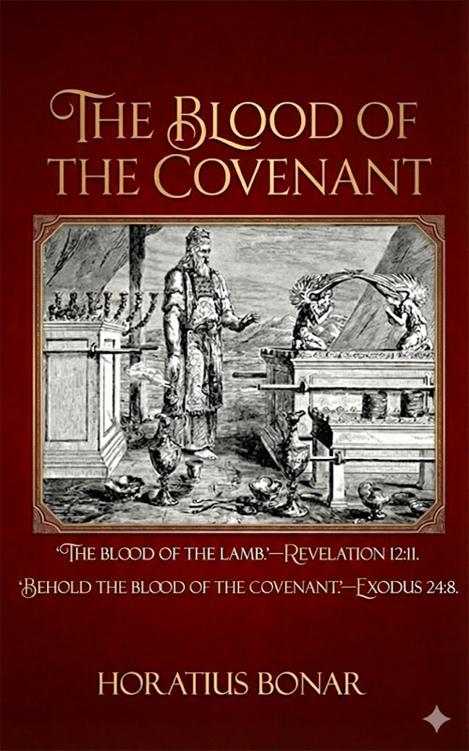
The Blood of the Covenant
by Horatius Bonar
They overcame him by the blood of the Lamb."--Revelation
12:11.
"Behold, the blood of the covenant."--Exodus 24:8.
All through Scripture we find traces of the blood. 'You shall bruise
His heel' was the first reference to it. The bruised heel of the
woman's seed was to be the foundation stone of our deliverance. It
was to be deliverance by blood. The bruised heel was to tread upon
the serpent's head. In connection with this announcement as to the
bruised heel, sacrifice was ordained; and thus the truth began to be
developed; victory for the sinner through the blood of One who was
to be slain.
'The blood is the life' (Deuteronomy 12:23). Not that blood and
life are actually the same thing--the one is material, the other
immaterial. But the blood is the 'life made visible'--the liquid link
between body and soul, which, once broken, brings death. The blood
poured out is the life drained away from the body--the departure of
the soul from its material dwelling. Thus the blood and the life are
identified. God identifies them; law identifies them. Blood 'shed' is
the symbol or visible exhibition of 'death'.
Death was the penalty of man's guilt. The wages of sin is death.
The soul that sins--it shall die. If, then, another life is to be taken for
our life, and another death is to be substituted for ours, the true
expression of this is the drawing the blood from the victim, and
putting that blood on us. This is the symbolic declaration of the great
substitution, the great transference--one life for another, one death
for another. Death, with all its consequences, lies on the transgressor
until another death comes (in the symbolic form of blood), and
washes it away. When the sinner receives God's testimony to 'the
blood of the Lamb', then the transference is at once completed--
death passes away.
Let us see the different aspects in which the blood is presented to
us in Scripture; the manifold blessings with which it is connected;
the various points at which we come into contact with it.
I. The blood of the Lamb contains the good news. (Hebrews
12:24) It 'speaks better things than that of Abel.' It speaks of grace,
not of wrath; of mercy, not of vengeance; of peace returning, not of
peace departing. As seen on the altar, it tells the good news of life
given for life; as seen upon the mercy seat, it says, 'Let us come
boldly to the throne of grace.' Glad tidings of great joy to the
sinfullest are contained in the blood--the precious blood of Christ. It
offers to the sinner a reversal of the sentence of death, by presenting
him with the death of another in his stead.
II. The blood of the Lamb is the purchase money for the Church.
(Acts 20:28) As God's eternal purpose deals both with the Church as
a whole, and with each chosen soul, so does the blood. It is the price
or ransom of the whole Church; it is the price and ransom of each
should that is saved. Of the church it is true--'she is bought with a
price;' of each saint it is true--he is bought with a price. The 'blood of
the covenant' is the payment demanded by the Father, and paid by
the Son. Not without blood can the purpose of the Father be carried
out. It is the legal payment of the price or penalty, because it was the
death which the Church should have died--but which her Surety took
upon Him.
III. The blood of the Lamb is the atonement. (Exodus 30:10)
'Aaron shall make an atonement upon the horns of the altar with the
blood of the sin-offering' (Leviticus 17:11). 'The life of the flesh is in
the blood, and I have given it to you upon the altar to make an
atonement for your souls; for it is the blood that makes an
atonement for the soul.' The Old Testament word "atonement"
means 'to cover;' and the blood is that which 'covers' sin, so that it
becomes hidden and indiscernible by God Himself--as if the only
thing through which the eye of God could not penetrate was the altar
blood. To him whose sin is thus 'covered' by the blood, God is
propitious. The blood propitiates; and the blood, received by the
sinner (in the belief of God's testimony to it), propitiates God toward
the sinner himself personally. Only the blood can cover! Not
mountains, nor seas, nor the thick forests of earth; only blood--the
blood of the one Sacrifice. In this is atonement; and, as the result of
atonement, reconciliation with God. Looking at the paschal blood,
God says, 'Pass over, slay not;' looking at the sacrificial blood, God
says, 'Their sins and iniquities will I remember no more!'
IV. The blood of the Lamb is the redemption. (Ephesians 1:7;
Colossians 1:14; 1 Peter 1:18,19; Revelation 5:9) Redemption is not
the same as the atonement or the purchase money, already noticed.
It is the carrying out of that for which the price was paid and the
atonement made. The paying down the money is one thing; the
redeeming the person so paid for, so ransomed, is something more.
It is nearly synonymous with salvation, only it expresses the way by
which the salvation has been obtained--by ransom or purchase.
Hence the expression, 'the redemption of the purchased possession'
(Ephesians 1:14). Redemption by blood is our gospel; redemption
presented fully by the redeeming One to the 'lawful captive,' to the
imprisoned and exiled sinner. He who believes enters into possession
of all that it contains.
V. The blood of the Lamb is the bringing near. (Ephesians 2:13)
The far off are made near by the blood. It is the blood which removes
the distance; that brings God near to us, and us near to God. It
annihilates all distance, and all variance. The blood brings about the
meeting between us and God. Incarnation is not the bringing near,
nor the thing which brings us near; it is merely the first step in a
process, which, had it not ended in the blood shedding, would have
been all in vain. It is the blood that emboldens us to draw near to
God, and justifies God in drawing near to us. 'Let us draw near' is the
voice of the blood, speaking both from the altar and the mercy seat.
And how? 'With at true heart and in the full assurance of faith.' And
the blood provides for both of these.
VI. The blood of the Lamb contains the cleansing. (1 John 1:7)
This is spoken of also as 'purging' (Hebrews 9:14, 22), and as
'washing' (Revelation 1:5); and it is to this that Zechariah refers,
when he speaks of the fountain opened for sin and for uncleanness
(ch. 13:1); and David, when he prays, 'Purge me with hyssop, and I
shall be clean; wash me, and I shall be whiter than the snow' (Psalm
51:7). It is specially to the guilt that these passages refer--the judicial
or legal defilement or condemnation, as the consequence of sin
committed; so that, when that defilement or condemnation was
removed by the application of the blood of the substitute, the man
became clean in the sight of God and of His law. He was purged in
conscience and in heart; in body, soul, and spirit. After this, the
inward purification began, and was carried on in connection with the
blood, through the power of the Spirit. We preach the purging and
cleansing blood. It has lost none of its efficacy. The Lamb slain is the
same as ever; and the High Priest is the same as ever; and the blood
is the same as ever--as able to purge and purify.
VII. The blood of the Lamb contains the peace. (Colossians 1:20)
'Peace through the blood of His cross;' for 'He is our peace'
(Ephesians 2:14); and because of the blood, God 'is pacified towards
us for all that we have done' (Ezekiel 16:63). It is the blood that has
made the peace, for it removes that which produced the controversy
and contention. The blood pacifies. It removes that which drew on us
the wrath of God, quenching that wrath; it removes that which made
us dread God and flee from Him, like Adam. Peace through the blood
is our message! To the guiltiest rebel upon earth it comes!
VIII. The blood of the Lamb contains the pardon. (Hebrews
9:22) 'Without shedding of blood is no remission.' By the shedding of
blood then, there is remission of sins. The many blood sheddings
have ceased (Hebrews 10:18); and the one blood shedding, which in
its value, and efficacy, and suitableness is everlasting and infinite,
remains. Taking it as the payment of the penalty, substituted by God
for our non-payment of it, we are forgiven. He who receives the
divine testimony to the blood is in so doing forgiven. That blood, by
covering his sins, brings pardon--pardon to anyone who is willing to
take pardon in this way from God.
IX. The blood of the Lamb contains justification. (Romans 5:9)
'Justified by His blood.' We get justification by His grace and by His
righteousness. Here it is said to be by His blood. Justification seems
here opposed to 'condemnation'--the sweeping away of everything
that brought us under condemnation. This the blood accomplishes;
meeting every accusation, answering every plea, setting aside
everything that is laid to our charge. Looking to the blood, we can
say, 'who is he who condemns?' The blood sets us right in conscience
and in law with God. It justifies the ungodly.
X. The blood of the Lamb contains that which makes white.
(Revelation 8:14) 'They have washed their robes and made them
white in the blood of the Lamb.' Not only the man, but his garments
are made white. This is more than cleansing. It is the word used
regarding Christ's transfiguration-garments (Matthew 17:2); the
angel-robes (Matthew 28:3); the heavenly clothing (Revelation 4:4);
the judgment throne (Revelation 20:2). Whiter than snow or wool,
white as the garments of Christ--no, the 'head and hair' of Christ
(Revelation 1:14). This is the result of the application of the blood to
those who were 'blacker than the coal,' redder than crimson. What
potency, what virtue, what excellency does this blood contain! How it
beautifies and glorifies!
XI. The blood of the Lamb contains that which sanctifies.
(Hebrews 13:12) 'That He might sanctify the people with His own
blood.' This is consecrating them as His kings and priests, setting
them apart for service, making them 'saints,' holy ones. The blood of
the great Sin-offering (outside the gate) sanctifies. As soon as the
blood touches us, by our believing, we are set apart--we become the
royal priesthood, holy to the Lord.
XII. The blood of the Lamb contains the power to conquer.
(Revelation 12:2) 'They overcame by (on account of) the blood of the
Lamb.' No victory without the blood! No power to fight; no motive in
fighting; no hope of overcoming. The blood takes the strength from
the enemy. The blood supplies us with all these. We look to it, and
out of weakness we are made strong. We look to it, and we are
cheered as well as nerved for conflict with the enemy.
XIII. The blood of the Lamb contains our right of entrance into
the holiest. (Hebrews 10:19) He entered 'by His own blood' (Hebrews
9:12). He gives us this blood as our right of entrance is sprinkled and
consecrated by His blood. Let us draw near! The blood removes all
cause of dread, all possibility of rejection, more--gives the certainty
of reception. Let us go in! We are sure of a welcome. It gives boldness
as well as right of entrance. It says, 'Draw near boldly.'
XIV. The blood of the Lamb contains the seal of the covenant.
(Luke 22:20) 'This cup is the new testament in my blood.' The blood
seals the covenant--and the cup is the symbol of that seal. It is 'the
everlasting covenant' (Hebrews 13:20); the 'covenant of peace'
(Isaiah 54:10); 'the new covenant' (Jeremiah 31:31); the covenant
which is absolute and unconditional; which not only gives to each
sinner who believes a present standing before God of favor and love,
but which secures his eternal future beyond the possibility of a
second fall. The blood covenant makes us safe forever. O blood-
sealed covenant, ordered in all things and sure, what a foundation
are those for our faith to rest upon, and of our hope to rejoice in! Yes,
and the ages to come are all contained within your ample compass.
XV. The blood of the Lamb contains the true drink for the soul.
'My blood is the true drink' (John 6:55). It quenches the thirst of the
soul--the thirst of parching produced by an evil conscience and a
sense of wrath, which dries up the frame like a potsherd (Psalm
22:15). It removes the wrath and the sense of wrath--by showing us
that wrath transferred to the Substitute. It relieves the conscience
when first we come into contact with it; and it keeps it relieved from
day to day, as we drink it by faith. It is 'drink indeed.' It calms, it
revives, it refreshes, it soothes; it is like cold water to the thirsty lips
under a scorching sun. Nothing but the blood can allay this thirst;
nothing else can be drink for the soul, for the intellect, the
conscience, the heart.
XVI. The blood of the Lamb contains life. (John 6:53) 'Unless
you eat the flesh and drink the blood of the Son of man, you have no
life in you.' The blood not only 'removes death' (judicial and
spiritual), but it gives and 'preserves life' (judicial and spiritual). It
quickens! Israel was forbidden to taste the literal blood, and would
have been punished with death had they done so; we are commanded
to drink the spiritual or symbolical blood, with the promise and
assurance that it contains life for us. Without it we have no life. We
are not only to be sprinkled with it outwardly, but we are to receive it
inwardly--to drink it. As with the water, so with the blood. They are
for inward as well as for outward application. We drink them and
live; and are washed with them and made clean.
XVII. The blood of the Lamb contains protection. (Exodus 12:13;
Hebrews 6:28) The blood of the paschal lamb was Israel's protection.
No sword could reach the man on the door of whose dwelling God
saw the sprinkled blood. So the blood of Christ our Passover
protects. In believing God's testimony to the blood; it becomes
sprinkled upon us; and from that moment we are safe. The blood is
our security. God sees it, and bids the sword pass by.
XVIII. The blood of the Lamb contains separation from the
world. (Hebrews 13:2) As the Sin-offering, Jesus suffered outside the
gate; thereby not only fulfilling His sacrificial work, and completing
the sacrificial symbol or type, but leaving us an example that we
should follow His steps. 'Let us go forth' is the voice that comes to us
from the blood. Come out and be separate, and touch not the unclean
thing; for the blood of the sin offering is upon us, and Jesus is before
us. Let us go forth not only from Babylon and Egypt, but from
'Jerusalem'--Jerusalem, which had become the type of the false
Church--the mere religious professor--which, while naming His
name, rejects Him and His cross, more--crucifies Him afresh! Let us
keep ourselves unspotted not only from the ungodly world as such,
but from a worldly Church--worldly professors, who, instead of
bearing Christ's reproach, bring reproach upon Him!
XIX. The blood of the Lamb contains resurrection. (Hebrews
13:20) By the blood of the everlasting covenant, Christ was raised.
Our sins had slain Him, shed His blood, and brought Him down to
the grave! But that shed blood was the removal of the sins that had
weighed Him down. God saw in that blood the finished substitution.
He accepted it, and gave evidence to that completed work of
propitiation, by raising the Substitute. As the great Shepherd, He
gave His life for the sheep; His life was accepted instead of theirs;
His death made their dying no longer necessary--no, unjust. The
blood was the payment of that which had brought death on Him and
us; and therefore He was raised. With Him we rise--by the efficacy of
the same blood. That blood, which is the symbol of death, is the seal
of resurrection.
XX. The blood of the Lamb contains condemnation. (Matthew
27:4, 25; Acts 5:28; Hebrews 10:29) It thus contains the
condemnation of Judas, of Jerusalem and Israel--of all rejecters of
Christ. The same blood that spoke of pardon speaks of
condemnation. Under the weight of 'rejected blood' the unbelieving
sinner perishes. This is the condemnation which the church in these
last days is preparing for itself--(1) slighting the blood; (2) rejecting
it; (3) trampling on the Son of God, and counting the blood of the
covenant an unholy thing. Under this aggravated guilt the world shall
go down to wrath; for it is guilt of the deepest dye--the deliberate
refusal of and contempt for all that God has provided for the sinner.
If an Israelite had torn down the tabernacle, overthrown altar and
laver, slain the priest, cast forth the blood and water, defiled the
mercy-seat, he would be but a type of him who values at nothing the
Son of God, and slights His blood. This is the millstone which the
world is fastening to its own neck, which shall sink it in the abyss
forever!
Yet still the value and the virtue of the blood of the Lamb remain
the same. It has lost none of its efficacy. It can still cleanse, and
redeem, and purify. It can still pacify the conscience and reconcile of
God. Not even its most deliberate rejecters need despair, or fear that
it may not avail for them. It cannot lose its power. Up to the very last
it avails. Of its divine value the chief of sinners may avail himself
without fear or distrust. In crediting the Holy Spirit's testimony to its
undiminished and unchangeable sufficiency, the guiltiest upon earth
will draw out all its fullness to himself; the whole value of the blood
passes over to him who believes, as soon as he has believed. Not
upon feeling, but upon believing, does the obtaining of its benefits
depend. As soon as we receive the divine testimony, all that the blood
has secured for sinners passes over to us as our righteous and
everlasting possession. The preciousness of the blood is transferred
to us; the preciousness of Him whose blood it is becomes ours, and
we are accepted in the Beloved! 'Jehovah our righteousness' is our
joy and our song!
-----
MONERGISM BOOKS
The Blood of the Covenant by Horatius Bonar, Copyright © 2019
All rights reserved under International and Pan-American Copyright
Conventions. By downoading this eBook, you have been granted the
non-exclusive, non-transferable right to access and read the text of
this e-book on-screen. No part of this text may be reproduced,
transmitted, downloaded, decompiled, reverse engineered, or stored
in or introduced into any information storage and retrieval system,
in any form or by any means, whether electronic or mechanical, now
known or hereinafter invented, without the express written
permission of Monergism Books.
ePub, .mobi & .pdf Editions October 2019 Requests for information
should be addressed to: Monergism Books, PO Box 491, West Linn,
Oregon, 97068