
spotlight-on-the-psalms
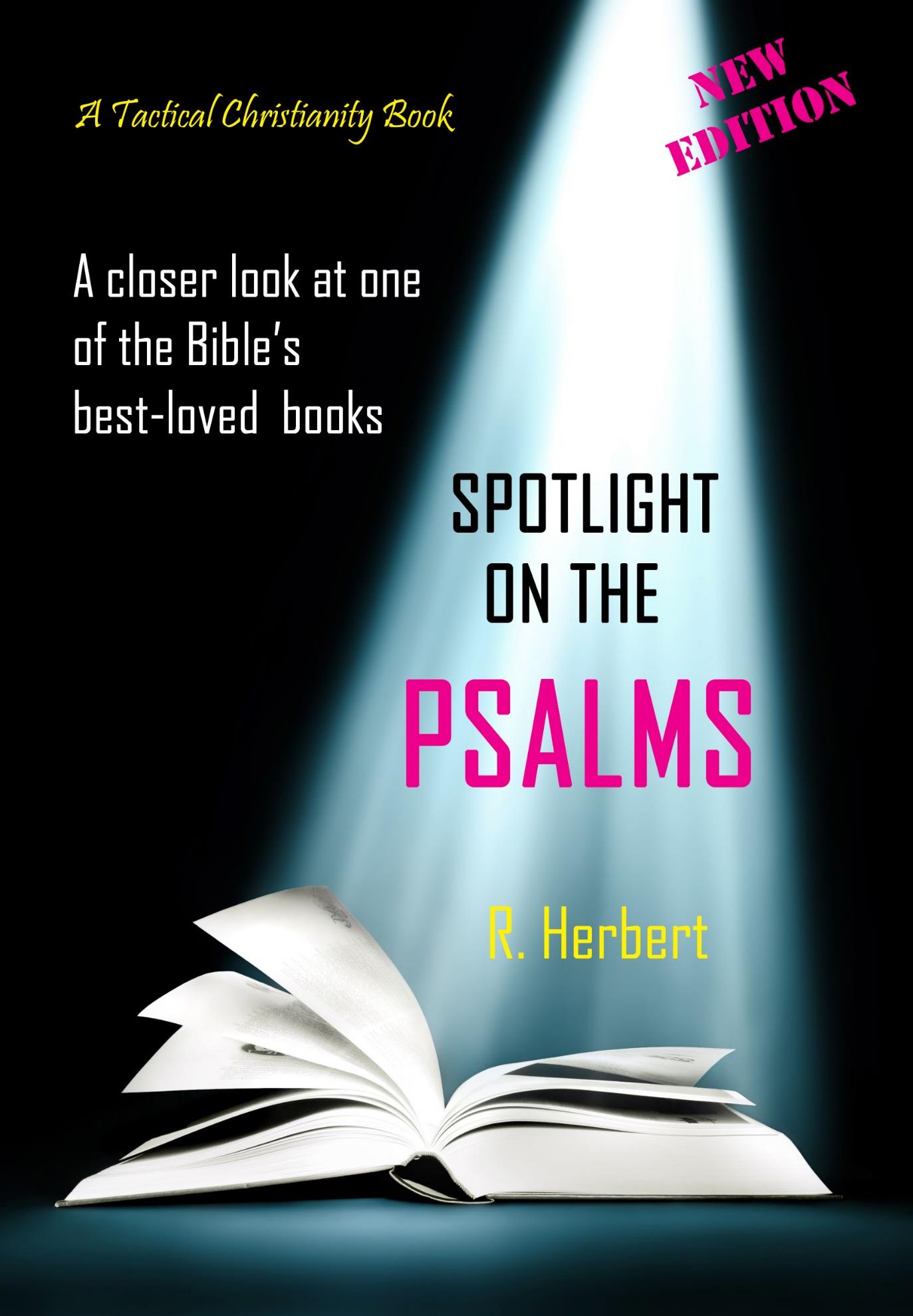
SPOTLIGHT on the PSALMS
A closer look at one of the Bible's best-loved books
By R. Herbert
© 2015, 2022, Tactical Belief Books – an imprint of TacticalChristianity.org & LivingWithFaith.org
Second edition, revised and expanded © 2022.
ISBN 978-1-943846-56-6 The text and images in this e-book are copyright. All Rights Reserved. This book is not to be sold. It is made available by the publisher without charge and free copies can be downloaded from: TacticalChristianity.org or LivingWithFaith.org. Unless otherwise indicated, all Scripture quotations are from THE HOLY BIBLE, NEW INTERNATIONAL VERSION® NIV® Copyright © 1973, 1978, 1984 by International Bible Society® Used by permission. All rights reserved worldwide. In addition to the NIV, in a few cases the ESV (English Standard Version ©), HCSB (Holman Christian Standard Bible ©), KJV (King James Version), NKJV (New King James Version ©), and NRSV (New Revised Standard Version ©) are also cited.
About the Author: The author served as an ordained minister and church pastor for a number of years and holds an earned Ph.D. degree in the languages, cultures and archaeology of the ancient Near East and biblical world. He writes for a number of Christian publications and for the websites www.LivingWithFaith.org and www.TacticalChristianity.org. His other e-books are available for free download from those sites and from FreeChristianEBooks.org.
Cover: Base image © by saiva
CONTENTS Preface Introduction PART ONE: WISDOM Wisdom in the Psalms Psalm 1: Two Ways of Life Psalm 19: The Benefits of Wisdom Psalm 34: Proverbial Wisdom Psalm 37: What We Want in Life PART TWO: PROTECTION Protection in the Psalms Psalm 17: In the Shadow of Wings Psalm 23: The Shepherd and Host Psalm 91: The Dweller in Secret Places Psalm 121: Ascending Mountains
PART THREE: PRAISE Praise in the Psalms Psalm 18: A Rock, a Fortress, and Thundering Clouds Psalm 65: Gates of the Morning and Evening Psalm 104: An Egyptian Hymn of Praise? Psalm 103: Seven Blessings Psalm 63: Patterns of Praise PART FOUR: PRAYER Prayer in the Psalms Psalm 9: Praise before Prayer Psalm 25: A Wider Circle of Prayer Psalm 51: A Psalm of Repentance Psalm 55: A Prayer of Trust Psalm 139: To the God Who Sees All PART FIVE: KINGSHIP Kingship in the Psalms Psalm 45: A Royal Wedding Song
Psalm 16: At the King's Right Hand Psalm 2: Once and Future Kings Psalm 89: The Throne of David PART SIX: PROPHECY Prophecy in the Psalms Psalm 22: The Messiah's Death Foretold Psalm 69: A Psalm of Suffering Psalm 110: An Eternal King and Priest Psalm 118: A Psalm of Salvation Appendix 1: Understanding the Psalms of Vengeance Appendix 2: The Musical Nature of the Psalms Index of Psalms Discussed in Detail About Our Books
PREFACE Every book of the Bible is important, of course, but the collection of compositions we know as the book of Psalms is one of the most important. It is the biblical book Jesus quoted more often than any other, and he constantly used it to explain his own purpose and ministry. Psalms is also the book of the Old Testament quoted most (almost a hundred times) throughout the New Testament – it is quoted by almost every writer and in a great majority of the New Testament books.
Today the book of Psalms is the Old Testament book most Christians know best and the one to which many frequently turn for encouragement and inspiration. But Psalms is a treasure house of virtually inexhaustible riches, and even if you have read the book many times, we think you will find Spotlight on the Psalms worth your time.
Using understandable cultural and archaeological background information from the time the Psalms were composed, this book provides a practical commentary on selected psalms that can help you both to better understand the book of Psalms and to better apply its messages in your own life.
Each of the included psalms was carefully chosen to show an aspect of the book with which you might be unfamiliar and which you might find helpful. Principles you learn from study of these psalms will help you to better understand many of the others.
The following Introduction gives a brief background to the book and then, in Chapter 1, we turn the spotlight on the psalms themselves.
INTRODUCTION The book of Psalms is one of the most-read and best-loved books of the Bible. Among Christians, it is certainly the most-read book of the Old Testament, but many read the Psalms for the poetic beauty of the compositions and the inspiration they offer without realizing things about the background to the book that can significantly enrich our understanding of what the psalms say and their message for us today.
This Introduction provides a summary of that background material – what the psalms are, who wrote them, and what types of literature they represent. But if you wish to go to the featured psalms immediately, you can jump over this material and begin reading in Chapter 1. (Of course, you can always come back to this introductory material later if you find it would be helpful as you get into the book.) The Books of Psalms In the Hebrew text of the Old Testament, Psalms is the first book of the section called the "Writings," and its importance led to the fact that by New Testament times this whole section of the Scriptures was sometimes referred to as simply "the Psalms" (Luke 24:44). The book's one hundred fifty psalms are grouped into five smaller "books" as follows: Book 1 (Psalms 1–41), Book 2 (Psalms 42–72), Book 3 (Psalms 73–89), Book 4 (Psalms 90–106), Book 5 (Psalms 107–150). The numbering of the individual psalms differs among branches of Christianity because the number assigned to each psalm varies slightly between the Hebrew text and its ancient translation, the Greek Septuagint. While most Protestant translations use the Hebrew numbering, many Catholic and Eastern Orthodox Bibles follow the Greek numbering. This means that when we are reading about the psalms in books such as this one, we should keep in mind
that the number of an individual psalm may be slightly different (usually only by one) in our Bibles if we are using a Catholic or Greek Orthodox translation. But looking at the verses quoted in a specific chapter of this book and comparing them with your own Bible will enable you to see which psalm is being discussed.
The psalms found in our Bibles were evidently selected from a wide range of compositions that originally existed. The ancient Greek Septuagint includes a Psalm 151 (a Hebrew version of which was found in the Dead Sea Scrolls), and some ancient Syriac versions of the Bible include Psalms 152–155. Additionally, there are a further eighteen "Psalms of Solomon" which were possibly of Hebrew origin, but which have survived only in some later Greek and Syriac translations.
The Authorship of the Psalms Many people assume the Psalms were written by King David, who ruled Israel c. 1010–970 BC, but a number of authors are actually represented in the book. David is said to have written about half of the psalms. The Hebrew Bible attributes seventy-three of the compositions to David, and the Greek Septuagint attributes eightythree to him.
Although some literary critics reject the idea that the ancient Israelite king composed any of the psalms, this is an approach which routinely tries to divorce famous literary works from their traditional authors (including Shakespeare and other relatively modern writers). There is no historical reason to preclude Davidic authorship of the psalms ascribed to him – and for those who believe in the inspiration of the Bible, the fact that Jesus specifically attributed a number of the psalms that he quoted to David (Matthew 22:43-45; etc.) is proof enough that David was indeed their author.
The Psalms also name five other individual authors and two families in their superscriptions (the small introductory notes mentioning the psalm's author, musical instructions and sometimes
other information). We should realize, however, that these notes were added after the psalms were originally composed – and in some cases, perhaps considerably later. Also, it is unclear if some of the notes that say "A psalm of …" mean that the psalm was written by or for an individual. But if we presume the people named are authors, in addition to David we find the following:
Asaph, the sons of: The sons of Asaph were selected by David to lead the people in worship and were later recommissioned when Nehemiah rebuilt Jerusalem. Twelve psalms (50 and 73-83) are ascribed to the family of Asaph. Ethan: A man of wisdom (1 Kings 4:31 tells us Solomon was even wiser than Ethan the Ezrahite) and a musician who apparently composed Psalm 89. Heman: A grandson of the prophet Samuel, the Levite Heman is listed along with Jeduthan (perhaps the same individual as Ethan) and Asaph as one of three main musicians appointed by King David (1 Chronicles 25:1). He was apparently the author of Psalm 88. Korah, the sons of: The book of Numbers records that a man named Korah rebelled against Moses and Aaron, but his sons continued to serve in the tabernacle and temple. The sons of Korah apparently wrote 11 psalms (42, 44-49, 84-85, 87-88). Moses: The greatest Old Testament leader who wrote the books of Genesis, Exodus, Leviticus, Numbers, and Deuteronomy apparently also wrote at least one psalm (Psalm 90) and perhaps several others. Solomon: David's son and successor, King Solomon, who is associated with Proverbs, Ecclesiastes, and the Song of Songs, also has two of the psalms (72 and 127) attributed to him in the Hebrew Bible.
The remaining fifty psalms are not credited to any author, but based on their vocabulary and style it seems very possible that some of these so-called "orphan psalms" were composed by David.
This variety of authorship means the psalms were written over the course of a number of centuries. The oldest psalm in the collection is probably the prayer of Moses (Psalm 90), and the latest psalm included in the book is probably Psalm 137, a lament composed during the time when the Jews were the captives of the Babylonians, from about 586 to 538 B.C. Types of Psalms The book of Psalms contains a number of different types of material. In some cases, much if not most of a psalm consists of one type of material – such as praise or prayer – and in those situations the compositions can be said to be psalms of that particular type. The Hebrew title of the whole book is tehillim, meaning "praises," and many psalms are almost purely songs of praise. But other psalms are called tephillot, meaning "prayers." The title of the whole of Book 2 of the Psalms (42–72) is "the prayers of David son of Jesse" (Psalm 72:20).
In addition to praise and prayer, there are also many other types of material in the psalms. For example, there are songs of thanksgiving (such as Psalm 100), psalms of complaint (such as Psalm 3), and the so-called imprecatory psalms, which invoke judgment or curses upon those perceived to be the enemies of God (such as Psalms 69 – see Appendix 1).
The exact number of types of psalms depends on how we define the material itself. Some scholars note as few as five types while others feel there are as many as ten or more. In this book we have selected examples from six types of psalms which are explained at the beginning of each section.
Note, however, that although many psalms fall neatly within these categories, most psalms actually contain a number of kinds of
material. A given psalm may, in fact, be half praise and half thanksgiving, or even half thanksgiving and half complaint! Looked at this way, for understanding the psalms, it is often important to be able to recognize the nature of the blocks of material within the composition we are reading rather than trying to classify the whole psalm as one particular type.
Bringing the Psalms to Life However we choose to categorize the psalms, one of the main things we can do to increase our understanding of these compositions is to learn more about the situations in which they were written and some of the influences on their writers that can help us to better appreciate what is being said.
In fact, even a little knowledge of the literary and historical – and even musical (see Appendix 2) – background to the psalms can make many of them come to life so that we see them in a new light and with a deeper understanding. We hope that as you read the comments on the selected psalms, the "spotlight" this book provides through this kind of background material will help to illuminate these wonderful compositions for you personally.
PART ONE: WISDOM
WISDOM IN THE PSALMS Proverbs tells us "Wisdom is the principal thing; therefore get wisdom" (Proverbs 4:7 NKJV), and the authors of many of the psalms would agree. The importance of wisdom is certainly seen in the psalms of David, as well as those composed by Solomon and other individuals renowned for their knowledge and understanding.
The psalms that are classified as "wisdom psalms" are given this name because of their similarity to the wisdom literature represented in the Bible by the books of Job, Proverbs, and Ecclesiastes, as well as books that were produced in other cultures of the ancient Near East. Regardless of their specific content, these psalms consistently contrast the actions and lifestyles of those who reject God's way (the "foolish" or "wicked") with those who obey God (the "wise" or "righteous"). In the wisdom psalms the discussions of these characteristics may be found alongside prayers for help or hymns of praise, but they form the core of all the psalms of this type.
It is important to realize that the wisdom psalms give an ideal picture of life, however. For example, the righteous person is said to be " like a tree planted by streams of water, which yields its fruit in season and whose leaf does not wither. Whatever he does prospers" (Psalm 1:3), while the wicked "are like chaff that the wind blows away" (Psalm 1:4). Other psalms may complain that the wicked often succeed in life and that the righteous suffer, but the purpose of the wisdom approach is to teach the usual and ultimate outcomes of our life choices.
In that regard, as we study psalms of this type, we should remember that the essential meaning of the Hebrew word hokhma or "wisdom" is to live life skillfully. The purpose of the wisdom psalms is to encourage and help us to do that – as we will see in the following examples.
PSALM 1: TWO WAYS OF LIFE Psalm 1 introduces a theme that runs throughout the whole book of Psalms – the idea that there are two ways of life in this world: the way of those King David calls the "wise" or "righteous" and the way of those he calls the "foolish" or "wicked." But David's approach is far from a simplistic "black and white" mentality that sees people only as good or bad.
While the literature of most of the nations that surrounded ancient Israel characterized people in exactly that way – as good or bad, as heroes or villains – David's approach is remarkably sophisticated and looks beneath the surface of human character in a profound way which is profitable for us to consider.
David shows that people exist, in fact, along a spectrum or range of behavior and moral attitude, but he does this in a remarkably simple way – by comparing the range of human behavior to basic human actions or postures:
"Blessed is the one who does not walk in step with the wicked, or stand in the way that sinners take, or sit in the company of mockers" (vs. 1). In this opening verse David uses metaphorical language for specific types of wrong behavior from the perspective of our "posture" (which, as most dictionaries show, can reflect our attitude as well as the position of our bodies).
It's easy to read over these words without thinking about the analogy David was making, but we see in Psalm 1:1 three different ways we can be in error in our lives. First, David speaks of the person who walks "in step with the wicked" or "in the way of the wicked," as other translations word it. When we read the entirety of Psalms we see that this isn't just a poetic way to say "does wrong" – it is a specific comment regarding those who choose to actively
move toward or along with what is wrong. It's an expression based on a Hebrew way of thought that is found not only in the Psalms, but also in many other biblical books: "They rush to commit evil deeds" (Proverbs 1:16), "Feet that run rapidly to evil" (Proverbs 6:18), "Their feet run to evil" (Isaiah 59:7), etc. This is ultimate wrongdoing in that it encompasses a deliberate choosing of evil.
Next, David speaks of those who "Stand in the way that sinners take." By contrast with those who "run to evil," such people do not necessarily desire to go in a wrong way. This is evident in the fact that they are not "walking" or "running" with evil, but they "stand" in that way in the sense that they do not remove themselves from it. This can apply to those who know better but do not choose to avoid evil or even feel trapped in its hold through the force of habit, addiction, or lack of resolve. In Ecclesiastes 8:3 we are warned not to "stand" in an evil situation or to "stand" for evil by supporting those who further it.
Finally, in this analogy David speaks of those who "sit in the company of mockers." Being a "mocker" in the Hebrew Scriptures is often synonymous with being someone in rebellion against the way of God (Proverbs 29:8; Isaiah 29:20; etc.). In this case, we are not told of those who actively seek evil or who do not remove themselves from it, but those who, perhaps in weakness of character, "sit" with those who do wrong – they passively accept what is not right, because of peer pressure, work pressure, or whatever.
It's a simple analogy, but David's three "postures" of sin should remind us all that we can be "good" without being "all good" – it is possible to fail by degree. We may not actively be seeking evil by "walking" or "running" after it, but are we still allowing ourselves to "stand" or stay in wrongdoing, or to be influenced by those around us so that we "sit" with and do not truly separate ourselves from those we know influence us to do wrong?
Elsewhere, the word of God gives us alternatives to these failing behaviors. We are told in 2 John 1:6 "this is love: that we walk in obedience to his commands." Philippians 4:1 tells us that we should
"stand firm in the Lord in this way" and Revelation 3:21 states "To the one who is victorious, I will give the right to sit with me on my throne." The common denominator in all these positive spiritual "postures" is clearly that of obedience – of walking, standing and sitting with God.
David confirms this fact by stressing that in contrast to those who follow the way of unrighteousness, the person is blessed "whose delight is in the law of the Lord, and who meditates on his law day and night" (Psalm 1:2). It is through that kind of commitment, David tells us:
That person is like a tree planted by streams of water, which yields its fruit in season and whose leaf does not wither— whatever they do prospers (Psalm 1:3).
PSALM 19: THE BENEFITS OF WISDOM This psalm of David begins with a well-known and beautiful outpouring of praise:
The heavens declare the glory of God; the skies proclaim the work of his hands. Day after day they pour forth speech; night after night they reveal knowledge (vss. 1-2). But the theme of the composition soon changes, and the core of the psalm – verses 7-11 – is a detailed statement of the benefits of wisdom:
The law of the Lord is perfect, refreshing the soul. The statutes of the Lord are trustworthy, making wise the simple. The precepts of the Lord are right, giving joy to the heart. The commands of the Lord are radiant, giving light to the eyes. The fear of the Lord is pure, enduring forever. The decrees of the Lord are firm, and all of them are righteous. They are more precious than gold, than much pure gold; they are sweeter than honey, than honey from the honeycomb. By them your servant is warned; in keeping them there is great reward (vss. 7-11).
In these verses, the way of God is characterized by six terms – as his "law," "statutes," "precepts," "commands," "fear," and "decrees." Some of these terms are used of specific types of commands in the Old Testament, but their use can also overlap in many cases. The word "fear" which might seem out of place in the list is actually central to much wisdom literature. The "fear of the Lord" is more than just a response to God's power. Like commands and precepts, it has to be learned (Psalm 34:11) and is directly associated with learning God's word (Psalms 112:1; 119:33-38, 57-66; etc.) and with wisdom itself (Proverbs 1:7, 29; 2:5; 8:13; 9:10; 15:33; etc.).
As is often typical of wisdom literature, following these aspects of God's instruction is said to bring rewards "refreshing the soul," "making wise the simple," "giving joy to the heart," etc. The benefit of "giving light to the eyes" is particularly important, as in many ancient cultures the expression meant not only to "enlighten" intellectually, but also had the direct meaning of giving life itself. In ancient Egypt the parallel expression was to "give breath to the nose," but in the Old Testament the expression "to give light to the eyes" was preferred.
The expression that God's decrees are "…sweeter than honey, than honey from the honeycomb" is not redundant, as most "honey" in the ancient Near East was made from date syrup and honey from the honeycombs of bees was considered to be a great luxury – the ultimate sweetness!
After extolling the benefits of God's ways, the psalm closes with three verses that convey important theological concepts not common in that day and age. In verse 12 David asks: "But who can discern their own errors? Forgive my hidden faults" – a prayer asking forgiveness for unwitting errors as well as those deep within the soul.
Verse 13 asks: "Keep your servant also from willful sins; may they not rule over me," highlighting the type of disobedience that is committed in weakness despite our knowledge of its wrongness.
Finally, verse 14 asks: "May these words of my mouth and this meditation of my heart be pleasing in your sight, Lord" – stressing
both our outward expression and inward thoughts and calling on God as the One who both helps protect us from error and forgives us when we do fail.
So Psalm 19 contains, as do many of the psalms, a number of different types of material. It begins with praise and ends with prayer, but its core is clearly that of a song of wisdom – a theme with which both prayer and praise naturally interact.
PSALM 34: PROVERBIAL WISDOM This psalm has an interesting background. According to the superscription, it was composed by David after he had fled from Saul to the court of the neighboring king, Achish, where David acted as though he were insane in order to escape probable extradition (1 Samuel 21:10). This psalm is said to have been written by David in gratitude for his escape, but its form is also worth noticing. The psalm begins like a psalm of praise:
I will extol the Lord at all times; his praise will always be on my lips. I will glory in the Lord; let the afflicted hear and rejoice. Glorify the Lord with me; let us exalt his name together (vss. 1-3). But the composition soon changes to one stressing wisdom. Verses 4-10 expound the benefits of righteousness, and verse 11 is typical of the introduction to ancient books of wisdom in addressing its audience as a teacher would speak to students: "Come, my children, listen to me; I will teach you the fear of the Lord." The following verses take the form of the short wisdom sayings found in the book of Proverbs:
Whoever of you loves life and desires to see many good days, keep your tongue from evil and your lips from telling lies (vss. 12-13). Turn from evil and do good; seek peace and pursue it (vs. 14).
The eyes of the Lord are on the righteous, and his ears are attentive to their cry; but the face of the Lord is against those who do evil, to blot out their name from the earth (vss. 15-16). The righteous cry out, and the Lord hears them; he delivers them from all their troubles. The Lord is close to the brokenhearted and saves those who are crushed in spirit (vss. 17-18). Here, David uses three types of parallels found in wisdom literature: "synthetic parallelism" which repeats or expands what has been stated in the first line (vss. 12-13); "synonymous parallelism" which restates the idea of the first line in a different way (vs. 14); and "antithetical parallelism" in which two ideas or outcomes are contrasted (vss. 15-16).
So these are true proverbs in true proverb formats, but the author weaves them seamlessly into the composition of the psalm. We do not know why some psalms insert proverb-like material and other wisdom psalms do not, though the intended nature of the compositions is clear.
But more important than the format of these verses is their message. Verses 12-16 were quoted in their entirety by the apostle Peter in his first epistle (1 Peter 3:10-12), where he builds a whole lesson around them prefaced by the command: "Do not repay evil with evil or insult with insult. On the contrary, repay evil with blessing, because to this you were called so that you may inherit a blessing" (1 Peter 3:9, emphasis added).
Peter's point is an encouraging one. He explains the meaning of David's words to show that if we follow the right way, seeking peace and pursuing it, we are fulfilling our calling to inherit the blessing God wishes to give us – a blessing that not only applies to the future, but also to the present. We see this in the fact that Peter's paraphrase of David's words in Psalm 34:12 carries the meaning of "a life worth living, a life which makes a person glad to live each
day." That is the essence of the proverbial wisdom found in this and other psalms – seeking the right way leads to a life of blessings now as well as later.
We all know this at one level, but on those days when "nothing goes right" and the world around us seems crazy – even in extreme cases like the day David wrote Psalm 34, when he had to feign insanity in order to survive – we can remember the bad things pass and we still have a life and a future.
PSALM 37: WHAT WE WANT IN LIFE
Psalm 37 is a skillfully composed "acrostic" poem, the stanzas of which begin with the successive letters of the Hebrew alphabet. At the practical level, David seems to have composed the psalm as an old man (vs. 25), looking back over his life at "what works" and "what doesn't work." The psalm repeatedly contrasts the ways of the righteous and those of the wicked, often by means of short proverb-like statements. For example, "those who are evil will be destroyed, but those who hope in the Lord will inherit the land" (vs. 9), "Better the little that the righteous have than the wealth of many wicked" (vs. 16).
One of the most remarkable aspects of this psalm is found in its first seven verses. The psalm begins by reminding us of the fate of those who try to obtain their wants in wrong ways: "Do not fret because of those who are evil or be envious of those who do wrong; for like the grass they will soon wither" (vss. 1-2). But David then points to the potential for fulfillment of all our right desires:
Trust in the Lord and do good; dwell in the land and enjoy safe pasture. Take delight in the Lord, and he will give you the desires of your heart. Commit your way to the Lord; trust in him and he will do this: He will make your righteous reward shine like the dawn, your vindication like the noonday sun (vss. 3-7). First, David discusses our physical needs: "Trust in the Lord, and do good; dwell in the land and enjoy safe pasture" (vs. 3). Here, a life combining faith and good works ("trust" and "do good") puts us in position for God to care for our basic physical needs. Even
though economic hardship sometimes happens to his people, God does supply the needs of those who walk with him (vs. 25).
Next, the psalmist covers the fulfillment of emotional needs for those whose devotion to God goes past the minimum level of obedience: "Take delight in the Lord, and he will give you the desires of your heart" (vs. 4). So often we find that as our perspective changes, we begin to "want" rightly and unselfishly in all areas of life — especially in our relationships with others — and our deepest emotional desires seem to be granted.
Then, David points to a total commitment to God: "Commit your way to the Lord; trust in him and he will do this: He will make your righteous reward shine like the dawn, your vindication like the noonday sun" (vss. 5-6). The word "commit" in this verse is a strong one which does not signify any kind of half-hearted application of our energy. The word is a form of the Hebrew gol, used for the concept of "rolling" as in a large, heavy stone (Genesis 29:3, 8; etc.). It implies a fully energetic moving or thrusting of our will – an allout effort toward God's way. This kind of commitment, David tells us, results in eventual fulfillment of even our highest spiritual goals.
In these few verses we see the fulfillment of everything we really want in this life and beyond: our physical needs, emotional desires, and ultimately our spiritual aspirations. David makes it clear that this three-level staircase of walking with God is no selfish investment program of giving more to get more. Rather, he paints a picture of the sincere development of our dedication and love for God and the resulting fulfillment of our needs and rightful desires that God delights to give us.
PART TWO: PROTECTION
PROTECTION IN THE PSALMS The theme of protection is one found frequently in the book of Psalms. As with all the themes or categories we might consider, there is a certain amount of overlap; we find psalms offering prayers for protection and others giving praise for protection received. But a good many psalms simply talk about the protection given by God to his people under difficult circumstances.
Among these compositions stressing protection are some of the best known and most frequently read psalms. Psalm 23 – "The Lord is My Shepherd" – is one of those compositions, of course. Although, as the chapter on that psalm shows, the shepherd motif is actually only half of what this famous psalm conveys, and the second half of the psalm is a little different from what most people presume.
Psalm 91, which begins "Whoever dwells in the shelter of the Most High will rest in the shadow of the Almighty" (Psalm 91:1), and Psalm 121 which begins "I lift up my eyes to the hills. From where does my help come?" (Psalm 121:1 ESV) are another two well-known and much-loved psalms of this type, though once again, as we will see, there is more to the structure and message of these compositions than is often realized.
In fact, all of the psalms considered in this section as examples of the theme of protection can be found to have aspects which casual reading can easily miss. Psalms of this type are often full of unexpected significance and meaning and are well worth our focused study.
PSALM 17: IN THE SHADOW OF WINGS
Psalm 17 has similarities to Psalm 16 (see Part Five), though it appears to have been composed under very different circumstances. While Psalm 16 clearly has a military setting, Psalm 17 seems to be a prayer for protection not from enemies of other nations, but from enemies among those David knew in his own life, from those who surrounded him daily.
Like Psalm 16, Psalm 17 begins with a short prayer: "Hear me, Lord, my plea is just; listen to my cry. Hear my prayer…" (vs.1). David pleads his innocence from anything that might have brought on his enemies' hatred, though he admits that walking in God's ways may have been held against him by those who wished to bribe or otherwise corrupt him (vss. 4-5). In response to these circumstances of the hatred of those around him, David calls for God's protection – first in a general way, and then through the use of a military metaphor:
I call on you, my God, for you will answer me; turn your ear to me and hear my prayer. Show me the wonders of your great love, you who save by your right hand those who take refuge in you from their foes … hide me in the shadow of your wings from the wicked who are out to destroy me, from my mortal enemies who surround me…. with your sword rescue me from the wicked (vss. 6-9, 13). The plea for God to use his sword in protection is clearly a militarybased one, but it is easy to read over what David also says that has equal military significance. When the king says "… hide me in the shadow of your wings," we should not see it as the kind of "mother
hen and her chicks" analogy used in Psalm 91:4 and Matthew 23:37. In this case, it is almost certain that what David has in mind is the kind of protection the gods of Israel's neighbors were said to grant their kings.
In ancient Egypt, for example, wings represented divine protection, and the wings of one of the great sun gods were often depicted overshadowing the king in royal Egyptian art. Most ancient Egyptian depictions of warfare show the king riding into battle or fighting beneath the outstretched wings of the god who protected him. Other cultures followed this artistic lead, and we find the same motif used in literature and art in many of the nations around ancient Israel.
As we see in many other instances in the Psalms, David was not averse to using the analogies of the culture of the time, but he applied them to the One God who was his protection. In Psalm 17, by referring to the wings and sword of God, he refers to divine protection in both its defensive and offensive forms.
Finally, Psalm 17 closes with a thought that has a future afterlife aspect which applies to everyone who seeks God's help as David did: "As for me, I will be vindicated and will see your face; when I awake, I will be satisfied with seeing your likeness" (vs. 15).
PSALM 23: THE SHEPHERD AND HOST Psalm 23 is undoubtedly the best-known and most loved of all the psalms, but its message is somewhat different from what many people assume. The psalm is actually composed of two parts, only the first of which relates to the concept of the shepherd. David begins the psalm: "The Lord is my shepherd" (vs. 1) and continues in verses 1-4 by developing the metaphor through the analogies of God's leading, guiding and pasturing – as a shepherd would his flock.
Those who know animals, as David did (1 Samuel 17:34-35), realize that sheep are almost entirely dependent on their shepherd not only to find water and pasture for them, but also to protect them. Verse 4 addresses this need and has brought comfort and encouragement to uncounted people in times of problems and great danger:
Even though I walk through the darkest valley, I will fear no evil, for you are with me; your rod and your staff, they comfort me (vs. 4). The analogy of the rod and staff used here is directly appropriate to the shepherd, as David would have known well. The "rod" was a mace or club, often with a heavy stone or metal head, that was an effective weapon kept at the ready in the shepherd's belt, while the staff was not a spear or weapon per se, but a strong wooden staff that could be used to fend off marauding wild animals. The two objects represent respectively God's offensive and defensive protection for his people.
The final verses (vss. 5-6) of this short psalm switch from the shepherd motif to another one – that of fellowship with God who is pictured as the Divine Host whose blessings are symbolized by the good things of a banquet:
You prepare a table before me in the presence of my enemies. You anoint my head with oil; my cup overflows. Surely your goodness and love will follow me all the days of my life, and I will dwell in the house of the Lord forever (vss. 5-6). The closing words "I will dwell in the house of the Lord forever" have been used in countless memorial services and understood as speaking of the afterlife, but their original meaning may have been somewhat different.
The Hebrew Scriptures actually never use the term "house of the Lord" for God's heavenly dwelling, only for the earthly temple. In fact, the term "forever" that closes this psalm is literally "for length of days" – and connotes any extended or repeated time. The verse signifies that David looked forward to "dwelling in" or "returning to" the house of the Lord many times – a statement found in other psalms such as Psalm 27:4.
Although the concept of the afterlife is clearly seen in other psalms, Psalm 23 focuses, in fact, on God's care for his people (expressed symbolically as the care of a shepherd or a host) and our fellowship with God (expressed symbolically as being in his "house") continually.
PSALM 91: THE DWELLER IN SECRET PLACES
This psalm, which repeatedly changes person and often addresses the hearer directly, is unusual, but it is one of a type in which the blessings of protection are stated as a matter of fact rather than being requested in prayer or acknowledged in thanks. The theme is clear from the psalm's first verses:
Whoever dwells in the shelter of the Most High will rest in the shadow of the Almighty. I will say of the Lord, "He is my refuge and my fortress, my God, in whom I trust (vss. 1-2). The Hebrew for the word "rest" used here means to "lodge" as a guest, so the idea of dwelling with God is repeated. The psalmist then affirms that those who do make a practice of dwelling in God's shelter will be saved from "snare" and "pestilence" (vs. 3) as types of both man-made and natural harm, respectively. Further, the psalm tells us, God's protection will be ongoing:
You will not fear the terror of night, nor the arrow that flies by day, nor the pestilence that stalks in the darkness, nor the plague that destroys at midday (vss. 5-6). But this psalm makes it clear that God's protection will be a reaction to our action:
If you say, "The Lord is my refuge," and you make the Most High your dwelling, no harm will overtake you (vss. 9-10).
These verses reiterate the importance of ongoing "dwelling" with God rather than calling to him only in time of need. They are followed by two verses that we know from another context – the wilderness temptation of Jesus (Matthew 4:1-11):
For he will command his angels concerning you to guard you in all your ways; they will lift you up in their hands, so that you will not strike your foot against a stone (vss. 11-12). Interestingly, although it is anonymous a number of scholars have attributed this psalm to Moses who wrote the immediately preceding Psalm 90. Much of the vocabulary of Psalm 91 is similar to that of Deuteronomy, and some of its references do seem to possibly be from a wilderness setting. If Psalm 91 was, in fact, a wilderness psalm, it is perhaps of particular interest that verses 1112 were quoted by Satan as a test to tempt Christ in the wilderness. Christ also rebuked the devil by quoting other Mosaic verses from Deuteronomy.
In any event, verses 11-12 are the only reference in the Old Testament to guardian angels, and we should remember that belief in angels was unique to biblical religion. The nations surrounding ancient Israel believed in gods and in demons, but only Israel understood angels as being the messengers and servants of the One God.
The psalm ends in affirmation of the principle of human action and divine reaction:
"Because he loves me," says the Lord, "I will rescue him; I will protect him, for he acknowledges my name. He will call on me, and I will answer him; I will be with him in trouble, I will deliver him and honor him. With long life I will satisfy him and show him my salvation" (vss. 14-16).
Notice that these verses confirm an initial relationship with God ("'Because he loves me,' says the Lord" – vs. 14) as necessary for God's hearing the prayer of need when it is offered ("I will rescue him" – vs. 15). This is in contrast to the situation with the unrighteous (vs. 8), and so Psalm 91 further emphasizes the principle of the two ways of life seen in Psalm 1 and in so many of the other psalms.
As we know (and as the preceding Psalm 90 clearly shows), following God does not guarantee protection from every evil of this life. So Psalm 91 ultimately refers to the eternal safety and security of those who dwell with God – though a great many Christians have, of course, found that these promises often are applied to us in this life also. The decision of when and how to apply the promise of protection rests with God, but the fact that the promise is there can be a comfort to us all.
PSALM 121: ASCENDING MOUNTAINS Psalm 121 is one of the fifteen compositions in the book of Psalms called songs of "ascents" (Psalms 120–134). But although it mentions hills or mountains, it is not about scaling towering mountain peaks. Nevertheless, the idea of ascending a mountain can help us understand this well-loved psalm.
The hills or mountains mentioned in the psalm's first line are those on which Jerusalem is built (as we see in Psalm 87:1 where "mountain" is literally "mountain range"). Pilgrims traveling from the lowlands to Jerusalem for the annual religious festivals had to take the roads that rose up into the hill country – a journey that could often be difficult or dangerous in that age. Thus, pilgrims preparing for the festivals might well look up to the hills and ask how they would successfully make the journey. This psalm gives the positive answer:
I lift up my eyes to the mountains – where does my help come from? My help comes from the Lord, the Maker of heaven and earth (vss. 1-2). The details of God's protection are specific to this situation of "ascent," as if it were the dangerous ascent of an actual mountain summit:
He will not let your foot slip – he who watches over you will not slumber; indeed, he who watches over Israel will neither slumber nor sleep (vss. 3-4).
The stress is on God's ongoing protection throughout the ascent which would normally take several days:
The Lord watches over you – the Lord is your shade at your right hand; the sun will not harm you by day, nor the moon by night (vss. 5-6). In the desert climate of ancient Israel, heatstroke and dehydration could certainly be potential problems on the journey of ascent, but the fact that protection from the moon is also mentioned shows the promised protection is not from the actual sun and moon, but metaphorically that of ongoing protection – through day and night.
The Lord will keep you from all harm— he will watch over your life; the Lord will watch over your coming and going both now and forevermore (vss. 7-8). So the psalm ends with a clear promise of protection both "coming and going" – on both the ascent and descent stages of the journey. It was doubtless recited by those preparing to go to the "pilgrim festivals" (Deuteronomy 16:16) and returning from them, and it remains a beautiful expression of trust in God's care for us today – whenever the road ahead is difficult or dangerous.
PART THREE: PRAISE
PRAISE IN THE PSALMS Songs of praise are the most numerous of all the types of psalms. Although some of the deeply moving prayer psalms may be better known, those emphasizing praise actually form the core of the book. When we count all the psalms containing at least some praise material, compositions of this type outnumber all other types combined.
The psalms of praise are often sung or chanted in formal worship settings today, but we can learn much from them in our own personal study. They are among the most encouraging words found in the Bible. This is especially true of the psalms attributed to David which show the king offering praise when things were going well, when things were not going well, and even when things were terrible! These psalms, often more than any other type of biblical literature, can help us to keep things in perspective. Equally important, the psalms of praise teach us about other forms of interaction with God – especially prayer, as we will see.
There is one thing that we must understand in looking at these psalms closely. The psalms of praise are often very similar to types of literature found in the other ancient nations of the biblical world. We will show clear examples of this and why we need not think that the psalms were simply copied from Israel's pagan neighbors. Many of the psalms of praise do follow the literary forms, ideas and expressions of the world in which they were set, but they also contain a great amount of very different material that makes them not only unique, but also of the greatest value for our study today.
PSALM 18: A ROCK, A FORTRESS,
AND THUNDERING CLOUDS Psalm 18 is an extended psalm of praise by David, thanking God for rescuing him from his enemies, including King Saul, who wished to kill him. Using military symbolism, as David so often does, the first verses of the psalm summarize this situation:
I love you, Lord, my strength. The Lord is my rock, my fortress and my deliverer; my God is my rock, in whom I take refuge, my shield and the horn of my salvation, my stronghold. I called to the Lord, who is worthy of praise, and I have been saved from my enemies (vss. 1-3). The psalm then begins to describe, in highly poetic terms, God's rescue of David.
He parted the heavens and came down; dark clouds were under his feet. He mounted the cherubim and flew; he soared on the wings of the wind. He made darkness his covering, his canopy around him— the dark rain clouds of the sky. Out of the brightness of his presence clouds advanced, with hailstones and bolts of lightning. The Lord thundered from heaven; the voice of the Most High resounded. He shot his arrows and scattered the enemy, with great bolts of lightning he routed them (vss. 6-14). In this account of God's saving activity, there is a high degree of similarity between the poetic images David used and those used to
portray the god Baal in the literatures of the cultures surrounding Israel at the time. Baal (meaning "lord") could actually refer to a number of forms of a Semitic storm and fertility god venerated throughout the region, and the worship of any Baal was counted as an abomination in the Bible. But among Baal's titles were "Almighty," "Lord of the Earth," and "Rider of the Clouds," and he was regarded as a mighty warrior who fought with thunder and lightning. These titles and images associated with Baal are also found in other psalms, but they do not demonstrate some kind of mixing of biblical and pagan Canaanite religion. Baal was not the only god of the surrounding pagan cultures. There were, in fact, dozens – and their followers all used terms and verbal pictures to describe and praise their gods.
Although David used the same kind of language associated with the gods of his day when praising the God of Israel, we find a great difference. The psalms utilize language associated with other gods, but for a very different purpose. Psalm 18 and its related psalms ascribe all of the qualities and powers associated with other deities of that day to God alone. It is as if these psalms tell us, "Yes, these things are symbols of divine power, but that power belongs to the one true God," as verse 31 shows: "For who is God besides the Lord? And who is the Rock except our God?"
Verses 16-24 return to David's immediate situation and seem to affirm David's innocence, but we should not discount a possible messianic reference in these verses (see Part Six), and the latter part of the psalm contains a number of intriguing and colorful statements such as: "To the faithful you show yourself faithful, to the blameless you show yourself blameless, to the pure you show yourself pure, but to the devious you show yourself shrewd" (vss. 25-26), which can be profitable to think about. Finally, Psalm 18 closes with a joyful exaltation – praise regarding David's deliverance from Saul and his other enemies: "You exalted me above my foes; from a violent man you rescued me, therefore I will praise you" (vss. 48-49).
PSALM 65: GATES OF THE MORNING AND
EVENING
Psalm 65 is a beautiful psalm of praise which begins "Praise awaits you, our God, in Zion."
The psalm continues with two distinct lines of thought giving different reasons for praise. First, in verses 1-4 the focus is on God's blessings – including answered prayer (vs. 2), forgiveness (vs. 3), and physical blessings (vs. 4). Next, the psalm enumerates God's deeds – including his creative (vs. 6), ruling (vs. 7), and sustaining (vss. 9-13) works.
But tucked in, as it were, among these words of praise is verse 8 – a verse that paints a word picture easy to miss in many translations. The NIV simply states "where morning dawns, where evening fades, you call forth songs of joy," but a few translations successfully capture the image doubtless called up in the minds of the original hearers of this psalm: "you make the gateways of the morning and the evening shout for joy" (Psalm 65:8 NRSV).
What are these "gates"? In many parts of the ancient Near East, in the cultures surrounding ancient Israel such as Babylon and Egypt, the sun was believed to rise from the underworld each day through gates which opened on the eastern horizon. At night, the sun then sank back into the depths of the earth through gates of the evening in the west.
For the cultures that held this kind of belief, the gates of the evening and morning were places of great significance controlled by the gods, but they were essentially part of the underworld and as such they were places of darkness, foreboding, and closeness to death.
The biblical writers rejected this view and characterized the morning and evening as times of joy – times in which the one true God demonstrated his power and his care for his creation (Psalm 30:5; 42:8; 49:14; 141:2; etc.). Psalm 65:8 captures this perspective in a single verse, showing that each morning's "gate" was a sign of the hope of life and each evening's "gate" a time for rejoicing in the life God had given.
Today we may smile at the conceptions held by ancient pagan peoples, but we should be equally impressed with the enlightened nature of the biblical view. Psalm 65:8 and similar verses shun the darkened ideas of ignorance that surrounded ancient Israel and remind us that every morning and evening is a cause for joy. It's a message we should remember as we go from day to day and one we can apply in two small ways.
First, Psalm 92:1-2 tells us: "It is good to praise the Lord ... proclaiming your love in the morning and your faithfulness at night," yet it is easy to forget to do this joyfully at the sleepy and tired ends of the day when joy is so often replaced by the hurry of preparing for the day or the winding-down at its end. Psalm 65:8 is a colorful reminder to include real joy in our morning and evening prayer.
Second, despite the problems or the simple ongoing strain that we may be facing in our lives, Psalm 65:8 calls us to consider ourselves as gatekeepers: to think of each morning and evening as an opportunity to reflect joy to others. They can sometimes be the hardest times to let our light shine, but remembering this simple verse can make a difference in helping us treat the morning and the evening as the times of joy they were intended to be.
PSALM 104: AN EGYPTIAN HYMN OF PRAISE? This psalm has been extensively studied, as it has been found that there are a great number of similarities between it and the famous "Hymn to the Aten" – the sun god of the Egyptian pharaoh Akhenaten – dating to the fourteenth century B.C. Some scholars have gone so far as to say the psalm is based on the earlier hymn, as the similarities are often striking. Here are just three of the dozens of parallels between the two compositions:
Hymn to the Aten: How many are your deeds … You made the earth … you alone, all peoples, herds, and flocks. Psalm 104: How many are your works, Lord! In wisdom you made them all; the earth is full of your creatures.
Hymn to the Aten: You set every man in his place, you supply their needs; everyone has his food. Psalm 104: All creatures look to you to give them their food at the proper time.
Hymn to the Aten: When you have dawned they live, when you set they die; Psalm 104: When you open your hand, they are satisfied… when you take away their breath, they die. At first sight, it would appear that Psalm 104 follows the Egyptian hymn closely, but the order of the material in the psalm is often quite different to that in the Aten hymn, and there is a great deal of material in each composition that is not in the other one. We can also find similarities between Psalm 104 and other Egyptian compositions, so it seems more likely that the psalm follows common patterns and expressions found in Egyptian hymns (and
some from other ancient cultures), rather than having any actual dependency on the Aten hymn.
More importantly, the Hebrew psalm contains many philosophical and theological concepts that are quite alien to the Egyptian hymn. Psalm 104:2 states: "The Lord wraps himself in light as with a garment," while Atenism taught that the god Aten was light itself.
In the same way, verse 4 of the psalm states: "He makes winds his messengers, flames of fire his servants," and we see the same pattern that the God of Israel rules above his creation, using its elements as he desires rather than being a personification of them.
Verses 6-9 of the psalm talk of the earth being covered by "the watery depths," but this is speaking of the waters of the original creation (Genesis 1:1), not the biblical flood of Noah. In the mythologies of most ancient Near Eastern cultures, the world was created out of a watery beginning.
Many verses in the psalm discuss aspects of the physical creation, some of which were based on knowledge of distant lands. For example, verse 32 tells us God is one who: "looks at the earth, and it trembles, who touches the mountains, and they smoke," and while earthquakes are well known in Israel and its surrounding region, there were no active volcanoes in that area.
Although the greater part of Psalm 104 details aspects of the creation, the description is clearly set within a context of praise. Every created thing and every natural process is ascribed to God, and just as the psalm opens with the words: "Praise the Lord, my soul" (vs. 1), it ends on the same note, though doubled to heighten its emphasis: "Praise the Lord, my soul. Praise the Lord" (vs. 35).
PSALM 103: SEVEN BLESSINGS This psalm, which is ascribed to David, is a superlative poem of praise. Beginning "Praise the Lord, my soul; all my inmost being, praise his holy name" (Psalm 103:1), the psalm continues by listing specific blessings given by God:
Praise the Lord, my soul, and forget not all his benefits— who forgives all your sins and heals all your diseases, who redeems your life from the pit and crowns you with love and compassion, who satisfies your desires with good things so that your youth is renewed like the eagle's (vss. 2-5). David's list of blessings is an extensive one on which we can profitably meditate in our own lives. The list of blessings may seem to be a random one, but it probably has significance in the fact that seven specific gifts from God are enumerated: 1) forgiveness, 2) healing, 3) redemption, 4) love, 5) compassion, 6) satisfied desires, 7) renewed youth. The fact that seven blessings are mentioned in these verses is probably significant in that the number seven was symbolic of totality or completion in Hebrew culture (seven days of the week, seven annual festivals, etc.), so the seven blessings that are listed are doubtless meant to connote the idea of the totality of all blessings, though in reality other gifts are possible, of course.
The psalm continues, in fact, to mention other gifts of God. For example, verse 6 tells us "The Lord works righteousness and justice for all the oppressed," but much of the rest of the psalm elaborates on one or more of the seven blessings – as with the gifts of forgiveness and compassion:
The Lord is compassionate and gracious, slow to anger, abounding in love. He will not always accuse, nor will he harbor his anger forever; he does not treat us as our sins deserve or repay us according to our iniquities. For as high as the heavens are above the earth, so great is his love for those who fear him; as far as the east is from the west, so far has he removed our transgressions from us. As a father has compassion on his children, so the Lord has compassion on those who fear him; for he knows how we are formed, he remembers that we are dust (vss. 8-14). The stress on God's compassionate care for humanity is heightened by the way in which David shows God is truly conscious of human vulnerability and mortality (vss. 14-16), and the psalm then shows God's particular care for his people:
the Lord's love is with those who fear him, and his righteousness with their children's children (vs. 17). It is a view of human life and of history itself that far transcends that held by the nations surrounding ancient Israel and one that ultimately forms the basis of David's praise in this psalm – which ends as it began:
Praise the Lord, all his heavenly hosts, you his servants who do his will. Praise the Lord, all his works everywhere in his dominion. Praise the Lord, my soul (vss. 21-22).
PSALM 63: PATTERNS OF PRAISE Sometimes we see rather vague printed prayers of praise produced to be used by Christians, and while these may be helpful in some circumstances, despite their generic nature, how unlike the praises of David they are! There is nothing vague or generic in the praises the king offered to God. If we learn anything from the psalms of praise composed by David, it is that he constantly tied his praise to actual events and concrete concepts. Psalm 63 is an excellent example of this.
The superscription to this psalm tells us it is "A psalm of David. When he was in the Desert of Judah." The first verse of the composition positions it in that concrete and immediate setting, and David uses the situation poetically to reflect his relationship with God, as he often does:
You, God, are my God, earnestly I seek you; I thirst for you, my whole being longs for you, in a dry and parched land where there is no water (vs. 1). Then, as the psalm progresses, David praises God repeatedly for specific things using a formula he employs in many of his compositions: "Because you do X, I will praise you in way Y." Notice these clear examples from Psalm 63:
Because your love is better than life … I will praise you as long as I live (vss. 3b-4a). Because you are my help, I sing in the shadow of your wings (vs. 7).
I cling to you; [because] your right hand upholds me (vs. 8, note the reversed order, but the same pattern – in this case "I will … because you …"). If we look for it, we will find this pattern frequently in David's compositions, but it is only one of the many patterns of praise we can find in the book of Psalms. David offers praise for things God has done in the past or present, and for things God will do in the future; he offers praise for things God has done for him, and for others; for things asked for, and for things received that were not even asked for. There are, in fact, dozens of ways we can find David offering thanks and praise and dozens of different responses David offers in return for God's graciousness and help.
This is one of the major reasons the praises we read in the Psalms seem so fresh and real – they are based on real events and living responses. David's praises are never generic, and there is a lesson in that for us. As the Bible's true "master of praise," there is much we can learn from David. Looking for the patterns we can find in his psalms and enriching our own praise through them is one of those many worthwhile lessons.
PART FOUR: PRAYER
PRAYER IN THE PSALMS For most of us, the word "prayer" simply means communicating with God in some way, but for our study of the Psalms it helps to define the word a little more clearly.
The English word "prayer" is derived from a word meaning to "ask," "beg," or "request," but the most frequently found Hebrew word for prayer in the Psalms is tephillah, which comes from the root pallel meaning to judge or clarify. The word often carries the meaning of judging or defining oneself, and this idea of "getting oneself in perspective" in one's approach to God is often just as important as the concept of asking for something.
In the Psalms we find clear examples of both of these aspects of prayer. On the one hand we find prayers of sincere pleading, asking for things that are vitally needed – as in Psalm 39:12: "Hear my prayer, Lord, listen to my cry for help; do not be deaf to my weeping." On the other hand, we find many examples in which the psalmist clearly wishes to clarify and enhance his relationship with God – as in Psalm 139:23: "Search me, God, and know my heart; test me and know my anxious thoughts."
There are other aspects of prayer, of course – such as confession, thanksgiving, and intercession for others. Also, as we will see, in addition to being a theme of the Psalms in its own right, praise is an especially important part of prayer.
Multiple aspects of prayer can often be found in the same composition, and it is important for understanding psalms of this type to look for the different kinds of prayer as we read and try to discover what is in the psalmist's mind. It is then that we will see most deeply into these psalms – realizing that prayer is so much more than just asking – and profit from them the most.
PSALM 9: PRAISE BEFORE PRAYER If we glance at Psalm 9 quickly, we may see it as being mainly a psalm of praise – and that certainly is a major aspect of this composition, but it is not the only one. Psalm 9 is just as much a psalm of prayer and is a striking example of the concept of "praise prefacing prayer."
Notice how David begins the psalm by giving a summary – a table of contents, as it were – of the points he will make in its first half (vss. 1-12):
I will give thanks to you, Lord, with all my heart; I will tell of all your wonderful deeds. I will be glad and rejoice in you; I will sing the praises of your name, O Most High (vss. 1-2). Here, David separates four ways of expressing praise: giving thanks, reiterating God's deeds, rejoicing in God, giving praise. When we look carefully, we find that David follows this "table of contents" closely. In verses 3-6 he lists the things for which he is thankful that God has done for him personally ("For you have upheld my right and my cause"), in verses 7-8 he lists a number of God's great deeds that apply to all people ("He rules the world in righteousness, and judges the peoples with equity"), in verses 9-10 he gives reasons to be glad and rejoice in God ("Those who know your name trust in you, for you, LORD, have never forsaken those who seek you"), and finally, in verses 11-12 he offers praise ("Sing the praises of the LORD, enthroned in Zion").
This is a clear example of the way David often organized his psalms with the expression of an opening thought that is then elaborated throughout the rest of the psalm. The fact that he breaks his address to God into four specific and different types of praise provides a great lesson for us. Is our praise often flat and "single
track," or are we learning to aim for the richness of wide-ranging praise that David exhibits in so many of his psalms?
At the midpoint of this psalm – in verse 13 – David turns to his own situation and the danger he was experiencing at the time he composed the psalm:
Lord, see how my enemies persecute me! Have mercy and lift me up from the gates of death, that I may declare your praises in the gates of Daughter Zion, and there rejoice in your salvation (vss. 13-14). The second half of the psalm (vss. 13-20) is, in fact, a prayer for help, but notice how David frames his request in a very particular way. Not only do we see him prefacing his prayer with praise that is a full fifty percent of what he has to say, but even when he gets to his plea for help, the request itself is made within the context of praise: "Have mercy and lift me up … that I may declare your praises" (vs. 13, emphasis added).
Look for this pattern as you read the psalms and you will see it repeatedly. David seldom simply calls out for help. Often he approaches God with reverent praise and presents his requests in that context. Ultimately, his psalms of request are just as much about praising God as they are asking for God's help, though the help is clearly needed.
Perhaps there is a lesson in this for us. How do we approach God with our own requests? David could never be accused of simply bringing a "shopping list" of needs to God's throne, and we can learn a great deal about ourselves by looking at how our own requests are presented. Psalm 9 shows us that a request presented in praise is more than just a petition, it is a request for God's love made within the expression of our love for God.
PSALM 25: A WIDER CIRCLE OF PRAYER Psalm 25 is one of David's compositions that includes prayer, praise and wisdom in the course of its twenty-two verses, but prayer begins and ends the psalm and is its underlying theme. In the NIV the psalm begins "In you, LORD my God I put my trust," but this obscures the prayer that is clear in the Hebrew and which is more closely followed by almost all other translations: "To you, O LORD, I lift up my soul" (vs.1 ESV, NKJV, etc.). The prayer continues: "I trust in you; do not let me be put to shame, nor let my enemies triumph over me" (vs. 2 NIV).
Clearly, this psalm was composed under difficult circumstances, but the following verses are instructive in showing us David's attitude in such times:
Show me your ways, LORD, teach me your paths. Guide me in your truth and teach me, for you are God my Savior, and my hope is in you all day long ... Do not remember the sins of my youth and my rebellious ways; according to your love remember me, for you, LORD, are good (vss. 4-7). One of the great lessons of this psalm is seen in these verses – that we should continue to seek God in difficult times not only in prayer for help, but also in prayer for guidance and to see his way more clearly. In fact, verses 12-14 are of the type found in wisdom psalms, such as Psalm 19, in which the idea of fearing God is tied to learning God's ways:
Who, then, are those who fear the Lord? He will instruct them in the ways they should choose…. The Lord confides in those who fear him; he makes his covenant known to them (vss. 12, 14). The psalmist then returns to the theme of prayer, asking God's help in two specific areas:
Look on my affliction and my distress and take away all my sins. See how numerous are my enemies and how fiercely they hate me! (vss. 18-19). The king knew well that in some cases our troubles are self-caused (Psalm 51:3, Proverbs 16:7), and his prayer is one both for forgiveness and for relief from the dangers he faced. Naturally, this is not always the case, but David speaks of his sins repeatedly in this psalm (vss. 7, 11, 18), and he apparently saw a connection between his need for forgiveness and help in this situation.
Notice that in praying for forgiveness and help in this psalm, David refers not only to his own sins, but also to those of others who need forgiveness as well. He widens the scope of the psalm by saying that God "instructs sinners in his ways" (vs. 8), and he widens the circle of his prayer as he closes the psalm with the specific plea: "Deliver Israel, O God, from all their troubles!" (vs. 22). The lesson in this plea should stay with us after we read this psalm. Although it is particularly natural to focus our prayers on ourselves in prayers for forgiveness, there is no better time to pray for the forgiveness of others than when we are conscious of our own failings. The words of David in Psalm 25 provide a glimpse into David's inner feelings in a difficult time – words that asked not only for mercy on himself, but also for God's mercy on others.
PSALM 51: A PSALM OF REPENTANCE Psalm 51 has been called the greatest chapter on repentance in the whole Bible, and we need only read the psalm to see exactly what is meant by true and heartfelt sorrow after sin. The moving psalm was written by the repentant David after the prophet Nathan accused the king of his adultery with Bathsheba and the murder of her husband Uriah (2 Samuel 11).
In the cultures that surrounded Israel in the ancient Near East, worshipers did not usually pray for the forgiveness and removal of sin, but rather that the deity they had offended in some way would be appeased. Prayers for forgiveness in such cultures often stressed the righteousness of the person praying and the fact that he or she claimed not to know that wrong had been committed. At the other extreme, prayer was sometimes made for forgiveness from every type of sin so that whatever had been done wrong might be covered.
By contrast, David "owns" his sin – he takes full personal responsibility for his misdeeds and makes heartfelt confession for exactly what he has done:
Have mercy on me, O God, according to your unfailing love; according to your great compassion blot out my transgressions. Wash away all my iniquity and cleanse me from my sin. For I know my transgressions, and my sin is always before me (vss. 1-3). David also prays from the realization of a larger perspective in which he admits his sin was something that was done against God himself:
Against you, you only, have I sinned and done what is evil in your sight; so you are right in your verdict and justified when you judge (vs. 4). These verses do not mean that David felt he had not sinned against Bathsheba and her husband, but that he acknowledged the source of the laws he had broken, and that judgment ("your verdict") ultimately belonged to God. But David also appealed to God as the God of forgiveness as well as justice:
Cleanse me with hyssop, and I will be clean; wash me, and I will be whiter than snow… Hide your face from my sins and blot out all my iniquity (vss. 7, 9). In these poetic lines David mentions "hyssop" (probably either the herb today called oregano or marjoram) which was used in rituals of purification (Leviticus 14:4-6, etc.) as well as removal of sins by washing them away, overlooking them, and blotting them out (in the manner that unwanted text was scraped away from the surface of ancient parchments). But the appeal for cleansing is far from being only outward:
Create in me a pure heart, O God, and renew a steadfast spirit within me. Do not cast me from your presence or take your Holy Spirit from me. Restore to me the joy of your salvation and grant me a willing spirit (vss. 10-12). These words show the vast difference between the common ancient prayers of forgiveness that primarily sought only reconciliation with an offended deity – in which purification and forgiveness were
regarded as all that was needed – and David's attitude of asking for personal inward change. The verses are remarkable in that they stress inner change and renewal. The request that God not take his Spirit from David is unique in the Hebrew Bible and completely unknown in the prayers of other nations to their gods.
Finally, David ends his psalm with words that are as theologically profound and personally meaningful today as they were three thousand years ago:
You do not delight in sacrifice, or I would bring it; you do not take pleasure in burnt offerings. My sacrifice, O God, is a broken spirit; a broken and contrite heart you, God, will not despise (vss. 16-17). David's prayer of repentance combines the essential elements of any such prayer: admitting wrong, a plea for forgiveness, a plea for change and restoration, an expression of trust in God's mercy. It is a prayer which has undoubtedly been spoken by countless believing individuals who have acknowledged and confessed their wrongdoing. It is a prayer that will not ever grow old until the world itself is changed (Revelation 22:3).
PSALM 55: A PRAYER OF TRUST This psalm of David is a plea for God's help under dire circumstances. "Listen to my prayer, O God," he begins, "do not ignore my plea," because:
My thoughts trouble me and I am distraught because of what my enemy is saying, because of the threats of the wicked; for they bring down suffering on me and assail me in their anger (vss. 2b-3). The prayer here appears to be for help in dealing with the emotional pain and physical danger present in the threats perpetrated by the king's enemies – threats that were evidently extremely serious (vss. 4-5). But the situation seems to be both widespread and particular, both general and personal. First David tells us:
I see violence and strife in the city. Day and night they prowl about on its walls; malice and abuse are within it. Destructive forces are at work in the city; threats and lies never leave its streets (vss. 9b-11). But then he complains that:
If an enemy were insulting me, I could endure it; if a foe were rising against me, I could hide. But it is you, a man like myself, my companion, my close friend (vss. 12-13 and see vss. 20-21).
David's reaction to these things is partly one which we all experience:
I said, "Oh, that I had the wings of a dove! I would fly away and be at rest. I would flee far away and stay in the desert; I would hurry to my place of shelter, far from the tempest and storm" (vss. 6-8). But he overrides this human reaction with his trust in God's help:
As for me, I call to God, and the Lord saves me. Evening, morning and noon I cry out in distress, and he hears my voice. He rescues me unharmed from the battle waged against me, even though many oppose me (vss. 16-18). He tells us that he calls on God "evening, morning, and noon" – the times of the three temple sacrifices when offerings were made to God. But the sense of the words is one of ongoing, continuous supplication, and David calls on all who suffer in the same way to do the same:
Cast your cares on the LORD and he will sustain you; he will never let the righteous be shaken (vs. 22). This advice, and Psalm 55 itself, is sometimes said to be a retrospect based on different problems that had occurred at different times, but there is nothing in the composition that would not fit with the
occasion when the king was betrayed by his counselor Ahitophel and other friends at the time of David's son Absalom's rebellion (see 2 Samuel 15:12; 16:20-21; 17:23; and see also Psalm 41:9). This situation would explain the intense personal suffering David appears to be under in this psalm – the kind of suffering that can only come from the betrayal or conscious hurt committed by family members or the closest friends. Nevertheless, David's prayer is one of ultimate trust even in such circumstances, and it is a prayer that was answered through God's intervention (2 Samuel 17:14).
PSALM 139: TO THE GOD WHO SEES ALL Psalm 139 shows that the requests we make in prayer need not always be long. The composition looks like a psalm of praise, but it is really a short, two verse prayer with an extended twenty-two verse introduction!
Rather than beginning with a request or the statement of a problem, as most prayer psalms do, David begins Psalm 139 with the thought that God has "searched" the king and knows him (vs. 1), and states that "You know when I sit and when I rise; you perceive my thoughts from afar" (vs. 2). Few of the gods of the nations around Israel were believed to see "everything." But even where this might have been the case, there is something unique about the degree to which David ascribes true and complete omniscience to the God of Israel – stating that even "Before a word is on my tongue you, Lord, know it completely" (vs. 4). It is a level of omniscience that the psalmist himself can hardly comprehend: "Such knowledge is too wonderful for me, too lofty for me to attain" (vs. 6).
In the following verses the psalm moves from God's omniscience to the idea that he is also omnipresent – able to be present everywhere. This is certainly a singular concept in the ancient world. While the chief gods of other cultures were sometimes said to be able to act throughout the world, their presence was actually limited. The sun god moved from this world to the underworld each night, and many texts speak of gods whose reach did not extend to distant areas controlled by other deities. This is very different from the idea that God is everywhere that we find in Psalm 139:
Where can I go from your Spirit? Where can I flee from your presence? If I go up to the heavens, you are there; if I make my bed in the depths, you are there.
If I rise on the wings of the dawn, if I settle on the far side of the sea, even there your hand will guide me, your right hand will hold me fast (vss. 7-10). The uniqueness of this understanding has sometimes caused it to be doubted, but the concept is also clear in other areas of the Hebrew Bible (1 Kings 8:27; Proverbs 15:3; Jeremiah 23:24; etc.).
The psalmist then continues by considering the omnipotence of God – his incredible power:
For you created my inmost being; you knit me together in my mother's womb. I praise you because I am fearfully and wonderfully made; your works are wonderful (vss. 13-14). Taken together, the portrait of God painted by David is unique in the ancient world. No other ancient god is so fully described as omniscient, omnipresent and omnipotent. Certainly some aspects of these qualities are claimed for various ancient deities to one degree or another (see Psalm 104), but no other ancient text comes close to saying what this psalm affirms.
Notice where this amazing portrayal of the nature of God leads in Psalm 139. Although it would be purely a psalm of praise if it had stopped at this point, David ends the composition with a short prayer that gives context to what he has said. He applies the knowledge of God's characteristics and power directly to his own relationship with God:
Search me, God, and know my heart; test me and know my anxious thoughts. See if there is any offensive way in me, and lead me in the way everlasting (vss. 23-24). In this psalm, David calls on the One who is everywhere, who has all power, and who sees everything – from the depths of the earth to
the child being formed in the mother's womb – to see and to reveal the very depths of his own heart. Perhaps the psalmist's highest praise in this amazing psalm is his realization that God can see things within David's mind and heart that he cannot see himself. It is a prayer of deep humility and the ultimate request for change, as David asks the God who sees everything to reveal and cleanse him from any unseen and unknown instances of lack of faith ("my anxious thoughts") or obedience ("any offensive way").
So Psalm 139 is not only a song of praise extolling God's ultimate awareness, presence, and power with a short prayer appended. It is among the most theologically profound of all the psalms and also one of the most personal, as it shows the extent to which God knows us completely and desires us to know ourselves.
PART FIVE: KINGSHIP
KINGSHIP IN THE PSALMS A number of the psalms have been characterized as "royal" psalms or psalms of kingship, though different criteria have been used to define psalms of this type. The earliest scholars to categorize these compositions suggested that the royal psalms dealt with the spiritual role of kings in the worship of God, though more recently the definition has been widened to include psalms which were composed to celebrate various aspects of the king's life – such as royal weddings (Psalm 45), psalms dealing with aspects of the king's rule (Psalm 72), and even psalms concerning the royal city of Jerusalem (Psalms 46, 48, 87, and 122).
As we study the kingship psalms we need to differentiate between what is being said of the human, secular king and the Divine King – God himself. The human king is clearly the subject in some psalms (as in Psalm 45), and in others God is praised and worshiped as King (for example, Psalms 47, 93, 96-99).
But in many other cases the royal psalms may alternate between the human king and the Divine King as their subject – requiring us to read them carefully. This is particularly true because the human king is often referred to as the "anointed" one of God (because monarchs were anointed with oil at their coronation – for example, 1 Kings 1:39), and the Hebrew word for "anointed" is massiach or "messiah."
In this sense the human king was a "messiah," and the royal psalms may speak almost in the same breath of him or of the much greater promised Messiah (Genesis 49:10). Christians believe, of course, that the references clearly applying to the promised kingly Messiah ultimately point to Jesus Christ, the King of Kings, who will reign forever (Revelation 11:15; 19:16).
PSALM 45: A ROYAL WEDDING SONG Psalm 45 is unlike most other psalms. It was clearly composed (probably by the Sons of Korah) in preparation for an unnamed king's marriage. The king's bride is from elsewhere (vs. 10) and apparently from the city of Tyre (vs. 12). This has led to the suggestion that the psalm may have been written for King Ahab and his wife Jezebel (who was from the Tyrian region, 1 Kings 16: 31), but that couple's ungodliness makes them unlikely candidates for a psalm preserved in the Bible. It seems far more likely that the princess of Tyre was a bride of Solomon, who took many foreign wives, or of David who also had multiple wives, although of those who are named we do not find any with a Phoenician name.
The psalm begins with the introduction: "My heart is stirred by a noble theme as I recite my verses for the king" (vs. 1) and continues with two sections of equal length praising the king and his bride. In the stanza dedicated to the king the psalmist compliments the monarch (vs. 2) and then urges him:
Gird your sword on your side, you mighty one; clothe yourself with splendor and majesty. In your majesty ride forth victoriously in the cause of truth, humility and justice; let your right hand achieve awesome deeds. Let your sharp arrows pierce the hearts of the king's enemies; let the nations fall beneath your feet (vss. 3-5). All of this could perhaps be said of the royal human bridegroom, but as the verses continue we see increasing flashes of what must be messianic references. This becomes clear in the final verses apparently dedicated to the Divine King:
Your throne, O God, will last for ever and ever; a scepter of justice will be the scepter of your kingdom. You love righteousness and hate wickedness; therefore God, your God, has set you above your companions by anointing you with the oil of joy (vss. 6-7). Here, the psalmist's words obviously rise to a messianic significance far beyond the rule of the human king, and these verses were quoted directly in the New Testament book of Hebrews as referring to Jesus Christ (Hebrews 1:8-9).
The psalm transitions to its second half with the line "at your right hand is the royal bride in gold of Ophir" (vs. 9), and the bride is then encouraged to forget her distant home (vs. 10) and to "Let the king be enthralled by your beauty" (vs.11). A high point of the psalm is reached with the declaration "In embroidered garments she is led to the king" (vs. 14), and the bride herself is promised "Your sons will take the place of your fathers; you will make them princes throughout the land" (vs.16).
So Psalm 45 is both a beautiful marriage song in its own right, and one with clear messianic allusions. The idea of the "bride" of the Messiah is only glimpsed occasionally in the Hebrew Bible, but it is manifest in the New Testament where the marriage of Christ and the Church is specifically celebrated (Revelation 19:7; etc.).
Psalm 45 is also a clear example of the way in which many of the royal psalms have verses with messianic significance embedded within them. We should watch for these verses as they can occur unexpectedly, but if we look out for them we will see them – like flashes of light suddenly reflected from a jeweled crown.
PSALM 16: AT THE KING'S RIGHT HAND This psalm begins with a short prayer of the type a warrior might well offer before battle: "Keep me safe, my God, for in you I take refuge" (Psalm 16:1). But the rest of the psalm is a song of praise and thanksgiving, presumably composed after the battle was over.
David develops the theme of giving praise after surviving conflict by saying "you make my lot secure" (vs. 5) and "I will praise the Lord, who counsels me" (vs. 7), before making an interesting statement:
I keep my eyes always on the Lord. With him at my right hand, I will not be shaken (vs. 8). It is easy to read over this statement without noticing the military metaphor that forms a large part of what David is giving thanks for. When the warrior king says "With him at my right hand, I will not be shaken," it is far more than a pleasant poetic expression.
In the time of David a well-armed warrior would usually hold his primary weapon – whether a sword, spear or sling – in his right hand and his shield in his left hand. The warrior the king placed at his right hand had his own shield next to the king and had the privilege of protecting the king's exposed side in the line of battle. To be the king's "right hand man" was not just a statement of usefulness or proximity to the king, but an affirmation of the fact that one was trusted completely – with the life of the king himself.
So when David places God in this role, he can confidently affirm "With him at my right hand, I will not be shaken" (vs. 8), and the force of the metaphor is seen in the fact that the Hebrew word translated "shaken" can also be translated "slip" or to "lose one's footing." David knew that with God at his "right hand," he not only was protected from the blows of the enemy, but also, as long as he
kept himself in this position with God, he had God's protection from stumbling and falling. The metaphor is a military one, but the spiritual application is obvious (see also Psalm 109:31).
As with so many other psalms, Psalm 16 then transitions to a prophetic aspect which we know, from our own perspective, refers to the messianic King of David's line:
Therefore my heart is glad and my tongue rejoices; my body also will rest secure, because you will not abandon me to the realm of the dead, nor will you let your faithful one see decay. You make known to me the path of life; you will fill me with joy in your presence, with eternal pleasures at your right hand (vss. 9-11). These verses speak not only of David himself, but also, prophetically, of the death and resurrection of the Son of David, Jesus Christ (Acts 2:27). But we should not miss the way in which David skillfully ends his psalm with a reversal of the metaphor he has used, in that he shows the joys of eternity in terms of serving in the same trusted and intimate position – at God's right hand.
PSALM 2: ONCE AND FUTURE KINGS The second psalm introduces two specific characters in David's songs. First we see David himself as king – as "the Lord's anointed." As we have seen, kings were consecrated for their office by an anointing with oil (for example, 1 Kings 1:39), and so David often refers to himself in this way.
In Psalm 2 he complains that "The kings of the earth rise up and the rulers band together against the Lord and against his anointed" (vs. 2). We do not know the details of this situation, but David clearly was living under threat from other rulers – probably from neighboring nations that Israel attempted to control for its own safety (vs. 3). But David saw his own position as linked closely to the rule of God, and this psalm shows the king's unflinching trust in God's support.
The psalm continues by reporting God's words, perhaps revealed through a priest or prophet: "I have installed my king on Zion, my holy mountain" (vs. 6), and although this statement could certainly apply to David himself, beginning in this verse or in verse 7, the psalm transitions to talk of a far greater King than David:
I will proclaim the Lord's decree: He said to me, "You are my son; today I have become your father. Ask me, and I will make the nations your inheritance, the ends of the earth your possession. You will break them with a rod of iron; you will dash them to pieces like pottery" (vss. 7-9). This is clearly a Messianic prophecy as statements such as "I will make the nations your inheritance, the ends of the earth your possession" obviously could not apply to David himself. In verse 9 we are told this messianic King would break the nations with a rod of iron and dash them to pieces like pottery. This is a fascinating reference which we can only fully understand in terms of the culture
of David's time. The kings of the ancient Near East whose nations surrounded and often threatened Israel frequently conducted what is called an "execration ritual" in which the names of enemy nations were written on pottery jars, then the king would smash the jars with a mace or club in order to symbolically destroy his enemies.
While we may think the expression "break them with a rod of iron" refers to the king's harsh rule, it suggests instead the idea of breaking the enemies' power to harm the people of Israel, and that must be what is meant here or the reference to smashing pottery would be meaningless.
So David's second psalm introduces him as the king of Israel at that time and also introduces the great future King who eventually would break human powers of destruction and rule over the whole earth. Biblically the two kings are interconnected as the Scriptures show that the Messiah would eventually come from the line of David (John 7:42) and would rule on David's throne (Psalm 89:3-4; Isaiah 9:7).
We understand the second psalm much better when we see that it "telescopes" time in order to convey David's certainty not only of God's protection and intervention in his own time, but also of God's eventual intervention and bringing about the destruction of evil on a worldwide scale. It is because of that certainty that even in a time of threat, David was confident to end the psalm with the jubilant exclamation "Blessed are all who take refuge in him" (vs. 12).
PSALM 89: THE THRONE OF DAVID This majestic psalm is attributed to Ethan the Ezrahite, one of the leading musicians and wise men of David's reign. The psalm was evidently composed during a period of great trouble and contrasts that time of difficulty with the future prosperity and peace promised to David and his descendants (2 Samuel 7:12-17). The psalm begins with the affirmation of God's lasting love (vss. 1-2), which is mentioned as the basis of the covenant made with David:
You said, "I have made a covenant with my chosen one, I have sworn to David my servant, I will establish your line forever and make your throne firm through all generations" (vss. 3-4). The psalmist then elaborates on the faithfulness of God as seen in his perpetual rule over nature and the upholding of creation (vss. 914). The rule of God is stressed over the "surging sea"– a symbol of uncontrolled chaos in the ancient world (vs. 9); over Rahab – a sea monster personifying chaos (vs. 10); over the whole heaven and earth in general (vs. 11); and then specifically over Tabor and Hermon – two towering mountains signifying the north and south of Israel, and thus the whole land (vs. 12).
The psalm then returns to its monarchial theme and God's promises to David:
to your faithful people you said: "I have bestowed strength on a warrior; I have raised up a young man from among the people. I have found David my servant; with my sacred oil I have anointed him. My hand will sustain him; surely my arm will strengthen him (vss. 19-21).
Some of these words were referenced by the apostle Paul in Acts 13:22: "I have found David son of Jesse, a man after my own heart; he will do everything I want him to do" (a composite of Psalm 89:20 and 1 Samuel 13:14), so the application of verses 19-21 to David himself is without doubt. But they may well still have a messianic aspect, as we see in the verses that follow:
And I will appoint him to be my firstborn, the most exalted of the kings of the earth. I will maintain my love to him forever, and my covenant with him will never fail. I will establish his line forever, his throne as long as the heavens endure (vss. 27-29). Clearly, these verses could not literally apply to David or his physical descendants and must have reference to the person of the promised Messiah who would be of the line of David and able to provide a never-ending presence on the Davidic throne. This duality of application both to David and his descendants and to the promised Messiah is common in the royal psalms and something which we must keep in mind as we read them. Importantly, we must recognize that the intended application may switch back and forth as the psalm progresses. Psalm 89 continues (vss. 30-34) by speaking of the punishment that would come on David's descendants if they were not faithful to God – something that could not apply to the Messiah of God; but the messianic application becomes clear again in the immediately following verses:
Once for all, I have sworn by my holiness— and I will not lie to David— that his line will continue forever and his throne endure before me like the sun; it will be established forever like the moon, the faithful witness in the sky (vss. 35-37).
The fluctuating nature of the prophecies in these compositions – from human to divine to human application – is a feature of the royal psalms that we will see again in Part Six of this book dealing with prophecy in the psalms.
But Psalm 89 is a good example of how we must not focus only on the prophetic nature of these kingly compositions. It is also a wonderful example of the faithfulness of God – as we see in some of the psalm's most meaningful and encouraging lines:
You, LORD, are mighty, and your faithfulness surrounds you … nor will I ever betray my faithfulness (vss. 8, 33). Fittingly, this psalm ends not with one, but with two Amen's – a literary device for "doubly" confirming what was written.
PART SIX: PROPHECY
PROPHECY IN THE PSALMS It often surprises first-time readers of the book of Psalms how many prophetic statements the psalms contain. This is especially true of the compositions ascribed to King David – who the New Testament specifically calls a prophet (Acts 2:30).
Prophets did not exclusively foretell the future and were essentially spokespersons for God conveying many kinds of messages, but there is no shortage of material in the Psalms that does relate to some fulfillment far in the future from when they were written. Some of those prophecies relate to the nation of Israel, some to the descendants of the king, and a great many to the promised Messiah we began to discuss in the previous section.
While there are no psalms that could be described as wholly prophetic in nature, some have individual verses of future significance and others have a great many such verses. In this section we consider some examples of psalms of the latter type – compositions with a good deal of prophetic information.
Some of these psalms contain material which is among the clearest and most firmly verified of all the Bible's prophecies. As we will see, Psalm 22 provides an example of this. Anyone who has read the New Testament accounts of the crucifixion of Jesus Christ can see the obvious parallels between this psalm and what the Christian writers record. In fact, the authors of the Gospels – especially Matthew – often highlight their accounts with direct quotations from this psalm.
But the prophecies found in other psalms are often no less remarkable in what they foretell and in how those things can be seen to have come to pass. The Davidic psalms contain many such "flashes" of prophetic "light" and it is clear that David was privileged to function as one of the greatest prophets in terms of the details found in the inspired words given to him.
PSALM 22: THE MESSIAH'S DEATH FORETOLD Of all the prophecies found in the Bible, perhaps the most amazing are those found in the twenty-second psalm. The clearly prophetic details of the death of the individual spoken of in Psalm 22 match the New Testament accounts of the crucifixion of Christ found in the Four Gospels to such a degree that they remain a central part of Christian faith in the death and resurrection of Jesus.
Skeptics have often attempted to negate the prophetic aspects of this psalm, which was composed approximately one thousand years before the life of Christ, but the reality of its foretelling cannot be ascribed to sheer coincidence.
Certainly parts of Psalm 22 may have had a preliminary application to events in the life of David himself, but many of its details – such as the dividing of the individual's clothes, the casting of lots for them, and the piercing of his hands and feet – obviously did not.
In the same way, it is clear that the crucifixion of Jesus was witnessed by a great many individuals, and it is unrealistic in the extreme to suggest that the early Christians simply said that all the details mentioned in Psalm 22 occurred at the death of Jesus when many individuals could have contradicted them if that were not the case.
Here are just some of the statements found in Psalm 22 alongside their parallels in the gospel accounts of Jesus' crucifixion. A number of other correspondences can be seen by reading the psalm in its entirety, but consider the following selected examples:
Psalm 22:1 My God, my God, why have you forsaken me? Matthew 27:46 About the ninth hour Jesus cried…"My God, My God, why have you forsaken me?"
Psalm 22:7 All who see me mock me. Matthew 27:41 In the same way the chief priests, the teachers of the law and the elders mocked him. Psalm 22:7 …they hurl insults, shaking their heads. Matthew 27:39 Those who passed by hurled insults at him, shaking their heads. Psalm 22:8 "He trusts in the LORD," they say, "let the Lord rescue him. Let him deliver him." Matthew 27:43 He trusts in God. Let God rescue him now if he wants him. Psalm 22:14 I am poured out like water. John 19:34 …pierced Jesus' side with a spear, bringing a sudden flow of blood and water. Psalm 22:15 My mouth is dried up like a potsherd, and my tongue sticks to the roof of my mouth. John 19:28 Later… so that Scripture would be fulfilled, Jesus said, "I am thirsty." Psalm 22:16 …they pierce my hands and my feet. John 19:23-24a …the soldiers crucified Jesus. Psalm 22:18 They divide my clothes among them and cast lots for my garment. John 19:23-24a When the soldiers crucified Jesus, they took his clothes, dividing them into four shares, one for each of them, with the undergarment remaining … "Let's not tear it," they said, "Let's decide by lot who gets it." Psalm 22 does not end with the death of the one it describes, however. The psalm continues by speaking of a time beyond the death of that clearly messianic individual:
All the ends of the earth will remember and turn to the Lord, and all the families of the nations will bow down before him, for dominion belongs to the Lord and he rules over the nations. All the rich of the earth will feast and worship; all who go down to the dust will kneel before him— those who cannot keep themselves alive. Posterity will serve him; future generations will be told about the LORD. They will proclaim his righteousness, declaring to a people yet unborn: He has done it! (vss. 27-31). Notice especially the closing words of the psalm: "He has done it!" These words, referring to the future culmination of the purposes of God beyond the suffering and death of the promised Messiah, were also closely echoed in the final words of Jesus on the cross: "It is finished!" (John 19:30).
When we understand the messianic nature of Psalm 22, we can also understand the seemingly strange words of Jesus: "My God, my God, why have you forsaken me?" (Mark 15:34 ESV). Jewish rabbis utilized the principle of referring to a scriptural passage by means of a few of its words, knowing that their hearers would mentally supply the rest of the passage. We see Jesus using this method of teaching and reference (called remez, meaning "a hint") frequently (Matthew 21:15; etc.). When Jesus quoted the opening verse of Psalm 22 "My God, my God, why have you forsaken me?" every biblically literate Jew present at the crucifixion would have been reminded of the prophecies made in that psalm – the many details that matched Jesus' crucifixion – simply by his quoting its opening verse. This was the final proof Jesus offered that he was, indeed, the One who was prophesied.
PSALM 69: A PSALM OF SUFFERING This psalm is attributed to David, but the final verses (vss. 33, 3536) talk of Judah as a captive people and of the hope of rebuilding the cities of Judah, so these verses were probably added later if the core of the psalm was composed by David himself.
Psalm 69 is a moving prayer, parts of which seem to apply to trials of the king or of the nation of Israel, but parts of which are clearly messianic. As a result, along with Psalm 22, this is one of the most frequently quoted psalms in the New Testament. The psalm begins with a cry of need voiced symbolically: "Save me, O God, for the waters have come up to my neck" (vs. 1), and some of what follows could apply to David, but not to the Messiah:
Lord … may those who hope in you not be disgraced because of me; God of Israel, may those who seek you not be put to shame because of me (vs. 6). But within a few lines we find statements which clearly are prophetic of the Messiah. In the New Testament, verse 9: "for zeal for your house consumes me," is used specifically of Christ after his cleansing of the temple (John 2:17), and the psalm reaches a prophetic crescendo in verses 19-21:
You know how I am scorned, disgraced and shamed; all my enemies are before you. Scorn has broken my heart and has left me helpless; I looked for sympathy, but there was none, for comforters, but I found none. They put gall in my food and gave me vinegar for my thirst (vss. 19-21).
These lines capture the anguish of the psalm as a whole, and also provide an amazingly specific prophecy that was fulfilled, of course, in the crucifixion of Jesus when he was given vinegar and gall to drink (Matthew 27:48).
Yet this composition is also a good example of how prophetic material ebbs and flows throughout the individual psalms. In the lines following this specific prophecy, Psalm 69 continues by condemning those who torment the speaker and seek his destruction. The psalmist prays for retribution on them:
Charge them with crime upon crime; do not let them share in your salvation. May they be blotted out of the book of life and not be listed with the righteous (vss. 27-28). How unlike the response of Christ these words are when they are compared to his prayer for those who gave him vinegar and gall (Matthew 27:34) and who crucified and mocked him: "Jesus said, "Father, forgive them, for they do not know what they are doing" (Luke 23:34). It is difficult to reconcile such different approaches, and we can only presume the psalm gives the response that was deserved by those who tortured and executed the innocent Messiah, while his words on the cross gave the response that, like God's grace itself, was not deserved.
Psalm 69 contains a few other prophetic verses. Verse 25, for example, tells us "May their place be deserted; let there be no one to dwell in their tents," a verse that was specifically quoted (along with Psalm 109:8) by the apostle Peter as applying to Christ's betrayers and Judas in particular (Acts 1:20).
But unlike Psalm 22 and Psalm 118, which contain a large number of focused messianic verses, Psalm 69 represents a more frequently encountered type of psalm – where many verses could apply to events at its time of writing, but occasional flashes of future prophetic significance also occur.
By bringing together the prophetic material from Psalm 22 and that scattered throughout the other psalms, such as Psalm 69, we see an amazing set of scriptures that cannot be applied to their time of writing and which foretell details of far future events regarding the suffering role of the Messiah. Such details remain inexplicable in terms of a purely human origin of these psalms.
PSALM 110: AN ETERNAL KING AND PRIEST Psalm 110 is the most quoted psalm in the New Testament, and the first verse alone is quoted some twenty-five times there. The psalm is only seven verses long, but it holds a vast amount of prophetic significance. So important is this little psalm that Martin Luther wrote 120 pages of commentary on it!
The psalm is unusual in that the whole composition is spoken not by the author, but by God, and it begins with a single line that is the clearest picture in the Old Testament of God, whom we know as the Father, speaking to the pre-incarnate Son, who became Jesus the Messiah: "The LORD says to my lord …" This was the verse Jesus used to confound the Pharisees by asking them:
"What do you think about the Messiah? Whose son is he?" "The son of David," they replied. He said to them, "How is it then that David, speaking by the Spirit, calls him 'Lord'? For he says, 'The Lord said to my Lord …' "If then David calls him 'Lord,' how can he be his son?" No one could say a word in reply, and from that day on no one dared to ask him any more questions" (Matthew 22:42-46). After the opening line, Psalm 110 is divided into two sections which speak prophetically of a messianic Priest-King – a single individual who fulfills both roles. Verses 1b-3 tell us of the promised divine King and verse 4 of the promised divine Priest.
The first section speaks of the promised King very much as Psalm 2 also does, but here we have a coronation scene, and the king is told: "Sit at my right hand until I make your enemies a footstool for your feet. The LORD will extend your mighty scepter from Zion, saying, 'Rule in the midst of your enemies!'" (vss. 1-2).
In the second section the divine Priest is compared to Melchizedek, the mysterious King and Priest of Salem to whom Abraham paid a tithe (Genesis 14:18-20). This is the One who Hebrews 7:3 confirms was "without father or mother, without genealogy, without beginning of days or end of life, resembling the Son of God, … a priest forever" – clearly the pre-incarnate Christ. In fact, many scholars have pointed out that the whole of the important central section of the New Testament book of Hebrews (chapters 5-10) is based on this psalm's description of the divine Priest-King.
In its closing verses, using symbolic defensive-offensive military language of the kind we saw in Psalm 2, this psalm gives divine promises that God will destroy the enemies of the Priest-King:
The Lord is at your right hand; he will crush kings on the day of his wrath. He will judge the nations … (vss. 5-6). Finally, Psalm 110 ends in a seemingly unexpected way:
He will drink from a brook along the way, and so he will lift his head high (vs. 7). Some have felt that these final verses transition to speak of David himself, but "He will judge the nations" appears to be clearly messianic in nature. Verse 7 seems to simply use a military metaphor for a battle-weary warrior being refreshed before continuing the fight, indicating that the destruction of the promised Priest-King's enemies will continue until it is complete.
PSALM 118: A PSALM OF SALVATION This "orphan" psalm has no superscription providing any clue as to its authorship, though its continued use of the first person, its general style, and its references that seem to require the speaker to be a king, all suggest that it is very possibly a composition of David.
The psalm begins and ends with the short verse of praise: "Give thanks to the Lord, for he is good; his love endures forever" (vss. 1, 29). The psalm also includes what seems to be a clear example of responses spoken by the congregation in the repetition of one of its phrases by different groups of individuals (vss. 2-4).
Psalm 118 then continues by expressing problems and dangers that were encountered by the speaker (or possibly the nation as a whole) and positive affirmations of God's help through these difficulties – including the well-known "The LORD is with me; I will not be afraid. What can mere mortals do to me?" (vs. 6).
Beginning in verse 17 the words of the psalm appear to become increasingly prophetic, and verse 22 is of great importance regarding the promised Messiah: "The stone the builders rejected has become the cornerstone" (vs. 22). The New Testament unequivocally applies this verse to Jesus Christ. It was used in this way by Jesus himself during his ministry, because he was rejected by his own people (Matthew 21:42), and by the apostle Peter after the Resurrection (Acts 4:11) to show that Christ had become the cornerstone of God's new temple or house – the Church.
But the most specific prophetic aspect of Psalm 118 is found in the following verses which have a very clear application to events at the culmination of the ministry of Jesus Christ:
Open for me the gates of the righteous; I will enter and give thanks to the Lord.
This is the gate of the LORD through which the righteous may enter (vss. 19-20). LORD, save us! LORD, grant us success! Blessed is he who comes in the name of the LORD. From the house of the LORD we bless you. The LORD is God, and he has made his light shine on us. With boughs in hand, join in the festal procession up to the horns of the altar (vss. 25-27). These verses foreshadowed Jesus' triumphal entry into Jerusalem as he went up to the temple in the week before his betrayal and death (Matthew 21:8-9). "Blessed is he who comes in the name of the Lord" was sung by the crowds who spread palm branches before him and who came "with boughs in hand" to "join in the festal procession" (Matthew 21:8).
The word "Hosanna!" shouted by the people during that procession (Matthew 21:9) is found in Psalm 118:25 – "Save us" from the Hebrew hosh`iana, and written as hosanna in the Greek of the New Testament. As is so often the case with the prophetic material of the psalms, even a single word may have a world of prophetic significance within it.
APPENDIX 1: UNDERSTANDING THE PSALMS OF
VENGEANCE "Appoint someone evil to oppose my enemy; let an accuser stand at his right hand. When he is tried, let him be found guilty, and may his prayers condemn him. May his days be few; may another take his place of leadership. May his children be fatherless and his wife a widow. May his children be wandering beggars; may they be driven from their ruined homes. May a creditor seize all he has; may strangers plunder the fruits of his labor. May no one extend kindness to him or take pity on his fatherless children. May his descendants be cut off, their names blotted out from the next generation" (Psalm 109:1, 6-13). The so-called imprecatory psalms have a way of getting our attention. Their name comes from the verb "imprecate" which means "to invoke a curse upon," as these compositions invoke judgment, punishment or curses on – and may even express hatred for – the individuals or groups they are directed against.
The psalms given this label include 5, 10, 17, 28, 31, 35, 40, 58, 59, 69, 70, 79, 83, 109, 129, 137, 139, and 140, though some of these compositions only contain a few verses of an imprecatory nature. But the extreme nature of the curses these psalms call down seems to be at total odds with Christ's command that we love our enemies (Matthew 5:44). How are we to understand them then, as inspired compositions within the Bible as a whole?
Problematic Explanations Apologists have tried to explain these psalms in various ways. The most common rationale for the assumed disparity between the curses of the imprecatory psalms and Christian attitudes is that
psalms of this type belong to an "Old Covenant" dispensation and that they reflect a sub-Christian ethical standard that was replaced with the teachings of Christ. But this view fails to take into account the fact that Christ himself frequently quoted the imprecatory psalms (for example, Psalm 69 – quoted in Matthew 27:24; John 2:17; John 15:25; etc.), and the apostle Paul states that certain individuals should be "accursed" in a very similar manner (Galatians 1:8-9, etc.).
Another view is that the psalmist was simply stating what would happen to the wicked rather than wishing evil on them, and that these psalms were spoken in the "indicative mood," explaining the punishment that would occur, and not in the "imperative mood," commanding or requesting the punishment. But that theory does not fit the wording of a number of the psalms which make clear requests to God to destroy the offending individual or enemy.
Various other approaches suggest that the curses found in these psalms were "cathartic" for emotional or ritual cleansing or for release of frustration (we might say "blowing off steam") or even just quoting other people's words, but these and similar explanations are all unconvincing in trying to avoid the simple reality that the imprecatory psalms seem to be in direct contradiction to an attitude of forgiveness.
Ancient Legalities There are two much more likely possibilities for understanding the imprecatory psalms. The first centers on the fact that in a great many of these compositions, there seems to be a background of some kind of accusation. For example, in Psalm 109 the curses (quoted at the beginning of this appendix) are preceded with the statement:
"people who are wicked and deceitful have opened their mouths against me; they have spoken against me with lying tongues. With words of hatred they surround me; they attack me
without cause. In return for my friendship they accuse me" (Psalm 109:2-4 and see vs. 31). In the same way, after reciting the curses of this psalm, the psalmist exclaims: "May this be the Lord's payment to my accusers, to those who speak evil of me" (Psalm 109:20).
It is known that in many cultures of the ancient Near East curses were invoked on those who acted as false witnesses. If the imprecatory psalms follow this pattern, we should see their curses as the "legal boilerplate" of the day rather than as personal expressions of hatred or vengeance. This view is an attractive one in that many of the psalms are known to utilize the specific religious and social vocabulary of their time.
Two Sides of the Same Truth But although this understanding of the nature of the imprecatory psalms makes very good sense, there is also another and perhaps even better explanation for them – that their curses are exactly what they seem to be and that this need not, in fact, contradict the Christian ethic of forgiveness.
Viewed this way, the curses of the Old Testament reflect the psalmist's firm belief in both God's justice and his intolerance for sin. Taking this view, the biblical scholar Walter Kaiser wrote:
To be sure, the attacks which provoked these prayers were not from personal enemies; rather, they were rightfully seen as attacks against God and especially his representatives in the promised line of the Messiah (Hard Sayings of the Old Testament, Downers Grove, IL, 1988, p. 172). This approach certainly fits a great many of the facts we have. In Psalm 109 – the example we have used throughout this appendix – the psalmist stresses that the attacks on him were not from enemies, but from friends who had falsely turned on him (Psalm
109:3-5). This is a common theme that the attackers who had turned on the anointed king equally displayed wickedness in their rebellion against God: "Declare them guilty, O God! Let their intrigues be their downfall. Banish them for their many sins, for they have rebelled against you" (Psalm 5:10).
When we attempt, as Christians, to forgivingly love the sinner while hating the sin, this is very different from the situation in which David is, under inspiration, looking at the sin from the perspective of God's judgment. That there is nothing "unchristian " about this is seen in the fact that Christ himself essentially did the same thing in declaring "woe" on the scribes and Pharisees (Matthew 23:13-39) or on the inhabitants of Capernaum (Matthew 10:15), and that Paul quoted the imprecatory Psalm 69:22-23 in Romans 11:9-10, and he himself also leveled imprecation against certain individuals.
In his book Reflections on the Psalms (London and New York, 1958, p. 33), C. S. Lewis wrote: "The ferocious parts of the Psalms serve as a reminder that there is in the world such a thing as wickedness and that . . . is hateful to God." This is perhaps the most realistic way to look at the imprecatory psalms – that they describe hatred for extreme sin and its practitioners at the level in which the two are not separated, which is completely different from the Christian approach of looking at individuals from the perspective of God's love and willingness to forgive and thus separating the sinner from the sin.
Both approaches look at sin from God's perspective, but one view – seen in the words of Christ and Paul as well as those of David – is based on God's judgment, and the other (also seen in the words of Christ and Paul as well as those of David) is based on God's mercy. As has often been said, we must not ever presume that one aspect of God's character obliterates any other. The imprecatory psalms represent the justice of God's ways just as the scriptural call to forgiveness represents his mercy.
APPENDIX 2: THE MUSICAL NATURE OF THE
PSALMS Many of the psalms mention musical instruments (Psalm 150, etc.) or musical directions (Psalms 4, 9, 49, etc.), making it clear that most, if not all, of the psalms were originally intended to be sung. Some are clearly songs of worship or hymns of praise while others are prayers or statements of faith set to music. In many cases the music came first, and we find psalms labeled "to [be sung to] the tune of Doe of the Morning" (Psalm 22) or some other tune that was evidently well-known in ancient Israel.
In the original Hebrew of the Old Testament the collected psalms are called the Tehillim, meaning "Praises," but our word "Psalms" comes from the Greek word psalmoi in the Septuagint translation, where it referred to the music of stringed instruments such as the harp, lyre, and lute, and to compositions which were sung to the accompaniment of such stringed instruments.
Some psalms are called by the Hebrew name shir ("song") or tehillah ("song of praise"), and a large number are designated mizmor. This last word appears in the superscriptions of fiftyseven psalms, thirty-five of which are said to be "mizmor of David." Because the term may be related to the Hebrew word "to prune," as in pruning a grapevine or other plant (Isaiah 5:6), some scholars think it refers to a stringed instrument being plucked in the way a vine shoot is plucked by the fingers of a vinedresser. But the linguistic similarity of mizmor to the related Akkadian (Mesopotamian) word zamaru, "to sing," may indicate that mizmor was a term for a song or for a song accompanied by stringed instruments.
The structure of many psalms also indicates that various parts or refrains may have been divided among singers. This style of singing, which is called "antiphonal," involves two individuals or groups
singing alternate musical phrases. Other psalms may have been sung in a "responsorial" manner, in which the singer or group sang the main body of the psalm, and the congregation sang or chanted set responses (for example, Psalm 118:2-4) or expressions such as Hallelujah! ("Praise God") or Amen ("May it be so").
The following Hebrew terms are mainly of uncertain meaning and are often left untranslated in many versions of the Old Testament. The meanings given below represent what are thought to be the most likely possibilities. Aijeleth-Shahar: Probably a tune – "The Day Dawns." Alamoth: The root of this Hebrew word refers to young women. In the Psalms the term possibly means a tune to be sung or played at a high pitch or a tune for female singers. Al-Taschith: Probably a tune – "Do Not Destroy." Gittith: This word may mean "A Tune from Gath" or "A Song of the Grape Harvest," but it could also refer to a kind of instrument or a musical term. Higgaion: This word may mean a "soliloquy" or "meditation." It could possibly represent a murmuring harp tone or a deep sound or tone. The KJV translates the word as a "solemn sound," but more recent translations usually opt for the sound of a harp or lyre. Mahalath: Probably a tune – "The Great Dancing and Shouting" – but the term could represent a musical instrument, a style of playing, or a type of dance. It is the name of one of Esau's wives in Genesis 28:9 and one of Rehoboam's wives in 2 Chronicles 11:18. Maskil: The word means "prudent" and this term is believed to refer to a contemplative, instructive, or wisdom psalm, or a contemplative style of music.
Michtam: Literally "engraved," from the Hebrew word katam, "to cut in or engrave." The word could refer to psalms speaking of truth as something permanently written, though some scholars feel it may refer to a plaintive style of music. Muth-labben: May refer to a tune called "The Death of the Son" (as the NIV translates it) or "The Death of a Hero," but the word may also have been used as a musical term. Neginoth: (singular form Neginah): "strikings" or "smitings." Nehiloth: Probably a tune – "Concerning Inheritances" or "The Great Inheritance." Selah: This term appears 71 times in the book of Psalms (and also three times in the book of Habakkuk – 3:3, 9, 13) which is far more often than all the occurrences of "Amen" and "Hallelujah!" combined. But its meaning remains uncertain. It seems most likely that it signifies a pause in the song, or a "thought-link" instructing the hearer to look back at what has been said and to note its connection to what follows. When the term occurs at the end of a psalm, that psalm seems to be linked to the following one. Sheminith: "The eight" or "eighth" may be a musical term meaning a musical instrument – possibly a lyre – of eight strings. The word also appears in 1 Chronicles 15:21. Shiggaion: Seems to mean "a loud cry," but its use in the Psalms is unclear. It may refer to a dirge or a song with irregular or rapid changes of rhythm. Shoshannim: "Lilies," seems to relate to the Passover and Spring Holy Days of the Hebrew calendar.
INDEX OF PSALMS DISCUSSED IN DETAIL Psalm 1: Two Ways of Life Psalm 2: Once and Future Kings Psalm 9: Praise before Prayer Psalm 16: At the King's Right Hand Psalm 17: In the Shadow of Wings Psalm 18: A Rock,a Fortress, and Thundering Clouds Psalm 19: The Benefits of Wisdom Psalm 22: The Messiah's Death Foretold Psalm 23: The Shepherd and Host Psalm 25: A Wider Circle of Prayer Psalm 34: Proverbial Wisdom Psalm 37: What We Want in Life Psalm 45: A Royal Wedding Song Psalm 51: A Psalm of Repentance Psalm 55: A Prayer of Trust Psalm 63: Patterns of Praise Psalm 65: Gates of the Morning and Evening Psalm 69: A Psalm of Suffering Psalm 89: The Throne of David Psalm 91: The Dweller in Secret Places Psalm 103: Seven Blessings Psalm 104: An Egyptian Hymn of Praise? Psalm 110: An Eternal King and Priest Psalm 118: A Psalm of Salvation Psalm 121: Ascending Mountains Psalm 139: To the God Who Sees All
ABOUT OUR BOOKS This book is distributed without charge by the publisher. Its material is copyright, but sections may be reproduced in fair-use quotation, and the book may be freely distributed as long as it is unchanged and given without charge. "Freely you have received; freely give" (Matthew 10:8).
You can find more free Christian e-books on the publisher's websites at TacticalChristianity.org, LivingWithFaith.org, and FreeChristianEBooks.org. New books are added periodically. If you do not have access to a Bible to read the additional verses given in each chapter of this book, to continue your study, or for Bible study at any time, you can download free electronic Bibles from FreeChristianEBooks.org. A number of Bible websites such as BibleHub.com and BibleGateway.com also provide free access to online translations of the Bible in many languages.