
Short Treatise on the Lord's Su
Copyright ©Monergism Books
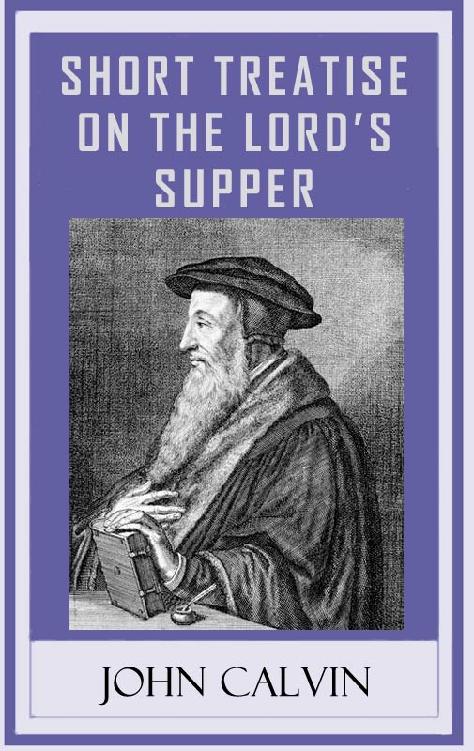
Short Treatise on the Lord's Supper
by John Calvin
TABLE OF CONTENTS
Introduction
Short Treatise on the Holy Supper of our Lord and only Saviour Jesus Christ
I: Reason for the Institution of the Holy Supper
II: Benefits of the Holy Supper
III. The Right Use of the Sacrament
IV. Errors Corrupting the Sacrament
V. The Present Dispute
INTRODUCTION
LITTLE NEED BE SAID BY WAY OF EXPLANATION OF THE Short Treatise, since it carries within itself its own exposition. In the
Editions of the Institutes of 1536 and 1539, as well as in the earlier Catechism referred to in the preface to the Catechism published in this volume, Calvin had already set forth his views on the nature of the Holy Supper. But the time was ripe for something more and other. The controversy between Lutherans and Zwinglians raged bitterly, and deeply agitated the minds of ordinary people. There was room, as C.R. puts it, for a little book specially written in his native French, to show calmly and clearly a middle way between the contending parties. The Treatise was written in 1540, and seems to have been, after some difficulty in finding a printer, published in Geneva the next year.
Calvin's doctrine is expounded with the utmost clarity here, and in its main outline is repeated in other much longer and more controversial works but not with equal lucidity. He puts aside the view that the elements of the Holy Supper are bare signs, figures or symbols; on the other hand, as appears with greater emphasis elsewhere, he turns his face against any view that would so tie the body of Christ to the elements as to subject it to being consumed by unworthy communicants. He affirms a true and real presence of Christ in the elements. Those enjoy this presence and all allied blessings who, complying with the primitive eucharistic injunction, lift up their minds and hearts on high, and so, not stopping at the visible signs, partake of the gifts Christ crucified procured and Christ exalted dispenses.
Almost as notable as the firm precision of the contents of the Treatise, is the dispassionate and conciliatory tone in which reference is made to the parties contending within the Reformed Church. It is a tone, one must concede, that is not maintained in all his later controversial writings. Here, however, his express aim is to explain if not to justify the sharpness of the debate to those pained by the appearance of controversy, and this apologetic purpose is admirably advanced by the eirenic tone in which the whole is couched.
Textual variations in this Treatise are inconsiderable, in the sense that the meaning is never once in doubt. Nor has it often seemed worthwhile to draw attention to them.
Here, as elsewhere, shorter paragraphs have been introduced, and for ease in following the course of the argument the divisions referred to by Calvin in the text have been marked as separate sections. (See C.R. V, xlix.)
Short Treatise on the Holy Supper
of our Lord and only Saviour Jesus Christ
Because the holy sacrament of the Supper of our Lord Jesus Christ has been for long entangled in several major errors, and during these past years involved anew in diverse opinions and contentious disputes, it is no wonder if weak consciences are unable rightly to resolve what view they ought to hold, but remain in doubt and perplexity, waiting until, all contentions being laid aside, the servants of God come to some agreement in the matter. However, since it is a very perilous matter not to have any certainty concerning this ordinance, knowledge of which is so needful for our salvation, I have thought that it would be a very useful labour to try briefly and yet clearly to extract the chief substance of what it is necessary to know of the matter. It should be added that I have been asked to do this by certain worthy persons, who realized the need for it, and whom I could not refuse without violating my duty.
But in order to be rid of all difficulty, it is expedient to note the order which I propose to follow. First, then, we shall expound to what end and for what reason the Lord instituted this holy
sacrament for us. Second, what fruit and benefit we obtain from it, when it will likewise be shown how the body of Jesus Christ is given to us. After this, what is its legitimate use. Fourth, we shall detail with what errors and superstitions it has been contaminated, where, too, it will be shown how different should be the servants of God from the papists. And last, we shall mention what has been the source of the dispute, which has been so sharply conducted, even among those who in our time have brought back the gospel into the light, and employed themselves in rightly edifying the Church in sound doctrine.
I: REASON FOR THE INSTITUTION OF
THE HOLY SUPPER
As to the first article: Since it pleased our loving God to receive us by Baptism into his Church, which is his house, and which he will maintain and govern, and since he has received us not only to keep us as servants, but as his own children, it remains that, to discharge the office of a loving father, he nourish us, and provide all that is necessary to life. For as to bodily nourishment, since it is common to all, and the bad have part in it like the good, it is not peculiar to his family. It is very true that we have it as evidence of his fatherly goodness in maintaining us as far as the body is concerned, seeing that we participate in all the good things which with his blessing he gives us. But as the life into which he has regenerated us is spiritual, so the food for preserving and confirming us in it must be spiritual. For we ought to understand that he has not only called us to possess one day his heavenly inheritance, but that by hope he has already in a measure installed us in its possession; that not only has he promised life to us, but has already translated us into it, delivering us from death. And this when, in adopting us as children, he begot us again by the seed of immortality, which is his Word imprinted in our hearts by his Holy Spirit.
To maintain us in this life, then, what is required is not to feed our bodies with corruptible and transitory provisions, but to nourish our souls on better and more precious diet. Now all Scripture tells us that the spiritual bread by which our souls are maintained is the same Word by which our Lord regenerated us. But it often adds the ground of this, that in it Jesus Christ, who alone is our life, is given and administered to us. For we must not think that there is life anywhere else but in God. But just as God has set all fulness of life in Jesus, in order to communicate it to us by means of him, so he has ordained his Word as instrument by which Jesus Christ, with all his benefits, is dispensed to us. Yet it always remains true that our souls have no other pasture than Jesus Christ. Therefore the heavenly Father, in his care to nourish us, gives us nothing else, but rather recommends us to take our fill there, as from a refreshment manifestly sufficient, with which we cannot dispense, and beyond which it is impossible to find any other.
We have already seen how Jesus Christ is the only provision by which our souls are nourished. But because it is distributed by the Word of the Lord, which he has appointed as instrument to this end, it is also called bread and water. Now what is said of the Word fitly belongs also to the sacrament of the Supper, by means of which our Lord leads us to communion with Jesus Christ. For seeing we are so foolish, that we cannot receive him with true confidence of heart, when he is presented by simple teaching and preaching, the Father, of his mercy, not at all disdaining to condescend in this matter to our infirmity, has desired to attach to his Word a visible sign, by which he represents the substance of his promises, to confirm and fortify us, and to deliver us from all doubt and uncertainty. Since then it is a mystery so high and incomprehensible, when we say that we have communion with the body and blood of Jesus Christ, and since we on our side are so rude and gross that we cannot understand the smallest things concerning God, it was of consequence that he give us to understand, according as our capacity can bear it. For this reason, the Lord instituted for us his Supper, in order to sign and seal in our consciences the promises
contained in his gospel concerning our being made partakers of his body and blood; and to give us certainty and assurance that in this consists our true spiritual nourishment; so that, having such an earnest, we might entertain a right assurance about salvation. Second, for the purpose of inciting us to recognize his great goodness towards us, so that we praise and magnify it more fully. Third, to exhort us to all sanctity and innocence, seeing that we are members of Jesus Christ, and particularly to unity and brotherly charity, as is specially recommended to us. When we have noted well these three reasons, which our Lord imposed in ordaining his Supper for us, we shall be in a position to understand both what benefits accrue to us from it, and what is our duty in its right use.
II: BENEFITS OF THE HOLY SUPPER
It is now time to come to the second point, namely, to show how profitable the Supper of our Lord is to us, on condition that we make profitable use of it. Now we shall understand its utility by reflecting on our indigence, to which it is an aid. It is necessary that we be in great trouble and distress of conscience, when we consider who we are and examine what is in us. For there is none of us who can find a single grain of righteousness in himself; but on the contrary we are all full of sin and iniquity; so much so that no other party is needed to accuse us but our own conscience, no other judge to condemn us. It follows then that the wrath of God is kindled against us, and there is no one able to escape eternal death. If we are not indolent and stupid, this awful thought must be a kind of perpetual hell to vex and torment us. For the judgment of God cannot occur to our recollection without our seeing that our condemnation follows as a consequence. We are then already in the abyss of death, unless our loving God draw us out. Moreover, what hope of resurrection can we have, considering our flesh which is nothing but rottenness and corruption? So, as regards the soul, as well as the body, we are more than miserable, if we remain within our selves; and it can only be that we have great sadness and
anguish from the feeling of such misery. Now our heavenly Father, to succour us from it, gives us the Supper as a mirror in which we contemplate our Lord Jesus Christ crucified to abolish our faults and offences, and raised to deliver us from corruption and death, and restoring us to a heavenly immortality. Here, then, is the peculiar consolation we receive from the Supper, that it directs and conducts us to the cross of Jesus Christ and to his resurrection, in order to assure us that, whatever iniquity there may be in us, the Lord does not cease to regard and accept us as righteous; whatever material of death may be in us, he does not cease to vivify us; whatever the wretchedness we may have, yet he does not cease to fill us with all felicity.
Or to explain the matter more simply, as we in ourselves are lacking in all good and have not a particle of what might help us to salvation, the Supper is attestation that, being made partakers of the death and passion of Jesus Christ, we have everything that is useful and salutary for us. Therefore we can say that the Lord here displays to us all the treasures of his spiritual grace, seeing that he makes us associates of all the blessings and riches of our Lord Jesus Christ. Let us remember then, that the Supper is given us as a mirror, in which we may contemplate Jesus Christ crucified to deliver us from damnation, and risen again to procure righteousness and eternal life for us. It is indeed true that this same grace is offered us by the gospel; yet as in the Supper we have a more ample certainty and fuller enjoyment, it is with good reason that we recognize such a fruit as coming from it.
But because the blessings of Jesus Christ do not at all belong to us, unless he first be ours, it is necessary in the first place that he be given us in the Supper, so that the things which we have mentioned be really accomplished in us. For this reason, I am accustomed to say that the matter and substance of the sacraments is the Lord Jesus Christ, and the efficacy of them are the gifts and blessings which we have by means of him. Now the effect of the Supper is to confirm for us the reconciliation which we have with God through
his death and passion; the washing of our souls which we have by the shedding of his blood; the righteousness we have in his obedience; in short, the hope of salvation which we have from all he has done for us. It is necessary, then, that the substance should be joined with these, otherwise nothing would be firm or certain. Hence we must conclude that two things are presented to us in the Supper: Jesus Christ as source and substance of all good; and second, the fruit and efficacy of his death and passion. This is implied also by the words which are there used. For in commanding us to eat his body and drink his blood, he added that his body was delivered for us, and his blood shed for the remission of our sins. Hereby he declares, first, that we ought not simply to communicate in his body and blood, without further consideration, but to receive the fruit which comes to us from his death and passion; and second, that we can only attain to the enjoyment of such fruit by participating in his body and blood, of which it is the product.
We begin now to enter into the question so much contested both in ancient and in present days: how these words are to be understood, in which the bread is called the body of Jesus Christ, and the wine his blood. This can be disposed of without great difficulty, if we remember carefully the principle which I have laid down. It is that all benefit which we ought to seek from the Supper is annulled, unless Jesus Christ be there given to us as substance and foundation of all. This agreed, we shall confess without doubt that to deny the true communication of Jesus Christ to be offered us in the Supper is to render this holy sacrament frivolous and useless—a blasphemy execrable and unworthy of attention. Moreover, if the reason for communicating with Jesus Christ is in order that we have part and portion in all the gifts which he has procured for us by his death, it is not only a matter of being partakers of his Spirit; it is necessary also to partake of his humanity, in which he rendered complete obedience to God his Father, to satisfy our debts; though rightly speaking, the one cannot be without the other. For when he gives himself to us, it is in order that we possess him entirely. For this reason, as it is said that his Spirit is our life, so he himself with
his own mouth declares that his flesh is truly food, and his blood truly drink. If these words are not spoken in vain, it follows that to have our life in Christ our souls should be fed on his body and his blood, as their proper food. This, then, we expressly testify in the Supper, when we are told of the bread, that we take and eat it and that it is his body; and that we drink of the chalice and that it is his blood. It is said expressly of the body and the blood, in order that we learn to seek in them the substance of our spiritual life. Now, if it be asked nevertheless whether the bread is the body of Christ, and the wine his blood, we should reply that the bread and the wine are visible signs, which represent to us the body and the blood; but that the name and title of body and blood is attributed to them, because they are as instruments by which our Lord Jesus Christ distributes them to us. This form and manner of speaking is in principle very appropriate. For though it may be that the communion we have with the body of Christ is something incomprehensible, not only to the eye but to our natural sense, it is there visibly shown to us. Of this we have a very apposite example in a similar case. Our Lord, wishing at his Baptism to give visible appearance to his Spirit, represented it under the form of a dove. John the Baptist, relating this story, says that he saw the Holy Spirit descending. If we enquire more closely, we find that he saw only the dove, for the Holy Spirit is essentially invisible. Yet knowing that this vision is not an empty figure, but a certain sign of the presence of the Holy Spirit, he does not hesitate to say that he saw it, because it is represented to him according to his capacity. It is like this with the communion which we have with the body and blood of our Lord. It is a spiritual mystery, which cannot be seen by the eye, nor comprehended by the human understanding. It is therefore symbolized by visible signs, as our infirmity requires, but in such a way that it is not a bare figure, but joined to its reality and substance. It is therefore with good reason that the bread is called body, since not only does it represent it to us, but also presents it to us. Hence we shall readily concede that the name body of Jesus Christ is transferred to the bread, as it is the sacrament and figure of it. But we likewise add that the sacraments of the Lord ought not and cannot at all be separated
from their reality and substance. To distinguish them so that they be not confused is not only good and reasonable but wholly necessary. But to divide them so as to set them up the one without the other is absurd. Therefore when we see the visiblesign, we ought to regard what representation it carries and by whom it is given us. The bread is given to symbolize the body of Jesus Christ, with command that we eat it; and it is given us by God who is certain and immutable truth. If God cannot deceive or lie, it follows that he performs all that it signifies. We must then really receive in the Supper the body and blood of Jesus Christ, since the Lord there represents to us the communion of both. For otherwise what would it mean that we eat the bread and drink the wine as a sign that his flesh is our food and his blood our drink, if he gave only bread and wine and left the spiritual reality behind? Would it not be under false colours that he had instituted this mystery? We have then to confess that if the representation which God grants in the Supper is veracious, the internal substance of the sacrament is joined with the visible signs; and as the bread is distributed by hand, so the body of Christ is communicated to us, so that we are made partakers of it. If there were nothing more, we have good reason to be satisfied when we realize that Jesus Christ gives us in the Supper the real substance of his body and his blood, so that we may possess him fully, and, possessing him, have part in all his blessings. For since we have him, all the riches of God, which are comprehended in him, are proffered to us in order that they may be ours. Thus, as a brief definition of this benefit of the Supper, we may say that Jesus Christ is there offered to us that we may possess him, and in him all the fulness of his gifts which we can desire; and that in this we have great assistance in confirming our conscience in the faith which we ought to have in him.
The second benefit which the Supper yields us is that it urges and incites us the better to recognize the blessings which we have received, and daily receive, from the Lord Jesus Christ, so that we may render him such offering of praise as is his due. For of ourselves we are so negligent that it is unusual for us to meditate on
the goodness of God, unless he rouse us from our indolence, and impel us to do our duty. Now we cannot conceive having a spur to prick us more sharply into life than when he makes us, so to say, see with the eye, and touch with the hand and manifestly feel a blessing so inestimable, that we feed upon his own substance. He will signify this by commanding that we show forth his death until he come. If it is, then, a thing so necessary to salvation not to overlook the gifts which God has made us, but to hold them diligently in mind and extol them to others for mutual edification, in this we see another outstanding benefit of the Supper, that it turns us from ingratitude, and does not allow us to forget the good our Lord did us in dying for us, but rather induces us to render thanks to him, and, as it were, by public confession, protest how much we are indebted to him.
The third benefit consists in our having a vehement incitement to holy living, and above all to observe charity and brotherly love among us. For since we are there made members of Jesus Christ, being incorporated into him and united to him as to our Head, this is good reason, first, that we be conformed to his purity and innocence, and especially that we have to one another such charity and concord as members of the same body ought to have. To understand properly this benefit, we must not suppose that our Lord only warns, incites and inflames our hearts with the external sign, For the chief thing is that he cares for us internally by his Holy Spirit, so as to give efficacy to his ordinance, which he has destined for this purpose, as an instrument by which he will do his work in us. Therefore seeing that the virtue of the Holy Spirit is joined to the sacraments when they are duly received, we have reason to hope they will afford a good means and assistance for our growth and advance in sanctity of life and especially in charity.
III: THE RIGHT USE OF THE
SACRAMENT
Let us come to the third chief head which we proposed at the beginning of this treatise, that is to the right use, which consists in observing the institution of our Lord with reverence. For whoever approaches this holy sacrament with contempt or indifference, not caring much about following where our Lord calls him, perversely misuses it and thus contaminates it. Now to pollute and contaminate what God has so sanctified is intolerable sacrilege. It is, then, not without reason that Paul passes such grave condemnation on those who take it unworthily. For if there is nothing in heaven or earth of greater value and dignity than the body and blood of our Lord, it is no small fault to take it inconsiderately and without being well prepared. Therefore he exhorts us to examine ourselves well, in order to use it properly. When we understand what kind of examination this should be, we shall know the use for which we seek.
Now we must here be well on our guard. For, as we cannot take too great diligence in examining ourselves, as our Lord commands, so on the other hand doctors of sophistry have brought poor consciences into perilous perplexity, or rather into an awful hell, by demanding I know not what kind of examination, which they cannot possibly get through. To rid ourselves of all these troubles, we must reduce the whole, as I have already said, to the ordinance of our Lord, as to a rule which will not permit us to err if we follow it. In following it, we have to examine whether we have a true repentance in ourselves and a true faith in our Lord Jesus Christ. These two things are so joined that the one cannot stand without the other. For if we think our life to be located in Christ, we must acknowledge that in ourselves we are dead. If we seek in him our strength, we must understand that in ourselves we are weak. If we judge all our felicity to be in his grace, we ought to understand how great is our misery without it. If we have our rest in him, we must by ourselves feel tormented and unquiet. Now such feeling cannot exist without producing first a distaste of all our life; then anxiety and fear; and finally a desire and love of righteousness. For he who knows the baseness of his sin and the unhappiness of his state and condition
while alienated from God, is so ashamed of it, that he is constrained to discontent with himself, to self-condemnation, and to groaning and sighing with a great sadness. Moreover, the judgment of God presents itself forthwith, to oppress the sinful conscience with remarkable anxiety, since it has no way of escape and nothing to answer in its defence. When, with such a realization of our misery, we can taste the goodness of God, then we desire to order our life by his will, and to renounce all our earlier life, in order to be made new creatures in him.
If we wish, then, to communicate worthily in the sacred Supper of our Lord, we must hold in firm and hearty confidence the Lord Jesus Christ as our sole righteousness, life and salvation, receiving and accepting the promises which are given us by him as certain and assured; renouncing on the other hand all other confidence, in order that, distrusting ourselves and all other creatures, we may rest fully in him and content ourselves with his grace alone. Now because this cannot be, unless we recognize the need for him to assist us, it is of importance that we be also sharply touched to the very heart with a true feeling of our misery, to make us hunger and thirst after him. In fact, what a mockery it would be to come without appetite to look for food. Now to have a good appetite, it is not enough that the stomach be empty; it is necessary that it be in good order and capable of receiving nourishment. Hence then it follows that our souls ought to be oppressed by famine and to have desire and ardent longing to be fed, in order to find their proper nourishment in the Supper of the Lord. Moreover, it is to be noted that we cannot desire Jesus Christ without aspiring to the righteousness of God, which consists in self-denial and obedience to his will. For it is absurd to pretend to be of the body of Christ while we abandon ourselves to all licence and lead a dissolute life. Since in Christ there is nothing but chastity, benignity, sobriety, truth, humility and all like virtues, if we desire to be his members, all uncleanness, arrogance, intemperance, falsehood, pride and like vices must be put far from us. For we cannot mingle these things with him, without doing him grave dishonour and affront. We must always remember that there
is no more agreement between him and iniquity than between light and darkness. Here, then, is how we should come to him in true repentance, in the remembrance that our life is to be conformed to the example of Jesus Christ. While this should be general in all parts of our life, yet it has a special application to charity, which is above all recommended to us in this sacrament; for which reason it is called the bond of charity. For as the bread, which is there sanctified for the common use of us all, is made of many grains so mixed together that one cannot be discerned from the other, so ought we to be united among ourselves in one indissoluble friendship. What is more: we all receive there the same body of Christ, in order that we be made members of it. If we have, then, dissensions and discords among us, it is not our fault if Jesus Christ is not rent in pieces; and we shall be guilty of a like sacrilege, as if we had done it. We must then not at all presume to approach, if we bear any hatred or rancour against living man, and especially any Christian who may be within the unity of the Church. To fulfil completely the order of our Lord, we must bring another disposition. It is to confess with the mouth and to testify how much we are indebted to our Saviour, and to render thanksgiving to him, not only that his name be glorified in us, but also that others be edified and instructed by our example, what they ought to do.
But because not a man will be found on earth, who has so advanced in faith and sanctity of life, that he does not still have much infirmity in one or other, there might be a danger that some good consciences be troubled by what has been said, if one did not obviate it by moderating the commands which we have imposed concerning both faith and repentance. It is a perilous method of teaching that some adopt, to demand a perfect confidence of heart and a perfect penitence, and to exclude all who do not have them. For in so doing, all are excluded without exception. Were it so, who can boast of being untouched by all mistrust? or of being subject to no vice or infirmity? Truly the children of God have only such faith, that they have always need to pray that the Lord help their unbelief. For it is a malady so rooted in our nature that we are never quite
cured until we are delivered from this prison of our body. Moreover, they walk in purity of life of such a kind that they need to pray daily both for remission of sins and for grace to make better progress. Though some be more imperfect and others less, yet there is no one who does not fail in many respects. Hence the Supper would be not only useless to us all, but also pernicious, if we had to bring an integrity of faith or life in which there was nothing with which to find fault. This is contrary to the intention of our Lord, for there is nothing given to his Church that is more salutary. Therefore, when we feel our faith to be imperfect, and our conscience not so pure as not to accuse us of many vices, this must not hinder us presenting ourselves at the Holy Table of our Lord; provided that amid this infirmity we feel in our heart that, without hypocrisy and deceit, we hope for salvation in Christ, and desire to live according to the rule of the gospel. I say expressly that there be no hypocrisy; for there are many who deceive themselves by vain flatteries, making themselves to believe that it is enough to condemn their vices, though they continue in them; or rather leave them for a time, in order to return immediately after. Now true repentance is firm and constant; therefore it makes us battle against the evil which is within us, not for a day or a week, but without end or intermission.
When we feel within us a strong distaste and hatred of all vices, proceeding from the fear of God, and a desire to live well in order to please our Lord, we are fit to partake of the Supper, notwithstanding the vestiges of infirmity which we carry in our flesh. If indeed we were not weak, subject to mistrust, and imperfect in life, the sacrament would be of no service to us, and it would have been superfluous to institute it. Since then it is a remedy which God has given us to assist our frailty, to fortify our faith, to augment our charity, and to further us in all sanctity of life, so far from this making us abstain, we ought the more to make use of it, the more we feel oppressed by the disease. For if we allege as pretext for not coming to the Supper, that we are still weak in faith or in integrity of life, it is as if a man excuse himself from taking medicine because he is sick. This then is how the frailty of the faith which we feel in
our heart, and the imperfections which persist in our life, ought to incite us to come to the Supper, as to a remedy designed to correct them. Only let us not come without faith or repentance. Of these, the former is hidden in the heart, and therefore our conscience must testify concerning us before God. The second manifests itself by works, and therefore must be somehow apparent in our life.
As to the time of using it, there can be no certain rule for all. For there are certain particular impediments which excuse a man for absenting himself. And besides we have no express command, constraining Christians to make use of it every day it is offered to them. However, if we have careful regard to the end for which our Lord intended it, we should realize that the use of it ought to be more frequent than many make it. For the more infirmity oppresses us, the more frequently we need to have recourse to that which is able and ought to serve to confirm our faith and further us in purity of life. Therefore, the custom ought to be well established in all Churches, of celebrating the Supper as frequently as the capacity of the people will allow. And each individual in his own place ought to prepare himself to receive it whenever it is administered in the congregation, unless there be some grave hindrance which compels him to abstain. Though we have no express command defining the time and the day, it should be enough for us to know that the intention of our Lord is that we use it often; otherwise we shall not know well the benefit which it offers us.
The excuses which some allege on the other hand, are very frivolous. Some say that they feel themselves unworthy, and under cover of this abstain from it for a whole year. Others, not content with wondering about their worthiness, pretend that they cannot communicate with persons whom they see coming without good preparation. Some again think it is superfluous to use it often, since, if we have once received Jesus Christ, there is no need to return so often afterwards to receive him. I ask the first, who make a cover of their unworthiness, how their conscience can allow them to remain more than a year in so poor a state, that they dare not invoke God
directly. For they will confess that it is audacity to invoke God as our Father, if we are not members of Jesus Christ. This we cannot be, unless the substance and reality of the Supper be fulfilled in us. Now if we have the reality, we are, a fortiori, capable of receiving the sign. It is evident, then, that he who would exempt himself from receiving the Supper because of unworthiness, bars himself from praying to God. For the rest, I have no intention of forcing consciences that are tormented with certain scruples that suggest themselves, they know not how; I rather advise them to wait till the Lord deliver them. Similarly, if there is a legitimate cause of hindrance, I do not deny that it is lawful to defer coming. Only I would point out that no one ought to remain content for long to abstain from the Supper because of his unworthiness, seeing that to do so deprives him of the communion of the Church in which all our good consists. Rather let him strive to contend against all the impediments which the devil puts before him, in order not to be excluded from so great a benefit, and consequently from all the gifts of which absence would deprive him.
The second class have some plausibility, for they employ the following argument. If it is not allowed to eat the common bread with those who call themselves brothers but lead a dissolute and wicked life, a fortiori, we ought to abstain from communicating with them in the bread of our Lord, which is sanctified to represent and dispense to us the body of Christ. But the reply is not very difficult. It is not the office of each individual to judge and discriminate, in order to admit or reject as seems to him good; seeing that this prerogative belongs generally to the Church as a whole, or rather to the pastor with the elders whom he ought to have for assisting him in the government of the Church. For Paul does not command us to examine others, but each is to examine himself. It is very true that our duty is to admonish those whom we see to live disorderly, and, if they will not listen, to advise the pastor of them, in order that he take proceedings on the authority of the Church. But the right way of withdrawing from the company of the wicked is not to quit the communion of the Church. Moreover, it will most frequently
happen that sins are not so notorious as to justify going the length of excommunication. For though the pastor in his heart judge some man unworthy, yet he has not the power of pronouncing him to be so, or of interdicting him from the Supper, unless he can prove it by an ecclesiastical judgment. In this case, we have no other remedy than to pray to God, that he would deliver his Church more and more from all scandals, and to await the Last Day, when the chaff will be manifestly separated from the good grain. The third class have no semblance of plausibility. For this spiritual bread is not given us in order that on the first occasion we eat our fill of it; but rather that, having had some taste of its sweetness, we may long for it the more, and use it when it is offered us. This is what we have expounded above, that while we remain in this mortal life, Jesus Christ is never communicated to us in such a way that our souls are wholly satisfied with him, but he desires to be our continual nourishment.
IV: ERRORS CORRUPTING THE
SACRAMENT
To come to the fourth principal matter: the devil, knowing that our Lord left nothing more beneficial to the Church than this holy sacrament, according to his accustomed manner, exerted himself from the beginning to contaminate it with errors and superstitions, and to corrupt and destroy its fruit, and has not ceased to pursue this course, until he has almost wholly subverted the ordinance of the Lord, and converted it into falsehood and vanity. My intention is not to indicate at what time each abuse took its rise, and at what time it has been increased. It will suffice to indicate under different heads what errors the devil has introduced, against which we must be on guard, if we wish to enjoy the Supper of our Lord in its entirety.
As to the first error: while the Lord has given us his Supper in order that it be distributed among us, to testify that in communicating in
his body we have part in the sacrifice which he offered on the cross to God his Father, for the expiation and satisfaction of our sins, men have, on the contrary, out of their own head invented that it is a sacrifice by which we obtain the remission of our sins before God. This is a blasphemy which is intolerable. For if we do not acknowledge the death of our Lord Jesus Christ as a unique sacrifice by which he has reconciled us to the Father, effacing all the faults for which we are liable to his judgment, we destroy its virtue. If we do not confess Jesus Christ to be the sole sacrificer, or as we commonly call it Priest, by whose intercession we are restored to the Father's favour, we despoil him of his honour and do him grave hurt. Since, then, this view of the Supper held by some, that it is a sacrifice for procuring the remission of sins, derogates from the true view, it must be condemned as pernicious. Now that it does so derogate is notorious. For how can we reconcile these two things, that Jesus Christ in dying has offered a sacrifice to his Father by which he has once for all procured remission and pardon for all our faults, and that it is necessary every day to sacrifice in order to obtain that which we ought to seek in his death alone? This error was not from the beginning so extreme; but little by little has increased, until it came to what it is. It appears that the ancient Fathers called the Supper a sacrifice. But they offered the reason that the death of Jesus Christ is there represented. Hence what they say is this, that this name is attributed to it solely because it is a memorial of the unique sacrifice, at which we ought to stop short. Yet I cannot quite excuse the custom of the ancient Church. For by gestures and manner of acting, they outlined a kind of sacrifice, as if it were the same ceremony as there was in the Old Testament, except that in place of the animal bread was used for victim. Because this approaches too near to Judaism, I do not approve it. For in the Old Testament, in the time of symbols, the Lord had ordained such ceremonies, until this sacrifice was made in the flesh which is its fulfilment. Since it has been perfected, there remains nothing but for us to receive its communication. Hence it is superfluous to symbolize it any longer. This is the significance of the order which Jesus Christ left us, not that we offer or immolate,
but that we take and eat that which has been offered and immolated. However, though there was some weakness in such observance, there was not such impiety as later supervened. For what properly belongs to the death of Christ has been wholly transferred to the mass, that is to satisfy God for our sins, and by this means to reconcile us to him. Moreover, the office of Jesus Christ has been attributed to those who are called priests, that is persons sacrificing to God, and by sacrificing interceding for us and so obtaining grace and pardon for our faults. I do not wish to dissimulate the explanations which the enemies of truth allege in this connection. They say that the mass is not a new sacrifice, but only an application of the unique sacrifice of which we have spoken. Though they disguise their abomination a little by so speaking, yet it is no more than a mere quibble. For it is not simply affirmed that the sacrifice of Christ is unique, but that it is not to be repeated, seeing that its efficacy endures always. It is not said that Christ once offered himself to the Father, in order that others after him might make the same oblation, and thus apply to us the virtue of his intercession. What is said is that he is entered into the heavenly sanctuary, and that he there appears for us to render the Father favourable by his intercession. As to applying the merit of his death to us, in order that we may perceive its benefit, this is effected not in the manner that the popish Church thinks, but when we receive the message of the Gospel as it is proclaimed to us by the preaching of the ministers, whom God has appointed as his ambassadors, and as it is sealed by the sacraments. The opinion of everyone has been approved by all their doctors and prelates, that in hearing mass or having it said, one merits, by this devotion, grace and righteousness before God. We say that to obtain any profit from the Supper, we need bring nothing of our own, to merit what we seek; we have only to receive by faith the grace which is there presented to us, which indeed does not reside in the sacrament, but points us to the cross of Jesus Christ as its source. Thus, then, it is apparent that there is nothing more contrary to true understanding of the Supper, than to make such a sacrifice of it as diverts us from recognizing the death of Christ as a sacrifice unique and with a virtue that lasts for ever.
This being well understood, it will appear that all masses, in which there is no such communion as the Lord instituted, are nothing but abomination. For our Lord did not ordain that a single priest, after having made his sacrifice, should keep himself apart, but desired that the sacrament be distributed in the gathering, after the example of the first Supper which he made with his apostles. But after this evil opinion was forged, out of it, as from an abyss, has come the unhappy custom, that the people, contenting themselves with being present to participate in the merit of what is being done, abstain from communicating, because the priest pretends to offer his host for all, and especially for those present. I omit to speak of the abuses which are so stupid that they deserve no notice, such as attributing a mass to each saint, and transferring what is said of the Lord's Supper to St. William and St. Walter, or making a common market of them for buying and selling or other such villainies, to which the word sacrifice has given rise.
The second error which the devil has sown to corrupt this holy mystery, has been to forge and invent that, after the words pronounced with the intention of consecration, the bread is transubstantiated into the body of Christ, and the wine into his blood. This lie first of all has no foundation in Scripture, nor any evidence from the ancient Church; and, what is more, cannot be reconciled or harmonized with the Word of God. When Jesus Christ, pointing to the bread, called it his body, is it not a too forced construction to say that the substance of the bread is annihilated, and in its place the body of Christ is substituted? But there is no need to consign the matter to dubiety, seeing that the truth is sufficiently evident to refute the absurdity. I leave alone the numberless passages from both the Scriptures and the ancient Fathers where the sacrament is called bread. I only say that the nature of the sacrament requires that the material bread remain as visible sign of the body. For it is a general rule for all sacraments that the signs which we see have some correspondence with the spiritual things they symbolize. As then at Baptism we have assurance of internal washing when the water is given us for
attestation to cleanse our bodily defilements, so in the Supper there must be material bread, to testify to us that the body of Christ is our food. For otherwise what meaning could there be in whiteness symbolizing it for us? We see clearly, then, how the whole representation, which our Lord wished to give in condescension to our infirmity, is lost, unless the true bread remain. For the meaning of the words which our Lord requires us to use is as if it were said: Just as man is sustained and maintained so far as the body is concerned by eating bread, so my flesh is the spiritual nourishment by which souls are vivified. Moreover, what would become of the other simile which Paul employs: As many grains of corn are mixed together to make one bread, so we must be united together, since we all partake of one bread. If there were whiteness only without substance, would it not be mockery to speak thus? Therefore without any doubt we conclude that this transubstantiation is an invention forged by the devil, to corrupt the truth of the Supper.
From this phantasy, several other follies have sprung. And would to God that they were only follies, and not gross abominations! For a local presence of I know not what kind has been imagined, and Jesus Christ, in his divinity and his humanity, thought to be attached to this whiteness, without regard to all the absurdities which follow. Though the old doctors of the Sorbonne dispute with great subtlety, how the body and blood are joined to the signs, yet it cannot be denied that this opinion has been received by great and small in the popish Church, and that it is cruelly maintained today by fire and sword, that Jesus Christ is contained under these signs, and that he must there be sought. Now to maintain this, it is necessary to confess, either that the body of Christ is without limit, or that it can be in different places. In saying so, we come at last to the point where it appears nothing but a phantom. Hence to wish to establish such a presence, that the body of Christ is enclosed within the sign, or is joined locally to it, is not only a dream but a damnable error, contradicting the glory of Christ, and destructive of what we ought to hold concerning his human nature. For Scripture teaches us everywhere, that as our Lord Jesus Christ on earth took our
humanity, so he has exalted it to heaven, withdrawing it from its mortal condition, but not changing its nature. So we have two things to consider when we speak of our Lord's humanity. We may not destroy the reality of his nature, nor derogate at all from its glorious estate. To observe this rightly, we have always to raise our thoughts on high, to seek our Redeemer. For if we wish to abase him under the corruptible elements of this world, besides subverting what Scripture declares concerning his human nature, we annihilate the glory of his ascension. Because several others have treated this matter amply, I desist from saying more. I only wish to note in passing that to enclose Jesus Christ fantastically under the bread and wine, or so to join him to them as to amuse our understanding there instead of looking at him in heaven, is a pernicious fancy. We shall refer to this in another place.
Now this perverse opinion, having been once accepted, has given rise to many other superstitions. And first, this carnal adoration, which is nothing but idolatry. For to prostrate oneself before the bread of the Supper, and to adore Jesus Christ in it as though he were there contained, is to make an idol displace the sacrament. We have no commandment to adore, but to take and eat. This, then, ought not to have been audaciously attempted. Moreover, the practice always observed in the ancient Church was that, before celebrating the Supper, the people were solemnly exhorted to lift their hearts on high, to show that we must not stop at the visible sign, to adore Jesus Christ rightly. But there is no need to battle at length over this point, when the presence and conjunction of reality and sign, of which we have spoken and shall again speak, is well understood. From the same source proceeded other superstitious practices, such as carrying the sacrament in procession through the streets once a year, making another day a tabernacle for it, and all the year round keeping it in a cupboard to amuse the people, as if it were a god. Because all this has not only been contrived without the Word of God, but also is directly contrary to the institution of the Supper, it ought to be rejected by all Christians.
We have shown the source of the calamity which befell the popish Church, that the people abstained from communicating in the Supper for a whole year; and this because it is held to be a sacrifice, which is offered by one in the name of all. But again, even when thus used only once a year, it is miserably wasted and as it were rent in pieces. For instead of distributing the sacrament of the blood to the people, as the command of our Lord intends, they are made to believe that they must be content with the other portion. Thus poor believers are unhappily defrauded of the gift which our Lord had made to them. For if it is no little benefit to communicate in the blood of our Lord as our nourishment, it is a very great cruelty to steal it from those to whom it belongs. In this we can see with what audacity and boldness the pope tyrannized over the Church, when once he usurped dominion. Our Lord, having commanded his disciples to eat the bread sanctified in his body, when he came to the chalice does not say simply: Drink, but adds expressly that all are to drink of it. Could we have anything clearer than this? He says that we are to eat the bread, without using a universal term. He says that we are all to drink of the cup. Whence this difference, unless he wished to anticipate this wickedness of the devil? Yet such is the pride of the pope, that he dares to say: All are not to drink. And to show that he is wiser than God, he alleges that there is good reason that the priest have some privilege over the people, in honour of the sacerdotal dignity. As if our Lord had not at all considered how one ought to be distinguished from the other! Moreover, he objects to the dangers which might occur if the chalice were given to all. It could happen that some drop be occasionally spilt; as if our Lord had not foreseen this! Is not this to accuse God openly of confusing the order to be observed, and putting his people in danger without purpose? To show that there is no great disadvantage in this change, they point out that under one kind all is contained so that the body cannot be divided from the blood; as if our Lord had foolishly distinguished them! For if we can leave one of the parts behind as superfluous, it would have been folly to recommend them separately. Some of his supporters, seeing that it was impudence to maintain this abomination, have wished to excuse it otherwise.
They say that Jesus Christ, in instituting the sacrament, spoke only to his disciples whom he had elevated to sacerdotal rank. But what will they answer to what Paul says, when he delivered to all Christian people that which he had received from the Lord, that each should eat of this bread and drink of this cup? And in fact, who revealed to them that our Lord gave the Supper to his apostles as priests? The words mean the opposite, when he commands them to follow his example. He then delivers to them the rule which he wished to be always observed in his Church. Thus it was observed in the ancient Church, until Antichrist, having gained the upper hand, openly raised his horns against God and his truth, to destroy it completely. We see then that it is an intolerable perversion to divide and dissect the sacrament thus, separating the parts which God joined.
To come to an end, we comprehend under one article what could be considered separately. The article is that the devil introduced the manner of celebrating the Supper without any doctrine, and in place of the doctrine substituted ceremonies, partly unfitting and useless, and partly even dangerous, from which much ill has followed—to such an extent, that the mass, which takes the place of the Supper in the popish Church, when strictly defined, is nothing but pure apishness and buffoonery. I call it apishness, because the Supper of our Lord is there counterfeited without reason, just as an ape, capriciously and without discernment, follows what it sees done. This being so, the chief thing which our Lord recommends to us, is to celebrate this mystery with true intelligence. It follows then that the substance of it all consists in the doctrine. This taken away, it is no more than a cold ceremony without efficacy. This is not only shown in Scripture, but also attested by the canons of the pope, in a sentence cited from Augustine, where he asks; What is the water of Baptism without the Word, but a corruptible element?—and the Word not merely as uttered but as understood. He thereby means that the sacraments take their virtue from the Word, when it is preached intelligibly. Without this, they are unworthy to be called sacraments. Now intelligible doctrine of the mass is so lacking, that
on the contrary the whole mystery is considered spoiled, if everything is not done by stealth, so that nothing is understood. Therefore their consecration is nothing but a piece of sorcery, seeing that, by murmuring and gesticulating in the manner of sorcerers, they think to constrain Jesus Christ to descend into their hands. We see, then, how the mass being thus arranged, is a manifest profanation of the Supper of Christ, rather than an observance of it. For the proper and chief substance of the Supper is lacking, that the mystery be well explained to the people, and the promises clearly recited, instead of the priest muttering to himself apart without sense or reason. I call it buffoonery, because the mimicry and gesture made there suit rather a farce than such a mystery as the Supper of our Lord.
It is indeed true, that the sacrifices in the Old Testament took place with much ornament and ceremony. But because there was a sound meaning, and the whole was suited to instruct and excite the people to piety, they are far from being similar to those now used, which serve no end but the amusement of the people without any advantage. As these mass-mongers allege the example of the Old Testament in defence of their ceremonies, we must observe what difference there is between what they do and what God commanded the people of Israel to do. If there were only this, that what was then practised was founded on the command of the Lord, while all their frivolities have no foundation but men, there would be great enough dissimilarity. But we have more for which to reprove them. For it is not without reason that our Lord ordained such a form for a time, in order that it might some day come to an end and be abrogated. For as he had not then granted such clarity of doctrine, he desired that this people be more exercised in symbols, to compensate them for what they lacked in another direction. But since Jesus Christ was manifested in the flesh, doctrine has been so much the more clarified, and the symbols have been diminished. Since then we have the body, we should relinquish the shadows. For if we are to return to ceremonies which are abolished, we should repair the veil of the temple, which Jesus Christ rent by his death, and should thus
obscure the clarity of the Gospel. Thus we see that such a multitude of ceremonies in the mass is a kind of Judaicism, manifestly contrary to Christianity. I do not intend to disapprove ceremonies which contribute to decency and public order and increase reverence of the sacrament, provided they are sober and suitable. But such an abyss without end or measure is quite intolerable, seeing that it gave rise to a thousand superstititions, and as it were stupefied the people without bringing any edification.
Hence we can also see the difference there ought to be between the papists and those to whom God has given knowledge of his truth. To begin with, they will not doubt but that it is an abominable sacrilege to represent the mass as a sacrifice by which remission of sins is procured for us; or rather that the priest is mediator for the application of the merit of the death and passion of Christ to those who buy his mass, or attend it, or accord it devotion. But on the contrary, they must conclude that the death and passion of our Lord is the unique sacrifice by which the wrath of God is satisfied, and perpetual righteousness procured for us; and then that the Lord Jesus is entered into the heavenly sanctuary, finally to appear for us, and intercede with the virtue of his sacrifice. For the rest, they will readily grant that the fruit of this death is communicated to us in the Supper, not at all by the merit of the act, but by reason of the promises which we are there given, provided we receive them by faith. Second, they should not at all allow that the bread is transubstantiated into the body of Jesus Christ, nor the wine into his blood; but must insist on this, that the visible signs retain their true substance to represent to us the spiritual truth of which we have spoken. Third, they must hold for certain that our Lord gives us in the Supper what he signifies by it, and we thus really receive the body and blood of Jesus Christ. Nonetheless they will not seek it as though it were enclosed under the bread or attached locally to the visible sign, so far are they from adoring the sacrament. But they will rather raise their understandings and their hearts on high, both to receive Jesus Christ, and also to adore him. From this it will follow that they disapprove and condemn as idolatry all these
superstitious fashions, such as carrying the sacrament in solemn procession, or constructing for it tabernacles for its adoration. For the promises of our Lord do not extend beyond the use he has left us. Next they will hold that to deprive the people of one of the parts of the sacrament, that is of the chalice, is to violate and corrupt the ordinance of our Lord, and that for right observance both are to be distributed to all. Last, they will regard it as a superfluity, not only useless but also dangerous and ill-consorted with Christianity, to use so many ceremonies borrowed from the Jews, beyond the simplicity which the apostles left us; and that it is an even greater perversion to celebrate the Supper by mimicry and I know not what buffoonery, without expounding the doctrine but rather burying it, as if the Supper were a kind of magical trick.
V: THE PRESENT DISPUTE
As to the contention which has been so keenly debated in our time, an unhappy business, which the devil no doubt stirred up to impede, or rather quite interrupt, the advance of the Gospel, I could wish that the memory of it be quite abolished, so far am I from desiring to relate it at length. Nonetheless, because I see many good consciences troubled, since they know not to which side to turn, I shall briefly state what seems to me to be necessary advice for showing them how they ought to decide. First, I pray all the faithful, in the name of God, not to be too offended at the great difference which has arisen between those who ought to be leaders in bringing back truth to the light of day. For it is no new thing for the Lord to leave his servants in some ignorance, and to permit them to dispute against each other. And this, not to leave them for ever, but only for a time, to humble them. In fact, had all turned out as desired up till now, without any disturbance, men might possibly have forgotten themselves, or the grace of God be less acknowledged than is proper. Thus our Lord was pleased to deprive men of all cause for
glory in order that he alone be glorified. Moreover, if we consider in what an abyss of darkness the world was, when those who have shared in this controversy began to elicit the truth for us, we shall not wonder at all that they did not know everything at the outset. It is rather to be wondered at that our Lord in so short a time has so illumined them, that they have themselves escaped from the slime of error, and thus drawn others out of it who had been plunged in it for so long. But nothing could be better than to show how the thing came about, because this will make it evident that there is not at all so great occasion to be offended as is commonly thought.
When Luther began to teach, he regarded the matter of the Supper in such a way, that, with respect to the corporal presence of Christ, he appeared ready to leave it as the world generally conceived it. For while condemning transubstantiation, he said that the bread was the body of Christ, insofar as it was united with him. Further, he added some similes which were a little harsh and rude. But he did so as by constraint, because he could not otherwise explain his meaning. For it is difficult to give an explanation of so high a matter, without using some impropriety of speech.
On the other hand, there arose Zwingli and Œcolampadius, who, considering the abuse and deceit which the devil had employed to establish such a carnal presence of Christ as had been taught and held for more than six hundred years, thought it wrong to dissimulate; since this view implied an execrable idolatry, in that Jesus Christ was adored as if enclosed under the bread. Now because it was very difficult to remove this opinion, rooted so long in the hearts of men, they applied all their mind to decry it, remonstrating that it was a quite gross error not to acknowledge what is so clearly testified in Scripture, concerning the ascension of Jesus Christ, that he was in his humanity received up into heaven, where he dwells until he descend to judge the world. While they were absorbed with this point, they forgot to define what is the presence of Christ in the Supper in which one ought to believe, and what communication of his body and his blood one there received.
So Luther thought that they intended to leave nothing else but bare signs without any corresponding spiritual substance. Hence he began to resist and oppose them, even to the extent of denouncing them as heretics. Once the contention had begun, it became more inflamed with time, and so has continued too bitterly for a period of fifteen years or thereabouts, without either party listening to the other in a peaceful frame of mind. For though they once held conference, yet there was such alienation, that they parted without any agreement. Then instead of meeting with goodwill, they have always retreated farther and farther from one another, thinking of nothing but to defend their own opinion and confute anything contrary. Here we have the reason, then, why Luther failed on his side, and Œcolampadius and Zwingli on theirs. It was Luther's duty, in the first place, to make it clear that he did not intend to set up such a local presence as the papists imagine; second, he should have protested that he did not mean the sacrament to be adored instead of God; and third, he should have abstained from the similes so harsh and difficult to conceive, or have used them with moderation, interpreting them so that they could not occasion offence. Once the debate was taken up, he went beyond measure not only in declaring his opinion, but also in blaming the other with a too sharp bitterness of speech. For instead of explaining himself so that his opinion could be understood, with his accustomed violence in attacking those who contradicted him, he used exaggerated forms of speech, which were certainly hard to bear by those who otherwise were not very disposed to believe what he said. The others offended also, by being so eager to decry the contrary opinion of the papists concerning the local presence of the body of Jesus Christ as superstitious and fantastic, and the adoration which followed from it as perverse, that they laboured more to destroy the evil than to build up the good. For though they did not deny the truth, yet they did not teach it as clearly as they ought. I mean that in taking too great pains to maintain that the bread and the wine are called the body and blood of Christ because they are signs, they took no care to make the reservation that they are such signs that the reality is joined to them; or to protest that they did not at all intend to
obscure the true communion which our Lord gives us in his body and blood by the sacrament.
Both parties failed altogether to have patience to listen to each other, in order to follow truth without passion, wherever it might be found. None the less, we must not leave off thinking what is our duty. It is not to forget the gifts which our Lord bestowed on them, and the blessings which he distributes to us at their hands and by means of them. For if we are not quite ungrateful and forgetful of what we owe them, we could well pardon them this and more than this, without blaming or defaming them. In short, since we see that they were and still are distinguished by holy life and excellent knowledge and by conspicuous zeal to edify the Church, we ought always to judge and speak with modesty and reverence; just because it has pleased God at last, having humbled them thus, to bring to an end this unhappy disputation, or at least to calm it, in anticipation of it being quite resolved. I say this because there is not yet any published formula in which agreement has been framed, as would be expedient. But this will happen when God is pleased to bring into one place all those who are to draw it up. Meanwhile, it must content us that there is brotherliness and communion between the Churches, and that all agree in what is necessary for meeting together, according to the command of God. We all confess, then, with one mouth that, in receiving the sacrament in faith, according to the ordinance of the Lord, we are truly made partakers of the real substance of the body and blood of Jesus Christ. How this is done, some may deduce better and explain more clearly than others. But be this as it may, on the one hand we must, to shut out all carnal fancies, raise our hearts on high to heaven, not thinking that our Lord Jesus Christ is so abased as to be enclosed under any corruptible elements. On the other hand, not to diminish the efficacy of this sacred mystery, we must hold that it is accomplished by the secret and miraculous virtue of God, and that the Spirit of God is the bond of participation, for which reason it is called spiritual.
MONERGISM BOOKS
A Discourse Concerning Evangelical Love, Church Peace, and Unity by John Owen, Copyright © 2020
All rights reserved under International and Pan-American Copyright Conventions. By payment of the required fees, you have been granted the non-exclusive, non-transferable right to access and read the text of this e-book on-screen. No part of this text may be reproduced, transmitted, downloaded, decompiled, reverse engineered, or stored in or introduced into any information storage and retrieval system, in any form or by any means, whether electronic or mechanical, now known or hereinafter invented, without the express written permission of Monergism Books.
ePub and .mobi Editions Januray 2020 Requests for information should be addressed to: Monergism Books, PO Box 491, West Linn, OR 97068