
Institutes 1541 John Calvin
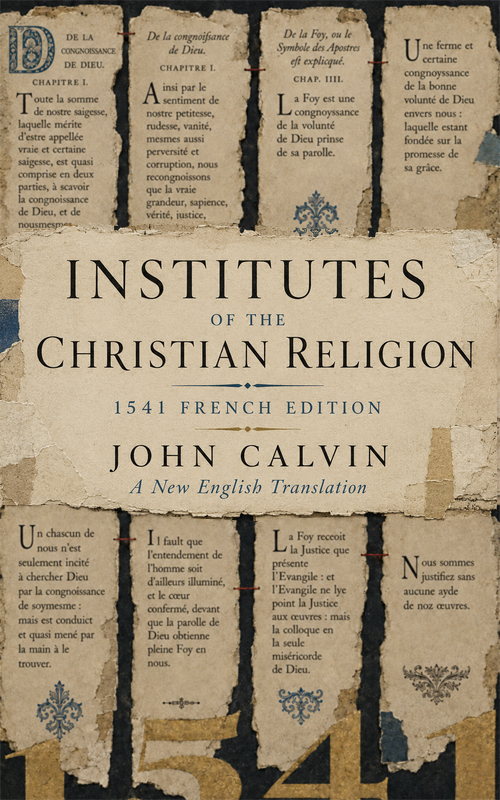
INSTITUTES
OF THE CHRISTIAN RELIGION
1541 FRENCH EDITION
JOHN CALVIN
A New English Translation
Based on the 1911 French edition prepared under the direction of
Abel Lefranc by Henri Châtelain and Jacques Pannier
MONERGISM BOOKS
English translation and editorial material © 2026 Monergism Books
John Calvin's original work and the 1911 French edition are in the
public domain. All rights reserved with respect to the original
material contained in this edition.
Prepared with the assistance of artificial intelligence under careful
human editorial oversight.
Published by Monergism Books
P.O. Box 491 West Linn, Oregon 97068
www.monergism.com
Post Tenebras Lux After Darkness, Light
Note on This Edition
This volume presents a new English translation of John Calvin's first complete French edition of the Institutes of the Christian Religion, published in 1541. Calvin translated and adapted it from the substantially enlarged Latin edition of 1539. Unlike the definitive 1559–1560 recension, arranged in four books, the 1541 edition consists of seventeen chapters and preserves the more compact and continuous form of Calvin's earlier theological synthesis.
Although Calvin continued to revise and enlarge the Institutes throughout his life, the 1541 edition is not merely a preliminary sketch. Its fundamental doctrines are fully formed: the knowledge of God and ourselves, the authority of Scripture, humanity's ruin in Adam, salvation through Jesus Christ, justification by faith, the work of the Holy Spirit, election and providence, the sacraments, the church, civil government, and the Christian life.
Calvin intended the Institutes to serve as a guide to Holy Scripture rather than a substitute for it. As he explains in the "Argument of the Present Book," his purpose was to furnish readers with a summary of Christian doctrine that would enable them to read the Old and New Testaments with greater understanding. Readers are therefore encouraged to approach this work as Calvin intended: as an aid to knowing God, resting in Christ, and growing in true godliness.
This translation is based upon the 1911 critical reprint of the 1541 French text prepared under the direction of Abel Lefranc by Henri Châtelain and Jacques Pannier. The spelling and punctuation of the French have been interpreted in light of sixteenth-century usage, while the English has been rendered in a clear and dignified modern style. Every effort has been made to preserve Calvin's theological precision, rhetorical force, and pastoral purpose.
Argument of the Present Book
In order that readers may derive greater benefit from this present book, I wish briefly to show them the profit they may receive from it. In doing so, I shall show them the end toward which they ought to strive and direct their attention while reading it.
Although Holy Scripture contains a perfect doctrine to which nothing can be added—for in it our Lord has chosen to unfold the infinite treasures of his wisdom—nevertheless, a person who is not thoroughly practiced in its study has great need of some guidance and direction in order to know what he ought to seek there. Otherwise, he may wander here and there rather than keep to a certain path by which he may always attain the end to which the Holy Spirit calls him.
It is therefore the duty of those who have received greater light from God than others to assist the simple in this matter and, as it were, extend a hand to guide them and help them discover the sum of what God has willed to teach us in his Word.
Now this cannot be done better in writing than by treating the principal and weightiest subjects comprehended within Christian philosophy. For whoever possesses an understanding of these subjects will be prepared to make more progress in the school of God in one day than another would in three months. This is because he knows, at least approximately, where each individual statement belongs and possesses a rule by which to measure and arrange everything presented to him.
Seeing, therefore, how necessary it was to assist in this manner those who desire to be instructed in the doctrine of salvation, I have endeavored, according to the ability the Lord has given me, to devote myself to this task. To that end, I have composed the present book.
I first published it in Latin so that it might serve all learned persons, whatever their nation. Afterward, desiring to communicate to our French nation whatever benefit might arise from it, I also translated it into our language.
I dare not commend it too highly or declare how profitable its reading may be, lest I appear to value my own work too greatly. Nevertheless, I can promise this much: it may serve as a key and an opening, giving all the children of God access to a sound and proper understanding of Holy Scripture.
Therefore, if from this time forward our Lord grants me the means and opportunity to write any commentaries, I shall employ the greatest brevity possible. It will not be necessary to make lengthy digressions, since I have here treated at length almost all the articles belonging to the Christian religion.
Since we must acknowledge that all truth and sound doctrine proceed from God, I shall boldly declare in simplicity what I think of this work, recognizing it to be God's more than mine—for, in truth, the praise for it ought to be rendered to him.
I exhort all who reverence the Word of the Lord to read this book and diligently impress it upon their memory if they desire, first, to possess a summary of Christian doctrine, and then to obtain an entrance by which they may profit from reading both the Old and New Testaments.
When they have done so, they will know by experience that I have not sought to deceive them with empty words.
If anyone cannot comprehend everything contained in it, he must not therefore despair. Rather, let him always continue forward, hoping that one passage will provide a clearer and more familiar explanation of another.
Above all, he must make it his constant concern to return to Scripture itself and carefully examine the scriptural testimonies that I cite.
A Dedication to Francis I
TO THE MOST HIGH, MOST MIGHTY, AND MOST ILLUSTRIOUS
PRINCE, FRANCIS, MOST CHRISTIAN KING OF FRANCE, HIS
PRINCE AND SOVEREIGN LORD,
JOHN CALVIN WISHES PEACE AND SALVATION IN GOD.
When I first applied myself to writing this present book, Most Noble King, nothing was further from my mind than to write anything that would be presented to Your Majesty. My only purpose was to teach certain rudiments by which those who possessed any sincere affection for God might be instructed in true godliness.
By this labor I desired chiefly to serve my fellow Frenchmen, among whom I saw many hungering and thirsting for Jesus Christ, but very few who had received a right knowledge of him. This intention may readily be perceived from the book itself, which I have adapted to the simplest form of instruction possible.
But when I saw that the fury of certain wicked men had risen to such a height in your kingdom that it left no room for any sound doctrine, it seemed expedient to make this present book serve two purposes: first, as instruction for those whom I had originally determined to teach; and second, as a confession of faith addressed to you, by which you may learn the nature of that doctrine against which those
who now trouble your kingdom with fire and sword are so furiously enraged.
For I will not be ashamed to confess that I have here presented a summary of that very doctrine which they believe ought to be punished with imprisonment, banishment, confiscation, and fire, and which they cry out must be driven from land and sea.
I know well with what horrible reports they have filled your ears and heart in order to make our cause exceedingly hateful to you. But in keeping with your clemency and gentleness, you ought to consider that no innocence would remain, whether in words or deeds, if accusation alone were sufficient.
Certainly, if anyone, seeking to stir up hatred against this doctrine— which I intend to defend before you—should argue that it has already been condemned by the common consent of every rank of society and that numerous judgments have been pronounced against it, he would be saying nothing except that it has been partly crushed by the violence and conspiracy of its adversaries and partly maliciously oppressed by their lies, deceits, slanders, and treachery.
It is force and violence when cruel sentences are pronounced against it before it has been permitted a defense. It is fraud and treachery when it is groundlessly branded as sedition and criminality.
Lest anyone suppose that we complain of these things without cause, you yourself, Most Excellent King, can bear witness to the false accusations by which this doctrine is daily defamed before you. You are told that it aims at nothing less than the overthrow of every kingdom and civil government, the disturbance of peace, the
abolition of laws, the destruction of lordships and possessions—in short, the reduction of everything to chaos.
And yet you hear only the smallest portion of these accusations. For among the common people, horrible reports are spread against this doctrine which, if they were true, would rightly cause the whole world to judge both it and all its authors worthy of a thousand fires and a thousand gallows.
Who can now wonder why it is so universally hated, when such wicked slanders are believed? This is why every rank of society conspires with one accord to condemn us and our doctrine.
Carried away and inflamed by this passion, those appointed to judge the matter pronounce as their sentence the opinion they had already formed before leaving home. They believe they have faithfully discharged their duty so long as they condemn no one to death except those convicted either by their own confession or by reliable testimony.
But convicted of what crime? Of this condemned doctrine, they say. But by what law has it been condemned? The very point of the defense was not to disavow this doctrine but to maintain it as true. Yet here the accused are denied permission even to open their mouths.
Therefore, Most Illustrious King, I do not ask without reason that you undertake a complete examination of this cause, which until now has been conducted confusedly, without any proper legal procedure, and with impetuous passion rather than judicial moderation and gravity.
Do not suppose that I am attempting to present a private defense of myself in order to obtain permission to return to my native country. Although I bear toward it the natural affection that is proper, nevertheless, as matters now stand, I do not greatly grieve at being deprived of it.
Rather, I undertake the common cause of all believers, and indeed the cause of Christ himself—a cause that today has been so completely torn apart and trampled underfoot in your kingdom that it appears utterly desperate. This has certainly happened through the tyranny of certain Pharisees rather than by your will. But there is no need here to explain how this has occurred. Whatever the cause, Christ's cause is grievously afflicted.
For the power of God's adversaries has prevailed to such an extent that, although the truth of Christ has not been destroyed and scattered, it is nevertheless hidden and buried as something disgraceful. Moreover, the poor Church has either been consumed by cruel deaths, driven away by banishment, or so terrified by threats and alarms that she dares not utter a word.
Yet they still persist with their customary fury, seeking to overthrow the wall they have already shaken and to complete the ruin they have begun. Meanwhile, no one steps forward to oppose such violence and provide a defense against it.
And if there are some who wish to appear strongly favorable toward the truth, they say that some allowance should be made for the imprudence and ignorance of simple people. For this is how they speak: they call the most certain truth of God "imprudence and ignorance," and those whom our Lord has so highly esteemed that he
has communicated to them the secrets of his heavenly wisdom they call "simple people." Thus everyone is ashamed of the gospel.
It belongs to you, therefore, Most Gracious King, not to turn away either your ears or your heart from so just a defense, especially when so great a matter is at stake: how the glory of God shall be maintained upon earth, how his truth shall retain its honor and dignity, and how the kingdom of Christ shall remain undiminished.
O cause worthy of your hearing, worthy of your jurisdiction, worthy of your royal throne! For this consideration makes a true king: that he recognizes himself as God's true minister in governing his kingdom. On the contrary, whoever does not reign for the purpose of serving the glory of God exercises not kingship but robbery.
Anyone who expects lasting prosperity in a kingdom not governed by the scepter of God—that is, by his holy Word—is deceived. For the heavenly decree cannot lie by which it is declared that the people will be scattered when prophecy fails.
—Proverbs 29:18
Nor should contempt for our lowly condition turn you away.
Certainly, we fully recognize how poor and contemptible we are: before God, miserable sinners; before men, despised and rejected; indeed, if you will, the filth and refuse of the world—or anything still more vile that can be named.
Thus nothing remains in which we may glory before God except his mercy alone, by which we are saved without any merit of our own;
nor before men except our weakness, which everyone regards as a great disgrace.
Nevertheless, our doctrine must remain exalted and unconquerable above all the glory and power of the world. For it is not ours, but belongs to the living God and to his Christ, whom the Father has appointed King to reign from sea to sea and from the rivers to the ends of the earth.
—Psalm 72:8
He shall so reign that by striking the earth with the rod of his mouth alone, he will shatter all its strength and glory like a vessel of clay. Thus the Prophets foretold the majesty of his kingdom: that he would overthrow kingdoms hard as iron and bronze and glittering like gold and silver.
—Isaiah 11:4; Psalm 2:9; Daniel 2:31–45
It is true that our adversaries deny this, reproaching us for falsely claiming the Word of God, of which, they say, we are perverse corrupters. But by your own prudence you will be able to judge, upon reading our confession, how this reproach is not merely a malicious slander but an utterly shameless falsehood.
Nevertheless, it will be useful to say something here to prepare the way for that reading. When Saint Paul required that all prophecy conform to the analogy and likeness of faith, he established a most certain rule by which every interpretation of Scripture may be tested.
—Romans 12:6
If our doctrine is examined by this rule of faith, the victory is already ours. For what accords more closely with faith than to acknowledge ourselves destitute of all strength, that we may be clothed by God; empty of every good, that we may be filled by him; slaves of sin, that we may be delivered by him; blind, that we may be enlightened by him; lame, that we may be made upright by him; weak, that we may be sustained by him; and to remove from ourselves every ground of glory, so that he alone may be glorified and we may glory in him?
When we say these and similar things, our adversaries cry out that in this way we overthrow that blind light of nature of which they speak, together with holy preparations, free will, works meritorious of eternal salvation, and their works of supererogation. For they cannot bear that the entire praise and glory of every good, all strength, righteousness, and wisdom should reside in God.
But we never read that those who drew too deeply from the fountain of living waters were reproved. On the contrary, those who dug for themselves dry and broken cisterns incapable of holding water are severely condemned.
—Jeremiah 2:13
Furthermore, what is more proper to faith than to promise ourselves that God will be a gentle and gracious Father when Christ is acknowledged as our brother and propitiator? What is more proper than to expect every good and every blessing from God, whose love toward us was so great that he did not spare his own Son but delivered him up for us all?
—Romans 8:32
What is more proper than to rest in a certain expectation of salvation and eternal life when we consider that Christ has been given to us by the Father and that such treasures are hidden in him?
They oppose these things and say that such certainty of confidence is not free from arrogance and presumption. But just as we must presume nothing of ourselves, so we ought to expect everything from God. We are stripped of all vainglory for no other reason than that we may glory in God.
What more shall I say? Consider, O Most Virtuous King, every part of our cause, and judge us the most perverse of all men if you do not plainly find that we labor and suffer injuries and reproaches because we have placed our hope in the living God and because we believe that eternal life consists in knowing the one true God and Jesus Christ, whom he has sent.
—John 17:3
Because of this hope, some of us are confined in prisons, others whipped, others led forth to make public penance, others banished, others cruelly afflicted, and still others compelled to escape by flight. We are all oppressed by tribulation, regarded as accursed and detestable, subjected to insults, and treated inhumanely.
Now consider, on the other hand, our adversaries—I mean the order of priests, with whose approval and at whose prompting all the others oppose us—and observe with me for a moment the motives by which they are governed.
They readily permit both themselves and others to remain ignorant of, neglect, and despise the true religion taught to us in Scripture, which ought to be settled and agreed upon among all. They think it makes little difference what faith anyone does or does not hold concerning God and Christ, provided that, by what they call implicit faith, he submits his understanding to the judgment of the Church.
They are not greatly troubled even if the glory of God is profaned by open blasphemies, provided that no one utters a word against the authority of our holy mother Church.
Why, then, do they contend with such severity and harshness for the Mass, purgatory, pilgrimages, and such rubbish, even denying that true godliness can exist unless all these things are believed and maintained with the most explicit faith, although they prove none of them from the Word of God?
Why, except that their belly is their god and the kitchen their religion?
—Philippians 3:19
Take these things away, and they believe not only that they can no longer be Christians, but that they can scarcely remain alive. For although some live delicately amid abundance while others barely subsist by gnawing crusts, they all live from the same pot—a pot that without such assistance would not merely grow cold but freeze entirely.
Therefore, the one among them who cares most for his belly is the most zealous defender of their faith. In short, they all pursue the
same purpose: either to preserve their dominion or to keep their bellies full. Not one of them displays the slightest appearance of sincere zeal.
Nevertheless, they do not cease to slander our doctrine and to discredit and defame it by every possible means, so that they may render it either hateful or suspect.
They call it new and only recently invented. They reproach it as doubtful and uncertain. They ask by what miracles it has been confirmed. They inquire whether it is right for it to prevail against the consent of so many ancient Fathers and such longstanding custom.
They insist that we must either confess it to be schismatic because it wages war against the Church, or else claim that the Church was dead throughout the many centuries in which no mention of this doctrine was heard.
Finally, they say that many arguments are unnecessary, since its character may be judged by its fruits—namely, that it produces such a multitude of sects, so many disturbances and seditions, and such boldness in wrongdoing.
Certainly, it is easy for them to gain the advantage over a deserted and defenseless cause, especially when they must persuade an ignorant and credulous populace. But if we were likewise permitted to speak, I believe that the fury with which they foam so violently against us would be somewhat cooled.
First, in calling this doctrine new, they do a grave injury to God, whose sacred Word did not deserve to be branded with novelty.
I do not doubt that it is new to them, since Christ himself and his gospel are new to them. But whoever knows that this preaching of Saint Paul is ancient—that Jesus Christ died for our sins and rose again for our justification—will find nothing new among us.
—Romans 4:25
That this doctrine remained hidden and unknown for so long must be attributed to the impiety of men. Now that it has been restored to us by the goodness of God, it ought at least to be received in its ancient authority.
From the same source of ignorance arises their judgment that it is doubtful and uncertain. This is truly what our Lord complains of through his Prophet:
"The ox knows its owner, and the donkey its master's manger, but my people do not know me."
—Isaiah 1:3
But however much they ridicule its uncertainty, if they were required to seal their doctrine with their own blood and at the cost of their lives, it would soon become evident how highly they value it. Our confidence is altogether different, for it fears neither the terrors of death nor the judgment of God.
In demanding miracles from us, they act unreasonably. For we are not inventing some new gospel, but retain that gospel whose truth is
confirmed by every miracle ever performed by Jesus Christ and his Apostles.
It might be said that they possess this advantage over us: that they can confirm their doctrine by continual miracles performed even to the present day. But instead, they allege miracles so frivolous or fraudulent that they might unsettle and cause doubt in a mind that would otherwise remain entirely at peace.
Yet even if their miracles were the most extraordinary and astonishing imaginable, they ought to possess no authority against the truth of God. For the name of God must always and everywhere be sanctified, whether through miracles or through the natural order of things.
Their argument might have a better appearance if Scripture had not instructed us concerning the lawful use of miracles. For Saint Mark says that the miracles performed by the Apostles served to confirm their preaching.
—Mark 16:20
Likewise, Saint Luke says that by these means the Lord intended to bear witness to the Word of his grace.
—Acts 14:3
To this corresponds the Apostle's statement that the salvation proclaimed through the gospel was confirmed when God bore witness to it by signs, wonders, and miraculous powers.
—Hebrews 2:3–4
When we hear that miracles are seals appointed to authenticate the gospel, shall we turn them to the destruction of its authority? When we hear that they are intended to establish the truth, shall we employ them to confirm falsehood?
Therefore, the doctrine that precedes the miracles, as the Evangelist says, must first be examined. If it is approved, it may then properly receive confirmation from miracles.
Now, as Christ says, a sure mark of true doctrine is that it seeks not the glory of men but the glory of God.
—John 7:18
Since Christ declares that this must be the test, miracles are misused when they are directed toward any purpose other than glorifying the name of God.
We must also remember that Satan has his miracles. Although they are illusions rather than genuine works of power, they are nevertheless of such a kind that they may deceive the simple and unlearned.
—Deuteronomy 13:1–3; 2 Thessalonians 2:9–10
Magicians and sorcerers have always been renowned for miracles. The idolatry of the Gentiles was sustained by astonishing miracles, yet these are not sufficient to commend to us the superstition of either magicians or idolaters.
The Donatists once employed this same device to astonish the simple among the common people: they claimed to perform many miracles.
We therefore give our adversaries the same answer that Saint Augustine gave the Donatists: our Lord has sufficiently warned us against such wonder-workers by foretelling that false prophets would arise who, through great signs and wonders, would deceive even the elect, if that were possible.
—Matthew 24:24
Saint Paul likewise warned that the reign of Antichrist would come with all power and with false signs and wonders.
—2 Thessalonians 2:9
"But our miracles," they say, "are performed neither by idols, sorcerers, nor false prophets, but by the saints." As though we did not understand that it is Satan's craft to transform himself into an angel of light!
—2 Corinthians 11:14
The Egyptians once made a god of Jeremiah, who was buried in their land, offering sacrifices to him and rendering all the other honors they customarily gave their gods. Were they not abusing God's holy Prophet for their idolatry? Yet through such veneration of his tomb, they obtained healing from the bites of serpents.
What shall we say except that it has always been, and always will be, a most righteous judgment of God to send a powerful delusion upon those who have not received the love of the truth, so that they should believe a lie?
—2 Thessalonians 2:10–11
Therefore, we do not lack miracles, and these are most certain and not subject to ridicule. On the contrary, the miracles our adversaries claim for themselves are nothing but Satan's delusions whenever they draw the people away from honoring their God and lead them into vanity.
—Deuteronomy 13:1–3
Furthermore, they unjustly set the ancient Fathers against us—I mean the writers of the early Church—as though those Fathers favored their impiety. If the dispute between us were to be settled by their authority, the greater part of the victory would fall to us.
Although many things were written wisely and excellently by these ancient Fathers, they also experienced in some places what happens to all men: they failed and erred. Yet these good and obedient sons, according to the integrity of their minds, judgments, and wills, adore only the Fathers' errors and faults.
As for the things the Fathers wrote well, they either fail to notice them, conceal them, or so thoroughly distort them that they appear to care for nothing except gathering dung from among gold.
Afterward, they pursue us with loud accusations, calling us despisers and enemies of the Fathers. But so far are we from despising them that, if it belonged to our present purpose, I could easily confirm by their testimony the greater part of what we teach today.
Yet we read their writings with such judgment that we always keep before our eyes what Saint Paul says—
Namely, that all things are ours to serve us, not to rule over us, and that we belong wholly to Christ alone, whom we must obey entirely and without exception.
—1 Corinthians 3:21–23
Those who do not observe this order can possess no certainty in the faith, since the holy men in question were ignorant of many things, often differed among themselves, and sometimes even contradicted themselves.
"They do not command us without reason," our adversaries say, "not to remove the boundaries established by our fathers."
—Proverbs 22:28
But the same rule does not apply to the boundaries of fields and to the obedience of faith. Faith must be ordered in such a way that it forgets its people and its father's house.
Moreover, since they are so fond of allegories, why do they not regard the Apostles as their fathers rather than any others, whose boundaries it is unlawful to remove? For this is how Saint Jerome interpreted the passage, whose words they themselves have cited in their canons.
And if they insist that the boundaries of the Fathers whom they have in mind must be observed, why do they themselves overstep them so audaciously whenever it suits them?
Those were numbered among the Fathers, one of whom said that God neither drinks nor eats and therefore has no need of dishes or
cups. Another said that the sacraments of Christians require neither gold nor silver, and that they are not made pleasing to God by gold.
They therefore overstep these boundaries when they take such delight in gold, silver, marble, ivory, precious stones, and silks in their ceremonies, and imagine that God is not rightly honored except through an abundance and superfluity of such things.
He too was a Father who said that he freely dared to eat meat during Lent while others abstained from it, because he was a Christian. They therefore break this boundary when they excommunicate anyone who has tasted meat during Lent.
Those also were Fathers, one of whom said that a monk who does not labor with his hands should be regarded as a robber. Another said that monks are not permitted to live from the possessions of others, even if they continually devote themselves to contemplation, prayer, and study.
They have likewise overstepped this boundary by placing the idle bellies of monks in brothels—that is, their cloisters—to be filled with the possessions of others.
He was a Father who said that it was a horrible abomination to see an image of Christ or of any saint in Christian churches.
—Epiphanius, in a letter translated by Saint Jerome
They are far from observing this boundary when they leave no corner of their churches empty of images.
Another Father advised that, after performing the duty of humanity toward the dead by burying them, they should be left to rest.
—Ambrose, On Abraham
They break this boundary when they require perpetual concern for the dead.
He too was numbered among the Fathers who denied that the true body of Christ was contained beneath the bread in the sacrament of the Supper, affirming instead that it was only a mystery of his body. These are his exact words.
—The author of the Imperfect Work on Matthew, formerly attributed to Chrysostom
They therefore exceed the proper bounds when they say that Christ's body is locally enclosed there.
Those also were Fathers, one of whom ordered that anyone who received one of the elements of the Supper while abstaining from the other should be entirely excluded from its use. The other maintained that the blood of the Lord must not be denied to the Christian people, since they ought to shed their own blood in confessing him.
—Gelasius; Saint Cyprian
They abolished these boundaries when they rigorously commanded the very practice that the one punished by excommunication and the other condemned by powerful reasoning.
He too was a Father who affirmed that it is rash to determine any obscure matter one way or another without clear and evident testimonies from Scripture.
—Saint Augustine
They forgot this boundary when they established so many constitutions, canons, and authoritative determinations without any Word of God.
He too was a Father who, among the other heresies of Montanus, reproached him for being the first to impose laws concerning fasting.
—Apollonius, in the Ecclesiastical History
They likewise overstepped this boundary when they prescribed fasts by strict law.
He too was a Father who maintained that marriage ought not to be forbidden to ministers of the Church and declared union with a lawful wife to be chastity. And those were Fathers who agreed with his judgment.
—Paphnutius, in the Tripartite History
They passed beyond this boundary when they required their priests to abstain from marriage.
He too was a Father who wrote that Christ alone must be heard, concerning whom the heavenly Father said, "Hear him"; and that we must not regard what others before us have done or said, but only what Christ, who is first above all, has commanded.
—Saint Cyprian
They neither remained within these bounds themselves nor permitted others to remain there when they established another master besides Christ, both over themselves and over others.
All the Fathers, with one accord, abhorred and unanimously condemned the contamination of God's holy Word by sophistical subtleties and its entanglement in philosophical disputes and controversies.
Do our adversaries remain within these boundaries when they spend their entire lives doing nothing but burying and obscuring the simplicity of Scripture beneath endless controversies and questions more than sophistical?
Indeed, if the Fathers were now raised from the dead and heard this method of disputation, which our adversaries call speculative theology, nothing would be further from their minds than to suppose that such disputes concerned God.
But how lengthy would our discourse become if I attempted to enumerate how boldly they cast off the yoke of the Fathers whose obedient children they wish to appear? Indeed, months and years would pass in recounting these matters. Yet their shamelessness is so brazen that they dare reproach us for overstepping the ancient boundaries.
Their appeal to custom accomplishes nothing. For it would be a great injustice if we were compelled to yield to custom. Certainly, if human judgments were upright, custom ought to be derived from the
conduct of the good. But matters have often proceeded otherwise, for whatever is seen to be practiced by many soon acquires the authority of custom.
Yet human life has never been so well ordered that the best things pleased the majority. Thus from the individual vices of many has arisen a public error—or rather, a common consent in vice—which these worthy men now desire to be regarded as law.
Those who are not entirely blind perceive that seas of evil have overflowed upon the earth, that the whole world is corrupted by many deadly plagues, and, in short, that everything is falling into ruin. We must therefore either despair entirely of human affairs or remedy such evils, even by severe measures.
Yet the remedy is rejected for no other reason than that we have long been accustomed to these calamities. But even though public error may possess authority in human government, in the kingdom of God his eternal truth alone must be heard and obeyed. Against it, no passage of time, ancient custom, or conspiracy of any kind can prevail.
Thus Isaiah once instructed God's elect not to call everything a conspiracy merely because the people called it a conspiracy. That is, they were not to join in the people's conspiracy, nor fear what they feared or be terrified, but were instead to sanctify the Lord of hosts and make him alone their fear.
—Isaiah 8:12–13
Let our adversaries, then, set before us as many examples as they please from both past and present. If we sanctify the Lord of hosts, they will not greatly terrify us.
Though many generations may have agreed in the same impiety, the Lord is mighty to execute vengeance to the third and fourth generation. Though the whole world may conspire in the same wickedness, he has taught us by experience what becomes of those who sin with the multitude: he destroyed the entire world by the flood, preserving Noah and his small family, who by his faith alone condemned the whole world.
—Genesis 7; Hebrews 11:7
In short, an evil custom is nothing other than a public plague, and those who die among the multitude perish no less certainly than if they perished alone.
Nor do they press us so forcefully by their argument that we must confess either that the Church was dead for many years or that we are now fighting against the Church.
Certainly, the Church of Christ has lived and will continue to live as long as Christ reigns at the right hand of his Father. She is sustained by his hand, protected by his guardianship, and strengthened by his power. For without doubt he will fulfill what he once promised: that he would remain with his people until the end of the age.
—Matthew 28:20
Against this Church we wage no war. For with one accord, together with the whole company of believers, we worship and honor one God and one Lord Jesus Christ, as he has always been worshiped by his servants.
—1 Corinthians 8:6
But our adversaries depart far from the truth when they acknowledge no Church unless it is presently visible to the eye and seek to confine it within boundaries that do not contain it at all.
Our controversy consists in these two points. First, they always require a visible and outward form of the Church. Second, they locate that form in the see of the Roman Church and in the order of the prelates.
We, on the contrary, affirm that the Church may continue to exist without a visible appearance, and that her appearance must not be judged by the outward magnificence they so foolishly admire. She possesses entirely different marks: the pure preaching of God's Word and the proper administration of the sacraments.
They are not satisfied unless the Church can always be pointed out with the finger. Yet how often was she so disfigured among the Jewish people that no appearance of her remained? What visible form do we suppose shone in the Church when Elijah complained that he alone had been left?
—1 Kings 19:10
How many times since the coming of Christ has she remained hidden without outward form? How often has she been so oppressed by wars, seditions, and heresies that she appeared nowhere?
If these men had lived at such times, would they have believed that any Church existed? Yet Elijah was told that seven thousand men still remained who had not bowed the knee to Baal.
—1 Kings 19:18
Nor should it be in any way uncertain to us that Jesus Christ has always reigned upon the earth since he ascended into heaven. But if believers amid such desolations had insisted upon seeing some definite outward appearance of the Church, would they not have lost heart?
Indeed, Saint Hilary regarded it as a great fault in his own day that men, blinded by a foolish reverence for the dignity of their bishops, failed to consider what deadly plagues were sometimes concealed beneath such disguises. He speaks in this manner:
"I admonish you: beware of Antichrist. You are too attached to walls, seeking the Church of God in the beauty of buildings and imagining that the unity of believers is contained there. Can we doubt that Antichrist will establish his seat there? The mountains, forests, lakes, prisons, and deserts are safer and more trustworthy to me, for the Prophets prophesied while hidden in such places."
—Saint Hilary, Against Auxentius
What, then, does the world honor today in these mitered bishops except the assumption that those who preside over the greatest cities must be the most excellent?
Let us therefore cast aside such a foolish judgment. Since the Lord alone knows those who are his, let us permit him sometimes to withdraw the outward manifestation of his Church from human sight.
I readily confess that this is a dreadful judgment of God upon the earth. But if the impiety of men deserves it, why do we attempt to resist divine justice?
In this way the Lord punished the ingratitude of men in former ages. Because they refused to obey his truth and had extinguished his light, he permitted their blinded minds to be deceived by gross falsehoods and buried in profound darkness, so that no form of the true Church remained visible.
Yet amid these errors and darkness he preserved his own, however scattered and concealed they may have been. This is no wonder, for he has shown that he knows how to preserve them both amid the confusion of Babylon and in the flames of the burning furnace.
As for their insistence that the form of the Church must be judged by some kind of empty splendor, I will merely indicate in passing how dangerous this is, lest the discussion become too long.
"The pope of Rome," they say, "who occupies the Apostolic See, together with the other bishops, represents the Church and must be regarded as the Church. Therefore, they cannot err."
For what reason? "Because," they reply, "they are pastors of the Church and consecrated to God."
Aaron and the other leaders of Israel were also pastors. Aaron and his sons had already been chosen as God's priests, yet they erred when they fashioned the calf.
—Exodus 32
According to this reasoning, why would the four hundred prophets who deceived Ahab not have represented the Church? Yet the Church stood with Micah alone—an insignificant and despised man, but one from whose mouth the truth proceeded.
—1 Kings 22
Did not those prophets who rose against Jeremiah bear the name of the Church when they boasted that the law could not fail among the priests, counsel among the wise, or the word among the prophets?
—Jeremiah 18:18
Did not the same outward appearance shine in the council assembled by the priests, teachers, and religious leaders to deliberate upon the death of Jesus Christ?
—John 11:47–53
Let our adversaries now go and cling to these outward disguises, making Christ and all the Prophets of the living God schismatics while making Satan's ministers instruments of the Holy Spirit.
Moreover, if they are speaking seriously, let them answer me honestly: in what region or among what people do they believe the Church resided after Pope Eugenius of Rome was deposed by the definitive judgment of the Council of Basel and Amadeus was appointed in his place?
Even if it caused them to burst with anger, they could not deny that the council, so far as outward solemnities were concerned, was lawful and legitimate, having been convened not merely by one pope but by two.
There Eugenius was condemned as a schismatic, rebel, and contumacious offender, together with the whole company of cardinals and bishops who had conspired with him to dissolve the council.
Nevertheless, being afterward sustained by the favor of princes, he retained possession of the papacy. The election of Amadeus, solemnly completed by the authority of the sacred and general council, vanished into smoke—except that Amadeus was pacified with a cardinal's hat, like a barking dog with a piece of bread.
From those heretics, rebels, and contumacious offenders have proceeded all the popes, cardinals, bishops, abbots, and priests who have lived since.
Here they must inevitably be caught. On which side will they place the name of the Church?
Will they deny that the council was general, though it lacked nothing in outward majesty? It had been solemnly summoned by two papal
bulls, opened by the legate of the Holy Apostolic See who presided over it, duly ordered in every ceremony, and continued in the same dignity to the end.
Will they confess that Eugenius and his whole faction were schismatics—the very faction by which they themselves were consecrated?
They must therefore define the form of the Church differently, or else, according to their own doctrine, we shall regard every one of them as schismatics, since they knowingly and willingly received ordination from heretics.
Even if it had never before been demonstrated that the Church is not bound to outward splendor, they themselves give us sufficient proof. Under the title and appearance of the Church, they have proudly made themselves feared throughout the world, though in truth they are deadly plagues of the Church.
I do not speak of their morals and execrable deeds, with which their whole lives are filled, since they describe themselves as Pharisees who must be heard but not followed.
But if you are willing to devote a little of your leisure to reading our teaching, you will clearly recognize that their doctrine itself—the very doctrine by which they demand to be acknowledged as the Church— is a cruel hell and slaughterhouse of souls, a firebrand, a ruin, and a destruction of the Church.
Finally, they act perversely when they reproach our doctrine for the disturbances, tumults, and controversies that have followed its
preaching and for the fruits it now produces in many people. The blame for these evils is unjustly cast upon the doctrine itself when it ought to be attributed to Satan's malice.
It is almost a distinguishing characteristic of the Word of God that it never comes forth without Satan awakening and taking up arms against it. This is a most certain mark by which it may be distinguished from false doctrines, which readily reveal themselves by being willingly received by everyone and pleasing the whole world.
Thus, some years ago, when everything lay buried in darkness, this lord of the world played with men as he pleased and, like Sardanapalus, rested and amused himself in undisturbed peace. For what else could he do but sport and jest while remaining in the peaceful and untroubled possession of his kingdom?
But since the light shining from above has begun to drive away his darkness, and since the stronger one has assaulted and disturbed his kingdom, he has immediately awakened from his idleness and taken up arms.
At first he stirred up the power of men, seeking through it violently to suppress the truth as it began to appear. When force accomplished nothing, he turned to ambushes. Then, through his Anabaptists and similar people, he raised up numerous sects and conflicting opinions in order to obscure that truth and finally extinguish it.
Even now he continues to assail it by both methods. Through the violence and hands of men, he attempts to tear up this true seed; and
so far as he is able, he seeks through his tares to choke it, preventing it from growing and producing fruit.
Yet all his efforts will be in vain if we heed the Lord's warnings. Long ago he exposed Satan's schemes so that we should not be taken by surprise, and he has armed us with sufficiently strong defenses against his devices.
Besides, how perverse it is to burden the Word of God with the blame either for the hatred and seditions raised against it by foolish and reckless men or for the sects sown by deceivers!
Yet this is nothing new. Elijah was asked whether he was the one troubling Israel.
—1 Kings 18:17
Christ was regarded by the Jews as a seditious man, and the Apostles were accused of stirring up the people to rebellion.
—Luke 23:2; John 19:12; Acts 24:5
What else are those doing today who impute to us the disturbances, tumults, and controversies raised against us?
Elijah has taught us what answer must be given: it is not we who sow errors or stir up disturbances, but they themselves who seek to resist the power of God.
—1 Kings 18:18
Although this reason alone is sufficient to restrain their rashness, we must also care for the weakness of those who are often alarmed by such scandals and begin to waver in their distress.
Therefore, lest they have occasion to become discouraged and lose heart, they should remember that the same things we now witness occurred in the time of the Apostles.
There were then ignorant and unstable people who, as Saint Peter relates, distorted to their own destruction what Saint Paul had written by divine inspiration.
—2 Peter 3:16
There were despisers of God who, when they heard that sin had abounded so that grace might abound all the more, immediately objected:
"Shall we therefore continue in sin so that grace may abound?"
—Romans 6:1
When they heard that believers were not under the law, they replied:
"Shall we sin because we are not under the law but under grace?"
—Romans 6:15
There were some who accused Saint Paul of encouraging evil.
—Romans 3:8
False prophets intruded themselves to destroy the churches he had established. Some preached the gospel from envy and contention rather than sincerity, and even maliciously, supposing thereby to increase the burden of his imprisonment.
—1 Corinthians 4; Galatians 1; Philippians 1:15–17; 2 Timothy 1:15
In some places the gospel made little progress. Everyone sought his own interests rather than the service of Jesus Christ.
—Philippians 2:21
Others turned back like dogs returning to their vomit and pigs to wallowing in the mire.
—2 Peter 2:22
Many twisted the liberty of the Spirit into fleshly license. Many false brothers insinuated themselves among believers, from whom great dangers afterward arose. Even among the brothers themselves, various disputes broke out.
What were the Apostles to do amid these things? Was it expedient for them to conceal the gospel for a time, or to abandon and renounce it altogether, when they saw it becoming the seed of so many disputes, the source of so many dangers, and the occasion of so many scandals?
But amid such distress they remembered that Christ is a stone of stumbling and offense, appointed for the fall and rising of many, and a sign that would be opposed.
—Isaiah 8:14; Romans 9:33; Luke 2:34
Armed with this confidence, they advanced boldly and passed through every danger of tumult and scandal.
We must comfort ourselves with the same consideration, since Saint Paul testifies that this is a perpetual characteristic of the gospel: it is the aroma of death leading to death among those who perish, and the aroma of life leading to life among those who are saved.
—2 Corinthians 2:15–16
But I return to you, O Most Magnanimous King. You ought not to be moved by those false reports through which our adversaries endeavor to cast you into fear and alarm—namely, that this "new gospel," as they call it, seeks nothing but occasions for sedition and complete impunity in wrongdoing.
For God is not the author of confusion but of peace, and the Son of God is not the minister of sin, for he came to destroy the works of the devil.
—1 Corinthians 14:33; Galatians 2:17; 1 John 3:8
As for us, we are unjustly accused of ambitions of which we have never given the slightest suspicion.
It is indeed very plausible, they would have you believe, that we are plotting to overthrow kingdoms—though not a single seditious word has ever been heard from us, and our lives were always known to be simple and peaceable while we lived under your rule. Even now,
though driven from our homes, we do not cease to pray to God for your prosperity and that of your kingdom.
It is equally plausible, they suggest, that we seek permission to commit every evil without fear of correction. Although our conduct is blameworthy in many respects, there is nevertheless nothing in it deserving so grave a reproach.
Moreover, thanks be to God, we have not profited so poorly from the gospel that our lives cannot provide these slanderers with examples of chastity, generosity, mercy, temperance, patience, modesty, and every other virtue.
Indeed, the truth plainly bears witness for us that we fear and honor God sincerely, since by both our lives and our deaths we desire his name to be sanctified.
Even the mouths of the envious have been compelled to testify to the innocence and upright civic conduct of some among us who were put to death for the very thing that deserved singular praise.
Now, if there are any who under the pretext of the gospel stir up tumults—something not seen until now in your kingdom—or who seek to conceal their fleshly license beneath the name of the liberty given to us by God's grace, as I know many do, there are laws and punishments appointed by those laws to correct them severely according to their offenses.
But meanwhile, let not the gospel of God be blasphemed because of the crimes of the wicked.
O Most Magnificent King, I have exposed in sufficient words the venomous iniquity of our slanderers, so that you may not incline your ear too readily to believe their reports. Indeed, I fear that I have already spoken at excessive length, since this preface has almost assumed the proportions of a complete defense.
Yet my purpose here has not been to compose a full defense, but only to soften your heart so that you may grant our cause a hearing. Although your heart is presently turned and estranged from us—I might even say inflamed against us—I nevertheless hope that we may recover your favor if you will only read, without indignation and anger, this confession of ours, which we desire to serve as our defense before Your Majesty.
But if, on the contrary, the slanders of our enemies so obstruct your ears that the accused are given no opportunity to defend themselves, and if these violent persecutors, without your intervention, continue to exercise their cruelty through imprisonment, whippings, torture, mutilation, and burning, then we, like sheep appointed for slaughter, shall be reduced to every extremity.
Nevertheless, through patience we shall possess our souls and await the mighty hand of the Lord. Without doubt, it will reveal itself in due season and appear armed both to deliver the afflicted from their suffering and to punish those who despise him.
—Luke 21:19
May the Lord, the King of kings, establish your throne in righteousness and your seat in equity, Most Mighty and Most Illustrious King.
From Basel, the twenty-third day of August, 1535.
CHAPTER ONE
The Knowledge of God
Nearly the whole sum of our wisdom—wisdom that deserves to be called true and certain—consists in two parts: the knowledge of God and the knowledge of ourselves.
The first must show us not only that there is one God whom all ought to worship and honor, but also that he is the fountain of all truth, wisdom, goodness, righteousness, judgment, mercy, power, and holiness. Thus we learn to expect and seek all these things from him and, moreover, to acknowledge with praise and thanksgiving that they proceed from him.
The second, by showing us our weakness, misery, vanity, and vileness, leads us to self-abasement, distrust of ourselves, and hatred of ourselves. It then kindles within us a desire to seek God, since in him rests all our good, of which we find ourselves empty and destitute.
Now it is not easy to discern which of these two kinds of knowledge precedes and produces the other. For since a whole world of misery
is found in man, we cannot rightly look upon ourselves without being touched and pierced by the knowledge of our wretchedness, and then immediately lifting our eyes to God and arriving at least at some knowledge of him.
Thus, through the awareness of our littleness, ignorance, vanity, and even our perversity and corruption, we recognize that true greatness, wisdom, truth, righteousness, and purity reside in God.
Finally, our miseries move us to consider the blessings of the Lord; nor can we earnestly aspire to him until we have begun to be altogether displeased with ourselves. For who among men would not willingly rest content in himself? Indeed, who does not rest content in himself so long as, through ignorance of himself, he remains satisfied with his own abilities and does not perceive his misery?
Therefore, each one of us is not only incited to seek God through the knowledge of himself, but is also guided and, as it were, led by the hand to find him.
On the other hand, it is evident that man never attains a clear knowledge of himself unless he has first contemplated the face of the Lord and, after considering him, descends to examine himself. For this arrogance is rooted in us all: it always seems to us that we are righteous, truthful, wise, and holy, unless we are convicted by unmistakable evidence of unrighteousness, falsehood, folly, and impurity.
But we are not thus convicted if we look only at ourselves and do not also look to the Lord, who is the only standard to which this judgment must be conformed. Because we are all naturally inclined
to hypocrisy, an empty appearance of righteousness amply satisfies us in place of the reality. And because there is nothing around us that is not greatly defiled, whatever is somewhat less polluted is accepted by us as perfectly pure, so long as we confine our minds within the bounds of our humanity, which is altogether corrupted.
It is just as an eye that sees nothing but objects of a black color judges that which possesses only a dim whiteness—or is even half gray—to be the whitest thing in the world.
Another comparison drawn from bodily sight will show even more clearly how greatly we deceive ourselves in judging the virtues of the soul. For if in broad daylight we look down toward the earth, or contemplate the things surrounding us, it certainly seems to us that our sight is exceptionally strong and clear. But when we raise our eyes directly toward the sun, the power that appeared so strong when directed toward the earth is confused and dazzled by so great a light. We are therefore compelled to confess that the keen sight by which we examine earthly things is exceedingly weak and feeble when directed toward the sun.
The same thing happens when we assess our spiritual abilities. So long as our contemplation does not rise above the earth, we remain thoroughly satisfied with our own righteousness, wisdom, and virtue. We flatter and applaud ourselves and come very near to regarding ourselves as demigods.
But once we direct our thoughts toward the Lord and recognize the perfection of his righteousness, wisdom, and power—the standard by which we must be measured—then what formerly pleased us under the appearance of righteousness will be seen to be defiled with the
greatest unrighteousness; what wonderfully deceived us under the guise of wisdom will reveal itself as utter folly; and what bore the appearance of power will prove to be miserable weakness. So far is even that which appears most perfect in us from corresponding to the purity that is in God.
From this arises the horror and astonishment by which Scripture often tells us the faithful were overcome whenever they perceived the presence of God. For when we see that those who, while the Lord seemed absent, stood firm and secure are shaken and terrified as soon as he manifests his glory to them—so terrified as to be almost swallowed up by the horror of death and nearly reduced to nothing— we may understand from this that man is never sufficiently affected by the knowledge of his weakness until he has compared himself with the majesty of God.
We have numerous examples of this terror among both the judges and the prophets. Indeed, this saying was common among the people of God: "We shall die, for the Lord has appeared to us." —Judges 13; Judges 6; Ezekiel 1.
Accordingly, when the book of Job seeks to humble men through the knowledge of their folly, weakness, and corruption, it continually draws its principal argument from the description of God's wisdom, power, and purity—and not without reason.
For we see how Abraham more fully acknowledges himself to be dust and ashes the nearer he comes to beholding the glory of the Lord. — Genesis 18.
We see how Elijah cannot endure God's presence with uncovered face, so great is his fear of looking upon him. —1 Kings 19.
And what, then, shall man do—man who is nothing but corruption and a worm—when—even the cherubim must cover their faces out of great fear and reverence?
This is what the prophet Isaiah means when he says that the sun will be ashamed and the moon confounded when the Lord of hosts reigns. That is, when he exalts and displays his brightness, whatever otherwise shines most brilliantly will be darkened in comparison with it. —Isaiah 24.
Nevertheless, although the knowledge of God and the knowledge of ourselves are mutually connected, proper order requires that we treat the knowledge of God first and afterward descend to the other.
We hold it beyond doubt that, by a natural inclination, there exists in the human mind some awareness of the divine, so that no one may take refuge in a plea of ignorance. The Lord has imparted to everyone some apprehension of his majesty, so that all men, knowing that there is a God and that he is their Creator, may be condemned by their own testimony for having failed to honor him and dedicate their lives to doing his will.
Certainly, if anywhere among men we were to look for such ignorance that God remained altogether unknown, it would seem most likely to be found among the crudest peoples, those most remote from civilization and humanity. Yet, as even the pagans acknowledge, there is no nation so barbarous and no people so
savage that it does not possess this impression within the heart: that there is some God.
Even those who in other areas of life appear scarcely to differ from brute beasts nevertheless always retain some seed of religion. So deeply has this universal conviction taken root in every mind and become fixed in every heart.
Therefore, since from the beginning of the world there has been no region, city, or even household able to exist without religion, we have in this a kind of tacit confession that an awareness of the divine is engraved upon the hearts of all men.
Indeed, idolatry itself supplies us with abundant proof of this conviction. For we know how unwilling man is to humble himself and to honor other creatures above himself. Since, then, he would rather worship wood and stone than be thought to have no God, it is evident how powerful this impression of the divine majesty must be. It cannot be erased from the human mind; indeed, it is easier for man's natural disposition to be broken—as it certainly is when man descends from his pride and presumption and voluntarily humbles himself beneath the vilest creatures of the earth in order to show reverence toward God.
It is therefore a false opinion, maintained by some, that religion was originally invented through the craft and cunning of a few men as a means of keeping the simple common people restrained and obedient—as though those who induced others to worship God possessed no conception of the divine themselves.
I readily confess that certain shrewd and deceitful men among the pagans fabricated many things in religion to inspire fear and breed superstitious scruples in the common people, so that they might make them more obedient and easier to command. But they could never have accomplished this unless men's minds had already been settled in the firm conviction that there was a God. From that source arose their entire inclination to believe what was said concerning him.
Nor should we suppose that those who, under the pretense of religion, deceived the simple were themselves altogether empty and destitute of the conviction that there is a God. For although there were some in ancient times—and are many today—who deny every deity, nevertheless, whether they wish it or not, they continually feel what they desire not to know.
We read of no one who ever abandoned himself to a more audacious or outrageous contempt of God than the Roman emperor Gaius Caligula. Yet no one ever trembled more miserably whenever any sign of God's wrath appeared. Thus, in spite of himself, he dreaded the God whom he deliberately endeavored to despise.
You will commonly see the same thing happen to those like him. For the more audaciously anyone despises God, the more easily he is terrified by the sound of a leaf falling from a tree. From where does this arise, except that God's majesty takes vengeance upon them by terrifying their consciences all the more as they strive to flee from it?
They search for every possible hiding place in which to withdraw from God's presence and attempt to erase the remembrance of it from their minds. But whether they wish it or not, they remain
tightly confined by it. Although at times it may appear to vanish briefly, it always returns and presses them anew more forcefully than before.
Thus, if they experience any relief from the anguish of conscience, it differs little from the sleep of drunkards or madmen, who do not rest peacefully even while asleep because they are continually disturbed by terrifying visions and dreams.
Therefore, even the most wicked furnish us with an example that the knowledge of God universally retains some power within the hearts of all men.
We have already stated that the knowledge of God ought to produce this effect in us: to plant in our hearts some seed of religion. First, it should instruct us in the fear and reverence of God; afterward, it should teach us that every good must be sought in him and that all gratitude for it is owed to him.
For how can any thought of God enter your mind without your immediately considering that, since you are his workmanship, by right of creation you are subject and submitted to his dominion; that your life ought to be devoted to his service; and that everything you purpose, say, and do ought to be directed toward him?
If this is so, it clearly follows that your life is corruptly ordered unless it is regulated in obedience to his holy will.
On the other hand, you cannot clearly comprehend him unless you acknowledge that he is the fountain and source of every good. From this consideration would arise a desire to be united with him and a
confidence in his goodness, were it not that the human understanding, through its perversity, is drawn away from the proper pursuit of him.
But in both respects a marvelous vanity and foolishness appear in us all. For although our entire life ought to be governed by perpetual obedience toward him, we resist him in almost all our works and then seek to appease him with a few petty satisfactions. Although we ought to please him through holiness and innocence of heart, we fabricate all manner of worthless trifles and ceremonies, hoping to amuse him with them.
Moreover, although our confidence ought to be fixed entirely upon him, it rests instead upon ourselves or upon other creatures.
Finally, we are enveloped in so many errors and wicked opinions that the spark of truth which gave us light to contemplate the majesty of God is so covered and extinguished that it does not lead us to a right knowledge of him.
Only the original seed remains, which can never be entirely uprooted: namely, the recognition that there is some divine being. Yet even this seed is so corrupted that it produces only the worst fruit.
Men sin principally in two ways in this matter.
The first is that poor men, in seeking the truth of God, do not rise above their own nature as they ought, but measure his greatness according to the dullness of their senses. They do not comprehend
him as he presents himself to be known, but imagine him as they have fashioned him in their presumption.
By doing this, they open a bottomless pit. Once it has been opened, no matter which way they turn, they must always stumble into condemnation. For whatever they afterward endeavor to do in order to serve God cannot be credited to him, because it is not God whom they honor, but the imagination of their own heart in his place.
Thus the empty excuse many customarily offer to defend their superstition is overthrown. They suppose that every religious affection, whatever its character—even when disordered—is sufficient. But they fail to consider that true religion must be conformed to God's will as its perpetual rule. They also fail to consider that God always remains like himself and is not a phantom who changes according to each person's desire.
Indeed, one may see by how many empty delusions superstition makes sport of God when it attempts to please him. For while embracing almost exclusively those things about which he testifies that he has no concern whatever, it neglects the things he has ordained and declared acceptable to him—or even openly rejects them.
Therefore, all who devise religions in their own minds with which to honor God worship nothing but their own fantasies. They would never dare to trifle with God in this way unless they had first fashioned him according to their own imaginations.
For this reason, the apostle teaches that such an uncertain and disordered conception of God is ignorance of God. "When you did
not know God," he says, "you served those who by nature are not gods." —Galatians 4:8.
In another passage he says that the Ephesians were without God when they were estranged from the right knowledge of him. — Ephesians 2:12.
In this respect, it makes little difference whether one imagines one god or many, since in either case the true God is forsaken and abandoned. Once he is forsaken, nothing remains but abominable idolatry.
We must therefore conclude with Lactantius that no religion is lawful unless it is joined with truth.
The second fault men commit is that they are forcibly drawn, against their will, to give some consideration to God. They are not moved by a fear arising from reverence for his majesty, but only by dread of his judgment—whose judgment they dread because they cannot escape it, while at the same time they abhor him.
What a pagan poet said properly applies to impiety, and to impiety alone: namely, that fear first introduced reverence for God into the world.
Certainly, all whose hearts are estranged from the righteousness of God would gladly wish his throne—which they know has been established to punish every transgression against that righteousness —to be overthrown. By this desire they wage war against God, who cannot exist apart from his judgment. But knowing that his power
over them is inescapable, since they can neither drive it away nor avoid it, they fear it.
Therefore, lest they appear altogether contemptuous of his majesty, they perform some outward form of religion, whatever it may be. Meanwhile, however, they do not cease defiling themselves with every kind of vice and heaping sin upon sin, until they have entirely violated the Lord's holy law and overthrown all his righteousness.
At the very least, they are not so restrained by this feigned fear that they do not rest content in their sin and flatter themselves, preferring to loosen the reins upon the intemperance of their flesh rather than submit it to the government of the Holy Spirit.
But since all this is only an empty shadow of religion—indeed, scarcely worthy of being called even a shadow—we must briefly explain that special knowledge of God which is implanted only in the hearts of believers, together with the disposition of piety that follows from it.
First, the believing heart does not fashion for itself some god at random. It looks to him who is the one and only true God. Nor does it attribute to him whatever it pleases, but is content to receive him as he reveals himself, always taking diligent care not to depart from his will through presumptuous boldness.
Having thus known him, and understanding that by his providence he governs all things, the believer trusts him as guardian and protector and therefore commits himself to his keeping.
Because he knows God to be the author of every good, whenever he is pressed by any need, he immediately turns to him for help. Having called upon his name, he waits for aid from him. Because he is persuaded of God's goodness and kindness, he rests securely in his clemency and does not doubt that in God's mercy a remedy is always prepared for all his miseries.
Insofar as he acknowledges him as Lord and Father, he regards him as worthy that he should devote himself to his command, revere his majesty, endeavor to advance his glory, and follow his will.
Insofar as he sees him to be a righteous Judge who will one day take severe vengeance upon all transgressors, he continually sets God's throne before his eyes so that he may be restrained from everything that provokes his wrath.
Nevertheless, he is not so terrified by the thought of God's judgment that he desires to withdraw from it, even if some means of escape were available. On the contrary, he receives God no less willingly as the punisher of the wicked than as the rewarder of the righteous, since he knows that it belongs no less to God's glory to punish the evil and unrighteous than to bestow the reward of eternal life upon the faithful.
Moreover, he is not restrained from sinning merely by fear of vengeance. Because he loves and reveres God as his Father and fears him as his Lord, even if there were no hell, he would still dread offending him.
This is pure and true religion: faith joined with an unfeigned fear of God—provided that under the word fear we comprehend both a love
for the righteousness God has ordained in his law and the reverence willingly rendered to his majesty with an undivided heart.
Therefore, if we have all been born for the purpose of knowing God, and if the knowledge of him is vain and unfruitful unless it reaches this point, it is evident that all who do not direct every thought and action of their lives toward this end turn aside and fall away from the order of their creation.
Even the philosophers were not ignorant of this. Plato meant nothing else when he repeatedly taught that the soul's highest good is likeness to God, when, having attained the true contemplation of him, it is altogether transformed into him.
Accordingly, Gryllus also reasons very wisely in Plutarch when he maintains that, if religion were removed from human life, men would not merely possess no excellence above the brute beasts, but would in many ways be considerably more miserable. For, being subject to so many kinds of evils, they lead a laborious and restless life.
It is the knowledge of God alone that renders them superior, for through it they may aspire to immortality.
Since God has willed that the principal end of the blessed life should consist in the knowledge of his name, he manifests himself clearly to all, lest he should appear to exclude anyone from entrance into blessedness.
For although by nature he is incomprehensible and hidden from human understanding, he has engraved upon each of his works certain marks of his majesty by which he makes himself known to us
according to our limited capacity. I mean marks so conspicuous and evident that even the blindest and most ignorant people in the world are deprived of every excuse for ignorance.
Therefore, although his essence is hidden from us, his powers, which continually appear before our eyes, reveal him to us insofar as it is necessary for us to know him for our salvation.
First, wherever we turn our eyes, there is no portion of the world so small that at least some spark of his glory does not shine within it. In particular, we cannot survey this beautiful masterpiece of the whole world in all its length and breadth without being, so to speak, completely dazzled by an infinite abundance of light.
For this reason, the apostle to the Hebrews rightly calls the worlds mirrors of invisible things, because the ordered structure of the world serves us as a mirror in which to contemplate God, who is otherwise invisible. —Hebrews 11:3.
For the same reason, the prophet attributes to the heavenly creatures a language known to every nation, since they bear such evident testimony to the divine nature that it cannot remain unknown even to the most ignorant and barbarous peoples. —Psalm 19.
Saint Paul explains this more openly when he says that what needed to be known of God has been manifested, since his invisible attributes—even his eternal power and divinity—become apparent when contemplated through the creation of the world. —Romans 1:19–20.
There are innumerable evidences, both in heaven and upon earth, that testify to his marvelous wisdom. I do not mean only those that are difficult to comprehend and can be understood only through the study of astronomy, medicine, and natural philosophy, but also those plainly visible to the most uneducated. Thus men cannot open their eyes without being compelled to become witnesses of God's wisdom.
It is true that those instructed in the liberal arts, or who have at least acquired some knowledge of them, possess special assistance in penetrating more deeply into the secrets of divine wisdom. Nevertheless, no one is prevented by ignorance of these disciplines from perceiving abundant skill in the works of God and thus being moved to admiration of their Maker.
For example, exceptional knowledge and skill are required to investigate the movements of the stars, arrange their courses, measure their distances, and observe the distinctive property of each. As God's providence displays itself more clearly through such study, the heart ought correspondingly to be raised higher in acknowledging his glory.
Nevertheless, even those who possess no assistance other than their own eyes cannot remain ignorant of the excellence of divine wisdom, which plainly reveals itself in the infinite and beautifully ordered variety of the stars. It is therefore certain that there is no one to whom God does not sufficiently declare his wisdom.
Likewise, no small degree of subtle understanding is required to perceive in the construction of the human body that harmony, proportion, beauty, and usefulness which Galen demonstrates. Yet the human body presents to everyone's sight so ingenious a
composition that its Maker deserves to be judged worthy of admiration on its account.
Moreover, by how many examples does the power of God draw us to contemplate him? This must necessarily happen unless we remain ignorant of what power is required to sustain by his Word alone this infinite expanse of heaven and earth; at his command to make the heavens tremble with thunder, to consume with lightning whatever he pleases, to set the air ablaze with flashes of light, and to astonish the world with various kinds of storms; and then, whenever he pleases, immediately to restore it to perfect serenity.
By that same power he so restrains the sea, suspended as it were in the air, that it cannot harm the earth, although from its height it threatens to destroy it. At one moment he stirs it up terribly through the great violence of the winds; at the next he calms its waves and renders it tranquil.
This same power ought also to lead us to consider his eternity. For he from whom all things derive their origin must necessarily be eternal and have his beginning from himself.
Furthermore, if we seek the reason that moved him both to create all things once for all and afterward to preserve them in their created state, we shall find no other cause than his goodness.
Even if his goodness stood alone, it ought to be more than sufficient to draw us to love him, since, as the prophet teaches, there is no creature upon which his mercy has not been poured out. —Psalm 145:9.
Similarly, in the second class of God's works—those events that occur beyond the ordinary course of nature—equally evident signs of his attributes appear.
For in governing the human race, he so orders his providence that although he is generally kind and generous toward all in every way, he nevertheless daily displays his righteousness toward the good by governing them, and his judgment toward the wicked.
The vengeance he executes upon sins is neither hidden nor unknown. Likewise, he shows beyond all doubt that he is the guardian and protector of innocence by prospering the lives of the righteous through his blessing, supplying their needs, relieving their sorrows, remedying their adversities, and providing in every way for their salvation.
Although he permits the wicked and evildoers to remain unpunished for a time, while allowing the good and innocent to be burdened with many adversities and even oppressed by the unrighteousness of the wicked, the perpetual rule of his justice ought not thereby to be obscured.
On the contrary, we ought to reach an altogether different conclusion. Whenever his wrath is manifestly declared against any sin, we must recognize that all sins are detestable to him. And because he leaves many sins unpunished, we must await another judgment to which their punishment has been deferred.
Likewise, what abundant occasion he gives us to contemplate his mercy when he does not cease extending his clemency toward
miserable sinners, drawing them back to himself with more than fatherly kindness until their obstinacy is broken by his benefits.
His power and wisdom are no less clearly displayed. His power is plainly manifested when the cruelty of the wicked, which appeared invincible to human judgment, is often broken and annihilated in a single moment; their arrogance subdued; all their fortifications destroyed; their armies shattered and broken to pieces; their strength scattered; their undertakings overturned and confounded by their own violence; and their audacity, which exalted itself to the heavens, cast down to the center of the earth.
Conversely, the despised are raised from the dust and the poor lifted from the dunghill. The oppressed and afflicted are delivered from extreme anguish; those who had despaired are restored to good hope; the unarmed and few prevail against the many and well armed, and the weak against the strong.
God's wisdom appears in ordering all things according to their proper time, confounding all worldly wisdom, taking the wise in their own craftiness, and governing the whole administration of the world according to his singular reason.
We see, then, that no lengthy or intricate demonstration is required to set forth the testimonies that illuminate and confirm the majesty of God. From the few examples we have touched upon, it is evident that these testimonies are so conspicuous and confront us so completely wherever we turn that they may readily be marked by the eye and pointed out with the finger.
We must observe here that we are invited to a knowledge of God that does not consist merely in empty speculation, but is useful and fruitful when once properly received by us.
For God is manifested to us through his works. When we experience their power within ourselves and receive their benefit, we must necessarily be affected far more deeply by such knowledge than if we merely imagined God somewhere in the air without any experiential awareness of him within ourselves.
From this we see that the proper way to seek God, and the best order we can follow, is to contemplate him in his works. Through them he draws near and becomes familiar to us, and even communicates himself to us.
We must not attempt, through presumptuous curiosity, to scrutinize the greatness of his essence, which we ought rather to adore than investigate too curiously. The apostle had this in view when he said that God need not be sought far away, since by his power he dwells in each one of us. —Acts 17:27–28.
For the same reason, David, after confessing God's unutterable greatness, turns to recounting his works and declares that he will proclaim him through them.
Therefore, let us also apply ourselves to this search for God—a search that holds our minds in admiration while also affecting them and giving them a true apprehension of him.
Such knowledge ought not only to move us to honor and serve God, but also to incite and urge us toward the hope of the life to come.
For since we perceive that the tokens our Lord gives us of both his clemency and his faithfulness are only partial and incomplete, we must recognize them as samples of what will one day be fully revealed on the day appointed for that purpose.
On the other hand, since we see the good and innocent burdened with afflictions, harassed by injuries, oppressed by slanders, and mistreated with insults and reproaches, while the wicked flourish and prosper, enjoying peace and honor without any distress, we must conclude that there will be another life in which unrighteousness will receive its punishment and righteousness its reward.
Moreover, since we see the faithful frequently chastened by the Lord's rods, we ought firmly to conclude that the wicked will much less escape his chastisements.
We must therefore confess that in each of the Lord's works—but especially in the total multitude of them—his attributes are represented as in paintings. Through these, the whole world is invited to the knowledge of God and, through that knowledge, to the enjoyment of supreme blessedness.
Yet although these attributes appear there with the greatest clarity, we often fail to understand where they lead, what they signify, and for what purpose they ought to be understood, until we descend into ourselves and consider how God displays his life, wisdom, and power within us, and exercises his righteousness, goodness, and mercy toward us.
Nevertheless, whatever light may be kindled for us in the contemplation of God's works to represent both him and his
immortal kingdom, our minds are so carnal that we see nothing in these manifest testimonies, any more than if we were blind.
For as regards the whole structure of the world, how many of us, when we lift our eyes toward heaven or cast them over all the regions of the earth, bring our minds back to the remembrance of the Creator? Do we not rather leave the Maker behind and stop at the contemplation of the creatures?
And as regards those events that ordinarily occur beyond the course of nature, how many people suppose that fortune rules them, tossing and driving men here and there, rather than that the providence of God governs them well?
If at times we are compelled to return to the consideration of God in these matters—as necessarily happens to all men—then, immediately after conceiving some slight awareness of an uncertain deity, we fall back into the follies of our flesh and corrupt the pure truth of God by our vanity.
It is true that we differ in this respect: each person individually fashions some new error for himself. But in this we are all alike: every last one of us forsakes the one true God in order to embrace our lying imaginations.
This evil afflicts not only the simple common people and those of dull understanding, but also those most distinguished for wisdom and learning.
How fully has the entire race of philosophers displayed its folly and stupidity in this matter! For even if we pardon the others, who went
astray in a thoroughly disorderly fashion, Plato himself—who among them all was the most sober and reasonable and came closest to true religion—became altogether confused here, for he sought a corporeal God. This is unworthy of and wholly unsuited to the divine majesty.
What, then, could happen to the others, since the foremost among them, whose duty it was to enlighten and give light to the rest of the people, went astray so grievously?
Likewise, although the government of human affairs displays providence so clearly that it is impossible to deny it, men profit no more from this than if they believed all things were recklessly tossed and turned about by fortune. Such is our inclination toward vanity and error.
I am still speaking of the most distinguished, not of the common people, whose folly has overflowed beyond measure in polluting and corrupting the truth of God.
It is therefore in vain that so many lamps shine upon us throughout the structure of the world to illuminate the glory of the Creator. Although they cast their rays upon us, they cannot guide us into the right path. They do indeed emit certain sparks, but these are extinguished before they reach full brightness.
Therefore, in the same passage where the apostle calls the world an image of invisible things, he adds that it is by faith that man understands that it was framed by the Word of God. He signifies that the invisible divinity is represented by the visible form of the world, but that our eyes fail to behold it unless they are enlightened by the inward revelation of God through faith. —Hebrews 11:3.
Likewise, when Saint Paul teaches that what ought to be known concerning God is manifested through the creation of the world, he does not mean a manifestation that the human understanding is capable of receiving properly. Rather, he indicates that it proceeds no further than to render men inexcusable. —Romans 1:19–20.
The same apostle, although he says in one passage that God need not be sought far away because he dwells in us, teaches elsewhere how little this nearness profits us:
In former times, God permitted the nations to walk in their own ways. Nevertheless, he did not leave himself without witness, sending his benefits from heaven, giving rains and fruitful seasons, and filling men with food and gladness.
—Acts 14:16–17.
Therefore, although God is not without witnesses—for by his generosity he gently invites men to the knowledge of himself—they nevertheless continue to follow their own ways; that is, they walk in damnable error.
Although our natural ability fails us so that we cannot ascend to a pure and sound knowledge of God, nevertheless, because the fault of this ignorance lies within us, every evasion is taken away.
We are not permitted to plead ignorance in such a way that we are not continually convicted of negligence and ingratitude.
It would certainly be a wretched defense, unworthy of being admitted, if man were to claim that he lacked ears to hear the truth
which even creatures without understanding proclaim with a clear and loud voice; that he had no eyes to see what creatures possessing no sight display; or that, because of the weakness of his mind, he failed to know what all creatures without intelligence teach.
Therefore, we are justly deprived of every excuse for wandering aimlessly across the fields like those who are lost, when all things point out the right way to us.
Nevertheless, although it must be attributed to the corruption of men that they immediately corrupt the seed of the knowledge of God spread within their understanding through the marvelous workmanship of nature, so that it never comes to good fruit, it is still most certainly true that the simple and bare testimony the creatures render to God's greatness does not sufficiently instruct us as we now are.
For as soon as we have acquired some slight taste of divinity through contemplating the world, we forsake the true God and set up in his place the dreams and imaginations of our own minds, transferring to them the praise of righteousness, wisdom, goodness, and power.
Moreover, we so obscure God's daily works—or overturn them by judging them wrongly—that we rob and deprive him of the praise and thanksgiving due to him for them.
Therefore, just as the Lord sets before everyone without exception the brightness of his majesty, represented in his creatures, in order to strip human impiety of every defense, so on the other hand he provides a surer remedy for the weakness of those to whom he is pleased to make himself known unto salvation.
For their instruction he does not employ only mute creatures, but also opens his sacred mouth. He not only declares to them that some God ought to be worshiped, but also shows them that he himself is the God who must be worshiped. He not only teaches them to acknowledge a God, but also presents himself to them as the one upon whom they must depend.
Indeed, from the beginning, the Lord has followed this order in calling his servants: in addition to all the teachings already mentioned, he has employed his Word, which is a more certain and familiar mark by which he may be known.
In this manner Adam, Noah, Abraham, and the other fathers entered into a right knowledge of him, being enlightened by his Word— whether it was communicated to them through oracles and visions or, having first been revealed to their forefathers, was delivered to them through their preaching, as it were from hand to hand.
For it made no difference how they became partakers of the divine Word, provided they understood that it had proceeded from God. Of this the Lord always made them certain whenever he was pleased to grant a revelation of it.
God therefore disclosed himself to a small number of people, giving them a manifest sign of his presence. He entrusted to them the treasure of his saving doctrine so that they might serve as its stewards toward their posterity.
Thus we see that Abraham communicated to his household the covenant of eternal life that had been given to him and took care that it should be preserved for the generation to come.
From that time onward, the descendants of Abraham were distinguished from the other nations by this difference: through a singular grace of God, they had been received into this fellowship of the Word.
Then, when it pleased the Lord to establish a church yet more distinctly separated from others, he published that same Word more solemnly and willed that it should be committed to writing as an authoritative document.
From that time, therefore, the oracles and revelations of God's Word began to be recorded in writing. Previously, they had been preserved among the faithful people by being handed down from one person to another.
In this matter, the Lord provided for the welfare of later generations by a singular providence. For if we consider how inclined the human understanding is to fall into forgetfulness of God, how easily it is led into error, and how fickle it is in devising new and counterfeit religions at every moment, we can readily recognize how necessary it was for heavenly doctrine to be committed to writing, so that it might not perish through forgetfulness, vanish through error, or be corrupted by the audacity of men.
It is therefore evident that God employed his Word toward those whom he willed to instruct fruitfully, because he saw that the figure and image of himself imprinted upon the structure of the world was not sufficient. We must consequently walk by this path if we sincerely aspire to the right contemplation of his truth.
We must, I say, return to the Word, in which God is most clearly shown to us and vividly portrayed through his works, when those works are judged not according to the perversity of our understanding, but according to the rule of eternal truth.
If we turn aside from that Word, then no matter how swiftly we run, we shall never reach the goal, because we are running outside the path.
For we must understand that the light of God, which the apostle calls inaccessible, is like a labyrinth in which we shall lose ourselves unless we are guided through it by the direction of the Word. Thus, it is better to limp along this path than to run swiftly outside it.
Accordingly, after David has recounted how the glory of God is proclaimed by the heavens, how the works of his hands are declared by the firmament, and how his majesty is manifested through the beautifully ordered succession of day and night, he then proceeds to speak of God's Word:
The law of the Lord is perfect, converting the soul; the testimony of the Lord is sure, giving wisdom to the simple; the statutes of the Lord are right, rejoicing the heart; the commandment of the Lord is clear, enlightening the eyes.
—Psalm 19:7–8.
By this he signifies that instruction through the creatures is common to all, but instruction through the Word is the particular school of the children of God.
Once it has been established that the Word set before us is from God, no one could be so desperately audacious—unless he were altogether destitute of natural sense and even of humanity—as to dare withhold belief from it.
But because new oracles are not brought down from heaven every day, and we possess only Scripture, in which it pleased God to preserve his truth in everlasting remembrance, we must briefly explain why Scripture possesses among believers the same authority that the voice of God would possess if heard from his own mouth.
This matter certainly deserves to be treated more fully and considered more diligently. Nevertheless, readers will pardon me if I pay greater regard to what the plan of the present book permits than to what the magnitude of the subject requires.
Many are entangled in this most pernicious error: that Scripture possesses no more authority than is granted to it by the consent of the church—as though the eternal and inviolable truth of God rested upon the pleasure of men.
With great dishonor to the Holy Spirit, they ask: Who will certify to us that Scripture proceeded from God? Who will assure us that it has been preserved entire down to our time? Who will persuade us that one book ought to be received with obedience and another rejected, unless the church supplies a certain rule concerning all these matters?
They therefore conclude that determining what reverence we owe to Scripture and what books ought to be included within it rests upon the decision of the church.
In this manner, these blasphemers, desiring to establish an unrestrained tyranny under the pretense of the church, care nothing about the absurdities in which they entangle themselves and others, provided they can persuade the simple that everything is lawful for the church.
But if this were so, what would become of poor consciences seeking certain assurance of eternal life, when they saw all its promises resting and depending upon the judgment of men alone? If they held such an opinion, how could they ever cease trembling and wavering?
Moreover, to what mockery by unbelievers would our faith be exposed? How suspect would it become in the eyes of the whole world if it were thought to rest upon the mercy and good pleasure of men?
But such liars are easily refuted by a single statement from Saint Paul, who testifies that the church is supported upon the foundation of the prophets and apostles. —Ephesians 2:20.
If the doctrine of the prophets and apostles is the foundation of the church, then that doctrine must possess its certainty before the church begins to appear.
Nor can they evade the matter by arguing that although the church originated from that source, it nevertheless remained uncertain which books ought to be attributed to the prophets and apostles until the church rendered its judgment upon them.
For if the Christian church was from the beginning founded upon the writings of the prophets and the preaching of the apostles, then
wherever that doctrine is found, its authority must have preceded the church, since without it the church could never have existed.
It is therefore a delusion and a falsehood to say that the church has the power to judge Scripture in such a way that it grants Scripture, according to its own pleasure, whatever certainty it possesses.
Accordingly, when the church receives and approves Scripture, it does not thereby make it authentic, as though it had previously been doubtful and uncertain. Rather, because the church recognizes it as the truth of its Lord, it immediately reveres it, as duty requires.
As for their question—How shall we know that Scripture came from God if we do not appeal to the decree of the church?—it is as though someone asked how we learn to distinguish light from darkness, white from black, or bitter from sweet.
For Scripture displays no less evident a testimony to its truth than white and black things display their colors, or sweet and bitter things their tastes.
Nevertheless, if we wish to provide properly for consciences so that they are not continually agitated by doubt, we must derive the authority of Scripture from a higher source than human reasons, evidences, or conjectures. We must, namely, ground it upon the inward testimony of the Holy Spirit.
For although Scripture possesses in its own majesty enough to command reverence, it begins truly to affect us only when it is sealed upon our hearts by the Holy Spirit.
Being enlightened by his power, we no longer believe—either on the basis of our own judgment or that of others—that Scripture is from God. Rather, above all human judgment, we hold it as indubitable that Scripture was given to us from the very mouth of God through the ministry of men, just as if we visibly beheld the very essence of God in it.
We do not seek arguments or probabilities upon which our judgment may rest. Instead, we submit our judgment and understanding to Scripture as to something exalted beyond any need of being judged.
We do not do this as some are accustomed lightly to receive an unknown thing that later displeases them once it has become known. Rather, we do so because we are entirely certain that in Scripture we possess unconquerable truth.
Nor do we submit as ignorant people are accustomed to make their minds captive to superstitions. We do so because we perceive there the express power of the divine nature displaying its energy. By this power we are drawn and inflamed knowingly and willingly to obey, yet with an efficacy greater than that of human will or knowledge.
It is therefore a persuasion that does not require reasons, yet a knowledge supported by the very best reason: namely, that our minds possess in it a more certain and secure rest than in any reasons.
Finally, it is a conviction that can be produced only by heavenly revelation.
I say nothing other than what every believer experiences within himself, except that words fall far beneath the dignity of the subject and are insufficient to explain it properly.
If we do not possess this certainty—higher and firmer than every human judgment—then in vain will the authority of Scripture be proved by arguments, established by the consent of the church, or confirmed by other evidences. Unless this foundation is laid first, Scripture will always remain in suspense.
Conversely, once Scripture has been received with the obedience properly due to it and freed from every doubt, the reasons that previously possessed little power to fix and implant its certainty within our hearts will then become excellent aids.
It is impossible to express how greatly Scripture is confirmed when we carefully consider how well God has arranged and ordered within it the dispensation of his wisdom; how its doctrine everywhere reveals itself to be heavenly, containing nothing earthly; how beautifully all its parts agree with one another; and the many other characteristics suited to give authority to writings.
Moreover, our hearts are strengthened still more when we consider that it is the majesty of the subject matter, rather than the elegance of the words, that carries us away in admiration.
Indeed, it was not without the great providence of God that the sublime mysteries of the heavenly kingdom were delivered to us in humble words without great eloquence. Had they been supported and adorned by eloquence, the wicked would have slanderously claimed that all their power resided in it.
But now, since this simple, unpolished, and almost rustic manner moves us to greater reverence than all the eloquence of the world's rhetoricians, what can we conclude except that Scripture contains within itself such power of truth that it has no need of verbal artistry?
It is therefore not without reason that the apostle argues that the faith of the Corinthians was founded not upon human wisdom but upon the power of God, since his preaching among them had not consisted in persuasive words of human wisdom but had been confirmed by demonstrations of the Spirit and of power. —1 Corinthians 2:4–5.
For the truth is free from every doubt when, without external assistance, it is sufficient of itself to stand firm.
How peculiarly this power belongs to Scripture appears from the fact that no human writings, however skillfully polished and adorned, possess equal power to move us.
Let us read Demosthenes or Cicero, Plato or Aristotle, or any others of their company. I readily confess that they will wonderfully attract, delight, and move us, even to the point of transporting the mind.
But if we turn from them to the reading of Holy Scripture, whether we wish it or not, Scripture will pierce us to the very heart. It will so penetrate our hearts and fix itself so deeply within us that, compared with its efficacy, all the power of rhetoricians and philosophers will be nothing but smoke.
From this it is easy to perceive that Holy Scripture possesses a divine quality for inspiring men, since it so greatly surpasses all the graces produced by human skill.
On the other hand, the consent of the church is not without importance. It should not be regarded as nothing that, throughout all the ages since Scripture was published, there has been a perpetual agreement in submitting to it.
Although the devil has striven in many ways to oppress or overthrow it—even to erase it entirely from the memory of men—it has nevertheless always remained, like the palm tree, unconquered and victorious.
For scarcely any philosopher or rhetorician of outstanding intelligence has failed to apply his subtlety against Scripture. Yet all have accomplished nothing. The whole power of the earth has armed itself to destroy its truth, and all its efforts have vanished into smoke.
How could Scripture have resisted when so fiercely attacked from every side if it had been defended only by human support?
We ought rather to conclude that the Holy Scripture we possess is from God, since, in spite of all the wisdom and power of men, it has nevertheless advanced by its own power.
Moreover, it was not merely one city or nation that conspired to receive it. Across the whole breadth and length of the earth, Scripture has obtained its authority through the harmonious consent of peoples who otherwise possessed nothing in common.
Such agreement among peoples so diverse, who otherwise differ in their customs and manner of life, ought to move us, since it is evident that the power of God worked to bring them into agreement.
Nevertheless, this consideration will carry still greater weight when we contemplate the integrity and holiness of those who agreed to receive Scripture. I do not mean every one of them, but those whom our Lord appointed as lamps in his church to enlighten it through the radiance of their holiness.
Moreover, with what certainty ought we to receive this doctrine, which we see sealed and attested by the blood of so many holy persons?
Once they had received it, they did not hesitate to die courageously and even joyfully for it. How, then, can we fail to receive it with a certain and invincible persuasion, since it has been delivered to us with such a pledge and confirmation?
It is therefore no small confirmation of Scripture that it has been sealed by the blood of so many witnesses—especially when we recognize that they did not suffer death for the testimony of their faith through frenzy or madness, as sometimes happens with minds carried away by error and deprived of reason, but through a zeal for God as sober and well regulated as it was firm and constant.
There are many other clear and compelling reasons by which the majesty and dignity of Scripture may not only be established in the hearts of believers but also powerfully defended against the malice of slanderers.
Nevertheless, these reasons are not sufficient in themselves to establish Scripture's certainty properly until the heavenly Father causes his divinity to shine forth within it, removes it from every doubt and dispute, and establishes firm reverence for it.
Therefore, Scripture will finally satisfy us with the saving knowledge of God only when its certainty rests upon the inward persuasion of the Holy Spirit.
The human testimonies that serve to confirm it will then cease to be vain when they follow this principal and sovereign testimony as secondary aids and means provided to support our weakness.
Those who forsake Scripture and imagine some other path by which to reach God are not so much deceived by error as driven by sheer madness.
Certain fanatics of this kind have lately arisen who proudly pretend to possess the teaching of the Spirit. They themselves despise all reading and mock the simplicity of those who still follow what they call the dead and killing letter.
But I should like to ask them: Who is this spirit by whose inspiration they are carried so high that they dare despise the whole doctrine of Scripture as childish and contemptible?
If they reply that it is the Spirit of Christ, their confidence is altogether ridiculous. For I suppose they will concede that the apostles and believers of the primitive church were inspired by the Spirit of Christ. Yet none of them learned thereby to despise the
Word of God. On the contrary, each was moved to greater reverence for it, as their writings clearly testify.
Moreover, I should like them to answer this question: Have they received a different spirit from the one the Lord promised to his disciples? Although they are mad beyond measure, I do not suppose they have been carried away by such insanity that they would dare boast of this.
What did the Lord declare that his Spirit would be when he promised him? He said that the Spirit would not speak from himself, but would bring to the apostles' remembrance what Christ had taught them by his Word. —John 14:26; 16:13.
It is therefore not the office of the Holy Spirit, as he has been promised to us, to invent new and previously unknown revelations or to devise some new form of doctrine that draws us away from the doctrine of the gospel once received. Rather, his office is to seal and confirm within our hearts the doctrine dispensed to us through the gospel.
From this we readily understand that we must diligently labor both to hear and to read Scripture if we desire to receive any fruit or benefit from the Spirit of God.
Conversely, if any spirit forsakes the wisdom contained in the Word of God and brings us a different doctrine, he ought rightly to be suspected of vanity and falsehood.
What else could we do? Since Satan transforms himself into an angel of light, what authority would the Spirit possess among us if he were
not distinguished by a most certain mark?
He is indeed sufficiently and clearly identified for us by the voice of the Lord, unless these miserable people deliberately desire to wander into their own confusion, seeking a spirit from themselves rather than the Spirit who proceeds from him.
But they object that it would be a great absurdity for the Spirit of God, to whom all things ought to be subject, to be made subject to Scripture.
As though it were a dishonor to the Holy Spirit to be everywhere like and consistent with himself, to remain perpetually constant, and never to vary!
Certainly, if he were subjected to some human, angelic, or other standard, one might say that he was thereby lowered and reduced to servitude. But when he is compared with himself and considered according to his own character, who can say that he is thereby injured?
"But in this way," they say, "he is subjected to examination."
I admit it. But it is an examination by which he has willed that his majesty should be established among us. It ought to be sufficient for us when he reveals himself. But so that the spirit of Satan may not gain entrance under his name, the Holy Spirit wills to be recognized by us in the image of himself that he has imprinted upon Scripture.
He is the author of Scripture. He cannot be variable or unlike himself. Therefore, he must always remain such as he once revealed
himself there.
This brings him no dishonor, unless we would say that it would be honorable for him to degenerate from himself.
As for their accusation that we adhere too closely to "the letter that kills," they show by this how they do not escape God's punishment for having despised Scripture.
For it is evident that in this passage Saint Paul is contending against those deceivers who exalt the bare law apart from Christ, thereby turning the people away from the grace of the New Testament, in which the Lord promises that he will engrave his law upon the inward parts of believers and write it upon their hearts.
The law of God, therefore, is a dead letter and kills its disciples when it is separated from the grace of Christ and merely sounds in the ears without touching the heart.
But if by the Spirit of God it is livingly impressed upon the will, and if it communicates Jesus Christ to us, then it is the Word of life, converting souls and giving wisdom to the simple.
Indeed, in the same passage the apostle calls his preaching "the ministry of the Spirit." —2 Corinthians 3:6–8.
By this he signifies that the Spirit of God is so joined and bound to his truth, which he has expressed in the Scriptures, that he finally displays his power when the Word is received with the reverence properly due to it.
This in no way contradicts what was said shortly before: that the Word possesses little certainty for us unless it is confirmed by the testimony of the Spirit.
For the Lord has bound together, as by a mutual bond, the certainty of his Spirit and of his Word. He has done this so that our understanding may receive the Word with obedience when it sees the Spirit shining within it as a light by which it may contemplate the face of God. Likewise, he has done it so that we may receive the Spirit of God without fear of deception or error, recognizing him in his image—that is, in his Word.
And truly, this is how the matter stands. God did not communicate to men a Word that he intended immediately to abolish when his Spirit came. Rather, he sent the same Spirit by whose power he had previously dispensed his Word, so that by effectually confirming it he might complete his work through it.
In this manner Christ opened the understanding of the two disciples —not to make them wise by themselves through rejecting Scripture, but so that they might understand it. —Luke 24:27, 45.
Likewise, when Saint Paul exhorts the Thessalonians not to quench the Spirit, he does not carry them away into the air toward empty speculations apart from the Word. He immediately adds that they must not despise prophecies. —1 Thessalonians 5:19–20.
By this he certainly signifies that the light of the Spirit is extinguished when prophecies are treated with contempt.
What will these proud fanatics say to this, who regard no illumination as valid except when, forsaking and despising the Word of God, they rashly embrace whatever enters their imagination while dreaming?
A very different sobriety ought to characterize the children of God. Because they see themselves deprived of every light of truth when they are without the Spirit of God, they also know that the Word is the instrument through which the Lord dispenses the illumination of his Spirit to believers.
For they acknowledge no other Spirit than the one who dwelt in the apostles and spoke through their mouths—the Spirit by whom they are continually brought back and led again to attend to the Word.
But since we have taught that the knowledge of God—which is otherwise displayed abundantly enough in the structure of the world and in all creatures—is nevertheless declared to us more familiarly through his Word, we must now consider whether God represents himself in Scripture as he has already been shown to us in his works. This would certainly be a lengthy subject if one wished to treat it thoroughly. I shall be content, however, merely to present a summary by which believing consciences may be instructed concerning what they ought chiefly to seek concerning God in the Scriptures, and may be directed toward a definite goal in order to attain it.
First, then, the Lord declares himself to be the God who, after creating heaven and earth, poured out his infinite grace and beneficence upon the human race. Nevertheless, he has always and continually nourished and sustained believers, preserving them by
his particular grace; and he, in turn, has been known and honored by them. Likewise, through the histories of every age, he sets before our eyes—as though in a painting—the constancy of his goodness toward believers: how carefully his providence watches over them; how inclined he is to do them good; how powerful his help is; how ardently he loves them; how great his patience is in bearing with their faults; what fatherly mercy he displays in chastening them; and how faithfully he keeps his promises to them forever.
On the other hand, he shows the severity of his vengeance upon sinners: how terrifying the kindling of his wrath is after he has borne with them for a long time, and how mighty his hand is to confound and scatter them. This description agrees very well with what we have said appears in the whole fabric of the world.
Yet in one particular passage God's character is expressed in such a way that his face is vividly represented to us, so that we may behold it plainly. For in the description given by Moses, it seems that he intended briefly to comprehend everything that men are permitted to know concerning God. He speaks in this manner:
"The Lord, the Lord God, merciful and gracious, patient, and abundant in goodness and truth, keeping mercy for a thousand generations, forgiving iniquity and sins, yet by no means holding the guilty innocent, visiting the iniquity of the fathers upon the children and grandchildren." —Exodus 34
Here we must observe that God's eternity and his self-existent being are proclaimed by the name first attributed to him. This name, repeated twice in Hebrew, means as much as "the One who alone is."
Then his attributes are recounted, by which he is shown to us—not as he is in himself, but as he is toward us. Thus this knowledge consists more in living experience than in empty speculation.
Moreover, we see that the attributes enumerated here are those which, as we have noted, shine forth in heaven and earth: namely, mercy, goodness, compassion, righteousness, judgment, and truth. His power is included under the Hebrew word given to him as his third title, which means one who contains all powers within himself.
The prophets likewise ascribe these same titles to him when they wish fully to magnify his holy name. So that we need not collect a great many passages, one psalm will suffice for the present, in which the whole sum of his attributes is so diligently recounted that nothing is omitted. Yet nothing is named there that cannot also be contemplated in the creatures. Thus God makes himself known to us by experience as the very same God whom he declares himself to be in his Word. —Psalm 145
In Jeremiah, where God declares how he wills to be known by us, he does not give so full a description; nevertheless, it comes to the same thing:
"Let him who glories glory in this: that he knows me, the God who exercises mercy, justice, and judgment in the earth." —Jeremiah 9
Certainly, these three things are chiefly necessary for us to know: his mercy, in which the salvation of us all consists; his judgment, which
he daily executes upon the wicked and reserves for them in a still more severe form unto eternal ruin; and his righteousness, by which his faithful people are graciously preserved. When these things are comprehended, the prophet testifies that we have abundant reason to glory in God.
Yet in saying this, neither his power, his truth, his holiness, nor his goodness is omitted. For how could the knowledge of his righteousness, mercy, and judgment—as required in that passage— stand unless it were founded upon his immutable truth? And how could anyone believe that he governs the earth in righteousness and judgment without first understanding his power? From where does his mercy proceed, if not from his goodness? Finally, if all his ways are mercy, judgment, and righteousness, then his holiness likewise shines forth in them.
Now the knowledge of God presented to us in Scripture tends toward no other end than that which is given to us through the creatures: namely, first to awaken us to the fear of God, and afterward to lead us to place our trust in him, so that we may learn to serve and honor him through innocence of life and sincere obedience, and to rest wholly in his goodness.
Nevertheless, because God does not present himself to be rightly and immediately contemplated except in the face of his Christ—and because that face can be beheld only with the eyes of faith—it will be better to defer what remains to be said concerning the knowledge of God until we come to speak of the understanding of that faith.
CHAPTER TWO
The Knowledge of Man and Free Will
It is not without reason that the ancient proverb has always so strongly commended to man the knowledge of himself. For if we consider it shameful to be ignorant of the things that pertain to human life, ignorance of ourselves is far more disgraceful, since through it we miserably deceive ourselves when deliberating about everything necessary and are left altogether blind.
But the more useful this commandment is, the more diligently we must guard against misunderstanding it—as we see has happened to certain philosophers. For when they admonish man to know himself, they immediately direct him toward considering his own dignity and excellence. They set nothing before him except those things by which he may be raised up in vain confidence and swollen with pride.
The truth of God, however, commands us to seek something very different when we consider ourselves: namely, a knowledge that draws us far away from every presumption of our own strength, strips us of every ground of boasting, and brings us to humility. We must follow this rule if we wish to attain the goal of judging rightly and acting rightly.
I know how much more agreeable it is to man to be led to acknowledge his gifts and excellencies than to hear and behold his poverty, disgrace, shamefulness, and weakness. For there is nothing the human mind desires more than to be sweetened with pleasant
words and flatteries. Therefore, when a man hears his good qualities praised, he is only too inclined to believe everything spoken to his advantage.
It is no wonder, then, that the greater part of the world has gone astray in this matter. For since men possess a disordered and blind love of themselves, they willingly persuade themselves that there is nothing in them worthy of contempt. Thus, without needing any other advocate, everyone embraces this vain opinion: that man is sufficient of himself to live both well and happily.
If there are some who wish to think more modestly, although they grant something to God so that they may not appear to attribute everything to themselves, they nevertheless divide matters between God and themselves in such a way that the chief portion of strength, wisdom, and righteousness remains with them. Since man is already inclined by nature to flatter himself, there is nothing that can please him more than to be tickled with empty praises. Therefore, whoever has most highly exalted the excellence of human nature has always been the most warmly welcomed.
Nevertheless, such teaching, which instructs man to rest content in himself, does nothing but deceive him—and deceives him so thoroughly that whoever gives credence to it is ruined. For what profit is it to conceive an empty confidence, so that we deliberate, plan, attempt, and undertake what we think is good, while at the same time lacking both sound understanding and the power to accomplish it? To fail, I say, from the very beginning, and yet to persist with an obstinate heart until we are utterly confounded?
Nothing else can happen to those who trust that they can accomplish anything by their own power.
Therefore, if anyone listens to teachers of this sort, who occupy us with contemplating our own righteousness and strength, he will not advance in self-knowledge but will be blinded by the most destructive ignorance. Although the truth of God agrees with the common judgment of all men in this—that the second part of our wisdom consists in the knowledge of ourselves—there is nevertheless a great difference concerning the manner in which we are to know ourselves.
According to the judgment of the flesh, a man appears to know himself very well when, trusting in his own understanding and strength, he takes courage to apply himself to his duty and, renouncing every vice, strives to do what is good and honorable. But the man who examines himself properly according to the standard of God's judgment finds nothing that can lift up his heart with confidence. The more deeply he examines himself, the more he is cast down, until, altogether emptied of every hope in himself, he leaves himself nothing by which he might rightly order his life.
Nevertheless, we do not deny that there remains some seed of nobility in our nature which ought to incite us to pursue righteousness and integrity. For we cannot consider either our original condition or the end for which we were created without that thought serving as a spur to stir and urge us to meditate upon the immortality of God's kingdom. But so far is this recognition from giving us reason to lift up our hearts that it ought rather to bring us to humility and modesty.
For what is that original condition? It is the one from which we have fallen. What is the end for which we were created? It is the one from which we have completely turned aside. Thus nothing remains for us except that, after considering our miserable condition, we should groan and, in groaning, long after our lost dignity.
Now when we say that man must not look upon anything in himself that would lift up his heart, we mean that there is nothing in him on account of which he ought to become proud. Therefore, if it seems good, let us divide the knowledge that man ought to possess of himself in this way.
First, he must consider the end for which he was created and the extraordinary gifts with which God endowed him, so that by this consideration he may be stirred to meditate upon the life to come and to desire to serve God.
Second, he must assess his riches—or rather, his poverty. Once he has recognized it, he must be cast down into utter confusion, as though reduced to nothing. The first consideration is intended to teach him what his duty and calling are; the second, to teach him how capable he is of performing what he ought to do. We shall treat both matters in their proper places as the order of the discussion requires.
Before entering upon a description of this miserable condition of man, however, it is necessary to know what he was when first created. For when we point out these natural vices in man, there is a danger that we may seem to attribute them to the author of nature, who is God. Impiety imagines that it has a sufficient defense under this pretext if it can claim that every vice it possesses proceeded from
God. And when it is reproved, it does not hesitate to contend with God and transfer to him all the blame of which it stands accused.
Even those who profess to speak more soberly concerning God willingly seize upon the opportunity to excuse their vices by blaming nature, never considering that in doing so they dishonor God— although less openly—since, if there were any defect in our nature as it was formed by him, some portion of the reproach would fall upon him. Since, therefore, we see that the flesh seeks every possible escape by which it thinks the guilt of its vices may be transferred elsewhere, we must counteract this malice.
The calamity of the human race must therefore be treated in such a way that we cut off every evasion of our flesh and vindicate the righteousness of the Lord, not merely from accusation but also from every reproach and complaint. Yet this must be done without departing from the pure truth. So far is that truth from lending support to such absurdities that, as soon as it is rightly understood, it is sufficient to refute them.
It is certain that Adam, the father of us all, was created in the image and likeness of God. This shows that he was made a partaker of divine wisdom, righteousness, power, holiness, and truth. For we cannot possibly maintain the error of those who place this image of God in the dominion and preeminence granted to man over the animals—as though he had been made like God merely because he had been appointed their lord. The declaration that man was created in the image of God would not be repeated so often by Moses if it carried no greater significance.
Indeed, Saint Paul removes every difficulty concerning this question when he speaks in this manner:
"Be renewed in the spirit of your mind, and put on the new man, who is created according to God in righteousness and true holiness." —Ephesians 4
And again:
"Do not lie to one another, since you have put off the old man with all his deeds and have put on the new man, who has been renewed in knowledge according to the image of him who created him." —Colossians 3
We see how Paul explains the image of God: it is the conformity of our spirit to the Lord when, having been cleansed from every earthly defilement, it desires nothing but spiritual purity.
Man, therefore, having been created in the image of God, was endowed with gifts and excellencies that testified to the extraordinary generosity of his Creator toward him. For he adhered to God through participation in every good and would have lived forever had he persevered in the integrity he had received.
But he did not remain in that condition long. For by his ingratitude he quickly rendered himself unworthy of all the benefits God had bestowed upon him. Thus the heavenly image he bore was effaced; for being alienated from God by sin, he was likewise estranged from participation in every good, since such blessings can be possessed
only in him. Therefore, in place of the wisdom, power, holiness, truth, and righteousness with which he had been adorned in the likeness of God, there came dreadful plagues: ignorance, weakness, impurity, vanity, and unrighteousness. He was not only enveloped in these evils personally but also entangled all his posterity in them. For all his descendants resemble him, from whom they derive their origin, and are born defiled with his pollution.
This is the hereditary corruption that the ancient fathers called original sin, using the word sin to denote the depravity of our nature, which had formerly been good and pure. Concerning this matter they engaged in great controversy with the Pelagians. For when these heretics were convicted by the clear testimonies of Scripture that sin had descended from the first man to all his posterity, they quibbled that it had descended by imitation and not by generation.
Therefore, these holy men labored to demonstrate that we are not corrupted by an evil acquired from the example of others but that we bring our perversity with us from our mother's womb. This cannot be denied without extraordinary shamelessness. Yet no one acquainted with the writings of Saint Augustine—who has seen what sort of senseless brutes the Pelagians were and how little shame they possessed—will be surprised at their audacity in this matter.
What David confesses is undoubtedly true: that he was brought forth in iniquity and conceived by his mother in sin. —Psalm 51
He is not accusing his parents of wrongdoing. Rather, to magnify more fully the goodness of God toward him, he recalls the perversity that was his from his very birth. Since this was not peculiar to David,
it follows that the universal condition of all mankind is represented by his example. All of us, therefore, who are produced from an unclean seed, are born defiled with the infection of sin; indeed, even before we come forth into the light, we are polluted before the face of God. For "who can bring a clean thing out of an unclean?" as it is said in the book of Job. —Job 14
We must hold it as settled, then, that Adam was not merely the father of human nature but also, as it were, its stock or root; and therefore, through his corruption, the human race was rightly corrupted. The apostle demonstrates this more clearly by comparing Adam with Christ:
"Just as sin entered the whole world through one man, and death through sin—and death spread to all men, because all sinned—so likewise through the grace of Christ righteousness and life are restored to us." —Romans 5
What will the Pelagians prattle here—that sin was spread throughout the world merely by imitating Adam? Do we therefore receive no other benefit from the grace of Christ than that it is set before us as an example to imitate? Who could endure such blasphemy?
But since there is no doubt that the grace of Christ becomes ours by communication and that through it we possess life, it likewise follows that both righteousness and life were lost in Adam just as we recover them in Christ, and that sin and death were engendered in us through Adam just as they are abolished through Christ.
Nor, in order to understand this, is there any need to involve ourselves in that troublesome dispute which greatly tormented the ancient teachers: namely, whether the soul of the child proceeds from the substance of the father's soul, since original sin resides in the soul. We ought to be content to know that the Lord had placed in Adam the graces and gifts he intended to confer upon human nature. Therefore, when Adam lost them, he lost them not only for himself but for us all.
Who will concern himself with the origin of the soul after understanding that Adam had received the endowments he lost not for himself alone but also for us, since God had not bestowed them upon him merely as one individual man but so that his whole posterity might enjoy them together with him? There is therefore nothing absurd in saying that, when Adam was stripped of them, human nature was deprived of them; or that, when he was defiled by sin, the infection spread to us all.
For just as nothing but rotten shoots proceed from a rotten root, carrying their rottenness into every branch and leaf they produce, so Adam's children were polluted in their father and in turn became the source of pollution to their descendants. That is to say, the beginning of corruption was so rooted in Adam that it has flowed down, as by a perpetual current, from parents to children.
It is easy to refute the Pelagians' objection. They say it is unreasonable that children born to believing parents should derive corruption from them, since they ought rather to be purified by their parents' purity. To this we answer that children do not descend from
the spiritual regeneration that God's servants possess through the Holy Spirit, but from the carnal generation they possess from Adam.
It is indeed true that God sanctifies the children of believers on account of their parents, but this does not occur by virtue of their nature; it proceeds from his grace. It is therefore a spiritual blessing that does not prevent that original curse from remaining universally present in human nature.
Now, so that this may not be spoken rashly, we must define original sin. Yet it is not my intention to examine all the definitions given by those who have written concerning it. I shall merely offer one that seems to me consistent with the truth.
We shall say, then, that original sin is a hereditary corruption and perversity of our nature which, first, renders us guilty of the wrath of God and, afterward, produces in us the deeds that Scripture calls "works of the flesh." It is properly what Saint Paul frequently calls simply sin, without adding the word original. The deeds that proceed from it—such as adulteries, fornications, thefts, hatreds, murders, and gluttonies—he accordingly calls the fruits of sin, although all such deeds are themselves also called sins in Scripture.
We must therefore consider two things distinctly. First, we are so corrupted in every part of our nature that, on account of this corruption, we are justly condemnable before God, to whom nothing is pleasing except righteousness, innocence, and purity. Nor should it be said that this guilt arises solely from another person's fault, as though we answered for the sin of our first father while having personally deserved no punishment.
For when it is said that through Adam we have become liable to the judgment of God, this does not mean that we ourselves are innocent and, without having deserved any punishment, merely bear the consequences of his sin. Rather, because through his transgression we have all been enveloped in ruin, he is said to have brought us all under guilt. Yet we must not understand that he merely made us liable to punishment without communicating his sin to us. For the sin descended from him truly resides in us, and punishment is justly due to it.
Therefore Saint Augustine, although he sometimes calls it the sin of another in order to show more clearly that we possess it by descent, nevertheless affirms that it is the particular sin of every one of us. The apostle himself testifies that death came upon all men because all have sinned—that is, because all are enveloped in original sin and defiled by its stains.
For this reason even infants are included within this condemnation— not simply on account of another's sin but on account of their own. For although they have not yet produced the fruits of their iniquity, they nevertheless possess its seed hidden within them. Indeed, their very nature is a seedbed of sin; therefore it cannot be anything but displeasing and abominable to God.
The second point we must consider is that this perversity is never idle within us but continually produces new fruits—namely, those works of the flesh we have just described—just as a burning furnace continually throws forth flames and sparks, and a spring pours forth its water.
Therefore, those who have defined original sin as the absence of original righteousness have, in those words, comprehended its whole substance; yet they have not sufficiently expressed its active power. For our nature is not merely empty and destitute of every good; it is so fertile in every kind of evil that it cannot remain idle.
Those who have called it concupiscence have not used an altogether unsuitable word, provided there is added what many will not concede: that every part of man, from the understanding to the will and from the soul even to the flesh, is defiled and altogether filled with this concupiscence—or, to state it more briefly, that man of himself is nothing but corruption.
Let those who dare attribute the cause of their sin to God now consider this, since men are said to be naturally sinful. They perversely contemplate God's workmanship in its present pollution, whereas they ought instead to seek and contemplate it in the nature Adam received before he was corrupted. Our perdition therefore proceeds from the fault of our flesh and not from God, since we perished for no other reason than that we fell away from our original creation.
Nor should anyone object here that God could have provided better for our salvation if he had prevented Adam's fall. For this objection is so audacious and presumptuous that it ought never to enter the mind of a believer. Moreover, it pertains to the predestination of God, which will be treated afterward in its proper place.
Let us therefore remember always to attribute our ruin to the corruption of our nature and not to that nature which was originally given to man, lest we accuse God as though our evil came from him.
It is true that this mortal wound of sin is lodged in our nature, but there is a great difference between saying that our nature was wounded from its beginning and saying that it was wounded afterward by something coming from elsewhere. It is certain that it was wounded by sin, which entered afterward. We therefore have no one but ourselves of whom to complain.
Scripture carefully draws attention to this. For Ecclesiastes says:
"I know that God created man upright, but he has devised many wicked inventions."
From this it is evident that man alone must be blamed for his ruin, since by God's grace he had received a natural uprightness but through his own folly fell into vanity.
We say that man is naturally corrupted by perversity, but that this perversity is not an original part of his nature. We deny that it belongs to his nature in order to show that it is rather an added quality that came upon man, not an essential property of his substance that had been rooted in him from the beginning. Nevertheless, we call it natural so that no one may imagine that each person acquires it through evil habit and example, since it envelops us all from our first birth.
Nor do we speak this way without authority. For the same reason, the apostle calls us all by nature children of God's wrath. How could God be angry with the noblest of his creatures, seeing that even the lesser works he has made are pleasing to him? The answer is that he is angry with the corruption of his work rather than with the work itself.
Therefore, if man is not without cause said to be naturally abominable to God, we may rightly say that he is naturally vicious and evil. Saint Augustine does not hesitate, on account of our corrupted nature, to call those sins natural which necessarily reign in our flesh whenever the grace of God is absent from us.
By this distinction the folly of the Manichaeans is refuted. Imagining an essential perversity in man, they claimed that he had been created by someone other than God, so that they would not attribute to God any origin of evil.
Since we have seen that the dominion of sin, after subjugating the first man, brought the whole human race into bondage, it remains for us to determine whether, since falling into this captivity, we have been deprived of all liberty and freedom—or whether some portion of it remains, and, if so, how far it extends.
But so that the truth of this question may be more easily clarified, we must first establish the goal toward which our whole discussion is to be directed. We shall recognize the goal we ought to pursue by considering the dangers that lie on either side.
For when man is stripped of every good, he immediately takes from this an occasion for carelessness. Because he is told that he possesses no power in himself to do good, he makes no effort to apply himself to it, as though it had nothing at all to do with him. On the other hand, not even the smallest ability can be attributed to him without his being lifted up in vain confidence and presumption—and without robbing God of that same measure of his honor.
To avoid falling into these evils, therefore, we must maintain this balance: man must be taught that there is no good in him and that he is surrounded by misery and necessity; nevertheless, he must also understand how he ought to aspire after the good of which he is empty and the liberty of which he has been deprived. Indeed, he ought to be more sharply pricked and earnestly stirred to pursue these things than if he were made to believe that he possessed the greatest power in the world.
Everyone can see how necessary this second point is—namely, to awaken man from his negligence and sloth. Concerning the first point, however—the necessity of showing him his poverty—many raise more doubt than they should. There is no question that nothing belonging properly to man should be taken from him; that is, we must not attribute to him less than he possesses. But it is equally evident how necessary it is to strip him of false and empty glory.
For if man was not permitted to glory in himself when, through God's beneficence, he was clothed and adorned with the highest gifts, how much more ought he now to humble himself, since through his ingratitude he has been brought down into the deepest disgrace, having lost the excellence he formerly possessed?
To make this easier to understand, I say that Scripture, when man was exalted to the highest degree of honor he could possess, attributed nothing more to him than that he had been created in the image of God. By this it signifies that he was not rich in goods belonging to himself but that his blessedness consisted in participation in God.
What remains for him now, therefore, except to acknowledge his God when he has been stripped and deprived of every glory? He failed to acknowledge God's kindness and generosity while he abounded in the riches of his grace. Since he did not glorify God by gratefully acknowledging the blessings he had received from him, let him at least glorify him now by confessing his poverty.
Moreover, it is no less beneficial for us to renounce every claim to the praise of wisdom and power than it is necessary for maintaining the glory of God. Thus those who attribute anything to us beyond due measure not only blaspheme God but also bring us to ruin.
For what else is it, when we are taught to walk in our own strength and power, but to raise us upon the tip of a reed that cannot support us without immediately breaking and causing us to fall? Indeed, we still pay too much honor to our powers by comparing them to a reed, for everything men imagine concerning them is nothing but smoke.
It is therefore not without reason that this excellent saying is so frequently repeated by Saint Augustine:
"Those who defend free will cast it headlong into ruin rather than establish it."
I have found it necessary to give this introduction because there are some who cannot endure having man's power overthrown and reduced to nothing so that the power of God may be established in him. They judge this whole discussion to be not merely useless but exceedingly dangerous. Yet we shall discover it to be exceedingly profitable and, what is more, one of the foundations of true religion.
To consider man's faculties properly, we shall begin by dividing them in the simplest manner possible. For there is no need to follow the subtle distinctions of the philosophers.
I readily confess that what Plato says has some appearance of reason: that man possesses five senses, which he calls instruments through which the common sense—as a universal receptacle—receives all external objects presented to sight, hearing, taste, smell, or touch. Then the imagination distinguishes what the common sense has conceived and apprehended; afterward reason performs its office by judging everything. Finally, above reason stands the understanding, which contemplates with a steady and settled gaze all the things that reason examines by its processes of thought.
Thus, according to him, there are three powers in the soul concerned with knowing and understanding, which are therefore called cognitive faculties: reason, understanding, and imagination. Corresponding to these are three others concerned with desire: the will, whose office is to desire what understanding and reason set before it; anger, which follows what reason and imagination present to it; and concupiscence, which lays hold of what is presented to it by the imagination.
Even if all these things are true, or at least probable, there is still no need for us to occupy ourselves with them, because there is danger that they would help us very little while greatly troubling us by their obscurity.
We might introduce other distinctions, such as that given by Aristotle: that there is one part of the soul which possesses no reason in itself but can nevertheless be guided by reason, and another part
which actually participates in reason. Likewise, that there are three things from which all human actions proceed: sense, understanding, and appetite.
But we must employ a manner of speaking that can be understood by everyone, and this cannot be taken from the philosophers. For even when they intend to speak very simply, they divide the soul into two parts: understanding and appetite. Yet they divide each of these again.
They say there is a contemplative understanding, which does not proceed to action but rests solely in contemplation—the faculty Cicero denotes by the word intelligence. The other is practical understanding, which, after apprehending good or evil, moves the will either to pursue or avoid it. Under this kind is included the knowledge of how to live well.
Likewise, they divide appetite into concupiscence and will, calling it will when man's desire submits to reason and concupiscence when it breaks forth into intemperance and casts off the yoke of restraint. In doing this, they always imagine that there is a reason in man by which he can govern himself properly.
But we, who say that human reason is depraved, cannot entirely agree with them. We must therefore adopt another division: there are two parts in our soul—the understanding and the will. The understanding exists to distinguish among all the things presented to us and to judge what ought to be approved or condemned. The office of the will is to choose and pursue what the understanding has judged to be good and, conversely, to reject and avoid what it has condemned.
We need not pause here over Aristotle's overly subtle argument that there is properly no movement in the understanding, but that it is choice which moves man. Without becoming entangled in superfluous questions, it should be sufficient for us that the understanding is, as it were, the governor and captain of the soul; that the will depends upon its determination and desires nothing until after it has received its judgment.
Therefore Aristotle speaks truly in another passage when he says that avoidance and desire in the appetitive faculty correspond to denial and affirmation in the understanding. We shall see later how reliable the guidance of the understanding is in directing the will properly. Here we intend only to show that all the powers of the human soul may be reduced to one of these two divisions.
In this manner we include sense under the understanding, although the philosophers distinguish them, saying that sense inclines toward pleasure while understanding inclines toward honor and virtue. Moreover, instead of the term appetite, we use the more familiar word will.
Let us now consider what ability resides in each of these two faculties. The philosophers commonly agree that reason resides in the human soul and serves as a lamp to guide the understanding and as a queen to govern the will. For they imagine that reason is so filled with divine light that it can properly distinguish between good and evil, and that it possesses sufficient power to command.
By contrast, they say that sense is full of ignorance and dullness, unable to rise to the consideration of high and excellent things but always remaining fixed upon the earth. They maintain that appetite,
if it submits to reason and does not allow itself to be subjugated by sense, possesses a natural inclination to seek what is good and honorable and can thus remain upon the right path. But if it gives itself over as a slave to sense, it is corrupted and depraved by it and breaks forth into dishonorable things.
They therefore say that the human understanding possesses reason within itself to guide man in living well and happily, provided that it maintains its nobility and gives scope to the virtue naturally rooted within it. At the same time, they acknowledge an inferior impulse called sense, by which man is turned aside and drawn into error and ignorance, but which reason can nevertheless subdue and gradually suppress.
They place the will midway between reason and sense, possessing the liberty either to submit to reason, if it so chooses, or to surrender itself to sense. It is true that experience has sometimes compelled them to confess how difficult it is for man to establish the reign of reason within himself, since at one moment he is enticed by pleasure, at another deceived by a false appearance of good, and at another agitated by intemperate affections, which are like cords—as Plato says—pulling and tossing him here and there.
For this reason Cicero says that we possess only a few small sparks of goodness kindled by nature in our minds, which we easily extinguish through false opinions and evil conduct. Moreover, they confess that when such diseases have once taken possession of our minds, they reign there so powerfully that they cannot easily be restrained; nor do they hesitate to compare them to unruly horses. For just as an unruly horse, having thrown its rider, kicks without restraint, so the
soul, having rejected reason and surrendered itself to its concupiscences, breaks forth into complete disorder.
For the rest, they hold it as settled that both virtues and vices lie within our power. For if it were not within our choice, they say, to do either good or evil, neither would it be within our power to abstain from them. Conversely, if we are free to abstain from them, we are also free to perform them.
Now, they argue, we do by free choice everything we do, and we freely abstain from those things from which we abstain. It follows, therefore, that it lies within our power to refrain from the good or evil we perform and likewise to perform what we leave undone. Indeed, some of them have gone so far in their folly as to boast that they have life through the benefit of God but possess the ability to live well from themselves.
In summary, then, the philosophers' position is this: the reason residing in the human understanding is sufficient to guide us properly and show us what is good to do. The will, being subject to reason, is tempted and enticed by sense to do evil; nevertheless, because it possesses freedom of choice, it cannot be prevented from following reason completely.
As for the teachers of the Christian Church, although none of them failed to acknowledge that man's reason had been greatly impaired by sin and that his will was subject to many sinful desires, most of them nevertheless followed the philosophers more closely than was necessary.
It seems to me that two considerations moved the ancient fathers to do this. First, they feared that if they deprived man of every freedom to do good, the philosophers would ridicule their doctrine. Second, they feared that the flesh, which is already sufficiently inclined toward carelessness, would seize upon this as an occasion to despise good works. Therefore, so as to teach nothing contrary to the common opinion of mankind, they attempted partly to reconcile the doctrine of Scripture with that of the philosophers.
Yet it is evident from their words that they were chiefly concerned with the second point. Chrysostom says in one passage:
"God has placed good and evil within our power, granting us free will to choose either one. He does not draw us by compulsion but receives us if we come willingly to him."
Again:
"He who is evil can become good if he wills, and he who is good can change and become evil. For God has given us freedom of choice in our nature and imposes no necessity upon us, but provides us with remedies to use if we see fit."
Again:
"Just as we can do nothing good without being aided by the grace of God, so unless we contribute what lies within us, his grace will not come to our aid."
He had previously said that everything does not depend upon God's assistance but that we also contribute something from our own part.
Indeed, this saying is common with him:
"Let us contribute what lies within us, and God will supply the rest."
To this corresponds what Saint Jerome says:
"It belongs to us to begin and to God to perfect; it is our duty to offer what we can and his to accomplish what we cannot."
We certainly see that in these statements they attributed more power to man than they ought, because they believed that our sloth could not otherwise be awakened except by teaching that it is our own fault if we do not live well. We shall afterward see whether they had good reason to do this. Indeed, it will become evident—to speak frankly— that the statements we have cited are false.
Although the Greek doctors, above all others—and Saint Chrysostom especially—exceeded proper bounds in magnifying human powers, nearly all the ancient fathers, with the exception of Saint Augustine, are so inconsistent on this subject, or speak so doubtfully or obscurely, that scarcely any settled conclusion can be drawn from their writings.
Therefore, we shall not pause to report individually the opinion of each one. We shall merely touch in passing upon what various writers have said as the order of the discussion requires.
Later writers, each desiring to display some particular subtlety in defending human powers, progressively fell from bad to worse until
they brought the world to the opinion that man was corrupted only in his sensual part, while his reason remained sound and his will retained freedom for the most part.
The term free will has always been used among the Latin writers. The Greeks employ an even more presumptuous term, by which they signify that man possesses power from himself.
Since everyone, even among the common people, has thus been thoroughly imbued with the opinion that we all possess free will— and since most of those who wish to be regarded as learned do not understand how far this freedom is supposed to extend—let us first consider what this term means. Afterward, from the pure doctrine of Scripture, we shall quickly determine what ability man possesses to do either good or evil.
Although this term is commonly used by everyone, very few define it. Nevertheless, Origen seems to have given the definition generally accepted in his day when he said that free will is a faculty of reason for discerning good and evil, and a faculty of the will for choosing between them.
Saint Augustine does not differ from this when he says that it is a faculty of reason and will by which good is chosen when the grace of God assists, and evil when that grace withdraws. Saint Bernard, attempting to speak more precisely, became more obscure, saying that it is a consent arising from the liberty of the will, which cannot be lost, together with an unalterable judgment of reason.
Anselm's definition is scarcely clearer. He says that free will is the power to preserve uprightness for the sake of uprightness itself. The
Master of the Sentences and the scholastic doctors therefore preferred Saint Augustine's definition because it was easier to understand and did not exclude the grace of God, without which they well knew that the human will possesses no power.
Nevertheless, they added something of their own, thinking either to state the matter better or at least to explain more clearly what others had said. First, they agree that the term judgment should be referred to reason, whose office is to distinguish between good and evil, while the description free or liberated, which is added to it, properly belongs to the will, which may be inclined toward either side.
Since liberty therefore properly belongs to the will, Thomas Aquinas thinks this would be a good definition: free will is an elective power which, although standing midway between understanding and will, nevertheless inclines more toward the will.
We have now seen wherein the power of free will is said to consist: namely, in reason and will. It remains to determine how far it extends. Ordinarily, external matters that do not pertain to the kingdom of God are attributed to man's counsel and choice, while true righteousness is attributed to the spiritual grace of God and the regeneration of his Spirit.
Wishing to express this, the author of the book The Calling of the Gentiles says that there are three kinds of willing. The first he calls sensual, the second natural, and the third spiritual. He makes the first two free in man but says that the third is the operation of the Holy Spirit. We shall afterward discuss whether this position is true. Our present task is merely to recount briefly the opinions of others.
From this it follows that writers, when treating free will, have not paid much attention to all the external works pertaining to bodily life but have chiefly considered obedience to the will of God. I readily confess that this second question is the principal one, but I also maintain that the other must not be neglected, and I hope to prove my judgment when we come to it.
Moreover, a distinction has been received in the theological schools in which three kinds of liberty are enumerated. The first is freedom from necessity, the second freedom from sin, and the third freedom from misery. They say that the first is so rooted in man by nature that it cannot be taken from him, while they confess that the other two were lost through sin.
I willingly accept this distinction, except that in it necessity is wrongly confused with compulsion. It will become evident in its proper place that these are two very different things.
It is therefore settled that man possesses no free will to do good unless he is aided by the grace of God—and specifically by that spiritual grace which is given through regeneration to the elect alone. Nevertheless, it is not yet clear whether man is altogether deprived of the ability to do good or whether some small and feeble remnant remains in him which can accomplish nothing without God's grace but, when assisted by that grace, performs its own part.
The Master of the Sentences, wishing to decide this point, says that a twofold grace is necessary to render man capable of doing good. He calls the first operating grace, which causes us effectually to will the good. The other he calls cooperating grace, which follows the good will in order to assist it.
What displeases me in this division is that, while attributing to God's grace the work of making us effectually desire the good, he implies that by nature we desire the good to some extent, although our desire has no effect. Saint Bernard speaks in nearly the same manner, saying that every good will is the work of God but that man, by his own impulse, can desire to possess a good will.
But the Master of the Sentences misunderstood Saint Augustine, whom he believed himself to be following in making this distinction.
There is, moreover, an ambiguity in the second part that troubles me, since it has produced a perverse opinion. For the scholastics have thought that he says we cooperate with the grace of God because it lies within our power either to nullify the first grace offered to us by rejecting it or to confirm it by obeying it.
The author of The Calling of the Gentiles holds the same position. He says that those who possess rational judgment are free to withdraw themselves from grace, so that their not departing from it is counted to them as virtue. Thus they may possess some merit for having done what they might have left undone had they so willed, although this cannot be accomplished without the cooperating grace of God.
I have wished to note these points in passing so that the reader may understand wherein I differ from those scholastic doctors who maintained a sounder doctrine than the Sophists who came afterward. With these later writers our disagreement is greater, because they departed much further from the purity of their predecessors.
However that may be, from this distinction we may understand what moved them to concede free will to man. For the Master of the Sentences finally declares that man is not said to possess free will because he is equally capable of thinking or doing good as he is of doing evil, but only because he is not subject to compulsion.
This liberty is not hindered even though we are evil and slaves of sin and can do nothing but evil. We see, therefore, that they confess man is not said to possess free will because he has a free choice between good and evil, but because he does what he does willingly and not by compulsion.
That statement is certainly true. But what a mockery it is to adorn so small a thing with so magnificent a title! A splendid liberty indeed— to say that man is not compelled to serve sin, but that he is held in such voluntary bondage that his will is kept captive by the chains of sin.
Certainly, I abhor all disputes about words by which the Church is troubled to no purpose. Nevertheless, I think we ought to avoid every term that carries some absurd implication, especially where there is danger of error.
For when free will is attributed to man, how many do not immediately conclude that he is master both of his judgment and of his will, able by his own power to turn himself in either direction? But someone may say that this danger can be removed, provided the people are carefully instructed concerning what the term free will means.
I say, on the contrary, that because of our natural inclination to follow falsehood and deceit, we shall more readily seize upon a single word as an occasion for error than be instructed in the truth by a lengthy explanation. Of this we have more than sufficient evidence in the case of this very term. For once it was introduced, it was received in such a way that the explanations given by the ancient writers were disregarded, and men seized upon it as an occasion for pride in themselves.
Moreover, if the authority of the fathers carries weight with us, although they continually use this term, they nevertheless show what little value they place upon it—especially Saint Augustine, who does not hesitate to call the will enslaved. It is true that in one place he contradicts those who deny that there is any free will, but he immediately makes clear what he intends when he says:
"Only let no one deny free will in such a way that he seeks thereby to excuse sin."
On the other hand, he confesses that man's will is not free without the Spirit of God, since it is overcome by its own sinful desires. Again, he says that after the will was conquered by the vice into which it had fallen, our nature lost its liberty. Again, that man, by making evil use of free will, lost both it and himself. Again, that free will is held captive and can accomplish nothing good.
What shall we say, moreover, when in another place he seems almost to mock this expression by saying that man indeed possesses free will, but not a will that has been set free; that it is free from righteousness and enslaved to sin? When he testifies that man's liberty means nothing more than that he has wandered away from
righteousness, having cast off its yoke in order to serve sin, is he not plainly mocking the title bestowed upon man when he is said to possess free will?
Therefore, if anyone uses this expression with a sound understanding, I shall not greatly dispute with him over it. But because I see that it cannot be used without great danger and that its abolition would, on the contrary, greatly benefit the Church, I would prefer not to use it. And if anyone asked my advice, I would tell him to abstain from it.
Some may think that I have seriously prejudiced my own case by admitting that all the ecclesiastical doctors, with the exception of Saint Augustine, spoke so doubtfully or inconsistently about this matter that no settled teaching can be drawn from them. They will interpret this as though I wished to dismiss them simply because they oppose me.
But I have sought nothing more than honestly to inform readers, for their benefit, of the true state of the matter, so that they do not expect from these writers more than they will find. For they will always remain uncertain: at one moment the fathers strip man of all power and teach him to take refuge in the grace of God alone; at another, they attribute some ability to him, or at least appear to do so.
Nevertheless, it is not difficult for me to show from certain of their statements that, whatever ambiguity may be found in their language, they either regarded human powers as altogether nothing or at least esteemed them very little, attributing all the praise for good works to the Holy Spirit.
For what else is meant by that saying of Saint Cyprian so frequently quoted by Saint Augustine?
"We must glory in nothing, because nothing good is our own."
Certainly, it reduces man altogether to nothing in order to teach him to seek everything in God.
The same is true of what Eucherius, the ancient bishop of Lyon, says:
"Christ is the tree of life, and whoever stretches out his hand toward him shall live. The tree of the knowledge of good and evil is free will, and whoever desires to taste of it shall die."
Likewise, Saint Chrysostom says that man is not merely a sinner by nature but is altogether nothing but sin. If there is nothing good in us; if man from head to foot is nothing but sin; if it is not even lawful for him to make the attempt—what value can free will possess? How can it be lawful to divide the praise for good works between God and man?
I could produce many similar testimonies from the other fathers. But so that no one may object that I have selected only those passages that serve my purpose while omitting those that might harm my case, I refrain from extending the list.
Nevertheless, I dare affirm this: although they sometimes exceed proper measure in exalting free will, they always tend toward this
end—to turn man away from confidence in his own power and teach him that all his strength resides in God alone.
Let us now proceed to consider simply and truthfully what the nature of man actually is.
I am compelled to repeat here what I touched upon at the beginning of this treatise: namely, that the man who has made the greatest progress in self-knowledge is the one who, through an understanding of his calamity, poverty, nakedness, and disgrace, has been cast down and overwhelmed.
For there is no danger that man will abase himself too greatly, provided he understands that he must recover in God what he lacks in himself. On the contrary, he cannot attribute to himself even a single grain of goodness beyond what is proper without ruining himself through vain confidence and becoming guilty of sacrilege by usurping the glory of God.
Indeed, whenever this desire enters our mind—to claim that we possess something of our own, residing in us rather than in God—we must understand that this thought is suggested by no other counselor than the one who induced our first parents to desire to become like God, knowing good and evil. If the word that exalts man in himself is a diabolical word, we must give it no place unless we wish to take counsel from our enemy.
It is certainly pleasant to imagine that we possess so much power within ourselves that we can rest content in ourselves. But Scripture contains too many declarations warning us against this vain confidence, such as the following:
"Cursed is the man who trusts in man and makes flesh his strength." —Jeremiah 17
Again:
"God takes no pleasure in the strength of the horse, nor in the legs of a mighty man, but delights in those who fear him and acknowledge his goodness." —Psalm 147
Again:
"It is he who gives strength to the weary and restores him whose courage fails. He wearies and casts down those in the flower of youth; he brings the strong into decline and strengthens those who hope in him." —Isaiah 40
All these declarations tend toward this end: that no one should rest in even the smallest confidence in his own strength if he wishes to have God for his help, for God resists the proud and gives grace to the humble.
Let us also call to mind all these promises:
"I will pour water upon the thirsty land and rivers upon the dry ground." —Isaiah 44
Again:
"All you who thirst, come and draw water." —Isaiah 55
And there are other similar promises, all of which testify that no one is admitted to receive the blessings of God except the person who faints and fails under the awareness of his poverty.
Nor should we forget other passages, such as this one from Isaiah:
"The sun shall no longer be your light by day, nor the moon your light by night, but your God shall be your everlasting light." —Isaiah 60
Certainly, the Lord does not take the light of the sun or moon away from his servants. But because he wills to appear as the only glorious one in them, he drives far from them all confidence in those things that appear most excellent in our estimation.
Therefore, I have always been greatly pleased with this statement of Chrysostom, in which he says that humility is the foundation of our philosophy. I am even more pleased with the statement of Saint Augustine:
"When Demosthenes, the Greek orator, was asked what the first rule of eloquence was, he answered, 'Delivery.' When asked the second, he gave the same answer, and likewise concerning the third. In the same way, if you ask me concerning the principles of the Christian religion, I shall answer that the first, the second, and the third are humility."
By humility, however, Augustine does not mean that a man who imagines he possesses some power nevertheless refrains from becoming proud. He means that a man truly recognizes himself to be such that he has no refuge except to humble himself before God, as Augustine declares elsewhere:
"Let no one flatter himself. Of himself, every man is a devil; whatever good he possesses, he has from God. For what do you possess from yourself except sin? If you wish to claim what is your own, claim sin, for righteousness belongs to God."
Again:
"Why do we presume so greatly upon the power of our nature? It is wounded, cast down, scattered, and destroyed. It needs a true confession, not a false defense."
Let us not therefore contend with God concerning our supposed rights, as though we were being impoverished. For just as our humility is his exaltation, so the confession of our humility always finds his mercy ready as its remedy.
Yet I do not intend that man should surrender to God anything that rightfully belongs to him, or turn his mind away from recognizing whatever ability he might truly possess, merely in order to reduce himself to humility. I require only that, laying aside all foolish selflove, pride, and ambition—affections by which he is far too greatly blinded—he should contemplate himself in the mirror of Scripture.
In order that our discussion may proceed according to the distinction we have established, by which we divided the human soul into understanding and will, we must first examine what power resides in the understanding.
To say that it is so completely blinded that no knowledge of anything whatever remains to it would contradict not only the Word of God but also ordinary experience. For we see that the human mind possesses some desire to inquire after truth, toward which it would not be so inclined unless it had first received some taste of it.
The fact that the human mind possesses a natural love of truth is therefore already some spark of light within it. The contempt for truth found in brute beasts demonstrates that they are filled with dullness and possess no perception of reason. Nevertheless, this desire, such as it is, fails before it has properly begun, because it falls away into vanity.
For on account of its dullness, the human understanding cannot maintain a sure path in seeking truth but wanders through various errors. Like a blind man walking in darkness, it stumbles here and there until it loses its way altogether. Thus, in seeking truth, it shows how unfit and incapable it is to seek and find it, since it usually does not even discern what things it ought to apply itself to knowing.
It therefore torments itself with foolish curiosity in investigating superfluous and worthless things. As for necessary things, it either despises them altogether or, instead of looking directly at them, merely casts a passing glance in their direction—and even this rarely occurs. Certainly, it almost never happens that man applies himself to them seriously.
Although all pagan writers complain about this perversity, we nevertheless see that they have all become entangled in it. Therefore Solomon, in Ecclesiastes, after recounting all the things in which men delight and imagine themselves to be wise, finally declares them all to be vain and frivolous.
Nevertheless, when the human understanding applies itself to some field of study, its labor is not so entirely vain that it makes no progress, especially when it directs itself toward earthly things. Indeed, it is not so dull that it receives no slight taste of heavenly things, although it pursues them carelessly. Yet it does not possess equal ability regarding both. For when it attempts to rise above the present life, it is then chiefly convicted of its weakness.
Therefore, to understand more clearly how far the understanding can ascend in each sphere, we must employ a distinction.
The distinction shall be this: the understanding of earthly things is different from the understanding of heavenly things. By earthly things, I mean those which do not extend to God and his kingdom, to true righteousness, or to the immortality of the life to come, but are connected with the present life and are, as it were, enclosed within its bounds. By heavenly things, I mean the rule and nature of true righteousness and the mysteries of the heavenly kingdom.
Under the first category are included political knowledge, the proper governance of a household, the mechanical arts, philosophy, and all the disciplines called liberal arts. To the second belong the knowledge of God and his will and the rule for conforming our lives to it.
Concerning the first category, we must confess this: because man is by nature a social creature, he is also moved by a natural inclination to foster and preserve society. Therefore, we see that certain general conceptions of civil integrity and order are impressed upon the understanding of all men.
From this it follows that no one can be found who does not recognize that all human societies ought to be regulated by laws and who does not possess within his understanding some principles from which such laws arise. From this also comes the agreement that has always existed among both nations and individuals in accepting laws, because some seed of them proceeds from nature in everyone without the instruction of any teacher or lawgiver.
This is not contradicted by the disputes and conflicts that immediately arise. Some would have every law abolished, all integrity overthrown, and all justice extinguished so that they might govern themselves according to their own desires, like thieves and robbers. Others—as more commonly happens—regard as unjust what one lawgiver ordains as good and right and judge to be good what he forbids as evil.
The first do not hate laws because they are unaware that laws are good and holy. Rather, being seized and carried away by their desires as by a frenzy, they fight against reason. What they approve in their understanding they hate in their heart, where wickedness reigns.
The second group, despite their disagreement, do not differ so completely that they lack the common apprehension of equity we have mentioned. For since their disagreement concerns which laws are best, it is a sign that they agree upon some general principle of
equity. In this also the weakness of the human understanding is displayed, for while imagining that it follows the right path, it limps and wavers.
Nevertheless, this remains firmly established: there is in all men some seed of civil order. This is a strong indication that, regarding the government of the present life, no one is entirely destitute of the light of reason.
As for both the mechanical and liberal arts, our possession of some aptitude for learning them demonstrates that the human understanding retains some ability in this sphere. Although everyone is not suited and able to learn them all, it is nevertheless a sufficient indication that the human understanding has not been deprived of all power in this respect, since no one can be found who does not possess some readiness to learn at least one of them.
Moreover, men possess not merely the power and facility to learn the arts. We see that each person, within his own art, frequently invents something new or improves and refines what he has learned from others. In this matter Plato was mistaken in thinking that such apprehension was merely the recollection of what the soul knew before being placed within the body. Nevertheless, reason compels us to confess that some principle of these things has been impressed upon the human understanding.
These examples therefore show that a certain universal apprehension of reason is naturally imprinted upon all men. Yet it is universal in such a way that each person ought to acknowledge in his own understanding a particular grace of God.
God sufficiently exhorts us to this acknowledgment by creating some who are foolish and senseless. In them he represents, as in a mirror, what excellence the human soul would possess if it were not enlightened by his light—a light which, although natural to all, is nevertheless a gracious benefit of his generosity toward every individual.
The invention of the arts, the methods of teaching them, orderly instruction, and distinguished knowledge and excellence within them —because these things are granted only to a few—are not certain proofs of the natural ability possessed by all men. Nevertheless, because they are bestowed upon both the good and the wicked, we may properly number them among the gifts of nature.
Therefore, when we behold in pagan writers that admirable light of truth which shines in their works, it ought to remind us that human nature, although fallen from its integrity and greatly corrupted, nevertheless continues to be adorned with many gifts from God.
If we acknowledge the Spirit of God as the only fountain of truth, we shall neither reject nor despise the truth wherever it appears, unless we wish to dishonor the Spirit of God. For the gifts of the Spirit cannot be treated with contempt without showing contempt and reproach toward him.
Can we deny that the ancient jurists possessed great clarity of judgment when they established such excellent order and so equitable a civil government? Shall we say that the philosophers were blind when they investigated the secrets of nature so diligently and described them with such skill? Shall we say that those who taught us the art of reasoning—that is, the method of speaking rationally—
possessed no understanding? Shall we say that those who devised the science of medicine were senseless? Shall we regard the other disciplines as follies?
On the contrary, we cannot read the books written on these subjects without being filled with admiration. We admire them because we are compelled to recognize the wisdom they contain. Yet we ought not to regard anything as excellent or praiseworthy without acknowledging that it comes from God. To do otherwise would be the grossest ingratitude—an ingratitude not found even among the pagan poets, who confessed that philosophy, law, medicine, and the other disciplines were gifts of God.
Since, therefore, these men, who possessed no assistance beyond the gifts of nature, displayed such ingenuity in understanding worldly and earthly things, their examples ought to teach us how much grace our Lord has left to human nature even after it was stripped of the highest good.
Nevertheless, we must not forget that all such abilities are gifts of the Spirit of God, which he distributes to whomever he pleases for the common good of the human race. For if knowledge and skill had to be specially bestowed by the Spirit of God upon those who constructed the tabernacle in the wilderness, it is no wonder that we should say that the knowledge of those things chiefly necessary to human life is communicated to us by the Spirit of God.
If anyone objects, "What does the Spirit of God have to do with the wicked, who are altogether alienated from God?" I answer that this argument is insufficient. For when Scripture says that the Spirit
dwells only in believers, this refers to the Spirit of sanctification, by whom we are consecrated to God to be his temples.
Nevertheless, God does not cease to fill, move, and give life to all creatures by the power of this same Spirit, and he does so according to the particular nature he bestowed upon each creature at its creation. Now if the Lord has willed that the wicked and unbelieving should serve us in understanding natural philosophy, dialectic, and the other disciplines, we ought to make use of them in these matters, lest our negligence be punished for despising the gifts of God wherever they are offered to us.
Yet so that no one imagines man to be truly blessed merely because we grant him such great ability to comprehend earthly things contained within this corruptible world, we must likewise observe that his whole faculty of understanding, together with the knowledge arising from it, is frivolous and of no importance before God when it lacks a firm foundation in truth.
For the statement of Saint Augustine is entirely true—a statement that the Master of the Sentences was compelled to approve: just as the supernatural gifts bestowed upon man at the beginning were taken from him after he fell into sin, so the natural gifts remaining to him were corrupted. Not that these gifts can in themselves be defiled, insofar as they proceed from God, but they ceased to be pure in man after he became polluted, so that no praise for them may be attributed to him.
It now remains to explain what human reason is capable of perceiving when it seeks the kingdom of God and what capacity it possesses for comprehending spiritual wisdom. This wisdom consists
in three things: knowing God, knowing his will, and knowing how we ought to regulate our lives according to that will.
Concerning the first two—and especially the second—even those possessing the most subtle understanding among men are blinder than the blind themselves. I do not deny that here and there in the writings of the philosophers we find well-expressed statements concerning God. Yet such instability always appears in them that it is evident they possessed only confused notions of him.
It is true that God gave them some slight taste of his divinity so that they could not plead ignorance as an excuse for their impiety. He also moved them to utter certain statements by which they might be convicted. But what they saw, they saw in such a way that it could not direct them to the truth—much less enable them to attain the true knowledge of God.
We may explain this by a comparison. If a man stands in the middle of a field at night during a thunderstorm, a flash of lightning may enable him to see a great distance around him—but only for an instant. Thus it will be of no use in guiding him along the right path. For the light vanishes so quickly that, before he can properly fix his eyes upon the road, he is again overwhelmed by darkness. So far is that momentary light from conducting him safely home.
Moreover, those few drops of truth that we see scattered throughout the writings of the philosophers—by how many dreadful falsehoods are they obscured?
But, as I have said, concerning the second matter their ignorance is such that they have never possessed even the slightest certain
knowledge of the will of God, without which the human understanding is filled with extraordinary confusion.
Therefore human reason can never approach, strive toward, or direct itself to this truth: to understand who the true God is and what he wills to be toward us.
But because, being intoxicated with false presumption, we can scarcely believe that our reason is so blind and dull in understanding the things of God, it will be better, as it seems to me, to prove this from the testimonies of Scripture rather than by arguments.
Saint John demonstrates it clearly when he says that from the beginning life was in God, that this life was the light of men, and that this light shines in darkness but is not received by the darkness. —John 1
By these words he teaches that the soul of man is to some extent enlightened by the light of God, so that it is never entirely destitute of some flame, or at least some spark. Nevertheless, he also declares that by this illumination it cannot comprehend God.
Why is this? Because man's entire natural ability, as far as the knowledge of God is concerned, is nothing but darkness. For when the Holy Spirit calls men darkness, he strips them of every faculty for spiritual understanding.
Therefore John affirms that believers who receive Christ are born neither of blood, nor of the will of the flesh, nor of the will of man, but of God alone. It is as though he were saying that the flesh is incapable of wisdom so high as to comprehend God and the things
belonging to God unless it is illuminated by the Holy Spirit. In the same way, Jesus Christ testified to Saint Peter that his ability to know him came through a spiritual revelation from God his Father. —Matthew 16
If we held as settled—as we unquestionably ought—that everything our Lord confers upon his elect through the Spirit of regeneration is lacking in our nature, we would have no reason to waver on this point.
For the faithful people speak in this manner through the prophet:
"With you, Lord, is the fountain of life; in your light we shall see light." —Psalm 36
Saint Paul likewise testifies that no one can rightly confess Christ except by the Holy Spirit.
Again, John the Baptist, seeing the dullness of his disciples, cries out that no one can understand anything unless it is given to him from heaven. —John 3
That by this word gift he means spiritual revelation and not the ordinary understanding of nature is evident from his complaint that all his preaching concerning Christ had accomplished nothing among his disciples. It is as though he said, "I see plainly that my words possess no power to instruct men in divine things unless God instructs them by his Spirit."
Likewise, Moses, reproaching the people for their forgetfulness, also observes that they cannot understand anything of the mysteries of God unless grace is given to them:
"Your eyes have seen great signs and wonders, yet the Lord has not given you a heart to understand, ears to hear, or eyes to see." —Deuteronomy 29
What more could he have said if he had called them senseless blocks when it came to considering the works of God?
For this reason, the Lord promises the Israelites through his prophet, as a particular grace, that he will give them a heart by which they will know him. —Jeremiah 24
By this he signifies that the human understanding can possess no spiritual wisdom except insofar as it is enlightened by him.
But Saint Paul speaks still more clearly than all the others. In treating this subject, he reaches the following conclusion:
"The natural man cannot comprehend the things of the Spirit; they are foolishness to him, and he cannot grasp them." —1 Corinthians 2
Whom does he call the natural man? The one who relies upon the light of nature. Here, then, is how man naturally stands: he cannot know spiritual things.
If the reason is asked, it is not merely that he neglects them. Even if he were to exert himself with all his strength, he would still be altogether unable to attain them, because, as Saint Paul says, they must be spiritually discerned.
By this he means that these things, being hidden from human understanding, are illuminated through the revelation of the Spirit. Thus all the wisdom of God is nothing but foolishness to man until he is enlightened by grace.
Paul had previously exalted the knowledge of the things God has prepared for his servants above the reach of sight, hearing, and the capacity of our understanding. Indeed, he had testified that human wisdom is like a veil that prevents us from beholding God properly.
What more do we require? The apostle declares that the wisdom of this world must be made foolish—as God has indeed determined to make it—and shall we attribute to it such great subtlety that it can penetrate to God and all the mysteries of his kingdom? May such madness be far from us.
It remains to speak of the third point: knowing the rule by which we may rightly order our lives—that is, knowing the true righteousness of works. In this matter the human understanding appears to possess somewhat greater discernment than in the subjects previously discussed.
For the apostle testifies that the Gentiles, who do not possess the law, are a law to themselves and show that the work of the law is written upon their hearts, since their consciences bear witness and their
thoughts accuse or defend them before the judgment of God. —Romans 2
Now if the Gentiles naturally possess the righteousness of God impressed upon their minds, we shall not say that they are altogether blind concerning the knowledge of how they ought to live. Indeed, it is commonly held that man is sufficiently instructed in the right rule of living well by this natural law of which the apostle speaks.
Nevertheless, we must consider the purpose for which this knowledge of the law was given to men. Then it will become evident how far it can direct us toward the goal of reason and truth. This may be clearly understood from Saint Paul's words if we consider the course of his argument.
He had said shortly before that those who sinned under the law would be judged by the law and that those who sinned without the law would perish without the law. Because this latter point appeared unreasonable—namely, that poor, ignorant peoples should perish without possessing any light of truth—he adds that their conscience may serve them as a law, since it is sufficient to condemn them justly.
The purpose of the natural law, therefore, is to render man inexcusable. Accordingly, we may properly define it in this way: it is an awareness of conscience by which conscience sufficiently distinguishes between good and evil to deprive man of the excuse of ignorance, since he is convicted by his own testimony.
Man possesses such a strong inclination to flatter himself that he always willingly attempts, as far as he is able, to turn his
understanding away from acknowledging his sin. This seems to have moved Plato to say that we sin only through ignorance.
That would have been well said if human hypocrisy could so conceal its vices that the conscience would not meanwhile be pursued by the judgment of God. But since the sinner, although turning away from the discernment of good and evil contained within his heart, is continually dragged back to it by force and cannot so close his eyes that he is not compelled, whether willing or unwilling, sometimes to open them, it is false to say that men sin only through ignorance.
Themistius, another philosopher, therefore speaks more truly when he teaches that man's understanding is seldom mistaken in its general judgment but is deceived when it considers a particular matter involving himself.
For example, if it is asked generally whether murder is evil, no one will deny that it is. Nevertheless, the man plotting his enemy's death deliberates upon it as though it were a good thing. Likewise, an adulterer will condemn sexual immorality in general while flattering himself concerning his own adultery.
Here, then, is where ignorance lies: after man has formed a sound universal judgment, once he includes himself in the particular matter, he forgets the rule he previously followed and fails to apply it to himself. Saint Augustine treats this subject very well in his exposition of Psalm 57.
Nevertheless, the statement of Themistius does not apply universally. Sometimes the shamefulness of an evil deed presses so closely upon the sinner's conscience that he does not fall because he
is deceived by a false appearance of good but knowingly and willingly gives himself over to evil.
From this disposition arise the statements found in pagan writings:
"I see and approve the better course, yet I still follow the worse."
And there are other similar sayings.
To remove all uncertainty concerning this question, Aristotle gives a useful distinction between incontinence and intemperance. Where incontinence reigns, he says, man's particular knowledge of good and evil is taken away by his disordered desire. Thus, in his own sin, he fails to recognize the evil that he condemns generally in everyone else. But after his desire has ceased to blind him, repentance follows and brings him to recognize his wrongdoing.
Intemperance is a more dangerous disease. It is the condition in which a man sees that he is doing evil yet does not desist, but obstinately persists in his wicked purpose.
When we see that man possesses a general judgment by which to distinguish good from evil, we must not therefore suppose that this judgment is altogether sound and unimpaired. For if men possess discernment between good and evil only so that they cannot plead ignorance as an excuse, it is by no means necessary that the truth should be known to them in every particular. It is sufficient that they know enough of it to be unable to evade judgment without being convicted by the testimony of their own conscience.
Indeed, if we examine what understanding of righteousness we possess according to the law of God, which is the pattern of perfect righteousness, we shall discover in how many ways our understanding is blind.
Certainly, it does not at all understand the chief matters contained in the First Table: placing our trust in God, giving him the praise due to his power and righteousness, calling upon his name, and observing his Sabbath rest. What human understanding, by its natural perception, has ever—not merely known, but even imagined—that the true honor and worship of God consists in these things?
For when the wicked desire to honor God, although they are drawn away a hundred thousand times from their foolish fantasies, they always return to them. It is altogether impossible to persuade them that no worship is pleasing to God except spiritual worship. Can we praise an understanding which can neither comprehend the truth by itself nor listen to sound admonitions? Yet this is precisely how the human understanding has conducted itself in this matter. We therefore perceive that it is altogether dull and senseless.
As for the commandments of the Second Table, man possesses somewhat greater understanding of them because they relate more closely to human and civil life. Nevertheless, his understanding sometimes fails even here.
To the most excellent human minds, it appears absurd to tolerate an excessively harsh ruler when that authority may be resisted by any means. Human reason can judge only that patiently bearing such rule is the mark of a cowardly and broken spirit, while resisting it is honorable and manly. The Lord, however, condemns this excessive
pride of heart and commands his people to exercise the patience that men condemn and reproach.
Moreover, our understanding is so blind concerning this point of God's law that it cannot recognize the evil of its own sinful desire. For the natural man cannot be brought to acknowledge his inward disease, and the light of nature is extinguished before it can even approach the entrance to that abyss.
When philosophers speak of the immoderate movements of our hearts, they mean those that reveal themselves through visible signs. But they regard as nothing those evil desires that secretly stir the heart.
Therefore, just as Plato was rightly reproved above for attributing every sin to ignorance, so we must reject the opinion of those who think that every sin involves fully deliberate malice. For we experience more often than we should how frequently we go astray while possessing what we imagine to be a good intention.
Our reason and understanding are enveloped in so many forms of ignorance, subject to so many errors, hindered by so many obstacles, and so frequently thrown into perplexity that they are far from being able to direct us with certainty.
Saint Paul demonstrates how weak our understanding is to guide us throughout our lives when he says:
"We are not sufficient of ourselves to think anything as of ourselves." —2 Corinthians 3:5
He is not speaking merely of the will or affection. He deprives us even of the ability to conceive by ourselves what it is good to do.
Someone will ask, "Are all our skill, wisdom, knowledge, and careful thought so depraved that we cannot think or meditate upon anything good before God?" I confess that this appears very harsh to us, since it greatly offends us to be stripped of prudence and wisdom, which we consider our principal excellence.
Yet it appears entirely just to the Holy Spirit, who knows that all the thoughts of the world are vain and plainly declares that everything the human heart is capable of devising is evil. If everything our understanding conceives, considers, deliberates, and plans is always evil, how could it occur to us to deliberate upon anything pleasing to God, to whom nothing is acceptable except righteousness and holiness?
Thus we may see that the reason of our understanding, whichever way it turns, is altogether subject to vanity. David recognized this in himself when he prayed that understanding might be given to him by God so that he might rightly learn his commandments. For the man who desires a new understanding signifies that his own is insufficient.
Saint Augustine so clearly recognized this inability of our reason to understand the things of God that he confessed the grace and illumination of the Holy Spirit to be no less necessary to our understanding than the light of the sun is to our eyes. Indeed, not content with this, he adds that although we open our bodily eyes to receive the light, the eyes of our understanding remain closed unless our Lord himself opens them.
We must now examine the will, in which liberty—if any remains in man—properly resides. For we have seen that choice belongs more to the will than to the understanding.
First, lest the common philosophical maxim—that all things naturally desire the good—should appear to prove that some uprightness remains in the human will, we must observe that the power of free will is not to be sought in an appetite that proceeds more from natural inclination than from deliberate judgment.
Even the scholastic theologians confess that there is no exercise of free will except where reason considers both alternatives. By this they mean that the object of desire must be something subject to choice and that deliberation must precede in order to make choice possible.
Indeed, if we consider the nature of this natural desire for good in man, we shall find that he shares it with brute beasts. For they all desire what benefits them, and when something bearing the appearance of good presents itself to their senses, they pursue it.
But in this natural appetite man does not rationally discern, according to the excellence of his immortal nature, what he ought to seek. Nor does he consider it with true wisdom. Rather, without reason or deliberation, he follows the impulse of his nature like a beast.
Therefore, the mere fact that man is moved by a natural instinct to desire the good has nothing to do with free will. For free will would require that he discern the good by right reason, choose it after recognizing it, and pursue it after choosing it.
To remove every difficulty, we must observe two points at which men are deceived in this matter. First, in the common saying that all things desire the good, the word desire does not mean a proper movement of the will but a natural inclination. Second, the word good does not mean righteousness and virtue but that every creature desires its own well-being according to the nature it possesses.
Since this natural desire is of no importance in proving that man possesses liberty—any more than the inclination of all inanimate creatures to attain the perfection of their nature proves that they possess liberty—we must now consider whether man's will has been so completely corrupted and depraved that it can produce nothing but evil, or whether some sound portion remains from which good desires may proceed.
Those who attribute our ability to will the good effectually to God's first grace appear by their language to imply that the soul possesses some faculty for aspiring willingly toward the good, but that this faculty is so weak that it cannot attain a firm affection capable of moving man to exert himself.
There is no doubt that the scholastics commonly received this opinion as it had been handed down to them by Origen and certain ancient writers. For when they consider man in his merely natural condition, they describe him according to Saint Paul's words in the seventh chapter of Romans:
"I do not do the good that I will, but I do the evil that I do not will. I possess the will, but I lack the ability to accomplish it." —Romans 7
In this manner they completely distort the argument Saint Paul pursues in that passage. For he is treating the Christian conflict, which he touches upon more briefly in Galatians: believers continually experience within themselves a conflict between the Spirit and the flesh.
They do not possess the Spirit by nature but through regeneration. That Paul is speaking of the regenerate is evident from the fact that, after saying no good dwelt in him, he adds by way of explanation that he means in his flesh. Therefore, he denies that it is properly he who does the evil but says that it is sin dwelling within him.
What does he mean by the words in me—that is, in my flesh? It is as though he had said, "No good dwells in me from myself, since nothing good can be found in my flesh."
From this follows his manner of excusing himself:
"It is no longer I who do the evil, but sin dwelling within me."
Such an explanation belongs only to believers, who strive after the good through the principal part of their soul.
Moreover, the conclusion that follows demonstrates this with perfect clarity:
"I delight in the law of God according to the inward man, but I see another law in my members warring against the law of my mind."
Who could possess such a conflict within himself except the man who, having been regenerated by the Spirit of God, still carries the remnants of his flesh? Saint Augustine, therefore, having at one time interpreted this passage as referring to man in his natural condition, afterward retracted that interpretation as false and unsuitable.
Indeed, if we concede that man possesses even the slightest movement toward good without the grace of God, what shall we answer the apostle, who denies that we are sufficient even to think anything good? What shall we answer the Lord, who declares through Moses that everything devised by the human heart is altogether perverse? —Genesis 8
Since, therefore, they have gone astray by misunderstanding one passage, we ought not to be detained by their notion. Rather, we must receive what Christ says:
"Whoever commits sin is the slave of sin." —John 8
Now we are all sinners by nature. It follows, therefore, that we are all under the yoke of sin. Moreover, if the whole man is held in bondage to sin, his will—which is the principal part of him—must necessarily be constrained and enclosed within the strongest chains.
Nevertheless, man cannot be better understood in either part of his nature than when we give him the descriptions with which Scripture adorns him. If the whole man is described by the Lord's words, "That which is born of the flesh is flesh," as can easily be proved, it is
evident that he is a miserable creature. —John 3
For the mind of the flesh, as the apostle testifies, is death, since it is hostility against God, being neither subject to the law of God nor able to submit to it. —Romans 8
If the flesh is so perverse that in its every affection it exercises hostility against God; if it cannot agree with divine righteousness; in short, if it can produce nothing but the material of death—then, assuming that there is nothing in man's nature except flesh, how could we extract from it even one drop of goodness?
But someone will say that the term flesh refers only to the sensual part of man and not to the higher part of the soul. I answer that this is easily refuted by the words of Christ and the apostle.
The Lord's argument is that man must be born again because he is flesh. He does not mean that man must be born again merely according to his body. Now the soul cannot be said to be born again if it is corrected only in some portion, but only if it is entirely renewed.
This is confirmed by the contrast made both there and in Saint Paul. For the Spirit is so opposed to the flesh that nothing intermediate remains. Therefore, according to this distinction, everything in man that is not spiritual is carnal. Yet we possess not a single drop of this Spirit except through regeneration. Everything we possess by nature, therefore, is flesh.
I shall not recount individually everything David and all the prophets say concerning the vanity of man. But it is a weighty declaration in the Psalms that if man were weighed against vanity, he would be found even more vain than vanity itself. —Psalm 62
It is a severe condemnation of man's understanding that all the thoughts proceeding from it are derided as foolish, frivolous, mad, and perverse. Nor is the condemnation of the heart any less severe when it is declared to be more deceitful and perverse than all things. —Jeremiah 17
But because I am endeavoring to be brief, I shall content myself with one passage that will serve as a perfectly clear mirror in which we may contemplate the whole image of our nature. For when the apostle seeks to overthrow the pride of the human race, he employs these testimonies:
"There is none righteous, none who understands, none who seeks God. All have turned aside; all have become worthless. There is none who does good, not even one. Their throat is an open grave; their tongues are deceitful; the venom of asps is under their lips; their mouth is full of cursing and bitterness; their feet are swift to shed blood; destruction and misery are in their paths; and the fear of God is not before their eyes." —Romans 3
With these severe words, he does not thunder against certain particular men but against the whole lineage of Adam. Nor does he
merely reprove the corrupt conduct of one age; he accuses the perpetual corruption of our nature.
For his intention in that passage is not simply to rebuke men so that they might amend their ways. Rather, it is to teach that every one of them, from the first to the last, is enveloped in such calamity that none can escape unless delivered by the mercy of God.
Since this could not be proved unless it were evident that our nature has fallen into this ruin, he cites these testimonies in which our nature is shown to be more than lost.
Let this therefore be settled: men are not as Saint Paul describes them merely because of corrupt custom but also because of natural perversity. Otherwise, his argument could not stand. His purpose is to demonstrate that we possess no salvation except through the mercy of God, since every man is in himself lost and ruined.
I am not concerned here to explain how each testimony fits into Saint Paul's argument, for I receive these declarations as though Paul himself had first spoken them rather than quoted them from the prophets.
First, he strips man of righteousness—that is, of integrity and purity. Then he deprives him of understanding, the evidence of which follows: all men have turned away from God, although seeking God is the first step of wisdom.
Next follow the fruits of unbelief: all have turned aside and become, as it were, corrupt, so that not one of them does good. He then lists
all the wickednesses with which those who have abandoned themselves to unrighteousness defile every member of their bodies.
Finally, he testifies that all men are without the fear of God, by whose rule we ought to direct all our ways. If these are the hereditary riches of the human race, it is vain to seek any goodness in our nature.
I confess that all these wickednesses do not outwardly appear in every person. Nevertheless, no one can deny that each person carries their seed enclosed within himself. For just as a body containing within itself the cause and matter of disease will not be called healthy, even though the disease has not yet manifested itself and no pain is felt, neither can the soul be regarded as sound while containing such impurities within itself.
Yet the comparison is not entirely adequate. For however diseased the body may be, it still retains the vigor of life. But the soul, being submerged in this abyss of iniquity, is not merely diseased; it is also empty of every good.
A question arises here nearly identical to the one already resolved above. For in every age there have been some who, under the guidance of nature, have aspired to virtue throughout their lives. Even when much could be criticized in their conduct, they nevertheless showed, by their devotion to honorable living, that some purity seemed to remain in their nature.
Although we shall explain more fully what value such virtues possess before God when we treat the merit of works, we must say here whatever is necessary for the subject presently before us.
These examples might appear to warn us against regarding man's nature as altogether corrupt, since by its inclination some men have not only performed many excellent deeds but have conducted themselves honorably throughout the whole course of their lives.
But we must remember that amid the universal corruption of which we have spoken, the grace of God still has some place—not to correct the perversity of nature, but to suppress it and restrain it inwardly. For if God permitted all men to follow their desires with the reins completely loosened, there would be no one who did not demonstrate by experience that all the vices for which Saint Paul condemns human nature were present within him.
For who could separate himself from the number of mankind? Yet this is what anyone must do if he wishes to exempt himself from what Saint Paul says of everyone: that their feet are swift to shed blood; their hands are defiled with robbery and murder; their throats resemble open graves; their tongues are deceitful; their lips are venomous; their works are useless, unrighteous, corrupt, and deadly; their hearts are without God and contain nothing but malice; their eyes are set upon ambush; their hearts are lifted up to commit outrage; and, in short, every part of them is prepared to do evil.
If every soul is subject to all these monstrous vices, as the apostle boldly declares, we can see what would happen if the Lord allowed human desire to roam according to its inclination. No rabid beast is carried away so violently, and no river is so fierce and swift that its flood rushes forth with such impetuosity.
In his elect, the Lord cures these diseases in the manner we shall afterward explain. In the reprobate, he merely restrains them as with
a bridle, so that they do not break forth beyond the measure he knows to be expedient for the preservation of the whole world.
From this it comes that some are restrained by shame and others by fear of the laws from abandoning themselves to many wicked deeds, although they do not entirely conceal their evil desires. Others, because they think that an honorable manner of life will benefit them, aspire to it after a fashion. Still others go further and display a particular excellence so that, by an appearance of majesty, they may keep the common people obedient to them.
In this manner, the Lord by his providence restrains the perversity of our nature, but he does not cleanse it.
Someone may say that this is insufficient to resolve the question. For either we must regard Catiline as equal to Camillus, or else in Camillus we possess an example that nature, when properly guided, is not entirely destitute of goodness.
I confess that the virtues found in Camillus were gifts of God and that, considered in themselves, they might be regarded as praiseworthy. But how will they prove that there was natural uprightness within him? Must we not return to the heart and argue in this way: if a natural man possessed such integrity of heart, then human nature is not without some faculty for aspiring to the good?
But what if his heart was perverse and crooked and sought anything rather than uprightness? If we grant that he was a natural man, there can be no doubt that his heart was such.
What power, then, shall we attribute to human nature for applying itself to the good if, even in the greatest appearance of integrity found within it, we see that it always tends toward corruption?
Just as we shall not praise as virtuous a man who possesses nothing but vices concealed beneath the appearance of virtues, neither shall we attribute to the human will the ability to desire the good while it remains fixed in its perversity.
Nevertheless, the surest and simplest answer is this: such virtues are not common properties of human nature but particular graces of the Lord, which he distributes even to the wicked in whatever manner and measure he pleases.
For this reason, in our ordinary manner of speaking, we do not hesitate to say that one person is well-born and another ill-born, or that one possesses a good nature and another a bad nature. Nevertheless, we do not cease to include both under the universal condition of human corruption. We mean only that God has granted a particular grace to the one which he has denied to the other.
The will, therefore, being bound and held captive under the slavery of sin, cannot in any way move itself toward the good, much less apply itself to it. For such a movement is the beginning of our conversion to God, which Scripture attributes entirely to the grace of the Holy Spirit.
Thus Jeremiah prays that the Lord would turn him if he wills that he should be turned. For the same reason, when the prophet describes the spiritual redemption of believers in that chapter, he says that they have been redeemed from the hand of one stronger than
themselves. By this he indicates how tightly the sinner is bound while, being forsaken by God, he remains under the devil's yoke.
Nevertheless, the will always remains in man, and by its own inclination it is bent toward sin. For when man fell into this necessity, he was not deprived of his will but of a sound will.
Saint Bernard therefore speaks correctly when he says that willing is found in every man, but to will the good is the result of correction, while to will evil is the result of our defect. Thus simply to will belongs to man; to will evil belongs to corrupted nature; and to will good belongs to grace.
Now when I say that the will has been deprived of liberty and is necessarily drawn toward evil, it is remarkable that anyone should find this manner of speaking strange, since it contains no absurdity and was commonly employed by the ancient doctors.
Some are offended because they cannot distinguish between necessity and compulsion. But if someone were to ask them whether God is not necessarily good and whether the devil is not necessarily evil, what would they answer?
It is certain that God's goodness is so inseparably joined to his divinity that it is no less necessary for him to be good than to be God. And by his fall the devil has so alienated himself from every participation in goodness that he can do nothing but evil.
Now if some blasphemer should murmur that God deserves little praise for his goodness because he is necessarily good, would the
answer not be easy? It is because of his infinite goodness—and not because of violent compulsion—that he cannot do evil.
If, therefore, the fact that God necessarily does good does not prevent his will from being free in doing good, and if the devil still sins willingly although he can do nothing but evil, who will argue that sin is not voluntary in man merely because man is subject to the necessity of sinning?
Although Saint Augustine teaches this necessity everywhere, he did not cease to affirm it even when Celestius slandered the doctrine in order to make it hateful. He uses these words:
"Through man's liberty it came about that he fell into sin; now the corruption that followed has changed liberty into necessity."
We must therefore carefully observe this distinction: after man was corrupted by his fall, he sins willingly—not against his heart and not by compulsion. He sins, I say, from a thoroughly willing inclination and not because he is driven by violence. He sins from the impulse of his own sinful desire and not because he is constrained by something outside himself.
Nevertheless, his nature is so perverse that he cannot be moved, urged, or led except toward evil. If this is true, it is evident that he is subject to the necessity of sinning.
It is now time to speak of the remedy provided by the grace of God, through which our corrupt nature is corrected. For since the Lord, in coming to our aid, supplies what we lack, when it becomes evident
what his work within us is, it will also be easy to understand the extent of our poverty.
When the apostle tells the Philippians that he is confident that the one who began a good work in them will complete it until the day of Jesus Christ, there is no doubt that by the beginning of this good work he means the origin of their conversion—when their will was turned toward God. —Philippians 1:6
Therefore, the Lord begins his work within us by inspiring in our hearts the love, desire, and pursuit of goodness and righteousness— or, to speak more properly, by inclining, forming, and directing our hearts toward righteousness. He completes his work by confirming us in perseverance.
So that no one may quibble that God begins the good within us merely by assisting our will, which would otherwise be too weak, the Holy Spirit declares elsewhere what our will is worth when abandoned to itself:
"I will give you a new heart and create a new spirit within you. I will remove the heart of stone from within you and give you a heart of flesh. I will put my Spirit within you and cause you to walk in my commandments." —Ezekiel 36
Who can now say that the weakness of the human will is merely strengthened so that it may aspire vigorously to choose the good, when we hear that it must be entirely reformed and renewed?
If stone is so pliable that by handling it we can bend it into whatever form we wish, I shall not deny that the human heart possesses some ability and inclination to obey God, provided its weakness is strengthened. But if our Lord intended by this comparison to show that nothing good can be drawn from our heart unless it is made entirely different, then let us not divide between God and ourselves the praise that he attributes to himself alone.
If, therefore, when the Lord turns us toward the good, it is as though a stone were transformed into flesh, it is certain that everything belonging to our own will is abolished and that everything succeeding it comes from God.
Some may perhaps concede that the human will is turned toward righteousness and uprightness by the power of God alone and that by itself it is turned away from them, yet maintain that once it has been prepared, it performs its own part.
They may appeal to Saint Augustine, who writes that grace precedes every good work and that in doing good the will is led by grace and does not lead it; it follows and does not go before.
But I understand the prophet's words to contain two things: first, that the Lord corrects—or rather abolishes—our perverse will; and then that he gives us a good will from himself.
Insofar as our will is preceded and prepared by grace, I allow it to be called grace's handmaid. But because the will, once reformed, is itself the work of God, it must not be attributed to man that by his will he submits to preceding grace.
Saint Chrysostom therefore did not speak properly when he said that grace can accomplish nothing without the will, just as the will can accomplish nothing without grace—as though the will itself were not produced and formed by grace.
As for Saint Augustine, it was not his intention to give the human will any share of the praise for good works when he called it the handmaid of grace. He intended only to refute the wicked doctrine of Pelagius, who placed the first cause of salvation in human merit.
Therefore, addressing what was necessary for that controversy, Augustine demonstrates that grace precedes every merit, while leaving aside the other question: what is the continual effect of grace within us? This he treats exceedingly well elsewhere.
For when he says repeatedly that the Lord goes before the unwilling man so that he may will, and assists the willing man so that he may not will in vain, Augustine makes God entirely the author of every good.
Since we have now reached the principal point of the matter, let us summarize the issue and establish our position by testimonies from Scripture. Afterward, so that no one may falsely accuse us of overthrowing Scripture, let us show that the truth we maintain was likewise taught by this holy man.
I do not think it necessary to produce one after another every testimony from Scripture that might be cited to confirm our position, provided we select those that open the way to understanding the rest. On the other hand, I think it useful to demonstrate clearly how fully I agree with this holy man, whom the Church rightly reveres.
When the Lord places these two things in the conversion of his people—that he will remove their heart of stone and give them a heart of flesh—he openly testifies that everything originating from us must be abolished in order to bring us to the good, and that everything substituted in its place proceeds from his grace.
Nor does he say this in only one passage, for we also read in Jeremiah:
"I will give them one heart and one way, that they may fear me all their days. Then I will put the fear of my name within their hearts, so that they may not turn away from me." —Jeremiah 32
Likewise, in Ezekiel:
"I will give them one heart and create a new spirit within them. I will remove their heart of stone and give them a heart of flesh." —Ezekiel 11
He could not more completely remove from us the praise for everything good and upright in our will and claim it for himself than by calling our conversion the creation of a new spirit and a new heart.
For it always follows that nothing good can proceed from our will until it has been reformed, and that after its reformation, insofar as it is good, it is from God and not from us.
Thus we see how the saints prayed. Solomon said:
"May the Lord incline our hearts to himself, that we may fear him and keep his commandments."
He shows the stubbornness of our heart by confessing that it is naturally rebellious against God and his law unless it is bent in the opposite direction.
Likewise, when David asks the Lord to create a new heart within him and renew a right spirit within him, does he not acknowledge that every part of his heart is filled with impurity and defilement and that his spirit is enveloped in perversity? Moreover, by calling the purity he desires a creation of God, he attributes the whole power of producing it to him. —Psalm 51
It is remarkable that, to humble our pride, God requires nothing more strictly than that we observe his Sabbath—that is, that we rest from all our works. Yet nothing is extracted from us with greater difficulty than this: that, abandoning all our own works, we should give place to his.
If this madness did not hinder us, the Lord Jesus has given sufficiently abundant testimony to his grace so that its glory might not be obscured:
"I am the vine; you are the branches, and my Father is the vinedresser. As the branch cannot bear fruit of itself unless it abides in the vine, neither can you unless you abide in me; for apart from me you can do nothing." —John 15
If we can no more bear fruit from ourselves than a branch torn from the vine and deprived of all nourishment, there is no longer any need to inquire how capable our nature is of doing good. Nor is there any ambiguity in the conclusion: apart from him, we can do nothing.
He does not say merely that we are so weak that we cannot accomplish enough. By reducing us altogether to nothing, he excludes every notion that we possess even the slightest power.
If, being grafted into Christ, we bear fruit like a branch of the vine which receives its vigor from the moisture of the earth, the dew of heaven, and the warmth of the sun, it seems to me that no portion of praise remains for us in any good work if we intend to preserve God's honor entire.
Therefore, the apostle gives all the praise to God:
"It is God who works in us both to will and to accomplish." —Philippians 2
The first part of a good work is the will. The second is to strive to perform it and to possess the power to do so. God is the author of both. It follows, therefore, that if man attributes anything to himself, either in the willing or in the accomplishment, he robs God of precisely that much.
If it were said merely that God assists our feeble will, something would remain to us. But when it is said that he produces the will, it is thereby shown that everything good within it comes from somewhere other than ourselves.
Moreover, because even the good will is delayed and oppressed by the heaviness of our flesh, Paul adds that, to overcome every difficulty, our Lord gives us the constancy and power to carry it into effect.
Indeed, what Paul teaches elsewhere could not otherwise be true: that there is one God who works all things in all. In this manner, therefore, God begins and completes the good work within us. By his grace the will is stirred to love the good, inclined to desire it, and moved to seek and devote itself to it. Furthermore, this love, desire, and endeavor do not fail but continue until they attain their effect. Finally, man pursues the good and perseveres in it to the end.
God does not move our will in the manner long imagined and taught, as though it afterward remained within our choice either to submit to his movement or to resist it. Rather, he moves it with such efficacy that it must follow.
Therefore, what is frequently read in Chrysostom should not be accepted: that God draws only those who are willing to be drawn. By this he means that when God extends his hand to us, he waits to see whether we shall choose to avail ourselves of his aid.
We readily concede that while man remained upright, his condition was such that he could incline himself toward either side. But since Adam has demonstrated by his own example how poor and miserable free will is, what benefit shall we receive unless God both wills and accomplishes everything within us?
Yet although God pours the fullness of his grace upon us, we rob him of its praise by our ingratitude. For the apostle does not merely teach
that the grace of willing rightly is offered to us if we choose to accept it. He teaches that God produces and forms the willing within us.
This means nothing less than that God, by his Spirit, directs, bends, and governs our heart and reigns there as in his own possession.
Nor can Christ's declaration be understood in any other way:
"Everyone who has been taught by my Father comes to me." —John 6:45
By this we must understand that God's grace is of itself powerful to accomplish and bring its work to completion, as Saint Augustine maintains.
God does not distribute this grace to everyone, contrary to the common proverb that grace is denied to no one who does what lies within him. We must indeed teach that God's goodness is offered without exception to all who seek it—but—
But since no one begins to seek God before being inspired from heaven, we must not diminish the grace of God even in this respect. Certainly, this privilege belongs to the elect alone: that, being regenerated by the Spirit of God, they are led and governed by him.
Nor ought there to be any doubt that perseverance must be regarded as a free gift of God. Yet a contrary and false opinion has become rooted in men's hearts: that perseverance is distributed to each person according to his merit—that is, according to whether he shows himself ungrateful for the first grace or responds to it properly.
But since this opinion arose from the imagination that it lies within our power either to reject or accept the grace of God when it is presented to us, it is easily refuted, because that supposition has already been shown to be false.
Indeed, there is a twofold error here. Besides saying that by making good use of God's first grace we merit that he should reward our good use with subsequent graces, they also add that it is not the grace of God alone that works within us, but that grace merely cooperates with us.
Concerning the first point, we must hold this conclusion: as the Lord God multiplies his graces in his servants and daily confers new gifts upon them, he finds in them material and occasion to enrich and increase them because the work he has already begun within them is pleasing to him.
To this must be referred the following declarations:
"To the one who has, more will be given."
And again:
"Because you have shown yourself a faithful servant in little things, I will set you over greater things."
But here we must guard against two errors. First, we must not attribute the good use of God's grace to man as though man rendered that grace effective by his own diligence. Second, we must not say that the additional graces conferred upon the believer are rewards
for his good use of the first grace, as though everything did not proceed from the free goodness of God.
I therefore confess that believers ought to expect this blessing: the better they use the graces of God, the more new and greater graces will daily be added to them. But I also maintain that this good use itself comes from God and that its reward proceeds from his free benevolence.
Saint Paul expressly declares this. After saying that it is God who works within us both to will and to accomplish, he immediately adds that God performs both according to his good pleasure, signifying by these words his free and unmerited goodness. —Philippians 2
As for their claim that, after yielding to the first grace, we cooperate with God, I answer: if they mean that after being brought by God's power into the obedience of righteousness, we willingly follow the guidance of his grace, I concede it. For it is entirely certain that wherever the grace of God reigns, there is such a readiness to obey.
But from where does this readiness come except from the Spirit of God, who, being consistent with himself, nourishes and strengthens within us the desire for obedience that he produced from the beginning?
If, on the contrary, they mean that man possesses from his own power the ability to cooperate with the grace of God, I say that this is a deadly error.
But they object, "What, then, does the apostle mean when he says, 'I labored more abundantly than all the others—yet not I, but the grace of God with me'?" They say that because it might have seemed excessively arrogant for Paul to prefer himself above all the others, he qualifies his statement by giving praise to the grace of God, yet in such a way that he calls himself God's fellow worker.
It is remarkable that so many otherwise respectable men have stumbled over this straw. For Saint Paul does not say that the grace of God worked together with him in order to make himself its partner. Rather, he attributes the entire praise of the work to grace:
"It was not I who labored, but the grace of God that was with me." —1 Corinthians 15:10
The whole error has arisen because they relied upon the common translation, which is ambiguous. But Saint Paul's Greek text is so clear that there can be no doubt about its meaning.
Let us now hear Saint Augustine speak, lest the Pelagians of our own day—that is, the Sophists of the Sorbonne—reproach us, as they commonly do, with having all the ancient doctors opposed to us. In this they follow their father Pelagius, who troubled Saint Augustine with the same false accusation.
Augustine treats this matter at length in the book he entitled On Rebuke and Grace. I shall briefly cite several passages in his own words.
He says that the grace of persevering in the good was given to Adam if he had willed to use it, but that it is given to us so that we may will and, by willing, overcome our sinful desires. Thus Adam possessed the ability if he had willed, but he was not given the willing by which he might exercise that ability. To us, however, both the willing and the ability are given.
He says that the first liberty was the ability not to sin, but that the liberty we now possess is much greater: the inability to sin. The Sorbonists interpret this as referring to the perfection that shall exist in the life to come, but that is a mockery, since Augustine afterward explains himself by saying that the will of believers is so governed by the Holy Spirit that they are able to do good because they will to do it, and they will to do it because God creates the willing within them.
For if, amid such great weakness, their will were left to them so that they could do good with God's assistance if they so chose, yet God did not give them the willingness amid so many temptations, then their weak will would succumb and they could not persevere.
God therefore came to the aid of the weakness of the human will, directing it so that it could not bend this way or that and governing it so that it could not turn aside. For in this manner, although it is weak, it cannot fail.
Shortly afterward, Augustine explains how necessarily our hearts follow God's movement when he draws them. He says that God indeed draws men according to their will and not by compulsion, but that the will itself is what God has formed within them.
We now have the principal point we are debating confirmed by the mouth of Saint Augustine: grace is not merely presented by God to be rejected or accepted according to each person's pleasure. Rather, grace alone moves our hearts to follow its working and produces within them both the choice and the willing.
Thus every good work that follows is the fruit of grace, and grace is received by no living man except insofar as it has formed his heart unto obedience. For this reason the same doctor says elsewhere that it is the grace of God alone which performs every good work within us.
When Augustine says in another place that the will is not destroyed by grace but is changed from evil to good and, after being made good, is assisted, he means only that man is not drawn by God like a stone, without any movement of his heart, through some external force. Rather, he is moved in such a way that he obeys willingly.
Moreover, Augustine teaches that grace is specially given to the elect as a free gift when he writes to Boniface in this manner:
"We know that the grace of God is not given to all men, and that when it is given to anyone, it is not given according to the merits of his will but according to the free goodness of God. When it is denied, this is done according to the righteous judgment of God."
In this same letter, he strongly and firmly condemns the opinion of those who believe that subsequent grace is repaid according to human merit because men, by not rejecting the first grace, have shown themselves worthy of the second.
For he requires Pelagius to confess that grace is necessary for every single work and that it is not bestowed in return for our merits, so that it may be acknowledged as pure grace.
But this question cannot be summarized more clearly than by what Augustine says in the eighth chapter of On Rebuke and Grace:
First, the human will does not obtain grace through its freedom but obtains freedom through the grace of God.
Second, through that grace the will is conformed to the good so that it may love the good and persevere in it.
Third, it is strengthened by an invincible power to resist evil.
Fourth, while governed by grace it never fails; when abandoned, it immediately falls.
Again, by the free mercy of God the will is turned toward the good and, once turned, perseveres in it.
Again, when man's will is led toward the good and, after being directed to it, is confirmed in it, this proceeds from the will of God alone and not from any merit.
In this manner, no other free will remains to man than that which Augustine describes elsewhere: man can neither turn to God nor continue in God except by his grace, and whatever he is able to do, he is able to do only through that grace.
This grace of God is sometimes called deliverance, by which we are set free from the bondage of sin; sometimes restoration, by which,
putting off the old man, we are restored to the image of God; sometimes regeneration, by which we are made new creatures; and sometimes resurrection, by which God, causing us to die to ourselves, raises us again by his power.
Nevertheless, we must observe that this deliverance is never so complete that some part of us does not remain under the yoke of sin. Our restoration is never so perfect that many traces of the earthly man do not remain. Our regeneration is never so complete that we retain nothing of the old man.
For as long as we are enclosed within this prison of our body, we continually carry with us the remnants of our flesh, which diminish our liberty accordingly.
Therefore, from the time of regeneration, the believing soul is divided into two parts, between which there is perpetual conflict. Insofar as it is ruled and governed by the Spirit of God, it possesses a desire and love for immortality which incites and leads it toward righteousness, purity, and holiness. Thus it meditates upon nothing but the blessedness of the heavenly kingdom and aspires entirely after fellowship with God.
Insofar as it still remains in its natural condition, however, being hindered by earthly mire and entangled in evil desires, it does not perceive what ought to be desired or where true blessedness lies. Being held by sin, it is turned away from God and his righteousness.
From this arises a conflict which exercises the believer throughout his entire life. By the Spirit he is lifted upward; by the flesh he is drawn downward. According to the Spirit, he ardently desires
immortality; according to the flesh, he wanders into the way of death. According to the Spirit, he seeks to live righteously; according to the flesh, he is enticed toward unrighteousness. According to the Spirit, he is led toward God; according to the flesh, he is drawn backward. According to the Spirit, he despises the world; according to the flesh, he desires worldly pleasures.
This is not an empty speculation of which we possess no experience in life. It is practical doctrine which we truly experience within ourselves if we are children of God.
We see, therefore, that the flesh and the Spirit are like two combatants who pull the believing soul in opposite directions and wage battle within it. Nevertheless, the outcome of this conflict is that the Spirit prevails.
For when it is said that the flesh turns the soul away from God, draws it away from immortality, prevents it from pursuing holiness and righteousness, and distances it from the kingdom of God, we must not understand that its temptations possess such power that they overthrow and destroy the work of the Spirit or extinguish his power. May that never be!
What, then, does the flesh accomplish? When it strives to cast the believer down, it weighs him down. When it seeks to turn him from his course, it delays and hinders him. When it attempts to extinguish every love of righteousness within him, it diminishes that love to some degree. When it seeks to suppress it entirely, it causes it to bend somewhat.
Amid these difficulties, the servant of God must be so animated that, with the chief desire of his heart and his principal affection, he aspires toward God, diligently seeks and strives after him, and continually groans and sighs because the hindrance of his flesh prevents him from running his course as he ought.
This is what Saint Paul means when he says that if we are sons of God, we do not walk according to the flesh but according to the Spirit. Having described the conflict, he signifies that the Spirit of God must gain the upper hand and obtain the victory.
It is now easy to see the difference between the natural and the regenerate man. The natural man is indeed pricked and prodded by his conscience so that he does not sleep altogether undisturbed in his vices. Nevertheless, he still delights in them with his whole heart, takes pleasure in them, and willingly gives them free rein, fearing nothing except the punishment he sees prepared for all sinners.
The regenerate man, adhering with the principal part of his heart to the righteousness of the law, hates and detests the sin he commits through weakness. He is displeased with it and does not consent to it. Rather, he takes pleasure and delight in the law of God and finds in it greater sweetness than in all the pleasures of the world.
Moreover, he never sins knowingly without doing so against the inclination of his renewed heart. For not only does his conscience resist the evil, but part of his affection does so as well.
Certain Anabaptists imagine some kind of frenzied licentiousness in place of the spiritual regeneration of believers. They suppose that the children of God, having been restored to a state of innocence, ought
no longer to concern themselves with restraining the desires of their flesh. Instead, they should follow the Spirit as their guide, under whose direction they cannot go astray.
It would be incredible that the human mind could fall into such madness if they did not arrogantly proclaim this doctrine themselves. It is indeed a horrible monstrosity. Yet it is only right that the audacity of those who undertake to change God's truth into a lie should be punished in this manner.
I ask them, then, whether every distinction between shamefulness and honor, righteousness and unrighteousness, good and evil, virtue and vice is to be abolished.
"That distinction," they say, "arose from the curse of the old Adam, from which we have been delivered through Christ."
There will therefore be no difference between sexual immorality and chastity, sincerity and deceit, truth and falsehood, equity and robbery.
"Cast away," they say, "every empty fear and boldly follow the Spirit, who will require nothing evil, provided that we surrender ourselves to his guidance."
Who would not be astonished at such irrational claims? Nevertheless, this is a popular and agreeable philosophy among those who, blinded by the madness of their sinful desires, have lost all common sense.
But what Christ, I ask, have they fashioned for us, and what spirit? We acknowledge one Christ and his Spirit—the Christ promised by the prophets and proclaimed in the gospel as having been revealed. Yet we hear nothing of this sort concerning him.
For the Spirit whom Scripture reveals does not favor murder, sexual immorality, drunkenness, pride, strife, greed, and fraud. Rather, he is the author of love, chastity, sobriety, modesty, peace, self-control, and truth.
He is not a spirit of fantasy or confusion, rushing thoughtlessly here and there toward either evil or good. He is full of wisdom and understanding to distinguish between good and evil.
He does not drive man into dissolute and unrestrained license. Rather, as he distinguishes good from evil, he also teaches us to pursue the one and flee the other.
But why do I exert myself so greatly to refute this brutish madness? To Christians, the Spirit of God is not some foolish notion they have fashioned in their dreams or received from others. They know him as Scripture reveals him.
There it is said that he is given to us for sanctification, so that after cleansing us from impurity and defilement, he may lead us into obedience to the righteousness of God. Such obedience cannot exist unless the sinful desires—to which these men wish to give free rein— are tamed and subdued.
Scripture further teaches that although the Spirit sanctifies us, much weakness always remains within us as long as we are enclosed in our
mortal bodies. Consequently, because we are still far from perfection, we must make daily progress; and because we remain entangled in many vices, we must continually fight against them.
It follows that we must keep careful watch lest we be overtaken by the treacheries of our flesh, and that we must not rest as though no danger remained—unless we imagine ourselves to have advanced further in holiness of life than Saint Paul, who was afflicted by the messenger of Satan so that divine power might be perfected in his weakness. —2 Corinthians 12
Indeed, we see how he confesses that the conflict between the Spirit and the flesh of which we have spoken was present within himself. —Romans 7
I think we have sufficiently proved that man is so completely held captive under the yoke of sin that, by his own nature, he can neither desire the good in his will nor apply himself to it.
Moreover, we have distinguished between compulsion and necessity, from which it is evident that although man necessarily sins, he nevertheless sins willingly.
But because, when man is placed under the devil's bondage, it appears that he is governed by the devil's will rather than his own, it remains for us to explain how this occurs. Afterward we must resolve a commonly disputed question: whether anything should be attributed to God in those evil works in which Scripture indicates that his power is somehow at work.
Concerning the first matter, Saint Augustine somewhere compares man's will to a horse that is governed according to the will of its rider. He then compares God and the devil to riders.
If God occupies the place in man's will, like a skillful and prudent rider, he directs it properly. He urges it forward when it is too sluggish, restrains it when it is too impetuous, checks it when it rushes forward too violently, corrects its rebelliousness, and leads it into the right path.
But if the devil gains the seat, like a foolish and wicked rider, he drives the will astray across open fields, causes it to fall into ditches, makes it stumble and tumble down ravines, and accustoms it to rebellion and disobedience.
We shall content ourselves with this comparison for the present, since we possess no better one.
Therefore, when it is said that the will of the natural man is subject to the devil's dominion and governed by him, this does not mean that it is violently compelled, against its own inclination, to obey him—as a slave might be forced to perform his duty although unwilling.
Rather, we mean that, being deceived by the devil's frauds, it necessarily submits to his pleasure, although it does so without compulsion. For those whom our Lord does not graciously govern by his Spirit are abandoned to Satan to be led by him.
For this reason Saint Paul says that the god of this world—that is, the devil—has blinded the minds of unbelievers so that they do not
perceive the light of the gospel. —2 Corinthians 4
Elsewhere, he says that the devil reigns in all the wicked and disobedient. —Ephesians 2
The blindness of the wicked, therefore, and all the evil deeds that follow from it are called works of the devil. Nevertheless, their cause must not be sought outside the will of the wicked themselves, from which the root of evil proceeds and in which the foundation of the devil's kingdom—namely, sin—resides.
God's action in these same events, however, is entirely different. To understand it properly, let us consider the injury the Chaldeans inflicted upon Job: after killing his servants, they carried away all his livestock. —Job 1
We plainly see the immediate authors of this wickedness. For when we see thieves who have committed murder or robbery, we do not hesitate to impute the fault to them and condemn them.
Yet the history also recounts that this came from the devil. We therefore see that he performed his own part in it. On the other hand, Job acknowledges that it was God's work, saying that God had stripped him of the possessions taken from him by the Chaldeans.
How can we say that the same work was performed by God, the devil, and men without either excusing the devil because he appears to be acting together with God or declaring God to be the author of evil?
Easily—if we consider first the purpose and then the manner of acting:
God's purpose was to exercise his servant in patience through adversity. Satan endeavored to drive him to despair. The Chaldeans sought to enrich themselves by violently seizing another man's possessions. Such a difference of purpose clearly distinguishes the work of one from that of another.
There is no less dissimilarity in their manner of acting. The Lord abandons his servant Job to Satan to be afflicted. He then delivers to Satan the Chaldeans, whom he had appointed as ministers to accomplish this, and permits him to move and direct them.
Satan, by his poisonous incitements, stimulates the already wicked hearts of the Chaldeans to commit this iniquity. The Chaldeans, giving themselves over to evil, defile both their souls and their bodies.
It is therefore proper to say that Satan works in the reprobate, within whom he exercises his kingdom—that is, the kingdom of perversity. It may also be said that God works in them in a certain manner, since Satan, who is the instrument of his wrath, moves them here and there according to God's will and ordinance to execute his judgments.
I am not speaking here of that universal operation of God by which all creatures are sustained and receive the power to perform whatever they do. I am speaking of his particular action, which manifests itself in each individual work.
We therefore see that there is nothing improper in attributing the same work to God, the devil, and man. But the difference in their intention and manner of acting causes God's righteousness to appear blameless throughout, while the wickedness of the devil and man is displayed to their shame.
The ancient doctors sometimes feared to confess the truth on this point because they were afraid of giving the wicked an occasion to slander God's works or speak irreverently of them. While I approve of such sobriety, I do not think there is any danger in simply maintaining what Scripture teaches us.
Saint Augustine himself sometimes felt this concern, as when he said that the blindness and hardening of the wicked should be attributed not to God's operation but to his foreknowledge. Yet this subtlety cannot agree with the many expressions of Scripture that clearly demonstrate something more than God's foreknowledge.
Likewise, the claim some make that God merely permits evil but does not send it cannot stand. Scripture frequently says that God blinds and hardens the wicked, that he turns, bends, and moves their hearts. Such forms of speech are not explained by appealing merely to foreknowledge or permission.
We therefore answer that this occurs in two ways.
First, when God's light is withdrawn, nothing remains in us except darkness and blindness. When his Spirit is withdrawn, our hearts become hard as stone. When his guidance ceases, we can do nothing but wander astray. Therefore, it is rightly said that he blinds,
hardens, and moves those from whom he removes the ability to see, obey, and do good.
The second manner, which corresponds more closely to the proper meaning of the words, is that God, in order to execute his judgments through the devil—the minister of his wrath—directs the counsels of the wicked wherever he pleases, moves their wills, and strengthens their efforts.
According to the first sense, we must understand what is said in Job:
"He removes speech from the eloquent and counsel from the aged and wise. He takes understanding from the rulers of the earth and causes them to wander where there is no path." —Job 12
Likewise, what Saint Paul says:
"God sends them a powerful delusion so that they believe a lie." —2 Thessalonians 2
And in Isaiah:
"Why, Lord, have you caused us to wander from your ways? Why have you hardened our hearts so that we do not fear you?" —Isaiah 63
These statements signify more what God makes of men by abandoning and forsaking them than the manner in which he
actively works within them.
But other testimonies go further. Concerning the hardening of Pharaoh, the Lord says:
"I will harden Pharaoh's heart so that he will not listen to you or release the people." —Exodus 4, 7, and 10
Afterward, Scripture says that God confirmed and strengthened Pharaoh's heart. Should we understand this merely to mean that God hardened him by not softening him? That is indeed true, but God did more: he delivered Pharaoh's heart to Satan so that he might confirm him in his obstinacy. Therefore, God had previously said, "I will hold his heart firm."
Likewise, when the people of Israel departed from Egypt, the inhabitants of the lands they entered came against them with hostile hearts. From where shall we say they received this impulse? Moses certainly says that it was the Lord who hardened their hearts. —Deuteronomy 2
The prophet, recounting the same history, says that the Lord turned their hearts to hate his people. —Psalm 105
We cannot now say that they failed merely because they were deprived of God's counsel. For if they were strengthened and led to this action, the Lord in some manner inclined and directed them toward it.
Moreover, whenever it pleased God to punish the transgressions of his people, how did he accomplish this through the wicked? Certainly, in such a manner that it is evident that the power and efficacy of the work proceeded from him and that the wicked were merely his instruments.
Therefore, he sometimes threatens that by whistling he will summon unbelieving nations to destroy Israel. At other times he compares them to a net, and at still others to a hammer.
But he demonstrated especially how far he was from being inactive within them when he compared Sennacherib, a wicked and perverse man, to an axe, saying that he directed and moved him by his hand to cut down according to his good pleasure. —Isaiah 10
Saint Augustine provides a useful distinction in one place: that the wicked sin proceeds from themselves, but that in sinning they accomplish one thing rather than another proceeds from the power of God, who orders the darkness according to his pleasure.
That Satan's agency intervenes to incite the wicked whenever God in his providence wills to bend them one way or another is sufficiently evident from one passage. For Scripture frequently says that an evil spirit from God came upon Saul or departed from him. —1 Samuel 16, 18, and 19
It is not lawful to refer this to the Holy Spirit. We therefore see that the unclean spirit is called a spirit from God because he answers to God's pleasure and power and serves as an instrument of his will rather than acting as an independent author.
Nevertheless, as has been said, there always remains a great difference between what God does and what the devil and the wicked do in the same work. God causes the evil instruments he holds in his hand and can bend wherever he pleases to serve his righteousness. The devil and the wicked, being evil, bring forth in their deeds the wickedness they have conceived within their perverse minds.
The remainder of what pertains to defending the majesty of God against every slander and refuting the evasions employed by blasphemers on this subject will be explained in the treatment of God's providence. Here I have intended only to show briefly how the devil reigns within a wicked man and how God works both in the devil and in the wicked.
As for those actions that are in themselves neither good nor evil and belong more to earthly than to spiritual life, we have not yet explained what liberty man possesses in them.
Some have said that we possess free choice in such matters. They have done so, I think, not because they intended to establish this as certain, but because they did not wish to debate a matter they considered of little importance.
For my part, I confess that those who recognize that they possess no power to justify themselves understand what is necessary for salvation. Nevertheless, I do not think it should be neglected that we understand it to be a particular grace of God when it enters our mind to choose and desire what is profitable to us, and likewise when our mind and heart avoid what is harmful.
Indeed, the providence of God extends so far that it not only causes what he knows to be expedient to occur but also inclines the wills of men toward that same end.
It is true that if we judge the conduct of outward affairs according to our senses, we shall conclude that they lie within man's choice and power. But if we listen to the many testimonies declaring that our Lord governs human hearts even in this sphere, we shall subject the human will to God's particular movement.
Who moved the hearts of the Egyptians to lend the people of Israel their most precious possessions? They would never have been inclined to do this by themselves. It follows, therefore, that their hearts were governed more by God than by their own impulse or inclination. —Exodus 11
Who turned Absalom's heart so that he rejected Ahithophel's counsel, which had ordinarily been received as though it were an oracle? —2 Samuel 17
Who induced Rehoboam to obey the counsel of the young men? —1 Kings 12
Someone will reply that these are particular examples from which no general rule should be drawn. But I say that they are sufficient to prove what I maintain: whenever God wills to accomplish his providence, even in outward matters, he bends and turns men's wills according to his pleasure. Their choice is never so free that God does not rule over it, whether they will it or not.
Daily experience compels us to conclude that our heart is governed more by God's movement than by its own choice and liberty. For our reason and understanding often fail us in matters that are not particularly difficult to comprehend, and our courage fails in tasks that are easy to perform. Conversely, in matters exceedingly obscure and doubtful, we deliberate without difficulty and know how to bring them to a successful conclusion. In matters of great consequence and danger, our courage remains firm and fearless.
From where does this proceed except that God works in both cases?
Indeed, I understand Solomon's statement in this manner:
"The Lord makes the ear hear and the eye see." —Proverbs 20:12
It does not seem to me that he is speaking there merely of creation but of the particular grace God grants to men from day to day.
Moreover, when Solomon says that the Lord holds the hearts of kings in his hand like a stream of water and causes them to flow wherever he pleases, there is no doubt that under one particular class he includes all men. —Proverbs 21:1
For if any man's will could be exempted from all subjection, this privilege would belong above all to a king, whose will governs others. If, therefore, the king's will is directed by the hand of God, our own will will not be exempt from the same condition.
Saint Augustine has an excellent statement concerning this:
"Scripture, when diligently examined, shows that not only the good wills of men—which God creates in their hearts and, having created them, directs toward good works and eternal life—are within God's power, but also all those wills that pertain to the present life. They are so completely in his power that he inclines them according to his pleasure, now in one direction and now in another—either to benefit their neighbors or to harm them when he wills to execute punishment. He does all this according to his hidden yet righteous judgment."
Readers must remember here that man's faculty of free will must not be measured by the outcome of events, as some ignorant people do. They imagine that they can prove the human will to be enslaved because events do not turn out according to the desires of even the greatest princes in the world, and because these rulers frequently cannot accomplish their plans.
But the power and liberty presently under discussion must be considered within man himself and not measured by outward events.
For when free will is debated, the question is not whether man is able to accomplish and execute whatever he has resolved without anything hindering him. Rather, the question is whether in all things he possesses freedom of choice in his judgment to distinguish good from evil, approving the one and rejecting the other; and likewise, whether he possesses freedom of inclination in his will to desire, seek, and pursue the good while hating and avoiding evil.
For if man possessed such freedom, he would be no less free when confined within a prison than when ruling over the whole earth.
We would now have said enough concerning the bondage of the human soul, were it not that those who seek to seduce it with a false opinion of liberty have arguments by which they oppose our position.
First, they raise certain alleged absurdities to make our doctrine appear hateful, as though it contradicted the common sense of mankind. Afterward, they employ testimonies from Scripture in an attempt to refute it. We shall answer them in that order.
They argue, then, that if sin occurs by necessity, it is no longer sin; and that if it is voluntary, it can be avoided. This was the weapon Pelagius used in fighting against Saint Augustine. Nevertheless, we do not wish their argument to be dismissed without a hearing before we have refuted it.
I deny, therefore, that sin ceases to be imputed as sin merely because it is necessary. I likewise deny that because sin is voluntary, it necessarily follows that it can be avoided.
For if anyone wishes to use this as a defense in contending with God —as though it were a sufficient excuse to say that he could not have acted otherwise—the answer is immediately ready:
"Your destruction comes from yourself, O Israel; in me alone is your salvation." —Hosea 13
From where does this inability which man pleads arise, except from the perversity of his nature? And from where does this perversity arise, except that man departed from his Creator?
Since all men are guilty of this fall, they must not imagine that they can excuse themselves by the necessity under which they labor to do evil, for that very necessity contains the just cause of their condemnation.
The other part of their argument is likewise invalid, insofar as they assume that everything done voluntarily is done in complete liberty. For we have already proved that many things are done willingly although the choice involved is not free.
They next argue that if virtues and vices do not proceed from free choice, it is improper for man to be either rewarded or punished. Although this argument is taken from Aristotle, I confess that Saint Chrysostom and Saint Jerome use it in some places.
Jerome, however, does not conceal the fact that it was a familiar argument among the Pelagians, whose words he reports as follows:
"If the grace of God works within us, then grace itself will be rewarded, and not we, who perform no labor."
As for the punishments God inflicts for evil deeds, I answer that they are justly due to us because the guilt of sin resides within us. For it makes no difference whether we sin with a free or an enslaved judgment, provided that we sin from voluntary desire—especially since man is convicted as a sinner precisely because he is under the bondage of sin.
As for the reward of doing good, what absurdity is there in confessing that it is granted to us through the kindness of God rather than repaid to us for our merits?
How often Saint Augustine repeats this declaration:
"God does not crown our merits in us, but his own gifts."
And again, the reward that comes to us is not so called because it is owed to our merits, but because it is bestowed upon the graces previously conferred upon us.
They rightly perceive that merits can no longer have any place unless good works proceed from man's own power. But that they should regard this conclusion as so strange is itself absurd.
The apostle will deliver them from this foolish imagination if they will listen to the foundation from which he derives our blessedness and the eternal glory we await:
"Those whom God chose, he called; those whom he called, he justified; and those whom he justified, he glorified." —Romans 8
Why, then, are believers crowned? According to the apostle, it is because through the Lord's mercy—and not through their own diligence—they were chosen, called, and justified.
Let this foolish fear therefore be cast away: that no merit will remain unless free will is maintained. For it is absurd to flee from the conclusion toward which Scripture leads us.
"If you have received all things," says Saint Paul, "why do you boast as though you had not received them?" —1 Corinthians 4
We see that he strips free will of every power in order to destroy all claim to merit. Nevertheless, because God is rich and generous in doing good, he rewards the graces he has conferred upon us as though they were virtues proceeding from ourselves, because in giving them to us he has made them ours.
They next raise an objection that appears to have been taken from Saint Chrysostom: if it were within our power to choose good or evil, then all men would have to be either good or wicked, since they all possess the same nature.
This agrees with the statement of the author of the book entitled The Calling of the Gentiles, which is attributed to Saint Ambrose: that no one would ever depart from the faith unless the grace of God left the human will changeable.
I am astonished that such great men could have gone astray in this matter. For how did Chrysostom fail to consider that it is God's election which thus distinguishes between men?
Certainly, we ought not to be ashamed to confess what Saint Paul so firmly asserts: that all men are perverse and given over to wickedness. But we immediately add with him that God's mercy comes to the aid of some so that not all remain in perversity.
Since we are all naturally afflicted with the same disease, none are preserved except those whom God is pleased to heal. The others, whom he abandons according to his righteous judgment, remain in their corruption until they are finally consumed.
From no other cause does it arise that some persevere to the end while others fail midway along the road. For perseverance is itself a gift of God, which he does not distribute indiscriminately to everyone but gives to whomever he pleases.
If it is asked why some persevere steadfastly while others are so changeable, no other reason will be found except that the former are sustained by God's power so that they do not perish, while the latter do not receive the same strength because God wills to display in them an example of human instability.
They also argue that all exhortations would be pointless, admonitions useless, and reproofs ridiculous if it were not within the sinner's power to obey them.
Because these same objections were formerly raised against Saint Augustine, he was compelled to publish the book entitled On Rebuke and Grace. Although he answers all of them fully, he reduces the question to this summary:
"O man, recognize in what is commanded what you ought to do. In being reproved for not having done it, recognize that through your own fault you lack the necessary power. In praying to God, recognize from whom you must receive what you need."
First, we are not alone in defending this cause; Christ and all his apostles defend it with us. Let our adversaries therefore consider how they will prevail when they undertake battle against such opponents.
Although Christ declared that apart from him we can do nothing, he nevertheless did not cease to reprove those who did evil apart from him or to exhort everyone to good works.
How sharply Saint Paul reproves the Corinthians because they did not live in love! Yet afterward he prays that God would make them loving.
He testifies to the Romans that righteousness depends neither upon man's willing nor upon his running, but upon the mercy of God. Nevertheless, he does not afterward cease to admonish, exhort, and correct them.
Why, then, do our opponents not warn the Lord against wasting his labor by unreasonably requiring from men what he alone can give them, or by reproving them for what they commit solely because his grace is absent?
Why do they not instruct Saint Paul to pardon those who do not possess within themselves either the willing or the ability to accomplish the good except through God's mercy, which is absent when they fail?
But none of these objections has any force, since God's doctrine rests upon the soundest reason—provided it is rightly considered.
It is true that Saint Paul shows that teaching, exhortation, and reproof possess little power in themselves to change the human heart when he says:
"The one who plants is nothing, and the one who waters is nothing, but God who gives the increase." —1 Corinthians 3
Someone will ask, then, "What purpose do exhortations serve?"
I answer that if they are despised by an obstinate heart, they will serve as testimony to convict that person at the judgment of God. Indeed, even in the present life they touch and press upon the evil conscience. For although it mocks them, it cannot refute them.
But someone may object, "What, then, can the poor sinner do, since he is denied the readiness of heart required for obedience?"
I answer: how can he excuse himself when he can attribute the hardness of his heart to no one but himself?
Therefore, although the wicked would gladly ridicule God's commandments and warnings if they could, they are confounded by their power, whether they will it or not.
But their principal usefulness must be considered in believers. Although the Lord accomplishes everything within them by his Spirit, he nevertheless uses the instrument of his Word to complete his work within them—and he uses it effectually.
Let this therefore be settled, as it ought to be: all the power of the righteous resides in the grace of God.
If someone then asks why believers are admonished concerning their duty and not simply left to the guidance of the Holy Spirit; why they are urged by exhortation, since they cannot hasten any further than
the Spirit moves them; or why they are corrected when they fail, since through the weakness of their flesh they necessarily stumble— we must answer:
"O man, who are you to impose a law upon God?"
If God wills through exhortation to prepare us to receive the grace by which we obey his exhortation, what fault can you find with this order and method?
Even if exhortations served no other purpose among believers than to convict them of sin, they still ought not to be regarded as useless.
But now, since exhortations greatly profit us by kindling the heart with love for righteousness and, conversely, with hatred and displeasure toward sin—because the Holy Spirit works inwardly while employing this outward instrument for man's salvation—who will dare reject them as superfluous?
If anyone desires a clearer answer, I shall give him the solution briefly. God works within us in two ways: inwardly by his Spirit and outwardly by his Word.
By his Spirit, illuminating our minds and forming our hearts in the love of righteousness and innocence, he regenerates man as a new creature. By his Word, he moves and incites man to desire and seek this renewal. In both, he displays the power of his hand according to the order of his administration.
When he addresses that same Word to the wicked and reprobate, although it does not bring them to repentance, he nevertheless
makes it serve another purpose: that their consciences may be pressed in the present life and that they may be rendered all the more inexcusable on the day of judgment.
They labor greatly to gather a host of Scripture passages so that, if they cannot prevail by possessing better and more appropriate testimonies than we do, they may at least overwhelm us by their sheer number.
But this is like a commander assembling a great multitude of men wholly untrained for war in order to frighten his enemy. Before they are put into action, they may make an impressive display; but if they must enter battle and engage the enemy, they will be made to flee at the first blow.
In the same way, it will be easy for us to overthrow all their objections, which possess nothing but appearance and empty display. And because all the passages they allege can be reduced to certain categories, once we have arranged them accordingly, one answer will satisfy many. It will therefore be unnecessary to resolve them one by one.
They make a great shield of God's commandments, which they suppose to be so proportioned to our strength that we are able to perform everything required in them. They therefore gather together a great number of commandments and use them to measure human powers.
They argue in this way: either God mocks us when he commands holiness, godliness, obedience, chastity, love, and gentleness and forbids impurity, idolatry, sexual immorality, anger, robbery, pride,
and similar things—or he requires nothing except what lies within our power.
Now all the commandments they collect may be distinguished into three kinds. Some command man to turn to God; others simply require observance of the law; and still others command perseverance in the grace of God already received.
Let us first treat them all generally and afterward descend to the particular categories.
I confess that it has long been common to measure man's abilities by what God commands and that this has some appearance of reason. Nevertheless, I say that it proceeds from profound ignorance.
For those who seek to demonstrate that it would be altogether absurd if obedience to the commandments were impossible for man employ a very weak argument: namely, that otherwise the law would have been given in vain—as though Saint Paul had never spoken concerning it.
For I ask you, what do the statements he gives us concerning the law mean? That the law was given to increase transgressions; that through the law
—that through the law comes the knowledge of sin; that the law produces sin; that it entered in order to multiply sin. Does this mean that the law had to correspond to our abilities in order not to have been given in vain?
Rather, in all these passages Saint Paul shows that God commanded what was beyond our power in order to convict us of our inability.
Certainly, if Scripture taught nothing more than that the law is the rule of life according to which our works must be measured, I would immediately agree with their opinion without difficulty. But since Scripture carefully explains many different uses of the law, we ought to rest upon its interpretation rather than upon our own imaginations.
As far as the present question is concerned, as soon as the law ordains what we are to do, it also teaches that the ability to obey proceeds from the grace of God. Therefore, it instructs us to seek that grace through prayer.
If we saw only bare commandments and no promise, we would have to test our powers to see whether they were sufficient to perform what is commanded. But since promises are joined to the commandments—promises declaring not only that we need God's assistance for our support but that all our strength resides in his grace—they sufficiently demonstrate that we are not merely insufficient but altogether incapable of observing the law.
Let them therefore cease measuring our powers by the commandments of God, as though God had adjusted the rule of righteousness he intended to give according to our weakness and smallness. Rather, through the promises let us consider how poorly equipped we are, since in everything and everywhere we have such great need of his grace.
"But who," they ask, "can be persuaded that God addressed his law to logs or stones?"
I answer that no one seeks to persuade them of this. For the wicked are not logs or stones when, being taught by the law that their sinful desires oppose God, they are rendered guilty by the testimony of their own consciences. Nor are believers logs or stones when, being warned of their weakness, they take refuge in the grace of God.
To this purpose belong the following statements of Saint Augustine:
"God commands what we cannot perform so that we may know what we ought to ask from him."
Again:
"The usefulness of the commandments is great if free will is so understood that the grace of God is thereby honored all the more."
Again:
"Faith obtains what the law commands."
Indeed, God requires faith from us, yet he does not find what he requires unless he has placed it within us so that he may find it there.
Again:
"Give what you command, and command whatever you will."
This will appear more clearly if we consider the three kinds of commandments of which we have spoken.
The Lord often requires, both in the Law and in the Prophets, that men should turn to him. Yet the Prophet answers from another direction:
"Turn me, O Lord, and I shall be turned. After you had turned me, I repented," etc. —Jeremiah 31
He also commands us to circumcise our hearts; yet through Moses he declares that this circumcision is performed by his own hand. He repeatedly requires a new heart from men; yet he testifies that he alone renews it.
What, then, will those say who allege God's commandments in order to exalt man's power and diminish the grace of God, by which alone, as we see, those commandments are fulfilled?
The second kind of commandment we have mentioned is straightforward: to honor God, to serve him and cleave to his will, to observe his commandments, and to follow his teaching. Yet there are countless testimonies declaring that whatever righteousness, holiness, piety, and purity we possess is a free gift proceeding from him.
As for the third kind, we have an example in the exhortation of Saint Paul and Barnabas to the believers that they should persevere in the grace of God. But elsewhere Saint Paul shows where the power to do so comes from:
"Be strong, my brethren, in the power of the Lord." —Ephesians 6
Elsewhere he forbids us to grieve the Spirit of God, by whom we have been sealed as we await our redemption. But what he commands there, he elsewhere asks of the Lord in prayer, because it does not lie within human ability. He prays that the Lord would make the Thessalonians worthy of his calling, fulfill in them what he had purposed according to his goodness, and bring the work of faith to completion.
The more subtle and malicious among them quibble over these testimonies, claiming that none of this prevents us from joining our powers to God's grace, so that he merely assists our weakness. They produce certain passages from the Prophets in which God appears to divide the power of our conversion between himself and us, such as this:
"Turn to me, and I will turn to you."
We have already shown what assistance we receive from God, and there is no need to repeat it here, since our present purpose is merely to show that our opponents vainly ascribe to man the ability to fulfill the law simply because God commands us to obey it. For it is evident that God's grace is necessary to fulfill what he commands, and that it is promised to us for this very purpose.
As for the last statement, "Turn to me, and I will turn to you," it does nothing to confirm their error. For by God's turning we must not understand the grace by which he renews our hearts to holiness of life, but that by which he testifies his goodwill and love toward us by
causing us to prosper—just as he is said to withdraw from us when he afflicts us.
Because the people of Israel, after having long endured misery and calamity, complained that God had turned away from them, he answered that his kindness would not fail them if they returned to uprightness of life and to him, who is the rule of all righteousness.
It is therefore a corruption of this passage to interpret it as though it divided the effectual power of our conversion between God and ourselves. We have treated this question briefly because it will have to be discussed again in the treatment of the Law.
The second class of their arguments does not differ greatly from the first. They allege the promises in which God appears to make a covenant with our will, such as the following:
"Seek righteousness and not wickedness, and you shall live." —Amos 5
Again:
"If you are willing to obey me, I will give you an abundance of good things. But if you refuse, I will cause you to perish by the sword." —Isaiah 1
Again:
"If you remove the abominations from before my face, you shall not be driven away."
—Jeremiah 4
Again:
"If you obey the voice of the Lord your God, observing and performing all his commandments, he will make you the most excellent people upon the earth." —Deuteronomy 28
And there are other similar passages. They therefore suppose that God would be mocking us by making these things depend upon our will if they were not entirely within our power.
Indeed, from a human perspective, this argument appears very plausible. For it might be argued that God would be cruel to suggest that nothing prevents us from enjoying his favor and receiving every good thing from him, while in fact we possess no power to do so. It might also appear ridiculous for him to offer his blessings in such a manner that we could never enjoy them. In short, one might claim that God's promises possess no certainty if their fulfillment depends upon an impossibility.
We shall speak elsewhere of those promises to which an impossible condition is attached, and it will then appear that, although their fulfillment is impossible for us, there is nevertheless no absurdity in them.
As for the present question, I deny that the Lord is cruel or inhumane toward us when he exhorts us to obtain his graces and blessings, although he knows that we are powerless to do so. For
since these promises are offered both to believers and to the wicked, they serve a useful purpose for each.
Through his commandments the Lord pricks and awakens the consciences of the wicked, so that they may not carelessly flatter themselves in their sins, disregarding his judgment. In the same way, through his promises he makes them witnesses against themselves, showing how unworthy they are of his kindness. Who will deny that it is fitting for God to bless those who honor him and severely punish those who despise his majesty?
The Lord therefore acts justly when he presents this condition to the wicked, who are held captive under the yoke of sin: that if they turn away from their evil way of life, he will bestow every good thing upon them. Even if there were no other reason, this alone would suffice— that they might understand that they are justly excluded from the blessings belonging to God's servants.
On the other hand, since God intends by every means to stir up his faithful people to implore his grace, it should not seem strange that he does through his promises what, as we have recently shown, he also does through his commandments.
When he teaches us his will through his commandments, he warns us of our misery by showing how greatly we resist that will. At the same time, he urges us to call upon his Spirit so that we may be directed in the right way. But because our sluggishness is not sufficiently aroused by the commandments, he adds his promises, by whose sweetness he leads us to love what he commands. And the more we love righteousness, the more fervently we seek the grace of God.
Thus, in the declarations we have cited, God does not attribute to us the ability to perform what he commands. Yet neither does he mock our weakness, since by these means he both promotes the good of his servants and renders the wicked inexcusable.
The third class of arguments has some affinity with those preceding it. For they produce passages in which God reproaches the people of Israel, declaring that it was owing to them alone that they did not remain in a prosperous condition. For example:
"The Amalekites and the Canaanites are before you, and you shall perish by their sword, because you were unwilling to obey the Lord."
Again:
"Because I called you and you did not answer, I will destroy you as I destroyed Shiloh."
Again:
"This people did not listen to the voice of their God or receive his instruction; therefore, they have been rejected."
Again:
"Because you hardened your hearts and refused to obey the Lord, all these evils have come upon you."
"How," they ask, "could such reproaches properly be addressed to people who could immediately answer: 'We desired nothing more than to prosper, and we feared calamity. The reason we did not obey
the Lord or listen to his voice so that we might avoid evil and enjoy a better condition was that we were not free to do so, being held captive by sin. God therefore unjustly reproaches us for the evils we suffer, since it was not within our power to avoid them'?"
In reply, leaving aside this excuse of necessity, which is frivolous and of no force, I ask whether they can deny that they are at fault. For if they are convicted of wrongdoing, God does not say without cause that their perversity prevented him from preserving them in prosperity.
Let them answer, then, whether they can deny that their perverse will was the cause of their obstinacy. If they find the source of evil within themselves, why do they seek its cause elsewhere, attempting to persuade themselves that they are not the authors of their own ruin?
If it is true, therefore, that sinners through their own vice are deprived of God's blessings and receive punishment from his hand, these reproaches are justly directed against them. If they persist in evil, they should learn to accuse their own iniquity as the cause of their misery rather than condemn God as excessively severe. But if they are not altogether hardened and are still capable of being taught, let them conceive sorrow and hatred for the sins by which they have made themselves miserable. In this way they may return to the right path and confess the truth of what God declares when he reproves them.
The prayer of Daniel shows that such reproofs have served this purpose among believers. As for the first use, we see an example in the Jews, to whom Jeremiah, at God's command, declared the cause
of their miseries, although nothing could occur except what God had foretold:
"You shall speak my word to them, but they will not listen; you shall call them, but they will not answer."
"But what purpose is there," someone will ask, "in speaking to the deaf?"
It is so that, despite themselves, they may understand that what is said to them is true: namely, that it is an abominable sacrilege to attribute to God the cause of their calamities when that cause resides within themselves.
By these three answers, anyone may easily dispose of the countless testimonies gathered by the enemies of God's grace—from the commandments, the promises of the law, and the reproaches God directs against sinners—in their attempt to establish in man a free will that cannot be found there.
They nevertheless allege a testimony from the Law of Moses that appears strongly to contradict our answer. For after publishing the law, Moses made this declaration before the people:
"The commandment that I give you today is not hidden from you, nor is it far away or exalted above heaven; but it is near you, in your mouth and in your heart, that you may perform it." —Deuteronomy 30
If this were spoken merely of the commandments, I confess that we would have great difficulty answering it. For although one might say that Moses is speaking of the ease with which the commandments may be understood, rather than performed, some uncertainty would still remain.
But we have an able interpreter who removes every doubt: Saint Paul, who affirms that Moses is speaking here of the doctrine of the gospel. If some obstinate person were to reply that Saint Paul diverted this passage from its natural meaning in order to apply it to the gospel—although such a wicked statement ought not to be tolerated—we nevertheless have sufficient grounds to defend the Apostle's interpretation.
For if Moses were speaking only of the commandments, he would have deceived the people with a false confidence. What could they have done but ruin themselves if they had attempted to observe the law by their own power, as though it were easy? Where is this supposed ease to be found, since our nature fails at this very point, and no one attempts to walk without stumbling?
It is therefore perfectly certain that by these words Moses included the covenant of mercy, which he had proclaimed together with the law. Saint Paul, considering that salvation is offered to us in the gospel—not under the law's harsh, difficult, and altogether impossible condition, but under a condition that is easy and accessible—applies this testimony to confirm how freely the mercy of God is offered to us. This passage therefore contributes nothing toward establishing freedom in the human will.
They commonly object certain other passages in which God is said sometimes to withdraw his grace from men in order to observe which way they will turn. For example, it is said in Hosea:
"I will withdraw and remain apart until they resolve in their hearts to follow me." —Hosea 5
"It would be ridiculous," they say, "for the Lord to observe whether men will follow his way unless their hearts possessed the power to incline in either direction by their own strength."
As though it were not customary for God to declare through his prophets that he will reject and abandon his people until they repent! But let us consider what they wish to infer from this. If they mean that a people abandoned by God can turn to him by their own power, all Scripture contradicts them. If they acknowledge that God's grace is necessary for man's conversion, these passages do nothing to support their argument against us.
They will say, however, that they acknowledge grace to be necessary in such a way that human power still contributes something. But how do they prove this? Certainly not from this passage or any similar one. For these are two entirely different things: to withdraw from a man in order to observe what he will do when abandoned, and to assist his weakness by strengthening his feeble powers.
But they will ask, "What, then, do such expressions mean?" I answer that they amount to this, as though God were saying:
"Since I accomplish nothing with this rebellious people by warnings, exhortations, or reproofs, I will withdraw for a time. I will remain silent and permit them to be afflicted. Then I shall see whether, after prolonged calamity, they will remember me and seek me."
When God is said to withdraw, it means that he withdraws his word. When he is said to observe what men will do in his absence, it means that, without manifesting himself to them, he afflicts them for a time. He does both to humble us more deeply. For his chastisements and punishments would destroy us a hundred thousand times before they corrected us, unless he made us teachable by his Spirit.
It is therefore wrongly inferred that man possesses some power to turn to God merely because God, offended by our hardness and obstinacy, is said to withdraw from us his word, through which he communicates his presence, and to observe what we can do by ourselves. He does all this only to make us understand that of ourselves we are nothing and can do nothing.
They also draw an argument from a common manner of speaking used not only by men but by Scripture itself: good works are called ours, and we are said to do good just as we are said to do evil. If sins are rightly imputed to us as proceeding from us, they argue, then by the same reasoning good works must also be attributed to us. For it would be unreasonable to say that we perform those things to which God moves us like stones, since we cannot perform them by our own impulse. They therefore conclude that, although God's grace possesses the principal power, such expressions nevertheless indicate that we possess some natural ability to do good.
If their only objection were that good works are called ours, I would answer that we also call our daily bread "ours," although we ask God to give it to us. What, then, can be inferred from this word except that what was in no way owed to us becomes ours through God's infinite kindness? They must therefore either find fault with our Lord for speaking in this manner, or cease regarding it as strange that good works should be called ours when everything we possess in them comes from God's generosity.
Their second objection is somewhat stronger. Scripture frequently affirms that believers serve God, maintain his righteousness, obey his law, and devote themselves to doing good. Since these are the proper acts of the human understanding and will, how could they be attributed both to the Spirit of God and to us unless our power were in some way joined with God's grace?
We shall easily disentangle ourselves from all these arguments if we properly consider the manner in which God works in his servants. First, the comparison by which they seek to burden us is inappropriate. Who is so unreasonable as to imagine that man is moved by God in the same way that we throw a stone? Certainly, nothing of the kind follows from our doctrine.
We say that man naturally possesses the faculties of approving and rejecting, willing and refusing, striving and resisting. Yet he uses them to approve vanity and reject the true good; to will evil and refuse good; to strive after sin and resist righteousness.
What, then, does the Lord do? If he chooses to employ man's perversity as an instrument of his wrath, he turns and directs it wherever he pleases, so that through an evil hand he may accomplish
his own righteous and good works. When, therefore, we see a wicked man serving God in this manner while seeking only to gratify his own wickedness, shall we compare him to a stone driven by some external force without any motion, perception, or will of its own? We plainly see how great the difference is.
But what shall we say of the righteous, who are chiefly under discussion here? When the Lord purposes to establish his reign within them, he restrains and governs their will so that it is not carried away by disordered desire, as its natural inclination would otherwise dictate. He then bends, forms, directs, and leads it according to the rule of his righteousness, causing it to desire holiness and innocence. Finally, by the power of his Spirit, he confirms and strengthens it so that it neither wavers nor falls away.
It is therefore evident that the grace of God is, as it were, the guidance and bridle of his Spirit by which the human will is directed and governed. Yet he cannot govern it without correcting, reforming, and renewing it.
For this reason we say that the beginning of our regeneration consists in the abolition of what is naturally ours. Likewise, God cannot correct the will without moving, urging, directing, and sustaining it. Therefore, we say that all the actions proceeding from it are entirely from him.
Yet we do not deny the absolute truth of Saint Augustine's statement that our will is not destroyed by the grace of God but restored. These two statements agree perfectly: the human will is restored when, after its perversity has been corrected, it is directed according to the rule of righteousness; and in doing this, a new will is created in man,
since his natural will is so corrupt and perverted that it must be entirely renewed.
Nothing now prevents us from saying that we perform the works which the Spirit of God performs in us, although we do not cooperate with his grace by any power of our own. The first reason is that God wills everything he performs in us to become ours, provided we understand that it does not originate from us. The second is that understanding, will, and endeavor belong to us by nature, and God directs them toward the good so that something good may proceed from them.
The other arguments they gather here and there will not greatly trouble persons of even moderate understanding, provided they have carefully remembered the answers given above. They cite what is written in Genesis:
"Your desire shall be under you, and you shall rule over it." —Genesis 4
They interpret this as referring to sin, as though God were promising Cain that sin could not rule in his heart if he were willing to labor to overcome it.
We maintain, on the contrary, that these words should rather be understood of Abel. For in this passage God intends to rebuke the envy Cain had conceived against his brother. He does so for two reasons. The first is that Cain deceived himself by supposing that he could attain preeminence over his brother before God, who honors nothing but righteousness and integrity. The second is that Cain was exceedingly ungrateful for the blessing he had received from God,
since he could not tolerate his brother, who was his inferior and subject to his authority.
Nevertheless, lest it appear that we choose this interpretation merely because the other is contrary to our doctrine, let us grant them that God is speaking of sin. If so, God either promises Cain that he shall prevail over it or commands him to do so. If he commands him, we have already shown that they can prove nothing from a commandment to establish free will. If it is a promise, where is its fulfillment, since Cain was overcome by the sin over which he was supposed to rule?
They may perhaps say that a tacit condition is contained in the promise, as though God had said, "If you fight, you shall obtain the victory." But who could tolerate such evasions? For if the passage is interpreted as referring to sin, there can be no doubt that it is an exhortation from God. It does not show what man is able to do but what his duty is, even though he is unable to perform it.
They also appeal to the Apostle's statement that salvation does not lie in the hands of him who wills or of him who runs, but in the mercy of God. From this they infer that the will and exertion of man contribute something, while the mercy of God supplies what remains.
But if they properly considered what the Apostle is discussing in this passage, they would not misuse his words so thoughtlessly. I know that they can cite Origen and Saint Jerome in defense of their interpretation. Yet we need not concern ourselves with what those men thought, provided we understand what Saint Paul intended to say: namely, that salvation is obtained only by the one upon whom
God has mercy, while ruin and destruction await all whom he has not chosen.
He had shown the condition of the reprobate through the example of Pharaoh. He had proved the free election of believers through the testimony given to Moses:
"I will have mercy on whom I will have mercy."
He therefore concludes that it does not depend upon him who wills or him who runs, but upon God who shows mercy.
If anyone argues from these words that man possesses some power of willing and acting, as though Saint Paul had merely said that human will and effort are insufficient by themselves, he argues both wrongly and foolishly.
We must therefore reject this subtlety, which has no sound basis. For what sense is there in arguing: "Salvation does not lie in the hands of him who wills or him who runs; therefore, there must be some willing and some running"? Saint Paul's meaning is much simpler: no willing or running on our part leads us to salvation; God's mercy alone reigns in this matter.
For he speaks here in precisely the same way as in another passage, where he says that the goodness of God and his love toward mankind appeared, not according to works of righteousness that we had performed, but according to his infinite mercy. If I were to argue from this that we had performed some good works merely because Saint Paul denies that we obtained God's grace by works of righteousness we had done, they themselves would laugh at me. Yet
their argument is of precisely the same kind. Let them therefore consider carefully what they are saying, and they will cease relying upon such frivolous reasoning.
They next produce the testimony of Ecclesiasticus, a book whose author is known not to possess unquestioned authority. Yet even if we did not reject it—as we would have every right to do—how could it assist their cause?
It says that after man was created, he was left to his own will, and that God gave him commandments which, if he observed them, would preserve him. It also says that life and death, good and evil, were set before man so that he might choose whichever he desired.
Let it be granted that at his creation man possessed the ability to choose life or death. But what if we answer that he has lost it? Certainly, I have no wish to contradict Solomon, who affirms that man was created upright in the beginning but devised many evil schemes for himself. Yet because man, by degenerating and turning away from God, ruined both himself and all his descendants, whatever is said concerning his original creation must not be applied to his present, corrupt nature.
Therefore, I answer both them and the author of Ecclesiasticus, whoever he may be, in this manner:
"If you intend to teach man to seek within himself the power to obtain salvation, your authority is not so great in my estimation that it can prevail against the Word of God, which plainly teaches the contrary. But if you intend only to restrain the blasphemies of the flesh—which seeks to excuse itself by transferring its faults to God—
and therefore show that man received a good nature from God and became the author of his own ruin, I willingly agree with you, provided we also agree that man is now stripped of the gifts and graces he originally received from God."
But our opponents have nothing more frequently upon their lips than Christ's parable of the man whom robbers left half dead by the roadside. I am well aware that it is commonly taught that the calamity of the human race is represented in the person of this man. From this they draw the following argument: man was not so completely slain by sin and the devil that no portion of life remained in him, since he is said to have been left only half dead. "For where," they ask, "would this half-life be found unless some measure of right understanding and will remained in him?"
First, what will they do if I refuse to admit their allegory? For there is no doubt that the ancient fathers devised it beyond the literal and natural meaning of the passage. Allegories ought to be received only insofar as they are founded upon Scripture; far less can they serve to establish any doctrine.
Moreover, we do not lack reasons by which to refute everything they say. The Word of God does not leave half a life in man but declares him altogether dead with respect to the blessed life. When Saint Paul speaks of our redemption, he does not say that we have been delivered from half-death, but that we have been raised from the dead. He does not call those who are half alive to receive the grace of Christ, but those who are dead and buried. This agrees with our Lord's declaration that the hour has come when the dead shall rise at
his voice. Would they not be ashamed to set some trifling allegory against so many clear testimonies?
Yet even if their allegory were valid, what could they conclude from it against us? They will say, "Man is half alive; therefore, some portion of life remains in him." I readily acknowledge that his soul still possesses the capacity for understanding, although it cannot penetrate to the heavenly wisdom of God. He retains some judgment of good and evil and some awareness that there is a God, although he has no true knowledge of him.
But what does all this amount to? Certainly, it cannot make Saint Augustine's statement any less true: that after man's fall, the gracious gifts belonging to salvation were taken away from him, while the natural gifts that cannot lead him to salvation were corrupted and defiled.
Let this conclusion, therefore, remain firm and certain, since it cannot be shaken in any way: the human understanding is so completely alienated from the righteousness of God that it can imagine, conceive, and comprehend nothing but wickedness, iniquity, and corruption. Likewise, the human heart is so poisoned by sin that it can produce nothing but perversity. And if anything proceeds from it that bears some appearance of goodness, the understanding nevertheless remains enveloped in hypocrisy and vanity, and the heart remains devoted to every kind of evil.
CHAPTER THREE
Of God's Law
In explaining what is required for the true knowledge of God, we have shown that we cannot conceive of him according to his greatness without immediately recognizing that he alone possesses the majesty to which supreme honor belongs.
In treating the knowledge of ourselves, we said that the chief point is this: emptied of every imagined confidence in our own power and stripped of all trust in our righteousness—indeed, humbled by the consideration of our poverty—we must learn perfect humility, laying ourselves low and renouncing all glory.
Both truths are shown to us in the law of God. There the Lord first claims the authority to command and teaches us to reverence his divine majesty, showing us in what that reverence consists. Then, having established the rule of righteousness, he convicts us both of weakness and unrighteousness. For our nature, being corrupt and perverse, is entirely contrary and opposed to that righteousness; and our power, being feeble and incapable of doing good, cannot attain its perfection.
Therefore, the order laid down at the beginning of this work now leads us to treat the law of God. Yet what we should expect from the written law is already taught to us in some measure by that inward
law which, as we have said, is written and almost imprinted upon every human heart. For our conscience does not allow us to sleep perpetually without awareness. It inwardly bears witness and reminds us of what we owe to God, showing us the difference between good and evil and accusing us when we fail to do our duty.
Nevertheless, man is so entangled in the darkness of ignorance that by this natural law he can scarcely gain the faintest taste of what worship is pleasing to God; he is very far indeed from a true knowledge of it. Moreover, he is so swollen with pride and ambition, and so blinded by self-love, that he cannot yet examine himself and descend, as it were, within himself, in order to learn to humble himself and confess his misery.
Therefore, because it was necessary on account of the dullness of our minds and our arrogance, the Lord gave us his written law. By it he provides a clearer testimony of what was too obscure in the natural law and, driving away our carelessness, impresses it more vividly upon our minds and memories.
It is now easy to understand what we must learn from the law: that because God is our Creator, he rightly occupies toward us the position of Lord and Father, and therefore we owe him glory, reverence, love, and fear. Consequently, we are not free to follow the desires of our minds wherever they may lead us; rather, we depend entirely upon our God and must rest solely in what pleases him.
Moreover, we learn that righteousness and uprightness are pleasing to him, while iniquity is abominable. Therefore, unless we wish perversely and ungratefully to turn away from our Creator, we must love righteousness throughout our lives and diligently pursue it. For
if we render him the reverence that is his due only when we prefer his will to our own, it follows that no rightful honor can be given to him except by observing righteousness, holiness, and purity.
Nor may man excuse himself on the ground that he lacks the power, like a poor debtor unable to pay what he owes. For it is not fitting to measure God's glory according to our ability. Whatever our condition may be, God always remains like himself: the friend of righteousness and the enemy of iniquity. Whatever he requires from us—since he can require nothing unjustly—we are bound by natural obligation to obey.
Our inability to do so is our own fault. For if we are held captive, as though bound by our sinful desires, and are therefore not free to obey our Father, we must not plead this necessity in our defense, since the evil of it lies within us and must be imputed to us.
When the law has instructed us thus far, we must then, under its guidance, descend into ourselves. From this we shall derive two conclusions.
First, by comparing the righteousness of the law with our wickedness, we discover how far we are from satisfying the will of God. We are therefore unworthy even to retain our place and rank among his creatures, much less to be regarded as his children.
Second, when we consider our powers, we find them not merely insufficient to fulfill the law but altogether powerless. From this necessarily follows distrust of our own strength, and then anguish and trembling of spirit. For the conscience cannot bear the burden of sin without immediately setting the judgment of God before itself;
and the judgment of God cannot be perceived without producing the terror of death. Likewise, when conscience is convinced by experience of its own weakness, it cannot avoid despairing of its own powers. Both affections produce dejection and humility.
Thus, in the end, man—terrified by the awareness of the eternal death which he sees approaching as the deserved reward of his unrighteousness—turns to the mercy of God alone as the one harbor of salvation. Perceiving that he lacks the power to pay what he owes to the law and despairing of himself, he begins to breathe again, looking and pleading for help from elsewhere.
But the Lord is not content merely to show us the reverence we owe to his righteousness. In order also to incline our hearts to love righteousness and hate iniquity, he adds promises and threats. Because the eye of our understanding is so dim that it cannot be moved by the beauty and excellence of virtue alone, the Lord in his kindness has chosen to attract us to love and desire it by the sweetness of the reward he sets before us.
He therefore declares that he will reward virtue and that whoever obeys his commandments will not labor in vain. Conversely, he makes known that unrighteousness is not only detestable to him but cannot escape punishment, because he has determined to avenge contempt for his majesty.
To urge us by every possible means, he promises both the blessings of the present life and eternal blessedness to those who keep his commandments. On the other hand, he threatens transgressors not only with bodily calamities but also with the torment of eternal death. For this promise:
"The one who does these things shall live by them," —Leviticus 18
and the corresponding threat:
"The soul that sins shall surely die," —Ezekiel 18
undoubtedly refer to that future death or immortality which shall never end.
Indeed, wherever mention is made of the Lord's favor or wrath, eternal life is included under the former and eternal destruction under the latter. Yet in the law there is also a long catalogue of blessings and curses belonging to the present life (Leviticus 26; Deuteronomy 28).
In the punishments he announces, we perceive his perfect purity, since he cannot tolerate iniquity. In the promises, on the other hand, we see how greatly he loves righteousness, since he will not allow it to go unrewarded.
His marvelous kindness is likewise displayed. For since we and everything belonging to us are indebted to his majesty, he rightly requires everything from us as his due. But the payment of such a debt deserves no reward. Therefore, he relinquishes his rightful claim when he offers us any reward for our obedience, since we do not render it freely as something that was not already owed to him.
What benefit these promises can afford us in themselves will soon appear. For the present, it is enough to understand and consider that
the promises of the law contain a singular commendation of righteousness, so that we may perceive more clearly how pleasing its observance is to God. Conversely, its penalties are added to increase our abhorrence of unrighteousness, lest the sinner become so intoxicated by the sweetness of sin that he forgets the judgment of God prepared for him.
Moreover, when the Lord, intending to give us the rule of perfect righteousness, reduced every part of it to his own will, he thereby showed that nothing is more pleasing to him than obedience. This must be observed all the more carefully because the boldness and intemperance of the human mind are exceedingly prone to devise new honors and forms of worship to render to God in order to obtain his favor.
This irreligious affectation of religion, being naturally rooted in our minds, has manifested itself in every age and still manifests itself throughout the whole human race. Men are always eager to devise some means of acquiring righteousness apart from the Word of God. Hence, among the good works commonly esteemed, the commandments of the law occupy the lowest place, while an infinite multitude of human precepts holds the first rank and greatest prominence.
But what did Moses seek more earnestly to restrain than this desire when, after publishing the law, he spoke to the people in this manner?
"Take heed and obey what I command you, that it may go well with you and with your children after you, when you do what is good and pleasing before your God. Do only what I
command you, neither adding to it nor taking away from it." —Deuteronomy 12
And earlier, after declaring that Israel's wisdom and understanding before all the nations of the earth consisted in having received the Lord's judgments, statutes, and ceremonies, he immediately added:
"Take careful heed to yourself and to your soul. Do not forget the things your eyes have seen, nor ever allow them to depart from your heart." —Deuteronomy 4
The Lord foresaw that after receiving the law the Israelites would not restrain themselves from inventing new ways of serving him unless he held them under a tight rein. He therefore declared that his Word contained the entire perfection of righteousness, which should have been more than sufficient to restrain them. Yet they did not desist from the presumption that had been so expressly forbidden.
And what of us? Certainly, we are bound by the same word. For there is no doubt that the Lord's purpose of ascribing to his law the complete doctrine of righteousness remains perpetually valid. Nevertheless, not content with it, we labor remarkably hard to invent and fabricate one supposed good work after another.
The best remedy for correcting this vice is to have this thought firmly planted in our hearts: the law was given to us by the Lord to teach us perfect righteousness, and the only righteousness taught in it is that we should regulate and conform ourselves to the divine will.
It is therefore useless to invent new forms of works in order to obtain God's favor, since the lawful worship of God consists solely in obedience. Indeed, the pursuit of good works that depart from the law of God is an intolerable corruption of divine and true righteousness.
But when the law of the Lord has been explained to us, we shall then be able to discuss its office and use more properly and profitably. Before examining each commandment individually, however, it is useful first to understand what pertains to the law as a whole.
First, we must firmly establish that the law regulates human life not merely according to outward decency but also according to inward and spiritual righteousness. Although no one can deny this, very few seriously consider it. This happens because men do not regard the Lawgiver, whose nature must determine the nature of the law.
If an earthly king were to forbid adultery, murder, and theft by an edict, I acknowledge that a man who merely conceived a desire to commit adultery, theft, or murder—but neither performed the act nor attempted to perform it—would not be liable to the prescribed penalty. For since the jurisdiction of a mortal lawgiver extends only to outward conduct, his ordinances are not violated unless the evil proceeds into action.
But God, from whose sight nothing is hidden and who regards purity of heart more than the outward appearance of goodness, forbids every carnal desire, hatred, covetousness of another's possessions, deceit, and everything similar when he forbids adultery, murder, and theft. Since he is a spiritual Lawgiver, he addresses the soul no less
than the body. Hatred and anger are murder in the soul; covetousness is theft; and disordered lust is adultery.
Someone may object that human laws also consider the intentions and wills of men, rather than merely accidental outcomes. I acknowledge this, but they consider only those intentions that manifest themselves outwardly. They examine the purpose for which each act was performed, but they do not investigate secret thoughts. Therefore, whoever refrains from outward transgression has satisfied civil laws.
By contrast, since the law of God is given to our souls, our souls must chiefly be restrained if we would properly observe it. Yet most men, even when they wish to avoid appearing contemptuous of the law, bring their eyes, feet, hands, and other bodily members into some outward conformity with its commandments, while their hearts remain entirely alienated from obedience. Thus they imagine that they have acquitted themselves if they conceal from men what lies exposed before God.
They hear:
"You shall not murder." "You shall not commit adultery." "You shall not steal."
Therefore, they do not draw the sword to kill, associate with prostitutes, or lay hands upon another person's possessions. All this is good. Yet their hearts are full of murder and burn with carnal desire. They cannot look upon their neighbor's property without
envy, devouring it in their covetousness. Thus they lack what is chief in the law.
From where, I ask, does such stupidity arise, except that they disregard the Lawgiver and adapt righteousness to their own understanding?
Saint Paul strongly opposes this opinion when he declares that the law is spiritual (Romans 7). By this he means not only that it requires the obedience of the soul, understanding, and will, but also an angelic purity which, purged from every carnal stain, savors nothing but the Spirit.
In saying that this is the meaning of the law, we do not introduce a new interpretation of our own; we follow Christ, its most excellent interpreter. The Pharisees had spread among the people the perverse opinion that whoever committed no outward act contrary to the law was a faithful keeper of it. Christ refutes this error by declaring that an impure look at a woman is adultery and that all who hate their brother are murderers (Matthew 5).
He pronounces liable to judgment all who merely conceive anger in their hearts; liable before the council all who reveal their inward displeasure by murmuring; and liable to the fire of hell all who openly express their malice through abusive speech.
Those who failed to understand this imagined that Christ was a second Moses who brought an evangelical law to supply what was lacking in the Mosaic law. From this arose the commonly accepted notion that the perfection of the evangelical law is far greater than that of the ancient law.
This is a most perverse error. For when we later summarize the commandments of Moses, his own words will show how greatly this opinion dishonors the law of God. Moreover, it would imply that the holiness of the ancient fathers differed little from hypocrisy. Finally, it would turn us away from the one perpetual rule of righteousness which God gave at that time.
The error is easily refuted, because those who hold it suppose that Christ added something to the law, whereas he merely restored it to its integrity, purging it of the falsehoods and Pharisaical leaven by which it had been obscured and corrupted.
We must observe, secondly, that God's commandments contain something more than what is expressly stated in their words. Yet this principle must be applied with such restraint that we do not impose upon them whatever meaning seems good to us, turning them this way and that according to our pleasure. For some, by taking such liberty, cause the authority of the law to be despised as uncertain or lead men to despair of ever attaining a sound understanding of it.
We must therefore find, if possible, some method that will conduct us safely and certainly to the will of God. That is, we must determine how far our interpretation may extend beyond the words themselves, so that it may appear not to be an addition imposed upon God's law by human glosses, but a faithful declaration of the Lawgiver's pure and natural meaning.
Certainly, in all the commandments it is so evident that one part is used to signify the whole that anyone who sought to restrict their meaning to the bare words would deserve ridicule. It is therefore clear that even the most restrained interpretation of the law extends
beyond its words. But how far it extends remains uncertain unless some limit is established.
I believe the best rule is to direct our attention to the reason for which each commandment was given—that is, to consider in every commandment the purpose for which God gave it to us.
Every commandment either commands or forbids something. We shall obtain the true understanding of either kind by considering the reason for it or the end toward which it tends. For example, the purpose of the fifth commandment is that honor should be rendered to those upon whom God has chosen to confer it. Its substance, therefore, is that it pleases God for us to honor those to whom he has given some preeminence, while contempt and rebellion against them are abominable to him.
The reason for the first commandment is that God alone should be honored. Its substance, therefore, is that true piety—the honor we render to his majesty—is pleasing to God, while impiety is abominable to him.
Thus, in every commandment we must first consider the subject being addressed. We must then seek its purpose until we discover what God intends to declare pleasing or displeasing to him. Finally, from what the commandment states, we must reason to its contrary in this manner:
If this pleases God, its contrary displeases him. If this displeases him, its contrary pleases him. If he commands this, he forbids its contrary. If he forbids this, he commands its contrary.
What may now seem obscure because it has been stated briefly will become clearer in practice when we explain the commandments. It is therefore enough to have mentioned it here, except that our last point must be confirmed, since otherwise it might either be misunderstood or appear unreasonable.
Our statement that where good is commanded, its contrary evil is forbidden requires no proof, for everyone concedes it. Common judgment will likewise readily admit that when evil is forbidden, its contrary good is commanded. For it is commonly understood that when vices are condemned, virtues are commended.
But we require something more than men ordinarily understand when they acknowledge this principle. By the virtue contrary to a vice, they generally mean nothing more than abstaining from that vice. We go further, interpreting it to mean actively doing what is contrary to the evil.
This will be better understood by an example. In the commandment, "You shall not kill," common human understanding considers nothing more than abstaining from every act of violence and every desire to cause harm. But I say that we must understand something further: we must assist in preserving our neighbor's life by every means within our power.
Lest I appear to speak without reason, I will prove my assertion. The Lord forbids us to harm or injure our neighbor because he wills that our neighbor's life should be dear and precious to us. He therefore also requires every duty of love by which that life may be preserved.
Thus we can perceive how the purpose of a commandment teaches us what it commands or forbids us to do.
If anyone asks why the Lord merely indicated his will in part rather than expressing it plainly, several reasons might be given. But one satisfies me above all others. Since the flesh always endeavors to disguise the shamefulness of its sin or conceal it beneath empty excuses unless that sin can be pointed out unmistakably, God chose to present as an example the most vile and disordered form within each class of sin. He did this so that the very hearing of it might fill us with horror and cause us to detest every form of that sin all the more earnestly.
We are often deceived in our assessment of vices because we diminish their seriousness whenever they are somewhat concealed. The Lord therefore delivers us from this deception by teaching us to refer every fault to its general category, so that we may better understand how abominable it ought to be to us.
For example, hatred and anger do not appear especially detestable to us when called by their ordinary names. But when the Lord forbids them under the name of murder, we perceive more clearly how greatly he abominates them, since he gives them the name of so horrible a crime. Being thus instructed by God's judgment, we learn to estimate more properly the gravity of faults that previously appeared slight to us.
Third, we must consider what is signified by the division of the law into two tables. No person of sound judgment can suppose that Scripture mentions them so frequently without reason. The
explanation is so readily understood that there need be no uncertainty about it.
When the Lord intended to teach all righteousness in his law, he divided it so that the first table concerns the duties we owe him in honoring his majesty, while the second concerns what we owe our neighbor according to love.
Certainly, the first foundation of righteousness is the honor of God. When that is overthrown, all the other parts collapse like the pieces of a ruined building. For what kind of righteousness is it to refrain from harming our neighbor through theft and robbery while sacrilegiously robbing God's majesty of his glory? Or to refrain from defiling our bodies through sexual immorality while polluting God's name with blasphemies? Or to refrain from murdering men while endeavoring to extinguish the memory of God?
It is therefore useless to claim righteousness without religion, just as it would be useless to display a beautiful body without a head. Indeed, properly speaking, religion is not merely the head of righteousness and virtue but almost its very soul, giving it life and vigor. For men will never maintain equity and love among themselves without the fear of God.
We therefore call the worship of God the beginning and foundation of righteousness, because without it everything men may devise for living uprightly, chastely, and temperately is vain and worthless before God. We likewise call it the source and spirit of righteousness, because by fearing God as the judge of good and evil, men learn to live purely and uprightly.
Therefore, in the first table the Lord instructs us in piety and religion so that we may honor his majesty. In the second, he ordains how, because of our fear of him, we ought to conduct ourselves toward one another.
For this reason, as the Evangelists relate, our Lord Jesus summarized the whole law in two articles:
That we love God with all our heart, with all our soul, and with all our strength; and that we love our neighbor as ourselves. —Matthew 22; Luke 10
We see how, of the two parts in which he comprehends the whole law, he directs one toward God and the other toward men.
Yet although the whole law is contained in these two points, our Lord, to remove every excuse, chose to declare more fully and plainly in ten commandments both what pertains to the fear, love, and honor of his divine majesty and what pertains to the love he commands us to bear toward our neighbor for his sake.
It is therefore not a useless exercise to inquire how the commandments should be divided, provided we remember that everyone may exercise freedom of judgment in this matter and that we should not provoke contention against anyone who disagrees with us. I say this so that no one may be surprised by the division I shall follow, as though it were newly invented.
There is no uncertainty concerning the number of the commandments, since the Lord has removed all controversy by his
Word. The dispute concerns only how they are to be divided.
Those who divide them so that the first table contains three commandments and the second seven either remove the commandment concerning images from the number or include it under the first, although the Lord plainly gave it as a distinct commandment. Moreover, they thoughtlessly divide into two commandments the tenth, which forbids coveting our neighbor's possessions. There is also another argument against them: their division was unknown in the early church, as we shall shortly see.
Others, like us, place four commandments in the first table, but they regard the opening statement as merely a promise and not a commandment.
For my part, unless I am convinced otherwise by compelling reason, I cannot understand the ten words mentioned by Moses as anything other than ten commandments. Moreover, it seems to me that we can identify them distinctly and in order. Therefore, while leaving others free to think as they please, I shall follow what appears most probable to me.
The statement which they make the first commandment serves as a preface to the whole law. The ten commandments then follow: four in the first table and six in the second, according to the order in which we shall present them.
Origen gives this division without hesitation as one commonly received in his time. Saint Augustine also approves it in the third book To Boniface. It is true that elsewhere he prefers the former division, but for a very slight reason: that if only three
commandments were placed in the first table, they would represent the Trinity. Yet even there he does not conceal that, in other respects, our division pleases him more.
We also have another ancient Father who agrees with our opinion: the author of the incomplete commentary on Saint Matthew.
Josephus assigns five commandments to each table, a division that appears to have been common in his day. But apart from the fact that reason opposes this arrangement, since it confuses the distinction between the honor of God and love for our neighbor, the authority of Jesus Christ also stands against it, for he places the commandment to honor father and mother within the second table.
Let us now hear the Lord speak.
The First Commandment
I am the Lord your God, who brought you out of the land of Egypt, out of the house of bondage. You shall have no other gods before my face.
It matters little whether we take the opening statement as part of the first commandment or set it apart, provided we understand that it serves as a preface to the whole law.
First, whenever laws are enacted, provision must be made lest they be rendered ineffective through disregard or contempt. Therefore, at the outset, the Lord guards against the danger that the majesty of his law might be despised. He does this by establishing it upon three grounds.
First, he claims for himself the right and authority to command, thereby binding us to the necessity of obedience. Second, he promises us his grace, gently drawing us to follow his will. Finally, he reminds us of the blessing he has bestowed upon us, so that we may be convicted of ingratitude if we despise what he commands.
Under the name "the Lord" is signified his rightful dominion and authority over us. For if all things proceed from him and subsist in him, it is right that they should be referred to him, as Saint Paul says. By this name, therefore, we are taught that we must submit ourselves to the Lord's yoke, since it would be monstrous for us to withdraw from the government of him apart from whom we cannot exist.
After teaching us his right to command and that all obedience is owed to him, he also draws us gently, lest it appear that he intends to constrain us merely by necessity. He does so by declaring himself to be our God.
For this expression implies a mutual relationship, which is expressed in the promise:
"I will be their God, and they shall be my people."
From this promise Jesus Christ demonstrates that Abraham, Isaac, and Jacob obtained salvation and eternal life, because God had promised to be their God.
Therefore, these words amount to this: "I have chosen you to be my people, not merely to bestow blessings upon you in this present life, but to conduct you to the eternal blessedness of my kingdom."
The purpose toward which this grace tends is stated in many passages. For when our Lord calls us into the fellowship of his people, he chooses us, as Moses says, to sanctify us to his glory and so that we may keep his commandments. Hence comes the exhortation which the Lord addresses to his people:
"Be holy, for I am holy."
From these two considerations is derived the solemn appeal God makes through his prophet:
"A son honors his father, and a servant his master. If I am your master, where is the fear due to me? If I am your father, where is the love?" —Malachi 1
He then recounts the blessing he has bestowed upon his servants. This ought to move them all the more deeply because ingratitude is a crime more detestable than any other.
At that time, he reminded the people of Israel of the blessing he had bestowed upon them—a deliverance so great and marvelous that it rightly deserved to be held in everlasting remembrance. Moreover, it was fitting that this deliverance should be mentioned when the law was about to be proclaimed. For the Lord signifies that he delivered them for this very purpose: that they should acknowledge him as the author of their liberty and render him honor and obedience.
But lest we imagine that this has nothing to do with us, we must consider that Israel's bondage in Egypt was a figure of the spiritual
captivity in which we are all held until the Lord, delivering us by his mighty hand, transfers us into the kingdom of liberty.
Therefore, just as in ancient times, when he intended to restore his church in Israel, he delivered that people from Pharaoh's cruel dominion by which they were oppressed, so today he rescues all those to whom he reveals himself as God from the miserable bondage of the devil—a bondage prefigured by Israel's physical captivity.
There is therefore no creature whose heart ought not to be inflamed to hear this law, since it proceeds from the sovereign Lord from whom all things derive their origin and to whom, by right, their ultimate end must also be directed.
Moreover, everyone ought to be especially moved to receive this Lawgiver, knowing that he has been chosen to observe his commandments and that from his grace he expects not only every temporal blessing but also the glory of immortal life.
Finally, we ought to be powerfully moved to obey our God when we understand that by his mercy and power we have been delivered from the abyss of hell.
After having founded and established the authority of his law, God gives the first commandment:
"You shall have no other gods before my face."
The purpose of this commandment is that God wills to possess sole preeminence and to be exalted among his people. To accomplish this, he requires us to put far away every form of impiety and superstition
by which the glory of his divinity is diminished or obscured. By the same reasoning, he wills that we honor him with a true affection of piety. This is virtually contained in the plain meaning of the words.
For we cannot have him as our God without attributing to him those things which properly belong to him. Therefore, when he forbids us to have other gods, he signifies that we must not transfer elsewhere anything that belongs to him.
Although the things we owe to God are innumerable, they may properly be reduced to four: adoration, trust, invocation, and thanksgiving.
By adoration, I mean the reverence a creature renders to God by submitting himself to his greatness.
By trust, I mean the assurance of heart we possess in him through knowing him rightly. Attributing all wisdom, righteousness, goodness, power, and truth to him, we regard our blessedness as consisting in communion with him.
Invocation is the recourse our soul has to him as its only hope whenever it is pressed by some necessity.
Thanksgiving is the grateful acknowledgment by which the praise for every good thing is rendered to him.
As God cannot tolerate our transferring any part of these things elsewhere, so he requires that they all be rendered entirely to him. For it would not be enough merely to abstain from every foreign god unless we rested in him. Some wicked people imagine that the
shortest course is to ridicule all religion, but that is no observance of this commandment.
On the contrary, if we would properly keep it, true religion must first reside within us. By it our souls must be directed toward God and, having known him, be led to honor his majesty, place their trust in him, seek his assistance, acknowledge all his gifts, and magnify all his works—in short, to regard him as their sole end.
We must then guard against every false conception, lest our souls be carried here and there after various gods. Here we must carefully observe the hidden nature of impiety and the disguises by which it deceives us.
It does not lead us toward foreign gods in such a way that we appear altogether to forsake the living God. Rather, while leaving him the highest honor, it joins to him a multitude of lesser gods among whom it divides his power. Thus the glory of his divinity is scattered here and there until it is altogether dissipated.
In this manner, the ancient idolaters, both Jews and Gentiles, imagined a supreme God who was Lord and Father over all. Yet they subjected to him a multitude of other gods, to whom they attributed the government of the world jointly with him.
The same has formerly been done with departed saints. They were exalted until they were made companions of God, being honored and invoked as he is and thanked for every blessing.
We imagine that God's glory is not at all obscured by this abomination, although it is for the most part suppressed and
extinguished, except that we retain some notion that he possesses supreme power above the others.
Therefore, if we would have only one God, let us remember that his glory must not be diminished in any respect, but that everything properly belonging to him must be preserved entirely for him.
The text then adds that we must have no other gods before his face.
By these words, he warns us that we cannot revolt into impiety without his witnessing and observing our sacrilege. For impiety becomes all the more audacious when it imagines that it can deceive God in its secret hiding places.
But the Lord declares, on the contrary, that everything we devise and contemplate is known to him. Therefore, if we desire our religion to be approved by God, let our conscience be pure from every evil thought, entertaining no inclination toward superstition or idolatry.
For the Lord does not merely require that his glory be maintained by outward confession, but that it be preserved before his face, from which nothing is hidden and before which everything is visible and manifest.
The Second Commandment
You shall not make for yourself any carved image or likeness of anything that is in heaven above, on the earth beneath, or in the waters under the earth. You shall not worship or honor them.
As in the preceding commandment God declared himself to be the only God, besides whom we must neither possess nor imagine another, so here he shows more clearly what he is and how he ought to be worshiped, lest we form any carnal conception of him.
The purpose of the commandment is that God will not allow the rightful honor we owe him to be profaned by superstitious observances. In short, he recalls and withdraws us from all carnal forms of worship devised by our understanding after it has conceived of God according to its own dullness. He consequently directs us to the rightful worship due to him—worship that is spiritual and instituted by God himself.
He identifies the most conspicuous vice in this matter: outward idolatry. Yet the commandment has two parts. The first restrains our presumption, lest we attempt to subject the incomprehensible God to our senses or represent him by any image. The second forbids the religious adoration of any images.
The reason for the first part is stated by Moses:
"Remember that the Lord spoke to you in the valley of Horeb. You heard his voice, but you saw no form. Therefore, take heed that you make no likeness of him," etc. —Deuteronomy 4
Isaiah frequently employs the same argument: that it dishonors God's majesty to represent by corporeal matter or a visible, senseless image him who is spiritual and invisible and who gives motion to every creature. Likewise, it dishonors him to compare his infinite essence to a small piece of wood, stone, gold, or silver.
Saint Paul makes the same argument in his address to the Athenians:
"Since we are the offspring of God, we ought not to suppose that his divinity is like gold or silver or carved stone, or anything fashioned by human skill." —Acts 17
From this it is evident that every statue made to represent God is altogether displeasing to him as an insult to his majesty.
It is true that God has sometimes manifested his presence through certain signs so clearly that he is said to have been seen face-to-face. Yet all such signs likewise demonstrated that his essence is incomprehensible, for he almost always appeared in a cloud, flame, or smoke. This signified that human sight cannot penetrate so far as to behold him clearly.
Therefore, Moses, to whom God revealed himself more intimately than to anyone else, could never obtain permission to see his face. Instead, he was told that man is incapable of beholding such great brightness (Exodus 33).
Even the mercy seat, through which the Lord manifested the power of his presence, was constructed to signify that the best view we can have of his divinity is to marvel at it as something surpassing our understanding. The cherubim covered it with their wings, a veil concealed it, and the place itself was so secluded and obscure that it was sufficiently hidden by its own arrangement.
It is therefore evident that those who defend images of God and the saints by appealing to the cherubim that God commanded to be
made are not in their right minds. For what did those images signify except that no image is capable of representing the mysteries of God? They were fashioned so that, by covering everything with their wings, they restrained the curiosity of the human eye from attempting to behold God.
Moreover, we must observe that every likeness is forbidden no less than a carved image. This refutes the foolish distinction made by the Greeks. They imagine that they have acquitted themselves if they do not carve God with hammer and chisel, while displaying greater superstition toward painted images than any other people.
But the Lord does not merely forbid a sculptor to fashion his likeness; he permits no image of him at all, because every such representation falsifies him and insults his majesty.
Furthermore, the text specifies the forms by which the pagans customarily represented God. By the things in heaven, he means the sun, moon, and stars, and perhaps also birds. For in Deuteronomy 4, when explaining his intention, he names both birds and stars. I would not have mentioned this except that I see some referring these words to angels. I pass over the remaining categories because they are sufficiently clear.
The second part of the commandment follows, concerning adoration. Such adoration is wicked when directed toward any image of God and doubly execrable when directed toward images of male or female saints.
These, then, are the stages of idolatry. First, the human understanding, swollen with pride and presumption, dares to
imagine God according to its own apprehension. But because it is filled with dullness and ignorance, it conceives in God's place nothing but vanity and a phantom.
Then follows a second act of presumption: man attempts outwardly to represent God as he has inwardly conceived him. Thus the understanding conceives the idol, and the hand gives birth to it.
The example of Israel shows that idolatry originates in man's inability to believe that God is near unless he has some bodily representation of his presence. The people said to Aaron:
"We do not know what has become of this Moses. Make us gods who shall go before us."
They certainly knew that he was God whose power they had experienced in so many miracles.
But they did not believe that he was near them unless they could see some bodily representation with their eyes as a testimony that God went before them. Therefore, by means of an image preceding them, they wished to be assured that God was guiding them on their journey.
We also see this daily by experience: the flesh is never at rest until it has found some fabrication resembling its own nature, in which it may delight as though it were an image of God. Consequently, in nearly every age since the world began, men, following this desire, have fashioned images to assure themselves that God was near whenever they possessed some visible sign of him.
And because they imagined that they saw God in such images, they worshiped him there. Finally, fixing all their sight and thought upon them, they became still more brutish. As though some divinity resided within the stone or wood, they were moved to reverence and wonder.
It is therefore evident that man never begins to worship images without first conceiving some carnal and perverse fantasy. This is not because he regards the images themselves as gods, but because he imagines that some divine power resides within them. Therefore, whether a person intends an image to represent God or some creature, when he bows before it to render honor, he is already steeped in superstition.
For this reason, the Lord not only forbade the making of statues to represent him but also the consecration of pillars or stones before which reverence might be offered.
Let those, then, who seek empty excuses to defend the execrable idolatry by which religion was corrupted and destroyed for so many years direct their ears and minds to this point.
"We do not regard images as gods," they say.
But neither were the Jews so entirely senseless that they had forgotten there was a God who delivered them from Egyptian bondage before they fashioned the calves. Indeed, when Aaron, after making the calves, summoned them to worship the gods who had delivered them from Egypt, they readily agreed. By this they signified that they intended to remain devoted to the living God who had
delivered them, provided they could possess a representation of him in the calf.
Likewise, we must not suppose the pagans were so ignorant that they failed to understand there was some god other than wood and stone. For this reason, they changed their images whenever they pleased while always retaining the same gods in their minds. Moreover, they made many images of the same god without imagining that they were different gods. Finally, they consecrated new statues every day without supposing that these were new gods.
What, then, did they do? Certainly, all idolaters, both Jews and pagans, entertained the fantasy we have described. Not content with a spiritual knowledge of God, they imagined that by making images they would obtain a more certain knowledge of him.
Once this false and perverse representation of God was introduced, there was no end to the corruption. Adding error upon error, they finally imagined that God manifested his power through his images.
Nevertheless, the Jews believed that in worshiping images they were honoring the eternal God, Creator of heaven and earth. The pagans likewise believed that they were worshiping the gods whom they imagined to dwell in heaven.
Anyone who denies that the same thing was formerly done, and is still done under the papacy, speaks falsely. For why do they kneel before images? Why do they come before them to pray, as though by doing so they approached nearer to the ears of God?
Why is there such a great distinction between images of the same God, so that one is altogether neglected or only lightly honored while another is held in the highest esteem and veneration? Why do they undertake pilgrimages to visit idols whose likenesses they possess in their own homes?
Why do they fight for them today as though they were defending their wives, children, and very lives—so that they would more readily suffer God himself to be taken from them than their images?
And yet I have not even begun to recount the gross superstitions of the common people, which are almost infinite and deeply rooted in the hearts of the greater part of the world. I merely indicate in passing what they allege when they seek to defend themselves and clear themselves of idolatry.
"But," they say, "we do not call images our gods." Neither did the ancient Jews or pagans. Yet the Prophets, and indeed all Scripture, continually reproach them for committing spiritual adultery with wood and stone for no other reason than that which moves those today who boast of being Christians: they worshiped God carnally through representations of stone and wood.
Their final refuge is to say that images are "the books of the unlearned." Even if we granted this—although it is false, since throughout the papacy images are possessed for the sake of worship —I still cannot see what benefit the unlearned can derive from images in which God is portrayed in a manner that can only make them Anthropomorphites, that is, cause them to conceive of God as corporeal.
Let them read what Lactantius and Eusebius wrote on this subject. They do not hesitate to conclude that all who can be represented by images must have been mortal men. Saint Augustine does not differ greatly from them, declaring that it is wicked not only to worship images but even to erect any representation of God.
As for images intended to portray male and female saints, what purpose can they serve except as examples of pomp and indecency— and such examples that anyone who imitated them would deserve to be whipped? It is shameful to say, but true, that prostitutes in a brothel are dressed more chastely and modestly than the images of virgins displayed in churches. The attire of the martyrs is no more appropriate.
Let there at least be some decency in their images, so that their falsehood may not be quite so shameless when they claim that these are books of holiness.
Yet we further answer that this is not the manner in which Christians ought to be taught in the church. God has willed that his people should be instructed by a doctrine far different from such rubbish. He ordained that the preaching of his Word and the administration of his sacraments should be presented to all as their common instruction. Those who have leisure to cast their eyes here and there contemplating images show little affection for that doctrine.
What purpose, then, would there have been in erecting so many crosses of wood, stone, silver, and gold if this truth had been properly impressed upon the people: that Christ was crucified for our sins, bearing our curse upon the cross and blotting out our transgressions? The simple would have profited more from that one
statement than from a thousand crosses of wood or stone. As for those of gold and silver, I acknowledge that the covetous will take greater delight in them than in any word of God.
Finally, I ask them: whom do they call "the unlearned," whose ignorance can be instructed only through images? Certainly, our Lord has declared that every member of his church shall be taught by his Spirit and his Word, so that they may be known as disciples of God. There is the extraordinary benefit that proceeds from images—a benefit that can never be adequately repaid!
To declare more expressly how detestable all idolatry is to the Lord, the commandment consequently adds:
"For I, the Lord your God, am mighty and jealous," etc.
This is as though he said that he alone is the one upon whom we must depend. To lead us to this, he displays his power, which he cannot permit to be despised. He then calls himself jealous, signifying that he cannot tolerate a rival.
Third, he declares that he will avenge his majesty and glory if anyone transfers them to creatures or idols. Nor will this be a simple act of vengeance, but one extending to the children, grandchildren, and great-grandchildren who imitate the impiety of their forefathers. Conversely, he promises his mercy and kindness to a thousand generations of those who love him and keep his law.
It is not unusual for the Lord to assume toward us the relation of a husband. For the union by which he joins us to himself, receiving us
into the fellowship of the church, is like a spiritual marriage requiring mutual faithfulness.
Therefore, as the Lord always and everywhere fulfills the office of a faithful husband, so he requires us to preserve for him the love and chastity of marriage. That is, our souls must not abandon themselves to the devil and the sinful desires of the flesh, which is a form of spiritual adultery.
For this reason, when he reproves the Jews for their unfaithfulness, he complains that they have committed adultery and broken the covenant of marriage. Just as a good husband, the more faithful and loyal he is, becomes all the more indignant when he sees his wife turning toward an adulterer, so the Lord, who has betrothed us to himself in truth, declares that he is moved with extraordinary jealousy whenever we despise the chastity of his marriage and defile ourselves with evil desires.
This is especially so when we transfer elsewhere his glory, which above all things must be preserved whole and entire for him, or pollute it with any superstition. For in doing this, we not only violate the faith pledged in marriage but also defile our souls with adultery.
We must consider what he means by the threat that he will visit the iniquity of the fathers upon their children to the third and fourth generation. For besides the fact that it would be inconsistent with the equity of divine justice to punish the innocent for another person's fault, the Lord himself declares that he will not permit the son to bear the father's iniquity.
Nevertheless, this statement is frequently repeated: the sins of the fathers shall be punished in their children. Moses often speaks in this manner:
"Lord, Lord, who repays the iniquity of the fathers upon their children." —Exodus 34; Numbers 14
Jeremiah likewise says:
"Lord, who shows mercy to a thousand generations and repays the iniquity of the fathers into the bosom of their children." —Jeremiah 32
Some, unable to resolve this difficulty, understand it as referring to temporal punishments, which children may fittingly suffer on account of their fathers since such afflictions are often beneficial to them. This is certainly true. For Isaiah declared to King Hezekiah that because of the sin he had committed, the kingdom would be taken from his children and they would be carried into a foreign land (Isaiah 39).
Likewise, the households of Pharaoh and Abimelech were afflicted because of the injury their masters had done to Abraham. Many other similar examples could be cited. Yet this is an evasion rather than a true interpretation of the passage. For the Lord here announces a punishment so severe that it cannot be restricted to the present life.
We must therefore understand the statement in this manner: the curse of God not only falls upon the head of the wicked man but is also spread over his whole family.
When this occurs, what can be expected except that the father, being forsaken by the Spirit of God, should live wickedly; that the son, likewise abandoned by God because of his father's sin, should follow the same path to destruction; and that the grandson and later descendants, being the accursed offspring of wicked men, should proceed into the same ruin?
First, let us consider whether such punishments conflict with God's justice. Since the entire nature of mankind is deserving of condemnation, it is certain that ruin awaits all those to whom the Lord does not communicate his grace. Nevertheless, they perish through their own iniquity and not through any unjust hatred on God's part. Nor can they complain that God does not assist them by his grace unto salvation as he assists others.
When, therefore, this punishment comes upon wicked men for their sins—that their households are deprived of God's grace for many years—who can condemn God for it?
"But," someone will say, "the Lord declares, on the contrary, that the child shall not suffer punishment for the father's sin" (Ezekiel 18).
We must observe what is being addressed in that passage. The Israelites, after long suffering various calamities, had a common proverb that their fathers had eaten sour grapes and the children's teeth were set on edge. By this they meant that their ancestors had committed the faults for which they themselves endured so many
evils without deserving them, and that this proceeded from God's excessively harsh anger rather than from measured severity.
The Prophet declares that this is not so. Rather, they suffer for their own faults, and it is inconsistent with God's justice that a righteous and innocent child should be punished for his father's sins. But no such thing is stated in the present passage.
For the visitation spoken of here is fulfilled when the Lord withdraws from the household of the wicked his grace, the light of his truth, and every other aid to salvation. When the children, abandoned by God to blindness, follow the course of their forefathers, they bear the curse of God. But when God afterward punishes them both with temporal calamities and eternal death, he does so not for the sins of others but for their own.
On the other hand, a promise is given that God will extend his mercy to a thousand generations of those who love him. This promise is frequently found in Scripture and is included in the solemn covenant God makes with his church:
"I will be your God and the God of your offspring after you." —Genesis 17
Solomon had this in view when he said that after the death of the righteous, their children shall be blessed. This is not only because good nurture and instruction contribute greatly to a person's wellbeing, but also because of the blessing God has promised to his servants: that his grace will abide perpetually upon their families.
This brings singular consolation to believers and ought greatly to terrify the wicked. For if the memory both of righteousness and of iniquity retains such power before God after a person's death that the blessing of the former extends to his descendants, and likewise the curse of the latter, then much more will the person who has lived well be blessed by God forever, and the person who has lived wickedly be cursed.
This is not contradicted by the fact that good children sometimes proceed from the offspring of the wicked and, conversely, wicked children from the offspring of believers. For the Lord did not intend here to establish an invariable rule that would derogate from his election. It is sufficient both to console the righteous and to terrify the sinner that this declaration is neither empty nor frivolous, even though it is not fulfilled in every instance.
The temporal punishments God sends upon some are testimonies of his wrath against sin and signs of the future judgment that shall come upon all sinners, although many remain unpunished in the present life. In the same way, when the Lord gives an example of this blessing by continuing his grace and goodness toward the children of believers on account of their fathers, he bears witness that his mercy abides eternally upon his servants.
Conversely, when he pursues the father's iniquity as far as the son, he demonstrates the severity of the judgment prepared for the wicked because of their own sins. This is his principal purpose in the present statement.
Moreover, he intended in passing to signify the greatness of his mercy by extending it to a thousand generations, while assigning
only four generations to his vengeance.
The Third Commandment
You shall not take the name of the Lord your God in vain.
The purpose of this commandment is that the Lord wills the majesty of his name to be holy and sacred to us. Its substance, therefore, is that we must not profane it through contempt or irreverence. Corresponding to this prohibition is the positive command that his name should be held by us in singular esteem and honor.
Therefore, both our hearts and our mouths must be trained to think and speak of God and his mysteries only with reverence and great sobriety. Likewise, when considering his works, we must conceive nothing that does not tend to his honor.
We must carefully observe these three points. First, whatever our minds conceive of God or our tongues speak concerning him must be consistent with his excellence and the holiness of his name and must tend to exalt his greatness.
Second, we must not recklessly misuse his holy Word or pervert his mysteries to serve our avarice, ambition, or follies. Rather, because the dignity of his name is imprinted upon his Word and mysteries, we must always hold them in honor and esteem.
Finally, we must not speak evil of his works or disparage them, as certain wicked people customarily do with contemptuous speech. Instead, we must ascribe the praise of wisdom, righteousness, and power to everything we acknowledge that he has done.
This is what it means to sanctify the name of God. Whenever we act otherwise, his name is wickedly polluted because it is diverted from the lawful use to which it was consecrated. Even if there were no other evil, it is diminished in dignity and rendered contemptible.
If it is so wicked to employ God's name too lightly and recklessly, it is a far greater sin to direct it toward an altogether evil use, as in sorcery, necromancy, unlawful incantations, and similar practices.
Nevertheless, the commandment speaks especially of oaths, in which the abuse of God's name is more detestable than in anything else. This is intended to produce in us a greater horror of every other form of its abuse.
We must first understand what an oath is. An oath is an appeal to God as witness in order to confirm the truth of our words. Open blasphemies uttered to defy God are not worthy of being called oaths.
Scripture shows in many passages that such an appeal, when properly made, is a form of glorifying God. Thus, when Isaiah says that the Assyrians and Egyptians shall be received into God's church:
"They shall speak the language of Canaan and swear by the name of the Lord." —Isaiah 19
That is, by swearing in the Lord's name, they shall declare that they acknowledge him as their God.
Likewise, when Isaiah speaks of the enlargement of God's kingdom:
"Whoever asks for prosperity shall ask it in God, and whoever swears shall swear by the true God." —Isaiah 65
Jeremiah similarly says:
"If the teachers instruct my people to swear by my name, as they formerly taught them to swear by Baal, I will cause them to prosper in my house." —Jeremiah 12
It is rightly said that by invoking God's name as witness we testify to our religious devotion toward him. For in this manner we confess him to be eternal and immutable truth. We call upon him not merely as a competent witness to the truth, but as the one to whom alone it belongs to uphold truth, bring hidden things to light, and know the human heart.
When human testimony fails us, we take God as our witness, particularly when we must affirm something concealed within the conscience. Therefore, the Lord is bitterly angered against those who swear by foreign gods and regards such an oath as a sign that they have renounced his name:
"Your children have forsaken me and swear by those who are no gods." —Jeremiah 5
Moreover, he demonstrates how detestable this sin is by the severity of its punishment when he declares that he will destroy all those who
swear both by the name of God and by the name of their idol (Zephaniah 1).
Since we understand that the Lord wills the honor of his name to be exalted in our oaths, we must be all the more careful that his name is not despised or diminished instead of honored.
To swear falsely by his name is an exceedingly great insult, and therefore the law calls it profanation (Leviticus 19). For what remains to God if he is stripped of his truth? He would no longer be God. Yet he is stripped of his truth when he is made the witness and approver of falsehood.
Therefore, when Joshua sought to compel Achan to confess the truth, he said:
"My son, give glory to the God of Israel." —Joshua 7
By this he indicates that God is grievously dishonored when anyone swears falsely by his name. This is not surprising, since by doing so we endeavor, so far as lies within us, to brand God as a liar.
A similar solemn appeal made by the Pharisees in the Gospel of Saint John shows that this form of speech was commonly used among the Jews when they wished to place someone under oath (John 9).
The formulas of Scripture likewise teach us how greatly we ought to fear swearing falsely:
"As the Lord lives."
And:
"May the Lord do this and more to me."
Again:
"May God be witness against my soul."
These expressions signify that we cannot call God as witness to our words without his avenging the perjury if we swear falsely.
When we employ God's name in a truthful but unnecessary oath, it is not altogether profaned, yet it is rendered contemptible and lowered from its proper honor. This, then, is the second kind of oath by which God's name is taken in vain.
It is therefore not enough to abstain from perjury. We must also remember that oaths were instituted not to serve the disorderly pleasure of men but only for necessity; outside that necessity they are unlawful. It follows that those who employ them in matters of no importance depart from their proper and lawful use. No necessity can be alleged except that which serves religion or love.
In this matter men sin today with shameful excess, all the more because long familiarity has caused the offense to be regarded as nothing, although it is by no means insignificant in the judgment of God. For God's name is used indiscriminately in foolish and frivolous conversation, and men imagine there is no wrong in this because their habitual license has given them, as it were, a prescriptive right to do so.
Nevertheless, God's commandment remains forever, and the threat attached to it remains inviolable and will one day be fulfilled. By it, spiritual vengeance is pronounced upon all who have taken God's name in vain.
There is also another grievous fault: in their oaths men substitute the names of saints for the name of God, swearing by Saint James or Saint Anthony. This is manifest impiety, since God's glory is thereby transferred to them. It is not without reason that God expressly commanded men to swear by his name and by a special commandment forbade them to swear by foreign gods (Deuteronomy 6; Exodus 23).
This is also what the Apostle means when he writes that men swear by one greater than themselves, but God swears by himself because there is none greater than he (Hebrews 6).
The Anabaptists, not content with this limitation, condemn all oaths without exception because Christ's prohibition is general:
"I tell you not to swear at all, but let your word be 'Yes, yes,' or 'No, no.' Whatever exceeds this is evil." —Matthew 5
But in doing so, they wrong Christ by making him the adversary of his Father, as though he had come to earth to abolish his commandments. For in his law the Lord not only permits oaths as lawful—which ought to be sufficient—but commands their use when necessity requires it (Exodus 22).
Yet Christ testifies that he is one with his Father, that he brings nothing his Father has not commanded, and that his doctrine is not his own. What, then, will they say? Will they make God contradict himself by forbidding and condemning what he once approved by commanding it? Their opinion therefore cannot be accepted.
Yet because Christ's words present some difficulty, we must examine them more closely. We shall not understand them unless we consider his purpose and direct our attention to what he intends in that passage. He does not purpose either to enlarge or restrict the law, but merely to restore its natural meaning, which had been greatly corrupted by the false glosses of the scribes and Pharisees.
If we hold to this, we shall not suppose that Christ intended to condemn every oath universally, but only those that transgress the rule of the law. His words show that the people at that time guarded only against perjury, although the law forbids not merely false oaths but also unnecessary ones.
Therefore, the Lord Jesus, the true interpreter of the law, warns that it is wrong not only to swear falsely but also simply to swear. How does he mean? To swear vainly. But those oaths approved by the law he leaves lawful and entirely intact.
They insist upon the expression "at all," but it does not refer to the act of swearing itself; rather, it refers to the forms of oath that follow. For part of their error was that when they swore by heaven and earth, they imagined they were not touching the name of God. Therefore, after correcting the principal transgression, the Lord removes all their evasions so that they may not imagine they have
escaped guilt merely by suppressing God's name and swearing instead by heaven and earth.
No person of sound understanding, therefore, can doubt that in this passage the Lord condemns only those oaths already forbidden by the law. For he who represented throughout his life the perfection he commanded did not hesitate to swear when circumstances required it. His disciples, whom we do not doubt followed his rule, followed the same example.
Who would dare say that Saint Paul would have sworn if all oaths had been absolutely forbidden? Yet when the matter requires it, he swears without any hesitation, sometimes even adding an imprecation.
The question, however, is not yet fully resolved, because some believe that only public oaths are excepted. These include those required of us by the magistrate, those made by the people to their rulers or by rulers to the people, those made by soldiers to their commanders, and those exchanged between princes when forming an alliance.
They also include within this category—and rightly so—all the oaths found in Saint Paul, since the Apostles in the exercise of their office were not private individuals but public ministers of God.
Indeed, I do not deny that public oaths are the safest because they are supported by the clearest testimonies of Scripture. The magistrate is commanded to require a witness to swear concerning a doubtful matter, and the witness is bound to answer. Likewise, the Apostle says that human disputes are settled by this remedy
(Hebrews 6). Thus both the magistrate and the witness possess proper authorization for what they do.
We may also observe that the ancient pagans regarded public and solemn oaths with great religious reverence, while placing little value upon those made privately, as though God took no account of them.
Nevertheless, it is exceedingly dangerous to condemn private oaths when they are made reverently, soberly, and in necessary matters, since they are supported by sound reason and examples from Scripture. For if private persons may invoke God as judge of their statements, much more may they invoke him as witness.
For example, your neighbor may accuse you of some act of dishonesty. You endeavor in love to clear yourself, but he refuses to accept any explanation. If your reputation is endangered by his obstinate false suspicion, you may without offense appeal to God's judgment so that he may declare your innocence.
If we consider the words themselves, it is a far more solemn thing to call upon God as judge than merely as witness. I therefore see no reason to condemn an oath in which God is invoked as witness.
We also possess many examples of this. Abraham and Isaac swore oaths to Abimelech. If anyone argues that these were public oaths, Jacob and Laban were at least private persons, yet they confirmed their covenant by an oath (Genesis 31).
Boaz was a private man, yet he ratified by oath his promise to marry Ruth (Ruth 3). Likewise, Obadiah—a righteous and God-fearing
man, as Scripture testifies—confirmed by oath what he wished Elijah to believe (1 Kings 18).
I therefore see no better rule than that we regulate our oaths so that they are neither rash nor lightly made, neither concerned with frivolous matters nor prompted by disordered passion. Instead, they must serve a genuine necessity—namely, when God's glory must be maintained or love toward men preserved. This is the end toward which the commandment tends.
The Fourth Commandment
Remember to sanctify the day of rest. Six days you shall labor and perform all your work. The seventh is the rest of the Lord your God. You shall perform none of your work— you, your son or daughter, your male or female servant, your livestock, or the stranger within your gates. For in six days, etc.
The purpose of this commandment is that, being dead to our own desires and works, we should meditate upon the kingdom of God and exercise ourselves in that meditation by the means he has ordained.
Nevertheless, because this commandment has a particular character distinct from the others, it requires a somewhat different exposition. The ancient doctors customarily called it "shadowy," because it contains the outward observance of a particular day, which was abolished at the coming of Christ along with the other figures.
This is certainly true, but it touches only half the matter. We must therefore begin our exposition from a higher point and consider three purposes contained within this commandment.
First, under the rest of the seventh day, the Lord intended to represent spiritual rest to the people of Israel. Believers must cease from their own works so that they may permit God to work within them.
Second, he willed that there should be an appointed day on which they assembled to hear the law and observe his ceremonies.
Third, he intended to give a day of rest to servants and laborers subject to the authority of others, so that they might have some relief from their toil.
Yet many passages show that the representation of spiritual rest held the principal place in this commandment (Numbers 15; Exodus 31 and 35; Jeremiah 17; Ezekiel 20 and 22; Isaiah 56). For God never required obedience to any commandment more strictly than to this one.
When he declares through his Prophets that all religion has been destroyed, he complains that his Sabbath has been polluted and violated or that it has not been properly kept and sanctified—as though, once this point were abandoned, nothing remained in which he could be honored.
Conversely, he greatly commends its observance. For this reason, among all the blessings God had bestowed upon them, the faithful
regarded the revelation of his Sabbath as a singular benefit. Thus the Levites speak in Nehemiah:
"You revealed your holy Sabbath to our fathers and gave them your commandments, ceremonies, and law by the hand of Moses." —Nehemiah 9
We see how they esteemed it above all the other commandments. This shows us the dignity and excellence of the Sabbath, which Moses and Ezekiel also explain clearly. For we read in Exodus:
"Observe my Sabbath, for it is a sign between me and you throughout your generations, that you may know that I am the God who sanctifies you. Therefore, keep my Sabbath, for it must be holy to you. Let the children of Israel keep it and celebrate it throughout their generations, for it is a perpetual covenant and an everlasting sign." —Exodus 31
Ezekiel speaks of this even more fully, yet the substance of his words is that the Sabbath was a sign by which Israel was to know that God was its Sanctifier (Ezekiel 20).
If our sanctification consists in renouncing our own will, the correspondence between the outward sign and the inward reality is already evident. We must cease altogether so that God may work within us. We must surrender our will, resign our hearts, and renounce and forsake all the desires of our flesh. In short, we must cease from everything proceeding from our own understanding so
that, with God working within us, we may rest in him, as the Apostle also teaches.
This was represented to Israel by the rest of the seventh day. To render its observance more sacred, our Lord confirmed this order by his own example. For it ought greatly to move man when he is taught to imitate his Creator.
If anyone seeks a hidden significance in the number seven, it is probable that, since this number signifies perfection in Scripture, it was chosen here to denote perpetuity. This corresponds with what we find in Moses: after telling us that the Lord rested on the seventh day, he appoints no subsequent day to bring that rest to an end.
Another probable interpretation may also be offered. By this number the Lord intended to signify that the Sabbath of believers will never be perfectly accomplished until the last day. We begin it here and pursue it daily, but because we still wage continual warfare against our flesh, it will not be completed until Isaiah's declaration is fulfilled —that in the kingdom of God there shall be a Sabbath continuing eternally (Isaiah 66)—when God shall be all in all (1 Corinthians 15:28).
It may therefore appear that by the seventh day the Lord intended to represent to his people the perfection of the Sabbath that will come on the last day, so that throughout this life they might continually aspire toward that perfection.
If this interpretation seems too subtle and anyone is unwilling to receive it, I do not object to his resting in a simpler explanation: that
the Lord appointed a day by which the people, under the tutelage of the law, might be trained to meditate upon an endless spiritual rest.
He assigned the seventh day either because he judged it sufficient, because he wished to encourage the people more effectively to observe this ceremony by setting his own example before them, or rather because he intended to show that the Sabbath tended toward no other end than to conform them to their Creator.
The precise explanation matters little, provided the mystery's significance remains: that the people were instructed to cease from their own works. The Prophets continually directed the Jews toward this contemplation so that they would not imagine they had fulfilled the commandment merely by abstaining from manual labor.
Besides the passages already cited, Isaiah says:
"If you turn away your foot on the Sabbath, refraining from doing your own pleasure on my holy day; if you call the Sabbath holy and delightful to the glorious Lord, and honor him by not performing your own works or pursuing your own pleasure, then you shall prosper in God." —Isaiah 58
There is no doubt that what was ceremonial in this commandment was abolished by the coming of Christ. For he is the truth whose presence causes all figures to vanish. He is the body before whom the shadows are forsaken. He is, I say, the true fulfillment of the Sabbath.
For being buried with him through baptism, we are united with him in his death so that, being made participants in his resurrection, we may walk in newness of life (Romans 6).
Therefore, the Apostle says that the Sabbath was a shadow of things to come and that the substance belongs to Christ—that is, the true and solid reality, which he explains clearly in that passage (Colossians 2).
This reality is not content with a single day but requires the whole course of our lives, until, being altogether dead to ourselves, we are filled with the truth of God. It follows that every superstitious observance of days must be far removed from Christians.
Nevertheless, since the two remaining purposes must not be numbered among the ancient shadows but apply equally to every age, although the Sabbath has been abolished, this principle continues among us: we must have appointed days on which to assemble to hear preaching, offer public prayers, and celebrate the sacraments. Second, servants and laborers must be given some relief from their work.
There is no doubt that the Lord had both purposes in view when he commanded the Sabbath. The first is sufficiently demonstrated by the practice of the Jews themselves. Moses notes the second in Deuteronomy:
"That your male and female servants may rest as you do. Remember that you were a servant in Egypt." —Deuteronomy 5
Likewise in Exodus:
"That your ox and donkey and your household may rest." —Exodus 23
Who can deny that these two purposes apply to us no less than to the Jews? Ecclesiastical assemblies are commanded by the Word of God, and experience itself demonstrates how necessary they are for us. But unless appointed days are established, when could we assemble?
The Apostle teaches that among us all things must be done decently and in order (1 Corinthians 14). Yet so far is it from being possible to preserve decency and order without this arrangement of days that, if it were abolished, we would immediately witness extraordinary disorder and confusion within the church.
If, therefore, we experience the same necessity that the Lord intended to remedy by ordaining the Sabbath for the Jews, let no one claim that this law has no relevance to us. For our gracious Father certainly intended to provide for our necessity no less than for theirs.
"But why," someone may ask, "do we not assemble every day and thereby remove this distinction?"
I would greatly desire it. Indeed, spiritual wisdom deserves to have some portion of every day assigned to it. But if, because of the infirmity of many, daily assembly cannot be obtained, and love does not permit us to compel them any further, why should we not follow the rule God has shown us?
We must speak somewhat more fully on this matter because certain restless minds today raise an uproar over Sunday. They complain that the Christian people are being maintained in a form of Judaism because they still retain some observance of days.
I answer that we observe Sunday without Judaizing because there is a great difference between us and the Jews. We do not observe it with strict religious devotion as a ceremony containing some spiritual mystery. Rather, we employ it as a necessary means of preserving good order within the church.
"But," they say, "Saint Paul denies that Christians should be judged regarding the observance of days, since such things are shadows of things to come. For the same reason, he fears that he has labored among the Galatians in vain because they still observe days. And in Romans he declares it superstition to distinguish one day from another" (Colossians 2; Galatians 4; Romans 14).
But what person of sober understanding does not see what kind of observance the Apostle is discussing? Those people were not considering the purpose we have described—the preservation of order and good governance in the church. By retaining festivals as shadows of spiritual things, they obscured the glory of Christ and the brightness of the gospel.
They did not abstain from manual labor because it hindered them from devoting themselves to meditation upon God's Word. Rather, they did so out of foolish devotion, imagining that by resting they were rendering service to God.
It is against this perverse doctrine that Saint Paul protests, not against the lawful ordinance established to preserve peace within Christian fellowship. For the churches he founded observed the Sabbath for this latter purpose. He demonstrates this by appointing that day for the Corinthians to bring their offerings to the church (1 Corinthians 16).
If we fear superstition, it was more to be feared in the Jewish festivals than it is now on Sunday. Therefore, because it was expedient to overthrow superstition, the day observed by the Jews was abandoned. And because another day was necessary for maintaining order, good governance, and peace in the church, a different day was appointed in its place.
I do not insist upon the number seven in order to subject the church to any form of bondage. For I would not condemn churches that appointed other solemn days for assembly, provided there were no superstition—which there is not when the sole purpose is to maintain good order.
Let this, then, be the substance of the commandment. As the truth was represented to the Jews under a figure, so it is declared to us without a figure: throughout our lives we must meditate upon a perpetual rest from our own works so that God may work within us by his Spirit.
Second, we must observe the lawful order of the church by hearing the Word, celebrating the sacraments, and offering public prayers.
Third, we must not excessively burden those who are under our authority.
This overturns the falsehoods of those false teachers who formerly filled the poor common people with Jewish notions, distinguishing between Sunday and the Sabbath only by saying that the seventh day formerly observed had been abolished but that one day must nevertheless still be kept in the same manner.
This amounts to nothing more than changing the day in defiance of the Jews while retaining the superstition condemned by Saint Paul: that the day possesses some hidden spiritual significance, as it did under the Old Testament.
Indeed, we see what their doctrine has produced. Those who follow it surpass the Jews in their carnal conception of the Sabbath, so that the rebukes found in Isaiah would apply more properly to them than to those whom the Prophet reproved in his own day.
The Fifth Commandment
Honor your father and your mother, that your days may be prolonged upon the land which the Lord your God gives you.
The purpose is this: because God wills the order he has established to be maintained, we must observe the degrees of authority as he has appointed them.
The substance of the commandment, therefore, is that we must reverence those whom the Lord has ordained as our superiors and render them honor and obedience, together with gratitude for the benefits we have received from them.
From this follows the prohibition that we must not detract from their dignity through contempt, rebellion, or ingratitude. For the word honor bears this broad meaning in Scripture. Thus, when the Apostle says that elders who rule well are worthy of double honor, he speaks not only of the reverence owed to them but also of the compensation their labor deserves.
Because this commandment, which subjects us to our superiors, is strongly opposed to the perversity of our nature—which, swollen with ambition and pride, does not willingly submit—the least objectionable and most agreeable form of authority is presented to us as an example, since it is best able to bend and soften our hearts toward obedient submission.
Thus, through the subjection that is sweetest and easiest to bear, the Lord gradually accustoms us to every form of lawful subjection, because the same principle applies to them all.
Whenever God gives someone preeminence, he communicates his own name to that person insofar as is necessary to preserve his authority. The titles Father, God, and Lord belong so properly to God that whenever they are mentioned, our hearts ought to be moved by an acknowledgment of his majesty.
Therefore, when he permits men to share these titles, he imparts to them, as it were, some spark of his own brightness so that they may be ennobled and rendered honorable according to their rank.
Thus, in the person called father, we must recognize something of divine honor, since he does not bear God's title without cause.
Likewise, one who is a prince or lord participates in some measure in the honor of God.
We must not doubt, therefore, that the Lord here establishes a universal rule: according as we recognize someone to have been ordained by God as our superior, we must render him honor, reverence, and love and perform every service toward him within our power.
Nor must we consider whether our superiors are worthy of such honor. Whatever their character may be, they did not attain their position apart from God's will, and it is on account of that position that our Lord commands us to honor them.
Nevertheless, he expressly commands us to reverence the parents who brought us into this life, something nature itself ought to teach us. For all who violate parental authority through contempt or rebellion are monsters rather than men.
Therefore, our Lord commands that all who disobey father or mother should be put to death, and with good reason. For since they do not acknowledge those through whom they entered this life, they are surely unworthy to live.
Many passages of the law confirm what we have said: the honor spoken of here consists of three parts—reverence, obedience, and love arising from gratitude for benefits received.
The first is commanded when God orders that anyone who curses father or mother should be put to death, for in this manner he
punishes all contempt and disrespect (Exodus 21; Leviticus 20; Proverbs 20).
The second appears in his command that the rebellious and disobedient child should likewise be put to death.
The third is confirmed by Christ's declaration in Matthew 15 that God commands us to support our parents and do them good.
Whenever Saint Paul mentions this commandment, he exhorts us to obedience, which belongs to the second part (Ephesians 6; Colossians 3).
The promise is added to commend the commandment more highly and remind us how pleasing this submission is to God. Saint Paul uses this incentive when he says that this is the first commandment with a promise. For the promise previously given in the first table was not attached to one commandment alone but extended to the whole law.
The present promise must be understood in this manner. The Lord spoke specifically to the Israelites concerning the land he had promised them as an inheritance. If possession of that land was a pledge of God's favor, we should not be surprised that he chose to testify to his grace by promising them long life, through which they might enjoy his blessing for a longer time.
It is therefore as though he had said: "Honor your father and mother, so that by living long you may enjoy for a longer time the land that shall serve as a testimony of my grace toward you."
Moreover, because the whole earth is blessed to believers, we rightly number the present life among God's blessings. Therefore, insofar as long life is evidence of God's favor toward us, this promise also belongs to us.
Long life is not promised to us, any more than it was promised to the Jews, because it contains blessedness within itself, but because it is a sign of God's goodness toward the righteous.
Therefore, if an obedient child dies in youth—as frequently happens —God nevertheless remains entirely faithful to his promise. Indeed, he fulfills it no less than if he were to give a hundred acres of land to someone to whom he had promised only two.
The whole matter rests upon this: long life is promised here only insofar as it is a blessing, and it is a blessing from God insofar as it testifies to his grace. Yet he displays that grace to his servants a hundred thousand times more clearly in death.
Conversely, when the Lord promises his blessing in the present life to those who obey their fathers and mothers, he likewise signifies that his curse shall come upon all who are disobedient. To ensure that his judgment is executed, he commands in his law that justice be carried out against them.
If they escape the hands of men in some manner, God himself will avenge their disobedience. For we see how many such people die in wars, quarrels, or other ways, so that it becomes apparent that God's hand is at work in bringing them to a miserable end.
And if some escape until old age, yet remain deprived of God's blessing in this life, merely languishing here while being reserved for greater punishment hereafter, they are very far from participating in this promise.
Finally, we must briefly observe that we are commanded to obey our parents only in the Lord, as is evident from the foundation we have established (Ephesians 6). They preside over us because God has elevated them and communicated to them some portion of his honor.
Therefore, the submission rendered to them should serve as a step leading us to reverence God, who is the supreme Father. Consequently, if they seek to make us transgress his law, we must not then regard them as fathers but as strangers who seek to turn us away from obedience to our true Father.
We must form the same judgment concerning our princes, lords, and superiors. For it would be exceedingly unreasonable if their preeminence possessed any authority to diminish the supremacy of God, since it depends upon his authority and ought to magnify rather than diminish it—to confirm rather than violate it.
The Sixth Commandment
You shall not kill.
The purpose of this commandment is that, because God has united the whole human race in a common bond, the safety and preservation of everyone must be precious to each of us.
In sum, therefore, every act of violence, injury, or harm by which our neighbor's body is wounded is forbidden to us. From this we must proceed to the positive command: if we are able to do anything to preserve our neighbor's life, we must faithfully employ ourselves in doing so. We must both provide whatever contributes to his welfare and oppose whatever threatens it. Likewise, if anyone is in danger or distress, we must assist and relieve him.
If we remember that God is the Lawgiver who speaks here, we must understand that he gives this rule to our souls. For it would be ridiculous to suppose that he who beholds the thoughts of the heart and chiefly regards them would instruct only our bodies in true righteousness.
Therefore, murder of the heart is forbidden here, and the inward affection of preserving our neighbor's life is commanded. Although the hand gives birth to murder, the heart conceives it when infected with anger and hatred.
Consider whether you can be angry with your brother without desiring to harm him. If you cannot be angry without such a desire, neither can you hate him without it, since hatred is nothing but deeprooted anger.
However much you may dissemble and seek refuge beneath deceitful excuses, it is certain that hatred and anger cannot exist without the desire to do harm. If you still seek to evade the matter, the Holy Spirit has already pronounced that everyone who hates his brother in his heart is a murderer (1 John 3:15).
Christ likewise declares that whoever is angry with his brother is liable to judgment; whoever displays his anger is liable to condemnation before the council; and whoever insults him is liable to the fire of hell (Matthew 5).
Scripture identifies two reasons upon which this commandment is founded: man is the image of God, and he is also our own flesh.
Therefore, if we would not violate the image of God, we must do no injury to our neighbor. And if we would not renounce all humanity, we must cherish him as our own flesh.
The exhortation that may be drawn from the benefit of Christ's redemption will be treated elsewhere. But the Lord intended us naturally to consider these two things already mentioned in man, both of which lead us to do him good: that in everyone we should reverence God's image impressed upon him and love our own flesh.
Therefore, a person who has abstained from shedding blood is not necessarily innocent of murder. For whoever either commits an act contrary to his neighbor's welfare, endeavors or plots to do so, or merely conceives it in his heart is regarded by God as a murderer.
Conversely, unless we employ ourselves according to our ability and the opportunity given us to do good to our neighbor, we transgress this commandment by our cruelty.
If the Lord is so deeply concerned for the bodily welfare of every person, we may understand from this how greatly he obligates us to seek the salvation of souls, which are incomparably more precious before him.
The Seventh Commandment
You shall not commit adultery.
The purpose of this commandment is that, because God loves purity and chastity, every form of uncleanness must be far removed from us.
Its substance, therefore, is that we must not be stained by any impurity or fleshly intemperance. Corresponding to this prohibition is the positive command that our life in all its actions should be regulated by chastity and self-control.
God expressly forbids adultery, toward which all sexual incontinence tends, so that by the shamefulness and indecency of adultery—which is all the more visible more visible because it dishonors our bodies— he may cause us to abhor every form of sexual impurity.
Man was created on the condition that he should not live alone but should possess a helper corresponding to himself. Moreover, through the curse of sin, he became still more subject to this necessity. Therefore, insofar as it was expedient, the Lord provided us with a remedy by instituting marriage, which, having ordained it by his authority, he sanctified by his blessing.
From this it is evident that every union of man and woman outside marriage is cursed before him, while the fellowship of marriage is given as a remedy for our necessity so that we may not give free rein to our sinful desires.
Let us not flatter ourselves when we hear that a man cannot live with a woman outside marriage without incurring the curse of God.
We need this remedy for two reasons: both because of the condition of our original nature and because of the corruption that subsequently entered it. No one is exempt except the person to whom God has granted a special grace. Let everyone, therefore, carefully consider what has been given to him.
Those who have not received the special gift of continence, if they refuse to employ the remedy granted and offered to them, contend against God and resist his ordinance.
Let no one object here, as many customarily do, that by God's assistance he will be able to do all things. For such assistance is given only to those who walk in his ways—that is, within their calling (Psalm 91). All who forsake the means God provides and rashly attempt to overcome their necessity by their own presumption have departed from that calling.
The Lord declares that continence is a singular gift, not bestowed indiscriminately upon his whole church but upon very few of its members. For he sets before us a particular class of persons who have made themselves eunuchs for the kingdom of heaven—that is, so that they may devote themselves more freely to the service of God's glory (Matthew 19).
Lest anyone imagine that this lies within our own power, Christ had already said that not everyone is capable of receiving it, but only those to whom it is given from heaven. He therefore concludes, "Let the one who is able to receive it, receive it."
Saint Paul teaches the same even more clearly when he says:
"Each person has received his own gift from God, one in this manner and another in that." —1 Corinthians 7
But our priests, monks, and nuns, disregarding this consideration, confidently suppose that they will be able to remain continent. Yet who revealed to them that they could preserve chastity throughout their lives, as they bind themselves perpetually to do?
They hear God's declaration concerning the universal condition of mankind:
"It is not good for man to be alone."
They also understand—and would to God they did not so keenly experience—how fierce the goads of incontinence are within their flesh. With what boldness, then, do they dare reject this general calling for their entire lives, since the gift of continence is often granted only for a particular season, as circumstances require?
In such obstinacy, they should not expect God to assist them but should instead remember what is written:
"You shall not tempt the Lord your God."
To tempt God is to strive against the nature he has given us and to despise the remedies he provides, as though they had no relevance to us.
These people not only do this but are unashamed to call marriage a pollution. Yet our Lord did not consider its institution unworthy of his majesty; he pronounced it honorable among all; and Jesus Christ sanctified it by his presence and honored it with his first miracle (Genesis 2; Hebrews 13; John 2).
They do this solely to magnify the condition they have embraced— the abstention from marriage—as though their own lives did not plainly demonstrate that abstaining from marriage and possessing virgin chastity are entirely different things.
Yet they are so shameless as to call their manner of life "angelic." In this they grievously insult the angels of God, comparing them with fornicators, adulterers, and men guilty of even worse abominations.
No elaborate arguments are needed here, since the truth itself convicts them. For we see plainly with what horrible punishments our Lord repays such arrogance and contempt for his gifts. I am ashamed to uncover the more secret things, although far too much is already known—so much that the very air stinks with it.
They offer one argument to prove that priests should not marry: if the Levitical priests were required to refrain from relations with their wives whenever they approached the altar, so that they might offer their sacrifices more purely, it would be improper for the Christian sacraments, being nobler and more excellent, to be administered by married men.
As though the evangelical ministry and the Levitical priesthood were the same office!
On the contrary, the Levitical priests represented the person of Jesus Christ, who, as Mediator between God and men, was to reconcile us to the Father by his perfect purity.
Since those priests were sinners and could not fully correspond to Christ's holiness, they were commanded to purify themselves beyond ordinary human custom whenever they approached the sanctuary, so that they might represent him in some measure through these figures. At that time, they specifically bore the figure of Christ because, acting as mediators, they appeared before God on behalf of the people in the tabernacle, which was an image of the heavenly throne.
But because ecclesiastical pastors do not possess this office or represent this person, the comparison is irrelevant.
Therefore, the Apostle declares without exception that marriage is honorable among all, but that God will judge fornicators and adulterers (Hebrews 13).
Moreover, it was exceedingly presumptuous for them to require such continence as a matter of necessity. In doing so, they brought great reproach upon the ancient church, which was not only distinguished by pure doctrine but flourished even more remarkably in holiness.
For what, I ask, will they say of all the ancient Fathers, who plainly not only tolerated marriage among bishops but also approved it? It would follow that they perpetuated a profanation of God's mysteries, since, according to the present opinion, married men could not administer them purely.
It is true that this matter was debated at the Council of Nicaea. As there are always certain superstitious persons who invent some new fantasy to make themselves appear remarkable, some wished marriage to be forbidden to priests.
But what was decided? The opinion of Paphnutius was accepted, who declared that a man's faithful cohabitation with his wife was chastity. Thus holy marriage remained intact. It was not regarded as dishonorable for bishops to be married, nor was marriage judged to bring any stain upon the ministry.
Likewise, the Fathers who followed, with the exception of Jerome, did not detract so severely from the honor of marriage.
We shall be content with one testimony from Saint Chrysostom, since he cannot be suspected of favoring marriage too greatly. On the contrary, he was excessively inclined to praise and magnify virginity. Yet he speaks in this manner:
"The first degree of chastity is undefiled virginity. The second is marriage faithfully preserved. Therefore, the love of a husband and wife who live honorably in marriage is a second kind of virginity."
Now, if married persons acknowledge that their union is blessed by God, this should warn them not to contaminate it through unrestrained intemperance. Although the honor of marriage covers the shamefulness of incontinence, that does not mean marriage should become an incentive to it.
They must not imagine, therefore, that everything is lawful for them. Each husband must conduct himself soberly toward his wife, and each wife likewise toward her husband, governing themselves so that they do nothing contrary to the holiness of marriage.
For God's ordinance must be regulated and reduced to such modesty, not allowed to overflow into dissipation.
Finally, we must consider who the Lawgiver is that condemns adultery: the one who possesses us entirely and therefore rightly requires integrity from us in body, soul, and spirit.
Thus, when he forbids adultery, he also forbids us to entice others toward evil by immodest clothing, indecent gestures and behavior, or shameful speech.
The philosopher Archelaus did not speak without reason when he told a young man dressed too delicately that it made no difference through which part of his body he displayed his immodesty. This judgment is valid before God, who abhors every impurity wherever it may be found, whether in soul or body.
Lest anyone doubt this, let us remember that God commends chastity to us here. If he commands chastity, he condemns everything opposed to it.
Therefore, if we would obey this commandment, our hearts must not burn inwardly with evil desire; our eyes must not look immodestly; our faces must not be adorned for seduction; our tongues must not entice others to immorality with filthy words; and our mouths must not, through intemperance, provide occasion for lust.
For all these vices are stains by which chastity and continence are defiled and their purity polluted.
The Eighth Commandment
You shall not steal.
The purpose of this commandment is that, because all injustice is displeasing to God, we must render to everyone what properly belongs to him.
Its substance, therefore, is that God forbids us to seek to draw another person's possessions to ourselves and commands us faithfully to labor to preserve for everyone what is his.
We must understand that what each person possesses did not come to him by chance but through God's distribution. Therefore, no one can be defrauded of his possessions without violating God's providential arrangement.
There are many forms of theft. One consists in violence, when another person's property is forcibly seized and plundered as though by robbery. Another consists in fraud and malice, when someone cunningly impoverishes his neighbor through deceit. Another employs a still more concealed craftiness, depriving someone of his possessions under the appearance of law. Another operates through flattery, when persuasive words are used to obtain, under the title of a gift or by some other means, what rightfully ought to belong to another.
But rather than spend too long cataloguing its various forms, we must briefly observe that every means we employ to enrich ourselves at another's expense must be regarded as theft whenever it departs from the Christian sincerity that love requires and turns aside into any crookedness, deceit, or harmful dealing.
Although those who act in this manner often win their cases before an earthly judge, God regards them as nothing other than thieves. He sees the schemes crafty men devise from afar to catch the simple in their nets. He sees the severity of the exactions by which the powerful oppress the weak. He sees how poisonous are the flatteries employed by those who sweeten their words to deceive someone— things that often escape human detection.
Moreover, this commandment is transgressed not only when someone is wronged in his money, merchandise, or possessions, but in any right belonging to him. For we defraud our neighbor of his property when we deny him the duties we owe him.
Thus, if a steward, sharecropper, or tenant, instead of watching over his master's property, lives idly and neglects the interests of the one who supports him; if he wastefully dissipates what has been entrusted to him or consumes it in excess; if a servant mocks his master, divulges his secrets, or plots against his property, reputation, or life; or if, on the other hand, a master treats his household inhumanely—all this is theft before God.
For whoever fails to discharge toward others the duty required by his calling withholds what properly belongs to them.
We shall therefore obey this commandment if, being content with our condition, we seek no gain except what is honest and lawful; if we do not desire to enrich ourselves by injuring our neighbor; if we do not plot his ruin in order to obtain his property; if we do not labor to accumulate wealth from the blood and sweat of others; and if we do not grasp unjustly and indiscriminately at everything possible either to satisfy our avarice or squander it in excess.
On the contrary, we must always aim to assist everyone, as far as we are able, with our counsel and resources in preserving what belongs to him. If we must deal with wicked and deceitful people, we should be prepared to surrender something of our own rather than contend with them through the same malice.
Nor is this all. When we see others suffering poverty, we must share in their need and relieve their necessity from our abundance.
Finally, everyone must consider what duties his office obligates him to perform toward others so that he may discharge them faithfully.
By this same rule, the people must render honor to their superiors, willingly submitting to them, obeying their laws and commands, and refusing nothing they can perform without offending God.
Conversely, superiors must exercise care and diligence in governing their people, maintaining peace everywhere, defending the good, punishing the wicked, and administering their office as those who must give an account to God, the sovereign Judge.
Let ministers of the church faithfully administer the Word of God, neither corrupting the doctrine of salvation nor compromising its
purity. Let them instruct the people not only through sound doctrine but also by the example of their lives. In short, let them preside over the sheep as good shepherds.
On the other hand, let the people receive them as messengers and apostles of God, rendering them the honor our Lord assigns to them and providing for their livelihood.
Let parents labor to nurture, instruct, and govern their children as persons entrusted to them by God. They must not treat them so harshly that they lose heart, but sustain them with the gentleness and kindness appropriate to their condition. As has already been stated, children in turn owe their parents reverence and submission.
Likewise, let the young honor the aged, since our Lord has willed that advanced age should be honorable. Let the aged also endeavor to guide the young by their wisdom, not treating them with excessive severity but exercising a gravity tempered by gentleness and kindness.
Let servants render themselves useful to their masters and diligently seek to please them—not merely while being watched, but sincerely from the heart as those who serve God.
Let masters likewise not make themselves excessively harsh and unmanageable toward their servants, oppressing them with severity or treating them contemptuously. Rather, let them recognize them as brothers and fellow servants of God and therefore treat them humanely.
In this manner, let everyone consider what he owes his neighbors according to his station and position and render them their due.
Moreover, we must always direct our attention toward the Lawgiver so that we remember that this rule is ordained for the soul no less than for the body. Thus, everyone must apply his will to preserving and advancing the welfare and advantage of all men.
The Ninth Commandment
You shall not bear false witness against your neighbor.
The purpose of this commandment is that, because God is truth and abhors falsehood, we must uphold truth without deceit.
Its substance, therefore, is that we must not injure anyone's reputation through slander or false reports, nor harm him in his possessions. In short, we must not wrong anyone either by speaking evil of him or by holding him up to ridicule.
Corresponding to this prohibition is the positive command that we faithfully assist everyone in upholding the truth, whether to preserve his property or his reputation.
It appears that our Lord intended to explain the meaning of this commandment in Exodus 23 when he said:
"You shall not uphold a false report, nor join with another to bear false witness in support of a lie."
Again:
"You shall flee from every falsehood."
Elsewhere he forbids us not only to spread malicious reports, defame, and slander others but also to deceive our brother, for he expressly mentions both offenses (Leviticus 19).
There is no doubt that, just as he previously sought to correct cruelty, sexual impurity, and avarice, he here intends to restrain falsehood, which is comprehended under the two categories already mentioned. For either we injure our neighbor's reputation by speaking evil of him, or we hinder his welfare through lies and deceitful words.
It matters little whether this commandment is understood specifically of solemn testimony given in court or of statements made privately. For we must always return to this principle: from every category of vice, our Lord sets forth one particular form as an example, to which all the others must be referred, and he chooses the form in which the vice's shamefulness appears most clearly.
Nevertheless, I prefer to understand the commandment generally, since false testimony in court is never given without perjury, and perjury has already been addressed in the first table.
We now see that properly observing this commandment requires us to employ our speech truthfully for our neighbor's benefit, both to preserve his reputation and to protect his interests.
The equity of this is evident. For if a good reputation is more precious than any treasure, a man is no less wronged when deprived of his good name than when stripped of his possessions. Indeed, a
neighbor may sometimes suffer greater injury through falsehood than through theft.
Nevertheless, it is astonishing how little concern men show about offending in this matter. Very few are not deeply infected with this vice, for everyone is inclined to scrutinize and expose the faults of others.
Nor should we imagine it a sufficient excuse to say that we have not lied. For he who forbids us to defame our neighbor through falsehood also wills that his reputation should be preserved insofar as truth permits. Although the commandment expressly forbids only injuring his reputation by falsehood, it thereby signifies that his good name is precious to God.
It ought to be sufficient for us to see that our Lord takes care that our neighbor should not be defamed. Therefore, all malicious detraction is undoubtedly condemned here.
By detraction, we do not mean a rebuke intended to correct someone; a judicial accusation intended to remedy wrongdoing; a public correction administered to one person to warn others; or a warning concerning a wicked person given to those who need to know his character lest they be deceived by him. Rather, we mean hateful injury proceeding from malice or a desire to speak evil.
Moreover, this commandment extends so far that we must not cultivate a reputation for wit by gracefully taunting and wounding others in jest, as some do who take great delight in putting someone to shame. For through such intemperance, a lasting stain is often left upon the person who has been ridiculed.
If we now consider the Lawgiver, who ought to rule over our ears and hearts no less than over our tongues, we shall recognize that the desire to hear slanderers, the readiness to give them an audience, and the willingness to believe their evil reports are no less forbidden than slander itself.
For it would be absurd to say that God hates the tongue's malicious speech but does not condemn the heart's malignity.
Therefore, if we possess true fear and love of God, let us endeavor— as far as possible and appropriate, and as love requires—not to lend either our ears or our tongues to reproach, detraction, or mockery. Let us not readily admit evil suspicions into our hearts. Instead, interpreting everyone's words and actions in the best possible light, let us preserve each person's honor in every way.
The Tenth Commandment
You shall not covet your neighbor's house. You shall not desire his wife, his male or female servant, his ox or donkey, or anything that belongs to him.
The purpose of this commandment is that, because God wills our entire soul to be filled and possessed by the affection of love, every contrary desire must be cast out of our hearts.
Its substance, therefore, is that no thought should enter our minds that might stir our hearts toward a desire harmful or injurious to our neighbor.
Corresponding to this prohibition is the positive command that whatever we conceive, deliberate, desire, or pursue must be joined with the welfare and advantage of our neighbor.
But a considerable difficulty arises here. For if what we previously said is true—that in forbidding adultery and theft, our Lord thereby forbade impurity and every intention to harm, deceive, or rob—it might appear unnecessary for him now separately to prohibit coveting another person's possessions.
We can resolve this question by considering the difference between a settled intention and covetous desire. By a settled intention, we mean a deliberate purpose of the will after the human heart has been conquered and subjected by temptation. Covetous desire may exist without such deliberation or consent, when the heart is merely enticed and incited to commit some evil.
Therefore, as the Lord previously required man's intentions, undertakings, and actions to be governed by the rule of love, he now requires that the very thoughts of the mind be directed according to the same rule so that none may arise to incite us to the contrary.
As he previously forbade the heart to be led into anger, hatred, adultery, robbery, and falsehood, so he now forbids it even to be provoked or moved toward them.
It is not without reason that he requires such perfect uprightness. For who will deny that every faculty of the soul ought rightly to be devoted to love? And if any faculty is turned away from love, who will deny that it has become corrupt?
From where does any desire harmful to your neighbor enter your mind except that, neglecting others, you seek only your own advantage? For if your whole heart were occupied by love, no such imagination could enter it. We must therefore conclude that the heart is empty of love insofar as it entertains such desires.
Someone will object, however, that it is improper to condemn as covetous desires those fantasies that flit through the mind and then vanish, since covetousness has its seat within the heart.
I answer that we are speaking here of imaginations that do not merely pass through the mind but also prick the heart with desire. For we never conceive any desire or wish in our thoughts without the heart being touched and inflamed by it.
Our Lord therefore commands a marvelous fervency of love which he will not permit to be hindered by even the slightest sinful desire. He requires a wonderfully well-ordered heart that he will not permit to be pricked in the least by any impulse contrary to the law of love.
Saint Augustine opened the way for me to understand this commandment, lest anyone imagine that I stand alone in my interpretation.
Although God's intention was to forbid every evil desire, he nevertheless selected as examples those objects that most commonly attract and deceive us.
In doing so, he allows nothing to human desire, since he withdraws it from those objects toward which it is chiefly inclined.
We now have the second table of the law, which fully instructs us concerning what we owe to men for the sake of God, upon whom love is founded. Therefore, one might continually repeat everything taught in this second table, but it would accomplish nothing unless this doctrine were first established upon the fear and reverence of God as its foundation.
It will not now be difficult to determine the purpose of the law: perfect righteousness, by which human life is conformed to the purity of God as its pattern.
For our Lord has so portrayed his nature in the law that if anyone fulfilled what is commanded, he would represent the image of God in his life.
Therefore, when Moses wished briefly to remind the people of Israel of God's commandments, he said:
"And now, Israel, what does the Lord your God require of you except that you fear him and walk in his ways; that you love and serve him with all your heart and all your soul; and that you keep his commandments?" —Deuteronomy 10
Moses never ceased repeating this whenever he wished to declare the purpose of the law.
This, then, is the aim of the law's doctrine: to unite man to his God through holiness of life and, as Moses says elsewhere, to cause him to cleave to God (Deuteronomy 11).
The fulfillment of this holiness consists in two things: that we love the Lord our God with all our heart, soul, and strength, and then our neighbor as ourselves (Matthew 22).
The first is that our soul should be entirely filled with love for God. From this will follow love for our neighbor.
This is what the Apostle means when he says that the end of the commandment is love proceeding from a pure conscience and sincere faith (1 Timothy 1). We see how a good conscience and faith— in a word, piety and the fear of God—are placed first as the head, from which love toward our neighbor is then derived.
It would therefore be foolish to imagine that the law teaches only certain rudiments of righteousness, merely introducing men to its beginnings without conducting them along the path of perfection. For we could desire no greater perfection than that comprehended in the statements of Moses and Saint Paul.
Where would anyone wish to proceed who was not content with instruction that directs and forms man toward the fear of God, the spiritual worship of his majesty, obedience to his commandments, the uprightness of God and his ways, purity of conscience, sincerity of faith, and love?
This confirms the interpretation we have given, by which we refer to the commandments of the law everything required for piety and love. For those who stop at certain elementary principles, as though the law taught God's will only in part, do not properly understand its purpose, as the Apostle says.
Nevertheless, because Christ and his Apostles, when summarizing the law, sometimes make no mention of the first table, we must say a word about this. Many are mistaken by applying to the whole law words that concern only half of it.
In Saint Matthew, Christ says that the weightier matters of the law consist in mercy, judgment, and faithfulness (Matthew 23). By faithfulness, there is no doubt that he means truth or integrity. Nevertheless, in order to extend this statement to the entire law, some interpret faithfulness as religion. This is groundless, for Christ is speaking there of the works by which a man ought to demonstrate his righteousness.
If we observe this principle, we shall not be surprised that elsewhere, when asked which commandments must be observed to enter eternal life, he answers by listing the following:
"You shall not kill. You shall not commit adultery. You shall not steal. You shall not bear false witness. You shall honor your father and mother. You shall love your neighbor as yourself." —Matthew 19
For the observance of the first table consisted either in the inward affection of the heart or in ceremonies. The heart's affection could not be seen, while hypocrites observed the ceremonies more diligently than anyone else. Works of love, therefore, provide a more certain testimony of righteousness.
But someone will ask whether living honorably and faithfully among men is more important for obtaining righteousness than fearing God
and honoring him through piety.
I answer that it is not. Yet because no one can truly preserve love in its entirety unless he first fears God, works of love also provide evidence of a person's piety.
Moreover, since God cannot receive any benefit from us, as he declares through his Prophet, he does not require us to labor to do good to him. Instead, he exercises us in good works toward our neighbor (Psalm 16).
It is therefore not without reason that Saint Paul places the believer's entire perfection in love (Ephesians 1). In another passage, he calls love the fulfillment of the law, saying that the person who loves his neighbor has fulfilled the law (Romans 13).
He then says that the whole law is comprehended in this statement:
"You shall love your neighbor as yourself." —Galatians 5:14
He teaches nothing beyond what the Lord says in this declaration:
"Whatever you would have others do to you, do the same to them, for this is the law and the Prophets." —Matthew 7:12
It is certain that both the law and the Prophets give first place to faith and reverence for God's name, and afterward commend love toward our neighbor. But the Lord means that there we are commanded to practice uprightness and equity toward men as evidence that the fear of God truly resides within us.
Let us therefore hold firmly to this point: our life is properly ordered according to God's will and the commandment of his law when it is beneficial in every way to our brethren.
Conversely, throughout the whole law not a single syllable is found instructing man what he ought to do or refrain from doing for his own advantage. Indeed, since men are naturally far more inclined to love themselves than they ought to be, there was no need to give them a commandment inflaming them toward a love that already exceeded all proper measure.
It is therefore evident that the observance of the commandments consists not in love of ourselves but in love of God and our neighbor. Consequently, the person lives best who lives for himself as little as possible, while no one lives more disorderly than the person who lives for himself and thinks only of his own advantage.
Indeed, to express more clearly the affection of love we owe our neighbor, the Lord refers us to the love we bear ourselves and sets it before us as a rule and pattern. This must be carefully considered.
We must not understand this comparison as certain Sophists have done, supposing that Christ commands everyone first to love himself and afterward his neighbor. Rather, he intended to transfer to others the love we naturally direct toward ourselves.
Therefore, the Apostle says that love does not seek its own advantage (1 Corinthians 13).
Their argument is not worth a straw: that the rule must precede the thing measured by it, and that our Lord measures love for our
neighbor according to self-love.
I answer that our Lord does not establish self-love as a superior rule to which love for our neighbor, being inferior, must be conformed. Rather, because through our natural perversity our love rested upon ourselves, he shows that it must be extended elsewhere, so that we may be no less ready to do good to others than to ourselves.
Moreover, since Jesus Christ, in the parable of the Samaritan, showed that even the greatest stranger in the world is included under the name neighbor, we must not restrict the commandment of love to those connected to us by some bond or affinity (Luke 10).
I do not deny that the more closely someone is joined to us, the more readily and intimately we ought to assist him. The rule of humanity requires that the closer the bonds of kinship, friendship, or neighborhood joining us together, the more obligations we have toward one another. We may observe this without offending God, whose providence leads us to do so.
Nevertheless, I maintain that we must embrace all men without exception in the affection of love. We must make no distinction between Greek and barbarian, consider neither whether they are worthy or unworthy nor whether they are friends or enemies. For we must consider them in God, not in themselves.
When we turn away from this consideration, it is no wonder that we fall into many errors. Therefore, if we would maintain the right course of love, we must not fix our eyes upon men themselves, whose qualities would often compel us to hate rather than love them.
Instead, we must look to God, who commands us to extend toward all men the love we bear him.
Thus, we must always retain this foundation: whoever the man may be, we must nevertheless love him if we love God.
It was therefore either pernicious ignorance or malice when the scholastic doctors transformed our Lord's commandments not to seek vengeance and to love our enemies into mere counsels, which they say we are free either to obey or disregard.
They declared that only monks were necessarily bound to observe these commandments. They attributed to monks a more perfect righteousness than to ordinary Christians because monks bound themselves to keep what they called the "evangelical counsels."
Their reason for refusing to regard these things as commandments was that they were too burdensome and difficult, even for Christians living under the law of grace.
But do they truly dare to abolish God's eternal law concerning love for our neighbor? Can any such distinction be found anywhere in Scripture? Do we not instead find the very opposite—many commandments strictly requiring us to love our enemies?
For what does it mean that we must feed our enemy when he is hungry; that we must lead his ox and donkey back to the road when they have strayed; and that we must raise them when they have fallen beneath their burdens? Shall we show kindness to our enemies' animals while bearing no love toward the enemies themselves? (Proverbs 25; Exodus 23).
What then? Is it not God's eternal word that vengeance belongs to him alone and that he will render to everyone what is due (Deuteronomy 32)?
This is stated still more expressly elsewhere:
"You shall not seek vengeance or retain the memory of injuries done to you by your neighbors." —Leviticus 19
Either let them erase these passages from Scripture or confess that God intended to act as Lawgiver by commanding these things, not merely as a counselor, as they imagine.
Moreover, what do these words mean, which they have corrupted by a foolish gloss?
"Love your enemies," says our Lord. "Do good to those who hate you, pray for those who persecute you, and bless those who speak evil of you, that you may be children of your Father who is in heaven."
Who could fail to conclude with Chrysostom that, because the reason attached is so necessary, these are not counsels but commandments? What remains for us if our Lord removes us from the number of his children?
According to the opinion of these rabbis, monks alone will be children of God and may dare to call upon him as their Father. What, meanwhile, will become of the church? By this reasoning, it will be sent away among the pagans and publicans.
For our Lord immediately adds:
"If you love only those who love you, what reward do you expect? The pagans and publicans do the same."
We shall have reached a fine condition indeed if we retain the title of Christians while being deprived of the heavenly inheritance!
Such teachers plainly reveal themselves to be children of Satan when they so boldly cast off the yoke common to all God's children.
Indeed, I do not know whether I should marvel more at their stupidity or their shamelessness in publishing this doctrine. For none of the ancient writers hesitates to pronounce it a settled matter that these are all commandments. We see that there was still no doubt about this in Saint Gregory's time, since without hesitation he numbers them among the commandments.
But let us see how foolishly they argue. "This would be too heavy a burden for Christians," they say—as though anything more burdensome could be imagined than loving God with all our heart, soul, and strength.
Compared with that commandment, nothing is difficult, whether we are required to love our enemy or relinquish every desire for vengeance. Indeed, everything in the law, down to its smallest point, is lofty and difficult for our weakness.
God alone enables us to walk uprightly. Let him give what he commands and command whatever he wills.
When they say that Christians are under the law of grace, this does not mean that Christians may live disorderly with the reins loosened. It means that they have been incorporated into Christ, by whose grace they are freed from the curse of the law and by whose Spirit the law is written upon their hearts.
Saint Paul calls this grace a law in an improper sense because he wishes to preserve the comparison he had established between the two. But these foolish men groundlessly imagine some great mystery in the word law.
What they have said about venial sin is equally irrational. They call both concealed impiety against God, which violates the first table of the law, and the direct transgression of the final commandment "venial sin."
For this is their definition: venial sin is an evil desire that arises without deliberate consent and does not remain long within the heart.
I maintain, on the contrary, that no evil desire can enter the heart except because something required by the law is lacking.
We are forbidden to have foreign gods. When the soul, tempted by distrust, looks here and there and wavers; when it is moved to seek its blessedness anywhere other than in God—from where do these movements arise, however slight they may be, except that there is some emptiness within the soul that permits such temptations?
To avoid a lengthy argument, we are commanded to love God with all our heart, soul, and mind. Therefore, unless every power and faculty
of the soul is devoted to loving God, we have departed from obedience to the law.
For when temptations hostile and contrary to God's kingdom possess enough strength to unsettle us or place even the slightest impediment within our minds, preventing God from being entirely obeyed and his will from being fulfilled without resistance, this is a sign that his kingdom has not been firmly established within our consciences.
Moreover, we have shown that the final commandment properly concerns this very matter. Has any evil desire pricked our heart? We are already guilty of covetousness and consequently transgressors of the law.
For the Lord has forbidden not only deliberate schemes and designs harmful to our neighbor but also our being stimulated or inflamed by any such desire. Wherever the law is transgressed, the curse of God is prepared.
We must not, therefore, exempt even the slightest desires from the condemnation of death.
I wish such people would consider what Christ means when he says:
"Whoever breaks one of the least commandments and teaches others to do likewise shall be of no esteem in the kingdom of heaven."
Are they not among those people when they dare to diminish the transgression of the law as though it were not worthy of death?
They ought to consider not merely what is commanded but who it is that commands. For there is no transgression so small that it does not detract from his authority. Is it a trivial matter, in their estimation, that God's majesty should be violated in any respect?
Moreover, if the Lord has declared his will in the law, everything contrary to the law displeases him. Do they imagine God's wrath so feeble and disarmed that vengeance does not immediately follow?
Indeed, he has declared this plainly enough, if only they could bring themselves to hear his voice rather than obscure his truth with their frivolous subtleties:
"The soul that sins shall surely die." —Ezekiel 18
Again:
"The wages of sin is death." —Romans 6
These men acknowledge that sinful desire is sin because they cannot deny it, yet they maintain that it is not mortal sin.
Since they have persisted so long in their folly, let them at least amend it now. But if they determine to persevere in their obstinacy, let the children of God leave them to it and acknowledge that every sin is mortal.
For every sin is rebellion against the will of God, which necessarily provokes his wrath, and every sin is a transgression of the law, against which eternal death is pronounced without exception.
As for the sins committed by the saints and believers, they are indeed venial—but this is because of God's mercy, not because of their own nature.
From what we established above—that the law instructs us in perfect righteousness—it likewise follows that the complete observance of the law is complete righteousness before God, by which a man may be accounted righteous before his heavenly throne.
Therefore, after publishing the law, Moses does not hesitate to call heaven and earth as witnesses that he has set before the people of Israel life and death, good and evil (Deuteronomy 30).
Nor can we deny that complete obedience to the law is rewarded with eternal life, as the Lord has promised. Nevertheless, we must also consider whether we render such obedience that we may derive from it any confidence of salvation.
For what benefit is there in knowing that eternal life may be expected as the reward of obedience to the law unless we also know whether we can attain salvation by this means?
Here the law's inability to save us is revealed. Because such obedience is found in none of us, we are excluded from the promises of life and fall under the eternal curse.
I speak not merely of what actually occurs, but of what must necessarily occur. For because the law's doctrine far surpasses human ability, we may indeed behold its promises from a distance, but we can derive no benefit from them.
Nothing therefore comes to us from the law except a clearer perception of our misery, since every hope of salvation is removed from us and death is revealed.
On the other side stand its dreadful threats, which press not merely some of us but everyone without exception. They press and pursue us with inexorable severity, so that in the law we behold a certain curse.
Therefore, if we look only to the law, we can do nothing but lose all courage, become overwhelmed with confusion, and despair. For in it we are all cursed and condemned, and none of us is included in the blessedness promised to those who observe it.
Someone will ask whether God delights in deceiving us. For it appears to be mockery to show man some hope of happiness, call and exhort him toward it, and promise that it is prepared for him, while access to it remains closed.
I answer that although the law's promises, being conditional, are fulfilled only for those who have accomplished perfect righteousness —which is found in no human being—they were nevertheless not given in vain.
For once we understand that they possess no validity or efficacy toward us unless God receives us through his free goodness without regard to our works, and once by faith we have received that goodness offered to us in the gospel, these same promises, with their conditions, are not empty.
For then the Lord freely gives us all things. His kindness extends so far that he does not reject our imperfect obedience. Rather, forgiving
and pardoning what is lacking in it, he accepts it as good and complete and consequently permits us to receive the fruit of the law's promises as though their condition had been fulfilled.
But because this question will be treated more fully when we discuss justification by faith, I will not pursue it further at present.
We must now explain and confirm more briefly our assertion that observing the law is impossible. For this statement appears so absurd to some that Saint Jerome did not hesitate to condemn it as wicked. I am not concerned with the reason that moved him to do so; it is enough for us to understand the truth.
I shall not introduce elaborate distinctions concerning different kinds of possibility. I call impossible that which has never been seen and which, according to God's decree, never shall be.
If we examine the whole period since the beginning of the world, I maintain that among all the saints there has never been one who, while confined within this prison of a mortal body, possessed such perfect love that he loved God with all his heart, soul, and strength.
I maintain further that there has never been one who was not stained by some sinful desire. Who can contradict this?
I am well aware what sort of saints superstition imagines: persons of such purity that even the angels of heaven could scarcely equal them. But this conflicts both with Scripture and with experience.
I maintain still further that there never shall be anyone who attains such perfection until he is delivered from his body. This is proved by
many clear testimonies of Scripture.
At the dedication of the temple, Solomon declared:
"There is no man on earth who does not sin." —1 Kings 8:46
David says:
"No one living shall be justified before you." —Psalm 143:2
This statement is frequently repeated in the book of Job. Saint Paul affirms it more clearly than all the others:
"The flesh desires what is contrary to the Spirit, and the Spirit what is contrary to the flesh." —Galatians 5:17
Nor does he offer any other reason to prove that all who are under the law are accursed than this declaration:
"Cursed is everyone who does not continue in obedience to all the commandments." —Galatians 3:10
By this he signifies—or rather assumes as an established fact—that no one can continue in such obedience.
Now whatever Scripture has foretold must be regarded as certain forever, and indeed as necessary. The Pelagians troubled Saint Augustine with this subtlety. To avoid their accusation, he
acknowledged that the Lord could, if he wished, raise a mortal man to angelic perfection, but that he had never done so and never would, because he had declared the contrary.
I do not oppose this statement, but I add that there is no sense in setting God's power against his truth. Therefore this proposition cannot rightly be disputed: that those things which the Lord has declared shall never occur may properly be called impossible.
Yet even if the dispute concerns merely the word impossible, Jesus Christ himself, when asked by his disciples who could be saved, answered:
"With men this is impossible, but with God all things are possible." —Matthew 19:25–26
Saint Augustine demonstrates by sound arguments that in this present life we never render to God the love we owe him. Love, he says, proceeds from knowledge in such a way that no one can love God perfectly unless he has first known his goodness perfectly.
But while we remain on this earthly pilgrimage, we see his goodness only dimly, as in a mirror (1 Corinthians 13:12). It therefore follows that the love we bear him is imperfect.
Let us therefore hold this as certain: the fulfilment of the law is impossible for us while we live in this world, as will elsewhere be demonstrated from Saint Paul.
But in order that the whole matter may be more clearly understood, let us summarize the office and use of the law, which, so far as I can judge, consists of three parts.
The first is that by revealing the righteousness of God—that is, the righteousness acceptable to him—the law warns each person of his own unrighteousness, makes him certain of it, and finally convicts and condemns him. For man, who is otherwise blinded and intoxicated by self-love, must be compelled to recognize and confess both his weakness and his impurity.
Unless his vanity is visibly exposed, he is swollen with a foolish confidence in his own strength. Nor can he be brought to recognize its weakness and insufficiency while he measures it according to his own imagination. But when he attempts to obey the law of God, the difficulty he encounters gives him reason to humble his pride. For however highly he may formerly have esteemed his powers, he then feels how heavily they are burdened beneath so great a weight, until they stagger, waver, collapse, and finally fail altogether. Thus, instructed by the doctrine of the law, man is stripped of the selfconfidence with which he is naturally filled.
He must also be cleansed of that other vice of arrogance of which we have spoken. For so long as he relies upon his own judgment, he invents hypocrisy in place of true righteousness. Delighting in this, he proudly sets himself against the grace of God under the pretense of certain observances devised by his own mind.
But when he is compelled to examine his life according to the standard of God's law, he abandons the conception he had formed of this false righteousness. He sees how exceedingly far he is removed
from true holiness and, on the contrary, how full he is of vices from which he formerly imagined himself free. For sinful desires are so deeply concealed and entangled that they easily escape man's notice.
It is not without reason that the apostle says:
"I would not have known what covetousness was unless the law had said, 'You shall not covet.'" —Romans 7:7
For unless covetousness is exposed by the law and drawn out of its hiding places, it kills the wretched man without his even perceiving it.
The law is therefore like a mirror in which we behold first our weakness, then the iniquity arising from it, and finally the curse proceeding from both—just as in a mirror we perceive the blemishes upon our face.
For the man who lacks every ability to live righteously can do nothing but remain in the mire of sin. After sin follows the curse. Therefore, the more fully the law convicts us of transgression, the more it reveals us to be condemned and deserving of greater punishment.
This is what the apostle means when he says:
"Through the law comes the knowledge of sin." —Romans 3:20
Here he identifies the law's first office, which it performs toward sinners who have not yet been regenerated.
The following statements have the same meaning: that the law entered so that sin might increase (Romans 5:20); and therefore that it is a ministry of death, which produces the wrath of God and kills us (2 Corinthians 3:7; Romans 4:15).
For there is no doubt that the more closely the conscience is touched by an understanding of its sin, the more iniquity increases at the same time, since rebellion against the Lawgiver is then joined to transgression.
It follows that the law arms God's vengeance for the destruction of the sinner, since of itself it can do nothing but accuse, condemn, and destroy. As Saint Augustine says, if the Spirit of grace is removed, the law serves no other purpose than to accuse and kill.
Yet in saying this, we do no injury to the law, nor do we detract anything from its excellence. Certainly, if our will were wholly grounded and ordered in obedience to it, the mere knowledge of its doctrine would be sufficient for our salvation.
But since our nature, being corrupt and carnal, is directly opposed to the spiritual law of God and cannot be corrected by its discipline, it follows that the law, which would have been given for salvation if it had been rightly received, becomes for us an occasion of sin and death.
For since we are all convicted of transgressing it, the more clearly it reveals God's righteousness, the more fully it exposes our unrighteousness. The more certainly it assures us of the reward prepared for righteousness, the more certainly it assures us also of the condemnation prepared for the unrighteous.
Therefore, so far are we from doing any injury to the law by these statements that we could not better commend the goodness of God. For it thereby becomes evident that our own perversity alone prevents us from obtaining the eternal blessedness offered to us in the law.
This gives us reason to value more highly the grace of God, which supplies what the law lacks, and to love more deeply his mercy, by which that grace is bestowed upon us. For we see that he never grows weary of doing us good, but continually adds blessing upon blessing.
Now, when our unrighteousness and condemnation are exposed and confirmed by the testimony of the law, this is not done so that we should fall into despair and, having entirely lost heart, abandon ourselves to destruction. Such an outcome will not occur if we make proper use of the law. It is true that the wicked are driven to despair in this way, but that arises from the obstinacy of their hearts.
The children of God, however, must reach a different end. They must understand what Saint Paul teaches when he acknowledges that we are all condemned by the law:
"So that every mouth may be stopped, and the whole world may be held accountable to God." —Romans 3:19
Again, in another place he teaches that God has confined all under unbelief, not that he might destroy them or leave them to perish, but:
"That he might have mercy upon all." —Romans 11:32
That is, having laid aside every vain confidence in their own strength, they must recognize that they are sustained by his hand alone. Moreover, being left entirely empty and destitute, they must flee to his mercy, rest wholly upon it, hide themselves beneath its shelter, and embrace it alone as their righteousness and merit—as it is offered in Jesus Christ to all who seek, desire, and await it by true faith.
For in the law the Lord appears as the rewarder only of perfect righteousness, of which we are all destitute. Conversely, he reveals himself as the severe executor of the punishments due to our sins. But in Christ his face shines upon us, full of grace and gentleness, although we are poor and unworthy sinners.
Concerning the instruction we ought to receive from the law, so that we may be led to implore God's help, Saint Augustine frequently speaks in this manner:
"The law commands so that, after striving to fulfil its commandments and failing through our weakness, we may learn to implore the help of God."
Again:
"The usefulness of the law is to convince man of his weakness and compel him to seek the medicine of grace, which is in Christ."
Again:
"The law commands; grace gives strength to do what is good."
Again:
"God commands what we cannot do so that we may know what we ought to ask from him."
As for the second benefit of the law, Saint Augustine does not declare it so expressly—perhaps because he thought that the one could be understood from the other, or perhaps because he was not so fully settled concerning it.
Now, although the benefit of which we have spoken properly belongs to the children of God, it is nevertheless shared also by the reprobate. For although they do not reach the point attained by believers—being humbled according to the flesh so that they may receive spiritual strength from the Spirit—but instead collapse entirely in terror and despair, it nevertheless serves to reveal the equity of God's judgment that their consciences should be tormented in this way.
For they continually attempt, as far as they can, to evade the judgment of God. Yet although that judgment has not yet been openly manifested, they are so overwhelmed by the testimony of the law and of their own conscience that they reveal what they have deserved.
The second office of the law is this: that those who care to do what is right only under compulsion, upon hearing its dreadful threats, may at least be restrained from wickedness by fear of punishment.
They are restrained, not because their hearts are inwardly moved or affected, but because they are held in check, as by a bridle, from carrying out the evil desires that they would otherwise fulfil with unrestrained license.
This does not make them any more righteous or better before God. For although fear or shame restrains them so that they dare not carry out what they have conceived in their hearts or unleash the fury of their intemperance, their hearts are not thereby brought into the fear and obedience of God.
Indeed, the more they restrain themselves, the more they burn and rage inwardly in their lusts, ready to commit every wicked and shameful deed if the terror of the law did not hold them back. Not only do their hearts remain evil, but they also mortally hate the law of God; and because God is its author, they abhor him. If it were within their power, they would gladly abolish him, since they cannot endure his commanding what is good, holy, and upright, or his avenging himself upon those who despise his majesty.
This disposition appears more openly in some and remains more concealed in others, but it exists in all who have not been regenerated. They submit to the law only after a fashion—not willingly, but under compulsion and with great resistance. Nothing constrains them except their fear of God's severity.
Nevertheless, this constrained and forced righteousness is necessary for human society. The Lord provides for its peace by preventing everything from being overturned into confusion, as would happen if everyone were permitted to do whatever he pleased.
Moreover, it is not useless for the children of God to be governed by this elementary discipline during the time when they do not yet possess the Spirit of God but live according to the folly of their flesh. For it sometimes happens that the Lord does not immediately reveal himself to his elect, but allows them to walk in ignorance for a time before calling them.
During that period, though they make little present progress because their hearts have not yet been tamed and subdued, they are nevertheless restrained from complete dissolution by this servile fear. Thus they are gradually accustomed to bearing the Lord's yoke, so that when he calls them they are not wholly unprepared to submit to his commandments as something new and unknown.
It is likely that the apostle intended to describe this office of the law when he said that the law was not given for the righteous, but for the lawless and rebellious, the ungodly and sinners, the unholy and profane, murderers of fathers and mothers, manslayers, the sexually immoral, thieves, liars, perjurers, and all who practice anything contrary to sound doctrine (1 Timothy 1:9–10).
He thereby shows that the law is like a bridle restraining the desires of the flesh, which would otherwise burst forth without measure.
The third use, which is the principal one and belongs most properly to the purpose for which the law was given, has its place among believers, in whose hearts the Spirit of God already reigns and exercises his power.
For although they have the law written upon their hearts by the finger of God—that is, although under the guidance of the Holy Spirit
they possess the desire to obey God—they nevertheless benefit from the law in two ways.
First, it is an excellent instrument by which they may learn more fully and certainly, day by day, what the will of God is toward which they aspire, and by which they may be confirmed in the knowledge of it.
Just as a servant, although fully resolved in his heart to serve his master faithfully and please him in every respect, must nevertheless become thoroughly acquainted with his character and carefully consider his wishes in order to conform himself to them, so none of us should imagine himself exempt from this necessity.
For no one has yet attained such wisdom that he cannot, through daily instruction in the law, advance from day to day and acquire a clearer understanding of God's will.
Moreover, because we need not only instruction but also exhortation, the servant of God will derive this benefit from the law: by frequently meditating upon it, he will be stirred to obedience, strengthened in it, and drawn back from his faults.
For the saints must urge themselves onward in this way. However eager they may be to devote themselves to doing good, they are continually hindered by the sluggishness and heaviness of their flesh, so that they never fully perform their duty.
To this flesh the law serves as a whip, driving it to work like a donkey that refuses to move forward unless continually struck. Or, to speak more plainly, since the spiritual man has not yet been delivered from
the burden of his flesh, the law serves as a perpetual goad, preventing him from falling asleep or growing sluggish.
David had this use in view when he celebrated the law of God with such great praises:
"The law of the Lord is perfect, converting the soul; the commandments of the Lord are right, rejoicing the heart." —Psalm 19:7–8
Again:
"Your word is a lamp to my feet and a light to direct my path." —Psalm 119:105
The same is true of all that follows in that psalm.
This does not conflict with the statements of Saint Paul cited above, where he shows not what benefit the law brings to a believer who has already been regenerated, but what the law can accomplish in man by itself.
David, by contrast, shows how profitably the Lord instructs his servants in the doctrine of his law when he inwardly inspires them with the desire to follow it.
Some ignorant persons, being unable to discern this distinction, rashly reject Moses and insist that the law should be abandoned. For they do not think it fitting for Christians to attend to a doctrine that in itself contains a ministry of death.
Such an opinion must be far removed from us, since Moses clearly declared that although the law can produce nothing but death in sinful man, it nevertheless brings a very different benefit to believers. As he approached death, he made this declaration before the people:
"Take to heart all the words by which I testify to you today, so that you may teach them to your children and instruct them carefully to observe everything written in this book. For these things have not been commanded to you in vain, but so that you may live by them." —Deuteronomy 32:46–47
Indeed, if no one can deny that the law contains a complete image of perfect righteousness, then we must say either that we ought to have no rule for living well or that we must adhere to this one. For there are not many rules for a godly life, but only one, which is perpetual and unchangeable.
Therefore, David's declaration that the righteous man meditates upon the law day and night must not be confined to one age, but applies to every generation until the end of the world (Psalm 1:2).
Nor should we be troubled that the law requires a more perfect holiness than we can attain while confined within the prison of the body, so that on this account we abandon its teaching.
For while we are under the grace of God, the law does not exercise its severity by pressing us to the utmost, as though nothing could satisfy it unless we perfectly fulfilled everything it commands. Rather, by exhorting us toward the perfection to which it calls us, it shows us the goal toward which we must strive throughout our lives.
If we never cease striving toward that goal, this is sufficient. For this whole life is like a race. When we reach its end, the Lord will grant us the blessing of attaining the goal we now pursue, although we are still far from it.
Now, because the law serves to exhort believers—not to bind their consciences under the curse, but to awaken them from sluggishness by urging them onward and correcting their imperfection—some, wishing to express this deliverance from its curse, say that the law has been abrogated and annulled for believers.
They do not mean that it no longer continually commands them to do what is good and holy, but that it is no longer to them what it formerly was: namely, that it no longer overwhelms their consciences with the terror of death.
Indeed, Saint Paul clearly teaches such an abrogation of the law. Moreover, it appears that this teaching was attributed to Jesus Christ, since he defended himself against the charge that he intended to destroy or dissolve the law—something he would not have done unless he had been accused of it (Matthew 5:17).
This opinion would not have arisen without some appearance of plausibility. It is therefore likely that it proceeded from a false interpretation of his teaching, just as nearly all errors take their occasion from some truth.
But to keep ourselves from falling into this error, we must carefully distinguish between what has been abrogated in the law and what still remains firmly established.
When the Lord Jesus says:
"I have not come to abolish the law, but to fulfil it."
And again:
"Not one letter of it shall pass away until heaven and earth pass away and everything written in it is fulfilled." —Matthew 5:17–18
He shows that his coming has in no way diminished the reverence and obedience due to the law. And rightly so, since he came to provide a remedy for its transgressions.
Therefore, the doctrine of the law is in no way violated by Jesus Christ. It continues to train us in every good work by teaching, admonishing, reproving, and correcting us.
What Saint Paul says concerning the curse does not relate to the law's office of instruction, but to its power to bind and enslave the conscience. For the law, by its nature, not only teaches but strictly demands everything it commands. If it is not obeyed—and indeed, if its demands are not fulfilled to the very last point—it immediately pronounces its dreadful sentence of condemnation.
For this reason the apostle says that all who are under the law are accursed, because it is written:
"Cursed is everyone who does not fulfil everything that is commanded." —Galatians 3:10
He consequently identifies as being under the law all those who do not establish their righteousness in the forgiveness of sins, by which we are delivered from the law's severity.
We must therefore escape from these bonds unless we wish to perish miserably in captivity. But from what bonds? From that rigorous demand by which the law pursues us without making any allowance and without leaving a single fault unpunished.
To redeem us from this wretched curse, Christ was made a curse for us, as it is written:
"Cursed is everyone who hangs upon a tree." —Galatians 3:13; Deuteronomy 21:23
In the following chapter Saint Paul says that Christ was made subject to the law in order to redeem those who were under its bondage. But he immediately adds:
"So that we might receive adoption as sons." —Galatians 4:4–5
What does this mean? That we should no longer remain imprisoned in the captivity that held our consciences bound in the anguish of death.
Nevertheless, the authority of the law always remains unimpaired, so that we must continually receive it with the same honor and reverence.
There is somewhat greater difficulty in another passage, found in the Epistle to the Colossians:
"When you were dead in your sins and in the uncircumcision of your flesh, God made you alive together with Christ, forgiving you all your trespasses, blotting out the handwriting of decrees that stood against us and was contrary to us, and fastening it to the cross." —Colossians 2:13–14
For Saint Paul appears to extend the abrogation of the law further, as though its decrees no longer concerned us in any way.
Some understand this passage solely of the moral law, though they explain that it is not the law's doctrine that has been abolished, but its excessive severity. Others, considering Saint Paul's words more carefully, recognize that they properly refer to the ceremonial law and observe that Saint Paul commonly uses the word decrees when speaking of it. For in the Epistle to the Ephesians he says:
"Jesus Christ is our peace, who has united us together, abolishing the law of commandments contained in decrees." —Ephesians 2:14–15
There is no doubt that this statement must be understood of the ceremonies, for he says that this law served as a wall separating the Jews from the Gentiles.
I therefore acknowledge that the first interpretation is rightly criticized by the second group. Nevertheless, it seems to me that they themselves have not yet fully explained the apostle's meaning. For I do not approve of confusing these two passages as though one were entirely identical to the other.
The meaning of the passage in Ephesians is this: Saint Paul, wishing to assure the Ephesians that they had been received into fellowship with the people of Israel, tells them that the barrier which formerly divided them has been removed. This barrier consisted in the ceremonies. For the washings and sacrifices by which the Jews sanctified themselves to God separated them from the Gentiles.
But in the Epistle to the Colossians, everyone can see that Saint Paul addresses a deeper mystery. The question there concerns the Mosaic observances to which false teachers wished to subject the Christian people. Therefore, just as in the Epistle to the Galatians, when treating the same controversy, he carries the matter further and traces it back to its source, so he does here.
For if nothing is considered in the ceremonies except the obligation to perform them, why does he call them a bond of debt, and one that stood against us? And why would he place almost the whole substance of our salvation in its cancellation and destruction? It is therefore clear that we must look beyond the outward ceremonies themselves.
I am confident that I have found the true meaning, provided that what Saint Augustine very rightly writes elsewhere is acknowledged as true: that the Jewish ceremonies contained a confession of sins rather than a cleansing from them.
For what did the Jews do in sacrificing except confess themselves guilty of death, since they substituted an animal in their place to be slain? What did they do by their washings except confess themselves unclean and defiled? Thus they acknowledged the debt arising from
their impurity and transgressions, but this confession did not pay that debt.
For this reason the apostle says that redemption from transgressions was accomplished through the death of Christ—transgressions that remained under the Old Testament and had not yet been abolished (Hebrews 9:15).
Saint Paul therefore rightly calls the ceremonies bonds of debt standing against those who observed them, since by those ceremonies they testified to and sealed their own condemnation.
This is not contradicted by the fact that the ancient fathers participated in the same grace as we do. For they obtained that grace through Christ, not through the ceremonies. In this passage Saint Paul separates the ceremonies from Christ because, after the gospel had been revealed, their continued observance obscured his glory.
We have therefore established that the ceremonies, when considered in themselves, are rightly called bonds of debt contrary to human salvation, since they were like legally binding documents obliging consciences to acknowledge their debts.
Therefore, because the false teachers wished to compel the Christian Church to observe them, Saint Paul rightly goes back to their original purpose and warns the Colossians of the danger into which they would fall if they allowed themselves to be brought under such bondage.
For by the same means the grace of Christ would be taken from them, since by the cleansing accomplished once for all through his
death, he abolished all those external observances by which men confessed themselves indebted to God but were never discharged from their debts.
CHAPTER FOUR
Of Faith, In Which the Apostles' Creed Is Explained
From the preceding discussion, it is now easy to understand what the Lord requires of us in his law. If we fail in even the smallest point, he declares against us his wrath and the terrible judgment of eternal death. Moreover, it has been shown not only how difficult it is for men to fulfill the law, but that this is entirely beyond their power. Therefore, if we look only at ourselves and consider what we deserve, not a single drop of good hope remains for us, but only the certain ruin of death, since we are utterly rejected by God.
It was then shown that there is only one way to escape this calamity: namely, the mercy of God, provided that we receive it with firm faith and rest in it with assured hope. It now remains for us to explain what this faith must be, by means of which all whom our Lord has chosen to be his children enter into possession of the heavenly kingdom. For it is evident that just any opinion or persuasion concerning God would not be sufficient to produce so great a blessing.
We must therefore apply ourselves all the more diligently to discovering the true nature of faith, because we see how perniciously ignorant of it people are today. For a great part of the world understands by the word faith nothing more than a common credulity by which a man assents to what is related in the Gospel. This evil, like countless others, must be attributed to the Sophists and Sorbonnists. For besides diminishing the power of faith by their
obscure and shadowy definition, they introduce some frivolous distinction between formed and unformed faith, and bestow the name of faith upon a vain opinion empty of the fear of God and of all godliness. Against this the whole of Scripture bears witness.
I intend to refute their definition in no other way than by simply declaring the nature of faith as it is shown to us by the word of the Lord. From this it will appear clearly how foolishly they prattle about it. Their distinction is not worth a straw more. For although, as a manner of teaching, we allow that there are two kinds of faith when we wish to show what knowledge of God the wicked possess, nevertheless, with Saint Paul, we acknowledge and confess only one faith among the children of God.
It is indeed true that many believe there is a God and think that what is contained in the Gospel and Scripture is true, with the same sort of judgment by which one commonly regards as true what one reads in histories or has seen with one's own eyes. Others go still further, for they hold the word of God to be an unquestionable oracle, do not altogether despise its commandments, and are somewhat moved by its promises. We say that such people are not without faith, but only in an improper manner of speaking, because they do not openly assail the word of God with impiety, nor reject or despise it, but rather display some appearance of obedience.
Yet just as this shadow or image of faith is of no value, so it is unworthy of such a name. And although we shall shortly see more fully how greatly it differs from true faith, it will do no harm to give a brief demonstration of it now.
It is said of Simon Magus:
"Simon himself also believed." —Acts 8:13
Yet soon afterward he revealed his unbelief. When Scripture gives him this testimony of faith, we will not understand it, as some do, to mean that he merely pretended faith in words while having none of it in his heart. Rather, we think that, being overcome by the majesty of the Gospel, he had given it some sort of credence, acknowledging Christ as the author of life and salvation in such a way that he willingly accepted him as such.
In this same manner, our Lord says in the eighth chapter of Saint Luke:
"They believe for a time." —Luke 8:13
These are the ones in whom the seed of the word is choked before it bears fruit, or else withers and perishes before taking root. We do not doubt that such people are touched by some taste of the word, so that they receive it eagerly, and are struck by its power in such a way that, in their hypocrisy, they deceive not only other men but also their own hearts. For they persuade themselves that the reverence they bear toward the word of God is the truest godliness they could possess, because they consider nothing in the world to be impiety except when that word is openly reviled or despised.
Yet whatever this reception of the Gospel may be, it does not penetrate to the heart so as to remain firmly planted there. And although at times it appears to take root, those roots are not living. So full of vanity is the human heart, so filled with countless hiding
places of falsehood, and so shrouded in hypocrisy that it deceives itself.
Nevertheless, let those who glory in such a counterfeit of faith understand that in this respect they are in no way superior to the devil. Indeed, the first group of whom we have spoken are far inferior to the devils, since they remain stupefied when hearing those things at which the devils tremble. The others resemble them in this respect: whatever perception they possess ultimately ends in terror and dread.
On the contrary, true Christian faith, which alone deserves to be called faith, is not content with a bare knowledge of history. It takes its seat in the human heart, cleansing it of pretense, falsehood, and hypocrisy, and so possessing it that it does not readily vanish from it.
First, in order rightly to understand its power and proper nature, we must be warned to have recourse to the word of God. Faith has such an affinity and correspondence with the word that it cannot properly be judged from anywhere else. For the word is, as it were, its object and goal, upon which it must continually look. If it turns away from that word, it is no longer faith, but uncertain credulity and wandering error. That same word is the foundation by which faith is sustained and supported; if faith is removed from it, it immediately stumbles. Take away the word, therefore, and no faith will remain.
We are not discussing here whether the ministry of man is necessary to sow the word from which faith is conceived. We shall treat that elsewhere. We are saying that the word, from whatever quarter it comes to us, is like a mirror in which faith must look upon and contemplate God. Therefore, whether God employs the service of
man in this matter or works by his power alone, he always presents himself through his word to those whom he wills to draw to himself.
For faith does not consist merely in understanding that there is a God. What is chiefly required is that we understand what his will is toward us. It is useful for us to know not only what he is in himself, but what he wills to be toward us. We now know, therefore, that faith is a knowledge of the will of God derived from his word.
The foundation of faith is the persuasion we possess concerning the truthfulness of God. So long as your heart does not have a settled certainty of this, the word possesses very little authority in you, or none at all. Moreover, it is not enough to believe that God is truthful and can neither lie nor deceive, unless you are firmly resolved that everything proceeding from him is sure and inviolable truth.
But since the human heart is not established in faith by every word of God alike, we must inquire further what faith properly looks for in the word. It was the voice of God that said to Adam:
"You shall surely die." —Genesis 2:17
It was also the voice of God that said to Cain:
"The blood of your brother cries to me from the earth." —Genesis 4:10
Yet such declarations could only shake faith, so far were they from establishing it. We do not deny, meanwhile, that it is the office of faith to assent to the truth of God whenever he speaks, whatever he
says, and in whatever manner he speaks. But we are now asking what faith finds in that word upon which it may lean and rest.
If our conscience sees nothing but indignation and vengeance, how can it fail to tremble with horror? And if once it regards God with horror, how can it fail to flee from him? Yet faith must seek God, not flee from him. It is therefore evident that we do not yet have a complete definition, since merely knowing each and every expression of God's will must not be regarded as faith.
What, then, if in place of "will" we put "goodwill" or "mercy"? Certainly, in this way we come nearer to the nature of faith. For we are moved to seek God after we have learned that our good is found in him—something he declares to us by assuring us that he cares for our salvation. Therefore, we need the promise of his grace, in which he testifies to us that he is a gracious Father toward us, because the human heart can rest only upon that promise.
Moreover, since the knowledge of God's goodness can be of no great value unless it causes us to rest in that goodness, we must exclude every understanding mingled with doubt, which does not stand firm but wavers as though uncertain about the matter. Yet so far is the human understanding, blinded and darkened as it is, from being able to penetrate and attain to the knowledge of God's will, and so far is the heart—accustomed as it is to waver in doubt and uncertainty— from being assured so as to rest in such a persuasion, that the human understanding must be illuminated from elsewhere and the heart strengthened before the word of God can obtain full faith within us.
We now have a complete definition of faith if we determine that it is a firm and certain knowledge of God's goodwill toward us, which,
being founded upon the free promise given in Jesus Christ, is revealed to our understanding and sealed upon our heart by the Holy Spirit.
Let us now examine each word in order. When we have carefully considered them, I think no difficulty will remain.
When we call faith a knowledge of the will of God, we do not mean an apprehension like that which men have of things subject to their senses. For it so far surpasses every human sense that the mind must rise above itself to attain to it. Even when it has attained, it does not comprehend what it perceives. Yet, being fully assured and persuaded of what it cannot comprehend, it understands more by the certainty of this persuasion than it would if it comprehended some human thing according to its own capacity.
Saint Paul therefore speaks very well when he says that we must comprehend the length, breadth, depth, and height, and know the love of Christ, which surpasses all knowledge:
"That you may comprehend what is the breadth, length, depth, and height, and know the love of Christ, which surpasses all knowledge." —Ephesians 3:18–19
For he intended to signify both things together: namely, that what our understanding apprehends of God by faith is altogether infinite, and that this manner of knowing surpasses all understanding. Nevertheless, because our Lord has revealed to his servants the mystery of his will, which was hidden throughout all ages and generations, faith is rightly called knowledge.
Saint John also calls it knowledge when he says that believers know they are the children of God:
"We know that we are the children of God." —1 John 3:2
Indeed, they know it with certainty, being strengthened by persuasion of the truth of God rather than instructed by any human demonstration or argument. This is also signified by the words of Saint Paul:
"While we dwell in this body, we are as pilgrims far from the Lord, for we walk by faith and not by sight." —2 Corinthians 5:6–7
By this he shows that the things we understand by faith are absent from us and hidden from our sight. We therefore conclude that the understanding of faith consists more in certainty than in apprehension.
We add that this knowledge is certain and firm in order to express how solid its constancy is. For just as faith is not content with a doubtful and shifting opinion, neither is it content with an obscure and perplexed thought. Rather, it requires a full and settled certainty, such as one ordinarily possesses concerning things thoroughly proved and understood.
There are many who conceive of the mercy of God in such a way that they receive very little consolation from it. Meanwhile, they are confined in miserable anguish because they doubt whether he will be merciful to them, for they restrict too narrowly the clemency they
think they know. This is how they regard it: they consider it great and abundant, extended to many and offered to all; yet, on the other hand, they doubt whether it will reach them, or rather whether they will be able to reach it. Since this thought stops halfway, it is only half a thought. Therefore, instead of confirming the soul in tranquility and assurance, it troubles it with doubt and anxiety.
The certainty that Scripture always joins with faith is of a very different character: namely, to place beyond doubt the goodness of God as it is set before us. This cannot be done unless we truly taste its sweetness and experience it within ourselves. For this reason the Apostle derives confidence from faith, and boldness from confidence, saying:
"Through Christ we have boldness and access with confidence by faith in Jesus Christ." —Ephesians 3:12
This is so true that the word faith is often used to mean confidence. Here lies the principal point of faith: that we do not think the promises of mercy offered to us by the Lord are true only outside us and not within us, but rather that, by receiving them into our hearts, we make them our own.
From such a reception proceeds the confidence that Saint Paul elsewhere calls peace—unless someone should prefer to derive that peace from confidence as its consequence:
"Being justified by faith, we have peace with God." —Romans 5:1
This peace is an assurance that gives rest and gladness to the conscience before the judgment of God. Without it, the conscience must necessarily be wonderfully troubled and almost torn apart, unless, by forgetting God and itself, it falls asleep for a little while. I rightly say "for a little while," for it does not long enjoy this miserable forgetfulness before it is immediately pierced and stung to the quick by the judgment of God, the remembrance of which confronts it from hour to hour.
In short, no one is truly a believer except the person who, being assured by a settled persuasion that God is a gracious and benevolent Father toward him, expects all things from his goodness; except the person who, relying upon the promises of God's goodwill, conceives an undoubted expectation of his salvation. The Apostle shows this in these words:
"If we hold firm to the end our confidence and the rejoicing of our hope." —Hebrews 3:6
By saying this, he testifies that no one rightly hopes in God unless he dares boldly to glory in being an heir of the heavenly kingdom.
I say again, no one is a believer except the person who, resting upon the assurance of his salvation, dares without doubting to defy the devil and death, as the Apostle teaches in the conclusion he draws in Romans:
"I am assured that neither death nor life, neither angels nor principalities nor powers, neither things present nor things to come, shall be able to separate us from the love that God
bears toward us in Jesus Christ." —Romans 8:38–39
For this reason, he does not consider the eyes of our understanding to be properly enlightened unless we behold the hope of the eternal inheritance to which we are called:
"That the eyes of your understanding may be enlightened, so that you may know what is the hope of his calling and what are the riches of the glory of his inheritance." —Ephesians 1:18
Throughout his teaching, he maintains that we do not properly comprehend the goodness of God unless we possess great assurance in it.
But someone will object that believers have a very different experience. For not only are they troubled and agitated by doubts while acknowledging the grace of God toward them—which ordinarily happens to them—but at times they are also greatly astonished and terrified, so violent are the temptations that shake them. This does not seem very compatible with the certainty of faith of which we have spoken. We must therefore resolve this difficulty if we wish the doctrine set forth above to remain intact.
When we teach that faith must be certain and assured, we do not imagine a certainty untouched by any doubt, or an assurance assailed by no anxiety. On the contrary, we say that believers wage a perpetual battle against their own distrust. Far from placing their consciences in some peaceful repose disturbed by no storm, we affirm that they are continually exercised by unrest. Nevertheless,
however they may be assailed, we deny that they ever fall or depart from the assured confidence they have once conceived in the mercy of God.
To understand this better, we must return to the division between the Spirit and the flesh, of which we have spoken elsewhere and which is clearly displayed here. The heart of the believer therefore feels this division within itself: in part it is filled with gladness through the knowledge it possesses of God's goodness, and in part it is pierced with bitterness by the sense of its misery; in part it rests upon the promise of the Gospel, and in part it trembles at the sight of its iniquity; in part it apprehends life with joy, and in part it recoils in horror from death.
This conflict arises from the imperfection of faith, because during the present life we never attain to that blessed condition in which, being cleansed of all distrust, we possess the fullness of faith within us. From this arises the battle: the distrust still remaining in the flesh rises up to assail and overthrow faith.
But here someone will say: If such doubt is mingled with certainty in the heart of the believer, do we not always return to the conclusion that faith possesses no certain and clear knowledge of the will of God, but only an obscure and perplexed one? I answer, no. For although we are distracted by various thoughts, it does not follow that we are separated from faith. If we are driven here and there by the assaults of unbelief, it does not follow that we are cast into its abyss. If we are shaken, that does not mean we fall. For the outcome of this battle is always that faith rises above those difficulties by which it is besieged, even when it appears to be in danger.
In short, as soon as the smallest drop of faith imaginable is placed in our souls, we immediately begin to behold the face of God as gracious and favorable toward us. It is true that we behold it from afar, yet with so certain a gaze that we know there is no deception in it. Afterward, as we make progress—and we ought to make continual progress—we advance and draw nearer, so that our vision becomes more certain. Moreover, through continued contemplation, this knowledge becomes more familiar to us.
Thus we see that the understanding, when first enlightened with the knowledge of God, remains enveloped in great ignorance, which is gradually removed. Nevertheless, neither its ignorance nor the obscurity of its vision prevents it from enjoying a clear knowledge of the will of God. This is the first and principal point of faith.
It is as though someone confined in a deep prison received the light of the sun only indirectly and imperfectly through a high and narrow window. He would not have a full and unobstructed view of the sun, yet he would still possess its certain light and receive its benefit. In the same manner, although we are confined in the prison of this earthly body and surrounded on every side by much darkness, if we possess even the smallest spark of God's light revealing his mercy to us, we are sufficiently enlightened to possess firm assurance.
Both of these things are clearly shown to us by the Apostle in various places. For when he says:
"We know in part, and we prophesy in part," and, "We see obscurely, as through a mirror." —1 Corinthians 13:9, 12
he indicates how small a portion of divine wisdom is allotted to us in the present life. Yet elsewhere he shows how great is the certainty contained in even the smallest drop of such knowledge, testifying that through the Gospel:
"We behold the glory of God with unveiled face and without obstruction, and are transformed into the same image." —2 Corinthians 3:18
It is indeed inevitable that amid such ignorance there should be many doubts and fears, especially since our heart is naturally inclined toward unbelief. Moreover, temptations arise, infinite in number and diverse in kind, which from hour to hour make astonishing assaults upon us. Above all, the conscience, being burdened by the weight of its sins, now complains and groans within itself, now accuses itself, at times is silently pierced, and at other times is openly tormented.
Therefore, whether adversities present some appearance of God's wrath or the conscience finds an occasion for it within itself, unbelief arms itself with these things to fight against faith. It directs all its weapons toward this end: to make us think that God is opposed to us and angry with us, so that we expect no good from him and fear him as our mortal enemy.
To withstand such assaults, faith is armed with the word of God. When it is assailed by the temptation that God is opposed to us and is our enemy because he afflicts us, faith sets against it this defense: that even in afflicting us he is merciful, because his chastisements proceed from love rather than wrath. When it is attacked by the thought that God is a righteous Judge who punishes all iniquity, it
holds up this shield: that mercy is prepared for every sin whenever the sinner turns to the Lord's clemency.
In this manner, however severely the believing soul may be tormented, it ultimately overcomes every difficulty. It never permits its confidence in the mercy of God to be torn away or shaken from it. On the contrary, all the doubts by which it is exercised are turned into a greater certainty of that confidence.
We experience this in the saints, who, when they see themselves severely pressed by God's vengeance, nevertheless continue to address their complaints to him. Even when it appears that they will not be heard at all, they still call upon him. For why would they complain to one from whom they expected no relief? And how would they be moved to call upon him unless they hoped to receive some help from him?
In this way, the disciples whose weakness of faith Jesus Christ rebuked cried out that they were perishing, yet they still implored his help:
"Lord, save us; we are perishing." —Matthew 8:25
We therefore affirm again what was said above: that the root of faith is never entirely torn from the heart of the believer, but always remains firmly planted there, although, when shaken, it may appear to bend this way and that. Its light is never so completely extinguished that at least some spark does not always remain. Job shows this when he says:
"Though he should kill me, yet will I hope in him." —Job 13:15
For the saints never have greater cause for despair than when they feel the hand of God raised to destroy them, according to what they can judge from the present condition of things.
There is another kind of fear and trembling by which the certainty of faith is so far from being diminished that it is instead strengthened. This occurs when believers regard the examples of God's vengeance executed upon the wicked as warnings for themselves, so that they may not provoke God's wrath by committing the same offenses, and therefore guard themselves more diligently against doing evil.
Or else, when they acknowledge their misery, they learn to depend wholly upon God, without whom they see themselves to be more frail and unstable than a breath of wind. For when the Apostle, after setting forth the chastisements God had inflicted upon the people of Israel, warns the Corinthians not to fall into the same sins, he does not in any way overthrow their confidence. He merely awakens them from their indolence, which ordinarily tends to bury faith rather than establish it.
Likewise, when he takes occasion from the ruin of the Jews to exhort the person who stands to take heed lest he fall, he does not command us to waver as though uncertain of our steadfastness. He merely removes all arrogance and rash confidence in our own strength, so that we Gentiles may not triumph over the Jews whose place we have taken:
"Do not be proud, but fear." —Romans 11:20
Likewise, when he teaches us to work out our salvation with fear and trembling:
"Work out your salvation with fear and trembling." —Philippians 2:12
he requires nothing else than that, in deep humility concerning ourselves, we should accustom ourselves to rely upon the power of the Lord.
Nothing can move us more powerfully to rest the certainty and confidence of our faith in God than distrust of ourselves and the distress we feel after recognizing our misery. In this sense we must understand the words of the Prophet:
"I will enter your temple in the abundance of your goodness, and there I will worship in fear." —Psalm 5:7
Here he very properly joins the boldness of faith, which rests upon the mercy of God, with that fear and holy trembling by which we must be affected whenever we appear before the majesty of God and, by its brightness, perceive the uncleanness within us.
Solomon therefore speaks truly:
"Blessed is the man who continually causes his heart to fear, but he who hardens his heart shall fall into ruin." —Proverbs 28:14
He means a fear that makes us more watchful and prudent, not one that afflicts us to the point of despair. This occurs when our courage, confused within itself, is comforted in God; cast down in itself, it is raised up in him; distrusting itself, it stands firm in the hope it possesses in him. There is therefore no obstacle preventing believers from feeling fear and trembling while at the same time enjoying the surest consolation, since on the one hand they consider their own vanity and on the other behold the truth of God.
The fear of God, which throughout Scripture is attributed to believers and is sometimes called the beginning of wisdom and sometimes wisdom itself, is one, yet it proceeds from a twofold affection. For God possesses the reverence due both to a father and to a master. Therefore, whoever wishes rightly to honor him will endeavor to conduct himself toward him as an obedient son and a servant ready to perform his duty.
Through his Prophet, God calls the obedience rendered to him as our Father "honor," and the service performed to him as our Master "fear":
"The son honors his father, and the servant his master. If I am your Father, where is the honor you owe me? If I am your Master, where is the fear?" —Malachi 1:6
Yet although he distinguishes the two, he joins them together at the beginning by comprehending both under the word "honor." Let the fear of God, therefore, be for us a reverence mingled with such honor and fear. It is no wonder that the same heart should receive both affections together.
It is indeed true that the person who considers what a Father God is to us has sufficient reason—even if there were no hell—to dread offending him more than death. Yet, on the other hand, because our flesh is inclined to cast off all restraint in doing evil, it is necessary, in order to restrain it, to keep this thought in mind: that the Lord, under whose power we are, abominates all iniquity, and that those who provoke his wrath by living wickedly will not escape his vengeance.
What Saint John says does not conflict with this:
"Fear is not in love, but perfect love casts out fear." —1 John 4:18
For he is speaking of the trembling produced by unbelief, from which the fear of believers is far removed. The wicked do not fear God because they dread offending him, if they could do so without punishment. Rather, because they know he has the power to avenge himself, they recoil in horror whenever his wrath is mentioned to them. Indeed, they fear his wrath because they think it near and expect from hour to hour that it will fall upon and overwhelm them.
Believers, on the contrary, as has been said, fear offending him more than they fear punishment. They are not terrified by the fear of punishment as though hell were already present to swallow them up, but by that fear they are drawn back from exposing themselves to danger. Therefore, when the Apostle speaks to believers, he says:
"Let no one deceive you concerning these things, for because of them the wrath of God comes upon the children
of disobedience." —Ephesians 5:6
He does not threaten that the wrath of God will descend upon them. Rather, he exhorts them to consider that God's wrath is prepared for the wicked because of the sins he had just recounted, so that they may not venture to follow them and thereby come to the same destruction.
Moreover, by the goodwill of God, upon which we say faith looks, we must understand that we obtain possession of salvation and eternal life. For if nothing can be lacking to us when God is gracious toward us, it ought to suffice for the certainty of our salvation that God assures us of his love toward us. As the Prophet says:
"Cause your face to shine, and we shall be saved." —Psalm 80:3
Scripture therefore places the sum of our salvation in this: that the Lord, having abolished all enmity, has received us into his grace:
"He is our peace, who has abolished the enmity, that he might reconcile us to God." —Ephesians 2:14–16
By this it signifies that, once God is reconciled to us, no danger remains that can prevent all things from turning to our good. Therefore, in apprehending the love of God, faith comprehends within it the promises of the present and future life and a firm assurance of every good thing—such assurance, that is, as may be obtained from the word of the Gospel.
For faith does not certainly promise itself either long life, great honors, or an abundance of riches in the present life, since the Lord has not willed to guarantee any of these things to us. Rather, it is content with this certainty: that although many supports of this life may fail us, God will never fail us. Its principal assurance rests in the expectation of the life to come, which has been placed beyond all uncertainty for us by the word of God.
Whatever calamity and misery may befall those whom our Lord has once received into his love, it cannot prevent the goodwill of God alone from being their complete blessedness. Therefore, when we wished to express the sum of all blessedness, we set forth the grace of God, as the fountain from which every kind of good flows to us. This is readily observed throughout Scripture, which always directs us back to the love of God whenever it speaks not only of eternal salvation but of any good thing we possess. For this reason David testifies that the goodness of God, when perceived by the believing heart, is sweeter and more desirable than life itself:
"Your goodness is better than life." —Psalm 63:3
We make the free promise the foundation of faith because faith properly rests upon it. For although faith regards God as truthful in everything and everywhere—whether he commands, forbids, promises, or threatens—and although it obediently receives his commandments, observes his prohibitions, and fears his threats, nevertheless, properly speaking, it begins with the promise, rests upon it, and ends in it. For faith seeks life in God, and life is not
found in the commandments or threats, but solely in the promise of mercy—and that promise must be free.
For conditional promises, insofar as they direct us back to our works, promise life only if we find it within ourselves. Therefore, if we do not wish faith to tremble and waver from side to side, we must support it upon such a promise of salvation as is offered to us freely and out of pure generosity by the Lord, in consideration of our misery rather than our worthiness.
For this reason, the Apostle gives the Gospel the particular title "the word of faith":
"This is the word of faith that we preach." —Romans 10:8
He grants this title neither to the commandments nor to the promises of the law, because nothing can assure faith except this message sent from the goodness of God, by which he reconciles the world to himself. From this arises the correspondence he frequently establishes between faith and the Gospel, as when he says:
"Through him we have received grace and apostleship for the obedience of faith." —Romans 1:5
Again:
"The Gospel is the power of God unto salvation to everyone who believes." —Romans 1:16
And again:
"In it the righteousness of God is revealed from faith to faith." —Romans 1:17
This is no wonder. For since the Gospel is the ministry of our reconciliation with God, there is no other sufficient testimony of God's goodwill toward us, the knowledge of which is required in faith:
"God has given us the ministry of reconciliation, declaring that he was in Christ reconciling the world to himself." —2 Corinthians 5:18–19
Therefore, when we say that faith must rest upon free promises, we do not deny that believers receive and reverence the word of God in all its parts. Rather, we appoint the promise of mercy as the proper object of faith.
Believers must indeed acknowledge God as the Judge and punisher of evildoers. Nevertheless, they look especially upon his clemency, since he is described to them in this manner:
"He is good and merciful, slow to anger and abundant in goodness, gracious to all, and extending his mercy over all his works." —Psalms 86:5, 15; 145:8–9
Moreover, it is not without reason that we enclose all the promises in Christ, since the Apostle comprehends the whole Gospel in the
knowledge of him. In another passage he teaches:
"All the promises of God are in him Yes and Amen." —2 Corinthians 1:20
That is to say, they are ratified in him. The reason for this is evident. For whatever good the Lord promises, he thereby testifies to his goodwill, so that there are no promises from him that are not testimonies of his love.
This is not contradicted by the fact that the more benefits the wicked receive from his hand, the more guilty they become and the more severe the judgment they incur. For since they neither consider nor acknowledge that the blessings they possess come to them from the hand of God—or, if they acknowledge it, do not ponder his goodness in their hearts—they can no more comprehend his truth than brute beasts, which, according to the nature given them, receive the same fruit of his generosity without acknowledging it in any way.
Nor does it contradict what we have said that, by rejecting the promises addressed to them, they thereby gather a more severe vengeance against themselves. For although the power of the promises is finally displayed when they are received by us, their truth and proper character are never extinguished by our unbelief or ingratitude.
Therefore, since the Lord by his promises invites and summons men not only to receive the fruits of his goodness but also to recognize and esteem them, he likewise declares his love toward them. We must therefore return to this point: every promise is a testimony of God's love toward us.
Now it is beyond dispute that no one is loved by God outside Christ, since he is the beloved Son in whom the Father's affection rests:
"This is my beloved Son, in whom I am well pleased." —Matthew 17:5
Therefore, this love must come to us through him. For this reason the Apostle calls him our peace:
"He is our peace." —Ephesians 2:14
And in another passage he presents him as the bond by which the Father's goodwill is joined to us:
"Nothing shall be able to separate us from the love of God which is in Jesus Christ our Lord." —Romans 8:39
It follows that we must always look to Christ whenever any promise is offered to us. Saint Paul therefore speaks rightly when he teaches that all God's promises are confirmed and fulfilled in him.
The bare declaration that we possess the word of God ought indeed to be sufficient to engender faith within us, were it not that our blindness and stubbornness hindered it. But because our mind is inclined to vanity, it can never adhere to the truth of God; and because it is stupefied, it cannot behold his light. Therefore, the word by itself profits nothing without the illumination of the Holy Spirit. From this it is evident that faith surpasses all human understanding.
Nor is it enough for the understanding to be illuminated by the Spirit of God unless the heart is also strengthened by his power. In this matter the Sorbonne theologians err most grievously, for they think that faith is merely an assent to the word of God residing in the understanding, while leaving behind the confidence and certainty of the heart.
Faith, therefore, is a singular gift of God in two respects: first, because the human understanding is illuminated to perceive the truth of God; and then because the heart is strengthened in that truth.
It is indeed an opinion very strange to the world when it is said that no one can believe in Christ except the person to whom it is particularly given. This is partly because men do not consider how lofty and difficult to comprehend heavenly wisdom is, nor how great their dullness and weakness are in comprehending the mysteries of God. It is also partly because they do not regard that firmness of heart which is the principal part of faith.
This error is easily refuted. For, as Saint Paul says:
"Who knows the things of a man except the spirit of the man that is within him?" —1 Corinthians 2:11
How, then, could a creature be certain of the will of God? And if the truth of God is doubtful to us even in the things we presently see with our eyes, how could it be firm and indubitable when the Lord promises us things the eye does not see and the understanding cannot comprehend?
Human wisdom is so stupefied and bewildered here that the first step toward making progress in the Lord's school is to renounce it. For by it, as by an intervening veil, we are prevented from comprehending the mysteries of God, which are revealed only to little children:
"You have hidden these things from the wise and understanding and have revealed them to little children." —Matthew 11:25; Luke 10:21
Indeed, flesh and blood do not reveal them:
"Flesh and blood have not revealed this to you, but my Father who is in heaven." —Matthew 16:17
And the natural man is incapable of understanding spiritual things. On the contrary, the doctrine of God is foolishness to him, because it can be known only spiritually:
"The natural man does not receive the things of the Spirit of God, for they are foolishness to him, and he cannot know them because they are spiritually discerned." —1 Corinthians 2:14
Therefore, the help of the Holy Spirit is necessary to us here—or rather, his power alone reigns here.
"Who has known the mind of the Lord, or who has been his counselor?" —Romans 11:34
But:
"The Spirit searches all things, even the hidden things of God," and through him "we know the mind of Christ." —1 Corinthians 2:10, 16
The Lord Jesus says:
"No one can come to me unless the Father who sent me draws him. Therefore, everyone who has heard my Father and learned from him comes to me—not that anyone has seen the Father except him who is sent from God." —John 6:44–46
Therefore, just as we cannot approach Christ unless we are drawn by the Spirit of God, so when we are drawn, we are carried altogether beyond our own understanding. For the soul, being enlightened by him, receives, as it were, a new eye with which to behold the heavenly mysteries, by whose brightness it was formerly dazzled.
Thus, when the human understanding is illumined by the light of the Holy Spirit, it then begins to taste the things belonging to the kingdom of God, of which it could previously have no perception. Therefore, although our Lord Jesus Christ explains the mysteries of his kingdom most clearly and properly to the two disciples mentioned by Saint Luke, he accomplishes nothing until:
"He opens their minds to understand the Scriptures." —Luke 24:45
In the same manner, after the Apostles had been instructed by his divine mouth, it was still necessary for the Spirit of truth to be sent to them, to give entrance into their understandings to the doctrine they had previously received through their ears:
"When the Spirit of truth comes, he will lead you into all truth." —John 16:13
The word of God is like the sun, for it shines upon all to whom it is proclaimed, but without effect among the blind. Now we are all naturally blind in this respect. Therefore, the word cannot enter our minds unless the Spirit of God, who is the inward teacher, gives it entrance by his illumination.
It remains, then, that what the understanding has received should be planted in the heart. For if the word of God merely flutters about in the head, it has not yet been received by faith. Its true reception occurs only when it has taken root in the depths of the heart, so as to become an invincible fortress for withstanding and repelling every assault of temptation.
Now, if it is true that the proper understanding of our mind comes from the illumination of the Spirit of God, his power appears much more evidently in such a strengthening of the heart. For there is more distrust in the heart than blindness in the mind, and it is more difficult to give assurance to the heart than to instruct the understanding.
Therefore, the Holy Spirit serves as a seal to imprint upon our hearts the same promises he first impressed upon our understanding, and
as a pledge to confirm and ratify them. As the Apostle says:
"After you believed, you were sealed with the promised Spirit, who is the pledge of your inheritance." —Ephesians 1:13–14
Do you see how he shows that the hearts of believers are marked by the Holy Spirit as by a seal, and how he calls him the Spirit of promise because he makes the Gospel certain to us? Likewise, he says to the Corinthians:
"God, who has anointed us, has also sealed us and given the pledge of his Spirit in our hearts." —2 Corinthians 1:21–22
Again, in another place, when speaking of the confidence and boldness of our hope, he places its foundation in the pledge of the Spirit:
"He who has prepared us for this very thing is God, who has given us the pledge of the Spirit." —2 Corinthians 5:5
From this we may judge how pernicious the doctrine of the Sophistical theologians is when they teach that we can determine nothing concerning the grace of God within us except by moral conjecture, according as each person considers himself not unworthy of it.
Certainly, if we must judge from our works what disposition God has toward us, I confess that we cannot comprehend it by even the
slightest conjecture. But since faith must correspond to the simple and free promise of God, no room remains for doubt. For with what confidence shall we be armed against the devil if we think that God is gracious toward us only under the condition that we deserve his favor?
But since we have reserved a separate discussion for this subject, we will not pursue it further at present, especially because it is evident that nothing is more contrary to faith than conjecture or any other persuasion approaching doubt and uncertainty.
To confirm this error, they always have upon their lips a passage from Ecclesiastes, which they wickedly corrupt:
"No one knows whether he is worthy of hatred or love." —Ecclesiastes 9:1
Even if I leave aside the fact that this sentence has been poorly rendered in the common translation, little children can still see what Solomon intended to say. His meaning is that if anyone attempts to judge from present circumstances who is loved and who is hated by God, he will labor in vain, since prosperity and adversity are common both to the righteous and the wicked, both to the person who serves God and to the person who pays him no regard.
It follows that God does not always testify his love toward those whom he causes to prosper temporally, nor does he declare his hatred toward those whom he afflicts. Solomon says this to rebuke the vanity of the human understanding, since it is so stupefied when considering matters of the greatest importance. As he had said
shortly before, one cannot discern how the soul of man differs from the soul of a beast, because it appears that both die the same death:
"As the one dies, so dies the other." —Ecclesiastes 3:19
If anyone wished to infer from this that the doctrine we hold concerning human immortality rests upon nothing but conjecture, would we not rightly judge him to be mad? Are these men, then, of sound mind when they argue that there is no certainty of God's grace among men simply because it cannot be comprehended by a fleshly examination of present circumstances?
But they allege that it is rash presumption to attribute to ourselves an undoubted knowledge of the divine will. I would grant them this if we undertook to subject the incomprehensible counsel of God to the narrow limits of our understanding. But when we simply say with Saint Paul:
"We have received, not the spirit of this world, but the Spirit who proceeds from God, that we might know the things God has given us." —1 Corinthians 2:12
what can they murmur against this without insulting the Spirit of God? If it is a horrible sacrilege to suspect any revelation proceeding from him of falsehood, uncertainty, or ambiguity, how do we err by affirming the certainty of what he has revealed to us?
But they again maintain that we act rashly in daring thus to glory in the Spirit of Christ. In this they display their profound stupidity.
Who would imagine that those who wish to make themselves teachers of the whole world could be so ignorant as to err so grossly in the first elements of Christianity? Indeed, I would find it unbelievable if their writings did not bear witness to it.
Saint Paul declares that none are children of God except those who are led by his Spirit:
"As many as are led by the Spirit of God, they are the children of God." —Romans 8:14
These men would have the children of God guided by their own spirits while being empty of the Spirit of God.
Saint Paul teaches that we cannot call God our Father unless the Spirit impresses this cry within us, for he alone can bear witness to our souls that we are the children of God:
"You have received the Spirit of adoption, by whom we cry, 'Abba, Father.' The Spirit himself bears witness with our spirit that we are the children of God." —Romans 8:15–16
These men, although they do not forbid us to call upon God, deprive us of the Spirit by whose guidance we must invoke him.
Saint Paul denies that anyone who is not led by the Spirit of Christ belongs to him:
"If anyone does not have the Spirit of Christ, he is not his." —Romans 8:9
These men invent a Christianity that has no need of the Spirit of Christ.
Saint Paul gives us no hope of the blessed resurrection unless we know the Holy Spirit to be dwelling within us:
"If the Spirit of him who raised Jesus from the dead dwells in you, he who raised Christ from the dead shall also give life to your mortal bodies by his Spirit dwelling in you." —Romans 8:11
These men imagine a hope empty of any such knowledge.
Perhaps they will reply that they do not deny the necessity of the Holy Spirit, but that in humility and modesty we ought to suppose we do not possess him. But what, then, does the Apostle mean when he commands the Corinthians:
"Examine yourselves and prove whether Jesus Christ dwells in you,"
adding that whoever does not possess this knowledge is reprobate?
"Do you not know yourselves, that Jesus Christ is in you, unless you are reprobates?" —2 Corinthians 13:5
Saint John likewise says:
"By the Spirit whom he has given us, we know that he dwells in us." —1 John 3:24
And what else do we do but call the promises of Jesus Christ into doubt when we wish to be his servants without his Spirit, seeing that he declared he would pour him out upon all his people?
"I will pour out my Spirit upon all flesh." —Joel 2:28
What else do we do but rob the Holy Spirit of his glory when we separate faith from him, although faith is properly his work?
Since these things are the first lessons we must learn in our religion, it is great blindness to accuse Christians of arrogance when they glory in the presence of the Holy Spirit, without whom there is no Christianity. Indeed, by their own example these men demonstrate the truth of what the Lord says: that his Spirit is unknown to the world and is known only by those in whom he dwells:
"The world cannot receive him, because it neither sees nor knows him; but you know him, because he dwells with you and shall be in you." —John 14:17
And so that they may overthrow the foundations of faith on every side, they attack them from yet another direction. They say that although we may judge the grace of God according to the righteousness in which we presently stand, the certainty of our hope must nevertheless remain in suspense.
A fine confidence of salvation would remain to us if we could do nothing more than suppose, by what they call "moral conjecture,"
that we are presently in the grace of God while not knowing what may happen tomorrow. The Apostle speaks very differently:
"I am certain that neither angels nor powers nor principalities, neither death nor life, neither things present nor things to come, shall be able to separate us from the love with which God embraces us in Jesus Christ." —Romans 8:38–39
They attempt to escape by a frivolous answer, saying that the Apostle possessed this certainty by a special revelation. But they are held too firmly by his words to escape so easily. For there he treats the blessings that proceed from faith generally to all believers, not something he experienced only in his own person.
"Yes," they say, "but he himself endeavors to make us afraid by reminding us of our weakness and instability when he says":
"Let him who thinks he stands take heed lest he fall." —1 Corinthians 10:12
That is true. Yet he does not give us a fear intended to terrify us, but only to teach us to humble ourselves beneath the mighty hand of God, as Saint Peter declares:
"Humble yourselves under the mighty hand of God." —1 Peter 5:6
Moreover, what madness is it to limit the certainty of faith to a brief period of time, when it properly belongs to faith to pass beyond the present life and extend into future immortality?
Therefore, when believers acknowledge that it comes from the grace of God that, being enlightened by his Spirit, they enjoy by faith the contemplation of the life to come, such glorying is so far from deserving the charge of arrogance that anyone ashamed to confess it displays extreme ingratitude rather than modesty or humility, since he suppresses and obscures the goodness of God that he ought to magnify.
By the same reasoning, two other falsehoods of the Sophists are likewise overthrown. The first is their notion that faith is "formed" when a good affection is added to the knowledge of God. The second is that, by bestowing the name of faith upon ignorance and lack of knowledge of God, they deceive ordinary people, persuading them that ignorance does not prevent a person from possessing what they call "implicit faith."
As to the first, they show plainly enough that they do not understand the nature of faith's assent in receiving the truth of God, since they fabricate an "unformed faith" consisting of a bare and frivolous assent. For we have already declared that the assent of faith belongs more to the heart than to the mind, and more to the affections than to mere understanding.
For this reason, faith is called obedience, above which the Lord prefers no other service:
"Through Jesus Christ we have received grace and apostleship for the obedience of faith." —Romans 1:5
And rightly so, since nothing is more precious to him than his truth, which Jesus Christ says is sealed and approved by believers:
"He who has received his testimony has set his seal that God is true." —John 3:33
Since this matter admits of little doubt, we conclude in a word that the Sorbonnists speak foolishly when they say that faith is formed when a good affection is joined to assent, seeing that the assent described in Scripture cannot exist without a good affection.
But there is another and much clearer reason. For faith receives Christ as he is offered by the Father, and he is offered not only as righteousness, forgiveness of sins, and peace, but also as sanctification and a fountain of living water. Faith therefore cannot properly acknowledge him without apprehending the sanctification of his Spirit.
Or, if someone wishes to have this stated still more clearly: faith consists in the knowledge of Christ, and Christ cannot be known without the sanctification of his Spirit. It follows that faith must never be separated from a good affection.
Those who customarily allege Saint Paul's words:
"If anyone had such perfect faith that he could remove mountains, but had no love, he would be nothing." —1 Corinthians 13:2
and who use them to construct an unformed faith devoid of love, do not consider what the word "faith" signifies in this passage.
Saint Paul had been discussing the various gifts of the Spirit, among which he had named tongues, powers, and prophecies. He had exhorted Christians to devote themselves to the more excellent and profitable gifts—that is, those from which greater fruit and benefit might come to the whole body of the Church:
"Earnestly desire the more excellent gifts, and I will show you a still more excellent way." —1 Corinthians 12:31
He then adds that he will show them a still more excellent way: namely, that although all these gifts are excellent in their own nature, they are to be esteemed as nothing unless they serve love. For they are given for the edification of the Church, and if they are not directed toward that end, they lose their beauty and value.
To prove this, he sets forth a division, repeating the same graces he had mentioned before but calling them by different names. Thus, what he had first called "power," he afterward calls "faith," signifying by both words the power to perform miracles.
Now, since this power—whether it is called faith or power—is a particular gift of God which a wicked man may possess and abuse, as he may the gift of tongues, prophecy, and other similar gifts, it is no wonder that it can be separated from love.
The whole error of these poor men is that, although the word "faith" has various meanings, they fail to observe this diversity and argue as
though it were always used in precisely the same sense. The passage from Saint James that they also cite to confirm their error will be explained elsewhere.
Their fantasy of implicit faith not only buries true faith but utterly destroys it. Is this what it means to believe: to understand nothing, provided that one submits one's judgment to the Church? Certainly, faith does not consist in ignorance but in knowledge—and that not only of God, but also of his will.
For we do not obtain salvation because we are prepared to receive as true everything the Church may determine, or because we commit to it the responsibility of inquiring and knowing. Rather, we obtain salvation because we know that God is a benevolent Father toward us through the reconciliation accomplished in Christ, and because we receive Christ as given to us for righteousness, sanctification, and life.
It is through this knowledge, and not by submitting our minds to unknown things, that we obtain entrance into the heavenly kingdom. For when the Apostle says:
"With the heart one believes unto righteousness, and with the mouth confession is made unto salvation." —Romans 10:10
he does not mean that it is sufficient for someone implicitly to believe what he does not understand. Rather, he requires a pure and clear knowledge of the goodness of God, in which our righteousness consists.
It is true that I do not deny that, since we are enveloped in ignorance, many things are and will remain hidden from us until, having laid aside this mortal body, we are brought nearer to God. In such matters, I confess that nothing is more fitting than to suspend our judgment and meanwhile remain firmly resolved to continue in unity with the Church.
But it is mockery to bestow the name of faith, under this pretext, upon sheer ignorance. For faith consists in the knowledge of God and Christ, not in reverence for the Church.
Indeed, we see what an abyss they have opened by such implication: the ignorant receive without any discernment everything presented to them under the name of the Church, even the grossest errors that can be offered to them. Although such thoughtless readiness causes a man to stumble into ruin, it is nevertheless excused by them on the ground that he believes nothing definitively, but only with this condition added: "if such is the faith of the Church."
In this manner they pretend that truth is possessed in error, light in blindness, and knowledge in ignorance. But so that we may not spend too long refuting these follies, we merely admonish readers to compare them with our doctrine, for the very clarity of the truth will furnish arguments enough to confound them.
Because it seemed to me that the nature of faith could not be better explained than by considering the promises upon which it is so firmly founded that, if they are removed, faith is ruined—or rather, vanishes altogether—I have therefore drawn our definition from them. Nevertheless, this definition does not differ from that of the Apostle, when he teaches:
"Faith is the substance of things hoped for and the proof of things not seen." —Hebrews 11:1
For by the word hypostasis, which he uses, he means a support upon which the believer's soul rests. It is as though he said that faith is a certain and assured possession of the things God has promised us.
Yet to signify that these things are too lofty to be apprehended by our senses, beheld by our eyes, or touched by our hands until the last day, when their full revelation will be made—and that meanwhile we possess them only by surpassing the whole capacity of our minds, raising our understanding above everything in this world, and finally rising above ourselves—he adds that this assurance concerns things that lie in hope and therefore are not seen. As Saint Paul says:
"What is seen is not hope, for we do not hope for what we see." —Romans 8:24
When he calls faith the proof or demonstration of things not seen, he speaks as though he were saying that it is evidence of what does not appear, a vision of what is not seen, a clear perception of obscure things, a presence of things absent, and a demonstration of things hidden.
For the mysteries of God, and especially those pertaining to our salvation, cannot be contemplated in their own nature. We behold them only in the word of God, of whose truth we must be so firmly persuaded that we regard everything it declares as already done and accomplished.
How, then, can a heart rise to acknowledge and taste such goodness in God without also being inflamed with love for him? For such an abundance of sweetness as God has laid up for those who fear him cannot be truly understood without moving the heart. Moreover, it cannot move the heart without drawing and raising it to itself.
It is therefore no wonder that this affection never enters a perverse and crooked heart, since it opens our eyes and gives us access to all the treasures of God and the holy mysteries of his kingdom, which must not be polluted by the entrance of an unclean heart.
Now, what the Sorbonnists teach—that love precedes faith and hope —is sheer fantasy, since faith alone first engenders love within us. But this matter and others like it will be treated elsewhere. For now, let it suffice for us to understand what faith is.
Although it is true that the proper nature of faith is most clearly displayed when it is directed toward the Gospel as its goal, we must nevertheless inquire what faith ought principally to behold in that Gospel. We briefly touched upon this when we showed how the sum of the Gospel is contained in Jesus Christ. By this we meant that all the promises are not only comprehended in him but also presented to us in him. But since this matter deserves a clearer explanation, we must now pursue it.
"This is eternal life: to know the only God, and Jesus Christ whom he has sent." —John 17:3
It is therefore a matter of great importance to possess a right knowledge of the Father and of Christ. What must be understood
concerning the Father is seen only in the Son. For the Father dwells in inaccessible light, yet through his Son he sheds upon us the brightness of that light. He is invisible not only to the eye but also to the understanding; nevertheless, in his Son he gives us his living image to contemplate.
Therefore, the Apostle places the illumination of the knowledge of God in the face of Jesus Christ:
"God has shone in our hearts to give the light of the knowledge of his glory in the face of Jesus Christ." —2 Corinthians 4:6
Nor would Christ rightly be called the light of the world unless through him the brightness of divine glory were revealed to men:
"I am the light of the world." —John 8:12
Thus, not only is what the Apostle says true—namely, that Christ is the brightness of his Father's glory and the living image of his substance:
"He is the brightness of his glory and the express image of his substance." —Hebrews 1:3
but we must also add that in him the Father's glory is displayed to us and the image of his substance appears to us. For the Father willed to place in him everything he possessed, so that through him he might communicate himself to us and glorify his name.
If, therefore, we seek access to the Father, we must turn to the one who alone can reveal him to us. When he calls himself the Way, he shows that it belongs to him alone to direct us:
"I am the way, the truth, and the life; no one comes to the Father except through me." —John 14:6
When he calls himself the Door, he declares that it is his office to grant us entrance:
"I am the door; if anyone enters through me, he shall be saved." —John 10:9
And, as it is said elsewhere:
"No one knows the Son except the Father, nor does anyone know the Father except the Son and the one to whom the Son wills to reveal him." —Matthew 11:27; Luke 10:22
For just as it has been said that we must be drawn by the Spirit of the Father in order to be moved to seek and receive Jesus Christ, so, on the other hand, we must understand that the invisible Father is to be sought nowhere except in Jesus Christ, who is his image.
Now, the true knowledge of Christ consists in receiving him as he is offered to us by the Father: namely, with the whole fullness of heavenly riches, so that he may be to us a treasure of blessedness and every good thing.
Nevertheless, in order to enter into possession of these riches, we must first know the means by which they were acquired for us: namely, the obedience of Christ, which he displayed by doing and accomplishing everything necessary for our salvation according to the eternal counsel of God.
Therefore, just as the Gospel is the object of our faith, and Christ is presented through the Gospel as its particular object, so in Christ faith looks upon what he did and suffered for our salvation. To obtain a complete explanation of faith, therefore, we must keep before our eyes everything in Christ that serves to confirm it. For after we have understood its matter and substance, it will be easy to perceive its whole nature and proper character as in a picture.
The Apostles' Creed will serve us as such a picture, for in it the whole ordering of our salvation is set forth in all its parts, without a single point being omitted. I call it the Apostles' Creed without troubling myself greatly about who composed it.
Certainly, the ancients attributed it to the Apostles with broad agreement, whether because they believed it had been written by them collectively, or because they regarded it as a summary of their doctrine arranged by others and wished to give it authority by that title.
However that may be, I do not doubt that, from whatever source it proceeded, it was received from the very beginning of the Church, even from the time of the Apostles, as a public and established confession of faith. Nor is it likely that it was composed by any private individual, since it has always possessed inviolable authority among believers.
The principal matter is beyond dispute: the whole history of our faith is briefly and beautifully arranged within it, and nothing contained in it lacks confirmation by sure testimonies of Scripture. Once this is understood, there is no need to torment ourselves greatly over who composed it or to dispute the matter with others—unless someone is not satisfied to possess the settled truth of the Holy Spirit but also insists upon knowing through whose mouth it was declared or by whose hand it was written.
Before proceeding to its exposition, however, we must consider two points. The first is that when this history is set before us, it is not so that we should stop at a bare knowledge of it, but rather that through it our understanding should rise to the comprehension of something higher.
For since the things recounted in it are of two kinds, some visible and others invisible, what we have said applies to both. The power of God, the Holy Spirit, the forgiveness of sins, and other similar matters are spiritual things that cannot be seen with the eye. When they are recounted to us, it is not enough merely to believe them true unless from that belief we derive confidence and hope.
Thus, we must not merely regard God as almighty but acknowledge him as the one who sustains us by his power. Nor must we merely conceive of the Holy Spirit in our imagination, but receive him together with his power. The same rule must apply to the other similar articles, which we will explain in their proper time and place. For now, we have wished only to give a brief example.
Again, the birth, death, resurrection, and ascension of Christ were events openly visible to men. Yet when they are related to us, the
believing soul must not remain fixed upon their outward appearance. Since it knows that all the works of God are done in wisdom, it must consider and understand the reason for which they were done.
Thus, the object upon which our faith looks is the history, while its end and purpose is the contemplation of the invisible and incomprehensible things derived from that history. In this way, our soul conceives from the death of Christ confidence in his satisfaction, and from his resurrection the hope of immortality.
The second point that I said we must observe is the division of the Creed. It contains three parts describing the Father, the Son, and the Holy Spirit, upon whom the whole mystery of our redemption depends. The fourth shows the things in which our salvation consists.
This order must not be neglected. For to arrive at the knowledge of our salvation, we must first consider these three points, which are its foundation and substance.
The first is the great goodness and kindness of the heavenly Father and his love toward the human race, demonstrated in that he did not spare his own Son but delivered him to death for us, that he might restore us to life:
"He who did not spare his own Son, but delivered him up for us all." —Romans 8:32
The second is the obedience of the Son, which fulfills the mercy of God for the accomplishment of our salvation.
The third is the power of the Spirit, through whom the fruit of God's goodness in Jesus Christ is communicated to us.
Saint Paul had these things in view when he wished for the Corinthians the love of God, the grace of Christ, and the fellowship of the Holy Spirit:
"The grace of the Lord Jesus Christ, the love of God, and the fellowship of the Holy Spirit be with you all." —2 Corinthians 13:14
For every good thing we possess proceeds from the love of God and is given and offered to us in Jesus Christ as the sole fountain of grace. By the power of the Spirit, we are made partakers of all the blessings presented to us by the goodness of God.
From this follows the faith we possess concerning the Church, the forgiveness of sins, the resurrection of the flesh, and eternal life, which form the fourth part of the Creed.
Now, because Satan, desiring to destroy all faith from its root, has always stirred up great disturbances, partly concerning the divinity of Jesus Christ and partly concerning the personal distinction within God, and has in almost every age raised up wicked minds to trouble believers with these disputes, even attempting to overthrow the whole of Scripture, it seems good to me to begin the exposition of the Creed with this point.
Nevertheless, because I have resolved to instruct those who render themselves teachable rather than to contend against the rebellious, I will not engage in as lengthy a disputation as the importance of the
matter might require. I will content myself with showing what must be followed and what must be avoided in this matter, yet in such a way that the truth may be defended against the slanders of the wicked. As I have said, my principal endeavor will be to instruct in true and firm doctrine those who willingly submit themselves in obedience to the truth.
First, if we must inquire soberly into all the profound mysteries contained in Scripture, we must above all exercise exceptional sobriety in this matter, taking great care that neither our thoughts nor our words pass beyond the limits of the word of God.
For how can the human understanding reduce the infinite essence of God to its own narrow measure, seeing that it has not yet been able to comprehend the nature of the sun, which is continually visible to the eye? Indeed, how can it investigate the subsistence of God when it does not even understand its own?
Let us therefore leave to God the knowledge of himself. He alone, as Saint Hilary says, can bear competent witness concerning himself, since he is known only through himself. We will leave this knowledge to him when we conceive of him as he manifests himself to us and inquire concerning him only through his word.
There are five excellent homilies by Saint Chrysostom on this subject against a sect of heretics called the Anomoeans. Yet even these could not restrain the audacity of the Sophists from giving free rein to their tongues and prattling senselessly about the majesty of God. They have shown no more modesty here than they ordinarily do in all other matters.
Since our Lord has punished their recklessness by permitting them to fall into many follies, we must be warned by their example to content ourselves with learning what Scripture teaches us, without embracing any subtle speculation. Indeed, we must not even allow it to enter our minds to seek anything concerning God except in his word, to think anything concerning him except in accordance with his word, or to speak anything concerning him except by his word.
Scripture so frequently and so clearly declares that there is one God, of an eternal, infinite, and spiritual essence, that there is no need to prove it at length. For the Manichaeans' abuse of certain testimonies to establish two first principles was an utterly outrageous folly.
Likewise, the Anthropomorphites, who imagined God to be bodily because Scripture attributes to him a mouth, ears, hands, and feet, erred most grossly. For who is so lacking in understanding that he cannot see that our Lord attributes these things to himself in order to condescend to our capacity, just as a nurse lisps with a little child to accommodate herself to its limited understanding?
Such expressions, therefore, do not so much describe what God is as accommodate the knowledge of him to our ignorance. To do this, he must descend far beneath his own greatness and majesty. It is therefore evident how foolishly those men rave who seek to measure his essence by such descriptions.
We hold it as settled, then, that there is one God and that his essence is infinite, eternal, and spiritual. But the distinction of the Father, the Son, and the Spirit within the Godhead is not so easy to comprehend and greatly troubles many minds.
Let us therefore divide this question into two parts. The first will confirm the divinity of the Son and the Spirit; the second will explain the nature of the distinction among the Father, the Son, and the Spirit.
Scripture provides no lack of testimonies to establish both. For when we hear it speak of the Word of God, it would be a great absurdity to imagine a voice cast into the air and immediately vanishing, as the oracles and prophecies given of old to the fathers did with respect to their outward utterance. Rather, it signifies the eternal wisdom residing in God, from which all the ancient oracles and prophecies proceeded.
For, as Saint Peter testifies, the prophets under the Old Testament spoke by the Spirit of Christ no less than the Apostles who came after them and all those who have ministered the truth of God to men:
"The Spirit of Christ who was in them testified beforehand." —1 Peter 1:11
Moses sufficiently shows that the world was not created by some sudden and temporary will in God, but by his eternal counsel and, if it is permissible to speak in this way, by his abiding and immutable heart.
Yet if this should remain doubtful or obscure to anyone, it is expressed still more clearly in Solomon, where he introduces the wisdom of God, which, having been begotten from all eternity, presided over the creation of the world and presides over all the works of God.
But Saint John declares it more plainly than either of them when he says:
"In the beginning was the Word, and the Word was with God, and the Word was God." —John 1:1
For in each of these two clauses he attributes a permanent essence to the Word. Therefore, although all revelations proceeding from heaven are rightly given the title "words of God," we must nevertheless acknowledge the essential Word, who is the origin and fountain of all revelations and is subject to no change. He always remains in God and is himself God.
Nevertheless, there are some who, not daring openly to deprive the Son of God of his divinity, endeavor secretly to rob him of his eternity. For they say that the Word began to exist when God opened his mouth at the creation of the world and commanded all things to be made.
But they sin most recklessly against the majesty of God by imagining some novelty in his substance. For just as the names of God that relate to his works were first attributed to him when those works began to exist—as when he is called the Creator of heaven and earth —so, on the contrary, godliness acknowledges no name signifying that something new has arisen within God himself.
But they quibble in this manner: Moses, by relating that God then began to speak, indicates that previously there was no Word in him. But must we infer that because something began to be manifested at a particular time, it had no prior existence?
I conclude precisely the opposite: since the power of his Word was manifested at the very moment when light was created, that Word must already have existed. If anyone asks how long before, no beginning will be found. For Jesus Christ, who is that Word, sets no limit of time when he says:
"Father, glorify your Son with the glory that I had with you before the world was created." —John 17:5
In speaking thus, he passes beyond all time and all years. We therefore conclude again that the Word of God, having been conceived in him without any beginning, has always remained in him. By this his eternity, majesty, and true divine essence are established.
But since, once his divinity has been proved, everything else follows, we must concentrate principally upon establishing it, having first briefly considered in what sense he is called the Son of God.
The ancients, who held that Jesus Christ was begotten of the Father by an eternal generation, endeavored to prove it by this testimony from Isaiah:
"Who shall declare his generation?" —Isaiah 53:8
But they misunderstood the passage. For the Prophet does not there treat of how the Son was begotten of the Father, but of the abundance of offspring by which the kingdom of Jesus Christ would be multiplied.
What they allege from the Psalms is scarcely more certain:
"I have begotten you from my womb before the morning star." —Psalm 110:3, common translation
For this is taken solely from the common translation, which in this place does not correspond to the Hebrew truth. The Hebrew reads in this manner:
"The dew of your birth is like the rising of the morning star." —Psalm 110:3
The argument possessing the greatest appearance of strength, then, is drawn from the Apostle's words, where it is said:
"All things were created through the Son." —Colossians 1:16
For if the Son had not then existed, he could not have manifested his power. Nevertheless, it appears from other similar expressions that this argument is not altogether firm. None of us would grant that the title "Christ" belonged to our Lord Jesus while the Jews were in the wilderness, since that title possesses a proper significance belonging particularly to his human nature. Yet Saint Paul attributes it to him at that time:
"They drank from the spiritual Rock that followed them, and that Rock was Christ." —1 Corinthians 10:4
Likewise, when he says elsewhere:
"Jesus Christ was yesterday, is today, and shall be forever." —Hebrews 13:8
if anyone wished to prove from this that the name "Christ" had always properly belonged to our Savior, he would accomplish nothing.
What else do we do by misusing testimonies of Scripture that, in their natural sense, contribute little to our cause, except expose the articles of our faith to the mockery of heretics? As for me, this one argument will always suffice as much as any other to confirm my conscience in the eternity of the Son of God.
It is that God is Father to men only through his only Son, to whom alone this honor properly belongs and through whose benefit it is communicated to us. Now God has always willed to be invoked as Father. It follows, therefore, that the Son already existed through whom this fellowship was established.
Let us now proceed to demonstrate his divinity, which rests upon two kinds of proof. For the name and honor of God are clearly attributed to the Son of God by evident testimonies of Scripture, and he is proved to be God by the power of his works.
First, David speaks to him in this manner:
"Your throne, O God, shall endure forever; the scepter of your kingdom is a scepter of uprightness." —Psalm 45:6
Perhaps some wicked man will attempt to evade this passage by saying that the name Elohim, which is used there, is also applied to angels and rulers. But there is no passage in Scripture where an eternal throne is thus erected for a creature. For he is not simply called God, but also an eternal ruler.
Moreover, this title is never given to anyone else without some qualification, as Moses is called a god to Pharaoh. Thus, in this passage the believer can understand none other than the one true God. That this is spoken of the Son of God is evident from what follows:
"Therefore God, your God, has anointed you with the oil of gladness." —Psalm 45:7
The one spoken of here is therefore God, yet he has God above him. This is Jesus Christ, who in his humanity willed to appear as a servant, submitting himself to God his Father.
In Isaiah he is presented as God and as invested with power, which belongs only to the living God:
"This is the name by which he shall be called: Mighty God, Father of the age to come." —Isaiah 9:6
The Jews must not be permitted, merely to quibble, to overturn the Prophet's passage by rendering it in this manner: "This is the name by which the mighty God, the Father of the age to come, shall call
him," leaving to Jesus Christ nothing except the title "Prince of Peace."
For what purpose would the Prophet, contrary to the whole custom of Scripture, have gathered so many titles together to bestow them upon God in a single passage? On the contrary, it is clear that he intended to adorn Jesus Christ with the titles properly belonging to him.
Still more evident is what is said in Jeremiah: that he shall be called the Branch of David, raised up for the salvation of the people, and:
"The Eternal, our righteousness." —Jeremiah 23:5–6
Since the Jews themselves teach that the other names of God are like titles honoring his glory, while the name used here by the Prophet is the proper name of his essence, we have proof that the Son of God is also our one and eternal God.
Elsewhere God himself testifies:
"I will not give my glory to another." —Isaiah 42:8
The Jews maliciously attempt to overturn this passage, alleging that Moses gave this same name to the altar he had erected and that Ezekiel attributes it to the Church of God. But this quibble is utterly vain.
For who does not see that the altar was erected as a memorial and sign that God was the exaltation of Moses? Likewise, the name of
God is not properly assigned to the Church, but rather signifies the presence of God within it. For the Prophet's words are:
"The name of the city shall be: The Eternal dwells there." —Ezekiel 48:35
And Moses speaks in this manner:
"He built an altar to God and named it: The Eternal is my exaltation." —Exodus 17:15
What else does Jeremiah mean except that Jerusalem is the place where the Lord dwells? And what else does Moses mean except that God is his strength, in testimony of which he erects an altar?
But it may be said that there is greater difficulty in another passage, in Jeremiah 33, where what had previously been said of Jesus Christ is transferred to the Church:
"This is the name by which she shall be called: The Eternal, our righteousness." —Jeremiah 33:16
I answer that this passage is so far from opposing us that it is instead well suited to defend our cause. For the Prophet, having first testified that Jesus Christ is our true God, from whom all righteousness must proceed to us, consequently adds that the Church will possess such certain knowledge of this truth that she will even be able to glory in his name.
The New Testament is filled with countless testimonies. I must therefore take care to select some of the most appropriate rather than gather them all.
First, it is worthy of notice that the Apostles show that the things foretold concerning the eternal God were either fulfilled or would finally be fulfilled in Jesus Christ. For example, Isaiah predicts that the God of hosts would be a stumbling stone to the Jews and Israelites:
"He shall be a stone of stumbling and a rock of offense to both houses of Israel." —Isaiah 8:14
Saint Paul says that this was fulfilled in Christ:
"They stumbled at the stumbling stone, as it is written: Behold, I lay in Zion a stumbling stone and a rock of offense." —Romans 9:32–33
By this he signifies that Christ is the same God of hosts of whom Isaiah spoke.
Likewise, in another place he says:
"We must all appear before the judgment seat of Christ, for it is written: As I live, every knee shall bow before me, and every tongue shall confess to God." —Romans 14:10–11
Since God said this of himself in Isaiah:
"Every knee shall bow to me, and every tongue shall swear by my name." —Isaiah 45:23
and since it is fulfilled in Jesus Christ, it follows that he is the same God whose glory cannot be transferred elsewhere.
Moreover, what the Apostle declares to have been spoken of Jesus Christ in Ephesians clearly belongs to God alone:
"Ascending on high, he led his enemies captive." —Ephesians 4:8
The Prophet had spoken this of God, who had given his people victory over their enemies:
"You have ascended on high; you have led captivity captive." —Psalm 68:18
Saint Paul, knowing that this was only a shadow and that its fulfillment is found in Jesus Christ, attributes it to him.
In the same manner, Saint John testifies that it was the glory of the Son of God that appeared to Isaiah:
"Isaiah said these things when he saw his glory and spoke of him." —John 12:41
although the Prophet says that it was the majesty of the living God:
"I saw the Lord sitting upon a throne, high and exalted." —Isaiah 6:1
Moreover, there is no doubt that the passages cited by the Apostle in the Epistle to the Hebrews belong to God alone:
"Lord, in the beginning you founded heaven and earth." —Hebrews 1:10
Again:
"Let all his angels worship him." —Hebrews 1:6
Although these titles honor the majesty of God, applying them to Jesus Christ is not an abuse of them. For it is evident that everything foretold there has been fulfilled in him alone. It is he who came forward to show mercy to Zion. It is he who has taken possession of every people and every region of the world by extending his kingdom everywhere.
And why would Saint John have hesitated to attribute the majesty of God to Jesus Christ, after affirming at the beginning of his Gospel that he is the eternal God?
"In the beginning was the Word, and the Word was with God, and the Word was God." —John 1:1
Why would Saint Paul have feared to place him upon the throne of God, after speaking so clearly of his divinity by saying:
"Christ, who is God over all, blessed forever." —Romans 9:5
And so that we may see how consistently he perseveres in this doctrine, he says elsewhere:
"God was manifested in the flesh." —1 Timothy 3:16
If he is the God blessed forever, he is the one to whom, in another passage, the same Apostle teaches that all glory is due.
Indeed, he declares this openly when he writes:
"Jesus Christ, being in the form of God, did not consider it robbery to make himself equal with God, but willed to empty himself." —Philippians 2:6–7
And so that the wicked might not murmur that he was some god made in haste, Saint John proceeds further, saying:
"He is the true God and eternal life." —1 John 5:20
Nevertheless, it ought to suffice us to hear him called God, especially by the mouth of Saint Paul, who openly declares that there are not many gods but only one:
"Although many are called gods in heaven and on earth, nevertheless, for us there is only one God, from whom are
all things." —1 Corinthians 8:5–6
When we hear from Saint Paul himself that:
"God was manifested in the flesh," —1 Timothy 3:16
and that:
"God purchased his Church with his own blood," —Acts 20:28
why should we imagine a second God whom he does not acknowledge?
Finally, since it is certain—as indeed it is—that all believers have held this same conviction, Saint Thomas, by confessing Christ to be his God and Lord, declares him to be the one God whom he had always worshiped:
"My Lord and my God." —John 20:28
Moreover, if we judge his divinity by the works attributed to him in Scripture, it will appear still more clearly. For when he says that from the beginning until that very hour he had always worked together with his Father:
"My Father works until now, and I also work," —John 5:17
the Jews, although otherwise exceedingly dull, understood very well that by this he attributed to himself the power of God. For this reason, as Saint John says, they sought all the more to kill him, since he not only violated the Sabbath but also presented himself as the Son of God, making himself equal with God:
"Therefore the Jews sought all the more to kill him, because he not only broke the Sabbath but also called God his own Father, making himself equal with God." —John 5:18
How great, then, would our dullness be if we failed to recognize that his divinity is fully established in this passage?
Indeed, governing the world by his providence and power and upholding all things by his command—which the Apostle says belongs to him—is proper to the Creator alone:
"He upholds all things by the word of his power." —Hebrews 1:3
Not only does the government of the world belong to him jointly with the Father, but so do all the other offices that cannot be transferred to any creature.
The Lord declares through the Prophet:
"I, even I, am he who blots out your iniquities for my own sake." —Isaiah 43:25
Following this declaration, the Jews thought that Jesus Christ insulted God by assuming authority to forgive sins. But Christ not only maintained in words that this power belonged to him; he also proved it by a miracle:
"That you may know that the Son of Man has authority on earth to forgive sins—Rise, take up your bed, and go to your house." —Matthew 9:6
We see, therefore, that Jesus Christ possesses not only the ministry of proclaiming the forgiveness of sins but also the power itself, which God once declared would belong to him forever.
What then? Is it not proper to God alone to know and understand the secrets and thoughts of men? Yet this power belonged to Jesus Christ:
"He knew all men and had no need that anyone should testify concerning man, for he knew what was in man." —John 2:24–25
His divinity is demonstrated almost visibly in his miracles. For although the Prophets and Apostles performed similar miracles, there is a great difference: they were only ministers of God's gifts, whereas Jesus Christ possessed the power within himself.
At times, it is true, he employed prayer in order to refer the glory to his Father. But we see that he most often demonstrated the power to be his own. How could he fail to be the true author of miracles when by his own authority he granted others the ability to perform them?
For the Evangelist relates that he gave his Apostles power to raise the dead, cleanse lepers, cast out devils, and do other such works.
The Apostles, for their part, exercised this power in such a manner as to show clearly that it proceeded from none other than Jesus Christ. Saint Peter said to the paralytic:
"In the name of Jesus Christ, rise and walk." —Acts 3:6
It is therefore no wonder that Jesus Christ appealed to his miracles to overcome the unbelief of the Jews, since, being performed by his own power, they bore abundant testimony to his divinity.
Moreover, if apart from God there is no salvation, no righteousness, and no life, then Christ, containing all these things in himself, is thereby demonstrated to be God. No one should allege that these things were merely granted to him by God, for it is not said that he received the gift of salvation, but that he himself is salvation.
And if no one is good except the one God:
"No one is good except God alone." —Mark 10:18
how could a mere man be—not merely good and righteous, but goodness and righteousness themselves?
And what shall we say to the Evangelist's teaching that from the beginning of the world life was in him, and that, being life, he was also the light of men?
"In him was life, and the life was the light of men." —John 1:4
Having such demonstrations of his divine majesty, we dare to place our faith and hope in him, although we know it is blasphemy to place our confidence in a creature. Nor do we do this rashly, but according to his word:
"You believe in God; believe also in me." —John 14:1
Saint Paul likewise says:
"We have believed in Jesus Christ, that we might be justified by the faith of Jesus Christ." —Galatians 2:16
In this manner he interprets two passages from Isaiah:
"Whoever believes in him shall not be put to shame." —Romans 10:11; Isaiah 28:16
Again:
"There shall arise from the root of Jesse a Prince to rule the peoples; in him the Gentiles shall hope." —Romans 15:12; Isaiah 11:10
And what need is there to recount many testimonies, since this declaration is so frequently repeated?
"Whoever believes in me has eternal life." —John 6:47
Moreover, the invocation that proceeds from faith is also due to him, although invocation belongs properly to the majesty of God, if anything does. The Prophet says:
"Whoever calls upon the name of the Lord shall be saved." —Joel 2:32
Likewise, Solomon says:
"The name of the Lord is a strong fortress; the righteous takes refuge in it and shall be saved." —Proverbs 18:10
Now the name of Christ is invoked for salvation. It follows, therefore, that he is God.
We have an example of this invocation in Saint Stephen, when he says:
"Lord Jesus, receive my spirit." —Acts 7:59
Afterward, as Ananias testifies in the same book:
"Lord Jesus, you know how greatly he has afflicted all the saints who call upon your name." —Acts 9:13–14
And so that we may understand that all the fullness of the Godhead dwells bodily in Jesus Christ, Saint Paul confesses that he determined to know no other doctrine among the Corinthians than the knowledge of him, and that he preached nothing except him alone:
"I determined to know nothing among you except Jesus Christ, and him crucified." —1 Corinthians 2:2
What does it mean to preach nothing but Jesus Christ to believers, whom God forbids to glory in any name but his own?
"Let him who glories glory in this: that he understands and knows me." —Jeremiah 9:24
Who, then, will dare to say that he is a mere creature, when the knowledge of him is our only glory?
It is also of no small importance that, in the greetings the Apostles customarily place at the beginning of their writings, they request the same blessings from Jesus Christ that they request from God his Father. By this they demonstrate not only that through Christ's intercession and mediation we obtain the blessings of God, but that we receive them from Christ himself.
This knowledge, which consists in practice and experience, is far more certain than all idle speculations. For the believing soul unmistakably recognizes—and, so to speak, touches with its hand—
the presence of God wherever it feels itself given life, illuminated, saved, justified, and sanctified.
We must therefore employ the same proof to establish the divinity of the Holy Spirit. For the things Scripture assigns to him are far above all creatures, as is also our experience of him.
First, it is he who, being everywhere present, sustains, preserves, and gives life to all things in heaven and on earth. By the very fact that he has neither end nor limits, he is excluded from the number of creatures. For it is altogether divine to extend his power everywhere, imparting existence, life, and motion to all things.
Moreover, if regeneration unto incorruptible life is nobler and more excellent than every bodily power, what must we judge concerning the Holy Spirit, from whom it proceeds? Scripture teaches us in many places that he is the author of regeneration by his own power, not by a borrowed power, and even attributes to him the glory of our future immortality.
In short, Scripture attributes to him, as it does to the Son, all the offices that properly belong to the Godhead. For it says that:
"The Spirit searches all things, even the deep things of God." —1 Corinthians 2:10
God has no counselor among the creatures. Scripture assigns to the Spirit the power of wisdom and speech, which our Lord declared to Moses belonged to his majesty alone:
"Who has made man's mouth? Is it not I, the Lord?" —Exodus 4:11
Likewise, through the Spirit we are brought into participation in God, and thus we experience his power giving us life. Our justification is his work. From him proceed all sanctification, truth, grace, and everything that can be regarded as good. For there is only one Spirit, says Saint Paul, from whom we receive every kind of good:
"There are varieties of gifts, but the same Spirit," who "distributes to each one individually as he wills." —1 Corinthians 12:4, 11
Indeed, when Scripture speaks of him, it plainly employs the name of God. For Saint Paul concludes that we are temples of God because his Spirit dwells within us:
"Do you not know that you are the temple of God and that the Spirit of God dwells in you?" —1 Corinthians 3:16
This must not be passed over lightly. For since our Lord so often promises that he has chosen us to be his temple and dwelling place, this promise is fulfilled in us only because his Spirit dwells within us. Indeed, the Apostle calls us, with the same meaning, sometimes the temple of God and sometimes the temple of his Spirit.
Saint Peter, rebuking Ananias for lying to the Holy Spirit, says:
"You have not lied to men, but to God." —Acts 5:3–4
Likewise, where Isaiah presents the Lord of hosts as speaking, Saint Paul says that it was the Holy Spirit who spoke:
"The Holy Spirit spoke rightly through Isaiah the Prophet." —Acts 28:25; Isaiah 6:9–10
And where God complains that he was provoked to wrath by the people's stubbornness, Isaiah says:
"They rebelled and grieved his Holy Spirit." —Isaiah 63:10
To bring this discussion to a close, one argument should abundantly satisfy us in establishing the divinity of the Father, the Son, and the Holy Spirit. If by baptism we are consecrated to the faith and worship of one God, then the one into whose name we are baptized is our God. It is therefore evident that the Father, the Son, and the Holy Spirit are comprehended within the same divine essence, since we are baptized into the name of the Father, the Son, and the Holy Spirit:
"Baptize them in the name of the Father, and of the Son, and of the Holy Spirit." —Matthew 28:19
Saint Paul so closely joins these three—God, faith, and baptism—that he argues from one to the other in this manner:
"There is one Lord, one faith, one baptism, one God." —Ephesians 4:5–6
From the fact that there is only one faith, he proves that there is only one God. From the fact that there is only one baptism, he proves that there is only one faith. For since faith must not wander or look here and there, but rest and find satisfaction in one God alone, we may infer that if there were several faiths, there would have to be several gods.
Now, since baptism is the sacrament of faith, its unity confirms us in the unity of faith. From this it is easy to conclude that we can be baptized only into one God, since we receive the faith of the one into whose name we are baptized.
What, then, did Christ mean when he commanded that men be baptized into the name of the Father, the Son, and the Holy Spirit, except that we must believe in the Father, the Son, and the Holy Spirit? And what else is this but a clear testimony that the three are one God?
Since it must be settled among us that there is only one God, we conclude that the Son and the Holy Spirit are the very divine essence. The Arians were therefore greatly deluded, for although they granted Jesus Christ the title of God, they deprived him of the divine substance.
The Macedonians were driven by a similar madness, for by the Holy Spirit they understood nothing more than the gifts of grace God distributes to men. But just as wisdom, understanding, prudence, power, and other virtues proceed from him, so he is the one fountain
of prudence, wisdom, power, and every other virtue. Nor is he divided according to the diverse distribution of graces, but always remains whole, although the graces are variously distributed, as the Apostle says:
"One and the same Spirit works all these things, distributing to each one individually as he wills." —1 Corinthians 12:11
On the other hand, Scripture shows us a certain distinction between God and his Word, and between the Word and the Holy Spirit. Nevertheless, as the greatness of the mystery warns us, we must consider this distinction with great reverence and sobriety.
I am therefore greatly pleased with the saying of Saint Gregory Nazianzen:
"I cannot conceive of the One without the Three shining around me, nor can I distinguish the Three without immediately being brought back to the One."
We must therefore beware of imagining a Trinity of persons in God that occupies our understanding without bringing it back to this unity. Certainly, the words Father, Son, and Spirit signify a real distinction, so that no one should suppose they are merely different titles attributed to God in order to designate him in various ways. But we must observe that this is a distinction, not a division.
Likewise, the heavenly Father shows that he possesses a property distinct from his Son when in Zechariah he calls him his companion or fellow:
"Awake, O sword, against my shepherd and against the man who is my fellow, says the Lord of hosts." —Zechariah 13:7
For since there is no equality between God and creatures, this name would not be attributed to the Son unless it marked some distinction between him and the Father.
Again, the Son distinguishes himself from the Father when he says:
"There is another who bears witness concerning me." —John 5:32
We must understand in the same manner the statement that the Father created all things through his Word, which could not have occurred unless there were some distinction between the Father and the Son.
Moreover, the Father did not descend to earth, but the one who proceeded from him did. The Father did not die and rise again, but the one whom he had sent. Nor should it be said that this distinction originated when the Son assumed flesh, since it is evident that before then the only Son was in the bosom of the Father:
"The only Son, who is in the bosom of the Father, has revealed him." —John 1:18
For who would dare to say that he entered the Father's bosom only when he descended from heaven to assume our humanity? He was therefore there from the beginning, reigning in glory.
The distinction of the Holy Spirit from the Father is signified when it is said that he proceeds from the Father:
"The Spirit of truth, who proceeds from the Father." —John 15:26
His distinction from the Son is signified when he is called "another," as when Jesus Christ declares that another Comforter will come:
"I will ask the Father, and he will give you another Comforter." —John 14:16
The same distinction is expressed in many other passages.
As to expressing the nature of this distinction, I do not know whether it is expedient to borrow analogies from human things. The ancients sometimes do so, but they likewise confess that everything they can say on the subject falls far short.
Therefore, I am reluctant to undertake anything in this matter, lest, by saying something inappropriate, I give the wicked occasion to speak evil or the ignorant occasion to be misled. Nevertheless, we must not conceal the distinction expressed in Scripture.
To the Father is attributed the beginning of every action and the fountain and origin of all things. To the Son are attributed wisdom, counsel, and the ordering of all things. To the Holy Spirit are attributed the power and efficacy of every action.
Moreover, although the eternity of the Father is also the eternity of the Son and of his Spirit—since God could never have existed without
his wisdom and power, and in eternity we must seek neither first nor second—nevertheless, the order observed among the Father, the Son, and the Spirit is not superfluous. The Father is named first, then the Son as coming from him, and afterward the Holy Spirit as proceeding from both.
For every person's understanding naturally inclines to consider first God, then his wisdom, and finally his power, by which he executes what he has determined in his wisdom. For this reason the Son is said to proceed from the Father, and the Spirit from both. This is frequently repeated in Scripture, but nowhere more clearly than in Romans 8, where the Holy Spirit is called indifferently both the Spirit of Christ and the Spirit of him who raised Christ from the dead:
"If anyone does not have the Spirit of Christ, he is not his"; and, "If the Spirit of him who raised Jesus from the dead dwells in you, he who raised Christ from the dead shall also give life to your mortal bodies." —Romans 8:9, 11
And rightly so. For Saint Peter also testifies that it was the Spirit of Christ by whom the Prophets spoke:
"The Spirit of Christ who was in them testified beforehand." —1 Peter 1:11
Yet Scripture frequently teaches that it was the Spirit of the Father.
This distinction is so far from contradicting the unity of God that it instead proves that the Son is the same God as the Father, since they
possess one and the same Spirit, and that the Spirit is not a different substance from the Father and the Son, since he is their Spirit.
For in each person the whole divine nature must be understood, together with the property belonging to that person. The Father is wholly in the Son, and the Son is wholly in the Father, as Christ himself affirms:
"I am in my Father, and my Father is in me." —John 14:10
Therefore, all the teachers of the Church admit no difference of essence among the persons. In this sense we must reconcile the statements of the ancients that might otherwise appear contradictory. For at times they call the Father the beginning of the Son, while at other times they teach that the Son possesses his divinity and essence from himself.
As to the quibble of the Sabellians that God is called Father, Son, or Spirit only in the same way that he is called powerful, good, wise, and merciful, it is easily refuted. For these latter titles are epithets showing what God is toward us, whereas the former terms are names declaring what he is in himself.
Moreover, the fact that God is called Spirit must not lead us to confound the Spirit with the Father and the Son. There is no contradiction in saying that the whole essence of God is spiritual and that within this essence are comprehended the Father, the Son, and the Spirit. This is declared by Scripture. For just as we hear there that:
"God is Spirit," —John 4:24
so we also hear that the Spirit is of God and proceeds from God.
Those who are not contentious can plainly see how, within one simple divine essence, the Father is comprehended together with his Word and his Spirit. Even the most rebellious cannot contradict this: the Father is God, the Son likewise is God, and the Holy Spirit is God; yet there can be only one God.
On the other hand, Scripture names three, marks out three, and distinguishes three. There are therefore three and one: one God, one essence. Who, then, are the three? Not three gods or three essences, but three properties.
To signify both the unity and the distinction, the ancients said that there is one essence and three hypostases within it. The Latins, agreeing with them in meaning, retained one of these terms but expressed the other somewhat differently. For they said that there is one essence and three persons, intending by this latter word the corresponding meaning.
The heretics bark at this terminology, while some who are not altogether wicked also murmur that these words essence and hypostasis were invented by men and are nowhere found in Scripture. But since they cannot deny that there are three within the one Godhead, what obstinacy is it to reject words that signify nothing other than what Scripture testifies?
They say it would be more expedient to confine not only our understanding but also our speech within the limits of Scripture than to publish unfamiliar words that become seeds of quarrels and dissensions. For in this way, they say, men languish in disputes over words, truth is lost in contention, and love is destroyed.
But if they call every word unfamiliar that cannot be found syllable for syllable in Scripture, they impose a severe condition upon us, for by doing so they condemn every sermon not composed word for word from Scripture.
If, however, they mean by unfamiliar words those that have been inquisitively invented and superstitiously defended, serving contention more than edification; those employed without necessity or benefit; those that stir up offense among believers; or those that might draw us away from the simplicity of Scripture, then I heartily approve their sobriety.
For I judge that we should speak of God with no less reverence than we think about his majesty, since everything we conceive concerning him from ourselves is nothing but folly, and everything we attempt to say from ourselves is inept.
Nevertheless, we must observe a proper moderation here. It is true that we must derive from Scripture the rule both of our thoughts and of our words, referring to it every conception of our minds and every expression of our mouths. But who can prevent us from explaining in clearer words those things that are obscurely set forth in Scripture, provided that what we say faithfully expresses the truth of Scripture, that it is done without excessive liberty, and that there is good reason for doing so? We have daily examples of this.
And what shall we say when it is proved that the Church was compelled to employ the words Trinity and persons? If anyone then rejects them under the pretext of their novelty, may we not judge that he cannot bear the light of truth, since the only thing he can condemn in them is a clearer explanation of what is contained in Scripture?
Such novelty of words—if it must be called novelty—is especially necessary when truth must be defended against slanderers who overturn it by evasions. We experience this more than enough today, finding great difficulty in convicting the enemies of truth because, twisting this way and that like serpents, they find some means of escape unless they are pressed closely and held, as it were, in a vise.
In this manner, the ancients, being troubled by corrupt doctrines, were compelled to explain clearly and plainly what they believed, so as to leave no refuge for the wicked, to whom every obscurity of speech would have served as a hiding place for concealing their errors.
Arius confessed that Jesus Christ was God and the Son of God because he could not resist so many testimonies of Scripture. Then, as though he had discharged his duty, he pretended to agree with the others. Yet meanwhile, he continued to say that Christ had been created and had possessed a beginning like the other creatures.
The ancient Fathers, in order to draw this malicious evasion out of the darkness, went further and declared Christ to be the eternal Son of God and of the same substance as his Father. Then the impiety of the Arians came openly to light, for they could not endure this doctrine but held it in abhorrence.
If from the beginning they had sincerely confessed Jesus Christ to be God, they would not have denied his divine essence. Who, then, will dare accuse the good Fathers of being eager for quarrels and dissensions because they became so deeply engaged in controversy over one little word, even to the disturbance of the Church's tranquility? For that little word revealed the difference between true Christians and heretics.
Then Sabellius arose, declaring that the words Father, Son, and Holy Spirit were of no importance and possessed no proper meaning or significance beyond that belonging to the other titles of God. If anyone disputed with him, he acknowledged that the Father was God, the Son likewise, and the Holy Spirit. But afterward he found an escape, claiming that he had confessed nothing more than if he had called God good, wise, powerful, and so forth. Thus he returned to his old refrain: that the Father was the Son and the Son was the Holy Spirit, without any distinction.
Those who at that time were concerned for the honor of God opposed him in order to overthrow his wickedness, showing that three properties must be acknowledged in the one God. To arm themselves with plain and evident truth against his quibbles and crooked cunning, they affirmed that three persons subsist in the one God—or, what amounts to the same thing, that within the one divine essence there is a Trinity of persons.
If, therefore, these terms were not rashly invented, we must beware lest we ourselves be convicted of rashness if we condemn them. I would gladly have them buried, provided that this faith prevailed throughout the world: that the Father, the Son, and the Holy Spirit
are one God; that the Son is nevertheless not the Father, nor the Spirit the Son; and that there is a distinction of properties.
Indeed, the word hypostasis is used by the Apostle in the same sense, as it seems to me, in which the ancients employed it, when he calls the Son:
"The express image of the hypostasis of God his Father." —Hebrews 1:3
For I do not agree with those who in this passage understand hypostasis to mean essence, explaining it as though Christ represented the appearance of his Father within himself as wax bears the figure of a seal. Rather, I believe the Apostle's meaning to be this: although the Father possesses his own distinct property, he has nevertheless expressed himself so vividly in his Son that his very hypostasis—that is, his person—shines forth and is manifested in him.
For it would be improper to call Christ the image of his Father's essence, since he contains that essence wholly within himself—not in part, nor as something transferred to him, but perfectly.
For the rest, I am not so harsh and inflexible as to stir up great controversies over mere words. For I perceive that the ancient Fathers, although they endeavored to speak with great reverence in this matter, did not agree with one another in every respect, and that some of them did not always speak in the same manner.
How many expressions and forms of speech used by the Councils does Saint Hilary excuse? What boldness of expression does Saint
Augustine sometimes employ? How great a difference exists between the Greeks and the Latins?
A single example will suffice to demonstrate this variety. In translating the Greek word homoousios, the Latins said that the Son was consubstantial with the Father, signifying that he was of the same substance. Thus they used substance to mean essence. Yet, on the contrary, one reads more than a hundred times in Saint Hilary that there are three substances in God.
Indeed, Saint Hilary reproaches the heretics as guilty of a great crime because, through their recklessness, he was compelled to expose to the hazards of human speech matters that ought to be kept within the heart. He does not conceal that this is to undertake things unlawful, presume upon things not granted, and express things inexpressible.
A little afterward, he excuses himself because he is compelled to introduce new terms. For after setting forth the natural names— Father, Son, and Holy Spirit—he adds that everything one might seek beyond them surpasses all eloquence, the understanding of our senses, and the conception of our minds.
In another passage, he regards the bishops of Gaul as blessed because they had neither devised nor received nor even known any confession other than that first and simplest confession delivered to all the churches since the time of the Apostles.
The modesty of this holy man ought to warn us not to condemn too readily those who are unwilling to subscribe to all our terminology. But we must teach the simple what necessity compels us to speak in
this manner and gradually accustom them to our way of speaking. We must also admonish them kindly that, when it is necessary to oppose the Arians on the one side and the Sabellians on the other, they should not, by preventing the means of doing so, give occasion for suspicion that they favor their errors.
Arius does indeed say that Christ is God, but secretly he quibbles that Christ was created and had a beginning. He confesses that Christ is one with the Father, but afterward whispers into the ears of his disciples that he is united to the Father as other believers are, although by a singular privilege. If we say that Christ is of the same substance as the Father, we cut off his opportunity for malice without adding anything to Scripture.
Sabellius says that the names Father, Son, and Holy Spirit signify no distinction within God. If we say that there are three in God, he will cry out that we are attempting to make three gods. If we say that within the one divine essence there is a Trinity of persons, we simply explain what Scripture teaches and close the mouth of this heretic.
If some are held by such scrupulosity that they cannot endure these terms, nevertheless, no one can deny that when we hear Scripture declaring that there is one God, we must understand a unity of the divine essence, and that when it names three, we must acknowledge three distinct properties.
When this is confessed simply and without deceit, we need not trouble ourselves about words. Let us now proceed, therefore, to the exposition of the Creed.
THE FIRST PART
I believe in God the Father Almighty.
We must first note this manner of speaking. To believe in God means to receive and acknowledge him as our God, so that we may adhere to him and to his word. This expression is taken from the Hebrew language, which uses "believe in God" for believing God and giving credence to him, although the expression signifies something higher as well.
Here, therefore, believers profess that they receive and acknowledge God as their God, so that they may be acknowledged by him as his servants and may glory with all his people, saying:
"You are our God from the beginning; therefore, we shall not die." —Habakkuk 1:12
For when we possess him as our God, we possess life and salvation in him.
To confirm this confidence, the title Father is added here. For through his beloved Son, in whom his good pleasure rests, God has declared himself to be our Father:
"This is my beloved Son, in whom I am well pleased." —Matthew 3:17
Therefore, he receives us in his Son, establishing a spiritual family relationship from which, as Saint Paul says:
"Every family in heaven and on earth is named." —Ephesians 3:15
As soon, therefore, as faith rises to God, it possesses him as Father, because it cannot comprehend him apart from his Son, through whom so great a blessing is communicated to us. If he is our Father, we are his children; and if we are his children, we are also his heirs.
We attribute all power to him—not the vain, dormant, and idle power imagined by the Sophists, but power full of efficacy and action. For God is called Almighty, not because he could do all things but nevertheless remains inactive, but because he holds everything in his hand, governs heaven and earth by his providence, and performs and disposes all things according to his counsel and will:
"Our God is in heaven; he does whatever pleases him." —Psalm 115:3
For if he does whatever pleases him and nothing is hidden from his providence, it follows that everything occurs by his power and command.
We touch upon this subject only briefly for now because we defer its fuller treatment to another place. Faith arms itself with a twofold consolation from the power of God.
First, it knows that he possesses more than sufficient ability to do good, since his arm extends to rule and govern all things, heaven and earth are his possession and dominion, and every creature depends upon his pleasure in order to advance the salvation of believers.
Second, faith sees that there is complete security in his protection, since everything that could harm us is subject to his will; the devil, together with all his schemes, is restrained by his will as by a bridle;
and, in short, everything that could oppose our salvation is subject to his command.
Creator of Heaven and Earth
Although the understanding of the wicked is compelled merely by beholding the world to acknowledge its Creator, faith possesses a particular manner of contemplating God as the Creator of heaven and earth. For this reason the Apostle says:
"By faith we understand that the worlds were formed by the word of God." —Hebrews 11:3
Indeed, we cannot understand except by faith what it means to call God the Creator of the world, however much we may appear to comprehend it with our minds and confess it with our mouths.
After our fleshly understanding has once conceived the power of God displayed in creation, it stops there. Even when it proceeds further, it considers only the power and wisdom he employed in making such a work. It then apprehends some general activity by which he preserves and directs the things he created, attributing to this activity the movement of all creatures.
But faith rises higher. After understanding that God is the Creator of the world, it also acknowledges him as its perpetual Preserver and Governor. It does not conceive of some undefined universal movement by which he directs both the entire structure of the world and all its parts. Rather, it comprehends his particular providence,
by which he sustains, preserves, and gives life to everything he has created, even the smallest birds of the air.
Although the difference may not appear great, human wisdom never rises to the contemplation pursued by David in Psalm 104, especially in its conclusion:
"All things wait upon you, Lord, and you give them food in due season. When you give it to them, they gather it; when you open your hand, they are filled with every good thing. When you hide your face from them, they are troubled; when you withdraw their breath, they perish and return to dust. When you send forth your Spirit, they are created anew, and the face of the earth is renewed." —Psalm 104:27–30
Similar declarations are found throughout Scripture, as when it is said:
"In God we live and move and have our being." —Acts 17:28
That from his hand dew and rain are scattered to water the fields; that by his command heaven becomes hard as iron; that from him proceed peace and war, life and death, light and darkness, pestilence and health, abundance and famine, and all other things, according as it pleases him either to display his goodness by doing good or to declare the rigor of his judgment by severity.
From this comes a singular consolation to the believing conscience. If he feeds the young ravens that cry to him for help:
"He gives food to the beasts and to the young ravens that cry." —Psalm 147:9
much more will he give nourishment to us, who are his people and the sheep of his flock.
If a little sparrow does not fall to the ground apart from his knowledge and will:
"Not one of them shall fall to the ground without your Father." —Matthew 10:29
much more does he watch over our salvation and take care for it, since he promises to preserve us as the pupil of his eye:
"He who touches you touches the pupil of his eye." —Zechariah 2:8
If man does not live by bread alone, but rather by the power of the word proceeding from the mouth of God:
"Man shall not live by bread alone, but by every word proceeding from the mouth of God." —Matthew 4:4
then his promise that his help will never fail us ought to be sufficient, since that help alone is able to sustain us.
On the contrary, when the believer sees barrenness, famine, or pestilence, he will recognize the wrath of God rather than attribute
such things to fortune.
Finally, understanding that God is our Creator, Guardian, and Nourisher, he will conclude that we belong to him and not to ourselves; that we must live according to his will and not our own; and that our life, together with all its actions, must be directed toward him, since it is sustained entirely by his grace.
Now, so that no one may be troubled because the glory of creating all things is here particularly assigned to the Father, as though the Son and the Holy Spirit were thereby excluded, we must note that this is to be understood according to the personal properties we have explained as existing in God.
For since the beginning of everything is attributed to the Father, we properly say that he does all things—but he does so in his wisdom and through his Spirit.
If, therefore, we wish profitably to acknowledge God as the Creator of heaven and earth and the Father Almighty, we must depend upon his providence. We must then consider in our hearts his clemency and fatherly goodness and magnify him with our mouths. We must honor, fear, and love so good a Father; devote ourselves wholly to his service; and receive everything willingly from his hand, even those things that appear most contrary to our welfare.
When we suffer adversities and afflictions, we must judge that his providence orders them for our salvation. Therefore, whatever may happen, we must never doubt that he is gracious toward us and loves us, having the advancement of our salvation in view. For the first part of the Creed was given to instruct us in such confidence.
THE SECOND PART
And in Jesus Christ, his only Son, our Lord.
What we have said—that Jesus Christ is the proper goal and object of our faith—is readily apparent from the fact that all the parts of our salvation are here enumerated and comprehended in him. For, as the Prophet says:
"The Lord went forth to save his people, to save them with his Christ." —Habakkuk 3:13
For through Christ's hand he accomplished the work of his mercy— that is, the redemption of his people.
First, our Redeemer is called Jesus. This title was given to him by the mouth of the Father because he was sent to save his people and deliver them from sin:
"You shall call his name Jesus, for he shall save his people from their sins." —Matthew 1:21
In him, therefore, and nowhere else, we shall find salvation. For this name was not imposed upon him by chance or human presumption. Nor was it without cause that the angel, by God's ordinance, called him by this name. It was done so that, being drawn away from every fantasy of seeking salvation elsewhere, we might hold him alone as our Savior.
For this reason Scripture declares:
"There is no other name under heaven given among men by which we must be saved." —Acts 4:12
This name therefore signifies to all believers that they must seek salvation in him alone and assures them that they will find it there.
The title Christ, meaning Anointed, is added. Although this title may with some reason be attributed to others, it belongs to him by a singular privilege. For the Lord anoints all those upon whom he pours out the graces of his Spirit.
It is certain that no believer has ever been without this spiritual anointing. It follows, therefore, that all believers are anointed by God. The Prophets also possessed their anointing, as did the kings and priests—not merely the outward and ceremonial anointing mentioned in the Old Testament, but a spiritual anointing.
For a Prophet, who must serve as God's messenger among men, must be endowed with singular graces of the Holy Spirit. The same is true of a priest, who is called the messenger of the living God, and finally of kings, who bear the image of God upon earth.
Therefore, the material oil with which Prophets, priests, and kings were anointed and consecrated to their offices was not a vain and meaningless sign, but a sacrament of the true spiritual anointing.
Nevertheless, all such anointings are nothing in comparison with that of our Savior. For all other men have received different portions of grace according to the measure God was pleased to distribute to
them. No one except Christ alone possessed them all together in their fullness.
Saint John, explaining more openly what had been foretold concerning him:
"God has anointed you with the oil of gladness above your companions," —Psalm 45:7
says:
"God does not give him the Spirit by measure." —John 3:34
He also adds the reason:
"From his fullness we have all received, and grace for grace." —John 1:16
For this reason another Prophet had foretold that the Spirit of the Lord would rest upon him—not to confer upon him only one grace, but to equip him with wisdom, understanding, power, counsel, knowledge, and godliness:
"The Spirit of the Lord shall rest upon him: the Spirit of wisdom and understanding, the Spirit of counsel and power, the Spirit of knowledge and of the fear of the Lord." —Isaiah 11:2
This prophecy was visibly confirmed when the Spirit appeared at his baptism, descending upon him and resting in him:
"He saw the Spirit of God descending like a dove and coming to rest upon him." —Matthew 3:16
It is therefore with good reason that the title Christ is attributed preeminently to our Savior.
There is also good reason why the Spirit of God is called an anointing and his graces are called oil. Unless we are saturated by him, we wither, for in ourselves we possess nothing but barrenness and dryness and are devoid of all the vigor of life.
The Spirit of God, therefore, having been poured out in complete abundance upon Jesus, chose his soul as his proper dwelling place, so that from it he might flow down upon us as from the one fountain.
Thus, all believers are anointed with the oil of the Holy Spirit solely through participation in Jesus Christ, and each one receives it in proportion as he has communion with him.
We have in few words the difference between our Savior's anointing and ours. Our Lord bestowed upon him fully and without measure all the treasures of his spiritual riches, from which Christ distributes some portion to each of us. Moreover, God caused his whole Spirit to rest upon him so that he might be for us the fountain from which the Spirit afterward proceeds to be distributed to us, so that we may all draw from his abundance and, having fellowship with him, partake of the graces of the Holy Spirit through that communion.
Moreover, through this anointing Jesus Christ was appointed King by his Father, so that all power in heaven and on earth might be subjected to him, as the Psalmist teaches. Likewise, he was consecrated Priest to perform the office of Intercessor before his Father.
These things are of great importance for strengthening and supporting our faith. As to his kingdom, it is not fleshly or earthly and therefore subject to corruption, but spiritual, belonging chiefly to the life to come and the heavenly kingdom.
Moreover, his manner of reigning is not so much for his own benefit as for ours. For he arms and strengthens us with his power, adorns us with his magnificence, enriches us with his blessings, and, in short, raises and exalts us through the majesty of his kingdom.
By means of the communion through which he has united himself to us, he makes us kings, arming us with his power to battle against the devil, sin, and death; clothing and adorning us with the garments of his righteousness in the hope of immortality; and filling us with the riches of his holiness so that we may bear fruit to God in good works.
We receive no less benefit from his priestly office. Through his intercession, he makes the Father gracious toward us by virtue of the eternal reconciliation he accomplished through his death. Moreover, he receives us into fellowship and participation in that priesthood, so that, possessing him as our Intercessor and Mediator, we may offer to the heavenly Father our prayers, thanksgivings, ourselves, and everything proceeding from us.
Thus, what our Lord anciently promised to his people:
"You shall be to me a kingdom of priests," —Exodus 19:6
is fulfilled for us today in our Savior, who alone grants us entrance into the kingdom of righteousness and the holy tabernacle of God.
In short, by the name Jesus, our confidence in redemption and salvation is confirmed. By the title Christ, we are invited to receive the fellowship of the Holy Spirit and the fruit of sanctification proceeding from him, since Christ sanctified himself for us, as he declares with his own mouth:
"For their sakes I sanctify myself." —John 17:19
He is afterward called the Son of God—not as other believers are, by adoption and grace, but as the true and natural Son, and for this reason the only Son, so that he may be distinguished from all others.
For in Scripture God grants to all of us who are regenerated unto new life the honor of being called his children. Nevertheless, he attributes particularly to Jesus Christ alone the titles of true and only Son. How could he be the true and only Son among so great a multitude of brothers unless he possessed by nature what the others possess by gift?
We must beware of agreeing with those who confess Jesus Christ to be the only Son of God in such a way that, if they are pressed closely, it becomes apparent that they confess this only because he was conceived by the Holy Spirit in the womb of the Virgin. The Manichaeans likewise once imagined man to be of the substance of
God because one reads that God breathed into Adam the breath of life.
On the contrary, Scripture shows us that the Son of God is his Word, begotten of him before all ages.
It is true that such people cite the following testimony in defense of their error:
"God did not spare his own Son." —Romans 8:32
They also cite the angel's declaration:
"The holy one who shall be born of you shall be called the Son of God." —Luke 1:35
But so that they may not boast too greatly in such objections, let them consider with me what these words mean.
If it is a sound argument that Jesus Christ began to be the Son of God when he was conceived in the Virgin's womb because, when conceived in her, he was called the Son of God, it will likewise follow that he began to be the Word of life only when he was manifested in the flesh. For Saint John says that he proclaims the Word of life whom human hands touched and human eyes beheld:
"That which was from the beginning, which we have heard, which we have seen with our eyes, and which our hands have touched concerning the Word of life." —1 John 1:1
Likewise, if they wish to follow this manner of reasoning, how will they explain what is said by the Prophet?
"You, Bethlehem, land of Judah, are little among the thousands of Judah; nevertheless, from you I will cause a Ruler to arise who shall govern my people Israel, whose goings forth have been from the beginning, from the days of eternity." —Micah 5:2
But a single passage from Saint Paul will resolve all such quibbles:
"He was set apart for the Gospel of God, which God had promised beforehand through his Prophets, concerning his Son, who was made of the seed of David according to the flesh and declared to be the Son of God with power." —Romans 1:1–4
Why would he particularly call him the Son of David according to the flesh and, on the other hand, say that he was declared the Son of God, unless he intended to indicate that this declaration was made apart from consideration of the flesh?
Certainly, this statement is so clear that to reply against it would not be ignorance but obstinacy. Nevertheless, we must not deny that he is the Son of God in the flesh he assumed. Rather, if we wish to speak in a manner that edifies our faith, when we call him the Son of God, we must understand not only the Word of God, eternal in himself, but the Word together with the humanity in which he was clothed, as will shortly be explained more fully.
Finally, the title Lord is given to Jesus Christ because he was appointed by the Father to be our Lord, King, and Lawgiver. Likewise, when the Father manifested his Son in the flesh, he declared that this was the one through whom he willed to reign and govern.
Therefore, the Apostle says:
"For us there is one God, from whom are all things, and we in him; and one Lord Jesus Christ, through whom are all things, and we through him." —1 Corinthians 8:6
By this is signified not only that he is our Protector and Master, whose doctrine we must hear and follow, but also that he is our Head and Prince, to whose power we must submit, whose pleasure we must obey, and according to whose will we must direct all our works.
For the Father has given him the right of the firstborn within his household, so that he may rule over his brothers with authority and distribute the blessings of his inheritance according to his will.
Who was conceived by the Holy Spirit, born of the Virgin Mary.
Because the mystery of the incarnation, just as it dazzles the understanding of the simple by its great brightness, also troubles and perplexes them if it is not rightly understood, we must explain it somewhat before proceeding further.
First, it was necessary that the one who was to be our Mediator should be true God and true man. For since our iniquities had placed an obstacle between God and us, alienated us from the kingdom of heaven, and turned God away from us, no one could serve as the means of reconciling us unless he could reach God himself.
But what creature could have reached him? Could it have been one of Adam's children? All of them, together with their first father, recoiled in horror from appearing before his face. Could it have been
one of the angels? They also needed a head through whom they might be perfectly united to their God.
What then? The matter was altogether hopeless unless the majesty of God descended to us, since it was not within our power to ascend to him.
For this reason, the Son of God had to become Immanuel—that is, God with us—and in such a manner that, as he joined his divinity to us, he also joined our humanity to his divinity. Otherwise, there would have been no union near enough or firm enough to give us hope that God dwelt among us and assisted us, so great was the distance between our lowliness and the greatness of the divine majesty.
Therefore, when Saint Paul presents him to us as Mediator, he expressly calls him a man:
"There is one God and one Mediator between God and men, the man Jesus Christ." —1 Timothy 2:5
He could just as readily have called him God, or at least omitted the word man, just as he omits the name of God in this passage. But he knew our weakness. Therefore, so that no one should torment himself by wondering where this Mediator must be sought or by what path one must approach him, Paul immediately adds that he is a man, as though saying that he is our near neighbor, joined to us because he is our flesh.
By this he intended to signify what is declared more fully elsewhere:
"We do not have a High Priest who cannot have compassion upon our infirmities, but one who was tempted in every respect as we are, yet without sin." —Hebrews 4:15
What we have said will become more evident if we consider how extraordinary the office of Mediator was: to restore us so completely to God's grace that we, who were children of men, should become his children; and that we, who were heirs of hell, should become heirs of the heavenly kingdom.
Who could have accomplished this unless the Son of God had become the Son of Man and so assumed our condition that he transferred his own to us, making ours by grace what belonged to him by nature?
We therefore possess confidence that we are the children of God, having this pledge: that the natural Son of God took a body from our body, flesh from our flesh, and bone from our bones, in order to be united with us. He received into his person what belonged to us so that what properly belonged to him might become ours, and thus he might be, together with us, both Son of God and Son of Man.
For this reason, we hope that the heavenly inheritance is ours, because the Son of God, to whom it belonged entirely, has adopted us as his brothers. And if we are his brothers, we are also his fellow heirs.
There is another reason why the one who was to be our Redeemer had to be true God and true man. It was his task to swallow up death. Who could do this except life? It was his task to conquer sin. Who
could do this except righteousness? It was his office to subdue the powers of the air—that is, the devils. Who could do this except a power superior to the air and the world?
And in whom do life, righteousness, and the power of heaven reside except in God alone? Therefore, the Lord in his great clemency made himself our Redeemer when he willed to redeem us.
The other part of our redemption was that man, who had lost and ruined himself through disobedience, should efface his disgrace through obedience, satisfy the judgment of God, and suffer the penalty due to his sin:
"As by one man's disobedience many were made sinners, so by the obedience of one shall many be made righteous." —Romans 5:19
The Lord Jesus therefore came forward, assumed the role of Adam, and took his name, so that he might render himself obedient to the Father in Adam's place, present our humanity in satisfaction before the judgment of God, and bear the penalty of sin in the same flesh in which it had been committed.
Finally, since God alone could not experience death and man alone could not overcome it, he joined divinity with humanity so that he might subject the weakness of the one to endure the penalty of death, and by the power of the other fight against death until he obtained the victory.
Those, therefore, who strip Christ either of his divinity or of his humanity not only blaspheme his greatness or obscure his goodness,
but also do grave injury to men by overthrowing their faith, which cannot stand firmly unless supported by this foundation.
I consider it unnecessary to spend further time proving his divinity. The truth of his human nature was assailed by both the Manichaeans and the Marcionites, who attempted to overthrow it. The former imagined that he had brought a spiritual body from heaven. The latter held that he possessed no true body, but only a phantom and the appearance of a body.
Yet Scripture supplies many testimonies by which both errors may be firmly resisted. For the blessing was not anciently promised in a heavenly seed or in the disguise of a man, but in the seed of Abraham and Jacob:
"In your seed shall all the nations of the earth be blessed." —Genesis 22:18
Nor was the eternal throne promised to a man fashioned in the air, but to the Son of David and the fruit of his body:
"Of the fruit of your body I will set one upon your throne." —Psalm 132:11
For this reason, when manifested in the flesh, he is called the Son of Abraham and of David:
"The book of the generation of Jesus Christ, the Son of David, the Son of Abraham." —Matthew 1:1
This is not merely because he was born of the Virgin, as though he had first been fashioned in the air, but because, according to the flesh, he was formed from the seed of David, as Saint Paul explains:
"His Son, who was made of the seed of David according to the flesh." —Romans 1:3
The same Apostle elsewhere testifies that he descended from the Jews:
"From them, according to the flesh, came Christ." —Romans 9:5
Therefore, Christ himself, not content merely to call himself a man, calls himself the Son of Man, intending to signify that he is a man begotten from human seed.
Since the Holy Spirit had so often, through various mouths, expressed this truth so carefully and plainly—a truth not in itself particularly difficult—who would have expected men to be so shameless as to resort to evasions here? Nevertheless, we possess still other testimonies by which such slanders may be refuted.
Saint Paul says:
"God sent forth his Son, made of a woman." —Galatians 4:4
There are also countless passages showing that he was subject to cold, heat, hunger, and the other infirmities of our nature. But we should select those that can build up our hearts in true confidence.
For example, it is said that he did not confer upon the angels the honor of assuming their nature, but assumed ours, so that in our flesh and blood he might destroy through death the one who possessed the dominion of death:
"Since the children partake of flesh and blood, he himself likewise partook of the same, so that through death he might destroy the one who had the power of death." —Hebrews 2:14
Again, through this fellowship he regards us as his brothers:
"He is not ashamed to call them brothers." —Hebrews 2:11
Again, he had to be made like his brothers so that he might become a faithful and merciful Intercessor:
"He had to be made like his brothers in all things, so that he might be a merciful and faithful High Priest." —Hebrews 2:17
Again:
"We do not have a High Priest who cannot have compassion upon our infirmities, but one who was tempted in every respect as we are, yet without sin." —Hebrews 4:15
And there are other similar passages.
The heretics draw the passages they use to confirm their errors most ineptly toward their own fantasies. Marcion and his followers said that Christ had assumed a phantom instead of a body because it is said:
"He was made in the likeness of men and was found in appearance as a man." —Philippians 2:7–8
But he erred because he failed to consider what Saint Paul means there. For Paul does not intend to explain what kind of body Jesus Christ assumed. He merely shows that although Jesus Christ might have claimed the glory of divine majesty, he conducted himself as a man, humbling himself in his outward appearance.
The Manichaeans fashioned for him a body in the air because he is called the second Adam, heavenly and coming from heaven:
"The first man is of the earth, earthly; the second man is the Lord from heaven." —1 Corinthians 15:47
But in this passage the Apostle does not speak of a heavenly essence, but of the spiritual power given to Christ to make us alive.
On the contrary, the doctrine believers hold concerning the true human nature of Jesus Christ is very well confirmed by this passage. For if he did not possess the same nature as we do, the argument Saint Paul presses so forcefully would be frivolous: that since Jesus Christ has risen, we shall also rise; and that if we do not rise, it would follow that Christ has not risen:
"If there is no resurrection of the dead, then Christ has not risen." —1 Corinthians 15:13
When it is said that the Word was made flesh:
"The Word was made flesh and dwelt among us," —John 1:14
we must not understand this as though the Word had been transformed into flesh or confusedly mingled with it. Rather, he took a human body from the Virgin's womb as a temple in which he might dwell.
The one who was the Son of God became the Son of Man, not by a confusion of substances but by unity of person. That is, he so joined and united his divinity with the humanity he assumed that each of the two natures retained its proper character, while Jesus Christ possessed not two distinct persons but one person alone.
If anything comparable to this mystery can be found, the likeness of man appears suitable. For we see that man is composed of two natures, yet neither is so mingled with the other that it fails to retain its proper character. The soul is not the body, and the body is not the soul.
Therefore, something may be said particularly of the soul that cannot belong to the body, and likewise something may be said of the body that cannot belong to the soul. Something may also be said of the man that cannot belong to either the soul or the body considered separately.
Finally, the things belonging particularly to the soul are transferred to the body, and those belonging to the body are mutually transferred to the soul. Meanwhile, the person composed of these two substances is one man, not several.
This manner of speaking signifies that there is one nature in man composed of two united parts, while a distinction nevertheless remains between them. Scripture speaks in this manner concerning Jesus Christ. For sometimes it attributes to him what can refer only to his humanity; sometimes what belongs particularly to his divinity; and sometimes what belongs to both natures united and not to either one alone.
Indeed, Scripture expresses so carefully the union of the two natures in Jesus Christ that it communicates to one what belongs to the other. This manner of speaking was called by the ancient teachers the communication of properties.
When I have proved all these things by sound testimonies of Scripture, it will be evident that I am saying nothing of my own.
When Jesus Christ said concerning himself:
"Before Abraham was, I am," —John 8:58
this could not be understood of his humanity, for he did not become man until many centuries after Abraham's death.
Likewise, what is said of him:
"He is the firstborn of every creature," and, "He is before all things, and by him all things consist," —Colossians 1:15, 17
cannot belong to man. Such praises, therefore, belong properly to his divinity.
But the following things belong to his humanity: that he is called the servant of the Father; that he grew in age and wisdom before God and men:
"Jesus increased in wisdom and stature and in favor with God and men"; —Luke 2:52
that he confesses himself to be less than the Father:
"My Father is greater than I"; —John 14:28
that he does not seek his own glory; that he does not know when the last day will come:
"Of that day and hour no one knows, neither the angels of heaven nor the Son, but the Father alone"; —Matthew 24:36
that he does not speak from himself; that he does not seek his own will; and that he can be seen and touched.
For insofar as he is God, he is equal to the Father; he cannot increase in anything; he does all things for his own sake; nothing is hidden
from him; he does everything according to his pleasure; and he is invisible and cannot be touched.
There is a communication of properties when Saint Paul says:
"God purchased his Church with his own blood," —Acts 20:28
and:
"The Lord of glory was crucified." —1 Corinthians 2:8
Certainly, God has no blood and cannot suffer. But because Christ, who was true God and true man, was crucified and shed his blood for us, what was done in his humanity is transferred by an improper yet reasonable manner of speaking to his divine nature.
The same example appears when Saint John says that God laid down his life for us:
"By this we know the love of God: that he laid down his life for us." —1 John 3:16
For there he attributes to the divinity what belongs particularly to the humanity.
On the other hand, when Christ said:
"No one has ascended into heaven except the Son of Man who is in heaven,"
—John 3:13
he was not then in heaven according to his body. But because he was God and man, by reason of the union of his two natures he attributed to the one what belonged to the other.
Yet we cannot better understand the true substance of Christ than through the passages that comprehend both natures together, of which there are many in the Gospel of Saint John. For the things stated there belong neither to his humanity nor to his divinity considered separately, but to his person insofar as he is God and man.
Thus, authority was given to him by the Father to forgive sins, raise whomever he wills, and bestow righteousness, holiness, and salvation. He was appointed Judge over the living and the dead so that he might be honored as the Father. He is the Light of the world, the Good Shepherd, the only Door, and the Vine.
For he received these privileges when he was manifested in the flesh, although he possessed them in himself before the creation of the world. It is certain that they cannot belong to a man possessing nothing but humanity.
We must understand in this same sense what Saint Paul says:
"Then he shall deliver the kingdom to God his Father," —1 Corinthians 15:24
after he has executed judgment. Certainly, the kingdom of the Son of God, which had no beginning, can have no end.
But just as his kingdom was in some measure hidden beneath the humility of the flesh, and he emptied himself, taking the form of a servant and outwardly laying aside his majesty to render himself obedient to the Father; and just as, after this submission, he was crowned with glory and honor and, being exalted, received a name above every name, before which every knee must bow:
"He humbled himself and became obedient unto death. Therefore God also highly exalted him and gave him a name above every name, so that at the name of Jesus every knee should bow," —Philippians 2:8–10
so likewise he will then submit to his Father both this crown of glory and everything he received from him in the flesh:
"Then the Son himself shall be subject to him who subjected all things to him, so that God may be all in all." —1 Corinthians 15:28
This observation will be greatly useful in freeing us from many perplexities. It is remarkable how some simple people torment themselves when such expressions are presented to them, in which things are attributed to Christ that belong properly neither to his humanity nor to his divinity considered separately. They fail to consider that these things belong to his person, in which he was manifested as God and man.
Indeed, one may see how all the things stated above agree perfectly together, provided that we are willing to consider so great a mystery with the reverence due to its greatness.
But there is nothing that furious and deranged minds will not disturb. They seize upon what belongs properly to the humanity of Jesus Christ in order to destroy his divinity; upon what belongs to his divinity in order to destroy his humanity; and upon what is said of both natures together in order to overthrow them both.
But what is this except to argue that Christ is not man because he is God, that he is not God because he is man, and that he is neither God nor man because he contains both natures within himself?
We therefore conclude that Christ, insofar as he is God and man, composed of two natures united but not confused, is our Lord and the true Son of God, even according to his humanity, although not simply by reason of his humanity.
For we must abhor the heresy of Nestorius, who, dividing rather than distinguishing the natures of Jesus Christ, thereby imagined a double Christ. On the contrary, we see how Scripture proclaims loudly and clearly that the one born of the Virgin Mary shall be called the Son of God:
"The holy one who shall be born of you shall be called the Son of God." —Luke 1:35
It also declares that this Virgin is the mother of our Lord:
"Why is this granted to me, that the mother of my Lord should come to me?" —Luke 1:43
We therefore confess that he was born of the Virgin Mary so that he might be acknowledged as the true Son of Abraham and David who had been promised through the Law and the Prophets. From this faith receives a twofold benefit.
First, it sees that the Son of God, by assuming our flesh, was prepared to accomplish the salvation of men, since by this means he called us into fellowship and communion with himself and all his blessings. Desiring to overcome the devil and death, he assumed our condition, in which he willed to conquer and triumph, so that the victory and triumph might be ours.
The second benefit is that, by tracing the lineage of Jesus Christ back to David and Abraham, we possess greater certainty that our Redeemer is the one whom God had foretold so long before.
It is then said that he was conceived by the Holy Spirit because it was not fitting that the one sent to purify others should himself possess an impure and contaminated origin. Nor was it fitting that the human body taken by the divine essence as its dwelling place should be polluted by the universal corruption of mankind.
The Holy Spirit therefore worked here and, by his marvelous and incomprehensible power, overcame the ordinary law of nature. He caused Jesus Christ to be stained by no spot or fleshly pollution, but to be born in perfect holiness and purity.
Faith is therefore taught to seek all holiness confidently in Jesus Christ and in him alone, because he alone was exempted in his conception from human corruption.
It follows afterward how he accomplished our redemption, for which purpose he had become mortal man. For because God had been provoked to wrath by man's disobedience, Christ made satisfaction through his obedience, subjecting himself to the Father even unto death.
Therefore, in the restoration of our salvation, his obedience must be held in the highest esteem, as Saint Paul says:
"Just as by the transgression of one all were constituted sinners, so by the obedience of one many are accounted righteous." —Romans 5:19
In this, therefore, lies the sum of our salvation: that the Son of God, having been given to us, set aside his own will and not only dedicated his life to the good pleasure of his Father, but also did not refuse to suffer the horror of death when the Father commanded him to do so, in order to appease his majesty, which had been provoked by our rebellion.
Thus, by the merit of this obedience, the heavenly Father was reconciled to the human race, which he had previously hated entirely.
For by his death Christ offered to the Father a sacrifice of sweet fragrance, satisfying his righteous judgment and obtaining eternal sanctification for his believers. He shed his sacred blood as the price of our redemption, in order to extinguish the fury of God that had been kindled against us and to purge away our iniquity.
Therefore, when we seek assurance of salvation, we must come to this redemption, by which God was made gracious toward us, heaven was opened to us, and righteousness was obtained for us.
For Scripture teaches nothing more frequently than this: that Christ, by the power of his sacrifice, merited for us the goodwill of the Father, in which lies the principal pledge and confidence of our life; and that the filth and stains of our sins, by which God's will was turned and alienated from us, were washed and cleansed by his blood, according to Saint John's declaration:
"The blood of Jesus Christ cleanses us from every sin." —1 John 1:7
Here, then, is the sum of our redemption: being delivered through Christ's satisfaction from the bonds of sin, we are thereby restored to righteousness and holiness and reconciled to God, who hates nothing in us except our iniquity.
He suffered under Pontius Pilate and was crucified.
Here both the name of the judge by whom he was condemned and the kind of death he suffered are expressed—not only to confirm the truth of the history, but because both belonged to the mystery of our redemption.
For since sins had to be blotted out by the death of Christ and the condemnation resulting from them had to be removed, it would not have been sufficient for him to suffer just any kind of death. To fulfill properly every part of our redemption, a particular kind had to be
chosen by which, transferring our condemnation and the penalty due to God's wrath upon himself, he might deliver us from both.
First, therefore, he suffered under the governor of the province and was condemned by a judicial sentence, so that he might deliver us from condemnation before the judgment seat of the supreme Judge.
If robbers had cut his throat, or if he had been murdered during a riot by private individuals, there would have been no appearance of satisfaction in such a death. But when he is brought before the court to be accused, convicted by testimony, and condemned by the mouth of the judge, we see that he assumed the place of a criminal.
Here we must consider two things that had been foretold by the Prophets and bring singular consolation to our faith.
When we hear that Christ was led from the judgment hall to death and hung between criminals, we see the fulfillment of the prophecy cited by the Evangelist:
"He was numbered among the transgressors." —Isaiah 53:12
Why was this? It was so that he might discharge the penalty owed by sinners and take their place, for he suffered death not on account of righteousness but on account of sin.
On the other hand, when we hear that he was acquitted by the very mouth that condemned him—for Pilate was compelled repeatedly to bear public testimony to his innocence—we should remember what was said by another Prophet:
"I restored what I did not take away." —Psalm 69:4
Thus, in Jesus Christ we shall behold the person of a sinner and criminal represented, while from his innocence we shall know that he was burdened with the sin of others and not with his own.
He therefore suffered under Pontius Pilate, being condemned as a criminal by the judicial sentence of the governor of the land. Nevertheless, he was not condemned without also being pronounced righteous, for Pilate declared that he found no cause against him.
Moreover, the manner of his death is not without mystery. The cross was accursed, not only according to human opinion but by the decree of God's law:
"He who is hanged upon a tree is accursed of God." —Deuteronomy 21:23
Therefore, when Christ was fastened to the cross, he subjected himself to the curse. It had to be done in this way: the curse owed to us and prepared for our iniquities had to be transferred to him so that we might be delivered from it.
This had previously been prefigured in the law. For the sacrificial victims offered for sins were themselves called sin. By this name the Holy Spirit intended to signify that they received the entire curse due to sin.
What was therefore represented figuratively in the Mosaic sacrifices was truly fulfilled in Jesus Christ, who is the substance of those
figures. Thus, to accomplish our redemption, he made his soul an offering for sin, as the Prophet says:
"You shall make his soul an offering for sin." —Isaiah 53:10
In this way, the whole curse owed to us as sinners was laid upon him so that it might no longer be imputed to us.
The Apostle declares this more openly when he says:
"The Father made him who knew no sin to be sin for us, so that in him we might obtain righteousness before God." —2 Corinthians 5:21
For the Son of God, being pure and free from every fault, took upon himself and was clothed with the disgrace and shame of our iniquities, while covering us with his purity.
This is also demonstrated in another passage of Saint Paul, where it is said that sin was condemned for sin in the flesh of Jesus Christ:
"God, sending his own Son in the likeness of sinful flesh and for sin, condemned sin in the flesh." —Romans 8:3
For the heavenly Father abolished the power of sin when its curse was transferred to the flesh of Jesus Christ.
It is now evident what the Prophet's declaration means:
"The Lord laid upon him all our iniquities." —Isaiah 53:6
It means that, desiring to blot out their stains, Christ first received them upon his own person so that they might be imputed to him.
The cross, therefore, was a sign of this. Being fastened to it, Jesus Christ delivered us from the curse of the law, as the Apostle says, by becoming a curse for us:
"Christ redeemed us from the curse of the law, being made a curse for us; for it is written, 'Cursed is everyone who hangs upon a tree,' so that the blessing promised to Abraham might be poured out upon all peoples." —Galatians 3:13–14
Nevertheless, we must not understand that he received our curse in such a way as to be covered and overwhelmed by it. On the contrary, by receiving it he crushed, broke, and dispersed it.
Faith therefore apprehends absolution in Christ's condemnation and blessing in his curse.
Died and was buried.
Here we may perceive how, from beginning to end, he submitted himself to fulfill our obligation and pay the price of our redemption. Death had bound us beneath its yoke; he delivered himself into its power in order to rescue us from it.
This is what the Apostle means when he says:
"He tasted death for everyone." —Hebrews 2:9
For by dying, he caused us not to die—or, what amounts to the same thing, by his death he obtained life for us.
He differed from us in this: he permitted himself to be given over to death as though to be swallowed by it, yet not to be entirely devoured, but rather to devour death so that it might no longer possess the power over us that it formerly had.
He permitted himself to be, as it were, subdued by death—not to be oppressed and overthrown by it, but rather to overthrow the dominion it exercised over us.
Finally, he died so that through death he might destroy the one who possesses the dominion of death—that is, the devil—and deliver those who throughout their lives were held in bondage by the fear of death:
"Through death he destroyed the one who had the power of death, that is, the devil, and delivered those who through fear of death were all their lifetime subject to bondage." —Hebrews 2:14–15
This is the first fruit his death brings us.
The second is that, by its power, his death mortifies our earthly members so that they no longer perform their former works, and puts to death the old man within us so that he no longer possesses his former strength or bears fruit from himself.
The burial of Jesus Christ tends toward this same end: that, having fellowship in it, we may be buried to sin. For when the Apostle says that we are planted together with Christ in the likeness of his death:
"We have been planted together in the likeness of his death," —Romans 6:5
that we are buried with him into the death of sin:
"We were buried with him through baptism into death," —Romans 6:4
that through his cross the world is crucified to us and we to the world:
"The world is crucified to me, and I to the world," —Galatians 6:14
and that we have died with him:
"You are dead, and your life is hidden with Christ in God," —Colossians 3:3
he not only exhorts us to imitate the example of Christ's death but also demonstrates that an efficacy resides within it which must appear in all Christians, unless they wish to render the death of their Redeemer useless and unfruitful.
A twofold grace is therefore presented to us in the death and burial of Jesus Christ: deliverance from death and the mortification of our flesh.
He descended into hell.
Although it appears from the books of the ancient teachers who explained the Creed that this clause was not universally established among the churches, I nevertheless judge that it must not be omitted, because it contains a great and excellent mystery.
There are also some among the ancients who do not omit it. From this we may conjecture that it was added shortly after the time of the Apostles, but came into general use only gradually. However that may be, it is beyond dispute that it was drawn from what all true believers ought to hold and believe.
For there is none of the ancient Fathers who does not mention the descent of Jesus Christ into hell, although they understand it in different senses. It is not a matter of great importance to know by whom or at what time this statement was inserted into the Creed. Rather, we must see that we possess here a full and complete summary of our faith, in which nothing is lacking and nothing is proposed that has not been drawn from the word of God.
As to this article, it will soon become evident that it is of such importance to the accomplishment of our salvation that it must by no means be omitted.
Its interpretation varies. Some think that nothing new is stated here, but that what was previously said concerning Christ's burial is merely repeated in different words, since the word hell is frequently used to mean the grave.
As to what they maintain concerning the meaning of the word, I grant that it is true: the word hell is often used for the grave. But two reasons oppose their opinion, and these seem to me sufficient to refute it.
First, it would have been an exceedingly idle thing, after stating clearly and in familiar words a matter containing no difficulty in itself, to repeat it in words far more obscure. For when two expressions are joined together to signify the same thing, the second ought to serve as an explanation of the first. But what kind of explanation would it be to say that the burial of Jesus Christ means that he descended into hell?
Moreover, it is not likely that, in this summary where the principal articles of our faith are briefly comprehended in a few words, the ancient Church intended to include something so superfluous and irrelevant that it would have had no place even in a much longer treatise. I do not doubt that those who examine the matter closely will agree with me.
Others understand by the word hell some place beneath the earth to which they give the name Limbo. There, they imagine, the Fathers who lived under the Old Testament were confined as in a prison. They say that Christ descended there to deliver them, just as he broke the gates of bronze and the bars of iron.
Although this fable has distinguished authorities behind it and is still defended as truth today, it nevertheless remains nothing but a fable.
The passages they allege from Zechariah and Saint Peter do nothing to support their position. For when the Prophet says:
"By the blood of your covenant with Zion, you have delivered the prisoners from the pit in which there was no water," —Zechariah 9:11
he is not speaking of the dead or of Limbo. By the waterless pit he means the gulf and abyss of misery in which all sinners lie, and by the prisoners he means the people held captive in extreme calamity and anguish.
When Saint Peter says that Jesus Christ came and preached in spirit to the spirits who were in prison:
"He went and preached to the spirits in prison." —1 Peter 3:19
he means nothing other than that the power of the redemption accomplished by Jesus Christ was made known to the spirits of those who had died beforehand.
For the believers who had always hoped for salvation in him then knew his visitation and presence fully and, as it were, with their own eyes. The reprobates, on the contrary, seeing that he alone was the salvation of the whole world and that they were excluded from it, were more clearly assured that no hope remained for them.
When Saint Peter places both the righteous and the unbelieving in prison without distinction, this must not be understood as though the righteous had been confined in some narrow captivity before Jesus Christ came. Rather, because they beheld their redemption
from afar and as in a dim shadow, their expectation—since it could not be entirely free from anxiety—is compared to a prison.
We must therefore seek a more certain interpretation of this article. The word of God supplies one that is not only sound and holy but also filled with great consolation.
It would have been nothing if Jesus Christ had merely discharged the obligation of bodily death. He also had to experience the severity of God's judgment, so that by interceding and, as it were, placing himself in the way, he might prevent God's wrath from falling upon us by satisfying it himself.
To accomplish this, it was necessary for him to fight, as it were, hand to hand against the powers of hell and the horror of eternal death. The Prophet says:
"The chastisement required for our peace was laid upon him; he was wounded for our transgressions and afflicted for our iniquities." —Isaiah 53:5
By this he signifies that Christ was substituted in the place of sinners as their representative and surety—or rather, as the principal debtor —to receive the punishments that ought to have been imposed upon them. The only difference is that he could not be held and overcome by the pains of death:
"It was impossible for him to be held by death." —Acts 2:24
It is therefore no wonder that he is said to have descended into hell, since he endured the death imposed by God's wrath upon evildoers.
To understand this more easily, is it not a terrible and miserable abyss to feel oneself forsaken and abandoned by God, to receive no help when calling upon him, and to expect nothing except that he has conspired to destroy us?
Yet we see that Jesus Christ came to such a point that, pressed by anguish, he was compelled to cry:
"My God, my God, why have you forsaken me?" —Matthew 27:46
Some interpret this as though he spoke according to the opinion of others rather than from his own inward feeling. But that is not credible, since it is evident that these words proceeded from the profound bitterness of his heart.
Nevertheless, we do not infer from this that God was ever hostile toward or angry with his Christ. For how could the Father be angry with his beloved Son, in whom he declared that he took all his pleasure? Or how could Christ, by his intercession, appease the Father toward men if he had provoked the Father against himself?
Rather, we say that Christ sustained the weight of God's vengeance, in that he was struck and afflicted by God's hand and experienced all the signs God displays toward sinners when he is angry with them and punishes them.
Saint Hilary therefore says that through the death of Jesus Christ we have obtained this blessing: that death is now abolished. In other passages he speaks in a manner closely corresponding to our doctrine, as when he says, "The cross, death, and hell are our life." Again, "The Son of God is in hell, but man is exalted to heaven."
In short, Jesus Christ fought against the power of the devil, the horror of death, and the pains of hell, obtaining victory over them and triumphing over them, so that in death we might no longer fear those things that our Prince has abolished and brought to nothing.
On the third day he rose from the dead.
Since nothing but weakness appears in the cross, death, and burial of Christ, faith must pass beyond them in order to be fully strengthened.
Although in his death we possess the complete accomplishment of salvation—since by it we are reconciled to God, his righteous judgment has been satisfied, the curse has been abolished, and we have been acquitted of all the penalties we owed—nevertheless, Scripture does not say that we were raised to the hope of life through his death, but through his resurrection:
"He has begotten us again unto a living hope through the resurrection of Jesus Christ from the dead." —1 Peter 1:3
For just as Christ, by rising again, showed himself victorious over death, so the victory over our death consists in his resurrection.
The words of Saint Paul will show more clearly what this means:
"He was delivered for our sins and raised for our justification." —Romans 4:25
It is as though he said that by Christ's death sin was taken away, and by his resurrection righteousness was restored. For how could he have delivered us from death by dying if he had succumbed to it? How could he have obtained victory for us if he had failed in the conflict?
We therefore divide the substance of our salvation between Christ's death and resurrection in this manner: through his death, sin was destroyed and death abolished; through his resurrection, righteousness was established and life restored to supremacy. Yet this occurred in such a way that it is through the resurrection that his death possesses its efficacy.
Moreover, just as we explained above that the mortification of our flesh depends upon communion with the cross of Christ, so we must understand that another corresponding fruit proceeds from his resurrection.
For, as the Apostle says, we are planted together in the likeness of his death so that, being made partakers of his resurrection, we may walk in newness of life:
"We have been planted together in the likeness of his death, so that, just as Christ was raised from the dead, we also
might walk in newness of life." —Romans 6:4–5
Therefore, in another place, just as he argues from the fact that we have died with Christ that we must mortify our members upon the earth:
"You are dead. Mortify, therefore, your members that are upon the earth," —Colossians 3:3, 5
so from the fact that we have risen with Christ, he infers that we must seek heavenly things:
"If you have risen with Christ, seek the things that are above." —Colossians 3:1
By these words he not only exhorts us to newness of life after the example of the risen Christ, but also teaches that it is by Christ's power that we are regenerated unto righteousness.
We receive a third benefit from this resurrection. Possessing it as the pledge of our resurrection, we are thereby rendered more certain of our own, since Christ's resurrection is its foundation and substance:
"Christ has risen from the dead and become the firstfruits of those who sleep." —1 Corinthians 15:20
We should also note in passing that he is said to have risen from the dead. By this the reality of both his death and resurrection is
signified. It is as though the Creed said that he suffered the same death as other men and received immortality in the same flesh he had assumed as mortal.
He ascended into heaven and is seated at the right hand of God the Father Almighty.
Although Christ began at his resurrection to manifest his glory and power, having laid aside the lowliness of his mortal nature and the shame of the cross, he truly exalted his kingdom when he ascended into heaven. The Apostle shows this when he says:
"He ascended above all the heavens so that he might fulfill all things." —Ephesians 4:10
For we see how much more abundantly he then poured out the graces of his Spirit, how greatly he enlarged his majesty, and how much more fully he displayed his power, both in assisting his own people and overthrowing his enemies.
Therefore, when he was received into heaven, he removed the presence of his body from our sight, but not so that he might cease assisting believers who must still journey upon earth. Rather, he did so to govern the world by a power more present than before.
Indeed, the promise that he would remain with us until the end of the age was fulfilled through this ascension:
"Behold, I am with you always, even to the end of the age." —Matthew 28:20
For just as his body was raised above all the heavens, so his power and efficacy were extended beyond every boundary of heaven and earth.
It is therefore immediately added that he is seated at the right hand of the Father. This comparison is drawn from kings, whose appointed governors are seated beside them after being entrusted with the administration of their kingdoms.
Thus Christ, whom the Father willed to exalt and through whose hand he willed to exercise his dominion, is said to be seated at the Father's right hand. By this expression we must understand that he was appointed Lord of heaven and earth and solemnly took possession of his dominion—not only taking it once, but maintaining it until he descends on the day of judgment.
For so the Apostle explains it when he says:
"The Father seated him at his right hand, above every principality, power, might, dominion, and every name that is named, not only in this age but also in the age to come. He subjected all things beneath his feet and appointed him Head over all things to the Church." —Ephesians 1:20–22
We see, then, what is meant by saying that Jesus Christ is seated: that all creatures, both heavenly and earthly, honor his majesty, are governed by his hand, obey his pleasure, and are subject to his power.
The Apostles mean nothing else when they so frequently mention this except that all things have been placed under his command. Therefore, those who think this word signifies only the blessedness into which Jesus Christ was received are mistaken.
Nor does it matter that Saint Stephen testifies in Acts that he saw him standing:
"I see the heavens opened and the Son of Man standing at the right hand of God." —Acts 7:56
For the question here concerns not the posture of his body but the majesty of his dominion. Thus, to be seated signifies nothing other than to preside upon the heavenly throne.
From this several benefits come to our faith. First, we understand that by his ascension into heaven the Lord Jesus opened to us the way that had been closed by Adam. For since he entered there in our flesh and, as it were, in our name, it follows, as the Apostle says, that we are already in some measure seated with him in the heavenly places:
"God has raised us up together and made us sit together in the heavenly places in Jesus Christ." —Ephesians 2:6
For we possess not merely a bare hope of heaven, but already possess it in our Head.
Moreover, we acknowledge that it is greatly for our benefit that he dwells with the Father. Having entered the sanctuary not made by human hands, he continually appears there as our Advocate and Intercessor:
"Christ entered into heaven itself, now to appear in the presence of God for us." —Hebrews 9:24
He so turns the Father's eyes toward his righteousness that he turns them away from the sight of our sins. He so reconciles the Father's heart toward us that through his intercession he gives us access to his throne, preparing grace and clemency for us and causing that throne not to be dreadful to us, as it must be to all sinners.
Third, in this article we apprehend the power of Jesus Christ, in which are situated our strength and might, our help, and our triumph over hell. For when he ascended into heaven, he led his enemies captive and, having despoiled them, enriched his people and continues daily to enrich them with spiritual graces:
"Ascending on high, he led captivity captive and gave gifts to men." —Ephesians 4:8
He is therefore seated on high so that from there, pouring out his power upon us, he may give us spiritual life and sanctify us by his Spirit; adorn his Church with many precious gifts; preserve it by his protection against every injury; restrain and confound by his power all the enemies of his cross and of our salvation; and, finally, exercise all power in heaven and on earth until he has conquered and
destroyed all his enemies, who are also ours, and perfected his Church.
From there he shall come to judge the living and the dead.
Even now the servants of Jesus Christ possess sufficient signs to recognize the presence of his power. But because his kingdom is still obscured and hidden beneath the lowliness of the flesh, faith is here directed toward his visible presence, which he will manifest on the last day.
For he will descend visibly, just as he was seen ascending:
"This same Jesus who was taken up from you into heaven shall come in the same manner as you saw him go into heaven." —Acts 1:11
He will appear to everyone with the inexpressible majesty of his kingdom, the splendor of immortality, the infinite power of his divinity, and the company of his angels.
We are therefore commanded to await our Redeemer from heaven on the day when he will separate the lambs from the goats and the elect from the reprobate. No one, whether living or dead, will be able to escape his judgment.
The sound of the trumpet will be heard from every end of the world, summoning all men to appear before his judgment seat, both those then living and those who have died beforehand:
"The Lord himself shall descend from heaven with the trumpet of God." —1 Thessalonians 4:16
Some understand the living and the dead to mean the good and the wicked. Indeed, we see that some of the ancients were uncertain how these words should be interpreted. But the first meaning is much more appropriate because it is simpler, less forced, and drawn from Scripture's customary manner of speaking.
Nor does this contradict the Apostle's declaration:
"It is appointed for all men once to die." —Hebrews 9:27
For although those who are still living in mortal life when judgment comes will not die according to the natural order, the transformation they will undergo bears so great a resemblance to death that it is rightly called death.
It is certain that not all will remain for long in what Scripture calls sleep, but all will be transformed and changed:
"We shall not all sleep, but we shall all be changed, in a moment, in the twinkling of an eye." —1 Corinthians 15:51–52
What does this mean? Their mortal life will be abolished in a moment and transformed into a new nature. No one can deny that such an abolition of the flesh is death.
Nevertheless, it remains true that the living and the dead will be summoned to judgment. For the dead who are in Christ will rise first, and afterward those who remain alive will meet the Lord in the air, as Saint Paul says:
"The dead in Christ shall rise first. Then we who are alive and remain shall be caught up together with them to meet the Lord in the air." —1 Thessalonians 4:16–17
Indeed, it is likely that this article was taken from Saint Peter's preaching in Acts 10:
"He is the one appointed by God to be Judge of the living and the dead," —Acts 10:42
and from Saint Paul's solemn charge to Timothy:
"I charge you before God and the Lord Jesus Christ, who shall judge the living and the dead." —2 Timothy 4:1
From this comes a singular consolation: we hear that the authority to judge has been given to the one who has appointed us to share in his honor by exercising judgment. So far is he from ascending his throne to condemn us.
For how could so gracious a Prince destroy his people? How could the Head scatter his own members? How could the Advocate condemn those whose defense he has undertaken?
If the Apostle dares to glory that no one can condemn when Jesus Christ intercedes for us:
"Who is he who condemns? It is Christ who died, who also rose again, who is at the right hand of God and intercedes for us." —Romans 8:34
it is still more certain that Christ, being our Intercessor, will not condemn us, since he has undertaken our cause and promised to sustain us.
It is no small assurance to know that we shall appear before no judgment seat other than that of our Redeemer, from whom we expect salvation.
Moreover, we learn here that the one who now promises us eternal blessedness through his Gospel will then ratify his promise by rendering judgment. The Father has therefore honored his Son by attributing to him the authority to judge in such a way that he has also provided consolation for the consciences of his servants, which might otherwise tremble at the horror of judgment if they possessed no certain hope there.
Since we see that the whole sum and every part of our salvation are comprehended in Jesus Christ, we must beware of transferring even the smallest portion of it elsewhere.
If we seek salvation, the name of Jesus alone teaches us that it is found in him. If we desire the gifts of the Holy Spirit, we shall find them in his anointing. If we seek strength, it is found in his lordship.
If we need purity, it is presented to us in his conception. If we desire tenderness and kindness, his birth presents them to us, for through it he was made like us so that he might learn compassion.
If we ask for redemption, his suffering grants it to us. In his condemnation we possess our absolution. If we desire deliverance from the curse, we obtain that blessing through his cross. We have satisfaction in his sacrifice, cleansing in his blood, and reconciliation through his descent into hell.
The mortification of our flesh lies in his burial, and newness of life in his resurrection, in which we also possess the hope of immortality. If we seek the heavenly inheritance, it is assured to us by his ascension. If we seek help, comfort, and an abundance of every good thing, we possess them in his reign. If we desire to await judgment in safety, we possess this blessing also in the fact that he is our Judge.
In short, since the treasures of every good thing are found in him, we must draw from him and nowhere else.
For those who, not content with Christ, waver here and there among various hopes do not keep to the right path, even if they chiefly look to him, because they turn some portion of their thoughts elsewhere.
Yet such distrust cannot enter our understanding once we have rightly known his riches.
THE THIRD PART
I believe in the Holy Spirit.
Faith in the Holy Spirit now follows, and it is necessary for the accomplishment of our salvation. For what has been said—that we must seek our cleansing and sanctification in Jesus Christ—cannot be obtained unless it is communicated to us by the Holy Spirit.
The Apostle signifies this when he says:
"You were washed and sanctified in the name of Jesus Christ and by the Spirit of our God." —1 Corinthians 6:11
It is as though he said that the graces of Jesus Christ are impressed upon our consciences by the Holy Spirit.
Therefore, after faith in the Father and the Son, faith in the Holy Spirit is rightly added, for through him the fruit of divine mercy and of the grace obtained by Jesus Christ is conferred upon us.
When we hear the name Spirit, we must call to mind all the offices Scripture attributes to him and expect from him the blessings that proceed from them according to its testimony.
For Scripture teaches that every grace of God is the work of his Spirit, because through him the Father performs all things in his Son. Through him he creates, sustains, gives life to, and preserves all his works. Through him he calls and draws all his believers to himself, justifies them, and sanctifies them unto newness of life. He enriches them with various kinds of grace and strengthens them by his heavenly power until they have reached their goal.
Therefore, when the Holy Spirit dwells within us in this manner, it is he who enlightens us with his light so that we may understand what abundant gifts of God's goodness we possess in Jesus Christ. Thus, he may rightly be called the key by which the treasures of the heavenly kingdom are opened to us, and his illumination the eye of our understanding by which we behold them.
For this reason he is sometimes called a pledge and a seal, because he seals within our hearts the certainty of God's promises. At other times he is called the Teacher of truth, the Author of light, and the Fountain of wisdom, knowledge, and understanding.
It is he who, cleansing us from every defilement, consecrates us as holy temples to God. He so adorns us with his holiness that we are made dwelling places of God.
It is he who, by watering us, makes us fruitful so that we produce the fruits of righteousness. For this reason he is frequently called water, as in these passages from the Prophet:
"All you who thirst, come to the waters." —Isaiah 55:1
Again:
"I will pour water upon the barren ground and rivers upon the dry land." —Isaiah 44:3
To this corresponds Christ's declaration inviting all who thirst to draw living water:
"If anyone thirsts, let him come to me and drink." —John 7:37
At other times he is called water because of his power to purge and cleanse, as in Ezekiel, where the Lord promises pure water to cleanse his people:
"I will sprinkle pure water upon you, and you shall be clean." —Ezekiel 36:25
It is he who, refreshing us with his moisture, instills within us the vigor of life. For this reason he is called oil and anointing.
It is he who, burning and consuming the vices of our sinful desires, inflames our hearts with love. Because of this power, he is called fire.
It is he who breathes divine life into us so that we no longer live from ourselves but follow his movement and guidance.
Therefore, if there is any good within us, all of it is produced by his grace and power. On the contrary, what we possess from ourselves is nothing but blindness of mind and perversity of heart.
It is now evident how profitable and necessary it is that our faith be directed toward the Holy Spirit, since in him we find the illumination of our souls, our regeneration, the communication of every grace, and even the efficacy of all the blessings that come to us from Jesus Christ.
THE FOURTH PART
I believe the holy catholic Church, the communion of saints.
We shall speak more fully of the Church elsewhere. For the present, we shall touch upon those things that faith must contemplate in order to receive consolation from it.
First, it is not without reason that we say, "I believe the Church," rather than, "I believe in the Church." I know that the second expression is more customary today, that it was used in ancient times, and that even the Nicene Creed, as recited in ecclesiastical history, says, "I believe in the Church."
Nevertheless, it is also evident from the writings of the ancient Fathers that they readily accepted the expression "I believe the Church," rather than "in the Church." For Saint Cyprian and Saint Augustine not only speak in this manner but expressly teach that the expression would be improper if the preposition in were added.
They confirm their opinion with a reason that is not frivolous. We testify that we believe in God because our heart relies upon him as true and our confidence rests in him. This would be no more appropriate to the Church than to the forgiveness of sins or the resurrection of the flesh.
Therefore, although I do not wish to contend over words, I prefer to follow the expression that properly clarifies the matter rather than affect forms of speech that introduce needless obscurity.
We must now recall what we previously observed: thus far, the substance, foundation, and cause of our salvation have been demonstrated to us; now the effect follows.
For the person who understands the power of God and his fatherly goodness, the righteousness of Christ, and the efficacy of the Holy Spirit possesses the cause of his salvation. But he does not yet see how salvation is accomplished in men unless he proceeds to the Church, the forgiveness of sins, and eternal life.
Therefore, after being taught that God is the author of life, we proceed in good order from this to acknowledge the work he performs within us.
First, the Church is here presented to us as an article of faith, so that we may believe that the whole multitude of Christians is joined together by the bond of faith and assembled into one people, whose Prince and Captain is the Lord Jesus. Indeed, it is united as one body whose Head is Christ:
"The Church is his body, the fullness of him who fills all things." —Ephesians 1:22–23
For God eternally chose all his people in Christ so that he might assemble and gather them into his kingdom.
How necessary it is for us to believe the Church is evident from this: in order to be regenerated unto immortal life, the Church must conceive us as a mother conceives her children; and in order to be preserved, she must maintain and nourish us within her bosom.
For she is the mother of us all:
"Jerusalem which is above is free, and she is the mother of us all." —Galatians 4:26
Our Lord has entrusted to her all the treasures of his grace so that she may guard them and distribute them through her ministry.
Therefore, if we desire entrance into the kingdom of God, we must acknowledge the Church by faith. This means not merely conceiving in our understanding the number of the elect, but acknowledging such a unity of the Church that we do not doubt that we have been incorporated into it.
For we can possess no hope of the heavenly inheritance unless we first adhere to Jesus Christ our Head through this communion with all his members, since Scripture declares that there is no salvation outside this unity of the Church.
For in this sense we must understand the prophecies declaring that salvation will be found in Zion and Jerusalem:
"In Mount Zion and in Jerusalem there shall be deliverance." —Joel 2:32
Therefore, when the Lord wills to pronounce eternal death upon certain persons, he says:
"They shall not be in the assembly of my people, nor shall they be enrolled among the children of Israel." —Ezekiel 13:9
Moreover, this fellowship is called catholic, or universal, because there are not two or three churches. On the contrary, all God's elect are so united and bound together in Christ that, just as they depend upon one Head, they are incorporated into one body, supporting one another as true members.
Indeed, they are all made one because they live by the same Spirit of God in one faith, hope, and love, and are called not only to the same inheritance but also to the same fellowship with God and Jesus Christ.
The Church is also called holy. For all whom God's providence has chosen to be incorporated into it are sanctified by God through spiritual regeneration.
Saint Paul therefore sets forth this order of God's mercy:
"Those whom he predestined, he also called; those whom he called, he also justified; and those whom he justified, he also glorified." —Romans 8:30
Thus, our calling and justification are nothing other than a testimony of divine election, since the Lord brings into the fellowship of his Church those whom he had predestined before they were born.
For this reason, Scripture frequently regards as belonging to the Church only those in whom the Lord has thus demonstrated his election. For it is fitting that the children of God should be described to us according to what our understanding can comprehend: namely, that they are led by the Spirit of God.
Nevertheless, we must carefully consider what kind of holiness exists in the Church. For if we refused to acknowledge any Church unless it were perfect from beginning to end, we would find none.
What Saint Paul says is indeed true:
"Jesus Christ gave himself for the Church, that he might sanctify it, having cleansed it by the washing of water through the word of life, so that he might present it to himself as a glorious bride, having neither spot nor wrinkle." —Ephesians 5:25–27
But this statement is no less true: the Lord works day by day to remove her wrinkles and cleanse her stains. It follows that her holiness is not yet perfect.
The Church, therefore, is holy in such a way that she advances daily but has not yet attained perfection. Each day she moves forward but has not yet reached the goal of holiness, as will be explained more fully elsewhere.
Therefore, when the Prophets foretell that Jerusalem shall be holy, that strangers shall no longer pass through her, and that God's temple shall be holy so that no unclean person shall enter it, we must not understand this as though no stain remained upon the members of the Church.
Rather, because believers sincerely aspire from their hearts toward complete holiness and purity, the perfection they do not yet possess is attributed to them through the goodness of God.
Although it often happens that no great signs of this sanctification are visible among men, we must nevertheless remain firmly persuaded that there has been no age since the beginning of the world in which the Lord did not possess his Church, and that there never will be an age in which he does not possess it.
For although the whole human race has been corrupted and perverted by Adam's sin from the beginning of the world, God has never ceased to sanctify from this corrupt mass vessels for honor, so that no age has failed to experience his mercy.
This he has testified through certain promises, as when he says:
"I have made a covenant with my chosen one; I have sworn to David my servant: I will preserve your seed forever and establish your throne through all generations." —Psalm 89:3–4
Again:
"The Lord has chosen Zion; he has chosen it for his dwelling place. This is my rest forever." —Psalm 132:13–14
Again:
"Thus says the Lord, who causes the sun to shine by day and the moon by night: When this established order fails, then shall the seed of Israel cease—and not before." —Jeremiah 31:35–36
The article that follows concerning the communion of saints was commonly omitted by the ancients. Nevertheless, it must not be despised. For just as it is necessary for us to believe the Church, it is not superfluous to know what we believe the Church to be.
I therefore judge this clause to be an explanation of the Church, showing us its nature and proper character: namely, that the union in which Jesus Christ joins his believers is of such importance that they share together in every good thing.
Nevertheless, by this expression we must not understand that each person does not possess different graces, since Saint Paul says:
"There are different gifts, but the same Spirit." —1 Corinthians 12:4
Nor must we suppose that civil order, by which each person possesses his property separately, ought to be overthrown. For during this mortal life, it is necessary that rights and possessions should remain individually distinguished in order to preserve peace and tranquility among men.
Rather, we understand a communion compatible with this distribution of possessions and graces. For whatever anyone has received from the hand of God, he must make others partakers of it, although it was given particularly to him and not to them.
Among the members of one body there are various faculties and different offices, yet there is such unity that each member serves the others. For, as Saint Paul teaches the Corinthians and Ephesians, whatever grace each person has received must be directed and
contributed toward the common benefit of the Church, because our Lord wills that it should be administered in this manner.
Likewise, elsewhere he argues that callings are diverse because the communion we possess with one another must be ordered according to the diversity of graces.
Now, since we believe the holy Church through its communion, and since through the faith we possess in Christ we have confidence that we are members of it, we should consider what fruit comes to us from this.
It is no small thing to recognize that we are called into the unity of the Church, which the Lord God has chosen and set apart to be the body and fullness of Christ:
"The Church, which is his body, the fullness of him who fills all things." —Ephesians 1:22–23
It is also:
"The pillar and foundation of the truth," —1 Timothy 3:15
and the perpetual dwelling place of his divine majesty.
When we possess this assurance, our salvation is supported by so firm a foundation that even if the entire structure of the world were shaken, it would remain firm and immovable.
First, it is founded upon God's election and cannot fail unless his eternal providence is overthrown.
Moreover, our salvation is confirmed because Christ must remain whole, and he will no more permit his believers to be torn away from himself than he will allow his members to be ripped apart.
Furthermore, we are certain that so long as we remain within the bosom of the Church, the truth remains with us.
Finally, we understand that the promises declaring that God will dwell forever in Jerusalem and never depart from her midst belong to us:
"God is in the midst of her; she shall not be moved." —Psalm 46:5
Such is the power of the Church's unity that it can preserve us in fellowship with God.
Likewise, the word communion can bring us great consolation. For since all the graces our Lord has conferred upon his members, who are also our fellow members, belong to us, our hope is strengthened by all the blessings they possess.
Moreover, to remain within the unity of this Church, it is not necessary for us to see a Church with our eyes or touch it with our hands. Rather, the fact that we must believe the Church signifies that we must acknowledge it no less when it is invisible to us than if we saw it plainly.
Nor is our faith in any way diminished because it acknowledges a Church our understanding cannot comprehend. For we are not commanded to distinguish the elect from the reprobate—a task belonging to God alone and not to us—but to possess this certainty in our hearts: that all who, through the clemency of God the Father and the power of the Holy Spirit, have come to participate in Christ are set apart as God's own inheritance. And since we are numbered among them, we are heirs of this grace.
It is now time to speak of the visible Church, which we can apprehend with our senses, and to show what judgment we ought to form concerning it.
For the Lord has marked his Church with certain signs and emblems insofar as it is necessary for us to recognize it. It is true that the privilege of knowing precisely who belongs to him rests with him alone, as Saint Paul says:
"The Lord knows those who are his." —2 Timothy 2:19
Indeed, to prevent human presumption from advancing so far, he has made good provision by warning us daily through experience how greatly his secret judgments surpass our understanding.
On the one hand, those who appeared entirely lost and were regarded as beyond hope are restored to the right path. On the other hand, those who seemed firmly established stumble. God alone sees who will persevere to the end, which is the principal matter in our salvation.
Nevertheless, because the Lord saw that it was necessary for us to know whom we should regard as his children, he accommodated himself in this respect to our capacity. Since certainty of faith was not required in judging others, he substituted the judgment of love. According to this judgment, we ought to acknowledge as members of the Church all who, by their confession of faith, godly example of life, and participation in the sacraments, profess the same God and the same Christ with us.
From this we can readily discern where the Church is. Wherever we see the word of God purely preached and heard, and the sacraments administered according to Christ's institution, there we must not doubt that a Church exists, because the promise he has given us cannot fail:
"Where two or three are gathered together in my name, I will be in the midst of them." —Matthew 18:20
But to understand the substance of this matter properly, we must proceed through the following steps.
The universal Church is the whole multitude that agrees with the truth of God and the doctrine of his word, whatever diversity of nations or distance between regions may exist, because it is united by the bond of religion.
Under this universal Church are comprehended the churches distributed throughout every city and village. Each of these possesses the title and authority of a Church.
The persons acknowledged as belonging to a particular church by their profession of faith, although they may not truly belong to the Church, are nevertheless regarded as belonging to it until they have been rejected by public judgment.
Although churches and particular persons must be judged differently. For it may happen that we must treat as brothers and regard as believers those whom we do not personally consider worthy of that number, because the common judgment of the Church still tolerates and endures them within the body of Christ.
We will not, therefore, approve such persons as members of the Church according to our private judgment. Nevertheless, we will leave them the place they hold among the people of God until it is taken from them by lawful means.
With respect to a congregation, however, we must proceed differently. If it possesses the ministry of the word and honors it, and if it retains the administration of the sacraments, it must undoubtedly be acknowledged as a Church, because it is certain that the word and sacraments cannot remain without fruit.
In this manner we shall preserve the unity of the universal Church, which devilish spirits have always endeavored to scatter, and we shall not take away the authority belonging to the ecclesiastical assemblies established in every place for the needs of men.
We have identified the preaching of God's word and the administration of the sacraments as the marks of the Church. For these two things cannot exist without bearing fruit and prospering through God's blessing.
I do not say that wherever there is preaching, its fruit immediately appears. Rather, I mean that wherever the word is received and given a settled dwelling place, it always produces some effect.
However that may be, wherever the preaching of the Gospel is reverently heard and the sacraments are not neglected, there appears, at least for that time, a definite form of the Church that cannot be doubted. It is not lawful to despise its authority, disregard its admonitions, reject its counsel, or mock its discipline. Much less is it permissible to separate from it or break its unity.
For God esteems the communion of his Church so highly that he regards as a traitor to Christianity anyone who withdraws from a Christian fellowship in which the ministry of his word and sacraments is present. He holds its authority in such esteem that when it is violated, he declares his own authority to be violated.
We must therefore carefully retain the marks set forth above and esteem them according to God's judgment.
For there is nothing Satan schemes more earnestly to accomplish than one of these two things: either, by abolishing or obscuring the true marks by which we may discern the Church, to deprive us of every true means of distinguishing it; or to induce us to despise those marks so that he may separate us and cause us to revolt from the communion of the Church.
Through his cunning, the pure preaching of the Gospel was hidden for many years. Now, through the same malice, he endeavors to overthrow the ministry that Jesus Christ so established in his Church that, if it is destroyed, the edification of the Church perishes.
How dangerous—or rather, how pernicious—a temptation it is when the thought enters a person's heart to separate from a congregation in which appear the marks by which our Lord considered his Church sufficiently identified.
We see how necessary it is to guard ourselves on both sides. So that we may not be deceived under the name of the Church, we must test every congregation claiming that name by the standard God has given us, just as gold is tested by a touchstone.
If it possesses the order our Lord established in his word and sacraments, it will not deceive us, and we may safely render to it the honor belonging to the Church.
On the contrary, if it wishes to be acknowledged as the Church without the word of God and his sacraments, we must guard no less carefully against deception in this case than against rashness in the other.
When we say that the pure ministry of the word and the proper administration of the sacraments are a sufficient pledge and guarantee that a Church exists in every fellowship where we see both, this must carry such weight that we should reject no assembly preserving them, although it may be subject to many faults.
Indeed, there may be some defect either in doctrine or in the administration of the sacraments that ought not entirely to alienate us from communion with a Church. For all the articles of divine doctrine are not of equal importance.
Some are so necessary to know that no one should doubt them, any more than the settled principles of Christianity: for example, that there is one God; that Jesus Christ is God and the Son of God; that our salvation rests in his mercy alone; and other similar truths.
There are other matters disputed among the churches that nevertheless do not break their unity. To give an example, suppose one Church held that souls, when separated from the body, are immediately taken into heaven, while another, without daring to determine their location, simply believed that they live in God. If this difference existed without contention or obstinacy, why should those churches separate from one another?
These are the Apostle's words:
"Let those of us who are mature possess the same mind; and if you think differently about anything, God will reveal this also to you." —Philippians 3:15
Does he not thereby show that if Christians disagree concerning matters that are not greatly necessary, this ought not to cause disturbance or division among them?
It is true that complete agreement in everything is best. But since there is no one who is not enveloped in some ignorance, we must either abandon every Church or pardon ignorance in those who err concerning matters that may be unknown without endangering salvation or violating religion.
I do not intend here to defend any errors, even the smallest, nor would I wish them to be encouraged by concealing or indulging them. But I say that we must not lightly abandon through dissension a Church in which the principal doctrine of our salvation is preserved intact and the sacraments are administered as our Lord ordained.
Meanwhile, if we endeavor to correct whatever displeases us within it, we are only performing our duty. Saint Paul's declaration leads us to this:
"If something is revealed to another who is sitting by, let the first be silent." —1 Corinthians 14:30
From this it is evident that every member of the Church is charged with edifying the others according to the measure of grace given to him, provided that it is done decently and in order. That is, we must neither renounce the communion of the Church nor, while remaining within it, disturb its government and discipline.
As to imperfection of conduct, we must exercise far greater patience. For it is easy to stumble in this matter, and the devil possesses astonishing devices by which to seduce us.
There have always been some who persuaded themselves that they possessed perfect holiness and, as though they were angels of Paradise, despised every human fellowship in which they perceived any human weakness. Such were those anciently called Cathars, meaning "the pure," and also the Donatists, who approached the madness of the former.
Today there are similar Anabaptists—those who wish to appear the most enlightened and imagine that they have advanced beyond everyone else.
Others err more from an inconsiderate zeal for righteousness than from such presumption. When they see that among those to whom the Gospel is proclaimed the fruit does not correspond to the doctrine, they immediately judge that no Church exists there.
Their offense is entirely justified. Indeed, we give them far too much cause for it and cannot in any way excuse our accursed indolence, which God will not leave unpunished, as he is already beginning to chastise it with dreadful rods.
Woe, therefore, to us who, through our disorderly conduct, cause weak consciences to be wounded and scandalized by us.
Nevertheless, the persons of whom we speak also err by exceeding proper measure. Where our Lord requires them to exercise clemency, they set it aside and devote themselves entirely to rigor and severity.
Because they judge that no Church exists unless they see perfect purity and holiness of life, under the pretext of hating vice they depart from the Church of God, imagining that they are withdrawing from the fellowship of the wicked.
They allege that the Church of Jesus Christ is holy. But they must listen to what Christ himself says concerning it: that it is mingled with good and evil.
For the parable is true in which he compares it to a net that gathers every kind of fish, which are not separated until they reach the shore:
"The kingdom of heaven is like a net cast into the sea, which gathered fish of every kind. When it was full, they drew it to shore and separated the good from the bad." —Matthew 13:47–48
Let them also hear what he says in another parable: it is like a field that, after being sown with good wheat, is also corrupted by tares, from which the good harvest cannot be cleansed until it is brought into the barn:
"The kingdom of heaven is like a man who sowed good seed in his field, but his enemy came and sowed tares among the wheat. Let both grow together until the harvest." —Matthew 13:24–30
Since the Lord declares that his Church will remain subject to this misery until the day of judgment—always burdened with wicked men —it is vain for them to seek a Church altogether pure and spotless.
But they say it is intolerable that vices should reign everywhere in this manner. I grant that a different condition is greatly to be desired, but in answer I set before them the teaching of Saint Paul.
Among the Corinthians, it was not merely a small number who had fallen; almost the whole body was corrupted. Nor was there only one kind of evil, but many. Their faults were not minor, but great and enormous transgressions. The corruption existed not only in their conduct but also in their doctrine.
What did the holy Apostle do—the chosen instrument of the Holy Spirit upon whose testimony the Church is founded? Did he seek to separate from them? Did he cast them out of Christ's kingdom? Did he pronounce a final curse upon them and exterminate them altogether?
Not only did he do none of these things, but he acknowledged them as the Church of God and the fellowship of saints and confessed them to be such.
If the Church remained among the Corinthians while contentions, factions, and envy reigned among them; while lawsuits and quarrels abounded; while malice flourished; while wickedness that ought to have been abhorrent even among the Gentiles was publicly tolerated; while Saint Paul, whom they ought to have honored as their father, was slandered; while some mocked the resurrection of the dead, without which the whole Gospel is overthrown; while God's gifts served ambition rather than love; and while many things were done dishonorably and without order—if the Church nevertheless remained among them because they retained the preaching of the word and the sacraments, who will dare deny the name of Church to those against whom not even a tenth part of such faults can be alleged?
I ask those who judge the present churches with such severity: What would they have done with the Galatians, who had almost revolted from the Gospel? Yet Saint Paul still acknowledged a Church among them.
Believers must arm themselves with such considerations, lest, by wishing to appear excessively zealous for righteousness, they
separate themselves from the kingdom of heaven, which is the one kingdom of that righteousness.
For since our Lord has willed that we preserve the communion of his Church by remaining in the public assemblies where we possess his word and sacraments, whoever separates from such a fellowship because of hatred for the wicked enters upon a path from which it is very easy to depart from the communion of saints.
Let them therefore consider that within a great multitude there are many who are truly good and upright before God, although they cannot discern them with their eyes.
Let them also consider that among those who are morally corrupt, many do not delight in or flatter themselves concerning their vices,, but, frequently touched by the fear of God, endeavor to return to a better path.
Let them consider that a man must not be judged by one, two, or three actions, since even the holiest sometimes fall grievously.
Let them judge that the word of God and his holy sacraments possess greater power and importance to preserve a Church than the vices of some corrupt members possess to destroy it.
Finally, let them consider that God's judgment ought to possess greater authority than human opinion in determining where the Church exists and where it does not.
Nevertheless, if churches are properly governed, they will not harbor wicked persons within their bosom when they recognize that such
persons are so intoxicated with their vices that they delight in them.
For the Lord has provided a good remedy to prevent such corrupt members from spreading their corruption throughout the whole body of the Church. Excommunications were ordained for this purpose. Through them, those who falsely profess the faith of Christ while scandalizing his name by a dishonorable and wicked life must be removed and expelled from among the people of God, since they are unworthy to glory in the name of Christ.
Therefore, when the Church excludes from its fellowship all manifest adulterers, fornicators, thieves, swindlers, robbers, extortioners, murderers, the seditious, brawlers, quarrelers, false witnesses, wrongdoers, drunkards, gluttons, squanderers of property, perjurers, blasphemers, and other such persons—when they refuse to be corrected by admonitions—she undertakes nothing unreasonable. She merely exercises the jurisdiction God has given her.
And so that no one should despise such a judgment of the Church or regard it as a small matter to be condemned by the sentence of believers, the Lord has testified that this is nothing other than the declaration of his own sentence and that what they pronounce on earth will be ratified in heaven:
"Whatever you bind on earth shall be bound in heaven, and whatever you loose on earth shall be loosed in heaven." —Matthew 18:18
For they possess the word of God by which to condemn the perverse, and they possess the same word by which to receive with mercy all who truly repent.
Those who think that churches can long endure without being bound and united by this discipline are greatly mistaken, since there can be no doubt that we cannot dispense with a remedy the Lord foresaw to be necessary for us.
Indeed, the benefits arising from this discipline demonstrate still more clearly how necessary it is.
The first is that persons of dissolute conduct should not, to God's great dishonor, be numbered among Christians, as though the Church were a refuge for the wicked and those who live evil lives.
For since the Church is the body of Christ, she cannot be contaminated by corrupt members without some portion of their shame falling upon the Head. Therefore, so that nothing may remain in the Church by which God's name might be dishonored, all who by their shameful conduct disgrace and dishonor Christianity must be expelled from it.
The second benefit is that the good should not be corrupted by association with the wicked, as frequently occurs. For because we are inclined to go astray, nothing is easier for us than to follow an evil example.
The Apostle noted this benefit when he commanded the Corinthians to banish from their fellowship the man who had committed incest:
"A little leaven leavens the whole lump." —1 Corinthians 5:6
Indeed, the holy Apostle perceived so great a danger here that he forbade the good from maintaining fellowship and familiarity with the wicked:
"If anyone among you who is called a brother is sexually immoral, covetous, an idolater, a reviler, a drunkard, or an extortioner, I do not permit you even to eat with such a person." —1 Corinthians 5:11
The third benefit is that those disciplined by excommunication, being ashamed of their disgrace, may repent and through such repentance come to amendment of life.
Thus, even for their salvation, it is expedient that their wickedness should be punished, so that, being warned by the rod of the Church, they may recognize the faults in which they indulge and become hardened when treated too gently.
Those separated from the flock of the Church are therefore not excluded from the hope of salvation. Rather, they are punished with temporary correction until they turn away from their wicked manner of life and begin to live holily and honorably.
This is what the Apostle means when he says:
"If anyone does not obey our teaching, mark that person and do not associate with him, so that he may be ashamed." —2 Thessalonians 3:14
Likewise, in another passage, when he says:
"I have delivered the incestuous man of Corinth to Satan for the destruction of the flesh, so that the spirit may be saved in the day of the Lord." —1 Corinthians 5:5
he means, in my judgment, that he disciplined him with a temporary condemnation so that his spirit might be eternally saved.
Some understand this as referring to a particular bodily torment inflicted by the devil, but that appears to me very uncertain. Rather, it should be understood as I have explained it.
We must not, therefore, erase the excommunicated from the number of the elect or despair of them as though they were already lost. It is permissible to judge them strangers to the Church according to the rule I established above, but only for the duration of their separation.
Even if we perceive in them more pride and obstinacy than humility, we must still commit them to God's hand and commend them to his goodness, hoping for something better in the future than what we presently see.
To speak more briefly, we must not condemn to eternal death a person who is in the hand of God alone. Rather, we must judge each person's works according to the law of God. When we follow this rule, we adhere to the judgment God has revealed instead of advancing our own.
We must not assume greater liberty in judging unless we wish to limit the power of God and subject his mercy to our imagination. Whenever it pleases him, by that mercy the most wicked are
transformed into upright persons and strangers are received into the Church.
God does this so that human opinion may be frustrated and human audacity restrained, since, unless corrected, it always dares to claim more authority than belongs to it.
As to Christ's declaration that whatever the ministers of his word bind or loose on earth shall be bound or loosed in heaven, it does not follow that we are able to discern who belongs to his Church and who does not.
For since this promise is repeated twice, it possesses a different meaning in each passage.
In the first passage, the Lord does not intend to give some visible mark by which those who are bound or absolved may be recognized by sight. He simply testifies that those who on earth—that is, in this life—receive by faith the doctrine of the Gospel, in which Christ is offered to us for redemption and deliverance, shall truly be loosed and absolved in heaven—that is, before God upon his heavenly throne.
On the contrary, those who despise and reject that doctrine possess in it a testimony that they remain bound in heaven and before God, and are even more tightly confined in their bonds.
In the second passage, which treats of excommunication, the power of binding and loosing is placed within ecclesiastical discipline. Those who are excommunicated are not cast into eternal ruin and
despair. Rather, through the condemnation of their conduct, they are warned that eternal condemnation awaits them unless they repent.
This is the difference between excommunication and the curse that the ecclesiastical teachers call anathema. In anathematizing a man, all hope of pardon is taken from him and he is delivered to the devil. In excommunicating him, it is chiefly his conduct that is punished.
Although his person is also punished, this is done in such a way that, by warning him of his future condemnation, he is called back to the way of salvation. If he obeys, the Church stands ready to receive him again in friendship and restore him to her communion.
Therefore, although we cannot properly observe ecclesiastical discipline while associating privately and maintaining close familiarity with the excommunicated, we must nevertheless endeavor, as far as lies within us, to restore them to the right path— whether through exhortation and instruction, clemency and kindness, or our prayers to God—so that, being restored, they may return to the communion of the Church.
The Apostle also teaches us this:
"Do not regard him as an enemy, but admonish him as a brother." —2 Thessalonians 3:15
He likewise requires the whole Church to display such gentleness in receiving those who show some sign of amendment. For he does not wish her to exercise excessively rigorous severity, proceed strictly to the very end, and remain inexorable. Rather, he wishes her to come
forward willingly to receive the offender so that he may not be overwhelmed by excessive sorrow:
"You ought rather to forgive and comfort him, lest he be swallowed up by excessive sorrow." —2 Corinthians 2:7
If this moderation is not carefully maintained, there is danger that discipline may become a kind of Gehenna and that, instead of being correctors, we may become executioners.
It has already been explained what importance the ministry of God's word and the sacraments ought to possess among us, and how greatly we must honor it as the sign and mark of the Church.
First, wherever this ministry remains intact, no moral faults can prevent a Church from existing there.
Second, even if there are some minor faults in doctrine or the sacraments, these do not prevent the ministry and sacraments from retaining their efficacy.
Moreover, it has been shown that the errors to be pardoned in this manner are those that do not touch the principal doctrine of our religion or contradict the articles of faith in which all believers must agree. As to the sacraments, tolerable faults are those that neither abolish nor overthrow the Lord's institution.
But if falsehood arises to destroy the first principles of Christian doctrine and overthrow what must necessarily be known, and if the proper use of the sacraments is abolished, then the ruin of the
Church follows, just as human life ends when the throat is cut or the heart is pierced.
Since this is the condition of the Pope's kingdom, one may judge what remains there of the Church. In place of the ministry of the word, there is a perverse priesthood fabricated from falsehood. In place of our Lord's Supper, there is an abominable sacrilege. The worship of God is obscured and contaminated by countless superstitions. Almost the whole doctrine without which Christianity cannot exist is buried and trampled underfoot. The public assemblies are like schools of idolatry and impiety.
Therefore, in withdrawing from participation in so many abominations and sacrileges, there is no danger that we are separating ourselves from the Church of Christ. For the communion of the Church was not instituted to become a bond uniting us in idolatry, impiety, ignorance of God, or any other wickedness, but rather to preserve us in the fear of God and obedience to his truth.
It will appear more clearly how we ought to regard the churches oppressed by the tyranny of that Roman idol if we compare them with the ancient Church of Israel as it is portrayed to us by the Prophets.
While God's covenant was preserved in purity in Judah and Israel, the true Church existed there because the things upon which the Church is founded were present. They possessed the doctrine of truth in the law, and its administration was entrusted to the priests and Prophets. They were received among the people of God through the sacrament of circumcision, and they possessed the other sacraments as exercises by which they might be strengthened in faith.
There can therefore be no doubt that the testimonies and titles with which our Lord honored his Church belonged to them at that time.
After they abandoned God's law and degenerated into idolatry and superstition, they began partly to lose this privilege. For who would dare take away or deny the title of Church to those to whom our Lord has given the preaching of his word and the use of his sacraments?
On the other hand, who would dare regard simply and without qualification as the Church an assembly in which the word of God is openly trampled underfoot and its ministry—which is, as it were, the strength and very soul of the Church—is destroyed?
Someone may ask, then, whether no form of the Church remained among the Jews after they had declined into idolatry. The answer is easy.
If we consider the Church in the sense in which we are now speaking —an assembly whose judgment must be reverenced, whose authority must be esteemed, whose admonitions must be received, whose corrections and discipline must not be despised, and whose communion must not be abandoned—the Prophets cry aloud that such fellowships were not to be regarded as churches but as profane and polluted synagogues.
For if they had been churches, Elijah, Micah, and the other servants of God would have been banished from the Church, since the Prophets, priests, and people held them in greater abhorrence than the uncircumcised.
If they had been churches, it would follow that the Church was not the pillar of truth but the pillar of falsehood, and not the tabernacle of the living God but a refuge for idols.
Nevertheless, there remained among them certain prerogatives and privileges belonging particularly to the Church, chiefly the covenant of God. That covenant was maintained by its own steadfastness in opposition to the people's impiety rather than being confirmed by them.
Therefore, because of the certainty and constancy God maintains in his grace and goodness, the divine covenant remained firm there, and its truth could not be abolished by the people's unfaithfulness.
Circumcision likewise could not be so polluted by their impure and defiled hands that it ceased to be the sign and sacrament of that covenant. For this reason our Lord said that the children born to that people were his:
"You took your sons and daughters, whom you had borne to me." —Ezekiel 16:20
For the same reason, anyone today who acknowledges the assemblies under the Pope as Churches of God, although we see them filled with idolatry, superstitions, and wicked doctrines, and therefore thinks it necessary to remain completely within their communion—even to the point of consenting to their doctrine—will be grievously deceived.
For if they are Churches, the power of the keys has been entrusted to them. But the keys are inseparably joined to the word of God, and
that word has been excluded and driven from them.
Moreover, if they are Churches, Christ's promise applies to them:
"Whatever you bind on earth shall be bound in heaven, and whatever you loose on earth shall be loosed in heaven." —Matthew 18:18
Yet all who openly profess themselves servants of Jesus Christ are cast out and excommunicated by them. It follows, therefore, either that the promise of Jesus Christ is frivolous and vain or that they are not Churches—at least in this respect.
Finally, instead of the ministry of the word, there are only schools of impiety and every kind of error. Therefore, either they are not Churches according to the present consideration, or no mark will remain by which we may distinguish between the assemblies of believers and the synagogues of the Turks.
Nevertheless, we leave to them the remnants and appearances of the Church that our Lord has preserved there since they were scattered.
First, there is the covenant of God, which is inviolable, and baptism, which is its sacrament. Having been consecrated by the mouth of the Lord, baptism retains its power despite human impiety.
In short, we neither deny altogether that the Church exists there nor grant it without qualification. They are Churches insofar as our Lord preserves there remnants of his people, although miserably scattered, and insofar as certain marks of the Church still remain—
especially those whose efficacy can be destroyed neither by the cunning of the devil nor by the wickedness of men.
On the other hand, because the marks required in the Church, as we are presently considering it, have been effaced there, I say that if we seek a properly ordered Church, no legitimate form of the Church exists there.
Antichrist has so disturbed and overturned everything that it more closely resembles Babylon than the holy city of God.
Now, if it is evident that Antichrist reigns there, we must infer from this that they are Churches of God, since Scripture foretells:
"He shall sit in the temple of God." —2 Thessalonians 2:4
But we must understand that they are Churches contaminated and polluted by his abominations.
The forgiveness of sins.
The forgiveness of sins is appropriately joined to the Church, since it can be obtained only by those who are members of the Church, as the Prophet says:
"The people who dwell there shall have their iniquity forgiven." —Isaiah 33:24
This heavenly Jerusalem must therefore first be built, and then this grace has its place within her: that the iniquity of all her citizens shall
be blotted out.
I say that she must first be built, not because the Church can ever exist without the forgiveness of sins, but because the Lord has promised his mercy only within the communion of saints.
The forgiveness of sins, therefore, is our first entrance into the Church and the kingdom of God, for without it we possess no covenant or fellowship with God, as the Prophet Hosea shows:
"On that day, says the Lord, I will make a covenant with the beasts of the earth and the birds of heaven. I will break the bow and the sword and cause all warfare to cease from the earth, and I will make them lie down without fear. I will make an everlasting covenant with them in righteousness, judgment, mercy, and compassion." —Hosea 2:18–19
We see how our Lord reconciles us to himself through his mercy.
Likewise, in another passage, when he foretells that he will gather the people whom he had scattered in his wrath, he says:
"I will cleanse them from all the iniquity by which they have sinned against me." —Jeremiah 33:8
Therefore, at our first entrance we are received into the fellowship of the Church through the sign of washing. By this we are shown that we possess no access to God's household unless our defilements are first cleansed by his goodness.
What this forgiveness of sins is and how it is accomplished will be explained more carefully elsewhere. Nevertheless, we must note here what is shown by the order of the Creed: forgiveness is not given to us because of our merit, but solely through God's grace.
For it has first been declared that through the righteousness of Christ God is made gracious toward us and wills to be our good Father. The Holy Spirit has also been treated, through whom we are sanctified so that we may have communion with Christ. Finally, the Church has been considered, which is brought forth through these things.
The forgiveness of sins is then mentioned, through which we are made members of the Church. By this order it is signified that such forgiveness depends upon and consists in nothing other than Christ alone, through the power of the Holy Spirit.
Nor should we understand that through this forgiveness our Lord merely receives us into his Church once, but also that by it he maintains and preserves us there.
For what benefit would there be if our Lord granted us a pardon that brought us no lasting advantage? God's mercy would be vain and ineffectual if it were granted to us only once.
Every believer can bear witness to this, for there is no one who does not feel himself guilty throughout his life of many infirmities requiring the mercy of God.
Therefore, since we remain burdened with the remnants of sin for as long as we live, it is certain that we could not remain in the Church
for a single moment unless God's grace continually came to our aid by forgiving our faults.
On the other hand, the Lord has called his people to eternal salvation. They must therefore believe that his grace is always ready to show mercy toward their offenses.
We are therefore admonished here to believe that, through God's clemency, by the merit of Jesus Christ and the sanctification of his Spirit, the forgiveness of our sins has been granted to us and is granted to us daily insofar as we are united to the body of the Church.
Since there are some who endeavor to deprive the Church of this sole refuge of salvation, we must further strengthen consciences against so pestilent an error.
The Novatians troubled the ancient Church with this false doctrine, and in our present age there are certain Anabaptists who closely resemble them in this fantasy. For they imagine that through baptism God's people are regenerated into a pure and angelic life that must never be contaminated by the stains of the flesh. If they fall after baptism, these teachers leave them no expectation except the inexorable severity of God.
In short, they give no hope of pardon or mercy to a sinner who falls after receiving God's grace, for they acknowledge no forgiveness of sins except that by which we are first regenerated.
Although no falsehood is more clearly refuted in Scripture than this one, nevertheless, because such people find simple persons to
deceive—as Novatus anciently gained many followers—let us show briefly how dangerous their error is both to themselves and to others.
First, since all the saints, by God's command, daily make this request:
"Forgive us our debts," —Matthew 6:12
they thereby confess that they are sinners.
Nor do they ask in vain, for the Lord Jesus did not command us to ask for something he is unwilling to give. Indeed, having promised generally that the whole prayer he gave us would be heard by the Father, he attached a particular promise to this request.
What more do we desire? The Lord wills that all his saints confess themselves sinners every day throughout their lives, and he promises them pardon. What audacity is it, then, either to deny that they are sinners or, when they have fallen, to exclude them from every grace?
Moreover, whom does he command us to forgive seventy times seven —that is, as often as necessary? Is it not our brothers?
"I do not say to you seven times, but seventy times seven." —Matthew 18:22
And why does he command this except that we should imitate his clemency?
He therefore forgives not merely once or twice, but whenever a poor sinner, cast down and wounded by the recognition of his faults, sighs
after him.
To begin at the very origin of the Church, the Patriarchs were circumcised and received into God's covenant. There is no doubt that they had also been taught by their father to pursue righteousness and integrity. Yet they conspired to kill their brother—a crime abominable even among the most desperate criminals in the world.
Eventually, being softened by Judah's admonition, they sold him. But this was still intolerable cruelty.
Simeon and Levi murdered the entire population of Shechem to avenge their sister, although they had no right to do so. Indeed, their action was condemned by their father.
Reuben committed execrable incest with his father's wife. Judah, intending to commit fornication, violated even natural decency by having relations with his daughter-in-law.
Yet so far were they from being erased from among the elect people that they were instead appointed its heads.
What shall we say of David? As the one responsible for administering justice, how grievously did he offend when he attempted to satisfy his adultery by shedding innocent blood? He had already been regenerated and had received an exceptional testimony above the other children of God. Nevertheless, he committed a wickedness from which even the Gentiles would have recoiled in horror. Yet this did not prevent him from obtaining mercy.
And so that we do not spend too long upon particular examples, how many promises do we possess concerning God's mercy toward the Israelites? How frequently is it shown that the Lord was always gracious toward them?
For what does Moses promise the people when, after declining into idolatry and forsaking the living God, they return to him?
"The Lord will bring you back from captivity and have compassion upon you. He will gather you from among the peoples where you have been scattered. Even if you were dispersed to the ends of the world, he will gather you from there." —Deuteronomy 30:3–4
But I do not wish to begin a recital that would have no end. For the Prophets are filled with such promises, in which they offer mercy to a people who had committed countless crimes.
What iniquity is more grievous than rebellion? For this reason, it is called a divorce between God and his Church. Nevertheless, even this is pardoned through God's goodness.
Through the mouth of Jeremiah he says:
"What man, if his wife abandoned herself to adultery, would afterward receive her again? Yet all your ways are polluted by your adulteries, people of Judah, and the whole land is filled with them. Nevertheless, return to me, and I will receive you. Return to me, rebellious and obstinate people. I will not turn my face from you, for I am holy, and my wrath
shall not endure forever." —Jeremiah 3:1, 12
Certainly, no other disposition could exist in the one who says that he does not desire the death of the sinner, but that the sinner should turn and live:
"I have no pleasure in the death of the wicked, but that the wicked should turn from his way and live." —Ezekiel 33:11
Therefore, when Solomon dedicated the temple, he appointed it for this purpose: that prayers made there for the forgiveness of sins should be heard:
"When your children sin—for there is no man who does not sin—and in your wrath you deliver them to their enemies, and afterward they repent in their hearts and turn to you, praying in their captivity and saying, 'Lord, we have sinned and lived wickedly,' and when in their supplication they look toward the land you gave their fathers and toward your holy temple, then you shall hear their prayers from heaven, be gracious to your people who have offended you, and forgive all the transgressions they have committed against you." —1 Kings 8:46–50
Nor was it in vain that God ordained sacrifices for sins among his people in his law. If he had not known that his servants would continually be stained by vices, he would not have given them this remedy.
I ask, then, whether the coming of Christ, in which the whole fullness of grace was displayed, has deprived believers of the right to pray for the forgiveness of their faults and left them without mercy whenever they offend God.
What else would this mean except that Christ came for the ruin of his people rather than for their salvation, if God's goodness—which was always ready for the saints under the Old Testament—has now been taken away entirely?
But if we believe Scripture, which proclaims loudly and clearly that God's grace and love toward men have fully appeared in Christ, that the riches of his mercy have been displayed in him, and that reconciliation with men has been accomplished, we must not doubt that his clemency is now set forth more abundantly rather than shortened or diminished.
We also possess visible examples of this. Saint Peter had heard from the mouth of Jesus Christ that whoever refused to confess his name before men would not be acknowledged by him before the angels of heaven. Yet Peter denied him three times, even with curses. Nevertheless, he was not excluded from grace.
Those among the Thessalonians who lived disorderly lives were disciplined by Saint Paul in such a manner that he still invited them to repentance.
Saint Peter did not drive Simon Magus to despair, but instead gave him good hope by counseling him:
"Repent of this wickedness and pray to God that the thought of your heart may be forgiven." —Acts 8:22
Indeed, have not grievous faults sometimes overtaken an entire Church? What did Saint Paul do in such cases except endeavor to restore the whole people to the right path rather than abandon them under a final curse?
The Galatians' revolt from the Gospel was no minor fault. The Corinthians were still less excusable, since their vices were both more numerous and equally enormous.
Nevertheless, neither the Galatians nor the Corinthians were excluded from God's goodness. On the contrary, those who had offended more grievously than others through fornication, impurity, and every kind of shamefulness were expressly called to repentance.
For the covenant our Lord made with Christ and all his members remains and shall always remain inviolable:
"If his children forsake my law and do not walk in my commandments, if they profane my statutes and do not keep my ordinances, then I will visit their iniquities with the rod and their sins with chastisements. Nevertheless, my mercy shall not depart from them." —Psalm 89:30–33
Finally, the order of the Creed shows us that this grace and clemency always remain and reside within the Church, because after the Church is established, the forgiveness of sins is immediately added.
It must therefore have its place among those who belong to the Church.
Some who are a little more subtle, seeing the doctrine of the Novatians so clearly refuted by Scripture, do not make every sin unpardonable, but only deliberate transgressions into which a man falls knowingly and willingly. In speaking this way, they suppose that no sin is forgiven except one committed through ignorance.
But since the Lord ordained in the law some sacrifices to blot out his people's deliberate sins and others to purge sins of ignorance, what recklessness it is to leave no hope of pardon for a deliberate sin.
I maintain that nothing is clearer than this: the one sacrifice of Jesus Christ possesses power to forgive the deliberate sins of believers, since God testified to this through the fleshly sacrifices that prefigured it.
Moreover, who will excuse David under the pretext of ignorance, seeing that it is evident he was thoroughly instructed in the law? Did he not know the criminality of adultery and murder, when he punished these offenses daily among his subjects?
Did the Patriarchs imagine that murdering their brother was good and honorable? Had the Corinthians profited so little that they considered incontinence, fornication, hatred, and contention pleasing to God? After being so carefully warned, was Saint Peter ignorant of the sinfulness of denying his Master?
Let us not, therefore, through our inhumanity close the door to God's mercy, which so freely presents itself to us.
I am not unaware that some ancient teachers interpreted the sins forgiven daily to mean the lighter faults arising from the weakness of the flesh. Moreover, they thought that the solemn repentance then required for serious offenses ought no more to be repeated than baptism.
This opinion must not be understood as though they intended to cast into despair anyone who fell again after once being received to repentance, or as though they wished to diminish daily faults by regarding them as insignificant before God.
For they well knew that the saints frequently stumble through some failure of faith; that they sometimes swear rashly, become excessively angry, even proceed at times to open insults, and fall into other vices that our Lord holds in no small abhorrence.
Rather, they spoke in this manner to distinguish between private faults and public crimes that caused great scandals within the Church.
Moreover, the great difficulty with which they pardoned those who had committed some offense worthy of ecclesiastical correction did not arise because they thought sinners obtained pardon from God only with difficulty. By such severity, they wished to deter others from falling into offenses for which they would deserve excommunication from the Church.
Nevertheless, the word of God, which alone must serve as our rule here, requires greater moderation and compassion. For it teaches that the rigor of ecclesiastical discipline must not proceed so far that
the person whose welfare ought to be sought is overwhelmed by sorrow.
Nevertheless, those who are so harsh and inexorable toward deliberate sins appeal to the authority of the Apostle, who appears to remove every hope of pardon in this matter. For he says:
"It is impossible for those who were once enlightened and received into the grace of heaven, who were made partakers of the Holy Spirit and tasted the word of God and the powers of the life to come, if they fall away again, to be restored to repentance, since this would be to crucify the Son of God a second time and expose him to mockery." —Hebrews 6:4–6
Again, in another place he says:
"If we sin after receiving the knowledge of the truth, no sacrifice remains for us, but only a dreadful expectation of judgment." —Hebrews 10:26–27
These are the passages through whose misinterpretation the Novatians formerly troubled the Church.
Because they appear severe at first sight, some good men have judged this Epistle to be spurious. Nevertheless, it everywhere displays a truly apostolic spirit.
Since we dispute only with those who receive it, it is easy to show that these declarations do nothing to confirm their error.
First, the Apostle must agree with his Master, who declares:
"Every sin and blasphemy shall be forgiven, except the sin against the Holy Spirit, which shall not be forgiven either in this world or in the world to come." —Matthew 12:31–32
It is certain that the Apostle accepted this exception, unless we wish to make him an adversary of Christ's grace. It follows that what he says in both passages must be understood solely of the sin against the Holy Spirit.
If this deduction is not sufficient for them, I will show further how his words apply here. To explain this properly, we must know what this abominable crime is for which there shall be no forgiveness.
Saint Augustine defines it in one place as hardness and obstinacy continuing until death, together with despair of obtaining grace. But this does not agree with Christ's declaration that it shall not be forgiven in this age. Either that statement would be made in vain, or the sin can be committed in this world. Yet according to Saint Augustine's definition, it is not committed unless a person persists in it until death.
As to what others say—that envying the graces of one's neighbor is to sin against the Holy Spirit—I do not know upon what foundation it rests.
We must therefore provide the true definition, which, when established by sound testimonies, will easily overthrow the others.
I say, then, that a person sins against the Holy Spirit when he has been so touched by the light of God's truth that he cannot plead ignorance, yet nevertheless resists it through deliberate malice merely for the sake of resisting it.
For the Lord Jesus, wishing to explain what he had said, immediately adds:
"Whoever speaks a word against the Son of Man shall obtain pardon, but whoever blasphemes against the Holy Spirit shall receive no grace." —Matthew 12:32
Saint Matthew, instead of speaking merely of blasphemy against the Spirit, refers to a spirit of blasphemy.
How can someone dishonor the Son of God without that dishonor also extending to his Spirit? This occurs when a man ignorantly contradicts the truth of God that he has not known and ignorantly speaks against Christ, while nevertheless possessing such a disposition that he would never wish to extinguish God's truth if it were revealed to him or speak one evil word against someone whom he knew to be Christ.
Such persons sin against the Father and the Son. There are many today who hate and reject the doctrine of the Gospel, yet would greatly honor it and reverence it with all their hearts if they believed it truly to be the Gospel.
But those who are convicted in their consciences that the doctrine they oppose comes from God, yet nevertheless continue to resist it
and endeavor to destroy it, blaspheme against the Spirit. For they fight against the light presented to them through the power of the Holy Spirit.
There were such persons among the Jews. Although they could not withstand the Spirit speaking through the mouth of Saint Stephen, they nevertheless endeavored to resist him:
"They were unable to resist the wisdom and the Spirit by which he spoke." —Acts 6:10
There is no doubt that some were moved by an inconsiderate zeal for the law. But it is evident that there were others who, from deliberate malice and impiety, raged against God—that is, against the doctrine they could not be ignorant had proceeded from God.
Such were the Pharisees whom Jesus Christ rebuked. In order to overthrow the power of the Holy Spirit, they slandered it as though it came from Beelzebub:
"He casts out devils only through Beelzebub, the prince of devils." —Matthew 12:24
This, then, is the spirit of blasphemy: when human audacity deliberately endeavors to annihilate the glory of God.
Saint Paul signifies this when he says that he obtained mercy because he had acted unbelievingly through inadvertence and ignorance:
"I obtained mercy because I acted ignorantly in unbelief." —1 Timothy 1:13
If ignorance joined with unbelief caused him to obtain pardon, it follows that there is no mercy when unbelief proceeds from knowledge and deliberate malice.
It will be evident that the Apostle speaks in this sense if his meaning is carefully considered. For he directs his words against those who imagined that they could return to Christianity after having once renounced it.
To draw them away from this fantasy and pernicious opinion, he declares something entirely true: those who have once knowingly and willingly renounced Jesus Christ can never again have any part in him.
Christ is not renounced by those who merely transgress his word through a disordered life, but by those who deliberately reject it altogether.
The Novatians and their followers therefore misunderstand the words fall away. They suppose that a person falls away when, although taught by God's law not to steal, he nevertheless fails to abstain from theft.
But I say that we must understand here a comparison of contrary things. When the Apostle speaks of those who fall away after being enlightened, tasting the word of God, his heavenly grace, and the powers of the life to come, and being illuminated by the Holy Spirit, he means those who through deliberate malice extinguish the Spirit's
light, reject God's word and the taste of his grace, and alienate themselves from his Spirit.
Indeed, to express still more clearly that he was speaking of malicious and deliberate impiety, in one passage he expressly adds the word willingly:
"If we sin willingly after receiving the knowledge of the truth, no sacrifice for sins remains." —Hebrews 10:26
He does not deny that Christ is a perpetual sacrifice for blotting out the iniquities of believers. He had treated this truth throughout almost the whole Epistle when explaining Christ's priesthood.
Rather, he means that no other sacrifice remains when this one is rejected. And it is rejected when someone deliberately tramples underfoot the truth of the Gospel.
Some object that it is excessively cruel and incompatible with God's clemency to exclude any sinner from the forgiveness of sins when he seeks mercy. The answer is easy.
The Apostle does not say that God will deny them pardon if they turn to him. Rather, he expressly says that they will never return to repentance, because God in his righteous judgment will strike them with eternal blindness on account of their ingratitude.
The example of Esau, which the Apostle applies to this matter, does not contradict this:
"He found no place for repentance, although he sought it carefully with tears." —Hebrews 12:17
For Esau attempted in vain, with tears and cries, to recover the birthright he had lost.
Nor does the Prophet's declaration contradict it:
"Then they shall cry to the Lord, but he will not answer them." —Micah 3:4
By such expressions, Scripture does not signify true repentance or a sincere calling upon God. Rather, it signifies the distress by which the wicked, when pressed by extreme calamity, are compelled to acknowledge what they had previously regarded as mockery and fable: that their entire good rests in God's help.
Yet they cannot sincerely invoke or seek that help. They merely groan because it has been taken from them.
Therefore, by the word crying, the Prophet, and by the word tears, the Apostle, signify nothing other than the horrible torment by which the wicked are agitated in despair and anguish when they see that they possess no remedy for their misery except the goodness of God, in which they are altogether unable to trust.
The Resurrection of the Flesh;
Everlasting Life
Here we have the goal and fulfilment of our blessedness. First, the resurrection of the flesh is assured to us, by which we enter into possession of everlasting life, since our flesh and blood cannot possess the Kingdom of God, nor can corruption inherit incorruption. This is not merely difficult to believe, but altogether incredible if we judge it according to human reason. Thus, although many philosophers were not wholly ignorant of the immortality of the soul, not one of them ever entertained the slightest thought of the resurrection of the flesh. For who could imagine that the bodies we now possess—some of which rot in the earth, some are eaten by worms, others by birds or beasts, and still others are reduced to ashes by fire—shall one day be fully restored?
Yet the Lord has admirably provided against this difficulty, not only by bearing certain testimony in words to this future resurrection, but also by giving us visible assurance of it in Jesus Christ. Thus what would otherwise seem incredible has been shown before our eyes. Therefore, if we wish rightly to understand what this resurrection will be, we must always look to Jesus Christ, who is both its mirror and its substance. The Apostle likewise admonishes us of this when he describes the restoration of our body as conformity to the glorious body of the Lord Jesus.
Just as he was raised in the same body in which he had suffered, though after the resurrection it possessed a glory altogether different from what it had before, so we also shall rise in the same flesh that
we now bear, and yet after the resurrection we shall be otherwise than we are now. Saint Paul explains this difference by several comparisons. The flesh of men and that of beasts share the same substance, yet their quality differs. The stars are of the same essence, but not of the same quality. In the same way, we shall retain the substance of our body, but its quality will be changed. Therefore, this body which is now corruptible shall not perish in our resurrection, but, putting off corruption, shall be made incorruptible; and, putting off mortality, shall be made immortal.
There will therefore be no difficulty preventing the Lord from restoring from corruption all those who have been consumed by death before the day of judgment, by the same power which he displayed in raising his Son. For those who are then alive shall pass into immortality by a sudden transformation rather than by the ordinary course of death.
And because the prophecy that death shall be swallowed up in victory will then be fully accomplished, everlasting life is mentioned together with the resurrection. Were every human tongue to express all that it could concerning the excellence of this life, scarcely the smallest part of it would be touched. For although Scripture teaches that the Kingdom of God is full of glory, joy, and blessedness, everything it says remains far beyond our understanding and is, as it were, veiled beneath figures, until the day comes when the Lord shall reveal himself to us face to face. Therefore, because the Prophets could not express this spiritual blessedness in its true substance, they described it and portrayed it, as it were, under bodily figures. Nevertheless, because our hearts must be kindled with love for it and with expectation of it, we must chiefly dwell upon this thought.
Namely, that since God, as our living fountain, contains in himself the fullness of every good, those who aspire to the supreme good and to every part of blessedness can desire nothing beyond him. Saint Peter declares that believers are called to become partakers of the divine nature. How is this so? It is because the Lord will be glorified in his saints and exalted in those who have believed his Gospel. If the Lord is to impart his glory, power, and righteousness to his elect— indeed, to communicate himself to them—we must understand that every good is comprehended under this grace. And even when we have made great progress in meditating upon it, we must still understand that we remain at the very bottom, standing only at the threshold, and that during this life we shall never approach the greatness of this mystery.
It is no wonder that no mention is made here either of the resurrection of the wicked or of the everlasting death prepared for them. For only those things are set forth here by which the believer's conscience ought to be consoled, nourished, and strengthened in confidence of salvation. Nevertheless, curious minds must not therefore imagine that the wicked will not rise merely because the Creed contains no testimony concerning their resurrection. The condition of the wicked after this life is sufficiently revealed elsewhere, and everything that ought to make them tremble is clearly declared. We must not therefore look for such things in the Creed, which contains only the matter necessary to establish and build up our faith.
Does not the Lord Jesus testify clearly enough to the universal resurrection when he says that he will gather all nations before him
and separate them, as a shepherd separates the sheep from the goats? Likewise, in another place:
"Those who have done good will enter into the resurrection of life, and those who have done evil into the resurrection of condemnation."
—John 5:29
What could we ask for that is clearer than Saint Paul's confession before Felix, governor of Judea, that he awaited the future resurrection both of the wicked and of the righteous? Since, therefore, the universal resurrection is so firmly established by so many testimonies, a host of frivolous minds ought not to call it into doubt. Indeed, the reward of the righteous and the punishment of the wicked are so closely joined that the one necessarily carries the other with it. Therefore, whoever testifies that the one will take place presupposes the other at the same time. The Lord clearly indicates this through the Prophet:
"The day of vengeance is in my heart, and the time of redemption has come."
—Isaiah 63:4
Likewise, in another place:
"You shall see, and your heart shall rejoice, and your bones shall flourish like grass; and the hand of the Lord shall be known toward his servants, and his indignation toward his enemies."
—Isaiah 66:14
Because this occurs only obscurely in this world and is never fully accomplished here, it properly belongs to the final day of recompense, when the judgment and righteousness of God will be revealed.
But since no description is sufficient to show how horrible the punishments of the wicked will be, the torments they must endure are represented to us by bodily things: darkness, weeping, gnashing of teeth, everlasting fire, and worms continually gnawing at the heart. For it is certain that by such expressions the Holy Spirit intended to signify an extreme horror that overwhelms every faculty. Thus he says that a deep Gehenna has been prepared for them from all eternity, burning with fire, with wood always ready to sustain it, and that the breath of God is like sulfur kindling it.
Although such expressions ought to instruct us to conceive something of the miserable condition of the wicked, we must chiefly fix our thoughts upon this: what wretchedness it is to be separated from all fellowship with God. And not only this, but also to feel his majesty opposed to us—a majesty from which we cannot flee, but which continually pursues us. For first, his indignation is like a blazing fire which, by its mere touch, devours and swallows up all things. Then all creatures so serve his indignation in executing its severity that all those to whom God has revealed his wrath feel heaven, earth, sea, every beast, and all other things armed for their ruin and destruction.
The Apostle therefore spoke of no small matter when he said that unbelievers will be punished everlastingly by the presence of the
Lord and the glory of his power. For if the poor conscience, seeing itself in the presence of God and feeling his wrath, is so torn, pierced, crushed, anguished, transfixed, shattered, and broken that it would be sweeter to be swallowed up in a thousand abysses than to endure this torment for a single moment, how grievous must it be to remain shut up forever and without ceasing beneath the wrath of God?
As for the error of the Chiliasts, who have limited the Kingdom of Christ and the overthrow of the Devil and his members to a thousand years, it is so frivolous and childish that it scarcely needs, and is not even worthy, to be refuted. All Scripture loudly and clearly proclaims that neither the blessedness of the elect nor the torment of the wicked will ever end. Either we must derive from the Word of God our certainty concerning things that are invisible to the eye and cannot be comprehended by human reason, or we must believe nothing about them at all.
Those who assign the children of God only a thousand years for the blessedness of the life to come do not see what injury they do both to Christ and to his Kingdom. For if believers were not to be clothed with immortality, it would follow that Christ—to whose glory they shall be conformed—has not been received into immortal glory. If their blessedness has an end, it follows that the Kingdom of Christ, in which they dwell, is temporal. In short, either such people are utterly ignorant of divine things, or else with great malice they endeavor to overthrow all the grace of God and the power of Christ, whose accomplishment cannot be complete unless sin is abolished, death swallowed up, and everlasting life fully restored.
As for their fear of attributing excessive cruelty to God by saying that the wicked will be punished with everlasting torment, even the blind can see what folly this is—as though the Lord committed a great injustice by excluding from his Kingdom those who, through their ingratitude, have made themselves unworthy of it. "But their sins," they say, "are temporal." I grant them this; but the majesty of God, which they have offended, is eternal. It is therefore right that the memory of their iniquity should never perish. "But if this is so," they say, "the punishment will exceed the measure of the sin." I answer that this is an intolerable blasphemy: to esteem the majesty of God so lightly that contempt for it should be considered less serious than the destruction of a soul. Let us therefore leave such babblers aside, lest by answering them we should appear to judge them worthy of a response, contrary to what we said at the outset.
Wherever this living faith exists, it is impossible for it not always to carry with it the hope of everlasting salvation—or rather, not to beget and produce it. For if this hope is not in us, then however eloquently we may speak of faith, and however adorned our words may be, it is certain that we possess nothing of it. For if faith, as has been said, is a sure persuasion of the truth of God—that this truth cannot lie, deceive, or disappoint—then whoever has conceived this certainty likewise expects the Lord to fulfil his promises, which he holds to be true. Thus, in sum, hope is nothing other than the expectation of those good things which faith has believed to be truly promised by God.
Faith believes that God is true; hope expects that in due time he will reveal his truth. Faith believes that he is our Father; hope expects that he will show himself to be such toward us. Faith believes that
everlasting life has been given to us; hope expects that one day we shall possess it. Faith is the foundation upon which hope rests; hope nourishes and sustains faith. For just as no one can expect anything from God unless he has first believed his promises, so in turn the weakness of our faith must be sustained by patient expectation and hope, lest it fail.
Saint Paul therefore speaks most fittingly when he declares that our salvation is in hope. By waiting silently for God, hope restrains faith, lest it stumble through excessive haste. It strengthens faith, lest it waver concerning God's promises or entertain any doubt about them. It refreshes and comforts faith, lest it grow weary. It conducts faith to its final goal, lest it fail midway or even at the outset. Finally, by renewing and restoring faith from day to day, hope continually gives it strength to persevere.
We shall see still more clearly how many ways faith needs to be strengthened by hope if we consider how many kinds of temptation assail those who have once received the Word of God. First, by delaying the fulfilment of his promises, the Lord often keeps us waiting longer than we would wish. Here it is the office of faith to do what the Prophet says:
"Though the promise delays, continue to wait for it."
—Habakkuk 2:3
At times God not only leaves us languishing, but even gives the appearance of being angry with us. Here faith must come to our aid, so that, according to the words of another Prophet, we may wait for the Lord even though he has hidden his face from us.
Mockers also arise, as Saint Peter says, asking:
"Where is the promise of his coming? For since the creation of the world, all things continue in the same course."
—2 Peter 3:4
Indeed, the flesh and the world themselves suggest this thought to our minds. Here faith, sustained and supported by hope, must remain firmly fixed upon the eternity of God's Kingdom, so that it may regard a thousand years as one day.
Because of this affinity and resemblance, Scripture sometimes uses the two words faith and hope almost interchangeably. Thus, when Saint Peter says that the power of God preserves us through faith until the revelation of salvation, he attributes to faith what would seem more properly to belong to hope. Yet this is not without reason, since we have shown that hope is nothing other than the firmness and perseverance of faith.
It is now easy to see how grossly the Master of the Sentences errs when he gives hope a twofold foundation: the grace of God and the merit of works. Hope can have no other object than faith has. But we have clearly shown that faith has the mercy of God as its sole object, rests entirely upon it, and looks nowhere else.
Yet it is worth hearing the fine argument he advances:
"If you dare to hope for anything without having merited it, this is not hope, but presumption."
Tell me, my friends, who could refrain from cursing such beasts, who think it rash and presumptuous to believe with certainty that God is true? For although God commands us to expect all things from his goodness, they call it presumption to rest and repose in that goodness. But such a master is worthy of the disciples he has produced in the schools of the Sophists—that is, the Sorbonists.
We, on the contrary, since we see that God openly commands sinners to possess a sure hope of salvation, confidently presume so much upon his truth that, relying upon his mercy and rejecting all confidence in our works, we hope without any doubt for what he has promised us.
CHAPTER FIVE
Repentance
After faith, we must next speak of repentance, since it is not only joined to faith but also engendered by it. For grace and forgiveness are offered to the sinner through the preaching of the Gospel so that, being delivered from the miserable bondage of sin and death, he may be transferred into the Kingdom of God. It follows that no one can receive the grace of the Gospel by faith without turning from his wandering life into the right way and devoting his whole endeavor to the practice of true repentance.
Those who think that repentance precedes faith rather than proceeds from it are moved to say so by a very weak argument. Christ and John, they say, first exhort their hearers to repentance and then declare that the Kingdom of God has drawn near. Such a command, they say, was given to the Apostles, and Saint Paul observed the same order, as Saint Luke records. But by clinging too superstitiously to the order of the syllables, they fail to consider the purpose of these statements and how they are connected. For when Jesus Christ and John the Baptist give this exhortation:
"Repent, for the Kingdom of God has drawn near."
—Matthew 3:2
do they not derive the reason for repentance from the fact that Jesus Christ presents grace and salvation to us? Their words therefore
amount to this: "Since the Kingdom of God has drawn near, therefore repent."
Indeed, after recounting this preaching of Saint John, Saint Matthew says that it fulfilled Isaiah's prophecy concerning:
"The voice of one crying in the wilderness: Prepare the way of the Lord; make his paths straight."
—Isaiah 40:3
Yet the Prophet's order is that this voice should begin with consolation and glad tidings.
Nevertheless, when we say that repentance originates from faith, we do not imagine that some interval of time is required for it to be engendered. We mean that a man cannot rightly devote himself to repentance unless he recognizes that he belongs to God. But no one can be assured that he belongs to God unless he has first recognized his grace. These matters will be explained more clearly as we proceed.
As for those who invent a new form of Christianity—namely, that before receiving baptism a person must spend a prescribed number of days exercising repentance before being admitted to partake of the grace of the Gospel—their error and folly have no appearance of reason. I speak of many Anabaptists, especially those who desire to be called spiritual. But these are the fruits produced by that spirit of frenzy: to appoint a few days for the practice of repentance, which ought to continue throughout the whole life of a Christian.
Certain learned men of earlier times, wishing to speak simply and purely of repentance according to the rule of Scripture, said that it consists of two parts: mortification and vivification. They interpret mortification as a sorrow and terror of heart conceived through the knowledge of sin and the apprehension of God's judgment. For when anyone is brought to a true knowledge of his sin, he then begins to hate and detest it. He then becomes truly displeased with himself in his heart, confesses himself miserable and confounded, and wishes that he were other than he is.
Furthermore, when he is touched by the apprehension of God's judgment—for the one immediately follows from the other—he is humbled, terrified, and cast down; he trembles, is overwhelmed with anguish, and loses all hope. This is the first part of repentance, which is called contrition.
They interpret vivification as a consolation produced by faith. It occurs when a man, confounded by the consciousness of his sin and struck with the fear of God, turns his eyes toward the goodness and mercy of God and toward the grace and salvation found in Jesus Christ. He then rises again, breathes freely, recovers his courage, and, as it were, returns from death to life.
Others, because they see that this word is used in different senses in Scripture, have distinguished two kinds of repentance. To distinguish them, they have called one legal repentance, by which the sinner, pierced by the burning wound of his sin and, as it were, crushed by terror at the wrath of God, remains bound in this anguish without being able to escape it. The other they have called evangelical repentance, by which the sinner, though grievously afflicted within
himself, nevertheless rises higher, embracing Jesus Christ as the medicine for his wound, the consolation of his terror, and the harbor of refuge in his misery.
Cain, Saul, and Judas are examples of legal repentance. When Scripture describes their repentance, it means that, after recognizing the weight of their sin, they feared the wrath of God; but because they thought only of God's vengeance and judgment, they were swallowed up in that thought. Their repentance, therefore, was nothing other than a gateway to hell. Having already entered it in this present life, they began to suffer the wrath of God's majesty.
We see evangelical repentance in all those who, after being inwardly pierced by the sting of sin, nevertheless rise up in confidence in God's mercy and return to him. Hezekiah was troubled when he received the message of death, but he wept and prayed; and, looking to God's mercy, recovered confidence. The Ninevites were terrified by the dreadful proclamation of their destruction, but, clothed in sackcloth and ashes, they prayed in the hope that the Lord might turn and withdraw the fury of his wrath.
David confessed that he had sinned grievously by numbering the people, but added:
"Lord, take away the iniquity of your servant."
—2 Samuel 24:10
When Nathan rebuked him, he acknowledged the crime of adultery and prostrated himself before God, yet at the same time expected forgiveness. Such was the repentance of those who were pierced in
their hearts by Saint Peter's preaching but, trusting in God's goodness, asked:
"Men and brothers, what shall we do?"
—Acts 2:37
Such also was Saint Peter's repentance: he wept bitterly, yet did not cease to hope.
Although all these things are true, nevertheless, so far as I can understand from Scripture, the word repentance must be understood differently. For their inclusion of faith within repentance is contrary to what Saint Paul says in Acts: that he had testified to both Jews and Gentiles of repentance toward God and faith in Jesus Christ. There he presents faith and repentance as distinct things.
What then? Can true repentance exist without faith? Certainly not. Yet although they cannot be separated, they must nevertheless be distinguished. For just as faith cannot exist without hope, and yet faith and hope are different things, so repentance and faith, though joined together by an inseparable bond, must be united rather than confused.
I am not unaware that under the word repentance the whole of conversion to God is comprehended, of which faith is one of the principal parts. But when the nature and property of repentance have been explained, it will become evident in what sense this is said. The word used by the Hebrews to signify repentance means conversion. The word used by the Greeks means a change of mind and will. The reality corresponds well enough to these words, since
the sum of repentance is that, being drawn away from ourselves, we should be converted to God and, having abandoned our former thoughts and will, should take up new ones.
Therefore, in my judgment, we may properly define repentance in this way: it is a true conversion of our life to follow God and the way he shows us, proceeding from a genuine and unfeigned fear of God, and consisting in the mortification of our flesh and our old man and in the vivification of the spirit.
In this sense we must understand all the exhortations contained in both the Prophets and the Apostles by which they admonished the people of their time to repent. For they sought to bring them to this point: that, being confounded by their sins and pierced by fear of God's judgment, they should humble and prostrate themselves before the majesty they had offended and return to the right way. Therefore, when they speak of being converted and returning to the Lord, of repenting and doing repentance, they always aim at the same end. Saint Paul and Saint John likewise command men to produce fruits worthy of repentance, meaning that they must lead a life which in all its actions displays and testifies to such an amendment.
But before proceeding further, it will be useful to explain more fully the definition given above, in which three principal points must be considered. First, when we call repentance a conversion of life to God, we require a change not only in outward works but also in the soul, so that, having put off its old nature, it may afterward produce fruits worthy of its renewal. Wishing to express this, the Prophet commands those whom he exhorts to repentance to obtain a new
heart. Thus Moses, when repeatedly showing the people of Israel what true conversion is, teaches them to turn with all their heart and all their soul—an expression frequently repeated by the Prophets.
Nevertheless, there is no passage from which we may better understand the true nature of repentance than the fourth chapter of Jeremiah, where God speaks in this manner:
"Israel, if you return, return to me. Cultivate well the ground of your heart, and do not sow among thorns. Be circumcised to the Lord, and remove all uncleanness from your heart."
—Jeremiah 4:1–4
We see how he declares that, in order to begin living rightly, they can take no other starting point than to root all ungodliness out of the heart. For this reason Isaiah mocks all the endeavors of the hypocrites who in his time sought to amend their lives outwardly, yet meanwhile took no care to break the bond of ungodliness in which their hearts were entangled. In that same passage he also clearly shows what works ought to follow true repentance.
The second point was that we said repentance proceeds from a genuine fear of God. For before the sinner's conscience can be brought to repentance, it must first be touched by the judgment of God. Once this thought is firmly fixed in a man's heart—that God will one day ascend his judgment seat to require an account of every deed and word—it will not allow the poor sinner to rest or breathe for a single moment, but will continually prick and spur him to lead a new life, so that he may safely appear before that judgment.
Therefore, when Scripture exhorts us to repentance, it often reminds us that God will one day judge the world. Thus Jeremiah says:
"Lest my fury go forth like fire, and no one be able to extinguish it, because of your wickedness."
—Jeremiah 4:4
Likewise, Saint Paul said in his preaching at Athens:
"Although God allowed men to walk in ignorance, he now commands them to repent, because he has appointed a day on which he will judge the world in righteousness."
—Acts 17:30–31
The same is found in many other passages. At times Scripture shows by judgments already inflicted that God is Judge, so that sinners may consider that a far more grievous punishment awaits them unless they amend themselves in good time. We have an example of this in the twenty-first chapter of Deuteronomy.
Because the beginning of our conversion to God is hatred and horror of sin, the Apostle says that godly sorrow produces repentance. By godly sorrow he means that we not only fear being punished but hate and abhor sin because we understand that it displeases God.
We must now explain the third point: that repentance consists of two parts, the mortification of the flesh and the vivification of the spirit. Although the Prophets speak simply, accommodating themselves to the rudeness of the people with whom they had to deal, they nevertheless explain this clearly enough when they say:
"Cease from evil and do good."
—Psalm 34:14
And again:
"Wash yourselves from your uncleanness; forsake your perverse life; learn to do good; devote yourselves to righteousness and mercy."
—Isaiah 1:16–17
For in calling men away from wickedness, they require that all their flesh—that is, their whole nature—be mortified, since it is full of iniquity. This is a very difficult command, because it requires us to put off ourselves and forsake our own nature. For the flesh must not be considered truly mortified unless everything we possess from ourselves has been brought to nothing and abolished. Since all the thoughts and affections of our nature are opposed to God and hostile to his righteousness, the first entrance into obedience to the Law is to renounce our nature and our entire will.
The Prophet then signifies the renewal of life by the works that follow, namely righteousness, judgment, and mercy. For it would not be enough to perform these works outwardly unless the soul were first devoted to the love and desire of them. This occurs when the Spirit of God, having transformed our souls into his holiness, so directs them to new thoughts and affections that they may be said to have become other than they were before.
Both come to us through our participation in Christ. For if we truly partake of his death, by its power our old man is crucified and the body of sin residing within us is mortified, so that the corruption of our original nature may no longer retain its vigor. If we partake of his resurrection, by it we are raised to newness of life, which corresponds to the righteousness of God.
To state it in a word, I say that repentance is a spiritual regeneration whose purpose is that the image of God, which had been obscured and almost effaced in us by Adam's transgression, should be restored. The Apostle describes it in this way:
"With unveiled face, we reflect the glory of God and are transformed into the same image, from glory to glory, as by the Spirit of God."
—2 Corinthians 3:18
Likewise:
"Be renewed in your spirit, and put on the new man, who is created according to God in righteousness and true holiness."
—Ephesians 4:23–24
And in another place:
"You have put on the new man, who is renewed in knowledge according to the image of him who created him."
—Colossians 3:10
Thus, through this regeneration, by the grace of Christ we are restored to the righteousness of God from which we fell in Adam, for God is pleased to restore fully all those whom he adopts into the inheritance of everlasting life.
It may now also be understood what the fruits of repentance are.
But because some see that the Prophets speak of repenting with weeping and fasting, clothed in sackcloth and with ashes upon the head—as is especially evident in Joel—and therefore suppose that the principal part of repentance consists in fasting and weeping, we must guard against their error.
In that passage of Joel, what is said concerning the complete conversion of our hearts to the Lord and the rending, not of our garments, but of our hearts, properly belongs to repentance:
"Turn to me with all your heart, with fasting, weeping, and mourning. Rend your hearts and not your garments."
—Joel 2:12–13
Weeping and fasting are not presented as perpetual consequences of repentance, but as circumstances particularly appropriate to that occasion. For because Joel had announced a dreadful vengeance of God against the Jews, he admonished them to forestall it, not only by amending their lives, but also by humbling themselves and displaying signs of sorrow.
For just as in ancient times a man accused of a crime, in order to obtain mercy from the judge, allowed his beard to grow, left his hair
uncombed, and clothed himself in mourning, so it was fitting that this people, accused before God's judgment seat, should testify by outward signs that they sought nothing but to obtain pardon from his mercy.
Although the custom of clothing oneself in sackcloth and casting ashes upon the head belonged to that time and has no application to us today, nevertheless weeping and fasting would not be inappropriate for us whenever the Lord gives us some indication of approaching calamity. For when he causes some danger to appear, he declares that he is prepared to execute vengeance and is, as it were, already armed. The Prophet therefore speaks most fittingly when he exhorts to weeping and fasting—that is, to outward testimonies of sorrow—those to whom he had declared that God's judgment was ready to destroy them.
In the same way, pastors of the Church would not act improperly today if, whenever they perceived some approaching calamity— whether war, famine, or pestilence—they admonished their people that it would be good to pray to the Lord with weeping and fasting, provided they insisted upon the principal matter, which is to rend the heart and not the garments.
It is therefore certain that fasting is not always joined with repentance, but is particularly appropriate for those who wish to testify that they recognize themselves as having deserved God's wrath, and yet seek pardon from his mercy. For this reason Jesus Christ associates fasting with anguish and tribulation. For he excuses the Apostles for not fasting while they were in his company, because
that was a time of joy, saying that they would have occasion to fast in the time of sorrow, when he had deprived them of his company.
"The days will come when the bridegroom is taken away from them, and then they will fast."
—Matthew 9:15
I speak here of solemn and public fasting. For the Christian life ought to be governed with such sobriety that, from beginning to end, it displays something like a perpetual fast.
Now if it is true that the whole sum of the Gospel is comprehended in these two points—repentance and the forgiveness of sins, as is plainly evident—do we not clearly see that the Lord freely justifies his servants so that he may at the same time restore them to true righteousness through the sanctification of his Spirit?
John the Baptist, who was the messenger sent to prepare the way for Christ, had this as the sum of his preaching:
"Repent, for the Kingdom of God has drawn near."
—Matthew 3:2
In calling men to repentance, he admonished them to recognize themselves as sinners and to acknowledge themselves and all their works as condemned before God, so that with all their hearts they might desire the mortification of their flesh and a new regeneration by the Spirit of God.
In proclaiming the Kingdom of God, he called them to faith. For by the Kingdom of God, which he proclaimed to be near, he meant the forgiveness of sins, salvation, life, and everything else that we receive in Christ. Therefore it is said in the other Evangelists:
"John came preaching the baptism of repentance for the forgiveness of sins."
—Mark 1:4; Luke 3:3
This means nothing other than that he taught men, feeling themselves weary beneath the burden of their sins, to turn to God and conceive the hope of grace and salvation.
In the same manner Christ began his preaching:
"The Kingdom of God is near; repent and believe the Gospel."
—Mark 1:15
First, he declares that the treasures of God's mercy are opened in himself. Second, he requires repentance. Finally, he requires a sure confidence in God's promises. For this reason, when in another passage he wished briefly to summarize everything belonging to the Gospel, he said:
"It was necessary that Christ should suffer and rise from the dead, and that repentance and forgiveness of sins should be preached in his name."
—Luke 24:46–47
The Apostles proclaimed this after his resurrection, as when they said:
"God raised him up to give repentance to the people of Israel and the forgiveness of sins."
—Acts 5:31
Repentance is preached in the name of Christ when men understand through the doctrine of the Gospel that all their thoughts, affections, and actions are corrupt and sinful, and therefore that they must be regenerated if they wish to enter the Kingdom of God.
The forgiveness of sins is preached when men are taught that Christ has been made their redemption, righteousness, salvation, and life; that through him and on his account they are regarded as righteous and innocent before God; and thus that his righteousness is freely imputed to them.
Although we receive both repentance and forgiveness by faith, nevertheless, because the proper object of faith is the goodness of God by which our sins are forgiven, it was necessary to make the distinction we have made between faith and repentance.
Just as hatred of sin, which is the beginning of repentance, first gives us entrance into the knowledge of Christ—who communicates himself only to poor and afflicted sinners who groan, labor, are burdened and, as it were, famished, fainting beneath the weight of sorrow and misery—so, on the other hand, after we have begun repentance, we must continue in it throughout our whole life and
never abandon it until death if we wish to remain and abide in Christ.
For he came to call sinners, but to call them to repentance. He brought blessing to men who were unworthy of it, but with this purpose: that each should turn from his iniquity. Scripture is full of such statements.
Therefore, when the Lord offers us forgiveness of sins, he customarily requires in return an amended life, signifying that his mercy ought to be the cause and occasion of our amendment:
"Practice judgment and righteousness, for salvation is near."
—Isaiah 56:1
Likewise:
"Salvation will come to Zion, and to those in Israel who turn from their iniquity."
—Isaiah 59:20
Again:
"Seek the Lord while he may be found; call upon him while he is near. Let the wicked forsake his way and his perverse thoughts, and let him return to the Lord, and he will have mercy upon him."
—Isaiah 55:6–7
And again:
"Return to the Lord with amendment of life, so that your sins may be blotted out."
—Acts 3:19
Yet we must observe that this condition is added not because our amendment is the foundation upon which we obtain pardon. Rather, because the Lord wills to show mercy to men so that they may amend their lives, he shows us here the end toward which we must strive if we would obtain pardon from God.
Therefore, as long as we dwell in this prison of our body, we must continually and unceasingly fight against the corruption of our nature and against everything that is natural to us.
Plato once said that the life of a philosopher is a meditation upon death. We may say more truly that the life of a Christian is a perpetual endeavor and exercise in mortifying the flesh, until, the flesh having been put to death, the Spirit of God reigns within us.
Therefore, I consider him to have made great progress who has learned to be deeply displeased with himself—not so that he should stop there and proceed no further, but so that he may sigh after God and strive toward him; and so that, being united to the death and resurrection of Christ, he may devote himself to continual repentance. Indeed, those who are rightly touched with hatred of sin cannot do otherwise, for no one ever hates sin without having first come to love righteousness.
Because this statement is the simplest of all, it has seemed to me to agree exceedingly well with the truth of Scripture.
I now come to examine what the Sophists have taught concerning repentance, which I shall do as briefly as possible. For I do not intend to pursue the whole matter, lest this present little book, which I wish to keep concise, grow to excessive length. Besides, they have entangled a subject that was not otherwise very difficult in such lengthy disputations that it would not be easy to find a way out if we ventured too far into their labyrinths.
First, in defining repentance, they plainly show that they have never understood what it is. For they draw from the writings of the ancient Fathers certain statements that in no way express the force and nature of repentance. Such are the following: that to repent is to mourn the sins previously committed and not to commit again those that must afterward be mourned; likewise, that it is to lament past evils and no longer commit those that must be lamented; again, that it is a sorrowful vengeance, punishing in oneself what one wishes one had never committed; and again, that it is sorrow of heart and bitterness of soul for the evils one has committed or to which one has consented.
Even if we grant that these things were well said by the ancient Fathers—which a contentious person might easily deny—they were nevertheless not spoken with the intention of defining repentance, but only to exhort penitents not to fall again into the same faults from which they had been delivered.
And if definitions were to be made from everything the ancient Fathers are found to have said about repentance, they could have
brought forward others that appear no less suitable, such as this statement of Chrysostom: repentance is a medicine that extinguishes sin, a gift descended from heaven, a marvelous power, and a grace surpassing the force of laws.
After defining repentance so subtly, they divide it into three parts: contrition of heart, confession of the mouth, and satisfaction by works. This division is no more fitting than their definition, although throughout their whole lives they study nothing but dialectic—the art of defining and dividing properly.
But if someone were to argue from their definition, as is accepted among dialecticians, that a man may mourn the sins he has previously committed and cease committing them without making any confession with his mouth, how will they defend their division? For if a man who makes no oral confession may nevertheless be truly penitent, repentance can exist without such confession.
If they answer that this division must be referred to repentance insofar as it is a sacrament, or that it must be understood as describing the full perfection of repentance, which their definitions do not comprehend, they have no grounds for accusing me. They must rather attribute the fault to themselves for failing to define it more clearly and precisely. For my part, according to the measure of my ability, whenever a subject is under discussion, I hold to the definition, which ought to be the foundation of the entire disputation. But let us grant them this magisterial license and examine each of their divisions in order.
The readers must here be warned that we are not engaged in a frivolous dispute, but that the matter in question is of the greatest
importance above all others: namely, the forgiveness of sins. For when they require these three things for repentance—compunction of heart, confession of the mouth, and satisfaction by works—they likewise determine that these are necessary for obtaining the forgiveness of sins.
Now, if there is anything in our whole religion that we need to know, it is chiefly necessary that we understand this: by what means, in what manner, under what condition, and with what ease or difficulty the forgiveness of sins is obtained. Unless this knowledge is certain and settled, the conscience can have no rest, no peace with God, and no confidence or assurance. Instead, it continually trembles and is agitated, disturbed, tormented, and driven about. It abhors and hates the judgment of God and flees from it as much as it can. And if the forgiveness of sins depends upon the conditions to which they bind it, nothing is more miserable or more desperate than we are.
The first part they establish for obtaining pardon and grace is contrition, which they require to be duly performed—that is, fully and entirely. Yet they never determine when a person may be assured that he has adequately fulfilled this contrition. Here poor consciences are wonderfully vexed and afflicted, because they see that this due contrition is imposed upon them, yet they do not know the measure of the debt and therefore cannot be certain when they have paid what they owe.
If they say that we must do what lies within us, we shall always return to the same circle. For when will anyone dare assure himself that he has employed all his strength in mourning his sins? The result is that, after consciences have long struggled within
themselves and found no harbor in which they may rest and somewhat relieve their misery, they force themselves into a measure of sorrow and compel a few tears in order to fulfil this contrition.
If they wish to accuse me of slander, let them produce a single person who has not, through this doctrine of contrition, either been driven to despair or presented before God's judgment a feigned sorrow in place of true compunction.
We also said elsewhere that the forgiveness of sins is never granted to us without repentance, because no one can truly and sincerely implore God's mercy unless he is afflicted and wounded by the consciousness of his sins. But we likewise added that repentance is not the cause of this forgiveness, and we removed this torment from souls—the notion that contrition must be duly and fully accomplished.
Furthermore, we taught the sinner not to look upon his compunction or his tears, but to fix both eyes upon the mercy of God. We merely declared that those who are burdened and weary are called by Christ, since he was sent to proclaim glad tidings to the poor, to heal those who are brokenhearted, to proclaim deliverance to the captives, to release the prisoners, and to comfort those who mourn.
This excludes both the Pharisees, who, being satisfied and content with their own righteousness, did not recognize their poverty, and those who despise God and, being unconcerned about his wrath, seek no remedy for their misery. For such people do not labor, are not wounded in heart, are neither bound nor captive, and do not mourn.
There is a great difference between teaching a sinner to merit the forgiveness of his sins by a full and complete contrition, which he can never accomplish, and instructing him through the knowledge of his misery to hunger and thirst for the mercy of God; between showing him his weariness, anguish, and captivity so that he may seek consolation, rest, and deliverance—in short, teaching him through his humiliation to give glory to God.
Concerning confession, there has always been great controversy between the canon lawyers and the scholastic theologians. The former have said that it was ordained only by positive law—that is, by ecclesiastical constitutions. The latter have maintained that it was ordained by divine command.
In this controversy the theologians have displayed great shamelessness, corrupting and distorting as many passages of Scripture as they cited in support of their position. And when they saw that even by this means they could not accomplish their purpose, those who wished to appear the most subtle among them devised this escape: that confession descended from divine law as to its substance, but afterward received its form from positive law.
In the same way, the most foolish among the lawyers have been accustomed to trace the legal summons to divine law because it was said to Adam:
"Adam, where are you?"
—Genesis 3:9
They likewise trace the defendant's plea to divine law because Adam answered in his own defense:
"The woman whom you gave me…"
—Genesis 3:12
Yet they say that civil law afterward gave the form to both.
But let us see by what arguments they prove that this confession, whether in a determinate form or without one, was commanded by God. "Our Lord," they say, "sent the lepers to the priests." What of it? Did he send them to confession? Who ever heard that the Levitical priests were appointed to hear confessions?
They therefore resort to allegory and say that the Mosaic Law appointed the priests to distinguish between one kind of leprosy and another; that sin is spiritual leprosy; and that it belongs to the priest to judge it.
Before answering, I ask: if this passage appoints them judges of spiritual leprosy, why do they claim for themselves the examination of natural and bodily leprosy? Is this not to make sport of Scripture by twisting it in this way? "The Law entrusts the judgment of leprosy to the Levitical priests; therefore let us claim it for ourselves. Sin is spiritual leprosy; therefore let us be judges of sins."
Now I answer:
"When the priesthood is changed, there must also be a change of the law."
—Hebrews 7:12
Since every priestly office has been transferred to Jesus Christ, fulfilled in him, and brought to an end in him, all the dignity and prerogative of the priesthood must likewise be transferred to him. If they take such pleasure in allegories, let them set Christ before themselves as the only Priest and gather all jurisdiction before his tribunal. We shall readily allow them this.
Moreover, their allegory is inappropriate because it mixes a law that is purely civil with the ceremonies.
Why, then, did Christ send the lepers to the priests? It was so that the priests might have no occasion to accuse him of violating the Law, which commanded that anyone healed of leprosy should present himself before the priest and be purified by a prescribed offering. Therefore, he commanded the lepers whom he had healed to fulfil what the Law required:
"Go, show yourselves to the priests, and offer the gift that Moses commanded in the Law, as a testimony to them."
—Matthew 8:4
And truly, this miracle ought to have served as a testimony against them. They had declared these men to be lepers; afterward they pronounced them healed. Were they not compelled, whether they wished it or not, to become witnesses of Christ's miracles? Christ submitted his miracle to their examination. They could not deny it; yet because they still sought evasions, this work stood as a testimony against them.
In the same sense it is said elsewhere:
"This Gospel will be preached throughout the whole world as a testimony to all nations."
—Matthew 24:14
Likewise:
"You will be brought before kings and rulers as a testimony against them."
—Matthew 10:18
That is, so that they might be all the more fully convicted at God's judgment. But if they prefer to rest upon the authority of Chrysostom, he teaches that Christ did this because of the Jews, so that he would not be regarded as a transgressor of the Law.
They draw their second argument from the same source, namely allegory, as though allegories possessed great power to prove any doctrine. But I am willing to grant that they are sufficient if I do not show that I could advance them with greater plausibility than they do.
They say, then, that after our Lord had raised Lazarus, he commanded his disciples to loose him and unwrap him:
"Loose him, and let him go."
—John 11:44
First, they speak falsely, for nowhere is it said that our Lord gave this command to his disciples. It is far more likely that he spoke to the Jews who were present, so that the miracle might become more evident without any suspicion of fraud, and that his power might appear all the greater because, without touching Lazarus, he raised the dead by his word alone.
Certainly, I understand it in this way: to remove every evil suspicion from the Jews, our Lord willed that they themselves should remove the stone, smell the stench, perceive the certain signs of death, see Lazarus rise by the power of his voice alone, and be the first to touch him.
But let us grant that this was said to the disciples. What will they conclude? How much more plausibly might we interpret this passage allegorically by saying that our Lord intended thereby to teach his believers to loose those whom he had raised—that is, not to recall sins that he had forgotten, not to condemn as sinners those whom he had absolved, not to reproach them for what he had forgiven, and not to be severe and difficult in punishing where he was merciful, gentle, and gracious in pardoning? Let them now go and make a shield of their allegories.
They engage us a little more closely when they confirm their teaching by passages of Scripture which they regard as plain. "Those," they say, "who came to John's baptism confessed their sins, and Saint James commands us to confess our sins to one another."
I answer that it is no wonder that those who wished to be baptized confessed their sins. For it has already been said that John preached the baptism of repentance and baptized with water unto repentance.
Whom, then, would he have baptized except those who confessed themselves to be sinners? Baptism is a sign of the forgiveness of sins. Who would be admitted to this sign except sinners and those who recognized themselves as such? They therefore confessed their sins in order to be baptized.
Saint James does not command without reason that we confess to one another. But if they considered what immediately follows, they would find that this passage does little to support them:
"Confess your sins to one another, and pray for one another."
—James 5:16
He joins mutual prayer with mutual confession. If confession must be made only to priests, then prayer must also be made only for priests. Indeed, it would follow from Saint James's words that priests alone could confess, for in commanding us to confess to one another, he speaks only to those who are able to hear the confessions of others. He says mutually, or, if they prefer, reciprocally. But no one can confess reciprocally unless he also hears the confession of his companion. Since they grant this privilege only to priests, we gladly leave the priests, according to their own teaching, the responsibility of confessing to one another.
Let us therefore put aside such nonsense and understand the Apostle's simple and evident meaning: that we should communicate and disclose our infirmities to one another so that we may receive mutual counsel, compassion, and consolation; and further, that,
knowing the infirmities of our brothers, each of us should pray to God for them.
Why, then, do they cite Saint James against us, since we so earnestly require the confession of God's mercy, which cannot be confessed except by those who have first confessed their misery? Indeed, we declare accursed and condemned all who do not confess themselves to be sinners before God, before his angels, before the Church—in short, before all men. For God has concluded all under sin, so that every mouth may be stopped, all flesh humbled before him, and he alone justified and exalted.
I marvel even more at the boldness with which they dare affirm that the confession of which they speak is established by divine law. We certainly acknowledge that its use is very ancient, but we can easily prove that it was at first voluntary. Indeed, their own histories relate that there was no law or constitution concerning it before the time of Innocent III. There are also clear testimonies both in the histories and in other ancient writers showing that it was a matter of ecclesiastical discipline instituted solely by the bishops, not an ordinance established by Christ or his Apostles. I shall present only one of these testimonies, which will be more than sufficient to prove what I say.
Sozomen, one of the authors of the Ecclesiastical History, relates that this was a constitution of the bishops diligently observed by the Western churches, and especially at Rome. By this he shows that it was not a universal ordinance of all the churches.
He then explains that one of the priests was specially appointed to this office. In this he completely refutes what these men have
invented concerning the keys having been given indiscriminately to the whole order of priests. For it was not a common office belonging to them all, but the particular charge of one man chosen by the bishop for this purpose.
He further says that this practice continued at Constantinople until a woman, under the pretense of coming to confession, was discovered to have used it as a cover for having relations with one of the deacons of that church. Because of this offense, Nectarius, bishop of that city, a man renowned for holiness and great learning, abolished the practice of confession.
Let these asses prick up their ears. If auricular confession were a law of God, how could Nectarius have dared to abolish and overturn it? Will they accuse this holy man, esteemed and approved by all the ancient Fathers, of heresy and schism? By the same judgment they would condemn the Church of Constantinople—indeed, all the Eastern churches—which disregarded a law that, if these men speak truly, was inviolable and commanded to all Christians.
This abolition is also so frequently confirmed by Chrysostom, who likewise served as bishop of Constantinople, that it is astonishing they dare open their mouths in reply. He says:
"If you wish to blot out your sins, confess them. If you are ashamed to disclose them to a man, confess them daily within your soul. I do not tell you to disclose them to someone who may afterward reproach you. Confess them to God, who is able to cleanse them. Confess them upon your bed, so that your conscience may daily acknowledge its evil."
Likewise:
"It is not necessary to confess before a witness. Make the acknowledgment only in your heart. This examination requires no witness; it is sufficient that God alone sees and hears you."
Again:
"I do not summon you before men to disclose your sins to them. Examine your conscience before God. Show your wound to the Lord, who is its physician, and ask him to heal it. He is the one who reproaches nothing and compassionately heals the poor sufferer."
Again:
"I do not require you to confess to a man who may afterward reproach you or defame you by publishing your faults. Rather, show your wounds to God, who is the good physician."
He then introduces God speaking in this manner:
"I do not compel you to come before a public assembly. Confess your sins to me alone, so that I may preserve you."
Shall we say that Saint Chrysostom, in speaking this way, was so rash as to release men's consciences from bonds imposed upon them by the will of God? Certainly not. Rather, because he understood that this practice had not been ordained by God, he did not dare require it as necessary.
But to settle the whole matter more thoroughly, we shall first faithfully teach what kind of confession has been given to us in the Word of God. Afterward we shall expose their inventions concerning confession—not all of them, for who could drain so vast an ocean, but only those that belong to the substance of their doctrine.
I would not mention here that Scripture commonly uses the word confession to mean praise, were they not so shameless as to arm themselves even with such passages. Thus they say that confession produces joy in the heart, according to what is written in the Psalm:
"With the voice of joy and praise."
—Psalm 42:4
Let the simple therefore carefully observe this meaning and learn to distinguish it from the other, so that they may not easily be deceived by such falsehoods.
Concerning the confession of sins, Scripture teaches us as follows. Since it is the Lord who forgives, forgets, and blots out sins, let us confess them to him in order to obtain grace and pardon. He is the physician; therefore let us show him our wounds. He is the one whom we have offended and injured; therefore let us ask him for mercy and peace. He is the one who knows hearts and sees every thought; therefore let us open our hearts before him. He is the one who calls sinners; therefore let us withdraw from ourselves and go to him.
David says:
"I made my sin known to you and did not conceal my iniquity. I said, 'I will confess my transgression against myself to the Lord,' and you forgave the iniquity of my heart."
—Psalm 32:5
Such also is another confession of David:
"Have mercy upon me, Lord, according to your great mercy."
—Psalm 51:1
Such likewise is Daniel's confession:
"We have sinned, Lord; we have acted perversely, committed wickedness, and rebelled by turning away from your commandments."
—Daniel 9:5
There are many other similar examples throughout Scripture.
Saint John says:
"If we confess our sins, the Lord is faithful to forgive them."
—1 John 1:9
To whom shall we confess them? Certainly to him. That is, we must prostrate ourselves before him with an afflicted and humbled heart;
sincerely accuse and condemn ourselves before his face; and ask to be absolved by his goodness and mercy.
Whoever makes this confession from the heart before God will undoubtedly also have his tongue ready to confess whenever it is necessary to proclaim God's mercy among men. And he will not merely disclose the secret of his heart to one person, once, and in his ear, but will freely declare both his poverty and God's glory repeatedly, publicly, and in the hearing of the whole world.
In this manner David, after being rebuked by Nathan and pierced by the sting of conscience, confessed his sin both before God and before men:
"I have sinned against the Lord."
—2 Samuel 12:13
That is: "I no longer wish to excuse myself or resort to evasions. Let everyone judge me to be a sinner, and let even that which I wished to conceal from God be made manifest to men."
In this same manner we must understand the solemn confession made by the whole people at the admonition of Nehemiah and Ezra. Their example ought to be followed by the churches when they ask pardon from God, as is indeed the custom among well-ordered churches.
Moreover, Scripture commends to us two other kinds of confession. The first is made for our own benefit. Saint James refers to this when he commands us to confess our sins to one another. For he means
that, by disclosing our infirmities to one another, we should mutually assist one another with counsel and consolation.
The second is made for the sake of our neighbor, when he has been offended by our fault, so that we may reconcile and appease him. Christ speaks of this in Saint Matthew:
"If you bring your offering to the altar and there remember that your brother has something against you, leave your offering there and first go and be reconciled to your brother; afterward you may present your offering."
—Matthew 5:23–24
For love, when it has been broken by our fault, must be restored by acknowledging our guilt and asking forgiveness.
As for the first kind, Scripture assigns no particular person to whom we must unburden ourselves, but leaves us free to choose from among the believers whomever we think best to hear our confession. Nevertheless, because pastors ought to be more suited to this than others, it is best to address ourselves principally to them.
I say they are more suitable than others because, by the duty of their office, they have been appointed by God to instruct us how we ought to overcome sin and to assure us of God's goodness so that we may be comforted.
Therefore, whenever a believer finds himself in such perplexity of conscience that he cannot find relief without another's assistance, let him take care not to neglect the remedy God offers him. Namely, to
relieve himself and be delivered from his distress, let him privately confess to his pastor and receive consolation from him, since the pastor's office is to comfort God's people, both privately and publicly, through the doctrine of the Gospel.
Yet we must always observe this moderation: consciences must not be bound or brought under any yoke in matters that God has left free. No other manner or form of confession is found in Scripture than those I have described.
What do they do? They ordain that everyone, both men and women, as soon as they have reached the age of discretion, must confess all their sins to their own parish priest at least once a year. They further teach that sin is not forgiven except to those who have a firm intention of confessing themselves. If this intention is not fulfilled when opportunity is presented, no entrance into Paradise remains.
They also say that the priest possesses the power of the keys to bind or loose the sinner, because Christ's word cannot be in vain:
"Whatever you bind on earth shall be bound in heaven."
—Matthew 16:19
Yet they contend among themselves concerning this power. Some say that essentially there is only one key, namely the power to bind and loose; that knowledge is indeed required for its proper use, but that it is merely an accessory and does not belong to its essence.
Others, seeing that this granted too unrestrained a license, have numbered two keys: discernment and power. Still others, seeing that
this qualification restrained the priests' rashness, have forged new keys: namely, authority to discern, which they employ in pronouncing definitive sentences, and power, which they employ in executing those sentences. To these they have added knowledge as a counselor.
They do not dare simply to interpret binding and loosing as forgiving and blotting out sins, because they hear the Lord declaring through his Prophet:
"I, even I, am he who blots out your iniquities, Israel. I am he, and there is no other besides me."
—Isaiah 43:25
But they say that it belongs to the priest to pronounce who are bound or loosed and to declare whose sins are retained or forgiven. They say that the priest makes this declaration either in confession, when he absolves or retains sins, or by judicial sentence, when he excommunicates or releases from excommunication.
Finally, seeing that they still cannot extricate themselves from the objection that unworthy persons are often bound or loosed by their priests, although they are not therefore bound or loosed in heaven, they resort to this final refuge. They answer that the gift of the keys must be understood with a certain limitation: that Christ promised to approve in heaven a priestly sentence only when it was justly pronounced according to the merits of the person whom he binds or looses.
Furthermore, they say that these keys were given by Christ to all priests and are conferred upon them by the bishops at their ordination, but that their use belongs only to those holding ecclesiastical office. Thus the keys always remain with excommunicated and suspended priests, though rusted and obstructed.
Those who say these things might be regarded as sober and modest compared with others who, in a new forge, have fashioned new keys under which, they say, the treasury of the Church is enclosed. By the treasury of the Church they mean the merits of Jesus Christ, the Apostles, the martyrs, and other saints.
They pretend that the chief custody of this storehouse was entrusted to the Bishop of Rome, to whom belongs the primary dispensation of these goods, so that he may distribute them himself and delegate to others the jurisdiction to distribute them. From this have arisen the indulgences which the Pope sometimes grants in full and sometimes for a specified number of years, while cardinals grant a hundred days and bishops forty.
I shall answer all these points briefly, leaving aside for the present the question by what right—or rather by what wrong—they subject the souls of believers to their laws, for that will be considered in its proper place.
But their imposition of a law requiring the enumeration of every sin, their denial that sins are forgiven unless a person firmly intends to confess them, and their declaration that the entrance to Paradise is closed against those who have neglected an opportunity to confess— these things must not be tolerated in any way.
For how do they imagine that anyone can enumerate all his sins, when David, who, as I suppose, had considered the confession of his sins very carefully, could do nothing but cry:
"Who can understand his faults? Lord, cleanse me from my hidden sins."
—Psalm 19:12
And in another place:
"My iniquities have risen above my head; like a heavy burden, they have exceeded my strength."
—Psalm 38:4
Certainly David understood how deep the abyss of our sins is, how many kinds of crimes dwell within man, how many heads this monster of sin bears, and how long a tail it drags behind it. He therefore did not attempt to give a complete enumeration of them, but cried to God from the depth of his misery:
"I am submerged, buried, and suffocated. The gates of hell have surrounded me. Let your right hand draw me from this pit in which I am drowning and from this death in which I perish."
Who, then, will now imagine that he can keep an account of his sins when he sees that David could not discover the number of his own?
By this hell the consciences of those who possessed any sense of God were cruelly tormented. First, they attempted to make an account,
and for this purpose they divided sins into trunks, branches, and leaves according to the distinctions of the doctors of confession. Then they weighed their qualities, quantities, and circumstances.
At first the process seemed to proceed well enough. But when they had advanced a little further, they saw nothing but sky and sea, without finding any harbor or anchorage. The further they proceeded, the more the number increased; and lofty mountains rose before their eyes, obstructing their view, while no hope appeared that they could ever find a way out. They therefore remained in this anguish and finally found no other end than despair.
Then these inhuman executioners, in order to heal the wounds they had inflicted, supplied this remedy: that everyone should do what lay within his power. But fresh anxieties still pierced them—or rather, new torments flayed their poor souls—when these thoughts confronted them: "I have not devoted enough time to it. I have not applied myself to it as I ought. I have omitted part through carelessness, and forgetfulness arising from negligence is inexcusable."
They added other remedies to soothe these evils: "Repent of your negligence; if it is not too great, it will be forgiven." But none of these things could close the wound. They were not so much remedies for soothing the evil as poisons coated with honey, so that their bitterness would not offend the first taste, but they might deceive and penetrate the vital organs before being detected.
That terrible voice therefore continually presses and echoes in their ears: "Confess all your sins." Its horror cannot be quieted except by some sure consolation.
A great part of the world has acquiesced in such honeyed consolations, by which so deadly a poison was sweetened. This did not happen because men believed that God was satisfied or because they themselves were content. Rather, just as sailors who cast anchor in the middle of the sea find some respite from the labor of navigation, or as a weary and fainting traveler sits down in the middle of the road to rest, so these people took this respite, although it was not sufficient for them.
I shall not labor greatly to prove this true, since everyone can bear witness to it within himself. But I shall state briefly what kind of law this has been. First, it is simply impossible and therefore can do nothing but destroy, condemn, confound, and cast men into ruin and despair.
Furthermore, by turning sinners away from a true apprehension of their sins, it makes them hypocrites and ignorant both of God and of themselves. For while they occupy themselves entirely with enumerating their sins, they meanwhile forget the secret abyss of corruption lying in the depths of their hearts, their inward iniquities, and their hidden uncleanness. Yet it was chiefly by recognizing these that they ought to have considered their misery.
The right rule of confession, on the contrary, was to confess and acknowledge such an abyss of evil within us that it surpasses even our understanding. We see that the publican's confession was composed according to this rule.
"Lord, be merciful to me, a sinner."
—Luke 18:13
It is as though he said: "Everything within me is nothing but sin, so that neither my mind nor my tongue can comprehend its greatness. Therefore, let the abyss of your mercy swallow up the abyss of my sins."
"What then?" someone will ask. "Must we not confess each particular sin? Is no confession pleasing to God except that which is enclosed in these three words: 'I am a sinner'?"
I answer that we must endeavor, so far as we are able, to lay our whole heart open before God. We must not merely confess ourselves to be sinners, but truly regard ourselves as such, acknowledging with our whole mind how great and varied the uncleanness of our sins is. We must not merely acknowledge ourselves unclean, but consider the nature, extent, and many forms of our uncleanness. We must not merely acknowledge ourselves debtors, but consider how many debts burden and oppress us. We must not merely acknowledge ourselves wounded, but consider how many grievous and mortal wounds have pierced us.
Nevertheless, after a sinner has thus laid himself open before God through such knowledge, he must still believe and sincerely judge that far more evil remains within him than he can comprehend, and that the depth of his misery is such that he can neither fully examine it nor discover its end. Therefore, let him cry out with David:
"Who can understand his faults? Lord, cleanse me from my hidden sins."
—Psalm 19:12
Furthermore, as for their assertion that sins are not forgiven except on condition that a person has a firm intention of confessing himself, and that the gate of Paradise is closed against those who have neglected an opportunity to do so—God forbid that we should concede this point to them.
The forgiveness of sins is no different now from what it has always been. None of those whom we read to have obtained the forgiveness of their sins from Christ are said to have confessed them into the ear of some Master John. Indeed, they could not have done so, since there were then neither confessors nor confession of this kind. For many years afterward this confession remained unknown, during which time sins were forgiven without the condition these men require.
But so that we need not dispute as though the matter were doubtful, the Word of God, which endures forever, is plain:
"Whenever the sinner repents, I will forget all his iniquities."
—Ezekiel 18:21–22
Whoever dares add anything to this word does not bind sins, but the mercy of God.
It is therefore no wonder that we reject auricular confession, a thing so pestilent and in so many ways destructive to the Church. Indeed, even if it were a matter indifferent in itself, nevertheless, since it produces no fruit or benefit but, on the contrary, has caused so many
errors, sacrileges, and acts of impiety, who would not say that it ought to be abolished?
They do indeed recount certain benefits which they claim arise from it and magnify them as much as they can, but all are either invented or frivolous. One they commend above the rest: namely, that the shame suffered by the one confessing is a grievous punishment, by which he is made more cautious for the future and anticipates God's vengeance by punishing himself.
As though we did not overwhelm a man with sufficient shame when we summon him before that exalted heavenly tribunal and the judgment of God! And as though a man had made great progress when shame before another man restrained him from sin, though he felt no shame at having God as witness to his evil conscience!
Indeed, their assertion is plainly false. For we commonly see that nothing gives men greater boldness and license to do evil than the belief that, after making their confession to the priest, they may wipe their mouths and say they have done nothing. Not only do they become bolder in sinning throughout the entire year, but, feeling no concern about confession during the remainder of it and never sighing after God, they never return to examine themselves. Instead, they heap sin upon sin until, as they imagine, they disgorge them all together at one time.
Once they have disgorged them, they suppose themselves completely relieved of their burden. They imagine they have removed God's judgment by handing it over to the priest, and that they have caused God to forget what they have made known to the priest.
Moreover, who gladly sees the day of confession approaching? Who goes to it with a willing heart and does not rather come reluctantly and by compulsion, as though dragged to prison by the collar? The possible exception is the priests, who cheerfully delight in recounting their deeds to one another as though exchanging amusing tales.
I shall not soil much paper recounting the horrible abominations with which auricular confession is filled. I say only this: if the holy man Nectarius, of whom we spoke above, did not act rashly in removing this confession from his church—or rather, in abolishing every memory of it—because of a single report of fornication, then the innumerable acts of procuring, fornication, adultery, and incest arising from it give us sufficient warning to do the same today.
We must now examine the power of the keys, in which the confessors place the whole strength of their kingdom. "Were the keys," they ask, "given without cause? Was it said without cause, 'Whatever you loose on earth shall be loosed in heaven'? Shall we therefore make Christ's word ineffectual?"
I answer that there was ample reason for the keys to be given. We must observe that there are two passages in which the Lord testifies that whatever his servants bind or loose on earth shall be bound or loosed in heaven. Although these passages have different meanings, the ignorance of these swine ineptly confuses them, as they are accustomed to do in everything.
One is in Saint John, where Christ, sending his Apostles to preach, breathes upon them and says:
"Receive the Holy Spirit. Whose sins you forgive, they are forgiven them; and whose sins you retain, they are retained."
—John 20:22–23
The keys of the Kingdom of Heaven, which had previously been promised to Saint Peter, are now given to him together with the other Apostles. Nothing had been promised to him that he does not here receive equally with all the others.
It had been said to him:
"I will give you the keys of the Kingdom of Heaven."
—Matthew 16:19
Here they are all commanded to preach the Gospel. This is to open the gate of the heavenly Kingdom to those who seek access to the Father through Christ, and to close and bar it against those who turn aside from this way.
It had been said to him:
"Whatever you bind on earth shall be bound in heaven, and whatever you loose shall be loosed."
—Matthew 16:19
Here it is said to them all together:
"Whose sins you forgive, they are forgiven them; and whose sins you retain, they are retained."
—John 20:23
To bind, therefore, is to retain sins; to loose is to forgive them. And certainly, by the forgiveness of sins consciences are released from real fetters, while by the retaining of sins they are tightly bound.
I shall offer an interpretation of this passage that is neither overly subtle nor constrained or forced, but simple, true, and fitting. This command to forgive and retain sins, and the promise made to Saint Peter concerning binding and loosing, must be referred to nothing other than the ministry of the Word. When our Lord ordained this ministry for his Apostles, he likewise entrusted to them the office of binding and loosing.
For what is the sum of the Gospel except that all of us, being slaves of sin and death, are delivered and set free through the redemption that is in Christ Jesus? And, conversely, that those who do not acknowledge and receive Christ as their Deliverer and Redeemer are condemned to everlasting imprisonment?
When our Lord gave his Apostles this commission to carry among all the nations of the earth, he honored it with this noble testimony in order to show that it was his own commission, proceeding from him and ordained by him. He did this as a singular consolation both for the Apostles and for the hearers to whom this message was to be brought.
It was certainly necessary that the Apostles should possess great and firm assurance concerning their preaching. They were not only to undertake and carry it out amid innumerable labors, cares, hardships, and dangers, but finally to sign and seal it with their own
blood. It was therefore right that they should possess this certainty: that their preaching was neither vain nor frivolous, but full of power and efficacy.
Amid such anguish, difficulties, and dangers, they needed to be assured that they were doing the work of God, so that, though the whole world opposed and resisted them, they might know that God was for them. And although they did not have Christ, the author of their doctrine, visibly present with them on earth, they were to understand that he was in heaven confirming its truth.
On the other hand, it was necessary that the hearers should receive the clearest testimony that this doctrine was not the word of the Apostles but of God himself, and that it was not a voice originating on earth but one proceeding from heaven. For these things cannot lie within man's power: the forgiveness of sins, the promise of everlasting life, and the message of salvation.
Christ therefore testified that nothing in the preaching of the Gospel belonged to the Apostles except the ministry; that it was he who, through their mouths as through instruments, spoke and promised everything; that the forgiveness of sins which they proclaimed was the true promise of God; and that the condemnation which they pronounced was the certain judgment of God.
This testimony was given for all ages and still remains firm, making us all certain and assured that the word of the Gospel, whoever may preach it, is God's own sentence, published from his judgment seat, written in the book of life, passed, ratified, and confirmed in heaven.
Thus we understand that the power of the keys is simply the preaching of the Gospel. Indeed, with respect to men, it is not so much a power as a ministry. For Christ did not properly give this power to men, but to his Word, of which he made men the ministers.
The other passage, which we have said must be understood in another sense, is written in Saint Matthew:
"If one of your brothers refuses to hear the Church, let him be to you as a Gentile and a profane person. Truly, truly, I tell you that whatever you bind on earth shall be bound in heaven, and whatever you loose shall be loosed."
—Matthew 18:17–18
Nevertheless, we do not make these two passages so different that they do not possess a great affinity and resemblance. First, they are alike in this: both declarations are general, and the power of binding and loosing is the same in each—namely, through the Word of God. There is also the same command to bind and loose and the same promise.
But they differ in this respect: the first passage applies particularly to preaching, to which the ministers of the Word are appointed; the second concerns the discipline of excommunication entrusted to the Church.
The Church binds the person whom she excommunicates, not by casting him into perpetual ruin and despair, but by condemning his life and conduct and warning him beforehand of his condemnation if he does not return to the right way. She looses the person whom she
receives into her communion, because she makes him a participant in the unity she possesses in Jesus Christ.
Therefore, so that no one should despise the judgment of the Church or regard it as a light matter to be condemned by the sentence of believers, our Lord testifies that such judgment is nothing other than the publication of his own sentence, and that whatever they do on earth will be ratified in heaven.
For they possess the Word of God by which they condemn the wicked and perverse, and they possess the same Word by which they receive into grace those who return to an amended life. They cannot err or disagree with God's judgment, since they judge only according to his Law, which is not an uncertain or earthly opinion, but his holy will and heavenly oracle.
Furthermore, by the Church he means not certain tonsured and shaven men, but the company of the believing people gathered in his name. Nor should we listen to those mockers who argue in this manner: "How could anyone present a complaint to the Church, which is scattered and dispersed throughout the whole world?" For Christ shows clearly enough in what follows that he speaks of every Christian congregation, according as churches may be ordered in each place or province:
"Wherever two or three are gathered in my name, I will be there in the midst of them."
—Matthew 18:20
From these two passages, which I believe I have explained briefly and plainly, these madmen, without any discernment and according to their frenzy, endeavor to establish now their confession, now their excommunications, now their jurisdictions, now their power to impose laws, and now their indulgences.
But what if with a single stroke I cut through all such claims by denying that their priests are either vicars or successors of the Apostles? This point, however, will be treated elsewhere.
For the present, from the very thing with which they wish to fortify themselves, they construct an engine that overthrows all their fortresses. For Christ did not grant his Apostles the power to bind and loose before he had imparted the Holy Spirit to them.
I therefore deny that the power of the keys belongs to anyone except one who has received the Holy Spirit. And I deny that anyone can exercise the keys unless the government and guidance of the Holy Spirit goes before him and teaches him what he ought to do.
They boast that they possess the Holy Spirit, but by their deeds they deny him—unless perhaps they imagine the Holy Spirit to be something empty and worthless, as they would have us believe. But they will not be believed.
By this engine they are entirely overthrown. For whatever door they boast of having the key to, we must always ask them whether they possess the Holy Spirit, who directs and governs the keys. If they answer that they do, we must ask them in turn whether the Holy Spirit can err. They will not dare confess this openly, although they implicitly confess it by their doctrine.
We must therefore conclude that no priests possess the power of the keys when they rashly and indiscriminately bind those whom our Lord willed to be loosed and loose those whom he willed to be bound.
When they see themselves convicted by clear experience of binding and loosing the worthy and unworthy indiscriminately, they claim power without knowledge. Although they dare not deny that knowledge is required for proper use, they nevertheless teach that the power is also given to evil stewards.
But since the power is this:
"Whatever you bind or loose on earth shall be bound or loosed in heaven,"
either the promise of Jesus Christ must be false, or those who are invested with this power must bind and loose as they ought.
They cannot evade the matter by saying that Christ's promise is limited according to the merits of the person bound or absolved. We also confess on our part that no one can be bound or absolved unless he is worthy of it. But the messengers of the Gospel and the Church possess the Word by which this worthiness is to be measured.
By this Word the messengers of the Gospel may promise to all the forgiveness of sins in Christ through faith, and may pronounce condemnation upon all who have not embraced Christ. By this Word the Church declares that fornicators, adulterers, thieves, murderers, the covetous, and the wicked have no part in the Kingdom of God,
and she binds them with the strongest bonds. By this same Word she looses those who return in repentance, comforting them.
But what sort of power is it not to know what ought to be bound or loosed, since no one can bind or loose without knowing it? Why, then, do they say that they grant absolution by the authority bestowed upon them when the absolution itself is uncertain? What use is this imaginary power when it has no valid exercise?
I have already established either that it is altogether nothing or that it is so uncertain that it ought to be regarded as nothing. For since they confess that the greater part of priests do not use the keys properly, and that the power of the keys without lawful use is ineffectual, who will assure me that the man who absolves me is a faithful steward of the keys?
And if he is an evil steward, what does he possess except this frivolous absolution?
"I do not know what ought to be bound or loosed in you, since I possess no true use of the keys. But if you deserve it, I absolve you."
As much could be said, I will not say by a layman, since that would irritate them too greatly, but by a Turk or a devil. For this amounts to saying:
"I do not possess the Word of God, which is the certain rule for binding and loosing; but authority has been given to me to absolve you, if you deserve it."
We therefore see what they intended when they determined that the keys consist of authority to discern and power to execute, while knowledge intervenes merely as a counselor for their proper use. Namely, they wished to reign intemperately and licentiously, without God and without his Word.
As for their fitting these keys to so many doors and locks, making them serve now their jurisdictions, now their confessions, now their decrees, and now their excommunications, I shall state briefly what the truth is.
When Christ commands his disciples in Saint John's Gospel to forgive and retain sins, he does not make them legislators, ecclesiastical judges, dataries, copyists, or bearers of petitions. Rather, having made them ministers of his Word, he honors them with a singular testimony.
When in Saint Matthew he grants his Church the power to bind and loose, he does not command that, by the authority of some reverend mitred and horned prelate, poor people who cannot satisfy their creditors should be excommunicated and, with candles extinguished and bells ringing, subjected to aggravated censures. Instead, he wills that through the discipline of excommunication the perversity of the wicked should be corrected by the authority of his Word and the ministry of his Church.
Furthermore, those madmen who pretend that the keys of the Church are the dispensation of the merits of Jesus Christ and the martyrs, which the Pope distributes through his bulls and indulgences, have greater need of medicine to purge their brains than of arguments to refute them. Nor is there any great need to
refute indulgences diligently, for, shaken by many assaults, they are already beginning of themselves to collapse and fail.
Certainly, the fact that indulgences maintained and preserved themselves for so long, even amid such license and excess, shows us in what darkness and error men were buried for many years. They plainly saw themselves mocked and deceived by the Pope and his peddlers of pardons. They saw the salvation of their souls made into merchandise; the purchase of Paradise assessed at a fixed price; nothing given freely; and offerings drawn from their purses under this pretense, only to be wickedly spent afterward upon fornication, procuring, and gluttony.
They saw that the greatest promoters of indulgences were themselves their greatest despisers; that this monster grew larger every day and rose with ever greater fury, without end; and that new leaden seals were continually produced to extract fresh money. Nevertheless, they received indulgences with great honor, adored them, and purchased them. Even those who saw more clearly than others still imagined that they were salutary frauds by which they might be deceived with some benefit.
At last, now that the world has permitted itself to grow a little wiser, indulgences are cooling and freezing until they vanish altogether. But many who recognize the trafficking, frauds, thefts, and acts of robbery hitherto practiced by the agents and merchants of indulgences do not perceive the source of their impiety. It is therefore useful to show here not only what indulgences are as they have been practiced, but what they are in their own proper and best nature, apart from every merely accidental abuse.
To describe them truly, we say that they are a pollution of the blood of Christ and a falsehood of the Devil, intended to turn the Christian people away from the grace of God and from the life that is Christ, and to lead them astray from the way of salvation.
For how could the blood of Christ be more shamefully polluted and dishonored than by denying that it is sufficient for the forgiveness of sins, reconciliation, and satisfaction unless its supposed deficiency is supplied from elsewhere?
Saint Peter says:
"The Law and all the Prophets bear witness to Christ that the forgiveness of sins is to be received in him."
—Acts 10:43
Indulgences grant the forgiveness of sins through Saint Peter, Saint Paul, and other martyrs.
Saint John says:
"The blood of Christ cleanses us from sin."
—1 John 1:7
Indulgences make the blood of the martyrs an ablution for sins.
Saint Paul says:
"Christ, who knew no sin, was made sin for us"—that is, a satisfaction for sin—"so that in him we might be made the righteousness of God."
—2 Corinthians 5:21
Indulgences place satisfaction for sin in the blood of the martyrs.
Saint Paul cried out to the Corinthians, testifying that Christ alone had been crucified and died for them:
"Was Paul crucified for you?"
—1 Corinthians 1:13
Indulgences determine that Saint Paul and the other saints died for us.
In another passage Paul said that Christ purchased his Church with his own blood. Indulgences establish another purchase price in the blood of the martyrs.
The Apostle says:
"By one offering Christ has perfected forever those whom he has sanctified."
—Hebrews 10:14
Indulgences contradict this, affirming that the sanctification of Christ, which otherwise would not have been sufficient, is perfected by the blood of the martyrs.
Saint John says that all the saints washed their robes in the blood of the Lamb. Indulgences teach us to wash our robes in the blood of the saints.
Certainly, although their whole doctrine is stitched and woven together from horrible blasphemies and sacrileges, this blasphemy is more outrageous than all the others. Let them acknowledge whether these are not their conclusions: that by their deaths the martyrs merited more from God than was necessary; that they possessed such an abundance of merit that part of it could overflow to others; and therefore, lest so great a benefit be vain and lost, their blood is mingled with the blood of Christ. From all these merits together, the treasury of the Church is formed and accumulated for the forgiveness of and satisfaction for sins.
They say that Saint Paul's words must therefore be understood in this way:
"In my body I supply what is lacking in the sufferings of Christ for his body, which is the Church."
—Colossians 1:24
What is this but to leave Christ his name while making him merely one minor saint among the rest, scarcely distinguishable amid their multitude? Yet he alone ought to be preached, displayed, named, and looked to whenever the forgiveness of sins, cleansing, and satisfaction are in question.
Nevertheless, let us consider their arguments.
"In order," they say, "that the blood of the martyrs should not have been shed in vain, let it be communicated for the common benefit of the Church."
What? Was it not benefit enough that they glorified God by their death, sealed his truth with their blood, testified by their contempt for this present life that they sought a better one, confirmed the faith of the Church by their steadfastness, and confounded the obstinacy of its enemies?
But certainly I see what they mean. They acknowledge no benefit unless Christ ceases to be the sole Propitiator, unless he ceases to be the only one who died for our sins and was offered for our redemption.
How maliciously they corrupt the passage in which Saint Paul says that he supplied in his body what was lacking in the sufferings of Christ! For he does not refer this lack or its supply to the efficacy of redemption, cleansing, or satisfaction, but to the afflictions in which the members of Christ—that is, believers—must be exercised as long as they remain in this flesh.
He therefore means that this remains to be fulfilled in the sufferings of Christ: that, having once suffered in himself, Christ suffers daily in his members. For Christ honors us so greatly that he regards and calls our afflictions his own.
When Saint Paul adds that he suffered for the Church, he does not mean for the Church's redemption, reconciliation, or satisfaction, but for its edification and increase. Thus he says elsewhere:
"I endure all things for the sake of the elect, so that they may attain the salvation that is in Christ Jesus."
—2 Timothy 2:10
Likewise, he writes to the Corinthians that he willingly endured his tribulations for their consolation and salvation.
But let us not imagine that Saint Paul thought anything lacking in the sufferings of Christ with respect to the complete accomplishment of righteousness, salvation, and life, or that he intended to add anything to them. For he testifies so clearly and magnificently that the fullness of grace was poured out through Christ in such abundance that it far surpassed every abundance of sin.
By this grace alone all the saints have been saved, not by the merit of their life or death, as Saint Peter plainly testifies:
"We believe that through the grace of the Lord Jesus Christ we shall be saved, even as they."
—Acts 15:11
Thus, whoever locates the worthiness of any saint anywhere other than in the mercy of God does injury to God and to his Christ.
But why do I linger so long over this as though it were doubtful, when merely exposing such monstrosities is enough to defeat them?
Finally, even if we were to pass over these abominations in silence, who taught the Pope to enclose the grace of Jesus Christ in lead and parchment when the Lord willed it to be distributed through the Word of the Gospel? Certainly, either the Word of God is false or indulgences are false.
For Christ is offered to us in the Gospel with the whole abundance of heavenly blessings—with all his merits, all his righteousness,
wisdom, and grace—without any exception. Saint Paul bears witness to this when he says that the word of reconciliation was placed in the mouths of ministers so that they might carry this embassy to the world on Christ's behalf:
"We implore you to be reconciled to God. For he made him who knew no sin to be a sacrifice for sin, so that in him we might possess the righteousness of God."
—2 Corinthians 5:20–21
Indulgences, on the contrary, draw out a measured portion of Christ's grace from the Pope's cabinet, fasten it to lead and parchment and to a particular place, and separate it from the Word of God.
They assign satisfaction the third place in repentance. Everything they babble about it may be overthrown with a single word.
They say that it is not sufficient for the penitent to abstain from his former evils and amend his life for the better unless he makes satisfaction to God for what he has committed. They propose many means by which sins may be redeemed, namely tears, fasting, offerings, alms, and other works of charity. By these, they say, we must appease God, pay what is owed to his justice, compensate for our faults, and obtain pardon.
For although our Lord, through the liberality of his mercy, has forgiven us the guilt, they say that, according to the discipline of his justice, he retains the punishment. Nevertheless, everything comes down to this: that we obtain pardon for our sins through the
clemency of God, but only by means of the merit of our works, which compensate for the faults committed, so that satisfaction may be made to God's justice, which must be appeased by satisfactions.
Against such falsehoods I set the free forgiveness of sins, which is set forth in Scripture more clearly than almost anything else. First, what is forgiveness but a gift of pure liberality? A creditor who acknowledges by his receipt that payment has been made is not said to forgive a debt. Rather, it is the creditor who, without receiving anything, liberally and freely cancels the debt.
Why, moreover, does Scripture add the word freely, except to remove every notion of satisfaction? With what audacity, then, do they still erect their satisfactions when these have been so powerfully struck down?
And what of the Lord's declaration through Isaiah?
"I, even I, am he who blots out your iniquities for my own sake, and I will no longer remember your sins."
—Isaiah 43:25
Does he not openly declare that the cause and foundation of this forgiveness arise from his goodness alone?
Furthermore, since all Scripture bears witness to Jesus Christ that forgiveness of sins must be received through his name, does it not exclude every other name?
"Through his name everyone who believes in him receives forgiveness of sins."
—Acts 10:43
How, then, do they teach that forgiveness is received through the name of satisfactions?
They must not say that, although satisfactions are the means by which forgiveness is obtained, it is nevertheless received not in their name but in the name of Jesus Christ. For when Scripture says through the name of Christ, it means that we bring nothing and claim nothing of our own, but come solely for Christ's sake. Thus Saint Paul says that God was reconciling the world to himself in his Son, for his sake, not imputing men's sins to them.
I fear that, according to their perversity, they will reply that reconciliation and forgiveness take place once, when through Christ we are received into grace at baptism, but that if we fall again after baptism, we must raise ourselves up by satisfactions; and that the blood of Christ profits us nothing in this respect except insofar as it is administered to us through the keys of the Church.
But why do I say that I fear this reply, when they openly declare their impiety at this point—not merely one or two of them, but all their schools? For their master, after confessing according to Saint Peter's teaching that Christ paid the debt of our sins upon the cross, immediately corrects this statement by adding an exception: that in baptism all the temporal punishments of sins are remitted, but after baptism they are reduced by means of repentance. Thus, in accomplishing this, the cross of Christ and our repentance cooperate together.
But Saint John speaks very differently:
"If anyone sins, we have an Advocate with the Father, Jesus Christ, and he is the propitiation for our sins."
—1 John 2:1–2
Likewise:
"I write to you, little children, because your sins are forgiven through his name."
—1 John 2:12
Certainly, he is speaking to believers. When he presents Jesus Christ to them as the propitiation for sins, he shows that there is no other satisfaction by which the offense against God may be appeased. He does not say, "God was once reconciled to you through Christ; now seek other means of reconciliation." Rather, he makes Christ our perpetual Advocate, who by his intercession continually restores us to the Father's grace, and a perpetual propitiation by which sins are continually cleansed.
For what Saint John the Baptist said remains forever true:
"Behold the Lamb of God; behold him who takes away the sin of the world."
—John 1:29
It is he, I say, who takes sins away, and no other. That is, since he alone is the Lamb of God, he alone is also the offering for sins, their cleansing, and their satisfaction.
There are two things to consider here. First, the honor belonging to Christ must be preserved entirely for him. Second, consciences, assured of the forgiveness of their sins, must have peace with God.
Isaiah says that the Father laid upon his Son the iniquities of us all so that by his wound we might be healed. Saint Peter repeats this in other words:
"Christ bore all our sins in his body upon the tree."
—1 Peter 2:24
Saint Paul teaches that sin was condemned in Christ's flesh when he was made sin for us. That is, the whole power and curse of sin were slain in his flesh when he was offered as a sacrifice for us, upon whom the entire burden of our sins was cast, together with their curse and condemnation, the judgment of God, and the sentence of death.
Here we hear nothing of those fables and falsehoods which say that after baptism none of us participates in the power of Christ's death except insofar as he makes satisfaction for his sins by repentance. Rather, whenever we have sinned, Scripture calls us back to the one satisfaction of Christ.
Consider their accursed doctrine: that the grace of God works alone in the first forgiveness, but if we afterward fall, our works cooperate in obtaining pardon. If this were true, how could the testimonies we have cited apply to Christ?
What a vast difference there is between saying that our iniquities were laid upon Christ to be cleansed in him and saying that they are cleansed by our works; between saying that Christ is the propitiation for our sins and saying that God must be appeased by our works!
And if the conscience is to be given rest, what tranquility will it gain from hearing that sins must be redeemed by satisfaction? When will it ever be assured that its satisfaction has been fulfilled? It will therefore always doubt whether God is gracious to it and will remain in perpetual torment and horror.
Those who content themselves with light satisfactions hold God's justice in far too much contempt and do not sufficiently consider how grievous the guilt of sin is, as we have said elsewhere. And even if we granted them that certain sins could be redeemed, what would they do when burdened with so many sins that a hundred lifetimes, devoted to nothing else, could not suffice to make satisfaction for them?
Here they take refuge in a frivolous distinction: that some sins are mortal and others venial; that the former require a great satisfaction, while the latter may be cleansed by easy remedies, such as reciting the Lord's Prayer, taking holy water, and receiving the absolution of the Mass. In this manner they make sport of God and mock him.
But although the words mortal sin and venial sin are continually upon their lips, they have never yet known how to distinguish the one from the other, except that they make the ungodliness and uncleanness of the human heart—which is the most horrible sin before God—a venial sin.
We, on the contrary, according to the teaching of Scripture, which is the rule of good and evil, declare:
"The wages of sin is death."
—Romans 6:23
And:
"The soul that sins shall die."
—Ezekiel 18:4
Nevertheless, the sins of believers are venial, not because they do not deserve death, but because, through the mercy of God:
"There is no condemnation for those who are in Christ Jesus."
—Romans 8:1
Their sins are not imputed to them but are blotted out by grace.
I know how they slander this doctrine, saying that it is the Stoic paradox which made all sins equal.
But they will easily be convicted by their own mouths. For I ask whether, among the sins they confess to be mortal, they do not acknowledge one to be greater than another. It does not therefore follow that sins are equal merely because they are equally mortal.
Now, since Scripture determines that death is the wages of sin, and that just as obedience to the Law is the way of life, so transgression is
death, they cannot escape this sentence. What means will they find, then, to make satisfaction for such a multitude of sins?
Suppose satisfaction for one sin can be made in a single day. While they are making it, they will commit several more, since no day passes in which even the righteous man does not sin many times. And when they attempt to make satisfaction for several sins, they will commit still more, until they enter a bottomless abyss. I am speaking even of the most righteous.
Thus every confidence in making satisfaction has already been taken away. What, then, do they dream or expect? How do they still dare imagine that they can make satisfaction?
They endeavor to extricate themselves, but they cannot succeed. They invent a distinction between punishment and guilt. They confess that guilt is forgiven by the mercy of God, but they say that after guilt has been forgiven, punishment remains, which God's justice requires to be paid. Satisfactions, therefore, pertain to the remission of punishment.
What inconsistency is this? They now make the forgiveness of guilt free, although elsewhere they command it to be merited by prayers, tears, and other preparations.
But everything taught to us in Scripture directly opposes this distinction. Although I believe this has already been sufficiently proved above, I shall produce several more testimonies which, I trust, will so tightly constrain these serpents that they will be unable even to bend the tips of their tails.
Jeremiah says that this is the new covenant God has made with us in his Christ:
"I will remember their iniquities no more."
—Jeremiah 31:34
We learn from another Prophet what is meant by this, where the Lord says:
"If the righteous man turns aside from his righteousness, I will no longer remember any of his righteousness. If the sinner turns away from his iniquity, I will no longer remember any of his offenses."
—Ezekiel 18:21–24
When he says that he will no longer remember the righteous man's righteousness, he means that he will pay no regard to it in order to reward it. Conversely, therefore, not to remember sins means not to punish them.
This is what Scripture means elsewhere when it speaks of God casting sins behind his back, blotting them out like a cloud, casting them into the depths of the sea, not imputing them, and covering them. By such expressions the Holy Spirit has explained his meaning clearly enough, if only we would make ourselves teachable and listen to him.
Certainly, if God punishes sins, he imputes them; if he takes vengeance upon them, he remembers them; if he summons them to judgment, he does not keep them covered; if he examines them, he
has not cast them behind his back; if he regards them, he has not blotted them out like a cloud; and if he brings them forward, he has not cast them into the depths of the sea.
Now let us hear from the Prophet upon what condition the Lord forgives sins:
"Though your sins are like scarlet, they shall be made white as snow; though they are red like crimson, they shall become like wool."
—Isaiah 1:18
In Jeremiah it is likewise said:
"In that day the iniquity of Jacob will be sought, but it will not be found. Indeed, it will be nothing, because I will show mercy to the remnant whom I preserve."
—Jeremiah 50:20
If we wish to understand briefly the meaning of these words, let us consider, by contrast, what is signified when the Lord says that he binds iniquities in a bag, gathers them into a bundle, and engraves them with an iron stylus and a point of diamond. Certainly, if these expressions mean that the Lord will punish them—as no one can doubt—then neither can I doubt that the preceding statements promise that God will not punish the offenses he forgives.
Here I must adjure the readers not to listen to my interpretations, but to give some place to the Word of God. What would Christ have accomplished for us if punishment were still required for our sins?
For when we say that he bore all our sins in his body upon the tree, we mean nothing other than that he received the whole punishment and vengeance due to our sins.
Isaiah expressed this more vividly when he said:
"The chastisement—or correction—of our peace was upon him."
—Isaiah 53:5
What is the chastisement of our peace except the punishment due to our sins, which we ourselves had to bear before we could be reconciled to God, had Christ not discharged it for us? Here we see clearly that Christ suffered the punishments of sins in order to deliver his people from them.
When Saint Paul speaks of the redemption accomplished by Christ, he commonly uses the Greek word apolytrosis, which does not signify merely redemption, as commonly understood, but the price and satisfaction which in French we call a ransom. For this reason, he says in one place:
"Christ gave himself as a ransom for us."
—1 Timothy 2:6
That is, he constituted himself our surety in order to deliver us fully from all the debts of our sins.
Above all, we possess a firm argument in the Mosaic Law's ordinance concerning the manner of expiating—that is, cleansing—sins. For
there the Lord does not teach several ways of making satisfaction, but appoints sacrifices alone as the entire compensation, although he carefully sets forth in order the sacrifices that were to be offered according to the different kinds of sin.
What does this mean? He does not command the sinner to make satisfaction by good works and merits in order to obtain pardon, but requires sacrifice as the whole expiation. By doing so, does he not testify that there is only one kind of satisfaction by which his justice is appeased?
The sacrifices which the Israelites then offered were not valued as human works, but derived their worth from their truth—that is, from the one sacrifice of Christ.
As for the recompense God receives from us, the Prophet Hosea elegantly expresses it in a single statement:
"Lord, take away all our iniquities, and we will render to you the sacrifices of our lips."
—Hosea 14:2
There is the forgiveness of sins; and there is the satisfaction, which is nothing but thanksgiving.
But because they, for their part, also arm themselves with testimonies from Scripture, let us now consider the arguments they bring against us.
They say that David, after being rebuked by the Prophet Nathan for his adultery and murder, received forgiveness for his sin, yet was
afterward punished by the death of the son conceived in adultery. From this, they say, we are taught to redeem by satisfactions those penalties and punishments which we would otherwise have to endure after the forgiveness of our sins.
They also say that Daniel exhorted Nebuchadnezzar:
"Redeem your sins by almsgiving."
—Daniel 4:27
And Solomon writes that a man's iniquities are forgiven because of righteousness and mercy. Likewise:
"Love covers a multitude of sins."
—Proverbs 10:12; 1 Peter 4:8
And in Saint Luke our Lord says concerning the sinful woman:
"Her many sins have been forgiven because she loved much."
—Luke 7:47
How perversely they always interpret the works of God! If, on the contrary, they had carefully observed something that ought not to be disregarded—namely, that there are two kinds of divine judgment— they would have perceived something altogether different in David's correction than vengeance or punishment for sin.
It is highly profitable for us to understand the purpose of the chastisements God sends to correct our sins and how greatly they
differ from the punishments he sends upon the reprobate. Therefore, I do not think it superfluous to touch briefly upon this matter.
We shall signify all punishments generally by the word judgment, which we shall divide into two kinds. We shall call the first a judgment of vengeance and the second a judgment of correction.
By the judgment of vengeance, the Lord punishes his enemies in such a manner that he displays his wrath against them in order to ruin, destroy, and bring them to nothing. Therefore, it is properly called God's vengeance when the punishment he sends is joined with his wrath.
By the judgment of correction, he does not punish as one enraged, nor does he chastise in order to destroy or confound. Therefore, properly speaking, it ought not to be called vengeance, but admonition and correction.
The one belongs to a judge, the other to a father. For when a judge punishes an evildoer, he punishes his fault and crime. But when a father corrects his son, he does not aim to take vengeance upon his fault. Rather, he seeks to instruct him and make him more cautious for the future.
Chrysostom uses this comparison somewhat differently, though he arrives at the same point:
"The son is beaten, and so is the servant. But the servant is punished because he has sinned and receives what he deserves; the son is chastened by loving discipline."
Therefore, chastisement is administered to the son in order to amend him and restore him to the right way, while the servant receives what he has deserved because the master is indignant against him.
But to understand the whole matter more easily, we must make two distinctions. The first is that wherever punishment aims at vengeance, the wrath and curse of God are revealed, which he never directs against his believers. Correction, on the contrary, is a blessing from God and a testimony of his love, as Scripture says:
"Blessed is the man whom God corrects."
—Job 5:17
And again:
"My son, do not despise the Lord's correction, for the Lord corrects the one whom he loves."
—Proverbs 3:11–12; Hebrews 12:5–6
This difference is frequently noted. For all the afflictions the wicked endure in this world are to them like a gateway and entrance to hell, from which they perceive their everlasting condemnation as though from afar. So far are they from being amended or receiving any benefit from them that by these afflictions the Lord rather prepares them to receive the horrible punishment that must finally come upon them.
The Lord also chastises his servants, but not to deliver them over to death. Therefore, when struck by his rods, they recognize that this turns to their good and instruction. Thus, just as we see that
believers have always received such chastisements patiently and with a peaceful heart, so they have always regarded with horror those punishments in which God's wrath is displayed against them.
Jeremiah says:
"Correct me, Lord, but for my amendment and not in your wrath, lest I be brought to nothing. Pour out your fury upon the nations that do not know you and upon the kingdoms that do not call upon your name."
—Jeremiah 10:24–25
Likewise, David says:
"Lord, do not rebuke me in your fury or correct me in your wrath."
—Psalm 6:1; 38:1
Nor is this contradicted by the fact that the Lord is often said to be angry with his servants when he punishes and chastises their faults. Thus Isaiah says:
"I will praise you, Lord, for you were angry with me; but your fury has turned away, and you have comforted me."
—Isaiah 12:1
Likewise, Habakkuk says:
"When you are angry, remember mercy."
—Habakkuk 3:2
For by the same manner of speaking God is said to profane his inheritance, although we know that he will never truly profane it. Such language therefore does not refer to God's will or to the purpose he has in chastising his people, but to the intense pain experienced by all those toward whom he displays some rigor or severity.
Indeed, he sometimes not only pricks his servants with small goads but wounds them so deeply that they imagine themselves not far from hell. In doing this, he warns them that they have deserved his wrath, yet at the same time he assures them more fully of his clemency than of his severity.
For the covenant which he once made with Jesus Christ and his members remains as he promised and can never be broken:
"If his children forsake my Law and do not walk in my judgments, if they transgress my commandments and do not keep my ordinances, I will visit their iniquities with the rod and their sins with discipline. Nevertheless, I will not withdraw my mercy."
—Psalm 89:30–33
Indeed, to make us more certain of this, he says that the rods with which he will strike us will be the rods of men. By this expression, signifying that he will treat us gently and graciously, he shows that those whom he should strike with the full force of his hand could only be utterly overwhelmed and confounded.
The gentleness he exercises toward his people is likewise shown by the Prophet:
"I have refined you in the fire, but not as silver."
—Isaiah 48:10
For otherwise they would have been entirely consumed. That is, although the tribulations he sends upon his people are occasioned by their sins and faults, he nevertheless moderates them so that they do not destroy them beyond measure.
The second distinction is that when the wicked are struck by the scourges of God in this world, they already begin to endure the severity of his judgment. Although they will not be excused for failing to profit from these warnings of God's wrath, they are nevertheless not punished for their amendment, but only to make them understand that they have a Judge who will not allow them to escape without repaying them according to their deserts.
Believers, on the contrary, are struck not to make satisfaction for God's wrath or to pay what is owed to his judgment, but so that they may advance in repentance and return to the right way. We therefore see that such chastisements relate more to the future than to the past.
I prefer to express this in the words of Chrysostom rather than my own:
"The Lord punishes us for our faults, not to obtain some compensation for our sins, but to make us more cautious for
the future."
According to this distinction, when God deprived Saul of his kingdom, he punished him in vengeance; but when he took David's child from him, he corrected David for his amendment.
We must understand Saint Paul's words in this manner:
"When the Lord afflicts us, he corrects us so that we may not be condemned with the world."
—1 Corinthians 11:32
That is, the afflictions he sends us are not punishments intended to destroy us, but chastisements intended to instruct us.
Saint Augustine also agrees very well with us when he says that we must consider differently the chastisements by which our Lord visits his elect and the reprobate:
"For the former, after they have obtained grace, they are exercises; for the latter, without grace, they are condemnation."
He then cites the examples of David and others, saying that the Lord had no other purpose in chastising them than to exercise them in humility.
Nor should we infer from Isaiah's statement that the iniquity of the Jewish people was forgiven because they had received full correction from the Lord's hand that the forgiveness of our sins depends upon the chastisements we receive for them.
Rather, the meaning is as though God had said:
"I have punished and afflicted you enough, so that your heart has been entirely oppressed with sorrow and anguish. It is therefore time that, upon receiving the message of mercy, your hearts should be restored to joy."
Believers must arm themselves with this thought amid the bitterness of their afflictions:
"The time has come for judgment to begin at the house of God."
—1 Peter 4:17
What would believers do if they regarded the tribulation they endure as God's vengeance upon them? For whoever, when struck by God's hand, regards him as a judge punishing him cannot conceive of him otherwise than as angry and hostile. He cannot but detest God's rod as a curse and condemnation.
In short, whoever thinks that God is so disposed toward him that he still intends to punish him can never persuade himself that God loves him. We cannot profit from his discipline unless, while recognizing that he is displeased with our sins, we nevertheless regard him as gracious toward us and as bearing us an affection of love.
Nor does it make any difference whether the punishment is everlasting or temporal. For wars, famines, pestilences, and diseases are just as truly curses of God as the judgment of everlasting death
when our Lord sends them for the purpose of using them as instruments of his wrath and vengeance against the wicked.
Everyone can see, I think, the purpose of God's correction of David. It was to teach him how grievously murder and adultery displease God, since he displayed such wrath against them, and to warn him not to dare commit such an act again in the future. It was not a punishment by which David made some compensation to God for his fault.
We must judge in the same way concerning that other correction by which God afflicted the Jewish people with a terrible pestilence because of David's disobedience in numbering the people. For he forgave David the guilt of the offense. But because it was necessary, both as an example for every age and for David's humiliation, that such an act should not remain unpunished, our Lord chastised him severely with his rod.
The universal curse which our Lord pronounced upon the whole human race serves the same purpose. For when, even after obtaining grace, we still bear the miseries imposed upon our father Adam for his transgression, our Lord thereby warns us how greatly the transgression of his Law displeases him, so that, humbled and cast down by recognizing our poverty, we may aspire with more ardent desire toward true blessedness.
If anyone were to say that all the calamities we endure in this mortal life are compensations made to God for our faults, he would rightly be regarded as lacking understanding.
This, it seems to me, is what Saint Chrysostom intended when he wrote:
"If the reason God chastises us is to prevent us from continuing in evil or remaining hardened, then once he has brought us to repentance, punishment no longer has any place."
Therefore, according as he knows what is suitable to each person's nature, he treats some more severely and others more gently. Nevertheless, because there is none of us who does not wander and because we all need chastisement, this good Father, desiring our profit, visits us all without exception with his rods.
It is astonishing that they fix their attention upon the single example of David and are unmoved by so many examples demonstrating the free forgiveness of sins.
We read that the publican went down from the Temple justified, and no punishment followed. Saint Peter obtained pardon for his sin. As Saint Ambrose says:
"We read of his tears; we do not read of any satisfaction."
It was said to the paralytic:
"Rise; your sins are forgiven."
—Matthew 9:2
And no punishment was imposed upon him. All the absolutions mentioned in Scripture are described to us as free. The rule ought to
be drawn from this multitude of examples rather than from that one instance which contains something peculiar to itself.
In exhorting Nebuchadnezzar:
"Redeem your sins by righteousness and your iniquities by showing mercy to the poor,"
—Daniel 4:27
Daniel did not mean that righteousness and mercy were a propitiation before God or a redemption from punishments. For there has never been any other ransom than the blood of Christ. But in speaking of redeeming, Daniel refers it to men rather than to God, as though he had said: "O King, you have exercised an unjust and outrageous dominion. You have oppressed the weak, plundered the poor, and treated your people wickedly and unjustly. In return for the robberies, oppressions, and acts of violence you have committed against them, now render mercy and justice to them."
Likewise, when Solomon says that a multitude of sins is covered by love, he does not mean before God, but among men. For the whole statement reads:
"Hatred stirs up contentions, but love covers all iniquities."
—Proverbs 10:12
Here Solomon, according to his customary manner, compares by way of contrast the evils produced by hatred with the fruits of love. His meaning is this: those who hate one another bite, rebuke, and insult one another, turning everything into fault and reproach. Those who
love one another overlook, tolerate, and forgive many things between themselves—not because one approves the other's faults, but because he bears with them and seeks to remedy them by admonition rather than aggravating them by accusations.
Nor should we doubt that Saint Peter cited this passage in the same sense, unless we wish to charge him with corrupting and misapplying Scripture.
When Solomon says that sins are forgiven through mercy and kindness, he does not mean that they are compensated for before God so that, being satisfied and contented, he remits the punishments he would otherwise have sent. Rather, according to Scripture's common manner of speaking, he means that all who forsake their evil life and turn to God in holiness and good works will find him gracious to them. It is as though he said that God's wrath ceases and is appeased when we cease to do evil. This manner of speaking has been treated elsewhere.
As for the passage in Saint Luke, those who read our Lord's parable there with sound judgment will raise no controversy against us. The Pharisee thought within himself that our Lord did not know the sinful woman, since he had so readily allowed her to approach him. For he imagined that Christ would never have received her if he had known her to be the sinner she was. From this he inferred that Christ was not a prophet, since he could be so mistaken.
Our Lord, to show that she was no longer to be regarded as a sinner after her sins had been forgiven, presented this comparison:
"A creditor had two debtors. One owed him fifty francs and the other five hundred. He forgave the debt of both. Which of them ought to be more grateful to him?"
—Luke 7:41–42
The Pharisee answered:
"Certainly, the one whose greater debt was forgiven."
—Luke 7:43
Our Lord replied:
"From this understand that many sins have been forgiven this woman, since she has loved much."
—Luke 7:47
As is plainly evident, by these words he does not make the woman's love the cause of the forgiveness of her sins, but only its proof. For they are drawn from the comparison of the debtor whose five hundred francs had been forgiven. He does not say that they were forgiven because the debtor loved much, but that the debtor ought to love much because they had been forgiven.
The words must therefore be applied to the comparison in this manner: "You regard this woman as a sinner, but you ought to recognize her as otherwise, since her sins have been forgiven. The forgiveness of her sins ought to have been evident to you from her love, by which she gives thanks for the blessing bestowed upon her."
This is an argument drawn from subsequent effects, by which we demonstrate something from the signs that follow it. Finally, our Lord expressly testifies by what means this woman obtained pardon for her sin:
"Your faith has saved you."
—Luke 7:50
We therefore obtain forgiveness through faith; by love we give thanks and acknowledge the Lord's liberality.
I am not greatly surprised by the statements concerning satisfaction found in the writings of the ancient Fathers. To speak truthfully, I see that some of them—and nearly all whose works have come down to us—either erred at this point or spoke too harshly.
But I will not concede that they were so crude and ignorant as to have written what they said in the sense now imposed upon their words by these modern advocates of satisfaction. Chrysostom speaks in this manner in one passage:
"When mercy is sought, it is so that a man's sin may not be examined, that he may not be treated according to the rigor of justice, and that all punishment may cease. For where there is mercy, there is no longer Gehenna, examination, rigor, or punishment."
However they may attempt to evade these words, they can never be reconciled with the doctrine of the Scholastics.
Furthermore, in the book entitled De Dogmatibus Ecclesiasticis, which is attributed to Saint Augustine, it is said in the fifty-fourth chapter:
"The satisfaction of repentance consists in removing the causes of sin and no longer yielding to its suggestions."
From this it is evident that in those days the opinion that past offenses must be compensated for by satisfactions was rejected. For all satisfaction is there directed toward guarding oneself for the future and abstaining from evil.
I shall not cite Chrysostom's statement that the Lord requires nothing else from us except that we confess our faults before him with tears, since such statements are frequently repeated by the ancient Fathers.
Saint Augustine does indeed, in one place, call works of mercy toward the poor remedies for obtaining pardon from God. But so that no one should be confused or entangled by this, he explains his meaning more fully elsewhere:
"The flesh of Christ is the true and only sacrifice for sins— not only for those forgiven us in baptism, but also for those which afterward arise from the infirmity of the flesh, for which the Church prays daily, 'Forgive us our debts.' Indeed, they are forgiven through this one sacrifice."
Most often, however, the ancient Fathers used the word satisfaction not for a compensation rendered to God, but for a public declaration by which those who had been disciplined through excommunication,
when they came to be restored to the communion of the Church, gave the company of believers evidence of their repentance.
For certain fasts and other observances were appointed for them, by which they demonstrated that they truly and sincerely repented of their former life—or rather, by which they erased the memory of their evil conduct. Thus they were said to make satisfaction, not to God, but to the Church.
From this ancient custom have descended the confessions and satisfactions now in use. They are truly a serpentine brood which has so completely suffocated everything that was good in that ancient practice that not even its shadow remains.
I know well that the ancient Fathers sometimes speak rather crudely, and, as I said a little earlier, I do not wish to deny that they may occasionally have erred. But their books, which were only marked by a few small stains, are entirely defiled when handled by these swine.
And if the matter is to be decided by the authority of the ancient Fathers, what ancient Fathers do they set before us? The greater part of the statements with which Peter Lombard, their captain, filled his book were drawn from the fantasies of I know not what foolish monks, circulated under the names of Saint Ambrose, Jerome, Augustine, and Chrysostom.
In the present matter, for example, he borrows nearly everything he says from a book entitled On Repentance. This book, confusedly stitched together by some ignorant person from good and bad authors, is attributed to Saint Augustine, though it is such a work
that a moderately learned man would not condescend to acknowledge it as his own.
Likewise, let them no longer trouble our heads with their purgatory, which has been cut down, demolished, and uprooted by this axe. For I do not approve the opinion of those who think we ought to pass over this point in silence and refrain from mentioning purgatory because, as they say, it gives rise to great controversies and produces little edification.
Certainly, I also would advise leaving such nonsense behind if it did not carry such serious consequences with it. But since purgatory is constructed from many blasphemies, is daily supported by still greater ones, and gives rise to great scandals, it must not be passed over in silence.
Perhaps it might have been overlooked for a time that it was invented without the Word of God through foolish and audacious rashness; that it was received on the authority of I know not what revelations fabricated by Satan's cunning; and that certain passages of Scripture were wickedly corrupted to confirm it.
Nevertheless, our Lord does not regard it as a light offense when human audacity rashly intrudes into the secrets of his judgments. He has strictly forbidden men to seek truth from the dead while despising his voice, nor does he permit his Word to be treated so irreverently.
Yet let us grant that all these things could be tolerated for a time as though they were of little importance. But when the cleansing of sins
is sought anywhere other than in Christ, and satisfaction is transferred elsewhere than to him, it is dangerous to remain silent.
We must therefore cry aloud that purgatory is a pernicious fiction of Satan which casts intolerable reproach upon the mercy of God, makes the cross of Christ of no effect, and dissipates and overthrows our faith.
For what is their purgatory except a punishment suffered by the souls of the departed in satisfaction for their sins? Thus, if the notion of satisfaction is removed, their purgatory immediately collapses.
Now, if what we have previously argued makes it more than evident that the blood of Christ is the only cleansing, offering, and satisfaction for the sins of believers, what remains except that purgatory is a pure and horrible blasphemy against Jesus Christ?
I pass over the many falsehoods and sacrileges by which it is daily maintained and defended, the scandals it produces in religion, and the innumerable other evils that have flowed from this source of impiety.
Nevertheless, we must tear from their hands those testimonies of Scripture which they customarily and falsely claim for themselves. They say:
"When the Lord declares that the sin against the Holy Spirit will be forgiven neither in this world nor in the world to come, he indicates that certain sins will be forgiven in the world to come."
—Matthew 12:32
In reply, I ask whether it is not evident that the Lord is speaking there of the guilt of sin. If so, it contributes nothing to their purgatory, for they say that punishment is suffered there for sins whose guilt was forgiven in this mortal life.
Nevertheless, to stop their mouths completely, I shall give them an even clearer answer. Because the Lord intended to remove every hope of obtaining pardon for so execrable a crime, he was not content merely to say that it would never be forgiven. For greater emphasis, he used this division, placing on one side the judgment which each person's conscience feels in the present life, and on the other the final judgment that will be publicly revealed on the day of resurrection.
It is as though he had said: "Beware of fighting against God with deliberate malice, for such rebellion brings everlasting death. Whoever deliberately endeavors to extinguish the light of the Spirit presented to him will obtain pardon neither in this life, which is appointed for sinners to be converted, nor on the final day, when God's angels will separate the lambs from the goats and cleanse the Kingdom of God from every stumbling block."
They also bring forward this parable from Saint Matthew:
"Come to terms with your adversary, lest he bring you before the judge, and the judge deliver you to the officer, and the officer cast you into prison, from which you will not depart until you have paid the last farthing."
—Matthew 5:25–26
I answer that if in this passage the judge signifies God, the adversary the Devil, the officer an angel, and the prison purgatory, then I concede that they have won.
But if it is evident that Christ intended to show how many dangers those expose themselves to who would rather pursue their quarrels and lawsuits to the bitter end than settle them amicably, thereby warning us always to seek peace with everyone, where will purgatory be found here? In short, let the passage be examined and understood in its plain meaning, and nothing they claim will be found in it.
They also draw a proof from Saint Paul's words:
"Every knee shall bow before Christ, of those in heaven, those on earth, and those under the earth."
—Philippians 2:10
They take it as settled that those under the earth cannot mean those who are in everlasting death. Therefore, they conclude that these must be the souls in purgatory.
Their argument would not be bad if by the bending of the knee the Apostle meant the true worship believers render to God. But since he teaches simply that Jesus Christ has received from the Father sovereign dominion over every creature, what is wrong with understanding those under the earth as the devils? They will certainly appear before the Lord's throne and acknowledge their Judge with terror and trembling.
Saint Paul himself explains this prophecy in another place:
"We shall all appear before Christ's judgment seat. For the Lord says that every knee shall bow before him."
—Romans 14:10–11
They will reply that the words in Revelation cannot be explained in this manner:
"I heard every creature in heaven, on earth, under the earth, and in the sea saying, 'Praise, honor, glory, and power forever and ever to him who sits upon the throne and to the Lamb.'"
—Revelation 5:13
I readily grant them this. But what creatures do they suppose are spoken of here, since even those without soul or understanding are included? Nothing else is signified except that every part of the universe, from the summit of heaven to the center of the earth, each in its own place, magnifies the glory of its Creator.
I shall give no answer to what they produce from the history of the Maccabees, lest I appear to acknowledge that book as canonical.
But they claim to possess an invincible fortress in Saint Paul when he says:
"If anyone, in building upon this foundation, lays gold, silver, precious stones, wood, hay, or stubble, each man's work will be revealed by the day of the Lord, because it will
be disclosed by fire, and the fire will test what sort of work each has done. If anyone's work is burned, he will suffer loss; yet he himself will be saved, though through fire."
—1 Corinthians 3:12–15
"What fire," they ask, "could Saint Paul mean except purgatory, by which our stains are washed away so that we may enter the Kingdom of God purified?"
I answer that many even among the ancient Fathers interpreted it differently, understanding fire as the cross and tribulation by which the Lord tests his people in order to cleanse them from all their uncleanness. This is certainly far more plausible than imagining a purgatory.
Nevertheless, I do not accept this interpretation because I believe I have one that is more certain and clear. First, we see that the Apostle uses a metaphor or comparison, calling doctrines invented in the human mind hay, wood, and stubble. The reason for this comparison is evident: just as wood is consumed as soon as it is brought near the fire, so such human doctrines cannot endure when they are brought under examination. It is also evident that this examination is made by the Holy Spirit.
Thus, to carry the comparison through and make each part correspond to the other, he calls the examination of the Holy Spirit fire. For just as gold and silver are more surely tested the nearer they are brought to the fire, so that their purity may be known, so the truth of God, the more diligently it is considered by spiritual examination, is thereby more firmly confirmed in its authority. Just
as wood, stubble, and hay, when cast into the fire, immediately catch flame and are reduced to ashes, so all human inventions that are not established upon the Word of God cannot endure the examination of the Spirit without being destroyed and brought to nothing.
In short, if invented doctrines are compared to wood, stubble, and hay because, like wood, stubble, and hay, they are burned by fire and reduced to nothing; and if they are destroyed and scattered only by the Spirit of God, it follows that the Spirit is the fire by which they are tested. Saint Paul calls this testing the Day of the Lord, according to the usage of Scripture, which speaks in this way whenever the Lord in any manner manifests his presence to men. Now his face shines upon us chiefly when his truth is made clear to us.
We have already proved that fire in Saint Paul signifies nothing other than the examination of the Holy Spirit. It remains to understand how those who suffer the loss of their work will be saved through this fire. This will not be difficult if we consider the kind of men of whom he is speaking. For he refers to those who, in seeking to build up the Church, retain the right foundation but add to it material of a different kind that does not correspond to it. That is, they do not turn aside from the principal and necessary articles of the faith, yet they err in certain matters by mingling human dreams with the truth of God.
Such men, therefore, must suffer the loss of their work—that is, whatever they have added of their own to the Word of God must perish and be trampled underfoot. Their persons, meanwhile, will be saved—not because their error and ignorance are approved by God,
but because our Lord, by the grace of his Spirit, withdraws and delivers them from these things.
Therefore, all those who have defiled the sacred purity of Scripture with this filth and ordure of purgatory must allow their work to perish.
CHAPTER SIX
Of Justification by Faith and the Merits of Works
It seems to me that I have already explained with sufficient care how only one refuge of salvation remains for men—namely, faith—since they are all condemned by the Law. I also believe that I have sufficiently treated what faith is, what graces of God it communicates to man, and what fruits it produces in him. The substance of what has been said is this: by faith we receive and possess Jesus Christ as he is presented to us by the goodness of God; and by participating in him, we receive a twofold grace. The first is that, being reconciled to God through his innocence, instead of having a judge in heaven to condemn us, we have a most merciful Father. The second is that we are sanctified by his Spirit, so that we may pursue holiness and innocence of life.
Concerning regeneration, which is the second grace, I have said as much as seemed expedient. Justification was treated more briefly, because it was first necessary to understand that faith is neither idle nor barren of good works, although by it we obtain free righteousness through the mercy of God. It was also necessary to understand the nature of the good works of the saints, upon which part of the question now before us depends.
We must therefore consider justification by faith more fully. And in doing so, we must remember that this is the principal article of the Christian religion, so that everyone may devote greater care and diligence to reaching a settled understanding of it. For just as we
have no foundation upon which to establish our salvation unless we know God's will toward us, so we have no foundation upon which to build a life of godliness and the fear of God. Yet the necessity of rightly understanding this subject will become clearer as the doctrine itself is explained.
Therefore, lest we stumble at the very first step—as would happen if we began debating a matter whose meaning had not been established —we must first explain what is meant by the expressions to be justified before God and to be justified by faith or by works.
A person is said to be justified before God when he is accounted righteous before God's judgment and is accepted on account of his righteousness. For as iniquity is abominable to God, so a sinner cannot find favor before his face. Wherever sin is found, therefore, there the wrath and vengeance of God are revealed. Thus, the person who is justified is not regarded as a sinner but as righteous, and for that reason he is able to stand before God's judgment seat, where all sinners stumble and are confounded.
If a man falsely accused is examined by a judge, acquitted, and declared innocent, we say that he has been justified in court. In the same way, we say that a man is justified before God when, being separated from the number of sinners, he has God as the witness and approver of his righteousness.
Accordingly, we shall say that a man is justified before God by his works when his life possesses such purity and holiness that it deserves the title of righteousness before God, or when, by the integrity of his works, he is able to answer and satisfy the judgment of God. By contrast, a man is said to be justified by faith when, being
excluded from the righteousness of works, he apprehends by faith the righteousness of Jesus Christ, and, clothed with that righteousness, appears before the face of God not as a sinner, but as righteous.
Nevertheless, because most men imagine a righteousness compounded of faith and works, before proceeding further we must also show that the righteousness of faith differs so completely from the righteousness of works that, if the one is established, the other is overthrown. The Apostle says:
"I have counted all things as dung, that I may gain Christ and be found in him, not having my own righteousness, which is of the Law, but that which is through faith in Jesus Christ—the righteousness which is from God by faith."
—Philippians 3:8–9
Here we see that he contrasts them as opposing things and shows that whoever wishes to obtain the righteousness of Christ must abandon his own. Therefore, he says elsewhere that this was the cause of the ruin of the Jews:
"Seeking to establish their own righteousness, they did not submit to the righteousness of God."
—Romans 10:3
If, by establishing our own righteousness, we reject the righteousness of God, then to obtain the latter the former must be entirely abolished. This is also what he means when he says that our boasting
is excluded, not by the Law, but by faith. From this it follows that so long as the least drop of righteousness remains to us in our works, we retain some ground for boasting. Therefore, if faith excludes all boasting, the righteousness of faith cannot in any way coexist with the righteousness of works.
It was the theologians of the Sorbonne who filled the world with this false opinion, which is commonly held; but they err in two ways. First, they call faith a certainty of expecting a reward from God. Second, by the word grace they do not mean the gift of free righteousness that we receive, but the aid of the Holy Spirit for living well and holily. They read in the Apostle:
"He who comes to God must believe that he is a rewarder of those who seek him."
—Hebrews 11:6
But they do not consider the manner in which he is to be sought, which we shall soon explain.
That they are mistaken concerning the word grace is evident from their books. For their Master of the Sentences explains the righteousness that we have through Christ in two ways. First, he says that the death of Christ justifies us when it produces love in our hearts, by which we are made righteous. Second, it justifies us insofar as sin is extinguished through it—sin under whose power the devil held us captive—so that he can no longer overcome us.
We see that he considers the grace of God only insofar as we are directed to good works by the power of the Holy Spirit. He intended
to follow the opinion of Saint Augustine, but he follows it from a great distance and even strays far from a faithful imitation. For what that holy man expressed clearly, he obscures; and what was only slightly blemished in him, he corrupts entirely. The schools of the Sorbonne have continually gone from bad to worse, until at last they have fallen into the error of Pelagius.
Yet even Saint Augustine's position ought not to be accepted without qualification. For although he very properly strips man of all praise for righteousness and attributes it entirely to God, he nevertheless refers grace to the sanctification by which we are regenerated to newness of life. But when Scripture speaks of the righteousness of faith, it leads us elsewhere: it teaches us to turn our eyes away from our works and to look only to the mercy of God and the perfect holiness of Christ.
For Scripture sets before us this order of justification: at the outset, God receives the sinner out of his own pure and free goodness, seeing nothing in him that might move him to mercy except his misery, since he beholds him entirely destitute and empty of good works. He therefore takes from himself alone the reason for doing him good. He then touches the sinner with a sense of his goodness, so that, distrusting everything he possesses, he may rest the whole of his salvation upon the mercy God shows him.
This is the conviction of faith by which a man enters into possession of his salvation: through the doctrine of the Gospel, he knows that he has been reconciled to God because, having obtained forgiveness of his sins through the righteousness of Christ, he is justified. And although he is regenerated by the Spirit of God, he does not rest
upon the good works he performs, but is assured that his perpetual righteousness consists in the righteousness of Christ.
When all these things have been examined individually, our doctrine concerning this subject will be easily explained. They may be better arranged if we treat them in a different order from that in which we have proposed them; but this matters little, provided they are set forth in such a way that the whole subject is rightly understood.
Here we must remember the correspondence that we established above between faith and the Gospel. For we say that faith justifies because it receives the righteousness offered in the Gospel. Now, if righteousness is offered to us in the Gospel, all consideration of works is thereby excluded. Saint Paul shows this frequently, but especially in two passages. In the Epistle to the Romans, comparing the Law with the Gospel, he says:
"The righteousness which is of the Law is that whoever does the commandments of God shall live by them. But the righteousness of faith proclaims salvation to the one who believes in his heart and confesses with his mouth Jesus Christ, and that the Father has raised him from the dead."
—Romans 10:5, 9–10
Do we not see that he establishes this difference between the Law and the Gospel: the Law assigns righteousness to works, whereas the Gospel gives it freely, without regard to works? This is certainly a notable passage, capable of delivering us from many difficulties. For it is no small matter to understand that the righteousness given to us in the Gospel is free from the conditions of the Law.
This is why he so often contrasts the Law and the promise as opposing things:
"If the inheritance comes by the Law, it no longer comes by the promise."
—Galatians 3:18
There are other similar statements in the same chapter. It is certain that the Law also has its promises. Therefore, the promises of the Gospel must possess something distinctive and different, unless we wish to say that the comparison is meaningless. And what can this difference be except that the Gospel promises are free and rest solely upon the mercy of God, whereas the promises of the Law depend upon the condition of works?
The second passage is this:
"That no one is justified before God by the Law is evident, for the righteous shall live by faith. But the Law is not of faith, for it says: The one who does the things commanded shall live by them."
—Galatians 3:11–12
How could this argument stand unless it were first established that works are not taken into account? The Law, he says, differs from faith. In what respect? He adds that it is because the Law requires works in order to justify a man. It follows, therefore, that works are not required when a man is to be justified by faith. From this contrast it is evident that whoever is justified by faith is justified
without any merit from his works—indeed, entirely apart from all merit.
For faith receives the righteousness presented by the Gospel; and the Gospel is said to differ from the Law in this respect: it does not bind righteousness to works, but places it solely in the mercy of God. Saint Paul uses a similar argument in the Epistle to the Romans when he says that Abraham has no ground for boasting, since faith was imputed to him for righteousness. He immediately adds the reason: the righteousness of faith has its place where there are no works to which any reward is due.
"To the one who works, the reward is not credited as a gift, but as something owed. But to the one who does not work, but believes in him who justifies the ungodly, his faith is credited as righteousness."
—Romans 4:4–5
What follows tends toward the same end: we obtain the heavenly inheritance by faith so that we may understand that it comes to us by grace. He concludes that the heavenly inheritance is free because we receive it by faith. Why is this, except that faith, having no support in works, rests entirely upon the mercy of God?
The readers may now judge how fairly the Sophists act when they cavil at our doctrine that man is justified by faith alone. They dare not deny that man is justified by faith; but because the word alone is not expressly stated, they reproach us for adding it ourselves. If that is so, how will they answer Saint Paul's words, where he argues that righteousness cannot be by faith unless it is free? How can that
which is free agree with works? And by what slander will they escape his statement elsewhere that the righteousness of God is revealed in the Gospel? If it is revealed there, it is not revealed by halves or in part, but fully and perfectly. It follows, therefore, that the Law is excluded from it.
Indeed, their evasion is not merely false but utterly ridiculous when they say that we add something of our own by speaking of faith alone. For does not the one who removes from works all power to justify attribute that power entirely to faith? What else do these expressions of Saint Paul mean—that righteousness is given to us apart from the Law, and that man is freely justified without the aid of his works?
They have a very subtle escape here: they say that ceremonial works are excluded, but not moral works. This is utterly foolish, though they derive it from Origen and certain other ancient writers. They profit so greatly from their endless barking in the schools that they do not even know the first rudiments of logic. Do they imagine that the Apostle is out of his senses when he brings forward these testimonies to establish his teaching?
"The one who does these things shall live by them."
—Romans 10:5; Galatians 3:12
And again:
"Cursed is everyone who does not continue in all the things written here."
—Galatians 3:10
Unless they are altogether mad, they will not say that eternal life is promised to those who observe the ceremonies, or that only those who transgress the ceremonies are cursed. If these passages must be understood of the moral Law, there can be no doubt that moral works are excluded from the power to justify.
The arguments Saint Paul employs tend toward the same conclusion. For example:
"If the knowledge of sin comes through the Law, righteousness does not come through it."
—Romans 3:20
The Law produces the wrath of God; therefore, it does not bring us salvation. Since the Law cannot give assurance to consciences, it cannot give righteousness. And since faith is imputed for righteousness, righteousness is not given to us as the wages of works, but as the free gift of God.
Again, if we are justified by faith, all boasting is cast down. Again:
"If the Law could give life, righteousness would indeed come through the Law. But God has shut up all things under sin, so that the promised salvation might be given to those who believe."
—Galatians 3:21–22
Let them dare to allege that this is said of ceremonies and not of moral works; even little children would mock their impudence. Let this therefore remain settled: when the power to justify is taken away from the Law, the whole Law must be understood.
If anyone wonders why the Apostle chose to add the words of the Law, rather than speaking simply of works, we have the answer at hand. For works derive their worth, not so much from their own dignity as from their being approved by God. Who would dare to boast of any righteousness before God unless it were accepted by him? And who would dare to demand any reward from him unless he had promised it? It is therefore owing to God's generosity that works are honored with the title of righteousness and receive a reward, if indeed they can in any way be worthy of either. The whole value of works rests upon this: through them man seeks to render obedience to God.
Therefore, when the Apostle seeks elsewhere to prove that Abraham could not be justified by his works, he argues that the Law was published about four hundred years after the covenant of grace had been given to him. The ignorant might laugh at this argument, thinking that good works could certainly have existed before the Law was published. But because Saint Paul knew well that works possess no dignity except insofar as they are accepted by God, he takes it as evident that they could not justify before the promises of the Law had been given.
We thus see why, when he intends to deprive works of the power to justify, he expressly speaks of works of the Law: namely, because only works authorized by the Law could even come into question. Yet
he sometimes excludes all works simply and without qualification. For example, he says that David declares the blessedness of the man to whom God imputes righteousness apart from works. By all their cavils, therefore, they cannot prevent us from understanding this exclusion in its full and universal sense.
It is also in vain that they seek another subtle evasion, saying that we are justified by faith alone, but by a faith that works through love, intending thereby to signify that righteousness rests upon love. We readily confess with Saint Paul that no faith justifies except that which is joined with love. Yet faith does not derive its power to justify from love. Indeed, it justifies for no other reason than that it brings us into participation in the righteousness of Christ.
Otherwise, the Apostle's argument, which he presses so forcefully, would be overthrown:
"To the one who works, the reward is not credited according to grace, but according to debt. But to the one who does not work, but believes in him who justifies the ungodly, his faith is credited as righteousness."
—Romans 4:4–5
Could he have spoken more clearly? He declares that there is no righteousness of faith except where there are no works to which any reward is due, and that faith is imputed as righteousness only when righteousness is given to us by unmerited grace.
Let us now consider whether what was stated in our definition is true: that the righteousness of faith is nothing other than
reconciliation with God, which consists in the forgiveness of sins. We must always return to this principle: the wrath of God is prepared for all who persist in being sinners. Isaiah expressed this well when he said:
"The hand of God is not shortened, that he cannot save us; nor is his ear stopped, that he cannot hear us. But our iniquities have made a separation between him and us, and our sins have turned his face away from us, so that he will not hear us."
—Isaiah 59:1–2
We hear that sin creates a division between God and man and turns the face of God away from the sinner. Indeed, it cannot be otherwise, for it is wholly incompatible with his righteousness to have fellowship with sin. For this reason, Saint Paul says that man is an enemy of God until he is restored to his favor through Christ. Therefore, the one whom God receives into his love is said to be justified, because God cannot receive anyone into fellowship with himself without making him righteous who was formerly a sinner.
We add that this is accomplished through the forgiveness of sins. For if those reconciled to God are considered according to their works, they will still be found to be sinners; yet they must be altogether pure and free from sin.
It is therefore evident that those whom God receives into favor are made righteous in no other way than by being purified, insofar as their stains are blotted out by the forgiveness God grants them. Thus,
such righteousness may be called in a single word the forgiveness of sins.
Both points are very clearly declared in these words of Saint Paul:
"God was in Christ reconciling the world to himself, not imputing their trespasses to men, and has committed to us the word of reconciliation."
—2 Corinthians 5:19
He then adds the substance of his embassy:
"He who was pure and free from sin was made sin for us"— that is, the sacrifice upon which all our sins were transferred—"so that in him we might be righteous before God."
—2 Corinthians 5:21
In this passage he uses righteousness and reconciliation interchangeably, so that we understand the one to be contained within the other. The manner of obtaining this righteousness is also explained when he says that it consists in God's not imputing our sins to us.
Likewise, in the Epistle to the Romans, he proves by the testimony of David that righteousness is imputed to man apart from works:
"Blessed are those whose iniquities are forgiven, whose sins are covered, and to whom the Lord does not impute their faults."
—Romans 4:6–8
There is no doubt that David signifies righteousness by the word blessedness. Since he affirms that it consists in the forgiveness of sins, there is no need for us to define it otherwise. Therefore, Zechariah, the father of John the Baptist, places the knowledge of salvation in the forgiveness of sins. Following the same rule, Saint Paul concludes his sermon to the Antiochians concerning the substance of their salvation in this manner:
"Through Jesus Christ the forgiveness of sins is proclaimed to you, and from all the things from which you could not be justified by the Law of Moses, everyone who believes in him is justified."
—Acts 13:38–39
He so closely joins righteousness with the forgiveness of sins that he shows them to be the same thing. He therefore rightly argues throughout that the righteousness we obtain by the goodness of God is free.
From this it also follows that we are justified before God solely by the righteousness of Christ. This is equivalent to saying that man is not righteous in himself, but because the righteousness of Christ is communicated to him by imputation. This is a matter worthy of careful attention. For it causes the notion to vanish that man is justified by faith insofar as through faith he receives the Spirit of God, by whom he is made righteous.
That notion is entirely contrary to the doctrine established above, for there is no doubt that the man who must seek righteousness outside himself is destitute of righteousness of his own. The Apostle clearly shows this when he says:
"He who was innocent bore our transgressions, being presented as a sacrifice for us, so that in him we might be righteous before God."
—2 Corinthians 5:21
We see that he places our righteousness in Christ, not in us, and that this righteousness belongs to us by no other right than that we are partakers of Christ. For in possessing him, we possess with him all his riches.
Nor does anything oppose this in what he says elsewhere:
"Sin was condemned in the flesh of Christ, so that the righteousness of God might be fulfilled in us."
—Romans 8:3–4
Here he signifies no other fulfillment than that which we obtain by imputation. For the Lord Jesus communicates his righteousness to us in such a manner that, by an ineffable power, it is transferred to us insofar as the judgment of God is concerned.
That he intended nothing else is evident from the statement he had made shortly before:
"As by the disobedience of one we were constituted sinners, so by the obedience of one we are justified."
—Romans 5:19
What else is it to place our righteousness in the obedience of Christ but to affirm that we are righteous because Christ's obedience is reckoned to us and accepted as payment, as though it were our own?
Therefore, it seems to me that Saint Ambrose found an excellent illustration of this righteousness in the blessing of Jacob. Jacob had not merited the birthright in himself, but, concealed under the person of his brother and clothed in his garment, which gave off a pleasing fragrance, he gained access to his father and received the blessing in the person of another. In the same way, we must be hidden beneath the garment of Christ, our firstborn brother, in order to receive the testimony of righteousness before the face of our heavenly Father.
This is certainly the pure truth. For to appear safely before God, we must bear the sweetness of Christ's fragrance, and our faults must be buried beneath his perfection.
Although clear testimonies show all these things to be entirely true, their necessity cannot be properly perceived until we have set plainly before our eyes what must serve as the foundation of this whole dispute.
First, let us remember that we are not discussing how a man may appear righteous before the tribunal of some earthly judge, but before the heavenly throne of God. We must not, therefore, measure
by our own standard the integrity required to satisfy the judgment of God. Yet it is astonishing with what rashness and presumption men commonly proceed in this matter. Indeed, it is evident that none speak more boldly or boastfully about the righteousness of works than those who are openly wicked or inwardly bursting with vices and sinful desires.
This happens because they give no thought to the righteousness of God. If they possessed even the slightest sense of it, they would never mock it in this manner. Yet it is despised and mocked beyond measure whenever it is not acknowledged to be so perfect that nothing is acceptable to it except what is entirely whole, pure from every stain, and faultless in its perfection. Such righteousness has never been found in any living man, nor will it ever be.
It is easy for anyone to chatter in some corner of a school about the worth that works possess for justifying man. But when we come before the face of God, all such rubbish must be left behind, for there the matter is treated in earnest, not by frivolous disputations. It is there that we must direct our understanding if we wish profitably to inquire into true righteousness. There, I say, we must consider how we shall answer that heavenly Judge when he summons us to give an account.
We must therefore establish him upon his throne—not as our understanding imagines him, but as he is depicted for us in Scripture: he whose brightness obscures the stars; by whose power the mountains melt like snow beneath the sun; at whose wrath the earth is shaken; by whose wisdom the wise are caught in their craftiness; whose purity is so great that, in comparison with it, all
things are defiled and polluted; whose righteousness even the angels cannot endure; who does not acquit the wicked; and whose vengeance, once kindled, penetrates to the deepest parts of the earth.
Let him, then, sit in judgment to examine the works of men. Who will dare approach his throne without trembling? The Prophet speaks of him in this manner:
"Who shall dwell with a fire that consumes all things, or with a flame that cannot be extinguished? He who practices righteousness and truth, and who is pure and upright throughout his life."
—Isaiah 33:14–15
Whoever answers this description, let him come forward.
But this answer ensures that no one would dare present himself. For, on the other hand, this dreadful declaration ought to make us tremble:
"If you, O Lord, should mark iniquities, O Lord, who could stand?"
—Psalm 130:3
Certainly, the whole world would immediately perish. For it is written elsewhere:
"Can man be justified when compared with his God, or be found purer than his Creator? Behold, those who serve him are not faultless, and he finds fault even with his angels.
How much more shall those who dwell in houses of clay and are confined within earthly tabernacles be cast down?"
—Job 4:17–19
And again:
"Behold, among his saints there is none who is pure, and the heavens are not clean in his sight. How much more abominable and worthless is man, who drinks iniquity like water?"
—Job 15:15–16
It is there, then, that we must direct our eyes, so that we may learn to tremble rather than conceive a vain confidence. For while each of us limits himself to comparisons with other men, it is easy to imagine that we possess something others ought not to despise. But as soon as we raise our eyes to God, this confidence is instantly destroyed and brought to nothing.
Indeed, the same thing happens to our souls before God as happens to our bodies beneath the heavens. So long as a man limits himself to contemplating the things around him, he supposes his sight to be good and strong. But if he raises his eyes toward the sun, he is so dazzled by its brightness that this sight makes him feel the weakness of his vision more acutely than he previously perceived its strength in looking upon lesser things.
Let us not, therefore, deceive ourselves with vain confidence. Even if we are equal or superior to every other man, this is nothing before
God, to whom our examination of ourselves must be referred. If our presumption cannot be subdued by such admonitions, he will answer us as he answered the Pharisees:
"You are those who justify yourselves before men, but what is highly esteemed among men is abominable before God."
—Luke 16:15
Go, then, and boast proudly among men of your righteousness, while God holds it in abomination in heaven.
But what, by contrast, do the servants of God do when they have been truly instructed by his Spirit? They will certainly say with David:
"O Lord, do not enter into judgment with your servant, for no living man shall be justified before your face."
—Psalm 143:2
And with Job:
"How can man be righteous before God? If he wishes to contend with him, though accused on a thousand counts, he cannot answer him concerning even one."
—Job 9:2–3
We now hear clearly what the righteousness of God is: it is a righteousness that no human works can satisfy, and that will accuse us of a thousand crimes without our being able to clear ourselves of
even one. Saint Paul, that chosen vessel of God, had rightly conceived this in his heart when he confessed:
"Though I am conscious of nothing against myself, I am not thereby justified."
—1 Corinthians 4:4
For if the stars, which appear very bright and radiant during the night, lose all their light when the sun rises, what do we suppose will happen to the greatest innocence that can be imagined in man when it is compared with the purity of God?
For then there will be an examination of astonishing severity, reaching even the most secret thoughts of the heart. As Saint Paul says, it will reveal everything hidden in darkness and disclose what lies concealed in the depths of the heart, compelling the conscience— however much it resists or recoils—to bring forward even those things it has now forgotten. The devil, moreover, will prosecute as the accuser, pressing the man closely and knowing well how to allege against him every transgression to which he incited him.
There all the splendor and outward appearance of good works, which alone are now esteemed, will profit nothing. Only the sincerity of the heart will be in question. Therefore, all hypocrisy will be confounded and fall—not merely that by which those who secretly know themselves to be wicked disguise themselves before men, but also that by which each man flatters himself before God, since we are inclined to deceive ourselves by thinking too highly of ourselves. Though such hypocrisy is now drunk with pride and presumption, it will then be overthrown.
Those who do not raise their minds and thoughts to this spectacle may soothe themselves for a moment by attributing righteousness to themselves. But that righteousness will immediately be stripped from them at the judgment of God, just as a man who has dreamed of possessing great riches finds himself empty-handed when he awakens.
By contrast, all who seek the true rule of righteousness as though standing before God will certainly find that all the works of men, if judged according to their own worth, are nothing but filth and vileness; that what is commonly judged to be righteousness is sheer iniquity before God; that what is judged integrity is only pollution; and that what is judged glory is only disgrace.
After contemplating this perfection of God, we must then descend to examine ourselves, without flattering or deceiving ourselves through self-love. It is no wonder that we are blind in this matter, since none of us guards against that foolish and dangerous affection of self-love which Scripture shows to be naturally rooted in us. Solomon says:
"Every man's way is right in his own eyes."
—Proverbs 21:2
And again:
"All men think their ways are good."
—Proverbs 16:2
But what then? Is each man acquitted because of this error? Quite the contrary, for Solomon immediately adds:
"The Lord weighs the hearts."
—Proverbs 21:2
That is, while man flatters himself because of the outward appearance of righteousness he possesses, the Lord weighs in his balance all the iniquity and uncleanness hidden within the heart. Since, therefore, self-flattery profits nothing, let us not willingly deceive ourselves to our own ruin.
To examine ourselves rightly, we must always summon our conscience before the judgment seat of God. For his light is necessary to reveal and uncover the secret places of our perversity, which otherwise remain too deep and dark. If we do this, we shall then understand the meaning of this declaration:
"How far man is from being justified before God, since he is only corruption, a worm, worthless and abominable, who drinks iniquity like water! Who can make pure and clean that which is conceived from unclean seed? Not one."
—Job 15:14–16
We shall also experience what Job said of himself:
"If I seek to show myself innocent, my own mouth will condemn me; if I call myself righteous, it will prove me wicked."
—Job 9:20
For the Prophet's complaint concerning his own time does not belong to one age alone, but applies generally to every generation:
"All have wandered like lost sheep; each one has turned aside to his own way."
—Isaiah 53:6
For there he includes all those to whom the grace of redemption must be communicated. The severity of this examination must continue until it has subdued us with dismay at ourselves and thereby prepared us to receive the grace of the Lord. Whoever imagines that he is capable of enjoying that grace without first laying aside all pride of heart greatly deceives himself. This saying is well known:
"God resists the proud but gives grace to the humble."
—1 Peter 5:5
But how are we to humble ourselves unless, being altogether empty and poor, we give place to the mercy of God? For I do not call it humility if we imagine that something still remains in us. Indeed, a pernicious hypocrisy has formerly been taught by joining these two things together: that we must think humbly of ourselves before God, while nevertheless retaining some esteem for our own righteousness. For if we confess something before God other than what we think in our hearts, we wickedly lie to him.
We cannot think of ourselves as we ought unless everything that appears excellent in us is entirely trampled underfoot. Therefore,
when we hear from the Prophet's mouth that salvation is prepared for the humble, but ruin for the pride of the arrogant, let us first understand that we have no access to salvation unless we lay aside all pride and embrace true humility.
Second, let us understand that this humility is not a modesty by which we surrender even the smallest part of what is rightfully ours in order to abase ourselves before God. Among men, we call those humble who do not exalt themselves proudly or despise others, though they may believe themselves to possess some worth. But true humility is the unfeigned abasement of our hearts, proceeding from a right sense of our misery and poverty, by which our hearts are brought low. For humility is always described in this manner in the Word of God.
When the Lord speaks through Zephaniah in this manner:
"I will remove from your midst everyone who rejoices proudly, and I will leave only the afflicted and the poor; and they shall hope in God."
—Zephaniah 3:11–12
Does he not clearly show who the humble are—namely, those who are afflicted by the knowledge of their poverty? By contrast, he signifies the proud as those who rejoice, because men in prosperity are accustomed to exult. Moreover, he leaves nothing to the humble whom he intends to save except hope in God alone.
Likewise, in Isaiah:
"To whom shall I look, except to the poor man who is broken and afflicted in spirit and trembles at my words?"
—Isaiah 66:2
And again:
"The Lord, high and exalted, who inhabits his eternal throne and dwells in his majesty, dwells also with those who are humble and afflicted in spirit, to revive the spirit of the humble and the heart of the afflicted."
—Isaiah 57:15
When we hear the word affliction repeated so often, we must understand it as a wound by which the heart is so deeply pierced that the whole man is cast to the ground and cannot raise himself up. Our hearts must be wounded by such affliction if we wish to be exalted with the humble. If this does not happen, we shall be humbled by the mighty hand of God to our own confusion.
Moreover, our good Teacher, not content with words, has portrayed for us in a parable, as in a painting, the true image of humility. He sets before us the tax collector, who stood far off and dared not lift his eyes toward heaven, but prayed with deep groanings:
"Lord, be merciful to me, a poor sinner."
—Luke 18:13
Let us not imagine that his refusal to look toward heaven or draw near, and his striking his breast while confessing himself a sinner,
were signs of feigned modesty. They were testimonies of the inward affection of his heart.
On the other hand, Christ sets before us the Pharisee, who thanked God that he was not like other men—a thief, an unjust man, or an adulterer—that he fasted twice a week and gave tithes of all his possessions. He openly confessed that he derived his righteousness from the grace of God. Yet because he trusted himself to be righteous by his works, he returned home abominable before God. By contrast, the tax collector was justified through the acknowledgment of his iniquity.
From this we may see how pleasing our humility is to God: a heart is incapable of receiving God's mercy unless it is emptied of every opinion of its own worth. Whenever the heart is occupied by such an opinion, the entrance is closed to the grace of God.
To remove all doubt concerning this, the Lord Jesus was sent by his Father into the world with this commission:
"To bring good news to the poor, to heal those afflicted in heart, to proclaim liberty to the captives and release to those who are imprisoned, to comfort those who mourn, to give them glory instead of ashes, oil instead of weeping, and a garment of joy instead of sorrow."
—Isaiah 61:1–3
In accordance with this commission, he invites none to receive his kindness except those who are burdened and weary. Therefore, if we
wish to answer Christ's call, all arrogance and presumption must be far removed from us.
By arrogance, I mean the pride arising from a foolish persuasion of righteousness, when a man imagines that he possesses something by which he deserves to be acceptable to God. By presumption, I mean a fleshly security that may exist without any confidence in works. For there are many sinners who, being intoxicated with the sweetness of their vices, give no thought to God's judgment. As though stupefied, they make no effort to seek the mercy offered to them.
Such carelessness must be driven away no less than all confidence in ourselves must be cast down, if we wish to be free to run to Christ so that he may fill us with his riches. For we shall never trust him rightly unless we utterly distrust ourselves. We shall never rightly raise our hearts to him unless they have first been cast down within us. We shall never receive true consolation from him unless we are utterly bereft in ourselves.
We are therefore prepared to receive and obtain the grace of God when, having laid aside all confidence in ourselves, we rest upon his goodness alone. As Saint Augustine says, forgetting our own merits, we receive the graces of Christ.
Not to linger here too long, let us retain this rule, which is brief but universal and entirely certain: the man who has wholly brought himself to nothing and laid aside—not his righteousness, for he has none, but that shadow of righteousness which deceives us—is rightly prepared to receive the fruits of God's mercy. For the more a man rests upon himself, the more he obstructs the grace of God.
Here we have two principal matters to consider: that the glory of God should be preserved entire, and that our consciences should possess rest and assurance before his judgment seat.
We see how often and how earnestly Scripture exhorts us to render confession of praise to God whenever righteousness is in question. Indeed, the Apostle testifies that God had this end in view when he bestowed righteousness upon us in Christ: to display his own righteousness. He then adds what this display consists in—namely, that God alone should be acknowledged as righteous and as the one who justifies him who has faith in Jesus Christ.
Do we see, then, that God's righteousness is not sufficiently glorified unless he alone is accounted righteous and communicates the gift of righteousness to those who have not deserved it? For this reason, he wills that every mouth be stopped and that the whole world be declared indebted to him, because so long as man has anything with which to defend himself, the glory of God is diminished by that much.
Therefore, God shows in Ezekiel how his name is glorified when we acknowledge our iniquity:
"You shall remember your ways and all your transgressions by which you have polluted yourselves, and you shall be displeased with yourselves because of all the sins you have committed. Then you shall know that I am the Lord, when I have shown you mercy for my name's sake, and not according to your sins and wicked works."
—Ezekiel 20:43–44
If true knowledge of God consists in this—that, being cast down and as it were crushed by the knowledge of our own iniquity, we recognize that God does good to us though we are unworthy of it— why do we attempt, to our own great injury, to rob God of even the smallest drop of this praise for his free goodness?
Likewise, when Jeremiah cries:
"Let not the wise man glory in his wisdom, nor the rich man in his riches, nor the strong man in his strength; but let him who glories glory in God."
—Jeremiah 9:23–24
Does he not thereby signify that some portion of God's glory perishes if man glories in himself? Certainly, we never glory rightly in God unless we have laid aside our own glory. Indeed, we must hold this as a universal rule: whoever glories in himself glories against God. For Saint Paul says that men are finally subjected to God only when every ground of boasting has been taken away from them.
Therefore, when Isaiah declares that Israel shall have his righteousness in God, he adds that Israel shall also have his praise in him. It is as though he were saying that God's elect are justified for this very purpose: that they may glory in him and nowhere else. He had taught in the preceding statement how our praise is to be found in God:
"Surely, our righteousness and our strength are in the Lord."
—Isaiah 45:24–25
Let us note that what is required is not a bare confession, but one confirmed by an oath, so that we may not imagine we can discharge our duty by some feigned humility.
Nor should anyone allege that he does not glory when he esteems his own righteousness without arrogance. For such esteem cannot exist without producing confidence, and confidence cannot exist without giving birth to boasting.
Let us therefore remember that in every discussion of righteousness we must always keep this end in view: that all its praise should remain wholly and undiminished with God. For, as the Apostle says, God poured out his grace upon us to demonstrate his righteousness:
"That he might be righteous and the one who justifies him who has faith in Christ."
—Romans 3:26
Therefore, elsewhere, after saying that God has given us salvation to exalt the glory of his name, he repeats the same teaching:
"You are saved freely, and this is the gift of God, not from your works, so that no one may boast."
—Ephesians 2:8–9
In short, we must conclude that man cannot attribute to himself even a single drop of righteousness without committing sacrilege, since to do so is to diminish and abase the glory of God's righteousness.
Now, if we ask how the conscience may possess rest and rejoicing before God, we shall find no other way than that he bestow righteousness upon us through his free goodness.
Let us always remember this saying of Solomon:
"Who can say, 'I have cleansed my heart; I am purified from my sins'?"
—Proverbs 20:9
Certainly, there is not one person who is not burdened with countless defilements. Let even the most perfect descend into their consciences and bring their works to account. What outcome will they find? Will they be able to rest and possess gladness of heart, as though they had settled their account with God? Will they not rather be torn by dreadful torments, perceiving within themselves every ground of condemnation, if they are judged according to their works?
If the conscience looks toward God, it must either possess peace and agreement with his judgment or be besieged by the terrors of hell. We therefore accomplish nothing by discussing righteousness unless we establish a righteousness so firm that the soul, founded upon it, can stand before the judgment of God. When our souls possess something by which they may appear before God without terror and await and receive his judgment without doubt or fear, then we may believe that we have found a righteousness that is not counterfeit.
It is therefore not without reason that the Apostle presses this argument so earnestly. I prefer to use his words rather than my own:
"If the promise of our inheritance comes through the Law, faith is made void and the promise is abolished."
—Romans 4:14
He first concludes that faith is emptied and brought to nothing if righteousness takes account of the merits of our works or depends upon observing the Law. For no one could rest securely in it, since no one will ever be found who dares promise himself that he has satisfied the Law; indeed, no one fully satisfies it by his works. We need not seek far for proofs of this, for everyone may serve as his own witness if he is willing to examine himself honestly.
Every man would therefore first be tormented by doubt and then overwhelmed by despair as he considered the immense burden of debt weighing upon him and how far he fell short of the condition imposed upon him. Faith would thus already be oppressed and extinguished. For to waver, fluctuate, be driven up and down, doubt, falter, remain in suspense, and finally despair is not to possess confidence. Confidence means establishing the heart in a constant and settled certainty and possessing a firm support upon which it may rest.
The Apostle adds, secondly, that the promise would be nullified and abolished. For if its fulfillment depended upon our merit, when would we ever reach the point of deserving the grace of God? Indeed, this second point may be deduced from the first, for the promise is fulfilled only in those who receive it by faith. Therefore, if faith falls away, the promise no longer possesses any power.
Accordingly:
"We obtain the inheritance by faith, so that it may rest upon the grace of God and the promise may thereby be made certain."
—Romans 4:16
For the promise is firmly confirmed when it rests upon the mercy of God alone, since his mercy and truth are joined together by an everlasting bond. That is, whatever the Lord promises us from his goodness, he faithfully performs.
Here, therefore, we must rest and deeply fix all our hope. We must not turn our eyes toward our works to seek any assistance from them. In short, we must conclude as follows: Scripture declares that God's promises possess no power or effect unless they are received with a settled confidence of heart. On the other hand, it declares that they are rendered vain wherever doubt or uncertainty exists in the heart. It then teaches that we can do nothing but waver and tremble if those promises rest upon our works.
Therefore, either all righteousness must be taken away from works, or works must be entirely excluded from consideration, so that faith alone may have its place. The nature of faith is to close its eyes and open its ears—that is, to fix itself wholly upon the promise of God alone, without regard to any worthiness or merit in man.
Thus this beautiful promise of Zechariah is fulfilled:
"When the iniquity of the land has been blotted out, each man shall invite his neighbor beneath his vine and beneath his fig tree."
—Zechariah 3:9–10
In this passage, the Prophet signifies that believers enjoy no true peace until they have obtained the forgiveness of their sins.
To clarify the matter still further, let us examine what righteousness man may possess throughout the whole course of his life. We must distinguish four classes. A man is either destitute of the knowledge of God and entangled in idolatry; or, having received the Word and the sacraments, he nevertheless lives dissolutely and denies by his works the Lord whom he confesses with his mouth, and thus is a Christian only in title and profession; or he is a hypocrite who conceals his perversity under the appearance of uprightness; or, being regenerated by the Spirit of God, he devotes himself sincerely to pursuing holiness and innocence.
As for the first class, if such men are considered in their natural condition from the crown of the head to the sole of the foot, not a single grain of goodness will be found in them—unless we wish to accuse Scripture of falsehood when it gives all the children of Adam these descriptions: that their hearts are perverse and hardened; that everything they devise from their earliest youth is nothing but wickedness; that all their thoughts are vain; that there is no fear of God before their eyes; that none of them understands and none seeks God; and, in short, that they are flesh.
Under this word flesh are comprehended all the works Saint Paul enumerates:
"Fornication, uncleanness, shamelessness, wantonness, idolatry, sorcery, enmities, contentions, jealousies,
outbursts of wrath, quarrels, dissensions, sects, envy, murders,"
and everything else that can be imagined as vile and abominable.
—Galatians 5:19–21
Behold the noble dignity in confidence of which they ought to grow proud!
If some among them possess an outward appearance of honesty in their conduct, by which they may acquire a reputation for holiness among men, we must nevertheless remember that God has no regard for outward display. Therefore, if we wish such honesty to possess any value in justifying them, we must come to the fountain and source of their works. We must, I say, examine closely the inward affection from which such works proceed.
Although this subject opens a wide field for discussion, because the matter may be settled in few words, I shall be as brief as possible.
To begin with, I do not deny that all the virtues appearing in the lives of unbelievers and idolaters are gifts of God. Nor am I so removed from ordinary human judgment that I would say there is no difference between the justice, moderation, and equity of Titus and Trajan, who were good Roman emperors, and the rage, intemperance, and cruelty of Caligula, Nero, and Domitian, who reigned like savage beasts; or between the vile sexual immorality of Tiberius and the self-restraint of Vespasian. And, not to examine
every vice and virtue individually, there is also a difference between observing the laws and despising them.
There is such a distinction between good and evil that it appears even in this dead image of righteousness. For what order would remain in the world if these things were confused together? Therefore, the Lord has not only impressed upon every heart this distinction between honorable and shameful deeds, but has also frequently confirmed it by his providence. For we see how he grants many blessings of this present life to those who devote themselves to virtue among men.
This does not mean that such a shadow and image of virtue deserves the least of his benefits. Rather, it pleases him to show how greatly he loves true virtue by not leaving even its outward and counterfeit likeness entirely without temporal reward. From this follows what we have just acknowledged: such virtues as they are—or rather, such images of virtues—are gifts proceeding from him, since nothing praiseworthy exists that does not come from him.
Nevertheless, what Saint Augustine writes remains true: all those who are strangers to the religion of the one true God, however greatly they may be admired because of the reputation of their uprightness, are not only unworthy of any reward but rather deserve punishment, because they defile the gifts of God by the pollution of their hearts.
For although they are instruments of God for preserving and sustaining human society through justice, self-restraint, friendship, prudence, temperance, and courage, they nevertheless perform these good works of God very badly. They are restrained from wrongdoing,
not by a pure love of honesty or justice, but by ambition, self-love, or some other indirect and perverse consideration.
Since their works are corrupted at their very source by the impurity of the heart, they no more deserve to be numbered among the virtues than do those vices which deceive men because of some resemblance or affinity they bear to virtues. To state the matter briefly: since we know that the one constant end of righteousness and uprightness is that God should be honored, whatever aims elsewhere rightly loses the name of uprightness.
Since such men do not regard the end appointed by the wisdom of God, although their actions may outwardly appear good, they are nevertheless sinful because of their evil purpose. Moreover, if what Saint John says is true—
"He who does not have the Son of God does not have life,"
—1 John 5:12
then all who have no part in Christ, whoever they may be and whatever they may do or endeavor to do, spend the whole course of their lives tending only toward ruin, confusion, and the judgment of eternal death.
Saint Augustine therefore speaks very aptly when he compares the lives of such men to a race run off course. For the more swiftly a man runs while outside the right path, the farther he withdraws from his destination and the more miserable he becomes. He therefore concludes that it is better to limp along the right path than to run swiftly outside it.
Finally, it is certain that they are bad trees, since there is no sanctification except in communion with Christ. They may therefore produce beautiful fruits, even fruits sweet to the taste, but they cannot possibly produce good fruit.
From this we see clearly that everything man thinks, considers, undertakes, and does before he is reconciled to God is accursed. Not only does it possess no power to justify him, but it certainly deserves condemnation. And why do we dispute this as though it were doubtful, since it has already been established by the Apostle's testimony:
"Without faith it is impossible to please God."
—Hebrews 11:6
But the matter will become clearer still if we place the grace of God on one side and man's natural condition on the other. Scripture everywhere declares loudly and clearly that God finds nothing in man that moves him to do him good, but that he anticipates him by his free goodness. For what can a dead man possess by which he might be restored to life? When God enlightens man and gives him knowledge of his truth, he is said to raise him from the dead and make him a new creature.
We see that the goodness of God is frequently commended to us under this title, especially by the Apostle:
"God, who is rich in mercy, because of the great love with which he loved us, even when we were dead in sin, made us alive in Christ."
—Ephesians 2:4–5
Elsewhere, treating under the figure of Abraham the general calling of believers, he says:
"It is God who gives life to the dead and calls those things which do not exist as though they existed."
—Romans 4:17
If we are nothing, what can we do? Therefore, in the history of Job, God powerfully casts down all our presumption:
"Who has first given to me, that I should repay him? Everything is mine."
—Job 41:11
Saint Paul explains this declaration by applying it to show that we must not imagine we bring anything to God except utter confusion. Therefore, in the passage already cited, to show that we have entered into the hope of salvation through the grace of God alone and not through our works, he declares:
"We are his workmanship, created anew in Jesus Christ for good works, which God prepared beforehand so that we should walk in them."
—Ephesians 2:10
It is as though he said: Who among us will boast of having anticipated God by his righteousness, since our first ability to do
good proceeds from his regeneration of us? For as we are by nature, oil could more readily be drawn from a stone than a single good work from us. It is astonishing that man, after being condemned to such disgrace, still dares attribute anything to himself.
Let us therefore confess with that noble instrument of God, Saint Paul:
"We are called with a holy calling, not according to our works, but according to his election and grace."
—2 Timothy 1:9
And again:
"The goodness and love of God our Savior appeared when he saved us, not because of works of righteousness that we had done, but according to his mercy, so that, being justified by his grace, we might become heirs of eternal life."
—Titus 3:4–7
By this confession, we strip man of every drop of righteousness for the whole time that he has not been regenerated into the hope of life by the mercy of God. For if works possess any power to justify us, it would be false to say that we are justified by grace.
Certainly, the Apostle was not so forgetful that, in affirming justification to be free, he failed to remember what he argues elsewhere:
"Grace is no longer grace if works possess any value."
—Romans 11:6
And what else does the Lord Jesus mean when he says:
"I came to call sinners, not the righteous"?
—Matthew 9:13
If sinners alone are admitted to salvation, why do we seek entrance through our counterfeit righteousness?
This thought often comes to my mind: that I may be doing an injury to the mercy of God by taking such pains to defend it, as though it were doubtful or obscure. But because our wickedness is such that it never grants God what belongs to him unless compelled by necessity, I must remain on this subject a little longer than I would wish.
Yet because Scripture is sufficiently clear on this point, I shall contend with its words rather than my own. Isaiah, after describing the universal ruin of mankind, then explains very well the order of its restoration:
"The Lord looked, and it displeased him; and he saw that there was no man, and wondered that there was no one to intercede. Therefore, he brought salvation by his own arm and upheld himself by his own righteousness."
—Isaiah 59:15–16
Where are our righteous deeds, if what the Prophet says is true—that there is not a single man who assists God in recovering salvation?
In the same manner, another Prophet introduces the Lord speaking of reconciling the sinner to himself:
"I will betroth you to myself forever, in righteousness, judgment, grace, and mercy. I will say to the one who had not obtained mercy that he has now obtained it."
—Hosea 2:19, 23
If such a covenant, which is the first union of God with us, rests upon God's mercy, no other foundation remains for our righteousness.
Indeed, I would like to ask those who would persuade us that man comes before God with some merit of his own whether there can be any righteousness that is not pleasing to God. If it is madness to imagine such a thing, then what can proceed from the enemies of God that would be pleasing to him, since he holds them and all their works in utter abhorrence?
The truth testifies that we are all mortal enemies of God and that open warfare exists between him and us until, being justified, we are restored to his favor. If justification is the beginning of God's love toward us, what righteousness of works could precede it?
Therefore, to withdraw us from this pernicious arrogance, Saint John carefully admonishes us:
"We did not love him first, but he first loved us."
—1 John 4:10, 19
The Lord had taught the same thing long before through his Prophet:
"I will love them freely, for my wrath has turned away."
—Hosea 14:4
If he is inclined to love us by his own free will, he certainly is not moved by our works.
The ignorant common people understand nothing more from this than that no one merited Christ's becoming our redemption, but that our works assist us in entering into possession of that redemption. Yet, although we have been redeemed by Christ, we nevertheless remain children of darkness, enemies of God, and heirs of his wrath until, by the Father's free calling, we are incorporated into fellowship with Christ.
For Saint Paul does not say that we are purged and washed from our uncleanness except when the Holy Spirit performs this cleansing in us. Saint Peter, intending to teach the same thing, says:
"The sanctification of the Holy Spirit brings us to obedience and the sprinkling of the blood of Christ."
—1 Peter 1:2
If we are cleansed by being sprinkled with Christ's blood through the Spirit, let us not imagine that before this sprinkling we are anything other than sinners without Christ. Let this therefore remain certain: the beginning of our salvation is like a resurrection from death to life.
The second and third classes of men distinguished above are included under this same category. For the defilement of conscience
found in both is a sign that they have not yet been regenerated by the Spirit of God. Moreover, their lack of regeneration is a sign that they possess no faith. From this it is evident that they have not yet been reconciled to God or justified before his judgment, since these blessings are attained only by faith.
What could sinners alienated from God do that would not be abominable in his judgment? It is true that all unbelievers, and hypocrites especially, are swollen with this foolish confidence: although they know their hearts to be full of uncleanness and every vileness, nevertheless, if they perform some outwardly good works, they consider those works worthy of God's regard.
From this arises the deadly error that those who are convicted of possessing wicked and corrupt hearts cannot be brought to confess that they are destitute of righteousness. Although they acknowledge themselves to be unrighteous because they cannot deny it, they nevertheless attribute some righteousness to themselves. This madness is very well refuted by God through the Prophet Haggai.
"Ask the priests: If a man carries consecrated meat in the fold of his garment and touches bread with it, will the bread thereby be sanctified?"
The priests answer, No. Haggai then asks them:
"If a man who is polluted in his soul touches any of these things, will he not defile it?"
The priests answer, Yes. Then Haggai is commanded to tell them:
"Such is this people before my face, and such are the works of their hands; everything they offer me is defiled."
—Haggai 2:11–14
Would to God that we rightly received this declaration or engraved it upon our memories. For there is no man, however wicked his whole life may be, who can persuade himself of what the Lord so clearly declares here. If the most wicked man in the world has fulfilled his duty in some single matter, he does not doubt that it will be credited to him as righteousness. On the contrary, the Lord declares that no sanctification is gained thereby unless the heart is first properly purified. Not content with this, he testifies that all the preceding works of sinners are defiled by the impurity of their hearts.
Let us therefore beware of giving the name of righteousness to works that are condemned as polluted by the mouth of God. And by what striking comparisons does he demonstrate this! Someone might object that whatever God has commanded is inviolably holy. But God shows, on the contrary, that it is no wonder if the works sanctified by him in his Law are defiled by the uncleanness of the wicked, since an unclean hand profanes what had been consecrated.
He treats this subject very well also in Isaiah:
"Do not offer me sacrifices in vain. Your incense is an abomination to me. My heart hates all your feasts and solemn assemblies; I am greatly weary of enduring them. When you lift up your hands, I will turn my eyes away from you. When you multiply your prayers, I will not hear them,
for your hands are full of blood. Wash yourselves and be clean, and put away your evil thoughts."
—Isaiah 1:13–16
What does this mean? Does the Lord so utterly reject and abhor the observance of his Law? He rejects nothing belonging to the pure and true observance of the Law, whose beginning, as he teaches everywhere, is a heartfelt fear of his name. But when that is absent, everything presented to him is not merely rubbish, but foul and abominable filth.
Let the hypocrites go now and endeavor to commend themselves to God by their good works while their hearts remain entangled in perverse thoughts. They will certainly provoke him more and more in this manner:
"The sacrifices of the wicked are abominable to him, but the prayer of the righteous alone is pleasing to him."
—Proverbs 15:8
We therefore conclude that this must be settled among all who are even moderately acquainted with Scripture: every work proceeding from men whom God has not sanctified by his Spirit, however beautiful its outward appearance, is so far from being accounted righteousness before God that it is regarded as sin.
Therefore, those who have taught that works do not obtain grace and favor for the person, but rather that works become pleasing to God only when the person has first been accepted by him in his mercy,
have spoken rightly and truly. We must carefully observe this order, by which Scripture leads us as though by the hand. Moses writes:
"God looked with favor upon Abel and upon his works."
—Genesis 4:4
Do we not see that he shows God to be gracious toward men before he regards their works? The purification of the heart must therefore come first, so that the works proceeding from us may be graciously received by God. Now, the Holy Spirit has once for all declared through the mouth of Saint Peter:
"Our hearts are purified by faith alone."
—Acts 15:9
It follows, therefore, that the first foundation lies in true and living faith.
Let us now consider what righteousness is possessed by those whom we placed in the fourth class. We readily confess that when God reconciles us to himself through the righteousness of Jesus Christ, freely forgives our sins, and accounts us righteous, another benefit is joined with this mercy: by his Holy Spirit he dwells within us, and by the Spirit's power the desires of our flesh are mortified more and more each day.
We are thereby sanctified—that is, consecrated to God in true purity of life—insofar as our hearts are formed to obey the Law, so that our principal desire is to serve his will and advance his glory in every way. Nevertheless, even while we walk in the Lord's way under the
guidance of the Holy Spirit, remnants of imperfection remain within us so that we may not forget ourselves, and these give us occasion to be humbled.
"There is no righteous man who does good and does not sin."
—Ecclesiastes 7:20
What righteousness, then, will believers possess from their works? I say, first, that the best work they can present is always stained and corrupted by some pollution of the flesh, just as wine is spoiled when mixed with its dregs. Let the servant of God select what he considers the best work he has performed in his entire life. When he has carefully examined every part of it, he will undoubtedly find that in some respect it bears the corruption of his flesh. For our disposition toward doing good is never what it ought to be, while the weakness we discover when examining ourselves is great.
Although we see that the stains defiling the works of the saints are neither obscure nor hidden, let us nevertheless suppose that they are only small and insignificant blemishes. Will they not offend the eyes of the Lord, before whom even the stars are not pure? We therefore hold that not a single work proceeds from believers which, considered in itself, does not deserve just condemnation.
Moreover, even if it were possible for us to perform some pure and perfect works, a single sin would be sufficient to blot out and extinguish every remembrance of our previous righteousness, as the Prophet says. Saint James agrees:
"Whoever offends in one point has become guilty of all."
—James 2:10
Since this mortal life is never pure or free from sin, all the righteousness we might have acquired would continually be corrupted, overwhelmed, and lost by the sins that followed. It would therefore not enter into account before God or be imputed to us as righteousness.
Finally, when the righteousness of works is in question, we must not consider a single deed, but the Law itself. Therefore, if we seek righteousness in the Law, it will be in vain to produce one or two works; perpetual obedience is required.
The Lord does not, therefore, impute the free forgiveness of our sins to us as righteousness only once, as some foolishly imagine, so that after obtaining pardon for our former wicked life we should afterward seek righteousness in the Law. Were that so, he would merely mock us by deceiving us with a vain hope. For since we cannot attain perfection while we remain in this mortal body, and since the Law pronounces judgment and death upon all who have not fulfilled perfect righteousness by their works, it would always possess grounds to accuse and convict us unless the mercy of God intervened continually to absolve us through the constant forgiveness of sins.
Therefore, what we said at the beginning remains permanently established: if we are judged according to our own worth, whatever we endeavor to do, we shall always remain worthy of death, together with all our efforts and undertakings.
We must firmly hold to these two points. First, no work of a believer has ever been found that would not deserve condemnation if examined according to the strictness of God's judgment. Second, even if such a work could be found—which is impossible for man—it would nevertheless lose all favor and worth because it would be polluted and defiled by the sins remaining in the person.
The evasions by which the theologians of the Sorbonne seek to escape here do not deliver them. They say that the power of good works to justify man comes from the grace of God, who accepts them, and that the faults committed are compensated for by works of supererogation.
I answer that what they call accepting grace is nothing other than the free goodness of the heavenly Father by which he embraces and receives us in Jesus Christ. This takes place when he clothes us with Christ's innocence and credits it to us, so that by its benefit he may regard us as holy, pure, and innocent.
For the righteousness of Christ must present itself on our behalf and stand as our security before the judgment of God, because it alone, being perfect, can endure his gaze. Clothed with this righteousness, we obtain the continual forgiveness of our sins by faith. Covered by its purity, the stains and uncleanness of our imperfections are not imputed to us but are, as it were, buried so that they do not appear before God's judgment.
This continues until the hour comes when, after the death of our old man, the goodness of God receives us with Jesus Christ, the new Adam, into blessed rest, where we await the day of resurrection,
when, having received incorruptible bodies, we shall be transferred into heavenly glory.
If these things are true, there are no works that can of themselves make us acceptable to God. Indeed, they are not pleasing to him except insofar as the man who performs them, being covered with the righteousness of Christ, is pleasing to him and obtains forgiveness for his faults.
Their customary chatter about compensating God through works of supererogation possesses no greater strength. For do they not always return to the very point from which they have already been excluded —namely, that whoever keeps the Law in part is righteous by his works to that extent? In doing so, they take for granted something that no person of sound judgment would concede to them.
The Lord so frequently testifies that he acknowledges no righteousness except perfect obedience to his Law. What audacity is it, then, when we are destitute of such obedience, to produce a few pieces and fragments of good works, lest we should appear stripped of all glory—that is, lest we should yield entirely to God—and then attempt to redeem our deficiency through satisfactions?
Satisfactions have already been so powerfully overthrown above that they ought never to enter our minds, even in dreams. I say only that those who babble so thoughtlessly do not consider how abominable sin is to God. If they did, they would certainly understand that all the righteousness of men gathered into one heap would not suffice to compensate for a single sin.
We see that for one sin man was so completely rejected by God that he lost every means of recovering salvation. The ability to make satisfaction has therefore been taken from us. Those who flatter themselves that they possess such an ability will never satisfy God, to whom nothing proceeding from his enemies is acceptable. Now, all those to whom he wills to impute their sins are his enemies.
All our sins must therefore be covered and forgiven before he regards a single one of our works. It follows that the forgiveness of sins is free —a truth wickedly blasphemed by those who put forward any satisfactions.
Therefore, following the Apostle's example:
"Forgetting the things that are behind and reaching forward to those that are before us, let us press on in our course toward the prize of the heavenly calling."
—Philippians 3:13–14
How can the claim to possess works of supererogation agree with what is said here?
"When we have done everything commanded us, we must say, 'We are unprofitable servants; we have done only what we were obligated to do.'"
—Luke 17:10
To say this before God is not to pretend or lie, but to affirm within ourselves what we know to be true. The Lord therefore commands us to judge truthfully and acknowledge sincerely that we render him no
voluntary service beyond our obligation, but merely repay the services we already owe him.
And this is entirely right, for by our very condition we are his servants and are bound to render him so many services that we could never discharge them all, even if every thought and every member of our bodies were devoted to nothing else. Therefore, when he says, "After you have done everything commanded you," it is as though he said: Suppose that all the righteous deeds in the world were united in one man—and even more besides.
Since there is none among us who does not fall very far short of this goal, how dare we boast that we have added some surplus beyond the proper measure? Nor should anyone allege that a man who fails in part of his duty may nevertheless do more than is strictly required in another part. We must hold this rule: nothing can enter our minds that contributes either to God's honor or to love for our neighbor which is not already comprehended under the Law of God. And if it is part of the Law, we must not boast of voluntary generosity where we are bound by necessity.
To prove otherwise, they improperly allege Saint Paul's statement that he could boast of having surrendered his right among the Corinthians, although he might lawfully have exercised it, and that he not only rendered what his office required but went beyond his duty by preaching the Gospel to them without charge.
They ought to have considered the reason given there: he did this so that he would not cause the weak to stumble. For the deceivers who troubled that Church gained an entrance by refusing payment for their labor, intending thereby to win favor for their perverse doctrine
and bring the Gospel into disrepute. Saint Paul was therefore compelled either to expose the doctrine of Christ to danger or to counteract such schemes.
If it is a matter of indifference for a Christian to cause others to stumble when he can avoid doing so, then I confess that the Apostle gave God something beyond what he owed. But if such conduct was required of a prudent steward of the Gospel, I say that he merely did his duty.
Finally, even if this reason were not evident, what Saint Chrysostom says would nevertheless remain true: everything proceeding from us is in the same condition as the possessions of a servant—that is, by right of servitude it belongs to his master. Christ did not conceal this in the parable. For he asks what thanks we owe our servant when, after laboring throughout the day, he returns home in the evening. It may be that he has undertaken more labor than we would have dared impose upon him. Even so, he has done nothing beyond what he owed us by right of servitude, since he belongs to us together with everything he is able to do.
I shall not describe the supposed works of supererogation by which they wish to commend themselves before God. Yet they are nothing but rubbish, which he has neither commanded nor approved, and which he will never credit when the account is rendered. We may readily concede that they are works of supererogation in the sense intended by the Prophet:
"Who has required these things from your hands?"
—Isaiah 1:12
But these Pharisees must remember what is said elsewhere:
"Why do you spend your money for that which is not bread? Why do you labor for things that cannot satisfy you?"
—Isaiah 55:2
Our learned masters may discuss these matters easily enough while sitting comfortably upon cushions in their schools. But when the sovereign Judge appears from heaven upon his judgment seat, all their determinations will profit little and will vanish like smoke.
The question that ought to have been considered here is what ground of confidence we may bring to defend ourselves at that dreadful judgment—not what men may chatter or falsely invent in some corner of the Sorbonne.
We must drive two plagues from our hearts: we must place no confidence in our works, and we must attribute no praise to them. Scripture everywhere deprives us of confidence in them, declaring that all our righteous deeds are nothing but filth and corruption before God unless they derive a pleasing fragrance from the righteousness of Jesus Christ, and that they can do nothing but provoke God's vengeance unless they are sustained by the gentleness of his mercy.
Thus, Scripture leaves us nothing to do but implore the clemency of our Judge that we may obtain mercy, confessing with David:
"No one shall be justified before your face if you call your servants to account."
—Psalm 143:2
This is also expressed in Job's declaration:
"If I have done evil, woe to me; and if I have done well, even then I will not lift up my head."
—Job 10:15
Job does not mean that he freely chooses to yield to God rather than contend against his severity at his own peril. Rather, he signifies that he acknowledges no righteousness in himself that would not immediately collapse before God.
When confidence has been driven away, all boasting must likewise be destroyed. For who will ascribe the praise of righteousness to his works when, upon considering them, he trembles before God? Our hearts will therefore be rightly purified only when they rest upon no confidence whatever in works and derive from them no reason to exalt themselves or grow proud.
It is this error that leads men into such frivolous and deceitful confidence: they continually place the cause of their salvation in their works. But if we consider the four kinds of causes distinguished by the philosophers, we shall not find a single one that belongs to works when our salvation is in question.
Scripture everywhere teaches that the efficient cause of our salvation is the mercy of our heavenly Father and the free love he has borne toward us. As the material cause, it presents Christ and his
obedience, by which he has obtained righteousness for us. And what shall we call the instrumental cause except faith?
Saint John comprehends all three in oneends all three in one statement:
"God so loved the world that he gave his only Son, so that whoever believes in him should not perish but have eternal life."
—John 3:16
As for the final cause, the Apostle says that it was to demonstrate the righteousness of God and glorify his goodness. When we see that every part of our salvation lies outside ourselves, why should we derive any confidence or glory from our works?
As for the efficient and final causes, even the greatest adversaries of God's glory could not dispute them unless they wished to renounce the whole of Scripture. But when they come to the material and instrumental causes, they cavil as though our works shared equally with faith and the righteousness of Christ. Yet Scripture contradicts this as well, simply affirming that Christ is our righteousness and our life, and that we possess so great a blessing by faith alone.
The saints often strengthen and comfort themselves by recalling their innocence and integrity, and sometimes they appeal to these things. They do so in two ways. First, by comparing the justice of their cause with the evil cause of the wicked, they conceive a hope of victory—not so much because of the worth or value of their righteousness, but because the iniquity of their enemies deserves
defeat. Second, when examining themselves before God without comparing themselves with others, they receive some consolation and confidence from the purity of their conscience.
We shall consider the first of these later. For now, let us explain briefly how the second may agree with what we have already said: that before God's judgment we must place no confidence in our works and must not glory in them at all.
The agreement is this: when the saints seek to found and establish their salvation, they turn their eyes away from their works and fix them solely upon the goodness of God. They not only approach his goodness before all else as the beginning of their blessedness, but also regard it as the completion of their salvation, resting and acquiescing in it entirely.
Once the conscience has been founded, established, and confirmed in this manner, it may also be strengthened by considering works, insofar as they testify that God dwells and reigns within us. Since this confidence derived from works has no place until we have committed the entire confidence of our hearts to God's mercy, it provides no proof that works justify or can of themselves give assurance to man.
Therefore, when we exclude confidence in works, we mean only that the Christian soul must not regard the merit of works as a refuge of salvation but must rest entirely upon the free promise of righteousness. Yet we do not forbid it to sustain and strengthen itself by every sign it possesses of God's favor.
For if all the gifts God has bestowed upon us, when brought to remembrance, are like rays from the brightness of his face
illuminating us to contemplate the supreme light of his goodness, then all the more should the good works he has given us serve this purpose, since they demonstrate that the Spirit of adoption has been given to us.
Therefore, when the saints confirm their faith by their innocence or derive from it reason to rejoice, they do nothing more than recognize from the fruits of their calling that God has adopted them as his children.
Thus, Solomon's declaration—
"In the fear of the Lord there is strong confidence,"
—Proverbs 14:26
and the appeals the saints sometimes make when asking God to hear them—that they have walked before his face in integrity and sincerity —have no place as a foundation upon which to build the conscience. They possess value only when understood as signs of God's calling.
For the fear of God is never so perfect that it can of itself provide firm assurance. All the saints understand that they do not possess complete integrity, but an integrity mingled with many imperfections and remnants of their flesh. Yet because they take the fruits of their regeneration as evidence and signs that the Holy Spirit dwells within them, they possess no small reason to be strengthened in expecting God's help in every necessity, since they have experienced him as their Father in so great a matter.
Nevertheless, they cannot do this unless they have first apprehended the goodness of God and become assured of it solely through the promises of the Gospel.
For if they once begin to estimate God's goodness according to their works, nothing will be more uncertain or unstable. If works are considered in themselves, their imperfection will threaten man with God's wrath no less than their purity—such as it is and only imperfectly begun—will testify to his favor.
We now see that the saints derive no confidence from their works which attributes anything to the merit of those works, since they regard them only as gifts of God by which they recognize his goodness, and as signs of their calling by which they perceive their election. Nor does this confidence detract in any way from the free righteousness we obtain in Christ, since it depends upon and rests upon that righteousness.
Moreover, when Scripture says that good works are a reason why our Lord does good to his servants, this must be understood in such a way that what we have said above remains entirely intact: the origin and efficient cause of our salvation lies in the love of the heavenly Father; its matter and substance in the obedience of Christ; its instrument in the illumination of the Holy Spirit—that is, in faith; and its final cause is that the goodness of God should be glorified.
This does not prevent God from receiving works as subordinate causes. But how does this come about? Those whom he has predestined by his mercy to the inheritance of eternal life, he brings into possession of it, according to his ordinary dispensation, through
good works. Thus, what precedes in the order of his dispensation he calls the cause of what follows.
For this same reason, Scripture sometimes appears to signify that eternal life proceeds from good works—not because its praise should be attributed to them, but because God justifies those whom he has elected in order afterward to glorify them. Thus the first grace, which is like a step leading to the second, is called its cause.
Nevertheless, when the true cause must be assigned, Scripture does not direct us to works but confines us to the consideration of God's mercy alone. For what does this statement of the Apostle mean?
"The wages of sin is death, but eternal life is the gift of God."
—Romans 6:23
Why does he not contrast righteousness with sin, as he contrasts life with death? Why does he not make righteousness the cause of life, just as he says that sin is the cause of death? The comparison would have been complete in that form, whereas in the form he gives it, it appears somewhat incomplete. But by this comparison he intended to express the truth: death is owed as the wages of sin, whereas life rests solely in the mercy of God.
We have now resolved the principal difficulty in this matter: since every righteousness founded upon works must be confounded before the face of God, righteousness is contained solely in God's mercy, solely in participation in Christ, and therefore solely in faith.
We must carefully note that this is the principal point, lest we become entangled in the common error not only of ordinary people but also of the learned. For when the question is whether faith or works justify, they allege passages that appear to attribute some merit to works before God, as though justification by works were thereby demonstrated if it could be proved that works possess any value before God.
Now, it has been clearly demonstrated that the righteousness of works consists solely in a perfect and complete observance of the Law. From this it follows that no one is justified by his works unless he has attained such perfection that he cannot be convicted of even the smallest fault.
It is therefore another and distinct question whether works, although insufficient to justify man, may nevertheless obtain favor for him before God.
First, I am compelled to make this protest concerning the word merit: whoever first applied it to human works with respect to God's judgment did nothing beneficial for preserving the purity of the faith. For my part, I willingly abstain from all disputes about words. Yet I wish that this restraint had always been observed among Christians: that they had not needlessly and without good reason adopted terms foreign to Scripture which could produce many scandals and little fruit.
For why, I ask, was it necessary to introduce the word merit, when the worth of good works could have been explained in other terms without giving offense? We see, to the great injury of the whole world, how many scandals have arisen from this word. Since it is full
of pride, it cannot help but obscure the grace of God and fill men with vain presumption.
I confess that the ancient doctors of the Church commonly used the term. Would to God that by this one little word they had not given occasion for error to those who came after them! Nevertheless, in certain places they testified that by using it they had no intention of prejudicing the truth.
Saint Augustine says in one place:
"Let human merits, which perished in Adam, be silent here, and let the grace of God reign, as it reigns through Jesus Christ."
Likewise, Chrysostom says:
"All our works that follow God's free calling are like debts that we repay to him; but his benefits are grace, kindness, and pure generosity."
Leaving the word aside, however, let us consider the thing itself.
Scripture shows what our works merit when it declares that they cannot endure God's gaze because they are full of filth and uncleanness. It also declares what perfect obedience to the Law would merit, if such obedience could be found anywhere, when it commands us to regard ourselves as unprofitable servants even after we have done everything commanded us. For even then we would have given God nothing freely but would merely have discharged the services we owed him, for which he owes us no thanks.
Nevertheless, the Lord calls the works he has given us ours. He not only testifies that they are pleasing to him, but also promises that he will reward them. It is therefore our duty to take courage and be stirred up by such promises, so that we do not grow weary in doing good, and also so that we are not ungrateful for such goodness.
There is no doubt that everything praiseworthy in our works is the grace of God, and that there is not a single drop of goodness which we can properly attribute to ourselves.
If we truly acknowledge this, not only will all confidence in merit vanish, but every notion of merit as well. I say, therefore, that we do not divide the praise of good works between God and man, as the Sophists do, but preserve it entire for God.
We reserve only this for man: that by his uncleanness he pollutes and defiles works which otherwise, as proceeding from God, were good. For nothing proceeds even from the most perfect man in the world that is not stained by some blemish. Let God therefore summon the best works of men before his judgment seat, and in them he will find his own righteousness and man's disgrace.
Good works, therefore, please God and are not unprofitable to those who perform them. Indeed, they receive from God exceedingly abundant benefits as their reward—not because they merit them, but because the Lord's goodness freely appoints such a reward for them.
What ingratitude it is, then, if we are not content with such generosity from God, which rewards works with wages that are not owed and without any merit in them, but proceed further through
accursed ambition and claim that what comes from God's pure generosity is rendered to the merit of works!
Here I appeal to everyone's common sense. If a man who has been granted the use and enjoyment of a field attempts to claim ownership of it, does he not deserve, by such ingratitude, to lose even the possession he enjoyed? Likewise, if a servant who has been set free by his master refuses to acknowledge his former condition and claims that he was freeborn, does he not deserve to be reduced to servitude again?
For this is the lawful way to use benefits conferred upon us: we must not claim more than what has been given, nor defraud our benefactor of his praise. Rather, we must conduct ourselves so that what he has transferred to us may still appear in some sense to remain with him. If we owe such modesty toward men, let everyone consider how much more we owe it to God.
I know well that the Sophists misuse certain passages to prove that the word merit is found in Scripture. They allege a statement from Ecclesiasticus:
"Mercy will give place to each person according to the merit of his works."
—Ecclesiasticus 16:14
They also cite the Epistle to the Hebrews:
"Do not forget generosity and sharing, for such sacrifices merit the grace of God."
—Hebrews 13:16
Although I could reject Ecclesiasticus because the book is not canonical, I refrain from doing so. But I deny that they quote its words faithfully, for the Greek reads literally:
"God will give place to every act of mercy; each person will find according to his works."
—Ecclesiasticus 16:14
That this is the natural meaning and that the passage was corrupted in the Latin translation may easily be seen both from what follows and from the statement itself when considered independently.
As for the Epistle to the Hebrews, they do nothing but cavil, since the Greek word used by the Apostle signifies nothing more than that such sacrifices are pleasing to God. This alone should suffice to cast down and restrain every insolent pride within us, provided that in attributing any worth to works we do not exceed the limits of Scripture.
The doctrine of Scripture is that our works are stained with many blemishes by which God might justly be offended and provoked to wrath against us. So far are they from being able to obtain his grace and favor or move him to do us good. Nevertheless, because in his great clemency he does not examine them with strictness, he accepts them as though they were entirely pure. For this reason, he rewards them with innumerable benefits both in this present life and in the life to come, although they have not merited these things.
For I cannot accept the distinction made by certain men: that good works merit the graces God bestows upon us in this life, but that eternal salvation is the reward of faith alone. The Lord promises that the reward of our labors and the crown of our warfare are in heaven.
On the other hand, to attribute the new graces we receive from God each day to the merit of works, thereby removing them from grace, is contrary to the doctrine of Scripture. For although Christ says that more will be given to the one who has, and that the good servant who has proved faithful in small matters will be placed over greater things, he likewise shows that the growth of believers is a gift of his free goodness:
"All who thirst, come to the waters; and you who have no money, come and receive wine and milk without money and without payment."
—Isaiah 55:1
Therefore, everything given to believers for the advancement of their salvation is the pure generosity of God, just as eternal blessedness is. Nevertheless, both in the graces he now bestows upon us and in the future glory he will give us, he says that he takes our works into consideration. For, to testify to us of his infinite love, it pleases him not only to honor us in this manner but also to honor the benefits we have received from his own hand.
If these things had formerly been treated and explained in their proper order, so many disturbances and disputes would never have arisen. Saint Paul says that, to build the Church properly, we must retain the foundation he laid among the Corinthians:
"No other foundation can be laid than Jesus Christ."
—1 Corinthians 3:11
What foundation do we possess in Christ? Is it that he began our salvation so that its completion might afterward proceed from us? Did he merely open the way so that we might then follow it by our own effort? Certainly not. Rather, as Saint Paul had said before, we acknowledge that Christ has been given to us as righteousness. No one, therefore, is properly founded upon Christ unless he possesses his righteousness entirely in him. For the Apostle does not say that Christ was sent to assist us in obtaining righteousness, but that he himself might be our righteousness.
That is, from all eternity, before the creation of the world, we were elected in him—not according to any merit, but according to God's good pleasure. By his death we were redeemed from the condemnation of death and delivered from destruction. In him we were adopted by the heavenly Father to be his children and heirs. By his blood we were reconciled to God. Being kept under his protection, we are safe from every danger of finally perishing. Being incorporated into him, we already participate in eternal life in some measure, having entered the Kingdom of God by hope.
Yet even this is not the end. Having been received into fellowship with him, although we are still foolish in ourselves, he is our wisdom before God. Although we are sinners, he is our righteousness. Although we are unclean, he is our purity. Although we are weak and destitute of strength and armor with which to resist the devil, the power given to Christ in heaven and on earth—to crush the devil and
break the gates of hell—is ours. Although we still bear mortal bodies, he is our life.
In short, all his blessings are ours: in him we possess everything; in ourselves, nothing. We must therefore be built upon this foundation if we wish to be temples consecrated to God.
But for a very long time the world has been taught quite differently. Men have invented certain moral works by which people supposedly make themselves acceptable to God before being incorporated into Christ—as though Scripture lied when it says:
"Whoever does not possess the Son remains in death."
—1 John 5:12
If they are in death, how could they produce anything belonging to life? Likewise, they act as though it had been said in vain:
"Whatever is not done from faith is sin,"
—Romans 14:23
and as though good fruit could proceed from a bad tree.
What have these wicked Sophists left to Christ in which he may display his power? They say that he merited the first grace for us— that is, the opportunity to merit—but that it is now our responsibility not to fail to make use of the opportunity given to us. What shamelessness! What unrestrained audacity! Who would have expected that men professing to be Christians would so strip Jesus Christ of his power and virtually trample him underfoot?
Scripture everywhere bears this testimony concerning him: all who believe in him are justified. Yet these scoundrels teach that we receive no other benefit from him except that he has opened the way for us to justify ourselves.
Oh, if only they could taste the meaning of these declarations: that whoever possesses the Son of God also possesses life; that whoever believes has passed from death to life; that he is justified by God's grace so that he may become an heir of eternal life; that Christ dwells within him so that through Christ he may be united to God; that he participates in Christ's life; that he is seated with him in heaven; that he has already been transferred into God's Kingdom and has obtained salvation—and countless other similar declarations.
For these do not merely signify that the ability to acquire righteousness or salvation comes to us through Jesus Christ, but that both righteousness and salvation are given to us in him. Therefore, as soon as we are incorporated into Christ by faith, we are made children of God, heirs of heaven, partakers of righteousness, and possessors of life. To refute their falsehoods: we have not merely obtained an opportunity to merit, but all the merits of Christ, for they are communicated to us.
Thus the Sophists of the Sorbonne schools, mothers of every error, have destroyed the whole doctrine of justification by faith, in which the substance of all godliness was contained. They verbally confess that man is justified by faith formed by love, but afterward explain that works derive from faith their value and power to justify. It therefore appears that they mention faith only in mockery, because
they could not remain entirely silent about it when it is so frequently repeated in Scripture.
Not content with this, they rob God of a portion of the praise belonging to good works and transfer it to man. They see that good works contribute little to man's exaltation and cannot properly be called merits if they are regarded as fruits of God's grace. They therefore derive them from the capacity of free will—as though oil could be drawn from a stone.
It is true that they do not deny that grace is the principal cause, but they refuse to exclude free will, from which, they say, all merit proceeds. This is not merely the doctrine of the later Sophists. Their great master Peter Lombard says the same, though compared with the others he is notably restrained.
It was certainly an astonishing blindness that, while reading Saint Augustine—whom he so frequently quotes—he failed to see how carefully that holy man guarded against assigning even a single drop of the praise for good works to man. When treating free will above, we cited some of Augustine's testimonies on this subject, and a thousand similar statements may be found throughout his writings. For example, he says that all our merit proceeds from grace, that it is entirely given to us by grace and not acquired by our own ability, and other such things.
It is less surprising that Peter Lombard was not enlightened by the light of Scripture, since he was scarcely acquainted with it. Nevertheless, no clearer sentence could be desired against him and all his followers than that of Saint Paul, when, after forbidding
Christians all boasting, he adds the reason why they are not permitted to glory:
"For we are God's workmanship, created for good works, which he prepared beforehand so that we should walk in them."
—Ephesians 2:10
Since no good proceeds from us except insofar as we have been regenerated, and since our regeneration is entirely from God without any exception, it is sacrilege to attribute to ourselves even a single grain of the praise for good works.
Finally, although these Sophists speak endlessly and incessantly about good works, they instruct consciences in such a manner that those consciences never dare trust that God regards their works with favor. We, by contrast, without making any mention of merit, nevertheless give believers exceptional consolation through our doctrine when we testify that both they and their works are pleasing and acceptable to God. Indeed, we require that no one attempt or undertake any work without faith—that is, without having settled it as certain in his heart that the work will please God.
Therefore, let us never allow ourselves to be moved away from this foundation, even by the point of a needle, for upon it must rest everything belonging to the edification of the Church.
Thus, after laying this foundation, all God's servants whom he has charged with building his Kingdom give instruction and exhortation as needed. They admonish us that the Son of God appeared to
destroy the works of the devil, so that those who are of God should no longer sin; that the time already past was more than sufficient for us to follow the desires of the world; and that God's elect are vessels of his mercy, set apart for honor, and must therefore be cleansed from every defilement.
But everything is comprehended in this one statement:
"Christ will have as his disciples those who deny themselves, take up their cross, and follow him."
—Luke 9:23
The man who has denied himself has already cut off the root of every evil, for he no longer seeks what pleases himself. The man who has taken up his cross has prepared himself for every form of patience and gentleness.
Yet Christ's example comprehends not only these things but every other duty of godliness and holiness. He rendered himself obedient to his Father even unto death. He devoted himself wholeheartedly to completing God's works. He sought to exalt his Father's glory. He laid down his life for his brothers. He returned good for evil to his enemies.
If consolation is needed, these same servants of God provide exceptional comfort:
"We endure tribulations, but are not crushed by them; we are in need, but not utterly destitute; we undergo great assaults, but are not abandoned; we are cast down, but do
not perish. We bear the dying of Jesus Christ in our bodies so that his life may be manifested in us."
—2 Corinthians 4:8–10
And again:
"If we have died with him, we shall also live with him; if we endure with him, we shall likewise reign with him."
—2 Timothy 2:11–12
"We are conformed to his sufferings until we attain the likeness of his resurrection, since the Father has ordained that all whom he elected in Christ should be conformed to his image, so that he might be the firstborn among all his brothers. Therefore, neither adversity, nor death, nor things present, nor things to come can separate us from the love God bears toward us in Christ. Rather, everything that happens to us will work for our good and salvation."
—Philippians 3:10; Romans 8:28–29, 35, 38–39
Following this doctrine, we do not justify man before God by his works. Rather, we say that all who belong to God are regenerated and made new creatures, so that they pass from the dominion of sin into the Kingdom of righteousness. By such testimonies they make their calling certain, and, like trees, they are judged by their fruits.
This is sufficient to refute the impudence of certain wicked men who accuse us of abolishing good works and drawing men away from them when we teach that no one is justified by works or merits
salvation through them. They further accuse us of making the way to righteousness too easy by saying that it consists in the free forgiveness of our sins, and of enticing men by this flattery to do evil, to which they are already too inclined by nature.
These slanders, I say, have been sufficiently refuted by what we have already said. Nevertheless, I shall answer each of them briefly.
They allege that good works are destroyed when justification by faith is preached. But what if they are instead upheld and established? For we do not imagine a faith empty of all good works or a justification that can exist without them.
The heart of the matter is this: although we confess that faith and good works are necessarily joined together, we nevertheless place righteousness in faith, not in works. The reason is easily explained, provided we look to Christ, toward whom faith is directed and from whom it derives all its power.
Why are we justified by faith? Because by faith we apprehend the righteousness of Christ, which alone reconciles us to God. Yet we cannot apprehend this righteousness without also receiving sanctification. For when it is said that Christ has been given to us as redemption, wisdom, and righteousness, it is likewise added that he has been given to us as sanctification.
It follows that Christ justifies no one whom he does not at the same time sanctify. These benefits are joined together by an everlasting bond: when he enlightens us by his wisdom, he redeems us; when he redeems us, he justifies us; and when he justifies us, he sanctifies us.
But since our present subject concerns only righteousness and sanctification, let us confine ourselves to these two.
Although they must be distinguished, Christ inseparably contains them both. Do we wish, then, to receive righteousness in Christ? We must first possess Christ himself. Yet we cannot possess him without participating in his sanctification, since he cannot be torn into pieces.
Since the Lord Jesus never grants anyone the enjoyment of his benefits without giving himself, he bestows both together and never one without the other. From this it is evident how true this statement is: we are not justified without works, although we are not justified by works, because participation in Christ, in whom our righteousness consists, contains sanctification no less than righteousness.
It is also a lie to say that we turn men's hearts away from the desire to do good when we remove from them the notion of merit. For when they say that no one will care about living well unless he hopes for some reward, they are grievously mistaken.
If the only object is to make men serve God for payment and behave like hired laborers selling him their service, very little has been accomplished. God desires to be honored and loved from a willing heart, and he approves the servant who would continue to serve him even if every hope of reward were removed.
If men need to be stirred up to do good, no better spurs can be used than to set before them the purpose of their redemption and calling. This is what the Word of God does when it says:
"Our consciences have been cleansed from dead works by the blood of Christ, so that we may serve the living God."
—Hebrews 9:14
And again:
"We have been delivered from the hand of our enemies so that we may walk before God in righteousness and holiness all the days of our lives."
—Luke 1:74–75
Likewise:
"The grace of God has appeared so that, renouncing all ungodliness and worldly desires, we may live soberly, holily, and devoutly in this present age, while awaiting the blessed hope and the revelation of the glory of our great God and Savior."
—Titus 2:11–13
We are not called to provoke God's wrath against us, but to obtain salvation in Christ. We are temples of the Holy Spirit, which it is not lawful to defile. We are not darkness but light in the Lord, and therefore must walk as children of light. We are not called to uncleanness but to holiness, and the will of God is our sanctification, so that we abstain from every perverse desire. Since our calling is holy, we cannot answer it except by purity of life. We have been delivered from sin so that we may obey righteousness.
Could there be a more powerful argument to stir us up to love than the one Saint John employs?
"We should love one another as God has loved us."
He also teaches that the children of God differ from the children of the devil, and the children of light from the children of darkness, because they abide in love.
—1 John 3:10, 14; 4:11
Or could there be a more powerful argument than that used by Saint Paul?
"If we are united to Christ, we are members of one body, and therefore we must devote ourselves to helping one another."
—Romans 12:5; 1 Corinthians 12:12–27
Could we have a better exhortation to holiness than Saint John's declaration?
"Everyone who has the hope of life purifies himself, because his God is pure."
—1 John 3:3
Or than hearing from Christ's own mouth that he presents himself to us as an example so that we may follow in his steps?
"I have given you an example, so that you should do as I have done."
—John 13:15
I have briefly cited these passages merely as a sample.
For if I wished to collect all similar passages, I would have to produce a large volume. The Apostles are filled with exhortations, admonitions, and rebukes intended to instruct the man of God in every good work, yet they make no mention of merit.
On the contrary, they derive their principal exhortations from the fact that our salvation consists in God's mercy without our having merited anything. Saint Paul does this when, after teaching throughout the Epistle to the Romans that we possess no hope of salvation except in the grace of Christ, he begins his exhortation by grounding it upon the mercy he had proclaimed.
Indeed, this reason alone ought to move us sufficiently to live well: that God may be glorified in us. And if some are not so deeply moved by God's glory, the remembrance of his benefits ought to be sufficient to stir them up.
But because these Pharisees, by exalting merits, virtually force certain servile works from the people, they falsely accuse us of possessing no incentive to good works because we do not follow their method. It is as though God took great pleasure in such compulsory service, though he declares that he accepts no sacrifice except that which proceeds from a willing heart:
"Let no one give sorrowfully or under compulsion."
—2 Corinthians 9:7
I do not say this because I reject or despise the manner of exhortation Scripture frequently uses so as to leave no means unused for awakening our laziness—namely, setting before us the reward that God will render to each according to his works. But I deny that this is the only means of exhortation, or even the principal one. Moreover, I do not concede that we ought to begin there.
Finally, I maintain that this does nothing to establish the merits our adversaries invent, as we shall see hereafter. Furthermore, I say that such exhortations would profit nothing unless this doctrine had first been established: we are justified solely by the merit of Christ, in whom we participate by faith, and not by any merits of our works. For no one is disposed to live holily unless he has first received and rightly tasted this doctrine.
The Prophet teaches this very well when he says to God:
"There is mercy with you, O Lord, so that you may be feared."
—Psalm 130:4
He shows that no reverence for God exists among men until his mercy is known, for that mercy is its foundation.
It is an exceedingly frivolous slander to say that we invite men to sin by preaching the free forgiveness of sins, in which we place the whole of righteousness. For when we speak in this manner, we assign forgiveness such immense value that it cannot be compensated for by any good proceeding from us, and therefore could never be obtained unless it were free.
We say that it is free to us, but not to Christ, to whom it cost exceedingly dearly. For he purchased it with his most precious and sacred blood, because there was no other price by which the judgment of God could be satisfied.
By teaching men in this way, we admonish them that, as far as lies in their power, they shed this sacred blood whenever they sin. Moreover, we show them that the defilement of sin is such that it can be washed away only in this one fountain. When they hear this, should they not conceive a greater horror of sin than if they were told they could cleanse themselves by certain good works?
And if they possess any fear of God, how could they not abhor wallowing once again in the mire after having been cleansed, thereby troubling and polluting, so far as they are able, that most pure fountain in which they have been washed? The faithful soul says in Solomon:
"I have washed my feet; how shall I defile them again?"
—Song of Solomon 5:3
It is now evident which of us cheapens the forgiveness of sins and does more to destroy the dignity of righteousness. Our adversaries babble that God may be appeased by certain frivolous satisfactions— that is, by smoke and dung. We say that the offense of sin is far too grievous to be compensated for by such rubbish, and that God's wrath is far too severe to be so lightly removed. Therefore, this honor and prerogative belong solely to the blood of Christ.
They say that righteousness, whenever it is deficient, may be repaired through works of satisfaction. We say that righteousness is too precious to be so easily acquired and that, to recover it, we must take refuge solely in the mercy of God.
Everything else pertaining to the forgiveness of sins has been sufficiently treated in the fifth chapter.
Let us now proceed to the other arguments by which Satan, through his agents, boasts that he can destroy or diminish justification by faith. I believe our slanderers have already been deprived of the ability to accuse us of being enemies of good works. For we deny that works justify, not so that no good works should be performed or that they should be held in no esteem, but so that we should not trust in them, glory in them, or attribute salvation to them.
For this is our confidence, our glory, and the only haven of our salvation: Jesus Christ, the Son of God, is ours, and in him we are children of God and heirs of the heavenly Kingdom, called to the hope of eternal blessedness—not because of our worthiness, but because of God's goodness.
Nevertheless, since they attack us with other weapons, let us continue to repel their blows. First, they produce the legal promises God made to those who observe his Law. They ask whether we consider those promises vain or effective. Since it would be unreasonable to call them vain, they take it as settled that they possess some efficacy. From this they infer that we are not justified by faith alone, since the Lord speaks in this manner:
"If you listen to my commandments and keep them to perform them, the Lord will keep with you the promise he swore to your fathers. He will love you, multiply you, and bless you."
—Deuteronomy 7:12–13
And again:
"If you rightly order your ways, do not turn aside to foreign gods, and practice justice and uprightness without turning to evil, I will dwell with you."
—Jeremiah 7:5–7
I have no desire to recount a thousand similar promises, since they may all be answered by the same explanation, their meaning being no different from these.
The substance of their argument is that Moses testifies that blessing and cursing, life and death, are presented to us in the Law. Therefore, either we must render this blessing idle and fruitless or confess that justification is not by faith alone.
In answer, we have already shown that if we remain under the Law, we are excluded from every blessing and enclosed beneath the curse pronounced upon all transgressors. For God promises nothing except to the perfect observer of his Law, and no such person exists anywhere in the world.
It therefore remains permanently established that the Law binds the whole human race under the curse and wrath of God. If we wish to be
delivered from this, we must pass out from under the Law's dominion and be brought, as it were, from servitude into liberty.
This is not a fleshly liberty that withdraws us from obedience to the Law, invites us to dissoluteness and license, and loosens the reins upon our desires so that they may run wild. It is a spiritual liberty that comforts and strengthens the troubled and terrified conscience by showing it that it has been delivered from the curse and condemnation in which the Law held it confined.
We obtain this deliverance when by faith we apprehend the mercy of God in Christ, by which we are made certain and assured of the forgiveness of sins whose guilt the Law made us feel by stinging and biting our consciences.
For this reason, even the promises offered to us in the Law would be fruitless and powerless unless the goodness of God came to our aid through the Gospel. For the condition upon which they depend—that we fulfill the will of God—will never be accomplished.
The Lord does not come to our aid by leaving us some portion of righteousness in our works and supplying through his goodness whatever is lacking. Rather, he assigns Christ alone to us as the complete fulfillment of righteousness. For after the Apostle says that he and the other Jews, knowing that man cannot be justified by the works of the Law, had believed in Jesus Christ, he adds the reason— not that they might be assisted by faith in Christ to attain perfect righteousness, but that they might be justified without the works of the Law.
"We have believed in Jesus Christ so that we might be justified by faith in Christ and not by the works of the Law."
—Galatians 2:16
If believers depart from the Law and come to faith to obtain the righteousness they could not find in the Law, they certainly renounce the righteousness of works.
Let anyone, therefore, magnify as much as he wishes the rewards the Law declares to be prepared for its observers, provided he also considers that our perversity prevents us from receiving any fruit from them until we have obtained another righteousness.
Thus David, after speaking of the reward God has prepared for his servants, immediately turns to acknowledging the sins by which that reward is rendered inaccessible:
"In keeping your commandments there is great reward. But who can understand his faults?"
—Psalm 19:11–12
He clearly shows the blessings that ought to come to us from the Law, but when he immediately asks, "Who can understand his faults?" he identifies the obstacle that prevents our enjoyment of them from reaching us.
Likewise, elsewhere, after saying that all the Lord's ways are goodness and truth toward those who fear him, he adds:
"For your name's sake, O Lord, be merciful to my iniquity, for it is very great."
—Psalm 25:10–11
In this manner, we must acknowledge that God's favor is offered to us in the Law if we could acquire it by our works, but that we never obtain it through the merit of those works.
What then? someone will ask. Were the legal promises given in vain, only to disappear? I have already testified that this is not my position. I say, however, that their efficacy does not reach us so long as they are referred to the merit of works, and therefore that, considered in themselves, they are in some measure nullified.
Thus the Apostle says that this excellent promise—
"God has given us good commandments, which will give life to those who perform them,"
—Romans 10:5; Galatians 3:12
is of no benefit if we rest in it and profits us no more than if it had never been given. For what it requires is not found even in God's holiest servants, all of whom fall far short of fulfilling the Law and are surrounded by many transgressions.
But when the evangelical promises are set forth, proclaiming the free forgiveness of sins, they not only make us acceptable to God but also cause our works to be pleasing to him. And God not only accepts those works but rewards them with the blessings which, according to
the covenant he had made, were due to the complete observance of his Law.
I therefore confess that the reward promised by the Lord in his Law to all who observe righteousness and holiness is rendered to the works of believers. But in such a reward we must carefully consider the reasons why their works are received with favor.
There are three reasons. The first is that the Lord turns his eyes away from the works of his servants, which always deserve disgrace rather than praise, and receives and embraces them in Christ. Through faith alone, without any assistance from works, he reconciles them to himself.
The second is that, from his fatherly goodness and indulgence, he honors their works by regarding them as having some worth and value, without considering whether they are worthy of it.
The third is that he receives these works in mercy, not counting the imperfection within them, by which they are all so polluted that they deserve to be numbered among vices rather than virtues.
From this it appears how greatly the Sophists of the Sorbonne have deceived themselves. They imagined that they had avoided every absurdity by saying that works are able to merit salvation, not because of their intrinsic goodness, but because God in his kindness chooses to value them so highly.
Meanwhile, they failed to observe how far the works they call meritorious fall short of the condition required by the legal promises, unless they are preceded by the free righteousness that rests upon
faith alone and by the forgiveness of sins through which even good works must be cleansed from their stains. Thus, of the three reasons we have given for God's accepting the works of believers, they have noted only one and remained silent about the other two—even the principal ones.
They allege the statement of Saint Peter recorded by Saint Luke in Acts:
"Truly, I perceive that God is no respecter of persons, but in every nation the one who practices righteousness is acceptable to him."
—Acts 10:34–35
From these words they think they can construct an unanswerable argument: if man obtains favor with God through good works, then his obtaining salvation does not proceed from God's grace alone. Rather, God assists the sinner by his mercy in such a way that he is moved to do so by the sinner's good works.
But we can never reconcile the many statements of Scripture unless we recognize a twofold acceptance of man before God. For in man's natural condition, God finds nothing that could move him to mercy except sheer misery. If it is evident that when man is first received by God, he is empty and destitute of all good, and conversely burdened and filled with every kind of evil, on account of what virtue shall we say that he is worthy of God's calling?
Let every vain imagination of merit therefore be rejected, since the Lord so openly demonstrates his free mercy toward us.
In the same passage, the angel tells Cornelius:
"Your prayers and alms have come before the face of God."
—Acts 10:4
They perversely twist this to prove that man is prepared by good works to receive the grace of God. Yet Cornelius must already have been enlightened by the Spirit of wisdom, since he was instructed in true wisdom—namely, the fear of God. Likewise, he must have been sanctified by the same Spirit, since he loved righteousness, which, as the Apostle says, is a fruit of the Spirit.
Therefore, everything in Cornelius that was pleasing to God had come from God's grace. So far was he from having prepared himself by his own effort to receive that grace.
Certainly, not a single syllable of Scripture can be produced which does not agree with this doctrine: God has no other reason for receiving man into his love than that he sees him to be utterly lost if abandoned to himself. Therefore, because he does not will to leave him in destruction, he exercises his mercy by delivering him.
We now see that this acceptance does not arise from man's righteousness, but is a pure testimony of God's goodness toward miserable sinners, who otherwise are altogether unworthy of such a benefit. But after God has drawn man out of such an abyss of destruction and sanctified him by the grace of adoption—because he has regenerated and reformed him to newness of life—he also receives and embraces him as a new creature, together with the gifts of his Spirit. This is the acceptance of which Saint Peter speaks. For
after their calling, believers are pleasing to God even with respect to their works, because God cannot but love the good things which he has conferred upon them by his Spirit.
Nevertheless, we must always maintain that they are pleasing to God on account of their works only because God, by reason of the free love he bears them, accepts their works. For whence do their good works come, except that the Lord, having chosen them as vessels of honor, also wills to adorn them with true purity? And whence are these works accounted good, as though there were nothing in them to condemn, except that this gracious Father pardons the stains and blemishes with which they are defiled?
In short, Saint Peter means nothing else in this passage than that God loves his children, in whom he sees the likeness of his own countenance impressed. For we taught above that our regeneration is, as it were, the restoration of his image in us. Since, therefore, the Lord rightly loves and honors his image wherever he beholds it, it is not without cause that the life of believers, when formed and ordered to holiness and righteousness, is said to be pleasing to him. But because believers, while surrounded by their mortal flesh, are still sinners, and their works are only begun and therefore contain many faults, God cannot be gracious either to his children or to their works unless he receives them in Christ rather than in themselves.
In this sense we must understand the passages which testify that God is gracious and kind toward those who live uprightly. Moses said to the Israelites:
"The Lord your God keeps his covenant and mercy for a thousand generations with those who love him and keep his
commandments."
—Deuteronomy 7:9
This saying was commonly repeated among the people, as we see in Solomon's solemn prayer:
"O Lord God of Israel, who keeps covenant and mercy with your servants who walk before you with all their heart."
—1 Kings 8:23
The same is said in Nehemiah's prayer. The reason is that, just as the Lord in making his covenant of grace requires holiness and integrity of life in return from his servants, so that his goodness may not be mocked and despised, and that no one may be puffed up with a vain confidence in his mercy so as to feel secure while walking perversely, so also, after receiving them into the fellowship of his covenant, he wills by this means to keep them in their duty. Nevertheless, the covenant does not cease to be freely made at the beginning and always to remain free.
It will be useful to note in passing the difference between such expressions and legal promises. By legal promises I do not mean all those scattered throughout the Law of Moses, since many evangelical promises are found there, but those which properly belong to the doctrine of the Law. Such promises, whatever name may be given them, promise recompense and reward on condition that we do what is commanded. But when it is said that the Lord keeps the promise of his mercy toward those who love him, this serves rather to show who the servants of God are who have embraced his covenant from the
heart than to express the cause for which God is gracious toward them.
The reason for this is that, just as the Lord in his kindness calls us to the hope of eternal life in order that he may be feared, loved, and honored by us, so all the promises of his mercy found in Scripture are rightly directed toward this end: that we should hold him in honor and reverence. Therefore, whenever we hear that the Lord does good to those who observe his Law, let us remember that Scripture is thereby identifying the children of God by the mark which ought continually to distinguish them. Let us consider that God has adopted us as his children so that we may honor him as our Father. Therefore, if we would not renounce the right of our adoption, we must strive to press toward the goal to which our calling leads us.
Nevertheless, on the other hand, let us hold this as certain: the fulfillment of God's mercy does not depend upon the works of believers. Rather, when the Lord fulfills the promise of salvation in those who answer their calling by uprightness of life, it is because he recognizes in them the true marks and tokens of his children— namely, the graces of his Spirit.
To this we must refer what is said concerning the citizens of Jerusalem in the fifteenth Psalm:
"Lord, who shall dwell in your tabernacle, and establish his dwelling upon your holy mountain? He who is innocent in his hands and pure in his heart."
—Psalm 15:1–2
Likewise, in Isaiah:
"Who shall dwell with the fire that consumes everything? He who practices righteousness and speaks the truth."
—Isaiah 33:14–15
The same applies to other similar passages. For these things are not said in order to describe the foundation upon which believers must stand before God, but only the manner by which he calls them into his fellowship and maintains and preserves them in it. Because he detests sin and loves righteousness, he purifies by his Spirit those whom he wills to unite to himself, so that he may make them conformable to his nature.
Therefore, if the first cause is sought by which entrance into God's kingdom is opened to us and by which we are enabled to persevere there, the answer is ready: it is because the Lord once adopted us by his mercy and continually preserves us. But if the manner in which this is accomplished is asked, then we must turn to our regeneration and its fruits, of which this Psalm and other passages speak.
But it appears that there is much greater difficulty in answering those testimonies which honor good works with the title of righteousness and say that man is justified by them. As to the first kind, we see that the commandments of God are frequently called righteous ordinances and acts of righteousness. Of the second kind we have an example in Moses, when he says:
"This shall be our righteousness, if we observe all these commandments."
—Deuteronomy 6:25
If it is answered that this is a legal promise joined to an impossible condition, there are other passages of which the same cannot be said. For example:
"It shall be reckoned to you as righteousness if you return to the poor man the pledge he has given you."
—Deuteronomy 24:13
Likewise, the Prophet says that the zeal of Phinehas in avenging Israel's disgrace was reckoned to him as righteousness.
"And it was reckoned to him as righteousness."
—Psalm 106:31
Therefore, the Pharisees of our day think they have excellent grounds for crying out against us here. For when we say that, once the righteousness of faith is established, the righteousness of works must be overthrown, they argue in return that if righteousness comes through works, it cannot be true that we are justified by faith alone.
I answer that it is no wonder if the commandments of the Law are called righteousness, for they truly are righteousness. Nor do we deny this to God's Law, as though it did not contain perfect righteousness. For although, because we owe everything it requires, even if we had fulfilled it we would still be unprofitable servants, nevertheless, since the Lord has bestowed upon its observance the honor of calling it righteousness, it is not for us to take away what he has given it.
We therefore willingly confess that obedience to the Law is righteousness, and that the observance of each commandment is a part of righteousness—provided that none of the other parts is lacking. But we deny that such righteousness can be found anywhere in this world. For this reason we abolish the righteousness of the Law, not because it is insufficient in itself, but because, owing to the weakness of our flesh, it appears nowhere.
But someone may say that Scripture not only calls God's precepts righteousness, but also bestows this title upon the works of believers, as when it records that Zechariah and his wife observed the Lord's righteous ordinances.
"They were both righteous before God, walking blamelessly in all the commandments and ordinances of the Lord."
—Luke 1:6
I answer that in speaking this way Scripture evaluates their works according to the nature of the Law rather than according to their own actual condition. It is true that the Lord, by the contents of his Law, has shown men what righteousness is. But we do not put that righteousness into effect unless we observe the whole Law, for it is corrupted by every transgression. Since, therefore, the Law teaches nothing but righteousness, if we consider the Law itself, all its commandments are righteousness. But if we consider men, they do not merit the praise of righteousness for observing one commandment while transgressing many others, especially since they perform no work in obedience to God which is not in some way defective because of its imperfection.
Our answer, therefore, is that when the works of the saints are called righteousness, this does not arise from their merit, but from the fact that they tend toward the righteousness which God has commanded us—a righteousness which is nothing unless it is perfect. But it is found perfect in no man in the world. We must therefore conclude that no good work in itself merits the name of righteousness.
I now come to the second kind, where the principal difficulty lies. Saint Paul has no stronger argument for proving the righteousness of faith than when he cites what Moses wrote:
"Faith was reckoned to Abraham as righteousness."
—Genesis 15:6
Since, therefore, according to the Prophet, the zeal of Phinehas was likewise reckoned to him as righteousness, what Saint Paul argues concerning faith may also be concluded concerning works. Accordingly, our adversaries, as though they already held the victory in their hands, determine that although we are not justified without faith, we are nevertheless not justified by faith alone, but that works must be joined to it in order to complete our righteousness.
Here I solemnly appeal to all who fear God: since they know that the rule of righteousness must be taken from Scripture alone, let them also consider diligently and with humility of heart how Scripture may be reconciled with itself, without any sophistry. Saint Paul, knowing that the righteousness of faith is a refuge for those who are destitute of any righteousness of their own, boldly infers that whoever is justified by faith is excluded from the righteousness of works. Knowing, furthermore, that the righteousness of faith is common to
all God's servants, he again infers with the same confidence that no one is justified by works, but rather that we are justified without any assistance from our works.
But it is one thing to discuss what value works possess in themselves, and another to consider how God regards them after the righteousness of faith has been established. If works are to be valued according to their own worth, we say that they are unworthy to be presented before the face of God. Therefore, there is no man in the world who possesses anything in his works of which he may boast before God. It remains, then, that all men, being deprived of every assistance from their works, must be justified by faith alone.
We explain this righteousness in the following manner: the sinner, being received into communion with Christ, is reconciled to God by his grace, because, being purified by Christ's blood, he obtains forgiveness of his sins; and being clothed with Christ's righteousness as though it were his own, he is able to stand before God's judgment seat. Once the forgiveness of sins has been established, the works which follow are valued on a basis other than their own merit. For everything imperfect in them is covered by Christ's perfection, and everything defiled and stained in them is cleansed by his purity, so that it is not brought into account.
After the guilt of transgressions has thus been blotted out—which formerly prevented men from producing anything pleasing to God— and after the defects of imperfection, by which all good works are stained and blemished, have also been buried, then the good works performed by believers are accounted righteous, or, what amounts to the same thing, are imputed as righteousness.
If anyone should now raise this against me in order to overthrow the righteousness of faith, I will first ask him whether a man ought to be accounted righteous on account of two or three good works while transgressing the Law in all the others. That would be altogether unreasonable. I will then ask whether he is righteous even on account of many good works when he may still be found guilty in some respect. My adversary will not dare affirm this either, since God's sentence contradicts it, pronouncing accursed all who have not fulfilled every commandment.
I will proceed still further and ask whether there is a single good work in which no impurity or imperfection can be found. How could that be possible before the eyes of God, in whose sight the stars are neither pure nor bright, nor the angels righteous? He will therefore be compelled to confess that no good work can be found which is not polluted and corrupted, both by the transgressions a man has committed elsewhere and by its own imperfection, so that it is unworthy to bear the name of righteousness.
Now, if it is evident that it proceeds from justification by faith that works which were otherwise only partly good, impure, corrupted, and unworthy to appear before God—much less to please him—are imputed as righteousness, why should we allege the righteousness of works in order to destroy the righteousness of faith, by which that very righteousness is produced and in which it consists? Would we produce a serpent's brood, in which the children destroy their mother? Yet this is precisely where the argument of our adversaries leads. They cannot deny that justification by faith is the beginning, foundation, cause, matter, and substance of the righteousness of
works. Nevertheless, they conclude that man is not justified by faith because good works are imputed as righteousness.
Let us therefore leave such rubbish behind and confess the truth of the matter: if all the righteousness that can be found in our works proceeds from and depends upon justification by faith, then the latter is not diminished in the least by the former, but is rather confirmed, since its power is shown to be all the greater.
Furthermore, let us not imagine that works are so highly esteemed after free justification that they succeed faith in the office of justifying man, or that they justify him jointly with faith. For unless the righteousness of faith always remains entire, the uncleanness of works will be exposed, so that they will merit nothing but condemnation. Nor is there any absurdity in saying that man is so justified by faith that not only is he righteous in his person, but his works also are accounted righteous without having merited it.
In this manner, when Saint Paul wishes to prove that our blessedness consists in God's mercy and not in our works, he presses strongly the words of David:
"Blessed are those whose iniquities are forgiven and whose sins are covered. Blessed is the man to whom the Lord has not imputed his faults."
—Psalm 32:1–2
If anyone should set against this the countless testimonies which appear to place blessedness in our works, as when it is said:
"Blessed is the man who fears God."
—Psalm 112:1
"Blessed is he who has compassion on the afflicted poor."
—Proverbs 14:21
"Blessed is the man who has not walked in the counsel of the wicked."
—Psalm 1:1
"Blessed is the man who endures temptation."
—James 1:12
"Blessed are those who maintain righteousness and justice."
—Psalm 106:3
"Blessed are the poor in spirit."
—Matthew 5:3
None of this will make Saint Paul's statement any less true. For since these virtues are never all present in man in such a manner that they can be accepted by God in themselves, it follows that man is always miserable until he is delivered from misery through the forgiveness of his sins.
Since, therefore, every kind of blessedness mentioned in Scripture is nullified and lost, so that man receives the fruit of none of them
unless he first obtains blessedness in the forgiveness of his sins— which makes room for all the other blessings of God—it follows that this free blessedness is not merely the chief and highest, but the only blessedness, unless we would have it destroyed and abolished by the blessings which depend upon it alone.
There is therefore no good reason for us to be troubled or disturbed by the fact that believers are frequently called righteous in Scripture.
I confess that they bear this title on account of their holy life. But since they devote themselves more to pursuing righteousness than they actually fulfill it, it is only right that this imperfect righteousness of works should be subordinated to the righteousness of faith, upon which it is founded and from which it derives everything it possesses.
But our adversaries proceed further and say that Saint James contradicts us so plainly that it is impossible for us to escape him. For he teaches that Abraham was justified by works, and that we also are all justified by works and not by faith alone. But I ask whether they intend to set Saint James at war with Saint Paul. If they regard Saint James as a servant of Christ, his statement must be understood in such a way that it does not disagree with Christ, who spoke through the mouth of Saint Paul.
The Holy Spirit affirms through Saint Paul that Abraham obtained righteousness by faith and not by his works, and that we also must all be justified apart from the works of the Law. The same Spirit declares through Saint James that our righteousness consists in works and not in faith alone. It is certain that the Spirit does not contradict himself. What, then, is the reconciliation?
It is enough for our adversaries if they can uproot the righteousness of faith, which we desire to be planted deeply within the heart. They are not greatly concerned about giving rest to consciences. Thus we see how they endeavor to shake the righteousness of faith, yet provide no certain rule of righteousness to which consciences may submit. Let them therefore triumph as much as they please, provided they can boast of no other victory than having taken away every certainty of righteousness. They will indeed obtain this accursed victory wherever, having extinguished every light of truth, they have blinded the world with their darkness. But wherever God's truth remains firm, they will accomplish nothing.
I therefore deny that the statement of Saint James, which they continually have upon their lips and make their great shield, supports them in any way. To make this clear, we must first consider the purpose toward which he is directing his argument, and then observe where they go astray.
Because there were then many—as this evil is common in the Church —who demonstrated their unbelief by despising everything proper to believers, yet did not cease falsely boasting of the title of faith, Saint James mocks this foolish presumption. His intention, therefore, is not to detract in the least from true faith, but to show how absurd such babblers were in attributing so much to an empty appearance of faith that, contenting themselves with it, they meanwhile led dissolute lives.
Once this is understood, it is easy to see where our adversaries are mistaken, for they err in two respects: first, by misunderstanding the word faith; and then by misunderstanding the word justify. When
Saint James speaks of faith, he means nothing more than a frivolous opinion, which differs greatly from true faith. He does this by way of concession, as his opening words demonstrate:
"What does it profit, my brothers, if someone says that he has faith but does not have works?"
—James 2:14
He does not say, "If someone has faith without works," but, "If he boasts that he has it."
He makes this still clearer afterward when, in mockery, he makes such faith inferior to the knowledge possessed by demons, and finally calls it dead. We may sufficiently understand what he means from the definition he gives:
"You believe that there is one God."
—James 2:19
Certainly, if the whole substance of this faith consists merely in believing that there is a God, it is no wonder that it cannot justify. Nor should we imagine that this detracts in any way from Christian faith, whose nature is altogether different. For how does true faith justify, except by uniting us to Jesus Christ, so that, being made one with him, we may partake of his righteousness? It does not therefore justify because it conceives some knowledge of the Deity, but because it causes man to rest in the certainty of God's mercy.
We have not yet reached the heart of the matter until we expose their other error. For Saint James appears to place a part of our
righteousness in works. But if we would have him agree both with the whole of Scripture and with himself, it is necessary to understand the word justify differently here from the way it is used by Saint Paul. For Saint Paul calls us justified when, all consideration of our own righteousness being set aside, we are accounted righteous.
If Saint James had intended this meaning, he would have cited Moses improperly when he said that Abraham believed God. For he adds that Abraham obtained righteousness through his works, in that he did not hesitate to sacrifice his son at God's command, and that in this manner the Scripture was fulfilled which says:
"Abraham believed God, and it was imputed to him as righteousness."
—Genesis 15:6
If it is absurd for an effect to precede its cause, then either Moses falsely testifies in this passage that faith was imputed to Abraham as righteousness, or Abraham did not merit his righteousness by the obedience he rendered to God in being willing to sacrifice Isaac.
Abraham was justified by faith before Ishmael was conceived, and Ishmael had already grown up before Isaac was born. How, then, can we say that Abraham acquired righteousness through an act of obedience performed long afterward? Therefore, either Saint James has overturned the entire order—which it is not lawful even to imagine—or, in saying that Abraham was justified, he did not mean that Abraham had merited being accounted righteous.
What, then, did he mean? It is evident that he speaks of the demonstration of righteousness, not of its imputation. It is as though he had said: Those who are righteous by faith demonstrate their righteousness through obedience and good works, and not by a bare and imaginary profession of faith. In short, he is not disputing the means by which we are justified, but requires from believers a righteousness that manifests itself in works.
Just as Saint Paul affirms that man is justified without the assistance of his works, so Saint James does not concede that anyone who claims to be righteous may be destitute of good works. This consideration will free us from every difficulty. For our adversaries chiefly err in imagining that Saint James is determining the manner in which we are justified, whereas he seeks no other end than to overthrow the vain confidence of those who falsely claim the title of faith in order to excuse their negligence in doing good. Therefore, however they twist and turn the words of Saint James, they can draw from them only these two conclusions: first, that an empty imagining of faith does not justify us; and second, that the believer, not content with such an imagining, demonstrates his righteousness by good works.
What they allege from Saint Paul in the same sense does not help them in the least:
"The doers of the Law shall be justified, not the hearers."
—Romans 2:13
I do not wish to evade the difficulty by using Saint Ambrose's answer, who explains that this was said because the fulfillment of the Law is
faith in Christ. For this seems to me a mere escape, which is altogether unnecessary when a clear path lies open before us.
In this passage Saint Paul casts down the pride of the Jews, who gloried in the mere knowledge of the Law even though they were great despisers of it. Therefore, lest they should take such pleasure in a bare knowledge of the Law, he warns them that if we seek our righteousness in the Law, we must come to its observance, not merely to an understanding of it.
Certainly, we do not call into question that the righteousness of the Law consists in good works. Nor do we deny that perfect righteousness is found in the complete observance of holiness and innocence. But it has not yet been proved that we are justified by works unless someone can be produced who has fulfilled the Law.
Saint Paul's line of argument demonstrates that he intended nothing else. After condemning both Jews and Gentiles alike as unrighteous, he proceeds to distinguish between them:
"Those who have sinned without the Law shall perish without the Law; and those who have sinned under the Law shall be judged by the Law."
—Romans 2:12
The first statement applies to the Gentiles, and the second particularly to the Jews. But because the Jews, closing their eyes to their transgressions, gloried in possessing the Law, he properly adds that the Law had not been given to them so that they might be made righteous merely by hearing its voice, but by obeying its
commandments. It is as though he had said: Do you seek righteousness in the Law? Do not appeal merely to hearing it, which in itself is of little value, but produce the works by which you may demonstrate that the Law was not given to you in vain.
Since they all failed in this respect, it followed that they were stripped of the glory to which they laid claim. Therefore, from Saint Paul's meaning we should form an argument contrary to that of our adversaries: if the righteousness of the Law consists in the perfection of good works, and no one can boast of having satisfied the Law by his works, then the righteousness of the Law does not exist among men.
Afterward our adversaries assail us with passages in which believers boldly offer their righteousness to God for examination and desire to receive judgment according to it. Thus David says:
"Judge me, O Lord, according to my righteousness and according to the innocence that is in me."
—Psalm 7:8
Again:
"Hear my righteous cause, O Lord. You have tested my heart and visited it by night, and no iniquity has been found in me."
—Psalm 17:1, 3
Again:
"The Lord will reward me according to my righteousness and repay me according to the purity of my hands, for I have kept the right way and have not turned away from my God."
—Psalm 18:20–21
Again:
"Judge me, O Lord, for I have walked in innocence. I have not sat among liars, nor have I joined myself to the wicked. Therefore, do not destroy my soul with the ungodly."
—Psalm 26:1, 4, 9
I have already spoken above of the confidence which believers appear to derive from their works. The passages cited here will not trouble us greatly if we consider their context, which is twofold. For in speaking this way, believers do not ask that their whole life be examined so that they may be acquitted or condemned according to it, but present some particular cause to God for judgment. Secondly, they attribute righteousness to themselves not in relation to God's perfection, but in comparison with the wicked and ungodly.
First, when the justification of man is in question, it is not enough that he should have a good and righteous cause in some particular matter; he must possess complete righteousness throughout the whole course of his life. This no one has ever possessed or ever will.
Now, in those prayers in which the saints invoke God's judgment to vindicate their innocence, they do not mean to boast that they are
pure and free from every sin, or that nothing in their lives can be condemned. Rather, having placed all confidence of salvation in God's goodness, yet trusting that he is the protector of the afflicted, avenging the injuries done to them and defending them when they are unjustly oppressed, they commend to him the particular cause in which they suffer innocently.
Moreover, when they present themselves with their adversaries before God's throne, they do not allege an innocence capable of answering to his purity if it were strictly examined. But because they know that their sincerity, righteousness, and simplicity are pleasing and acceptable to God in comparison with the malice, wickedness, and deceit of their adversaries, they do not hesitate to call upon God as judge between themselves and those wicked men.
Thus, when David said to Saul:
"May the Lord repay every man according to the righteousness and faithfulness found in him."
—1 Samuel 26:23
He did not mean that God should examine each man individually and reward him according to his merits. Rather, he testified before God to his own innocence in comparison with Saul's wickedness.
Likewise, when Saint Paul glories in the good testimony of his conscience, that he has performed his office in simplicity and integrity, he does not mean to rely and rest upon this glory when he comes before God's judgment.
"Our glory is this: the testimony of our conscience, that we have conducted ourselves in the world in simplicity and godly sincerity."
—2 Corinthians 1:12
Rather, being compelled by the accusations of the wicked, he defends his faithfulness and integrity against their slander—qualities which he knew to be known and pleasing to God. For we see what he says elsewhere:
"I am not conscious of anything against myself, yet I am not thereby justified."
—1 Corinthians 4:4
He certainly understood that God's judgment is very different from human estimation. Therefore, although believers call upon God as witness and judge of their innocence against the wickedness of hypocrites, whenever they have to deal with God alone, they all cry with one voice:
"O Lord, do not enter into judgment with your servants, for no one living shall be justified before you."
—Psalm 143:2
Distrusting their works, they willingly confess:
"Your goodness is better than life."
—Psalm 63:3
There are other, nearly similar passages which might cause someone difficulty. Solomon says:
"He who walks in integrity is righteous."
—Proverbs 10:9
Again:
"In the way of righteousness life is found, and in its pathway there is no death."
—Proverbs 12:28
For the same reason, Ezekiel declares:
"He who practices righteousness and justice shall surely live."
—Ezekiel 18:5, 9
I answer that we have no desire to deny, conceal, or obscure any of these things. But let one man come forward who possesses such integrity. If no mortal man can be found who does, then either all must perish under God's judgment or they must take refuge in his mercy.
Meanwhile, we do not deny that the integrity possessed by believers, although imperfect and containing much that may be condemned, serves them as a step toward immortality. But whence does this arise, except that when the Lord has received a man into the covenant of his grace, he does not examine his works according to
their merits, but accepts them with fatherly kindness, though they are unworthy of it?
By these words we do not mean merely what the Scholastics teach— that works derive their value from the grace of God which accepts them. For they mean that works which would otherwise be insufficient to acquire salvation are made sufficient because God esteems and accepts them. But I say, on the contrary, that all works, being polluted both by other transgressions and by their own blemishes, can have no value except insofar as our Lord does not impute the stains with which they are defiled, but pardons man all his faults. This is what is bestowed through free righteousness.
Nor is there any reason to allege here the prayers Saint Paul sometimes makes, in which he desires such perfection for believers that they may be found blameless and without fault at the Lord's judgment. The Caelestians, ancient heretics, used such statements to prove that man can possess perfect righteousness in the present life. Following Saint Augustine, we answer what we believe sufficient: all believers ought indeed to aspire toward this goal, that they may one day appear before God pure and without blemish. But because the best and most perfect state we can attain in the present life is nothing more than to make progress from day to day, we shall reach that goal only when, having been stripped of our sinful flesh, we shall cleave perfectly to our God.
Let us now proceed to explain the passages in which it is said that God will render to each person according to his works.
Such are the following passages:
"Each person shall receive according to what he has done in his body, whether good or evil."
—2 Corinthians 5:10
Again:
"Glory and honor to him who does good, but tribulation and anguish upon the soul of the wicked."
—Romans 2:9–10
Again:
"Those who have lived well shall go forth to the resurrection of life."
—John 5:29
Again:
"Come, you who are blessed by my Father; I was hungry, and you fed me; I was thirsty, and you gave me drink."
—Matthew 25:34–35
To these we should also join those passages in which eternal life is called a reward. Thus it is said:
"A man shall be recompensed according to the work of his hands."
—Proverbs 12:14
Again:
"He who obeys God's commandment shall be rewarded."
—Proverbs 13:13
Again:
"Rejoice, for your reward is great in heaven."
—Matthew 5:12; Luke 6:23
Again:
"Each person shall receive his reward according to his labor."
—1 Corinthians 3:8
As for the statement that God will render to each person according to his works, it may be resolved without great difficulty. For this expression indicates an order of consequence rather than the cause for which God rewards men. There is no doubt that our Lord proceeds by degrees in accomplishing our salvation:
"Those whom he predestined, he also called; those whom he called, he also justified; and those whom he justified, he also glorified."
—Romans 8:30
Although, therefore, the Lord receives his people into life by his mercy alone, yet because he conducts them into it by the path of
good works, in order to accomplish his purpose in them according to the order he has appointed, it is no wonder if they are said to be crowned according to their works, by which they are prepared to receive the crown of immortality.
For this same reason they are even said to work out their salvation when, by applying themselves to good works, they meditate upon eternal life. Nevertheless, it does not follow from this either that they are the authors of their salvation or that their salvation proceeds from good works.
What, then? As soon as they have been called into the fellowship of Christ through the knowledge of the gospel and the illumination of the Holy Spirit, eternal life has begun in them. Afterward the Lord brings to completion the work which he has begun in them until the day of Jesus Christ. God's work is completed in them when, representing the image of their heavenly Father in righteousness and holiness, they demonstrate themselves to be his legitimate children.
As for the word reward, it must not lead us to make our works the cause of our salvation. First, let this be firmly settled in our hearts: the kingdom of heaven is not the wages of servants, but the inheritance of children. It will be enjoyed only by those whom God has adopted as his children, and they will enjoy it for no other reason than this adoption.
For it is written:
"The son of the bondwoman shall not be heir with the son of the free woman."
—Galatians 4:30
Indeed, in the very passages where the Holy Spirit promises eternal life as the reward of works, by expressly calling it an inheritance he demonstrates that it comes from no other source. Thus, when Christ calls the elect of his Father to possess the heavenly kingdom, he certainly recounts the works which he wills to reward in them, but at the same time adds that they shall possess it by right of inheritance.
"Come, you who are blessed by my Father; inherit the kingdom prepared for you."
—Matthew 25:34
Saint Paul likewise exhorts servants who faithfully perform their duty to expect a reward from the Lord, but immediately adds that this reward is an inheritance.
"You shall receive from the Lord the reward of the inheritance."
—Colossians 3:24
We see how Christ and his apostles expressly guard against our attributing eternal blessedness to works rather than to God's adoption. Why, then, someone will ask, do they also mention works? This question may be resolved by a single example from Scripture.
Before Isaac was born, Abraham had been promised that he would have offspring in whom all the nations of the earth would be blessed, and that his descendants would be like the stars of heaven and the sand of the sea. Long afterward he prepared to sacrifice his son Isaac
according to God's command. After displaying such obedience, he received this promise:
"By myself I have sworn, says the Lord: because you have done this and have not withheld your own and only son in order to please me, I will bless you and multiply your offspring like the stars of heaven and the sand of the sea; and in your offspring all the nations of the earth shall be blessed, because you have obeyed my voice."
—Genesis 22:16–18
What do we hear here? Had Abraham merited by his obedience this blessing which had been promised to him before the command was ever given? Here, certainly, we see plainly and without ambiguity that the Lord rewards the works of believers with the same benefits which he had already given them before they had thought of doing anything, and at a time when he had no cause for doing them good except his mercy.
Nevertheless, it is neither deception nor mockery when God says that he rewards works with what he had freely given before those works existed. For because he wills us to exercise ourselves in good works as we contemplate the fulfillment of what he has promised, and by them to advance toward the blessed hope set before us in heaven, the fruit of the promises is rightly assigned to them, since they are, as it were, the means by which we are conducted into its enjoyment.
Both points were excellently expressed by the Apostle when he said that the Colossians devoted themselves to love because of the hope
laid up for them in heaven, of which they had heard through the true doctrine of the gospel.
"We have heard of your faith in Christ Jesus and of the love you have for all the saints, because of the hope laid up for you in heaven, of which you previously heard through the word of truth, the gospel."
—Colossians 1:4–5
By saying that they had learned through the gospel that the heavenly inheritance was prepared for them, he indicates that their hope was founded in Christ alone and not in any works. When he says that for this reason they strive to do good, he shows that believers must run throughout the whole course of their lives in order to apprehend it.
Now, lest we should imagine that the reward promised by the Lord is to be measured according to our merits, he sets before us a parable in which he compares himself to a householder who sends into his vineyard everyone he encounters—some at the first hour of the day, others at the second, others at the third, and some at the eleventh— and at evening distributes equal wages to them all.
The meaning of this parable is explained very well and briefly in the book entitled The Calling of the Gentiles, which is attributed to Saint Ambrose. Since its author is an ancient teacher, I prefer to use his words rather than my own:
By this similitude the Lord intended to show that the calling of all believers, although there may be some outward difference among them, belongs to his grace alone. Those,
therefore, who after laboring for only one hour are made equal to those who have borne the labor of the whole day represent the condition of those whom God, in order to magnify the excellence of his grace, calls at the end of their lives. He rewards them according to his mercy—not by paying them wages for their labor, but by pouring out upon them the riches of his goodness, just as he chose them apart from their works—so that even those who have labored a long time and receive no more than the last may understand that they receive everything as the gift of his grace and not as wages for their labor.
Therefore, let us not imagine that in the promises cited above the Holy Spirit intends to commend the worthiness of works, as though they merited such a reward. For Scripture leaves us nothing in which we may exalt ourselves before the face of God. On the contrary, its whole purpose is to confound our pride, humble us, cast us down, and bring us entirely to nothing.
Rather, through these promises the Holy Spirit comes to the aid of our weakness, which would otherwise immediately sink and fail if it were not thus sustained and comforted. First, let each person consider how difficult it is to renounce and forsake not only everything he loves, but also himself. Nevertheless, this is the first lesson Christ gives his disciples—that is, all believers. Throughout their lives he keeps them under the discipline of the cross so that they do not set their hearts upon the desire for or confidence in earthly goods. In short, he treats them in such a way that, wherever they turn their eyes throughout the whole extent of this world, they see nothing but cause for despair. Thus Saint Paul says:
"If we hope in Christ only for this life, we are the most miserable of all men."
—1 Corinthians 15:19
Therefore, lest we lose heart amid such anguish, the Lord comes to our aid and warns us to lift our heads on high and look farther ahead, promising that in him we shall find the blessedness which we do not see in this world.
He calls it a reward, wages, and recompense, not because he is estimating the merit of our works, but because he signifies that it is a recompense for the miseries, tribulations, and reproaches which we endure on earth. Therefore, there is no harm in following Scripture by calling eternal life a reward, since by it the Lord transfers his servants from labor to rest, from affliction to consolation, from sorrow to joy, from poverty to abundance, and from disgrace to glory. In short, he transforms all the evils they have endured into far greater blessings.
Nor is there any difficulty in regarding holiness of life as the way— not the way that opens an entrance for us into heavenly glory, but the way by which God conducts his elect to its manifestation, since it is his good pleasure to glorify those whom he has sanctified. Only let us not imagine any correspondence between merit and reward. Here the Sophists perversely go astray because they do not consider the purpose we have explained. What mockery it is, when God calls us toward one goal, to turn our eyes in another direction!
Nothing is clearer than that reward is promised to good works, not to puff up our hearts with glory, but to support the weakness of our
flesh. Anyone, therefore, who wishes to infer from this some merit in works turns aside from the true purpose.
Accordingly, when Scripture says that God, as a righteous judge, will give the crown of righteousness to his servants, I not only answer with Saint Augustine:
How could he give the crown as a righteous judge if he had not first given grace as a merciful Father? And how could there be any righteousness unless grace had first preceded it —the grace which justifies the ungodly? And how could this crown be rendered as something owed unless everything we possess had first been given to us when nothing was owed?
But I also add: How could God impute righteousness to our works unless by his indulgence he concealed the unrighteousness within them? How could he account them worthy of reward unless by his infinite goodness he blotted out whatever in them is worthy of punishment?
I add this to Saint Augustine's statement because he customarily calls eternal life grace, since it is given to us on account of God's free gifts when it is rendered to our works.
But Scripture humbles us still further. For besides forbidding us to glory in our works because they are God's free gifts, it also shows us that they are always stained with defilement, so that they can neither satisfy nor please God if examined according to the strictness of his judgment.
There are other passages which have nearly the same meaning as those we have just explained. Thus it is said:
"Make friends for yourselves by means of unrighteous riches, so that when you fail, they may receive you into the kingdom of God."
—Luke 16:9
Again:
"Teach the rich of this world not to become proud, nor to place their hope in the uncertainty of riches, but in the living God. Exhort them to do good, to be rich in good works, and to lay up for themselves a good treasure for the future, so that they may lay hold of eternal life."
—1 Timothy 6:17–19
We see that good works are compared to riches which, it is said, we shall enjoy in the blessedness to come.
I answer that we shall never rightly understand what is said in these passages unless we turn our eyes toward the end to which the Holy Spirit directs his words. If Christ's statement is true—
"Where your treasure is, there your heart will be also."
—Matthew 6:21
—then, just as the children of this age occupy and devote themselves entirely to gathering the things which belong to the happiness of the
present life, so believers, seeing that this life will vanish like a dream, must send ahead to the place where they shall live eternally those things which they desire to enjoy forever.
Therefore, we ought to follow the example of those who move from one place to another in order to dwell there permanently. They send all their possessions ahead of them and do not mind going without them for a short time. Rather, they consider themselves all the happier because they possess greater riches in the place where they are to spend the remainder of their lives.
If we believe that heaven is our country and our proper dwelling place, we ought to send our riches there rather than retain them here, only to abandon them when we are suddenly compelled to depart. And what is the manner of sending them ahead? It is to share them with the poor in their need, for the Lord acknowledges that whatever is bestowed upon them has been given to him.
"Whatever you have done to one of the least of these, you have done to me."
—Matthew 25:40
From this arises that excellent promise:
"He who gives to the poor lends to the Lord at interest."
—Proverbs 19:17
Again:
"He who sows abundantly shall reap an abundant harvest."
—2 Corinthians 9:6
For every act of love we perform toward our brothers is, as it were, placed for safekeeping in God's hands. Therefore, as a faithful guardian, he will one day restore it all to us with very generous interest.
What, then, someone will say? Are works of love held in such esteem by God that they are like riches entrusted to him? And who would shrink from speaking this way when Scripture testifies to it so plainly?
But if anyone wishes to establish the worthiness of works in order to obscure God's goodness, these testimonies will do nothing to confirm his error. For we can infer nothing from them except that God's goodness and indulgence toward us are marvelous. In order to encourage us to do good, he promises that no good work we perform shall be lost, even though they are all unworthy not only of being rewarded, but even of being accepted by him.
But they press more strongly the words of the Apostle, who, while comforting the Thessalonians in their tribulations, says that these are sent to them so that they may be found worthy of God's kingdom, for which they suffer:
"It is a righteous thing with God to repay affliction to those who afflict you, and to give you rest when the Lord Jesus is revealed from heaven."
—2 Thessalonians 1:5–7
Likewise, the author of the Epistle to the Hebrews says:
"God is not so unjust as to forget the labor you have undertaken and the love you have shown toward his name by sharing your goods with his people."
—Hebrews 6:10
I answer the first passage by saying that Saint Paul does not signify any worthiness of merit, but means only that, just as the heavenly Father has chosen us as his children, so he wills us to be made conformable to his firstborn Son. Therefore, as Christ first suffered before entering the glory appointed for him, so we also must enter the kingdom of heaven through many tribulations.
Accordingly, when we endure afflictions for Christ's name, the marks by which our Lord customarily identifies the sheep of his flock are impressed upon us. In this sense, therefore, we are accounted worthy of God's kingdom, because we bear in our bodies the marks of Jesus Christ, which are the tokens of God's children.
To this also belong the following statements:
"We bear in our body the dying of Christ, so that his life may be manifested in us."
—2 Corinthians 4:10
And:
"We are conformed to his sufferings so that we may attain to the likeness of his resurrection."
—Philippians 3:10–11
The reason Saint Paul adds—namely, that it is righteous with God to give rest to those who have suffered—is not intended to prove any worthiness in works, but only to confirm the hope of salvation. It is as though he had said: Just as it belongs to God's righteous judgment to take vengeance upon your enemies for the outrages and injuries they have inflicted upon you, so it likewise belongs to him to grant you relief and rest from your miseries.
The other passage, which says that good works must not be forgotten by God, and almost suggests that God would be unjust if he forgot them, must be understood in this sense: to awaken us from our sluggishness, the Lord has given us the hope that nothing we do for his name shall be lost.
Let us remember that this promise, like all the others, would profit us nothing unless the free covenant of his mercy came first, upon which the entire certainty of our salvation rests. Having this foundation, we ought to possess a certain confidence that God in his goodness will not withhold recompense from our works, although they are altogether unworthy of it.
The Apostle, therefore, to confirm us in this expectation, says that God is not unjust, so that he should fail to keep his promise. Accordingly, this righteousness of God refers more to the faithfulness of his promise than to the justice of rendering to us what is owed.
In this sense Saint Augustine has a notable saying which, since that holy man did not hesitate to repeat it often, ought also to be deeply impressed upon our memory:
The Lord is faithful, having made himself our debtor—not by receiving anything from us, but by freely promising us everything.
Our Pharisees also allege these statements of Saint Paul:
"If I had all faith, so as to remove mountains, but did not have love, I would be nothing."
—1 Corinthians 13:2
Again:
"Now these three remain: faith, hope, and love; but the greatest of these is love."
—1 Corinthians 13:13
Again:
"Above all, possess love among yourselves, which is the bond of perfection."
—Colossians 3:14
From the first two they endeavor to prove that we are justified by love rather than by faith, since love is the more excellent virtue. But this subtlety is easily refuted. For we have already explained elsewhere that what is mentioned in the first passage has nothing to do with true faith.
We confess that the second passage must be understood of true faith, above which Saint Paul prefers love as the greater—not because love
is more meritorious, but because it is more fruitful, extends farther, serves more people, and always retains its power, whereas the use of faith is only for a time.
If we consider excellence, love toward God would rightly hold the first place, though Saint Paul does not speak of it here. For his sole purpose is that through love we should mutually build one another up in God. But let us suppose that love is more excellent than faith in every respect. What man of sound judgment, or even of a settled mind, would infer from this that love justifies more than faith?
Faith's power to justify does not lie in the worthiness of faith as a work, for our justification consists solely in God's mercy and Christ's merit. Faith is said to justify only because it apprehends the righteousness offered to it in Christ.
Now, if our adversaries are asked in what sense they assign to love the power of justifying, they will answer that, because love is a virtue pleasing to God, righteousness is imputed to us through its merit insofar as it is accepted by divine goodness. From this we see how soundly their argument proceeds.
We say that faith justifies, not because through its own worthiness it merits righteousness for us, but because it is the instrument by which we freely obtain the righteousness of Christ. But they leave God's mercy behind and make no mention of Christ, in whom the whole substance of righteousness consists, and then argue that we are justified through love because love is more excellent. It is as though someone argued that a king is better suited to make a shoe than a shoemaker because he is far more worthy and noble.
This argument alone is sufficient to show us that all the schools of the Sorbonne have never understood what justification by faith is.
Now, if some contentious person objects that I take the word faith in different senses in Saint Paul, claiming that there is no justification for interpreting it differently within the same passage, I have very good reason for doing so. For since all the gifts he had mentioned may in some measure be reduced to faith and hope, because they belong to the knowledge of God, when he summarizes his argument at the end of the chapter, he comprehends them all under these two words.
It is as though he had said: Prophecy, tongues, the gift of interpretation, and knowledge all tend toward this end—to lead us to the knowledge of God. Now, in this mortal life we know God only by faith and hope. Therefore, when I name faith and hope, I comprehend all these gifts together. These three, then, remain: faith, hope, and love. That is, however varied the gifts may be, they are all related to these three, among which love is the chief.
From the third passage they infer that if love is the bond of perfection, it is also the bond of righteousness, since righteousness is nothing other than perfection. First, even if we leave aside the fact that Saint Paul calls it perfection when the members of a wellordered church are joined together, and even if we concede that man is made perfect before God through love, what new conclusion will they draw from this? For I will always reply that we never attain this perfection unless we perfectly fulfill love. From this I may infer that, since all men in the world fall far short of fulfilling love, every hope of perfection is taken from them.
I do not intend to pursue every testimony which these obstinate Sorbonists thoughtlessly gather here and there from Scripture in order to fight against us. For some of their allegations are so ridiculous that I cannot touch upon them without becoming as foolish as they are.
I will therefore conclude this subject after explaining one statement of Christ in which they take extraordinary delight. It is his answer to the doctor of the Law who asked him what was necessary for salvation:
"If you desire to enter into life, keep the commandments."
—Matthew 19:17
"What more do we need?" they say. "The Author of grace himself commands us to acquire God's kingdom by observing the commandments."
As though it were not evident that Christ always adapted his answers to those with whom he was dealing. In this passage he had been asked by a doctor of the Law about the means of obtaining eternal blessedness, and not simply, but in this form: What must men do to attain life? Both the character of the speaker and the nature of the question led the Lord to answer as he did.
For this doctor, being puffed up with a false opinion of legal righteousness, was blinded by confidence in his works. Moreover, he asked nothing except what works of righteousness a person must perform to acquire salvation. He was therefore rightly referred to the Law, in which we possess a perfect mirror of righteousness.
We also proclaim loudly and clearly that the commandments must be kept if righteousness is sought in works, and this is a doctrine which all Christians need to know. For how would they flee to Christ unless they knew that they had fallen into the ruin of death? And how would they know how far they had wandered from the path of life unless they understood what that path is?
Therefore, they are not properly instructed to flee to Christ in order to recover salvation until they understand the opposition between their lives and God's righteousness, which is contained in the Law.
The sum is this: if we seek salvation in our works, we must keep the commandments, which instruct us in perfect righteousness. But we must not stop here unless we desire to fail halfway along the road, for none of us is capable of keeping them. Since, therefore, we are all excluded from the righteousness of the Law, we need another refuge and help—namely, faith in Christ.
Therefore, just as the Lord Jesus in this passage referred the doctor of the Law—whom he knew to be puffed up with vain confidence in his works—to the Law, so that he might recognize himself as a poor sinner subject to condemnation, so elsewhere he comforts by the promise of his grace those who have been humbled by such knowledge, without making any mention of the Law:
"Come to me, all you who labor and are burdened, and I will give you rest."
—Matthew 11:28
Finally, after our adversaries have wearied themselves by perverting Scripture, they attempt to ensnare us with fallacies and empty sophistries. First, they quibble that faith is called a work, and therefore that we are wrong to oppose it to works as something distinct from them. As though faith, insofar as it is an act of obedience to God's will, acquired righteousness for us by its merit, rather than insofar as, by receiving God's mercy, it assures us of the righteousness of Christ, which is offered to us in the gospel through the free goodness of our heavenly Father.
Readers will pardon me if I do not waste time refuting such foolishness, for these objections are so slight and frivolous that they collapse of themselves. Nevertheless, I think it proper to answer one objection they make which, because it possesses some appearance and color of reason, might cause difficulty for the simple.
They say that since contrary things are governed by the same rule, and since every sin is imputed to us as unrighteousness, it is fitting that every good work should likewise be imputed as righteousness.
Those who answer that the condemnation of men proceeds properly from unbelief alone and not from particular sins do not satisfy me. I readily grant them that unbelief is the fountain and root of every evil, for it is the beginning of forsaking and virtually renouncing God, from which follow all transgressions of his will. But insofar as they appear to place good and evil works in the same balance when estimating man's righteousness or unrighteousness, I am compelled to oppose them.
For the righteousness of works is perfect obedience to the Law. Therefore, no one can be righteous by works unless throughout the
whole course of his life he follows God's Law, as it were, in a perfectly straight line. The moment he turns aside in any direction, he falls into unrighteousness. From this it is evident that righteousness does not consist in a few good works, but in the complete and perfect observance of God's will.
The rule for judging unrighteousness is altogether different. For whoever commits fornication or theft is guilty of death by that single offense, since he has violated the majesty of God. This is where our Sophists go astray: they fail to consider what Saint James says:
"Whoever transgresses one commandment is guilty of all, because the God who forbade murder also forbade theft."
—James 2:10–11
Therefore, it should not appear absurd when we say that death is the just reward of every sin, since all sins deserve God's wrath and vengeance. But it would be faulty reasoning to reverse this and argue that man can acquire God's favor through a single good work while provoking his wrath by many offenses.
CHAPTER SEVEN
Of the Similarities and Differences between the Old and New
Covenants
I have explained above, as well as I could, the substance of Christian doctrine, which consists in the knowledge of God and of ourselves, and through which we obtain salvation. We must now add an article which it is very useful to understand in order to establish the truth of the doctrine we have taught. It is this: all those whom God has ever called into the fellowship of his people from the beginning of the world attained this grace through the same doctrine and were united to God by its bond.
Although the testimonies we have gathered from both the Law and the Prophets to confirm what we have said sufficiently demonstrate that God's people have never possessed any other rule of holiness and religion, nevertheless, because theologians frequently engage in lengthy discussions concerning the difference between the Old and New Testaments, which might cause some difficulty for simple people, I have thought it good to devote a separate treatment to a fuller examination of this subject.
Moreover, what would otherwise have been very useful has become necessary because of the troublesome conduct of certain Anabaptists, who regard the people of Israel as nothing more than a herd of swine. For they imagine that our Lord intended merely to fatten them upon the earth, as in a trough, without giving them any hope of heavenly immortality.
Therefore, to draw all believers away from this pestilent error, and likewise to deliver simple people from all the difficulties which arise in their minds whenever some difference between the Old and New Testaments is mentioned, let us briefly consider in what respects the covenant which the Lord made with the people of Israel before the coming of Christ resembles or differs from the covenant he has made with us since manifesting Christ in the flesh.
Both matters may be summarized in a single statement: the covenant made with the ancient fathers is so similar to ours in substance and truth that it may be said to be one and the same covenant; it differs only in the manner of its administration.
But because no one could gain a clear understanding from such brevity, we must examine the matter more fully if we desire to make any progress. In explaining the similarity—or rather, the unity—of these covenants, it would be unnecessary to discuss again at length all the points which we have already settled. We must therefore concentrate here upon three articles.
First, the Lord did not set before the Jews earthly happiness or prosperity as the goal toward which they should aspire, but adopted them into the hope of immortality and revealed and testified to this adoption both through visions and in his Law and Prophets.
Second, the covenant by which they were united to God was not founded upon their merits, but solely upon his mercy.
Third, they possessed and knew Christ as Mediator, through whom they were united to God and made partakers of his promises.
The second point should be perfectly well known to us, since we have clearly proved from so many testimonies of the Prophets that every good thing the Lord has ever done or promised to his people has proceeded from his pure goodness and mercy. We have also sufficiently demonstrated the third point in various places, and have even touched somewhat upon the first in passing. But because the first was treated more briefly than the others, and because it is the subject of greater debate and controversy, we must devote greater care to explaining it. Nevertheless, we must treat it in such a way that, if anything is lacking in the proper explanation of the other two, we may also settle it briefly.
The Apostle certainly removes all doubt concerning these three points when he says that the Lord had long before promised the gospel of Jesus Christ through the Prophets in the Holy Scriptures, and has now revealed it at the time he appointed.
"The gospel of God, which he promised beforehand through his prophets in the Holy Scriptures, concerning his Son."
—Romans 1:1–3
Again, he says that the righteousness of faith taught in the gospel was testified to by the Law and the Prophets.
"But now the righteousness of God apart from the Law has been manifested, being witnessed by the Law and the Prophets."
—Romans 3:21
The gospel certainly does not confine men's hearts to the enjoyment of the present life, but raises them to the hope of immortality. Nor does it fasten them to earthly pleasures, but, by showing them the hope prepared for them in heaven, transports them upward. For this is where the description he gives elsewhere leads us:
"After you believed the gospel, you were sealed with the Holy Spirit, who is the pledge of our inheritance."
—Ephesians 1:13–14
Again:
"We have heard of your faith in Christ and of your love toward the believers, because of the hope laid up for you in heaven, of which you heard through the doctrine of the gospel."
—Colossians 1:4–5
Again:
"The Lord called us through his gospel to share in the glory of our Lord Jesus Christ."
—2 Thessalonians 2:14
Hence the gospel is also called the doctrine of salvation, the power of God for the salvation of everyone who believes, and the kingdom of heaven.
Now, if the doctrine of the gospel is spiritual and gives us entrance into incorruptible life, let us not imagine that those to whom the gospel was promised and preached remained like brute beasts, indulging their bodily pleasures without any concern for their souls.
Nor should anyone quibble that the gospel promises which God formerly gave through his Prophets were intended only for the people of the New Testament. For shortly after declaring that the gospel had been promised in the Law, the Apostle likewise adds:
"Whatever the Law says, it speaks to those who are under the Law."
—Romans 3:19
I readily confess that he is speaking there of another subject. But he was not so forgetful that, when saying that everything taught by the Law belongs to the Jews, he failed to remember what he had previously said concerning the gospel promised in the Law.
He therefore clearly demonstrates in this passage that the Old Testament looked chiefly toward the life to come, since he says that the promises of the gospel are contained within it. By the same reasoning, it follows that the Old Testament rested upon the free mercy of God and possessed its certainty in Christ.
For the preaching of the gospel proclaims nothing except that poor sinners are justified by God's fatherly mercy without having merited it, and its whole substance is comprehended in Jesus Christ. Who, then, will dare deprive the Jews of Christ, since we hear that the covenant of the gospel was made with them—a covenant whose only
foundation is Christ? Who will dare exclude them from the hope of free salvation, since we hear that the doctrine of faith was administered to them—the doctrine which brings us free righteousness?
And, lest we engage in a lengthy debate over so clear a matter, we have a notable statement from the Lord Jesus:
"Abraham was moved by a great desire to see my day; he saw it and rejoiced."
—John 8:56
What is said there of Abraham, the Apostle shows to have been common to the whole company of believers when he says:
"Jesus Christ is the same yesterday, today, and forever."
—Hebrews 13:8
For he is not speaking merely of Christ's eternal deity, but of the knowledge of his power, which has always been administered to believers.
Therefore, in their songs the Virgin Mary and Zechariah call the salvation revealed in Christ the fulfillment of the promises God had made to Abraham and the patriarchs. If God, by manifesting his Christ, fulfilled his ancient oath, it cannot be denied that the end of the Old Testament was Christ and eternal life.
Moreover, the Apostle not only makes the people of Israel like and equal to us in the grace of the covenant, but also in the meaning of
the sacraments. For when he wishes to warn the Corinthians by their example, lest they fall into the same crimes which God had severely punished among them, he begins by declaring that we possess no privilege or dignity capable of delivering us from the vengeance of God which came upon them.
Indeed, not only did our Lord confer upon them the same benefits which he confers upon us, but he also displayed his grace among them through the same signs and sacraments. It is as though he had said: You imagine yourselves to be beyond danger because Baptism, with which you have been marked, and the Lord's Supper possess special promises. Meanwhile, despising God's goodness, you live dissolutely. But you must understand that the Jews were not deprived of these same sacraments, and yet the Lord did not refrain from exercising the severity of his judgment against them.
They were baptized in the passage through the Red Sea and in the cloud which protected them from the heat of the sun.
Those who oppose this doctrine say that theirs was a carnal baptism corresponding to our spiritual Baptism only by a certain resemblance. But if this is conceded, the Apostle's argument will have no force, for his purpose was to deprive Christians of the vain confidence that they were more excellent than the Jews because of Baptism.
Nor can what immediately follows be explained away:
"They ate the same spiritual food and drank the same spiritual drink that is given to us."
—1 Corinthians 10:3–4
Saint Paul explains that this food and drink were Jesus Christ.
But to overthrow Saint Paul's authority, they further object with Christ's statement:
"Your fathers ate the manna in the wilderness and died. Whoever eats my flesh shall not die forever."
—John 6:49–51
The two passages are easily reconciled. Because the Lord Jesus was addressing hearers who sought only to fill their stomachs and cared little for the true nourishment of their souls, he adapted his discourse somewhat to their capacity. In particular, he compared the manna with his body according to their understanding.
They demanded that, in order to establish his authority, he demonstrate his power by some miracle like that which Moses had performed in the wilderness when he caused manna to rain down from heaven. In the manna they perceived nothing except a remedy for the bodily need which oppressed the people in the wilderness. They did not rise high enough to consider the mystery of which Saint Paul speaks.
Christ, therefore, to show how much greater and more excellent a benefit they ought to expect from him than the one they imagined their fathers had received from Moses, makes this comparison: If, in your judgment, it was so excellent a miracle that the Lord sent heavenly food to his people through the hand of Moses, so that they
should not perish from hunger but be sustained for a time, then recognize from this how much more precious is the food which brings immortality.
We see why the Lord passed over what was chief in the manna and took account only of its lesser benefit. The Jews had reproachfully set Moses before him as one who had relieved the people of Israel in their necessity by miraculously feeding them with manna. Christ answers that he is the dispenser of a far more precious grace, in comparison with which what Moses had done for Israel was almost nothing, however highly they esteemed it.
Saint Paul, considering that when the Lord caused manna to rain from heaven he intended not merely to send bodily food to his people, but also to give them a spiritual mystery representing the eternal life they were to expect from Christ, treats the matter as it deserved to be fully explained. We may therefore conclude without doubt that the same promises of eternal life which are presented to us today were not only communicated to the Jews, but were also sealed and confirmed to them by truly spiritual sacraments.
If readers would prefer to behold in the Law and the Prophets this revelation of God's spiritual covenant, which we have shown from the words of Jesus Christ and his apostles to be contained there, I am willing to satisfy them in this respect. I do so all the more gladly because our adversaries will thus be more fully refuted and left without any opportunity for evasion.
We shall begin with a demonstration which, although I do not doubt that the Anabaptists will regard it as frivolous and almost ridiculous —so proudly do they despise every argument—will nevertheless carry
great weight with all teachable people of sound judgment. Since God has communicated himself through his word of life to everyone whom he has ever received into grace, it follows that he has made them partakers of eternal life.
I say that God's word possesses such life-giving power that its communication is a most certain quickening of the soul. By communication I do not mean that general and universal operation which is spread throughout heaven and earth and over all the creatures of the world. For although it gives life to all things according to their various natures, it does not deliver them all from corruption. I mean that special communication by which the souls of believers are enlightened in the knowledge of God and in some measure united to him.
Since, therefore, Abraham, Isaac, Noah, Abel, Adam, and the other fathers adhered to God through such illumination by his word, I say there is no doubt that it gave them entrance into God's eternal kingdom. For it was a true participation in God, which cannot exist apart from the grace of eternal life.
If this still appears somewhat obscure, let us come to the very form of the covenant, which will not only satisfy every peaceable mind, but also sufficiently expose the ignorance of those who endeavor to contradict us. The Lord always made this covenant with his servants:
"I will be your God, and you shall be my people."
—Leviticus 26:12
The Prophets themselves explained that these words comprehended life, salvation, and the sum of all blessedness. For it is not without cause that David repeatedly declares:
"Blessed is the people whose God is the Lord."
—Psalm 144:15
And:
"Blessed is the nation whom he has chosen for his inheritance."
—Psalm 33:12
This is not to be understood merely of earthly happiness, but of the fact that God redeems from death, preserves forever, and continually maintains in his mercy all whom he has received into the fellowship of his people.
The same is said by the other Prophets:
"You are our God; we shall not die."
—Habakkuk 1:12
Again:
"The Lord is our King and Lawgiver; he will save us."
—Isaiah 33:22
Again:
"Blessed are you, O Israel, because you have salvation in God."
—Deuteronomy 33:29
But lest we labor excessively over what is unnecessary, this admonition which Scripture gives us repeatedly ought by itself to satisfy us: nothing is lacking for us to possess an abundance of every good thing and the certainty of salvation, provided that the Lord is our God.
And rightly so. For if the shining of his countenance is a most certain assurance of salvation, how could he declare himself to be a man's God without at the same time opening to him the treasures of salvation? For he is our God on the condition that he dwells in our midst, as he testified through Moses:
"I will set my dwelling among you and walk among you. I will be your God, and you shall be my people."
—Leviticus 26:11–12
Such a presence cannot be obtained without likewise possessing life. Even if nothing further had been expressed to them, they already possessed a sufficiently clear promise of spiritual life in these words:
"I am your God."
—Genesis 17:7
For he did not declare that he would be God merely to their bodies, but chiefly to their souls. Now, unless souls are united to God
through righteousness, they remain dead as strangers from him. But let them possess union with him, and it will bring them life.
There is still more: he not only declared himself to be their God, but promised always to remain so, in order that their hope, not resting in present things, might extend into eternity.
That this expression in the future tense was understood in this way is evident from many statements of the believers, in which they comfort themselves with the assurance that God will never fail them.
Moreover, there was a second part of the covenant which confirmed them still more fully that God's blessing was prepared for them beyond the limits of this earthly life:
"I will be the God of your offspring after you."
—Genesis 17:7
For if the Lord intended to declare his goodwill toward them by doing good to their descendants, it followed much more strongly that his kindness would be displayed toward them personally. God is not like men, who transfer to the children the love they bore toward those who have died because they no longer possess the ability to do good to the dead. But God, whose kindness is not hindered by death, does not withhold the fruit of his mercy from those for whose sake he has shown mercy to their descendants through a thousand generations.
He therefore intended by this to display the infinite abundance of his goodness, which his servants were to experience even after death,
when he described it as extending over their whole household even after their departure.
The Lord sealed the truth of this promise, and virtually displayed its fulfillment, by calling himself the God of Abraham, Isaac, and Jacob long after their deaths.
"I am the God of Abraham, the God of Isaac, and the God of Jacob."
—Exodus 3:6
Would not this title have been ridiculous if they had perished? It would have amounted to saying, "I am the God of those who no longer exist." Therefore, the Evangelists relate that Christ refuted the Sadducees by this single argument, so that they could not deny that Moses had testified to the resurrection of the dead in this passage.
"He is not the God of the dead, but of the living."
—Matthew 22:32
Indeed, they had also learned from Moses:
"All his saints are in his hand."
—Deuteronomy 33:3
From this it was easy for them to conclude that the saints are not extinguished by death, since he who holds life and death in his power has received them under his care and protection.
Let us now consider the principal matter in this controversy: whether believers under the Old Testament were so instructed by God that they recognized they possessed a better life elsewhere than upon earth, and therefore set their minds upon it while despising this corruptible life.
First, the manner of life God assigned them was nothing but a continual exercise by which he warned them that they were the most miserable people in the world if their happiness was confined to the earth.
Adam was already more than wretched merely through the remembrance of his lost happiness, and even by laboring as hard as he could, he could scarcely obtain a meager livelihood. And lest he should be afflicted only by this curse of God, he suffered extraordinary anguish from the very source from which he should have received some relief. Of his two sons, one was wickedly murdered by the hand of the other. Cain alone remained to him, whom he rightly had to regard with horror and abhorrence.
Abel, so cruelly murdered in the flower of his youth, stands before us as an example of human misery.
Noah spent a large part of his life constructing the ark amid great hardship and trouble, while the whole world rejoiced in pleasures and delights. His escape from death brought him greater distress than if he had died a hundred times. Besides the fact that the ark was like a tomb to him for ten months, what could have been more miserable than to remain shut up there so long, immersed in the filth and excrement of animals in a place without fresh air?
After escaping so many difficulties, he fell into a new cause of sorrow.
He saw himself mocked by his own son and was compelled with his own mouth to curse the one whom God had preserved for him from the flood as a great blessing.
When Abraham was first called by God, he was drawn away from his country, relatives, and friends, and deprived of the things most desirable in this world, as though God had deliberately intended to strip him of every earthly joy. As soon as he entered the land where he was commanded to dwell, famine drove him from it. He withdrew for relief into a country where, if he wished to preserve his life, he was compelled to surrender his wife—something more grievous to him than many deaths.
Did he return to the place of his habitation? He was again driven away by famine. What happiness was there in dwelling in a land where he was so often reduced to want, and where he might even die of hunger? In the land of Abimelech, he was reduced to the same necessity of surrendering his wife.
After wandering here and there for many years in uncertainty, disputes among his servants compelled him to send away his nephew, whom he regarded as his own son. There is no doubt that this separation was as painful as having one of his limbs cut off or torn away. Shortly afterward he heard that his enemies had carried him captive.
Having reached extreme old age, Abraham saw himself destitute of a child—the hardest affliction that age can bear. At last, beyond expectation, he begot Ishmael, but even his birth cost him dearly. He
was assailed by the reproaches of his wife Sarah, as though by encouraging the pride of her maidservant he had caused the turmoil in his household.
In his final years Isaac was given to him, but on this condition: his elder son was driven away and cast like a poor dog into the wilderness. After Isaac alone remained to him, in whom all the comfort of his old age was to be found, he was commanded to kill him. Could anything more miserable be imagined than that a father should become the executioner of his own child?
Had Isaac died from illness, who would not have regarded this poor old man as miserable, since the child had been given to him for so short a time—as though in mockery—only to double the sorrow of seeing himself deprived of offspring? Had Isaac been slain by a stranger, the calamity would have been still greater. But it surpasses every misery that he should be killed by his father's own hand.
In short, Abraham was so tormented and afflicted throughout his life that, if anyone wished to portray an example of a miserable existence, he could find nothing more suitable. If someone objects that Abraham was not altogether miserable, since he escaped so many dangers and survived so many storms, I answer that we do not call a life blessed merely because it reaches old age through infinite difficulties, but because a man passes it peacefully in prosperity.
Let us come to Isaac, who did not endure as many calamities, yet scarcely tasted the least pleasure or joy. On the other hand, he experienced troubles which prevent a man from finding happiness upon earth. Like his father, famine drove him from the land of Canaan. His wife was torn from his arms. His neighbors tormented
and harassed him in many ways wherever he went, so that he was compelled to contend even for water. The wives of his son Esau caused him much grief within his household. He was deeply afflicted by the discord between his sons and could remedy so great an evil only by banishing the one whom he had blessed.
As for Jacob, he is the very pattern and image of the greatest misery imaginable. While still living at home during his youth, he was tormented by anxiety because of his brother's threats, to which he was finally compelled to yield by fleeing from his parents and his country.
Besides the anguish of exile, he was harshly treated by his uncle Laban. It was not enough that he should endure seven years of hard and inhuman servitude; at the end of them he was deceived by being given a different wife from the one he had requested. To obtain the woman he desired, he had to enter a new period of servitude, during which he was scorched by the sun's heat during the day and numbed and frozen by cold at night. He endured rain, wind, and storm without sleep or rest, as he himself complained.
After spending twenty years in such a miserable condition, he still had to suffer daily injuries from his father-in-law. Nor did he enjoy greater peace in his own household, which was torn apart by the hatred, quarrels, and jealousies of his wives.
When God commanded him to return to his own country, he had to watch for an opportunity to depart, so that his leaving resembled a shameful flight. Even then he could not escape his father-in-law's wickedness, for Laban pursued him and overtook him along the way. And because God did not permit anything worse to befall him, Jacob
was subjected to many reproaches and insults from the very man against whom he had abundant grounds for complaint.
Immediately afterward, he entered into still greater distress.
For as he approached his brother, he saw before him every kind of death that might be expected from a cruel enemy. His heart was therefore horribly tormented and, as it were, torn apart with anguish while he awaited his coming. When he saw him, he threw himself at his feet as though half dead, until he found him gentler than he had dared to hope.
Upon first returning to his own country, he lost his wife Rachel in childbirth, whom alone he loved above all others. Afterward he was told that the son he had received from her, whom he loved above all his children, had been devoured by a wild beast. His heart was so bitterly wounded by this death that, after weeping greatly, he refused every consolation and resolved to die in his sorrow, finding no other comfort than the thought of following his son to the grave.
Furthermore, what sorrow, grief, and distress must he have suffered when he saw his daughter seized and violated? And then when his sons, to avenge her, plundered an entire city? By this they not only made him hateful to all the inhabitants of the region, but also placed him in danger of death.
Afterward came the horrible crime of Reuben, which must have caused him extraordinary anguish. For since one of the greatest miseries a man can suffer is to have his wife violated, what shall we say when such wickedness is committed by his own son? Shortly afterward his household was again defiled by another incest, so that
so many dishonors might have broken even the strongest and most patient heart in the world.
In his extreme old age, desiring to relieve the need of himself and his household, he sent his sons into a foreign country to obtain grain. One of them remained imprisoned, whom he believed to be in danger of death; and to recover him, he was compelled to send Benjamin, in whom he found all his delight.
Who could imagine that amid such a multitude of miseries he enjoyed even a single moment in which he might breathe freely? This is what he testified to Pharaoh:
"The days of the years of my life have been few and miserable."
—Genesis 47:9
He who affirms that he lived amid continual misery does not claim to have experienced the earthly prosperity God had promised him. Therefore, either Jacob was ungrateful and failed to acknowledge God's goodness, or he truthfully testified that his life had been miserable. If his statement was true, it follows that his hope was not fixed upon earthly things.
If all these holy fathers expected a blessed life from God—which is beyond doubt—they certainly knew and expected a blessedness other than that of earthly life. The Apostle demonstrates this exceedingly well:
"By faith Abraham dwelt in the promised land as in a foreign country, living in tents, as did Isaac and Jacob, who were heirs with him of the same inheritance. For they waited for a city with firm foundations, whose builder and maker is God.
"They all died in faith without having received the promises, but seeing them from afar, knowing and confessing that they were strangers upon the earth. By this they declared that they sought another country. If they had desired the country they had left, they had opportunity to return. But they desired a better country, that is, a heavenly one. Therefore God is not ashamed to be called their God, for he has prepared a dwelling place for them."
—Hebrews 11:9–10, 13–16
Indeed, they would have been more senseless than blocks of wood to pursue so steadfastly promises whose fulfillment they saw nowhere upon earth, unless they expected that fulfillment elsewhere.
Nor is it without cause that the Apostle chiefly emphasizes that they called themselves pilgrims and strangers in this world, as Moses himself records. For if they were strangers in the land of Canaan, what became of God's promise by which they were appointed its heirs? This therefore demonstrates that what God had promised them extended far beyond the earthly land.
Accordingly, they acquired not even a foot of possession in the land of Canaan, except for their tombs.
"He gave Abraham no inheritance in it, not even enough to set his foot upon."
—Acts 7:5
By this they testified that they did not expect to enjoy the promise until after death. This is also why Jacob considered it so important to be buried there that he bound his son Joseph by oath to carry his body there. Joseph acted upon the same conviction when he commanded that his remains be carried there some four hundred years after his death.
In short, it is manifest that in all their actions they continually looked toward the blessedness of the life to come. For why would Jacob have sought the birthright with such effort and danger, when it brought him no earthly benefit and drove him from his father's house, unless he had looked toward a higher blessing? Indeed, he declared that this was his desire when, breathing his final breaths, he cried:
"I will wait for your salvation, O Lord."
—Genesis 49:18
Since he knew that he was about to surrender his soul, what salvation could he have awaited unless he saw in death the beginning of a new life?
And why do we debate concerning the children of God, when even the man who endeavored to oppose the truth possessed the same conviction and perception? For what did Balaam mean when he desired:
"Let my soul die the death of the righteous, and let my end be like theirs."
—Numbers 23:10
He meant only what David afterward expressed:
"Precious in the sight of the Lord is the death of his saints."
—Psalm 116:15
And:
"The death of the wicked is miserable."
—Psalm 34:21
If death were man's final end, no difference could be discerned in it between the righteous and the wicked. They must therefore be distinguished by the condition prepared for each of them in the age to come.
We have not yet passed beyond Moses, whom the dreamers against whom we are speaking imagine to have had no other office than to induce the people of Israel to fear and honor God by promising them fertile possessions and an abundance of food. Nevertheless, unless someone deliberately wishes to extinguish the light presented to him, we already possess an entirely evident revelation of the spiritual covenant.
If we proceed to the Prophets, we shall there find full light by which to behold eternal life and Christ's kingdom. First comes David, who,
because he preceded the other Prophets, speaks more obscurely of the heavenly mysteries than they do. Nevertheless, with what clarity and certainty does he direct all his teaching toward this end?
He demonstrates the value he placed upon his earthly dwelling by this statement:
"I am a pilgrim and stranger here, as were all my fathers. Every living man is vanity; each passes away like a shadow. And now what do I await? O Lord, my hope is directed toward you."
—Psalm 39:5–7, 12
Certainly, he who, after confessing that he possesses nothing firm or permanent in this world, nevertheless retains a steadfast hope in God, beholds his happiness somewhere beyond this world. David therefore customarily recalls believers to this contemplation whenever he desires to comfort them. In another passage, after showing how brief and frail this life is, he adds:
"But the mercy of the Lord is from everlasting to everlasting toward those who fear him."
—Psalm 103:15–17
Similar is what he says elsewhere:
"You founded the earth from the beginning, O Lord, and the heavens are the works of your hands. They shall perish, but you remain; they shall grow old like a garment, and you shall change them. But you always remain the same, and
your years shall have no end. The children of your servants shall dwell securely, and their offspring shall be established before you."
—Psalm 102:25–28
If believers remain established before God even when heaven and earth pass away, it follows that their salvation is joined to his eternity. Indeed, this hope could not stand unless it were founded upon the promise set forth in Isaiah:
"The heavens shall vanish like smoke, and the earth shall wear out like a garment, and its inhabitants shall likewise perish; but my salvation shall endure forever, and my righteousness shall never fail."
—Isaiah 51:6
In this passage perpetuity is attributed to salvation and righteousness, not merely insofar as these things reside in God, but insofar as he communicates them to men.
Indeed, what David repeatedly says concerning the happiness of believers cannot be understood otherwise than by referring it to the manifestation of heavenly glory. Thus he says:
"The Lord preserves the souls of his saints; he will deliver them from the hand of the wicked."
—Psalm 97:10
"Light has arisen for the righteous, and joy for the upright in heart."
—Psalm 97:11
Again:
"The righteousness of the good endures forever. Their strength shall be exalted in glory, but the desire of sinners shall perish."
—Psalm 112:9–10
Again:
"The righteous shall give thanks to your name; the upright shall dwell with you."
—Psalm 140:13
Again:
"The righteous shall be held in everlasting remembrance."
—Psalm 112:6
Again:
"The Lord shall redeem the souls of his servants."
—Psalm 34:22
Yet the Lord not only permits his servants to be tormented by the wicked, but often allows them to be scattered and destroyed. He
permits the good to languish in darkness and misery while the wicked shine like the stars of heaven. Nor does he display the light of his countenance toward believers in such a way that they enjoy lasting happiness.
Therefore, David himself does not conceal that if we keep our eyes fixed upon the present condition of this world, it will be a grievous temptation capable of shaking us, as though innocence received no reward from God. Ungodliness prospers and flourishes while the company of the good is oppressed by disgrace, poverty, contempt, and every other kind of calamity.
"My foot had almost slipped, and my steps had nearly turned aside, when I saw the prosperity of senseless men and the flourishing condition of the wicked."
—Psalm 73:2–3
After recounting these things, he concludes:
"I considered whether I might understand these things, but they were only perplexity to my mind, until I entered the sanctuary of the Lord and understood their end."
—Psalm 73:16–17
Let us learn, therefore, from this confession of David alone that the holy fathers under the Old Testament were not ignorant of how seldom—or rather, how never—God completely fulfills in this world what he promises to his servants. For this reason they lifted their
hearts to God's sanctuary, where they found hidden what did not appear to them in this corruptible life.
That sanctuary was the final judgment for which we hope. They were content to apprehend it by faith, although they did not behold it with their eyes. Armed with this confidence, whatever happened in this world, they did not doubt that a time would come when God's promises would be fulfilled. This is clearly demonstrated by such statements as these:
"I shall behold your face in righteousness; I shall be satisfied with the sight of you."
—Psalm 17:15
Again:
"I shall be like a green olive tree in the house of the Lord."
—Psalm 52:8
Again:
"The righteous shall flourish like the palm tree and grow like a cedar in Lebanon. Those who are planted in the house of the Lord shall flourish in his courts. They shall bear fruit and remain green in their old age, and they shall be vigorous."
—Psalm 92:12–14
Where shall this vigor and beauty appear except when the present form of this world is overturned by the manifestation of God's kingdom?
Therefore, when they fixed their eyes upon this eternity and despised the bitterness of present calamities, which they saw to be temporary, they boldly gloried in these words:
"You will not permit the righteous to perish forever, O Lord, but you will plunge the wicked into the pit of destruction."
—Psalm 55:22–23
Where in this world is the pit of destruction that swallows up the wicked, when their very prosperity is elsewhere described as dying at ease without prolonged suffering? Where is such stability among the saints, whom David himself frequently laments as not merely shaken, but altogether oppressed and cast down?
He must therefore have set before his eyes not what is presented by the instability of this world, which resembles a sea tossed by various storms, but what the Lord will accomplish when he sits in judgment to establish the enduring order of heaven and earth. As David describes exceedingly well elsewhere:
"Fools trust in their abundance and boast in their great riches. Yet no man, however great, can deliver his brother from death or pay to God the price of his redemption. Although they see the wise and the foolish die and leave their riches to others, they imagine that their dwelling places shall endure forever and endeavor to acquire fame
and renown upon the earth. But man shall not remain in honor; he shall become like the beasts that perish.
"This thought of theirs is great folly, yet they have many imitators. They shall be gathered into the grave like a flock of sheep, and death shall rule over them."
—Psalm 49:6–14
"At the dawn of day the righteous shall rule over them; their glory shall perish, and the grave shall be their dwelling."
—Psalm 49:14
First, by mocking fools because they rest and content themselves in their transitory worldly pleasures, David shows that the wise must seek another happiness. But he reveals the mystery of the resurrection still more plainly when he establishes the reign of believers while predicting the ruin and desolation of the wicked. For what are we to understand by the dawn of day of which he speaks, except the revelation of a new life after the end of this present one?
From this also arose the conviction by which believers in those days customarily consoled themselves and were strengthened to endure patiently:
"God's wrath lasts only for a moment, but his mercy endures for life."
—Psalm 30:5
How could they limit their afflictions to a moment when they were afflicted throughout their lives? Where did they see such a long duration of God's goodness when they scarcely had opportunity to taste it? Certainly, had they fixed their attention upon the earth, they would have found nothing of the kind. But when they lifted their eyes to heaven, they understood that the tribulation which the saints must endure is only a passing breath of wind, while the blessings they are to receive are eternal.
On the other hand, they foresaw that the ruin of the wicked would have no end, although in their dreams they imagined themselves blessed. From this arose such familiar sayings as:
"The memory of the righteous shall be blessed, but the memory of the wicked shall rot."
—Proverbs 10:7
Again:
"Precious in the sight of the Lord is the death of his saints, but the death of the sinner is exceedingly grievous."
—Psalm 116:15; Psalm 34:21
Again:
"The Lord shall preserve the steps of his saints, but the wicked shall be cast down in darkness."
—1 Samuel 2:9
All such statements demonstrate that the fathers of the Old Testament clearly understood that, whatever misery believers might endure in this world, their end would nevertheless be life and salvation. Conversely, the happiness of the wicked is a beautiful and pleasant road leading to destruction.
For this reason they called the death of unbelievers "the death of the uncircumcised," intending to signify that the hope of resurrection had been taken from them. Therefore, David could devise no more grievous curse against his enemies than to pray:
"Let them be blotted out of the book of life, and let them not be written among the righteous."
—Psalm 69:28
But more notable than all the others is this statement of Job:
"I know that my Redeemer lives, and that on the last day I shall rise again from the earth and shall see my Redeemer in this body. This hope is hidden within my bosom."
—Job 19:25–27
Those who wish to display their subtlety quibble that this should not be understood of the final resurrection, but of the time when Job hoped the Lord would become gentler and more gracious toward him. Even if we grant them this in part, we shall nevertheless still maintain, whether they will or not, that Job could never have attained such a lofty hope if he had rested upon the earth.
We must therefore confess that Job raised his eyes toward future immortality, since he awaited his Redeemer even while lying, as it were, in the grave. For death is the extremity of despair to those who think only of the present life, yet it could not take away his hope:
"Though he should kill me, I will not cease to hope in him."
—Job 13:15
If some obstinate person murmurs that these statements were made by only a few people, and therefore cannot prove that such doctrine was commonly held among the Jews, I will answer immediately that this small number did not intend by such statements to display some hidden wisdom which only the most excellent minds could comprehend. For those who spoke in this manner had been appointed by the Holy Spirit as teachers of the people. Therefore, in keeping with their office, they openly proclaimed the doctrine which the whole people were required to hold.
When, therefore, we hear such evident oracles of the Holy Spirit, by which he anciently testified to spiritual life in the Jewish Church and gave an undoubted hope of it, it would be exceedingly perverse obstinacy to leave that people with nothing but a carnal covenant which mentioned only the earth and worldly happiness.
If I proceed to the Prophets who came afterward, I shall have still more abundant and accessible material with which to establish this case. For if victory was not too difficult for us with David, Job, and Samuel, it will be much easier with them. Indeed, the Lord observed this order in administering the covenant of his mercy: as the day of
full revelation approached, he increasingly enlarged the clarity of his doctrine.
Thus, when the first promise was given to Adam at the beginning, only a few small sparks were kindled. Afterward the light gradually grew and increased from day to day, until the Lord Jesus Christ, the Sun of Righteousness, dispelled every cloud and fully illuminated the world.
We need not fear, therefore, that the testimonies of the Prophets will fail us if we desire to use them to establish our case. But because I see that this subject is so extensive that we would have to dwell upon it longer than the scope of my undertaking permits—for it would provide enough material to fill a large volume—and because I believe I have already opened a way for all readers of moderate understanding to comprehend the matter for themselves, I shall avoid unnecessary prolixity.
I will only warn readers to remember to use the key I have given them to gain entrance. Whenever the Prophets speak of the blessedness of believers—of which scarcely the faintest shadow appears in this world—let them return to this distinction: in order to display God's goodness more clearly, the Prophets represented it through earthly benefits as by certain images. Yet through this portrayal they intended to raise men's hearts above the earth, above the elements of this world, and above this corruptible age, and to lead them to meditate upon the blessedness of spiritual life.
We shall be content with one example. When the people of Israel had been carried away to Babylon, they regarded their exile and desolation as equivalent to death. They could not be persuaded that
everything Ezekiel promised concerning their restoration was anything but fable and falsehood, for they imagined it was equivalent to saying that thoroughly decayed bodies would rise again.
To demonstrate that even this difficulty would not prevent him from fulfilling his grace toward them, the Lord showed the Prophet in a vision a field filled with bones, to which, in a moment, he restored spirit and strength solely by the power of his word. This vision certainly served to correct the unbelief of the people. At the same time, however, it warned them that God's power extended beyond the restoration he promised them, since at his mere command it was so easy for him to restore scattered bones to life.
We must therefore compare this statement with a similar one in Isaiah:
"The dead shall live and rise again with their bodies. Awake and arise, you who dwell in the dust, for your dew is like the dew upon a green field, and the land of the giants shall be laid waste. Go, my people; enter into your chambers and shut your doors behind you. Hide yourself for a little while, until the fury has passed. For behold, the Lord shall come forth to visit the iniquity of the inhabitants of the earth. The earth shall reveal the blood it has received and shall no longer conceal the dead who have been buried within it."
—Isaiah 26:19–21
Nevertheless, I do not mean that every passage must be interpreted according to this rule. For there are some which, without any figure or obscurity, demonstrate the future immortality prepared for
believers in God's kingdom. We have already cited some of these, and there are many others, but especially two.
The first is in Isaiah:
"As I shall establish before my face the new heavens and the new earth which I have created, so shall your offspring remain. One month shall follow another, and one Sabbath shall continually follow another. All flesh shall come to worship before my face, says the Lord. And the bodies of the transgressors who have despised me shall be exposed to disgrace."
—Isaiah 66:22–24
"Their worm shall never die, and their fire shall never be extinguished."
—Isaiah 66:24
The other passage is in Daniel:
"At that time Michael the Archangel shall arise, who is appointed to guard the children of God; and there shall come a time of distress such as has never been since the world was created. Then all the people whose names are found written in the book shall be saved. And those who rest in the earth shall arise, some to eternal life and others to everlasting disgrace."
—Daniel 12:1–2
As for the other two points—namely, that the ancient fathers possessed Christ as the pledge and assurance of the promises God had made to them, and that they placed all their confidence of blessing in him—I shall not labor greatly to prove them, because they are easy to understand and are not so greatly disputed.
We shall therefore conclude that the Old Testament, or the covenant God made with the people of Israel, was not confined merely to earthly things, but also contained certain promises of spiritual and eternal life, the hope of which was to be impressed upon the hearts of all who were truly joined to that covenant. This conclusion cannot be overthrown by any devices of the Devil.
Therefore, let this raging and pernicious opinion be far from us: that God set nothing before the Jews, or that they expected nothing from his hand, except to fill their stomachs, live amid carnal pleasures, abound in riches, be exalted in honor, possess numerous offspring, and enjoy other such things as worldly men desire.
For Jesus Christ promises his believers today no other kingdom of heaven than that in which they shall rest with Abraham, Isaac, and Jacob.
"Many shall come from the east and the west and shall sit down with Abraham, Isaac, and Jacob in the kingdom of heaven."
—Matthew 8:11
Saint Peter reminded the Jews of his day that they were heirs of evangelical grace because they were successors of the Prophets and
were included in the covenant which God had anciently made with Israel.
"You are the children of the prophets and of the covenant which God made with our fathers."
—Acts 3:25
And lest this should be testified by words alone, the Lord also confirmed it by deed. At the very hour when Christ rose again, he made many of the saints partakers of his resurrection, and they were seen in Jerusalem.
"Many bodies of the saints who had fallen asleep were raised, and after his resurrection they entered the holy city and appeared to many."
—Matthew 27:52–53
By this he gave a sure pledge that everything he had done or suffered to acquire salvation for mankind belonged no less to the believers of the Old Testament than to us.
Indeed, they possessed the same Spirit that we possess, by whom God regenerates his people unto eternal life. Since we see that God's Spirit—who is like a seed of immortality within us, and for this reason is called the pledge of our inheritance—dwelt in them, how dare we deprive them of the inheritance of life?
A prudent person cannot sufficiently marvel that the Sadducees anciently fell into such great stupidity as to deny the resurrection and
the immortality of souls, since both are so clearly demonstrated in Scripture.
We should be no less astonished by the brutish ignorance visible today among the whole Jewish people, in that they foolishly expect an earthly kingdom from Christ, had it not been foretold that such a punishment would come upon them for despising Jesus Christ and his gospel. For it was just that God should strike them with such blindness, since they extinguished the light presented to them and preferred darkness.
They therefore read Moses and continually meditate upon his writings, but the veil prevents them from beholding the light of his countenance. That veil shall always remain until they learn to refer Moses to Christ, from whom they now turn him away as much as they possibly can.
What then? someone will ask. Shall there remain no difference between the Old and New Testaments? And what shall we say to the many passages of Scripture which contrast them as things widely different?
I answer that I willingly accept all the differences which we find set forth in Scripture, provided that they detract nothing from the unity we have already established, as will be easy to see when we have treated them in order.
As far as I have been able to observe from a careful consideration of Scripture, there are four such differences, though if anyone wishes to add a fifth, I shall not object. I undertake to show that they all belong, and must be referred, to the different manner which God
employed in administering his doctrine rather than to its substance. Thus nothing will prevent the promises of the Old and New Testaments from remaining alike, or Christ from being acknowledged as the sole foundation of both.
The first difference, then, is this: although God always willed his people to raise their understanding toward the heavenly inheritance and fix their hearts upon it, nevertheless, in order to sustain them more effectively in the hope of invisible things, he caused them to behold that inheritance under earthly benefits and gave them, as it were, some foretaste of it.
Now, having revealed the grace of the future life more clearly through the gospel, he directs our minds straight toward meditation upon it, without training us through inferior things as he did the Israelites. Those who do not consider this purpose of God imagine that the ancient people never rose any higher than to expect those things which belonged to bodily comfort.
They see that the land of Canaan is so frequently named as the supreme reward given to those who observed God's Law. On the other hand, they see that God threatens the Jews with nothing more grievous than exterminating them from the land he had given them and scattering them among foreign nations. Finally, they see that nearly all the blessings and curses recited by Moses return to this same point.
From this they confidently conclude that God separated the Jews from other peoples not for their own benefit, but for ours, so that the Christian Church might possess an outward image in which to contemplate spiritual things. But since Scripture demonstrates that
through all the earthly promises God made to them, he intended to lead them by the hand into the hope of his heavenly graces, failure to recognize this method reveals excessive dullness—indeed, sheer brutishness.
This, then, is the point we must debate with such people. They say that the land of Canaan, which the people of Israel regarded as their supreme blessedness, represents our heavenly inheritance. We maintain, on the contrary, that in the earthly possession they enjoyed, they beheld the future inheritance prepared for them in heaven.
This will be made clearer by the comparison Saint Paul gives in the Epistle to the Galatians. He compares the Jewish people to an heir who is still a little child and, being incapable of governing himself, remains under the authority of a guardian or tutor.
"As long as the heir is a child, he differs in nothing from a servant, though he is lord of all, but remains under guardians and stewards until the time appointed by his father."
—Galatians 4:1–2
It is true that Saint Paul is principally treating the ceremonies there, but that does not prevent us from applying his statement to our present subject. We see, therefore, that the same inheritance was assigned to them as to us, but that they were not yet capable of enjoying it fully. The same Church existed among them as exists among us, but it was still in its childhood.
Therefore, the Lord maintained them under this tutelage: he did not give them the spiritual promises plainly, but instead presented them with an image and figure of them under earthly promises. Thus, when he received Abraham, Isaac, Jacob, and all their descendants into the hope of immortality, he promised them the land of Canaan as an inheritance—not so that their affections should rest there, but so that by beholding it they might be confirmed in the certain hope of the true inheritance prepared for them in heaven, which did not yet appear.
And lest they should be deceived, he also added a higher promise testifying that this earthly land was not the supreme and principal blessing he intended to bestow upon them. Thus, when Abraham received the promise that he would possess the land of Canaan, he did not stop at what he could see, but was raised upward by the accompanying promise:
"Abraham, I am your protector and your exceedingly great reward."
—Genesis 15:1
We see that the ultimate end of his reward was placed in God, so that he should not expect a transitory reward from this world, but an incorruptible one in heaven. We see that possession of the land of Canaan was promised to him only on the condition that it should serve as a token of God's goodwill and a figure of the heavenly inheritance.
Indeed, the statements of believers demonstrate that they understood it in this way. Thus David was prompted by God's
temporal blessings to meditate upon his supreme grace when he said:
"My heart and my flesh languish with desire to behold you, O Lord. The Lord is my inheritance forever."
—Psalm 73:26; Psalm 84:2
Again:
"The Lord is the portion of my inheritance and all my good."
—Psalm 16:5
Again:
"I cried to the Lord, saying, 'You are my hope and my inheritance in the land of the living.'"
—Psalm 142:5
Certainly, all who dare speak in this manner demonstrate that they rise above this world and all present things.
Nevertheless, the Prophets most frequently describe the blessedness of the coming age under the image and figure which they had received from God. According to this pattern we must understand those passages which say that the righteous shall inherit the land while the wicked shall be exterminated from it.
"The upright shall dwell in the land, but the wicked shall be cut off from it."
—Proverbs 2:21–22
Likewise, Jerusalem shall abound in riches and Zion in the abundance of every good thing. We understand that this does not properly belong to this mortal life, which is like a pilgrimage, nor did it belong to the earthly city of Jerusalem. Rather, it belongs to the true country of believers and to the heavenly city in which God has prepared blessing and life forever.
For this reason, the saints under the Old Testament esteemed this mortal life more highly than we ought to do today. Although they knew perfectly well that they were not to rest in it as their final end, nevertheless, because they also understood that God represented his grace to them through it in order to confirm them in hope according to their childhood, they regarded it with greater affection than they would have done had they considered it merely in itself.
Now, just as the Lord, by testifying to his goodwill toward believers through earthly benefits, represented the spiritual blessedness toward which they were to aspire, so, on the other hand, the bodily punishments he inflicted upon evildoers were signs of his future judgment upon the reprobate. Therefore, just as God's benefits were then more visibly displayed in temporal things, so also were his acts of vengeance.
The ignorant, failing to consider this correspondence between the punishments and rewards of that time, marvel that there should appear to be such variation in God. Since anciently he was so quick and sudden in taking severe vengeance upon men immediately after they offended him, they wonder why now, as though he had moderated his anger, he punishes more gently and less frequently.
They come very close, for this reason, to imagining different gods of the Old and New Testaments.
But we shall easily free ourselves from every such difficulty if we remember the divine administration we have noted: during the time when God delivered his covenant to the people of Israel, he presented it in a somewhat veiled form.
He intended, on the one hand, to signify and represent the eternal blessedness he promised them under his earthly benefits, and, on the other, the horrible damnation awaiting the wicked under bodily punishments.
The second difference between the Old and New Testaments lies in their figures. While the truth was still absent, the Old Testament represented it through images and possessed the shadow in place of the body. The New Testament contains the truth present and the substance itself.
Nearly all the passages in which the Old Testament is contrasted with the New should be referred to this difference, although nowhere is the subject treated more fully than in the Epistle to the Hebrews. There the Apostle argues against those who believed that all religion would be destroyed if the ceremonies of Moses were abolished.
To refute this error, he first takes what the Prophet had said concerning the priesthood of Jesus Christ. Since the Father appointed him an eternal High Priest, it is certain that the Levitical priesthood, in which one priest succeeded another, has been abolished. He proves that this new priesthood is more excellent than the former because it was established by an oath.
He then adds that when the priesthood was thus transferred, the covenant was also changed. Moreover, he shows that this was necessary because the Law possessed such weakness that it could not lead anyone to perfection. He then explains what this weakness was: it possessed outward ordinances which could not perfect their observers with respect to the conscience, since the blood of brute beasts cannot blot out sins or acquire true holiness.
He therefore concludes that the Law contained a shadow of the good things to come, not the living presence which is given to us in the gospel.
Here we must consider the particular respect in which he compares the legal covenant with the evangelical covenant, and the office of Moses with that of Christ. For if this comparison concerned the substance of the promises, there would be a great contradiction between the two Testaments. But since we see that the Apostle is directing us elsewhere, we must follow his intention if we would rightly discover the truth.
Let us therefore set before us the covenant which God once made to endure forever. The fulfillment by which it is ratified and confirmed is Jesus Christ. While Christ still had to be awaited, the Lord ordained through Moses ceremonies which would serve as signs and representations of him.
This, then, was the matter in controversy: whether the ceremonies commanded in the Law had to cease in order to give place to Jesus Christ. Although these ceremonies were only incidental or accessory to the Old Testament, nevertheless, because they were the instruments by which God maintained his people in its doctrine, they
bear its name, just as Scripture customarily attributes to the sacraments the names of the things they represent.
In short, therefore, the Old Testament here means the solemn manner by which the Lord's covenant was confirmed to the Jews, consisting of sacrifices and other ceremonies. Because there is nothing firm or substantial in these if we do not pass beyond them, the Apostle maintains that they had to end and be abolished in order to give place to Jesus Christ, who is the guarantor and Mediator of a better covenant. Through this covenant eternal sanctification was once for all acquired for the elect, and the transgressions which remained under the Old Testament were abolished.
Or, if anyone prefers, we may define it in this manner: the Old Testament was the doctrine God gave to the Jewish people, wrapped in ceremonial observances which possessed neither efficacy nor permanence in themselves. For this reason it was temporary, because it remained, as it were, suspended until it was supported by its fulfillment and confirmed in its substance.
But it became new and eternal when it was confirmed and established in the blood of Christ. For this reason Christ called the cup which he gave his disciples at the Supper:
"The cup of the New Testament in my blood."
—Luke 22:20
He thereby indicated that when God's covenant is sealed in his blood, its truth is fulfilled, and it thus becomes a new and eternal covenant.
From this it is evident in what sense Saint Paul says that the Jews were conducted to Christ by the elementary instruction of the Law before he was manifested in the flesh. He readily confesses that they were God's children and heirs, but because they were still in their childhood, he says that they were placed under the care of a tutor.
"The Law was our tutor to lead us to Christ."
—Galatians 3:24
For it was fitting that before the Sun of Righteousness had risen, there should not be such fullness of revealed light or such clear understanding.
The Lord therefore dispensed the light of his word to them in such a way that they still beheld it only from afar. Accordingly, when Saint Paul wished to describe this limited understanding, he used the language of childhood, saying that at that age the Lord instructed them through ceremonies, as by rudiments or elementary lessons suited to children, until Christ was manifested to increase the knowledge of his people and confirm them so that they should no longer remain in childhood.
This is the distinction Jesus Christ made when he said:
"The Law and the Prophets were until John the Baptist; since then the kingdom of God has been proclaimed."
—Matthew 11:13; Luke 16:16
What did Moses and the Prophets teach in their time? They gave some taste and savor of the wisdom which was one day to be
revealed, and showed it from afar. But when Jesus Christ could be pointed out with the finger, the kingdom of God was opened. For in him are hidden all the treasures of wisdom and knowledge, by which we may ascend almost to the highest heaven.
Nor is this contradicted by the fact that scarcely one person could be found in the Christian Church worthy to be compared with Abraham in steadfastness of faith, or that the Prophets possessed such great understanding that it remains sufficient to illuminate the world today. For we are not considering here what graces our Lord conferred upon particular individuals, but the general order which he observed at that time.
This order appears even in the doctrine of the Prophets, although they possessed a singular privilege above others. For their preaching is obscure, as of something distant, and is enclosed within figures. Moreover, whatever revelations they received, because it was necessary for them to submit to the common tutelage of the whole people, they were numbered among the children like everyone else.
Finally, there was never in those days any understanding so clear that it did not in some measure savor of the obscurity of the age. This is why Jesus Christ said:
"Many kings and prophets desired to see the things you see and did not see them, and to hear the things you hear and did not hear them. Therefore, blessed are your eyes because they see, and your ears because they hear."
—Matthew 13:16–17
Indeed, it was right that the presence of Jesus Christ should possess this privilege: to bring to the world a fuller understanding of the heavenly mysteries than had previously existed.
Let us now come to the third difference, which is taken from Jeremiah:
"Behold, the days are coming, says the Lord, when I will make a new covenant with the house of Israel and the house of Judah—not according to the covenant which I made with your fathers on the day when I took them by the hand to bring them out of the land of Egypt. For they broke and annulled it, although they were under my dominion.
"But the covenant which I shall make with the house of Israel shall be this: I will write my Law within them and engrave it upon their hearts, and I will be gracious to forgive their offenses. Then no one shall teach his neighbor, for they shall all know me, from the greatest to the least."
—Jeremiah 31:31–34
From this passage Saint Paul took occasion to make his comparison between the Law and the gospel, calling the Law a doctrine of the letter, a ministry of death and condemnation written upon tablets of stone, but the gospel a spiritual doctrine of life and righteousness engraved upon the heart. He further says that the Law must be abolished, while the gospel shall remain forever.
Since Saint Paul's intention was to explain the Prophet's meaning, it will be sufficient to consider the words of one in order to understand
both, although they differ somewhat from one another. For the Apostle speaks more severely of the Law than the Prophet does. He does this not by considering simply the nature of the Law itself, but because certain troublemakers, through their disordered zeal for the ceremonies, endeavored to obscure the brightness of the gospel. He was therefore compelled to discuss the Law in relation to their error and foolish attachment. We must note this as something distinctive in Saint Paul's treatment.
As to the agreement between him and Jeremiah, because both contrast the Old Testament with the New, neither considers anything in the Law except what properly belongs to it.
For example, the Law contains here and there promises of God's mercy. But because these are derived from another source, they are not taken into account when the nature of the Law itself is being considered. They attribute to the Law only the following: that it commands what is good and righteous; forbids every wickedness; promises a reward to those who observe righteousness; and threatens sinners with God's vengeance, without possessing the power to change or correct the perversity naturally present in all men.
Let us now explain point by point the comparison made by the Apostle. According to him, the Old Testament is of the letter because it was proclaimed without the effective working of the Holy Spirit.
The New Testament is spiritual because the Lord has engraved it upon the hearts of his people. Therefore, the second contrast Saint Paul makes serves to explain the first. The Old Testament is deadly because it can do nothing but envelop the whole human race in the
curse. The New is an instrument of life because, by delivering us from the curse, it restores us to God's grace.
His next statement tends toward the same end. The first is a ministry of condemnation because it demonstrates that all Adam's children are guilty of unrighteousness. The second is a ministry of righteousness because it reveals God's mercy, in which we are justified.
The final part must be referred to the ceremonies. Because they were images of things not yet present, they necessarily vanished with time. But because the gospel contains the body itself, its permanence endures forever.
Jeremiah likewise calls the moral Law a weak and fragile covenant, but for another reason: because it was immediately broken and annulled through the ingratitude of the people. But since this violation arose from an external defect, it should not properly be attributed to the Law itself. The ceremonies, however, because they were abolished at Christ's coming on account of their own weakness, contained within themselves the cause of their abolition.
Now, this difference between the letter and the Spirit must not be understood as though the Lord had anciently given his Law to the Jews without fruit or benefit, converting no one to himself. Rather, it is stated by way of comparison in order more greatly to magnify the abundance of grace which the Lord was pleased to display through the preaching of the gospel, thereby honoring the reign of his Christ.
For if we consider the multitude which he gathered from various nations through the preaching of his gospel and regenerated by his
Spirit, we shall find that, by comparison, the number of those who received the doctrine of the Law with true affection of heart was so small that there is no comparison. Nevertheless, if we consider the people of Israel by themselves, without comparing them to the Christian Church, there were indeed many true believers among them.
The fourth difference depends upon and arises from the third. For Scripture calls the Old Testament a covenant of bondage because it produces fear and terror in men's hearts, but the New Testament a covenant of liberty because it confirms them in security and confidence.
Saint Paul speaks in this manner in the Epistle to the Romans:
"You have not again received the spirit of bondage unto fear, but the Spirit of adoption, by whom we cry, 'Abba, Father.'"
—Romans 8:15
This is also what the author of the Epistle to the Hebrews means when he says that believers have not now come to the visible mountain of Sinai, where nothing appeared but fire, thunder, tempest, and lightning, so that the people of Israel saw nothing there which did not cause them horror and terror, and even Moses himself was afraid.
Nor does God speak to them with a terrifying voice as he did then. Rather:
"You have come to the heavenly mountain of Zion and to Jerusalem, the city of the living God, and to the company of angels."
—Hebrews 12:18–24
The statement briefly touched upon in the passage cited from Romans is explained more fully in the Epistle to the Galatians, where Saint Paul makes an allegory from Abraham's two sons.
Hagar, the bondwoman, represents Mount Sinai, where the people of Israel received the Law. Sarah, the free woman, represents Jerusalem, from which the gospel proceeds. Just as Hagar's offspring are enslaved and cannot receive the inheritance, while Sarah's offspring are free and destined to inherit, so the Law can produce nothing in us but bondage, while the gospel alone regenerates us unto liberty.
The sum is this: the Old Testament was given to terrify consciences, while through the New joy and gladness are given to them. The first held consciences bound and confined beneath the yoke of bondage; the second delivers and sets them free.
If anyone objects by appealing to the fathers of the Old Testament, arguing that since they possessed the same Spirit of faith as we do, it follows that they partook of the same liberty and joy, we answer that they obtained neither through the benefit of the Law. Rather, seeing themselves held captive by the Law in bondage and distress of conscience, they fled for refuge to the gospel. From this it is evident that their exemption from this misery was a particular fruit of the New Testament.
Furthermore, we deny that they possessed such complete liberty or assurance that they tasted nothing of the fear and bondage produced by the Law. For although they enjoyed the privilege they had obtained through the gospel, they were nevertheless subject, together with the rest of the people, to all the observances, burdens, and bonds which then existed.
Since, then, they were compelled to observe the ceremonies, which were signs of that tutelage which Saint Paul says resembled bondage, and also written acknowledgments by which they confessed themselves guilty before God without discharging their debts, it is rightly said that, in comparison with us, they were under a covenant of bondage, if we consider the order and manner in which the Lord then dealt with the people of Israel.
The last three comparisons concern the Law and the gospel. Therefore, in them we must understand the Law under the name of the Old Testament, just as the gospel is signified by the New Testament. The first comparison we made extended further, for it also embraced the condition of the ancient fathers before the Law. As for Saint Augustine's denial that the promises of that time are included under the Old Testament, his judgment in this matter is sound, and he intended nothing other than what we teach. For he had in view those statements we have cited from Jeremiah and Saint Paul, in which the Old Testament is contrasted with the doctrine of grace and mercy.
He therefore speaks very well when he says that all believers who, from the beginning of the world, were regenerated by God and followed his will in faith and love belong to the New Testament; and
that they fixed their hope not upon fleshly, earthly, and temporal goods, but upon spiritual, heavenly, and eternal ones. Above all, they believed in the Mediator, through whom they did not doubt that the Holy Spirit would be given to them and that they would obtain pardon whenever they sinned. This is what I have sought to maintain: namely, that all the saints whom Scripture tells us were chosen by God from the beginning of the world shared with us the same blessings that are given to us for eternal salvation.
There is only this difference between the distinction I have made and Augustine's: I have sought to distinguish between the clarity of the gospel and the obscurity that preceded it, according to Christ's declaration:
"The Law and the Prophets were until John the Baptist; from that time the kingdom of God began to be preached."
—Luke 16:16
Augustine was content to distinguish between the weakness of the Law and the firmness of the gospel. We must also note concerning the ancient fathers that, although they lived under the Old Testament, they did not rest in it, but always aspired to the New and truly participated in it with sincere affection of heart. For the Apostle condemns as blind and accursed all those who, content with outward shadows, did not raise their understanding to Christ. Indeed, what greater blindness could be imagined than to hope for the expiation of one's sins from the death of a brute beast, or to seek the purification of one's soul in the bodily sprinkling of water, or to desire to appease God by ceremonies of no worth, as though he took great delight in them? And this is to say nothing of many other similar things. All
those, therefore, who occupy themselves with the outward observances of the Law without looking to Christ fall into such absurdity.
The fifth difference, which we said might be added, consists in this: until the coming of Christ, God had set apart one people, to whom he had entrusted the covenant of his grace.
When Almighty God divided the nations, says Moses, when he separated the children of Adam, his people fell to him as his portion; Jacob became his inheritance (Deut. 32). Elsewhere he speaks to the people in this way: "Behold, heaven and earth, and all things contained in them, belong to your God. Nevertheless, he joined himself to your fathers and loved them, choosing their offspring after them out of all the other nations" (Deut. 10).
Our Lord, therefore, bestowed this honor upon that people alone: he made himself known to them as though he belonged more particularly to them than to the others. He entrusted his covenant to them, manifested the presence of his divinity in their midst, and exalted them with every other privilege. But let us pass over the other benefits he bestowed upon them and content ourselves with the one now under consideration: by communicating his Word to them, he joined himself to them so that he might be called and regarded as their God. Meanwhile, he permitted all the other nations to walk in vanity and error, as though they had no acquaintance with him, and he did not give them the remedy by which he might have helped them—namely, the preaching of his Word.
THE DIFFERENCE BETWEEN THE OLD
AND NEW TESTAMENTS
For this reason, Israel was then called God's beloved son, while all the others were regarded as strangers. Israel was said to be known by God and received under his protection and guardianship, while the others were abandoned in their darkness. Israel was said to be sanctified to God, while the others were profane. Israel was said to be honored by the presence of God, while the others were excluded from it.
But when the fullness of time arrived—the time appointed for the restoration of all things—and when the Mediator between God and man was revealed, he broke down the wall that had for so long confined God's mercy within a single people. He caused peace to be proclaimed to those who were far off as well as to those who were near, so that, being reconciled together to God, they might be united in one body (Eph. 2). Therefore, there is no longer any distinction between Jew and Greek, circumcision and uncircumcision; but Christ is all and in all. To him all the nations of the earth have been given as an inheritance, and the ends of the world as his dominion, so that without distinction he may reign from sea to sea, from east to west.
The calling of the Gentiles is therefore another notable mark by which the excellence of the New Testament over the Old is demonstrated. It had indeed been foretold and attested long before by many prophecies, but in such a way that its fulfillment was reserved for the coming of the Messiah. Even Jesus Christ, at the beginning of his preaching, did not yet open the way to the Gentiles,
but deferred their calling until he had accomplished everything belonging to our redemption and, having passed through the period of his humiliation, had received from the Father the name that is above every name, so that every knee should bow before him (Phil. 2).
This is why he told the Canaanite woman that he had been sent only to the lost sheep of the house of Israel (Matt. 15). And when he first sent out his apostles, he forbade them to go beyond those boundaries (Matt. 10), for the appointed time of which we have spoken had not yet arrived.
What is more, although the calling of the Gentiles had been demonstrated by so many testimonies, when the time came for it to begin, it nevertheless seemed so new and strange to the apostles that they regarded it almost as a wonder to be feared. Indeed, they undertook it only with great difficulty, and this is not surprising. For it did not appear reasonable to them that God, who had for so long separated Israel from the other nations, should suddenly remove that distinction, as though he had changed his purpose.
This had certainly been foretold by the prophets. Yet they could not listen so attentively to the prophecies that the novelty of the event did not deeply unsettle them. Nor were the examples God had previously given to indicate what he intended to do sufficient to free them from their doubts. For he had called only a very small number of Gentiles into his Church; and moreover, in calling them, he had incorporated them into the people of Israel through circumcision, so that they became, as it were, members of Abraham's household.
But through the public calling of the Gentiles, which took place after the ascension of Jesus Christ, they were not only raised to the same degree of honor as the Jews, but, what is more, were appointed in their place.
CHAPTER EIGHT
Of the Predestination and Providence of God
The covenant of life is not preached equally throughout the whole world; and even where it is preached, it is not received equally by all. In this diversity there appears a wonderful secret of God's judgment. For there is no doubt that this variety is governed by his good pleasure. Now if it is evident that it is by God's will that salvation is offered to some while others are excluded from it, great and profound questions arise from this which cannot be resolved except by teaching believers what they ought to hold concerning God's election and predestination.
This subject contains two parts. First, we must explain how it is to be understood that some are predestined to salvation and others to damnation. Then we must declare how this world is governed by God's providence, since everything that happens depends upon his ordinance. But before proceeding further in the treatment of this subject, I must address two kinds of people by way of preface.
The discussion of predestination is in itself somewhat obscure, but human curiosity makes it tangled, perplexing, and even dangerous. For the human understanding cannot restrain or confine itself, but wanders through great detours and raises itself far too high, desiring, if it were possible, to leave no secret to God which it has not investigated and examined. Since we see many falling into this audacity and presumption, including several who are otherwise not wicked, we must admonish them how they ought to conduct themselves in this matter.
First, then, let them remember that when they inquire into predestination, they enter the sanctuary of divine wisdom. If anyone thrusts and intrudes himself into it with excessive confidence and boldness, he will never succeed in satisfying his curiosity, but will enter a labyrinth from which he can find no way out. For it is not right that men should scrutinize the things which God has willed to keep hidden and whose knowledge he has reserved to himself. Nor should the height of his wisdom—which he has willed us to adore rather than comprehend, so that he might thereby appear wonderful to us—be subjected to human understanding, as though we could search it out even to eternity.
The secrets of his will which he has judged it good to communicate to us, he has testified to us in his Word. And he has judged it good to communicate everything which he saw to concern us and to be profitable for us. If this conviction once takes root in us—that the Word of God is the only way by which we are to be led in searching out everything that it is lawful to know concerning him, and the only light by which we may behold everything that it is lawful to see—it will easily restrain us and draw us back from all rashness. For we
shall know that once we have passed beyond the bounds of Scripture, we are wandering off the path and into darkness, and therefore can do nothing but stray, stumble, and strike against obstacles at every step.
Above all, therefore, let us keep this before our eyes: that to desire any other knowledge of predestination than that which is given to us in the Word of God is no less madness than attempting to walk across inaccessible rocks or to see in darkness. And let us not be ashamed to remain ignorant of anything in this matter, where there is an ignorance more learned than knowledge. Rather, let us gladly refrain from desiring a knowledge whose pursuit is foolish and dangerous, indeed even deadly. If the curiosity of our understanding presses us, let us always have this saying at hand to restrain it:
"He who searches into the majesty of God shall be overwhelmed by his glory."
—Proverbs 25:27
This should certainly deter us from such audacity, since we see that it can do nothing but cast us headlong into ruin.
On the other hand, there are others who, wishing to remedy this evil, strive almost to bury every mention of predestination. At the very least, they warn us to avoid making any inquiry into it, as though it were a dangerous subject. Although such modesty is praiseworthy insofar as it insists that we approach the mysteries of God only with great sobriety, yet because they go too far in the opposite direction, their counsel does little good for human minds, which are not so easily restrained.
Therefore, in order to keep a proper measure here, we must return to the Word of God, in which we have a sound rule for attaining certain knowledge. For Scripture is the school of the Holy Spirit, in which nothing necessary or profitable for us to know has been omitted, and nothing is taught which is not beneficial for us to learn. We must therefore take care not to hinder believers from investigating what Scripture contains concerning predestination, lest we appear either to deprive them of the good that God has communicated to them or to accuse the Holy Spirit of publishing things that ought to have been suppressed.
Let us therefore permit the Christian to open his ears and understanding to all the doctrine addressed to him by God, provided that he always maintains this restraint: when he sees the sacred mouth of God closed, he must also close to himself the way of further inquiry. This will be the proper boundary of sobriety: as we learn, we must follow God, always keeping him before us; and when he ceases to teach, we must cease from desiring to understand any further.
The danger feared by the well-meaning people of whom we have spoken is not so great that we should therefore cease listening to God in everything he says. I confess that the wicked and blasphemers immediately find in this doctrine of predestination something to criticize, distort, attack, or mock. But if we fear their insolence, we shall have to remain silent concerning the chief articles of our faith, scarcely one of which they do not defile with their blasphemies. A rebellious mind will run no less wildly when it hears that there are three persons in the one essence of God than when it is told that, in creating man, God foresaw what would happen to him. Likewise, these wicked men will not refrain from mockery when they are told
that the world was created little more than six thousand years ago. For they will ask how it is that God's power remained idle for so long.
In order to silence such sacrilegious men, must we cease speaking of the deity of Christ and of the Holy Spirit? Must we remain silent about the creation of the world? On the contrary, the truth of God is so powerful in this matter, as in every other, that it does not fear the slanders of the wicked. Saint Augustine demonstrates this very well in the little book he entitled On the Gift of Perseverance. For we see that the false apostles, though they condemned and defamed Saint Paul's doctrine, could not make him ashamed of it.
Some consider this whole discussion dangerous even among believers, alleging that it undermines exhortation, shakes faith, troubles hearts, and casts them down. But this is a frivolous objection. Saint Augustine does not conceal that he was reproved on these very grounds for preaching predestination too freely. Yet, as he was well able to do, he refuted these charges sufficiently.
As for us, because many different absurdities are alleged against the doctrine we shall present, it will be better to postpone answering each of them until its proper place. For the present, I desire to obtain this agreement from everyone: that we should not search into those things which God has willed to conceal, nor neglect those which he has revealed, lest he condemn us on the one hand for excessive curiosity or, on the other, for ingratitude. For Saint Augustine speaks very well when he says that we may safely follow Scripture, which stoops down to our littleness, like a mother accommodating herself to the weakness of her child when she wishes to teach him to walk.
The ancient writers have explained the terms foreknowledge, predestination, election, and providence in various ways. Leaving aside all superfluous disputes, let us simply follow the proper meaning of the words.
When we attribute foreknowledge to God, we mean that all things have always been and eternally remain before his sight, so that to his knowledge nothing is future or past, but all things are present. And they are so present that he does not merely imagine them through certain representations, as things retained in our memory are brought before our eyes by the imagination. Rather, he truly sees and beholds them as though they stood before his face. We say that this foreknowledge extends throughout the whole world and over every creature.
We call predestination God's eternal counsel, by which he determined what he willed to do with each person. For he does not create them all in the same condition, but appoints some to eternal life and others to eternal damnation. Thus, according to the end for which each person is created, we say that he is predestined either to death or to life. Common usage has established the term providence for the order God maintains in governing the world and directing all things.
We shall treat predestination first. According to what Scripture clearly teaches, we say that the Lord once for all determined by his eternal and immutable counsel whom he would receive unto salvation and whom he would leave in ruin. Those whom he calls to salvation, we say, he receives by his free mercy, without any regard whatever to their own worthiness. On the contrary, the entrance into
life is closed to all those whom he wills to deliver over to damnation; and this takes place by his secret and incomprehensible judgment, though that judgment is just and righteous.
Furthermore, we teach that the calling of the elect is a manifestation and testimony of their election. Likewise, their justification is another mark and sign of it, until they enter into glory, in which its fulfillment consists. Now, just as the Lord marks those whom he has chosen by calling and justifying them, so, on the contrary, by depriving the reprobate of the knowledge of his Word or of the sanctification of his Spirit, he shows by this sign what their end will be and what judgment is prepared for them.
I shall pass over here many dreams which various fools have invented to overthrow predestination. I shall confine myself to considering only those arguments which carry weight among learned men, which may raise some scruple among the simple, or which possess some appearance of plausibility by suggesting that God would not be just if our doctrine were true.
What we have said concerning the free election of believers is not without difficulty. For it is commonly believed that the Lord distinguishes among men according to the merits which he foresees in each one. Thus, it is said, he adopts into the number of his children those whose nature he foresees will be such that they are not unworthy of his grace; while, on the contrary, he leaves in perdition those whom he knows will be inclined toward wickedness or ungodliness.
This commonly received opinion is not confined to ordinary people, for in every age it has had distinguished advocates. I freely
acknowledge this, lest anyone suppose that our cause may be greatly harmed if their authority is brought forward against us. For God's truth is so clear in this matter that it cannot be obscured, and so certain that it cannot be shaken by any human authority.
Certainly, when Saint Paul teaches that we were chosen in Christ before the creation of the world, he excludes every consideration of our worthiness. For it is as though he were saying—
Because the heavenly Father found nothing in the entire offspring of Adam worthy of his election, he turned his eyes toward Christ, so that he might choose as members of his body those whom he willed to receive unto life.
Let this principle, therefore, be firmly established among believers: God adopted us in Christ to be his heirs because in ourselves we were incapable of such excellence. Saint Paul also makes this point elsewhere, when he exhorts the Colossians to give thanks to God:
"He has made us fit to share in the inheritance of the saints."
—Colossians 1:12
If God's election precedes the grace by which he makes us fit to obtain the glory of the life to come, what will he find in us that could move him to choose us?
What I maintain will be expressed still more clearly by another statement:
"God chose us before the foundations of the world were laid, according to the good pleasure of his will, that we should be holy, spotless, and blameless before his face."
—Ephesians 1:4–5
He sets God's good pleasure in opposition to every merit that could possibly be alleged, for wherever God's good pleasure reigns, no works come into consideration. It is true that he does not pursue this contrast further in that passage, but we must understand it according to the comparison he explains elsewhere:
"He has called us with his holy calling, not according to our works, but according to his purpose and grace, which was given to us in Christ from all eternity."
—2 Timothy 1:9
The words he immediately adds—"that we should be holy and spotless"—remove every difficulty. For if we say that he chose us because he foresaw that we would be holy, we reverse Saint Paul's order. We may therefore reason confidently in this way: since he chose us so that we should be holy, it was not because he foresaw that we would become so. For these two propositions are contrary to one another: that believers derive their holiness from election, and that they were chosen because of that holiness.
The sophistry to which they continually resort is of no value here. They say that although God does not grant the grace of election as a reward for preceding merits, he nevertheless bestows it because of future merits. But when it is said that believers were chosen so that
they should be holy, this signifies that all the holiness they were to possess takes its origin and beginning from election. How, then, can that which is produced by election be the cause of election?
Furthermore, the Apostle confirms what he has said still more strongly by adding that God chose us according to the decree of his will, which he had determined within himself. This is equivalent to saying that, in forming this purpose, he considered nothing outside himself to which he had regard. He therefore immediately adds that the whole sum of our election must be directed toward this end: that we should be to the praise of God's grace.
Certainly, God's grace does not deserve to be exalted alone in our election unless that election is free. But it will not be free if, in choosing his own, God takes into account what each person's works will be. Therefore, what Christ said to his disciples applies equally to all believers:
"You have not chosen me, but I have chosen you."
—John 15:16
By this he not only excludes every preceding merit, but also signifies that they possessed nothing in themselves for which they ought to have been chosen, unless he had first come to them in his mercy. In the same sense we must understand Saint Paul's declaration:
"Who has first given to him, that it should be repaid to him?"
—Romans 11:35
For he intends to show that God's goodness so completely precedes men that it finds nothing in them, either past or future, which could entitle them to it.
Furthermore, in the Epistle to the Romans, where Saint Paul begins this argument from a higher point and treats it more fully, he sets forth the condition of the elect and the reprobate under the example of Jacob and Esau:
"Before they were born or had done either good or evil, so that God's purpose might stand according to his election, it was said—not on account of works, but on account of him who calls—'The elder shall serve the younger,' as it is written: 'I have hated Esau and loved Jacob.'"
—Romans 9:11–13
What will those who assign any place in our election to works, whether past or future, allege to obscure these words? That would be to overturn entirely what the Apostle says: that the distinction made between the two brothers did not depend upon any consideration of their works, but upon God's pure calling, because God had determined what he would do with them before they were born.
The subtlety employed by the Sophists would not have escaped Saint Paul if it had possessed any foundation. But because he knew that God can foresee nothing good in man except what he has determined to give him by the grace of his election, he rejects the perverse notion that good works precede their own cause and origin. We have the Apostle's express words: the salvation of believers is founded upon
the good pleasure of God's election, and this grace is not acquired for them by any works, but comes to them from his free goodness.
We also have, as it were, a mirror or picture representing this truth to us. Esau and Jacob are brothers, born of the same parents and conceived together in the same womb. Before their birth, everything is equal in the one and the other. Nevertheless, God's judgment distinguishes between them, for he chooses one and rejects the other. Only the right of the firstborn could have caused one to be preferred above the other. Yet even that is disregarded, and what is denied to the elder is given to the younger. Indeed, in many other instances God appears deliberately to have disregarded primogeniture in order to deprive the flesh of every occasion for boasting. Rejecting Ishmael, he set his heart upon Isaac; humbling Manasseh, he preferred Ephraim.
If anyone objects that we must not judge eternal life from these lesser and earthly matters, and that it is absurd to infer that the one exalted to the honor of primogeniture was thereby adopted into the heavenly inheritance—as indeed there are many who do not spare even Saint Paul, but say that he misused the testimonies of Scripture by applying them to this subject—I answer that the Apostle did not speak so thoughtlessly, nor did he pervert the testimonies of Scripture to a foreign meaning. Rather, he perceived what such men are unable to consider: that by an outward sign God intended to represent Jacob's spiritual election, which otherwise remained hidden in his secret counsel.
For unless we refer the primogeniture given to Jacob to the life to come, the blessing he received would be utterly ridiculous, since it
brought him nothing but misery and calamity. Saint Paul therefore saw that by this outward blessing God had testified to the eternal blessing he had prepared for his servant in the heavenly kingdom. He therefore did not hesitate to use Jacob's reception of the birthright as proof that he had been chosen by God.
Jacob, then, is chosen and Esau rejected; and they are distinguished by God's election, though there was no difference between them in merit. If the cause is asked, Saint Paul gives this answer:
"For he said to Moses, 'I will have mercy upon whom I will have mercy, and I will show compassion to whom I will show compassion.'"
—Romans 9:15
What does this mean? Certainly, the Lord plainly declares that he finds in us no reason that should move him to do us good, but that he takes the whole reason from his own mercy, because the salvation of his people is his own work. Since God establishes your salvation in himself alone, why will you descend to yourself? Since he assigns his mercy alone as the entire cause, why will you turn aside to your merits? Since he wills to confine your whole thought to his goodness alone, why will you divert any part of it to the consideration of your works?
But someone will tell me that Saint Ambrose, Jerome, and Origen wrote that God distributes his grace among men according to his foreknowledge of how well each one will use it. I concede still more: Saint Augustine was once of the same opinion.
But after making greater progress in the knowledge of Scripture, he not only retracted this opinion as false but vigorously refuted it. Indeed, in reproving the Pelagians for persisting in this error, he spoke as follows: "Who would not marvel that so great a subtlety escaped the Apostle? For after setting forth the remarkable case of Esau and Jacob, and raising the question,
'What then? Is there unrighteousness with God?'
—Romans 9:14
he ought to have answered that God had foreseen the merits of each, if he had wished to settle the matter briefly. Yet he does not say this, but refers everything to God's judgment and mercy."
Let Saint Augustine's testimony carry some weight with those who willingly defer to the authority of the Fathers. But let us suppose that he had said nothing, and consider the matter itself. Saint Paul had raised a very difficult question: whether God acts justly in granting grace only to those whom he pleases. He could have resolved it in a single word by alleging that God considers men's works. Why, then, did he not do so? Why does he continue his argument in such a way that he leaves us facing the same difficulty? There is no other reason than that he ought not to answer in that way, for the Holy Spirit, who spoke through his mouth, omitted nothing.
He therefore answers without evasion that God graciously receives his elect because it pleases him, and that he shows them mercy because it pleases him. For the testimony of Moses which he cites—
"I will have mercy upon whom I will have mercy, and I will show compassion to whom I will show compassion"
—Romans 9:15
—is equivalent to saying that God is moved to pity and goodness by no other cause than his own will.
Therefore, what Saint Augustine says elsewhere remains true: God's grace does not find those whom it ought to choose, but makes them such. I have no regard for Thomas Aquinas's subtle distinction: that although the foreknowledge of merits cannot be called the cause of predestination on God's part, it may nevertheless be so called on our part. Thus, he says, God predestined his elect to receive glory because of their merits, since he willed to give them the grace by which they might merit that glory.
On the contrary, since God does not will us to consider anything in our election except his pure goodness, it is a perverse ambition to seek anything further. If I wished to contend by subtle reasoning, I would have ample means to refute Thomas's sophistry. He argues that glory is in some sense ordained beforehand for the elect because of their merits, since God first gives them the grace by which they may merit it. But what if I reply that the grace of the Holy Spirit, which our Lord gives to his people, serves their election and follows it rather than precedes it, since it is bestowed upon those to whom the inheritance of life had already been assigned? For this is the order God observes: after choosing them, he justifies them. It will therefore follow that God's predestination, by which he determines to call his people to salvation, is the cause of his determination to justify them, rather than the reverse.
But let us leave aside all such disputes as superfluous among those who consider the wisdom contained in God's Word sufficient. For an ancient teacher spoke very well when he said that those who assign the cause of election to merits desire to know more than it is profitable to know.
Let us now treat of the reprobate, of whom Saint Paul also speaks in this same passage. For just as Jacob, having merited nothing by his good works, is received into grace, so Esau, having committed no offense, is rejected by God. If we direct our thoughts to works, we do injury to the Apostle, as though he had failed to see what is obvious to us. Yet it is evident that he did not consider works, since he expressly insists that, although the two had done neither good nor evil, one was chosen and the other rejected. From this he concludes that the foundation of predestination does not lie in works.
Furthermore, when he raises the question whether God is unjust, he does not allege that God dealt with Esau according to his wickedness —which would have been the clearest and surest defense of God's righteousness—but gives an entirely different answer: that God raises up the reprobate in order to exalt his glory in them. Finally, he adds by way of conclusion:
"God has mercy upon whom he wills, and hardens whom he wills."
—Romans 9:18
We see how he refers both to the good pleasure of God. If, therefore, we can assign no other reason why God receives his elect except that it pleases him, neither shall we have any reason why he rejects the
others except his will. For when it is said that God hardens or shows mercy according to his pleasure, this is intended to admonish us not to seek any cause beyond his will.
Now when the human understanding hears these things, its intemperance cannot refrain from stirring up disturbances and commotions, as though a trumpet had sounded the charge. For carnal men, filled as they are with folly, bring suit against God as though he were subject to their censure. First they ask why God is angry with his creatures when they have not provoked him by any offense. For, they say, to destroy and ruin whomever he pleases is more characteristic of a tyrant's cruelty than of a judge's righteousness. Thus they imagine that men have good reason to complain against God if, by his mere will and without regard to their own merit, they are predestined to eternal death.
If such thoughts ever enter the minds of believers, they will be sufficiently armed to repel them if they consider only what rashness it is even to inquire into the causes of God's will, since his will is— and rightly ought to be—the cause of everything that is done. For if it has some cause, that cause must precede it and must, as it were, govern it, which it is unlawful to imagine. For God's will is so completely the supreme and sovereign rule of righteousness that whatever he wills must be held as righteous simply because he wills it.
Therefore, when it is asked why God has acted in this way, we must answer: because he willed it. If anyone proceeds further and asks why he willed it, he is asking for something greater and higher than the will of God, which cannot be found. Let human rashness
therefore restrain itself and cease seeking what does not exist, lest it fail to find what does exist. This bridle will be sufficient to restrain all who are willing to contemplate the secrets of God with reverence.
Against the wicked, who do not hesitate openly to slander God, the Lord will sufficiently defend himself by his own righteousness, without our serving as his advocates. For when he strips their consciences of every evasion, he will press and convict them so thoroughly that they will be unable to escape. Nevertheless, so that we may not tolerate their mockery of his holy name, he provides us in his Word with armor to resist their fury.
Therefore, if anyone attacks us by asking why God predestined some to damnation when they had not yet merited it, since they did not yet exist, we shall ask him in return what he thinks God owes to man if man is considered in his natural condition. Since we are all corrupted and defiled by sin, it is impossible for God not to hate us—not with tyrannical cruelty, but according to righteous justice. If all men, by their natural condition, are guilty of mortal condemnation, of what injustice, I ask, will those complain whom God has predestined to death? Let all the children of Adam come forward to contend and dispute with their Creator because, by his eternal providence and before their birth, they were consigned to perpetual misery.
But when God brings them to a true knowledge of themselves, what will they be able to murmur against this? If they are all taken from a corrupted mass, it is no wonder that they are subject to damnation. Let them not therefore accuse God of injustice because by his eternal judgment they are appointed to the condemnation toward which their own nature leads them.
But someone will ask whether they were not predestined by God's ordinance to this corruption, which we say is the cause of their ruin. For if this is so, when they perish in their corruption, they are merely bearing the misery into which Adam fell by God's will and into which he cast all his descendants. Will God not therefore be unjust for thus making cruel sport of his creatures?
In reply, I confess that it was by God's will that all the children of Adam fell into this misery in which they are now held. This is what I said at the beginning: we must always return to the sole pleasure of God, the reason for which he keeps hidden within himself. But it does not follow that God may therefore be slandered. For with Saint Paul we shall answer in this manner:
"O man, who are you to contend with God? Does the vessel say to the potter who made it, 'Why have you formed me in this way?' Does not the potter have authority to make from the same lump of clay one vessel for honor and another for dishonor?"
—Romans 9:20–21
They will deny that God's righteousness is properly defended in this way, and will say that it is merely the sort of evasion commonly sought by those who lack a sufficient excuse. For it may seem that nothing more is being said than that God's power cannot be prevented from doing whatever pleases him. But I say that the matter is entirely different.
For what argument could be firmer or more solid than to admonish us to consider who God is? How could he who is Judge of the world
commit any injustice? If it is proper to his nature to execute righteousness, then he naturally loves that righteousness and hates all iniquity. The Apostle therefore did not seek some hiding place, as though he had been driven into a corner. Rather, he intended to show that God's righteousness is too high and excellent to be reduced to the measure of man or comprehended by the narrowness of the human understanding.
He readily confesses that God's judgments possess a depth capable of swallowing up the minds of the whole world if they attempt to penetrate it. But would it not be utterly unreasonable to subject God's works to the condition that whenever we cannot understand their reason, we may dare to condemn them?
Let some Manichean, Coelestian, or other heretic come forward to slander God's providence. I answer with Saint Paul that there is no need to give a full account of it, since by its greatness it entirely surpasses our understanding. What absurdity is there in this? Would they have God's power so restricted that he could do nothing beyond what our minds are capable of comprehending?
I say with Saint Augustine that God created some whom he foresaw would go into eternal perdition, and that this was done because he willed it.
Why he willed it is not for us to demand, since we cannot comprehend the reason. Nor is it fitting for us to dispute whether God's will is just, for whenever it is mentioned, we must understand by it an infallible rule of righteousness. Why, then, should anyone question whether there is unrighteousness where righteousness plainly appears?
Let us therefore not be ashamed to silence the wicked in Saint Paul's manner. Whenever they dare to bark like dogs, let us answer them: Who are you, miserable creatures, to bring an accusation against God merely because he has not lowered the greatness of his works to the level of your dullness? Do you imagine that what he does is unjust simply because its reason is hidden from us?
We shall gain nothing by going further, for we shall never satisfy their insolence. Moreover, God requires no other defense than that which he has employed by his Spirit, speaking through the mouth of Saint Paul. Indeed, we forget how to speak rightly whenever we do not speak according to God.
There is another objection raised by ungodliness, which aims not so much to condemn God as to excuse the sinner—although, in truth, the sinner cannot justify himself without bringing dishonor upon the Judge. Nevertheless, let us see what it is. Why, they ask, would God impute as sin to men those things which he has made necessary for them by his predestination? What could they do? Could they resist his decrees? That would be in vain; indeed, they are altogether unable to do so. Therefore, they say, God does not justly punish those things whose chief cause lies in his predestination.
I shall not employ here the defense commonly advanced by the teachers of the Church: that God's foreknowledge does not prevent man from being regarded as a sinner, since it is man's sins that God foresees, not his own. For the cavillers would not be satisfied with this, but would press further, saying that God could have prevented the evils he foresaw if he had wished. Since he did not do so, they would argue that he deliberately created man to conduct himself in
this manner. And if man was created under the condition that he should afterward do everything he does, then he cannot be blamed for things which he cannot avoid and to which he is bound by God's will.
Let us therefore consider how this difficulty may be resolved. First, we must all hold as settled what Solomon says:
"The Lord has made all things for himself, even the wicked for the day of destruction."
—Proverbs 16:4
Since the ordering of all things is in God's hand, and he can appoint life or death according to his pleasure, he disposes and ordains by his counsel that some should be certainly destined from their mother's womb to eternal death, in order that he may glorify his name in their destruction.
If anyone, wishing to excuse God, alleges that by his providence he imposes no necessity upon them, but creates them in this condition because he foresees what their perversity will be, such a person will say something true, but not the whole truth. The ancient teachers sometimes employed this solution, though rather hesitantly. The theologians of the Sorbonne rest entirely upon it, as though nothing could be raised against it.
For my part, I readily concede that foreknowledge alone imposes no necessity upon creatures, though not everyone will grant this, for some make it the cause of all things. But Lorenzo Valla appears to me to have drawn a subtler distinction. He shows that this dispute is
vain because life and death are acts of God's will rather than of his providence. If God merely foresaw what happens to men without disposing and ordaining it according to his good pleasure, then it would not be pointless to debate what necessity God's providence imposes. But since he foresees things for no other reason than that he has determined they should happen, it is foolish to dispute what his foreknowledge accomplishes when it is evident that everything comes to pass by his ordinance and disposition.
It cannot therefore be denied that before creating man, God foresaw the end to which he would come, and that he foresaw it because he had so ordained it in his counsel. If anyone here accuses God's foreknowledge, he does so rashly. For why should God be blamed for not being ignorant of the things that were to come? If there is any complaint, whether just or merely plausible, it must be directed rather against his providence.
What I say ought not to appear strange: God not only foresaw the fall of the first man, and in it the ruin of all his posterity, but also willed it to be so. For just as it belongs to his wisdom to possess foreknowledge of all future things, so it belongs to his power to rule and govern everything by his hand.
Some resort here to the distinction between will and permission, saying that the wicked perish by God's permission, but not by his will. Yet why should we say that he permits it except because he wills it? Nor is it even plausible in itself that man brought condemnation upon himself by God's mere permission rather than by his ordinance, as though God had not ordained what condition he willed for the chief and noblest of his creatures.
I therefore do not hesitate simply to confess with Saint Augustine that the will of God is the necessity of all things, and that whatever he has ordained and willed must necessarily come to pass, just as everything he has foreseen will certainly occur.
Now if the Pelagians, Manicheans, Anabaptists, or Epicureans—for in treating this matter we have to contend with these four sects— allege in their defense the necessity imposed upon them by God's predestination, they bring forward nothing relevant to their case. For if predestination is nothing other than the ordering and administration of divine justice, which remains blameless although it is hidden, then, since it is certain that they were not undeserving of being predestined to such an end, it is equally certain that the ruin into which they fall by God's predestination is just and righteous.
Furthermore, their destruction proceeds from God's predestination in such a way that its cause and substance will be found in themselves. The first man fell because God had judged it expedient. Why he so judged, we know nothing. Nevertheless, it is certain that he judged it so only because he saw that it served the glory of his name. And whenever God's glory is mentioned, let us also think of his righteousness, for whatever deserves praise must be righteous.
Man therefore falls according to God's ordinance, yet he falls through his own wickedness. Shortly before, the Lord had declared:
"Everything that he had made was very good."
—Genesis 1:31
From where, then, did man's perversity arise except that he turned away from his God? Lest anyone should think that it proceeded from his creation, the Lord had approved by his own testimony everything he had placed within him. Man therefore corrupted by his own wickedness the good nature he had received from the Lord, and by his fall dragged all his offspring with him into ruin.
Let us therefore contemplate the cause of man's condemnation in his corrupted nature, where it is evident to him, rather than seek it in God's predestination, where it is hidden and altogether incomprehensible. And let us not begrudge submitting our understanding so completely to God's infinite wisdom that it yields to him in many secret matters. For concerning things which it is neither lawful nor possible to know, ignorance is learned, while the desire to know them is a kind of madness.
Someone may perhaps say that I have not yet given a reason sufficient to restrain the blasphemous excuse which I condemn. I confess that this cannot be done in such a way that ungodliness will not continue to murmur and slander. Nevertheless, I believe I have said enough to deprive man not only of every reason for murmuring, but also of every pretext.
The reprobate wish to appear excusable in sinning because they cannot escape the necessity of sin, especially since that necessity proceeds from God's ordinance and will. I deny, however, that this excuses them, because the ordinance of God against which they complain is righteous. Although its righteousness is unknown to us, it is nevertheless most certain. From this we conclude that they
suffer no punishment which is not imposed upon them by God's perfectly just judgment.
We also teach that they act perversely when they seek to penetrate the inaccessible secrets of God in order to discover the origin of their damnation, while overlooking the corruption of their nature, from which it truly proceeds. That this corruption must not be imputed to God is evident from the good testimony he gave concerning his creation. For although by God's eternal providence man was created to come into the misery in which he now exists, he nevertheless derived the cause of that misery from himself and not from God. He perished for no other reason than that he degenerated from the pure nature God had given him into perversity.
The adversaries of God raise yet another alleged absurdity in order to discredit his predestination. Since, when speaking of those whom our Lord withdraws from the common condition of mankind to make them heirs of his kingdom, we assign no other cause for this than his good pleasure, they infer that there must therefore be partiality with God, which Scripture everywhere denies. Consequently, they say, either Scripture contradicts itself or God considers the merits of those whom he chooses.
First, when Scripture says that God shows no partiality, it means something different from what they suppose. By the term person, Scripture does not mean the man himself, but those outward circumstances visible in a man which might procure for him favor, approval, or dignity—or, on the contrary, hatred, contempt, or disgrace—such as wealth, influence, noble birth, honorable office,
nationality, bodily beauty, and similar things; or else poverty, low birth, lack of influence, absence of honor, and so forth.
Thus Saint Peter and Saint Paul teach that God shows no partiality because he makes no distinction between Greek and Jew, receiving one and rejecting the other merely on account of nationality (Acts 10:34–35; Romans 2:10–11; Galatians 3:28). Saint James uses the same expression when he says that God places no value upon riches in his judgment (James 2:1–5). Saint Paul also employs it elsewhere to show that when God judges master and servant, he makes no distinction between them (Colossians 3:25; Ephesians 6:9).
There will therefore be no contradiction in saying that by his good pleasure God chooses those whom he wills, without regard to any merit, while rejecting and reprobating the others. Nevertheless, to satisfy the matter more fully, we shall explain it in this way.
They ask how it can be that, of two men who differ in nothing as to merit, God leaves one behind and chooses the other. I ask them in return whether they suppose there is anything in the one who is chosen that inclines God's heart to love him. If they confess that there is nothing, as they necessarily must, it follows that God does not look to the man but draws from his own goodness the reason for doing him good.
Therefore, God's choosing one and rejecting another does not arise from any consideration of the man, but from his mercy alone, which must be free to manifest itself wherever and whenever he pleases. It is therefore false and wicked for some to accuse God of unequal justice because in his predestination he does not deal identically with all men.
"If God finds all men guilty," they say, "let him punish them all equally. If he finds them innocent, let him refrain from severity toward them all." But they treat God as though he were forbidden to show mercy, or as though, whenever he willed to show it, he were compelled entirely to renounce his judgment. For what else are they demanding when they insist that if all have sinned, all must be punished equally?
We confess that guilt is universal, but we say that God's mercy comes to the aid of some. "Then let it come to the aid of all," they reply. But we answer that it is right for him also to show himself a just Judge by punishing. When they refuse to permit this, are they not attempting either to deprive God of the liberty to show mercy or to allow it only on the condition that he cease to exercise judgment?
These statements of Saint Augustine are therefore most fitting: "Since the whole mass of mankind fell into condemnation in Adam, those who are taken from it and raised to honor are not vessels of their own righteousness, but of God's mercy. As for the others, who are appointed to dishonor, nothing is to be assigned except to his judgment, without accusing him of unrighteousness."
Again: "That God renders to those whom he has rejected the punishment due to them, while giving to those whom he has chosen the grace which was not due to them, may be shown to be righteous and blameless by the example of a creditor who is free to forgive one debtor while requiring payment from another."
The Lord, then, may give grace to whom he wills because he is merciful, and not give it to all because he is a just Judge. By giving
some what they do not deserve, he may display his free grace; by not giving it to all, he may display what all deserve.
The adversaries of the truth employ another slander in order to overthrow predestination. They say that once it is established, all concern and diligence for living well are destroyed. For who, they ask, upon hearing that death or life has already been decreed for him by God's immutable counsel, will not immediately think that it makes no difference how he lives, since God's predestination can neither be hindered nor furthered by his works? Thus everyone will abandon himself and allow himself to be carried without restraint wherever his desires lead him.
This allegation is not entirely fictitious, for there are certain swine who defile God's predestination with such blasphemies and, under this pretext, mock every admonition and warning: "God knows what he has once for all determined to do with us. If he has determined to save us, he will bring us to salvation in his time. If he has determined to damn us, we would torment ourselves in vain by attempting to be saved."
But Scripture, in teaching us with how much greater reverence and fear we ought to consider this mystery, instructs God's children in an entirely different understanding and condemns the wicked audacity and madness of such men. For it does not speak to us of predestination in order to fill us with rashness or incite us, through unlawful boldness, to scrutinize the inaccessible secrets of God. Rather, it does so that in humility and modesty we may learn to fear his judgment and magnify his mercy. All believers will therefore direct themselves toward this end.
The grunting of these swine is thoroughly silenced by Saint Paul. They say that they have no concern about living dissolutely because, if they belong to the number of the elect, their sins will not prevent them from attaining salvation. Saint Paul, on the contrary, teaches that the end of our election is that we should lead holy and blameless lives (Ephesians 1:4).
If the purpose of our election is that we should live holy lives, it ought to urge and spur us to pursue holiness rather than provide a pretext for negligence. How different these two things are: to have no concern for doing good because election is sufficient for salvation, and to be chosen for the very purpose of devoting oneself to good works! How, then, can we tolerate these blasphemies, which so wickedly overturn the whole order of predestination?
As for the other part of their argument—namely, that anyone rejected by God would labor in vain by striving to live purely and innocently— they are convicted in this of an impudent falsehood.
For from where could such a desire proceed except from God's election? All who belong to the number of the reprobate, being vessels made for dishonor, continually provoke God's wrath by innumerable crimes and confirm by evident signs the judgment decreed against them. So far are they from resisting it by some vain effort. Nevertheless, to clarify the matter more fully, we must treat both the calling of the elect and the hardening and blinding of the reprobate.
Election, which the Lord otherwise keeps hidden within himself, is finally manifested by his calling. For this reason, I commonly call calling the testimony of election:
"Those whom he chose beforehand, he predestined to be conformed to the image of his Son; those whom he thus predestined, he called; and those whom he called, he justified, that he might one day glorify them."
—Romans 8:29–30
Although the Lord, in choosing his own, adopted them as his children, we nevertheless see that they do not enter into possession of so great a blessing until he calls them. On the other hand, once they are called, they already enjoy in some measure their election. For this reason Saint Paul calls the Spirit whom they receive the Spirit of adoption, and also the seal and pledge of their future inheritance, because by his testimony he confirms and seals within their hearts the certainty of that adoption.
The Lord therefore chooses as his children those whom he elects and determines to be their Father; but by calling them, he brings them into his household and communicates himself to them. By thus joining calling with election, Scripture plainly shows that nothing is to be sought in it except God's free mercy. For if we ask whom he calls and why, Scripture answers: those whom he has chosen. But when we come to election, mercy alone appears on every side, according to Saint Paul's declaration:
"It is not of him who wills, nor of him who runs, but of God who shows mercy."
—Romans 9:16
This must not be understood in the common manner, dividing the work between God's grace and man's willing and running. For they explain it to mean that man's desire and effort can accomplish nothing unless God's grace gives them success, but that if God adds his assistance, both man's desire and effort contribute something toward obtaining salvation.
I prefer to refute this evasion by Saint Augustine's words rather than my own: "If the Apostle intended only to say that it does not lie entirely within the power of him who wills or runs unless the Lord assists him by his mercy, we might turn the statement around and say that it does not lie in God's mercy alone unless that mercy is assisted by man's willing and running. If this is plainly wicked, we must not doubt that the Apostle intended to assign everything to God's mercy, leaving nothing to our will or effort." Those are the words of that holy man.
I do not value a straw the subtlety they allege: that Saint Paul would not have spoken in this way unless there were some effort and willingness in us. For he was not considering what might exist in man. Rather, seeing that some attributed part of man's salvation to their own exertion, in the first part of his statement he simply condemns their error; then he maintains that the whole sum of salvation lies in God's mercy.
And what else do the Prophets do but continually proclaim God's free calling? We also see this in the substance of calling itself, for it consists in the preaching of the Word and the illumination of the Holy Spirit. The Prophet tells us to whom our Lord offers his Word:
"I was found by those who did not seek me; I appeared to those who did not inquire after me. I said to those who did not call upon my name, 'Here I am.'"
—Isaiah 65:1
And lest the Jews should imagine that such grace belonged only to the Gentiles, the Lord reminds them from where he took their father Abraham when he willed to receive him into his favor: from the midst of the idolatry in which he was engulfed together with all his relatives (Joshua 24:2–3). Since God enlightens by his Word those who have merited nothing, he thereby gives a sufficiently clear sign of his free goodness.
Yet lest the flesh should boast that it responds to him when called, God declares that we possess neither ears to hear nor eyes to see unless he has formed them for us. Furthermore, he forms them not according to the worthiness of each person, but according to his election. We have a notable example of this in Saint Luke, where it is said that Jews and Gentiles alike heard Saint Paul's preaching. Although all were taught by the same doctrine, we read:
"As many as had been ordained to eternal life believed."
—Acts 13:48
Should we not be ashamed to deny that calling is free, when election alone reigns in it from beginning to end?
This testimony refutes not only those who make man God's partner, cooperating in the accomplishment of his calling, but also those who
teach us to regard election as uncertain and suspended until it is confirmed by calling. It is indeed confirmed by calling, provided that by this word we mean only that election is attested by a sure testimony and, as it were, sealed. But it is false to say that election possesses no validity until we have received the gospel, or that it derives its power from our reception of it.
Just as those who teach that the power and firmness of election depend upon the faith by which we enter into its fellowship act perversely, so, on the other hand, we shall observe a very good order if, in seeking assurance of our election, we rest upon those signs which are its certain testimonies.
The Devil has no more grievous or dangerous temptation with which to shake believers than when, troubling them with doubts concerning their election, he entices them with a foolish desire to seek it outside the proper way. By seeking it outside the proper way, I mean when a poor man strives to penetrate the incomprehensible secrets of divine wisdom and, in order to discover what God has decreed concerning him in his judgment, attempts to search from the beginning of eternity.
Then he casts himself headlong into a deep gulf to drown; he entangles himself in snares from which he will never be able to escape; and he enters an abyss of darkness from which he will never emerge. For it is right that the presumption of the human understanding should be punished with such dreadful ruin when it attempts by its own power to ascend to the height of divine wisdom.
The temptation I have described is all the more deadly because nearly all of us are inclined toward it. Very few are not touched in
their hearts by this thought: From where does your salvation come except from God's election? And how is this election revealed? Once this thought takes possession of a man, it either torments him grievously or leaves him altogether bewildered and cast down.
I could have no more fitting proof of how perversely such people conceive of predestination. For the human mind cannot be infected by a more deadly error than when the conscience is disturbed and deprived of the peace and rest it ought to possess with God. This subject is like a sea; if we fear perishing in it, we must above all beware of the rock against which no one can strike without disaster.
Although this discussion of predestination is regarded as a dangerous sea, navigation upon it is safe, peaceful, and even joyful, unless someone deliberately seeks to place himself in danger. For just as those who, in order to gain certainty of their election, attempt to enter God's eternal counsel apart from his Word cast themselves headlong into a deadly abyss, so those who seek election rightly and in the order in which it is revealed in Scripture derive from it singular consolation.
Let this, then, be our way of investigating election: we must begin with God's calling and end with it, since the Lord wills calling to serve as the mark or sign by which we are assured of everything it is lawful to know concerning his counsel. And lest this testimony appear weak to anyone, let us consider how much clarity and certainty it brings us.
First, if we desire assurance of God's fatherly mercy and goodwill toward us, we must turn our eyes to Christ, in whom alone the Father's good pleasure rests (Matthew 3:17). If we seek salvation, life,
and immortality, neither must we resort elsewhere, since Christ alone is the fountain of life, the harbor of salvation, and the heir of the heavenly kingdom.
Now, toward what end does election tend except that, being adopted by God as his children, we should obtain salvation and immortality through his grace and love? However much one may turn, examine, or scrutinize the matter, it will be found that the purpose of our election extends no further than this.
Therefore, those whom God has chosen to be his children are not said to have been chosen in themselves, but in his Christ, because he could not love them except in him, nor honor them with his inheritance without first making them participants in Christ (Ephesians 1:4–5). If, then, we are chosen in Christ, we shall not find certainty of our election in ourselves, nor even in God the Father if we imagine him apart from his Son.
Christ, therefore, is the mirror in which we must contemplate our election, and in which we shall behold it without deception. For since he is the one into whose body the heavenly Father determined to incorporate from all eternity those whom he willed to be his own, so that he would acknowledge as his children all whom he recognized as Christ's members, we possess a sufficiently firm and evident testimony that we are written in the book of life if we have communion with Christ.
Now Christ has sufficiently communicated himself to us when, through the preaching of the gospel, he has testified that he is given to us by the Father to be ours with all his benefits. He bears witness
to us, I say, that all who receive him with true faith will be regarded by the heavenly Father as his children.
If we desire something beyond being God's children and heirs, we may indeed attempt to climb higher than Christ. But if this is our final boundary, is it not sheer madness to seek outside Christ what we have already obtained in him and what can be found in him alone? Furthermore, since he is the Father's eternal wisdom, immutable truth, and settled counsel, we need not fear that what he declares to us by his mouth differs in the least from the Father's will which we seek to know. Rather, he faithfully reveals that will to us as it was from the beginning and will always remain.
This also contributes greatly to establishing our confidence: the certainty of our election is joined to our calling. Those whom Christ has enlightened with the knowledge of himself and brought into the fellowship of his Church, he is said to receive under his protection and care. Moreover, all whom he receives are said to have been entrusted by the Father to his keeping, so that he may conduct them to eternal life.
What more do we desire? The Lord Jesus proclaims openly that the Father has committed to his protection all whom he wills to save (John 6:37–40; 10:27–29; 17:6–12). Therefore, when we wish to know whether God has taken our salvation into his care, let us ask whether he has entrusted us to Christ, whom he has appointed the sole guardian of all his people.
If we doubt whether Christ has received us into his protection and safekeeping, he answers that doubt by presenting himself as our Shepherd and declaring that he will number us among his sheep if
we listen to his voice (John 10:27). Let us therefore receive Christ, since he offers himself to us so graciously and comes forward to receive us.
There is no doubt that he will keep us among his flock and preserve us within his fold. But someone will say that we must be concerned about what may happen to us, and that when we think of the future, our weakness admonishes us to be watchful. For although Saint Paul says that God calls those whom he has chosen, the Lord Jesus also says:
"Many are called, but few are chosen."
—Matthew 22:14
Saint Paul likewise discourages us elsewhere from careless security:
"Let him who stands take heed lest he fall."
—1 Corinthians 10:12
Again:
"Have you been incorporated into the Church of God? Do not become proud, but fear, for the Lord can cut you off and put another in your place."
—Romans 11:20–22
Finally, experience shows us that faith and calling are of little value unless perseverance is joined to them, and perseverance is not given to all.
I answer that Christ has delivered us from this perplexity, for there is no doubt that the following promises concern the future:
"Everything the Father gives me will come to me, and whoever comes to me I will not cast out."
—John 6:37
Again:
"This is the will of my Father: that I should lose nothing of all that he has given me, but should raise it up at the last day."
—John 6:39
Again:
"My sheep hear my voice and follow me. I know them and give them eternal life, and no one shall snatch them from my hand. My Father, who gave them to me, is greater than all; therefore no one shall be able to snatch them from his hand."
—John 10:27–29
What did Christ intend to teach us here except to assure us that we shall possess eternal salvation once we have been made his?
It will be objected that every day some who appeared to belong to Christ fall away and perish. Indeed, in the place where he says that none of those given to him by the Father has perished, he excepts the
son of perdition. That is true, but it is equally certain that such people never adhered to Christ with that confidence of heart by which, as we say, our election is made certain to us.
"They went out from us," says Saint John, "but they were not of us; for if they had been of us, they would have remained with us."
—1 John 2:19
I do not deny that they possess signs resembling those of the elect, but I do not concede to them that firm foundation of their election which believers ought, as I have said, to derive from the Word of the gospel.
Let such examples therefore not disturb us or prevent us from resting securely upon the promises of the Lord Jesus, in which he declares that the Father has given him all those by whom he is received in true faith, and that none of their number will perish, since he is their guardian and protector. Judas will be discussed elsewhere.
As for Saint Paul, he does not simply forbid us all security, but rather that carnal carelessness which carries with it pride, presumption, and contempt for others, extinguishes humility and reverence for God, and causes us to forget his grace. For in that passage he speaks to the Gentiles, admonishing them not to insult the Jews proudly and inhumanely merely because they had been put in the place from which the others had been removed.
Likewise, he does not require a fear that causes us to waver in terror, but one which, by teaching us humbly to revere God's grace, diminishes nothing of the confidence we have in him, as has been said elsewhere.
As for Christ's statement that many are called but few are chosen, it is very far from bearing the meaning they assign to it. To understand it properly, we must note that there are two kinds of calling. There is a universal calling, which consists in the outward preaching of the gospel, by which the Lord invites all men to himself indiscriminately —even those to whom he presents it as an aroma of death and as the occasion of a more severe condemnation.
There is also another, special calling, of which he ordinarily makes believers alone participants, when by the inward illumination of his Spirit he causes the doctrine to take root in their hearts. Yet sometimes he also employs such a calling toward those whom he enlightens for a time and afterward, because of their ingratitude, abandons and casts into still greater blindness.
The Lord Jesus saw that the gospel was then being proclaimed to many, yet rejected by many, despised by others, and honored by very few. He therefore represents God to us under the person of a king who, wishing to hold a solemn banquet, sends his servants here and there to invite a great multitude. But scarcely any promise to come, for each alleges some hindrance. Because of their refusal, he is compelled to summon everyone who can be found in the streets. Everyone can plainly see that up to this point the parable must be understood of the outward calling.
He then adds that God, like a host receiving his guests, goes from table to table to welcome and honor all whom he has admitted. If he finds anyone without a wedding garment, he declares that he will not permit him to dishonor his banquet, but will cast him out.
I confess that this part must be understood of those who profess faith and are therefore received into the Church, but who are not clothed with the sanctification of Christ. It is therefore declared that the Lord will not forever tolerate such plagues, which do nothing but bring disgrace upon his Church, but will cast them out according to what their shamefulness deserves.
Thus few are chosen from the great number who have been called, but this is not the calling from which we teach believers to discern their election. For the calling spoken of there extends even to the wicked, whereas the second carries with it the Spirit of regeneration, who is the pledge and seal of the future inheritance and by whom our hearts are marked until the day of resurrection.
This is also the reason Christ makes the exception already mentioned when he says that none of his sheep has perished except Judas. Judas was numbered among Christ's sheep, not because he truly was one, but because he occupied a place among them. When the Lord says elsewhere that he had chosen him with the other Apostles, this must be referred only to his office:
"I have chosen you twelve, and one of you is a devil."
—John 6:70
That is, he had appointed him an Apostle. But when Christ speaks of election to salvation, he separates Judas from the number of the elect:
"I do not speak of you all; I know whom I have chosen."
—John 13:18
If anyone confuses the meaning of election in these passages, he will entangle himself miserably. If he knows how to distinguish them, nothing is easier.
Saint Gregory therefore spoke very poorly when he said that we may know our calling but remain uncertain of our election. From this he exhorted men to terror and trembling, reasoning that we know what we are today but do not know what we shall be tomorrow. Yet the course of his argument plainly reveals how he fell into this error. Because he founded election upon the merit of works, he had abundant reason to terrify men and make them distrustful, but he could not strengthen them because he did not direct them to confidence in God's goodness.
From this believers may gain some sense of what we said at the beginning: predestination, when rightly considered, does not trouble or shake faith, but rather establishes it most firmly.
The elect are not all gathered by the Lord's calling into Christ's flock from their mother's womb, nor are they all called at the same time, but according as it pleases God to dispense his grace to them. Before they are converted to the sovereign Shepherd, they wander like the rest and are scattered amid the universal disorder of the world. They
differ in nothing from others except that God, by singular mercy, preserves them from falling into eternal ruin.
If, therefore, we consider them in themselves, we shall see the offspring of Adam, which can manifest nothing but the perversity of its origin. That they do not fall into desperate ungodliness does not arise from any natural goodness, but because the Lord's eye watches over their salvation and his hand is extended to conduct them toward it.
Those who imagine that some mysterious seed of election is rooted in their hearts from birth, continually inclining them toward the fear of God, possess no authority from Scripture to prove their opinion, and experience itself refutes them. They bring forward certain examples to prove that some of the elect were not entirely without religion before being properly enlightened. They allege that Saint Paul was blameless in his Pharisaism, and that Cornelius the centurion was pleasing to God through his prayers and alms (Acts 10:1–4).
Concerning Saint Paul, I grant what they say. Concerning Cornelius, I say they are mistaken, for he had already been regenerated and enlightened; nothing remained lacking in him except a clearer revelation of the gospel.
But what will they finally gain even if we concede a dozen such examples? Will they conclude that all God's elect possessed the same disposition? That would be as though someone, having demonstrated the integrity of Socrates, Aristides, Xenocrates, Scipio, Curius, Camillus, and other pagans, wished to infer that all who were blinded by idolatry led holy and blameless lives.
Besides the fact that their argument is worthless, Scripture openly contradicts them in many places. For the condition which Saint Paul describes as having existed among the Ephesians before their regeneration does not display a single grain of this seed.
"You were dead," he says, "in trespasses and sins, in which you walked according to the course of this world and according to the Devil, who now works in the rebellious. Among them we all formerly lived, following the desires of our flesh and doing whatever seemed good to us; and we were all by nature heirs of God's wrath, like the rest."
—Ephesians 2:1–3
Again:
"Remember that you were once without hope and without God in this world."
—Ephesians 2:12
Again:
"You were once darkness, but now, being light in the Lord, walk as children of light."
—Ephesians 5:8
They may perhaps say that this must be referred only to ignorance of the truth, in which they readily confess believers are held before their calling. Yet this is an impudent evasion, since Saint Paul infers from this teaching that the Ephesians must no longer lie or steal.
But even if we grant them this, what will they answer to other passages? For example, after declaring to the Corinthians that idolaters, the sexually immoral, adulterers, the effeminate, sodomites, thieves, and the covetous will not possess the kingdom of God, he immediately adds that they had been entangled in these crimes before knowing Christ, but had now been cleansed by his blood and delivered by his Spirit:
"Such were some of you. But you have been washed, sanctified, and justified in the name of the Lord Jesus and by the Spirit of our God."
—1 Corinthians 6:9–11
Likewise, he says to the Romans:
"As you formerly yielded your members to the service of uncleanness and iniquity, so now yield them to the service of righteousness. For what fruit did you have from your former life, of which you are now ashamed?"
—Romans 6:19, 21
What seed of election, I ask, was bearing fruit in those who, leading altogether wicked and shameful lives and acting almost from desperate malice, had abandoned themselves to the most detestable sins in the world?
If the Apostle had wished to speak after the manner of these new teachers, he ought to have reminded them how indebted they were to God for not allowing them to fall into such misery. Saint Peter
likewise ought to have exhorted those to whom he wrote to give thanks to God for preserving them by giving them from the beginning a seed of holiness. But on the contrary, he admonishes them:
"The time already past is sufficient for you to have given free rein to every wicked desire."
—1 Peter 4:3
And what if we turn to examples? What seed was there in Rahab, a prostitute before she believed? Or in Manasseh, while he was shedding the blood of the Prophets until it overflowed the city of Jerusalem? Or in the thief who came to repentance as he breathed his last?
Let us therefore abandon these frivolous inventions which certain curious minds fabricate outside Scripture. Rather, let what Scripture contains remain firmly established:
"We have all been like poor wandering sheep, and each of us has turned aside to his own way."
—Isaiah 53:6
That is, each has turned toward destruction. From this gulf of perdition the Lord withdraws those whom he pleases—not all at once, but delaying until his appointed time. Meanwhile, he preserves them so that they do not fall into unpardonable blasphemy.
As the Lord, by the power of his calling, conducts his elect to the salvation to which he had predestined them in his eternal counsel, so
he also exercises his judgments upon the reprobate, by which he executes what he has determined to do with them. Therefore, those whom he has created for damnation and eternal death, so that they may be vessels of his wrath and examples of his severity, he brings to their appointed end either by depriving them of the opportunity to hear his Word or by further blinding and hardening them through its preaching.
Of the first kind we have innumerable examples, but we shall select one which is especially notable. For more than four thousand years before the coming of Christ, the Lord continually concealed the light of his saving doctrine from all the nations. If anyone alleges that he did not make the people of that time participants in so great a blessing because he judged them unworthy of it, their successors were no more worthy. Why, then, did he grant this grace to some rather than to others?
If anyone seeks here a higher reason than God's secret and hidden counsel, he will torment himself in vain. Nor need we fear that some disciple of Porphyry or other blasphemer will be permitted to slander God's righteousness merely because we offer no further answer. For when we affirm that no one perishes without deserving it, and that some are delivered from damnation solely by God's free generosity, that is sufficient to maintain God's glory without requiring our evasions for its defense.
The Lord therefore executes his predestination by depriving those whom he has rejected of the light of his truth and abandoning them to blindness.
As for the second kind, we experience it daily, and Scripture contains many examples of it. A hundred people may hear the same sermon: twenty will receive it with the obedience of faith, while the others will either disregard it, mock it, reject it, or condemn it. If anyone alleges that this diversity arises from their own wickedness and perversity, that will not suffice. For the same wickedness would possess the minds of them all unless the Lord corrected some by his grace.
Why, then, does he show grace to one while leaving another behind? Saint Luke gives the reason concerning those whom he calls, saying that they had been appointed beforehand to life (Acts 13:48). What, then, shall we think of the others except that they are vessels of his wrath, appointed to dishonor?
Let us therefore not be ashamed to speak with Saint Augustine: "God could certainly turn the will of the wicked toward good, since he is almighty. Of this there is no doubt. Why, then, does he not do so? Because he does not will it. Why he does not will it remains hidden within himself, for we ought not to know more than is fitting."
This is far better than evading the matter with Chrysostom by saying that God draws the one who calls upon him and stretches out his hand for assistance, so that the difference lies not in God's judgment but in man's willingness.
It certainly cannot be doubted that the Lord sends his Word to some whom he knows will thereby be increased in blindness. Why did he send so many messages to Pharaoh? Was it because he hoped to soften his heart by sending one embassy after another? Before he began, he knew what the outcome would be and had foretold it:
"Go," he said to Moses, "and declare my will to him. But I will harden his heart, so that he will not obey."
—Exodus 4:21
Likewise, when raising up Ezekiel, God warned him that he was sending him to a rebellious and obstinate people, so that he would not be astonished when he found their ears deaf (Ezekiel 3:7–9). He similarly foretold to Jeremiah that his doctrine would be like fire, consuming and scattering the people like straw (Jeremiah 5:14).
But the prophecy in Isaiah presses the matter still more forcefully, for the Lord sends him with this commission:
"Go and say to the children of Israel: 'Hear continually, but do not understand; see continually, but do not perceive. Harden the heart of this people, stop their ears, and cover their eyes, lest they see, hear, and understand, and be converted and saved.'"
—Isaiah 6:9–10
Thus he addresses his Word to them, but in order to make them still more deaf. He kindles the light, but in order to make them still more blind. He presents his doctrine to them, but in order to render them more stupefied. He offers them the remedy, but in order that they should not be healed.
Saint John, citing this prophecy, says that the Jews could not believe Christ's doctrine because this curse of God rested upon them (John 12:39–40). Nor can it be doubted that when God does not will to
enlighten someone, he presents his doctrine to him veiled, so that he will not profit from it but will fall into still greater bewilderment and stupidity. For Christ testifies that he explains to his Apostles alone the parables he had used among the people, because grace was given to the Apostles to know the mysteries of his kingdom, but not to the others (Matthew 13:10–11).
What does the Lord intend when he teaches those from whom he takes care to remain ununderstood? Consider where the fault lies, and the question will cease. For however much obscurity there may be in the doctrine, there is always sufficient light to convict the consciences of the wicked.
Yet it remains to ask why the Lord does this, since it is certain that he does it. If it is answered that he acts in this way because men have deserved it through their perversity and ingratitude, the answer will be true and proper. But since the reason for this diversity does not appear—why he bends some to obedience while causing others to persist in hardness—in order to resolve the matter properly, we must come to what Saint Paul draws from Moses' testimony:
"For this very purpose I raised you up, that I might display my name throughout all the earth."
—Romans 9:17
Therefore, when the reprobate do not obey although the kingdom of God is opened to them, this must rightly be attributed to their own perversity and wickedness, provided that we add that they were enslaved to this perversity because, by God's righteous but
incomprehensible judgment, they were raised up to display his glory in their condemnation.
Thus, when it is said of Eli's sons that they did not heed their father's saving admonitions because the Lord willed to destroy them, this does not mean that their stubbornness did not arise from their own wickedness. It also explains why they were abandoned to that stubbornness, though God could have softened their hearts: namely, because God's immutable decree had once for all appointed them to destruction (1 Samuel 2:25).
When the wicked hear this, they complain that God abuses his poor creatures, cruelly making sport of them through an unrestrained exercise of power. But we, who know that men are guilty in so many ways before God's throne that if he questioned them on a thousand points they could not answer him on one, confess that the reprobate suffer nothing that is not in accordance with his righteous judgment. Since we do not comprehend the reason for it, we must bear this patiently and not refuse to remain ignorant where the wisdom of God raises itself beyond our reach.
But certain passages of Scripture are objected to us in which the Lord appears to deny that the wicked perish by his ordinance, as though they acquired death for themselves by resisting him. We must explain these passages briefly to show that they in no way contradict what has been said.
These declarations of the Apostle are alleged:
"God wills all men to be saved and to come to the knowledge of the truth."
—1 Timothy 2:4
Again:
"He has shut up all men under unbelief, that he might have mercy upon all."
—Romans 11:32
Likewise, the Lord declares through his Prophet:
"I do not will the death of the sinner, but that he should turn and live."
—Ezekiel 18:23
The first passage from Saint Paul is improperly applied here, for the course of his argument easily shows that he is not speaking of every individual man, but of all ranks and conditions of men. He had commanded Timothy to offer solemn prayers for kings and rulers. Because it might have seemed somewhat strange to pray to God for a class of men regarded as almost beyond hope—since they were not only outside the fellowship of believers but were striving with all their power to oppress Christ's kingdom—he adds that this is pleasing to God, who wills all men to be saved.
By this he means nothing other than that God has barred no rank of men from the way of salvation, but has spread abroad his mercy in such a manner that he wills all ranks to participate in it.
The other testimonies do not declare what the Lord has determined in his secret judgment, but merely announce that pardon is prepared
for all sinners who seek it in true repentance. If anyone insists upon the word all in the statement that God wills to have mercy upon all, I shall reply with the declaration found elsewhere:
"Our God is in heaven, and he does whatever pleases him."
—Psalm 115:3
The former statement must therefore be interpreted consistently with this other declaration:
"I will have mercy upon whom I will have mercy, and I will show compassion to whom I will show compassion."
—Romans 9:15
Since he chooses those upon whom he will show mercy, he does not show it to all.
But someone will tell me that, if this is so, there will be little certainty in the promises of the gospel, for while they testify concerning God's will, they would declare that he wills something contrary to what he has secretly determined. I answer that this does not follow. For although the promises of salvation are universal, they do not in any way contradict the predestination of the reprobate, provided that we consider their fulfillment.
We know that God's promises become effectual for us when we receive them by faith. Conversely, when faith is absent, the promises are of no effect. If this is their nature, let us now consider whether they contradict God's predestination. It is said that God determined from the beginning whom he would receive into grace and whom he
would reject, and yet he promises salvation indiscriminately to all. I say that these things agree perfectly. For in promising salvation in this manner, the Lord means only that his mercy is offered to all who seek it.
Yet no one seeks it except those whom he has enlightened, and he enlightens those whom he has predestined to salvation. These experience the truth of the promises as sure and certain, so that no contradiction can be alleged between God's eternal election and his offering the testimony of his grace to believers.
Why, then, does he speak of all men? It is so that upright consciences may rest more securely, seeing that there is no distinction between sinners provided that faith is present; and, on the other hand, so that the wicked may not allege that they have no refuge from their misery, since through their ingratitude they reject the refuge offered to them.
Since, therefore, God's mercy is presented to both through the gospel, it is faith—that is, God's illumination—which distinguishes between believers and unbelievers, so that the former experience the efficacy of the gospel while the latter receive no benefit from it. And this illumination is governed by God's eternal election.
We must now address God's providence, which extends to the government of this whole world. Although, when rightly understood, it contributes wonderfully to strengthening faith, very few properly comprehend or meditate upon it.
Most people imagine in this matter nothing more than God's bare foreknowledge, never considering that all things are directed by his will and ordinance. Others do attribute some government to him, but
only one that is confused and general—namely, that the whole structure of the world, together with all its parts, is sustained and moved by him. But they will not allow that he directs the actions of every individual creature.
They call this universal providence, which, they say, does not prevent creatures from being carried here and there by chance, nor man from turning wherever he pleases by his free will. For they divide the work between God and man in such a way that they suppose God merely inspires man by his power with the ability to move, so that he may do whatever his nature permits, while man meanwhile governs his own actions by his own counsel.
In short, the common opinion is that the world, human affairs, and men themselves are governed by God's power, but not by a deliberate providence in which he determines everything that is to be done.
I pass over the Epicureans—with whose plague the world has always been filled—who imagine an idle God who concerns himself with nothing. I likewise pass over those no less senseless men who have assigned to God the government only of what lies above the middle region of the air, abandoning everything beneath it to fortune. The creatures themselves loudly and clearly condemn such madness.
As for the opinion I have described concerning God's universal providence, it is received by almost everyone. Although it possesses some appearance of truth, it is neither true nor tolerable. For since it grants to God only a blind and unconsidered movement, it deprives him of what is most essential: that in wisdom he directs and disposes every individual thing toward its appointed end.
Thus, it makes God the ruler of the world in word only and not in reality, since it denies him definite governance. For what is it to govern except to preside in such a way that the things under one's authority are directed by order and arrangement?
Indeed, Scripture everywhere displays God's particular providence so carefully that it is astonishing anyone could ever have doubted it. The Apostle says:
"In him we live and move and have our being."
—Acts 17:28
Christ likewise testifies:
"My Father works continually, and I work with him."
—John 5:17
Although these statements prove that the Lord works without ceasing in all the works he has created, they refer them merely to universal providence.
But there are clearer testimonies which cannot be evaded by such subterfuges. The Prophet Jeremiah cries:
"I know, O Lord, that the way of man is not within his own power, nor is it in man to direct his steps."
—Jeremiah 10:23
Likewise, Solomon says:
"A man's steps are directed by the Lord; how, then, can man understand his own way?"
—Proverbs 20:24
Let them now say that man is moved by God according to the inclination of his nature, but that he turns the movement wherever he pleases. If this were rightly said, man would possess authority over his own ways. They may perhaps deny this on the ground that he can do nothing without God's power. But since it is evident that the Prophet and Solomon intended to attribute to God not merely the power to act, but also the choice and providence by which he does everything according to his pleasure, that reply does not resolve the question.
Indeed, Solomon elsewhere expressly reproves the rashness of men who form their plans without regard to God, as though they were not directed by his hand:
"The arrangements of the heart belong to man, but the preparation of the tongue belongs to the Lord."
—Proverbs 16:1
It is truly ridiculous madness for men to propose doing without God what they cannot even utter with their mouths unless he pleases.
Furthermore, to express more clearly that absolutely nothing occurs in this world except by God's ordinance, Scripture expressly subjects to him those events which appear most accidental. For what shall we call more accidental than when a branch falls from a tree upon a
passerby and kills him? Yet God speaks very differently, declaring that he delivered the victim into the hands of the one by whom he was killed (Exodus 21:13).
Likewise, who would not attribute the casting of lots to the randomness of fortune? But the Lord does not permit this, for he maintains that the decision belongs to him:
"The lot is cast into the lap, but its every decision is from the Lord."
—Proverbs 16:33
He does not merely say that it is by his power that lots are placed in a container and drawn out. Rather, the very outcome which appeared accidental—whether the lot falls one way or another—he attributes to his providence.
Those who wish to make this doctrine odious slander it as the Stoic paradox that all things occur by necessity. The same reproach was also made against Saint Augustine. As for us, although we are not inclined to dispute over words, we nevertheless do not accept the term employed by the Stoics, namely fate. We reject it both because it belongs to that class of novel expressions which Saint Paul teaches us to avoid, and because our enemies attempt, through hatred of the word, to discredit God's truth.
As for the Stoic doctrine itself, it is falsely and maliciously attributed to us. For we do not imagine a necessity inherent in nature, arising from the perpetual connection of all things, as the Stoics did. Rather, we establish God as the Master and Governor of all things. We say
that from the beginning he determined in his wisdom what he would do, and that he now executes by his power everything he has decreed.
From this we conclude that not only heaven, earth, and all inanimate creatures are governed by his providence, but also the counsels and wills of men, so that he directs them toward the end he has appointed.
"What then?" someone will ask. "Does nothing occur by chance or accident?" I answer that Basil the Great spoke very well when he wrote that fortune and accident are pagan terms whose meaning ought never to enter a believer's heart. For if all prosperity is God's blessing and all adversity his curse, no place remains for fortune in anything that happens to men.
Nevertheless, because our weakness sinks beneath the height of God's providence, I shall introduce a distinction to assist it. We shall therefore say that although all things occur by God's ordinance, they are nevertheless accidental with respect to us.
This does not mean that we suppose Fortune rules over men, rashly turning all things upside down. Such a fantasy must remain far from a Christian heart. Rather, because the order, reason, end, and necessity of events are most often hidden in God's counsel and cannot be comprehended by human judgment, those things which we know certainly proceed from God's will nevertheless appear accidental to us. For they present no other appearance when considered in their own nature or judged according to our knowledge and understanding.
For example, suppose a merchant enters a forest with good and trustworthy companions, wanders from the path, and by his error falls among robbers who cut his throat. His death was not merely foreseen by God, but decreed by his will. For Scripture does not merely say that God foresaw how long each person's life would extend, but that he appointed and fixed its boundaries:
"Man's days are determined, and the number of his months is with you; you have appointed his limits, which he cannot pass."
—Job 14:5
Nevertheless, so far as our understanding can perceive, everything connected with such a death appears accidental. What, then, will a Christian think? Certainly, he will regard it as accidental according to its outward nature, yet he will not doubt that God's providence presided over it and directed what appeared to be chance toward its appointed end.
The same principle applies to future events. Since all things to come are uncertain to us, we hold them in suspense, as though they might occur in one way or another. Nevertheless, this remains settled in our hearts: nothing will happen that God has not ordained.
Therefore, in considering God's providence, we must beware of falling into the many fantasies of certain fools who babble about it in such a way that they confound heaven and earth. They reason as follows: If God has marked the moment of our death, we cannot escape it; therefore, every effort to protect ourselves is useless.
Some people will not dare to travel when they hear there is danger of being murdered by robbers. Some summon physicians and employ medicines during illness. Others abstain from heavy foods in order to preserve their health. Others fear to live in houses that are in danger of collapsing. In general, everyone seeks means by which to attain his purposes. These fools argue that either all such things are frivolous remedies by which men attempt to correct God's will, or else not everything happens by his will and ordinance.
For, they say, these two statements are incompatible: that life and death, health and sickness, peace and war, wealth and poverty come from God; and that by their own diligence men avoid or obtain these things according as they hate or desire them.
Furthermore, they say that the prayers of believers are not only superfluous but perverse, since by them believers ask God to provide for matters which he has already determined from eternity. In short, they abolish all deliberation concerning future things as contrary to God's providence, which once for all determined what it willed to be done without calling us into counsel.
Moreover, they attribute everything that happens to God's providence in such a way that they pay no regard to the man who committed the deed in question. If some villain murders a good man, they say that he has executed God's counsel. If someone steals or commits adultery, they call him the minister of God's providence because he has done what God foresaw. If a son allows his father to die without assisting him, they say that he could not resist God, who had so ordained it. Thus they turn every vice into a virtue because it serves God's ordinance.
As for future events, Solomon easily reconciles the deliberations men undertake concerning them with God's providence. For just as he mocks the presumption of those who boldly undertake without God whatever enters their imagination, as though they were not governed by his hand, so elsewhere he speaks in this manner:
"The heart of man ought to consider his way, but the Lord directs his steps."
—Proverbs 16:9
By this he signifies that God's eternal decree does not prevent us from providing for ourselves under his good will and ordering our affairs. The reason is evident. For he who has set the limits of our life has also entrusted its care to us, given us the means to preserve it, enabled us to foresee dangers so that they might not take us by surprise, and provided remedies by which we may resist them.
Our duty is now plain. If the Lord has committed our life to our keeping, let us preserve it. If he gives us the means of doing so, let us employ them. If he shows us dangers, let us not cast ourselves into them foolishly and without cause. If he offers remedies, let us not despise them.
"But no danger can harm us," someone will say, "unless it has been ordained to do so; and if it has, no remedy can prevent it." But what if dangers are not invincible precisely because the Lord has appointed remedies by which they may be overcome?
Consider how well your argument agrees with the order of divine providence. You infer that we need not guard ourselves against
dangers because, provided they are not invincible, we can escape them without taking precautions. The Lord, on the contrary, commands you to guard against them because he wills you to escape them.
These madmen fail to consider what is plainly visible: God has inspired men with the prudence to deliberate and protect themselves, so that by preserving their lives they may serve his providence. Conversely, through negligence and contempt they bring upon themselves the miseries he wills to impose upon them. For how does it happen that a prudent man, by ordering his affairs properly, turns aside an approaching evil, while a fool perishes through his rashness? Is it not because both folly and prudence are instruments of God's administration, each serving its respective purpose?
The Lord has therefore willed all future things to remain hidden from us so that, not knowing what will happen, we may take precautions beforehand and not cease employing the remedies he gives us against dangers until either we overcome them or they overcome us.
As for events already accomplished and past, these fanatics consider God's providence wrongly and perversely. We say that all things depend upon it as their foundation, and therefore that neither theft, adultery, nor murder occurs without the involvement of God's will.
They therefore ask: Why should a thief be punished if he impoverished someone whom God willed to chastise through poverty? Why should a murderer be punished if he killed someone whose life God had determined to end? In short, if all such people serve God's will, why should they be punished?
But I deny that they serve it. For we shall not say that a man driven by an evil heart devotes himself to God's service when he seeks only to gratify his wicked desire. The one who obeys God is the one who, having been instructed in his will, goes wherever it calls him.
And where does God instruct us concerning his will except in his Word? Therefore, in everything we undertake, we must look to God's will as he has declared it to us in that Word. God requires from us only what he commands.
If we do anything contrary to his commandment, it is not obedience but rather stubbornness and transgression. They reply that we would not do it unless he willed it. I confess this. But do we do it in order to please him? He does not command it. Rather, we undertake evil without considering what God requires. Indeed, we are so carried away by the fury of our intemperance that we deliberately strive to oppose him.
In this way, even while doing evil, we serve his righteous ordinance, because by the infinite greatness of his wisdom he knows how to employ evil instruments rightly to accomplish good. But consider how senseless their argument is. They insist that crimes should remain unpunished and that those who commit them should be acquitted because such acts do not occur apart from God's disposition.
I say even more: thieves, murderers, and other evildoers are instruments of God's providence, whom the Lord employs to execute the judgments he has decreed. Yet I deny that they can therefore claim any excuse. For what will they do? Will they involve God in the same iniquity with themselves, or cover their perversity with his
righteousness? They can do neither. Their own consciences so thoroughly convict them that they cannot clear themselves. Nor can they accuse God, since they find all the evil in themselves, while in him they find nothing except a good and lawful use of their wickedness.
"But nevertheless," someone will say, "he works through them." From where does the stench arise in a carcass after it has been opened and has begun to rot? Everyone sees that the sun's rays draw it forth, yet no one will therefore say that the rays themselves stink. Likewise, since the substance and guilt of evil reside in the wicked man, why should God contract any stain or defilement if he uses that evil according to his will?
Let us therefore drive away this doglike insolence, which may bark at God's righteousness from a distance but can never touch it.
Nevertheless, these absurdities cannot be refuted better or more briefly than by showing what rule we must follow in rightly considering and meditating upon God's providence.
The Christian heart, being firmly persuaded that nothing happens by chance but that all things occur through God's providence, will always look to him as the principal cause of everything that happens. Yet at the same time it will not cease to consider secondary causes in their proper place.
Furthermore, the believer will not doubt that God's providence watches over his preservation and will permit nothing to happen which does not contribute to his good and salvation. Since he must
deal first with men and secondly with the other creatures, he will be assured that God's providence reigns everywhere.
As for men, whether good or evil, he will recognize that their counsels, wills, strength, powers, and undertakings are under God's hand, so that it belongs to him to bend them wherever he pleases and to restrain them whenever he pleases.
There are many evident promises testifying that God's providence watches and, as it were, keeps guard to preserve the salvation of believers. For example:
"Cast your care upon the Lord, and he will sustain you, for he cares for us."
—Psalm 55:22; 1 Peter 5:7
Again:
"He who dwells under the protection of the Most High shall be preserved beneath his safeguard."
—Psalm 91:1
Again:
"Whoever touches you touches the pupil of my eye."
—Zechariah 2:8
Again:
"I will be to you a shield and a wall of bronze, and I will fight against your enemies."
—Jeremiah 15:20–21
Again:
"Even if a mother should forget her children, I will never forget you."
—Isaiah 49:15
Indeed, the chief purpose of the biblical histories is to demonstrate that God guards his servants so carefully that he will not permit them to strike their foot against a stone.
Although I rightly reproved above the opinion of those who imagine a universal providence of God which does not descend to the particular care of every creature, we must above all acknowledge this special care toward us. For this reason, after Christ says that not even the smallest sparrow falls to the ground without God's will, he immediately applies the statement to us:
"You are of greater value than many sparrows. Even the hairs of your head are all numbered."
—Matthew 10:29–31
He does this so that we may be certain that, since we are more precious to God than little birds, he watches over us more carefully than over them—so carefully that not one hair can fall from our head
without his permission. What more could we ask, if not even a single hair can fall from us without God's will?
The servant of God, being strengthened by all these promises and the corresponding examples, will also join to them the testimonies declaring that all men are under God's power, whether their hearts must be inclined to love us or their wickedness restrained so that it cannot harm us. For it was the Lord who gave his people favor, not only with those who were already friendly toward them, but even with the Egyptians (Exodus 3:21; 12:36).
As for the fury of our enemies, he knows how to break it in various ways. Sometimes he deprives them of understanding so that they cannot form sound plans. Thus he dealt with Ahab, sending a lying spirit to deceive him through the mouths of all his prophets (1 Kings 22:19–23). He did the same to Rehoboam, blinding him through the foolish counsel of the young men so that he would be stripped of his kingdom (1 Kings 12:6–15).
Sometimes, after giving them understanding to see and perceive what would be advantageous, he so completely casts down their courage and fills them with fear that they dare not undertake what they have conceived. Sometimes he permits them to strive to execute what their rage demands, but opposes their violence and does not allow them to accomplish their purpose. In this way he brought Ahithophel's counsel to nothing before its time, though it would have been destructive to David (2 Samuel 17:14).
Thus God takes care to govern and direct every creature for the salvation of his people—even the Devil, who, as we see, did not dare
to attempt anything against Job without God's permission and command.
When we possess this knowledge, it will necessarily produce gratitude for God's goodness in all prosperity, patience in adversity, and singular confidence concerning the future. Therefore, whatever happens according to our desire, we shall attribute it to God, whether we experience his kindness through men or he assists us through his other creatures.
We shall reason in our hearts: Certainly, it was God who turned their hearts to love me and made them instruments of his kindness toward me. In times of fruitfulness, we shall recognize that it was the Lord who commanded heaven to rain upon the earth so that it might bear fruit. In every other kind of prosperity, we shall not doubt that God's blessing alone is its cause. These admonitions will not permit us to be ungrateful.
On the contrary, if any adversity befalls us, we shall immediately raise our hearts to God, who alone can form them to patience and tranquility. If Joseph had confined himself to contemplating his brothers' treachery and the shameful deed they had committed against him, he would never have shown a brotherly spirit toward them. But because he turned his thoughts to God and forgot their injury, he was moved to gentleness and kindness, even consoling them himself:
"It was not you who sent me into Egypt, but by the Lord's will I was sent before you for your benefit. You intended evil against me, but the Lord turned it to good."
—Genesis 45:8; 50:20
If Job had looked only at the Chaldeans who had wronged him, he would have been inflamed with a desire for vengeance. But because he likewise recognized the work of God, he consoled himself with this beautiful declaration:
"The Lord gave, and the Lord has taken away; blessed be the name of the Lord."
—Job 1:21
Likewise, if David had occupied himself entirely with the wickedness of Shimei, who pursued him with insults and stones, he would have incited his men to vengeance. But because he understood that Shimei did not act without God's direction, he calmed them instead of provoking them:
"Leave him alone, for perhaps God has commanded him to speak evil against me."
—2 Samuel 16:10–11
If there is no better remedy against anger and impatience, we shall have profited greatly when we have learned so to contemplate God's providence in this matter that we can always bring our thoughts back to this point: The Lord willed it; therefore, it must be borne patiently —not merely because it is impossible to resist him, but because he wills nothing that is not just and beneficial.
This is why Scripture so carefully labors to establish this article. Amos declares:
"There shall be no evil in the city which the Lord has not sent."
—Amos 3:6
Jeremiah likewise reproves those who imagine that any calamity can occur without God's command:
"Who is he who speaks, and it comes to pass, when the Lord has not commanded it?"
—Lamentations 3:37
If the evils we suffer proceed from men, Scripture says that God has consecrated them to execute his work. They are therefore called nets, swords, and axes which he directs by his hand, and instruments of his wrath which he summons merely by whistling for them (Isaiah 5:26; 10:5, 15; 13:3; Ezekiel 12:13).
Thus Pilate and Herod, when they conspired to put Christ to death, are said to have gathered together to accomplish what God's counsel had decreed beforehand (Acts 4:27–28). In the same sense it is said that the Jews killed Christ according to what the heavenly Father had determined (Acts 2:23).
Thus they fulfilled everything that had been written concerning him (Acts 13:29). Likewise, the Gospels frequently repeat that the soldiers who crucified him carried out everything foretold in Scripture (John 19:24, 28, 36–37).
All these things teach us that whenever men afflict us through their wickedness, we must not cease looking to God and holding it certain
that, although they act unrighteously toward us, nothing happens except by his righteous ordinance, so that he permits, wills, and disposes it in this manner.
Likewise, if some adversity presses upon us without human involvement, Scripture declares that barrenness of the earth, famine, every disease, and the other things we regard as accidental are God's curses, or at least chastisements which he sends us (Leviticus 26; Deuteronomy 28).
Nevertheless, we shall not close our eyes to secondary causes. Although we regard those from whom we receive some benefit as ministers of God's kindness, we shall not despise them as though they had deserved no gratitude from us for their kindness. Rather, we shall acknowledge our obligation to them and confess it willingly, and we shall endeavor to repay them according to our ability when opportunity permits.
In short, we shall render God the honor of acknowledging him as the principal author of every good, while also honoring men as the ministers and dispensers of his benefits. We shall recognize that he intended to place us under obligation to them, since he showed himself our benefactor through their hands.
If we suffer some loss through our own negligence or carelessness, we shall indeed recognize that it occurred by God's will, yet we shall not cease to impute the fault to ourselves. If one of our relatives or friends, whose care had been entrusted to us, dies without having been properly attended, although we shall know that he had reached the limit which he could not pass, we shall not thereby diminish our
own guilt. Because we failed to perform our duty, we shall regard his death as having occurred through our fault.
Much more, therefore, if fraud or deliberate malice was involved in committing murder or theft, we ought not to excuse such crimes under the pretext of God's providence. Rather, in the same act we shall contemplate both God's righteousness and man's iniquity, as each plainly manifests itself.
As for future things, we shall take our point of departure chiefly from the secondary causes of which we have spoken. For we shall regard it as a blessing from God if he gives us human means by which we may sustain and preserve ourselves. We shall therefore deliberate, according to our ability, concerning what we ought to do, and shall not disdain to seek the assistance of those whom we see to be capable of helping us.
Rather, recognizing that it is God who places at our disposal every creature that may benefit us, we shall employ them as lawful instruments of his providence. And because we are uncertain what outcome our undertakings will have, except that we possess firm confidence that God will provide in everything for our good, we shall pursue what, so far as our understanding can discern, appears profitable to us.
Nevertheless, in forming our plans, we shall not follow our own judgment alone, but shall commend and submit ourselves to God's wisdom so that it may direct us rightly. Finally, our confidence will not be so fixed upon human assistance and means that we rest in them when they are available or lose courage when they fail us. For our understanding will remain fixed upon God's providence alone,
and consideration of present circumstances will not distract us from beholding it.
Here we may perceive the singular blessedness of believers. Human life is surrounded and almost besieged by innumerable miseries. Without looking any further, since our body is a receptacle of a thousand diseases and even nourishes their causes within itself, wherever a man goes he carries many forms of death with him. Thus his life is, as it were, wrapped in death. For what else can we say when we cannot even grow cold or perspire without danger?
Furthermore, whichever way we turn, everything around us is not merely suspect but openly threatens us, as though it intended to bring death upon us. If we board a ship, there is scarcely a foot between us and death. If we mount a horse, it need only stumble with one foot for us to break our neck. If we walk through the streets, every tile upon the roofs represents a danger hanging over us. If we hold a sword, or someone near us holds one, the slightest movement may wound us.
Every wild, untamed, or unmanageable beast we see is armed against us. If we shut ourselves within a beautiful garden filled with nothing but delight, a serpent may be concealed there. The houses in which we dwell are continually liable to burn: by day they threaten to impoverish us, and by night to collapse upon us. Whatever lands we possess, since they are exposed to hail, frost, drought, and other storms, threaten us with barrenness and consequently with famine.
I pass over poisonings, ambushes, and assaults, by which human life is threatened partly at home and partly in the open country. Amid such perplexities, must not man be more than miserable? Even while
living, he is only half alive, barely sustaining himself amid languor and distress, as though he saw a knife held to his throat at every moment.
Someone will say that these things happen rarely, or at least that they do not always happen to everyone, and that they can never all happen at once. I grant this. But because the examples of others warn us that they may happen to us, and that our life ought not to be considered exempt from any of them, we cannot avoid fearing them as though they were about to befall us.
What greater misery could be imagined than to live continually in such trembling and anguish? Furthermore, it would dishonor God to say that he had abandoned man, the noblest of his creatures, to the randomness of fortune. But my purpose here is merely to speak of the misery in which man would live if his life were governed by chance.
On the contrary, if God's providence shines within the believer's heart, he will not only be delivered from the fear and distress which previously oppressed him, but also relieved of every uncertainty. For just as we would rightly fear fortune if it governed us, so we have good reason boldly to entrust ourselves to God.
It is therefore a wonderful consolation to understand that the Lord so holds all things within his power, governs them by his will, and directs them by his wisdom that nothing occurs except as he has appointed it. Furthermore, he has received us into his safekeeping and committed us to the care of his angels, so that neither water, fire, sword, nor anything else can harm us except insofar as his good pleasure permits.
For it is written in the Psalm:
"He will deliver you from the snares of the hunter and from destructive plagues. He will shelter you beneath his wing, and you shall be safe beneath his feathers. His truth shall be your shield. You shall not fear the terrors of the night, nor the arrow that flies in broad daylight, nor the destruction that passes through the darkness, nor the evil that strikes in the brightness of day."
—Psalm 91:3–6
From this arises the confidence with which the saints glory:
"The Lord is my helper; I will not fear anything flesh can do to me."
—Psalm 118:6
Again:
"The Lord is my protector; what should I fear? Though an army encamp against me, I will not be afraid."
—Psalm 27:1, 3
Again:
"Though I walk through the darkness of death, I will not cease to hope."
—Psalm 23:4
From where could the believer derive such an unshakable assurance unless, where the world appears to be turned upside down at random, he recognizes that God is at work directing it and confidently expects all God's works to contribute to his salvation?
If he sees himself assaulted or harassed by the Devil or by wicked men, does he not then especially need to strengthen himself by recalling God's providence, without which he could only despair?
On the contrary, when he recognizes that the Devil and the entire company of the wicked are held tightly by God's hand as by a bridle, so that they cannot conceive any evil, nor, after conceiving it, devise how to commit it, nor, after devising it, carry it out, nor even lift a little finger except insofar as God commands—he possesses abundant consolation.
For just as it belongs to God alone to arm their fury and turn and direct it wherever he pleases, so it also lies within his power to restrain them, so that they cannot act according to the full measure of their intemperance.
For this reason Rezin and the king of Israel, although they had conspired to destroy the land of Judah and appeared to be blazing torches capable of setting the whole land on fire, were nevertheless said to be nothing but smoking firebrands from which only a little smoke could arise (Isaiah 7:4).
In short, so as not to remain any longer upon this subject, I say that the greatest misery man can suffer is to be ignorant of God's providence, while rightly knowing it is a singular blessedness.
We would now have said enough concerning God's providence and predestination, insofar as is necessary for the instruction and consolation of believers—for nothing could ever satisfy the curiosity of fools, nor should we trouble ourselves to do so—were it not that certain passages of Scripture appear to signify that God's counsel is not firm and immutable, as we have said, but changes according to the disposition of secondary causes.
First, Scripture sometimes speaks of God's repentance. Thus it is said that he repented of having created man, of having raised Saul to the throne, and that he will repent of the evil he had determined to send upon his people when he sees some amendment in them (Genesis 6:6; 1 Samuel 15:11; Jeremiah 18:8).
Furthermore, we read that he annulled and revoked what he had determined. Through Jonah he had announced to the Ninevites that their city would perish after forty days, yet afterward their conversion moved him to mercy (Jonah 3:4, 10). Likewise, through the mouth of Isaiah he had announced death to Hezekiah, but moved by his tears, he deferred it (Isaiah 38:1–5).
From these passages many argue that God did not determine by an eternal decree what he would do toward men, but ordains from day to day and hour to hour what he knows to be good and reasonable, according as each person's merits require.
As for the word repentance, we must hold firmly to this conclusion: repentance can no more apply to God than ignorance, error, or weakness. For since no one knowingly and willingly places himself under the necessity of repenting, we cannot say that God repents without confessing either that he was ignorant of what would
happen, that he was unable to prevent it, or that he rashly formed his purpose without due consideration.
But this is so far from the Holy Spirit's meaning that, in the very passage which speaks of God's repentance, he denies that God can repent because he is not a man (1 Samuel 15:29). It is therefore certain that God's government of human affairs is constant, perpetual, and exempt from every change of mind.
Indeed, so that his constancy might not be doubted, even his adversaries were compelled to bear witness to it. Whether he wished to or not, Balaam could not refrain from saying:
"God is not like men, that he should lie, nor like the children of Adam, that he should change his purpose. Therefore, everything he has spoken must be fulfilled."
—Numbers 23:19
What, then, does this word repentance mean? I answer that it bears the same sense as all the other forms of speech which describe God in human terms. Because our weakness cannot reach his height, the description given of him must stoop to our capacity so that we may understand it. The way it does so is by representing him not as he is in himself, but as we perceive him.
Although he is free from every disturbance, he is said to be angry with sinners. Therefore, when we hear that God is angry, we must not imagine that some agitation exists within him. Rather, we must recognize that this expression is drawn from our own experience,
because when he exercises the severity of his judgment, he presents the appearance of one who is angry.
Likewise, under the word repentance we must understand nothing other than a change in his works, because when men change their works, they testify that those works displease them. Since every change among men is a correction of something displeasing, and correction proceeds from repentance, the change which God makes in his works is therefore signified by the word repentance.
Meanwhile, his counsel is not overturned, his will is not reversed, nor is his disposition changed. Rather, he constantly pursues without variation what he foresaw, approved, and decreed from all eternity, although in human perception there appears to be a sudden change.
Therefore, when Scripture recounts that the calamity Jonah announced to the Ninevites was remitted and that Hezekiah's life was prolonged after he had received the message of death, it does not indicate that God revoked his decrees. Those who think so misunderstand the warnings. Although expressed without qualification, such warnings nevertheless contain an implied condition, as may be understood from the purpose toward which they were directed.
For why did God send Jonah to the Ninevites to foretell the destruction of their city? Why did he announce Hezekiah's death through Isaiah? He could certainly have destroyed them without sending them any message.
He therefore had another end in view than merely giving them advance warning of their approaching ruin. He did not will them to
perish, but rather to amend their lives so that they might not perish. Thus Jonah prophesied that Nineveh would be destroyed after forty days precisely so that it might not be destroyed. Hezekiah was deprived of the hope of living any longer so that he might obtain a longer life.
Who does not now see that by such threats God intended to move those whom he threatened to repentance, so that they might escape the judgment they had deserved by their sins? If this is true, the natural order of the matter leads us to supply an implied condition, although it is not expressly stated in these warnings.
We may confirm this by similar examples. When the Lord reproved King Abimelech for taking Abraham's wife, he spoke these words:
"Behold, you shall die because of the woman whom you have taken, for she has a husband."
—Genesis 20:3
After Abimelech had defended himself, God answered:
"Therefore, restore the woman to her husband, and he will pray for you, so that you may live. Otherwise, know that you shall surely die, you and all that you possess."
—Genesis 20:7
Do we not plainly see how, in the first declaration, he speaks with greater severity to terrify Abimelech's heart and thereby induce him more effectively to perform his duty, and then afterward clearly explains his intention?
Since the other passages bear the same meaning, it cannot be inferred from them that God departed in any respect from his original counsel by revoking what he had previously announced. On the contrary, he prepares the way for the fulfillment of his eternal counsel and ordinance when, by announcing the punishments that would befall them if they persisted in their sins, he brings to repentance those whom he wills to pardon.
So far is he from changing his will, or even his word. He simply does not explain his intention syllable by syllable, though it is nevertheless easy to understand. Therefore, this declaration of Isaiah must remain firmly established:
"The Lord of hosts has decreed it, and who shall overturn it? His hand is raised, and who shall turn it back?"
—Isaiah 14:27
CHAPTER NINE
Of Prayer, In Which the Prayer of Our Lord Is Explained
From what has been treated above, we clearly see how utterly destitute and deprived of every good man is, and how everything necessary for his salvation is lacking in him. Therefore, if he wishes to find anything with which to relieve his need, he must go outside himself and seek his help elsewhere.
Furthermore, it has been explained that our Lord freely presents himself to us in his Son, Jesus Christ, offering us in him every blessedness in place of our misery and every abundance in place of our poverty. In him he opens to us all his heavenly treasures and riches, so that our whole faith may look to his dearly beloved Son, our whole expectation may be directed toward him, and our whole hope may rest in him.
This is a secret, hidden, and concealed philosophy which cannot be understood by syllogisms. It is comprehended only by those whose eyes our Lord has opened, so that in his light they may see clearly.
Since faith teaches us to know that all the good which we need and which is lacking in ourselves is found in God and in his Son, our Lord Jesus Christ—in whom the Lord has placed the fullness of his blessings and gifts, so that from him, as from an overflowing fountain, we may all draw—it remains for us to seek these things in him and, through prayers and supplications, ask him for what we have learned is there.
Otherwise, to know God as the Master, Author, and Distributor of every good, who invites us to seek these things from him, yet never to approach him or ask anything of him, would profit us nothing. Indeed, it would be as though someone despised a treasure that had been shown to him and allowed it to remain buried and hidden beneath the earth. We must therefore treat this point more fully now, having previously spoken of it only incidentally and in passing.
It is through the benefit of prayer that we gain access to the riches which we possess in God. For prayer is, as it were, communion between men and God. Through it, being admitted into his true
temple, which is heaven, they appeal to him directly concerning his riches, so that when necessity requires, he may demonstrate by experience that what they believed to be true upon his bare word was neither false nor vain.
Thus we never see God set before us anything to hope for from him without likewise commanding us to ask it from him in prayer. What we have said is therefore true: by prayer we seek and find the treasures which are revealed and presented to our faith in the gospel.
How necessary and how beneficial in many ways the exercise of prayer is cannot be adequately expressed in words. It is certainly not without cause that the Lord testifies that the entire assurance of our salvation consists in calling upon his name (Joel 2:32). For through prayer we obtain the presence of his providence, by which he shows himself watchful in caring for us; of his power, by which he defends us and supports our weakness and need; and of his goodness, by which he receives us into grace, despite our being burdened with sins.
In short, since by prayer we call upon him to manifest himself as entirely present with us, singular rest comes from this to our consciences. For after laying before the Lord the necessity that presses upon us, we have sufficient ground for repose, knowing that nothing of our misery is hidden from him whose goodwill toward us is certain and whose power to help us is beyond doubt.
Nevertheless, someone may object: Does he not already know, without being informed, where we are distressed and what is beneficial for us? It would therefore appear superfluous to solicit him
by prayer, since we ordinarily solicit only those who give no thought to our affairs and are asleep.
But those who argue in this manner do not perceive the purpose for which our Lord instructed his people to pray. He did not ordain prayer for his own sake, but for ours. Although he watches and keeps guard to preserve us—even when we are so dull that we do not perceive the evils surrounding us—and although he sometimes helps us before he is invoked, it is nevertheless most necessary for us to call upon him continually.
First, prayer is necessary so that our hearts may be inflamed with an earnest and ardent desire always to seek, love, and honor him, as we accustom ourselves in every necessity to take refuge in him as the only harbor of salvation.
Second, it is necessary so that no desire may arise in our hearts which we would not dare immediately to make known to him, as we do when we lay our every affection before his eyes and, so to speak, unfold our whole heart before him.
Furthermore, prayer prepares us to receive his benefits with true gratitude and thanksgiving, since through prayer we are reminded that they come to us from his hand.
Moreover, having obtained what we requested, we recognize that he has answered our desires and are thereby more ardently incited to meditate upon his kindness. We also take greater pleasure in the blessings he gives us when we understand that we have obtained them through our prayers.
Finally, prayer confirms and establishes his providence within our hearts according to our limited capacity, since we see that he not only promises never to abandon us, but also grants us access to seek and call upon him in our necessity.
For all these reasons, the Father, who is full of mercy, though he never sleeps or ceases from working, often appears to sleep and remain inactive so that we may thereby be stirred to pray to and seek him, as our laziness and forgetfulness require.
It is therefore a thoroughly perverse argument to draw us away from prayer by alleging that it is superfluous to solicit by our requests the providence of God, which watches over the preservation of all things without being solicited. On the contrary, the Lord does not testify in vain:
"The Lord is near to all who call upon him in truth."
—Psalm 145:18
It is equally foolish to allege that there is no reason to ask for things which the Lord is already freely prepared to bestow upon us, since he wills us to recognize that the benefits proceeding from his free generosity have been granted in answer to our prayers.
The first rule for properly and duly ordering prayer is that our minds and hearts must be disposed as befits those who enter into conversation with God.
With respect to our understanding, this will occur when, disentangled from all carnal cares and thoughts which might turn it
aside or hinder it from looking directly and purely toward God, it not only applies itself entirely to prayer but is also, so far as possible, raised above itself.
Nevertheless, I do not require the mind to be so free that no care troubles or presses it. On the contrary, the ardor of prayer must often be kindled within us by anguish and great distress. Thus we see God's holy servants displaying extraordinary torment and still greater anxiety when they say:
"Out of the depths I cry to you, O Lord."
—Psalm 130:1
Rather, I mean that we must cast far away all foreign cares by which the understanding is carried here and there, withdrawn from heaven, and pressed downward toward the earth.
When I say that the understanding must be raised above itself, I mean that it must bring nothing before the Lord's face which our foolish and blinded reason habitually imagines. It must not remain confined within its own vanity, but must rise toward the purity of God.
In this matter men commonly sin very grievously. Not only does each person dare, without shame or reverence, to make God a witness of his follies and impudently present before his throne whatever has pleased his imagination, even in dreams, but such stupidity and madness exists in many that they dare to lay before God desires so shameful that they would blush to disclose them to men.
Likewise, the heart must strive toward the same end and follow the same course. As the understanding must be wholly directed toward God, so the affections must be entirely carried up to him.
Yet man's ability falls far short of such perfection. It remains far beneath it—or rather, collapses and fails altogether—unless the Spirit of God supports its weakness. For since we do not know how to pray rightly, he comes to our aid:
"The Spirit intercedes for us with groanings which cannot be expressed."
—Romans 8:26
This does not mean that he literally prays or groans, but that he moves and awakens within us the confidence, desires, and sighs which the powers of our nature were incapable of conceiving. This is not said so that, casting the duty of prayer upon God's Spirit, we should fall asleep in negligence or carelessness.
Some are accustomed wickedly to blaspheme by saying that we must wait without concern until the Spirit first moves our understanding, while it remains occupied and distracted elsewhere. On the contrary, the knowledge of our weakness ought to move us to desire and implore his assistance, with hatred and displeasure toward our own laziness and negligence.
Let the second rule be this: we must renounce every thought of our own glory, strip ourselves of every opinion of our own worthiness, and abandon all confidence in ourselves, giving glory to God through our humility and abasement, lest, by wishing to attribute even the
least thing to ourselves, we be cast down before his face because of our foolish arrogance.
We have many examples of this humiliation among God's servants. The holier they are, the more deeply they abase and humble themselves when they must appear before the Lord. Thus Daniel, although he receives so excellent a testimony from God's own mouth, nevertheless prays:
"We do not present our prayers before you on account of our righteousness, but on account of your great mercies. Hear us, O Lord. O Lord, be gracious to us. Hear us and do what we request for your own sake, because your name is called upon over your people and your holy place."
—Daniel 9:18–19
Isaiah prays in the same manner in the person of the people:
"Behold, you are angry with us because we have sinned. Your ways are established forever. We have all been filled with defilement, and all our righteousnesses have been like a cloth full of filth and pollution. We have all withered like the leaf of a tree, and our iniquities have scattered us like the wind. There is no one who calls upon your name or awakens himself to return to you. For you have hidden your face from us and have left us to decay in bondage to our sins. Yet now, O Lord, you are our Father. We are only clay; you are our Maker, and we are the work of your hand. Do not be angry with us, O Lord, and do not remember our iniquity forever. Consider rather that we are your people."
—Isaiah 64:5–9
Here we may perceive how they rest upon no confidence except this alone: because they know themselves to belong to God, they do not despair that he will receive them into his keeping.
Jeremiah speaks no differently:
"Though our iniquities testify against us, show us mercy for your name's sake."
—Jeremiah 14:7
Therefore, what is written in the prophecy attributed to Baruch, although its author is uncertain, is expressed with great holiness:
"The soul made sorrowful and desolate by the greatness of its affliction, the bowed, feeble, and hungry soul, and the failing eyes give glory to you. O Lord, we do not present our prayers before your eyes according to the righteousness of our fathers, nor do we ask your mercy on account of it. But because you are merciful, have compassion upon us, for we have sinned before you."
—Baruch 2:18–19
It is true that the saints sometimes appear to bring forward their righteousness in support of their prayers, so that they may more easily obtain from God what they request. Thus David says:
"Preserve my soul, because I am good."
—Psalm 86:2
Likewise, Hezekiah says:
"Remember, O Lord, that I have walked before you in truth and have done what was good in your sight."
—Isaiah 38:3
Nevertheless, by speaking in this manner they mean only to testify through the fruits of regeneration that they are God's children, to whom he has promised to be gracious. Through his Prophet he teaches:
"The eyes of the Lord are upon the righteous, and his ears are attentive to their requests."
—Psalm 34:15
Likewise, through the Apostle Saint John:
"We shall obtain whatever we ask because we keep his commandments."
—1 John 3:22
By these statements he does not mean that prayers are valued according to the merit of works. Rather, in this manner he wills to establish the confidence of those who perceive their consciences to be pure, sincere, and free from hypocrisy, as ought universally to be true of all believers.
For the statement made in Saint John by the blind man whose sight had been restored is drawn from the pure truth:
"God does not hear sinners."
—John 9:31
This is so, provided that by sinners we understand those who, without any desire to do good, remain altogether asleep in their sins. For the heart can never truly devote itself to calling upon God without at the same time aspiring and striving to honor and serve him.
The declarations made by the saints in which they call their purity or innocence to remembrance therefore correspond to such promises, so that the things which all God's servants ought to expect may be granted to them.
Moreover, we shall find that they ordinarily employed this manner of prayer when comparing themselves with their enemies and asking God to deliver them from their wickedness. It is no wonder that in such a comparison they brought forward their righteousness and sincerity of heart to move God—and, because of the justice of their cause, to obtain his help and support.
We therefore do not deprive the believing soul of the blessing of enjoying a good conscience before God and thereby strengthening itself in the promises with which the Lord consoles his true servants. But we teach that all confidence of obtaining from God what we ask rests solely upon his holy mercy, without any consideration of our own merit.
The third rule must be this: whenever we ask for anything that is beneficial to us, we must sincerely feel our poverty and, sincerely recognizing our need of it, ask with a true desire to obtain what we request. For what could we imagine to be more abominable to God than such pretence and hypocrisy? As when someone asks forgiveness of his sins while thinking that he is no sinner, or without even considering his sin; for in this way God is openly mocked. Nevertheless, the world is full of such perversity, so that many people, merely as a formality, often ask God for things which they think will come to them from elsewhere, or which they imagine they already possess without God's grace. Believers, therefore, must beware of requesting anything from him unless they earnestly desire it and seek to obtain it from his hand. Even what we ask solely for God's glory must be sought with fervent zeal and desire. Thus, when we ask that his name be hallowed, we must ardently desire that hallowing.
By this rule we banish from Christian prayer all hypocrisy and cunning by which anyone would seek to lie to God. For he promises that he will be near to all who call upon him in truth, and declares that those who seek him with all their heart will find him.
The fourth rule of right prayer is that we should be moved to pray by a sure hope of obtaining our request. By this we do not mean a confidence that gives the mind complete repose by freeing it from every anxiety. Such tranquil rest belongs to those who, possessing everything they desire, are tormented by no longing. On the contrary, believers are most powerfully spurred to call upon God when they feel themselves pressed by necessity and are agitated by troubles and torments almost to the point of fainting within themselves. Yet amid
such anguish God's goodness does not cease to shine upon them. Therefore, although they are wearied by the weight of the evil they feel, and although they fear and tremble lest something worse should yet befall them, they nevertheless console and strengthen themselves through that goodness, hoping for a favourable outcome.
The prayer of a believer must therefore proceed from these two affections and embody them both: it must sigh and groan beneath the evil that oppresses him, and reveal his fear and anxiety concerning the future; yet at the same time it must seek refuge in the Lord with certainty that he will reveal himself by bringing aid and comfort to the oppressed. For it cannot be expressed how greatly God is provoked by our distrust if we ask him for a grace which we do not expect to receive. Therefore our Lord Jesus laid down this rule for our prayers:
"Whatever things you ask for, believe that you will receive them, and they shall be granted to you according to your hope."
—Mark 11:24
On the contrary, those who, not resting securely upon his promise, call upon him while doubting his truth and remaining uncertain whether or not they will be heard, gain nothing. As Saint James says, he even compares them to the waves of the sea, driven to and fro by the wind.
Moreover, since the Lord so often declares that it shall be done to each person according to his faith, he thereby indicates that without faith we obtain nothing. In short, it is faith that obtains everything
granted to our prayers. This is signified by the following saying of Saint Paul:
"How shall they call upon him in whom they have not believed?"
—Romans 10:14
From this he concludes that God cannot rightly be invoked except by those to whom his goodness and mercy have been revealed through the preaching of the gospel.
Now, when we join such assurance of faith to the acknowledgment of our misery and poverty, our stains and sins, we declare plainly enough that, though we recognize ourselves as poor and unworthy, our hope must not thereby be diminished. If we feel burdened and laden with sins, and if we see ourselves to be imperfect and destitute of everything that could make us acceptable to God, this must not so terrify or frighten us that we withdraw from him. Indeed, when we approach him, it is necessary that we acknowledge ourselves to be such. For prayer is not intended to exalt us before God or to commend anything in us, but to confess our misery and lay before God our complaint concerning everything that afflicts us, as a child would do before his father. On the contrary, this very awareness ought rather to serve as a spur and goad inciting us to prayer. We are admonished of this by the example of the prophet, who asks God to heal his soul because he has sinned against him:
"Heal my soul, for I have sinned against you."
—Psalm 41:4
Besides this goad, by which the consciousness of our misery continually pricks us, our most gracious Father has added two further things which should especially move and incite us to prayer. The first is his command that we pray.
The other is the promise he has made to us that we shall obtain whatever we ask of him. The command is given and frequently repeated when he says:
"Ask. Come to me. Seek me. Return to me. Call upon me in the day of your distress."
And there are many other such passages. This command is also contained in the third commandment of the law, where we are forbidden to take God's name in vain. For since we are forbidden to take it in vain, we are likewise commanded to use it for his glory, giving him all honour for power, goodness, aid, and comfort by asking and expecting these things from him. Therefore, if in all our necessities we do not take refuge in him, seek him, and call upon him for help, we transgress his commandment and provoke his wrath no less than if we made other gods besides him or fashioned idols for ourselves. For we equally despise his will by disregarding one of his commandments as another, since he has commanded the one no less than the other.
Indeed, no thought could be imagined that would more effectively deliver us from every doubt than this: that no obstacle ought to hinder us from obeying God's commandment by which he commands us to pray. Therefore, those who call upon him, seek him, and praise him have great consolation in knowing that by doing so they obey his command and will and perform what is pleasing in his
sight, since he declares that nothing is more acceptable to him than obedience.
But believers receive still greater consolation from his promise, upon which rests all their confidence of obtaining what they ask. For this reason the Lord invites us with many exceedingly gracious promises:
"Ask, and it shall be given to you. Seek, and you shall find. Knock, and it shall be opened to you."
—Matthew 7:7
And through the prophet:
"You shall call upon me, and I will hear you. You shall seek me, and you shall find me."
—Jeremiah 29:12–13
Again:
"Call upon me in the day of your distress, and I will deliver you."
—Psalm 50:15
Again:
"He shall call upon me, and I will answer him. I will be with him in tribulation; I will deliver him and honour him."
—Psalm 91:15
But since there are innumerable similar sayings, it will suffice to have given a few as examples. Nevertheless, there are certain notable promises which it will be useful to hold firmly in our memory, such as these:
"The Lord is near to those who call upon him, provided they call upon him in truth."
—Psalm 145:18
Again:
"As soon as he hears the sound of your cry, he will answer you."
—Isaiah 30:19
And lest anyone should think that he is slow to hear, he afterward says:
"Before they have cried, I will answer them; while they are still speaking, I will hear them."
—Isaiah 65:24
But among all these promises, the following is the most remarkable, given in the passage where the dreadful vengeance of God that must come upon the whole world is described:
"Whoever calls upon the name of the Lord shall be saved."
—Joel 2:32
It remains, then, that, being assured by such exhortations, we should consider ourselves sufficiently supported to obtain our requests. For it is not the merit or worthiness of prayer that causes us to obtain them; rather, all our hope rests upon these promises and depends upon them.
Therefore, we must be assured that we shall be heard no less than Saint Peter, Saint Paul, and all the other saints were—although they possessed a greater holiness of life than we do—provided that we seek God with the same firm and steadfast faith as they did. For though in other respects we are inferior to them, we are equal to them in this: we have the same commandment to pray and the same promise of being heard. Provided that God is invoked with a sincere heart, he does not value prayer according to the worthiness of the person, but solely according to the faith by which his servants obey his commandment and trust in his promise. Considering this, David said:
"Behold, Lord, you have promised your servant that you will build him a house. Therefore your servant has today taken courage and found occasion to pray to you. Now, Lord, you are God, and your promises shall prove true. You have promised to do good to your servant; begin, therefore, to fulfil your word by blessing the house of your servant."
—2 Samuel 7:27–29
The Israelites considered the same thing when they founded their requests upon the remembrance of the covenant made with Abraham. In doing so they followed the example of their fathers, and especially of Jacob, who, after confessing that he was unworthy of all
the blessings he had received from the Lord's hand, nevertheless took courage to ask for further blessings because of the promise given to him.
But because every man is unworthy to approach God and present himself before his face, our heavenly Father, to raise us from the shame which we feel—or ought to feel—in ourselves, has given us his Son, our Lord Jesus Christ, to be our Mediator and Advocate with him. Under his guidance we may freely approach the Father, assured that we have an Intercessor whom the Father can refuse in nothing, and that nothing we ask in his name will be denied us. Moreover, God's throne is not only a throne of majesty but also a throne of grace, before which, in the name of such a Mediator and Intercessor, we may appear with complete confidence and boldness, to obtain mercy and find grace, aid, and everything else we need.
Therefore, just as we are commanded to call upon God and those who call upon him are promised that they will be heard, so we are particularly and expressly commanded to call upon God in the name of our Lord Jesus Christ. We also have the promise that we shall be heard in everything we ask in his name:
"Until now you have asked nothing in my name. Ask, and you shall receive. From now on you shall ask in my name; and whatever you ask, I will do, that the Father may be glorified in his Son."
—John 16:23–24; 14:13
From this it is undoubtedly evident that all who call upon God in any name other than that of Jesus Christ disobey God's commandment
and act contrary to his will. Nor do they have any promise from God that they will obtain anything whatsoever, since, as Saint Paul says:
"In Jesus Christ all the promises that come from God are Yes, and through Jesus Christ, Amen."
—2 Corinthians 1:20
That is, all God's promises are assured, firm, and certain in Jesus Christ, and in him they are fulfilled.
And since he is the only way and the sole entrance by which we have access to God, those who do not take him as their way and entrance have nothing by which they may approach God and can find nothing at his throne but wrath, terror, and judgment. Moreover, since God has uniquely sealed and appointed him to be our Head and Guide, those who turn away from him strive, as far as lies within them, to erase God's mark.
In this way Jesus Christ is appointed as the sole Mediator, through whose intercession the Father is rendered gracious and favourable toward us. Meanwhile, we still allow the saints their intercessions, by which they mutually commend one another's salvation to God, as Saint Paul mentions. Yet we require that these always depend upon the sole intercession of Jesus Christ, so far are they from diminishing it. For just as they proceed from the affection of love by which we are bound together as members, so they are directed toward the unity of our Head. Since, therefore, these prayers are made in Christ's name, do they not testify that no one can be aided or helped by the prayers of others except through Jesus Christ as Intercessor? And just as Jesus Christ, by his intercession, does not prevent us from helping
one another in the Church through prayer, so it must remain settled that all the intercessions of the Church must be directed and referred to his alone.
It is therefore nothing but sheer falsehood when the sophists of the present day babble that Christ is the Mediator of redemption, while believers are mediators of intercession—as though Christ, having completed a temporary mediation, had transferred his eternal and everlasting office to his servants. What splendid honour they render him by assigning him so small a portion of the honour that is his due! But Scripture speaks very differently, and the believer must rest in its simplicity, leaving these deceivers behind. For when Saint John says:
"If anyone has sinned, we have an Advocate with the Father, Jesus Christ."
—1 John 2:1
He does not mean that Christ was once our Advocate in the past, but assigns to him the office of perpetual Intercessor. Saint Paul likewise affirms that, seated at the Father's right hand, he still intercedes for us. And when, in another passage, he calls him the sole Mediator between God and men, does he not have in view the prayers he had mentioned just before? For after declaring that supplications must be made to God for all men, he confirms this statement by adding:
"There is one God and one Mediator who gives all men access to him."
—1 Timothy 2:5
We do not, indeed, imagine that Christ kneels and makes humble supplication. Rather, with the apostle, we understand that he so appears before the face of God that the efficacy of his death serves as a perpetual intercession. Moreover, having entered the heavenly sanctuary, he alone can present the prayers of the people, who have no immediate access to God.
As for the saints who, having departed from this world, live with Christ, if we attribute any prayer to them, let us not imagine that they have any way of praying other than Christ, who alone is the way, or that their requests are accepted by God in any other name. Since Scripture, withdrawing us from all others, calls us back to Christ alone, and since the heavenly Father wills that all things be gathered together in him, it has been the height of folly—indeed, of madness— to seek access through them in such a way that we are drawn away from Christ. And who can deny that this was done formerly, and is still done today wherever the papacy prevails? To obtain God's favour, the merits of the saints are pleaded; God is invoked in their names, while Jesus Christ is left behind.
What else is this but to transfer to them the office of sole intercession which we have maintained above belongs to Christ? Moreover, what angel or devil ever revealed a single syllable to men concerning the intercession of the saints as it has been invented? For Scripture says nothing of it. What reason, then, was there to fabricate it? Certainly, when the human mind seeks such secondary aids as are not given to it by God's Word, it plainly reveals its distrust. And if we call upon the consciences of those who rest upon the intercession of the saints to testify, we shall find that this practice arises from nothing but their uncertainty, as though Christ were insufficient for them or were
too severe. By this doubt they greatly dishonour Christ and strip him of the title of sole Mediator—a title which, having been bestowed upon him by the Father as his unique prerogative, must not be transferred elsewhere.
In doing so, they obscure the glory of his birth, nullify his cross, and overthrow the praise due to everything he accomplished and suffered, since it all tends to this end: that he alone should be acknowledged as Mediator. Likewise, they reject the benevolence of God, who has declared himself to be their Father; for he will not be their Father unless they regard Jesus Christ as their brother. This they utterly deny unless they consider him to possess a brotherly affection toward them as tender and gracious as any that can be found. Therefore Scripture presents him alone to us, directs us to him, and wills that we should rest in him. Saint Ambrose says: "He is our mouth, through which we speak to the Father; our eye, through which we behold the Father; and our right hand, through which we offer ourselves to the Father. Without him as Mediator, neither we nor any of the saints have access to God."
Folly has wandered so far in this matter that we may see vividly displayed the nature of superstition: once it has cast off the bridle, it never ceases to roam without restraint. For after men began to direct their thoughts toward the saints as intercessors, they gradually assigned to each one a particular office. Thus, according to the differing nature of their affairs, they invoked now one and now another as their advocate. Moreover, each person chose his own particular saint and placed himself under that saint's guardianship as under God's protection. Thus there arose not only what the prophet reproached in the Israelites—that gods had been established
according to the number of their cities—but gods according to the number of persons, since everyone had his own.
Now, if the saints have their affections fixed upon God's will, look to it, and direct all their desires toward it, then whoever assigns to them any prayer other than longing for the coming of God's kingdom holds an altogether crude and carnal view of them and even does them injury. From this we may judge how the common fancy ought to be regarded: namely, that the saints are favourably disposed toward each person according to the honour paid to them. Finally, many have not stopped short of dreadful sacrilege, invoking them not merely as patrons or advocates, but as governors of their salvation.
This is where wretched men fall when once they stray beyond their proper bounds—that is, beyond the Word of God.
Those who attempt to show that such intercession has a foundation in Scripture labour in vain. They say that the prayers of angels are often mentioned, and not only this, but that Scripture testifies that the prayers of believers are carried by their hands into God's presence. I grant them this. But if they wish to compare the departed saints with angels, they must prove that the saints are spirits appointed to minister for our salvation, commissioned to guide us in all our ways, surrounding us, admonishing us, and continually watching over our preservation. For all these things are attributed to angels, not to the saints.
They also cite what the Lord said to Jeremiah:
"Though Moses and Samuel stood before me to make supplication, my heart would not be inclined toward this
people."
—Jeremiah 15:1
From this they frame their argument as follows: Unless God intended to signify that the dead pray for the living, why would he have spoken in this way of Moses and Samuel, who were already dead? I argue the contrary: since it is evident that Moses and Samuel were not then praying for the people of Israel, the dead offer no prayers for the living. For whom among the saints shall we suppose to have cared for the people if Moses did not, who surpassed all others in this respect? Yet it may be inferred from the prophet's words that he was then making no request for them.
Therefore, if they seek such petty subtleties to conclude that the dead pray for the living because God said, "Though Moses and Samuel were praying," I have a more plausible argument: Moses was not praying during the people's most extreme necessity, since it is said that even if he did pray, he would not be heard. From this it is probable that no other saint prays, since Moses surpassed all others in goodness and compassion. See what they gain by their cavils: they are wounded by the very sword with which they thought themselves well armed.
Nevertheless, it is absurd to force this sentence beyond its plain meaning, since our Lord signifies nothing more than that he will not pardon this people even if they had some Moses or Samuel as their advocate—men for whose prayers he had formerly done so much. This meaning can be clearly gathered from a similar passage in Ezekiel:
"Though these three men—Noah, Daniel, and Job—were in the city, they would deliver neither son nor daughter by their righteousness, but only their own souls."
—Ezekiel 14:14, 20
Without question, he meant that even if they were raised from the dead and living in the city, they could not deliver it. Let us therefore leave aside those of whom Scripture openly testifies that they have completed their course. Accordingly, Saint Paul, speaking of David, does not say that he assists his successors by his prayers, but only that he served his own generation.
But someone will ask whether I intend to deprive them of every affection of love, since throughout their lives they were so ardent in love and compassion. I answer that, just as I do not wish curiously to pry into what they are doing or thinking, neither is it probable that they are driven to and fro by various desires. Rather, it is likely that with a settled will they seek the kingdom of God, which consists no less in the overthrow of the wicked than in the salvation of believers.
Moreover, even if we were to concede that they pray for us in this manner, it would not follow that they ought therefore to be invoked. Nor can this be inferred from the fact that people living on earth commend themselves to one another's prayers. For this serves to maintain love among them as they share their needs with one another and mutually take them upon themselves. They also do this at God's command and are not without promises—the two principal foundations of prayer. All these reasons are lacking with respect to the dead, with whom the Lord has left us no communication after
removing them from our company, nor, so far as we may conjecture, have they any communication with us.
If anyone contends that they must retain the same love they possessed while living, since they are united with us in one faith, I will ask further: Who has revealed that their ears are so long that they extend to our words, or their eyes so keen that they can perceive our necessities? It is true that the sophists babble in their schools about something they call the light of God's countenance, claiming that it is so great that, by contemplating it as in a mirror, the saints can perceive what takes place below. But to affirm this—and particularly with the boldness they display—is nothing other than attempting, through our foolish dreams, to penetrate God's secret judgments without his Word and to trample Scripture underfoot. For Scripture so often declares the wisdom of our flesh to be the enemy of God's wisdom, universally condemns the vanity of our understanding, casts down all our reason, and brings us back to God's will alone.
The testimonies they produce to support their falsehoods are perversely corrupted by them. They say that Jacob, at the point of death, asked that his name and the names of his fathers Abraham and Isaac should be invoked over his descendants. First, let us consider what this form of invocation means among the Israelites. They do not call upon their fathers for help, but merely ask God to remember his servants Abraham, Isaac, and Jacob. Their example therefore gives no support to those who address their words to the saints.
But because these blocks of wood, dull and senseless as they are, do not consider what it means for Jacob's name to be invoked, or for what purpose it should be invoked, it is no wonder that they err so foolishly regarding the manner of it. To understand this, we must note that the same form of speech occurs elsewhere in Scripture. Isaiah says that the name of men is invoked over women when the women acknowledge them as their husbands and place themselves under their guardianship and authority. Therefore, the invocation of Abraham's name over the Israelites consists in this: that, acknowledging him as the father of their race, they solemnly retain the memory of his name as their father.
Jacob does not do this because he is greatly concerned to preserve his own renown. Rather, because he understands that the entire blessedness of his descendants rests upon their possessing, as by succession, the covenant God had made with him, he desires for them what he knows to be their highest good: that they should be numbered among his children and acknowledged as his offspring. This is nothing other than handing down to them, from one generation to another, the succession of that covenant.
When their descendants likewise recall them in their prayers, they do not take refuge in the intercessions of the dead, but remind the Lord of his promise, in which he testified that he would be gracious and generous toward them for the sake of Abraham, Isaac, and Jacob. How little believers rested upon the merits of their fathers is sufficiently declared by the prophet, speaking in the common name of the whole Church:
"Lord God, you are our Father, though Abraham does not know us and Israel is ignorant of us. You, Lord, are our Father and Redeemer."
—Isaiah 63:16
Nevertheless, after speaking in this way, he likewise adds:
"Lord, turn your goodness toward us for the sake of your servants."
—Isaiah 63:17
They do not imagine any intercession here; rather, they recall the blessing of the covenant. But now that we have the Lord Jesus, in whose hand the eternal covenant of mercy was not only made but also confirmed, whose name should we plead in our prayers rather than his?
Some, however, are moved by the argument that the prayers of the saints were often heard. Why were they heard? Certainly because they prayed:
"They trusted in you and were preserved; they cried out and were not put to shame."
—Psalm 22:4–5
Let us therefore pray after their example, so that we, like them, may be heard. But contrary to all sound reason, these men argue that none shall be heard except those who have already been heard. How much better is Saint James's argument:
"Elijah was a man like us, and he prayed that it might not rain; and for three years and six months no rain fell upon the earth. Then he prayed again, and heaven gave rain, and the earth yielded its fruit."
—James 5:17–18
What then? Does Saint James infer that Elijah possessed some special prerogative to which we ought to have recourse? No. On the contrary, he demonstrates the perpetual efficacy of pure and holy prayer in order to exhort us to pray in the same manner. For we acknowledge far too feebly God's readiness and kindness to hear his people unless, by the experience of the saints whose prayers were heard, we are strengthened in a more certain confidence in his promises. In those promises he does not say that his ears will be inclined to hear one or two, or some small number, but all who call upon his name.
Prayer, as we understand it, has two parts: petition and thanksgiving, for all the forms Saint Paul lists may be reduced to these two heads. By petition we lay open our hearts and desires before God, asking of his goodness, first, those things which tend and contribute solely to his glory, and then those things which are also useful and necessary to us. By thanksgiving we acknowledge his benefits toward us and confess them to his praise, thanking him for all things, giving him the glory for every good, and attributing them all to his goodness. David comprehends both parts in a single verse, speaking in the person of our Lord:
"Call upon me in the day of your distress; I will deliver you, and you shall glorify me."
—Psalm 50:15
We must continually practise both. For our need and poverty are so great, and our imperfection presses and burdens us so heavily on every side, that all—even the holiest—have abundant occasion at every hour to complain and sigh to God and to call upon him in all humility. Moreover, the abundant and continual gifts of our Lord's benefits overflow upon us, and the wonders of his works, wherever we look, appear so great, excellent, and infinite that we never lack cause or occasion to praise, glorify, and exalt him and to give him thanks in all things and everywhere.
To explain this more fully: since all our hope and every good we possess rest in God, as has already been sufficiently shown, and since neither we nor anything belonging to or concerning us can prosper except through his blessing, we must continually commend to him both ourselves and everything that is ours. Moreover, whatever we purpose, say, or do must be purposed, spoken, and done under his hand and according to his will, in the hope of his aid. For our Lord curses all who, trusting in themselves or in others, devise and deliberate upon their plans, undertake anything, or seek to begin some work apart from his will and without calling upon him and imploring his aid.
From what has been said—that we must believe and acknowledge him to be the author of every good—it follows that we must receive everything as from his hand with continual thanksgiving. There is no proper way to use any of his benefits, which he continually bestows upon us, unless we are likewise constant in praising and thanking him. For when Saint Paul says:
"Every good thing from God is sanctified to us by the Word and prayer,"
—1 Timothy 4:5
he thereby also shows that without the Word and prayer these things are not sanctified to us. By the Word he means faith, which corresponds to that Word and believes it. Thus, without prayer and faith, none of God's blessings are sanctified to us.
Therefore David gives us sound instruction when, upon receiving a new benefit from God, he says that a new song has been placed in his mouth. By this he indicates that our silence is not free from ingratitude if we allow any of God's graces to pass without praise, since every time he does us good he gives us fresh occasion to bless him.
For this reason Saint Paul elsewhere commands us to pray without ceasing. He means that, as far as possible, at every time, every hour, in every place, and in all circumstances, our desires should be raised to God, both to seek every good from him and to praise him for every good, since the reminders he gives us of these duties are continual.
Although this command to pray continually principally concerns each person individually, it also applies in some measure to public prayers. These cannot be continual and should be conducted only according to the order established by the common consent of the Church, whenever it is judged fitting to assemble. Certain hours are therefore appointed which are indifferent before God but necessary for human practice, so that everyone's convenience may be considered and, as Saint Paul says:
"Everything in the Church may be done in good order and harmony."
—1 Corinthians 14:40
Nevertheless, this does not prevent every church from continually encouraging itself toward a more frequent practice of prayer, especially when it finds itself pressed by some necessity. As for perseverance, which is closely related to continual prayer, we shall have occasion to speak of it at the end.
None of this supports the superstitious prolonging and repetition of prayers which our Lord forbids. For he does not forbid us to persevere in prayer, whether at length, frequently, or with vehement affection. Rather, he teaches us not to imagine that we can compel God to grant our requests by importuning him with empty verbosity, as though he could be swayed by babbling after the manner of men.
Since the purpose of prayer, as has already been said, is that our minds should be raised and directed toward God to desire his glory and confess his praises, and to ask his help in our necessities, we may understand from this that the chief part of prayer lies in the heart and spirit. Indeed, prayer properly speaking is nothing other than this inward desire turning and directing itself toward God, who knows the secrets of the heart.
Therefore, when our Lord Jesus Christ wished to give us a sound rule for prayer, he commanded us:
"Enter your room, shut the door, and pray there in secret to your heavenly Father, so that he who sees and penetrates
every secret may hear you."
—Matthew 6:6
For after withdrawing us from the example of hypocrites, who seek the praise and favour of the people by making an ambitious display of their prayers, he then teaches what must be done: we must enter our room and pray there with the door shut. By these words, as I understand them, he instructs us to seek such a place of retreat as will help us to enter into our own hearts with our whole mind. He promises that God will be near to such inward affections of our hearts, for our bodies ought to be his true temples.
Christ did not thereby intend to deny that it is lawful or necessary to pray elsewhere. He wished only to declare that prayer is a secret matter, residing principally in the heart and spirit, and that it requires tranquillity of mind, free from all carnal affections and disturbances arising from earthly cares. It was therefore not without reason that the Lord Jesus himself, when he wished to devote himself wholly to prayer, withdrew from the noise of men. He did this to admonish us by his example not to despise such aids as enable our hearts to be raised more fervently to pray well.
Nevertheless, just as he did not cease to pray amid the multitude whenever the occasion required it, neither should we hesitate to lift our hands toward heaven in any place whenever necessity calls for it. Moreover, since God's Word commands public prayers among believers, there must be temples appointed for that purpose. Those who refuse to join with God's people in prayer there cannot excuse themselves by claiming that they enter their private rooms in obedience to God's commandment.
For he who promises to grant everything that two or three gathered in his name shall ask sufficiently testifies that he does not despise public prayers, provided that all ambition and desire for glory are excluded and that, on the contrary, there is a true and pure affection in the depths of the heart.
If this is the lawful use of temples—as it certainly is—we must beware of regarding them as God's proper dwelling places, as has been done for many years, or as places where our Lord hears us more readily. Nor must we attribute to them some secret holiness that renders our prayer more acceptable to God. For if we are the true temples of God, we must pray to him within ourselves if we wish to invoke him in his true temple. Let us leave such crude and carnal notions to the Jews or the Gentiles, since we have been commanded to invoke the Lord in spirit and truth, without distinction of place.
It is true that the temple was formerly dedicated by God's command for the offering of prayers and sacrifices, but that belonged to the time when the truth was represented beneath such shadows. Now that the truth has been vividly revealed to us, it does not permit us to rest in any material temple. Even the temple was not commended to the Jews on the condition that they should enclose God's presence within its walls, but to train them to contemplate the likeness and image of the true temple. Therefore, those who imagined in any way that God dwelt in temples constructed by human hands were severely rebuked by Saint Stephen.
It is likewise perfectly evident that speech and singing, when used in prayer, are of no value before God and profit nothing with him unless they arise from the affection and depths of the heart. On the
contrary, they irritate him and provoke his wrath against us if they proceed only from the mouth, because this is to abuse his most sacred name and hold his majesty in mockery, as he declares through his prophet:
"This people draws near to me with its mouth and glorifies me with its lips, but their heart is far from me. Their fear of me is governed by the commandments and doctrines of men. Therefore I will perform a great wonder among this people, a great and dreadful miracle: the wisdom of their wise men shall perish, and the understanding of their prudent men and elders shall be brought to nothing."
—Isaiah 29:13–14
We do not say, however, that speech or singing is not good. Rather, we highly esteem both, provided that they follow the affection of the heart and minister to it. For in doing so they assist the attention of man, which is frail and easily distracted unless strengthened in every possible way, and keep it fixed upon the thought of God.
Moreover, since all our members ought, each in its own capacity, to glorify God, it is fitting that the tongue—which God created especially to proclaim and magnify his name—should be employed in doing so, whether by speaking or singing. It is particularly necessary in the prayers offered publicly in Christian assemblies, where we must show that, just as we honour God with one spirit and one faith, so we praise him with a common voice and, as it were, with one mouth. This is done before men so that each person may plainly hear his brother's confession of faith and be edified and incited to imitate it.
From this it is also evident that public prayers must not be offered in Greek among Latin speakers, nor in Latin among the French or English—as has formerly been the general custom—but in the common language of the country, which the whole congregation can understand. For such prayer ought to serve the edification of the entire Church, which receives no benefit from unintelligible sounds. Even those who had no regard for love or humanity ought at least to have been moved somewhat by the authority of Saint Paul, whose words are sufficiently plain:
"If you give thanks in a language that is not understood, how shall the person who occupies the place of the unlearned say 'Amen' to your thanksgiving, since he does not understand what you are saying? You indeed give thanks well, but the other is not edified."
—1 Corinthians 14:16–17
Who, then, can sufficiently marvel at the unbridled audacity which the Papists have displayed and still display? Contrary to the apostle's prohibition, they chant and declaim in a foreign and unknown language, in which they themselves often do not understand a single syllable, nor do they wish others to understand. But Saint Paul shows us that we must follow a different course.
"What then shall I do?" he says. "I will pray with my voice, and I will pray with my understanding. I will sing with my voice, and I will sing with my understanding."
—1 Corinthians 14:15
In this passage he uses the word spirit where we have rendered it voice, but with the same meaning, for he understands by it the sound formed by the breath passing through the throat and reverberating in the air.
Nevertheless, we must always remember that the tongue without the heart, whether in private or public prayer, cannot but be exceedingly displeasing to God. Moreover, the ardour and vehemence of our desire ought to be so great that it surpasses everything the tongue can express. Finally, in private prayer the tongue itself is not necessary, except insofar as the understanding is unable to stir itself sufficiently, or a vehement emotion moves the tongue and compels it to act. For although the best prayers are sometimes made without speech, it often happens that the affection of the heart is so ardent that it moves both the tongue and the other members without any desire for display.
This was why Hannah, the mother of Samuel, moved her lips while praying. Believers daily experience something similar within themselves when, without having intended it, they utter cries and sighs in their prayers. As for the outward postures and bodily practices commonly observed—such as kneeling and uncovering the head—they are exercises by which we endeavour to prepare ourselves for greater reverence toward God.
We must now learn not only the manner of praying, but also the very pattern and form which our heavenly Father has given us through his dearly beloved Son, our Lord Jesus Christ. In this we may perceive his exceedingly great goodness and gentleness. For besides admonishing and exhorting us to turn to him in all our necessities, as
children have recourse to their father whenever need presses them, he knows that we cannot adequately understand how great our poverty and misery are, nor discern what it is good, useful, and beneficial to ask of him. He has therefore chosen to assist our ignorance and supply from himself what our understanding lacks.
He has given us a form of prayer in which, as in a picture, he has plainly set before us everything that it is lawful to wish and desire from him, everything that can benefit and profit us, and everything that we need and must ask of him. From this kindness and gentleness we may derive singular consolation, for we see and are assured that we make no request that is unlawful, troublesome, or strange before him, and ask nothing displeasing to him when, following his rule, we pray as though through his own mouth.
Plato, perceiving the ignorance of men in the desires and requests they present to God—which often could not be granted without causing them great harm—declares that the best manner of prayer is that taught by an ancient poet: to ask God to grant us what is good, whether we ask for it or not, and to avert evil from us even when we desire that it should befall us. In this he judges as rightly as a pagan man can, for he recognizes how dangerous it is to ask God for whatever our desires suggest. He likewise sufficiently reveals our wretchedness: we cannot safely open our mouths to ask anything of God unless the Holy Spirit guides us into the right manner of praying well.
This prayer, or rule of prayer, contains six petitions. For I have good reason not to agree with those who divide it into seven parts, since the evangelist, in saying, "Do not lead us into temptation, but deliver
us from the evil one," joins these two clauses together to form a single petition. It is as though he said: "Do not permit us to be overcome by temptation, but rather assist our frailty and deliver us, lest we succumb." Indeed, the ancient teachers agree with this interpretation. From this it is easy to judge that what is added in Saint Matthew, and what some have regarded as a seventh petition, is merely an explanation of the sixth and must be referred to it.
Although this prayer is such that in every part of it we must principally regard God's honour, and although it is beneficial to us that everything contained in it should come to pass as we request, nevertheless the first three petitions are specially devoted to seeking God's glory. This alone we must consider in them, without any regard for ourselves. The other three contain especially those things which we must ask for our necessities.
Thus, when we pray that God's name be hallowed, we must not do so out of any regard for our own benefit, but solely from consideration for God's glory, without any other affection, end, or intention. Nevertheless, this very thing results in our great benefit and advantage. For when God's name is hallowed as we pray, it likewise becomes our sanctification. Yet, as has been said, we must not seek that benefit in making the request. Even if all benefit to us were excluded and nothing whatsoever were to come to us from it, we should nevertheless continue to desire and request in prayer the hallowing of God's name and all other things pertaining to his glory.
This is evident in the examples of Moses and Saint Paul, who, turning their affections away from themselves, desired their own destruction with vehement and burning zeal so that, even at their
own loss if necessary, God's glory might be exalted and his kingdom increased. On the other hand, when we ask that our daily bread be given to us, although we ask for something that concerns us and our benefit, we must nevertheless seek God's glory first even in this. Indeed, if it were not to serve his glory, we should neither request it nor desire or wish to possess it.
Let us now begin to explain the prayer.
Our Father Who Art in Heaven
Here, at the very beginning of this prayer, appears what we have already said: all our prayers must be presented and addressed to God in the name of Jesus Christ, since none can be acceptable to him in any other name.
For in calling God our Father, we address him in the name of Jesus Christ. We could not call God our Father, and it would be arrogance and presumption to claim the title of his children, unless we had been made children by his grace in Jesus Christ. Christ, being his true, natural, and proper Son, has been given to us as our brother, so that what belongs to him by nature might become ours by gift and adoption, if with certain faith we receive this great blessing. As Saint John says:
"To all who believe in his only Son, God the Father has given this great excellence and privilege of being made children of God."
—John 1:12
He therefore calls himself our Father and wills that we should address him as such, delivering us from every distrust by the great tenderness contained in this name. For no affection of love can be found equal to a father's love. Thus he could give us no surer testimony of his infinite love toward us than by willing that we should be called his children.
Moreover, his love toward us is greater than that of all earthly fathers toward their children, insofar as he surpasses all men in perfect goodness and mercy. Thus, even if it were possible for every father on earth to lose all fatherly love and affection and to forsake and abandon his children, he could never fail us, since he cannot deny himself. For we have the promise he gave us through his Son, our Redeemer:
"If you, being evil, are accustomed to do good to your children, how much more will your heavenly Father, who is altogether good?"
—Matthew 7:11
Again, through the prophet:
"Can a mother forget her children? Even if she should forget them, I will never forget you."
—Isaiah 49:15
And if we are his children, then just as a child cannot seek the protection of a stranger without implying either the harshness and inhumanity or the poverty and weakness of his own father, so we cannot seek help elsewhere than from our heavenly Father without dishonouring him as either poor and powerless or harsh and cruel.
Nor should we plead that our sins ought to make us afraid to approach him because, although he is a good and gracious Father, we have nevertheless provoked him against us by our offences. For if among men a son can have no better advocate with the father whom
he has offended than himself, when in humility and obedience he acknowledges his wrongdoing and comes to ask his father for mercy —because a father's heart cannot deny itself but must be moved and softened by such entreaties—what will this Father of mercies and God of all consolation do? Will he not hear the tears and groans of his children when they pray for themselves, especially since he invites and exhorts them to do so, rather than all the requests that others could make on their behalf? Would he prefer that they seek refuge in others because they distrust and doubt his goodness and mercy?
He makes us understand this great fatherly mercy through the parable in which a father is represented to us who does not wait for his son to ask forgiveness in words, though that son had estranged himself from him, recklessly squandered his possessions, and grievously offended him. Rather, he anticipates him: recognizing him from afar as he sees him returning, he runs to meet him, embraces him, comforts him, and receives him again into favour.
By setting before us in a man an example of such great mercy and tenderness, God intended to teach us how much more grace, gentleness, and kindness we ought to expect and hope for from him. For he is not only a father, but the best and most compassionate of all fathers, if we come and cast ourselves upon his mercy, even though we have been ungrateful, rebellious, and wicked children.
And to give us greater certainty that, if we are Christians, he is such a Father to us, he has willed not only to be called Father by us, but expressly that we should call him our Father. It is as though we were saying to him: "Father, who are so tender toward your children and
so ready to pardon them, we, your children, make our request to you, assured that you are our Father and that you bear toward us only a fatherly affection and goodwill, however unworthy we may be of such a Father, whatever wickedness we have committed, and whatever imperfection or poverty may remain in us."
We are not here instructed that each person should individually call him my Father, but rather that all of us together should call him our Father. By this we are admonished how brotherly our affection toward one another ought to be, since we are all together children of one Father. For since he is the common Father of us all, from whom comes every good we can possess, we ought to regard nothing as so separate and divided among us that we are not ready, willingly and with all generosity of heart, to share it with one another as necessity requires.
If we are ready, as we ought to be, to support and help one another, there is nothing by which we can benefit our brothers more than by commending them to this most gracious Father, for when he is favourable toward us, we lack nothing. Indeed, we also owe this to our Father. For just as one who truly and sincerely loves and desires the welfare and honour of the head of a household likewise loves and promotes the welfare of his entire household, so, if we have a right affection toward this heavenly Father, it is fitting that we display it toward his people, his household, and his inheritance, which he has so highly honoured that he calls it the fullness of his only Son.
The Christian's prayer must therefore be so ordered and framed that it is common and embraces all who are his brothers in Jesus Christ— not only those whom he presently sees and knows to be such, but all
people living upon the earth. We do not know what our Lord has determined to do with them, but we ought to desire every good for them and hope for the best concerning them. Nevertheless, above all others, we must have a particular concern and affection for those of the household of faith, whom Saint Paul especially commends to us in all things. These are those whom, so far as we can judge, we know presently to be true believers and servants of God.
In short, all our prayers must be so common that they always regard the fellowship which our Lord has established in his kingdom and household. Yet this does not prevent us from praying particularly for ourselves and for others, provided that our affection does not wander or turn aside from concern for the welfare and preservation of this fellowship, but is directed entirely toward it. For although such prayers are expressed in particular terms, they nevertheless remain common because they tend toward this end.
All this may easily be understood by a comparison. God's command to relieve the need of all the poor is universal. Nevertheless, those obey it who, with this purpose, show mercy and share their possessions with those whom they see or know to be in need, even though they do not give to all others whose need is no less—either because they cannot know them all or because they cannot provide for everyone. In the same manner, those do not act contrary to God's will who, considering and reflecting upon the common fellowship of the Church, offer particular prayers in which, with particular words but with a public spirit and common affection, they commend to God either themselves or others whose needs he has chosen to make more immediately known to them.
Yet prayer and almsgiving are not entirely alike. For we can relieve with our possessions only those whose poverty is known to us, but by prayer we can and must help even those whom we do not know and who are separated from us by whatever distance may lie between us. This is accomplished through the universality of our prayers, in which all God's children are included, and those unknown to us are among their number.
The prayer then adds, Who art in heaven. From this we must not understand or imagine that he is enclosed or contained within the compass of heaven. For Solomon confesses:
"The heavens cannot contain you."
—1 Kings 8:27
And God himself says through his prophet:
"Heaven is my throne, and the earth is my footstool."
—Isaiah 66:1
By this he declares and makes known that he is not contained within any particular place, but is everywhere and fills all things. Yet because our ignorance and weakness of understanding cannot otherwise comprehend or conceive his glory, power, sublimity, and majesty, he signifies them to us by heaven, which is the highest and most glorious and majestic thing we can behold.
Therefore, since our senses are accustomed to regard everything they apprehend as confined within bounds, God is placed above every place so that, when we seek him, we may rise above every perception
of soul and body. Moreover, by this manner of speaking he is declared exempt from all corruption and change. Finally, it signifies that by his power he contains and governs the whole world.
Thus, Who art in heaven is as though he were described as possessing infinite greatness and exaltation, incomprehensible being, inexpressible power, and eternal immortality. These words should therefore move us to raise our hearts and minds when we think of God, so that we imagine nothing carnal or earthly concerning him, do not seek to measure him by our worldly reason, and do not subject him to our affections. Rather, we must acknowledge that he is eternal and immutable, never failing, never changing his goodwill, and never forsaking his people; that he is the Governor and Master of all things, whose might, power, and majesty extend everywhere and over all; that he is the Lord of every good, distributing his gifts to us; and that he rules over every evil that opposes us, protecting us from it.
THE FIRST PETITION
Hallowed Be Thy Name
Here the name of God signifies the reputation he bears among men. Since his name ought to correspond to his works, we understand by it the renown merited by all his attributes—his power, wisdom, justice, mercy, and truth. For God is rightly great and admirable because he is just, wise, merciful, powerful, and true.
We therefore ask that God's majesty, shining in all his attributes, may be hallowed. It is not to be hallowed within God himself, who
can undergo neither increase nor diminution, but in the sense that it should be regarded as holy—that is, truly acknowledged for what it is and magnified as it deserves. We ask, first, that his name may accord with his works, so that no work for which his greatness deserves to be exalted is concealed or obscured by the ingratitude or ignorance of men. Moreover, whatever he may be seen to do, we ask that all his works may appear glorious, as they truly are, so that the prophet's saying may be fully accomplished:
"According to your name, O Lord, so your praise extends throughout all the earth."
—Psalm 48:10
Thus, if he punishes, may he be acknowledged as just; if he pardons, as merciful; if he fulfils what he has promised, as true. In short, may there be nothing in which his glory does not shine, so that his praises may be engraved upon every heart and resound from every tongue.
Finally, may all ungodliness which pollutes and dishonours this holy name—that is, which obscures or diminishes its hallowing—perish and be confounded; and in its overthrow may God's majesty be made increasingly clear. Thus thanksgiving is contained in this petition. For when we ask that God's name be hallowed, we attribute to him the praise of every good, acknowledge that all things come from him, and recognize his graces and benefits toward us, by which he deserves to be regarded as holy.
THE SECOND PETITION
Thy Kingdom Come
God's kingdom consists of two parts. First, he reigns insofar as he directs and governs his people by his Holy Spirit, so that in all their works and words they may manifest his goodness and the riches of his mercy. On the other hand, he reigns insofar as he overwhelms the reprobates who do not acknowledge him as their God and Lord and refuse to be subject to him, and beats down their pride and arrogance to demonstrate that no power can resist his own.
Since these things take place daily before our eyes—because our Lord gives strength and efficacy to his Word, raising it like a sceptre, and causes it to bear fruit and reign even beneath the cross, contempt, and disgrace of the world—we may see that this kingdom exists even in the present world. Therefore Christ himself says that the kingdom of God is within us. At times he calls the Church the kingdom of heaven, because he truly rules within it; at other times he gives this name to the preaching of the gospel, through which he establishes his dominion. Nevertheless, his kingdom is not of this world, because, first, it is spiritual and consists in spiritual things, and, moreover, it is incorruptible and eternal.
We therefore pray that God's kingdom may come—that is, that day by day our Lord would increasingly enlarge the number of his subjects and believers, by whom he may be glorified in every way; and that among those whom he has already called into his kingdom
he would continually distribute and multiply his graces more abundantly, so that he may increasingly live and reign in them until, having perfectly united them to himself, he fills them entirely.
We likewise pray that he would increasingly cause his light and truth to shine, so that the darkness and falsehoods of the devil and his servants may vanish, be driven away, confounded, and annihilated. In praying that God's kingdom may thus come, we also pray that it may finally be perfected and completed. This will occur on the day of his judgment, when all things shall be revealed. On that day he alone shall be exalted and shall be all in all, after gathering his people into glory and casting down, subjugating, and destroying the entire kingdom of the devil.
THE THIRD PETITION
Thy Will Be Done on Earth as It Is in
Heaven
By this petition we ask that, just as nothing is done in heaven except by his ordinance, so he would subject the earth to his dominion, abolishing all obstinacy and rebellion. We ask that in this manner he would govern and dispose all things everywhere according to his will, direct the events and outcomes of everything, use all his creatures according to his pleasure, and subject all their wills to himself so that they obey his own.
Indeed, we ask that he would so impose his law and yoke upon the wicked desires of the devil and the reprobates—who strive to flee his
commandment and, as far as lies within them, reject it—that they may accomplish nothing except according to his good pleasure.
In making this prayer, we renounce all our desires and wishes, surrendering and abandoning to God every affection we possess and praying that he would not cause things to happen according to our appetite, but according to what he sees and knows to be good and as it pleases him. Indeed, we desire not only that the effects of our desires which oppose God should be nullified and destroyed, but that God would create in us a new heart and a new will, so that no desire may remain in us except one that accords with his will.
In short, we ask that we should will nothing of ourselves, but that his Spirit would will within us, causing us to love the things that please him and to hate and abhor everything that displeases him.
These are the first three petitions of this prayer, which we must offer with regard solely to God's honour, without considering ourselves or our own benefit. That benefit nevertheless follows, although it must not be the cause or end that moves us to make these requests.
And although all these things would still come to pass and be accomplished in their time even if we neither thought of, desired, nor requested them, we must nevertheless desire and ask for them. Indeed, it is greatly necessary that we do so, in order that we may profess and declare ourselves to be God's servants and children by desiring and pursuing, as far as lies within us, his honour as our Lord and Father.
Therefore, those who, lacking such an affection and desire to advance God's glory, do not pray that his name may be hallowed, that his
kingdom may come, and that his will may be done, neither are nor ought to be regarded among God's children and servants. And just as all these things shall come to pass and be accomplished despite them, so they shall result in their judgment and condemnation.
THE FOURTH PETITION
Give Us This Day Our Daily Bread
This is the first of the remaining three petitions, by which we ask God for those things that preserve us and supply our necessities. By it we ask God generally for everything our bodies require for their use under the elements of this world—not only that by which we are fed and clothed, but everything God knows to be good and useful for us, so that we may enjoy the blessings he gives us in peace and tranquillity.
In short, by this petition we entrust ourselves to his care and commit ourselves to his providence, that he may feed, sustain, and preserve us. For this most gracious Father does not disdain to take even our bodies under his protection and guardianship, so that he may exercise our faith in these lowly and little things as we look to him for everything we need, down to a crumb of bread and a drop of water.
Indeed, our perversity is such that we are always far more concerned about our bodies than about our souls. Therefore, many who dare to entrust their souls to God nevertheless remain anxious about their bodies. They continually doubt what they will live upon and with what they will be clothed; and unless they always have at hand an abundance of grain, wine, and other provisions, they tremble for fear
of want. This is what we have said: that this shadow of our corruptible life is esteemed by us far more highly than eternal immortality.
On the other hand, those who, through sure confidence in God, have laid aside all anxiety concerning their bodies likewise securely expect greater things from him, even salvation and eternal life. It is therefore no slight or insignificant exercise of our faith to hope from God for those things which are accustomed to cause us so much anxiety and torment. We have made considerable progress when we are delivered from this unbelief, which is rooted, as it were, in the very bones of every man.
The interpretation of some who refer this petition to supersubstantial bread does not appear to me very consistent with the meaning of Jesus Christ. We therefore ask our Father for our bread.
By saying daily and this day, or day by day, as the other evangelist has it, we are taught that we must not possess an immoderate desire for worldly goods and transitory things, which we afterward abuse by spending them upon pleasure, ostentation, or some other superfluous use. Rather, we must ask only for as much as is sufficient for our necessity and daily life, having certain confidence in our Father that, having fed us today, he will not fail us tomorrow.
However great an abundance of goods or provision and prosperity we possess, even if all our granaries and cellars are full, we must nevertheless always ask for our daily bread. We must remember that all material provision is nothing unless our Lord makes it fruitful and effective by pouring his blessing upon it. Even what is already in our
hands is not ours except insofar as it pleases God, hour by hour, to grant and give us its use.
Because human arrogance is not easily persuaded of this, the Lord testifies that he gave an enduring and remarkable example of it when he fed his people with manna in the wilderness, to remind us:
"Man does not live by bread alone, but by the word that proceeds from his mouth."
—Deuteronomy 8:3
By this sentence he signifies that it is his power alone that sustains both our lives and our strength, although he dispenses it to us through material elements. He likewise demonstrates this by the contrary when he breaks the sustaining power of bread, so that those who eat languish with hunger, and removes the substance from water, so that those who drink waste away with thirst.
Those who are not content with their daily bread but whose hearts are set upon covetousness and greed, desiring without limit, as well as those who rest in their abundance and trust in their riches, merely mock God when they use this petition and make this request of him. The first ask him for what they would not wish to receive and what they abhor—namely, only their daily bread. As much as they can, they conceal and disguise from him their covetous and greedy affection, whereas true prayer must disclose and lay open the whole heart before him.
The second group asks him for what they neither expect nor hope to receive from him, since they imagine that they already possess it in
their own homes.
The word our more fully reveals and makes known the grace and kindness of God, which makes ours what was in no way owed to us. Yet I do not strongly disagree with those who think this word signifies bread gained by our honest labour, without injury or fraud toward another, because whatever is acquired unjustly is never truly ours.
The words Give us signify that, from whatever source or by whatever means we obtain it, it is always the pure and free gift of God, even though it comes to us through the labour of our hands, through our skill and industry, or in any other manner whatsoever.
THE FIFTH PETITION
Forgive Us Our Debts, as We Also Forgive
Our Debtors
Here we ask that our sins be forgiven—a forgiveness necessary for every person without exception. We call sins debts because through them we owe punishment to God's justice as payment, and we could never satisfy that debt unless we were released from it by this forgiveness. This is the free pardon of his mercy, by which he generously releases and delivers us from the debt, receiving nothing from us that could release or acquit us, but satisfying himself from his own mercy in his Son, our Saviour Jesus Christ, who once offered himself to the Father as our satisfaction.
Therefore, those who imagine that by their own works and merits, or those of anyone else, they can satisfy God and through such satisfactions merit, obtain, compensate for, and purchase the forgiveness of their sins have no part in this free pardon. When they invoke God in this form, they merely accuse themselves and bear testimony against themselves. For they confess that they are indebted to God unless forgiveness is granted to them, yet they do not accept that forgiveness but reject it. By presenting and opposing their merits and satisfactions to God, they do not seek his grace and mercy but appeal to his justice.
We ask that this forgiveness be granted to us as we forgive our debtors—that is, as we pardon those who have wronged or injured us and offended us in word or deed. This does not mean that we forgive the guilt of sin, which belongs to God alone. Rather, the pardon and forgiveness we must exercise consists in willingly removing from our hearts all anger, hatred, and desire for vengeance, forgetting every injury and offence committed against us, and harbouring no ill will toward anyone.
Therefore, we must not ask God to forgive our sins unless we, for our part, likewise forgive in the manner described all who have offended us or continue to offend us. If we retain any hatred in our hearts, harbour any desire for vengeance, or consider how we may harm our enemies, wrongdoers, or those who bear us ill will—and especially if we do not strive with all our power to restore goodwill with them, be reconciled to them, live in peace, love, and charity with them, and render them every service and kindness—then in this prayer we ask God not to forgive our sins.
For we ask him to forgive us as we forgive others. If we do not forgive them, this is to ask him not to forgive us. What, then, do such people obtain by their request except a more grievous condemnation?
Finally, we must note that this condition—that he forgive us as we forgive our debtors—is not added because, by forgiving others, we merit forgiveness from our Lord. Rather, by these words he intended only to support the weakness of our faith. He added them as a sign by which we might be assured that he has forgiven our sins as certainly as we know that we have forgiven others, when our hearts are entirely emptied and cleansed of all hatred, envy, ill will, and vengeance.
Moreover, by this he intended to show that he excludes from the number of his children those who, being inclined to vengeance and reluctant to forgive, remain obstinate in their hostilities and, while retaining resentment and indignation against their neighbour, ask God to lay aside and forget his indignation against them. Such people must not be so bold as to invoke him as their Father.
THE SIXTH PETITION
Lead Us Not into Temptation, but Deliver
Us from the Evil One
There are many different kinds of temptations. Every wicked thought of our understanding that induces us to transgress the law—whether our own desire raises it within us or the devil stirs it up—is a temptation. And things that are not evil in themselves are nevertheless made temptations to us through the devil's cunning when they are set before our eyes so that, through their attraction, we may be drawn away and turn aside from God.
Of these latter temptations, some are on the right hand and others on the left. Those on the right include riches, power, honour, and similar things, which often dazzle men's sight by their appearance of goodness and splendour and intoxicate them with their sweetness, causing them to forget God. Those on the left include poverty, disgrace, contempt, afflictions, and similar things, by whose harshness and difficulty men become disheartened, lose all courage, abandon all confidence and hope, and finally become entirely alienated from God.
By this sixth petition, therefore, we ask God our Father not to permit us to succumb to the temptations that wage war against us, whether those produced within us by our own desires or those set before us by the devil. Rather, we ask him to sustain and strengthen us by his hand, so that by his power we may remain firm and stand against
every assault of the evil enemy, whatever thoughts he introduces into our minds. We also ask that we may turn to good everything set before us on either side—that we may not be lifted up by any prosperity, nor disheartened or driven to despair by any adversity.
We do not ask here that we should experience no temptations at all. Rather, we greatly need to be awakened, pricked, and spurred by them, lest we become excessively idle and drowsy. It was not without reason that David desired to be tested by our Lord. Nor does our Lord test his people daily without cause, chastening them for their instruction through disgrace, poverty, tribulation, and other forms of the cross.
But God tempts in one manner and the devil in another. The devil tempts in order to destroy, condemn, confound, and overwhelm. God, on the contrary, tests his servants to prove their sincerity by putting them to trial, to increase their spiritual strength, and to mortify, purge, and burn away their flesh by exercising them. For unless the flesh were restrained in this manner, it would rage and rebel beyond measure.
Moreover, the devil attacks treacherously and unexpectedly, seeking to overpower us before we are aware of him. But God does not permit us to be tempted beyond what we are able to bear. Rather, with the temptation he provides a favourable outcome, so that we may endure and bear everything he sends us.
It makes little difference whether by the evil one we understand the devil or sin. For Satan is the adversary who plots our ruin, while sin is the weaponry he employs to oppress and destroy us. Our request, therefore, is that we should neither be conquered nor overwhelmed
by any temptations, but that by our Lord's power we may stand strong and firm against every opposing power. This is what it means not to succumb to temptation: that, received into his safekeeping and secured by his protection and defence, we may triumph over sin, death, the gates of hell, and the whole kingdom of the devil. This is to be delivered from the evil one.
More is contained in this petition than appears at first sight. For if the Spirit of God is our strength for waging war against Satan, we shall never obtain victory unless we are first delivered from the weakness of our flesh and filled with the Spirit's power. Therefore, in asking to be delivered from Satan and sin, we request that God's fresh graces may continually increase within us until, having attained perfection, we may triumph over every evil.
We must also note carefully that it is not within our power to enter into combat against the devil, so mighty and formidable a warrior, to withstand his assaults, or to resist his violence. Otherwise, we would ask God vainly or mockingly for something we already possessed in ourselves. Certainly, those who prepare to fight him in confidence in themselves do not rightly understand what an enemy they face, how strong and cunning he is in warfare, or how thoroughly armed he is at every point.
We therefore ask to be delivered from his power as from the jaws of a furious and ravenous lion, ready to be immediately torn apart by his claws and teeth and swallowed up if our Lord withdraws from us even slightly. Yet we are certain that if the Lord is present to aid us and fights on our behalf, then without strength of our own, by his power we shall do valiantly. Let others trust as much as they please
in their free will and in the power they imagine themselves to possess. For us, it is enough that by God's power alone we stand and accomplish whatever we are able to do.
These last three petitions, by which we commend ourselves and everything concerning us to God, plainly demonstrate what we said before: that the prayers of Christians ought to be common, directed toward the general edification and benefit of the Church and the public advancement of the fellowship of believers. For in these petitions no one asks for something to be given privately to himself. Rather, all of us together ask for our bread, that our sins may be forgiven, that we may not be led into temptation, but that we may be delivered from the evil one.
After all the petitions, the reason is added from which proceeds such great boldness in asking and confidence in obtaining. Although this clause is not expressed in the Latin copies, it is so fitting in this place that it ought not to be omitted:
"For thine is the kingdom, and the power, and the glory, forever and ever. Amen."
Here lies the firm and tranquil repose of our faith. For if our prayers had to be commended to God on account of our worthiness, who would dare even to open his mouth before him? But now, although we are exceedingly wretched and unworthy and possess absolutely nothing by which to commend ourselves before God, we shall nevertheless always have reason to pray and shall never lose our confidence, since the kingdom, power, and glory cannot be taken from our Father.
Finally, the prayer concludes with Amen. This expresses the ardour of our desire to obtain all the petitions we have made to God. It also confirms our hope that everything for which we have prayed is granted to us and shall certainly be accomplished, for it has been promised by God, who cannot lie in his promises.
We see that everything we ought—and indeed everything we are able —to ask of God is described and contained in this prayer, rule, and form of praying given to us by our good Master, Jesus Christ. The Father appointed him to be our Teacher and wills that he alone should be heard and obeyed. For as God he has always been the Father's eternal wisdom, and as man he was his great Ambassador and Messenger given to men.
This prayer is so perfect that anything added to it which cannot be referred to what it contains is contrary to God and will never be granted by him. For here he has declared everything pleasing to him, everything necessary for us, and everything he wills to give us.
Therefore, all who desire to go further and presume to ask God for anything not contained or implied in this prayer seek, first, to add something of their own to the wisdom of God, which is a great blasphemy. Second, they are not content with God's will and refuse to remain subject to it. Third, they will not be heard, because they do not pray in faith.
It is perfectly certain that they cannot pray in faith in this manner, for they have no Word of God to support them, and unless faith rests upon that Word, it cannot exist at all. Not only do they possess no Word of God, but, as far as lies within them, they act contrary to it. Tertullian therefore spoke truly and most aptly when he called this
the lawful prayer, tacitly signifying that all others are irregular and unlawful.
Yet we do not mean this to be understood as though we were so strictly bound to this prayer and form of praying that it would be unlawful to alter a single syllable or to employ other words in prayer. For throughout Scripture we find many prayers whose words differ greatly from this one, yet all were written by the same Spirit, and their use is exceedingly beneficial to us. Many prayers are also continually suggested to believers by the same Spirit which do not correspond to this prayer in their precise wording.
We mean only to teach that no one should seek, expect, or request anything whatsoever beyond what is summarily contained in this prayer. Although his request may differ greatly in wording, its meaning must not vary in the least. It is certain that all the other prayers in Scripture, as well as those used by believers, may be referred to this one.
Indeed, no other prayer can be found that may be not merely preferred to this one, but even compared with it in perfection. For nothing has been omitted of all that may be conceived for the praise of God or of all that man ought to desire for his benefit and welfare. Everything is so rightly and perfectly comprehended in it that all men are deprived of any hope of devising a better form of prayer. In short, let us remember that this is the teaching of the wisdom of God, which taught what it willed and willed what was necessary.
Although, as has already been said, we must always sigh and pray without ceasing, keeping our hearts raised to God, nevertheless, because our frailty requires much assistance and our sluggishness
greatly needs to be awakened, it is good for each person, as a further exercise in prayer, to appoint certain hours for himself which are never allowed to pass without prayer and during which the whole affection of his heart is entirely devoted to it.
Such times include when we rise in the morning, before beginning our work and the duties of the day; when the hour comes to receive our meal and refreshment from God's blessings, and after we have received it; and when all the day's work is finished and the time has come to rest.
Yet this must not become a superstitious observance of hours, as though, having discharged our duty toward God at those times, we imagined that we had fully satisfied him for the remainder of the day. Rather, it must serve as discipline and instruction for our weakness, by which it is exercised and frequently stirred.
Above all, we must take great care that whenever we are afflicted by any perplexity or misfortune, or see that others are so afflicted, we immediately run to God in our hearts and call upon his aid. Likewise, we must allow no prosperity that comes to us, or that we know has come to others, to pass without declaring by praise and thanksgiving that we acknowledge his power and goodness.
Finally, in every prayer we must carefully observe that we do not attempt to subject or bind God to any particular circumstances, nor prescribe, appoint, or limit for him the time, place, manner, or means by which he must accomplish what we request. As we are taught in this prayer, we must impose no law or condition upon him, but leave and submit everything to his good pleasure, so that
whatever he does may be done in whatever manner, at whatever time, and in whatever place seems good to him.
Moreover, before making any request concerning ourselves and our necessities, we first ask that his will be done. By this we already subject our will to his, so that, restrained and held in check as by a bridle, it may not presume to bring him into subjection to itself, but may acknowledge him as the Master and Director of all its affections.
If, with our hearts thus formed in obedience, we permit ourselves to be governed by the laws of his divine providence, we shall easily learn to persevere in prayer and wait patiently upon the Lord, deferring our desires until the hour appointed by his will. We shall be assured by him that, although he does not appear to us, he is nevertheless always present, and that in his own time he will demonstrate that his ears were by no means deaf to our prayers, though they seemed to men to have been rejected and despised by him.
This will provide us with ready consolation, lest we become desolate and despair if God sometimes fails to satisfy our first desires. Such is the custom of those who, carried away by vehement ardour, invoke God in such a manner that if he does not visit them at the first appeal and immediately give them aid, they at once imagine that he is angry and indignant with them. Having lost all hope of being heard, they then cease to invoke him.
Rather, by moderating our hope and deferring its fulfilment, let us continue in that perseverance which is so highly commended to us throughout Scripture.
Moreover, this will be a good remedy to keep us from tempting God and provoking and irritating him against us through our impatience and importunity, as do those who will come to terms with him only by bargaining through particular agreements and conditions. As though he were their servant and subject to their desires, they attempt to place him under the laws of their demands. If he does not immediately obey them, they become angry, complain, speak evil, murmur, and rage. To such people he often grants in his fury and indignation what in his mercy and favour he denies and refuses to others.
We have an example of this in the children of Israel, for whom it would have been far better not to have been heard by God than to receive the meat and birds he gave them in his wrath.
And even if, after long waiting, our understanding cannot finally perceive that we have profited through our prayers and we feel no benefit from them, our faith will nevertheless assure us of what our senses could not perceive: that we have obtained from God everything that was good for us. For our Lord so often promises to concern himself with the troubles that burden us after we have once laid them before him.
Thus he will cause us to possess every abundance in poverty and every consolation in affliction. For even if everything else should fail us, the Lord God will never forsake us, since he cannot disappoint the expectation and patience of his people. He alone will be sufficient for us in place of all things, because he contains within himself every good. These blessings he will afterward reveal to us on the day of his judgment, when he will fully manifest his kingdom.
It is so necessary for believers to sustain themselves by this patience that they could not endure unless they rested upon it. For the Lord does not test his people lightly. Not only does he exercise them with considerable severity, but he often reduces them to the most extreme necessities and leaves them there for a long time before allowing them to taste and experience his sweetness. As Hannah says:
"Before he gives life, he puts to death; before he brings joy, he casts down to the grave."
—1 Samuel 2:6
When they are thus afflicted, desolate, and already half dead, what could they do but lose all courage and fall into despair unless this thought raised them up: that God watches over them and that everything they presently suffer and endure will finally have a favourable outcome?
Yet although they rest upon this assurance, they do not cease to pray, because unless our prayers possess the constancy to persevere, they profit us nothing.
CHAPTER TEN
Of the Sacraments
We must now speak of the sacraments. It is greatly necessary that we should receive some definite teaching concerning them, so that we may learn for what purpose they were instituted and how they ought to be used.
First, we must understand what a sacrament is: an outward sign by which our Lord represents and testifies to us his goodwill toward us, in order to support and strengthen the weakness of our faith. It may also be defined as a testimony of God's grace declared by an outward sign.
From this we see that a sacrament never exists unless God's Word precedes it. Rather, it is added to the Word as an appendage appointed to seal and confirm it and to give us greater assurance of it, as our Lord sees to be necessary because of the dullness of our understanding and the weakness of our flesh. This is not because the Word is insufficiently firm in itself or can receive any better confirmation in its own nature. For it is nothing other than God's truth, so sure and certain in itself that it can receive no better confirmation from elsewhere than from itself. Rather, the sacrament is given to confirm us in the Word.
Our faith is so small and feeble that unless it is supported on every side and sustained by every means, it is immediately shaken in every direction, agitated, and made to waver. And because we are so ignorant and so devoted and attached to earthly and carnal things that we neither consider nor can comprehend or conceive anything spiritual, the merciful Lord accommodates himself to the dullness of our understanding. Through these material elements he leads us to himself and causes us to contemplate even in the flesh what belongs
to the Spirit. This is not because the things presented to us as sacraments naturally possess such quality and power, but because they have been sealed and marked by God to bear this signification.
We must not listen to those who argue with the following cavil: Either we know that the Word of God preceding the sacrament is God's true will, or we do not. If we know it, we learn nothing new from the sacrament that follows. If we do not know it, the sacrament cannot teach it to us, since all its power and efficacy lie in the Word.
Let them be answered briefly that seals affixed to public letters and legal instruments are nothing when considered by themselves. If nothing were written on the parchment, they would serve no purpose and would be attached to it in vain. Nevertheless, when added to the letters, they confirm, certify, and render more authentic the writing contained in them.
Nor can they say that we recently invented this comparison to suit ourselves. Saint Paul employed it when he called the sacrament of circumcision by the Greek word sphragida, that is, a seal. In that passage he demonstrates that circumcision was not Abraham's righteousness, but a seal of the covenant through faith in which he had already been justified.
And why, I ask, should it offend us if we teach that the promise is sealed by the sacraments, since it is evident that one promise is confirmed by another? For the clearer promise is better suited to assuring faith. The sacraments bring us exceedingly clear promises and possess this special advantage beyond the spoken Word: they represent those promises vividly to us, as in a picture.
Nor should we be troubled by the distinction alleged between sacraments and the seals affixed to official documents: that since both consist of material elements belonging to this world, sacraments cannot serve to seal God's spiritual promises as seals authenticate the writings of princes concerning transitory and perishable things. For when a believer beholds the sacrament, he does not stop at its outward appearance, but by holy contemplation rises to behold the exalted mysteries hidden within it, according to the correspondence between the material figure and the spiritual reality.
And since our Lord calls his promises covenants and agreements, and the sacraments marks and tokens of those covenants, we may draw a comparison from human covenants and agreements. To confirm their agreements, the ancients were accustomed to slaughter a sow. What would a slaughtered sow have accomplished if the words of the agreement had not accompanied it and, indeed, preceded it? Sows are often slaughtered without signifying any mystery.
Likewise, what does clasping hands signify by itself, since people often seize the hands of their enemies in order to harm them? Yet when words of friendship and agreement have first been spoken, those words are confirmed by such a sign, even though the agreement had already been proposed, made, and settled.
The sacraments, therefore, are exercises given to make us more certain of God's Word and promises. Because we are carnal, they are likewise given to us in material things, so that they may instruct us according to the capacity of our dullness and guide and lead us as tutors guide young children. For this reason Saint Augustine calls a
sacrament a visible word, because it displays God's promises to us as in a picture and represents them vividly before us.
We may also employ other comparisons to describe the sacraments fully, as when we call them pillars of our faith. For just as a building rests and stands upon its foundation, yet is rendered more secure and stable when supporting pillars are added beneath it, so our faith rests and stands upon God's Word as upon its foundation. But when the sacraments are added, they serve as pillars upon which faith rests more securely and by which it is more firmly strengthened.
We may also call them mirrors in which we behold the riches of God's grace that he bestows upon us. For through these sacraments, as has already been said, he manifests himself to us according to what our dull understanding is capable of knowing and testifies to us his goodwill toward us.
Nor do those argue well who contend that the sacraments are not testimonies of God's grace because they are often received by the wicked, who nevertheless do not thereby perceive God to be any more favourable toward them, but instead incur still greater condemnation. By the same reasoning, the gospel would not be a testimony of God's grace, since it is heard by many who despise it. Nor, finally, would Jesus Christ himself be such a testimony, since he was seen and known by many, very few of whom received him.
The same may be seen in the official letters of princes. Although a large portion of the people know that the authentic seal affixed to them comes from the prince, they nevertheless despise it. Some set it aside as something that does not concern them, while others even
hold it in abhorrence. Thus, considering this correspondence, we cannot but approve the comparison made above.
It is therefore most certain that our Lord, both in his holy Word and in his sacraments, presents his mercy and gracious goodwill to all. Yet it is accepted only by those who receive both the Word and the sacraments with sure faith. In the same way, our Lord Jesus Christ was offered and presented by the Father to all for salvation, but he was not acknowledged and received by all. Saint Augustine, wishing somewhere to express this, said that the efficacy of the Word in the sacrament lies not in its being pronounced, but in its being believed and received.
We therefore conclude that the sacraments are rightly called testimonies of God's grace and, as it were, seals of the favour he bears toward us. By sealing that favour within us, they console our faith, nourish it, strengthen it, and increase it. The arguments some have attempted to raise against this are exceedingly frivolous and feeble.
Some say that if our faith is good, it cannot be made better. For, they argue, it is not faith unless it rests and relies upon God's mercy so firmly that it cannot be moved or drawn away from it. It would have been far better for them to pray with the apostles:
"Lord, increase our faith,"
—Luke 17:5
than to boast of such perfection of faith, which no man has ever possessed or ever will possess in this life.
Let them answer what kind of faith they think was possessed by the man who said:
"Lord, I believe; help my unbelief."
—Mark 9:24
For that faith, though only begun, was good, yet it could still be made better by the diminishing of unbelief. But they can be refuted by no surer argument than their own consciences. For if they confess themselves to be sinners—which, whether they wish it or not, they cannot deny—they must necessarily attribute the fault to the imperfection of their faith.
But they say that Philip answered the eunuch that, if he believed with all his heart, he was permitted to be baptized. What place, then, can there be here for the confirmation given by baptism when faith already occupies and fills the whole heart?
In reply, I ask them in turn: Do they not perceive that a considerable part of their own hearts is destitute and empty of faith? Do they not recognize within themselves some new increase of faith each day? A pagan boasted that he grew old while still learning.
We Christians, then, are exceedingly wretched if we grow old without making any progress. Our faith ought to pass through successive stages by which it continually advances until it grows into perfect manhood. Therefore, in this passage, to believe with all one's heart does not mean to be perfectly established in Jesus Christ, but simply to embrace him willingly and with sincere zeal—not to be satisfied
with what one has received of him, but to hunger and thirst for him with ardent affection and long after him.
This is Scripture's customary manner of speaking: it says that something is done with the whole heart when it means that it is done willingly and without hypocrisy. Such are these passages:
"With my whole heart I have sought you."
—Psalm 119:10
Again:
"I will praise you with my whole heart."
—Psalm 138:1
On the contrary, when reproving hypocrites and deceivers, Scripture customarily charges them with possessing "a heart and a heart"—that is, a double heart.
They further add that if faith were increased by the sacraments, the Holy Spirit would have been given in vain, since it is his work and power to begin, strengthen, and perfect faith. I confess to them that faith is the proper and entire work of the Holy Spirit. Being enlightened by him, we acknowledge God and the great treasures of his goodness. Without his light, our minds are so blind that they can see nothing, and so devoid of all perception that they cannot discern anything of spiritual realities.
But where they consider only one grace of God, we acknowledge three. First, our Lord teaches and instructs us by his Word. Second,
he confirms us by his sacraments. Third, by the light of his Holy Spirit he enlightens our understanding and gives entrance into our hearts to both the Word and the sacraments. Otherwise, they would merely strike the ears and present themselves to the eyes, but would neither penetrate nor move the inward man.
I therefore wish readers to understand that when I attribute to the sacraments the office of strengthening and increasing faith, I do not imagine that they possess an inherent power always to accomplish this, but that God instituted them for this purpose. They produce their effect when the inward Master of souls adds his power to them, by which alone hearts are pierced and affections moved to grant entrance to the sacraments.
If he is absent, the sacraments can convey no more to the mind than sunlight can convey to blind eyes or a sounding voice to deaf ears. I therefore make this distinction between the Spirit and the sacraments: I acknowledge that the power resides in the Spirit, leaving nothing further to the sacraments than that they are instruments which the Lord employs toward us. Without the Spirit's operation, these instruments would be useless and empty; nevertheless, they are full of efficacy when the Spirit works inwardly through them.
It is now evident how, in my judgment, faith is strengthened by the sacraments: just as the eyes see by the light of the sun and the ears hear through the sound of a voice. Certainly, light would accomplish nothing for the eyes unless they possessed the faculty of sight to receive it, nor would sound accomplish anything for the ears unless they had naturally been given the power of hearing.
Now, if it is true—as must be settled among us—that the Holy Spirit's operation in engendering, sustaining, preserving, and establishing faith corresponds to the sight of the eye and the hearing of the ear, then both conclusions follow perfectly well: the sacraments profit nothing without his power, and yet nothing prevents faith from being strengthened and increased by the sacraments in hearts already instructed by him.
By this reasoning the objections customarily raised by some are also answered. They argue that if we attribute the increase or confirmation of faith to created things, we thereby wrong the Spirit of God, who alone must be acknowledged as its author. But in doing so we do not rob him of the praise that belongs to him, since his strengthening and increasing of faith consists in preparing our minds by his illumination to receive the light set before us in the sacraments.
If this is still stated too obscurely, it may be clarified by the following comparison. If someone wishes to persuade another person to do something, he will consider every argument by which that person may be drawn to agree and, as it were, compelled to comply. Yet nothing has been accomplished if the person being addressed does not possess a lively and keen judgment capable of comprehending the weight of the arguments presented to him; if he is not likewise teachable by nature and inclined to obey sound instruction; and finally, if he has not formed such an opinion of the faithfulness and prudence of his counsellor that it already disposes his judgment to receive what is proposed.
For there are many stubborn minds that could never be persuaded by any argument. When a counsellor's integrity is suspected or his authority despised, nothing is accomplished, even among those who are otherwise easily led. On the contrary, when all these things are joined together, the counsel given will be willingly received, though it would otherwise have been despised.
God's operation within us is similar. So that the Word may not strike our ears in vain or the sacraments be presented to our eyes without benefit, he declares that it is God who speaks there, softens the hardness of our hearts, and prepares us for the obedience due to his Word. Finally, he conveys both the Word and the sacraments to the inward ears of the spirit.
There is therefore no doubt that both the Word and the sacraments strengthen our faith by setting plainly before our eyes the goodwill of our heavenly Father toward us. In the knowledge of that goodwill consists the stability of our faith, and upon it all its strength rests. The Spirit likewise strengthens faith by impressing this confirmation upon our hearts and making it effectual there.
The Lord Jesus demonstrates that this property belongs to the outward Word when he calls it seed. For just as seed, if it falls upon some barren and uncultivated place, perishes without producing anything, but if cast into a well-cultivated field yields abundant fruit, so the Word of God, if it falls upon a hard and rebellious mind, remains barren, like seed cast upon the gravel of the sea. But if it finds a soul properly prepared by the operation of the Holy Spirit, it becomes fruitful and produces an abundant harvest.
Now, if there is so close a correspondence between the seed and the Word—just as we say that grain grows, springs forth, and reaches maturity from the seed—why should we not likewise say that faith takes its beginning, growth, and perfection from the Word?
The sacraments are so truly confirmations of our faith that sometimes, when God wills to remove confidence in the things promised through them, he even removes the sacraments themselves. When he strips Adam of the gift of immortality and casts him out, he says:
"Let Adam not gather the fruit of life, lest he live forever."
—Genesis 3:22
What is this that we hear? Could that fruit have restored to Adam the incorruption from which he had already fallen? Certainly not.
Rather, it is as though he had said: "Let the sign of my promise, which might give him some hope of immortality, be taken from him, so that he may no longer entertain a vain confidence."
For the same reason, when the apostle exhorts the Ephesians to remember that they had been strangers to the promises, alienated from the commonwealth of Israel, without God and without Christ, he says that they had not participated in circumcision. By this he signifies that they were excluded from the promise, since they had not received its token.
They raise another objection: that God's glory is transferred to created things when so much power is attributed to them, and is
thereby diminished. This is easily answered. We do not place any power in created things, but merely say that God employs such means and instruments as he himself sees to be appropriate, so that all things may serve his glory, since he is the Lord and Master of all.
Thus he nourishes our bodies with bread and other foods, enlightens the world by the sun, and warms it by fire. Yet neither bread, the sun, nor fire accomplishes anything except insofar as under these means he bestows his blessings upon us. In the same way, he spiritually feeds and nourishes faith through the sacraments, whose only office is to represent God's promises before our eyes.
We must place no confidence in the other creatures which God in his goodwill has appointed for our use and through whose service he bestows the gifts of his goodness upon us. Nor must we admire or glorify them as the causes of our good. Likewise, our confidence must not rest in the sacraments, nor must God's glory be transferred to them. Rather, turning away from all created things and leaving them behind, both our faith and our confession must rise and direct themselves toward him who is the author both of the sacraments and of every other good.
Finally, when they seek support for their error from the very word sacrament, they proceed far too cunningly. They say that although the word has many meanings among approved authors, only one of them is appropriate or applicable to signs: namely, the solemn oath a soldier makes to his prince or captain when he is enrolled and received into the ranks. For just as by this oath new soldiers pledge their fidelity to their prince or captain, promise themselves to him, and declare that they belong to his army, so by our signs we confess
Jesus Christ to be our Captain and testify that we wage war beneath his banner.
They add comparisons to render their meaning clearer and more evident. Thus, in war the French and English distinguish one another because the French bear a white cross and the English a red one. Likewise, the Romans were distinguished from the Greeks by differences in clothing. Moreover, the ranks of Rome were distinguished from one another by their proper insignia: senators from knights by purple garments and rounded shoes, and knights from the common people by a ring. In the same way, we possess our signs by which we are distinguished and separated from unbelievers and those outside our religion.
But I can confidently affirm as true that the ancients who gave the name sacrament to our signs did not consider the sense in which Latin writers had used that word. Rather, for convenience they assigned it this new meaning, by which they simply designated sacred signs.
If we wish to examine the matter more subtly, it is reasonable to think that they transferred the word to this meaning by the same reasoning and analogy through which they gave the word faith the meaning in which we now use it. For although faith properly signifies the faithfulness by which a promise is kept, they employed it to signify the certainty or assured persuasion one possesses concerning that faithfulness.
In the same way, although a sacrament is the oath by which a soldier promises and binds himself to his captain, the ancients employed the word to signify the token by which the captain receives his soldiers
into his ranks and service. For through his sacraments the Lord promises us that he will be our God and that we shall be his people.
But we leave aside such subtleties, since by many exceedingly clear arguments we can demonstrate and prove that the ancients, in calling our signs sacraments, intended nothing other than to signify that they are signs of holy and spiritual realities. Indeed, in the Latin translation of Scripture, this word is often used for mystery.
We readily accept the comparisons they propose, but we do not permit them to place first what is least important in the sacraments, much less to recognize nothing else in them. The principal consideration concerning the sacraments must be that they are given to minister to our faith toward God.
The second consideration is that the sacraments serve to testify to our confession before men. According to this latter purpose, the comparisons just mentioned are good and entirely appropriate.
On the other hand, we must be warned that just as these people destroy the efficacy of the sacraments and abolish their use, so there are others who attribute to the sacraments certain mysterious powers which we nowhere read were ever given to them by God. Through this error the simple and ignorant are deceived and misled, being taught to seek God's gifts and graces where they cannot possibly be found. Little by little, they are turned and drawn away from him to pursue mere vanities.
For the schools of the sophists have unanimously determined that the sacraments of the new law—that is, those now used by the Christian Church—justify and confer grace, provided that we place
no obstacle of mortal sin in their way. It is impossible adequately to express how pernicious this opinion is, especially because it has been accepted for so many years, to the great injury of the Church, and still persists throughout a considerable part of the world.
It is indeed thoroughly diabolical. For by promising righteousness without faith, it casts consciences into confusion and condemnation. Moreover, by making the sacrament a cause of righteousness, it binds and entangles human minds in the superstition of resting in a bodily thing rather than in God, since they are naturally far more inclined toward earthly things than they ought to be. It would be desirable if we had not experienced these two evils so extensively; far from requiring any elaborate proof.
What is a sacrament received without faith but the ruin of the Church? For nothing should be expected from it except by virtue of the promise, which no less declares God's wrath to unbelievers than it presents his grace to believers. Therefore, anyone who imagines that he receives from the sacraments any benefit other than what he accepts by faith, as it is presented to him by the Word, is greatly deceived.
From this we may also infer that confidence of salvation does not depend upon participation in the sacraments, as though righteousness were located in them. We know that righteousness resides in Jesus Christ alone and is communicated to us no less through the preaching of the gospel than through the testimony of the sacraments. Indeed, it can exist fully without that sacramental testimony.
Thus Saint Augustine's statement is true: the visible sign often appears without the invisible sanctification, and conversely, the sanctification without the visible sign.
Let it therefore be certain to us that the sacraments have no other office than the Word of God: to offer and present Jesus Christ to us, and in him the treasures of his heavenly grace. They serve and profit none except those by whom they are taken and received in faith.
Moreover, we must beware of falling into a closely related error when we read the honourable language with which the ancients magnified the dignity of the sacraments. We must not imagine that some secret power is so attached and fastened to them that the graces of the Holy Spirit are distributed and administered through them as wine is dispensed in a cup or vessel.
Their whole office is merely to testify and confirm God's benevolence and favour toward us. They profit us no further unless the Holy Spirit comes to open our minds and hearts and make us capable of receiving this testimony. Here the various and distinct graces of God also appear clearly.
For the sacraments, as we have touched upon above, perform on God's behalf the same function that messengers bearing good news perform on behalf of men. They do not confer the benefit upon us, but merely announce and display the things given to us by divine generosity.
The Holy Spirit is not conveyed indiscriminately to everyone through the sacraments. Rather, God gives him particularly to his own. He is
the one who brings God's graces with him, gives the sacraments entrance within us, and causes them to bear fruit there.
Although we do not deny that the Lord attends his institution with the very present power of his Spirit, so that the administration of the sacraments which he has ordained may not be empty and unfruitful, we nevertheless teach that the inward grace of the Spirit, being distinct from the outward ministry, must also be considered separately from it.
When such doctrine is given concerning the sacraments, their dignity is sufficiently clarified, their use demonstrated, and their benefit commended. At the same time, a proper moderation is maintained: neither attributing to them more than we ought nor depriving them of anything that properly belongs to them.
The word sacrament, as we have used it thus far, comprehends generally all the signs God has ever appointed and given to men in order to certify and assure them of the truth of his promises. Sometimes he has chosen these signs from natural things; at other times he has presented them in miracles.
Examples of the first kind include his giving the tree of life to Adam and Eve as a pledge of immortality, so that they might remain assured of possessing it as long as they ate its fruit.
Likewise, he set the rainbow before Noah as a sign and token to him and his descendants that he would never again destroy the earth by a flood.
Adam and Noah possessed these things as sacraments—not because the tree gave them immortality, since it could not give immortality to itself, nor because the rainbow, which is merely the reflection of the sun's rays against the clouds, possessed the power to restrain and hold back the waters. Rather, these things had a mark engraved upon them by God's Word, making them tokens and seals of his promises.
The tree was certainly a tree before, and the rainbow was a rainbow. But after they had been marked by God's Word, a new form was given to them, and they began to be what they had not been before.
Lest anyone imagine this to be said without reason, the rainbow remains even today a witness to the promise and covenant God made with Noah. Whenever we behold it, we recognize in it God's promise that the earth will never again be destroyed by a flood.
Therefore, if some philosopher, wishing to mock the simplicity of our faith, says that the variety of colours forming the rainbow arises naturally from the reflection of the sun's rays against the opposing cloud, we shall concede this to him. But we may rebuke his ignorance because he does not acknowledge that God is the Lord of nature, who according to his will employs all the elements as instruments of his glory.
If God had engraved and bestowed such marks and tokens upon the sun, the stars, the earth, or stones, all these would be sacraments to us. For why do uncoined silver and silver that has been stamped and minted not possess the same price and value, although both are precisely the same metal? It is because the first possesses nothing beyond its nature, while the other, having been stamped with the
public die, becomes minted money and receives a newly assigned value.
And shall God not be able by his Word to seal and mark his creatures so that they become sacraments, though previously they were only bare and ordinary elements?
Examples of the second kind include his moistening the fleece while the ground received no dew, and afterward moistening the ground while the fleece remained dry, in order to promise Gideon victory. Likewise, he caused the shadow on the sundial to retreat ten degrees in order to promise Hezekiah recovery. Since these things were done to sustain, comfort, and strengthen the weakness of their faith, they were also sacraments to them.
But our present purpose is to treat particularly of those sacraments which our Lord instituted and willed to be ordinarily used in his Church, in order to nourish and preserve his people in one faith and in the confession of that faith.
These are given not only as signs but also as ceremonies—or, if someone prefers to express it this way, the signs given in them are ceremonies. Moreover, they are tokens of our profession by which we publicly acknowledge ourselves as belonging to God and pledge our fidelity to him.
Chrysostom therefore speaks very well when he calls them covenants by which the certificate of our debt is cancelled and, on the other hand, bonds by which we acknowledge ourselves indebted to live purely and holily. For just as our Lord remits in them the entire debt with which we are burdened because of the faults and offences we
have committed, so we in turn bind ourselves to serve him in holiness and innocence of life.
Such sacraments may therefore be defined as ceremonies by which the Lord wills to exercise his people: first, to preserve, awaken, and strengthen faith within the heart; and second, to testify to their religion before men.
These sacraments have also differed according to the dispensation of the times, in which it pleased the Lord to reveal and manifest himself to men in various ways. Circumcision was commanded to Abraham and his descendants, and afterward the washings and sacrifices were added to it through the Mosaic law. These were the sacraments of the Jews until the coming of our Lord Jesus Christ.
At his coming, those sacraments were abolished and two others instituted, which the Christian Church now uses: Baptism and the Lord's Supper.
Nevertheless, the ancient sacraments of the Jews tended toward the same end and purpose as our two sacraments do now: namely, to direct and lead men to Jesus Christ—or rather, as images, to represent him and make him known. For since, as we have already shown, sacraments are like seals by which God's promises are sealed, and since it is certain that no promise of God has been made to men except in Jesus Christ, the sacraments, in order to teach and remind us of God's promises, must necessarily show us Jesus Christ.
There is only one difference between these ancient and new sacraments: the former prefigured the promised Christ while he was
still awaited as one who was to come, whereas our new sacraments testify and teach that he has already been given and revealed.
When each of these things has been explained separately, they will be understood much more clearly.
First, circumcision was a sign to the Jews, admonishing them that everything proceeding from the seed of man—that is, the whole nature of man—is corrupt and needs to be circumcised and cut away. Moreover, it served as an assurance and reminder to confirm them in the promise made to Abraham concerning the blessed seed in whom all the nations of the earth were to be blessed and from whom they themselves were also to expect their blessing.
This saving seed, as Saint Paul teaches us, was Jesus Christ, in whom alone they hoped to recover what they had lost in Adam. Circumcision was therefore to them what Saint Paul says it had been to Abraham: a seal of the righteousness of faith. By it they were increasingly assured that their faith, by which they awaited this blessed seed, was and always would be imputed to them by God as righteousness. But in another, more appropriate place we shall pursue the comparison between circumcision and baptism.
The washings and purifications demonstrated to them their uncleanness, filth, and pollution, by which they were naturally defiled, stained, and infected. They also promised them another washing by which they would be purified and cleansed from their stains and corruption. That washing was Jesus Christ: by his blood we are purged and cleansed, and by his wounds we are healed.
The sacrifices accused and convicted them of their sins and iniquity and at the same time taught them that satisfaction had to be made to God's justice for those sins. Therefore, there would be a great High Priest and Bishop, a Mediator between God and men, who would satisfy God's justice by the shedding of blood and the offering of a sacrifice acceptable for the forgiveness of sins.
This great High Priest was Jesus Christ. The blood shed was his own, and he himself was the sacrifice. For he offered himself to the Father, becoming obedient unto death. By this obedience he abolished man's disobedience, which had provoked and aroused God's indignation.
As for our two sacraments, they present Jesus Christ to us all the more clearly because he has been manifested more nearly to men since he was truly given and revealed as the Father had promised him.
Baptism testifies to us that we are purged and washed, while the Supper of the Eucharist testifies that we are redeemed. In the water, washing is represented to us; in the blood, satisfaction. Both are found in Jesus Christ, who, as Saint John says, came by water and blood—that is, to cleanse and redeem.
The Spirit of God bears witness to this—or rather, three bear witness together: the water, the blood, and the Spirit. In the water and the blood we possess the testimony of our cleansing and redemption. The Holy Spirit, who is the principal witness, certainly confirms this testimony to us and causes us to believe, understand, and acknowledge it, for otherwise we could not comprehend it.
This exalted mystery was clearly shown to us when blood and water flowed from the sacred side of Jesus Christ as he hung upon the cross. For this reason Saint Augustine very aptly called Christ's side the source and fountain from which our sacraments have flowed. We must treat these sacraments somewhat more fully.
Moreover, the great distinction the scholastic doctors make between the sacraments of the old and new laws—as though the former merely represented God's grace from afar, while the latter actually bestow it—is to be rejected entirely. For the apostle speaks no more highly of the one than of the other when he teaches that our fathers under the Old Testament ate the same spiritual food as we do and explains that this food was Christ.
Who would dare call that sign empty and devoid of substance which demonstrated to the Jews the true communion of Jesus Christ? The context of the argument pursued by the apostle in that passage further supports this. In order that no one should despise God's justice under the pretext of his grace, he sets forth examples of the rigour and severity God displayed toward the Jews. And lest anyone should prefer himself to them as though possessing some greater privilege, he anticipates this objection by making them altogether equal to us.
But someone may cite what he says concerning circumcision in Romans, where he appears to make it far inferior to baptism, although this is not the case.
For everything stated there could equally well be said of baptism— and indeed is said of it. First, Saint Paul teaches that God takes no account of outward washing unless the heart is inwardly cleansed
and perseveres in purity to the end. Second, Saint Peter testifies that the truth of baptism does not consist in outward cleansing, but in a good conscience.
Nevertheless, because I reserve a fuller treatment of this subject for the place where I have determined to compare baptism with circumcision, I shall touch upon it only briefly here.
Perhaps these wretched sophists fell into this error because they were deceived and misled by the extravagant praises of the sacraments found in the ancient writers. Such is Saint Augustine's statement that the sacraments of the old law merely promised salvation, whereas ours give it.
Failing to perceive that such expressions were hyperbolic—that is, deliberately heightened—they in turn sowed and spread their own exaggerated conclusions, but in a sense altogether different from that intended by the ancient writers.
For in that passage Saint Augustine meant nothing other than what he himself writes elsewhere: namely, that the sacraments of the Mosaic law announced Jesus Christ beforehand, whereas ours proclaim him. It is as though he had said that the former represented Christ while he was still awaited as one who was to come, but ours display him as present after he has already come and been given to us.
This may easily be judged by examining the passage more closely, and also from a homily in which he openly confesses that the sacraments of the Jews differed in their signs but were alike in the
reality signified: different in visible appearance, but alike and one in spiritual power and efficacy.
CHAPTER ELEVEN
Of Baptism
Baptism has been given to us by God, first, to serve our faith toward him, and second, to serve our confession before men. We shall treat these two purposes and reasons for its institution in order.
As to the first, baptism brings three things to our faith, each of which must be considered separately.
First, God sets it before us as a sign and token of our cleansing. To explain it more clearly, he sends it to us as a message by which he declares, confirms, and assures us that all our sins are so forgiven, covered, abolished, and blotted out that he will never regard them, bring them again to remembrance, or impute them to us. For he wills that all who believe should be baptized for the forgiveness of their sins.
Therefore, those who have dared to write that baptism is nothing more than a mark and token by which we profess our religion before men, just as a soldier wears his prince's livery to declare his allegiance, have failed to consider what is principal in baptism: that we must receive it with this promise:
"All who believe and are baptized shall be saved."
—Mark 16:16
In this sense we must understand Saint Paul's statement that the Church was sanctified and cleansed by her bridegroom, Jesus Christ, through the washing of water with the Word of life. Likewise, in another place, that according to his mercy we have been saved through the washing of regeneration and renewal by the Holy Spirit. We must understand in the same way Saint Peter's statement that baptism saves us.
Saint Paul did not mean that our cleansing and salvation are accomplished by means of the water, or that the water contains power to cleanse, regenerate, or renew. Nor did Saint Peter mean that water is the cause of our salvation. They intended only to signify that in this sacrament we receive assurance of such graces.
This is sufficiently clear from their own words. Saint Paul joins together the Word of life, which is the gospel, and the baptism of water. It is as though he said that our cleansing and sanctification are announced to us through the gospel, while through baptism that announcement and message are signed and sealed.
Likewise, immediately after saying that baptism saves us, Saint Peter adds that this baptism is not the cleansing of bodily filth, but a good conscience toward God, which comes from faith.
Baptism promises us no other purification than that which comes through the sprinkling of Christ's blood. This blood is represented by water because of its likeness to water in washing and cleansing. Who,
then, will say that we are purified by the water itself, when it testifies that Christ's blood is our true and only washing? Thus no better argument can be found to refute the error of those who attribute so much to the power of the water than to explain what baptism signifies.
Nor should we imagine that baptism is given to us only with respect to the past, so that for the sins into which we fall again after baptism we must seek some other new remedy. It was because of this error that some in ancient times refused to be baptized until the end of their lives and the hour of death, imagining that they might thereby obtain complete forgiveness for their entire lives. This foolish notion is frequently rebuked by the bishops in their writings.
We must understand that whenever we are baptized, we are washed and cleansed once for the whole course of our lives. Therefore, whenever we fall again into sin, we must return to the remembrance of our baptism and thereby strengthen ourselves in that faith, so that we may remain certain and assured of the forgiveness of our sins.
For although baptism, having once been administered to us, may appear to belong to the past, it is not erased by subsequent sins. The purity of Jesus Christ is offered to us in it, and that purity always retains its power, always endures, and can never be overcome by any stain. Rather, it abolishes and cleanses all our defilements and impurities.
We must not take from this any occasion or licence to sin more readily in the future, for we are not encouraged to such boldness. This doctrine is given only to those who, after sinning, are desolate and grieve, wearied and burdened beneath the weight of their sins,
so that they may have something by which to raise and console themselves and not fall into confusion and despair.
For this reason Saint Paul says that Jesus Christ was made our propitiation for the forgiveness of former sins. He does not mean that in Christ we lack perpetual and continual forgiveness of sins until death. Rather, he signifies that Christ was given by the Father to poor sinners who, wounded by the burning sting of conscience, sigh after the Physician. To such people God's mercy is offered.
On the contrary, those who presume upon impunity and seek and take from it an occasion and licence to sin do nothing but provoke God's wrath and judgment against themselves.
The second consolation baptism brings us is that it displays our mortification in Jesus Christ and also our new life in him. For, as Saint Paul says, we are baptized into his death and buried with him in the likeness of his death, so that we may walk in newness of life.
By these words he does not merely exhort us to imitate Christ, as though he were saying that baptism admonishes us to die to our sinful desires after the likeness and example of Christ's death and to rise to righteousness after the example of his resurrection. He takes the matter much higher: Jesus Christ has made us partakers of his death through baptism so that we may be grafted into it.
Just as a graft draws its substance and nourishment from the root into which it is inserted, so those who receive baptism with the faith they ought truly experience the efficacy of Christ's death in the mortification of their flesh, and likewise the efficacy of his resurrection in the quickening of their spirits. From this Saint Paul
then takes occasion to exhort us that, if we are Christians, we must be dead to sin and alive to righteousness.
He employs the same argument elsewhere, where he says that we have been circumcised and have put off the old man, since we were buried with Christ through baptism. In this same sense, in the passage cited previously, he called it the washing of regeneration and renewal.
Finally, our faith also receives this consolation from baptism: it not only assures us that we are grafted into the death and life of Jesus Christ, but that we are so united to him that he makes us partakers of all his blessings. For this reason he dedicated and sanctified baptism in his own body, so that it might be a firm bond of the fellowship and union he willed to have with us.
Thus Saint Paul proves that we are children of God because through baptism we have put on Christ. We therefore see that baptism finds its fulfilment in him. For this reason we call him the proper object and goal toward which baptism is directed.
It is therefore no wonder that the apostles baptized in his name, although they had been commanded to baptize in the name of the Father, the Son, and the Holy Spirit. For everything offered in baptism concerning the gifts of God is found in Christ alone. Nevertheless, whoever baptizes in the name of Christ must likewise invoke the name of the Father, the Son, and the Holy Spirit.
We possess cleansing in Christ's blood because the Father, wishing to pour out his goodness and mercy, reconciled us to himself through Christ. And we obtain regeneration in Christ's death and life when,
through the sanctification of the Spirit, a new spiritual nature is formed within us. Therefore, the cause of both our cleansing and regeneration must be acknowledged in God the Father, the substance in the Son, and the efficacy in the Holy Spirit.
Thus John first, and afterward the apostles, baptized with the baptism of repentance for the forgiveness of sins, understanding by repentance regeneration, and by forgiveness of sins cleansing. From this it is also made perfectly certain that John's administration of baptism was entirely the same as that afterward given to the apostles. For baptism is not made different because it is administered by different hands; the same doctrine makes it the same baptism.
John and the apostles agreed in the same doctrine. They all baptized unto repentance and for the forgiveness of sins. John declared that Jesus Christ was the Lamb of God by whom the sins of the world were taken away and blotted out. By this he confessed, acknowledged, and testified that Christ was the sacrifice acceptable to the Father, the Propitiator, and the Saviour. What more could the apostles have added to this confession? Certainly nothing, for it is full and complete.
Therefore, let no one be troubled that the ancient writers attempt to distinguish the one baptism from the other. Their authority ought not to carry such weight with us that it causes the reasoning of Scripture to waver. Who would sooner agree with Chrysostom, who denies that the forgiveness of sins was comprehended in John's baptism, than with Saint Luke, who affirms the contrary—that John preached the baptism of repentance for the forgiveness of sins?
If anyone seeks a distinction from the Word of God, he will find no other than this: John baptized in the name of the one who was to come, while the apostles baptized in the name of the one who had already been manifested. The fact that the graces of the Holy Spirit were bestowed more abundantly after the resurrection does nothing to establish a difference between the baptisms.
For the baptism administered by the apostles while Christ was still dwelling on earth was named after him, and yet it had no greater abundance of the Spirit than John's baptism. Even after the Ascension, although the Samaritans had been baptized in the name of Jesus, they received no greater graces than believers had received before, until Peter and John were sent to lay hands upon them.
The ancients thought that John's baptism was merely a preparation for Christ's baptism. I believe they were misled because they read that those who had received John's baptism were baptized again by Saint Paul. But how mistaken their understanding was will appear below.
What, then, does John mean when he says that he baptizes with water, but that Jesus Christ would come and baptize with the Holy Spirit and with fire? This can be explained briefly. He did not intend to distinguish one baptism from the other, but to compare his own person with that of Jesus Christ. He declared himself to be the minister of the water, and Jesus the giver of the Holy Spirit. Christ would reveal this power by a visible miracle on the day when he sent the Holy Spirit upon his apostles in the form of tongues of fire. What more could the apostles claim for themselves? And what more can
those who baptize today claim? They are merely ministers of the outward sign, but Jesus Christ is the author of the inward grace.
The things we have already said concerning mortification and then concerning washing or purification were prefigured among the people of Israel. For this reason Saint Paul says that they were baptized in the cloud and in the sea.
Mortification was prefigured when God delivered them from Pharaoh's power and cruel bondage, made a way for them through the Red Sea, and drowned Pharaoh and the Egyptians, their enemies, who pursued them. In the same way, in baptism God promises us, and by a sign demonstrates and assures us, that by his power and might we are delivered from the captivity of Egypt—that is, from the bondage of sin—and that our Pharaoh, the Devil, has been drowned, although he still does not cease to trouble and harass us. But just as that drowned Egyptian did not remain at the bottom of the sea, but was cast upon the shore and frightened the children of Israel, who saw how dreadful he appeared even though he could no longer harm them, so indeed our enemy threatens us, displays his weapons, and makes his presence felt, but he cannot prevail.
Purification was prefigured in the cloud. For just as our Lord then covered them with a cloud, refreshing them so that they should not faint and perish under the excessively fierce and burning heat of the sun, so in baptism it is shown to us that we are covered and preserved by the blood of Jesus Christ, so that the severity of God's judgment—which is truly an unbearable fire and heat—may not fall upon us.
We can now clearly perceive how false is the teaching of some that through baptism we are released and delivered from original sin and from that corruption which has descended from Adam upon all his posterity, and that we are restored to the same original righteousness and purity of nature which Adam would have possessed if he had always remained in the integrity in which he was first created. Teachers of this kind have never understood what original sin is, what original righteousness is, or what the grace of baptism is.
Now it has been shown above that original sin is a perversity and corruption of our nature. This corruption first makes us guilty before God's wrath and liable to condemnation; and then it also produces in us the works which Scripture calls the works of the flesh.
These two things, therefore, must be considered separately. First, since we are thus corrupted and perverted in every part of our nature, we are already justly condemned and convicted before God on account of that corruption alone, for nothing is acceptable to him except righteousness, innocence, and purity. Even infants, therefore, bring their condemnation with them from their mother's womb. Although they have not yet produced the fruits of their iniquity, they nevertheless have its seed enclosed within them—or rather, their whole nature is a seed of sin. For this reason, it cannot but be hateful and abominable to God.
By baptism believers are assured that this condemnation has been removed and driven away from them. For, as we have said, through this sign our Lord promises us that we have received a full and complete forgiveness of sins—both of the guilt that would otherwise be imputed to us and of the punishment that we would have had to
bear and suffer for that guilt. They also receive righteousness, but such righteousness as God's people can obtain in this life: namely, by imputation alone, because in his mercy our Lord accounts them righteous and innocent.
The second thing to consider is that this corruption never ceases within us, but continually produces new fruits in us—namely, the works of the flesh described above—just as a burning furnace continually casts out fire and sparks, or as a flowing spring continually sends forth its water. For sinful desire never dies or is entirely extinguished in men until, delivered by death from the body of death, they have entirely put off their old selves.
Baptism indeed promises us that our Pharaoh has been drowned and our flesh mortified, yet not in such a way that it no longer exists or no longer troubles us, but only so that it may not overcome us. For as long as we live confined within the prison of our body, the remnants and relics of sin will dwell within us. But if by faith we hold fast to the promise God has given us in baptism, they will not have dominion or reign over us.
Nevertheless, let no one deceive himself or flatter himself in his wickedness when he hears that sin always dwells within us. This is not said so that sinners may securely fall asleep in their sins, but only so that those who are troubled, assailed, and tormented by their flesh may not despair or lose courage and hope. Rather, they should recognize that they are still upon the way and consider themselves to have made progress when they feel their sinful desires diminishing somewhat from day to day, until they reach the goal toward which
they strive: the final abolition of their flesh, which will be completed at the end of this mortal life.
We must therefore know and hold fast that we are baptized into the mortification of our flesh. This mortification begins in us at baptism and is pursued throughout every day of this life, but it will be perfected when we depart from this life to be with our Lord.
Baptism serves our confession before men in this way: it is a mark and sign by which we publicly declare that we wish to be numbered among the people of God; by which we testify that, together with all Christians, we consent and agree to the service of the one God and to one religion; and by which, finally, we publicly declare and affirm what our faith is. Thus God is glorified not only in our hearts, but our tongues and all the members of our bodies, so far as they are able, also sound forth his praises outwardly. For in this way, as is fitting, everything that belongs to us is employed in serving the glory of God, from which nothing ought to be excluded; and others are stirred by our example to devote themselves likewise.
Saint Paul had this in view when he asked the Corinthians whether they had been baptized in the name of Christ. By this he signifies that they had given and dedicated themselves to him, acknowledged him as their Lord and Master, and pledged their faith to him before men, so that they could no longer confess anyone but him alone without denying the confession they had made in baptism.
Now that we have explained the purpose for which our Lord instituted and ordained baptism, it will be easy to show how we ought to use and receive it. Insofar as it is given to strengthen, comfort, and confirm our faith, we must receive it as from the hand
of God and hold it as certain and indubitable that it is he who speaks to us through this sign; that it is he who purges and cleanses us and abolishes the memory of our sins; that it is he who makes us partakers of his Son's death; that it is he who destroys and puts to death the power of the Devil and of our sinful desire; and indeed that it is he who clothes us with his Son.
We must therefore believe and be assured that he performs all these things inwardly in our souls as truly and certainly as we see our bodies outwardly washed, submerged, and surrounded with water. For this analogy or correspondence is the surest rule concerning the sacraments: that in bodily things we should behold and consider spiritual things, since it has pleased the Lord to represent them to us under such figures.
This does not mean that such graces are bound up and enclosed within the sacrament, or that they are conferred upon us by its inherent power, but only that by this sign and mark the Lord testifies his will to us—namely, that he wills to give us all these things. This is evident in the example of the centurion Cornelius, who, after receiving the forgiveness of his sins and the visible graces of the Holy Spirit, was nevertheless afterward baptized—not to obtain a fuller forgiveness through baptism, but to give his faith a more certain confirmation.
Someone may perhaps object: If sins are not cleansed by baptism, why did Ananias tell Saint Paul that he should wash away his sins by baptism? I reply that we are said to receive, obtain, or acquire what we believe to be given to us by God, whether we then begin for the first time to know it or, having known it before, come to possess a
more certain persuasion of it. Therefore, in these words Ananias meant only this:
"Paul, in order that you may be assured that your sins are forgiven, be baptized."
—Acts 22:16
For the Lord promises the forgiveness of sins in baptism. Receive it, therefore, and hold it with assurance.
Moreover, we receive nothing from this sacrament except insofar as we receive it by faith. If faith is lacking, baptism will serve as a testimony to accuse us before God that we were unbelieving toward the promise given in it. But insofar as baptism is a sign and token of our confession, we ought thereby to testify that our confidence rests in the mercy of God; that our purity consists in the forgiveness of sins obtained through Jesus Christ; and that we enter the Church of God so that, in unity and agreement of faith and love, we may live with one heart among all believers. Saint Paul meant this when he said:
"We were all baptized by one Spirit into one body."
—1 Corinthians 12:13
Now if what we have established is true—that the sacrament must not be received as from the hand of the one who administers it, but as from the very hand of God, by whom it is undoubtedly sent—we may conclude that nothing is added to or taken from it by the dignity of the one through whose hand it is administered. Among men, when
a letter is sent, provided that the hand and seal of the writer are clearly recognized, it makes no difference who or what kind of person the messenger may be. So it ought to be enough for us to recognize the hand and seal of our Lord in his sacraments, by whatever messenger they may be brought.
This thoroughly refutes and destroys the error of the Donatists, who measured and valued the power and worth of the sacrament according to the dignity and worth of the minister. Such are our Anabaptists today, who deny that we have been properly baptized because we were baptized by unbelievers and idolaters in the papal kingdom. They therefore furiously demand that we be baptized again.
Against their follies we are armed with a sufficiently strong argument if we remember that we were baptized, not in the name of any man, but in the name of the Father, the Son, and the Holy Spirit. Therefore baptism is not man's but God's, by whomever it may have been administered. Whatever ignorance or contempt of God may have been present in those who baptized us, they did not baptize us into fellowship with their ignorance and impiety, but into the faith of Jesus Christ. For they did not invoke their own name, but God's, nor did they baptize us in any other name.
Now if the baptism was God's, it certainly carried the promise of the forgiveness of sins, the mortification of the flesh, spiritual renewal, and participation in Christ. Furthermore, they ask us what faith followed our baptism during the many years afterward, intending thereby to conclude that our baptism was empty, since it is not sanctified to us unless the word of promise is received by faith. We
answer that we were indeed blind and unbelieving for a long time and did not receive the promise given to us in baptism.
Nevertheless, because that promise was from God, it remained firm and true from the very beginning, immediately and forever. Even if all men were liars and unfaithful, God nevertheless remains true. Even if all men were lost and condemned, Jesus Christ nevertheless remains salvation.
We therefore confess that baptism profited us nothing at that time, since the promise offered to us in it was despised—and without that promise baptism is nothing. Now, however, since by God's grace we have begun to amend our lives, we condemn our blindness and hardness of heart, by which we remained ungrateful for so long toward his goodness. Yet we do not therefore believe that the promise has vanished. Rather, we reason in this way: God promises the forgiveness of sins in baptism, and he will undoubtedly keep that promise to all who believe. That promise was offered to us in baptism; therefore, let us now embrace it by faith. It was indeed buried from us for a long time because of our unbelief; let us now recover it by faith.
For this reason, when the Lord exhorts the Jewish people to repentance, he does not command those who had been circumcised by the hands of wicked and sacrilegious men—and who had themselves lived for some time in the same impiety—to be circumcised again. He requires only the conversion of the heart. For however greatly his covenant had been violated by them, its sign, as he had instituted it, always remained firm and inviolable. He therefore received them again on this sole condition: that they
should return to repentance. In doing so, he confirmed the covenant he had once made with them through circumcision, although it had been administered to them by wicked priests and falsified by their own iniquity.
But the Anabaptists imagine that they hurl a flaming dart at us when they allege that Saint Paul rebaptized those who had once been baptized with Saint John's baptism. For if, as we confess, Saint John's baptism was altogether the same baptism as ours today, then —as those men, having previously been wrongly instructed, were rebaptized into the true faith after receiving sound instruction—so also the baptism we received without true doctrine must be accounted nothing, and we must now be baptized anew into the true religion, which we have only lately begun to taste.
Some believe that those men had previously been baptized by some foolish imitator of Saint John, more into empty superstitions than into the truth. Their reason is the conjecture that these disciples confessed that they did not know about the Holy Spirit, whereas Saint John would not have left them in such ignorance. Yet it is no more credible that even unbaptized Jews would have had no knowledge of the Spirit, since he was so frequently mentioned to them in Scripture. Therefore, when they answer that they did not know whether there was a Holy Spirit, this must be understood to mean that they had heard nothing about whether the graces of the Holy Spirit, concerning which Saint Paul questioned them, were being distributed among Christ's disciples.
For my part, I grant that the first baptism given to these men was the true baptism of Saint John and was one and the same with the
baptism of Jesus Christ. But I deny that they were rebaptized. What, then, do these words mean: "They were baptized in the name of Jesus"? Some interpret them as meaning merely that they were instructed by Saint Paul in pure and sound doctrine. But I prefer to understand them more simply as referring to the baptism of the Holy Spirit—that is, that the visible graces of the Holy Spirit were given to them through the laying on of hands.
These graces are frequently called baptism in Scripture. Thus, on the day of Pentecost, the apostles remembered the Lord's words concerning the baptism of the Spirit and of fire. Saint Peter likewise relates that the graces which he saw poured out upon Cornelius and his household brought the same words to his remembrance.
Nor does what follows contradict this:
"When he had laid his hands upon them, the Holy Spirit came upon them."
—Acts 19:6
For Saint Luke is not recounting two different things, but follows a form of narration familiar to the Hebrews: they first state the matter summarily and then explain it more fully. Anyone may perceive this from the sequence of the words themselves:
"When they heard these things, they were baptized in the name of Jesus; and when Saint Paul had laid his hands upon them, the Holy Spirit came upon them."
—Acts 19:5–6
This latter expression describes what that baptism was.
But if the first baptism were invalidated and annulled by the ignorance of those who received it, so that another had to be administered, the apostles themselves should have been the first to be rebaptized. For during the three years following their baptism, they possessed no great knowledge of true doctrine. And among us, what oceans could furnish enough water to repeat all the baptisms corresponding to the ignorance that our Lord corrects in us daily?
Now, since we see that the practice of baptizing infants is attacked and disputed by certain malicious spirits—as though it had not been instituted by God, but recently invented by men, or at least introduced some years after the time of the apostles—we have considered it our duty to strengthen weak consciences on this point and to refute the false objections such deceivers might raise to overthrow the truth of God in the hearts of the simple, who may not be sufficiently practiced to answer their subtleties and cavils.
They commonly employ an argument that appears plausible enough at first. They say that they desire nothing except that the Word of God should be preserved in its purity and maintained in its entirety, without adding anything to it or taking anything from it, as those who first devised infant baptism allegedly added this practice by undertaking it without any command. We would grant that this argument was sufficient if they could prove their contention: that this baptism arose from human invention and not from God's ordinance. But when, on the contrary, we have clearly shown that they falsely and unjustly slander this institution—calling it a human tradition when it is firmly founded upon the Word of God—what
remains except that this pretext, which they vainly put forward, should vanish into smoke?
Here we must remember the rule Saint Paul gives us for rightly understanding Scripture: that in expounding it we must always follow the proportion and conformity of faith. This is as though he commanded us to keep our eyes fixed upon this goal: to relate everything taught in Scripture to the doctrine of faith, and from that doctrine, as from the true source, to derive the exposition of all spiritual teaching.
If we once establish this foundation in the present matter—a foundation that ought to be constant among Christians and applied throughout the whole Word of God—it will be easy for us to recognize that baptism is not administered to infants apart from the will and institution of the Lord. We shall also be able to free ourselves from and resolve all the difficulties in which some have become entangled through their failure to observe this necessary rule.
Now, to address the present subject particularly, this ought to be settled among believers: the right consideration of the signs or sacraments which the Lord has left and entrusted to his Church does not consist merely in their outward form or external ceremony, but depends chiefly upon the promises and spiritual mysteries which our Lord has chosen to represent by such ceremonies.
Therefore, to understand properly what baptism is and what it conveys, we must not fix our attention entirely upon the water and the outward action. Rather, we must raise our thoughts to the promises of God given to us in baptism and to the inward and
spiritual realities there displayed. If we grasp these, we possess the substance and truth of baptism. From them we will also come to understand why this sprinkling with water was ordained and what benefit it brings us.
On the other hand, if we despise and neglect these things and fix our minds wholly and exclusively upon the outward observance, we shall never comprehend the power or significance of baptism, nor even understand what the water used in it means or signifies. We need not pursue this at length, since it is so clearly and frequently demonstrated in Scripture that it cannot be doubtful or obscure among Christians.
It remains, then, to seek in the promises given in baptism what its proper substance is. Scripture teaches us that baptism first represents the forgiveness and cleansing of our sins, which we possess through the shedding of the blood of Jesus Christ; and then the mortification of our flesh, which we likewise obtain through participation in his death, so that we may rise to newness of life— that is, to innocence, holiness, and purity.
From this we understand, first, that the visible and material sign is nothing but a representation of higher and more excellent realities. To comprehend them, we must have recourse to the Word of God, in which the whole power of the sign consists. From that Word we see that the things signified and represented are the cleansing of our sins and the mortification of our flesh, so that we may be made partakers of the spiritual regeneration which must be present in all the children of God. Finally, we see that all these things are brought about in Jesus Christ, who is their foundation.
This, in sum, is the meaning of baptism, to which everything Scripture says concerning it may be reduced and referred, except for one point not yet mentioned: baptism is also a mark by which we acknowledge the Lord before men as our God and are enrolled among his people.
Since before the institution of baptism the people of God possessed circumcision in its place, which served under the Old Testament, we must now consider what similarity and what difference exist between these two signs. In this way we may likewise understand what can be inferred from one concerning the other.
When our Lord ordained circumcision for Abraham, he first gave him the promise that he would be his God and the God of his offspring, declaring himself to be all-sufficient and to hold all things in his hand, so that he might be to him the fullness and fountain of every good. Within these words is contained the promise of eternal life, as our Lord Jesus Christ explained when, from the fact that his Father had called himself the God of Abraham, he drew an argument to convince the Sadducees of the immortality and resurrection of believers:
"He is not the God of the dead, but of the living."
—Matthew 22:32
For this reason Saint Paul, in the second chapter of Ephesians, when showing them the miserable condition from which our Lord had delivered them, concludes from the fact that they had been without circumcision that they were without Christ, strangers to the
promises, without God, and without hope, since circumcision was the testimony of all these things.
Now the first step by which we approach God and enter into eternal life is the forgiveness of our sins. It follows, therefore, that this promise corresponds to the promise of baptism, which concerns our cleansing and washing.
Afterward, our Lord declares to Abraham how he wills him to walk before him in integrity and innocence. This is nothing other than mortification, in order to rise to newness of life. And so that there might be no doubt that circumcision was a sign and figure of mortification, Moses explains it more clearly in the tenth chapter of Deuteronomy, when he exhorts the people of Israel to circumcise their hearts to the Lord, because they are the people he has chosen from among all the nations of the earth.
Just as our Lord, in receiving Abraham's descendants as his people, commands them to be circumcised, so Moses declares that they must be circumcised in heart, intending to show what the truth of this fleshly circumcision is. Furthermore, lest the people should attempt to attain this mortification by their own power, he teaches them that it is the work of God's grace within us. All these things are repeated so frequently in the Prophets that there is no need to discuss them at length.
We have established, therefore, that circumcision conveyed to the fathers the same spiritual promise as baptism, signifying to them the forgiveness of their sins and the mortification of their flesh so that they might live unto righteousness. Moreover, just as we have said that Christ, as the fulfillment of these things, is the foundation of
baptism, so he is also the foundation of circumcision. Accordingly, he is promised to Abraham, and in him the blessing of all the nations of the earth—as though our Lord were saying that the whole earth, being cursed in itself, would receive blessing through him. The sign of circumcision is then added to seal and confirm this promise.
It is now very easy to judge and discern in what respects these two signs—circumcision and baptism—agree and in what respects they differ. The promise, which we have said constitutes the power of the sacraments, is the same in both: namely, the promise of God's mercy, the forgiveness of sins, and eternal life. The reality represented is likewise always the same: our cleansing and mortification. The cause and foundation of these things, which is Christ, is present in both for their confirmation and fulfillment.
It follows that there is no difference between them with respect to the inward mystery, in which the whole substance of the sacraments consists, as has been said. The entire difference between them lies only in the outward ceremony, which is the lesser part of the sacraments, since the principal consideration depends upon the Word and upon the reality signified and represented.
We may therefore conclude that everything belonging to circumcision also belongs to baptism, except for the outward and visible difference. We are led to this conclusion by the rule stated earlier: that all Scripture must be interpreted according to the proportion and analogy of faith, which always has regard to the promises. Indeed, the truth on this point is almost tangible.
For just as circumcision was a mark given to the Jews, acknowledging that God received them as his people and that they
acknowledged him as their God—and was thus for them the first outward entrance into the Church of God—so by baptism we are first received into the Church of our Lord, to be recognized as belonging to his people, and we publicly declare our intention to acknowledge him as our God. From this it is evident that baptism has succeeded circumcision.
Now, if anyone asks whether baptism ought to be administered to infants as belonging to them according to God's ordinance, who would be so devoid of sense as to base his answer solely upon the water and the visible observance, rather than considering the spiritual mystery? If we have regard to that mystery, there can be no doubt that baptism rightly belongs to infants.
For when our Lord formerly ordained circumcision for infants, he plainly showed that he made them partakers of everything represented by it. Otherwise, we would have to say that such an institution was nothing but falsehood and pretense—even a deceitful trick—which cannot be heard or tolerated among believers. For the Lord expressly declares that the circumcision given to the infant would confirm to him the covenant already stated.
If, therefore, the covenant always remains the same, it is entirely certain that the children of Christians are no less partakers of it than the children of the Jews were under the Old Testament. And if they are partakers of the reality signified, why should the sacrament, which is merely its figure and representation, not be administered to them?
If the outward sign is to be distinguished from the Word, which of the two should be regarded as greater and more excellent? Surely,
since the sign serves the Word, it is plainly inferior and of lesser worth. Now the Word of baptism is addressed to infants. Why, then, should the sign, which is dependent upon that Word, be withheld from them? Even if this were the only argument, it would be more than sufficient to silence every opponent.
The objection drawn from the particular day appointed for circumcision is entirely irrelevant. It is true that the Lord has not bound us to a particular day, as he did the Jews, but while leaving us free in that respect, he has nevertheless declared that infants ought to be solemnly received into his covenant. What more do we require?
Nevertheless, Scripture leads us to an even clearer knowledge of the truth. For it is certain that the covenant the Lord once made with Abraham—when he declared that he would be his God and the God of his offspring—is no less in force today among Christians than it was then among the Jewish people, and that this word is no less addressed to us today than it was to the fathers of the Old Testament. Otherwise, it would follow that the coming of Jesus Christ had diminished and restricted the grace and mercy of God—which is a horrible blasphemy both to speak and to hear.
Indeed, just as the children of the Jews were called a holy offspring because they were heirs of this covenant and were thereby separated from the children of unbelievers and idolaters, so the children of Christians are, for the same reason, called holy, even when only one parent—the father or the mother—is a believer; and by the testimony of Scripture they are distinguished from all others.
Now, after promising this covenant to Abraham, the Lord wills that it should be testified and sealed to infants by the outward sacrament.
What excuse do we have, then, for not testifying and sealing it today as was done then?
It cannot be objected that no other sacrament was ordained to testify this covenant except circumcision, which has now been abolished. The answer is ready: for that time our Lord ordained circumcision; nevertheless, though circumcision has been abrogated, the reason for confirming the covenant always remains, since it belongs as much to us as to the Jews. We must therefore carefully consider what we have in common with them and what differs. The covenant is common to both, and the reason for confirming it is the same. The only difference is that they had circumcision as its confirmation, whereas baptism serves us in that capacity today.
Otherwise, the coming of Christ would have caused God's mercy to be revealed less fully to us than it was to the Jews, if the testimony they possessed for their children were taken away from us. Since this cannot be said without greatly dishonoring Jesus Christ—through whom the Lord's infinite goodness has been poured out and manifested upon the earth more fully and richly than ever before— we must grant that God's grace ought not now to be more concealed or less firmly assured than it was under the shadows of the Law.
For this reason, our Lord Jesus, wishing to show that he had come to increase and multiply his Father's graces rather than to restrict them, kindly receives and embraces the children brought to him. He rebukes his apostles for attempting to hinder them, because they were keeping those to whom the kingdom of heaven belongs from coming to him who is the way and entrance into it:
"For to such belongs the kingdom of heaven."
—Matthew 19:14
But someone will ask: What similarity is there between Christ's embracing of the children and baptism? For it is not said that he baptized them, but only that he received and embraced them and prayed for them. Therefore, if we wished to follow our Lord's example properly, we should pray for infants rather than baptize them, since he did not do so.
Yet we must weigh the teaching of Scripture somewhat more carefully than such people do. It is no small matter that Jesus Christ wills the children to be brought to him, adding the reason that the kingdom of heaven belongs to such as these. He then further declares his will by his actions, in that he embraces them and prays for them.
If it is right to bring children to Jesus Christ, why should it not be lawful to receive them into baptism, which is the outward sign by which Jesus Christ declares to us the communion we have in him? If the kingdom of heaven belongs to them, why should they be denied the sign by which we are granted, as it were, an entrance into the Church and declared to be heirs of God's kingdom? Would we not be most unjust to drive away those whom our Lord calls to himself, to refuse them what he gives them, to shut the door against them when he opens it?
And if anyone insists upon separating what Jesus Christ did from baptism, which of the two should be regarded as greater: that Jesus Christ receives them, lays his hands upon them as a sign of sanctification, and prays for them, thereby showing that they are his; or that by baptism we testify that they belong to his covenant? The other cavils advanced to evade this passage are altogether frivolous.
For to argue that they were children already grown, merely because Jesus Christ says that they should be allowed to come, too plainly contradicts Scripture, which calls them little infants who had to be carried. Thus the word come must simply be interpreted as approach. This is how those who stubbornly oppose the truth seek in every syllable some pretext for evasion.
The objection of others—that it is not said that the kingdom of heaven belongs to infants, but only to those who are like them—is likewise a mere subterfuge. For if that interpretation were admitted, what force would there be in our Lord's reason for showing that the children ought to approach him? When he says, "Let the children come to me," nothing is more certain than that he is speaking of children who are young in age. Then, to show that this is reasonable, he adds, "For to such belongs the kingdom of heaven." The children must necessarily be included in these words. The expression to such must therefore be understood in this way: the kingdom of heaven belongs to them and to those who are like them.
There is now no one who cannot see that infant baptism was not rashly invented by men, since it has such clear approval from Scripture. Nor is there any force in the objection made by some, namely, that Scripture cannot show that any infant was ever baptized by the apostles. For although we confess that this is not expressly stated, it does not follow that the apostles did not baptize infants, since infants are never excluded when mention is made of an entire household being baptized.
By the same argument, we might contend that women ought not to be admitted to the Supper of our Lord, since Scripture never
expressly says that they partook of it in the time of the apostles. But in this matter we rightly follow the rule of faith, considering only whether the institution of the Supper applies to them and whether, according to our Lord's intention, it ought to be given to them. We proceed in the same way with baptism. For when we consider those for whom it was ordained, we find that it belongs no less to infants than to adults. Therefore, to exclude them from it would be to frustrate the Lord's intention.
In any case, what they spread abroad is a sheer falsehood: that infant baptism arose long after the time of the apostles. For we possess no history so ancient, dating from the earliest Church, that does not testify that it was already practiced at that time.
It remains to show what benefit believers receive from this practice of baptizing their children, and what benefit the children themselves receive from being baptized at such an age. For there are some who reject it as useless and of no importance. In this they are greatly mistaken.
Even if there were no other consideration than that in doing so they mock the ordinance of circumcision established by the Lord—which possesses the same worth and significance—this would furnish sufficient reason to restrain their rashness and presumption, since they foolishly and irrationally condemn everything their carnal understanding cannot comprehend.
But our Lord has provided still more fully for the overthrow of their foolish arrogance. For he has not left his will so hidden that he has failed to show the evident benefit of his institution. The sign given to infants is a seal confirming and, as it were, ratifying the promise our
Lord has made to his believers: that he will pour out his mercy not only upon them, but also upon their posterity, to a thousand generations.
In this, first, the goodness of God is testified in order that his name may be magnified and exalted. Second, the believer is comforted and given greater courage to devote himself entirely to God when he sees that this gracious Lord cares not only for him, but also for his children and his posterity.
Nor should anyone say that the promise alone would be sufficient to assure us of our children's salvation. God has judged otherwise, and, knowing the weakness of our faith, has chosen to support it in this matter. Therefore, all who rest with confident assurance upon this promise—that God wills to show mercy to their offspring—are dutybound to present their children to receive the sign of that mercy. In this they may be comforted and strengthened when they behold with their own eyes the Lord's covenant sealed upon the bodies of their children.
The benefit that comes to the child is that the Christian Church, recognizing him as a member of its body, holds him in particular care. And when he comes of age, he has reason to be more inclined to serve the Lord, who declared himself to be his Father before the child knew him, receiving him among his people from his mother's womb.
Finally, we must always fear this warning: if we neglect to mark our children with the sign of the covenant, the Lord will take vengeance upon us, because in doing so we renounce the benefit he offers us.
Let us now come to the arguments by which the evil spirit has sought to entangle many in error and deception under the pretense of adhering to the Word of God. Let us consider what force there is in all the devices of Satan by which he has attempted to overthrow this holy ordinance of the Lord, which has always, as was fitting, been reverently observed in his Church.
Those whom the Devil drives to contradict the certain Word of God on this point find themselves severely pressed and powerfully refuted by the comparison we have drawn between circumcision and baptism. They therefore strive to establish some great difference between these two signs, so that nothing belonging to the one may be applied to the other. First, they say that the reality signified is different. Second, that the covenant is altogether different. Third, that the children must be understood in different senses.
In attempting to prove the first point, they allege that circumcision was a figure of mortification, but baptism was not. This we grant them most willingly, for it supports our position. Indeed, to prove our contention, we use no other words than these: circumcision and baptism alike represent mortification. From this we conclude that baptism succeeded circumcision because it signifies to Christians the same reality that circumcision signified to the Jews.
As for their second assertion, they show how utterly beside themselves they are, not merely by overturning one passage through false interpretation, but by overturning the whole of Scripture. For they portray the Jews as a carnal and brutish people who had no covenant with God except concerning temporal life and no promise except concerning present and perishable blessings. In saying this,
what remains except that we should regard that nation as a herd of swine whom our Lord chose to feed at the trough, only afterward to leave them to perish eternally? For whenever we appeal to circumcision and the promises attached to it, they immediately reply that it was a literal sign and that its promises were carnal.
But if circumcision was a literal sign, then baptism must be so as well, since Saint Paul, in the second chapter of Colossians, does not make the one more spiritual than the other:
"In Christ we were circumcised with a circumcision made without hands, when we put off the body of sin dwelling in our flesh, which is the circumcision of Christ. We were then buried with Christ in baptism."
—Colossians 2:11–12
What else can this passage mean except that the fulfillment of baptism is the fulfillment of circumcision, since both signify the same reality? For Saint Paul intends to show that baptism is to Christians what circumcision formerly was to the Jews.
Now, since we have already clearly shown that the promises belonging to these two signs and the mysteries represented in them do not differ at all, we will not dwell upon this any longer. We will only admonish believers to consider whether a sign ought to be regarded as carnal and literal when everything it contains is spiritual and heavenly.
Nevertheless, because they allege certain passages to give their falsehood an appearance of truth, we will briefly resolve every
objection they can raise. It is certain that the chief promises our Lord gave his people under the Old Testament—the promises in which his covenant with them consisted—were spiritual and concerned eternal life. They were likewise spiritually understood by the fathers, so that they might conceive the hope of future glory and be carried toward it with their whole affection. Nevertheless, we do not deny that he also testified his goodwill toward them through other carnal and earthly promises, but these served to confirm the spiritual promises.
The same might be said of baptism in order to refute the error of those who seek nothing in it but water.
What, then, does the apostle mean elsewhere when he teaches that the true children of Abraham are not those of the flesh, but that only the children of the promise are counted as his offspring? These words seem to imply that descent from Abraham's physical lineage is of no benefit. Here we must carefully observe Saint Paul's intention.
To show the Jews that God's grace is not bound to Abraham's physical offspring, and that such bodily kinship has no value in itself, he sets before them, in the ninth chapter of Romans, Ishmael and Esau. Although descended from Abraham, they were rejected as strangers, while the blessing was established in Isaac and Jacob. From this follows the conclusion he afterward draws: salvation depends upon God's mercy, which he bestows upon whomever he pleases. The Jews therefore have no ground for glorying that they are the Church of God if they do not obey his Word.
Nevertheless, after thus chastening their vain glory, Saint Paul also recognizes that the covenant made with Abraham for himself and his offspring was not without value, but always retained its force.
Therefore, in the eleventh chapter, he declares that it must not be despised and that the Jews are the rightful and original heirs of the gospel. It is only through their ingratitude that they render themselves unworthy of it. Yet, however unbelieving they may be, he still calls them holy because of the holy ancestry from which they descend. He says that, in comparison with them, we are merely stunted offshoots taken and grafted into their root, while they are the natural branches.
For this reason, the gospel had to be presented to them first, as to the firstborn children in the Lord's household, to whom this privilege was due until they refused it. Even now we must not despise them, whatever rebellion we see in them, but should hope that the Lord's goodness still rests upon them because of the promise. For Saint Paul testifies that it will never depart from them, saying that the gifts and calling of God are without repentance or change.
Such is the force of the promise given to Abraham concerning his descendants. Therefore, although the Lord's election alone rules in this matter, distinguishing the heirs of the heavenly kingdom from those who have no share in it, this gracious God nevertheless chose to place his mercy particularly upon Abraham's offspring and to testify and seal it by circumcision.
The same principle now applies among Christians. For just as Saint Paul says in that passage that the Jews are sanctified by their root and origin, so elsewhere he affirms that the children of Christians are now sanctified through their parents. They must therefore be separated from others who remain unclean.
From this we may easily judge that their next assertion is false: that the infants who were circumcised merely prefigured the spiritual children regenerated by the Word of God. Saint Paul did not raise the matter to such an allegorical level when he wrote that Jesus Christ became a minister to the Jewish nation in order to confirm the promises made to their fathers. It is as though he had said: Since the promises given to Abraham and the fathers concern their offspring, Jesus Christ came to bring that nation to salvation and thus fulfill the truth of his Father.
Thus, even after the resurrection of Jesus Christ, Saint Paul understands the promise as still requiring literal fulfillment. Saint Peter says the same in the second chapter of Acts, declaring to the Jews that the promise belongs to them and to their children. In the third chapter, he calls them children—that is, heirs—of the covenants, still referring to this same promise.
This is also plainly shown by the passage from Saint Paul cited above. For he presents circumcision, which was given to young infants, as a testimony of spiritual communion with Christ. Indeed, what answer could be given to the promise the Lord makes to his believers in his Law, declaring that for their sake he will show mercy to their children for a thousand generations?
Shall we say that this promise has been abolished? That would be to destroy the Law of God, which is instead established by Christ insofar as it works for our good and salvation.
The other differences they attempt to establish between circumcision and baptism are altogether ridiculous, irrelevant, and even mutually contradictory. For after affirming that baptism belongs to the first
day of the Christian warfare, while circumcision belongs to the eighth day, after mortification has been fully accomplished, they immediately say that circumcision signifies the mortification of sin, whereas baptism is our burial after we have died to it.
Even a madman would not contradict himself so openly. According to the first assertion, baptism ought to precede circumcision; according to the second, one might conclude that it ought to follow it. Yet we should not be surprised at such inconsistency. For when the human mind devotes itself to inventing fables and dreamlike imaginations, it is prone to stumble into such absurdities.
We therefore say that the first of these two supposed distinctions is sheer fantasy. The eighth day must not be allegorized in this manner. It would be far better to explain it with the ancients as signifying that renewal of life depends upon the resurrection of Christ, which occurred on the eighth day; or that this circumcision of the heart must continue throughout the whole course of this life.
Yet it appears more likely that in appointing this day our Lord had regard to the frailty of infants. For since he willed his covenant to be imprinted upon their bodies, it is reasonable to suppose that he appointed this interval so that they might first be sufficiently strengthened and their lives not endangered by it.
Their second distinction is no more certain or substantial. To say that by baptism we are buried after mortification is mere mockery. Rather, we are buried in order to be mortified, as Scripture teaches.
Finally, they allege that if we take circumcision as the foundation for baptism, girls ought not to be baptized, since only males were
circumcised. But if they properly considered the meaning of circumcision, they would abandon this frivolous argument. For since by this sign the Lord demonstrated the sanctification of Israel's offspring, it is certain that it applied to females as well as males. It was not physically administered to females only because their nature did not permit it. Therefore, when the Lord commanded the male to be circumcised, he included the female under him. Since she could not receive circumcision in her own body, she nevertheless shared in the circumcision of the male.
Thus, setting aside and rejecting all these foolish fantasies as they deserve, we still retain the correspondence between baptism and circumcision with respect to the inward mystery, the promises, the use, and the efficacy.
They next contend that baptism ought not to be administered to infants because they are not yet capable of the mystery represented in it. For baptism, as is evident, signifies spiritual regeneration, which they claim cannot exist at such an age. They therefore conclude that infants must be left as children of Adam until they have grown sufficiently to attain the second birth.
All this wickedly contradicts the truth of God. For if they must be left as children of Adam, then they are left in death, since it is said that in Adam we can do nothing but die. On the contrary, Jesus Christ commands that they be allowed to approach him. Why? Because he is life. He therefore wills to make them partakers of himself in order to give them life; yet these men contend against his will, declaring that they must remain in death.
If they attempt to evade the matter by saying that they do not mean infants perish merely because they remain children of Adam, their error is sufficiently refuted by Scripture, which says that in Adam we are all dead and have no hope of life except through Christ. We must therefore have a share in him in order to be made heirs of life.
Likewise, it is said elsewhere that by nature we are all under the wrath of God and conceived in sin, which always carries condemnation with it. It follows that we must pass beyond our natural condition in order to partake of the kingdom of God. Could anything be stated more plainly than this?
"Flesh and blood shall not inherit the kingdom of God."
—1 Corinthians 15:50
Therefore, everything that belongs to us by nature must be abolished if we are to be made heirs of God, and this cannot occur without regeneration. In sum, the word of Jesus Christ must remain true when he affirms that he is life. We must therefore be in him if we are to escape the bondage of death.
But they ask: How can infants be regenerated when they have no knowledge of good or evil? We reply that although God's work is hidden and incomprehensible to us, it does not therefore cease to be accomplished. Now it is plainly evident that the Lord regenerates those infants whom he wills to save, since it is certain that he saves some of them. For if they are born in corruption, they must be cleansed from it before entering the heavenly kingdom, into which nothing defiled can enter. If they are born sinners, as David and
Saint Paul testify, they must be justified in order to be acceptable to God.
Why do we question the matter further when our Lord tells us that we must all be born again to enter his kingdom? And to silence those who murmur against this, he demonstrated in Saint John the Baptist what he is able to do in others when he sanctified him from his mother's womb.
Nor should this objection be admitted: that because this occurred once, it does not follow that it always occurs. We do not argue in that manner. We intend only to show that they unjustly restrict the power of God toward infants—a power he has once openly demonstrated.
Their other evasion is equally foolish when they allege that Scripture uses the expression from the mother's womb to mean from youth. For it is clear that the angel, in speaking to Zechariah, intended to affirm that John would be filled with the Holy Spirit while still in his mother's womb. The Lord will therefore sanctify whomever he pleases, just as he sanctified Saint John, since his hand has not been shortened.
Indeed, for this reason Jesus Christ was sanctified in his infancy, so that every stage of life might be sanctified in him according to his gracious purpose. For he assumed our own flesh and a body altogether like ours, except for sin, in order to make satisfaction in the very flesh in which the offense had been committed; to fulfill all righteousness and perfect obedience in the nature he intended to save; and also to be more inclined to bear with us in compassionate tenderness. Likewise, he was fully sanctified in his humanity from
his conception so that, by participation in him, even infants might be sanctified.
Both truths are sufficiently testified in Scripture. As to the first, he is called the offspring of Abraham and the fruit of David's body, and also the Son of both, because he descended from their lineage and posterity. Thus Saint Paul says that according to the flesh he came from the Jews. Elsewhere it is said that he did not take upon himself the nature of angels, but Abraham's offspring. The reason is then given: that he might in every respect be like us, except for sin. There can therefore be no doubt that in our own flesh and true humanity he accomplished everything belonging to our redemption.
As to the second point, we know that he was conceived by the Holy Spirit so that his humanity might be sanctified in all fullness and the fruit of his sanctification poured out upon us. Now, if Jesus is the pattern and model of all the graces the Lord bestows upon his children, he may also be an example to us in this respect: that God's hand is no less powerful toward infants than toward those of any other age.
However that may be, we must necessarily conclude that the Lord removes none of his elect from this world without first sanctifying and regenerating them by his Spirit.
They object that the truth recognizes no regeneration except that which is accomplished by the incorruptible seed, which is the Word of God. We reply that they misunderstand Saint Peter's statement. In saying this, he addresses only those who had been instructed in the gospel. For such persons the Word of God is always the seed of spiritual regeneration. But it cannot be inferred from this that
infants may not be regenerated by the Lord's power—a work hidden and secret from us, but easy and effortless for him.
Furthermore, it is altogether uncertain and unwarranted to affirm that the Lord cannot reveal himself to them in some manner. They ask: How could this occur, since faith comes by hearing, as Saint Paul says, and infants possess no discernment of good and evil? But they fail to observe that Saint Paul is speaking only of the ordinary manner in which the Lord works to give faith to his people, not that he is unable to work by another means. Indeed, he has done so in many whom he inwardly touched and drew to the knowledge of his name without ever causing them to hear any spoken word.
And because they imagine that this contradicts the nature of infants, who, according to Moses, do not yet possess discernment between good and evil, I ask them why they seek to restrict God's power, as though he could not accomplish in infants partly what he will accomplish in them perfectly.
For if the fullness of life consists in the perfect knowledge of God, then, since the Lord preserves unto salvation some who depart this world as infants, it is certain that they will receive the full revelation of God. Since, therefore, they will possess it perfectly in the life to come, why could they not receive some small taste of it here?
We do not mean to affirm that infants possess faith, since we do not know how God works within them. Our purpose is rather to expose the rashness and presumption of these people, who according to their foolish imagination affirm or deny whatever pleases them, without any regard for all the reasons that may be brought against them.
But they press the matter still further, saying that baptism is the sacrament of repentance and faith, as Scripture teaches us. Since repentance and faith cannot exist in an infant, it is therefore inappropriate to administer the sacrament to infants, because by doing so its meaning is rendered empty.
These arguments contend more against God's ordinance than against us. For it is evident from many testimonies of Scripture—especially from the fourth chapter of Jeremiah—that circumcision was a sign of repentance. Saint Paul also calls it the sacrament of the righteousness of faith. Let them ask God why he caused it to be administered to infants. For since the same principle applies to both sacraments, if there was nothing unreasonable in administering circumcision to infants, neither is there anything improper in administering baptism to them.
If they seek refuge in their customary evasion—that infants represented the true children who are regenerated—that defense has already been taken from them. We therefore say this: since our Lord willed circumcision, although it was the sacrament of faith and repentance, to be administered to infants, there is no impropriety in administering baptism to them—unless these slanderers wish to accuse God for having made such an ordinance. But the truth, wisdom, and justice of God shine so clearly in all his works as to confound their folly, falsehood, and wickedness.
For although infants did not then comprehend what circumcision signified, they were nevertheless circumcised in the flesh as a sign of the inward mortification of their corrupt nature, which they were to
meditate upon and pursue when their age permitted, having been instructed in it from their earliest years.
By this same reasoning we may answer the passages they cite concerning the meaning of baptism. For example, from Saint Paul's calling it the washing of regeneration and renewal, they contend that it ought to be administered only to those capable of being regenerated and renewed. But we will always reply: circumcision is a sign of regeneration and renewal; therefore, it ought to be administered only to those who are already partakers of them. Thus, according to their argument, God's ordinance commanding the circumcision of infants would have been foolish and unreasonable.
Therefore, no arguments that apply equally against circumcision should be admitted as objections against baptism. Nor can they evade the matter by alleging that whatever the Lord has instituted must simply be accepted as good and holy without further inquiry, whereas such reverence is not due to things he has not expressly commanded. For we need only answer this question: Did God institute circumcision for infants for good reason, or did he not?
If circumcision was rightly instituted, so that no absurdity can be alleged against it, then the same is true of baptism. We therefore answer their argument in this way.
Infants receive the sign of regeneration and renewal. If they depart this world before reaching the age of understanding, then, if they are among the Lord's elect, they are regenerated and renewed by his Spirit as he sees fit, according to a power hidden and incomprehensible to us. If they live to an age at which they can be instructed in the doctrine of baptism, they will learn that throughout
their whole lives they ought to do nothing but pursue this regeneration, whose mark they have borne from infancy.
In the same way we must understand Saint Paul's teaching in the sixth chapter of Romans and the second chapter of Colossians, that by baptism we are buried with Christ. In saying these things, he does not mean that they must precede baptism. He merely teaches what the doctrine of baptism is, which may be taught and learned after baptism has been received just as well as before. In the same way, Moses and the Prophets taught the people of Israel that circumcision signified the same reality, although they had been circumcised when young.
Therefore, if they wish to conclude that everything represented in baptism must precede baptism itself, their error is exceedingly gross —especially since these things were written to persons who had already been baptized. The same must be said of Saint Paul's words to the Galatians, that all of us who have been baptized have put on Jesus Christ. This is true—but to what end? So that henceforth we may live in him, not because we had already lived in him beforehand.
And although adults must not receive the sign until they first possess some understanding of the reality signified, the case of infants is different, as will be explained elsewhere. All such arguments, therefore, when handled in this manner, are nothing but corruptions of Scripture, as anyone may see.
We will deal briefly with their remaining arguments, which may be resolved without great difficulty. They allege that baptism is the forgiveness of our sins, in which they greatly err. For what then
would become of the blood of Jesus Christ, in which alone we possess full and complete cleansing?
But let us pardon this error, which is common among them, and give their argument a stronger appearance by framing it according to Scripture: baptism is a testimony of the forgiveness of our sins. This we grant. But we say that for this very reason it belongs to infants. For since they are sinners, they need pardon and the forgiveness of their defilements. Now, since the Lord testifies that he wills to show mercy to those of this age, why should we refuse them the sign, which is less than the reality itself? We therefore turn their argument back against them.
Baptism is the sign of the forgiveness of sins. Infants receive the forgiveness of their sins. Therefore, the sign, which ought to follow the reality, is rightly administered to them.
They bring forward what is written in the fifth chapter of Ephesians: that our Lord cleansed his Church by the washing of water with the Word of life. Yet this passage also works against them. For from it we reason as follows: if our Lord wills the cleansing of his Church to be testified and confirmed by the sign of baptism, and infants belong to the Church—since they are numbered among God's people and belong to the kingdom of heaven—it follows that they ought to receive the testimony of their cleansing along with the rest of the Church. For when Saint Paul says that our Lord cleansed his Church by baptism, he comprehends the whole Church generally, without exception.
We may draw the same conclusion from their appeal to the twelfth chapter of Saint Paul's First Epistle to the Corinthians, that through
baptism we are incorporated into Christ. For if infants belong to the body of Christ, as is evident from what has been said, it is fitting that they should be baptized and thereby joined to the other members of his body.
See how vigorously they fight against us with so many passages heaped together without sense, relevance, or understanding!
They next attempt to show from the practice recorded in Scripture that only adults are capable of receiving baptism. Saint Peter, they say, when asked by those who wished to turn to our Lord what they ought to do, replied:
"Repent, and let every one of you be baptized for the forgiveness of your sins."
—Acts 2:38
Likewise, when the eunuch asked Saint Philip whether he might be baptized, Philip answered that he might, provided that he believed with all his heart. From this they conclude that baptism is ordained only for those who possess faith and repentance.
But if we are to reason in this manner, the first passage would show that repentance alone is sufficient, since it makes no mention of faith; and the second would show that faith alone is sufficient, since repentance is not required there. They will tell me that the one passage supplements the other and that the two must therefore be joined together in order to understand them properly. Likewise, we say that to reconcile everything properly, the other relevant passages
must also be brought together, since the true meaning of Scripture often depends upon the context.
We see, then, that these persons who ask what they must do in order to turn to the Lord are old enough to understand. We do not say that such persons ought to be baptized unless there is first evidence of their faith and repentance, insofar as these can be discerned by men. But infants born to Christians must be placed in a different category.
We do not invent this distinction according to the fancy of our own minds, but possess the certain authority of Scripture for making it. We see that if anyone in former times joined the people of Israel in order to serve the living God, before receiving circumcision he first had to receive the Law and be instructed concerning the covenant our Lord had made with his people. This was because he did not by nature belong to the Jewish nation to which that sacrament belonged.
Indeed, even in dealing with Abraham, the Lord did not begin by commanding him to be circumcised without knowing why. Rather, he instructed him concerning the covenant he intended to confirm by circumcision; and after Abraham believed the promise, the Lord then ordained the sacrament for him.
Why, then, does Abraham receive the sign only after faith, while his son Isaac receives it before understanding anything? Because an adult who does not yet partake of the Lord's covenant must first know what that covenant is before entering it. But the infant born to him, being heir to the covenant by succession according to the promise made to his father, is rightly capable of receiving the sign without understanding its meaning.
Or, to state it more briefly and clearly: since the child of a believer partakes of God's covenant without understanding it, he must not be excluded from the sign, but is capable of receiving it without such understanding being required.
For this reason our Lord says that the children born of Israel's lineage were begotten to him as his own children. He regards himself as the Father of all the children of those to whom he promised that he would be their God and the God of their offspring.
But an unbeliever born of unbelievers remains a stranger to the covenant until he comes to the knowledge of God. It is therefore no wonder that he has no share in the sign, for otherwise he would receive it under false pretenses. Thus Saint Paul says that during the time of their idolatry the Gentiles were without covenant or testament.
The matter now appears sufficiently clear. Adults who wish to turn to our Lord must not be received into baptism without faith and repentance, since this is their only entrance into the covenant that baptism signifies. But the children of Christians, to whom the covenant belongs by inheritance through the power of the promise, are for this reason alone fit to be admitted to baptism.
The same must be said of those who confessed their faults and offenses in order to be baptized by John, since in them we see no other example than the one we ourselves would observe. For if a Jew, Turk, or pagan came to us, we would not administer baptism to him before properly instructing him and receiving such a confession as we considered satisfactory. Yet although Abraham was circumcised only after being instructed, this does not prevent his children after
him from being circumcised without instruction until they are capable of receiving it.
But to show further that the nature of baptism is such that it requires a present regeneration, they appeal to the testimony of the third chapter of Saint John:
"Unless a man is born again of water and of the Spirit, he shall not enter the kingdom of heaven."
—John 3:5
See, they say, how our Lord calls baptism regeneration. If, therefore, infants are incapable of being regenerated, how can they be fit to receive baptism, which cannot exist without regeneration?
First, we will not permit them thus to overturn Scripture by their false interpretations. For in this passage the Lord Jesus Christ makes no mention of baptism. Rather, he employs a metaphor and comparison drawn from bodily things in order to represent spiritual and heavenly things under such a figure.
That this is so appears from what he shortly afterward says to Nicodemus, to whom he was speaking: that he had so far spoken to him only of earthly things. For although his subject concerned high and spiritual realities, he nevertheless handled and explained them in a bodily manner, accommodating himself to the other man's dullness and limited capacity.
Having therefore shown how the natural man, because of what he is, tends toward the earth without aspiring to heaven, Christ means by
this regeneration of water and the Spirit that man must lay aside his heaviness and be reformed into a lighter and more refined nature.
Furthermore, it is evident for another reason that their interpretation must not be admitted: it would exclude from the kingdom of God everyone who had not been baptized. Now, suppose their opinion prevailed and infants were not baptized. What would they say about a young child who had been properly instructed in our faith but died before there was an opportunity to baptize him?
Our Lord says:
"Whoever believes in the Son has eternal life and shall not come into condemnation, but has already passed from death to life."
—John 5:24
Nowhere does he condemn those who have not been baptized. We do not say this in contempt of baptism, as though it might be neglected. We mean only to show that baptism is not so absolutely necessary that a person who was legitimately prevented from receiving it cannot be excused.
According to their interpretation, however, all such persons would be condemned without exception, even though they possessed the faith by which we possess Jesus Christ. Moreover, apart from this, they condemn all infants, since they deny them baptism while declaring baptism necessary to salvation. Let them now reconcile their teaching with Christ's word, by which the kingdom of heaven is assigned to infants.
And even if we granted everything they demand, their inference would still be false, because it proceeds from the false and foolish assumption that infants cannot be regenerated. The extensive argument already given makes the contrary evident: without regeneration there is no entrance into the kingdom of God, either for infants or adults. Now, since some who die as infants are heirs of the kingdom of God, it necessarily follows that they are first regenerated.
They arm themselves for the same purpose with Saint Peter's statement:
"Baptism, corresponding to the figure of Noah's ark, is given for our salvation—not the outward washing away of the defilements of the flesh, but the answer of a good conscience toward God, which comes through faith in the resurrection of Christ."
—1 Peter 3:21
If the reality of baptism is a good testimony of the conscience before God, then when this is separated from it, what remains but something empty and worthless? Therefore, if infants cannot possess this good conscience, their baptism is nothing but vanity and smoke.
Here they fall into their constant error of insisting absolutely, without exception, that the reality must precede the sign. We have already refuted this error abundantly. For circumcision, though administered to infants, did not cease to be the sacrament of the righteousness of faith and the sign of repentance and regeneration. If these things had been incompatible, God would not have made such an ordinance. But by teaching us that the substance of circumcision
is such, while nevertheless assigning it to infants, he sufficiently shows that, with respect to these things, it was given to them for the future.
Therefore, the present reality we must consider when baptism is given to infants is that it testifies to their salvation by sealing and confirming God's covenant upon them. The remaining realities signified take effect in them at the time appointed by the Lord for giving them knowledge of these things.
Above all, as their great shield and the principal stronghold of their position, they appeal to what they call the original institution of baptism, which they say was established by the words written at the end of Saint Matthew:
"Go, instruct all nations, baptizing them in the name of the Father, and of the Son, and of the Holy Spirit, teaching them to observe everything I have commanded you."
—Matthew 28:19–20
To this they join the passage from the end of Saint Mark:
"Whoever believes and is baptized shall be saved."
—Mark 16:16
See, they say, how our Lord commands people to be instructed before they are baptized and shows that faith must precede baptism. Indeed, our Lord demonstrated this by his own example, since he was not baptized until he was thirty years old.
At this point they err in many ways. It is an exceedingly evident error to say that baptism was first instituted at that time, since it had been practiced throughout the whole period of Jesus Christ's preaching. Since baptism must have been instituted before it could be practiced, how can we say that its first institution occurred so long afterward? They therefore strive in vain to take this passage as the original ordinance and thereby restrict the whole doctrine of baptism precisely to it.
But leaving aside this error, let us consider how strong their arguments are. They are not so formidable that we could not easily escape them if we wished to resort to evasions. For they rely so strictly upon the order and arrangement of the words, arguing that instruction must come before baptism and belief before receiving baptism because it is said, "Instruct and baptize," and, "Whoever believes and is baptized."
By the same reasoning, we might reply that baptism must come before teaching people to observe what Jesus commanded, since it is said, "Baptizing them, teaching them to observe everything I have commanded you."
And what if their interpretation of the previously cited passage from Saint John were accepted, so that what is said concerning regeneration by water must be understood of baptism? Could we not then prove by the same reasoning that baptism ought to precede spiritual regeneration, since it is named first? For it does not say, "Whoever is regenerated by the Spirit and water," but "by water and the Spirit."
Their argument already appears somewhat weakened. Nevertheless, we do not rest our case there, since we have a much more certain and substantial answer with which to defend the truth. The principal command our Lord gives his apostles here is to proclaim the gospel. To this he adds the ministry of baptism as something dependent upon their proper commission and principal charge. Therefore, baptism is discussed here only insofar as it is joined to teaching and preaching, as may be better understood through a fuller explanation.
The Lord, then, sends his apostles to instruct men from every nation upon the earth.
And which men does he mean? It is certain that he means only those capable of receiving instruction. He then says that such persons, after being instructed, ought to be baptized. Continuing his discourse, he says that such persons, believing and being baptized, shall be saved. Is any mention made here of infants, in either passage?
What kind of reasoning, then, is this which they employ? Adults must be instructed and believe before being baptized; therefore, baptism does not belong to infants. Let them strain themselves as much as they please; they can draw nothing more from this passage than that the gospel must be preached to those capable of hearing it before they are baptized, since such persons alone are under discussion. It is therefore a gross perversion of the Lord's words to use this as a pretext for excluding infants from baptism.
And so that everyone may plainly perceive where their ignorance lies, I will demonstrate it by a comparison. Saint Paul says:
"If anyone will not work, neither let him eat."
—2 Thessalonians 3:10
If someone inferred from this that infants should not be fed, would he not deserve the ridicule of the whole world? Why? Because he would be applying universally to everyone what was said only of a particular class of people. Yet these worthy men do nothing less in this matter. For what is said specifically of adults they apply to infants in order to establish a universal rule.
As for the example of our Lord, it cannot support them in any way. He was not baptized until he was thirty years old, but that was because he then intended to begin his preaching and through it to establish baptism, which John had already begun to administer. Wishing, therefore, to institute baptism within his doctrine, he first sanctified it in his own body at the beginning of his ministry in order to give it greater authority.
They likewise attempt to support themselves with the example recorded in the nineteenth chapter of Acts: that Saint Paul rebaptized certain disciples at Ephesus who had already received John's baptism because they had not been sufficiently instructed concerning the Holy Spirit. From this they attempt to show that if the first baptism of those disciples was invalid because of their ignorance, then much more must the baptism of infants, who lack all understanding, be regarded as void.
But if their interpretation were correct, each of us would require a river in which to be rebaptized. For who among us does not recognize within himself, from day to day, gross and grievous ignorance? At
every such discovery we would have to run to receive a new baptism, as though the first were of no importance.
Setting aside these thoroughly ridiculous absurdities, let us seek the true meaning of the passage. Some explain the statement that Saint Paul baptized them in the name of Jesus as signifying nothing more than instruction. Although this interpretation accords with Scriptural usage, I will offer another more fitting one, which I trust may be clearly established to everyone.
It is nothing new in Scripture for the reception of the visible graces of the Holy Spirit, such as were given at that time, to be called baptism. Thus it is said that the Lord baptized his apostles when he sent his Spirit upon them and conferred these graces.
According to the account, Saint Paul asks these disciples whether they have received the graces of the Spirit, and they reply that they do not know what these are. He then baptizes them in the name of Jesus—not with water, but in the manner in which the apostles had been baptized on the day of Pentecost.
This is further confirmed by the course of the narrative. What immediately follows—
"And when he had laid his hands upon them, the Holy Spirit came upon them"
—Acts 19:6
—is a clearer explanation of this baptism. Such is the customary manner of Scripture: first to state something briefly and then to
explain it through a fuller narration.
Otherwise, Saint Paul would have acted unreasonably in rebaptizing them because of their ignorance, since the apostles themselves remained so ignorant and untaught after their baptism that they knew very little of the power of Jesus Christ. But there is no need to labor over this matter any longer, since this baptism must plainly be understood as the laying on of hands through which the Holy Spirit was imparted.
They object that, by the same reasoning, the Supper ought to be administered to infants, whom we refuse to admit to it—as though the difference were not sufficiently and explicitly marked in Scripture in every possible way.
For if we consider the nature and purpose of baptism, we shall find that it is our first entrance by which we are recognized as members of the Church and given a place among the people of God. It is therefore the sign of our regeneration and spiritual birth, by which we are made children of God. The Supper, by contrast, was ordained for those who, having passed beyond infancy, are capable of receiving solid food.
On this point we possess the very clear Word of the Lord. With respect to baptism, it makes no distinction of age. But it does not permit the Supper to be administered except to those who can discern the Lord's body, examine and prove themselves, and proclaim the Lord's death. Could we desire anything clearer than this?
"Let each person examine himself, and so let him eat of this bread and drink of this cup."
—1 Corinthians 11:28
Self-examination must therefore precede, and this cannot occur in infants.
Again:
"Whoever eats unworthily receives condemnation upon himself, because he does not discern the Lord's body."
—1 Corinthians 11:29
If they cannot partake worthily except with self-examination, it would not be right to present infants with their judgment and condemnation by administering the Supper to them.
Again:
"Do this in remembrance of me. For whenever you eat this bread and drink this cup, you proclaim the Lord's death."
—1 Corinthians 11:24–26
How could infants, who cannot yet speak, proclaim the Lord's death?
None of these things is required for baptism. There is therefore a great difference between these two signs—a difference also observed under the Old Testament in the signs corresponding to them. For circumcision, which occupied the place of baptism, was administered to infants. But the Passover lamb, in whose place we now have the
Supper, was given among children only to those capable of asking what it signified.
If these poor people possessed even the slightest taste of the Lord's Word, they would not be so blind as to overlook things which display themselves plainly before their very eyes.
What we have said is plainly sufficient to show how unreasonably and improperly those men trouble the Lord's Church who stir up questions and disputes in order to condemn the holy practice which believers have diligently observed ever since the apostles. We have clearly proved that it has a firm and certain foundation in Holy Scripture, while abundantly refuting all the objections commonly raised against it.
We therefore do not doubt that all good servants of God, after reading this discussion, will be fully satisfied and will plainly perceive that every assault made to overthrow and abolish this holy ordinance is a deceitful device of the Devil. His purpose is to diminish the consolation the Lord intended to give us through his promise and thereby to obscure the glory of his name—a glory magnified all the more as the riches of his mercy are abundantly poured out upon men.
For when the Lord visibly testifies to us by the sign of baptism that, for our sake, he wills to regard our posterity and to be the God of our children, do we not have good reason to rejoice after the example of David? We may consider that the Lord assumes toward us the role of a gracious head of the household, extending his providence not only over us, but also over those who belong to us after our death. In this rejoicing God is especially glorified.
This is why Satan strives to deprive our children of participation in baptism: so that when the testimony ordained by the Lord to confirm to us the graces he wills to bestow upon them has been removed from our sight, we may gradually forget the promise he has given concerning them. From this would follow not only ingratitude and failure to recognize the Lord's mercy toward us, but also negligence in instructing our children in the fear and discipline of his Law and in the knowledge of his gospel.
For it is no small incentive to nurture them in true piety and obedience to God when we understand that from their birth the Lord has received them among his people as members of his Church.
Therefore, let us not reject the great kindness of our Lord, but confidently present to him our children, to whom by his promise he has granted entrance into the fellowship of those whom he acknowledges as members of his own household—which is the Christian Church.
CHAPTER TWELVE
Of the Lord's Supper
The other sacrament given and instituted for the Christian Church is bread sanctified as the body of our Lord Jesus Christ, and wine
sanctified as his blood, as the Ancients customarily spoke. We call it either the Lord's Supper or the Eucharist, because in it we are spiritually fed and nourished by the kindness of our Lord, and on our part give thanks to him for his goodness. The promise given to us in it clearly shows the purpose for which it was instituted and the end toward which it tends. It is intended to assure and confirm us that the body of our Lord Jesus Christ was once delivered for us in such a way that it is now ours and shall remain ours forever; and likewise that his blood was once shed for us in such a way that it is and always shall be ours.
Thus the error of those who have dared to deny that the sacraments are exercises of faith, given to preserve, sustain, strengthen, and increase it, is once again refuted and overthrown. For these are the Lord's words:
"This cup is the new covenant in my blood."
—Luke 22:20; 1 Corinthians 11:25
That is, it is a sign and testimony of the promise. Wherever there is a promise, faith has something upon which to rest, in which to find consolation, and by which to be strengthened.
Our souls may draw from this sacrament great sweetness and abundant consolation: we recognize that Jesus Christ is so incorporated into us, and we into him, that everything belonging to him we may call ours, and everything belonging to us we may call his. Therefore we may confidently assure ourselves that eternal life is ours and that the kingdom of heaven can no more fail us than it can fail Jesus Christ himself. On the other hand, we cannot be
condemned for our sins any more than he can, because they are no longer ours but his—not because any guilt for them may be imputed to him, but because he has made himself our debtor for them and has fully discharged the debt.
This is the exchange that, in his infinite goodness, he was pleased to make with us: by receiving our poverty, he transferred his riches to us; by bearing our weakness upon himself, he strengthened us with his power; by taking our mortality, he made his immortality ours; by descending to earth, he opened the way to heaven; and by becoming the Son of Man, he made us children of God.
All these things are so fully promised to us by God in this sacrament that we must be certain and assured that they are as truly set before us there as if Jesus Christ himself were visibly presented before our eyes and tangibly placed within our reach. For this word can neither fail us nor deceive us:
"Take, eat, and drink. This is my body, which is delivered for you. This is my blood, which is shed for the forgiveness of your sins."
—Matthew 26:26–28; Mark 14:22–24; Luke 22:19–20; 1 Corinthians 11:24–25
By commanding us to take, he signifies that it is ours. By commanding us to eat and drink, he shows that it is made one substance with us. When he says, "This is my body, which is delivered for you," and, "This is my blood, which is shed for you," he declares and teaches us that they are not so much his as ours, since
he took them and laid them down, not for his own benefit, but out of love for us and for our good.
We must carefully observe that the principal and almost the entire power and savor of the sacrament lies in these words: "Which is delivered for you," and, "Which is shed for you." Otherwise, it would profit us very little for the body and blood of Jesus Christ to be distributed to us now if they had not once been delivered for our redemption and salvation. Therefore they are represented to us under bread and wine to teach and show us not only that they are ours, but also that they are given to us for life and nourishment.
This is what we said above: that through the bodily things presented to us in the sacraments, we must be led, according to a certain correspondence and likeness, to spiritual things. For when we see bread presented to us as the sign and sacrament of the body of Jesus Christ, we must immediately grasp this likeness
—just as bread nourishes, sustains, and preserves the life of our bodies, so the body of Jesus Christ is the food, nourishment, and preservation of our spiritual life. And when we see wine offered to us as the sign of his blood, we must consider all that wine does for and contributes to the human body, so that we may understand that the blood of Jesus Christ does as much for us spiritually: it strengthens, comforts, refreshes, and gladdens us. For if we carefully consider what benefit we receive from the delivery of Christ's most sacred body and the shedding of his blood for us, we shall clearly see that, according to this analogy and likeness, what is attributed to bread and wine corresponds perfectly to them.
The chief purpose of the sacrament, therefore, is not simply to present the body of Jesus Christ to us, but rather to seal and confirm the promise by which Jesus Christ tells us that his flesh is truly food and his blood truly drink, by which we are nourished unto eternal life. For he declares himself to be the bread of life, of which whoever eats shall live forever.
"I am the bread of life. Whoever eats of this bread shall live forever."
—John 6:48, 51
To accomplish this—that is, to seal the promise just mentioned—the sacrament directs us to the cross of Jesus Christ, where that promise was fully verified and entirely fulfilled. For Jesus Christ called himself the bread of life, not because of the sacrament, as many have falsely interpreted it, but because he had been given to us as such by the Father and revealed himself as such when, having become a participant in our human mortality, he also made us participants in his divine immortality; when, offering himself as a sacrifice, he took our curse upon himself in order to fill us with his blessing; when in his death he devoured and swallowed up death; and when in his resurrection he raised to glory and incorruption our corruptible flesh, which he had assumed.
This teaching is clearly proved by the words he speaks in Saint John:
"The bread that I shall give is my flesh, which I shall give for the life of the world."
—John 6:51
There he undoubtedly showed that his body would be bread for the spiritual life of our souls because he was to deliver it to death for our salvation. For he gave it once as bread when he delivered it to be crucified for the redemption of the world. He gives it daily when, through the word of his gospel, he offers it to us so that we may partake of it insofar as it was crucified for us.
The sacrament, therefore, does not make Jesus Christ the bread of life by which we live and are continually nourished, but it gives us a certain taste and savor of that bread. In sum, it promises us that everything Jesus Christ did and suffered, he did and suffered to give us life, and that this life-giving power is eternal, so that by it we may always and without end be nourished, sustained, and preserved in life. For just as Jesus Christ would not have been the bread of life for us if he had not been born and died for us, and if he had not risen again for us, so he would not now be the bread of life if the fruit and efficacy of his birth, death, and resurrection were not eternal and immortal.
If this power of the sacrament had been sought and considered as it ought, it would have been sufficient to satisfy us, and the dreadful controversies by which the Church has been so grievously tormented, both in ancient times and even now within our own memory, would never have arisen. These disputes began when inquisitive men sought to define how the body of Jesus Christ is present in the bread, as though this were a matter worthy of being contested with such great strife, both in words and in minds.
It is commonly regarded as such, certainly, but those who do so fail to perceive that they ought first to have sought how the body of Jesus
Christ becomes ours insofar as it was delivered for us, and how his blood becomes ours insofar as it was shed for us. For to know that his body and blood have become ours in this manner is to possess the whole crucified Christ and to partake of all his benefits. Yet these matters, though of such great weight and consequence, have now been neglected—or rather despised and virtually buried—while this one thorny question is debated: How is the body swallowed and consumed by us?
Nevertheless, so that amid such a multitude and diversity of opinions the one sure truth of God may remain with us, let us first remember that the sacrament is a spiritual thing, by which our Lord intended to feed not our stomachs but our souls. Let us seek Jesus Christ in it, not for our bodies, nor as though he could be comprehended by our bodily senses, but in such a way that the soul recognizes him as presently given and offered to it. In sum, let us be content to possess him spiritually, for in this way we shall possess him unto life—which is to receive the entire benefit that may be received from the sacrament. Whoever has carefully considered and understood this will easily comprehend how the body of Jesus Christ is presented to us in the sacrament.
But in order to free ourselves from every scruple by which simple minds can scarcely avoid being perplexed amid such a diversity of opinions, let us first explain in what sense the bread is called the body of Christ and the wine his blood. Afterward, let us consider what communion in his body and blood our Lord gives to his believers in the Supper.
Before all else, we must reject as a monstrous invention the notion imagined by the Sophists concerning what they call transubstantiation. For if anyone, out of reverence for Christ's words, insists that the bread placed into the hand is the body delivered for us, their fantasy is very far removed from the plain meaning of those words. They interpret the word "is" to mean "is transubstantiated," adding that this transubstantiation does not occur through the conversion of one substance into another, but because the body takes the place of the bread, which they imagine vanishes.
Our Lord plainly testifies that what he breaks and places into the hands of his Apostles is his body. Who can fail to understand that by this he points to the bread? They cannot therefore claim that reverence for the words of Jesus Christ compels them to adopt this interpretation, for it is a forced gloss, contrary to the letter and doing violence to it. Never in any language in the world has the verb called substantive—namely, "to be"—been understood in this sense.
There are also many other arguments by which their opinion may easily be refuted. For by this means the mystery that the Lord intended to represent in his Supper would be taken away. What is the Supper but a visible and manifest testimony to the promise found in the sixth chapter of Saint John?
"Christ is the bread of life who came down from heaven."
—John 6:35, 41
The visible bread must therefore remain as a sign by which the spiritual bread is represented to us, unless we wish to destroy the entire benefit of the sacrament and the consolation our Lord has
given here to sustain our weakness. For just as the inward cleansing of the soul is more firmly assured to the hearts of believers when it is represented in Baptism by the outward washing with water, so the bread is of no small importance in the Supper as a testimony to us of the spiritual nourishment we have in the flesh of Christ.
Indeed, to what purpose would Saint Paul conclude:
"We are one bread and one body, because we all partake of one bread,"
—1 Corinthians 10:17
if there were nothing but a false appearance of bread and its true natural substance had been taken away? I pass over the many passages in Scripture where the bread and wine, even after they have been made signs of the body and blood, nevertheless retain their names.
It is a frivolous quibble when they say that Moses' rod was still called a rod after it had been turned into a serpent. For even if I pass over the fact that there was good reason for it to be called by that name, since it was shortly afterward to return to its own nature, there is nevertheless another, more evident reason. It is said there that the magicians' rods were swallowed up by Moses' rod. To speak properly, it was necessary to use the same name on both sides.
To call the magicians' rods serpents would not have been fitting, for it would have seemed that they had truly been changed into serpents, whereas it was only an illusion. It was therefore necessary to say that Moses' rod had swallowed up all the others.
What resemblance is there between this and the following expressions?
"The bread that we break."
—1 Corinthians 10:16
"As often as you eat this bread."
—1 Corinthians 11:26
"They continued in the breaking of bread."
—Acts 2:42
Moreover, the authority of antiquity, which they customarily set against the evident word of God, does nothing to support this article. For it was only recently invented—or at least was unknown in ancient times, when the doctrine of the gospel still retained some purity— since there is not one of the ancient Fathers who does not plainly confess that the signs of the Supper are truly bread and wine, although they often adorn them with various titles to honor the excellence of the mystery.
The opinion of those who obstinately insist upon holding to the words down to the final syllable, refusing to admit any figure of speech, is no more credible. Whatever absurdity is brought against them, they pay no attention to it. They insist that it must be settled that the bread is truly the body, contenting themselves with this single argument: that Christ pointed to the bread when he said:
"This is my body."
—Matthew 26:26; Mark 14:22; Luke 22:19; 1 Corinthians 11:24
Now, although they protest that their reverence for Christ's words prevents them from accepting any interpretation of so plain a statement, this is not a sufficient pretext for rejecting all the arguments presented against them. Yet I do not think that many arguments are needed to refute them, since they cannot open their mouths without revealing the absurdity of their doctrine. For when they say that the body is so mingled with the bread that the two become one thing in substance, this is not only contrary to the common judgment of all mankind but wholly opposed to faith.
"But," they say, "it is not lawful to interpret rashly those things that are plainly expressed in Scripture." Who denies it? But that this argument, which is continually on their lips, is irrelevant and improperly applied to the present matter will become clear once we have set forth the true interpretation.
Some, therefore, have judged rightly that, because of the affinity and close relationship between the things represented and their signs, the name of the thing is here attributed to the sign itself. It is true that this is a figurative expression, yet it is entirely fitting. For although the sign differs in essence from the thing signified—the latter being spiritual and heavenly, while the former is bodily and visible— nevertheless, since the sign does not merely portray the thing it represents as an empty image but truly delivers it, why should it not take its name?
For if human signs, which are representations of absent things rather than tokens and marks of things present, and which most often
deceive us in what they signify, nevertheless take the names of those things, then with far greater reason may the signs instituted by God borrow the titles of the things they represent, whose meaning they contain with certainty and without deception, and whose truth is always joined to them.
Therefore, whenever you encounter expressions such as "the bread is the body," "the breaking of bread is the communion of the body," and others like them, remember that the name of the higher and more excellent thing is transferred to the lower thing, according to the ordinary usage of Scripture.
I leave aside allegories and parables, lest anyone say that I am wandering beyond the proper bounds in search of evasions. But this figure of speech is especially common in connection with the sacraments. For otherwise we could not understand why circumcision is called the covenant, the lamb the Passover, the Mosaic sacrifices cleansings from sin, and the rock from which water flowed in the wilderness Christ, unless we understood these expressions as instances of transferred language.
Such is the likeness and close relationship between the sign and the thing signified that the passage from one to the other is easy. And since the sacraments bear a great resemblance to one another, they especially agree in this transference of names. Thus the Apostle teaches:
"The rock from which the Israelites received spiritual drink was Christ."
—1 Corinthians 10:4
It was Christ insofar as it was a symbol under which that spiritual drink was truly received, though not visibly perceived by the eye. In the same manner, the bread is now called the body of Christ because it is a symbol under which our Lord offers us the true eating of his body.
If some troublesome and importunate person stubbornly fastens upon the words, "This is my body," closing his eyes to every other consideration, there is enough in that very saying of Christ to overcome such obstinacy.
For the Lord does not say that the bread is his body in any other sense than he says that the wine is his blood. Now, where Saint Matthew and Saint Mark report that the Lord called the cup his blood of the new covenant, Saint Paul and Saint Luke say:
"This cup is the new covenant in my blood."
—Luke 22:20; 1 Corinthians 11:25
Therefore, whoever is so obstinate as to insist upon the former expression may cry as loudly as he pleases that the bread is the body and the wine is the blood; I shall maintain, on the contrary, that it is the covenant in the body and blood. For what will he say? Will he claim to be a more certain or faithful interpreter than Saint Paul or Saint Luke, who understand by the blood the new covenant confirmed in the blood?
It is now necessary to explain what this covenant in the body and blood of Jesus Christ is. For when we deny that the bread eaten in the Supper is the body of Christ, we do not intend in the least to
diminish the communion in his body that is there offered to believers. We wish only to teach that the thing represented must be distinguished from its sign. Experience shows us that this distinction is of far greater consequence than we would wish, and this to our great harm. For the human heart is so inclined to fall into superstition that, as soon as men forsake the truth, they become wholly absorbed in the sign unless they are loudly and clearly called away from it.
Yet here we must guard against two errors. The first is that, by diminishing the signs too greatly, we separate them from the mysteries with which they are in some measure joined and thereby lessen their efficacy. The second is that, by magnifying them beyond measure, we obscure the inward power.
No one, unless he is entirely without religion, refuses to confess that Christ is the bread of life by which believers are nourished unto eternal salvation. But there is no agreement among all concerning the manner in which we partake of him. For some define eating the flesh of Christ and drinking his blood simply as believing in him. Yet it seems to me that Christ himself intended to express something higher in that remarkable discourse in which he commends to us the eating of his body: namely, that we are given life through the true participation in himself that he grants us. He signified this by the words "drinking" and "eating," so that no one might suppose that it consists merely in knowledge.
For just as eating bread, rather than looking at it, supplies nourishment to the body, so the soul must truly be made a participant in Christ in order to be sustained by him unto eternal life.
Meanwhile, we readily confess that this eating takes place only through faith, since no other means can be imagined. But the difference between us and those whose interpretation I oppose is this: they consider eating to be nothing other than believing, whereas I say that by believing we eat the flesh of Christ and that this eating is a fruit of faith. Or, to state it more plainly, for them the eating is faith itself, whereas I say that it proceeds from faith. The difference in words is slight, but in substance it is great.
For although the Apostle teaches:
"Christ dwells in our hearts through faith,"
—Ephesians 3:17
no one will interpret this indwelling as faith itself. Rather, everyone recognizes that he intended to express a singular benefit of faith: that through it believers obtain Christ dwelling within them. In the same manner, when the Lord called himself the bread of life, he intended to signify not only that our salvation rests upon trust in his death and resurrection, but also that, through the true communion we have in him, his life is transferred to us and made ours, just as bread, when taken as food, gives strength to the body.
Saint Augustine, whom they bring forward as their advocate, wrote that we eat the body of Christ by believing in him only to signify that this eating proceeds from faith. I do not deny this, but I add that we receive Christ not as appearing from afar, but as giving and communicating himself to us.
Nor do those satisfy the matter who, after confessing that we have some communion in the body of Christ, explain it by making us participants only in his Spirit, leaving behind all mention of his flesh and blood—as though these words had been spoken in vain:
"My flesh is truly food, and my blood is truly drink."
—John 6:55
And again:
"Unless you eat this flesh and drink this blood, you shall have no life."
—John 6:53
The same applies to other similar statements. Therefore, since it is evident that the communion in question extends beyond what they say of it, let us explain briefly how far it extends—if indeed it is possible to express in words so great a mystery, which I plainly see that I cannot comprehend even in my mind.
I readily confess this, so that no one may measure the greatness of this mystery by my words, which are so feeble that they fall far beneath it. On the contrary, I urge my readers not to confine their understanding within such narrow bounds and limits, but to strive to rise higher than I am able to lead them. For whenever I myself consider this subject, after attempting to say everything, I plainly see how far I remain from attaining to its excellence. And although the understanding has greater power to conceive and comprehend than
the tongue has to express, even the understanding itself is overcome and overwhelmed by such greatness.
In the end, therefore, nothing remains for me but to fall into wonder before this mystery, which the understanding is incapable of comprehending fully, just as the tongue is incapable of explaining it. Nevertheless, I shall present here the substance of my doctrine, which I no more doubt to be true than I doubt that it will be approved by every upright and God-fearing heart.
First, Scripture teaches us that from the beginning Christ has been the life-giving Word of the Father, the fountain and source of life, from whom all things have received the power to exist. Saint John therefore sometimes calls him the Word of life and elsewhere says that life has always been in him, intending to signify that he has continually diffused his power throughout all creatures to give them life and strength.
Yet Saint John immediately adds that life was manifested when the Son of God, having assumed our flesh, gave himself to be seen and touched. For although he had previously diffused his powers throughout creation, man, having been alienated from God by sin, had lost communion with life and was besieged on every side by death. He therefore needed to be received anew into communion with this Word in order to recover any hope of immortality.
For how little ground for hope would we have if we understood that the Word of God contains within himself the entire fullness of life, while we remained far removed from him and saw nothing but death both within and around us? But since that fountain of life began to dwell in our flesh, it is no longer hidden far from us but gives and
presents itself to us so that we may enjoy it. In this way Jesus Christ has brought near to us the benefit of life, of which he is the source.
Moreover, he made the flesh that he assumed and clothed himself with life-giving, so that by participating in it we might be nourished unto immortality. For he says:
"I am the bread of life who came down from heaven."
—John 6:35, 51
And again:
"The bread that I shall give is my flesh, which I shall offer for the life of the world."
—John 6:51
By these words he shows that he is life insofar as he is the eternal Word of God who descended from heaven to us. But he also shows that, in descending, he poured this power into the flesh he assumed so that communion in it might reach even to us. From this follow these statements:
"My flesh is truly food, and my blood is truly drink."
—John 6:55
Thus both are nourishment by which believers are sustained unto eternal life. We therefore have a singular consolation in this: that we find life in our own flesh. For in this way we not only ascend to life,
but life comes forth to meet us and present itself to us. Let us only open our hearts to receive it, and we shall possess it.
Now, although the flesh of Christ does not possess so much power in itself that it could give us life—since in its original condition it was subject to mortality, and when made immortal received its power from elsewhere—nevertheless, it is rightly called life-giving because it was filled with the perfection of life in order to communicate that life to us. In this sense we must understand our Lord's words:
"As the Father has life in himself, so he has appointed the Son to have life in himself."
—John 5:26
For in that passage he speaks not of the attributes he eternally possessed in his divinity, but of those given to him in the flesh in which he appeared to us. He therefore shows that the fullness of life dwells even in his humanity, so that whoever partakes of his flesh and blood shall obtain the enjoyment of that life.
We may explain this more clearly by a familiar example. The water in a fountain is sufficient for drinking, irrigation, and other uses. Yet the fountain does not possess such abundance from itself, but receives it from the spring that continually flows into it and fills it, so that it never runs dry. In the same way, the flesh of Christ is like a fountain insofar as it receives the life flowing from his divinity in order to communicate it to us.
Who, then, does not see that communion in the body and blood of Christ is necessary for all who aspire to heavenly life? To this end
tend all these statements of the Apostle:
"The Church is the body of Christ and his fullness."
—Ephesians 1:22–23
"He is the Head, from whom the whole body, joined and held together by its bonds and joints, grows."
—Ephesians 4:15–16
"Our bodies are members of Christ."
—1 Corinthians 6:15
These things cannot be fulfilled unless he adheres to us wholly in body and Spirit.
But the Apostle sheds still greater light upon this fellowship by which we are united to Christ's flesh when he says:
"We are members of his body, of his flesh, and of his bones."
—Ephesians 5:30
Finally, to signify that the matter surpasses all words, he concludes in wonder:
"This is a great mystery."
—Ephesians 5:32
It would therefore be desperate folly to acknowledge no communion in the Lord's flesh and blood when Saint Paul declares it to be so great that he prefers to marvel at it rather than attempt to explain it in words.
Nevertheless, we must not imagine this communion as the Sophists have dreamed it: as though Christ's body descended upon the table and were placed there in a local presence to be touched with the hands, chewed with the teeth, and swallowed down the throat. For just as we do not doubt that his body possesses the dimensions required by the nature of a human body and is contained in heaven, where it was received until he comes for judgment, so we regard it as unlawful to bring it down among corruptible elements or to imagine that it is present everywhere.
Indeed, none of this is necessary for us to partake of him, since the Lord Jesus grants us this benefit through his Spirit: that we are made one with him in body, spirit, and soul. The bond of this union, therefore, is the Holy Spirit, by whom we are joined together with him. He is like a channel or conduit through which all that Christ is and possesses descends to us.
For if we see with our eyes that the sun, shining upon the earth, transmits something of its substance through its rays to produce, nourish, and cause the earth's fruits to grow, why should the light and radiance of the Spirit of Jesus Christ be less able to communicate his flesh and blood to us? Therefore, when Scripture speaks of the participation we have with Christ, it ascribes the entire power of it to his Spirit.
One passage will suffice in place of all the others. In the eighth chapter of Romans, Saint Paul declares that Christ dwells in us only through his Spirit. In doing so, however, he does not destroy that communion in Christ's body and blood of which we are now speaking, but shows that the Spirit is the sole means by which we possess Christ and have him dwelling within us.
The Lord testifies to such a communion in his body and blood in the Supper. Indeed, he offers and gives it to all who receive this spiritual banquet, although believers alone partake of it, insofar as through true faith they make themselves worthy to enjoy such a benefit. For this reason the Apostle says:
"The bread that we break is the communion of the body of Christ, and the cup that we sanctify by the words of the gospel and by prayers is the communion of his blood."
—1 Corinthians 10:16
No one should object that this is a figurative expression in which the name of the thing represented is attributed to the sign. For although they allege that the breaking of bread is plainly only the outward sign of the spiritual substance, and although we grant them this interpretation of Saint Paul's words, we may nevertheless infer from the fact that the sign is given to us that the substance is also truly delivered to us. For unless someone wishes to call God a deceiver, he will not dare to say that God presents a sign that is empty and devoid of its truth.
Therefore, if the Lord truly represents to us participation in his body under the breaking of bread, there can be no doubt that he gives that
participation at the same time. Believers must hold firmly to this rule: whenever they behold the signs ordained by God, they should likewise regard it as certain that the truth of the thing represented is joined to them, and they should rest in that sure persuasion. For why would our Lord place the sign of his body into your hand except to assure you of its true participation? Now, if it is true that the visible sign is given to us to seal the gift of the invisible reality, we must possess this unwavering confidence: that in receiving the sign of the body, we likewise receive the body itself.
But because many, unwilling to admit any participation in the body and blood of Jesus Christ unless it consists in a local presence and physical contact, devise many foolish fantasies concerning that local presence, we must briefly oppose this error.
Just as Jesus Christ clothed himself with and assumed our true flesh when he was born of the Virgin, and just as he suffered in our true flesh when he made satisfaction for us, so in rising again he received and resumed that same true flesh, and at his ascension carried it into heaven. For this is our hope: that we shall rise again and ascend into heaven because Jesus Christ rose again and ascended there. Yet how weak and frail would this hope be if our own flesh had not truly risen in Jesus Christ and entered the kingdom of heaven?
Now, it is the abiding nature of a body that it be contained in a place, possess definite dimensions, and have a visible form. I am well aware of the quibbles devised by certain stubborn men who obstinately defend the error into which they have once fallen. They claim that the dimensions of Christ's body have never been anything less than the entire length and breadth of heaven and earth. They say that his
birth as a little child from his mother's womb, his growth, his being stretched upon the cross, and his enclosure within the tomb all occurred by a certain dispensation, so that he might be born, die, and perform all other human works. They say likewise that his appearance after his resurrection in the customary form of his body, his visible reception into heaven, and finally his being seen after his ascension by Saint Stephen and Saint Paul all occurred by that same dispensation, so that he might visibly declare to men that he had been appointed and established as King in heaven.
What is this but to raise Marcion from hell? Who could doubt that Christ's body was merely an apparition if it were of such a nature?
They allege that Jesus Christ himself said:
"No one has ascended into heaven except he who descended from heaven, the Son of Man who is in heaven."
—John 3:13
But are they so dull and senseless that they do not see that this is spoken by a communication of attributes? In the same way, Saint Paul says:
"They crucified the Lord of glory."
—1 Corinthians 2:8
He does not mean that Christ suffered according to his divinity, but that the Christ who suffered upon the cross, despised and rejected, was himself also God and the Lord of glory. In the same manner, the
Son of Man was in heaven because this same Christ, who according to the flesh was the Son of Man upon earth, was also God in heaven.
For the same reason, in that very passage he is said to have descended from heaven according to his divinity—not because his divinity forsook heaven to hide itself within the prison of the body, but because, although it fills all things, it nevertheless dwelt bodily in Christ's humanity, that is, substantially, truly, and in an incomprehensible manner.
Others devise a somewhat subtler evasion. They say that the body presented in the sacrament is glorious and immortal, and therefore that there is no absurdity in its being in many places, being contained in the sacrament without occupying any place and without possessing any form. But I ask them: What kind of body did our Lord give to his disciples on the day before he suffered? Do not the words themselves declare that it was the mortal body that was shortly afterward to be delivered?
"But," they say, "he had already manifested his glory to the three disciples on Mount Tabor." This is certainly true. Yet by that brightness he gave them only a momentary foretaste of his immortality. But when he distributed his body to them at his final Supper, the hour was already near when he was to be struck by God, humbled and brought low, and disfigured like a leper. So far was he at that time from intending to display his glory.
And what a wide door is opened here to Marcion if the body of Jesus Christ could at one and the same time be seen in one place as mortal and despised and in another be borne as immortal and glorious! But I shall pass over so great an absurdity. Let them answer me only
concerning the glorified body: Is it still a body? "Yes," they say, "but without place, existing in many places, without form and without dimensions." Yet this is simply to call it a spirit, though by circumlocution rather than in one word.
Either let us openly deny the resurrection of the flesh, or let us confess that when the flesh has been raised, it will still be flesh. It differs from spirit precisely in being contained within spatial bounds, visible, and tangible. For whom, I ask, will they persuade that our bodies must become infinite after they have been received into heavenly glory and immortality? Yet the Apostle testifies:
"They shall be transformed to be like the glorious body of the Lord."
—Philippians 3:21
Therefore, let them not attribute to Christ's glorified body the property of existing in many places without being contained within any space, unless they are willing to confess the same of our bodies— which, I think, no one would concede.
Nor does the objection they so often raise help them at all: that Jesus Christ entered where his disciples were while the doors were shut. He certainly entered miraculously, for he neither broke the doors open by force nor waited until they were opened by human hands. Rather, by his power he caused every obstacle to give way and made a passage for himself.
After entering, however, he proved to his disciples the reality of his body:
"Look and touch, for a spirit does not have flesh and bones."
—Luke 24:39
Here the glorified body of Jesus Christ is proved to be a true body because it can be seen and touched. Take these properties away from it, and it will no longer be a true body.
At this point, in order to make us odious, they reproach us for speaking too narrowly of the power of Almighty God. But either they foolishly deceive themselves or maliciously lie. For the question here is not what God could have done, but what he willed to do. And we affirm that everything he was pleased to do has been done. Now, it pleased him that Jesus Christ should be:
"Made like his brothers in all things, except sin."
—Hebrews 2:17; 4:15
What is the nature of our body? Does it not have its own definite dimensions? Is it not contained in a place, touched, and seen?
"And why," they ask, "could God not cause one and the same body to occupy many different places, to be contained in no definite place, and to possess neither form nor dimensions?" O madman, why do you demand that the power of God make a body both a body and not a body at the same time? It is as though you demanded that it make light both light and darkness at once. But God wills light to be light, darkness to be darkness, and a body to be a body.
Certainly, whenever he wills, he can turn darkness into light and light into darkness. But when you demand that light and darkness
should not differ from one another, what are you doing but overturning the order established by God's wisdom? A body must therefore be a body and a spirit a spirit, each according to the law and condition under which it was created by God.
The condition of a body is that it exists in a definite place, with its own definite dimensions and form. Under this condition Jesus Christ assumed a body. He certainly bestowed incorruption and glory upon it, but he did not deprive it of its nature and reality. For the testimony of Scripture is clear and evident:
"He was taken up into heaven and shall return from there in the same manner as you saw him go."
—Acts 1:9–11
These stubborn men still attempt to retreat, saying that he ascended and will return visibly, but that in the meantime he remains with us invisibly. Yet our Lord testified that he possessed flesh and bones that could be touched and seen. And to depart and ascend does not mean to make a show of departing and ascending, but truly to do what the words declare.
But someone will ask whether we must assign Christ some particular region of heaven. To this I answer with Saint Augustine that the question is too curious and unnecessary. Provided that we believe he is in heaven, that is enough.
Now, if anyone wishes to bind the Lord's body and blood to the bread and wine, it will be necessary for the one to be separated from the other.
For just as the bread is given separately from the cup, so the body, being united to the bread, must be divided from the blood enclosed within the cup. Since they affirm that the body is in the bread and the blood in the cup, while the bread and wine are separated from one another, no evasion can enable them to escape the conclusion that the blood is thereby divided from the body. Their customary claim that the blood is in the body and the body likewise in the blood is altogether frivolous, since the signs in which they say these are contained were distinguished from one another by the Lord.
But if we lift our sight and thoughts to heaven and are transported there to seek Christ in the glory of his kingdom, then under the sign of bread we shall be distinctly fed with his flesh, and under the sign of wine nourished with his blood, so that we may enjoy him entirely. For although he has removed his flesh from us and ascended bodily into heaven, he nevertheless sits at the right hand of the Father—that is, he reigns in the Father's power, majesty, and glory.
This kingdom is neither confined within any bounds of place nor restricted by any dimensions that would prevent Jesus Christ from displaying his power wherever he pleases, in heaven and on earth; from declaring himself present by his power and might; from continually assisting his own, living within them, sustaining and strengthening them, giving them vigor, and serving them no less than if he were bodily present; and, in sum, from nourishing them with his own body, participation in which he causes to flow into them by the power of his Spirit.
This is the presence of the body required by the sacrament. We say that it is manifested there with such power and efficacy that it not
only brings our souls an unwavering confidence of eternal life, but also makes us certain and assured of the immortality of our flesh. For even now our flesh begins to be given life by the immortal flesh of Jesus Christ and in some measure shares in his immortality.
Those who go beyond this with their confused expressions do nothing but obscure the simple and complete truth. If anyone is still not satisfied, let him consider with me that we are now speaking of a sacrament, everything in which must be directed toward faith. Now, by the participation in Christ's body that we have described, we nourish faith no less than those who imagine themselves to bring Jesus Christ down from heaven.
Observe also that the rule of faith, according to which Saint Paul commands every interpretation of Scripture to be measured, undoubtedly accords perfectly with our doctrine here. On the contrary, let those who oppose so manifest a truth consider what rule or measure of faith they intend to follow. For:
"Whoever does not confess that Jesus Christ has come in the flesh is not of God."
—1 John 4:2–3
Such people, whatever pretense they may make, strip him of the reality of his flesh.
This understanding will also easily turn us away from the carnal adoration that some, through perverse presumption, have introduced into the sacrament.
For they reasoned among themselves in this way: If the body is there, then the soul and divinity are also there together with the body, since they can no longer be separated or divided from it. Therefore, Jesus Christ must be worshiped there.
Behold the excellent fruits of our understanding once we have permitted ourselves to turn aside and wander from the word of God into the dreams and fantasies of our own minds! But if the inventors of such arguments had, with the humility required of them, kept all the thoughts of their minds subject to the word of God, they would certainly have listened to what he says:
"Take, eat, and drink."
—Matthew 26:26–27
They would have obeyed this commandment, by which he commands that the sacrament be received, not worshiped. Therefore, those who receive it without worshiping it, as the Lord commanded, may be assured that they do not depart from God's commandment. This assurance is the greatest consolation we can have whenever we undertake and begin anything.
They have the example of the Apostles, whom we do not read as having worshiped the sacrament upon their knees, but as having received and eaten it while seated. They have the practice of the Apostolic Church, which Saint Luke recounts as having communed not in the adoration but in the breaking of bread. They have the Apostolic doctrine by which Saint Paul instructed the Corinthian church after declaring that he had received from the Lord what he taught them.
But those who worship the sacrament rest upon their own conjectures and upon arguments of their own invention, and they cannot produce a single syllable from the word of God. For whatever they may attempt to force from the words "body" and "blood," what person of sound and sober understanding will persuade himself that the body of Christ is Christ himself?
They certainly imagine that they have proved it by their syllogisms. But if their consciences should be assailed by some severe temptation, they will easily be dismayed, bewildered, and confounded, together with all their syllogisms, when they see themselves deprived of any sure word of God. For by that word alone our souls stand firm when they are called to give an account and defense, and without it they stumble and are ruined at every moment. They will then see that the doctrine and examples of the Apostles oppose them and that they alone have been the authors of their fantasies.
Along with such assaults, many other stings and reproaches of conscience will arise. What? Was it a matter of no consequence to worship God in this form when he had commanded us nothing concerning it? When the worship and glory of God were at stake, ought they with such rashness to have done something for which they had never received any word?
Moreover, Scripture has carefully explained to us the ascension of Jesus Christ, by which he withdrew the presence of his body from our sight and company in order to remove every carnal thought of him from us. And whenever Scripture mentions Jesus Christ, it
exhorts us to raise our minds above and seek him in heaven, seated at the right hand of the Father.
"Seek the things above, where Christ is seated at the right hand of God."
—Colossians 3:1
They ought therefore to have worshiped him spiritually in the glory of heaven, rather than inventing this exceedingly dangerous form of adoration, which fills us with gross and carnal notions of God and Jesus Christ.
Those who invented the adoration of the sacrament devised it from their own imaginations, beyond Scripture, in which not one word of it can be found. Such a teaching would not have been omitted if it had been pleasing to God. Therefore, they have despised God, who no less forbids anything to be added to his Scripture than anything to be taken away from it.
"You shall not add to the word that I command you, nor take anything away from it."
—Deuteronomy 4:2
By fashioning a god according to their own pleasure and will, they have forsaken the living God, because they have worshiped the gifts instead of the Giver himself. In this they have sinned doubly: first, because honor has been taken from God and transferred to the creature; and second, because God himself has been dishonored by
the pollution and profanation of his gift and benefit, when his holy sacrament was made into an abominable idol.
We, on the contrary, lest we fall into the same pit, must fasten our ears, eyes, hearts, thoughts, and tongues entirely upon the most holy doctrine of God. For it is the school of the Holy Spirit, our most excellent Teacher, in which one advances so fully that nothing needs to be added from elsewhere, and in which we should willingly remain ignorant of everything that is not taught there.
Thus far we have considered how this sacrament serves our faith before God. Now, since in it our Lord calls to our remembrance so great a bounty of his goodness as we have explained above, and admonishes us to acknowledge it, he likewise warns us not to be ungrateful for such manifest kindness, but rather to magnify it with fitting praises and commemorate it with thanksgiving.
Therefore, when he delivered the institution of this sacrament to his Apostles, he commanded them:
"Do this in remembrance of me."
—Luke 22:19; 1 Corinthians 11:24–25
Saint Paul interprets this as proclaiming the Lord's death. This means publicly and collectively, as though with one voice, plainly confessing that our entire confidence of life and salvation rests in the Lord's death, so that by our confession we may glorify him and by our example exhort others to give him the same glory.
Here we see once again the end toward which the sacrament is directed: to exercise us in the remembrance of the death of Jesus Christ. For when we are commanded:
"Proclaim the Lord's death until he comes,"
—1 Corinthians 11:26
this means nothing other than that we should declare with our mouths what our faith has recognized in the sacrament: namely, that the death of Jesus Christ is our life. This is the second use of the sacrament, which pertains to outward confession.
Third, our Lord intended it to serve as an exhortation to us, one more powerful than any other in stirring and inflaming us to love, peace, and unity. For there our Lord communicates his body to us in such a way that he is made entirely one with us, and we with him. Since he has only one body, of which he makes us all participants, it necessarily follows that through this participation we are all together made one body.
This unity is represented to us by the bread offered as the sacrament. For just as it is made from many grains of wheat so mingled and blended together that one cannot be distinguished or separated from another, so we must likewise be joined and united with one another in such harmony of will that no strife or division remains among us.
I prefer to explain this in Saint Paul's own words:
"The cup of blessing that we bless is the communion of the blood of Christ, and the bread of blessing that we break is
the participation in the body of Christ. Therefore, all of us who partake of one bread are one body."
—1 Corinthians 10:16–17
We shall have profited greatly from the sacrament if this knowledge is engraved and imprinted upon our hearts: that none of our brothers can be wounded, defamed, mocked, despised, or in any way offended by us without our also wounding, defaming, mocking, despising, and offending Jesus Christ in him; that we cannot be at discord or divided from our brothers without being at discord and divided from Jesus Christ; that we cannot love Jesus Christ without loving him in our brothers; that we must exercise the same care and concern for our brothers, who are members of our body, as we do for our own bodies; and that, just as no part of our body can suffer any pain without the sensation spreading to all the other parts, so we must not allow our brother to be afflicted by any evil without likewise bearing our share of it through compassion.
Saint Augustine therefore had good reason so often to call this sacrament the bond of love. For what sharper or more piercing spur could incite us to mutual love than Jesus Christ, who, in giving himself to us, not only invites us and shows us by his example that we should give and devote ourselves to one another, but also, by making himself common to us all, truly makes us all one in him?
But just as we see that the sacred bread of our Lord's Supper is sweet and delightful spiritual food to those whom it teaches to recognize Jesus Christ as their life, whom it moves to thanksgiving, and whom it exhorts to mutual love, so, on the contrary, it is turned into deadly
poison for those whom it does not instruct in faith and does not incite to a confession of praise and to love.
For just as bodily food, when it encounters a stomach filled with corrupt humors, becomes corrupted and, once corrupted, does more harm than good, so this spiritual food, if it enters a soul polluted by malice and perversity, plunges it into still greater ruin. This is not through any fault in the food itself, but because nothing is pure to those who are defiled by unbelief, however sanctified it may be by the blessing of God. For, as Saint Paul says:
"Whoever eats and drinks unworthily is guilty of the body and blood of the Lord and eats and drinks his own judgment and condemnation, not discerning the Lord's body."
—1 Corinthians 11:27, 29
Here we must observe that not discerning the Lord's body and blood and receiving them unworthily are the same thing. For such people, without the least spark of faith or any affection of love, thrust themselves forward like swine to receive the Lord's Supper, not discerning the Lord's body. Because they do not believe that this body is their life, they dishonor it as much as they are able, stripping it of all its dignity, and profane and pollute it by receiving it in this manner.
Moreover, because they are at discord with and alienated from their brothers, yet dare to mingle the sacred sign of the body of Jesus Christ with their disputes and divisions, they do all that lies within them to divide and tear the body of Jesus Christ limb from limb.
Therefore, they are rightly guilty of the body and blood of the Lord, which by their dreadful impiety they so shamefully pollute. Thus, by this unworthy eating, they receive their own condemnation.
For although they have no faith placed in Jesus Christ, nevertheless, by receiving the sacrament they publicly declare that they have no salvation anywhere but in Jesus Christ and renounce every other confidence. Thus they accuse themselves, bear witness against themselves, and seal their own condemnation.
Moreover, since they are divided and separated from their brothers— that is, from the members of Jesus Christ—by hatred and ill will, they have no part in Jesus Christ. Yet they testify that the only salvation consists in partaking of Jesus Christ and being united to him.
We should note in passing that this passage is cited in vain so often to prove a local presence of the body in the sacrament. I readily confess that Saint Paul speaks here of the true body of Jesus Christ, but the sense in which he does so is plainly evident. There is therefore no need to spend further time answering such an objection.
For the reason stated above, Saint Paul commands:
"Let a man examine himself, and so let him eat of this bread and drink of this cup."
—1 Corinthians 11:28
As I understand it, he intended each person to look within himself and consider whether, with heartfelt trust, he acknowledges Jesus Christ as his Savior and openly confesses him with his mouth;
whether, following the example of Jesus Christ, he is prepared to give himself to his brothers and share himself with those to whom he sees Christ communicated; whether, just as he acknowledges Jesus Christ, he likewise regards all his brothers as members of Christ's body; and whether he desires and is prepared to relieve, preserve, and assist them as he would the members of his own body.
This does not mean that these duties of faith and love can now be perfect in us. Rather, we must strive and earnestly desire that the faith already begun in us should daily be increased and strengthened more and more, and that our feeble love should be confirmed.
Some, wishing to prepare people for the worthiness required to receive the sacrament, have cruelly agitated and tormented poor consciences, yet have taught them nothing of what they needed to know. They have said that those receive the sacrament worthily who are in a state of grace, and they have interpreted being in a state of grace as being clean and purified from every sin. By this doctrine, every person who has ever lived or now lives upon earth would be excluded from the use of this sacrament.
For if we must find our worthiness within ourselves, we are undone. We can expect nothing but ruin and confusion. Though we exert ourselves with all our strength, we shall accomplish nothing except finally to become more unworthy than ever, after laboring as much as possible to discover some worthiness in ourselves.
To heal this wound, they have invented a means of acquiring worthiness: after duly examining our conscience, we are to purge away our unworthiness by contrition, confession, and satisfaction.
We have already explained the nature of this purging where it was more appropriate to treat the subject.
As for the present matter, I say that these remedies and comforts are far too feeble and frivolous for consciences troubled and cast down, afflicted and terrified by the horror of their sin. For if our Lord, by his prohibition, admits no one to partake of his Supper unless he is righteous and innocent, a person needs no small assurance to be certain that he possesses the righteousness he hears God requires.
But where shall we find assurance that those who have done all they can have thereby discharged their duty toward God? And even if this were so, when would anyone dare assure himself that he had truly done all that lay within him? Since no certain assurance of our worthiness is offered to us in this way, entrance to the sacrament would always remain shut and barred by that dreadful prohibition:
"Whoever eats and drinks unworthily eats and drinks judgment upon himself."
—1 Corinthians 11:29
It is now easy to judge the character of this doctrine and from what author it has proceeded, since it deprives and strips poor sinners of all the consolation of this sacrament, in which all the sweetness of the gospel was nevertheless offered to us. The Devil could scarcely have devised a more direct way to destroy men than to deceive and stupefy them so that they would never taste the sweetness of the nourishment with which their most gracious heavenly Father intended to feed them.
Therefore, lest we fall into such confusion and so deep an abyss, let us recognize that these holy provisions are medicine for the sick, strength for sinners, and alms for the poor. They would be of no use to the holy, righteous, and rich, if any such people could be found. For since Jesus Christ is given to us in them as food, we readily understand that without him we faint and perish. Moreover, since he is given to us as life, we understand that without him we are altogether dead in ourselves.
Therefore, the only and best worthiness we can bring before God is to offer him our vileness and unworthiness, so that by his mercy he may make us worthy of himself; to be confounded in ourselves, so that we may be comforted in him; to humble ourselves in ourselves, so that we may be exalted in him; to accuse ourselves, so that we may be justified in him; and to be dead in ourselves, so that we may be given life in him.
Moreover, we must desire and pursue the unity that he commends to us in his Supper. And just as he makes us all one in himself, so we should desire that one will, one heart, and one voice should be in us all.
If we had carefully considered these things, we would never be troubled by such thoughts as these: How can we, destitute and stripped of every good, defiled and infected with the stains of sin, and half dead, worthily eat the Lord's body?
Rather, we would remember that we come as the poor to a gracious giver of alms, as the sick to the physician, and as sinners to the Savior. We would understand that the worthiness God requires consists first and chiefly in faith, which attributes and assigns
everything to God and nothing to ourselves; and secondly in love, which it is enough to present to God even in its imperfection, so that he may increase and improve it, since it cannot be offered in perfection.
Some others agree with us that worthiness consists in faith and love, yet have greatly erred concerning the measure of this worthiness. They require a perfection of faith to which absolutely nothing could be added and a love equal to that which our Lord Jesus Christ has shown toward us. But by this very requirement they drive and repel everyone from receiving this holy Supper no less than those mentioned above. For if their opinion prevailed, no one would receive it except unworthily, since everyone without exception would be found guilty and convicted of imperfection.
Indeed, it was exceedingly ignorant—not to say senseless—to require for receiving the sacrament a perfection that would render the sacrament empty and superfluous. For it was instituted not for the perfect, but for the weak and feeble, in order to awaken, stimulate, incite, and exercise them in what they lack, both in faith and in love.
What we have thus far said concerning this sacrament amply demonstrates that it was not instituted to be received once a year merely as a matter of duty, as is now the common practice. Rather, it was intended to be frequently used by all Christians, so that the passion of Jesus Christ might often be brought to their remembrance. By this recollection and remembrance, their faith was to be sustained and strengthened, and they themselves stirred and exhorted to offer confession and praise to the Lord and to magnify and proclaim his goodness. Finally, their mutual love was to be
nourished and maintained, and they were to testify that love to one another, recognizing its bond in the unity of the body of Jesus Christ.
For whenever we partake of the sign of the Lord's body, we mutually bind ourselves to one another, as though by a written pledge, to every duty of love, so that none of us should do anything that wounds his brother or neglect anything by which he might aid and assist him whenever necessity requires it.
Saint Luke recounts that this was the practice of the Apostolic Church when he says:
"The believers continued steadfastly in the Apostles' doctrine and fellowship—that is, in almsgiving—in the breaking of bread, and in prayers."
—Acts 2:42
It should therefore have been the established practice that no assembly of the Church was held without the word, without almsgiving, without participation in the Supper, and without prayers.
It may also be reasonably inferred from Saint Paul's writings that this order was established in the Corinthian church. Indeed, the custom that commands people to partake only once a year is most certainly an invention of the Devil, whoever may have introduced it.
Zephyrinus, Bishop of Rome, is said to have been the author of this ordinance, though I do not believe that in his time it was what it has now become. As far as he was concerned, it may be that his institution made good provision for his church, given the
circumstances of the time. For there can be no doubt that the holy Supper was then offered to believers whenever they assembled as a congregation, and that a considerable number of them partook of it.
But since it scarcely ever happened that they all partook together at one time, and since those who lived among unbelievers and idolaters needed to testify to their faith by some outward sign, this holy man established a particular day for the sake of order and good governance, on which the entire Christian population of Rome would confess its faith by participating in the Supper of our Lord.
Yet they did not cease to partake frequently on that account, since not long before, Anacletus, also Bishop of Rome, had instituted the practice that all Christians should partake every day. But the institution of Zephyrinus, which was otherwise good, was afterward turned to evil when a fixed law requiring one Communion each year was established. The result has been that almost everyone, having partaken once and regarding themselves as having fully discharged their duty for the entire year, falls asleep for the remainder of it.
The practice ought to have been entirely different. The Supper of our Lord should have been offered to the Christian congregation at least once every week, and the promises by which we are spiritually fed and nourished in it should have been declared. Certainly, no one should have been compelled to receive it, but all should have been exhorted to do so, while those who neglected it should have been reproved and corrected. Then all together, as those who hunger, would have gathered for such a feast.
I therefore had good reason to lament from the beginning that this custom, which assigns us one day of the year and leaves us idle and
asleep for the entire remainder, was introduced through the cunning of the Devil.
From the same invention arose another ordinance, which has robbed and withheld one half of the Supper from the greater part of God's people: namely, the sign of the blood. Because it has been reserved exclusively for a certain number of shaven and anointed men, it has been forbidden to the laity and the profane—for these are the titles and names they give to God's inheritance.
The edict and ordinance of the eternal God is:
"Drink from it, all of you."
—Matthew 26:27
Yet man dares to revoke and annul it by a new and contrary law, decreeing that not everyone should drink from it. And lest such legislators appear to contend against God without reason, they allege the abuses that might arise if the cup were made available to all, as though these had neither been foreseen nor considered by the eternal wisdom of God.
Moreover, they subtly argue that one sign is sufficient for both. "For if it is the body," they say, "it is the whole Jesus Christ, who can no longer be disjoined or separated from his body. Therefore, the body contains the blood."
Behold the agreement between our understanding and God as soon as human reason is given the slightest freedom to run headlong and parade its cleverness! Our Lord points to the bread and calls it his
body; pointing to the cup, he calls it his blood. But the audacity of human reason and wisdom replies, on the contrary, that the bread is the blood and the wine is the body—as though our Lord had distinguished his body from his blood, both in words and signs, without cause or purpose; and as though anyone had ever heard the body or blood of Jesus Christ called both God and man.
Certainly, if he had intended to designate his whole person, he would have said, "It is I," as he customarily speaks in Scripture, rather than:
"This is my body. This is my blood."
—Matthew 26:26, 28
I am well aware that the ministers of Satan—as is their good custom when treating Scripture with mockery—ridicule us here and quibble that Jesus Christ admitted only his Apostles to participation in this Supper, whom he had already ordained and consecrated into the order of sacrificers, which they call the priesthood.
But I would have them answer five questions, from which they will not escape without being easily convicted, together with their lies.
First, by what oracle was this explanation, so far removed from the word of God, revealed to them? Scripture recounts that twelve were seated with Jesus Christ, but it does not so obscure Christ's dignity as to call them sacrificers—a title of which we shall speak later in its proper place. And although he then gave the sacrament to the twelve, he nevertheless commanded them to do likewise, that is, to distribute it among themselves in the same manner.
Second, why, during that better age—from the Apostles until a thousand years afterward—were all without exception made participants in both parts of the sacrament? Was the ancient Church ignorant of the company Jesus Christ had admitted to his Supper? It would be the height of shamelessness to retreat or equivocate here. The ecclesiastical histories and the writings of the Ancients are readily available, and they bear abundant and unmistakable testimony to this fact.
Third, why did Jesus Christ say simply of the bread that they should eat it, but of the cup that they should all drink from it—which they did—as though he had expressly intended to anticipate and prevent this diabolical wickedness?
Fourth, if our Lord, as they claim, considered only sacrificers worthy of his Supper, what man would ever have been so bold and presumptuous as to admit others to participate in it when they had been excluded by our Lord—especially since this participation is a gift over which no one could possess authority without the command of him who alone could give it? Indeed, by what audacity do they today undertake to distribute the sign of the body of Jesus Christ to the common people if they have neither a command nor an example from our Lord permitting them to do so?
Fifth, was Saint Paul lying when he told the Corinthians that he had received from the Lord what he taught them? For he afterward declares that this teaching required everyone without distinction to partake of both parts of the Supper.
And if Saint Paul learned from our Lord that everyone, without distinction or difference, was to be admitted to it, let those who
exclude and reject nearly all God's people consider from whom they learned to do so. For they can no longer claim God as their author, in whom there is neither yes and no—that is, who neither changes nor contradicts himself.
And yet we cloak such abominations with the name and title of the Church and defend them under that covering, as though these Antichrists were the Church—men who so readily trample underfoot, overthrow, and abolish the doctrine and institutions of Jesus Christ —or as though the Apostolic Church, in which Christianity flourished in all its excellence, had not been the Church.
By these inventions and others like them, Satan has endeavored to spread and mingle his darkness throughout the sacred Supper of Jesus Christ, in order to corrupt, deprave, and obscure it, or at least to prevent its purity from being retained and preserved in the Church.
But the crowning horror of this abomination came when he established a form by which this sacred Supper was not only obscured and perverted, but entirely erased and abolished, so that it vanished and disappeared from human memory. This occurred when he blinded nearly the whole world with the pestilent error that the Mass is a sacrifice and offering by which the forgiveness of sins is obtained.
I know how deeply this plague has taken root, beneath how great an appearance of goodness it conceals itself, how it covers itself with the name of Jesus Christ, and how many suppose that the whole substance of faith is comprehended in the single name of the Mass. But once it has been most clearly proved from the word of God that
this Mass, however adorned and embellished, gravely dishonors Jesus Christ, oppresses and buries his cross, consigns his death to oblivion, deprives us of the benefit that came to us from it, and destroys and scatters the sacrament in which the remembrance of that death was left to us—will it possess any roots so deep that this most powerful axe, the word of God, cannot cut, sever, and cast them down? Will there be any covering so beautiful that the evil hidden beneath it cannot be exposed by this light?
Let us therefore demonstrate first what we have asserted: that in the Mass an intolerable blasphemy and dishonor are committed against Jesus Christ. For he was appointed and consecrated by the Father as Priest and High Priest, not merely for a time, as we read of those appointed under the Old Testament. Since their lives were mortal, their priesthood and office could not be immortal. They therefore needed successors to be appointed in their place after their death. But Jesus Christ, who is immortal, needs no vicar to be substituted for him.
He was therefore appointed by the Father as Priest forever, according to the order of Melchizedek, so that he might exercise the office of the priesthood eternally and perpetually.
"You are a priest forever, according to the order of Melchizedek."
—Psalm 110:4; Hebrews 7:17
This mystery had long before been represented in Melchizedek, who, after being introduced once in Scripture as priest of the living God, is never mentioned there again, as though he had lived forever without
end. By this likeness Jesus Christ was called a priest according to his order.
Now, those who offer sacrifices every day necessarily require priests to make their offerings, and these priests are substituted for Jesus Christ as his successors and vicars. By this substitution they not only strip Jesus Christ of his honor and rob him of the prerogative of his eternal priesthood, but also endeavor to cast him down from the right hand of his Father, where he cannot sit immortal without at the same time remaining Priest forever.
Let them not allege that their sacrificers are not substituted as vicars for Jesus Christ as though he were dead, but merely serve as assistants to his eternal priesthood, which thereby remains forever in its proper state. For the Apostle's words press them too closely to allow such an escape:
"Many were made priests because death prevented them from continuing; but Jesus Christ, because he continues forever, possesses a priesthood that does not pass away."
—Hebrews 7:23–24
Jesus Christ, therefore, who cannot be prevented by death, stands alone and has no need of companions.
The second charge brought against the Mass is that it buries and suppresses the cross and passion of Jesus Christ. This is certainly most true. For if Jesus Christ offered himself as a sacrifice upon the cross in order to sanctify us forever and obtain eternal redemption
for us, then without doubt the effect and efficacy of that sacrifice endure without end.
Otherwise, we would esteem it no more highly than the oxen and calves sacrificed under the law, whose offerings are proved to have been ineffectual, weak, and devoid of all effect and power by the very fact that they were so often repeated. We must therefore confess either that the sacrifice Jesus Christ offered upon the cross lacked the power of eternal cleansing and sanctification, or that Jesus Christ made one sacrifice once for all.
This is what the Apostle says:
"Christ, the great Priest and High Priest, appeared once at the consummation of the ages to erase, destroy, and abolish sin by the sacrifice of himself."
—Hebrews 9:26
Again:
"It was the will of God to sanctify us through the offering of Jesus Christ made once for all."
—Hebrews 10:10
And again:
"By one offering he has perfected forever those who are sanctified."
—Hebrews 10:14
He then adds this remarkable statement:
"Where forgiveness of sins has once been obtained, no further offering remains."
—Hebrews 10:18
This was also signified by Jesus Christ in the final word he uttered as he was about to yield up his Spirit:
"It is finished."
—John 19:30
We customarily regard the final words of the dying as solemn commands.
In dying, Jesus Christ testifies to us that by his one sacrifice everything pertaining to our salvation was perfected and accomplished. Yet we add innumerable others to it every day, as though it were imperfect, although Jesus Christ has so plainly commended and declared its perfection to us.
Since the most holy word of God not only affirms, but cries aloud and solemnly declares, that this sacrifice was once perfected and that its power and efficacy are eternal, do not those who seek and demand other sacrifices accuse it of imperfection and weakness? And to what end does the Mass tend, which was established on the condition that a hundred thousand sacrifices should be offered every day, except that the passion of Jesus Christ—by which he offered himself as the one sacrifice to the Father—should remain buried and suppressed? Is there anyone, unless he is utterly blinded, who does not see that this
was Satan's audacious attempt to resist and fight against the plain and manifest truth of God?
I am well aware of the deception by which this father of lies customarily conceals his cunning, seeking to persuade us that these are not many different sacrifices, but one and the same sacrifice frequently repeated. But these clouds of his darkness are easily dispelled without difficulty. For throughout his entire argument, the Apostle maintains not only that there are no other sacrifices, but that this one sacrifice was offered once and must never be repeated.
But we must hear upon what foundation the Mass-mongers establish their sacrifices. They appeal to Malachi's prophecy, in which our Lord declares:
"Throughout the whole world incense shall be offered to my name, and a pure offering."
—Malachi 1:11
They reason as though it were something new or unusual for the Prophets, when speaking of the calling of the Gentiles, to represent the spiritual worship of God by the ceremonies of the law, so that they might show the people of their own age more familiarly how the Gentiles were to be brought into true participation in God's covenant. Indeed, the Prophets customarily described the things fulfilled under the gospel by means of the figures belonging to their own time.
This will be more easily understood through examples. Instead of saying that all peoples will turn to God, they say:
"They shall go up to Jerusalem."
—Isaiah 2:3
Instead of saying that the peoples of the south and east will worship God, they say that they will offer the riches of their countries as gifts. To show the great and abundant knowledge that would be given to believers in the revelation of Christ, they say:
"Your daughters shall prophesy, your young men shall see visions, and your old men shall dream dreams."
—Joel 2:28
But since examples of this manner of speaking are sufficiently frequent, I shall not spend time recounting many of them.
These poor, bewildered men are grossly deceived in recognizing no sacrifice other than that of their Mass, since believers now truly sacrifice to God and offer him a pure offering, of which we shall speak shortly.
I now come to the third effect of the Mass, where we must explain how it erases and removes from human memory the true and unique death of Jesus Christ. For just as among men the confirmation of a testament depends upon the death of the testator, so our Lord confirmed by his death the testament by which he granted us the forgiveness of our sins and eternal righteousness.
Those who dare to alter or innovate within this testament disown his death and regard it as worthless. And what is the Mass but a new and entirely different testament? For does not every Mass promise a new
forgiveness of sins and a new acquisition of righteousness, so that there are now as many testaments as there are Masses?
Let Jesus Christ, then, come again and confirm this new testament by another death—or rather, by infinitely many deaths, the infinitely many testaments contained in the Masses. Was I not therefore right when I said at the outset that by the Masses the one true death of Jesus Christ is erased and forgotten?
Moreover, does not the Mass directly tend toward killing and slaying Jesus Christ again, if that were possible? For, as the Apostle says:
"Where there is a testament, the death of the testator must necessarily intervene."
—Hebrews 9:16
The Mass claims to present a new testament of Jesus Christ; it therefore requires his death.
Moreover, the sacrifice that is offered must necessarily be slain and immolated. If Jesus Christ is sacrificed at every Mass, then at every moment, in a thousand places, he must be cruelly slain and put to death. This is not my argument, but the Apostle's:
"If Jesus Christ had needed to offer himself frequently, he would have had to suffer frequently since the foundation of the world."
—Hebrews 9:26
We must now consider the fourth work of the Mass: namely, that it deprives us of the benefit that came to us from the death of Jesus Christ by preventing us from recognizing and considering it. For who will believe himself redeemed by the death of Jesus Christ when he sees a new redemption in the Mass? Who will trust that his sins were forgiven there when he sees another forgiveness?
Nor will anyone escape by saying that we obtain forgiveness of sins in the Mass only because it was already acquired by the death of Jesus Christ. For this amounts to nothing other than saying that we were redeemed by Jesus Christ on the condition that we redeem ourselves.
For this is the doctrine that the ministers of Satan have sown, and this is what they defend today with clamor, sword, and fire: that when we offer Jesus Christ to the Father in the Mass, by the work of this offering we obtain forgiveness of sins and are made participants in the passion of Jesus Christ. What, then, remains to the passion of Jesus Christ except that it should be an example of redemption by which we learn to become our own redeemers?
I now come to the final "benefit" of the Mass: that the sacred Supper, in which our Lord left the remembrance of his passion engraved and imprinted, is taken away, lost, and abolished by the Mass. For the Supper is a gift of God that ought to be taken and received with thanksgiving. The sacrifice of the Mass, on the contrary, is presented as a payment made to God, which he receives from us as satisfaction.
As great as the difference is between receiving and giving, so great is the difference between a sacrament and a sacrifice. And this is indeed the most wretched ingratitude on man's part: where he ought to acknowledge with thanksgiving the bounty and liberality of divine
goodness, he instead seeks to persuade God that he has placed God under obligation to him.
The sacrament promised us that by the death of Jesus Christ we had been restored to life—not merely once, but that we are continually given life by it, because everything pertaining to our salvation was then accomplished.
The sacrifice of the Mass sings a very different song: that Jesus Christ must be sacrificed every day in order to benefit us in any way. The Supper was to be offered and distributed in the public assembly of the Church to instruct us concerning the communion by which we are all joined together in Jesus Christ. The sacrifice of the Mass breaks and destroys this fellowship.
For once the error prevailed that there must be priests who sacrificed for the people, as though the Supper had been reserved for them, it ceased to be communicated to the Church of believers as our Lord had commanded. The way was then opened for private Masses, which represent an excommunication rather than the fellowship instituted by our Lord, since the priest and sacrificer, intending to devour his sacrifice alone, separates himself from the whole body of believers.
Lest anyone be deceived, I call private Masses both those that are called High Masses because of their singing and loud cries, and those in which the priest alone mutters and mumbles. For all alike deprive the Church of common participation in the Supper.
But before concluding, I ask our doctors of the Mass: Since they know that obedience to God is better than all sacrifices and that he
desires men to heed his voice more than to offer him sacrifices—
"To obey is better than sacrifice, and to heed is better than the fat of rams."
—1 Samuel 15:22
—how can they suppose that God approves this manner of sacrifice, for which they have no commandment and which they see cannot be proved by a single syllable of Scripture?
Moreover, since they hear the Apostle saying:
"No one ought to take to himself the name and honor of the priesthood except the one who is called by God, as Aaron was. Even Jesus Christ did not thrust himself into it, but obeyed the calling of his Father."
—Hebrews 5:4–5
they must either show that God is the author and institutor of their priesthood or confess that their order and office are not from God, and that, without being called to them, they have intruded themselves by their own presumption. But they cannot produce so much as one letter in support of their priesthood.
What, then, will become of the sacrifices that cannot be offered without a priest? What remains except that the blind should see, the deaf should hear, and even little children should understand the abomination of the Mass? Presented in a golden vessel—that is, under the name of the word of God—it has so intoxicated, bewildered, and stupefied all the kings and peoples of the earth, from
the greatest to the least, that, becoming more senseless than brute beasts, they have placed the beginning and end of their salvation in this one execration.
Certainly, Satan never erected a more powerful engine for assaulting and overthrowing the kingdom of Jesus Christ. This is the Helen for whom the enemies of the truth now fight with such cruelty, fury, and rage. And truly she is a Helen with whom they commit adultery through spiritual fornication, the most abominable of all.
I do not here so much as touch with my little finger the gross and flagrant abuses by which they might claim that the purity of their sacred Mass has been profaned and corrupted: the shameful markets and commerce they conduct through it, the wicked and dishonorable profits these sacrificers make through their Masses, and the vast plunder by which they satisfy their greed.
I show only, and that in a few plain words, the nature of the Mass's most holy "holiness," by which it has merited for so long to be held in such admiration and veneration. A larger book would be required to explain and extol such great mysteries according to their worth. Nor do I wish to mingle here those filthy corruptions that are visible to everyone. My purpose is that all should understand that the Mass, considered in its purest and most excellent form and according to that by which it may be judged most favorably, is filled from root to summit with every kind of impiety, blasphemy, idolatry, and sacrilege, quite apart from its appendages and consequences.
Now, lest some quarrelsome person find occasion to contend with us again over the words "sacrifice" and "priest," I shall briefly explain
what I have meant throughout this discussion by the word "sacrifice" and the title "priest."
I do not see what reason anyone can have for extending the name "sacrifice" to every ceremony and observance pertaining to the worship of God. For we see that, according to the constant usage of Scripture, the name "sacrifice" is applied to what the Greeks sometimes call thysia and sometimes prosphora, terms that generally signify everything offered to God.
Nevertheless, we must employ a distinction here, one derived from the sacrifices of the Mosaic law, under whose shadows the Lord intended to represent to his people the whole truth concerning spiritual sacrifices. Although there were many kinds of these sacrifices, they may all be reduced to two classes.
An offering was made either for sin, as a form of satisfaction by which guilt was atoned for before God, or as a sign of divine worship and a testimony to the honor rendered to him.
Under this second class were included three kinds of sacrifice. Whether men sought God's favor and grace by way of supplication, rendered praise to him for his benefits, or simply exercised themselves in renewing the remembrance of his covenant, all these sacrifices served to testify to the reverence they bore toward his name. To this second class, therefore, must be assigned what the law calls burnt offerings, drink offerings, grain offerings, firstfruits, and peace offerings.
For this reason, we likewise divide sacrifices into two classes. We call the first the sacrifice appointed for the honor and reverence of God,
by which believers acknowledge him as the one from whom every good comes and proceeds and therefore render him the thanks that are his due. The other we call the propitiatory or expiatory sacrifice.
An expiatory sacrifice is one offered to appease God's wrath, satisfy his justice, and thereby purge and cleanse sins, so that the sinner, purified from their stains and restored to the purity of righteousness, may be received again into God's favor.
Such was the name given to the sacrifices offered under the law to blot out sins—not because they were sufficient to abolish iniquity or reconcile men to God, but because they prefigured the true sacrifice, which was finally and truly perfected by Jesus Christ. It was accomplished by him alone because no one else could perform it, and it was offered only once because the power and efficacy of that one sacrifice made by Jesus Christ are eternal.
He testified to this with his own voice when he said:
"It is finished."
—John 19:30
That is, everything necessary to reconcile us to the Father's favor and obtain forgiveness of sins, righteousness, and salvation was completed, consummated, and accomplished by his one offering. Nothing was lacking, and therefore no other sacrifice could afterward have any place.
We must therefore conclude that it is an intolerable reproach and blasphemy against Jesus Christ and the sacrifice he made for us by
his death upon the cross if anyone repeats an offering with the intention of thereby obtaining forgiveness of sins, reconciling God, and acquiring righteousness.
Yet what else is done in the Mass except that, through the merit of a new offering, we are made participants in the passion of Jesus Christ? And, lest there should be any limit to their profit, they thought it too little to say that their sacrifice applied equally and collectively to the whole Church. They added that it was within their power to apply it particularly to one person or another as they pleased—or rather, to anyone willing to pay well enough to purchase their merchandise.
Although they could not set its price as high as Judas did, they nevertheless retained a likeness in the number, so that by some token they might reproduce the example of their master. Judas sold Jesus Christ for thirty pieces of silver; these men, as far as lies within their power, sell him for thirty copper coins. But Judas sold him only once; these men sell him whenever they find a buyer.
In this sense we also deny that they are priests: namely, that by such an offering they intercede with God for the people, reconcile God to men, and accomplish the expiation and cleansing of sins. For Jesus Christ is the sole Priest and High Priest of the New Testament. All priesthoods have been transferred to him and are concluded and brought to an end in him.
Even if Scripture had made no mention of the eternal priesthood of Jesus Christ, the fact that God abolished the ancient priesthoods without instituting another new one would leave the Apostle's argument invincible:
"No one takes the honor of the priesthood upon himself unless he is called by God."
—Hebrews 5:4
With what confidence, then, do these sacrilegious men, who boast of being the slayers of Jesus Christ, dare to call themselves priests of the living God?
We do not use the words "priest" and "priesthood" according to the meaning of the Greek word from which they are derived, which signifies an elder. In that sense, true ministers of the Church might rightly be called priests, and their office a priesthood. But we use the terms according to their common meaning, so that "priest" signifies a sacrificer ordained to offer God the kind of sacrifice we have described, and "priesthood" signifies the dignity, state, and office of such a sacrificer.
Under the other kind of sacrifice, called the sacrifice of thanksgiving or praise, are included all duties of love. When these are performed toward our neighbors, they are in some measure rendered to God, who is thereby honored in his members. Also included are all our prayers, praises, thanksgivings, and everything else we do to serve and honor God.
All these offerings depend upon a greater sacrifice, by which we are consecrated and dedicated in body and soul as holy temples to God. For it is not enough that our inward actions should be devoted to his service; it is fitting that we ourselves first, and then all our works, should be dedicated to him, so that everything within us may serve his glory and exalt his magnificence.
This kind of sacrifice contributes nothing toward appeasing God's wrath, obtaining forgiveness of sins, or meriting and acquiring righteousness, but is directed solely toward magnifying and glorifying God. For it cannot be acceptable to him unless it proceeds from those who, having obtained forgiveness of sins, are already reconciled to him and justified from another source.
Moreover, such sacrifice is so necessary to the Church that it cannot exist without it. It will therefore continue forever, as long as the people of God endure, just as the Prophet has written:
"From the east to the west, my name is great among the nations; and in every place incense is offered to my name, and a clean and pure offering. For my name is greatly to be feared among the nations, says the Lord."
—Malachi 1:11
So far are we from taking this sacrifice away. Saint Paul likewise commands us:
"Offer your bodies as a living sacrifice, holy and pleasing to God, which is your reasonable service."
—Romans 12:1
He spoke with great precision when he added that this is the reasonable service we render to God. For he meant a spiritual manner of serving and honoring God, which he tacitly contrasted with the carnal sacrifices of the Mosaic law.
In this same way, alms and acts of kindness are called sacrifices in which God takes pleasure. The generosity of the Philippians, by which they relieved Saint Paul's need, is called:
"An offering of a sweet fragrance, a sacrifice acceptable and pleasing to God."
—Philippians 4:18
Likewise, all the works of believers are called spiritual sacrifices. Why pursue the matter at length, since this manner of speaking occurs so frequently in Scripture?
Even while the people were still being guided under the elementary instruction of the law, the Prophets made sufficiently clear that the outward sacrifices contained a substance and truth that remain today in the Christian Church. For this reason David prayed:
"Let my prayer ascend before the Lord like incense."
—Psalm 141:2
And Hosea calls thanksgivings:
"The calves of our lips."
—Hosea 14:2
Elsewhere, David calls them:
"Sacrifices of praise."
—Psalm 50:14, 23
The Apostle followed him in this when he commanded us:
"Offer to God sacrifices of praise, that is, the fruit of lips that glorify his name."
—Hebrews 13:15
It is impossible for this kind of sacrifice not to be present in the Supper of our Lord. For when we proclaim and commemorate his death and render thanksgiving, we do nothing other than offer a sacrifice of praise.
Because of this office of sacrificing, all Christians are called:
"A royal priesthood."
—1 Peter 2:9
For through Jesus Christ we offer to God the sacrifice of praise—that is, the fruit of lips confessing his name, as we have heard from the Apostle. For we could not appear before God with our gifts and offerings without an intercessor. Jesus Christ is that Mediator who intercedes for us and through whom we offer ourselves and all that belongs to us to the Father.
He is our High Priest, who, having entered the sanctuary of heaven, opens and grants us access to it. He is our altar, upon which we place our offerings. In him we dare everything that we dare. In sum, he is the one who:
"Has made us kings and priests to the Father."
—Revelation 1:6
If anyone wishes to argue from the authority of the Ancients that the sacrifice made in the Supper must be understood differently from the way we have explained it, I shall give a brief answer. If the purpose is to support the fantasy devised by the Papists concerning the sacrifice of the Mass, the Ancients must not be brought forward in its favor, since they all teach clearly and with one voice that only the remembrance of the one sacrifice made by Jesus Christ is celebrated in the Supper.
For our part, we do not deny that the offering of Jesus Christ is so presented to us there that we may virtually behold him with our eyes upon the cross, just as the Apostle says:
"Jesus Christ was portrayed as crucified among the Galatians,"
—Galatians 3:1
when the preaching of his death had been plainly declared to them.
Yet I perceive that even the Ancients turned this remembrance into something other than what the Lord's institution required, since their Supper represented some sort of spectacle of an immolation repeated, or at least renewed. Therefore, nothing is safer for believers than to adhere to the Lord's pure and simple ordinance.
Indeed, if we acknowledge that this is the Lord's Supper and not man's, then neither human authority, length of time, nor any other appearance should move or draw us away from his will. Therefore,
when the Apostle wished to restore the Supper to its proper integrity among the Corinthians, where it had been corrupted by certain abuses, the best and shortest course he could find was to recall them to this one institution, from which he shows that the perpetual rule must be taken.
Here readers may see, in a brief summary, everything we have thought necessary to know concerning these two sacraments, whose use was given to the Christian Church from the beginning of the New Testament until the consummation of the age.
Baptism is, as it were, an entrance into the Church and a first profession of faith. The Supper is a continual nourishment by which Jesus Christ spiritually feeds his believers. Therefore, just as there is:
"One God, one faith, one Christ, and one Church, which is his body,"
—Ephesians 4:4–6
so there is only one Baptism, which is never repeated. But the Supper is frequently distributed so that those who have once been received and engrafted into the Church may understand that they are continually nourished and fed by Jesus Christ.
Apart from these two sacraments, just as no other has been instituted by God, so the Church of believers must receive no other. It is easy to understand that establishing or instituting new sacraments does not belong to human power or authority if we remember what has been sufficiently and plainly explained above:
namely, that the sacraments are instituted by God to teach us concerning some promise of his and to testify to his favor toward us.
"Who has been the Lord's counselor?"
—Isaiah 40:13; Romans 11:34
No one, therefore, can certainly promise us anything concerning God's favor, assure us what disposition he bears toward us, or declare what he wills to give and what he wills to deny. It follows that no one can ordain or institute a sign that testifies to any will or promise of God. God alone, by giving us a sign, can testify concerning himself toward us.
I shall state it more briefly and perhaps more bluntly, but also more plainly: there can never be a sacrament without a promise of salvation. All men assembled together could not of themselves promise us anything concerning our salvation. Therefore, they cannot by themselves ordain or establish any sacrament.
Let the Christian Church, then, be content with these two. Let it not only refuse to admit, approve, or acknowledge any other at present, but let it never desire or expect a third until the consummation of the age.
Various signs were indeed ordained for the Jews at different times, in addition to those they ordinarily possessed—such as the manna, the water flowing from the rock, the bronze serpent, and others like them. But this diversity was intended to warn them not to rest in such figures, whose condition was not permanent, but to expect from
God something better that would remain unchangeable and without end.
Our situation is entirely different, for Jesus Christ has been revealed and manifested to us:
"In him are hidden all the treasures of knowledge and wisdom."
—Colossians 2:3
These treasures are present in him with such abundance and fullness that to expect or demand any new addition to them would truly be to tempt God and provoke him to anger against us. We must hunger only for Jesus Christ, seek him, behold him, learn him, and hold fast to him until that great Day comes when our Lord will fully manifest the glory of his kingdom and openly reveal himself to us as he is.
For this reason, the time in which we live is designated in Scripture as "the last hour," "the last days," and "the last times," so that no one may be deceived by any vain expectation of some new doctrine or revelation.
"Having formerly spoken many times and in many ways through the Prophets, the Lord has spoken in these last days through his beloved Son."
—Hebrews 1:1–2
He alone can reveal the Father to us.
Now, just as men are forbidden to make or institute new sacraments in the Church of God, so it would be desirable that as little human invention as possible should be mingled with those sacraments instituted by God. For just as wine is weakened and loses its flavor when mixed with water, and the whole batch of dough is soured by leaven, so the purity of God's mysteries is only defiled and corrupted when man adds anything of his own.
Yet we see how greatly the sacraments, as practiced today, have degenerated from their original purity. Everywhere there is far more pomp, ceremony, and theatrical display than there ought to be, while no account or mention is made of the word of God, without which the sacraments themselves are not sacraments.
Even the ceremonies instituted by God cannot appear amid so great a multitude of others, but are oppressed and cast into the background. How little do we see in Baptism of that which alone ought to shine forth and appear—namely, Baptism itself! The Supper was entirely buried when it was transformed and converted into the Mass. It is seen in some measure only once a year, and then torn apart, cut up, separated, broken, divided, and wholly disfigured.
How much better it would be if, whenever anyone was to be baptized, he were presented before the congregation of believers; if the whole Church, witnessing, watching, and praying over him, offered him to God; if the confession of faith in which the person being received into the faith must be instructed were recited; if the promises contained in Baptism were set forth and declared; if he were then baptized in the name of the Father, the Son, and the Holy Spirit; and if, finally, he were sent forth with prayers and thanksgiving.
In this way, nothing useful to Baptism would be omitted, and that one ceremony of which God is the author would shine forth most clearly without being obscured by any foreign corruptions.
As for whether the person being baptized is entirely immersed in water or whether water is merely poured upon him, this is a matter of no importance. According to the differing circumstances of various regions, it should remain within the liberty of the churches, for the sign is represented in either form. Nevertheless, the word "baptize" itself signifies complete immersion, and it is certain that the practice of entirely immersing the person was observed in the ancient Church.
As for the sacred Supper, it could be administered very fittingly if it were offered to the Church frequently, and at least once each week, in the following manner. First, the service should begin with public prayers, followed by the preaching of the word. Then, with bread and wine set upon the table, the minister should recite the institution of the Supper and afterward declare the promises left to us in it. At the same time, he should exclude from it all those who are barred by the Lord's prohibition.
Prayer should then be made that, just as our Lord in his kindness has granted us this sacred nourishment, so he would also be pleased to teach and prepare us to receive it rightly through faith and heartfelt gratitude; and that, since we are not worthy of such a banquet in ourselves, he would by his mercy make us worthy of it.
At this point, psalms should be sung or some portion of Scripture read. Then the believers should partake of this holy food in a fitting
and orderly manner, with the ministers breaking and distributing the bread and presenting the cup.
When the Supper has ended, there should be an exhortation to pure faith, a steadfast confession of it, love, and conduct worthy of Christians. Finally, thanksgiving should be rendered and praises sung to God.
When all these things had been completed, the Church and congregation should be dismissed in peace.
Whether believers take the bread into their own hands or not; whether they divide it among themselves or each one eats what has been given to him; whether they return the cup to the minister or pass it to the person beside them; whether the bread is leavened or unleavened; whether the wine is red or white—all this is immaterial and of no consequence. For these matters are indifferent and left to the liberty of the Church.
Nevertheless, it is certain that the practice of the ancient Church was for everyone to receive the bread into his own hand. And Jesus Christ said:
"Divide it among yourselves."
—Luke 22:17
It is evident from the histories that before the time of Alexander, Bishop of Rome, the bread used in the Supper was leavened bread of the ordinary kind commonly eaten. Alexander was the first to delight in using unleavened bread. I see no reason for this except that by a
novel spectacle he wished to draw the eyes of the common people into admiration rather than instruct their hearts in true religion.
I appeal to all who are touched, however slightly, by any affection for godliness: Do they not plainly see how much more clearly God's glory shines forth in such a use of the sacraments, and how much greater sweetness and spiritual consolation believers receive from it, than from these foolish and empty theatrical displays? Such spectacles serve no purpose except to deceive the minds of the people, who marvel at them and are filled with dread.
They call this keeping the people in religion and the fear of God, when in fact the people, stupefied and made senseless by superstition, are led wherever these men please.
If anyone wishes to defend these inventions on the ground of antiquity, I am not ignorant of how ancient the use of chrism and breathing upon the candidate in Baptism is, nor how soon after the age of the Apostles the Supper of our Lord became, as it were, corroded by human inventions. But such is the rashness and folly of human presumption and audacity that it cannot restrain itself from playing with the mysteries of God.
We, on the contrary, must remember that God esteems obedience to his word so highly that he wills us to judge by it both his angels and the whole world.
--------------
CHAPTER THIRTEEN
Regarding the Five Other Ceremonies Falsely Called Sacraments: Confirmation, Penance, Extreme Unction, Ecclesiastical Orders, and
Marriage
The preceding discussion of the sacraments should have satisfied every sober and teachable person, preventing them from pressing further out of curiosity or receiving, apart from the word of God, any sacraments beyond the two they know to have been instituted by the Lord.
Nevertheless, because the belief in seven sacraments has always been so widespread among men and so frequently discussed in disputations and sermons that, through long usage, it has become rooted in their hearts and remains firmly fixed there even now, I have thought it profitable to consider separately and more closely the other five commonly numbered among the Lord's sacraments. Having exposed every falsehood, I intend to show the simple what these ceremonies truly are and how they have thus far been wrongly regarded as sacraments.
First, we must retain what we have already established by an invincible argument: that the power to institute sacraments belongs to God alone. For a sacrament must assure and comfort the consciences of believers by a certain promise of God, and they could never receive such assurance from any man.
A sacrament must be a testimony to us of God's favor toward us, of which neither man nor angel can bear witness from himself, since:
"Who has been the Lord's counselor?"
—Romans 11:34
God alone testifies to us concerning himself through his word.
A sacrament is a seal by which God's testament and promise are sealed. Yet that promise could not be sealed by bodily things and the elements of this world unless they had been marked and appointed for this purpose. Man, therefore, cannot institute a sacrament, since human power cannot cause such great mysteries of God to be concealed beneath such lowly things. The word of God must precede in order to make a sacrament a sacrament.
OF CONFIRMATION
Confirmation, as it is called, is the first sign that human presumption has devised of itself and put forward as a sacrament of God. Its inventors have claimed that its power is to confer the Holy Spirit for the increase of the grace that was given in Baptism unto innocence, and to strengthen for battle those who were regenerated unto life in Baptism.
This Confirmation is performed with anointing and the following form of words: "I mark you with the sign of the holy cross and confirm you with the anointing of salvation, in the name of the Father, the Son, and the Holy Spirit."
All this is beautiful and pleasing, but where is the word of God that promises the presence of the Holy Spirit here? They cannot show so much as a letter of it. How, then, will they assure us that their chrism is a vessel of the Holy Spirit? We see oil—a thick and greasy liquid— and nothing more.
"Let the word be added to the element," says Saint Augustine, "and it will become a sacrament." Let them therefore show us this word if they wish us to behold anything in the oil besides the oil itself.
If they acknowledged themselves, as they ought, to be ministers of the sacraments, there would be no need to dispute any further. The first rule of a minister is to attempt nothing without a command. Let them produce some command authorizing them to do this, and I shall say no more. If they have no command, they cannot excuse their deed from being an exceedingly outrageous presumption.
For the same reason, our Lord asked the Pharisees:
"Was the baptism of John from heaven or from men?"
—Luke 20:4
If they had answered, "From men," he would have established that it was empty and frivolous. If they had answered, "From heaven," they would have been compelled to receive John's doctrine. Therefore, lest they should too greatly dishonor John, they did not dare confess that his baptism was from men.
Likewise, if Confirmation is from men, it is settled that it is empty and frivolous. If they wish to persuade us that it is from heaven, let
them prove it.
They defend themselves by the example of the Apostles, whom they suppose to have done nothing without good reason. This is certainly true, and we would not reprove them if they could show themselves to be imitators of the Apostles. But what did the Apostles do? Saint Luke recounts in Acts:
"When the Apostles at Jerusalem heard that the country of Samaria had received the word of God, they sent Peter and John to them. When they arrived, they prayed for the Samaritans that they might receive the Holy Spirit, for he had not yet descended upon any of them; they had only been baptized in the name of Jesus. Then, after praying, they laid their hands upon them, and through this laying on of hands the Samaritans received the Holy Spirit."
—Acts 8:14–17
Saint Luke also mentions this laying on of hands several other times.
I hear what the Apostles did: they faithfully discharged their office. The Lord willed that the visible and wondrous gifts of his Holy Spirit, which he was then pouring out upon his people, should be administered by the Apostles and distributed through this laying on of hands.
I imagine no profound mystery in this ceremony. Rather, I believe that the Apostles adopted it to signify that they commended to God and offered to him the person upon whom they laid their hands.
If the ministry then appointed to the Apostles still existed in the Church today, the laying on of hands should likewise be retained. But since such grace is no longer conferred, what purpose does the laying on of hands serve?
The Holy Spirit certainly still assists the people of God, for without his direction and guidance the Church cannot continue. We possess the unfailing promise by which Christ calls to himself those who thirst so that they may drink living water:
"If anyone thirsts, let him come to me and drink."
—John 7:37
But the wondrous powers and visible operations distributed through the laying on of hands have ceased and were intended to continue only for a time. For the new preaching of the gospel and the new kingdom of Christ had to be exalted and magnified by miracles such as had never before been seen or known.
When the Lord caused these miracles to cease, he did not therefore forsake his Church. Rather, he declared that the magnificence of his kingdom and the dignity of his word had already been sufficiently and gloriously manifested.
In what respect, then, do these charlatans imitate the Apostles? The laying on of hands ought immediately to produce a visible manifestation of the Holy Spirit's power. They accomplish nothing of the kind. Why, then, do they appeal to the laying on of hands in their defense? We certainly confess that it was practiced by the Apostles, but for an entirely different purpose.
Their argument is as frivolous as if someone were to say that the Lord's breathing upon his disciples was a sacrament by which the Holy Spirit is given.
But although the Lord did this once, he did not will that we should do the same. In this manner the Apostles used the laying on of hands for as long as it pleased the Lord, in answer to their prayers, to bestow the gifts of the Holy Spirit. He did not intend those who came afterward to counterfeit this empty and fruitless sign, as these apes do.
Moreover, even if they could show that in laying on hands they imitate the Apostles—although they have nothing in common with them except a foolish and perverse mimicry—where did they obtain the oil they call the oil of salvation? Who taught them to seek salvation in oil and to attribute to it the power of imparting spiritual strength?
Was it Saint Paul, who draws us so far away from the elements of this world and condemns nothing more strongly than bondage to such observances?
On the contrary, I boldly declare—not from myself, but from God— that those who call oil the oil of salvation renounce the salvation that is in Christ, reject Christ, and have no part in the kingdom of God. For oil is for the stomach and the stomach for oil, and the Lord will destroy them both. That is, all these weak elements that perish through use have no place in the kingdom of God, which is spiritual and everlasting.
Someone may say to me here: "What, then? Will you apply this same rule to the water with which we are baptized and to the bread and wine under which the Lord's body and blood are presented to us in the Supper?"
I answer that two things must be considered in the sacraments: the substance of the bodily thing presented to us and the mark impressed upon it by the word of God, in which its entire power consists.
Insofar as the bread, wine, and water presented to our eyes in the sacraments retain their natural substance, Saint Paul's statement applies:
"Food is for the stomach, and the stomach for food; but the Lord will destroy them both."
—1 Corinthians 6:13
For such substances pass away and vanish with the form of this world. But insofar as these things are sanctified by the word of God to become sacraments, they do not detain us in the flesh but instruct us spiritually.
Nevertheless, let us examine still more closely how many monstrosities this oil nourishes. These anointers say that the Holy Spirit is given in Baptism for innocence and in Confirmation for the increase of grace.
They say that in Baptism we are regenerated, while in Confirmation we are armed for battle. So shameless are they that they deny
Baptism is fully complete without Confirmation. O perversity!
Are we not buried with Christ so that we may be made participants in his resurrection? Saint Paul interprets this participation in the death and life of Jesus Christ as the mortification of our flesh and the vivification of the good Spirit:
"Our old man was crucified with him, so that we might walk in newness of life."
—Romans 6:4, 6
Could anyone be better armed for battle against the Devil?
As for Saint Luke's statement in the passage we cited—that the Samaritans had been baptized in the name of Jesus but had not received the Holy Spirit—he does not simply deny that they had received any gift of the Spirit, since they believed in Jesus Christ with the heart and confessed him with the mouth. Rather, he means that they had not received that gift of the Spirit by which manifest powers and visible graces were conferred.
For the same reason, it is said that the Apostles received the Spirit on the day of Pentecost, although long before they had been told:
"It is not you who speak, but the Spirit of your Father who speaks in you."
—Matthew 10:20
All you who belong to God, behold here the malicious and pestilent subtlety of Satan. What was truly given in Baptism, he causes to be
given in his Confirmation, so that he may cunningly draw us away from Baptism.
Who can now doubt that this doctrine is from Satan, since it cuts away from Baptism the promises that properly belong to it and transfers them elsewhere? We see again, I say, the foundation upon which this notable anointing rests.
The word of God says:
"All who have been baptized into Christ have put on Christ,"
—Galatians 3:27
together with his gifts. The word of the anointers says that in Baptism we received no promise that arms us for battle against the Devil. The first voice is the voice of truth; the second must therefore be the voice of falsehood.
I can therefore define this Confirmation more truthfully than they have done thus far: it is a direct insult against Baptism that obscures and abolishes its proper use; or it is a false promise of the Devil intended to draw us away from the truth of God; or, if one prefers, it is oil polluted by the Devil's falsehood, used to deceive the simple and unwary.
Moreover, these anointers add that all believers must receive the Holy Spirit through the laying on of hands after Baptism so that they may be found complete Christians, for no one is a complete Christian unless he has been anointed with episcopal chrism. These are their very words.
But I had thought that everything belonging to Christianity was contained and declared in Scripture. Now, as I see, the true rule of religion must be sought outside it. Thus the wisdom of God, heavenly truth, and the whole doctrine of Christ can only begin to make Christians; oil must perfect them.
By this doctrine all the Apostles and so many martyrs are condemned, for it is certain that they were never anointed with oil. That holy chrism did not yet exist by which their Christianity might be completed—or rather, by which they might be made Christians, since they were not Christians before receiving it.
But even if I remain silent, these chrism-mongers thoroughly refute themselves. What proportion of their people do they anoint after Baptism? Not a fourth part—not even a hundredth. Why, then, do they tolerate so many half-Christians within their flock when their imperfection could so easily be remedied?
Why do they so negligently permit their subjects to omit something that, according to them, cannot lawfully be omitted without grievous sin? Why do they not compel them more strongly to receive something so necessary and without which, as they say, salvation cannot be obtained, unless one is prevented by sudden death?
Certainly, by allowing it to be treated with such indifference, they tacitly confess that it is not of such great value as they pretend.
Finally, they determine that this sacred anointing must be held in greater reverence than Baptism because it is conferred only by the hands of great prelates, whereas Baptism is commonly administered by all priests.
What can be said here except that they are utterly mad? They are so enamored of their own inventions that, by comparison, they dare to despise God's holy institutions. O sacrilegious tongue! Do you dare set against Christ's sacrament grease infected only by the stench of your breath and bewitched by the muttering of a few words? Do you dare compare it with water sanctified by the word of God? But even this was too little for your audacity, since you have actually preferred it. Behold the decrees of the holy Apostolic See!
Some of them have attempted to moderate this fury with an opinion that is itself exceedingly outrageous. They have said that the oil of Confirmation should be held in greater reverence than Baptism, perhaps not because it confers greater power and benefit, but because it is administered by more dignified persons, because it is applied to a more dignified part of the body—namely, the forehead— or because it grants a greater increase of power, although Baptism is of greater value for forgiveness.
But by their first argument, do they not show themselves to be Donatists, estimating the power of the sacrament according to the dignity of its minister?
Nevertheless, let us grant them that Confirmation is called more dignified because of the dignity of the episcopal hand. But if someone asks them from what source such a prerogative was granted to bishops, what reason can they produce except their own dreams?
"The Apostles alone," they say, "exercised this right, since they alone distributed the Holy Spirit." But are bishops alone Apostles? Indeed, are they Apostles at all?
Nevertheless, let us grant them this also. Why do they not argue on the same grounds that bishops alone should touch the sacrament of the blood in our Lord's Supper, which they deny to the laity because, as they say, our Lord gave it only to the Apostles? If he gave it only to the Apostles, why do they not conclude that he therefore gave it only to bishops? But in that passage they make the Apostles mere priests; here they suddenly create them bishops.
Finally, Ananias was not an Apostle, yet he was sent to Saint Paul to restore his sight, baptize him, and fill him with the Holy Spirit.
For good measure, I shall add this also: If this office belonged exclusively to bishops by divine right, why have they dared communicate it to ordinary priests, as we read in one of Gregory's letters?
How frivolous, inept, and foolish is their other argument: that their Confirmation is more dignified than God's Baptism because in Confirmation the forehead is smeared with oil, whereas in Baptism only the crown of the head is wetted—as though Baptism were performed with oil rather than water!
I call all who fear God to witness whether these deceivers are not striving to corrupt the purity of the sacraments with the leaven of their false doctrine. I have said elsewhere that amid the multitude of human inventions one can scarcely perceive in the sacraments what truly comes from God. If anyone did not believe me then, let him at least now believe his own teachers.
Behold, the water—which is God's sign—is despised and defiled, while in Baptism they magnify only their oil. We, on the contrary, say
that in Baptism the forehead is wetted with water, in comparison with which we do not value all their oil as so much as dung, whether in Baptism or Confirmation.
If anyone objects that their oil is sold at a higher price, the answer is easy: their sale is fraud, wickedness, and theft.
By their third argument they reveal their impiety, teaching that a greater increase of power is conferred in Confirmation than in Baptism. The Apostles administered the visible gifts of the Holy Spirit through the laying on of hands. But what benefit is manifested by the grease of these deceivers?
Let us leave these moderators, who cover one blasphemy with many others. It is an insoluble knot, which is better cut apart altogether than laboriously untied.
When they see themselves deprived of the word of God and of every plausible argument, they resort to their customary claim: that this observance is very ancient and has been confirmed by the consent of many ages. Even if this were true, they would still accomplish nothing. A sacrament is not from earth but from heaven, not from men but from God alone. Let them prove that God is the author of their Confirmation if they wish it to be regarded as a sacrament.
But why do they appeal to antiquity when the Ancients nowhere recognize more than two sacraments? If we had to derive the assurance of our faith from men, we would possess an impregnable fortress in the fact that the Ancients never recognized as sacraments those things that these men falsely call sacraments.
The Ancients speak of the laying on of hands, but do they call it a sacrament? Saint Augustine plainly writes that it is nothing other than prayer. Let them not come here to obscure Saint Augustine's meaning with their foolish distinctions, claiming that his words should not be understood of the laying on of hands for Confirmation, but of that used for healing or reconciliation. His book is publicly available. If I twist his words into any sense other than that in which Saint Augustine wrote them, let them spit in my face.
I would desire us to retain the practice that I believe existed among the Ancients before this abortive fiction of a sacrament arose. It was not a Confirmation, which cannot even be named without doing injury to Baptism, but a Christian instruction by which children, or those who had passed beyond childhood, were required to give an account of their faith before the Church.
This would be an excellent method of instruction if there were a form specifically prepared for this purpose, containing and explaining in familiar language all the articles of our religion in which the universal Church of believers must agree without dispute.
A child of about ten years of age should present himself before the Church to declare the confession of his faith. He should be questioned upon each article and required to answer. If he were ignorant of anything or did not understand it properly, he should be instructed, so that in the presence and witness of the Church he might confess the true, one, and pure faith in which all believers worship God with one accord.
Certainly, if this discipline were practiced, the negligence of some fathers and mothers would be corrected. They could not then neglect
the instruction of their children without great shame, though at present they care little about it. There would be greater unity of faith among the Christian people, and many would not remain so ignorant and untaught. Some would not be so easily carried away by new doctrines. In sum, everyone would possess a clear guide to Christian doctrine.
OF PENANCE
Immediately after Confirmation they place Penance, of which they speak so confusedly and disorderly that nothing firm or certain can be gathered from their doctrine.
We have already explained at length elsewhere, first, what Scripture teaches us concerning repentance, and then what they teach concerning it. Now we need only touch upon how slight—or rather, how utterly nonexistent—the reason is by which they have made it a sacrament.
They labor greatly to find a sacrament in it, and no wonder, for they are seeking what does not exist. In the end, even the best explanation they can devise leaves everything suspended, uncertain, and confused through a diversity of opinions.
They say, then, that outward penance is a sacrament and that, if this is so, it must be regarded as the sign of inward repentance—that is, of contrition of heart—which, according to this reasoning, would be the substance of the sacrament. Or else they say that both are sacraments—not two sacraments, but one complete sacrament—and that the outward penance is the sacrament alone, while inward repentance is both the sacrament and its substance, and the
forgiveness of sins is the substance of the sacrament but not the sacrament itself.
In answer to all this, let those who remember the definition of a sacrament given above compare with it everything these men call a sacrament, and they will find no correspondence. For they will discover that penance is not an outward ceremony instituted by the Lord for the confirmation of our faith.
If they reply that my definition is not a law they are necessarily bound to obey, let them listen to Saint Augustine, for whom they pretend to possess an inviolable reverence. He says: "The sacraments were visibly instituted for carnal people so that, through the successive steps of the sacraments, they might be carried from those things visible to the eye to those comprehended by the understanding."
What do they see, or what can they show to others, that resembles this in what they call the sacrament of penance?
Saint Augustine says elsewhere: "A sacrament is so called because in it one thing is seen and another understood. What is seen has a bodily form; what is understood bears spiritual fruit."
But to defeat them even within their own boundaries, I ask: If there were any sacrament here, would it not be more plausible to say that the priest's absolution was the sacrament rather than either inward or outward penance? For it would have been easy to say that absolution is a ceremony ordained to confirm our faith in the forgiveness of sins and that it possesses the promise of the keys, as they call it, namely—
"Whatever you bind or loose on earth shall be bound or loosed in heaven."
—Matthew 16:19
But someone might object that many are absolved by priests for whom such absolution profits nothing, whereas, according to their doctrine, the sacraments of the New Law must effectually accomplish what they signify.
The answer is ready at hand. Just as there is a twofold eating in the Lord's Supper—one sacramental, which is common alike to the good and the wicked, and another specially belonging to the good—so they might also claim that absolution is received in two ways.
Nevertheless, I have never yet been able to comprehend what they mean when they say that the sacraments of the New Law possess such powerful efficacy. When I treated this subject in its proper place, I showed that this doctrine does not agree in any way with the truth of God.
I have wished only to show here that this difficulty would not prevent them from calling the priest's absolution a sacrament. For they could answer in Saint Augustine's words that sanctification is sometimes a visible sacrament, and that the visible sacrament sometimes exists without inward sanctification; likewise, that the sacraments accomplish what they signify only in the elect; and again, that some put on Christ only so far as receiving the sacrament, while others put him on unto sanctification. The first occurs alike in the good and the wicked; the second occurs only in the good.
Certainly, they have deceived themselves most childishly and have been blind in the full light of the sun, since amid such perplexity and difficulty they failed to recognize something so simple and familiar.
Nevertheless, lest they become proud regardless of where they place their sacrament, I deny that it ought to be regarded as a sacrament.
First, it has no promise from God, which is the sole foundation of a sacrament. For, as we have sufficiently explained above, the promise of the keys does not establish any particular form of absolution but pertains only to the preaching of the gospel, whether it is addressed to many or to one person, without distinction. That is, by this promise our Lord does not establish a special absolution pronounced individually to each person, but the absolution proclaimed indiscriminately to all sinners without particular address.
Second, whatever ceremony may be produced here is purely a human invention, whereas it has already been established that sacramental ceremonies can be ordained by God alone. Everything they have devised and persuaded people to believe concerning the sacrament of Penance is therefore falsehood and deception.
Moreover, they have adorned this counterfeit sacrament with a title fitting its nature, calling it "a second plank after shipwreck." For if anyone has stained through sin the garment of innocence received in Baptism, they say that he can wash it through Penance.
"But," they say, "this is Saint Jerome's expression." Whoever may have said it, the statement cannot be excused from being thoroughly pernicious. It speaks as though Baptism were erased by sin, rather than teaching sinners to recall it whenever they seek forgiveness of
sin, so that by remembering it they may be comforted, take courage, and strengthen their confidence that they will obtain the forgiveness promised to them in Baptism.
Therefore, whoever calls Baptism the sacrament of repentance will speak most properly, since it was given as consolation to those who strive to repent.
Lest anyone suppose this to be a dream of my own invention, it is evident that this was the common and settled judgment of the ancient Church. For in the book entitled On Faith, attributed to Saint Augustine, Baptism is called the sacrament of faith and repentance.
But why should we resort to uncertain testimonies, as though anything clearer could be required than what the Evangelist recounts?
"John preached the baptism of repentance for the forgiveness of sins."
—Luke 3:3
OF EXTREME UNCTION
The third counterfeit sacrament is Extreme Unction, which is administered only by a priest, only at the end of life, and only with oil consecrated by a bishop, accompanied by this form of words: "Through this holy anointing and his mercy, may God forgive whatever sins you have committed through hearing, sight, smell, touch, and taste."
They pretend that this sacrament possesses two powers: the forgiveness of sins and the relief of bodily illness, if this is expedient, or else the health of the soul.
They say that its institution is found in Saint James, whose words are:
"Is anyone among you sick? Let him call for the elders of the Church, and let them pray over him, anointing him with oil in the name of the Lord; and he shall recover his health, and if he has committed sins, they shall be forgiven him."
—James 5:14–15
This anointing belongs to the same class as the laying on of hands discussed above: it is a theatrical display and mimicry by which they attempt, without reason or benefit, to counterfeit the Apostles.
Saint Mark recounts that on their first mission the Apostles, according to the command they had received from the Lord, raised the dead, cast out devils, cleansed lepers, and healed the sick. He adds that in healing the sick they used oil:
"They anointed many sick people with oil and healed them."
—Mark 6:13
Saint James had this in view when he commanded that the elders be called to anoint the sick person.
But those who consider the liberty with which our Lord and his Apostles conducted themselves in these outward matters will easily
judge that no profound mystery was concealed beneath such ceremonies. When our Lord wished to restore sight to the blind man, he made clay from dust and saliva. He healed some by touch and others by his word. Likewise, the Apostles healed some diseases by words alone, others by touch, and still others by anointing.
"But," they may say, "this anointing was no more adopted rashly by the Apostles than were the other means." I grant this, though not that they adopted it as an instrument of healing. It was merely a sign intended to teach the simple from whom such power proceeded, lest they should attribute its praise to the Apostles. It is common and customary in Scripture for the Holy Spirit and his gifts to be signified by oil.
But the gift of healing the sick no longer exists, any more than the other miracles that the Lord willed to be performed for a time so that the new preaching of the gospel might remain forever worthy of wonder. Even if we granted, therefore, that anointing had been a sacrament of the miraculous powers then administered through the hands of the Apostles, it would have no relevance to us now, since the administration of those powers has not been entrusted to us.
And for what greater reason do they make a sacrament of this anointing than of all the other signs or symbols mentioned in Scripture? Why do they not appoint some pool of Siloam in which the sick may bathe at certain times?
"That would be done in vain," they say. Certainly no more vainly than their anointing.
Why do they not lie down upon the dead, since Saint Paul raised a dead youth by stretching himself over him? Why do they not make a sacrament of clay composed of saliva and dust?
"All the other examples," they say, "were particular cases, whereas anointing was commanded by Saint James."
Yes, but Saint James spoke for the time when the Church enjoyed the gift we have described. They would indeed have us believe that the same power still resides in their anointing, but experience proves the contrary.
No one should now marvel that they have so boldly deceived souls they saw to be stupefied and blinded because they had stripped them of the word of God—that is, of their life and light—since they are not ashamed to attempt to deceive the living and perceptive senses of the body.
They therefore make themselves worthy of ridicule when they boast of possessing the gift of healing. Our Lord certainly attends his own in every age and relieves their illnesses when necessary no less than he did in former times. But he no longer manifests those visible powers or the miracles he dispensed through the hands of the Apostles.
Therefore, just as the Apostles had good reason to represent by oil the grace entrusted to them, thereby showing that it was the power of the Holy Spirit and not their own, so, on the contrary, these men grievously insult the Holy Spirit when they claim that foul-smelling and ineffectual oil is his power.
It is just as though someone were to say that every kind of oil is the power of the Holy Spirit because Scripture uses oil as a name for his power, or that every dove is the Holy Spirit because he once appeared in that form.
But let them consider what they are doing. As for us—and this is sufficient for the present—we know with complete certainty that their Unction is not a sacrament, since it is neither a ceremony instituted by God nor accompanied by any promise from him.
For when we require these two things in a sacrament—that it be a ceremony ordained by God and that a promise be joined to it—we likewise require that the ceremony was ordained for us and that the promise belongs to us.
No one now contends that circumcision is a sacrament of the Christian Church, although it was an ordinance of God accompanied by a promise, because it was not commanded to us and its promise was not given to us.
We have already clearly shown that the promise they claim for their Unction does not concern us, and they themselves demonstrate this by experience. The ceremony ought to be employed only by those possessing the gift of healing, not by these executioners, who are more powerful to kill and wound than to heal.
Even if they succeeded in proving that what Saint James says about anointing applies to our time—which they are very far from doing— they would still have accomplished little toward establishing the Unction with which they have hitherto smeared us.
Saint James commands that all the sick be anointed. These men defile with their grease not the sick, but bodies already half dead, when the soul is ready to depart—or, as they say, at the final extremity. If their sacrament contains a ready remedy either to lessen the severity of the illness or to bring some relief to the soul, they are exceedingly cruel never to administer it in time.
Saint James intends the sick person to be anointed by the elders of the Church. These men admit no anointer except a priest. Their interpretation that the "elders" in Saint James means priests, and that the plural number was used for greater dignity, is altogether frivolous—as though the churches of that time had possessed such an abundance of priests that they could carry their box of oil in long processions.
When Saint James simply commands that the sick be anointed, I understand no anointing except one performed with ordinary oil. No other kind of oil is mentioned in Saint Mark's account.
These men consider no oil acceptable unless it has been consecrated by the bishop—that is, thoroughly warmed by his breath, bewitched by his muttering, and greeted nine times upon the knees: three times with, "Hail, holy oil"; three times with, "Hail, holy chrism"; and three times with, "Hail, holy balm." Such is their solemn ceremony. From whom did they learn such incantations?
Saint James says that when the sick person has been anointed with oil and prayed over, if he has committed sins, they shall be forgiven him. He does not mean that sins are erased by grease, but that the prayers of believers, by which their afflicted brother is commended to God, will not be in vain.
These men wickedly pretend that sins are forgiven through their sacred—that is, abominable—Unction. Behold how much they will have accomplished even if they are permitted to abuse Saint James's testimony according to their foolish imagination.
OF ECCLESIASTICAL ORDERS
The sacrament of Orders is placed fourth in their list, but it is so fertile that it gives birth to seven little sacraments of its own. It is truly ridiculous that, after declaring that there are seven sacraments, they count thirteen when they attempt to enumerate them.
They cannot excuse this by saying that the seven sacraments of Orders are one sacrament because they all lead to a single priesthood and are like steps by which one ascends to it. For since it is evident that each possesses different ceremonies, and since they say that each confers different graces, no one can doubt that, according to their own doctrine, seven sacraments must be acknowledged.
And why should we dispute this as though it were doubtful when they themselves openly confess that there are seven? They call them the seven ecclesiastical orders or degrees: doorkeepers, readers, exorcists, acolytes, subdeacons, deacons, and priests.
There are seven, they say, because the grace of the Holy Spirit possesses seven forms, with which those promoted to these orders must be filled, and which is increased and more abundantly bestowed upon them in their promotion.
First, their number is invented through a perverse gloss and interpretation of Scripture, because they imagine they have read in
Isaiah of seven powers of the Holy Spirit. In truth, however, the Prophet mentions no more than six in that passage:
"The Spirit of wisdom and understanding, the Spirit of counsel and might, the Spirit of knowledge and the fear of the Lord."
—Isaiah 11:2
Nor did he intend there to enumerate all the gifts of the Holy Spirit. For elsewhere in Scripture he is also called the Spirit of life, sanctification, and adoption as children of God.
Others, who consider themselves subtler, recognize not merely seven orders but nine, corresponding, as they claim, to the Church triumphant. Yet even among them there is conflict. Some make the clerical tonsure the first order and the episcopate the last. Others exclude the tonsure and include the archiepiscopate among the orders.
Isidore distinguishes them differently, making psalmists and readers separate orders. He appoints the former to lead the singing and the latter to read Scripture for the instruction of the people—a distinction observed by the canons.
Amid such diversity, what are we to reject or follow? Shall we say that there are seven orders? The Master of the Sentences teaches so, but the most enlightened Doctors determine otherwise. Then again, these Doctors disagree among themselves. Moreover, the sacred canons show us still another path.
Behold the agreement that exists among men when they dispute divine things without the word of God!
Furthermore, when they speak of the origin of their orders, how ridiculous they make themselves, even before little children! "Clerics," they say, "derive their name from lot, because they have fallen to God's lot, because they have been chosen by God, or because they possess God as their portion."
But it was sacrilege for them to appropriate exclusively a name belonging to the whole Church. For the word signifies an inheritance, and the Church is Christ's inheritance, given to him by the Father. Saint Peter does not call a few shaven men the clergy, as they have falsely glossed his words, but gives this title to the whole people of God.
Their records next say that clerics are shaved upon the crown of the head so that the circular tonsure may signify royal excellence, since clerics ought to be kings who govern both themselves and others, as Saint Peter tells them:
"You are a chosen generation, a royal priesthood, a holy nation, a people for his own possession."
—1 Peter 2:9
Here once again I hold them convicted of falsehood. Saint Peter speaks to the whole Church, but they twist his statement to apply to some priestly rabble, as though it had been said to them alone: "Be holy." It is as though they alone had been purchased by Christ's blood and they alone had been made a kingdom and priesthood to
God, rather than all believers without distinction, as Scripture testifies.
They then assign other reasons for their tonsure. The crown of their head is left bare to show that their minds ought to contemplate the glory of God face to face without hindrance; or to show that the vices belonging to the eyes and the head must be cut away; or to signify the forsaking and renunciation of temporal possessions, while the ring of hair that remains represents the portion of goods they retain for sustaining their lives.
All this exists only in figure, because the veil of the Temple has apparently not yet been torn. Thus, persuading themselves that they have fully discharged their duty when they have represented such things by their tonsure, they accomplish none of them in reality.
How long will they deceive us with such falsehoods and illusions? By clipping away a tuft of hair, clerics show that they have renounced the abundance of earthly possessions, that they contemplate God's glory free from every hindrance, and that they have mortified the lusts of their eyes and ears. Yet there is no class of men more filled with greed, ignorance, and sexual immorality. Why do they not demonstrate their holiness in reality rather than represent its figure by false and deceitful signs?
Finally, when they say that their tonsure derives its origin and meaning from the Nazirites, what do they prove except that their mysteries have descended from Jewish ceremonies—or rather, that they are pure Judaism?
When they add that Priscilla, Aquila, and Saint Paul, having taken a vow, cut their hair to be purified, they display great ignorance. Nothing of the kind is said concerning Priscilla, and it is said of only one of the other two, though it is uncertain which. For the cutting of the hair mentioned by Saint Luke may refer as readily to Saint Paul as to Aquila.
And lest we grant them even what they ask—namely, that they have taken Saint Paul as their example—the simple should note that Saint Paul never shaved his head for any sanctification, but only to accommodate himself to the weakness of his neighbors.
I customarily call such vows vows of love, not of piety. That is, they were undertaken not as an act of religion or service to God, but to bear with the weakness of the infirm, as Saint Paul says:
"To the Jews I became as a Jew."
—1 Corinthians 9:20
Thus, he did this temporarily to accommodate himself to the Jews. But when these men seek to imitate the purifications of the Nazirites without any benefit, what are they doing except erecting a new Judaism?
The decretal epistle was composed with the same careful wisdom. It forbids clerics, according to the Apostle, to let their hair grow, commanding them instead to shave it in a circle in the form of a sphere—as though the Apostle, when teaching what is honorable for all men, had been greatly concerned with the circular tonsure of their clerics.
Let readers judge from these beginnings what the other orders must be like when their entrance is of such a kind.
But this surpasses every folly: in each of their orders they make Christ their colleague.
First, they say, he exercised the office of doorkeeper when he drove the buyers and sellers from the Temple; and he shows that he is a doorkeeper when he says:
"I am the door."
—John 10:9
He assumed the office of reader when he read Isaiah in the midst of the synagogue. He performed the office of exorcist when, touching the ears and tongue of the deaf and mute man with his saliva, he restored his hearing and speech.
He testified that he was an acolyte by these words:
"Whoever follows me shall not walk in darkness."
—John 8:12
He performed the office of subdeacon when, girded with a towel, he washed the feet of his Apostles. He acted as a deacon when he distributed his body and blood to the Apostles at the Supper. He fulfilled the office of a priest when he offered himself upon the cross as a sacrifice to the Father.
These things are so impossible to hear without laughter that I marvel they could have been written without laughter—at least if those who wrote them were human.
But the subtlety with which they reason concerning the name "acolyte" is especially worthy of consideration. They interpret it as candle-bearer, using a word that I take to be magical, since it is certainly unknown to every language and nation. Yet the Greek word akolouthos means one who follows and accompanies, whereas by their term they mean someone who carries a candle.
Still, if I were seriously to occupy myself with refuting these follies, I would deserve to be mocked as well, so empty and frivolous are they.
Nevertheless, so that they may no longer deceive even women, we must expose their falsehoods a little further.
With great pomp and solemnity they create their readers, psalmists, doorkeepers, and acolytes to perform duties that they actually assign and entrust to little children or to those they call laymen.
For who most often lights the candles or pours the water and wine except some child or poor layman who earns his living by doing so? Do not these same people sing and open and close the church doors? For who has ever seen an acolyte or doorkeeper performing his office in their temples?
Rather, the person who performed the duties of an acolyte during childhood ceases, once ordained to that office, to be what he is called. It appears that they deliberately abandon the duties belonging to their office as soon as they receive its title.
Behold why they must be ordained through such sacraments and receive the Holy Spirit: namely, so that they may do nothing.
If they allege that this is merely the perversity of the present age, in which they forsake and despise their duty, they must likewise confess that their sacred Orders, which they so wonderfully exalt, have no fruit or use in the Church today. They must also confess that their whole Church is filled with accursed disorder, since it permits laymen and children to handle the candles and cruets, though no one is worthy to touch them except one consecrated as an acolyte, and since it entrusts the singing to children, though it ought to proceed only from consecrated lips.
For what purpose do they consecrate exorcists? I understand that the Jews had their exorcists, but I also see that they derived their name from the exorcisms they actually performed. But who has ever heard that these counterfeit exorcists accomplished even one feat belonging to their profession?
They pretend to possess the power to lay hands upon the deranged, unbelievers, and demoniacs. But they cannot persuade the devils that they possess such power—not only because the devils do not submit to their commands, but also because the devils exercise power over them. For scarcely one in ten of them could be found who is not himself driven by an evil spirit.
Everything they babble concerning their minor orders, therefore, whether they number five or six, is fabricated from falsehood and ignorance. Among these I include the degree of subdeacon, although it was transferred to the major orders after this multitude of minor orders had been produced.
It is plainly evident that they must not be regarded as sacraments, since, by their own confession, they were unknown to the primitive Church and were invented many years afterward. Since sacraments must possess a promise from God, they can be instituted neither by angels nor by men, but by God alone, to whom alone it belongs to give the promise.
They appear to possess testimony from the word of God for the remaining two, and therefore, by a peculiar prerogative, they call them specifically holy orders. But we must see how perversely they abuse Scripture for this purpose.
We shall begin with the order of priesthood. I use this name according to its customary meaning in French—that is, to signify what the Latins call sacerdotium.
They call those men priests to whom, they say, it belongs to offer upon the altar the sacrifice of Christ's body and blood, to recite prayers, and to bless the gifts of God. Therefore, at their ordination they receive a chalice with the paten and Host as a sign that they possess the power to offer sacrifices of reconciliation to God. Their hands are also anointed to signify that they possess the power to consecrate.
Not only do they have no support for any of this in the word of God, but they could scarcely have corrupted his order and ordinances more wickedly.
First, what we established in the preceding chapter must be regarded as conclusive: all who call themselves priests for the purpose of offering a sacrifice of reconciliation injure Christ. He was ordained
and consecrated by the Father with an oath as Priest according to the order of Melchizedek, without end and without successor.
He is the one who once offered the sacrifice of eternal cleansing and reconciliation and who, having now entered the sanctuary of heaven, intercedes for us.
In him we are indeed all priests, but only to offer praise and thanksgiving—in sum, to offer ourselves and everything belonging to us to God. It was Christ's unique preeminence to appease God and purge sins by his offering. What remains, then, except that their priesthood is a damnable sacrilege?
But since they are not ashamed to boast that they are the successors of the Apostles, we must consider how they discharge the Apostolic office. Yet they ought at least to agree among themselves if they wish their claims to be believed.
At present, the bishops, mendicant friars, and priests are engaged in mortal conflict concerning the succession of the Apostles. The bishops maintain that twelve were chosen for the office of Apostle by a unique prerogative, and they claim to occupy their place because they possess preeminence over the others. They say that ordinary priests occupy the place of the seventy disciples afterward appointed by our Lord.
But their argument is too weak to require a lengthy refutation, since it is destroyed by the very acts recorded in their own registers, where it is written: "Before the diabolical division entered the Church, so that one said, 'I belong to Cephas,' and another, 'I belong to Apollos,' there was no difference between priest and bishop."
The judgment of those who believe this distinction was borrowed from the Gentiles is therefore better, since the Gentiles possessed many kinds of priests distinguished by honor and rank.
The mendicant friars wish to pass themselves off as vicars of the Apostles solely because of one resemblance in which they are actually very unlike them: they wander here and there and live upon the property of others.
The Apostles did not travel rashly from place to place as these wandering vagrants do. They went wherever God called them in order to make the gospel fruitful. Nor did they idly fill their bellies with the possessions of others. Rather, according to the liberty granted them by God, they received the generosity of those whom they instructed in the word.
There was no need for the friars to adorn themselves with borrowed feathers, as though they lacked testimony concerning their true character, since Saint Paul describes them very well:
"We hear that some among you walk disorderly, doing no work, but meddling in the affairs of others."
—2 Thessalonians 3:11
And elsewhere he says:
"Among them are those who enter from house to house and take captive women burdened with sins, always learning but never coming to the knowledge of the truth."
—2 Timothy 3:6–7
Since they may rightfully claim these descriptions for themselves, let them leave the Apostolic office to others, from which they are as far removed as earth is from heaven.
Leaving these matters aside, let us consider generally how well their order of priesthood agrees with the office of the Apostles.
Before any settled form of the Church had been established, our Lord commanded his Apostles to preach the gospel to every creature and to baptize all believers for the forgiveness of sins. Before this, he had commanded them to distribute, according to his example, the holy sacrament of his body and blood. Nowhere is there any mention of offering sacrifice.
This is the holy, inviolable, and perpetual ordinance given to all who succeed the Apostles: they are commanded to preach the gospel and administer the sacraments. Those, therefore, who do not devote themselves to preaching the gospel and administering the sacraments falsely assume the name of the Apostles. Likewise, those who offer sacrifices falsely boast that they share the Apostolic ministry.
There is, however, a difference between the Apostles and those who now govern the churches. First, they differ in name. Although, according to the meaning and origin of the word, both may be called apostles, since all alike are sent by God, our Lord specially chose the Twelve to proclaim the new preaching of the gospel throughout the world. He willed that they in particular should be called Apostles because it was necessary that their commission should be clearly known, since they brought something new and previously unknown.
Those who now govern the churches are more properly called presbyters and bishops.
Second, they differ in office. Although both are charged with administering the word and the sacraments, the twelve Apostles were commanded to spread the gospel throughout various regions without being confined within fixed boundaries. Those who now govern the churches, however, have their own particular churches assigned to them.
We do not deny that a person ordained to govern one church may assist others if some disturbance arises that requires his presence, or that he may benefit them through his writings while absent. We simply say that this order is necessary for preserving the peace of the Church: each person's office should be clearly defined, so that they do not all interfere with one another, wander here and there without a calling, gather together in one place, or abandon the churches entrusted to them whenever they please.
Saint Paul establishes this distinction when he writes to Titus:
"I left you in Crete so that you might correct what was lacking and appoint pastors in every city."
—Titus 1:5
Saint Luke likewise demonstrates it in Acts when he recounts Saint Paul's address to the elders of the Ephesian church:
"Take heed to yourselves and to the whole flock over which the Holy Spirit has appointed you bishops, to govern the
Church of God, which he purchased with his own blood."
—Acts 20:28
For the same reason, Saint Paul mentions Archippus, bishop of the Colossians, and elsewhere the bishops of the Philippians.
When these things have been carefully considered, it will be easy to determine the office of presbyters, what kind of persons should be regarded as belonging to the presbyterial office, or rather, what the order of priesthood truly is.
Its office is to proclaim the gospel and administer the sacraments. I leave aside the holiness of life in which they must maintain themselves and their particular duty toward each person, since our purpose is not to enumerate all the qualities of a good pastor, but only to consider what profession is made by those who call themselves priests.
He is a bishop who, having been called to the ministry of the word and sacraments, faithfully executes his commission. I use the names presbyters and bishops interchangeably for the ministers of the Church. The order is this calling itself.
It is now necessary to show the manner of this calling, which consists of two things. First, we must understand by whom bishops or presbyters are to be appointed. Second, we must consider the ceremony by which they are to be ordained.
Regarding the first question—who ought to appoint bishops—we cannot derive certain instruction from the calling of the Apostles.
They did not wait to be called by men, but, being furnished solely with God's command, immediately set themselves to the work.
Nor is it entirely clear what order the Apostles themselves observed when appointing others. We know only that Saint Paul says, in the passage recently cited, that he left Titus in Crete to appoint bishops in every city. Elsewhere, he warns Timothy not to lay hands hastily upon anyone. And Saint Luke recounts in Acts that Paul and Barnabas appointed elders in every church in Lystra, Iconium, and Antioch.
These passages are frequently cited by the mitered prelates, according to their custom of carefully noting everything that appears to serve their interests. From them they infer that the power to ordain and consecrate priests, as they call it, was given to them alone. And to make their consecration appear venerable to the ignorant through outward display, they have adorned it with a multitude of ceremonies.
But if they wish their consecration to conform to Saint Paul's rule, they are mistaken in supposing that ordaining and consecrating mean anything other than appointing a bishop or pastor over a particular church. If they use these words otherwise, it is slanderous for them to twist these passages to suit their own imagination.
Indeed, their practice is altogether different. Those whom they consecrate they do not ordain as bishops but as priests. "In doing so," they say, "we appoint them to the service of the Church." But what do they regard as the service of the Church except the ministry of the word?
I know very well that they continually sing this refrain: that their priestly rabble are ministers of the Church. But they will never persuade any person of sound understanding to believe it. Indeed, they are convicted by the truth of Scripture, which recognizes no minister of the Church except the one who is a messenger of the word of God, called to govern the Church, and whom it sometimes calls a bishop, sometimes an elder, and sometimes a pastor.
If they reply that the canons forbid admitting anyone to orders without a title, I am not ignorant of this. But I do not accept as legitimate the titles they put forward. Are not most of their titles dignities, offices, provostships, canonries, prebends, chaplaincies, priories, and monasteries, derived partly from cathedral churches, partly from collegiate churches, partly from cloisters, and partly from ruined and abandoned houses?
I regard these seats as nothing but brothels of Satan, and I boldly affirm it. For to what occupation are all such people ordained except to sacrifice and immolate Jesus Christ? In short, they ordain no one except for the purpose of sacrificing, which is not to consecrate him to God but to dedicate him to devils.
The true and only ordination, on the contrary, is to call to the government of the Church a person whose life and doctrine have been thoroughly examined and to establish him in that office. In this sense we must understand the passages from Saint Paul cited above, although they include both the calling and its ceremony.
We shall speak of the ceremony later in its proper place. For now, let us consider the matter before us: by whom the ministers of the Church ought to be ordained—that is, established in their office.
What, then, shall we say? Did Saint Paul give Timothy and Titus the rights of appointment now claimed by the mitered princes? Certainly, nothing could be further from the truth.
Rather, having charged both of them to establish and order the churches of the provinces in which he had left them, he exhorted the one not to permit the churches to remain without pastors and warned the other to receive no one who had not been thoroughly examined.
Did Paul and Barnabas confer ecclesiastical possessions as metropolitans and archbishops do today? Certainly not. Moreover, I do not believe that they placed whomever they pleased over the churches without informing them and learning their wishes. Rather, I believe that, after consulting with those churches and hearing their judgment, they appointed those whom they knew to excel others in holiness of life and purity of doctrine.
This is indeed how it ought to have been done if those possessing power and preeminence wished to preserve the churches in their proper integrity. When a church was considering the election of a minister, before proceeding to the election it should have summoned from the surrounding region one or two bishops especially renowned for integrity of life and soundness of doctrine. Together with them, the church should have considered whom it would be best to appoint to that office.
No certain rule can be given as to whether it is better for a bishop to be elected by the whole assembly of Christians or according to the judgment of certain persons entrusted with this responsibility. The
decision must be made according to the circumstances of the time, the character of the people, and other considerations.
Saint Cyprian strongly maintains that an election is not duly conducted unless it is made by the votes of the whole people. The histories show that this practice was observed in many regions during his time.
Yet since it scarcely ever happens that so many minds accomplish anything well by common consent, and since the proverb is almost always true that the common people divide into factions according to their unconsidered passions, it seems to me most expedient that the magistrate, the council, or certain of the elders should be entrusted with this responsibility. As I have said, they should first summon some neighboring bishops whose lives and doctrine possess a good reputation. But princes or other rulers who possess zeal for godliness may make better provision for this according to the demands of the circumstances.
Certainly, no person of sound judgment will deny that it belongs to the order of a lawful calling for bishops to be elected by men, since Scripture bears so many testimonies to this manner of election.
Saint Paul does not contradict this when he denies that he was sent from men or by man:
"Paul, an Apostle—not from men nor through man."
—Galatians 1:1
The first point—not being sent from men—was common to him and to all good ministers of the word. We confess that this must be universally observed, since no one can rightly receive this office unless he has been called by God.
The second point, however—not being sent through man—was peculiar and particular to Saint Paul. By glorying that he had not been sent through men, he does not merely claim what belongs to every true and lawful pastor, but presents the marks of his Apostleship.
For there were some among the Galatians who, wishing to diminish his authority, represented him as an ordinary disciple appointed by the chief Apostles. Therefore, to preserve the dignity of his preaching, against which he saw such snares being laid, he needed to demonstrate that he was in no respect inferior to the other Apostles.
He therefore affirms that he was not chosen by human judgment according to the customary manner of ecclesiastical pastors, but was appointed by the Lord's own word and an open revelation.
Even though the Lord chose Saint Paul by his own word through a singular privilege, he nevertheless also employed the discipline and order of an ecclesiastical calling. For Saint Luke recounts that while the Apostles were fasting and praying, the Holy Spirit said:
"Set apart for me Paul and Barnabas for the work to which I have appointed them."
—Acts 13:2
What purpose did this separation and laying on of hands serve after the Holy Spirit had testified to Paul's election, except that ecclesiastical discipline should be observed by ordaining ministers through men?
The Lord could not have approved this order by a more remarkable example. Although he had already declared that he had appointed Paul as Apostle to the Gentiles, he nevertheless willed that Paul should be established by the Church.
The same thing may be seen in the election of Matthias. Because the Apostolic office was of such importance that the Apostles did not dare appoint anyone to their company by their own judgment, they placed two men before the assembly upon one of whom the lot might fall. In this way the election would possess clear testimony from heaven, while ecclesiastical order would nevertheless not be neglected.
Certainly, our horned prelates have utterly perverted the good order that ought to prevail through their rights of collation, presentation, representation, patronage, nomination, and other forms of tyrannical domination.
"But," they say, "the wickedness of the times required it. Since the common people were influenced more by favor or hatred in electing bishops than they were governed by sound judgment, this power had to be transferred to certain chief prelates."
Even if we grant that this was the remedy for a desperate disease, now that the medicine is known to be more harmful than the disease, why is no provision made against this new evil?
They answer that the canons strictly forbid bishops to abuse their power to the detriment of the Church. Yet, if we are willing to confess the truth, the canons are more like torches kindled to burn the whole world than sound rules for preserving orderly discipline. But I leave that matter aside for the present.
Why do they cite the canons to me when their own authors treat them as pure mockery whenever they please?
Can we doubt that in ancient times the people understood themselves to be bound by most holy laws when they saw the rule for electing bishops set before them in the word of God? For this one voice of God ought rightly to have been esteemed beyond comparison more highly than a hundred million canons.
Nevertheless, when the people were corrupted by wicked passions, they paid no regard to either reason or law. In the same manner, although good laws are written today, they remain hidden and buried on paper.
Meanwhile, the accepted and established custom is to ordain as pastors of churches none but barbers, cooks, cupbearers, muleteers, bastards, and every similar kind of person. Yet I have still not said enough. Bishoprics and parishes are also bestowed as rewards for pimping and sexual immorality. When they are given to huntsmen and thieves, matters are regarded as proceeding very well.
It is absurd to defend such an abomination by appealing to the canons.
I say again that the people formerly possessed an excellent canon when the word of God taught them:
"A bishop must be blameless, sound in doctrine, not quarrelsome, and not greedy."
—1 Timothy 3:2–3; Titus 1:7–9
Why, then, was the responsibility of electing a minister transferred from the people to these prelates? They can give no answer except that the word of God could no longer be heard amid the people's disputes and factions.
Why, then, should this power not now be taken from the bishops, who not only violate every law but shamelessly and without embarrassment confound heaven and earth through their greed, ambition, and unrestrained lust?
Is it even tolerable to hear men called pastors of churches who have never seen a single sheep of their flock; who have taken possession of their church by force and violence as though it were a conquered territory; who have obtained it through litigation; who have purchased it with ready money; who have gained it through degrading services; or who entered it as little children, as though it were their inheritance and family estate?
Did the audacity of the people, corrupt and inconsiderate though it may have been, ever proceed to such lengths?
Those who behold the present condition of the Church without being deeply grieved are cruel and inhuman. Those who possess the power
to set it in order but show no concern surpass all inhumanity.
We must now address the second point concerning the calling of pastors: by what ceremony they ought to be introduced into their office.
When our Lord sent his Apostles to preach the gospel, he breathed upon them. By this sign he represented the power of the Holy Spirit that he was placing within them.
These worthy gentlemen have retained this breathing. As though they were vomiting the Holy Spirit from their throats, they mutter over the priests they are ordaining:
"Receive the Holy Spirit."
—John 20:22
Thus, they leave nothing that they do not perversely counterfeit. I do not say that they behave like performers and actors, who possess some skill and method in their gestures, but like apes eager to imitate everything without reason or judgment.
"We follow our Lord's example," they say. But our Lord did many things that he did not intend us to imitate. He said to his disciples, "Receive the Holy Spirit." He also said:
"Lazarus, come forth."
—John 11:43
And to the paralytic:
"Rise and walk."
—Matthew 9:5
Why do they not say the same to every dead person and paralytic?
Our Lord displayed the work of his divine power when, by breathing upon his Apostles, he filled them with the grace of the Holy Spirit. If these men attempt to do the same, they encroach upon God and virtually challenge him to battle. But they are very far from producing the same effect and accomplish nothing by their foolish mimicry except to mock Christ.
It is true that they are so shameless as to dare claim that the Holy Spirit is conferred through them. But experience demonstrates how true this is, for it plainly shows us that all who are consecrated as priests are changed from horses into asses and from fools into madmen.
Nevertheless, I do not dispute that point with them. I reprove only this ceremony, which should not have been drawn into a general practice, since Christ employed it as a special sign of the miracle he was performing. So far is their excuse of imitating Christ from helping their cause.
Moreover, from whom did they derive their anointing? They answer that they derived it from the sons of Aaron, from whom their order originally descended. Thus, they prefer to defend themselves with misapplied examples rather than confess that what they rashly practice is their own invention.
They fail to consider that by claiming to be successors of the sons of Aaron they dishonor the priesthood of Jesus Christ, which alone was prefigured by the Levitical priesthoods. All those priesthoods were therefore fulfilled and brought to an end in his. In him they ceased, as we have already said several times, and as the Epistle to the Hebrews testifies without need of a thousand glosses.
If they take such delight in the Mosaic ceremonies, why do they not still sacrifice oxen, calves, and lambs? They certainly retain a large part of the Tabernacle and the whole Jewish religion. Yet they lack this one thing: they do not sacrifice calves and oxen.
Who does not see that this observance of anointing is far more dangerous and pernicious than circumcision, especially when joined with superstition and a Pharisaical opinion concerning the merit of the work? The Jews placed confidence in their righteousness through circumcision; these men place spiritual graces in their anointing.
For they say that this sacred oil impresses a character that cannot be erased, which they call indelible—as though the oil could not be removed and cleansed with dust and salt, or, if it were too deeply stained, with soap.
"But this character is spiritual." What fellowship does oil have with the soul?
Have they forgotten what they cite from Saint Augustine: that if the word is separated from the water, nothing remains but water, since it is by the word that the water becomes a sacrament? What word will they produce for their grease?
Will it be the command given to Moses to anoint the sons of Aaron? But Moses was likewise commanded concerning all the priestly garments and other ornaments with which Aaron was to be clothed, and the vestments with which his sons were to be adorned. He was further commanded to kill a calf and burn its blood, to slaughter and burn rams, and to consecrate the ears and garments of Aaron and his sons with the blood of one of the rams, together with innumerable other ceremonies.
I marvel that they have omitted all these while fastening upon the anointing alone. And if they delight in being sprinkled, why do they prefer oil to blood?
They are certainly devising something ingenious: a separate religion composed of Christianity, Judaism, and paganism, as though sewn together from many pieces. Their anointing therefore stinks because it lacks salt—that is, the word of God.
There remains the laying on of hands, which the Apostles plainly observed whenever they ordained someone to the ministry of the Church. Thus Saint Paul calls the appointment by which Timothy was established as bishop the laying on of hands of the presbytery.
I am not unaware that some understand "presbytery" here to mean the assembly of elders. In my judgment, however, we should understand it more simply as referring to the ministry, since elsewhere Saint Paul mentions only himself without speaking of several persons:
"I exhort you to stir up the gift that you received through the laying on of my hands."
—2 Timothy 1:6
I believe that this practice arose from the custom of the Hebrews, who, by laying on hands, presented to God whatever they wished to be sanctified and blessed. Thus Jacob, wishing to bless Ephraim and Manasseh, laid his hands upon their heads. In the same sense, it seems to me, the Jews laid their hands upon their sacrifices according to the commandment of the law.
Therefore, by laying on hands, the Apostles signified that they offered and dedicated to God the person upon whom they laid their hands.
What, then? Someone may ask whether they were clinging to the shadows of the law. Certainly not. Rather, without superstition, they employed this sign whenever it was useful.
They laid their hands upon those for whom they asked God to give the Holy Spirit. They administered him through this sign to signify and make known that he did not proceed from them but descended from above. In sum, through this sign they commended to God the person upon whom they asked that the grace of the Holy Spirit should be conferred, which it pleased God at that time to distribute through their ministry.
But whatever the purpose of the ceremony may have been, does it immediately follow that it must be a sacrament?
The Apostles prayed upon their knees. Can no one, then, bend the knee without performing a sacrament? It is recounted that the
Apostles turned toward the east to pray. Must facing east become a sacrament for us?
Saint Paul commands:
"Let men everywhere lift up holy hands to
God."
—1 Timothy 2:8
And it is frequently related that the saints prayed with uplifted hands. Must this gesture also become a sacrament?
In short, must all the practices of the saints be turned into sacraments?
Leaving aside every dispute, then, we shall briefly explain what use may presently be made of this ceremony. If we used it, as the Apostles did, for the purpose of conferring the gifts of the Holy Spirit, it would be a mockery. For neither this commission nor this sign has been appointed to us by God.
Yet this is what the Pope and his followers continually endeavor to do: to persuade people that through such signs they confer the gifts of the Holy Spirit, as we have discussed more fully when considering their Confirmation.
But suppose that the person received as bishop is placed in the midst of the assembly of believers, instructed concerning his office, and prayed over while the elders lay their hands upon his head—not because of any other mystery, but so that he may understand that he
is being offered and dedicated to God to serve him in this office, and so that the Church may be moved to commend him to God through its united prayers. Such a laying on of hands will not be condemned by anyone of sound judgment.
Although the word "deacon" possesses a broad meaning, Scripture particularly calls those men deacons whom the Church appoints as stewards and administrators to distribute alms from the common fund for the poor. Saint Luke records their origin, institution, and office in Acts.
When the Apostles heard the complaint of the Greeks that their widows were being neglected in the distribution to the poor, they explained that they could not adequately discharge both responsibilities—the preaching of the word and the care of the poor. They therefore asked the congregation to choose from among themselves seven men of good character to whom this responsibility might be entrusted.
This, then, is the office of deacons: to care for the poor and administer what they need. Their name is derived from this office, for "deacon" signifies "minister."
Saint Luke then recounts their appointment:
"They presented the men whom they had chosen before the Apostles, who prayed and laid their hands upon them."
—Acts 6:6
I would desire the Church today to possess such deacons and to appoint them with the same ceremony—namely, the laying on of hands—concerning which we have said what seemed sufficient.
Saint Paul likewise speaks of deacons, requiring that they be dignified, not double-tongued, not given to wine, not seeking dishonest gain, well instructed in the faith, husbands of one wife, and governing their children and households well.
But what resemblance do the deacons these men fabricate bear to such ministers? I say nothing about the persons themselves, lest they complain that we wrong them by judging their doctrine according to the vices of particular men. But I maintain that they act unreasonably when they appeal to the deacons appointed by the Apostolic Church as support for the kind of deacons they portray in their doctrine.
They say that it belongs to their deacons to assist the priests and serve in everything required for the sacraments, such as Baptism and chrism; to pour the wine into the chalice and place the bread upon the paten; to arrange the altar properly; to carry the cross; and to read the Gospel and Epistle to the people. Is there in all this a single word concerning the true office of deacons?
Now let us hear how they ordain them. The bishop alone lays his hand upon the deacon whom he ordains. He places the stole over his left shoulder so that he may understand that he has taken upon himself the easy yoke of God, in order to subject everything belonging to the left side to the fear of God. He gives him a book of the Gospels so that he may know himself to be their herald.
What do any of these things have to do with deacons? They act as though someone, wishing to ordain Apostles, appointed them to burn incense, adorn images, light candles, sweep churches, set mousetraps, and chase away dogs. Who would tolerate such people being called Apostles and compared with the Apostles of Christ?
Henceforth, then, let them not pretend that those whom they ordain only for their farces and theatrical displays are deacons.
They also call them Levites and derive their origin from the sons of Levi. I shall grant them this if they will also confess what is true: that by renouncing Jesus Christ they return to the Levitical ceremonies and the shadows of the Mosaic law.
Let us now conclude generally what judgment must be made concerning the sacrament of Orders. To bring the matter to an end without repeating from the beginning what has already been explained, the following should satisfy those who are willing to be teachable and modest, for whom this book is intended.
There is no sacrament except where a ceremony appears joined to a promise—or rather, where the promise shines forth in the ceremony. Here we do not find a single syllable of any special promise. It would therefore be vain to seek a ceremony intended to confirm the promise. Moreover, no ceremony ordained by God is found here. There can therefore be no sacrament.
OF MARRIAGE
The final sacrament they count is Marriage. Everyone confesses that it was instituted by God, but no one perceived it to be a sacrament
until the time of Pope Gregory. And what person of sound judgment would ever have imagined it?
It is certainly a good and holy ordinance of God. So too are the occupations of farmers, masons, shoemakers, and barbers, yet these are not sacraments. For a sacrament requires not merely that something be a work of God, but that it be an outward ceremony ordained by God to confirm some promise. Even children can judge that there is nothing of this kind in Marriage.
"But," they say, "it is a sign of a sacred thing—namely, the spiritual union of Christ with the Church."
If by the word "sign" they mean a mark or token presented to us by God to sustain our faith, they come nowhere near the mark. If they mean merely a sign produced by way of comparison, I shall demonstrate the subtlety of their reasoning.
Saint Paul says:
"As one star differs from another in brightness, so shall it be in the resurrection of the dead."
—1 Corinthians 15:41–42
Behold one sacrament.
Christ says:
"The kingdom of heaven is like a grain of mustard seed."
—Matthew 13:31
Behold another.
Again:
"The kingdom of heaven is like leaven."
—Matthew 13:33
Behold a third.
Isaiah says:
"The Lord will lead his flock like a shepherd."
—Isaiah 40:11
Behold the fourth. In another passage:
"The Lord shall go forth like a mighty man."
—Isaiah 42:13
Behold the fifth. And where would it end? According to this reasoning, there would be nothing that was not a sacrament. There would be as many sacraments as there are comparisons and parables in Scripture.
Indeed, theft itself would become a sacrament, since it is written:
"The day of the Lord shall come like a thief."
—1 Thessalonians 5:2
Who could endure these Sophists babbling so foolishly?
I readily confess that whenever we see a vine, it is very good to recall our Lord's words:
"I am the vine; you are the branches; my Father is the husbandman."
—John 15:1, 5
When a shepherd appears before us, it is good to remember Christ's words:
"I am the good Shepherd. My sheep hear my voice."
—John 10:11, 27
But if anyone were to make sacraments of such comparisons, he ought to be sent to a physician.
Nevertheless, they appeal to Saint Paul's words, in which they say the name "sacrament" is attributed to Marriage:
"He who loves his wife loves himself. No one has ever hated..."
Behold the fourth. In another passage:
"The Lord shall go forth like a mighty man."
—Isaiah 42:13
Behold the fifth. And where would it end? According to this reasoning, there would be nothing that was not a sacrament. There
would be as many sacraments as there are comparisons and parables in Scripture.
Indeed, theft itself would become a sacrament, since it is written:
"The day of the Lord shall come like a thief."
—1 Thessalonians 5:2
Who could endure these Sophists babbling so foolishly?
I readily confess that whenever we see a vine, it is very good to recall our Lord's words:
"I am the vine; you are the branches; my Father is the husbandman."
—John 15:1, 5
When a shepherd appears before us, it is good to remember Christ's words:
"I am the good Shepherd. My sheep hear my voice."
—John 10:11, 27
But if anyone were to make sacraments of such comparisons, he ought to be sent to a physician.
Nevertheless, they appeal to Saint Paul's words, in which they say the name "sacrament" is attributed to Marriage:
"He who loves his wife loves himself. No one has ever hated his own flesh, but nourishes and cherishes it, as Christ does the Church. For we are members of his body, of his flesh, and of his bones. For this reason a man shall leave his father and mother and be joined to his wife, and the two shall become one flesh. This is a great mystery; I speak concerning Christ and his Church."
—Ephesians 5:28–32
But to handle Scripture in this manner is to confound heaven and earth. Saint Paul, wishing to show husbands the singular love they owe their wives, sets Christ before them as their example. For just as Christ poured out all the treasures of his tenderness upon the Church to which he had joined himself, so every man must maintain the same affection toward his wife.
He then says, "He who loves his wife loves himself, just as Christ loved the Church." To explain how Christ loved the Church as himself—or rather, how he made himself one with the Church, his bride—he applies to Christ what Moses recounts that Adam said.
For when our Lord brought Eve before Adam, whom Adam knew had been formed from his side, he said:
"This is bone of my bones and flesh of my flesh."
—Genesis 2:23
Saint Paul testifies that all this was fulfilled in Christ and in us when he calls us members of his body, of his flesh, and of his bones—or
rather, one flesh with him.
Finally, he concludes with an exclamation: "This is a great mystery." And lest anyone be misled by the ambiguity, he expressly adds that he is not speaking of the bodily union of a man and woman, but of the spiritual marriage of Christ and his Church.
It is indeed a great secret and mystery that Christ permitted a rib to be taken from himself from which we might be formed. That is, although he was strong, he willed to become weak so that we might be strengthened by his power, with the result that we do not merely live, but he lives in us.
They were deceived by the word "sacrament" used in the common translation. But was it right that the whole Church should suffer because of their ignorance?
Saint Paul used the word "mystery," which signifies a secret. Although the translator could have rendered it "secret," or simply retained the word "mystery," since it was already sufficiently familiar among Latin speakers, he preferred to translate it as "sacrament." Yet he intended no other meaning than Saint Paul conveyed by the Greek word "mystery."
Let them now cry out against the knowledge of languages, through ignorance of which they deceive themselves in so simple and manifest a matter.
But why do they fasten so firmly upon the word "sacrament" in this passage while elsewhere, whenever it suits them, they pass over it carelessly and without notice? For the translator also used it in the
First Epistle to Timothy and several times in this same Epistle to the Ephesians, everywhere with no other meaning than "mystery."
Even if this error were forgiven them, they should at least have possessed a good enough memory to remain consistent in their falsehood and not contradict themselves.
After adorning Marriage with the title of sacrament, they now call it uncleanness, pollution, and carnal defilement. What inconsistency and fickleness is this? How absurd is it to forbid priests a sacrament?
If they deny that they forbid priests the sacrament itself, but only the pleasure of the carnal act, they still do not escape. For they teach that the carnal act is a sacrament and that it represents the union we have with Christ through conformity of nature, since man and woman do not become one flesh except through bodily union.
Some of them, however, have discovered two sacraments here: one representing God and the soul in the bridegroom and bride, and the other representing Christ and the Church in the husband and wife.
Whatever the case, according to their teaching, the carnal act is a sacrament from which no Christian ought lawfully to be excluded— unless they wish to say that Christian sacraments agree so poorly with one another that they cannot coexist.
There is yet another absurdity in their doctrine. They affirm that the grace of the Holy Spirit is conferred in a sacrament, and they confess that the carnal act is a sacrament; yet they deny that the Holy Spirit is present in it.
And lest they should deceive the Church in only one matter, what a multitude of errors, falsehoods, deceptions, and wickednesses have they joined to this error! One might say that in making Marriage a sacrament they did nothing but seek a hiding place for every abomination.
For once they had secured this point, they drew to themselves jurisdiction over matrimonial causes, claiming that Marriage was a sacred matter with which lay judges ought not to interfere.
Moreover, they enacted laws to establish their tyranny, some wicked and contrary to God, and others unjust toward men, such as the following.
Marriages contracted between young persons who remain under their parents' authority, without the consent of those parents, are nevertheless to remain firm and irrevocable.
Marriage may not be contracted between cousins related within the seventh degree—for what is truly the fourth degree according to the proper understanding of the law is counted by them as the seventh— and marriages already contracted within these degrees must be annulled and dissolved.
Moreover, they fabricate degrees of relationship according to their own pleasure, contrary to the laws of all nations and even to the ordinance of Moses.
A man who has put away an adulterous wife may not take another.
Those who are spiritually related may not contract marriage with one another.
No weddings may be celebrated from Septuagesima until the octave of Easter, nor during the three weeks preceding the Nativity of Saint John, for which they now substitute the week of Pentecost and the two preceding weeks.
Nor may weddings be celebrated from Advent until Epiphany, together with innumerable other prohibitions that it would take too long to recount.
In sum, we must escape from their mire, in which we have remained longer than I would have wished. Nevertheless, I believe I have accomplished something by exposing, at least in part, the stupidity of these asses.
CHAPTER FOURTEEN
On Christian Liberty
We must now treat Christian liberty, which anyone proposing to present a brief summary of evangelical doctrine ought not to neglect. For it is exceedingly necessary. Without knowledge of it, consciences scarcely dare undertake anything without doubt; they frequently hesitate and stop, and always tremble and waver.
Although we have touched upon it several times above, we have reserved the full discussion for this place. For as soon as Christian liberty is mentioned, some immediately give free rein to their desires, while others stir up great disturbances unless measures are taken at once to restrain such reckless minds, which corrupt the best things that could be presented to them.
Under the pretext of this liberty, some cast off all obedience to God and give their flesh unrestricted license. Others oppose the doctrine and refuse even to hear of this liberty, supposing that it overthrows all order, moderation, and proper discernment.
What shall we do, caught within such narrow straits? Would it not be better to leave Christian liberty aside in order to avoid such dangers?
But, as has been said, without knowledge of it neither Jesus Christ nor the truth of the gospel is properly known. We must therefore take care that this necessary doctrine is neither neglected nor buried, while at the same time restraining the absurd objections that may be raised against it.
Christian liberty, in my judgment, consists of three parts.
The first is that the consciences of believers, when seeking assurance of their justification, must rise above the law and forget all the righteousness of the law. For since the law, as has been shown above, leaves no one righteous, either we must be excluded from every hope of justification or we must be delivered from the law—and delivered in such a way that we pay no regard to our works.
For whoever supposes that he must contribute even a small measure of works in order to obtain righteousness can establish neither limit nor measure for them, but makes himself a debtor to the whole law.
Therefore, when our justification is in question, we must put away every thought of the law and our works, embrace the mercy of God alone, and turn our gaze away from ourselves to Jesus Christ alone.
The question here is not whether we are righteous, but how, though unrighteous and unworthy, we may be accounted righteous. If consciences desire any certainty concerning this matter, they must give no place to the law.
Yet no one should infer from this that the law is superfluous to believers. It continues to teach, exhort, and spur them toward what is good, although it has no place in their consciences before God's judgment. Since these two matters are very different, we must carefully distinguish them.
The whole life of Christians ought to be a meditation upon and exercise in godliness, since they are called to sanctification. The office of the law is to show them what they ought to do, thereby stirring them to pursue holiness and innocence.
But when consciences are troubled over how they may find God favorable toward them, what answer they will give, and upon what confidence they may stand if summoned to appear before God's judgment, they must not then reckon with the law or consider what it requires. Rather, they must present Jesus Christ alone as their righteousness, who surpasses every perfection of the law.
Almost the entire argument of the Epistle to the Galatians rests upon this point. It is easy to prove from Saint Paul's manner of reasoning that those are perverse interpreters who claim that he contends only for liberty from the ceremonies. For example, he says:
"Christ became a curse for us so that he might deliver us from the curse of the law."
—Galatians 3:13
Again:
"Stand firm in the liberty by which Christ has set us free, and do not permit yourselves to be subjected again to the yoke of bondage."
—Galatians 5:1
And:
"Behold, I, Paul, tell you that if you are circumcised, Christ will profit you nothing. Whoever is circumcised is a debtor to the whole law, and Christ has become of no effect to him. All of you who are justified by the law have fallen from grace."
—Galatians 5:2–4
These statements certainly concern something higher than liberty from ceremonies.
The second part of Christian liberty, which depends upon the first, is this: consciences do not serve the law as though constrained by its necessity, but, having been delivered from the law's yoke, freely obey the will of God.
For as long as they remain subject to the law, they are continually filled with fear and terror. They will therefore never be properly resolved to obey God's will voluntarily and with a free heart unless they first obtain this deliverance.
An example will show more briefly and clearly where this teaching leads. The commandment of the law is that we should love God with all our heart, all our soul, and all our strength.
To fulfill this commandment, the soul must first be emptied of every other thought, the heart purified of every other desire, and all our powers wholly devoted to God.
But even those who have advanced furthest in the way of God remain far from this goal. For although they love God with sincere affection and purity of heart, a great part of their heart and soul is still filled with fleshly desires. These hinder and draw them back, preventing them from running toward God as they ought.
They earnestly strive to advance, but the flesh partly weakens their strength and partly turns it toward itself.
What, then, shall they do when they see that they come nowhere near fulfilling the law? They will, they aspire, and they strive, but never with the perfection required. If they look to the law, they see that everything they might undertake to do remains under its curse.
No one should deceive himself by supposing that his work is not altogether evil merely because it is imperfect, or that God nevertheless accepts whatever good may be found in it. For the law, requiring perfect love, condemns every imperfection. Let anyone who holds such an opinion of his work examine it carefully, and he will discover that what he judged to be good in it is a transgression of the law.
Thus all our works remain bound under the curse of the law if they are measured by its rule. And how could poor souls take courage to perform any work from which they could expect nothing but a curse?
On the other hand, if, being delivered from this rigorous demand of the law—or rather, from all its rigor—they see themselves called by God with fatherly gentleness, they will then cheerfully and freely follow wherever he wills to lead them.
In sum, those held captive under the bonds of the law are like servants whose masters assign them a fixed amount of work for each day. Such servants believe they have accomplished nothing and dare not appear before their masters unless they have perfectly completed everything commanded them.
But children, who are treated more generously and gently by their fathers, do not fear to present to them work that is rough, halffinished, and even defective, trusting that their obedience and good intention will please their father, although they have not accomplished what they desired.
We must therefore be like children, never doubting that our most gracious and compassionate Father will accept our services, although
they are imperfect and defective, as he himself confirms through the Prophet:
"I will spare them as a father spares the children who serve him."
—Malachi 3:17
Here the word "spare" means to bear with them graciously, since he also makes mention of their service.
This assurance is exceedingly necessary for us, for without it all our labor will be in vain. God does not regard himself as honored by our works unless they are truly performed for his honor. And how could we perform them for his honor amid such fears and doubts, when we remain uncertain whether he is offended or honored by them?
For this reason, the author of the Epistle to the Hebrews attributes all the good works of the ancient Fathers to faith and estimates their value according to faith.
We have a notable passage concerning this liberty in the Epistle to the Romans, where Saint Paul concludes that sin must not rule over us because we are not under the law but under grace. For after exhorting believers:
"Do not let sin reign in your mortal body, and do not present your members to sin as instruments of unrighteousness, but dedicate yourselves to God as those raised from the dead, and your members to God as instruments of righteousness."
—Romans 6:12–13
—because they might object that they still carry with them flesh filled with sinful desire and that sin continues to dwell within them, he adds this consolation, which he derives from freedom from the law.
It is as though he said: Although believers do not yet perceive sin extinguished within them or the life of righteousness brought to perfection, they must not despair or lose courage, as though God were angry with them because of these remnants of sin. For by God's grace they have been set free from the law, so that their works are no longer examined according to its rule.
Those who infer that they may freely sin because we are no longer under the law should understand that this liberty does not belong to them at all, since its purpose is to stir and lead us toward what is good.
The third part of Christian liberty instructs us not to burden our consciences before God concerning outward things that are in themselves indifferent. It teaches us that we may either use them or abstain from them freely.
Knowledge of this liberty is also exceedingly necessary. If we lack it, our consciences will never find rest but will remain endlessly entangled in superstition.
Many people today suppose that we are unwise to raise questions about whether we are free to eat meat, whether the observance of particular days and the use of various kinds of clothing are matters of
liberty, and other such trifles, as they regard them. But these matters are more important than is commonly supposed.
For once consciences have bridled and bound themselves, they enter an endless labyrinth and a deep abyss from which they afterward find no easy escape.
If someone begins to doubt whether it is lawful to use linen for sheets, shirts, handkerchiefs, and towels, he will afterward be no more certain whether he may use hemp. Eventually, he will begin to waver over whether he may use even coarse flax fibers. For he will reason within himself that he could eat without a towel and manage without handkerchiefs.
If someone comes to believe that food slightly more delicate than other food is forbidden, he will eventually not dare, with a clear conscience before God, to eat either coarse bread or ordinary food, because the thought will always occur to him that he might sustain his life on still poorer fare.
If he has scruples about drinking good wine, he will afterward be unable with a peaceful conscience to drink spoiled or stale wine, or finally even water that is better or clearer than other water.
In short, he will be brought to such a point that he will regard stepping across a straw lying sideways as a grievous sin. For this is no minor conflict that begins within the conscience. The question at stake is whether it pleases God that we use these things or abstain from them.
God's will must precede all our deliberations and actions. Consequently, some must necessarily be cast into confusion through despair, while others, having rejected and driven away all fear of God, rush past every restraint because they cannot see the proper way.
For all who are entangled in such doubts encounter an offense to their conscience whichever way they turn.
Saint Paul says:
"I know that nothing is unclean in itself, except to the person who regards something as unclean; to him it is unclean."
—Romans 14:14
By these words, he submits all outward things to our liberty, provided our consciences possess a certain assurance of this liberty before God. But if some superstitious opinion fills us with scruples, things pure by their own nature become defiled to us.
Therefore, he afterward says:
"Blessed is the one who does not condemn himself in what he approves. But whoever has doubts about something is condemned if he does it contrary to his judgment, because he does not act from faith; and whatever does not proceed from faith is sin."
—Romans 14:22–23
Those who, caught within such narrow straits, nevertheless dare to do everything contrary to their consciences in order to appear bold and courageous—do they not thereby turn away from God?
On the other hand, those more deeply affected by the fear of God fall into dreadful fear and confusion because they are compelled to do many things against their consciences.
All who use things in either of these ways—whether with such boldness against conscience or with such fear and confusion—receive none of God's gifts with thanksgiving, although Saint Paul testifies that it is through thanksgiving alone that these gifts are sanctified for our use.
By thanksgiving, I mean that which proceeds from a heart recognizing God's goodness and generosity in his gifts. For many of them understand that the things they use are God's good gifts and praise God in his works. But since they do not believe that God has given these things to them, how can they thank him as their benefactor?
We see, in sum, the purpose of this liberty: that without scruple of conscience or disturbance of mind, we may apply God's gifts to the uses for which they were appointed to us. Through this confidence, our souls may possess peace and rest with God and acknowledge his generosity toward us.
We must carefully consider that Christian liberty, in all its parts, is a spiritual matter whose entire power consists in bringing timid consciences into peace with God—whether they labor under doubts concerning the forgiveness of their sins, are anxious and fearful
whether their imperfect works, stained by the defilements of their flesh, are pleasing to God, or remain uncertain concerning the use of indifferent things.
This liberty is therefore misunderstood by those who either use it as a pretext for their fleshly desires, abusing God's gifts for their own pleasure, or imagine that they do not possess liberty unless they display it before others and consequently pay no regard in its exercise to their weaker brothers.
Great faults are committed today in the first of these ways. Few people who possess the means to live extravagantly fail to delight in banquets, clothing, and buildings marked by excessive display and disorderly pomp. They are pleased to distinguish themselves from everyone else in these matters and take marvelous delight in their magnificence.
All this is defended and excused under the pretext of Christian liberty. They say these things are indifferent. I grant this, provided they are used indifferently. But when they are desired with covetousness, displayed with pomp and pride, and indulged in without restraint, they are defiled by such vices.
Saint Paul's words distinguish indifferent things very well:
"All things are pure to those who are pure, but to the defiled and unbelieving nothing is pure, since their minds and consciences are defiled."
—Titus 1:15
For why are curses pronounced upon those who are rich, who now possess their consolation, who are filled, who laugh, who sleep upon beds of ivory, who join possession to possession, and whose banquets are accompanied by harps, lutes, tambourines, and wine?
Certainly, ivory, gold, and riches are good creatures of God, permitted and even appointed for human use. Nor is it anywhere forbidden to laugh, to be satisfied with food, to acquire new possessions, to delight in musical instruments, or to drink wine. This is indeed true.
But when someone possesses an abundance of goods, buries himself in pleasures, intoxicates his soul and heart with present delights, and continually seeks new ones, he departs very far from the holy and lawful use of God's gifts.
Let them therefore put away their evil desires, their outrageous excess, their vain pomp and arrogance, so that they may use God's gifts with a pure conscience.
Once they have brought their hearts to this sobriety, they will possess the rule for their proper use. But where this temperance is lacking, even common and inexpensive pleasures will exceed due measure.
For this saying is most true: beneath gray cloth or coarse wool there often dwells a heart clothed in purple; and, on the other hand, beneath silk and velvet a humble heart is sometimes concealed.
Therefore, let each person live according to his condition, whether poorly, moderately, or richly, yet in such a way that all recognize that
they are nourished by God in order to live, not to immerse themselves in pleasures.
Let them understand that this is the rule of Christian liberty: that they learn with Saint Paul to be content with whatever is set before them and know how to bear both humiliation and honor, hunger and abundance, poverty and wealth.
"I have learned to be content in whatever condition I am. I know how to be brought low, and I know how to abound. In everything and in all circumstances, I have learned both to be filled and to hunger, both to abound and to suffer need."
—Philippians 4:11–12
The second fault of which we have spoken is also widespread. Many behave as though their liberty were neither safe nor complete unless other people witnessed it, and therefore exercise it imprudently and without discernment. By this inconsiderate use, they frequently offend their weaker brothers.
Today we see some who do not think they have properly preserved their liberty unless they take possession of it by eating meat on Friday. I do not reprove them for eating meat, but we must cast from our minds the false notion that we possess no liberty unless we display it at every opportunity.
We must recognize that by our liberty we gain nothing before men, but possess it before God, and that it consists as much in abstaining as in using. If someone truly understands that before God it is altogether indifferent whether he eats meat or eggs or dresses in red
or black, that is enough. His conscience is already delivered, and it is to the conscience that the benefit of this liberty belongs.
Therefore, even if he abstains from meat for the rest of his life and never wears more than one color, he is no less free. Indeed, he is free precisely because he abstains with a free conscience.
But the people we have described err most dangerously by paying no regard to the weakness of their brother. We must bear with that weakness in such a way that we do nothing rashly by which he may be caused to stumble.
Someone will say that it is sometimes proper to display our liberty before men. I grant this point also. But we must exercise the greatest care to preserve moderation, so that we do not neglect those who are weak, whom our Lord has particularly commended to our care.
I shall therefore say something here about offenses: how they must be distinguished, which ones must be avoided, and which may be disregarded, so that everyone may determine how his liberty should be exercised among men.
We must observe the common distinction between an offense that is given and one that is taken, since this distinction possesses clear testimony from Scripture and properly expresses its intended meaning.
If anyone, through carelessness, intemperance, or indiscreet rashness, does something at an improper time or place by which the weak and untaught are caused to stumble, it may be said that he has given offense, since the offense arose through his fault. In general, an
offense may be said to be given whenever the fault proceeds from the person who performs the action.
An offense is said to be taken when something that was not done intemperately or indiscreetly is nevertheless twisted by the wickedness and malice of others into an occasion of offense. In this case, no offense was given, but wicked people take offense without cause.
Only the weak are injured by the first kind of offense. Those offended by the second are people whose troublesome severity always seeks something to attack and condemn. We shall therefore call the one the offense of the weak and the other the offense of the Pharisees.
We must regulate and moderate the exercise of our liberty so that it yields to the ignorance of our weaker brothers, but not to the severity of the Pharisees.
Saint Paul shows abundantly in many passages how much consideration we owe to the weak:
"Receive those who are weak in faith."
—Romans 14:1
Again:
"Let us no longer judge one another, but rather take care not to place a stumbling block or occasion of falling before our brother."
—Romans 14:13
He makes many other statements directed toward the same end, which are better read in their proper place than recited here.
The substance of his teaching is:
"We who are strong ought to bear with the weaknesses of the weak and not please ourselves. Let each of us please his neighbor for his good and edification."
—Romans 15:1–2
Elsewhere, he says:
"Take care that your liberty does not become an offense to those who are weak."
—1 Corinthians 8:9
And:
"Eat whatever is sold in the marketplace, asking no question for conscience' sake. I speak of your conscience, not another person's."
—1 Corinthians 10:25, 29
In sum:
"Conduct yourselves so that you give no offense to Jews, Greeks, or the Church of God."
—1 Corinthians 10:32
Again, in another passage
"You have been called to liberty, my brothers. Only do not use your liberty as an opportunity for the flesh, but serve one another through love."
—Galatians 5:13
This is certainly true. Our liberty has not been given to us against our weaker neighbors, to whom love subjects us and makes us servants in every respect. Rather, it has been given so that, possessing peace with God in our consciences, we may also live peaceably with men.
As for the offense of the Pharisees, our Lord's words show us what regard we should have for it. He commands us to leave them alone and pay no attention to them:
"They are blind guides of the blind."
—Matthew 15:14
The disciples had warned him that the Pharisees were offended by his teaching. He replied that they should be left alone and that no concern should be shown for their offense.
Nevertheless, the matter remains uncertain unless we understand whom we ought to regard as weak and whom as Pharisees. Without this distinction, I do not see how we can exercise our liberty amid occasions of offense, since its exercise would always be exceedingly dangerous.
But it seems to me that Saint Paul clearly determines, both by teaching and example, how far we must restrain our liberty and when we must maintain it despite offense.
When he took Timothy as his companion, he circumcised him; yet he would never consent to circumcise Titus. The actions were different, but there was no change in either his judgment or his intention.
In circumcising Timothy, although he was free from all men, he made himself the servant of all:
"To the Jews I became as a Jew, that I might gain the Jews; to those under the law, as under the law, that I might gain those under the law; to the weak, as weak, that I might gain the weak. I became all things to all men, that I might save many."
—1 Corinthians 9:19–22
Here we have a proper moderation of our liberty: we may freely abstain from exercising it whenever doing so produces some good.
On the other hand, Saint Paul testifies to his purpose in steadfastly refusing to circumcise Titus when he writes:
"Even Titus, who was with me, though he was a Greek, was not compelled to be circumcised. This matter arose because of false brothers who had secretly entered to spy upon the liberty we possess in Jesus Christ, so that they might reduce us to bondage. We did not yield to them in submission for a
single moment, so that the truth of the gospel might remain with you."
—Galatians 2:3–5
Here, likewise, we see the necessity of defending our liberty whenever the commandments of false apostles threaten to overthrow it in weak consciences.
Everywhere we must serve in love and have regard for the edification of our neighbors. Saint Paul says elsewhere:
"All things are lawful for me, but not all things are beneficial. All things are lawful for me, but not all things edify. Let no one seek his own advantage, but the good of his neighbor."
—1 Corinthians 10:23–24
Nothing is clearer or more certain than this rule: we should exercise our liberty when doing so contributes to the edification of our neighbor. If its exercise is not beneficial to our neighbor, we must abstain from it.
Some imitate Saint Paul's prudence in abstaining from liberty while seeking nothing less than to serve love. For the sake of their own rest and tranquility, they desire every mention of liberty to be buried.
Yet sometimes it is no less lawful and necessary for the edification of our neighbors to exercise our liberty than to restrain it for their good.
Everything I have taught concerning the avoidance of offenses must be confined to indifferent things, which are in themselves neither good nor evil. Necessary duties must not be neglected for fear of causing offense. Here too, it is true, we must have regard for love— but in such a way that God is not offended for the sake of our neighbor.
I do not approve of the intemperance of those who do nothing except through tumult and would rather tear everything apart by violence than carefully unfasten it. On the other hand, neither do I accept the reasoning of those who, while leading others by their example into countless blasphemies, pretend that they must act as they do to avoid offending their neighbors. As though they were not meanwhile building up their neighbors' consciences in evil—especially when they remain perpetually stuck in the same mire, without any hope of emerging from it.
When the question arises of instructing their neighbor by doctrine or by the example of their lives, they say that he must be fed with milk. Yet under this pretext they maintain him in harmful and destructive errors. Saint Paul indeed says that he fed the Corinthians with milk; but if the Mass had existed at that time, would he have offered its sacrifice in order to give them milk to drink? No, for milk is not poison.
I fed you with milk, not solid food.
—1 Corinthians 3:2
They therefore lie when they pretend to nourish those whom they cruelly murder under the appearance of such gentleness. And even if
we granted that such concealment might be good for a time, how long will they continue feeding their children with the same milk? If they never grow strong enough to bear even the lightest solid food, it is certain that they were never nourished with wholesome milk.
Since, therefore, the consciences of believers, by the privilege of the liberty they possess in Jesus Christ, have been freed from the bonds and necessary observance of those things which the Lord willed to be indifferent to them, we conclude that they are free and exempt from the authority of all men. For it is not fitting either that Jesus Christ should be deprived of the praise due to him for so great a benefit, or that consciences should be deprived of its fruit.
Nor should we regard as a matter of slight importance something that we see cost Jesus Christ so dearly—something he purchased not with gold or silver, but with his own blood.
You were redeemed, not with corruptible things such as silver or gold, but with the precious blood of Christ.
—1 Peter 1:18–19
Thus Saint Paul does not hesitate to say that Christ's death is made vain for us if we place ourselves under subjection to men.
For in several chapters of the Epistle to the Galatians, he treats of nothing else but that Christ is buried for us—or rather, wholly extinguished—unless our consciences remain steadfast in their liberty. They would certainly fall from that liberty if they could be bound by laws and constitutions according to the pleasure of men.
But as this matter is most worthy of being known, so it needs to be explained more clearly. For today, as soon as any word is spoken about abolishing human constitutions, great uproars immediately arise, stirred up partly by seditious persons and partly by slanderers, as though all obedience to men were being rejected and overthrown.
To prevent this misunderstanding, we must observe that there is a twofold government in man. One is spiritual, by which the conscience is instructed and taught in the things of God and in all that pertains to godliness. The other is political or civil, by which a person is taught the duties of humanity and civility that must be observed among men.
These are commonly called spiritual and temporal jurisdiction— terms suitable enough, signifying that the first kind of government concerns the life of the soul, while the second serves this present life —not by providing men with food or clothing, but by establishing laws according to which they may live honorably and justly with one another.
The first has its seat within the soul; the second merely forms and regulates outward conduct. Let the reader, therefore, permit me to call the one the spiritual kingdom and the other the civil or political kingdom.
Since we have distinguished them, we must consider each separately and not confuse them with one another. For there are, as it were, two worlds within man, which may be governed by different kings and by different laws.
CHAPTER FIFTEEN
Of Ecclesiastical Power
Since everything previously said concerning Christian liberty belongs to the spiritual kingdom, in this discussion we are not contending against the authority of civil laws, but against the power usurped by those who desire to be regarded as pastors of the Church, though in truth they are its most cruel executioners. For they claim that the laws they make are spiritual and concern the soul, affirming that they are necessary to eternal life. By this means the kingdom of Christ is assailed and violated, and the liberty he has given to the consciences of believers is oppressed and overthrown.
For the present, I leave aside the impiety upon which they establish the observance of their laws, saying that by keeping them we obtain forgiveness of sins and righteousness, and placing in them the whole substance of religion. At present I shall contend only for this point: that no necessity should be imposed upon consciences in matters from which they have been set free by Jesus Christ, and that without this freedom—as we have already taught—they can have no rest before God.
If consciences would retain the grace they have once obtained in Jesus Christ, they must acknowledge Christ alone, their Liberator, as their King, and be governed by the one law of liberty, which is the
sacred word of the gospel. They must not be subjected to any servitude or held captive under any bonds.
These lawmakers indeed pretend that their constitutions are laws of liberty, a gracious yoke, and a light burden. But who does not see that these are sheer falsehoods? As for them, they need not fear feeling the weight of their laws, since, having cast off all fear of God, they despise their own laws as boldly as they despise the laws of God. But those who possess any concern for their salvation are far from regarding themselves as free so long as they remain bound by such chains.
We see how carefully Saint Paul avoided burdening consciences, not daring to bind them in even a single matter. And not without reason. He certainly knew that a mortal wound would be inflicted upon consciences if necessity were imposed upon them in matters that God had left free. By contrast, one could scarcely number the constitutions that these men have rigorously commanded under penalty of eternal death and imposed upon men as necessary to salvation. Among them are many that are exceedingly difficult to observe; and when taken together, their sheer multitude makes them impossible to keep. How, then, could those who find themselves burdened with so difficult a load escape severe anguish and perplexity?
We must therefore conclude briefly, in accordance with what we have taught, that our consciences are in no way bound or obligated before God by any such constitutions—those made for the purpose of binding our souls before God and imposing an obligation upon them as though they commanded things necessary to salvation. Such are
all the constitutions today called ecclesiastical, which they declare necessary for rightly honoring and serving God. And as they are innumerable, so they constitute just as many chains for holding souls captive.
What, then? Is there no ecclesiastical power? Many simple people, whom we especially desire to instruct, are troubled by this objection. We answer that we certainly acknowledge an ecclesiastical power, but only such a power as Saint Paul describes—one given for edification and not for destruction.
The authority which the Lord gave me for building you up, and not for destroying you.
—2 Corinthians 10:8
Those who use this power rightly regard themselves as nothing more than ministers of Christ and stewards of the mysteries of God.
Let a man so regard us as ministers of Christ and stewards of the mysteries of God.
—1 Corinthians 4:1
This power may be very properly defined as the ministry of the word of God. For Jesus Christ limited it in this way when he commanded his Apostles to go and teach all nations the things he had commanded them.
Go therefore and teach all nations . . . teaching them to observe all things whatsoever I have commanded you.
—Matthew 28:19–20
I wish that those charged with governing the Church of God clearly understood that this law was appointed for them. In this way the dignity of true pastors would be preserved unimpaired, while those who unjustly tyrannize over the people of God would no longer boast falsely of possessing such power.
Here we must recall what was stated elsewhere: that whatever dignity or authority Scripture attributes to the Prophets and priests under the old law, or to the Apostles and their successors, is not attributed to their persons, but to the ministry and office to which they were appointed—or, to speak more clearly, to the word of God, which they were called to administer.
For if we examine them all in order—Prophets and priests, Apostles and disciples alike—we shall find that they were never given any power to command or teach except in the name and according to the word of the Lord. God willed that Moses, the first of the Prophets, should be heard, but what did he command or even proclaim except what he had received from the Lord? For he could do nothing else.
At another time God appointed his Prophets over kingdoms and nations, to uproot and tear down, to destroy and overthrow, to build and to plant. But the reason is added: because he had put his word in their mouths.
Behold, I have put my words in your mouth. See, I have appointed you this day over nations and kingdoms, to uproot and tear down, to destroy and overthrow, to build and to plant.
—Jeremiah 1:9–10
For not one of all the Prophets opened his mouth without first receiving the word of God. Hence they so frequently repeat such expressions as these: "The word of the Lord"; "The burden of the Lord"; "The mouth of the Lord has spoken"; "A vision received from the Lord"; and "The Lord of hosts has spoken."
And rightly so. Isaiah confessed that his lips were unclean, while Jeremiah said that he did not know how to speak because he was a child. What could have proceeded from their unclean and childish mouths except foolish or impure things, if they had spoken their own words? But when their mouths became instruments of the Holy Spirit, they were made pure and holy.
In short, we have an excellent description in Ezekiel showing us the whole office of the Prophets:
Son of man, I have appointed you a watchman over the house of Israel. Therefore you shall hear the word from my mouth and warn them on my behalf.
—Ezekiel 3:17
When our Lord commands him to hear the word from his mouth, does he not forbid him to invent anything of his own? And what does it mean to proclaim on the Lord's behalf except to speak in such a way that he may confidently declare that the word he brings is not his own, but the Lord's?
The same thing is said in Jeremiah in other words:
Let the prophet who has a dream recount the dream, and let him who has my word speak my word faithfully. What has straw in common with wheat? says the Lord.
—Jeremiah 23:28
Likewise, God commanded that the word of the law should be sought from the mouths of the priests, but he added the reason: because they are messengers of the Lord of hosts.
For the lips of a priest should preserve knowledge, and men should seek the law from his mouth, for he is the messenger of the Lord of hosts.
—Malachi 2:7
Let us now come to the Apostles, who are honored with many excellent titles. They are called the light of the world and the salt of the earth. They are to be heard as Jesus Christ himself, and whatever they bind or loose on earth shall be bound or loosed in heaven.
Yet their very name shows how far their authority extends in the exercise of their office. They must be Apostles—that is, men sent forth—who do not babble whatever pleases them, but faithfully deliver the commission of the one who sent them.
Christ said to them:
As the Father has sent me, even so I send you.
—John 20:21
And he expressly testifies how he was sent by the living Father:
My doctrine is not mine, but his who sent me.
—John 7:16
Surely it would be an intolerable affront to the Apostles and their successors to exempt them from the law to which Jesus Christ himself submitted.
Yet the case of Jesus Christ is very different. For Christ, being the eternal and only Counselor of the Father, and having always dwelt in the Father's bosom, received his commission from the Father in such a manner that all the treasures of knowledge and wisdom were hidden within himself.
From this fountain all the Prophets drew whatever heavenly doctrine they ever taught. From this same fountain Adam, Noah, Abraham, Isaac, Jacob, and all others to whom God was pleased to reveal himself drew all the spiritual knowledge they possessed.
For if the statement of Saint John the Baptist has always been true— as certainly it has—
No one has ever seen God; the only-begotten Son, who is in the bosom of the Father, has revealed him to us.
—John 1:18
—and likewise Christ's own declaration—
No one knows the Father except the Son, and anyone to whom the Son chooses to reveal him.
—Matthew 11:27
—then how could those ancient fathers have understood or proclaimed the mysteries of God unless they had been taught by the Son, who alone enters into the Father's secret counsels?
Those holy men, therefore, never knew God except by beholding him in his Son as in a mirror; and those holy Prophets never spoke of him except by the Spirit of that same Son. Or, if anyone prefers it expressed in this way: God never revealed himself to—
[Text missing from the supplied excerpt.]
—the sheep and kill the wolves; that they guide the teachable by instruction and exhortation; that they constrain and correct the rebellious and obstinate; that they bind and loose, thunder and strike with lightning—but all through the word of God.
Now, if this power is compared with that claimed by the spiritual tyrants who masquerade as bishops and rulers of souls, there will be no greater resemblance between them than there is between Christ and Belial.
First, they would have our faith depend upon their judgment. Whatever they determine must be regarded by us as fixed and beyond doubt: whatever they approve, we must approve as certain; and whatever they condemn, we must regard as condemned. From this arise such conclusions as these: that the Church possesses
authority to create new articles of faith; that the authority of the Church is equal to that of Holy Scripture; that no one is a Christian who does not accept all the Church's constitutions, both affirmative and negative, either by explicit or implicit faith; and other such claims.
Furthermore, they would subject our consciences to their dominion, so that we must obey whatever laws they please to establish. Meanwhile, following their own desires and despising the word of God, they invent doctrines which they require us to believe and enact laws whose observance they make necessary.
As to the first point, they unjustly claim the freedom to teach new doctrine and construct new articles of faith—a freedom which we have recently shown was denied even to the Apostles. And if they still refuse to yield, Saint Paul declares that he has no desire to exercise dominion over the faith of the Corinthians, although he had been appointed their Apostle by the Lord.
Not that we exercise dominion over your faith, but we are fellow workers for your joy.
—2 Corinthians 1:24
And if he had approved such freedom to teach, he would not have established this rule: that when two or three Prophets speak, the others should judge, and that if something is revealed to another, the first should be silent.
Let two or three prophets speak, and let the others judge. But if something is revealed to another who is sitting by, let
the first be silent.
—1 Corinthians 14:29–30
For by doing this, he exempted no one from having his authority subjected to the judgment of the word of God.
He speaks still more clearly elsewhere, freeing our faith from all human traditions and inventions when he says that faith comes by hearing, and hearing by the word of God.
Faith comes by hearing, and hearing by the word of God.
—Romans 10:17
If faith depends upon the word of God alone, looks to it, and rests upon it, what place remains for the word of men?
As for the power to establish laws, since it was unknown to the Apostles and has so frequently been forbidden to the ministers of the Church by the word of God, I am astonished that these men dare to claim it, contrary both to the example of the Apostles and to God's explicit prohibition. For what Saint James says is not obscure:
He who judges his brother judges the law. But if you judge the law, you are not a keeper of the law but its judge. There is one Lawgiver, who is able to save and to destroy.
—James 4:11–12
The same truth had previously been declared in Isaiah:
The Lord is our King; the Lord is our Lawgiver; the Lord is our Judge; he will save us.
—Isaiah 33:22
We hear Saint James pronounce that he who possesses authority over the soul is Lord of life and death, salvation and condemnation. Since no man can claim such dignity for himself, we must therefore acknowledge God alone as King of our souls, for he alone possesses the power to save and condemn—or, in the words of Isaiah, he alone must be acknowledged as King, Judge, Lawgiver, and Savior.
Saint Peter also, when instructing pastors concerning their office, exhorts them to feed the flock without exercising dominion over God's heritage. By this name he means God's inheritance—that is, believers.
Feed the flock of God entrusted to you, exercising oversight not by compulsion but willingly; not for shameful gain but eagerly; neither as exercising dominion over God's heritage, but by being examples to the flock.
—1 Peter 5:2–3
Thus all the power boasted of by those who would exalt themselves apart from the word of God is overthrown and uprooted. For nothing was given to the Apostles by which they might establish their own kingdom and doctrine, but only what served to exalt and magnify the kingdom and doctrine of God.
I am well aware that they reply that their traditions do not originate with themselves but with God. For, as they claim, they do not teach their own inventions but merely dispense to the Christian people what they have received from the Holy Spirit, having been appointed by God's providence to govern them.
They offer several arguments in support of this claim. They say that our Lord has bestowed great and excellent titles upon his Church, calling her holy and blameless, without spot or wrinkle.
Christ loved the Church and gave himself for her, that he might sanctify and cleanse her . . . and present her to himself as a glorious Church, having neither spot nor wrinkle nor any such thing, but that she should be holy and blameless.
—Ephesians 5:25–27
They further argue that the Church possesses the clearest promises by which Jesus Christ has assured her that the presence of his Spirit will never fail her. Therefore, they say, anyone who doubts the authority of the Church not only does injury to her but blasphemes against the Holy Spirit, by whose guidance the Church is assuredly governed.
For this reason, they continue, Jesus Christ commanded that anyone who refused to hear the Church should be regarded as a heathen and a tax collector.
If he refuses to hear the Church, let him be to you as a heathen and a tax collector.
—Matthew 18:17
According to their opinion, therefore, this must be universally accepted as settled: that the Church cannot err in matters necessary to salvation.
Moreover, they apply to themselves everything said concerning the Church, as though it belonged particularly to them. For, they claim, if they should fall, the whole Church would collapse, since it is supported upon their shoulders alone.
They therefore conclude that we should possess as much confidence in the truth of the Church's councils as in the Church herself, since she is represented by them, and that we must not doubt that councils are directly governed by the Holy Spirit and therefore cannot err.
From this it likewise follows that their traditions are revelations of the Holy Spirit, which cannot be despised without despising God. And to give their constitutions still greater plausibility and authority, they claim that a large portion of them descended from the Apostles, such as prayers for the dead and almost the whole order of their ceremonies.
For they take it as settled that many things were revealed to the Apostles after the ascension of Jesus Christ which were never committed to writing, since our Lord had said to them:
I still have many things to say to you, but you cannot bear them now. You shall know them afterward.
—John 16:12–13
They further argue that one example sufficiently demonstrates what the Apostles did in all other matters: when they assembled together, they commanded, by the authority of the council, that all Gentiles abstain from food sacrificed to idols, from blood, and from the flesh of strangled animals.
It seemed good to the Holy Spirit and to us to lay upon you no greater burden than these necessary things: that you abstain from things sacrificed to idols, from blood, and from things strangled.
—Acts 15:28–29
But I shall enable all who have the patience to examine these arguments with me in order to understand easily how foolish and frivolous they are. Indeed, I would earnestly entreat these men themselves to listen if I thought that instructing them would accomplish anything. But since their whole intention is to disregard the truth so that they may serve their own interests by every possible means, I shall not suppose myself to be dealing with them.
I shall simply show those who fear God and possess a zeal for the truth—whom I have undertaken here to instruct—how they may escape from these men's snares.
They must first be warned not to be readily moved by the name of the Church, which is falsely claimed by these tyrants, who are in truth deadly plagues of the Church. For they allege nothing different from what the Jews formerly alleged when God's Prophets accused them of blindness, impiety, and idolatry.
As those Jews sheltered themselves beneath the name of the Temple, its ceremonies, and its priesthood—things in which they imagined the Church consisted—so these men likewise present us with certain outward marks as though they constituted the Church, although they are often far removed from the Church and the Church can very well exist without them.
We therefore need no other argument to refute them than that by which Jeremiah opposed the vain confidence of the Jews: they must not glory in lying words, saying, "The temple of the Lord, the temple of the Lord, the temple of the Lord."
Do not trust in lying words, saying, "The temple of the Lord, the temple of the Lord, the temple of the Lord."
—Jeremiah 7:4
For the Lord acknowledges nothing as his own in any place except where his word is heard and reverently kept. This is the perpetual mark by which the Lord has distinguished his people:
Everyone who is of the truth hears my voice.
—John 18:37
Likewise, Christ declares that he is the good Shepherd who knows his sheep and is known by them, and that they hear his voice and follow him.
I am the good Shepherd, and I know my sheep and am known by them.
—John 10:14
My sheep hear my voice, and I know them, and they follow me.
—John 10:27
Shortly before this he had said that the sheep follow their shepherd because they know his voice, and that they will not follow a stranger but will flee from him because they do not know the voice of strangers.
The sheep follow him, for they know his voice. They will not follow a stranger, but will flee from him, for they do not know the voice of strangers.
—John 10:4–5
Why, then, do we willingly go astray when discerning the Church, when Jesus Christ has marked her with so certain a sign? Wherever this sign appears, it cannot fail to identify the Church with certainty. Conversely, where it is absent, nothing remains that can provide a true indication of the Church.
Rather, Jerusalem must be distinguished from Babylon, and the Church of Christ from the company of Satan, according to the distinction established by our Lord:
He who is of God hears the words of God. You therefore do not hear them because you are not of God.
—John 8:47
In sum, since the Church is the kingdom of Christ, and since Christ reigns only through his word, can we still doubt that those are lying words which imagine the kingdom of Christ without his scepter—that is, without his holy word?
Now, if we cast aside all pretense and falsehood and consider what we truly need to examine—namely, what kind of Church Jesus Christ requires, so that we may submit ourselves to and conform to its rule —it will be sufficiently evident that this is not the Church which, transgressing the boundaries of the word of God, delights in making new laws and inventing new forms of divine worship.
For does not the law once given to the Church remain forever?
Take care to do everything that I command you. You shall neither add to it nor take away from it.
—Deuteronomy 12:32
And again:
Do not add to the words of the Lord, lest he rebuke you and you be found a liar.
—Proverbs 30:6
Since it cannot be denied that these words were addressed to the Church, what do those men accomplish by saying that, despite such prohibitions, she dared to add her own inventions to the word of God, except to accuse her of rebellion against God?
But let us not listen to the falsehoods by which they inflict so grave an injury upon the Church. Rather, let us recognize that the name of the Church is falsely invoked whenever men attempt to conceal beneath it their foolish presumption, by which they break through the boundaries of God's word to make room for their own inventions.
The words forbidding the universal Church to add anything to or subtract anything from the word of God are neither difficult, ambiguous, nor uncertain. They will say that this was spoken only of the law, after which came the Prophets. I grant this, provided they understand that the Prophets served more to fulfill the law than to add anything to it or take anything away from it.
Now, if the Lord did not permit anything to be added to or subtracted from the ministry of Moses—although it remained shrouded in obscurity until he provided clearer doctrine through his servants the Prophets, and finally through his beloved Son—why should we not judge it even more strictly forbidden to add anything to the law, the Prophets, the Psalms, and the gospel?
The Lord has certainly not changed his will. Long ago he declared that nothing offends him more grievously than when men attempt to worship him by means of their own inventions. We possess excellent testimonies of this in the Prophets, which ought continually to remain before our eyes.
In Jeremiah:
When I brought your fathers out of the land of Egypt, I did not command them concerning burnt offerings and sacrifices. But I gave them this command, saying, "Hear my
voice, and I will be your God, and you shall be my people; and walk in all the ways that I command you."
—Jeremiah 7:22–23
Again:
I solemnly charged your fathers, saying, "Hear my voice."
—Jeremiah 11:7
There are many other passages like these, but the following testimony recorded in Samuel is especially noteworthy:
Does the Lord delight in burnt offerings and sacrifices as much as in obedience to his voice? Behold, obedience is better than sacrifice, and to listen is better than the fat of rams. For rebellion against God is like witchcraft, and refusal to submit to him is like idolatry.
—1 Samuel 15:22–23
Since, therefore, all the inventions defended under the authority of the Church cannot be excused from impiety, it is easy to conclude that they are falsely attributed to the Church.
For this reason, we contend boldly against the tyranny of human traditions upheld under the name of the Church. We do not despise the Church, as our adversaries falsely accuse us of doing in order to make us odious; rather, we ascribe to her the praise of obedience, the highest praise she could desire.
It is they who grievously insult the Church by portraying her as rebellious against her Lord, since according to their claim she has transgressed the commandment of God. I shall say nothing further about their great imprudence and malice in continually appealing to the power of the Church while concealing and passing over both the commission she has received from God and the obedience she owes him.
But if we desire, as we ought, to agree with the Church, we must instead examine and consider what God has commanded both us and the whole Church, so that with one accord we may obey him. For there can be no doubt that we shall agree perfectly with the Church if in all things and everywhere we render ourselves obedient to God.
But they say that the Church is furnished with the fullest promises: that she will never be abandoned by Christ her Bridegroom, but will be guided by his Spirit into all truth.
First, all the promises they commonly allege are given no less to each individual believer than to the whole body of believers. For although our Lord was speaking to his twelve Apostles when he said—
I am with you always, even to the consummation of the age.
—Matthew 28:20
—and again—
I will pray to my Father, and he will give you another Comforter, that he may abide with you forever: the Spirit of truth, whom the world cannot receive because it neither
sees him nor knows him. But you know him, for he dwells with you and shall be in you.
—John 14:16–17
—he did not make these promises merely to the Twelve as a body, but to each one of them and to all his disciples whom he had already chosen or would afterward choose.
When they interpret these promises, which are full of singular consolation, as though they had been given to no individual Christian but only to the whole Church collectively, what do they do except deprive every Christian of the consolation that should come to him from them?
I do not deny that the Lord, though abounding in mercy and goodness toward all his people, nevertheless pours out his gifts more abundantly upon some than upon others. It is necessary that those appointed as teachers of the Church should possess excellent gifts above others.
Likewise, I do not deny that the gifts of God, being diverse, are distributed in different ways, nor that the fellowship of believers, furnished with this diversity of graces, is collectively far richer in all heavenly wisdom than any individual believer separately.
There are diversities of gifts, but the same Spirit.
—1 Corinthians 12:4
My only contention is that they perversely distort our Lord's words into a meaning different from that in which they were spoken.
We therefore confess, as the truth requires, that the Lord remains with his people forever and guides them by his Spirit. This Spirit is not a spirit of error, ignorance, falsehood, or darkness, but of revelation, truth, wisdom, and light. By him they may learn without deception the things freely given to them by God: namely, the hope of their calling, the riches of the glory of God's inheritance, and the exceeding greatness of his power toward all who believe.
We have received the Spirit who is from God, that we might know the things freely given to us by God.
—1 Corinthians 2:12
That you may know the hope of his calling, the riches of the glory of his inheritance in the saints, and the exceeding greatness of his power toward us who believe.
—Ephesians 1:18–19
Furthermore, we confess that the Lord has established such a diversity of graces in his Church that there will always be particular persons who excel in his gifts for her edification. For he has given Apostles, Prophets, teachers, and pastors, all of whom, though serving in different offices, labor with one purpose for the edification of the Church until we all come to the unity of the faith and of the knowledge of the Son of God, to maturity and to the full measure of the stature of Christ.
He gave some to be Apostles, some Prophets, some evangelists, and some pastors and teachers, for the perfecting of the saints, for the work of the ministry, and for
the edification of the body of Christ, until we all come to the unity of the faith and of the knowledge of the Son of God, to maturity, to the measure of the full stature of Christ.
—Ephesians 4:11–13
Yet since believers receive in this flesh only a foretaste and beginning of that Spirit—even those who above others abound in the riches of God's grace—nothing better remains for them than to acknowledge their weakness and keep themselves carefully within the bounds of God's word. Otherwise, if they attempt to advance beyond it according to their own understanding, they will immediately wander from the right path.
Indeed, there can be no doubt that if they depart from this word in the slightest degree, they will fall into many errors, because they still lack the fullness of that Spirit by whose teaching alone the mysteries of God are understood.
When Saint Paul says that Christ cleansed his Church by the washing of water with the word of life, that he might present her to himself as a glorious bride having neither spot nor wrinkle, but holy and blameless, he shows us more what Christ daily accomplishes in his elect than what he has already perfected in them.
Christ loved the Church and gave himself for her, that he might sanctify and cleanse her by the washing of water with the word, and present her to himself as a glorious Church, having neither spot nor wrinkle nor any such thing, but that she should be holy and blameless.
—Ephesians 5:25–27
For if he sanctifies, purifies, polishes, and cleanses them from their stains day by day, it is evident that they are still wrinkled and defiled and that something remains lacking in their sanctification. Moreover, to imagine the Church already holy and spotless while her members remain defiled and unclean—is this not sheer mockery?
It is therefore true that Christ has washed his Church by the washing of water through the word of life. That is, he has purified her by the forgiveness of sins, of which purification Baptism is the sign, and he has purified her in order to sanctify her. But only the beginning of this sanctification appears here. Its completion and perfection will be fully accomplished when Christ, the Holy One of holies, fills her entirely with his holiness.
Thus the Church, trusting in such promises, has abundant grounds for sustaining her faith, since she does not doubt that she will always possess the Holy Spirit as her most faithful guide and director in the right path. Nor will she be deceived in this confidence, for the Lord will not mislead his people or nourish them with empty expectations.
On the other hand, by acknowledging her ignorance, the Church receives a salutary warning to keep her ear continually attentive to the teaching of her Master and Bridegroom, as befits a modest bride and pupil. She is therefore not wise in herself and invents nothing from herself, but sets the boundary of her wisdom where Jesus Christ ceases to speak.
Thus she distrusts all the inventions of her own reason. But wherever she is supported by the word of God, she neither wavers nor doubts;
rather, she rests upon it securely with great certainty and steadfastness.
Indeed, we must carefully consider what use the Lord intends his Church to make of his Spirit. He says:
The Spirit whom I will send to you from the Father will guide you into all truth.
—John 15:26; 16:13
But how will he do this? Christ immediately adds:
He will bring to your remembrance all things that I have taught you.
—John 14:26
He therefore declares that we should expect nothing further from his Spirit than that, by enlightening our minds, he should cause us to receive the truth of his doctrine.
For this reason, the statement of Chrysostom is noteworthy:
Many boast of the Spirit, but those who introduce anything of their own falsely claim him. As Christ testified that he did not speak from himself, because his doctrine was taken from the law and the Prophets, so if anything is presented to us under the name of the Spirit that is not contained in the gospel, let us not believe it. For as Christ is the fulfillment of the law and the Prophets, so the Spirit is the fulfillment of the gospel.
It is therefore no wonder that Jesus Christ commended the authority of his Church so highly that he commanded anyone who refused to hear her to be regarded as a tax collector and a Gentile, adding the singular promise that wherever two or three are gathered in his name, he will be in their midst.
If he refuses to hear the Church, let him be to you as a heathen and a tax collector.
—Matthew 18:17
Where two or three are gathered together in my name, there am I in the midst of them.
—Matthew 18:20
But it is astonishing that these deceivers are so shameless as to dare boast of this testimony. For what can they conclude from it except that we are not permitted to despise the agreement of the Church, which never agrees except in the truth of God?
"The Church must be heard," they say. Who denies it? We must hear her because she pronounces nothing except from the word of God. If they demand anything beyond this, they should understand that these words of Christ lend them no support.
For since the promise is given to those gathered in Christ's name, and since such an assembly is called the Church, we acknowledge no Church except that which is gathered in Christ's name. But is it to be gathered in Christ's name when men despise God's command
forbidding them to add anything to or take anything from his word, and then invent whatever doctrine pleases them?
Finally, they conclude that the Church cannot err in matters necessary to salvation. We do not contradict this, but we differ sharply from them concerning its meaning. We believe that the Church cannot fail because, laying aside all confidence in her own wisdom, she permits herself to be taught by the Holy Spirit through the word of God.
They, on the contrary, maintain that because the Church is governed by the Spirit of God, she may safely proceed without the word, and that whatever she does, she can neither think nor speak anything but the truth.
But even if we were to grant them everything they demand concerning the Church, they would still have gained nothing in support of their traditions.
They imagine that truth cannot remain in the Church unless it resides among the pastors, and that the Church herself cannot exist unless she is represented in general councils. Yet this has been far from universally true, if the testimonies left by the Prophets concerning their own times are reliable.
Isaiah says:
All her watchmen are blind; they know nothing. They are all mute dogs that cannot bark. They sleep and love to slumber. The shepherds possess neither knowledge nor
understanding; they have all turned aside, each to his own way.
—Isaiah 56:10–11
Jeremiah likewise says:
From the prophet even to the priest, everyone practices falsehood.
—Jeremiah 6:13
Again:
The prophets prophesy lies in my name. I did not send them, nor did I command them.
—Jeremiah 14:14
To avoid spending too long recounting all such declarations, the reader may consult what is written concerning them in the twentythird and fortieth chapters of Jeremiah.
Ezekiel likewise writes:
The conspiracy of her prophets within her is like a roaring lion tearing its prey. They have devoured lives, seized precious possessions, and multiplied widows within her. Her priests have violated my law and profaned my holy things. They have made no distinction between what is common and what is consecrated to me. Her prophets have covered their work with worthless mortar, seeing false
visions and divining lies, saying, "The Lord has spoken," when the Lord has not spoken.
—Ezekiel 22:25–28
Micah also, having learned more than sufficiently by experience how deceptive such titles are when the reality does not correspond to them, introduces the Lord speaking to the prophets who were leading the people astray:
Therefore night shall come upon you without vision, and darkness without divination.—[continues]
—Micah 3:6
The sun shall set upon the Prophets, and the day shall grow dark over them. Those who see visions shall be confounded, and the diviners put to shame. They shall all cover their faces because there is no answer from the Lord.
—Micah 3:6–7
Zephaniah likewise says:
Her Prophets are unstable and treacherous men. Her priests have profaned the sanctuary and violated the law.
—Zephaniah 3:4
Someone will say that these things occurred among the Jews and have no bearing upon our own time. Would to God that this were
true! But Saint Peter foretold that precisely the same thing would happen among us:
As there were false Prophets among the people of Israel, so there shall be false teachers among you, secretly introducing destructive sects.
—2 Peter 2:1
Do you see how he warns that the danger will arise not from unlearned members of the common people, but from those who proudly assume the titles of teachers and pastors?
Moreover, how often did Christ and his Apostles foretell how great a danger the Church would face from her own pastors? Without filling many pages by pursuing this subject further, we are warned not only by the examples of that age but by those of every age that truth is not always nourished in the bosom of pastors, and that the salvation of the Church does not depend entirely upon their good government.
They ought indeed to be faithful guardians of the Church's peace and salvation, for they were appointed to preserve them. But it is one thing to fulfill one's duty and another to be under obligation to do what one does not in fact perform.
Yet I do not wish these statements to be understood as though I desired the authority of pastors to be treated lightly or rashly despised. I desire only that discernment be exercised in distinguishing true pastors, so that men are not immediately regarded as pastors merely because they bear the title.
For we must firmly maintain that their entire office is limited to the administration of the word of God; all their wisdom, to the knowledge of that word; and all their eloquence, to its proclamation. If they depart from it, they become foolish in their understanding, stammerers in their speech, and treacherous and unfaithful in the whole discharge of their office, whoever they may be—Prophets, bishops, teachers, or persons established in still higher dignity.
I am not speaking merely of one or two individuals. Even if the whole body of pastors together should attempt to govern itself according to its own understanding while abandoning the word of God, it could only become senseless.
Yet these men have no other reason for giving free rein to their inventions and departing from the word of God than that they are pastors. As though Joshua had not been a pastor, to whom it was said that he must turn neither to the right hand nor to the left, but carefully observe all the commandments of the law.
Take care to act according to all the law that Moses my servant commanded you. Do not turn from it to the right hand or to the left.
—Joshua 1:7
Meanwhile, they would have us believe that the light of truth can never fail them, that the Holy Spirit rests upon them, and that the Church is supported by them and cannot otherwise continue—as though the judgments of God were no longer in force and could not bring about today what the Prophets threatened against the leaders of their own time:
The priests shall be confounded, and the Prophets astonished.
—Jeremiah 4:9
And again:
The law shall perish from the priest, and counsel from the elders.
—Ezekiel 7:26
They proceed as though the warnings of Christ and his Apostles were likewise false. Jesus Christ says:
Many false Prophets shall arise and deceive many.
—Matthew 24:11
Saint Paul says to the bishops of Ephesus:
I know that after my departure savage wolves will enter among you, not sparing the flock. Even from among yourselves men will arise, speaking perverse things, to draw disciples after them.
—Acts 20:29–30
Saint Peter likewise writes:
There were false Prophets among the people of Israel, just as there shall be false teachers among you, who will secretly introduce destructive sects.
—2 Peter 2:1
There are many other similar passages. Yet these foolish men fail to understand that, in arguing against us in this manner, they are singing the same song once sung by those who opposed the word of God with the very same confidence in which they now pride themselves.
For their words were:
Come, and let us devise schemes against Jeremiah. For the law shall not perish from the priest, nor counsel from the wise, nor the word from the Prophet.
—Jeremiah 18:18
Therefore, let them appeal as much as they please to councils of bishops; they will accomplish very little. Nor will they persuade us of what they claim—that they are governed by the Holy Spirit—until they have proved that they are gathered in the name of Christ. For wicked bishops may conspire against Christ just as readily as good bishops may assemble in his name.
Many decrees issued by such councils bear witness to this. I could easily demonstrate their wickedness by evident arguments if I were not striving for the brevity required by this treatise.
Nevertheless, if we wish to judge the others by some of these decrees, Saint Paul declares that forbidding marriage and the use of certain foods is demonic falsehood and hypocrisy.
In the latter times some shall depart from the faith, giving heed to deceiving spirits and doctrines of demons, speaking lies in hypocrisy, forbidding marriage and commanding abstinence from foods which God created to be received with thanksgiving.
—1 Timothy 4:1–3
They must not attempt to excuse themselves by referring Saint Paul's statement exclusively to the Manichaeans and Tatianists, on the ground that those heretics entirely condemned marriage and the eating of meat, whereas they themselves forbid marriage only to certain persons and meat only on particular days. For they cannot deny that their decrees prohibit both marriage and the use of foods which God created to be received with thanksgiving.
Since these ordinances of Satan have been established by councils, let everyone consider what may be expected in all other matters from those who have once begun to serve as Satan's instruments.
Moreover, why is it necessary to recount the contradictions among councils and how what was established by one was undone by another? They say that such differences concern only outward discipline, in which no harm arises from making different laws for different times. But the truth is that even in matters of doctrine there has been great conflict and contradiction among councils.
This may be seen in the council at Constantinople convened by Emperor Leo and the council at Nicaea assembled by Irene, his mother, in opposition to him. The first concluded that images should
be torn down and destroyed; the second decreed that they should be restored.
In short, scarcely any true agreement has ever existed between the churches called Eastern and Western. Let them now go and boast, as they habitually do, that the Holy Spirit is bound and attached to their councils.
Yet I do not intend to condemn all councils or reject every judgment and doctrine that has proceeded from them. Indeed, I perceive in some of them—especially the ancient councils—a genuine devotion to godliness and great evidence of learning, prudence, and spiritual discernment. Nor do I doubt that other ages likewise possessed good bishops.
But in more recent councils, the same thing has occurred of which the Roman senators complained concerning the poor ordering of their senate: when opinions were counted without weighing their reasons, and decisions were reached merely according to the majority, the greater number often prevailed over the better judgment.
Even the ancient councils, which were the purest, are not entirely beyond criticism. The bishops of that time, though learned and prudent men, were so occupied with the particular matters for which they had assembled that they paid little attention to other questions. Or, being occupied with matters of great importance, they overlooked those of lesser consequence. At other times they could err through ignorance, or they might occasionally be carried away by excessive passion.
This last statement may appear especially severe, yet we possess a notable example in the first Council of Nicaea, whose dignity has been esteemed above that of every other council.
The bishops had assembled there to defend the chief article of our faith. They saw Arius present before them, ready to contend, and knew that to refute him they needed to remain united. Nevertheless, as though they had deliberately assembled to gratify him, and without concern for the danger threatening the Church, they began to bite, accuse, and insult one another. They presented defamatory charges exposing the whole course of one another's lives. In short, they neglected Arius in order to destroy one another.
They were so intemperate and bitterly set against one another that their disputes would never have ended if Emperor Constantine had not restrained them, declaring that he would not act as their judge. How much more likely is it that the councils which followed afterward were also liable to error?
Someone might think me unwise to point out such faults, since our adversaries themselves admit that councils can err in matters not necessary to salvation. Yet I do not do so without reason. For although they make this admission when compelled, they nevertheless insist that every determination of a council, in every matter and without exception, must be received as a revelation of the Holy Spirit. In this they demand more than their admission permits.
What do they seek by this except to persuade us that councils cannot err at all—or that if they do err, we are not permitted to recognize the truth but must consent to their error?
Therefore, no titles of councils, pastors, bishops, or the Church— which may be claimed falsely as readily as legitimately—should prevent us, having received such warnings, from testing every spirit by the rule of God's word to determine whether it is from God.
Do not believe every spirit, but test the spirits to determine whether they are from God.
—1 John 4:1
As for their claim that their traditions originated with the Apostles, it is sheer deception. For the whole doctrine of the Apostles tends toward this end: that consciences should not be burdened with new traditions and that the Christian religion should not be corrupted by our inventions.
Moreover, if the ancient histories are to be believed, the things they attribute to the Apostles were not merely unknown to them; the Apostles never even heard of them.
Nor should they babble that many Apostolic constitutions were received through custom though never committed to writing—things which the Apostles supposedly could not understand before the death of Jesus Christ but learned after his ascension through the revelation of the Holy Spirit.
I still have many things to say to you, but you cannot bear them now. When the Spirit of truth comes, he will guide you into all truth.
—John 16:12–13
What shamelessness is this? I readily confess that the disciples were still unlearned and ignorant when our Lord spoke these words to them. But did they remain in such ignorance when they committed their doctrine to writing that they afterward needed to supplement orally what was lacking in their writings?
If they wrote their doctrine after the Spirit of God had already guided them into all truth, what could have prevented them from committing to writing the whole and perfect knowledge of the doctrine of the gospel and leaving it to us as something signed and sealed?
Furthermore, they make themselves ridiculous when, attempting to explain what these great mysteries were that remained unknown to the Apostles for so long, they produce partly ceremonies borrowed and mingled from practices long common among Jews and Gentiles, and partly foolish inventions and senseless ceremonies known by heart even to ignorant priests who can scarcely walk or speak. Indeed, fools and children imitate them so perfectly that one would think they possessed the whole science of them in their heads.
The example of the Apostles which they allege to give authority to their tyranny serves their purpose no better.
"The Apostles and elders of the primitive Church," they say, "made an ordinance beyond the commandment of Christ, by which they forbade the Gentiles to eat things sacrificed to idols, the flesh of strangled animals, or blood. If they did this lawfully, why may their successors not follow their example whenever necessity requires it?"
I wish they would follow the Apostles both in this matter and in all others. For I deny that the Apostles instituted or ordained anything new in this instance, as may easily be proved.
In that very passage, Saint Peter declares that imposing any burden upon the disciples would be to tempt God. He would therefore contradict his own judgment if he afterward permitted a burden to be imposed upon them.
Why do you tempt God by placing a yoke upon the neck of the disciples which neither our fathers nor we were able to bear?
—Acts 15:10
It would certainly have been a burden if the Apostles, by their own authority, had decreed that the Gentiles were forbidden to eat things sacrificed to idols, the flesh of strangled animals, or blood.
Nevertheless, a difficulty remains, since they appear to have forbidden these things. But the solution is easy if one carefully considers the meaning of their ordinance.
Its first and principal point is that the Gentiles must be left in their liberty, without being troubled or burdened by observances of the law. Thus far, the ordinance directly supports our position.
The exception that follows concerning things sacrificed to idols, strangled flesh, and blood is not a new law enacted by the Apostles, but the eternal commandment of God requiring the preservation of love. It does not diminish the liberty of the Gentiles in any respect,
but merely instructs them how they should accommodate themselves to their brethren so that they do not give offense through the exercise of their liberty.
Let us therefore observe that this is the second point: the liberty of the Gentiles must neither harm nor give offense to their brethren.
If anyone still insists that the Apostles prescribed certain particular things, I answer that they merely indicated, as the circumstances of that time required, the matters in which the Gentiles might give offense to their brethren, so that they might avoid them. They added nothing of their own to God's eternal law, which forbids giving offense.
The situation is similar today. In regions where the churches are not yet well ordered, faithful pastors might instruct those who are already well established in the faith not to eat meat publicly on Friday or labor publicly on a feast day until those who are weak in faith have been strengthened by more certain instruction.
For although such things, once superstition is removed, are in themselves indifferent, they are not without sin when practiced in a manner that gives offense to weaker brethren. And present circumstances are such that believers could not do these things in the presence of their weaker brethren without grievously wounding their consciences.
Who, unless he wished to utter a gross slander, would dare say that faithful pastors acting in this manner were making a new law, when it is evident that they would merely be preventing offenses, which God has plainly forbidden?
The same may be said of the Apostles, whose intention was simply to uphold God's law requiring the avoidance of offenses. It was as though they had said: "God commands you not to offend your weaker brethren. You cannot eat things offered to idols, the flesh of strangled animals, or blood without offending them. We therefore command you, by the word of God, not to eat such things in a manner that causes offense."
Saint Paul testifies that this was the Apostles' intention when, in agreement with their ordinance, he writes:
Concerning food sacrificed to idols, we know that an idol is nothing in the world. Yet some eat such food with the consciousness that it has been dedicated to an idol, and their weak conscience is defiled. Take care, therefore, that this liberty of yours does not become an occasion of stumbling to the weak.
—1 Corinthians 8:4, 7, 9
Anyone who carefully considers these things will no longer be easily deceived by those who would persuade us that the Apostles, through this ordinance, began to restrict the liberty of the Church.
Although we have not said everything that might have been brought forward here, and although even what we have said has been treated only briefly, I believe that I have so thoroughly refuted our adversaries that no one should any longer doubt that the spiritual power in which the Pope and his whole kingdom glory is a blasphemous tyranny against the word of God and an unjust tyranny over his Church.
Under the name of spiritual power, I include their presumption in disseminating new doctrines to turn the poor people away from the pure simplicity of God's word; their audacity in making new laws by which they have cruelly tormented miserable consciences; and, in sum, all their so-called ecclesiastical jurisdiction, which they exercise through their suffragan bishops, vicars, penitentiaries, and judicial officials.
For if we permit Christ to reign among us, all this dominion is immediately overthrown and brought to ruin.
It does not belong to the present subject to treat the other kind of their lordship, which consists in possessions and estates, since it is not exercised over consciences. Yet even here one may perceive that they remain entirely true to themselves—that is, they are nothing less than the pastors of the Church they desire to be called.
I am not speaking here of the personal vices of particular men, but of an evil common to their whole estate, since they do not consider it properly ordered unless it is exalted in riches and pride.
First, was it proper for bishops to involve themselves in judicial affairs, assume the government of cities and countries, and undertake other duties that do not belong to them at all, when the burden of their proper office is so great that even if they devoted themselves to it continually, they could scarcely discharge it?
Was it fitting that in their retinues of servants and in the splendor of their clothing, tables, and houses, they should imitate princes, when their lives ought to have served as examples of sobriety, temperance, modesty, and humility?
Was it consistent with the office of pastors and bishops for them to seize not only cities, towns, and castles, but also great counties and duchies, and finally to stretch out their claws toward kingdoms and empires, when God's inviolable command forbids them all covetousness and greed?
Yet they are so shameless that they still dare to evade the matter and boast that it is entirely fitting for the dignity of the Church to be upheld by such splendor. Meanwhile, they claim that these things do not so greatly distract them from the duties of their calling that they cannot still attend to them properly.
As to the first claim, if it is a suitable support for their dignity that they should be raised to such heights that even the greatest princes of the world fear and dread them, then they have grounds for complaint against Jesus Christ, who has, according to their reasoning, grievously dishonored them.
For in their judgment, what greater injury could he have inflicted upon them than to say:
The kings and princes of the nations exercise dominion over them, but it shall not be so among you. Rather, let the greatest among you become as the youngest, and the one who governs as one who serves.
—Matthew 20:25–27; Luke 22:25–26
By these words, he places their office far from all the grandeur and glory of this world.
As for their second claim, I wish it were as easy for them to demonstrate it by experience as it is to boast of it without reason.
But if the Apostles did not consider it right to neglect the word of God in order to administer alms, this proves that one man cannot properly discharge the offices of both a good prince and a good bishop.
It is not fitting that we should neglect the word of God in order to serve tables.
—Acts 6:2
The Apostles, by reason of the excellent gifts they had received from God, were far more capable of bearing great responsibilities than anyone who has succeeded them. Yet even they confessed that they could not attend simultaneously to the ministry of the word and the distribution of alms without failing beneath the burden. How, then, could these men, who are nothing in comparison with the Apostles, surpass their diligence a hundredfold?
It was certainly an excessively rash undertaking even to attempt such a thing, yet the attempt was made. Everyone can see what resulted from it, and indeed no other outcome was possible: these men abandoned their own calling in order to perform the work of others.
The princes who bestowed so much of their possessions upon the bishops to enrich them may have acted from some zeal for godliness. But by this excessive generosity they made exceedingly poor provision for the good of the Church, whose true and ancient integrity they corrupted—or rather, entirely destroyed.
The bishops, for their part, who exploited the generosity of princes for their own advantage, have thereby sufficiently demonstrated that they are not bishops at all.
To conclude briefly concerning both kinds of power which they now contend so vigorously to preserve, it is easy to see what they are seeking. If they surrendered their spiritual kingdom and yielded it to Jesus Christ, there would be no danger to the glory of God, sound doctrine, or the welfare of the Church.
Likewise, if they relinquished their secular power, the common welfare of the Church would suffer no loss. But because they imagine that nothing can prosper unless they rule—as the Prophet says—with harshness and force, they are carried away and blinded by an insatiable lust for dominion.
With force and cruelty you have ruled them.
—Ezekiel 34:4
But enough has been said in passing concerning the temporal possessions of the Church. I now return to the spiritual kingdom, which is properly the subject under consideration.
When they find themselves deprived of every rational defense of this kingdom, they retreat to this final and miserable refuge. They claim that although they are ignorant in understanding and corrupt in heart, the word of God nevertheless remains in force, commanding us to obey our superiors. And although they impose harsh and unjust laws, our Lord commands us to do everything the scribes and
Pharisees say, even when they bind together unbearable burdens that they themselves would not touch with a finger.
The scribes and Pharisees sit in Moses' seat. Therefore, whatever they command you to observe, observe and do. But do not act according to their works, for they say and do not. They bind heavy and unbearable burdens and lay them upon men's shoulders, but they themselves will not move them with one of their fingers.
—Matthew 23:2–4
What, then? If we were required to receive the teaching of every pastor without distinction, why was it necessary for us to be warned so frequently and carefully by the word of God not to listen to the teaching of false Prophets and false pastors?
The Lord says:
Do not listen to the words of the Prophets who prophesy to you, for they teach you falsehood and proclaim visions from their own hearts, not what has proceeded from the mouth of the Lord.
—Jeremiah 23:16
Again:
Beware of false Prophets who come to you in sheep's clothing, but inwardly are ravenous wolves.
—Matthew 7:15
Nor would Saint John have warned us without reason to test the spirits to determine whether they are from God.
Do not believe every spirit, but test the spirits to determine whether they are from God.
—1 John 4:1
The messengers of the devil are not exempt from this examination, since even the angels of heaven are subject to it.
Moreover, does not our Lord's declaration that if one blind man leads another, both will fall into the ditch sufficiently show us that we must carefully consider which pastors we hear, and that it is unwise to listen indiscriminately to them all?
If the blind lead the blind, both shall fall into the ditch.
—Matthew 15:14
They cannot, therefore, terrify us with their titles of authority and draw us into their blindness. On the contrary, we see how carefully our Lord warns us, so that we may not readily allow ourselves to be led astray by the error of others, whatever imposing title may serve as its disguise. For if his word is true, all blind guides—whether called bishops, prelates, or pontiffs—can do nothing but draw those who follow them into the same ruin.
There remains their other claim concerning laws which, they say, must be obeyed even if they are a hundred times wicked and unjust. They argue that the question is not whether we assent to errors, but
only whether we who are subject to authority obey the rigorous commands of our superiors, which we are not permitted to reject.
But our Lord, by the truth of his word, fully defends us against this sophistry and delivers us from servitude, preserving us in the liberty he purchased for us by his sacred blood. For it is not true—as they maliciously pretend—that the matter concerns only the endurance of some harsh oppression in our bodies. Their aim is to deprive our consciences of their liberty, that is, of the fruit they receive through the blood of Christ, and to torment them with miserable servitude.
Yet let us pass over this point as though it were of slight importance. Do we imagine it a matter of little consequence to rob God of his kingdom, which he desires above all things to preserve for himself? Yet he is robbed of it whenever he is worshiped according to laws invented by men, since he wills to be the sole Lawgiver of his own worship and service.
Lest anyone regard this as a matter of little importance, let him hear how highly our Lord esteems it:
Because this people has worshiped me according to the commandments and doctrines of men, behold, I will again perform a great and marvelous work among them. The wisdom of their wise men shall perish, and the understanding of their prudent men shall be brought to nothing.
—Isaiah 29:13–14
In another place:
In vain do they worship me, teaching as doctrines the commandments of men.
—Matthew 15:9
Many find it strange that our Lord threatens to bring such a marvelous judgment upon a people because they worshiped him according to the commandments and doctrines of men, and that he declares such worship vain. But if they understood what it means to depend upon the mouth of God alone in matters of religion—that is, in matters of heavenly wisdom—they would likewise see that the Lord has no slight reason for abhorring all disorderly worship offered to him according to the foolish desires of men.
Although those who worship him in this manner possess some appearance of humility by submitting themselves to human laws for his honor, they are not at all humble before God. Indeed, they impose upon him the very laws they themselves observe.
For this reason Saint Paul so diligently exhorts us to beware of being deceived by human traditions. He employs a very fitting Greek term signifying "will-worship"—that is, worship invented by the will of men without the word of God.
These things indeed have an appearance of wisdom in willworship and false humility.
—Colossians 2:23
It is certain that both our own wisdom and the wisdom of all men must become foolishness to us, so that we may acknowledge God
alone as wise. Those who imagine that they please him through observances invented according to human preference are far removed from this path.
This has been done for many ages, even within our own memory, and continues today in lands where the creature possesses greater authority than the Creator. Their religion—if it deserves to be called religion—is confused with more numerous and foolish superstitions than ever existed in pagan idolatry. For what can the human mind produce except carnal and foolish things that clearly reveal the author from whom they proceeded?
There is something worse still. Once men begin to place religion in these vain traditions, that perversity is immediately followed by the execrable corruption Christ reproached in the Pharisees: the commandment of God is despised and abolished in order to preserve the commandments of men.
You have made the commandment of God of no effect by your tradition.
—Matthew 15:6
I shall not contend against our present lawmakers merely with my own words. I grant them the victory if they can prove that this accusation of Christ is not directed against them.
But how can they excuse themselves, when among them it is considered a hundred times more horrible a sin not to have confessed once a year into the ear of a priest than to have lived wickedly throughout the entire year; to have touched meat with the
tip of one's tongue on Friday than to have defiled every member of one's body each day by fornication; to have put one's hand to honest labor on a feast day than to have employed one's whole body in wicked deeds throughout the week; for a priest to be joined in lawful marriage than to be stained with a thousand adulteries; to have failed to fulfill a vow of pilgrimage than to have broken one's faith in every promise; not to have spent one's money upon the extravagant splendor of their churches than to have abandoned a poor person in extreme need; to have passed before an idol without removing one's hat than to have despised every person in the world; or not to have muttered long and meaningless words at appointed hours than never to have prayed with genuine affection?
What does it mean to nullify the commandment of God for the sake of human traditions, if this is not it?
They coldly commend obedience to God's commandments as though merely discharging a formal obligation, while demanding complete obedience to their own with as much earnestness as though the whole power of godliness consisted in them.
They punish transgressions of God's law with the fines of trivial satisfactions, yet punish the violation of one of their own decrees with nothing less than imprisonment, fire, or the sword. They are ready enough to pardon those who despise God, but pursue those who despise their authority with implacable hatred even to death.
They so instruct those whom they hold captive in ignorance that they would rather see the whole law of God overthrown than a single point of what they call the commandments of the Church.
First, it is already a serious departure from the right path when, over matters that are slight and—if judged according to God's standard— indifferent, one person despises, condemns, and rejects another. Yet, as though this evil were not already great enough, these weak and beggarly elements of the world, as Saint Paul calls them, are now esteemed more highly than the heavenly ordinances of God.
How do you turn again to the weak and beggarly elements, to which you desire again to be enslaved?
—Galatians 4:9
A man is absolved of adultery but condemned for what he eats. A lawful wife is forbidden to one who is permitted to keep a prostitute. This is the fruit of such corrupt obedience: the more it bows before men, the further it withdraws from God.
"Why, then," they ask, "did Christ command men to bear the intolerable burdens imposed by the scribes and Pharisees?"
But I ask them in return: why did Christ elsewhere command us to beware of the leaven of the Pharisees, calling their leaven—as the Evangelist Saint Matthew explains it—everything they mingled from their own teaching with the pure word of God?
Beware of the leaven of the Pharisees and Sadducees.
—Matthew 16:6
Then they understood that he did not tell them to beware of the leaven of bread, but of the doctrine of the Pharisees and Sadducees.
—Matthew 16:12
What more do we require when we are commanded to flee from and guard ourselves against all their doctrine? It is therefore perfectly evident that in the other passage our Lord did not intend the consciences of his people to be burdened with the Pharisees' own traditions.
The words themselves, unless twisted by sophistry, do not approach such a meaning. Our Lord was about to speak publicly against the wicked lives of the Pharisees. He therefore first instructed his hearers that although they saw nothing in the Pharisees' conduct worthy of imitation, they should not reject what the Pharisees taught verbally when they sat in Moses' seat—that is, when they explained the law.
The scribes and Pharisees sit in Moses' seat. Therefore, whatever they command you to observe, observe and do; but do not act according to their works, for they say and do not.
—Matthew 23:2–3
Some simple people, upon hearing that believers' consciences must not be bound by human traditions and that God is worshiped in vain by means of them, suppose that the same must be said of regulations established to preserve order in the Church. We must therefore correct their error.
It is admittedly easy to be mistaken here, since at first sight the difference between these two kinds of regulations is not apparent.
But we shall explain the whole matter so clearly that no one should afterward be deceived by their resemblance.
Let us begin with this consideration: if we recognize that every human society requires some form of government to preserve peace and concord, and that every undertaking requires some order to maintain public decency and even basic civility among men, then these things must especially be observed in churches. Churches are preserved by good order and are entirely dissipated by discord.
Therefore, if we desire to provide properly for the preservation of the Church, we must diligently ensure that everything is done decently and in good order, as Saint Paul commands.
Let all things be done decently and in good order.
—1 Corinthians 14:40
Since there is such great diversity among human minds and judgments, no system of government could continue among them unless it were established by definite laws, and no order could be properly maintained without some settled form.
Far from condemning laws directed toward this end, we affirm that without them churches would immediately become disordered and deformed. For Saint Paul's requirement that everything be done decently and in order could not otherwise be fulfilled unless order and propriety were preserved by some settled form.
Nevertheless, we must always take great care that such observances are not regarded as necessary to salvation and thus made binding
upon consciences, nor that the honor and worship of God be placed in them as though true godliness consisted in their observance.
This distinction alone separates the accursed constitutions by which, as we have said, true religion is obscured and consciences plunged into ruin from the holy ordinances of the Church, which always aim at one of two ends: either to preserve decency in the fellowship of believers or to maintain peace and concord among them.
Once it is understood that a law has been established as a rule of propriety, the superstition into which those fall who place the worship of God in human inventions is removed. Furthermore, once it is understood that the law aims only at the common good of men, the false notion of obligation and necessity is overthrown—the notion that troubles consciences when traditions are regarded as necessary to salvation.
The purpose of recognizing this distinction is simply that we may nourish love among ourselves by serving one another.
We have examples of the first kind in Saint Paul, when he forbids women to teach publicly and directs them not to appear except with their heads covered.
Let your women keep silence in the churches, for they are not permitted to speak.
—1 Corinthians 14:34
Every woman who prays or prophesies with her head uncovered dishonors her head.
—1 Corinthians 11:5
We also possess everyday examples among ourselves: praying publicly on our knees and with uncovered heads; not burying the dead without first wrapping them in a burial cloth; and not handling the sacraments of our Lord irreverently or indecently.
What, then? Is there so great a mystery in a woman's head covering that it is a serious crime for her to go into the street bareheaded? Is silence so absolutely commanded to her that she cannot speak without committing a grave offense? Is there such inherent sanctity in bending the knees or wrapping a dead body that these practices cannot be omitted without sin?
Certainly not. If the urgent need of her neighbor left a woman no time to cover her head, she would commit no sin by running to his aid bareheaded. There are also occasions when it would be better for her to speak than to remain silent. Nothing prevents a sick person who cannot kneel from praying while standing upright. Finally, if no cloth is available in which to wrap a dead body, it is better to bury it naked than to leave it unburied.
Nevertheless, in governing ourselves in these matters, we should follow the customs and laws of the country in which we live, together with a settled rule of modesty showing us what ought to be practiced and what ought to be avoided.
If anyone fails in these matters through forgetfulness or inadvertence, there is no sin. If he does so out of contempt, his obstinacy deserves condemnation. If anyone wishes to argue and
appear wiser than he ought, let him consider whether he can justify himself before God.
As for us, Saint Paul's words should satisfy us:
We have no such custom, nor do the churches of God.
—1 Corinthians 11:16
Examples of the second kind include appointed times for public prayers, preaching, and baptisms; places designated for these purposes; the singing of hymns or psalms; the days appointed for receiving the Lord's Supper; the manner of administering excommunication; and other similar matters.
It makes no essential difference which days or hours are chosen, what form the building takes, or which psalms are sung on one day or another. Nevertheless, settled days and hours must be appointed, and the place must be large enough to receive the congregation, if peace and concord are to be preserved.
For what disputes and confusion would arise if everyone were permitted to alter according to his own preference the things belonging to public order? No single arrangement would ever please everyone if such matters were left unsettled and subject to each person's will.
We must therefore take diligent care that no error arises to obscure or pollute the pure integrity of this practice. This may be accomplished if every ceremony employed possesses some evident usefulness, if only a few are adopted, and especially if the pastor
remains watchful to close the way against all false opinions through sound teaching.
Such knowledge will preserve the full liberty of each one of us in all these matters. Nevertheless, each person will voluntarily place some restraint upon his liberty whenever the propriety or love of which we have spoken requires it.
It will also cause us to observe these practices without superstition and prevent us from compelling others to observe them with excessive rigor. We shall not imagine that the worship of God is improved by a multitude of ceremonies, nor will one church despise another because of differences in outward forms.
Finally, rather than establishing a perpetual law concerning such matters, we shall direct the whole purpose and use of ceremonies toward the edification of the Church. According to the requirements of that edification, we must be prepared to permit not only the alteration of a particular ceremony but also the removal and abolition of all those previously observed.
The present age provides certain proof that, according to the needs of the time, it is often exceedingly beneficial to abolish certain observances which are neither indecent nor evil in themselves.
In former times, such blindness and ignorance prevailed that churches clung to ceremonies with so corrupt an opinion and so obstinate a zeal that they can scarcely be properly cleansed from the horrible superstitions in which they have been buried unless many ceremonies are removed—ceremonies which may originally have
been established for good reasons and which are not in themselves blameworthy.
If anyone stubbornly insists upon defending them, his obstinacy would be both wicked and harmful. Considered in themselves, we have already confessed that there is nothing evil in them. But when considered together with their circumstances, it becomes evident that the abuse of ceremonies has rooted such error in human hearts that it cannot easily be corrected unless the objects that continually renew the occasion for error are removed.
For this reason, Hezekiah is praised by the testimony of the Holy Spirit for breaking and destroying the bronze serpent which Moses had raised at God's command.
He broke in pieces the bronze serpent that Moses had made, for until those days the children of Israel burned incense to it.
—2 Kings 18:4
There would have been nothing wrong in preserving it as a memorial of God's grace if it had not begun to serve the people's idolatry. But since the good king had no other means of correcting the impiety committed by the people through their abuse of that serpent, he had no less reason to destroy it than Moses had possessed for raising it.
For corrupt human judgment must be treated like a weak stomach, from which foods difficult to digest are withheld, even though those same foods would have been wholesome for a strong and healthy stomach.
CHAPTER SIXTEEN
Of Civil Government
Since we have established that there are two kinds of government in man, and have already spoken sufficiently of the first—which resides in the soul or the inner man and concerns eternal life—the present place requires us to explain the second, which pertains only to the establishment of civil justice and the regulation of outward conduct.
Before proceeding further into this subject, we must recall the distinction previously made, lest we fall into the error common to many and carelessly confuse two things that are entirely different.
When such persons hear that the gospel promises a liberty which acknowledges no king or master among men but submits to Christ alone, they imagine that they receive no benefit from this liberty so long as they see any earthly power raised above them. They therefore suppose that nothing can prosper unless the whole world is transformed into a new order in which there are neither courts, laws, nor magistrates, nor anything else of the kind which they imagine restricts their liberty.
But whoever knows how to distinguish between body and soul, between this present transitory life and the eternal life to come, will likewise understand clearly enough that the spiritual kingdom of Christ and civil government are very different things.
Since it is a Jewish folly to seek and confine Christ's kingdom beneath the elements of this world, let us rather consider—as
Scripture plainly teaches—that the fruit we receive from the grace of Christ is spiritual. Let us therefore take diligent care to preserve within its proper bounds the liberty promised and offered to us in Christ.
Why does the same Apostle who commands us to stand firm and not submit again to a yoke of bondage elsewhere instruct servants not to be troubled by their earthly condition, unless spiritual liberty can very well coexist with civil servitude?
Stand firm, therefore, in the liberty by which Christ has made us free, and do not submit again to a yoke of bondage.
—Galatians 5:1
Were you called while a servant? Do not be troubled by it.
—1 Corinthians 7:21
In the same sense we must understand his other statements:
In the kingdom of God there is neither Jew nor Greek, male nor female, servant nor free.
—Galatians 3:28
And again:
There is neither Jew nor Greek, circumcision nor uncircumcision, barbarian nor Scythian, servant nor free, but Christ is all and in all.
—Colossians 3:11
By these statements he means that it makes no difference what condition we occupy among men or under the laws of what nation we live, since the kingdom of Christ does not consist in any of these things.
Yet this distinction is not intended to make us regard civil government as something polluted or as having no relevance to Christians.
It is true that certain fanatics today speak in this manner. They say that because through Christ we have died to the elements of this world and have been transferred into the kingdom of God among heavenly things, it is beneath us and unworthy of our high calling to occupy ourselves with the impure and profane cares belonging to worldly affairs, from which Christians ought to remain entirely removed.
"What purpose do laws serve," they ask, "without lawsuits and judicial proceedings? And what do lawsuits have to do with a Christian? Indeed, if it is unlawful to kill, what need have we of laws and courts?"
But as we have recently warned that this kind of government differs from the spiritual and inward kingdom of Christ, we must likewise understand that it is in no way opposed to it.
That spiritual kingdom already begins within us upon earth a certain foretaste of the heavenly kingdom, and within this mortal and transitory life a certain foretaste of immortal and incorruptible blessedness.
The purpose of temporal government, however, is to order our life in human society during the time we must live among men; to form our conduct according to civil justice; to reconcile us with one another; and to maintain and preserve common peace and tranquility.
I confess that all these things would be unnecessary if the kingdom of God, as it now exists within us, brought this present life to an end. But if it is the Lord's will that we should journey upon earth while aspiring toward our true country, and if such aids are necessary for our journey, then those who would separate them from man deprive him of his human nature.
They allege that such perfection ought to exist in the Church of God that it would itself be sufficient in place of all laws. But they foolishly imagine a perfection that could never be found in human society.
For since the insolence of the wicked is so great and their malice so rebellious that it can scarcely be restrained by the severity of laws, what may we expect from them if they perceive that they possess unbridled license to do evil, when even force can scarcely prevent them from committing it?
There will be a more suitable occasion later to discuss the usefulness of civil government. For the present, we wish only to make clear that to reject it is an inhuman barbarity, since it is no less necessary among men than bread, water, sunlight, and air—and its dignity is far greater still.
Civil government does not merely provide that men may eat, drink, and be sustained in life, although it includes all these things by making it possible for them to live together. It serves a higher
purpose: that idolatry, blasphemies against the name of God and his truth, and other public offenses against religion may not be openly promoted and spread among the people; that public tranquility may not be disturbed; that everyone may be preserved in possession of what belongs to him; and that men may conduct their affairs together without fraud or injury.
In sum, its purpose is that a public form of religion may exist among Christians and that humanity may be maintained among men.
Nor should it seem strange that I now assign to civil government the duty of properly ordering religion, a responsibility which I appeared above to remove from the authority of men. For I no more permit men here to devise laws according to their own pleasure concerning religion and the manner of worshiping God than I did before. I do, however, approve of a civil order that takes care that the true religion contained in the law of God is not publicly violated and polluted with impunity.
If we consider each part of civil government separately, the following order will help readers understand what judgment should be formed concerning the whole.
Civil government consists of three parts. The first is the magistrate, who is the guardian and preserver of the laws. The second is the law, according to which the magistrate governs. The third is the people, who must be governed by the laws and obey the magistrate.
Let us therefore consider first the office of the magistrate: whether it is a lawful calling approved by God, what duties belong to it, and how extensive its authority is. Second, we shall consider by what laws a
Christian commonwealth ought to be governed. Finally, we shall consider in what manner the people may make use of the laws and what obedience they owe to their rulers.
As for the office of magistrates, our Lord has not only testified that it is acceptable to him, but has also adorned it with honorable titles and thereby commended its dignity to us in a singular manner.
To state the matter briefly, all those established in positions of authority are called "gods." This title must not be regarded as insignificant, for it demonstrates that they have received their commission from God, are authorized by him, and in some measure represent his person as his deputies.
I have said, "You are gods, and all of you are children of the Most High."
—Psalm 82:6
This is not an interpretation of my own devising, but Christ's own explanation:
If Scripture called those gods to whom the word of God came—
—John 10:35
What does this mean except that they have received a charge and commission from God to serve him in their office and, as Moses and Jehoshaphat said to the judges they appointed over the cities of Judah, to administer justice not in the name of men but in the name of God?
You shall not show partiality in judgment, but shall hear the small as well as the great. You shall not fear the face of man, for the judgment is God's.
—Deuteronomy 1:17
Take heed what you do, for you judge not for man but for the Lord, who is with you in judgment.
—2 Chronicles 19:6
To the same purpose belongs what the Wisdom of God declares through the mouth of Solomon: that by him kings reign, counselors administer justice, princes maintain their authority, and the judges of the earth judge equitably.
By me kings reign, and rulers decree justice. By me princes rule, and nobles, even all the judges of the earth.
—Proverbs 8:15–16
This is equivalent to saying that kings and other rulers do not obtain their power upon earth merely through human perversity, but through the providence and holy ordinance of God, who is pleased to govern human society in this manner.
Saint Paul plainly demonstrates the same thing when he numbers governing among the gifts of God, which, being distributed in different ways among men, must be employed for the edification of the Church.
He who governs, let him do so with diligence.
—Romans 12:8
In that passage, however, he speaks of the council of elders appointed in the primitive Church to preside over public discipline, an office which he calls "governments" in the Epistle to the Corinthians.
God has appointed in the Church . . . helps and governments.
—1 Corinthians 12:28
Nevertheless, since we see that civil authority is directed toward the same end, there is no doubt that he commends to us every kind of lawful preeminence. He shows this still more clearly when he enters into a direct discussion of the subject. For he teaches that every such authority is an ordinance of God, and that none exist which have not been established by him. He further declares that rulers are ministers of God, appointed to honor those who do good and to execute the vengeance of his wrath upon those who do evil.
To the same purpose we should also consider the examples of the holy men, some of whom received kingdoms, such as David, Josiah, and Hezekiah; others held positions of government and high office under kings, such as Joseph and Daniel; while still others were entrusted with the leadership of a free people, such as Moses, Joshua, and the judges. From these examples we know that their station was acceptable to God, as he himself declared. We must not doubt, therefore, that civil authority is a calling not only holy and lawful before God, but also most sacred and honorable among all callings.
Magistrates ought continually to keep this in mind, since such a consideration may serve both as a powerful spur to urge them to perform their duty and as a wonderful consolation, enabling them patiently to bear the difficulties and vexations that attend their office. For to what great integrity, prudence, clemency, moderation, and innocence ought they to conform and regulate themselves when they know that they have been appointed ministers of divine justice? With what confidence would they dare admit any injustice into their tribunal when they understand it to be the throne of the living God? With what boldness would they pronounce an unjust sentence with the mouth which they know has been appointed to serve as an instrument of God's truth? With what conscience would they sign any wicked ordinance with the hand which they know has been appointed to write the judgments of God?
In short, if they remember that they are God's representatives, they must devote all their effort and care to presenting to men, in all their conduct, something like an image of God's providence, protection, goodness, gentleness, and justice. Moreover, they must always keep before their eyes that, if all those are accursed who perform the work of God deceitfully when it concerns the execution of vengeance, then much more are those accursed who act deceitfully in so just a calling.
Therefore, when Moses and Jehoshaphat wished to exhort their judges to perform their duty, they could find nothing better to stir their hearts than what we have just related: "Consider what you do, for you do not exercise judgment on behalf of men, but in the name of God, who is with you in judgment. Now therefore, let the fear of God be upon you. Take care what you do, for there is no injustice with the Lord our God." In another place it is said that God has taken
his place in the assembly of the gods and that in the midst of the gods he executes judgment. This ought deeply to affect the hearts of rulers, for by it they are taught that they are, as it were, God's lieutenants, and that they must give an account to him of the charge entrusted to them.
And rightly should this warning sharply prod them. For if they commit any wrong, they not only injure the people whom they unjustly oppress, but also offend God, whose sacred judgments they defile. Yet they may also receive abundant consolation from considering that their calling is neither profane nor foreign to a servant of God, but is a most holy office, since they perform and execute the very office of God.
On the contrary, those who are not satisfied with so many testimonies of Scripture, but still condemn this sacred calling as something wholly contrary to Christian religion and piety—what else do they do but mock God himself, upon whom fall all the reproaches directed against his ministry? Indeed, such people do not reject rulers merely so that they may not reign over them; rather, they reject God altogether. For if this was truly said by our Lord concerning the people of Israel, because they had rejected the rule of Samuel, why should it not also be said today of those who take the liberty of speaking evil against all the authorities ordained by God?
But they object that our Lord forbids all Christians to concern themselves with kingdoms or positions of authority when he tells his disciples that the kings of the nations exercise dominion over them, but that it must not be so among them, where he who is first must become the least. What excellent interpreters! A dispute had arisen
among the apostles as to which of them should be regarded as possessing the greatest dignity. Our Lord, in order to restrain this vain ambition, declares that their ministry is not like earthly kingdoms, in which one man holds precedence as head over all the others. But how, I ask, does this comparison diminish the dignity of kings? Indeed, what does it prove at all, except that royal government is not the apostolic ministry?
Furthermore, although there are various forms and kinds of rulers, they do not differ in this respect: we must receive them all as ministers ordained by God. For Paul included all these kinds when he said that there is no authority except from God. And the form least pleasing to men is commended in Scripture in a special manner above all the others—namely, the lordship and dominion of a single ruler. Because it carries with it the common subjection of all except the one man to whose will it subjects everyone else, it has never been agreeable to all men of excellent and lofty spirit. But Scripture, to counter this perversity of human judgment, expressly affirms that kings reign by the providence of divine wisdom and particularly commands that kings be honored.
Indeed, it is a vain occupation for private individuals, who possess no authority to order public affairs, to dispute about which form of civil government is best. Moreover, it is rash to make an absolute determination, since the chief consideration lies in the circumstances. Even if the various forms of government were compared apart from their circumstances, it would not be easy to determine which was most beneficial, so nearly equal are they, each having its own advantages.
Three forms of civil government are commonly reckoned: monarchy, which is the rule of one person, whether he is called a king, duke, or by some other title; aristocracy, which is government administered by the leading and distinguished men; and democracy, which is popular government, in which each member of the people possesses authority.
It is certainly true that a king, or anyone else to whom supreme rule belongs, may easily degenerate into a tyrant. But it is just as easy, when the prominent men possess authority, for them to conspire together to establish an unjust domination. And it is easier still, where the people possess authority, for them to stir up seditions.
Moreover, if we do not fix our eyes upon a single city alone, but look at and consider the whole world together—or even turn our attention to different countries—we shall certainly find that it was not without the providence of God that different regions were governed by different forms of civil government. For just as the elements cannot be held together except by an unequal proportion and tempering, so civil governments cannot be properly maintained except by a certain inequality
Yet there is no need to demonstrate all these things to those for whom the will of God is sufficient reason. For if it is his pleasure to appoint kings over kingdoms and other kinds of rulers over free peoples, it is our duty to submit and render obedience to whatever rulers govern the place where we live.
We must now briefly explain the office of magistrates, as it is described by the Word of God, and show wherein it consists. Jeremiah admonishes kings to execute judgment and justice, to
deliver the oppressed from the hand of the oppressor, not to mistreat strangers, widows, or orphans, to do no injury, and not to shed innocent blood. Again, Moses commands the governors whom he had appointed in his place to hear the causes of their brethren; to render justice to anyone who sought it, whether against his brother or against a stranger; to show no partiality in judgment, but to do justice to the small and the great alike; and not to be turned aside by fear of men, since judgment belongs to God.
I pass over what is written elsewhere: that kings must not multiply horses, set their hearts upon covetousness, or proudly exalt themselves above their brethren, but must diligently meditate upon the law of God throughout their lives. Likewise, judges must turn aside neither to one side nor the other and must accept no gifts. Many similar teachings are commonly read throughout Scripture.
For in undertaking here to explain the office of magistrates, my purpose is not so much to instruct them in what they ought to do as to show others what a magistrate is and for what purpose he has been ordained by God. We see, therefore, that magistrates are appointed as protectors and guardians of public peace, decency, innocence, and good order, and that they must devote themselves to maintaining the common safety and peace of all.
Since they cannot accomplish this unless they defend the good against the injuries of the wicked and come to the aid of those who are oppressed, they are therefore armed with power to restrain and severely punish evildoers, whose wickedness disturbs the public peace. Indeed, experience confirms the saying of Solon that every commonwealth depends upon two things: the rewarding of the good
and the punishment of the wicked. If these two things are removed, the whole order of human society is dissolved and brought to nothing.
For many have little concern to do good unless they see virtue rewarded with some honor. On the other hand, the evil desires of the wicked cannot be restrained unless they see vengeance and punishment ready at hand. These two duties are also included in the prophet's command to kings and other rulers to execute judgment and justice.
Justice consists in receiving the innocent under one's protection: maintaining, defending, supporting, and delivering them. Judgment consists in resisting the boldness of the wicked, restraining their violence, and punishing their offenses.
But here a difficult and weighty question arises: whether all Christians are forbidden to kill. For if God forbids it in his law, and if the prophet foretells concerning the Church of God that within it no one shall hurt or harm another, how can magistrates shed human blood without offending against godliness?
But if, on the other hand, we understand that the magistrate, in punishing, does nothing on his own authority, but merely executes the judgments of God himself, this scruple will not greatly trouble us. It is true that the law of God forbids killing. Yet, so that murderers may not remain unpunished, the Lord places the sword in the hands of his ministers to be used against them. It does not belong to believers to afflict or harm anyone. But to avenge, at God's command, the injuries suffered by the good is neither to harm nor to afflict.
It is therefore easy to conclude that, in this respect, magistrates are not subject to the general law. For although by that law the Lord binds the hands of all men, he does not bind his own justice, which he executes through the hands of magistrates. In the same way, when a prince forbids all his subjects to bear weapons or wound anyone, he does not thereby prevent his officers from executing the justice which he has specifically entrusted to them.
I wish that we would always keep this consideration before our eyes: that in this matter nothing is done through human rashness, but by the authority of God, who commands it to be done. Under his direction one never departs from the right path. For when we consider this, we shall find nothing to condemn in public punishment, unless we intend to prevent the justice of God from punishing crimes. But if we are not permitted to impose a law upon God, why do we slander the ministers of his justice? "They do not bear the sword in vain," says Saint Paul, for they are ministers of God, appointed to serve his wrath and to take vengeance upon those who do evil.
Therefore, if princes and other rulers recognize that nothing is more pleasing to God than their obedience, and if they desire to please him by godliness, justice, and integrity, let them devote themselves to the correction and punishment of the wicked.
Moses was certainly moved by this conviction when, knowing that by the power of the Lord he had been appointed to deliver his people, he put the Egyptian to death. He was moved by it again when he punished the people's idolatry with the death of three thousand men.
David also was moved by such zeal when, near the end of his life, he commanded his son Solomon to put Joab and Shimei to death.
How did the spirit of Moses, so gentle and gracious, become inflamed with such severity that, having stained his hands with the blood of his brethren, he did not cease killing until three thousand had been slain? How did David, a man of such great gentleness throughout his life, make so inhumane a testament with his dying breaths, commanding his son not to allow the gray heads of Joab and Shimei to go down to the grave in peace?
Surely both of them, in executing the vengeance entrusted to them by God, sanctified their hands by that cruelty—if cruelty it ought to be called—whereas they would have defiled them by showing pardon. "It is an abomination for kings to commit wickedness," says Solomon, "for a royal throne is established by justice."
Again, it is said that the king who sits upon the throne of judgment looks upon all the wicked—that is, in order to punish them. Likewise, "A wise king scatters the wicked and turns the wheel over them." Again, "Remove the dross from the silver, and the goldsmith will produce the vessel he desires; remove the wicked man from the presence of the king, and his throne will be established in righteousness." Again, both he who justifies the wicked and he who condemns the righteous are an abomination to God. Likewise, the rebellious man brings calamity upon himself, and a messenger of death is sent against him. Again, peoples and nations curse the man who says to the wicked, "You are righteous."
Now, if the true exercise of justice consists in pursuing the wicked with drawn sword, rulers who abstain from all severity and keep
their hands free from blood while the swords of the wicked are drawn to commit murder and violence make themselves guilty of great injustice. Far from deserving praise for justice or goodness, they deserve condemnation.
Nevertheless, I also mean that no excessive or unduly harsh severity should be mixed with this, and that the judgment seat must not become a gallows already erected. For I do not wish to favor any unrestrained cruelty or to say that a good and just sentence can be pronounced without clemency. Clemency must always have a place in the counsel of kings and, as Solomon says, is the true preservation of the royal throne. Therefore, it was well said by one of the ancients that clemency is the chief virtue of princes.
But a magistrate must guard against both extremes: lest by excessive severity he wound more than he heals, or by a foolish and superstitious affectation of clemency become cruel through his kindness, abandoning everything through his indulgence to the great injury of many. For it was not without reason that this saying was formerly used: it is hard to live under a prince who permits nothing, but far worse under one who leaves everything without restraint.
Since it is sometimes necessary for kings and peoples to undertake war in order to execute such justice, we may conclude from the same principle that wars directed toward this end are lawful. For if power has been given to them to preserve the peace of their country and territory, to suppress the seditions of contentious men and enemies of peace, to aid those who suffer violence, and to punish crimes, could they employ it for any better purpose than to break and overthrow the efforts of those who disturb both the private peace of
individuals and the common tranquility of all, and who seditiously stir up riots, violence, oppression, and other crimes?
If rulers are to be the guardians and defenders of the laws, they must break the efforts of all those whose injustice corrupts the order established by law. Indeed, if they rightly punish robbers who have injured only a few people, should they allow an entire country to be ravaged by acts of robbery without intervening? It makes no difference whether the person who invades another's territory, to which he has no right, in order to commit plunder and murder, is a king or a man of low estate. All such persons must be regarded as robbers and punished accordingly.
Here, however, magistrates must take great care not to yield in the least to their own desires. On the contrary, whenever they must administer punishment, they must refrain from anger, hatred, and excessive severity. Indeed, as Saint Augustine says, because of their common humanity they ought to have compassion upon the person whom they punish for his own crimes.
If they must take up arms against enemies—that is, against armed robbers—they must not seek a trivial occasion for doing so. Even when such an occasion presents itself, they must avoid it unless compelled by great necessity. For if we ought to do even better than the pagans taught—and one of them said that war should have no other end than the pursuit of peace—then surely every means must be attempted before resorting to arms.
In short, whenever blood must be shed, magistrates must not allow themselves to be carried away by private passion, but must be governed by concern for the public good. Otherwise, they wickedly
abuse their power, which was not given to them for their private advantage, but to be employed in the service of others.
From this right to wage war it follows that garrisons, alliances, and other military provisions are also lawful. By garrisons I mean armed forces stationed in frontier towns for the protection of the whole country. By alliances I mean confederations formed among neighboring princes so that they may assist one another if trouble should arise within their territories and jointly resist the common enemies of mankind. By military provisions I mean all supplies and preparations pertaining to the conduct of war.
It seems fitting to add one final point: the taxes and revenues received by princes are their lawful income. Nevertheless, they must employ them chiefly in meeting the expenses of their office. They may also lawfully use them to maintain their household dignity with suitable generosity, since this is in some measure connected with the majesty of their office.
Thus we see that David, Hezekiah, Josiah, Jehoshaphat, and the other holy kings—as well as Joseph and Daniel—lived magnificently at public expense, according to the rank in which they had been placed, without offense to their consciences. Moreover, we read in Ezekiel that large possessions were assigned to kings by the ordinance of God. Although in that passage the prophet describes the spiritual kingdom of Christ, he nevertheless takes as his pattern a just and lawful human kingdom.
On the other hand, princes must remember that their domains are not so much private revenues as resources to be applied to the public good of the whole people, as Saint Paul himself testifies. Therefore,
they cannot squander them without injuring the public. Indeed, they ought rather to consider them the very blood of the people, which it would be most cruel and inhuman not to spare.
Furthermore, they must understand that their levies, taxes, and other forms of tribute are nothing other than subsidies for public necessity, and that to burden the poor common people with them without cause is tyranny and robbery.
These observations do not encourage princes to engage in extravagant spending or disorderly generosity. Indeed, there is no need to inflame their desires, which are already far more ardent than they ought to be. But because it is essential that they undertake nothing unless they can do so with a sound conscience before God— and lest, by daring beyond what is lawful, they fall into contempt of God—it is fitting that they understand what they are permitted to do.
Nor is this teaching unnecessary for private individuals, for by it they will learn not to criticize and condemn the expenditures of princes merely because they exceed the measure and custom ordinarily observed by others.
After magistrates come laws, which are the true sinews—or, as Cicero calls them, the souls—of every commonwealth. Without laws magistrates cannot possibly continue, just as laws in turn are preserved and maintained by magistrates. Therefore, nothing could be more aptly said than to call the law a silent magistrate and the magistrate a living law.
When I promised to explain by what laws a Christian commonwealth ought to be governed, I did not mean that I would enter into a
lengthy discussion about which laws would be best. Such a discussion would be endless and would not suit our present purpose. I shall merely indicate briefly and in passing what kinds of laws it may lawfully employ before God and by which it may be justly governed among men.
I would even have omitted this matter altogether had I not seen that many fall into dangerous error concerning it. For some deny that a commonwealth is rightly ordered if, after setting aside the civil polity of Moses, it is governed by the ordinary laws of other nations. I leave it to others to consider how dangerous and seditious this opinion is. It will be sufficient for me at present to show that it is entirely false and foolish.
First, we must observe the common distinction by which the whole law of God given through Moses is divided into three parts: moral, ceremonial, and judicial. Each part must be considered separately so that we may properly understand what does and does not apply to us.
Meanwhile, no one should be troubled by the fact that the judicial and ceremonial laws are themselves included under morality. For although the ancients who devised this distinction were well aware that the ceremonies and judgments related to morals, they nevertheless saw that both could be changed or abolished without corrupting or diminishing good morals. For this reason, they did not call these two parts moral, but reserved that name for the part upon which true moral integrity depends.
We shall begin, then, with the moral law. Since it contains two principal points—the first commanding us to honor God sincerely
with pure faith and piety, and the second commanding us to be united with our neighbor in true love—it is the true and eternal rule of righteousness ordained for all people, in whatever country they may live and at whatever time, if they desire to regulate their lives according to the will of God. For this is his eternal and unchangeable will: that he should be honored by us all and that we should love one another.
The ceremonial law was a form of instruction for the Jews—that is, an elementary teaching which our Lord was pleased to give that people as an exercise during their childhood, until the fullness of time should come, when he would reveal the realities that were then represented in shadows.
The judicial law, which was given to them for their civil government, taught them certain rules of justice and equity by which they might live peaceably together without harming one another. Now, just as the observance of the ceremonies belonged to the doctrine of piety, which is the first part of the moral law, because it nurtured the Jewish Church in the reverence of God, it was nevertheless distinct from true piety itself. In the same way, although their judicial law had no other end than the preservation of that same love commanded in the law of God, it nevertheless possessed its own distinct character, which was not itself contained in the commandment of love.
Therefore, just as the ceremonies were abolished while true religion and piety remained entirely intact, so also those judicial laws may be annulled and abolished without violating the duty of love in any way. If this is true—and certainly it is—then every nation is free to enact
whatever laws it judges beneficial, provided that they are framed according to the eternal rule of love. Thus, although they differ in form, they all arrive at the same end.
I do not mean that we should regard as laws those barbarous and brutish ordinances which, for example, rewarded thieves with a certain prize, permitted indiscriminate sexual relations between men and women, or established other practices still more vile, outrageous, and detestable. Such ordinances are contrary not only to all justice, but also to all humanity.
What I have said will become clear if in every law we consider the following two things: the enactment of the law and the equity upon whose reason the enactment is founded. Equity, because it is natural, is always the same for every people. Therefore, all laws throughout the world, whatever their subject, ought to conform to the same equity.
As for particular statutes or ordinances, because they are connected with circumstances upon which they partly depend, there is no difficulty in allowing them to differ, provided that they all tend toward the same end of equity.
Since the law of God which we call moral is nothing other than a testimony of the natural law and of the conscience which our Lord has impressed upon the hearts of all men, there is no doubt that the equity of which we now speak is fully declared in it. Therefore, this equity alone must be the aim, rule, and end of all laws.
Furthermore, all laws that are framed according to this rule, directed toward this end, and limited by this standard ought not to displease
us, however much they may differ either from the Mosaic law or from one another. The law of God forbids stealing.
In Exodus we may see what penalty was appointed for theft under the civil government of the Jews. The oldest laws of other nations punished thieves by requiring them to repay twice what they had stolen. Later laws distinguished between open and concealed theft. Some proceeded as far as banishment, others to flogging, and still others to death.
The law of God forbids bearing false witness. Among the Jews, a false witness suffered the same penalty that the falsely accused person would have incurred had he been convicted. In some other countries the penalty was merely public disgrace, while in others it was death by hanging.
The law of God forbids murder. All the laws of the world agree in punishing murderers with death, although they employ different forms of execution. Yet amid this diversity they all tend toward the same end. Together they pronounce a sentence of condemnation against the crimes condemned by the eternal law of God—namely, murder, theft, adultery, and false testimony. They differ only in the severity of their penalties, and uniformity in this respect is neither necessary nor expedient.
There are regions that would quickly be overrun by murder and robbery unless they imposed severe punishments upon murderers. There are times that require penalties to be increased. And there are nations that need to be severely corrected for some particular vice toward which they are more inclined than others. Should not anyone who objects to such diversity—which is especially suited to
maintaining obedience to the law of God—be judged exceedingly malicious and hostile to the public good?
Some commonly object that injury is done to the law of God given through Moses when it is abolished and other, newer laws are preferred to it. But this objection is exceedingly frivolous. The laws established by rulers in their respective countries are not simply preferred to the Mosaic law as though they were inherently better, but are adopted according to the conditions and circumstances of the time, place, and nation.
Moreover, the Mosaic law is not thereby abrogated or annulled, since it was never commanded to us Gentiles. For our Lord did not administer it through the hand of Moses in order that it should be proclaimed to every nation and observed throughout the whole earth. Rather, having received the Jewish people under his particular protection, care, guidance, and government, he also chose to be their particular lawgiver. And, as befitted a good and wise lawgiver, he showed particular regard in all these laws for the welfare of that people.
It remains for us now to consider the last matter we proposed: in what way the Christian community may make use of laws, courts, and magistrates; what honor private individuals owe to their rulers; and how far their obedience ought to extend.
Many consider the office of magistrates useless among Christians and maintain that Christians may not appeal to them, since all vengeance, coercion, and litigation are forbidden to them. But since Saint Paul plainly testifies, on the contrary, that magistrates are God's ministers for our good, we understand from this that it is God's
will that by their power and assistance we should be defended against the malice and injustice of the wicked and live peaceably under their protection.
Now, if they would have been given to us by God for our protection in vain unless we were permitted to make use of such a good and benefit, it plainly follows that we may appeal to them and seek their assistance without offense. But here I must deal with two kinds of people.
For there are many who burn with such a passion for litigation that they are never at peace within themselves unless they are contending with others. Moreover, they never begin their lawsuits without deadly hatred and an unrestrained desire to injure and take revenge, and they pursue them with hardened obstinacy until their adversary is ruined. Meanwhile, so that they may appear to do nothing but what is right, they defend such perversity under the pretense of seeking justice.
But it does not follow that, because a person is permitted to compel his neighbor through a court of law to make restitution, he is therefore permitted to hate him, desire to harm him, or pursue him obstinately and without mercy. Let such people therefore learn this principle: legal proceedings are lawful only for those who use them rightly.
The proper use of them is as follows. First, with regard to the plaintiff: if he has been unjustly injured and oppressed, whether in his person or his possessions, he may place himself under the protection of the magistrate, present his complaint, and make his just and equitable request—but without any desire for revenge or
injury, without hatred or bitterness, and without contentious passion. On the contrary, he should be more ready to surrender what belongs to him and endure every injury than to conceive anger and hatred against his adversary.
Second, with regard to the defendant: when summoned, he may appear before the court and defend his cause with the best explanations and arguments available to him, without any bitterness, but simply from a desire to preserve in justice what belongs to him.
On the other hand, if their hearts are infected with malice, corrupted by envy, inflamed with indignation, driven by vengeance, or in any way so embittered that love is diminished, then even proceedings in the most just causes in the world cannot be anything but unjust and wicked. For this principle must be firmly settled among all Christians: no one may conduct a lawsuit, however good and equitable his cause may be, unless he bears toward his adversary the same goodwill and love that he would bear if the matter disputed between them had already been amicably settled and brought to peace.
Someone may perhaps object that such moderation and self-restraint are so rarely seen in court that, if they ever appeared, they would be regarded as something extraordinary. I readily confess that, given the perversity of men today, few examples of just litigation can be found. Nevertheless, the thing itself remains good and pure, provided it is not defiled by corrupt additions.
Furthermore, when we hear that the assistance of the magistrate is a holy gift of God, we must take all the greater care not to pollute it by our sin. But those who absolutely and entirely condemn all legal
disputes must understand that they reject a holy ordinance of God and one of those gifts that may be pure to those who are pure—unless they wish to accuse Saint Paul of wrongdoing. For he refuted the lies and false accusations of his accusers, even exposing their deceit and malice. In court he claimed the privilege owed to him as a Roman citizen, and when necessary he appealed from the unjust judgment of the governor to the imperial tribunal of Caesar.
Nor does this conflict with the prohibition laid upon all Christians against harboring any desire for vengeance—a desire which we likewise insist must be excluded from all lawsuits conducted by believers.
For in a civil case, no one proceeds rightly unless he simply commits his cause into the hands of the judge as a public protector, with innocent sincerity, thinking of nothing less than returning evil for evil, which is the desire for vengeance.
Likewise, when a criminal charge is pursued, I approve no accuser except one who comes before the court without being moved in any degree by a passion for revenge or provoked by some private injury, but solely from a desire to restrain the wickedness of the accused and break his power so that he may not harm the public. Once the desire for vengeance is removed, nothing is done contrary to the commandment which forbids Christians to take revenge.
If it is objected that Christians are not only forbidden to seek vengeance, but are also commanded to wait for the hand of the Lord, who promises to assist the afflicted and oppressed, and therefore that those who seek the magistrate's assistance for themselves or others anticipate God's vengeance, I answer that they do not. For we
must understand that the magistrate's vengeance is not man's but God's and that, as Saint Paul says, it is administered by God through the ministry of men.
Nor do we oppose the words of Christ by which he forbids us to resist evil and commands us to turn the right cheek to the person who has struck the left, and to surrender our cloak to the person who has taken our coat. By these words he requires the hearts of his servants to renounce the desire for vengeance so completely that they would rather suffer the injury to be doubled than consider how they might repay it in kind. Nor do we turn them away from such patience.
Christians must indeed be a people born and formed to endure injuries and insults and to be exposed to the malice, deceit, and mockery of the wicked. Nor is that all: they must also bear all these evils patiently. That is, they must so order their hearts that, after suffering one affliction, they prepare themselves to receive another and expect nothing throughout their entire lives but the continual bearing of the cross.
Meanwhile, they must do good to those who wrong them, pray for those who speak evil of them, and strive to overcome evil with good, which is their only victory. When their wills are thus disposed, they will not demand an eye for an eye or a tooth for a tooth, as the Pharisees taught their disciples to desire vengeance. Rather, as Christ instructs his followers, they will bear injuries to their bodies and possessions in such a manner that they are immediately ready to forgive them.
Nevertheless, this gentleness and moderation of spirit will not prevent them, while preserving sincere goodwill toward their
enemies, from seeking the magistrate's assistance for the protection of their property or, out of concern for the public good, from requesting the punishment of wicked and destructive persons who cannot otherwise be corrected except by being punished.
Finally, the objection commonly made that Saint Paul condemns all lawsuits is entirely false. It is easy to understand from his words that there existed in the Corinthian church a violent and unrestrained passion for litigation, even to the point of giving unbelievers occasion to speak evil of the gospel and of the whole Christian religion.
This is the first thing Saint Paul reproves in them: by the intemperance of their disputes they brought the gospel into disrepute among unbelievers. Moreover, he also condemns the fact that they quarreled among themselves, brother against brother, and were so far from enduring injury that they even coveted one another's possessions, attacked one another, and inflicted harm upon one another.
It is therefore against this furious passion for litigation that he contends, not against all legal disputes without distinction. Yet he declares that it is altogether wrong not to suffer injury and the loss of one's possessions rather than labor to preserve them through contentious disputes.
Christians ought always to seek to surrender their rights rather than begin lawsuits from which they will find it difficult to emerge without an indignant spirit inflamed with hatred against their brother. But when someone sees that he can defend his property without violating or harming love, he does nothing contrary to Saint Paul's teaching by
doing so, especially when the matter is of great importance and the loss would be grievous for him to bear.
In short, as we said at the beginning, love will give everyone the best counsel. It is so necessary in every lawsuit that all proceedings by which it is violated or wounded are unjust and accursed.
The first duty of subjects toward their rulers is to hold their office in high esteem, recognizing it as a commission given by God, and for that reason to render them honor and reverence as God's lieutenants and representatives.
For there are some who render sufficient obedience to their magistrates and would not wish to be without a ruler to whom they must submit, because they recognize that such authority is beneficial to the public good. Nevertheless, they regard the magistrate as nothing more than a necessary evil for mankind.
But Saint Peter requires more of us when he commands us to honor the king, as does Solomon when he commands us to fear God and the king. For under the word honor, Saint Peter includes the favorable judgment and esteem which he intends us to have for kings. And Solomon, by joining the king with God, ascribes to him great dignity and reverence.
Saint Paul also gives rulers a most honorable title when he says that we must be subject to them, not only because of wrath but also for conscience's sake. By this he means that subjects must not be moved to remain under the authority of their rulers merely by fear and dread of being punished by them—as the weaker yields to the strength of his enemy when he sees vengeance prepared against him
if he should resist. Rather, they must maintain this obedience out of the fear of God, as though they were serving God himself, since the authority of their ruler comes from him.
From this follows another duty: having thus honored and reverenced their rulers, subjects must submit to them in all obedience—whether by complying with their ordinances, paying taxes, bearing some public responsibility pertaining to the common defense, or obeying their commands.
"Let every soul," says Saint Paul, "be subject to the authorities that hold preeminence, for whoever resists the authority resists the order established by God."
He also writes to Titus in this manner: "Exhort them to remain in subjection to their princes and rulers, to obey their magistrates, and to be ready for every good work."
Likewise, Saint Peter says, "Be subject to every human ordinance for the Lord's sake, whether to the king as supreme, or to governors sent by him to punish evildoers and praise those who do good."
Furthermore, so that subjects may demonstrate that they obey not hypocritically but willingly, Saint Paul adds that in their prayers they must commend to God the preservation and prosperity of those under whose authority they live. "I exhort," he says, "that prayers, supplications, petitions, and thanksgivings be made for all men, for kings, and for all who are placed in authority, that we may lead a peaceful and quiet life in all godliness and dignity."
And let no one deceive himself here. For since magistrates cannot be resisted without resisting God, even though it may seem possible to despise a weak and powerless magistrate without punishment, God is strong and powerful to avenge contempt shown toward his ordinance.
Moreover, under this obedience I include the restraint that all private individuals must exercise concerning public affairs. They must not involve themselves in them on their own initiative, rashly assume the office of the magistrate, or undertake anything at all in public matters.
If there is some defect in the common government that needs correction, they must not therefore stir up a disturbance, undertake to set it right themselves, or put their hands to the work, since their hands are bound in this respect. Rather, they must bring the matter to the attention of the ruler, whose hand alone is free to administer public affairs.
I mean that they must do none of these things without authorization. For when the ruler's command has been given to them, they are invested with public authority. Just as a prince's counselors are commonly called his eyes and ears because he has appointed them to observe on his behalf, so we may call those whom he appoints to execute what must be done his hands.
Thus far we have described the magistrate as he ought to be, truly answering to his title: a father of the country he governs, a shepherd of the people, a guardian of peace, a protector of justice, and a defender of innocence. Anyone who wished to condemn such government would rightly be judged out of his mind.
But since it most often happens that the greater part of rulers depart from the right path—some, having no concern to perform their duty, sleep amid their pleasures and indulgences; others, whose hearts are set upon covetousness, put all laws, privileges, rights, and judgments up for sale; others plunder the poor common people to support their disorderly extravagance; and still others practice outright robbery by sacking houses, violating virgins and married women, and murdering the innocent—it is not easy to persuade many people that such men ought to be acknowledged as rulers and obeyed as far as possible.
For amid vices so enormous and so foreign not only to the office of a magistrate but even to all humanity, subjects see in their rulers no trace of the image of God that ought to shine in a magistrate. Nor do they perceive any appearance of a minister of God appointed to praise the good and punish the wicked. Consequently, they do not recognize in him the ruler whose dignity and authority Scripture commends to us.
Indeed, the inclination has always been rooted in human hearts to hate and detest tyrants no less than to love and reverence just kings. Nevertheless, if we direct our attention to the Word of God, it will lead us further. For it will make us obedient not only to the rule of princes who justly perform their office and faithfully discharge their duty, but also to all who possess any position of authority, even though they do nothing less than what belongs to their office.
For although our Lord testifies that the magistrate is a singular gift of his generosity, given for the preservation and welfare of mankind, and although he prescribes to magistrates what they ought to do, he
likewise declares that, whatever kind of men they may be, they possess their authority from him alone. Thus, those who govern with regard only for the public good are true mirrors and, as it were, representations of his generosity and goodness. On the other hand, those who conduct themselves unjustly and violently are raised up by him to punish the wickedness of the people. Yet both alike possess the dignity and majesty which he has conferred upon lawful rulers.
I shall proceed no further until I have cited some testimonies that firmly prove what I have said. There is no need to labor to show that a wicked king is an expression of God's wrath upon the earth, for I consider this universally acknowledged without dispute. In saying this, we would attribute nothing more to a king than to a thief who steals our possessions, an adulterer who violates our marriage, or a murderer who seeks to kill us, since all such calamities are numbered in the law among the curses of God.
Rather, we must insist upon proving and demonstrating what does not so easily enter the human mind: that in a wicked man, unworthy of all honor, who nevertheless possesses public authority, there remains the same dignity and power which our Lord by his Word has given to the ministers of his justice; and that, with respect to the obedience owed to his authority, subjects must render him the same reverence they would render to a good king, if they had one.
First, I admonish readers diligently to consider and observe the providence of God and the special operation by which he distributes kingdoms and establishes whatever kings he sees fit, of which Scripture frequently makes mention.
Thus it is written in Daniel: "The Lord changes times and seasons; he establishes kings and brings them down." Again: "So that the living may know that the Most High rules over the kingdoms of men, he gives them to whomever he wills." Although such statements occur frequently throughout Scripture, they are repeated with particular frequency in the prophecy of Daniel.
It is well known what kind of king Nebuchadnezzar was, who captured Jerusalem: namely, a great robber and plunderer. Nevertheless, our Lord affirms through the prophet Ezekiel that he gave him the land of Egypt as the reward for the work he had performed in his service by laying waste and plundering it.
And Daniel said to him, "You, O king, are a king of kings, to whom the God of heaven has given a kingdom powerful, strong, and glorious. To you, I say, he has given all the lands where the sons of men dwell, together with the wild beasts and the birds of heaven. He has placed them in your hand and made you ruler over them."
Again, Daniel himself said to Nebuchadnezzar's son Belshazzar, "The Most High God gave Nebuchadnezzar your father a kingdom, majesty, honor, and glory. And because of the majesty he gave him, all peoples, nations, and languages feared and trembled before him."
When we hear that he was appointed king by God, we must likewise recall the heavenly ordinance commanding us to fear and honor the king. We shall then not hesitate to render to a wicked tyrant the honor of which our Lord has made him worthy.
When Samuel warned the people of Israel what they would suffer under their kings, he said: "This will be the power of the king who
reigns over you. He will take your sons and assign them to his chariots, make them his horsemen, compel them to cultivate his lands and reap his harvest, and employ them to forge weapons. He will take your daughters to be perfumers, cooks, and bakers. He will take your fields, vineyards, and best gardens and give them to his servants. He will take a tenth of your grain and vineyards and give it to his servants and chamberlains."
"He will take your male servants, female servants, and donkeys and put them to his work. He will even take a tenth of your livestock, and you shall be his servants."
Certainly, kings could not justly do these things, for the law instructed them to observe temperance and moderation in everything. But Samuel called it the king's power over the people because the people would be required to submit to it and would not be permitted to resist. It was as though he had said: "The desires of kings will extend to the commission of all these outrages. It will not be your place to restrain them; all that will remain for you is to heed their commands and obey them."
There is, however, one passage in Jeremiah more notable than all the others. Although it is somewhat lengthy, it will be useful to cite it here, since it determines this whole question very clearly:
"I," says the Lord, "have made the earth, mankind, and the beasts that are upon the face of the earth. I made them by my great power and outstretched arm, and I give the earth to whomever I please. I have now placed all these lands into the hand of Nebuchadnezzar my servant, and all nations, powers, and kings shall serve him until the time of his land comes. And it shall happen that any nation or
kingdom that will not serve him or bow its neck beneath his yoke I will visit with sword, famine, and pestilence. Therefore, serve the king of Babylon and live."
From these words we perceive with how great an obedience our Lord required that this wicked and cruel tyrant should be honored, for no other reason than that he possessed the kingdom. That possession alone showed that he had been placed upon the throne by the ordinance of God and that by this ordinance he had been raised to royal majesty, which it was not lawful to violate.
If this principle is once firmly settled and fixed in our hearts—that by the same ordinance of God through which the authority of all kings is established, wicked kings also come to possess power—then these foolish and seditious thoughts will never enter our minds: that a king ought to be treated according to what he deserves, and that it is unreasonable for us to regard ourselves as subjects of one who does not, on his part, conduct himself toward us as a king.
It would be useless to object that this commandment was given specifically to the people of Israel, for we must observe the reason upon which it is founded. "I have given the kingdom to Nebuchadnezzar," says the Lord; "therefore, be subject to him, and you shall live." There is no doubt, then, that to whomever authority is given, subjection is also owed.
Now, whenever the Lord raises someone to sovereign authority, he thereby declares to us that the person reigns by his appointment. Scripture bears general testimony to this, as in the twenty-eighth chapter of Job.
"Because of the iniquity of a land, its rulers are frequently changed." Again, "He removes the bonds imposed by kings and once more exalts them in power." Once this is acknowledged, nothing remains but that we serve them if we desire to live.
There is also in the same prophet another commandment of God, by which he orders his people to seek the prosperity of Babylon, where they were being held captive, and to pray for it, because in its peace they would find their own peace.
Consider what is commanded here of the Israelites. They were to pray for the prosperity of the ruler by whom they had been conquered, even though he had stripped them of all their possessions, driven them from their homes, carried them into exile, and cast them into miserable servitude. Nor were they merely commanded, as we all are, to pray for their persecutors. They were to pray that his kingdom might be preserved in a flourishing and peaceful condition, so that they might live peaceably under his rule.
For the same reason David, although already chosen as king by God's ordinance and anointed with his holy oil, nevertheless regarded Saul's person as holy and sacred, even though Saul unjustly persecuted him without any fault on his part. He did so because the Lord had consecrated Saul by honoring him with royal majesty.
"Far be it from me," David said, "that I should commit such an act against my lord, the Lord's anointed, or put out my hand to harm him, for he is the Christ—that is, the anointed—of the Lord." Again: "My soul spared you, and I said, 'I will not put out my hand against my lord, for he is the Lord's anointed.'" And again: "Who can put out his hand against the Lord's anointed and remain innocent? As the
Lord lives, unless the Lord strikes him, or his day comes and he dies, or he is killed in battle, far be it from me that I should put out my hand against the Lord's anointed."
We owe this same disposition of reverence toward all our rulers for as long as they exercise authority over us, whatever kind of men they may be. I repeat this many times so that we may learn not to scrutinize the character of those whom we are required to obey, but to be satisfied with knowing that by the Lord's will they have been placed in an office upon which he has conferred an inviolable majesty.
But someone will say that rulers also owe a corresponding duty to their subjects. I have already acknowledged this point. Nevertheless, if anyone were to infer from it that obedience is owed only to a just ruler, he would reason perversely.
Husbands and fathers are also bound by certain duties toward their wives and children. But suppose they should perform their duties badly: fathers treating their children harshly and behaving abusively toward them, contrary to the command not to provoke them, and husbands despising and tormenting their wives, whom God commands them to love and protect as weaker vessels. Should their children therefore be less obedient to their fathers, or wives to their husbands?
But by the law of God they remain subject to them, even when they are wicked and unjust toward them.
Therefore, since none of us ought to consider how another person performs his duty toward us, but should remember and keep before
our eyes only what we ourselves are required to do, this principle must apply especially to those who are under the authority of others.
Thus, if we are cruelly oppressed by an inhuman prince, plundered and robbed by one who is covetous or extravagant, neglected and poorly protected by one who is careless, or even afflicted for the name of God by a sacrilegious and unbelieving ruler, let us first recall the offenses we have committed against God, which are undoubtedly corrected by such scourges.
Second, let us set this thought before us: it does not lie within our power to remedy such evils, and nothing remains for us but to implore the assistance of God, in whose hand are the hearts of kings and the changing of kingdoms.
He is the God who sits in the assembly of the gods and exercises judgment over them. At his presence all the kings and judges of the earth who have not kissed his Anointed will stumble and be confounded: those who have enacted unjust laws to oppress the poor in judgment and overthrow the rights of the weak, making widows their prey and plundering orphans.
In this his wonderful goodness, power, and providence are clearly displayed. Sometimes he openly raises up certain servants of his and arms them with his command to punish an unjust government and deliver from calamity a people wickedly oppressed. At other times he turns and directs to this work the fury of those who have different intentions and are devising something else.
In the first manner he delivered the people of Israel through Moses from the tyranny of Pharaoh. Through Othniel he rescued them from
the power of Chushan, king of Syria; and through other kings and judges he set them free from various forms of subjection and servitude.
In the second manner he restrained the insolence of the Egyptians by the Assyrians, the pride of Tyre by the Egyptians, the arrogance of the Egyptians by the Assyrians, the insolence of the Assyrians by the Chaldeans, the presumption of Babylon by the Medes and Persians, and the ingratitude of the kings of Judah and Israel by both the Assyrians and the Babylonians.
All alike were ministers and executors of his justice, yet there was a great difference between them. The former, because they had been called by God through a lawful calling to undertake such actions, did not violate the royal majesty bestowed by God when they rebelled against kings. Rather, they corrected an inferior power by a superior one, just as a king may lawfully punish his lieutenants and officers.
The latter, although directed by the hand of God wherever he pleased and unknowingly accomplishing his work, nevertheless had no intention in their hearts but to do evil.
Thus, although these actions differed greatly with respect to those who performed them—the former acting with the assurance that they were doing right, and the latter being driven by a very different zeal, as we have said—our Lord nevertheless accomplished his work equally through both, breaking the scepters of wicked kings and overthrowing oppressive governments.
Let princes hear these things and tremble. Meanwhile, above all else, we must take care not to despise or violate the authority of rulers.
That authority ought to be full of majesty in our sight, since it is confirmed by so many declarations of God, even when it is possessed by persons utterly unworthy of it, who by their wickedness pollute it as far as lies within their power.
For although the correction of a disorderly government is an act of God's vengeance, it does not follow that it has been entrusted to us, who have received no other command than to obey and endure. I am speaking throughout of private individuals.
For if in our time there were magistrates appointed to defend the people by restraining the excessive desires and license of kings—as the Spartans formerly had those whom they called ephors, the Romans their tribunes of the people, and the Athenians their demarchs, and as perhaps today the three estates possess such authority in each kingdom when they are assembled—I would be so far from forbidding such officers to oppose and resist the intemperance or cruelty of kings according to the duty of their office that, if they remained silent when they saw kings oppressing the poor common people without restraint, I would consider such silence worthy of being charged as perjury. For by it they would wickedly betray the liberty of the people, of which they ought to recognize that they have been appointed guardians by the will of God.
But in the obedience which we have taught is owed to rulers, there must always be one exception—or rather, one rule to be observed above all else: such obedience must never turn us away from obedience to him under whose will it is right that all the desires of kings should be restrained, all their commands should yield to his
ordinance, and all their loftiness should be humbled and brought low beneath his majesty.
Indeed, what perversity would it be, in order to please men, to incur the indignation of him for whose sake we obey men? The Lord, therefore, is the King of kings. As soon as he opens his sacred mouth, he must be heard above all, by all, and before all.
Only after him must we submit to the men who possess authority over us—and then only in him. If they command anything contrary to him, it must be of no account to us. Nor should we have any regard in such a case for the dignity of their office, to which no injury is done when it is subjected and brought into submission beneath the power of God, which alone is true power in comparison with all others.
I know well what danger may arise from the steadfastness I require here, since kings cannot endure being brought low, and their indignation, as Solomon says, is a messenger of death. But since this decree has been pronounced by Saint Peter, the heavenly herald, that we must obey God rather than men, we must console ourselves with this thought: we truly render to God the obedience he requires when we endure anything rather than depart from his holy Word.
And lest our courage fail us, Saint Paul urges us forward with another spur: we were purchased by Christ at so great a price—our redemption cost him so dearly—that we must not give ourselves over as slaves to the wicked desires of men, much less to impiety.
CHAPTER SEVENTEEN
Of the Christian Life
In undertaking to form the life of the Christian, I enter upon a broad and varied subject—one that could fill a large volume if I wished to treat it fully.
We see how extensive are the exhortations of the ancient teachers even when they treat only one particular virtue. This does not arise from excessive verbosity, for whatever virtue one undertakes to praise and commend, the abundance of the subject makes it seem that it has not been adequately treated unless many words have been employed.
My intention, however, is not to extend the doctrine of life which I wish to present so far as to explain every virtue individually and offer lengthy exhortations concerning each one. Such instruction may be obtained from the writings of others, especially from the homilies— that is, the popular sermons—of the ancient teachers.
It will be sufficient for me to present a certain order by which the Christian may be conducted and directed toward the proper goal of ordering his life well. I shall be content, I say, to set forth briefly a general rule to which he may refer all his actions.
Perhaps we shall have an opportunity at another time to compose exhortations like those found in the sermons of the ancient teachers. But the work now before us requires that we present a simple doctrine with the greatest possible brevity.
Just as the philosophers establish certain principles of virtue and uprightness from which they derive particular duties and all virtuous actions, so Scripture has its own method in this matter—a method far better and more certain than that of the philosophers.
There is only this difference: because the philosophers were filled with ambition, they sought the greatest possible clarity in order to display the order and arrangement of their teaching and thereby exhibit their subtlety. The Holy Spirit, by contrast, because he teaches without affectation or display, has not always observed a fixed order and method so strictly. Nevertheless, since he sometimes employs such an order, he thereby indicates that we ought not to disregard it.
The order of Scripture of which we speak consists of two parts. The first is to impress upon our hearts a love of righteousness, toward which we are not naturally inclined. The second is to provide us with a fixed rule that prevents us from wandering here and there or going astray in ordering our lives.
Concerning the first point, Scripture possesses many excellent reasons for inclining our hearts to love what is good. We have already noted several of them in various places and shall touch upon some of them again here.
What better foundation could Scripture lay than by reminding us that we must be sanctified because our God is holy?
You shall be holy, for I the Lord your God am holy.
—Leviticus 19:2
It adds this reason: although we were scattered like wandering sheep and dispersed throughout the labyrinth of this world, God has gathered us together to unite us to himself.
Whenever we hear of our union with God, we must remember that holiness is the bond of that union. This does not mean that through the merit of our holiness we enter into fellowship with God, for we must first cleave to him before we can become holy, so that he may pour his holiness upon us. Rather, since it belongs to his glory to have no fellowship with wickedness or uncleanness, we must resemble him because we belong to him.
Scripture therefore teaches that this is the purpose of our calling, toward which we must continually look if we desire to answer God's call. For what purpose would it serve to have been delivered from the filth and pollution in which we were submerged if we intend to wallow in it throughout our whole lives?
Furthermore, Scripture reminds us that if we wish to belong to the people of God, we must dwell in Jerusalem, his holy city. Since he has consecrated and dedicated it to his honor, it must not be contaminated and polluted by unclean and profane inhabitants.
Hence arise such declarations as these:
He who walks blamelessly and practices righteousness shall dwell in the tabernacle of the Lord.
—Psalm 15:1–2
He who walks righteously and speaks uprightly shall dwell on high.
—Isaiah 33:15–16
To move us still more powerfully, Scripture teaches that just as God has reconciled us to himself in Christ, so he has set Christ before us as the example and pattern to which we must be conformed.
Let those who suppose that only the philosophers have properly and adequately treated moral doctrine show me teaching in their books as excellent as what I have just described. When they desire to exhort us to virtue with all their power, they bring forward nothing more than that we should live according to nature.
Scripture leads us to a far better source of exhortation. It not only commands us to direct our whole life toward God, its Author, but, after reminding us that we have degenerated from the true purpose of our creation, it adds that Christ, who reconciles us to God his Father, has been given to us as an example of innocence whose image must be displayed in our lives.
What could be said with greater force or effectiveness? Indeed, what more could be required?
If God adopts us as his children on the condition that the image of Christ should appear in our lives, then if we do not devote ourselves to righteousness and holiness, we not only forsake our Creator through shameful disloyalty but also renounce him as our Savior.
Scripture then draws reasons for exhorting us from all God's benefits and from every part of our salvation.
Since God has given himself to us as our Father, we stand convicted of shameful ingratitude if we do not conduct ourselves as his children.
Since Christ has purified us by the washing of his blood and communicated this cleansing to us through Baptism, it is not fitting that we should defile ourselves again with fresh uncleanness.
Since he has joined and grafted us into his body, we must take diligent care not to contaminate ourselves in any way, seeing that we are his members.
Since Christ, our Head, has ascended into heaven, we must lay aside every earthly affection and aspire with our whole heart to the heavenly life.
Since the Holy Spirit has consecrated us to be temples of God, we must strive to have God's glory exalted in us and guard against admitting any pollution.
Since our souls and bodies are destined for the immortality of God's kingdom and the incorruptible crown of his glory, we must strive to preserve both pure and undefiled until the day of the Lord.
These are sound and suitable foundations for ordering our lives well, and nothing comparable to them will be found among all the philosophers. For when they seek to show man his duty, they never rise higher than an explanation of his natural dignity.
I must now address those who possess nothing of Christ except the name, yet nevertheless desire to be regarded as Christians. But how dare they glory in his sacred name, since no one has fellowship with him except the person who has rightly known him through the word of the gospel?
Saint Paul denies that anyone has received a true knowledge of Christ unless he has learned to put off the old man, who is corrupted by disorderly desires, and to be clothed with Christ.
You have not so learned Christ, if indeed you have heard him and been taught by him, as the truth is in Jesus: that you put off the old man, which is corrupted according to deceitful desires, and that you be renewed in the spirit of your mind and put on the new man, which is created according to God in righteousness and true holiness.
—Ephesians 4:20–24
It is therefore evident that such people falsely claim to know Christ and greatly dishonor him by doing so, however eloquently they may speak of him. For the gospel is not a doctrine of the tongue but of life. It must not merely be grasped by the understanding and memory, as other branches of learning are, but must entirely possess the soul and establish its seat and dwelling place in the depths of the heart. Otherwise, it has not been rightly received.
Let them therefore either cease dishonoring God by boasting that they are what they are not, or show themselves to be disciples of Christ.
We have rightly assigned the first place in religion to doctrine because it is the beginning of our salvation. But if that doctrine is to become useful and fruitful to us, it must penetrate deeply into the heart and display its power in our lives—indeed, it must transform us into its own nature.
If the philosophers have good reason to be angry with those who profess their art, which they call the mistress of life, yet reduce it to sophistical chatter, how much greater reason do we have to detest those babblers who are content to carry the gospel upon their lips while despising it throughout their lives?
Its power ought to penetrate the deepest recesses of the heart and become rooted in the soul a hundred thousand times more firmly than all philosophical exhortations, which possess little force by comparison.
I do not require that the conduct of a Christian should be nothing but the gospel in complete purity and perfection, although this is certainly to be desired and pursued. Yet I do not demand Christian perfection with such strictness and severity that I refuse to recognize anyone as a Christian unless he has already attained it.
If I did, every person in the world would be excluded from the Church, since not one can be found who is not still far from such perfection, even though some have made considerable progress, while the greater part have advanced only a little. Yet they must not therefore be rejected.
What, then, is required? We must keep continually before our eyes the goal toward which all our actions are to be directed: that we
should strive after the perfection God commands. We must labor and aspire to reach it.
For we are not permitted to bargain with God, receiving one part of what he commands in his word while leaving another aside according to our own preference. Above all, he always commends integrity to us. By this word he means a pure simplicity of heart, free and cleansed from all pretense and opposed to a divided heart.
Yet while we remain in this earthly prison, none of us is so strong and well prepared that he runs this race with the proper swiftness. Indeed, the greater part are so weak and feeble that they stagger and limp and can make little progress.
Let each of us therefore advance according to his limited ability, and let us not cease pursuing the path upon which we have begun. No one will walk so poorly that he cannot advance a little each day and gain some ground.
Let us therefore never cease striving to make continual progress in the way of the Lord, nor lose courage because our progress is small. Although our advancement does not answer to our desire, our labor is not lost when today surpasses yesterday.
Let us only keep our goal before us with pure and upright simplicity and strive to reach our destination. Let us not flatter ourselves with vain excuses or indulge our faults, but labor without ceasing to become better day by day until we attain that supreme goodness which we must seek and pursue throughout our lives.
We shall fully possess it only when, stripped of the weakness of our flesh, we are made complete participants in it—that is, when God receives us into his fellowship.
Let us now come to the second point. Although the law of God possesses an excellent method and a well-ordered arrangement for directing our lives, it nevertheless seemed good to our gracious heavenly Master to form his people by a still more exact doctrine according to the rule he had given them in his law.
The beginning of this instruction is that the duty of believers is to present their bodies to God as a living, holy, and acceptable sacrifice, and that in this consists the rightful worship we are to render him.
Present your bodies as a living sacrifice, holy and acceptable to God, which is your reasonable service. And do not be conformed to this world, but be transformed by the renewing of your mind, that you may discern what is the will of God.
—Romans 12:1–2
From this follows the exhortation that believers should not conform themselves to the pattern of this world but be transformed by the renewal of their minds, so that they may seek and know the will of God.
It is already a matter of great importance to understand that we are consecrated and dedicated to God, so that henceforth we should think, speak, meditate upon, and do nothing except for his glory. For
what has been consecrated may not lawfully be applied to a profane use.
If we are not our own but belong to the Lord, it is therefore evident what we must do to avoid error and toward what end all the actions of our lives must be directed.
We are not our own; therefore, neither our reason nor our will should rule in our deliberations and actions.
We are not our own; therefore, let us not set before ourselves the goal of seeking what is advantageous to us according to the flesh.
We are not our own; therefore, let us forget ourselves and everything belonging to us as far as possible.
Again, we belong to the Lord; therefore, let us live and die to him.
Whether we live, we live to the Lord; and whether we die, we die to the Lord. Therefore, whether we live or die, we are the Lord's.
—Romans 14:8
We belong to the Lord; therefore, let his will and wisdom govern all our actions.
We belong to the Lord; therefore, let every part of our lives be directed toward him as its only end.
How greatly has that man advanced who, knowing that he is not his own, has removed the lordship and government of himself from his
own reason and surrendered it to God! For as the most destructive plague that can bring men to ruin is their desire to please themselves, so the only haven of salvation is neither to be wise in ourselves nor to desire anything from ourselves, but to follow the Lord alone.
Let this, therefore, be our first step: to withdraw from ourselves so that we may devote the whole strength of our understanding to the service of God.
By "service," I do not mean merely obedience to his word, but that the human understanding, emptied of its own wisdom, turns entirely toward the Spirit of God and submits itself to his direction.
This transformation, which Saint Paul calls the renewal of the mind, was unknown to all the philosophers, although it is the first entrance into life. They teach that reason alone should rule and govern man. They believe that reason alone must be heard and followed, and therefore entrust to it the whole government of life.
Christian philosophy, by contrast, requires reason to yield and withdraw so that it may give place to the Holy Spirit and be subdued under his guidance. Thus a man no longer lives from himself but possesses and permits Christ to live and reign within him.
I no longer live, but Christ lives in me.
—Galatians 2:20
From this follows the other part we have stated: that we should not seek the things that please us, but those that please God and serve to
exalt his glory.
This too is a great virtue: having almost forgotten ourselves—or at least having ceased to be preoccupied with ourselves—we faithfully devote our attention to following God and his commandments.
When Scripture forbids us to have particular regard for ourselves, it not only removes from our hearts greed, the desire to rule, the ambition to attain high honors or advantageous alliances, but also seeks to uproot every form of self-seeking, the appetite for human glory, and other hidden plagues.
The Christian must be so disposed that throughout his whole life he remembers that he has to do with God. Since he knows that he must render an account to God for all his works, he directs his whole intention toward him and keeps it fixed upon him. For whoever looks to God in all his works easily turns his mind away from every vain thought.
This is the self-denial which Christ so carefully requires of all his disciples as their first lesson. Once it possesses the human heart, it first drives out pride, arrogance, and ostentation; then greed, intemperance, excess, sensual indulgence, and all the other vices produced by self-love.
Where self-denial does not reign, a man either abandons himself shamelessly to every kind of wickedness or, if some appearance of virtue exists, it is corrupted by an evil desire for glory.
Show me a man who freely practices kindness toward others without having renounced himself according to the Lord's command. Those
who have lacked this disposition have, at the very least, sought praise while pursuing virtue.
Even the philosophers who have contended most earnestly that virtue should be desired for its own sake have been so swollen with pride and arrogance that it is evident they desired virtue for no other reason than to have grounds for exalting themselves.
So far are the ambitious, who seek worldly glory, and those who are bursting with inward conceit from being able to please God that he declares the former have already received their reward in this world, while the latter are further from the kingdom of God than tax collectors and prostitutes.
They have received their reward.
—Matthew 6:2
The tax collectors and prostitutes enter the kingdom of God before you.
—Matthew 21:31
Nevertheless, we have not yet clearly explained how many hindrances prevent man from devoting himself to doing good unless he first renounces himself.
It was truly said in ancient times that a whole world of vices lies hidden within the human soul. We shall find no other remedy than to renounce ourselves and, without regard for what pleases us, direct and devote our understanding to seeking what God requires of us— and to seek these things solely because they are pleasing to him.
We must observe that this self-denial concerns partly our relationship with other people and partly—indeed, chiefly—our relationship with God.
When Scripture commands us to conduct ourselves toward others by preferring them to ourselves in honor and faithfully seeking their welfare, it gives commands which our hearts are incapable of obeying unless they have first been emptied of their natural disposition.
For we are all so blinded and carried away by self-love that there is no one who does not imagine that he has good reason to exalt himself above everyone else and to despise the whole world in comparison with himself.
If God has given us some gift worthy of esteem, our hearts immediately exalt themselves under its pretext. We not only become puffed up but nearly burst with pride.
We carefully conceal from others the faults with which we are filled and persuade ourselves that they are small and insignificant. Sometimes we even take them for virtues. As for our gifts, we esteem them in ourselves to the point of admiring them.
If the same gifts appear in others—even in greater measure—we obscure or depreciate them as much as possible so that we will not be compelled to yield to them. Conversely, whatever faults exist in our neighbors, we are not content to scrutinize them severely but maliciously magnify them.
From this arises the insolence by which each of us, as though exempt from the common condition of humanity, desires preeminence above
everyone else and, without excepting anyone, despises all others as his inferiors.
The poor indeed yield to the rich, commoners to the nobility, servants to their masters, and the ignorant to the learned. Yet there is no one who does not harbor some notion in his heart that he deserves to be exalted above all others.
Thus each person, by flattering himself, nourishes a kingdom within his own heart. Attributing to himself whatever pleases him, he sits in judgment upon the minds and conduct of others. If a dispute arises, the poison then breaks forth and reveals itself.
Many display some appearance of gentleness and modesty so long as everything proceeds according to their liking. But how few preserve gentleness and modesty when they are provoked and irritated?
Indeed, it cannot be otherwise unless the deadly plague of loving and exalting oneself is torn from the depths of the heart, as Scripture itself tears it out.
If we listen to its teaching, we must remember that all the graces God has bestowed upon us are not our own possessions but free gifts of his generosity. Therefore, whoever becomes proud because of them displays his ingratitude.
On the other hand, by continually recognizing our faults, we must be brought to humility. Thus nothing will remain in us capable of making us proud; instead, we shall find abundant reason to humble and abase ourselves.
Furthermore, we are commanded to hold all the gifts of God that we see in our neighbors in such honor and reverence that, because of those gifts, we also honor the persons in whom they reside. For it would be shameful indeed to deprive a person of the honor God has bestowed upon him.
We are further commanded not to fix our eyes upon the faults of others, but to cover them—not by flattering them and thereby encouraging their faults, but so that we do not insult someone who has committed an offense, since we owe him love and honor.
From this it will follow that, whoever we may have to deal with, we shall conduct ourselves not only modestly and moderately, but also with gentleness and friendship. Conversely, no one will ever attain true meekness by any other way than by having his heart disposed to humble himself and honor others.
As for fulfilling our duty by seeking our neighbor's welfare, how difficult it is! Unless we set aside consideration of ourselves and strip ourselves of every carnal affection, we shall accomplish nothing in this respect.
For who can fulfill the duties Saint Paul requires of love unless he has renounced himself so that he may devote himself entirely to his neighbors?
Love is patient and kind. It is neither envious nor boastful; it is not proud or insolent. It does not seek its own.
—1 Corinthians 13:4–5
If there were only this single requirement—that we must not seek our own advantage—we would still have to exert great force against our nature. For it draws us so strongly toward self-love that it does not easily permit us to neglect what benefits us in order to seek the welfare of others, much less to surrender our rights and yield them to our neighbors.
To bring us to this disposition, Scripture teaches that every gift we have received from the Lord has been entrusted to us on the condition that we employ it for the common good of the Church. Therefore, the lawful use of God's gifts consists in sharing them lovingly and generously with our neighbors.
No better or more certain rule for such sharing could be found than this: everything good we possess has been entrusted to us by God on the condition that it be administered for the benefit of others.
Scripture proceeds still further by comparing the gifts possessed by each of us to the particular functions of the members of the human body. No member possesses its ability for itself or applies it merely to its own private use. Instead, it employs that ability for the benefit of the other members and receives no advantage from it except that which proceeds from the benefit shared throughout the whole body.
In the same manner, a believer must devote all his powers to his brethren, making no private provision for himself except while keeping his intention continually directed toward the common welfare of the Church.
Let us therefore observe this rule in doing good and exercising kindness: whatever the Lord has given us by which we may assist our
neighbor, we are merely its stewards, and we must one day give an account of how faithfully we have discharged our trust.
Furthermore, there is no good or proper stewardship except that which is governed by the rule of love. From this it will follow that we shall not merely unite concern for our neighbor's welfare with concern for our own, but shall subordinate our own advantage to that of others.
Indeed, to show us the proper manner of administering what he gives us, the Lord long ago commended this principle to the people of Israel. Whenever he bestowed even the smallest benefit upon them, he commanded that the firstfruits of the new harvest be offered to him. By this the people testified that they were not permitted to enjoy any fruit from possessions that had not first been consecrated to him.
If God's gifts are finally sanctified to us only after we have consecrated them to him with our own hands, it is evident that any use which is not directed toward such consecration is a damnable abuse.
On the other hand, it would be foolish to attempt to enrich God by giving him something from the possessions entrusted to us. Since our beneficence cannot reach God himself, as the Prophet says, we must exercise it toward his servants who are in the world.
My goodness does not extend to you, but to the saints who are upon the earth.
—Psalm 16:2–3
Furthermore, lest we grow weary in doing good—as would otherwise continually happen—we must remember what the Apostle adds: love is patient and is not easily provoked.
Love is patient and kind . . . it is not easily provoked.
—1 Corinthians 13:4–5
The Lord commands us, without exception, to do good to everyone, although most people are unworthy if judged according to their own merits. But Scripture anticipates this objection by reminding us that we must not consider what men deserve in themselves. Rather, we must contemplate the image of God in everyone, to which we owe all honor and love.
We must recognize this image especially in those who belong to the household of faith, since it has been renewed and restored in them by the Spirit of Christ.
As we have opportunity, let us do good to everyone, and especially to those who belong to the household of faith.
—Galatians 6:10
Therefore, whoever the person may be who comes before us needing our assistance, we shall have no reason to refuse to help him.
If we say that he is a stranger, the Lord has impressed upon him a mark which ought to make him familiar to us.
If we allege that he is contemptible and worthless, the Lord replies that he has honored him by causing his own image to shine in him.
If we say that we owe him nothing, the Lord tells us that he has placed that person in his own stead so that, in doing good to him, we may acknowledge the benefits God has bestowed upon us.
If we say that he is unworthy for us to take even one step on his behalf, the image of God which we are to contemplate in him is altogether worthy of our devoting ourselves and everything we possess to his service.
Even if he were a person who not only deserved nothing from us but had also inflicted many injuries and outrages upon us, this would still be no sufficient reason for us to cease loving him and rendering him kindness and service.
If we say that he has not deserved such treatment from us, God may ask what he himself has deserved from us. For when he commands us to forgive men the offenses they have committed against us, he takes those offenses upon himself.
This is the only way by which we can attain something not merely difficult to human nature but altogether contrary to it: loving those who hate us, returning good for evil, and praying for those who slander us.
Love your enemies, bless those who curse you, do good to those who hate you, and pray for those who mistreat and persecute you.
—Matthew 5:44
We shall attain this, I say, if we remember that we must not dwell upon the wickedness of men but rather contemplate the image of God in them. By its excellence and dignity, that image can and ought to move us to love them and to blot out all the faults that might turn us away from doing so.
This mortification of self will truly prevail in us when our love is complete. Such love consists not merely in performing all the outward duties that belong to it, but in performing them with a sincere affection of friendship.
A person may render his neighbor everything he owes him with respect to outward duty and yet remain far from fulfilling his duty as he ought.
We see many who desire to appear exceedingly generous, yet give nothing without reproaching the recipient, either by a proud expression or an arrogant word.
In our present age, we have reached such a miserable condition that most people give no alms without adding an insult. Such perversity should not have been tolerated even among pagans.
The Lord requires something very different from Christians: that they give with a joyful and cheerful countenance and make their generosity gracious through kindness and gentleness.
First, they must put themselves in the place of the person who needs assistance. They must have compassion upon his condition as though they themselves felt and bore it, and be moved by the same merciful affection to help him as they would themselves.
A person possessing such a heart will not only refrain from contaminating his kindness toward his brethren with arrogance or reproach; he will neither despise the recipient because of his poverty nor seek to bring him into subjection as though he were personally indebted to him.
In the same way, we do not insult one of our bodily members when the rest of the body labors to relieve it, nor do we imagine that it has incurred a special debt to the other members because it has occasioned them more trouble than it has borne for them.
For the assistance which the members render one another is not regarded as a gratuitous favor but rather as the payment and satisfaction of what is owed by the law of nature.
By this means we shall also gain another benefit: we shall not imagine ourselves released and discharged from all further duty merely because we have fulfilled it in one particular respect, as people commonly suppose.
When a rich man has given something from his possessions, he frequently sets aside and neglects all his other obligations as though they did not concern him. On the contrary, everyone should recognize that he owes his neighbors everything he possesses and everything within his power. He must place no limit upon his obligation to do them good except where his ability fails. So long as that ability extends, it must be governed by love.
Let us now consider the other part of self-denial, which concerns God. We have already spoken of it in various places, and it would be unnecessary to repeat everything that has been said. It will be
sufficient to show how it should bring us into submission, patience, and gentleness.
First, in seeking the means of living peacefully and at ease, Scripture continually brings us back to this point: resigning ourselves and everything belonging to us to God, we must submit the affections of our hearts to him so that they may be tamed and subdued.
We possess a furious intemperance and an unbridled desire for reputation and honor, for acquiring power, accumulating wealth, and gathering everything that appears conducive to pomp and magnificence. Conversely, we greatly fear and hate poverty, lowliness, and disgrace, and therefore flee from them with all our strength.
For this reason, we see how troubled in spirit are all those who order their lives according to their own counsel; how many schemes they attempt; and how many ways they torment themselves in order to attain the objects toward which ambition and greed carry them and to avoid poverty and a low condition.
Therefore, if believers wish to avoid becoming entangled in these snares, they must follow this course.
First, they must neither desire, expect, nor imagine any means of prospering except through the blessing of God. They must therefore rest and rely securely upon it.
Although the flesh imagines itself fully capable of attaining its purpose—whether it aspires to honors and riches through its own skill, exerts its own efforts to obtain them, or receives assistance
from human favor—it is nevertheless certain that all these things are nothing. Neither our ingenuity nor our labor can ever profit us except insofar as the Lord causes both to prosper.
His blessing alone, on the contrary, will find a way through every obstacle and grant us a favorable outcome in all things.
Moreover, even if we could obtain some honor or wealth without his blessing—as we daily see the wicked attain great riches and high positions—nevertheless, wherever God's curse rests, not a single drop of happiness can be enjoyed. Therefore, unless his blessing rests upon us, everything we obtain will turn to our misery.
It would be sheer madness to desire anything that can only make us miserable.
Therefore, if we believe that every means of prospering rests in the blessing of God alone, and that without it nothing awaits us but misery and calamity, our duty is not to pursue riches and honors with excessive desire, trusting in our own ability, diligence, human favor, or fortune. Rather, we must always look to God so that, under his guidance, we may be led into whatever condition seems good to him.
From this it will follow that we shall not strive to draw riches to ourselves or seize honors by right or wrong, by violence, deceit, or any other crooked means. We shall seek only those advantages that do not turn us away from innocence.
For who could expect God's blessing to assist him while he commits fraud, robbery, and other wicked acts? Since that blessing attends
only those who are upright in their thoughts and actions, the person who desires it must thereby be restrained from all iniquity and evil designs.
Furthermore, it will serve as a bridle to restrain us from burning with a disordered desire to become rich or striving ambitiously to exalt ourselves. For what shamelessness would it be to imagine that God should help us obtain what we desire contrary to his word? Far be it from him to advance by the grace of his blessing what he condemns with his own mouth.
Finally, when events do not occur according to our hopes and desires, this consideration will restrain us from breaking forth into impatience and cursing our condition. For we shall recognize that to do so would be to murmur against God, by whose will poverty and riches, contempt and honors, are alike distributed.
In sum, whoever rests in God's blessing, as has been said, will not pursue by wicked and crooked means any of those things which men crave with furious desire, knowing that such means could profit him nothing.
If prosperity comes to him, he will not attribute it to his diligence, ability, or fortune, but will acknowledge that it comes from God.
On the other hand, if he makes little progress while others rise according to their desires—or even if his condition declines—he will nevertheless bear his poverty more patiently and moderately than an unbeliever would bear moderate wealth that fell short of what he desired.
For the believer possesses a consolation in which he can rest more contentedly than in all the riches and honors of the world, even if they were gathered into a single heap: he regards everything as ordered by God in the manner most conducive to his salvation.
Believers must not preserve such patience and moderation only in this particular matter, but extend it to all the circumstances to which this present life is subject.
Therefore, no one has properly renounced himself unless he has so resigned himself to God that he willingly permits his whole life to be governed according to God's pleasure.
Whoever possesses such a disposition will never regard himself as miserable, whatever may happen, nor complain of his condition in a manner that indirectly accuses God.
How necessary such a disposition is will become apparent if we consider how many calamities we are subject to. A thousand diseases continually trouble us, one after another. At one time pestilence torments us; at another, war. At another, frost or hail brings barrenness and consequently threatens us with poverty. At another, death deprives us of wives, children, and other relatives. Sometimes our house is consumed by fire.
These things cause men to curse their lives, abhor the day of their birth, detest heaven and the light, speak evil of God, and—as they are eloquent in blasphemy—accuse him of injustice and cruelty.
The believer, on the contrary, must behold even in these things the mercy of God and his fatherly kindness. Though he sees himself
bereaved by the death of all his relatives and his household left desolate, he will not cease to bless God. Rather, he will turn his thoughts to this: since the grace of God dwells in his house, it will not permit that house to remain desolate.
Though his crops and vineyards are ravaged and destroyed by frost, hail, or some other tempest, so that he foresees the danger of famine, he will not lose heart or become discontented with God. Rather, he will persevere in firm confidence, saying within himself, "Nevertheless, we remain under the protection of the Lord; we are the sheep of his pasture. Therefore, however severe the barrenness may be, he will always provide what we need to live."
Though he suffers the affliction of disease, he will not be so overwhelmed by pain that he breaks forth in impatience and complains against God. Rather, by considering the righteousness and goodness of his heavenly Father in chastening him, he will thereby be trained in patience.
In short, whatever may happen, knowing that everything proceeds from the Lord's hand, he will receive it with a peaceful and grateful heart, lest he resist the command of him to whom he has once committed himself.
Above all, let that foolish and miserable consolation of the pagans be far removed from the Christian heart: that adversities should be attributed to fortune so that they may be borne more patiently. For the philosophers reason that it would be foolish to become angry with fortune, since she is reckless and blind, casting her darts at random and wounding good and evil alike without distinction.
The rule of godliness, on the contrary, is that the hand of God alone directs and governs both prosperity and adversity. It does not act with thoughtless violence, but dispenses both good and evil according to a well-ordered justice.
Yet the believer's disposition must rise still higher—to the point to which Christ calls all his followers: that each should bear his cross.
For all whom the Lord has adopted and received into the company of his children must prepare themselves for a hard and laborious life, full of toil and innumerable kinds of suffering. It is the good pleasure of the heavenly Father to exercise his servants in this way, that he may put them to the test.
He began this order with Christ, his firstborn Son, and continues it toward all his other children. For although Christ was his beloved Son, in whom he was always well pleased, we nevertheless see that he was not treated softly or delicately in this world. Indeed, it may be said not only that he was continually afflicted, but that his whole life was nothing other than a kind of perpetual cross.
How, then, can we exempt ourselves from the condition to which Christ our Head was obliged to submit, especially since he submitted to it for our sake, that he might give us an example of patience? The Apostle therefore declares that God has appointed this end for all his children: that they should be conformed to his Christ.
From this we receive a singular consolation: that by enduring all the miseries commonly regarded as adverse and evil, we share in the cross of Christ, so that, just as he passed through an abyss of
suffering to enter into heavenly glory, we likewise may arrive there through various tribulations.
For Saint Paul teaches that when we experience within ourselves a participation in Christ's sufferings, we likewise apprehend the power of his resurrection; and that when we are made partakers of his death, we are thereby prepared to enter into his glorious immortality.
How powerful this is to sweeten every bitterness that may be found in the cross! For the more we are afflicted and endure misery, the more certainly our fellowship with Christ is confirmed. When we share in him, adversities are not only blessed to us, but also serve as aids by which our salvation is greatly advanced.
Moreover, the Lord Jesus had no need to bear the cross and endure tribulations except to testify to and prove his obedience toward God his Father. But for many reasons it is necessary that we should be continually afflicted in this life.
First, because we are naturally too inclined to exalt ourselves and attribute everything to ourselves, unless our weakness is visibly demonstrated to us, we immediately form an excessive estimate of our own strength and do not doubt that it will prove invincible against every difficulty that might arise. From this comes a vain and foolish confidence in the flesh, which afterward incites us to grow proud against God, as though our own ability were sufficient without his grace.
He cannot better subdue this presumption than by showing us through experience how much weakness—and even frailty—there is
within us. Therefore, he afflicts us with disgrace, poverty, sickness, the loss of relatives, or other calamities. Left to ourselves, we immediately succumb to these things because we possess no strength to bear them.
Then, having been humbled, we learn to implore his power, which alone enables us to stand firm beneath the weight of such burdens. Even the holiest believers, although they know that their steadfastness rests upon the Lord's grace and not upon their own strength, still become too secure in their own courage and constancy unless the Lord brings them to a more certain knowledge of themselves by testing them through the cross.
While everything remains peaceful, they flatter themselves with the thought that they possess great courage and constancy. But when shaken by tribulation, they discover that this confidence was hypocrisy.
In this way believers must be made conscious of their infirmities, so that they may grow in humility, cast aside every perverse confidence in the flesh, and entrust themselves entirely to the grace of God. Once they have done so, they experience the presence of his power, in which they find more than sufficient strength.
This is what Saint Paul means when he says that tribulation produces patience, and patience, proven character. For believers experience the truth of the Lord's promise to assist them in tribulation when they persevere patiently, sustained by his hand—something they could never do by their own strength.
Patience, therefore, proves to the saints that God truly gives the help he has promised whenever it is needed. By this their hope is also strengthened, since it would be the height of ingratitude not to expect for the future that faithfulness of God which they have already experienced to be firm and unchangeable.
We now see how many benefits proceed from the cross in one continuous sequence.
For by overthrowing the false opinion we naturally conceive of our own strength, and by exposing the hypocrisy that seduces and deceives us with its flatteries, the cross casts down that confidence in the flesh which was so destructive to us. Then, having thus humbled us, it teaches us to rest in God, who, being our foundation, does not permit us to fall or lose heart.
From this victory arises hope, because the Lord, by fulfilling what he has promised, confirms his faithfulness for the future. Even if these were the only reasons, it is evident how necessary the discipline of the cross is for us.
For it is no small benefit that the self-love which blinds us should be removed, so that we may rightly know our weakness; that, having rightly perceived it, we may learn to distrust ourselves; that, distrusting ourselves, we may transfer our confidence to God; that, relying upon God with assured confidence of heart, we may persevere victoriously to the end through his help; that, standing firm in his grace, we may know him to be true and faithful in his promises; and that, possessing certain knowledge of those promises, our hope may thereby be strengthened.
The Lord has yet another reason for afflicting his servants: to prove their patience and train them in obedience. Not that they can possess any obedience other than that which he has given them, but he is pleased in this way to display and bear witness to the graces he has placed within his believers, so that they do not remain idle and hidden within them.
Therefore, when he brings forth the patience he has given his servants, he is said to put their patience to the test. Hence the expressions that he tested Abraham and knew his godliness because Abraham did not refuse to sacrifice his son in order to obey him.
Saint Peter therefore says that our faith is tested by tribulation no less than gold is tested in the furnace.
—1 Peter 1:7
Who will deny that it is fitting for so excellent a gift, which the Lord has bestowed upon his servants, to be put into use so that it may become known and manifest? Otherwise, it would never be valued as it ought to be.
If, then, the Lord has good reason to provide occasion for the virtues he has placed within believers to be exercised, so that they neither remain concealed nor become useless, we see that it is not without cause that he sends afflictions, without which their patience would have no exercise.
I also say that by this means he trains them in patience, since they thereby learn not to live according to their own desires but according
to his pleasure. Indeed, if everything happened as they wished, they would never know what it means to follow God.
The pagan philosopher Seneca tells us that it was an ancient proverb, when someone was being exhorted to endure adversity patiently, to say, "We must follow God." By this they meant that a man truly submits to the Lord's yoke only when he permits himself to be chastened and willingly offers both hand and back to his rods.
Now, if it is right that we should render ourselves obedient in every way to our heavenly Father, we ought not to refuse his training us in that obedience by every means possible.
Yet we still do not perceive how necessary this is unless we consider how intemperately our flesh casts off the Lord's yoke as soon as it has been treated with a little indulgence. The same thing happens with unruly horses: after remaining idle and well fed in the stable for some time, they can scarcely afterward be broken, and no longer recognize the master whose control they formerly accepted.
In short, what the Lord complains happened to the people of Israel is commonly seen in all men: when they have grown fat from being fed too richly, they kick against him who nourished them.
—Deuteronomy 32:15
God's generosity certainly ought to draw us to consider and love his goodness. But since our ingratitude is such that we are more often corrupted by his indulgence than encouraged to do good, it is more than necessary that he keep a tight rein upon us and hold us under discipline, lest we break forth into such insolence.
Therefore, lest an excessive abundance of possessions make us proud, lest honors fill us with arrogance, and lest the gifts we possess in body or soul produce insolence within us, the Lord anticipates the danger and provides the remedy. Through the medicine of the cross, he restrains and subdues the folly of our flesh. He does this in various ways, according to what he knows to be expedient and salutary for each person.
For we are not all equally sick, nor do we all suffer from the same disease; therefore, the same treatment is not suitable for everyone. This is why he exercises some under one kind of cross and others under another. Yet although, in providing for the health of all, he administers a gentler medicine to some and a harsher and more rigorous one to others, he leaves no one entirely exempt, because he knows that everyone is diseased.
Moreover, our good Father must not only guard against our infirmity for the future; it is also frequently necessary for him to correct our past faults so that he may preserve us in obedience to himself. Therefore, whenever any affliction comes upon us, we should recall our past life. In doing so, we will undoubtedly find that we have committed some fault worthy of such chastisement.
Nevertheless, the recognition of our sin should not be the chief ground of our exhortation to patience, for Scripture supplies us with a far better consideration when it says that the Lord corrects us by adversity so that we may not be condemned with the world.
—1 Corinthians 11:32
Therefore, amid the greatest bitterness of tribulation, we ought to recognize the mercy and kindness of our Father, since even then he does not cease to advance our salvation. For he afflicts us not to destroy or ruin us, but to deliver us from the condemnation of the world.
This thought will lead us to what Scripture teaches elsewhere:
"My son, do not reject the Lord's correction, nor become weary when he reproves you. For the Lord corrects those whom he loves and treats them as his children."
—Proverbs 3:11–12
When we are told that these corrections are a Father's rods, is it not our duty to submit as teachable children rather than resist like desperate men hardened in their wickedness? The Lord would permit us to perish if, when we have gone astray, he did not draw us back to himself through correction. As the Apostle says, if he does not keep us under discipline, we are illegitimate children and not true sons.
—Hebrews 12:8
We are therefore exceedingly perverse if we cannot bear with the Lord when he displays his favor toward us and his concern for our salvation. Scripture marks this difference between unbelievers and believers: the former, like slaves of old who were perverse by nature, only grow worse and harder under the whip; the latter, like well-born children, are led by correction to repentance and amendment of life. Let us now choose which of these we prefer to be. But since this
subject has been treated elsewhere, it will be enough to have touched upon it briefly here.
The highest consolation, however, comes when we suffer persecution for righteousness. For then we ought to remember what honor the Lord bestows upon us by giving us the insignia of his service.
By persecution for righteousness I mean not only suffering for the defense of the gospel, but also for upholding every just cause. Whether in defending the truth of God against Satan's lies, or in protecting the innocent against the wicked and preventing them from suffering wrong and injury, we may incur the hatred and indignation of the world and thereby place our reputation, possessions, or lives in danger. Yet we should not grieve at having devoted ourselves so fully to God, nor regard ourselves as miserable when he declares us blessed by his own mouth.
Poverty, considered in itself, is indeed misery. The same is true of exile, contempt, disgrace, and imprisonment; and death, finally, is the greatest calamity. But when God breathes his favor upon us, there is none of these things that he does not turn to our happiness and blessing. Let us therefore be content with Christ's testimony rather than the false judgment of our flesh.
Then, following the example of the Apostles, we will rejoice whenever he counts us worthy to suffer dishonor for his name. For if, though innocent and possessing a good conscience, we are deprived of our possessions through the wickedness of the ungodly, we are indeed impoverished before men, but our true riches before God are thereby increased.
If we are driven out and banished from our country, we are received all the more deeply into the Lord's household. If we are harassed and afflicted, we are all the more firmly established in our Lord by being driven to seek refuge in him. If we suffer reproach and disgrace, we are all the more highly exalted in the kingdom of God. If we die, the way is opened for us into the blessed life.
Would it not be a great shame for us to value the things the Lord has so highly esteemed less than the pleasures of this world, which immediately vanish like smoke?
Since Scripture thus comforts us in every disgrace and calamity we must endure for the defense of righteousness, we are exceedingly ungrateful if we do not bear them patiently and with a cheerful heart —especially since this kind of cross belongs to believers above all others, and through it Christ wills to be glorified in them, as Saint Peter says.
Yet God does not require from us a joy that removes every bitterness of sorrow.
Otherwise, the patience of the saints under the cross would amount to nothing unless they were tormented by pain and felt anguish when they were afflicted. Likewise, if poverty were not harsh and bitter to them, if they suffered no torment in sickness, if disgrace did not wound them, and if death did not fill them with horror, what strength or moderation would there be in despising all these things?
But since each of these carries its own bitterness, by which it naturally pierces every human heart, the strength of a believer is displayed when, though assailed by the sharpness of such suffering
and grievously distressed, he nevertheless resists, overcomes, and rises above it. His patience is manifested when, though provoked by that same anguish, he is nevertheless restrained by the fear of God, as by a bridle, from breaking forth into any excess. His joy and gladness appear when, though wounded by sorrow and pain, he nevertheless rests content in the spiritual consolation of God.
The struggle believers sustain against the natural sense of pain, while pursuing patience and moderation, is very well described by Saint Paul in these words:
"We are afflicted in every way, but not crushed; we suffer poverty, but are not left destitute; we are persecuted, but not abandoned; we are struck down, but do not perish."
—2 Corinthians 4:8–9
We see that patiently bearing the cross does not mean becoming entirely insensible and feeling no pain, as the Stoic philosophers foolishly portrayed the courageous man of old: one who, having stripped himself of his humanity, would be no more affected by adversity than by prosperity, no more by sorrowful things than by joyful ones—or rather, who would be as unfeeling as a stone.
And what did they accomplish by this lofty wisdom? They painted an image of patience that has never existed among men and never can exist. Indeed, by seeking a patience that was too refined, they deprived mankind of its actual practice.
Even now, there are similar people among Christians who regard it as a fault not only to groan and weep but even to grieve and feel
anxiety. Such inhuman opinions generally proceed from idle men who exercise themselves more in speculation than in putting their hands to the work, and therefore can produce nothing but such fantasies.
For our part, we have no use for this harsh and rigorous philosophy, which our Lord Jesus condemned not only by his words but also by his example. He groaned and wept both over his own sorrow and out of compassion for others, and he taught his disciples no differently:
"The world will rejoice, but you will be sorrowful; it will laugh, but you will weep."
—John 16:20
And lest anyone should regard this as a fault, he pronounces those who mourn blessed.
—Matthew 5:4
This is no wonder. For if all tears are condemned, what judgment shall we make of the Lord Jesus, from whose body drops of blood fell? If every fear is branded as unbelief, what shall we think of the horror by which he was so profoundly overwhelmed? How shall we approve his confession that his soul was sorrowful even unto death?
I have said these things to preserve all godly hearts from despair, so that they may not abandon the pursuit of patience merely because they have not been entirely freed from the natural feeling of sorrow.
Those who make patience consist in insensibility, and turn a strong and steadfast man into a block of wood, must inevitably lose heart
and fall into despair when they attempt to practice patience.
Scripture, on the contrary, praises the saints for endurance when they are so afflicted by the severity of their sufferings that they are not thereby broken and made to faint; when they are so pierced with bitterness that spiritual joy remains with them; and when they are so oppressed by anguish that they nevertheless continue to breathe, rejoicing in the consolation of God.
Meanwhile, this conflict takes place within their hearts: their natural feeling flees from and abhors everything opposed to it, while the affection of godliness draws them through these difficulties into obedience to the will of God. Christ expressed this conflict when he said to Saint Peter:
"When you were young, you girded yourself and walked wherever you wished; but when you are old, another will gird you and lead you where you do not wish to go."
—John 21:18
Certainly, it is not likely that Saint Peter, when he was to glorify God by his death, was dragged to it by force and against his will; otherwise, his martyrdom would deserve little praise. Nevertheless, although he submitted to God's ordinance with a willing and joyful heart, he had not ceased to be human and was therefore divided between two inclinations.
For when he considered the cruel death he was to suffer, being terrified by its horror, he would willingly have escaped it. Yet when he considered that he was called to it by God's command, he
presented himself willingly and even joyfully, trampling every fear beneath his feet.
Therefore, if we desire to be disciples of Christ, we must strive to fill our hearts with such reverence and obedience toward God that they may tame and subdue every affection opposed to his good pleasure. Then, whatever tribulation we may undergo, and however great our anguish of heart, we will nevertheless steadfastly retain patience.
Adversities will always possess their sharpness and continue to wound us. When afflicted by sickness, therefore, we will groan, complain, and desire health. When pressed by poverty, we will feel the stings of perplexity and anxiety. Disgrace, contempt, and every other injury will likewise wound our hearts. When one of our relatives dies, we will render to nature the tears that are its due.
Yet we will always return to this conclusion: "Nevertheless, God has willed it; therefore, let us follow his will." Indeed, this thought must enter amid the pangs of pain, the tears, and the groans, so that it may bring our hearts to bear cheerfully the very things by which they are so deeply grieved.
Since we have derived the principal reason for bearing the cross well from the consideration of God's will, we must briefly define the difference between Christian and philosophical patience.
Very few philosophers have risen so high as to understand that men are exercised by God's hand through afflictions and that we must therefore submit to his will. Yet even those who have reached this point offer no other reason than necessity. But what does this mean except that we must yield to God because every effort to resist him
would be useless? For if we obey God only because we must, then whenever escape becomes possible, we will cease to obey him.
Scripture, however, requires us to consider something very different in the will of God: first, his righteousness and equity; and then, his concern for our salvation. Christian exhortations therefore proceed in this manner:
Whether poverty, banishment, imprisonment, disgrace, sickness, the loss of relatives, or any other adversity torments us, we must consider that none of these things happens except by the will and providence of the Lord. Moreover, he does nothing except according to a well-ordered justice.
For what? Do not the sins we commit daily deserve to be chastised a hundred thousand times more harshly and severely than they are? Is it not right that our flesh should be subdued and trained to the yoke, lest it wander into the intemperance toward which its nature inclines? Are not the righteousness and truth of God worthy of our suffering for their sake?
Since God's equity is plainly displayed in all our afflictions, we cannot murmur or rebel without committing injustice. We do not hear here the cold refrain of the philosophers, that we must submit because it is necessary, but a living and powerful admonition that we must obey because resistance is unlawful. We must embrace patience because impatience is rebellion against the will of God.
And since nothing is truly desirable to us except what we recognize as good and salutary, the Father of mercies also comforts us in this
matter by assuring us that, when he afflicts us with the cross, he is providing for our salvation.
If tribulations are salutary to us, why should we not receive them with a peaceful and grateful heart? Therefore, in bearing them patiently, we are not merely yielding to necessity but resting content in that which is for our good.
These thoughts, I say, will cause our hearts to be enlarged with spiritual joy in proportion as they are constrained by the natural bitterness of the cross. From this will also proceed thanksgiving, which cannot exist without joy.
Now, since praise of the Lord and thanksgiving can proceed only from a joyful and cheerful heart, and yet must not be hindered by anything in the world, it is evident how necessary it is that the bitterness of the cross should be tempered by spiritual joy.
Moreover, whatever kind of tribulation may afflict us, we must always keep this end in view: that we should become accustomed to despising the present life and thereby be stirred up to meditate upon the life to come.
For since the Lord knows very well how inclined we are toward a blind and even brutish love of this world, he employs a most suitable means to withdraw us from it and awaken us from our sluggishness, lest our hearts become too firmly attached to such a foolish love.
There is none of us who does not wish to appear as though, throughout the whole course of life, he aspires to heavenly immortality and strives to attain it. For we are ashamed to possess
no excellence above brute beasts, whose condition would be no worse than ours if no hope of eternity remained for us after death.
But if the plans, deliberations, undertakings, and works of each person are examined, nothing but earth will be seen in them. This dullness arises because our understanding is dazzled by the false brilliance that riches, honors, and power display in their outward appearance, and thus cannot see beyond them.
Likewise, our heart, being occupied with greed, ambition, and other evil desires, is so firmly attached here below that it cannot look upward. Finally, the whole soul, enveloped and entangled in fleshly pleasures, seeks its happiness upon the earth.
Therefore, to remedy this evil, the Lord teaches his servants the vanity of the present life by continually exercising them under various miseries. So that they may not promise themselves peace and rest in this life, he permits it frequently to be disturbed and troubled by wars, tumults, robberies, or other injuries.
So that they may not aspire with excessive desire to perishable riches, or rest content in those they already possess, he reduces them to poverty—sometimes through the barrenness of the land, sometimes through fire, and sometimes by some other means—or else confines them to a moderate estate.
So that they may not take excessive pleasure in marriage, he either gives them harsh and headstrong wives who torment them, gives them unruly children to humble them, or afflicts them by taking away their wives and children.
If he treats them gently in all these things, nevertheless, lest they become proud through vainglory or exalt themselves in disordered confidence, he warns them through sicknesses and dangers, setting almost visibly before their eyes how frail and fleeting are all possessions subject to mortality.
We therefore profit greatly under the discipline of the cross when we learn that the present life, considered in itself, is full of unrest and trouble, altogether miserable, and in no respect truly happy; and that all its highly valued goods are transient and uncertain, frivolous, and mingled with innumerable miseries.
From this we conclude that we must seek or expect nothing here but conflict, and that when the crown is in view, we must lift our eyes toward heaven. For it is certain that our hearts will never earnestly rise to desire and meditate upon the life to come unless they are first moved to despise this earthly life.
There is no middle way between these two extremes: either the earth must become contemptible to us, or it will hold us bound by an intemperate love of itself. Therefore, if we possess any concern for immortality, we must strive diligently to disentangle ourselves from these evil bonds.
Now, since the present life always possesses many delights with which to attract us and has a great appearance of pleasantness, grace, and sweetness with which to entice us, we greatly need to be drawn away from it hour by hour, lest we be deceived and, as it were, bewitched by such flatteries.
For what would happen, I ask you, if we enjoyed perpetual happiness here, seeing that even when continually pierced by so many spurs, we still cannot be sufficiently awakened to recognize our misery? Not only do learned men acknowledge that human life is like a shadow or smoke, but this is also a common proverb among ordinary people.
Because men saw that this was a most useful truth to know, they celebrated it in many fine sayings. Nevertheless, there is nothing in the world that we consider more carelessly or remember less.
For we undertake all our affairs as though we had established our immortality upon the earth. If a dead person is being buried, or if we find ourselves in a cemetery among the graves, because we then have an image of death before our eyes, I confess that we philosophize very well about the frailty of this life—although even this does not always happen, for sometimes these things scarcely move us at all.
But when it does happen, it is a fleeting philosophy that vanishes as soon as we turn our backs, leaving no memory behind. For having forgotten not only death but also our mortality, as though we had never heard of either, we fall back into complacency and a foolish confidence in earthly immortality.
If someone meanwhile quotes to us the ancient proverb that man is a creature of a day, we readily acknowledge it, but with so little thought that the conviction remains firmly rooted in our hearts that we are to live here forever.
Who, then, will deny that it is absolutely necessary for us—not merely to be admonished, but to be convinced by every possible experience—how miserable man's condition is with respect to this
earthly life? For even when we have been convinced of it, we can scarcely cease admiring this life so greatly that we are almost stupefied by it, as though it contained all happiness within itself.
Since it is necessary for the Lord to instruct us in this way, our duty is to heed the admonitions by which he awakens us from our carelessness, so that, despising the world, we may aspire with all our hearts to the contemplation of the life to come.
Nevertheless, believers must accustom themselves to such contempt for the present life as produces neither hatred of it nor ingratitude toward God. For although this life is filled with innumerable miseries, it is nevertheless rightly numbered among the blessings of God, which are not to be despised.
Therefore, if we recognize no grace of God in it, we are guilty of great ingratitude. To believers especially, it ought to be a testimony of the Lord's favor, since it is wholly appointed to advance their salvation.
For before fully revealing to us the inheritance of immortal glory, the Lord wills to declare himself our Father in lesser things—namely, in the benefits we receive daily from his hand. Since, therefore, this life serves to make known to us the goodness of God, shall we regard it as though it possessed no good at all?
We must therefore possess such a judgment and disposition as to regard it as a gift of divine kindness that ought not to be rejected.
For even if the testimonies of Scripture were lacking—which they certainly are not—nature itself would still exhort us to give thanks to
God because he created us and placed us in this world, preserves us in it, and supplies everything necessary to sustain us here.
Moreover, there is an even greater reason for gratitude if we consider that he is preparing us here for the glory of his kingdom. For he has ordained that those who are to be crowned in heaven must first fight upon earth, so that they may not triumph until they have overcome the difficulties of warfare and obtained the victory.
Another consideration also carries great weight: here we begin to taste the sweetness of his kindness in his benefits, so that our hope and desire may be stirred up to seek its full revelation.
Once we have established that this earthly life is a gift of divine mercy, for which we are indebted to God and ought to be grateful, it will then be time to consider its miserable condition, so that we may free ourselves from that excessive attachment to which, as we have shown, we are all naturally inclined.
Whatever we take away from the disordered love of this life must be transferred to the heavenly life.
I readily confess that those who judged the highest good to be never to have been born, and the second best to be dying quickly, reasoned well according to their human understanding. For since they were pagans, deprived of the light of God and true religion, what could they see in this earthly life except misery and horror?
Nor was it without reason that the Scythians wept at the birth of their children, while rejoicing and holding a solemn feast whenever one of their relatives died. Yet this profited them nothing. For
because they lacked the true doctrine of faith, they did not perceive how that which is neither blessed nor desirable in itself is turned to the salvation of believers. Therefore, the conclusion of their judgment was despair.
Let the servants of God, then, always keep this purpose in view when estimating this mortal life: seeing that it contains nothing but misery, they should become freer and better prepared to meditate upon the future and eternal life.
When they compare the two, they will be able not only to regard the present life lightly but even to despise it and esteem it as nothing in comparison with the life to come.
For if heaven is our homeland, what is the earth but a place of exile and banishment? If departing from this world is an entrance into life, what is this world but a grave, and what is remaining in it but being submerged in death? If being delivered from this body is freedom, what is the body but a prison? And if our supreme happiness consists in enjoying the presence of God, is it not misery to be deprived of it?
Now, until we depart from this world, we remain, as it were, far from God. Therefore, if earthly life is compared with heavenly life, there is no doubt that it may be despised and regarded almost as refuse.
It is true that we must never hate this life except insofar as it holds us under bondage to sin—although, strictly speaking, even this should not be imputed to life itself.
Whatever the case, we must become weary and dissatisfied with it in such a manner that, while desiring to see its end, we remain
prepared to continue in it according to God's good pleasure, so that our weariness may remain free from all murmuring and impatience.
For this life is like a station in which the Lord has placed us and in which we must remain until he calls us away. Saint Paul indeed laments his condition because he is detained, as though bound in the prison of his body, longer than he would desire, and he sighs with an ardent longing to be delivered.
—Romans 7:24; Philippians 1:23
Nevertheless, in order to submit to God's will, he declares himself ready for either life or death, because he knows that he owes it to God to glorify his name, whether by living or by dying. It belongs to the Lord to determine what is expedient for his glory.
Therefore, if we must live and die to him, let us leave both our life and our death to his good pleasure. At the same time, however, let us always desire death and meditate upon it continually, despising this mortal life in comparison with the immortality to come and desiring to renounce it whenever the Lord pleases, because it holds us in bondage to sin.
Yet it is a monstrous thing that many who boast of being Christians, instead of desiring death, hold it in such horror that as soon as they hear it mentioned, they tremble as though it were the greatest calamity that could befall them.
It is no wonder if our natural sense is moved and terrified when we hear that the body must be separated from the soul. But it is altogether intolerable that there should not be enough light within a
Christian heart to overcome and suppress this fear, such as it is, by a far greater consolation.
For if we consider that the tabernacle of our body—weak, defective, corruptible, frail, and tending toward decay—is taken down and, as it were, demolished so that it may afterward be restored in perfect, enduring, incorruptible, and heavenly glory, will not faith compel us ardently to desire what nature flees from and abhors?
If we consider that through death we are recalled from a miserable exile to dwell in our homeland—indeed, our heavenly homeland— shall we not derive singular consolation from this?
But someone will object that all things desire to continue in their existence. I acknowledge it. For this very reason, I maintain that we must aspire to the immortality to come, where we will possess a settled and enduring condition such as appears nowhere upon earth.
Is it right that brute beasts, and even insensible creatures down to wood and stones, possessing as it were some awareness of their vanity and corruption, should await the day of judgment to be delivered from it, while we—having first some natural understanding and then being illuminated by the Spirit of God—should fail, when our very existence is at stake, to lift our eyes above this earthly corruption?
—Romans 8:19–22
But it is not my intention to argue at length here against so great a perversity. Indeed, I declared at the outset that I did not intend to treat every subject here in the form of an extended exhortation.
I would advise those of such a timid disposition to read Saint Cyprian's book entitled On Mortality, were it not that they deserve to be sent instead to the philosophers, among whom they will find a contempt for death that ought to make them ashamed.
Nevertheless, we must hold firmly to this principle: no one has made proper progress in the school of Christ except the person who awaits with joy and gladness the day of death and the final resurrection. For Saint Paul describes all believers by this mark, and Scripture customarily directs us there whenever it wishes to present us with a reason for rejoicing:
"Rejoice and lift up your heads, for your redemption draws near."
—Luke 21:28
What sense is there, I ask, that what Jesus Christ considered a proper cause of rejoicing should produce in us nothing but sorrow and terror? If this is so, why do we boast of being his disciples?
Let us therefore return to a sounder judgment. Although the desire of our blind and senseless flesh resists, let us not hesitate to long for the coming of the Lord as a most blessed event—not merely with a simple desire, but with groaning and sighing after it.
For he will come to us as Redeemer, to deliver us from this abyss of every evil and misery and bring us into the inheritance of his glory.
While believers dwell upon the earth, they must be like sheep appointed for slaughter, so that they may be conformed to their
Head, Jesus Christ. They would therefore be desperately miserable if they did not lift their minds upward, so as to rise above everything in this world and look beyond the things presently before them.
But once they have raised their thoughts above earthly things, it will be easy for them to comfort themselves amid their sufferings. They may see the ungodly flourishing in riches and honors, enjoying peace and possessing everything they desire, living in pleasure and splendor. They may even be treated inhumanely by them, endure their insults, be plundered, or suffer every kind of outrage. Nevertheless, they will always keep before their eyes that final day when they know the Lord will gather his believers into the rest of his kingdom, wipe every tear from their eyes, crown them with glory, clothe them with gladness, satisfy them with the infinite sweetness of his delights, exalt them to his own height, and, in sum, make them participants in his blessedness.
On the other hand, he will cast into extreme disgrace the ungodly who exalted themselves upon the earth. He will exchange their pleasures for horrible torments, their laughter and joy for weeping and gnashing of teeth, and their ease for dreadful anguish of conscience. In sum, he will plunge them into eternal fire and subject them to the believers whom they wickedly mistreated.
This, indeed, is our only consolation. If it is taken away, we must either lose heart or flatter and beguile ourselves with vain and frivolous comforts that will end in our ruin.
For the Prophet himself confesses that he faltered and that his feet had almost slipped while he dwelt too intently upon the present prosperity of the ungodly. He could not stand firm until he turned
his thoughts to contemplate the sanctuary of God—that is, until he considered what the final end of the righteous and the ungodly would be.
—Psalm 73:2–17
To conclude in a word, I say that the cross of Christ finally triumphs within the hearts of believers over the devil, the flesh, sin, death, and the ungodly when they likewise turn their eyes to behold the power of his resurrection.
By this same lesson Scripture also instructs us in the proper use of earthly goods, a matter that must not be neglected when considering how to order our lives rightly. For if we are to live, we must also use the aids necessary for life. Indeed, we cannot entirely abstain even from things that seem to serve pleasure more than necessity.
We must therefore observe a proper measure, so that we may use these things with a pure and sound conscience, both for our necessity and for our enjoyment. God shows us this measure when he teaches that the present life is for his servants like a pilgrimage by which they journey toward the heavenly kingdom.
If we are merely passing through the earth, there is no doubt that we should use its goods in such a way that they advance rather than hinder our course. But because this matter is difficult, and because there is danger of falling into either extreme, let us endeavor to establish a sure rule by which we may safely govern ourselves.
There have been certain good and holy men who, seeing the intemperance of mankind daily breaking forth with unbridled license
unless severely restrained, sought to correct so great an evil by permitting man to use bodily goods only insofar as they were necessary. They did this because they saw no other remedy.
Their counsel indeed proceeded from a good intention, but they carried it to excessive rigor. For they did something very dangerous: they bound consciences more strictly than they were bound by the Word of God.
On the other hand, there are many today who seek a pretext for excusing every kind of intemperance in the use of external things and for giving free rein to the flesh, which is already far too ready to exceed all bounds. They take for granted a principle that I do not concede: that this liberty should not be restrained by any moderation, but that every person's conscience should be permitted to use it however it judges lawful.
I readily acknowledge that we neither should nor can bind consciences in this matter to fixed formulas and precepts. But since Scripture gives us general rules for lawful use, why should that use not be regulated according to them?
First, we must hold that the use of God's gifts is not disordered when it is directed toward the purpose for which God created and appointed them, since he created them for our good and not for our harm. Therefore, no one will follow a more upright course than the person who carefully considers that purpose.
If we consider why God created food, we will find that he intended not only to provide for our necessity but also for our pleasure and
refreshment. Likewise, in clothing, besides necessity, he considered what was fitting and becoming.
In herbs, trees, and fruits, besides the various benefits they provide, he intended to delight our sight by their beauty and to give us further pleasure through their fragrance. For if this were not true, the Prophet would not number among God's benefits that wine gladdens the heart of man and oil makes his face shine.
—Psalm 104:15
Nor would Scripture repeatedly mention, in commendation of God's kindness, that he has given all these good things to man. Indeed, the good qualities that things possess by nature show us how, for what purpose, and to what extent we ought to enjoy them.
Do we think that our Lord would have given flowers such beauty to present to our eyes if it were unlawful to receive any pleasure from seeing them? Do we think he would have given them so pleasant a fragrance if he had not intended man to delight in smelling them?
Moreover, has he not so distinguished colors that some possess greater beauty than others? Has he not given a particular splendor to gold, silver, ivory, and marble, making them more precious and noble than other metals and stones? Finally, has he not given us many things that we ought to value even though they are not necessary to us?
Let us therefore reject that inhuman philosophy which, by allowing man no use of God's creatures beyond bare necessity, not only deprives us without reason of the lawful enjoyment of divine
generosity, but cannot be practiced unless it strips man of every feeling and reduces him to a block of wood.
Yet, on the other hand, we must no less diligently guard against the desires of our flesh, which break forth without measure unless held under restraint. Moreover, as I have said, there are some who, under the pretext of liberty, permit the flesh everything.
It must therefore first be restrained by this rule: all the good things we possess were created for us so that we might acknowledge their Author and magnify his kindness with thanksgiving.
But where will thanksgiving be if, through gluttony, you load yourself with so much food and wine that you become senseless and useless for serving God and fulfilling the duties of your calling?
Where is the acknowledgment of God if the flesh, stirred up by excessive abundance to shameful desires, infects the understanding with its impurity until it blinds it and deprives it of the ability to distinguish good from evil?
How shall we thank God for the clothing he gives us if its extravagance makes us proud and causes us to despise others? If its display serves as an instrument of sexual immorality, how, I ask, shall we acknowledge our God if our eyes are fixed upon admiring the splendor of our garments?
The same may be said of every other kind of possession. It is therefore evident that this consideration already places some restraint upon the license to abuse God's gifts.
But there is no surer or shorter way than to bring man to despise the present life and meditate upon heavenly immortality, for from this follow two rules.
The first is that those who use this world should be as little attached to it as though they did not use it; those who marry, as though they were not married; and those who buy, as though they possessed nothing, according to Saint Paul's command.
—1 Corinthians 7:29–31
The second is that we should learn to bear poverty as patiently and peacefully as we use abundance moderately.
When Saint Paul commands us to use this world as though we did not use it, he not only cuts off all intemperance in eating and drinking, every form of luxury, excessive ambition, pride, and extravagant concern over buildings, clothing, and manner of life; he also corrects every care and affection that distracts or hinders us from contemplating the heavenly life and adorning our souls with their true ornaments.
It was truly said long ago by Cato that where there is great concern for outward display, there is great neglect of virtue. Likewise, an ancient proverb says that those who devote much attention to pampering and adorning their bodies care very little for their souls.
Therefore, although the liberty of believers in external things should not be confined to fixed formulas, it is nevertheless subject to this law: they should indulge themselves as little as possible. On the contrary, they should be vigilant in cutting off every superfluity and
every vain display of abundance, far from abandoning themselves to intemperance. They should diligently guard against turning into hindrances those things that ought to serve as aids.
The other rule is that those who live in poverty should learn patiently to do without the things they lack, lest they be tormented by excessive anxiety. Those who can maintain this moderation have made no small progress in the Lord's school. On the other hand, the person who has made no progress in this respect will scarcely possess anything by which he may prove himself a disciple of Christ.
Besides the many other vices that accompany the desire for earthly things, it almost always happens that the person who bears poverty impatiently displays the opposite vice when surrounded by abundance.
By this I mean that the person who is ashamed of a poor garment will glory in an expensive one. The person who, dissatisfied with a meager meal, torments himself with the desire for something better will be unable to remain temperate when he finds himself at a wellfurnished table. The person who cannot endure a lowly and private condition without becoming troubled and discontented will be unable to guard himself against pride and arrogance if he attains some position of honor.
Therefore, all who desire to serve God without hypocrisy must endeavor, following the Apostle's example, to know how to bear both abundance and need—that is, to remain moderate amid abundance and patiently content amid poverty.
—Philippians 4:12
Scripture gives us yet a third rule for regulating the use of earthly things, which we briefly touched upon when treating the commandments of love. It teaches that although all things are given to us by God's kindness and appointed for our benefit, they are nevertheless entrusted to us as a deposit for which we must one day give an account.
We must therefore administer them in such a way that we always remember this sentence: we must give an account of everything our Lord has committed to our care.
Moreover, we must consider who it is that calls us to account: God himself. Just as he has strongly commended abstinence, sobriety, temperance, and modesty, so he abhors every form of intemperance, pride, ostentation, and vanity. He approves no stewardship except that which is regulated by love, and by his own mouth he has condemned every pleasure that turns the human heart away from chastity and purity or renders the understanding dull.
We must also observe diligently that God commands each of us to regard his calling in all the actions of his life. For he knows how the human mind burns with restlessness, how lightly it is carried here and there, and how ambition and desire urge it to embrace many different things at once.
Therefore, lest we throw everything into confusion through our folly and rashness, he has distinguished the various conditions and ways of life and appointed to each person what he ought to do. And lest anyone should carelessly overstep his limits, he has called these ways of life vocations.
Each person, therefore, should regard his own condition as a station assigned to him by God, so that he does not thoughtlessly flit and wander here and there throughout the whole course of his life.
This distinction is so necessary that all our works are judged before God according to it—and often quite differently from the judgment of human or philosophical reason. Not only ordinary people but even the philosophers consider delivering one's country from tyranny the noblest and most excellent deed imaginable. Yet the private individual who kills a tyrant is plainly condemned by the voice of God.
I do not intend, however, to linger over all the examples that might be given. It is enough for us to recognize that God's calling is the principle and foundation by which we must govern ourselves rightly in everything, and that whoever does not direct himself according to it will never keep to the right path in faithfully discharging his duty.
He may sometimes perform an act that appears outwardly praiseworthy, but whatever esteem it may receive among men, it will not be accepted before the throne of God.
Moreover, unless we hold our calling as a perpetual rule, there will be no settled order or consistency among the various parts of our lives. Therefore, whoever has directed his life toward this end has ordered it exceedingly well.
From this we receive a singular consolation: there is no work so lowly or menial that it will not shine before God and be exceedingly precious in his sight, provided that in doing it we serve our calling.
THE END.
TABLE OF CONTENTS
Note on this Edition
Argument of the Present Book
A Dedication to Francis I
CHAPTER ONE: The Knowledge of God
CHAPTER TWO: The Knowledge of Man and Free Will
CHAPTER THREE: The Revelation of God's Law
CHAPTER FOUR: Of Faith, In Which the Apostles' Creed Is Explained
CHAPTER FIVE: Repentance
CHAPTER SIX: Of Justification by Faith and by the Merits of Works
CHAPTER SEVEN: Of the Similarities and Differences between the Old and New Covenants
CHAPTER EIGHT: Of the Predestination and Providence of God
CHAPTER NINE: Of Prayer, The Prayer of Our Lord Is Explained
CHAPTER TEN: Of the Sacraments
CHAPTER ELEVEN: The Significance of Baptism
CHAPTER TWELVE: The Significance of the Lord's Supper
CHAPTER THIRTEEN: Regarding the Five Other Ceremonies Falsely Called Sacraments: Confirmation, Penance, Extreme Unction, Ecclesiastical Orders, and Marriage
CHAPTER FOURTEEN: On Christian Liberty
CHAPTER FIFTEEN: The Authority of the Church
CHAPTER SIXTEEN: Of Civil Government
CHAPTER SEVENTEEN: Of the Christian Life